Analysing Public
Engagement with
Science on Twitter
Victoria Uren
The Team & the Papers (so far)
• Under construction: Uren, V., Dadzie, A.-S., Framing
public scientific communication on Twitter: a visual
analytic approach.
• Uren, V., Dadzie, A.-S., Nerding Out on Twitter: Fun,
Patriotism and #Curiosity. In MSM 2013 Making
Sense of Microposts, WWW 2013 Companion, Rio de
Janeiro, Brazil, 2013.
• Uren, V., Dadzie, A.-S., Ageing Factor: a Potential
Altmetric for Observing Events and Attention Spans in
Microblogs, In: 1st International Workshop on
Knowledge Extraction and Consolidation from Social
Media ( KECSM 2012) collocated with the 11th
International Semantic Web Conference.
• V.Uren, A.Dadzie, "Relative Trends in Scientific
Terms on Twitter", In: altmetrics11: Tracking scholarly
impact on the social Web, Workshop at: ACM Web
Science Conference 2011.
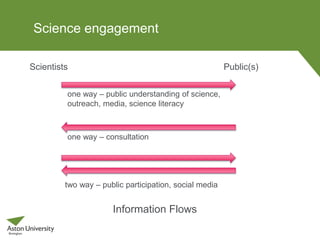
Science engagement
Scientists Public(s)
one way – public understanding of science,
outreach, media, science literacy
one way – consultation
two way – public participation, social media
Information Flows
Why look at science discussion on Twitter?
• Public engagement with science matters:
• Enthuse kids to learn science,
• Inform people about fascinating stuff,
• Build consensus for social and economic change,
• The public paid for the research
• Social media present a great opportunity to “talk nerdy” to the
public (on.ted.com/Marshall)
• Twitter particularly
• Low barriers to entry
• Expert and non expert participants
• Contributions on any topic
• BUT typically low levels of tweeting about science
METRICS – AGEING FACTOR
Uren, V., Dadzie, A.-S., Ageing Factor: a Potential Altmetric for Observing
Events and Attention Spans in Microblogs, In: 1st International Workshop on
Knowledge Extraction and Consolidation from Social Media ( KECSM 2012)
collocated with the 11th International Semantic Web Conference
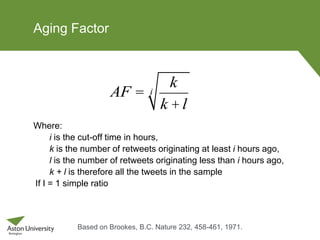
Aging Factor
Where:
i is the cut-off time in hours,
k is the number of retweets originating at least i hours ago,
l is the number of retweets originating less than i hours ago,
k + l is therefore all the tweets in the sample
If I = 1 simple ratio
AF =
k
k +l
i
Based on Brookes, B.C. Nature 232, 458-461, 1971.
Assumptions
• Aging Factor
• Provides a snapshot of retweeting rate for tweets containing
particular terms
• Assumes an exponential decay in the rate of retweeting
• Does NOT require the original tweets to be in the dataset
• Assumption 1: ageing factors for topics which concern special
events will be lower than suitable baselines.
• Assumption 2: ageing factors which are higher than suitable
baselines are associated with topics in which interest is
sustained over time.
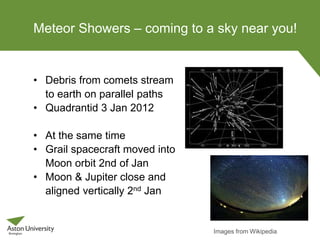
Meteor Showers – coming to a sky near you!
• Debris from comets stream
to earth on parallel paths
• Quadrantid 3 Jan 2012
• At the same time
• Grail spacecraft moved into
Moon orbit 2nd of Jan
• Moon & Jupiter close and
aligned vertically 2nd Jan
Images from Wikipedia
Dataset
• 24h 3 January 2012
• Filtered on UNESCO Thesaurus ‘Astronomical terms’
subheading (excluding ‘Time’), containing 32 terms.
• Total of tweets 408,800
• Total retweets 83,993
• 12,513 containing ‘space’
• 82,611 containing ‘earth|moon|sun|stars|universe|space’
(abbreviated as Astro)
• Divided into quarter days (labeled 6, 12, 18, 24)
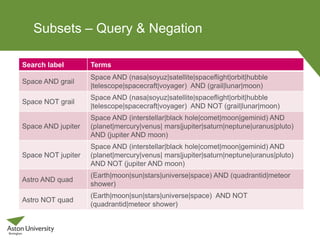
Subsets – Query & Negation
Search label Terms
Space AND grail
Space AND (nasa|soyuz|satellite|spaceflight|orbit|hubble
|telescope|spacecraft|voyager) AND (grail|lunar|moon)
Space NOT grail
Space AND (nasa|soyuz|satellite|spaceflight|orbit|hubble
|telescope|spacecraft|voyager) AND NOT (grail|lunar|moon)
Space AND jupiter
Space AND (interstellar|black hole|comet|moon|geminid) AND
(planet|mercury|venus| mars|jupiter|saturn|neptune|uranus|pluto)
AND (jupiter AND moon)
Space NOT jupiter
Space AND (interstellar|black hole|comet|moon|geminid) AND
(planet|mercury|venus| mars|jupiter|saturn|neptune|uranus|pluto)
AND NOT (jupiter AND moon)
Astro AND quad
(Earth|moon|sun|stars|universe|space) AND (quadrantid|meteor
shower)
Astro NOT quad
(Earth|moon|sun|stars|universe|space) AND NOT
(quadrantid|meteor shower)
Results – Modified Queries
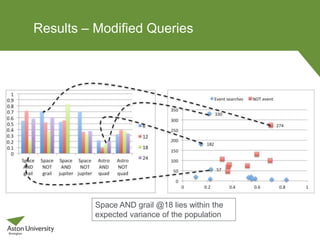
Space AND grail @18 lies within the
expected variance of the population
Results – 3 “Interesting” Sets
• 2 Astro AND quad points
• @18 0.15 182, @24 0.22 330
• Inference: retweeting activity around the Quadrantid meteor
shower was significant in the hours of darkness for the UK
and USA
• 1 Space NOT grail
• @6 0.71 274
• 216 of the retweets contained the phrase “join NASA”
• “Oh really? You need space? You might as well join NASA.”
• Inference: this is a funny joke (apparently)!
VISUALIZATION
•Under construction: Uren, V., Dadzie, A.-S., Framing public scientific
communication on Twitter: a visual analytic approach.
•Uren, V., Dadzie, A.-S., Nerding Out on Twitter: Fun, Patriotism and
#Curiosity. In MSM 2013 Making Sense of Microposts, WWW 2013
Companion, Rio de Janeiro, Brazil, 2013.
Research Questions
Is it possible to observe dynamic changes to the framing of science
communication in non-trending topics on Twitter?
Can changes be observed across disconnected time frames (within
days and in samples taken a year apart)?
Can visualisation provide further information in addition to
confirming the content analysis?
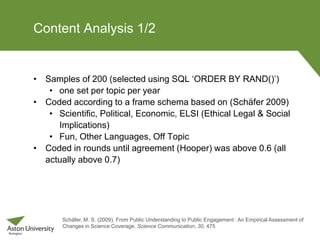
Datasets
• 3 topics
• Curiosity – a NASA Mars rover with an adventurous lifestyle
• Phosphorus – chemical element with roles in agriculture, biology &
warfare
• Permafrost – soil type recognized as a climate change indicator
• 2 time periods
• 4-9 Aug 2012 (Curiosity Landing)
• Tweets: Curiosity 1194470, Phosphorus 587, Permafrost 311.
• 4-9 Aug 2013 (Anniversary)
• Tweets: Curiosity 3310, Phosphorus 6269, Permafrost 618.
Content Analysis 1/2
• Samples of 200 (selected using SQL ‘ORDER BY RAND()’)
• one set per topic per year
• Coded according to a frame schema based on (Schäfer 2009)
• Scientific, Political, Economic, ELSI (Ethical Legal & Social
Implications)
• Fun, Other Languages, Off Topic
• Coded in rounds until agreement (Hooper) was above 0.6 (all
actually above 0.7)
Schäfer, M. S. (2009). From Public Understanding to Public Engagement : An Empirical Assessment of
Changes in Science Coverage. Science Communication, 30, 475
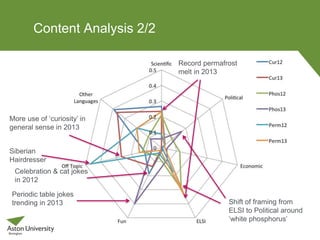
Content Analysis 2/2
More use of ‘curiosity’ in
general sense in 2013
Periodic table jokes
trending in 2013 Shift of framing from
ELSI to Political around
‘white phosphorus’
Siberian
Hairdresser
Record permafrost
melt in 2013
Celebration & cat jokes
in 2012
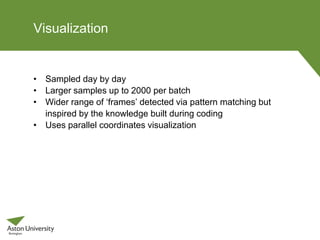
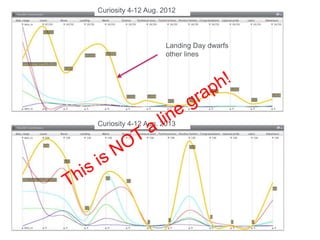
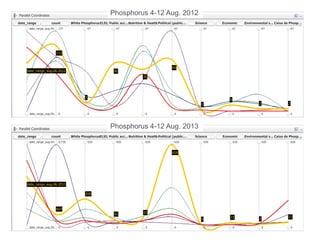
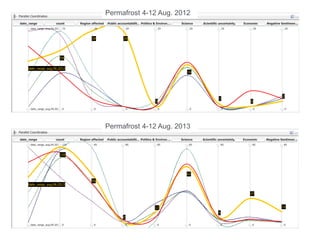
Visualization
• Sampled day by day
• Larger samples up to 2000 per batch
• Wider range of ‘frames’ detected via pattern matching but
inspired by the knowledge built during coding
• Uses parallel coordinates visualization
Curiosity 4-12 Aug. 2012
Curiosity 4-12 Aug. 2013
Landing Day dwarfs
other lines
Phosphorus 4-12 Aug. 2012
Phosphorus 4-12 Aug. 2013
Permafrost 4-12 Aug. 2012
Permafrost 4-12 Aug. 2013
Conclusions
Is it possible to observe dynamic changes to the framing of
science communication in non-trending topics on Twitter?
Yes – for reasonably populated topics
Can changes be observed across disconnected time frames
(within days and in samples taken a year apart)?
Yes – with appropriate normalisation the parallel
coordinates produce comparable polycurves
Can visualisation provide further information in addition to
confirming the content analysis?
Yes – allows us to be more fine grained, more explorative
Where Next?
• Socially important science (volcanos, bioenergy)
• More on Aging Factor (event detection)
THANK YOU!

Vu17072014

  • 1.
  • 2.
    The Team &the Papers (so far) • Under construction: Uren, V., Dadzie, A.-S., Framing public scientific communication on Twitter: a visual analytic approach. • Uren, V., Dadzie, A.-S., Nerding Out on Twitter: Fun, Patriotism and #Curiosity. In MSM 2013 Making Sense of Microposts, WWW 2013 Companion, Rio de Janeiro, Brazil, 2013. • Uren, V., Dadzie, A.-S., Ageing Factor: a Potential Altmetric for Observing Events and Attention Spans in Microblogs, In: 1st International Workshop on Knowledge Extraction and Consolidation from Social Media ( KECSM 2012) collocated with the 11th International Semantic Web Conference. • V.Uren, A.Dadzie, "Relative Trends in Scientific Terms on Twitter", In: altmetrics11: Tracking scholarly impact on the social Web, Workshop at: ACM Web Science Conference 2011.
  • 3.
    Science engagement Scientists Public(s) oneway – public understanding of science, outreach, media, science literacy one way – consultation two way – public participation, social media Information Flows
  • 4.
    Why look atscience discussion on Twitter? • Public engagement with science matters: • Enthuse kids to learn science, • Inform people about fascinating stuff, • Build consensus for social and economic change, • The public paid for the research • Social media present a great opportunity to “talk nerdy” to the public (on.ted.com/Marshall) • Twitter particularly • Low barriers to entry • Expert and non expert participants • Contributions on any topic • BUT typically low levels of tweeting about science
  • 5.
    METRICS – AGEINGFACTOR Uren, V., Dadzie, A.-S., Ageing Factor: a Potential Altmetric for Observing Events and Attention Spans in Microblogs, In: 1st International Workshop on Knowledge Extraction and Consolidation from Social Media ( KECSM 2012) collocated with the 11th International Semantic Web Conference
  • 6.
    Aging Factor Where: i isthe cut-off time in hours, k is the number of retweets originating at least i hours ago, l is the number of retweets originating less than i hours ago, k + l is therefore all the tweets in the sample If I = 1 simple ratio AF = k k +l i Based on Brookes, B.C. Nature 232, 458-461, 1971.
  • 7.
    Assumptions • Aging Factor •Provides a snapshot of retweeting rate for tweets containing particular terms • Assumes an exponential decay in the rate of retweeting • Does NOT require the original tweets to be in the dataset • Assumption 1: ageing factors for topics which concern special events will be lower than suitable baselines. • Assumption 2: ageing factors which are higher than suitable baselines are associated with topics in which interest is sustained over time.
  • 8.
    Meteor Showers –coming to a sky near you! • Debris from comets stream to earth on parallel paths • Quadrantid 3 Jan 2012 • At the same time • Grail spacecraft moved into Moon orbit 2nd of Jan • Moon & Jupiter close and aligned vertically 2nd Jan Images from Wikipedia
  • 9.
    Dataset • 24h 3January 2012 • Filtered on UNESCO Thesaurus ‘Astronomical terms’ subheading (excluding ‘Time’), containing 32 terms. • Total of tweets 408,800 • Total retweets 83,993 • 12,513 containing ‘space’ • 82,611 containing ‘earth|moon|sun|stars|universe|space’ (abbreviated as Astro) • Divided into quarter days (labeled 6, 12, 18, 24)
  • 10.
    Subsets – Query& Negation Search label Terms Space AND grail Space AND (nasa|soyuz|satellite|spaceflight|orbit|hubble |telescope|spacecraft|voyager) AND (grail|lunar|moon) Space NOT grail Space AND (nasa|soyuz|satellite|spaceflight|orbit|hubble |telescope|spacecraft|voyager) AND NOT (grail|lunar|moon) Space AND jupiter Space AND (interstellar|black hole|comet|moon|geminid) AND (planet|mercury|venus| mars|jupiter|saturn|neptune|uranus|pluto) AND (jupiter AND moon) Space NOT jupiter Space AND (interstellar|black hole|comet|moon|geminid) AND (planet|mercury|venus| mars|jupiter|saturn|neptune|uranus|pluto) AND NOT (jupiter AND moon) Astro AND quad (Earth|moon|sun|stars|universe|space) AND (quadrantid|meteor shower) Astro NOT quad (Earth|moon|sun|stars|universe|space) AND NOT (quadrantid|meteor shower)
  • 11.
    Results – ModifiedQueries Space AND grail @18 lies within the expected variance of the population
  • 12.
    Results – 3“Interesting” Sets • 2 Astro AND quad points • @18 0.15 182, @24 0.22 330 • Inference: retweeting activity around the Quadrantid meteor shower was significant in the hours of darkness for the UK and USA • 1 Space NOT grail • @6 0.71 274 • 216 of the retweets contained the phrase “join NASA” • “Oh really? You need space? You might as well join NASA.” • Inference: this is a funny joke (apparently)!
  • 13.
    VISUALIZATION •Under construction: Uren,V., Dadzie, A.-S., Framing public scientific communication on Twitter: a visual analytic approach. •Uren, V., Dadzie, A.-S., Nerding Out on Twitter: Fun, Patriotism and #Curiosity. In MSM 2013 Making Sense of Microposts, WWW 2013 Companion, Rio de Janeiro, Brazil, 2013.
  • 14.
    Research Questions Is itpossible to observe dynamic changes to the framing of science communication in non-trending topics on Twitter? Can changes be observed across disconnected time frames (within days and in samples taken a year apart)? Can visualisation provide further information in addition to confirming the content analysis?
  • 15.
    Datasets • 3 topics •Curiosity – a NASA Mars rover with an adventurous lifestyle • Phosphorus – chemical element with roles in agriculture, biology & warfare • Permafrost – soil type recognized as a climate change indicator • 2 time periods • 4-9 Aug 2012 (Curiosity Landing) • Tweets: Curiosity 1194470, Phosphorus 587, Permafrost 311. • 4-9 Aug 2013 (Anniversary) • Tweets: Curiosity 3310, Phosphorus 6269, Permafrost 618.
  • 16.
    Content Analysis 1/2 •Samples of 200 (selected using SQL ‘ORDER BY RAND()’) • one set per topic per year • Coded according to a frame schema based on (Schäfer 2009) • Scientific, Political, Economic, ELSI (Ethical Legal & Social Implications) • Fun, Other Languages, Off Topic • Coded in rounds until agreement (Hooper) was above 0.6 (all actually above 0.7) Schäfer, M. S. (2009). From Public Understanding to Public Engagement : An Empirical Assessment of Changes in Science Coverage. Science Communication, 30, 475
  • 17.
    Content Analysis 2/2 Moreuse of ‘curiosity’ in general sense in 2013 Periodic table jokes trending in 2013 Shift of framing from ELSI to Political around ‘white phosphorus’ Siberian Hairdresser Record permafrost melt in 2013 Celebration & cat jokes in 2012
  • 18.
    Visualization • Sampled dayby day • Larger samples up to 2000 per batch • Wider range of ‘frames’ detected via pattern matching but inspired by the knowledge built during coding • Uses parallel coordinates visualization
  • 19.
    Curiosity 4-12 Aug.2012 Curiosity 4-12 Aug. 2013 Landing Day dwarfs other lines
  • 20.
    Phosphorus 4-12 Aug.2012 Phosphorus 4-12 Aug. 2013
  • 21.
    Permafrost 4-12 Aug.2012 Permafrost 4-12 Aug. 2013
  • 22.
    Conclusions Is it possibleto observe dynamic changes to the framing of science communication in non-trending topics on Twitter? Yes – for reasonably populated topics Can changes be observed across disconnected time frames (within days and in samples taken a year apart)? Yes – with appropriate normalisation the parallel coordinates produce comparable polycurves Can visualisation provide further information in addition to confirming the content analysis? Yes – allows us to be more fine grained, more explorative
  • 23.
    Where Next? • Sociallyimportant science (volcanos, bioenergy) • More on Aging Factor (event detection)
  • 24.