0
BIG	DATA	
and	payment cards
Emiliano	Anzellotti
Madrid,	15° October 2014
1
Agenda
• The	European Commission Communication
• Big	Data
• The	definition,	
• The	Market	sentiment
• Tipical Benefits
• What will mean to	endorse the	«BD	approach»
• Applications	for	the	card	business
• What can	be	done by	(the	unbundled)	schemes?
2
EC concerns on BIG DATA
• “We witness a new industrial revolution driven by
digital data, computation and automation. Human
activities, industrial processes and research all lead
to data collection and processing on an
unprecedented scale, spurring new products and
services as well as new Business processes and
scientific methodologies.”
• “the European digital economy has been slow in
embracing the data revolution compared to the USA
and also lacks comparable industrial capability.
Research and innovation (R&I) funding on data in
the EU is sub-critical and the corresponding activities
are largely uncoordinated.”
• “the complexity of the current legal environment
together with the insufficient access to large datasets
and enabling infrastructure create entry barriers to
SMEs and stifle innovation”
3
EC calls for an action
According to	EC	«the	EU	must:
• support "lighthouse" data initiatives capable of improving competitiveness, quality of public services
and citizen's life
• develop its enabling technologies, underlying infrastructures and skills, particularly to the benefit of
SMEs
• extensively share, use and develop its public data resources and research data infrastructures
• focus public R&I on technological, legal and other bottlenecks
• make sure that the relevant legal framework and the policies, such as on interoperability, data
protection, security and IPR are data‐friendly
• rapidly conclude the legislative processes on the reform of the EU data protection framework, network
and information security, and support exchange and cooperation between the relevant enforcement
authorities
• accelerate the digitisation of public administration and services to increase their efficiency
• use public procurement to bring the results of data technologies to the market
4
Agenda
• The	European Commission Communication
• Big	Data
• The	definition,	
• The	Market	sentiment
• Tipical Benefits
• What will mean to	endorse the	«BD	approach»
• Applications	for	the	card	business
• What can	be	done by	(the	unbundled)	schemes?
5
BIG DATA Definition
According to EC:
“Data is "a reinterpretable representation of information in a formalized manner, suitable for
communication, interpretation or processing". Data can either be created/authored by people or
generated by machines/sensors, often as a "by‐product". Examples: geospatial information,
statistics, weather data, research data, etc.
The term "big data" refers to large amounts of different types of data produced with high
velocity from a high number of various types of sources. Handling today's highly variable and
real‐time datasets requires new tools and methods, such as powerful processors, software and
Algorithms”
6
Agenda
• The	European Commission Communication
• Big	Data
• The	definition,	
• The	Market	sentiment
• Tipical Benefits
• What will mean to	endorse the	«BD	approach»
• Applications	for	the	card	business
• What can	be	done by	(the	unbundled)	schemes?
7
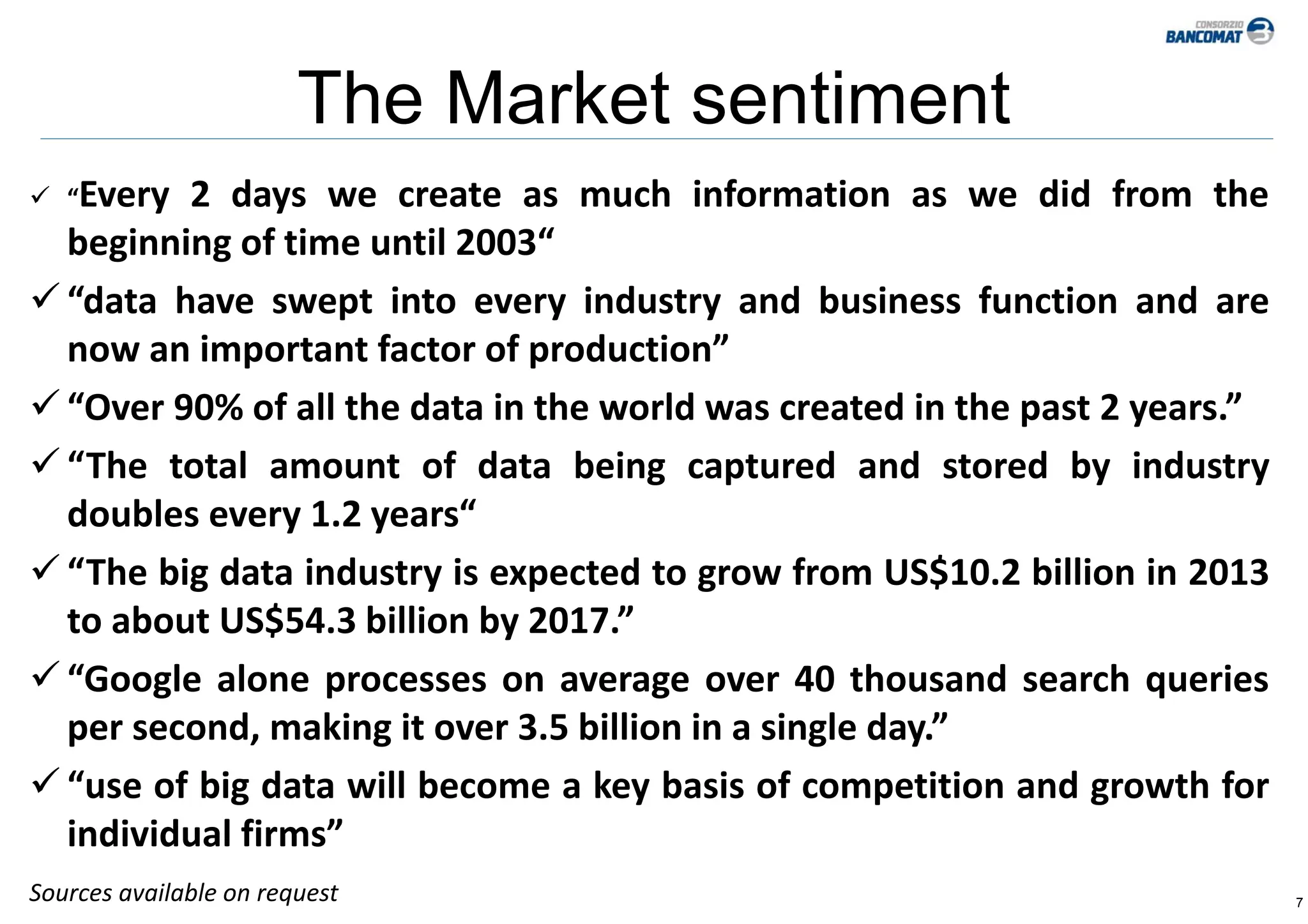
The Market sentiment
 “Every 2 days we create as much information as we did from the
beginning of time until 2003“
 “data have swept into every industry and business function and are
now an important factor of production”
 “Over 90% of all the data in the world was created in the past 2 years.”
 “The total amount of data being captured and stored by industry
doubles every 1.2 years“
 “The big data industry is expected to grow from US$10.2 billion in 2013
to about US$54.3 billion by 2017.”
 “Google alone processes on average over 40 thousand search queries
per second, making it over 3.5 billion in a single day.”
 “use of big data will become a key basis of competition and growth for
individual firms”
Sources available on request
8
Agenda
• The	European Commission Communication
• Big	Data
• The	definition,	
• The	Market	sentiment
• Tipical Benefits
• What will mean to	endorse the	«BD	approach»
• Applications	for	the	card	business
• What can	be	done by	(the	unbundled)	schemes?
9
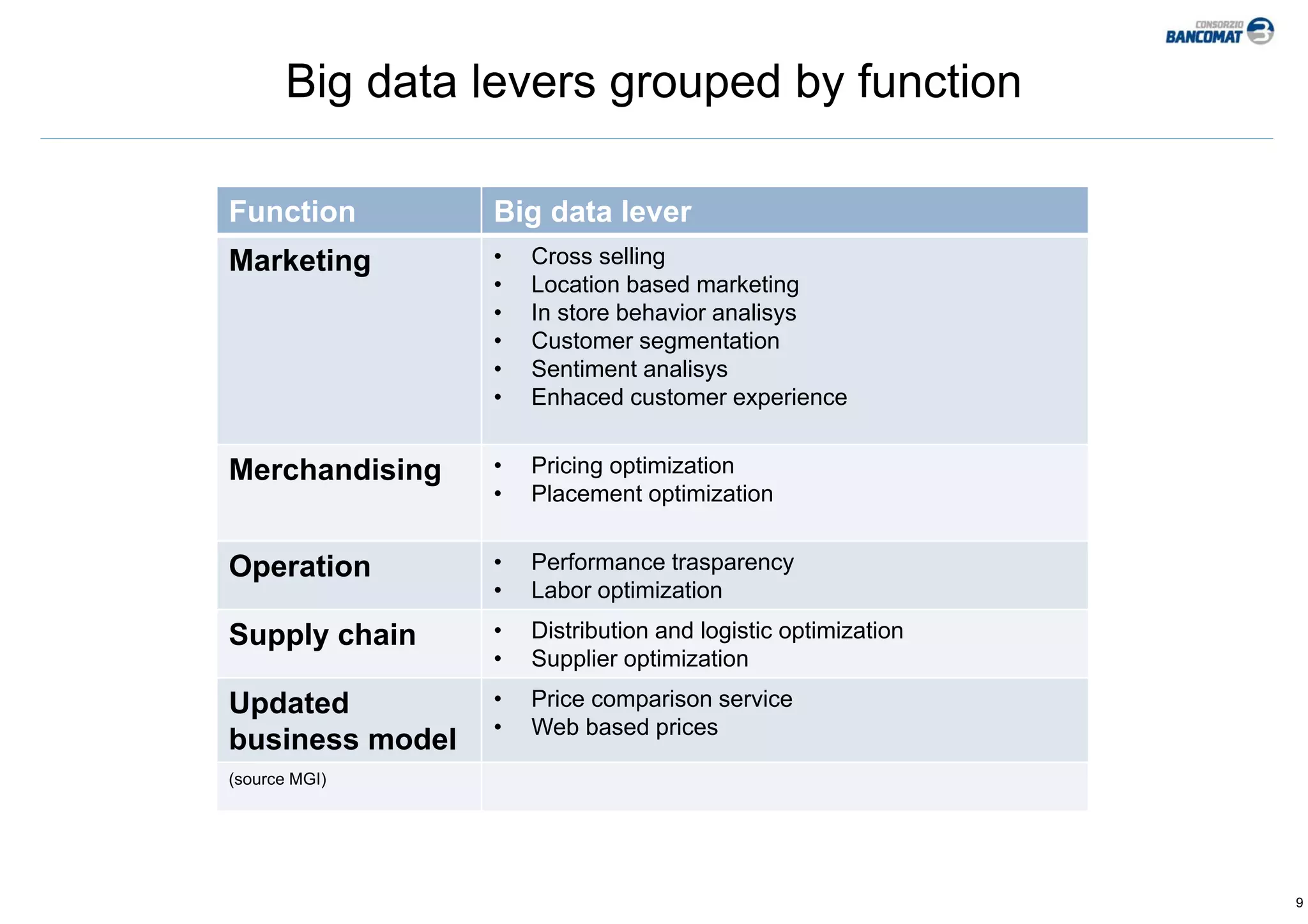
Big data levers grouped by function
Function Big data lever
Marketing • Cross selling
• Location based marketing
• In store behavior analisys
• Customer segmentation
• Sentiment analisys
• Enhaced customer experience
Merchandising • Pricing optimization
• Placement optimization
Operation • Performance trasparency
• Labor optimization
Supply chain • Distribution and logistic optimization
• Supplier optimization
Updated
business model
• Price comparison service
• Web based prices
(source MGI)
10
Agenda
• The	European Commission Communication
• Big	Data
• The	definition,	
• The	Market	sentiment
• Tipical Benefits
• What will mean to	endorse the	«BD	approach»
• Applications	for	the	card	business
• What can	be	done by	(the	unbundled)	schemes?
11
What will mean to endorse the «BD approach»
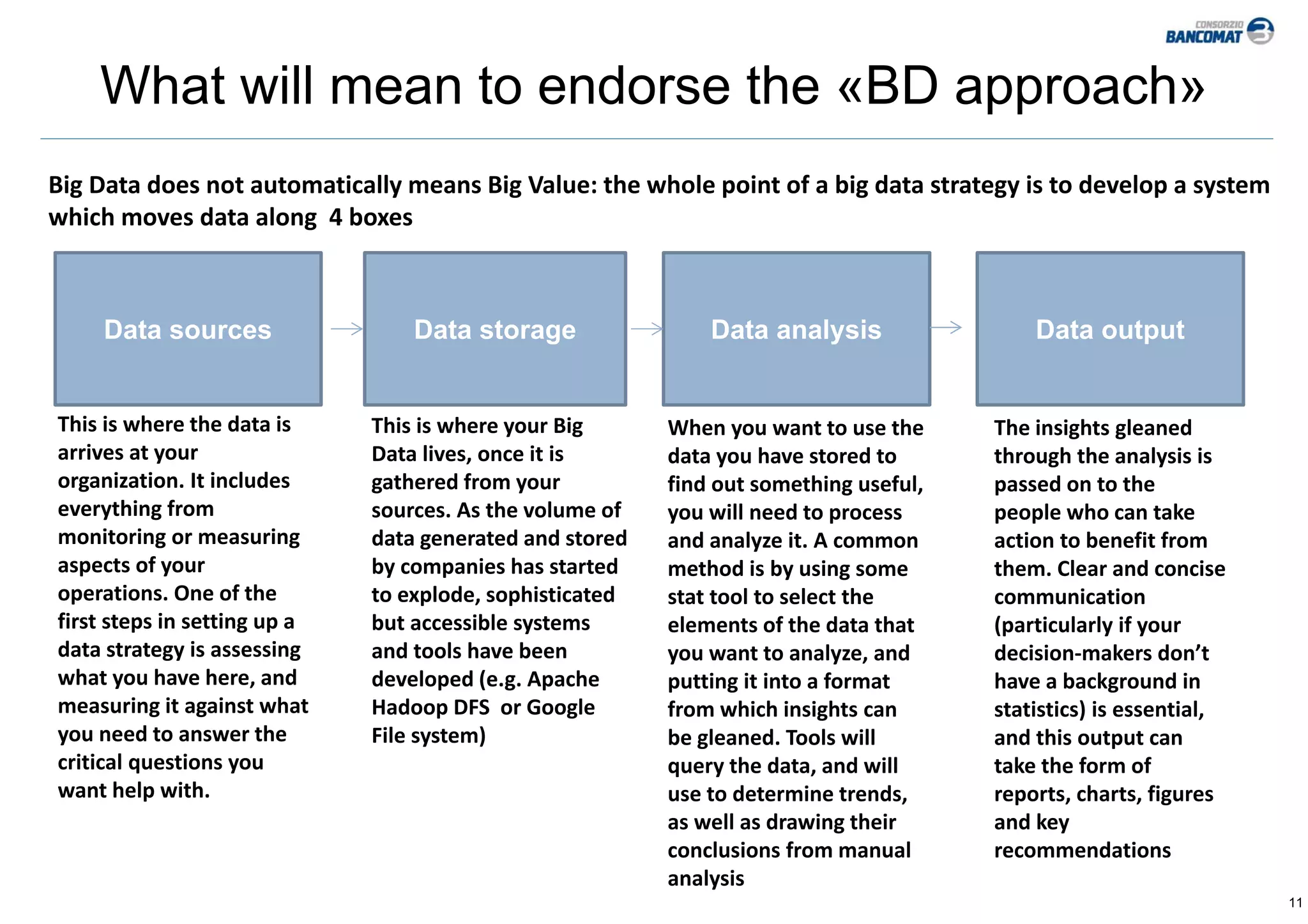
Big Data does not automatically means Big Value: the whole point of a big data strategy is to develop a system 
which moves data along  4 boxes
Data sources Data storage Data analysis Data output
This is where the data is 
arrives at your 
organization. It includes 
everything from 
monitoring or measuring 
aspects of your 
operations. One of the 
first steps in setting up a 
data strategy is assessing 
what you have here, and 
measuring it against what 
you need to answer the 
critical questions you 
want help with. 
This is where your Big 
Data lives, once it is 
gathered from your 
sources. As the volume of 
data generated and stored 
by companies has started 
to explode, sophisticated 
but accessible systems 
and tools have been 
developed (e.g. Apache 
Hadoop DFS  or Google 
File system)
When you want to use the 
data you have stored to 
find out something useful, 
you will need to process 
and analyze it. A common 
method is by using some 
stat tool to select the 
elements of the data that 
you want to analyze, and 
putting it into a format 
from which insights can 
be gleaned. Tools will 
query the data, and will 
use to determine trends, 
as well as drawing their 
conclusions from manual 
analysis
The insights gleaned 
through the analysis is 
passed on to the 
people who can take 
action to benefit from 
them. Clear and concise 
communication 
(particularly if your 
decision‐makers don’t 
have a background in 
statistics) is essential, 
and this output can 
take the form of 
reports, charts, figures 
and key 
recommendations
12
Agenda
• The	European Commission Communication
• Big	Data
• The	definition,	
• The	Market	sentiment
• Tipical Benefits
• What will mean to	endorse the	«BD	approach»
• Applications	for	the	card	business
• What can	be	done by	(the	unbundled)	schemes?
13
Payment	Evolution	and	Big	Data
According to	Cap	Gemini	research,	data	Management	will be	crucial to	increase ROI
14
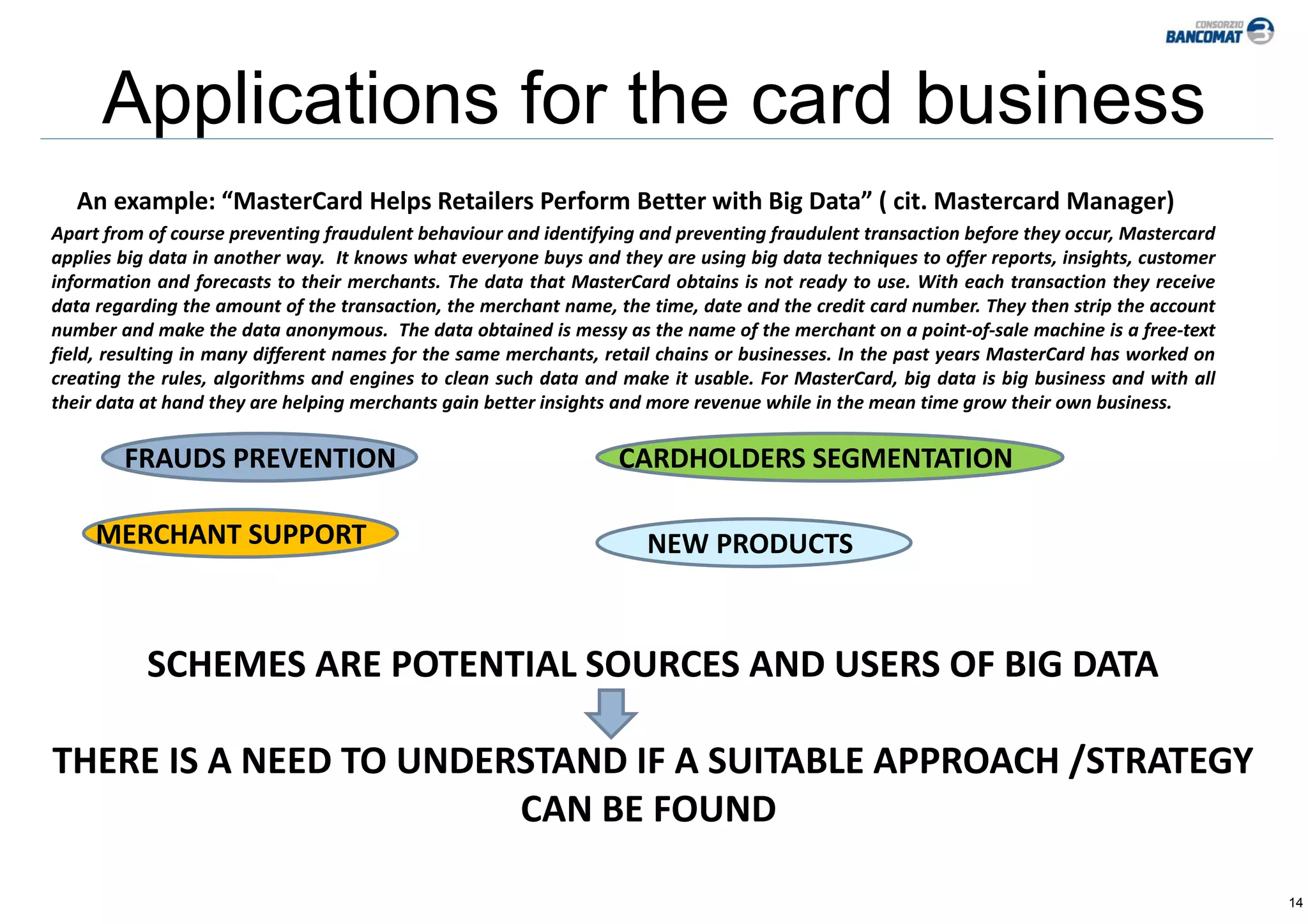
Applications for the card business
An example: “MasterCard Helps Retailers Perform Better with Big Data” ( cit. Mastercard Manager)
Apart from of course preventing fraudulent behaviour and identifying and preventing fraudulent transaction before they occur, Mastercard
applies big data in another way. It knows what everyone buys and they are using big data techniques to offer reports, insights, customer
information and forecasts to their merchants. The data that MasterCard obtains is not ready to use. With each transaction they receive
data regarding the amount of the transaction, the merchant name, the time, date and the credit card number. They then strip the account
number and make the data anonymous. The data obtained is messy as the name of the merchant on a point‐of‐sale machine is a free‐text
field, resulting in many different names for the same merchants, retail chains or businesses. In the past years MasterCard has worked on
creating the rules, algorithms and engines to clean such data and make it usable. For MasterCard, big data is big business and with all
their data at hand they are helping merchants gain better insights and more revenue while in the mean time grow their own business.
FRAUDS PREVENTION CARDHOLDERS SEGMENTATION
MERCHANT SUPPORT NEW PRODUCTS 
SCHEMES ARE POTENTIAL SOURCES AND USERS OF BIG DATA
THERE IS A NEED TO UNDERSTAND IF A SUITABLE APPROACH /STRATEGY
CAN BE FOUND 
15
Agenda
• The	European Commission Communication
• Big	Data
• The	definition,	
• The	Market	sentiment
• Tipical Benefits
• What will mean to	endorse the	«BD	approach»
• Applications	for	the	card	business
• What can	be	done by	(the	unbundled)	schemes?
16
What can be done by (the unbundled) schemes?
Card Schemes may be part of the Big Data initiatives, in order to :
‐ Clarify the business needs for the involved players
‐ Discuss and support the initiatives activated by the EC
‐ Agree on criteria for the data analisys
‐ indentify common layers for IT interventions
‐ Suggest focused market initiatives
‐ ….
17
Thanks a lot 
Emiliano Anzellotti
e.anzellotti@bancomat.it

D2-5_BIG DATA EmilianoAnzellotti_v2 [

  • 1.
  • 2.
    1 Agenda • The European CommissionCommunication • Big Data • The definition, • The Market sentiment • Tipical Benefits • What will mean to endorse the «BD approach» • Applications for the card business • What can be done by (the unbundled) schemes?
  • 3.
    2 EC concerns onBIG DATA • “We witness a new industrial revolution driven by digital data, computation and automation. Human activities, industrial processes and research all lead to data collection and processing on an unprecedented scale, spurring new products and services as well as new Business processes and scientific methodologies.” • “the European digital economy has been slow in embracing the data revolution compared to the USA and also lacks comparable industrial capability. Research and innovation (R&I) funding on data in the EU is sub-critical and the corresponding activities are largely uncoordinated.” • “the complexity of the current legal environment together with the insufficient access to large datasets and enabling infrastructure create entry barriers to SMEs and stifle innovation”
  • 4.
    3 EC calls foran action According to EC «the EU must: • support "lighthouse" data initiatives capable of improving competitiveness, quality of public services and citizen's life • develop its enabling technologies, underlying infrastructures and skills, particularly to the benefit of SMEs • extensively share, use and develop its public data resources and research data infrastructures • focus public R&I on technological, legal and other bottlenecks • make sure that the relevant legal framework and the policies, such as on interoperability, data protection, security and IPR are data‐friendly • rapidly conclude the legislative processes on the reform of the EU data protection framework, network and information security, and support exchange and cooperation between the relevant enforcement authorities • accelerate the digitisation of public administration and services to increase their efficiency • use public procurement to bring the results of data technologies to the market
  • 5.
    4 Agenda • The European CommissionCommunication • Big Data • The definition, • The Market sentiment • Tipical Benefits • What will mean to endorse the «BD approach» • Applications for the card business • What can be done by (the unbundled) schemes?
  • 6.
    5 BIG DATA Definition Accordingto EC: “Data is "a reinterpretable representation of information in a formalized manner, suitable for communication, interpretation or processing". Data can either be created/authored by people or generated by machines/sensors, often as a "by‐product". Examples: geospatial information, statistics, weather data, research data, etc. The term "big data" refers to large amounts of different types of data produced with high velocity from a high number of various types of sources. Handling today's highly variable and real‐time datasets requires new tools and methods, such as powerful processors, software and Algorithms”
  • 7.
    6 Agenda • The European CommissionCommunication • Big Data • The definition, • The Market sentiment • Tipical Benefits • What will mean to endorse the «BD approach» • Applications for the card business • What can be done by (the unbundled) schemes?
  • 8.
    7 The Market sentiment “Every 2 days we create as much information as we did from the beginning of time until 2003“  “data have swept into every industry and business function and are now an important factor of production”  “Over 90% of all the data in the world was created in the past 2 years.”  “The total amount of data being captured and stored by industry doubles every 1.2 years“  “The big data industry is expected to grow from US$10.2 billion in 2013 to about US$54.3 billion by 2017.”  “Google alone processes on average over 40 thousand search queries per second, making it over 3.5 billion in a single day.”  “use of big data will become a key basis of competition and growth for individual firms” Sources available on request
  • 9.
    8 Agenda • The European CommissionCommunication • Big Data • The definition, • The Market sentiment • Tipical Benefits • What will mean to endorse the «BD approach» • Applications for the card business • What can be done by (the unbundled) schemes?
  • 10.
    9 Big data leversgrouped by function Function Big data lever Marketing • Cross selling • Location based marketing • In store behavior analisys • Customer segmentation • Sentiment analisys • Enhaced customer experience Merchandising • Pricing optimization • Placement optimization Operation • Performance trasparency • Labor optimization Supply chain • Distribution and logistic optimization • Supplier optimization Updated business model • Price comparison service • Web based prices (source MGI)
  • 11.
    10 Agenda • The European CommissionCommunication • Big Data • The definition, • The Market sentiment • Tipical Benefits • What will mean to endorse the «BD approach» • Applications for the card business • What can be done by (the unbundled) schemes?
  • 12.
    11 What will meanto endorse the «BD approach» Big Data does not automatically means Big Value: the whole point of a big data strategy is to develop a system  which moves data along  4 boxes Data sources Data storage Data analysis Data output This is where the data is  arrives at your  organization. It includes  everything from  monitoring or measuring  aspects of your  operations. One of the  first steps in setting up a  data strategy is assessing  what you have here, and  measuring it against what  you need to answer the  critical questions you  want help with.  This is where your Big  Data lives, once it is  gathered from your  sources. As the volume of  data generated and stored  by companies has started  to explode, sophisticated  but accessible systems  and tools have been  developed (e.g. Apache  Hadoop DFS  or Google  File system) When you want to use the  data you have stored to  find out something useful,  you will need to process  and analyze it. A common  method is by using some  stat tool to select the  elements of the data that  you want to analyze, and  putting it into a format  from which insights can  be gleaned. Tools will  query the data, and will  use to determine trends,  as well as drawing their  conclusions from manual  analysis The insights gleaned  through the analysis is  passed on to the  people who can take  action to benefit from  them. Clear and concise  communication  (particularly if your  decision‐makers don’t  have a background in  statistics) is essential,  and this output can  take the form of  reports, charts, figures  and key  recommendations
  • 13.
    12 Agenda • The European CommissionCommunication • Big Data • The definition, • The Market sentiment • Tipical Benefits • What will mean to endorse the «BD approach» • Applications for the card business • What can be done by (the unbundled) schemes?
  • 14.
  • 15.
    14 Applications for thecard business An example: “MasterCard Helps Retailers Perform Better with Big Data” ( cit. Mastercard Manager) Apart from of course preventing fraudulent behaviour and identifying and preventing fraudulent transaction before they occur, Mastercard applies big data in another way. It knows what everyone buys and they are using big data techniques to offer reports, insights, customer information and forecasts to their merchants. The data that MasterCard obtains is not ready to use. With each transaction they receive data regarding the amount of the transaction, the merchant name, the time, date and the credit card number. They then strip the account number and make the data anonymous. The data obtained is messy as the name of the merchant on a point‐of‐sale machine is a free‐text field, resulting in many different names for the same merchants, retail chains or businesses. In the past years MasterCard has worked on creating the rules, algorithms and engines to clean such data and make it usable. For MasterCard, big data is big business and with all their data at hand they are helping merchants gain better insights and more revenue while in the mean time grow their own business. FRAUDS PREVENTION CARDHOLDERS SEGMENTATION MERCHANT SUPPORT NEW PRODUCTS  SCHEMES ARE POTENTIAL SOURCES AND USERS OF BIG DATA THERE IS A NEED TO UNDERSTAND IF A SUITABLE APPROACH /STRATEGY CAN BE FOUND 
  • 16.
    15 Agenda • The European CommissionCommunication • Big Data • The definition, • The Market sentiment • Tipical Benefits • What will mean to endorse the «BD approach» • Applications for the card business • What can be done by (the unbundled) schemes?
  • 17.
    16 What can bedone by (the unbundled) schemes? Card Schemes may be part of the Big Data initiatives, in order to : ‐ Clarify the business needs for the involved players ‐ Discuss and support the initiatives activated by the EC ‐ Agree on criteria for the data analisys ‐ indentify common layers for IT interventions ‐ Suggest focused market initiatives ‐ ….
  • 18.