NESSI Summit 2014
The European Data Market
Gabriella Cattaneo, IDC Europe
May 27, 2014 Brussels
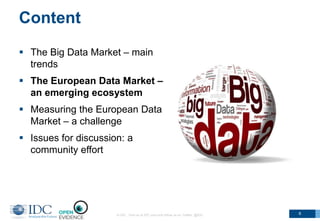
Content
 The Big Data Market – main
trends
 The European Data Market –
an emerging ecosystem
 Measuring the European Data
Market – a challenge
 Issues for discussion: a
community effort
© IDC Visit us at IDC.com and follow us on Twitter: @IDC 2
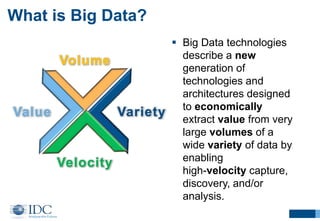
Volume
Variety
Velocity
Value
 Big Data technologies
describe a new
generation of
technologies and
architectures designed
to economically
extract value from very
large volumes of a
wide variety of data by
enabling
high-velocity capture,
discovery, and/or
analysis.
What is Big Data?
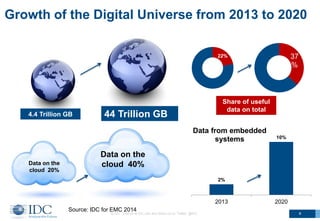
Growth of the Digital Universe from 2013 to 2020
© IDC Visit us at IDC.com and follow us on Twitter: @IDC 4
4.4 Trillion GB 44 Trillion GB
Data on the
cloud 20%
Data on the
cloud 40%
22% 37
%
Share of useful
data on total
2%
10%
2013 2020
Data from embedded
systems
Source: IDC for EMC 2014
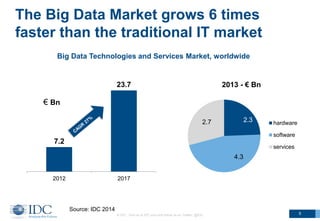
The Big Data Market grows 6 times
faster than the traditional IT market
© IDC Visit us at IDC.com and follow us on Twitter: @IDC 5
7.2
23.7
2012 2017
€ Bn
Big Data Technologies and Services Market, worldwide
Source: IDC 2014
2.3
4.3
2.7
2013 - € Bn
hardware
software
services
Content
 The Big Data Market – main
trends
 The European Data Market –
an emerging ecosystem
 Measuring the European Data
Market – a challenge
 Issues for discussion: a
community effort
© IDC Visit us at IDC.com and follow us on Twitter: @IDC 6
7
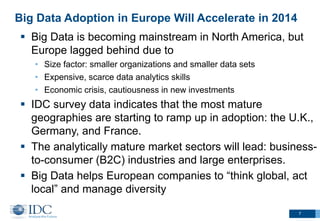
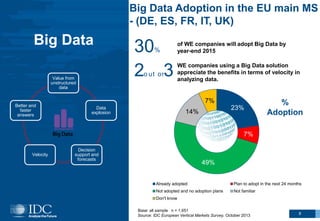
Big Data Adoption in Europe Will Accelerate in 2014
 Big Data is becoming mainstream in North America, but
Europe lagged behind due to
• Size factor: smaller organizations and smaller data sets
• Expensive, scarce data analytics skills
• Economic crisis, cautiousness in new investments
 IDC survey data indicates that the most mature
geographies are starting to ramp up in adoption: the U.K.,
Germany, and France.
 The analytically mature market sectors will lead: business-
to-consumer (B2C) industries and large enterprises.
 Big Data helps European companies to “think global, act
local” and manage diversity
23%
7%
49%
14%
7%
Already adopted Plan to adopt in the next 24 months
Not adopted and no adoption plans Not familiar
Don't know
Value from
unstructured
data
Data
explosion
Decision
support and
forecasts
Velocity
Better and
faster
answers
Big Data of WE companies will adopt Big Data by
year-end 2015
8
30%
WE companies using a Big Data solution
appreciate the benefits in terms of velocity in
analyzing data.
2o ut off3
%
Adoption
Base: all sample n = 1,651
Source: IDC European Vertical Markets Survey, October 2013
Big Data Adoption in the EU main MS
- (DE, ES, FR, IT, UK)
9
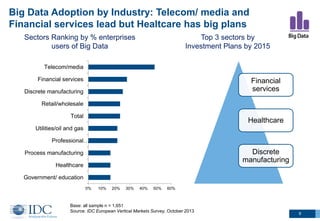
Big Data Adoption by Industry: Telecom/ media and
Financial services lead but Healtcare has big plans
Financial
services
Healthcare
Discrete
manufacturing
Top 3 sectors by
Investment Plans by 2015
Base: all sample n = 1,651
Source: IDC European Vertical Markets Survey, October 2013
0% 10% 20% 30% 40% 50% 60%
Government/ education
Healthcare
Process manufacturing
Professional…
Utilities/oil and gas
Total
Retail/wholesale
Discrete manufacturing
Financial services
Telecom/media
Sectors Ranking by % enterprises
users of Big Data
10
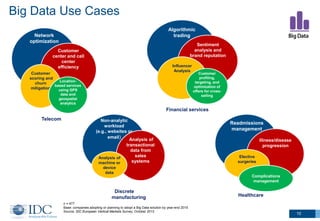
Big Data Use Cases
Non-analytic
workload
(e.g., websites or
email) Analysis of
transactional
data from
sales
systems
Analysis of
machine or
device
data
Discrete
manufacturing
Algorithmic
trading
Sentiment
analysis and
brand reputation
Influencer
Analysis
Customer
profiling,
targeting, and
optimization of
offers for cross-
selling
Financial services
n = 477
Base: companies adopting or planning to adopt a Big Data solution by year-end 2015
Source: IDC European Vertical Markets Survey, October 2013
Network
optimization
Customer
center and call
center
efficiency
Customer
scoring and
churn
mitigation
Location-
based services
using GPS
data and
geospatial
analytics
Telecom
Readmissions
management
Illness/disease
progression
Elective
surgeries
Complications
management
Healthcare
© IDC Visit us at IDC.com and follow us on Twitter: @IDC 11
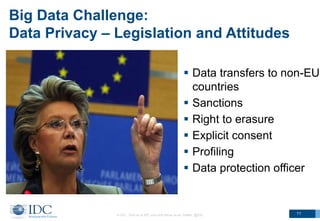
 Data transfers to non-EU
countries
 Sanctions
 Right to erasure
 Explicit consent
 Profiling
 Data protection officer
Big Data Challenge:
Data Privacy – Legislation and Attitudes
Content
 The Big Data Market – main
trends
 The European Data Market –
an emerging ecosystem
 Measuring the European Data
Market – a challenge
 Issues for discussion: a
community effort
© IDC Visit us at IDC.com and follow us on Twitter: @IDC 12
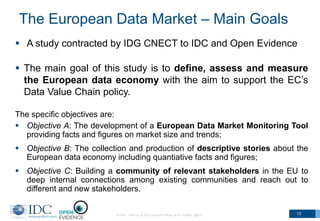
The European Data Market – Main Goals
 A study contracted by IDG CNECT to IDC and Open Evidence
 The main goal of this study is to define, assess and measure
the European data economy with the aim to support the EC’s
Data Value Chain policy.
The specific objectives are:
 Objective A: The development of a European Data Market Monitoring Tool
providing facts and figures on market size and trends;
 Objective B: The collection and production of descriptive stories about the
European data economy including quantiative facts and figures;
 Objective C: Building a community of relevant stakeholders in the EU to
deep internal connections among existing communities and reach out to
different and new stakeholders.
© IDC Visit us at IDC.com and follow us on Twitter: @IDC 13
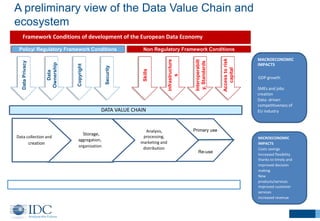
MICROECONOMIC
IMPACTS
Costs savings
Increased flexibility
thanks to timely and
improved decision
making
New
products/services
Improved customer
services
Increased revenue
MACROECONOMIC
IMPACTS
GDP growth
SMEs and jobs
creation
Data-driven
competitiveness of
EU industry
Data collection and
creation
Storage,
aggregation,
organization
Analysis,
processing,
marketing and
distribution
DATA VALUE CHAIN
Framework Conditions of development of the European Data Economy
Policy/ Regulatory Framework Conditions Non Regulatory Framework Conditions
DataPrivacy
Data
Ownership
Copyright
Security
Skills
infrastructure
s
Interoperabilt
y,Standards
Accesstorisk
capital
Primary use
Re-use
A preliminary view of the Data Value Chain and
ecosystem
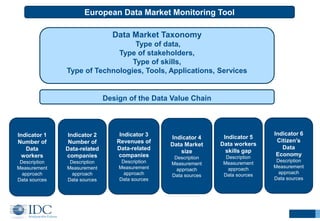
Data Market Taxonomy
Type of data,
Type of stakeholders,
Type of skills,
Type of Technologies, Tools, Applications, Services
Indicator 1
Number of
Data
workers
Description
Measurement
approach
Data sources
Indicator 2
Number of
Data-related
companies
Description
Measurement
approach
Data sources
Indicator 3
Revenues of
Data-related
companies
Description
Measurement
approach
Data sources
Indicator 4
Data Market
size
Description
Measurement
approach
Data sources
Indicator 6
Citizen’s
Data
Economy
Description
Measurement
approach
Data sources
Indicator 5
Data workers
skills gap
Description
Measurement
approach
Data sources
European Data Market Monitoring Tool
Design of the Data Value Chain
Content
 The Big Data Market – main
trends
 The European Data Market –
an emerging ecosystem
 Measuring the European Data
Market – a challenge
 Issues for discussion: a
community effort
© IDC Visit us at IDC.com and follow us on Twitter: @IDC 16
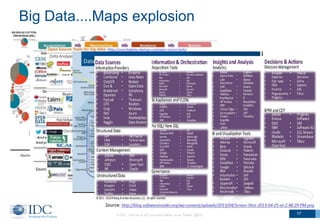
Big Data....Maps explosion
© IDC Visit us at IDC.com and follow us on Twitter: @IDC 17
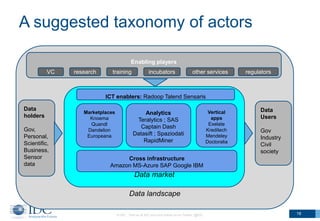
A suggested taxonomy of actors
© IDC Visit us at IDC.com and follow us on Twitter: @IDC 18
Data landscape
Data market
Data
holders
Gov,
Personal,
Scientific,
Business,
Sensor
data
Marketplaces
Knoema
Quandl
Dandelion
Europeana
ICT enablers: Radoop Talend Sensaris
Analytics
Teralytics ; SAS
Captain Dash
Datasift ; Spaziodati
RapidMiner
Vertical
apps
Exelate
Kreditech
Mendeley
Doctoralia
Data
Users
Gov
Industry
Civil
society
Enabling players
Cross infrastructure
Amazon MS-Azure SAP Google IBM
VC research training incubators regulatorsother services
Website objectives
 To give visibility to the data companies in EU
 To aggregate information about the existing data
communities (meta-community)
 To facilitate discussion about EU policies related
to the data economy
 To disseminate data snippets from the study
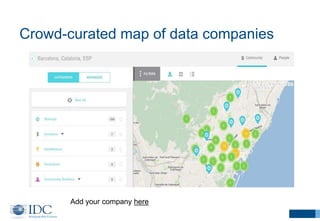
Crowd-curated map of data companies
Add your company here
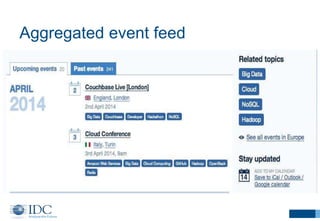
Aggregated event feed
Help us out
 www.datalandscape.eu (available mid-june)
 #eudatalandscape
 @eudatalandscape
 https://groups.diigo.com/group/eudataeconomy
 Call for animators: http://www.open-
evidence.com/call-for-animators-on-big-data/
IDC in Europe and Big Data
 Alys Woodward – Research Director,
European Software (Big Data, Advanced
Analytics, Enterprise Social)
 Donna Taylor – Research Director
European Storage
Big Data & Social Business Practice Co-Leads
Gabriella Cattaneo
IDC European Government Consulting
gcattaneo@idc.com

EU Data Market study. Presentation at NESSI Summit 2014 IDC & Open Evidence

  • 1.
    NESSI Summit 2014 TheEuropean Data Market Gabriella Cattaneo, IDC Europe May 27, 2014 Brussels
  • 2.
    Content  The BigData Market – main trends  The European Data Market – an emerging ecosystem  Measuring the European Data Market – a challenge  Issues for discussion: a community effort © IDC Visit us at IDC.com and follow us on Twitter: @IDC 2
  • 3.
    Volume Variety Velocity Value  Big Datatechnologies describe a new generation of technologies and architectures designed to economically extract value from very large volumes of a wide variety of data by enabling high-velocity capture, discovery, and/or analysis. What is Big Data?
  • 4.
    Growth of theDigital Universe from 2013 to 2020 © IDC Visit us at IDC.com and follow us on Twitter: @IDC 4 4.4 Trillion GB 44 Trillion GB Data on the cloud 20% Data on the cloud 40% 22% 37 % Share of useful data on total 2% 10% 2013 2020 Data from embedded systems Source: IDC for EMC 2014
  • 5.
    The Big DataMarket grows 6 times faster than the traditional IT market © IDC Visit us at IDC.com and follow us on Twitter: @IDC 5 7.2 23.7 2012 2017 € Bn Big Data Technologies and Services Market, worldwide Source: IDC 2014 2.3 4.3 2.7 2013 - € Bn hardware software services
  • 6.
    Content  The BigData Market – main trends  The European Data Market – an emerging ecosystem  Measuring the European Data Market – a challenge  Issues for discussion: a community effort © IDC Visit us at IDC.com and follow us on Twitter: @IDC 6
  • 7.
    7 Big Data Adoptionin Europe Will Accelerate in 2014  Big Data is becoming mainstream in North America, but Europe lagged behind due to • Size factor: smaller organizations and smaller data sets • Expensive, scarce data analytics skills • Economic crisis, cautiousness in new investments  IDC survey data indicates that the most mature geographies are starting to ramp up in adoption: the U.K., Germany, and France.  The analytically mature market sectors will lead: business- to-consumer (B2C) industries and large enterprises.  Big Data helps European companies to “think global, act local” and manage diversity
  • 8.
    23% 7% 49% 14% 7% Already adopted Planto adopt in the next 24 months Not adopted and no adoption plans Not familiar Don't know Value from unstructured data Data explosion Decision support and forecasts Velocity Better and faster answers Big Data of WE companies will adopt Big Data by year-end 2015 8 30% WE companies using a Big Data solution appreciate the benefits in terms of velocity in analyzing data. 2o ut off3 % Adoption Base: all sample n = 1,651 Source: IDC European Vertical Markets Survey, October 2013 Big Data Adoption in the EU main MS - (DE, ES, FR, IT, UK)
  • 9.
    9 Big Data Adoptionby Industry: Telecom/ media and Financial services lead but Healtcare has big plans Financial services Healthcare Discrete manufacturing Top 3 sectors by Investment Plans by 2015 Base: all sample n = 1,651 Source: IDC European Vertical Markets Survey, October 2013 0% 10% 20% 30% 40% 50% 60% Government/ education Healthcare Process manufacturing Professional… Utilities/oil and gas Total Retail/wholesale Discrete manufacturing Financial services Telecom/media Sectors Ranking by % enterprises users of Big Data
  • 10.
    10 Big Data UseCases Non-analytic workload (e.g., websites or email) Analysis of transactional data from sales systems Analysis of machine or device data Discrete manufacturing Algorithmic trading Sentiment analysis and brand reputation Influencer Analysis Customer profiling, targeting, and optimization of offers for cross- selling Financial services n = 477 Base: companies adopting or planning to adopt a Big Data solution by year-end 2015 Source: IDC European Vertical Markets Survey, October 2013 Network optimization Customer center and call center efficiency Customer scoring and churn mitigation Location- based services using GPS data and geospatial analytics Telecom Readmissions management Illness/disease progression Elective surgeries Complications management Healthcare
  • 11.
    © IDC Visitus at IDC.com and follow us on Twitter: @IDC 11  Data transfers to non-EU countries  Sanctions  Right to erasure  Explicit consent  Profiling  Data protection officer Big Data Challenge: Data Privacy – Legislation and Attitudes
  • 12.
    Content  The BigData Market – main trends  The European Data Market – an emerging ecosystem  Measuring the European Data Market – a challenge  Issues for discussion: a community effort © IDC Visit us at IDC.com and follow us on Twitter: @IDC 12
  • 13.
    The European DataMarket – Main Goals  A study contracted by IDG CNECT to IDC and Open Evidence  The main goal of this study is to define, assess and measure the European data economy with the aim to support the EC’s Data Value Chain policy. The specific objectives are:  Objective A: The development of a European Data Market Monitoring Tool providing facts and figures on market size and trends;  Objective B: The collection and production of descriptive stories about the European data economy including quantiative facts and figures;  Objective C: Building a community of relevant stakeholders in the EU to deep internal connections among existing communities and reach out to different and new stakeholders. © IDC Visit us at IDC.com and follow us on Twitter: @IDC 13
  • 14.
    MICROECONOMIC IMPACTS Costs savings Increased flexibility thanksto timely and improved decision making New products/services Improved customer services Increased revenue MACROECONOMIC IMPACTS GDP growth SMEs and jobs creation Data-driven competitiveness of EU industry Data collection and creation Storage, aggregation, organization Analysis, processing, marketing and distribution DATA VALUE CHAIN Framework Conditions of development of the European Data Economy Policy/ Regulatory Framework Conditions Non Regulatory Framework Conditions DataPrivacy Data Ownership Copyright Security Skills infrastructure s Interoperabilt y,Standards Accesstorisk capital Primary use Re-use A preliminary view of the Data Value Chain and ecosystem
  • 15.
    Data Market Taxonomy Typeof data, Type of stakeholders, Type of skills, Type of Technologies, Tools, Applications, Services Indicator 1 Number of Data workers Description Measurement approach Data sources Indicator 2 Number of Data-related companies Description Measurement approach Data sources Indicator 3 Revenues of Data-related companies Description Measurement approach Data sources Indicator 4 Data Market size Description Measurement approach Data sources Indicator 6 Citizen’s Data Economy Description Measurement approach Data sources Indicator 5 Data workers skills gap Description Measurement approach Data sources European Data Market Monitoring Tool Design of the Data Value Chain
  • 16.
    Content  The BigData Market – main trends  The European Data Market – an emerging ecosystem  Measuring the European Data Market – a challenge  Issues for discussion: a community effort © IDC Visit us at IDC.com and follow us on Twitter: @IDC 16
  • 17.
    Big Data....Maps explosion ©IDC Visit us at IDC.com and follow us on Twitter: @IDC 17
  • 18.
    A suggested taxonomyof actors © IDC Visit us at IDC.com and follow us on Twitter: @IDC 18 Data landscape Data market Data holders Gov, Personal, Scientific, Business, Sensor data Marketplaces Knoema Quandl Dandelion Europeana ICT enablers: Radoop Talend Sensaris Analytics Teralytics ; SAS Captain Dash Datasift ; Spaziodati RapidMiner Vertical apps Exelate Kreditech Mendeley Doctoralia Data Users Gov Industry Civil society Enabling players Cross infrastructure Amazon MS-Azure SAP Google IBM VC research training incubators regulatorsother services
  • 19.
    Website objectives  Togive visibility to the data companies in EU  To aggregate information about the existing data communities (meta-community)  To facilitate discussion about EU policies related to the data economy  To disseminate data snippets from the study
  • 20.
    Crowd-curated map ofdata companies Add your company here
  • 21.
  • 22.
    Help us out www.datalandscape.eu (available mid-june)  #eudatalandscape  @eudatalandscape  https://groups.diigo.com/group/eudataeconomy  Call for animators: http://www.open- evidence.com/call-for-animators-on-big-data/
  • 23.
    IDC in Europeand Big Data  Alys Woodward – Research Director, European Software (Big Data, Advanced Analytics, Enterprise Social)  Donna Taylor – Research Director European Storage Big Data & Social Business Practice Co-Leads Gabriella Cattaneo IDC European Government Consulting gcattaneo@idc.com

Editor's Notes

  • #5 The available storage capacity will decrease from 33% of the digital universe to only 15% Connected things from 20 to 30 billions from 7 to 15% of connectable things
  • #8 Copyright 2009 IDC. Reproduction is forbidden unless authorized. All rights reserved.
  • #9 Big Data – Introduction Source: IDC European Vertical Markets Survey, October 2013 n = 1,651 – Base: all sample
  • #10 Western Europe Big Data Adoption by Vertical Market Q. Are you familiar, do you already adopt, or are you planning to adopt a Big Data solution? Source: IDC European Vertical Markets Survey, October 2013 n = 1,651 – Base: all sample Current adoption of Big Data technologies is still relatively low and concentrated in larger companies. An exception — related to the low adoption rates — is the telecom/media sector, where data explosion led half of the companies to invest in Big Data for modernizing business analytics and data analysis. Other verticals show homogeneous adoption rates, with financial services and discrete manufacturing slightly above average. Financial services, discrete manufacturing, and healthcare are ripe for increasing investments in Big Data in the short term, while other verticals such as government/education show a wait-and-see approach. It is interesting to see how Big Data is not a familiar term yet for many companies (particularly the smallest ones), and/or they are not aware how this technology could add real value to their businesses.