



The BAM Diagram: A Useful Heuristic
A. Townsend Peterson
University of Kansas
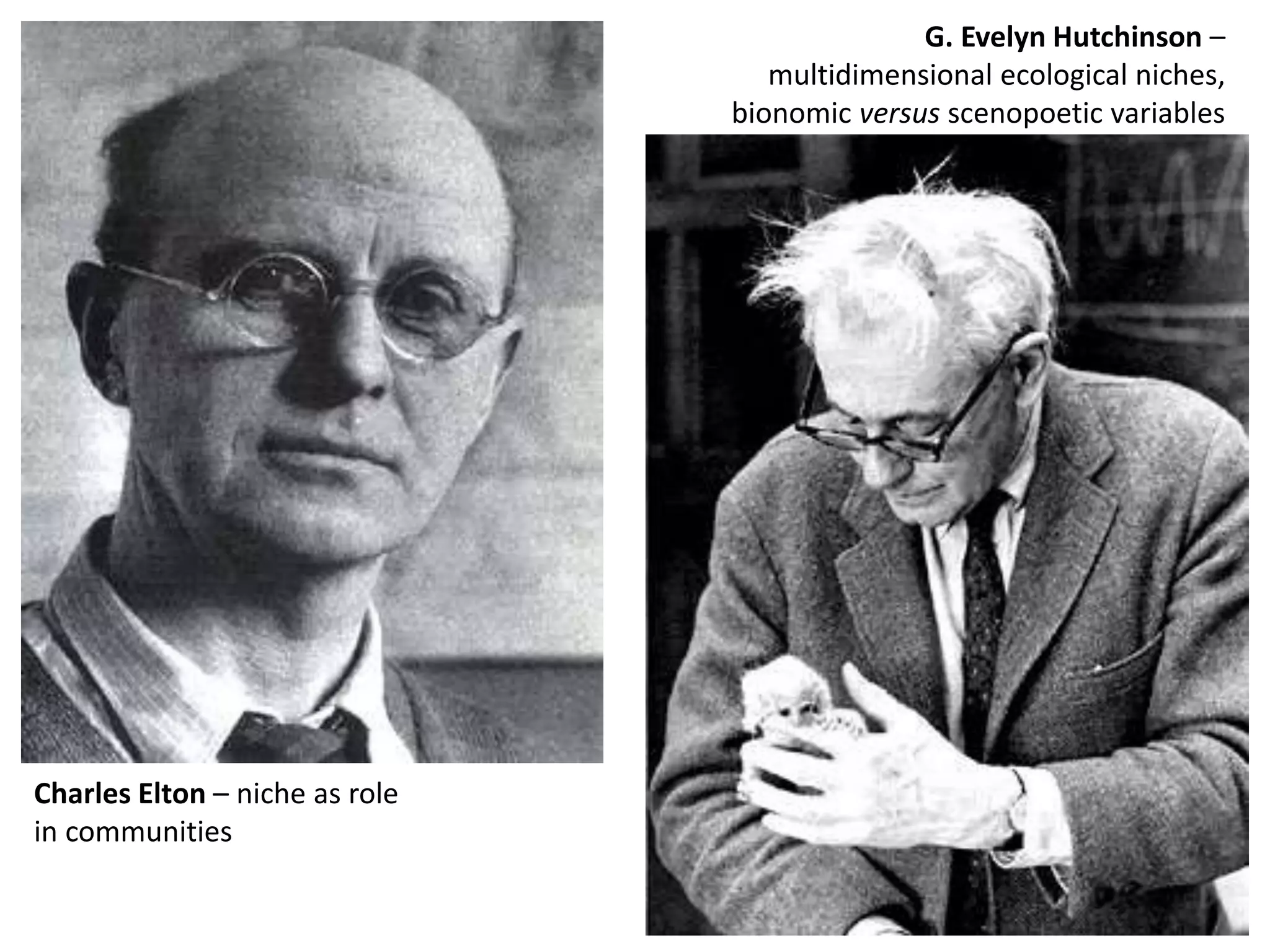
Charles Elton – niche as role
in communities
G. Evelyn Hutchinson –
multidimensional ecological niches,
bionomic versus scenopoetic variables
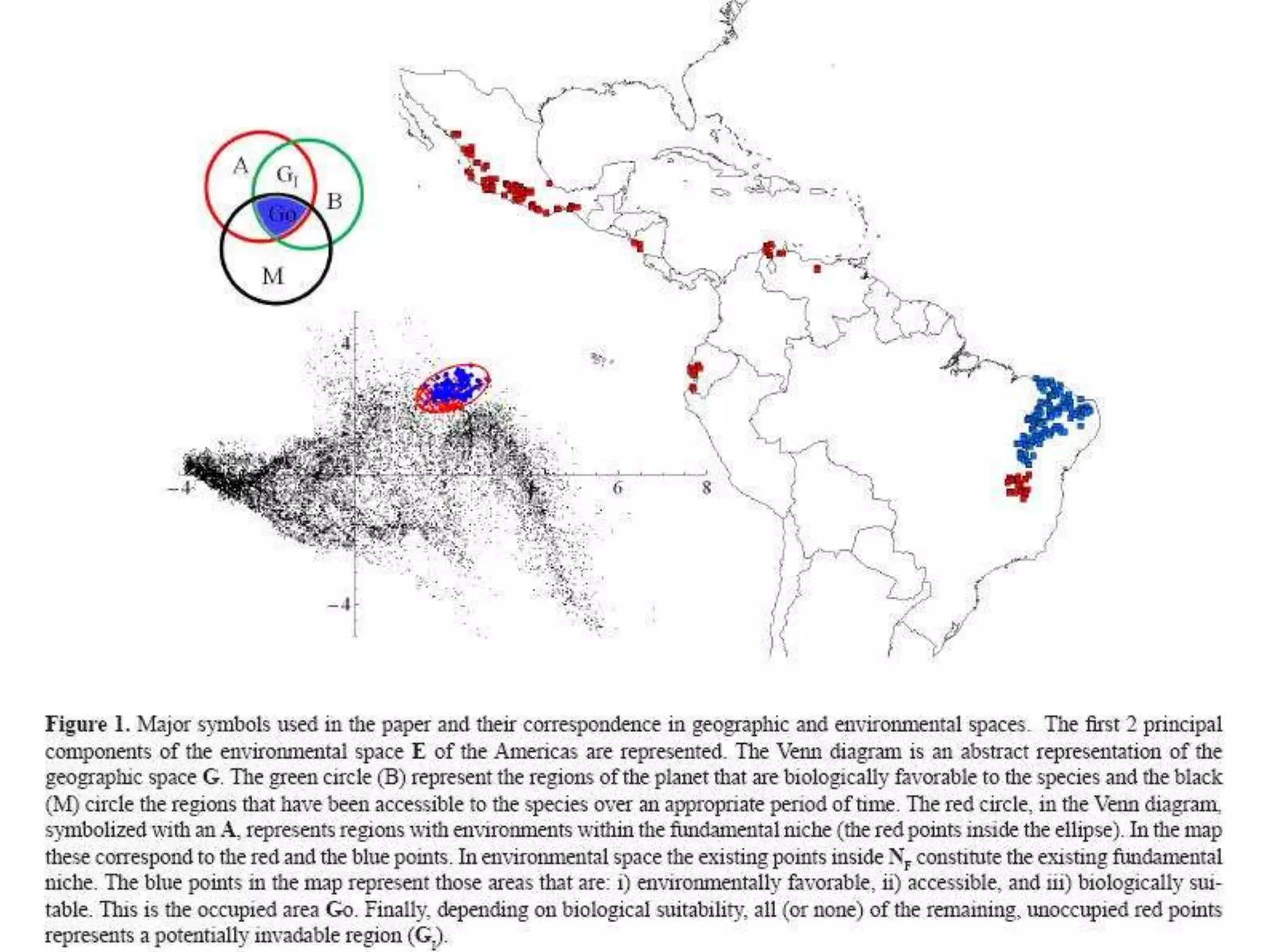
GEOGRAPHY – THE DISTRIBUTION
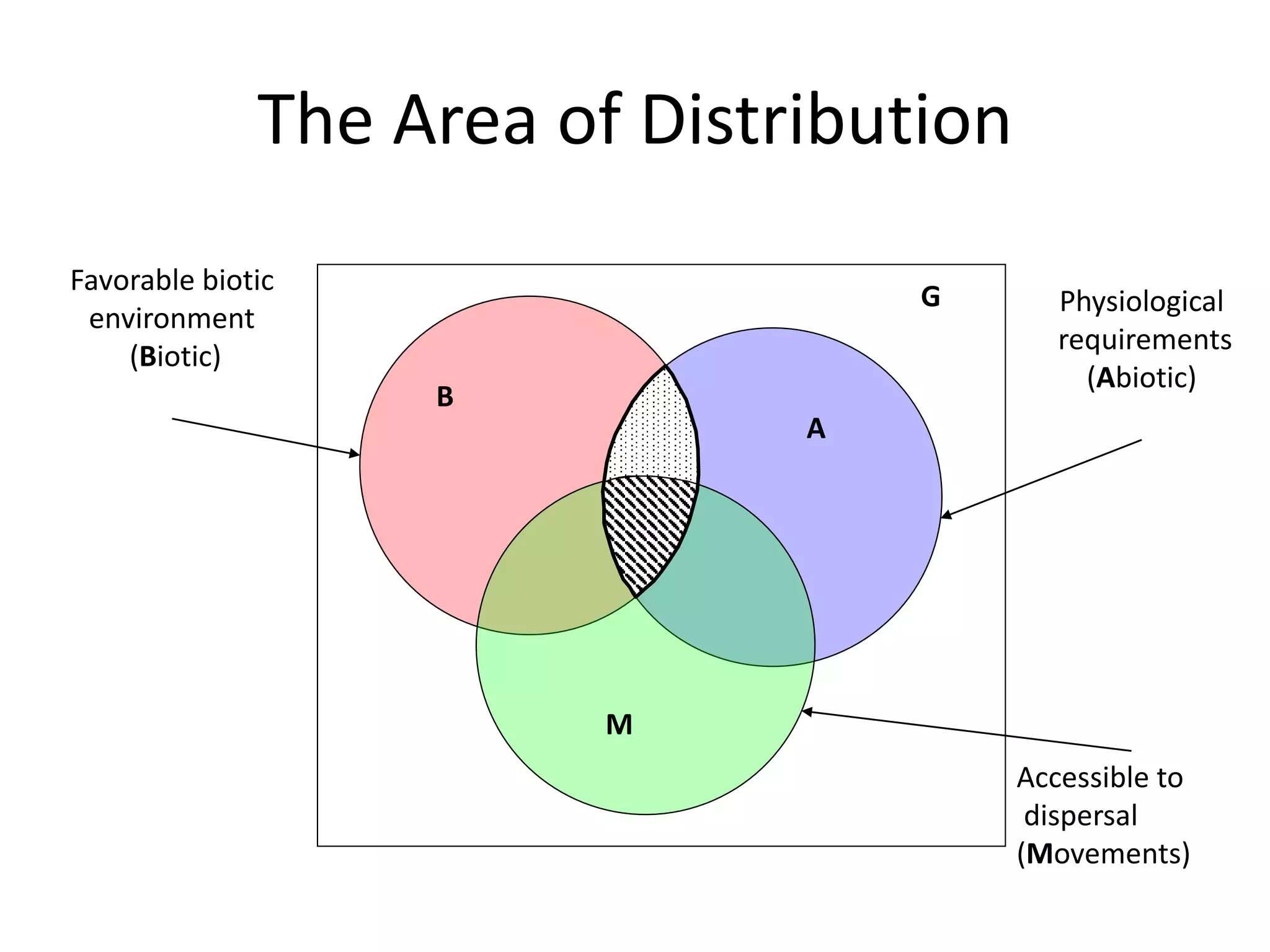
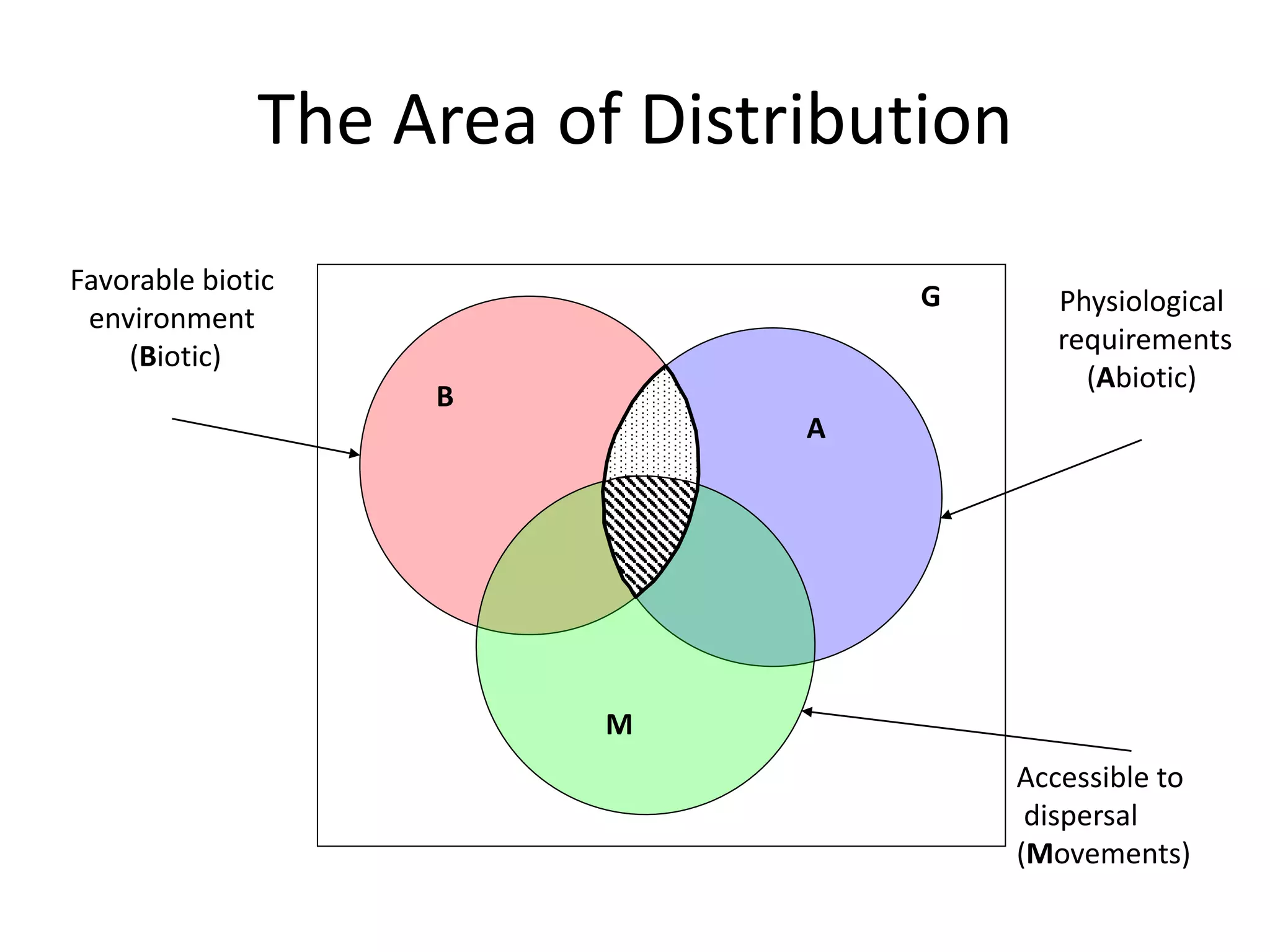
The Area of Distribution
G Physiological
requirements
(Abiotic)
A
Favorable biotic
environment
(Biotic)
B
Accessible to
dispersal
(Movements)
M
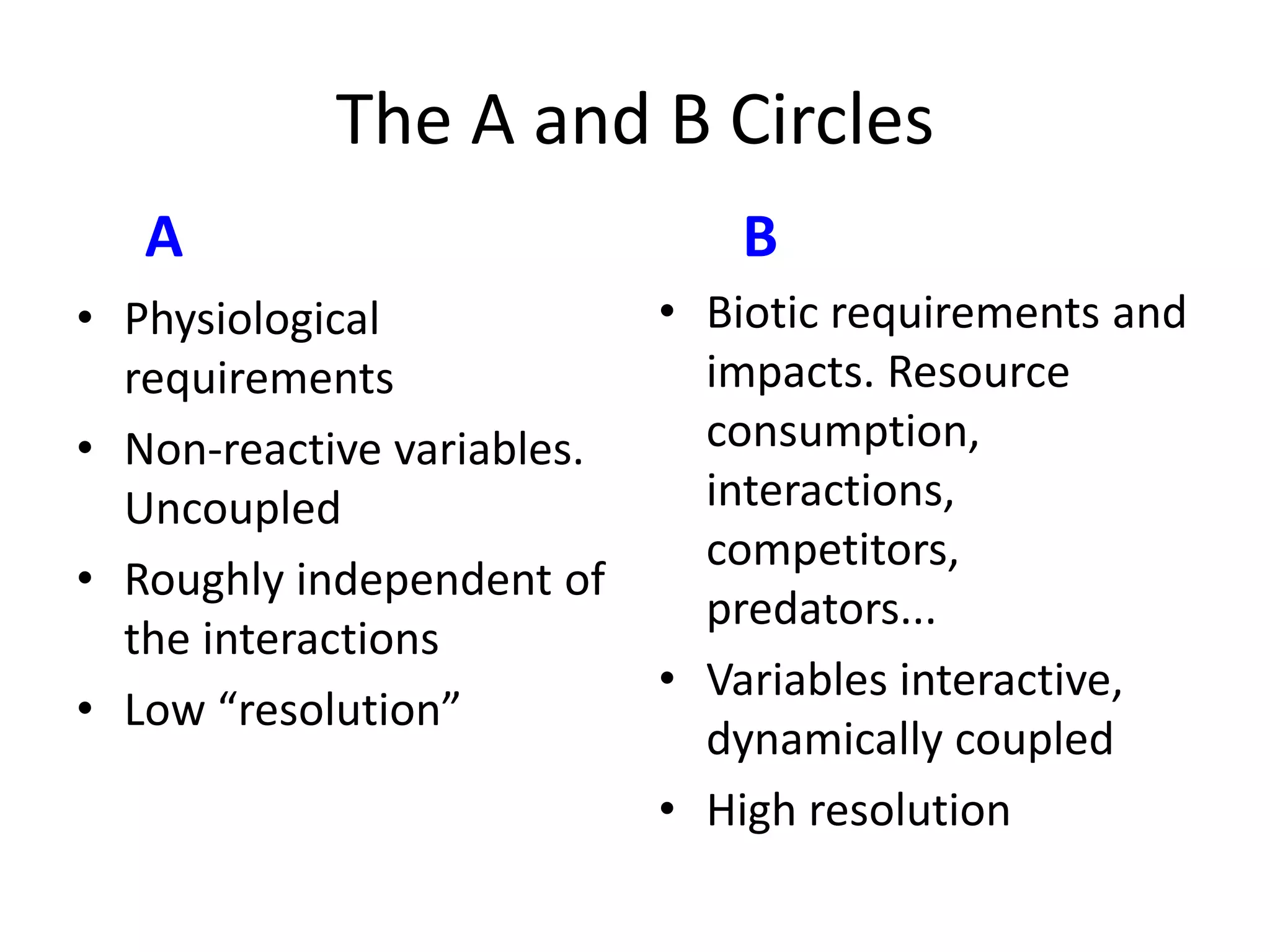
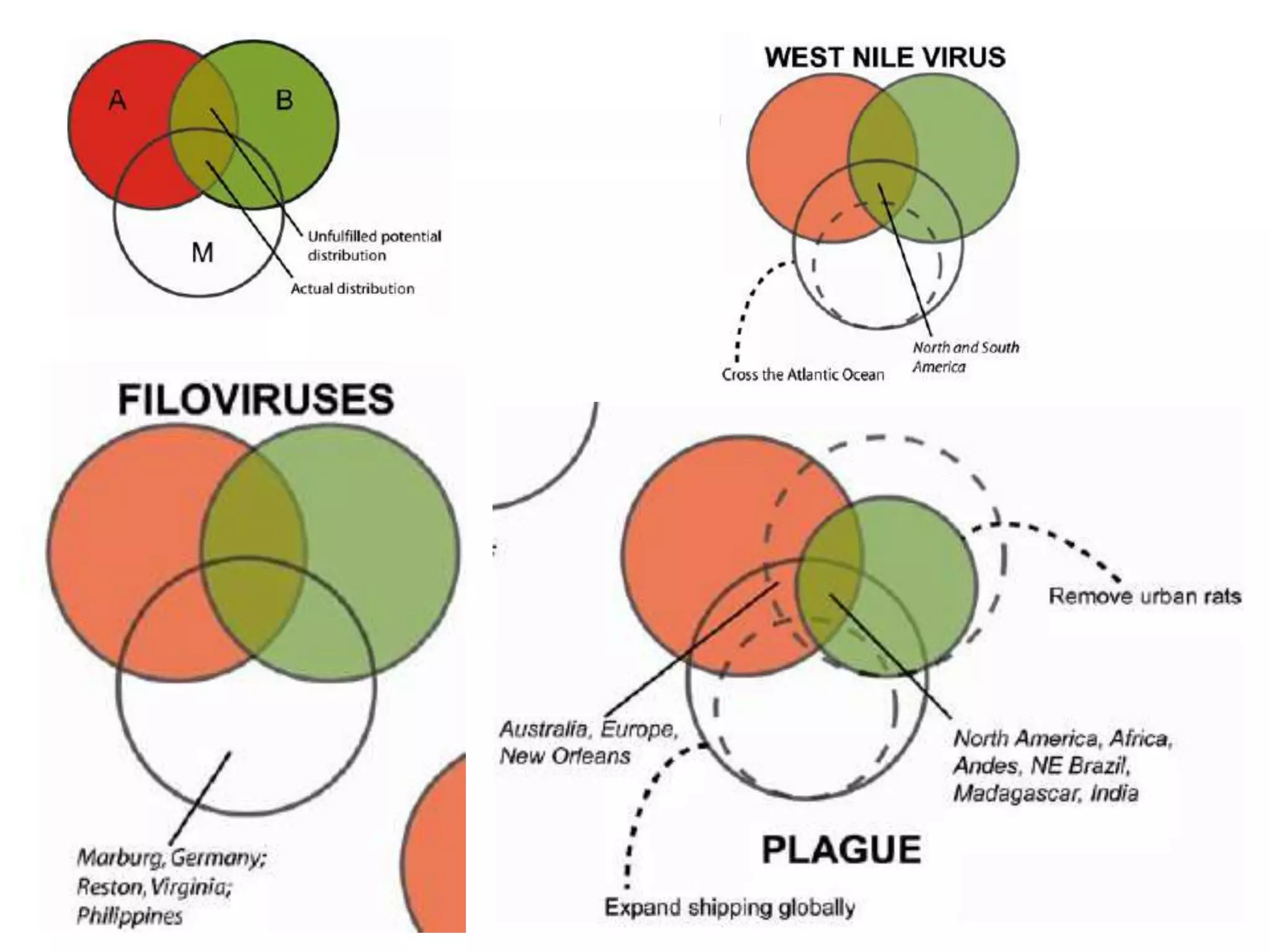
The A and B Circles
• Physiological
requirements
• Non-reactive variables.
Uncoupled
• Roughly independent of
the interactions
• Low “resolution”
• Biotic requirements and
impacts. Resource
consumption,
interactions,
competitors,
predators...
• Variables interactive,
dynamically coupled
• High resolution
A B
A Useful and Forgotten Distinction of
Hutchinson (1978)
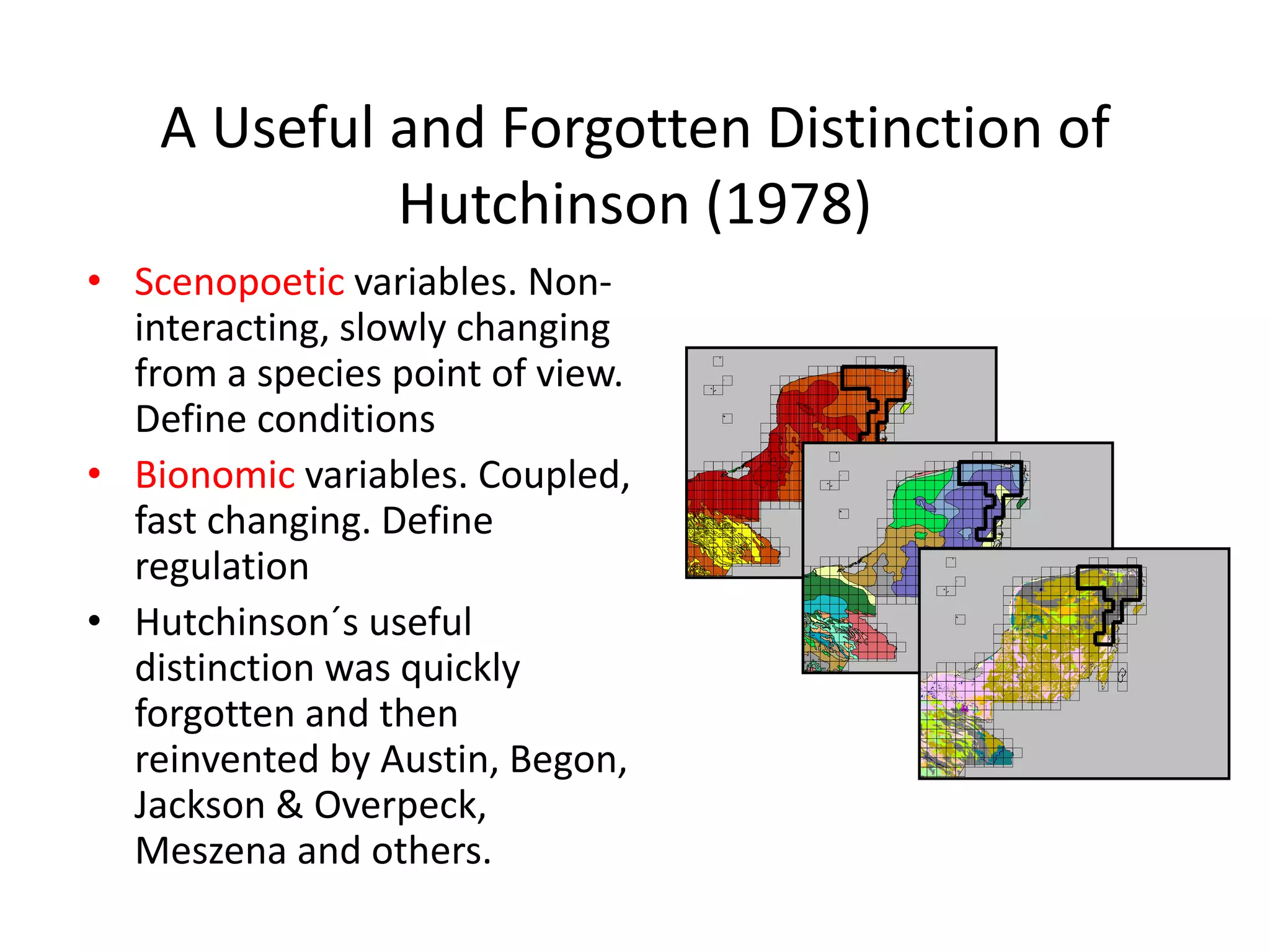
• Scenopoetic variables. Non-
interacting, slowly changing
from a species point of view.
Define conditions
• Bionomic variables. Coupled,
fast changing. Define
regulation
• Hutchinson´s useful
distinction was quickly
forgotten and then
reinvented by Austin, Begon,
Jackson & Overpeck,
Meszena and others.
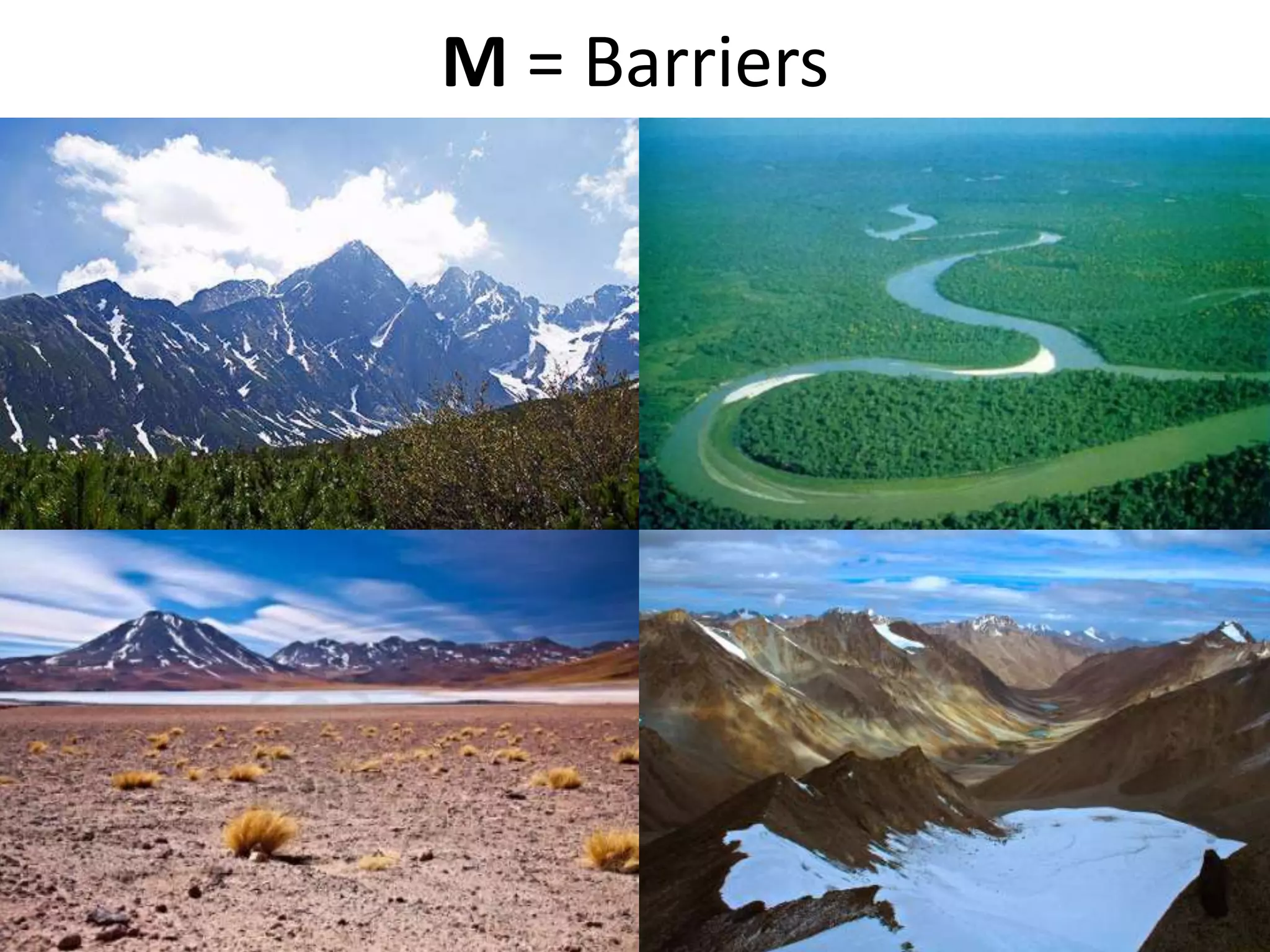
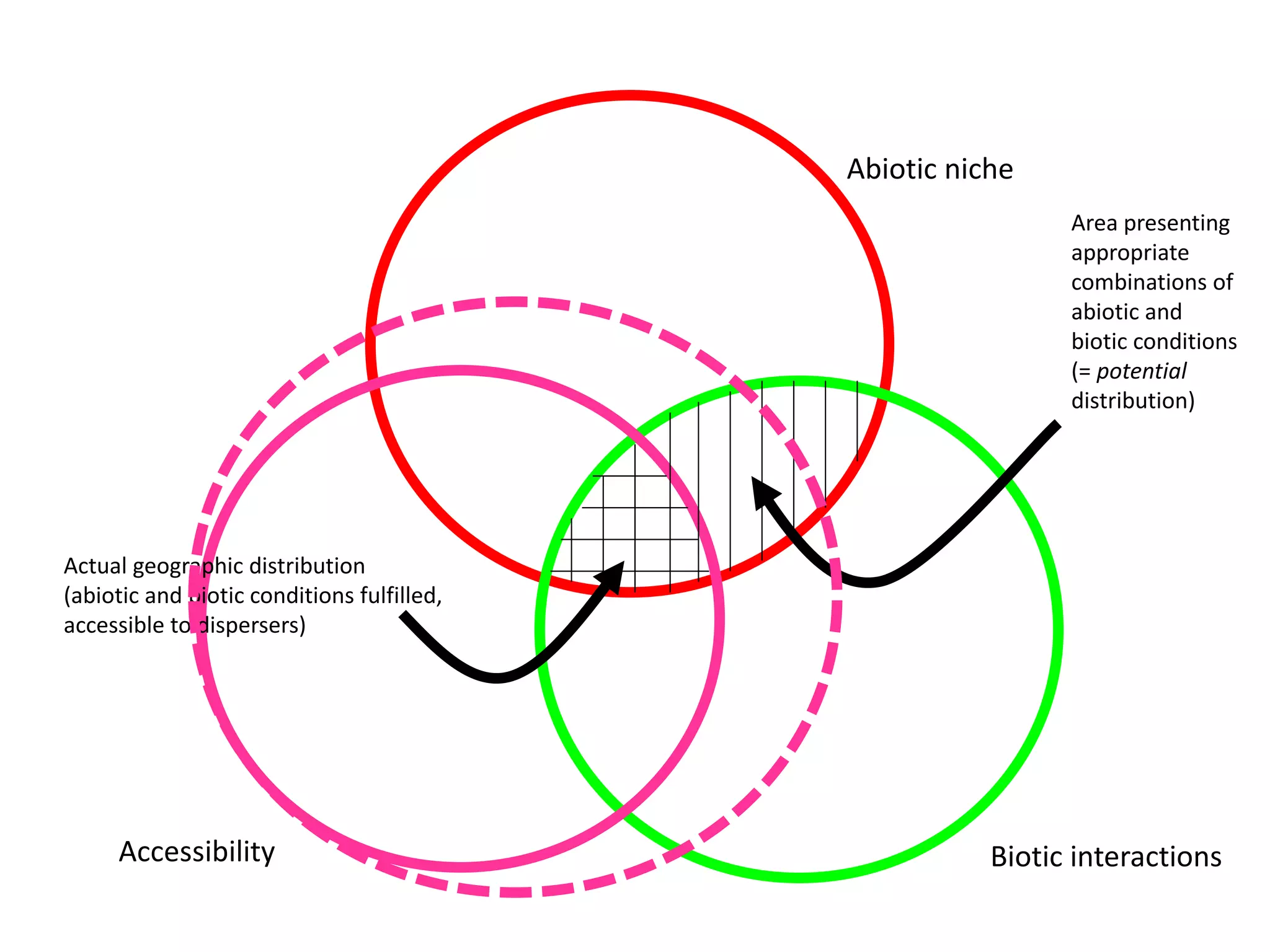
M = Barriers
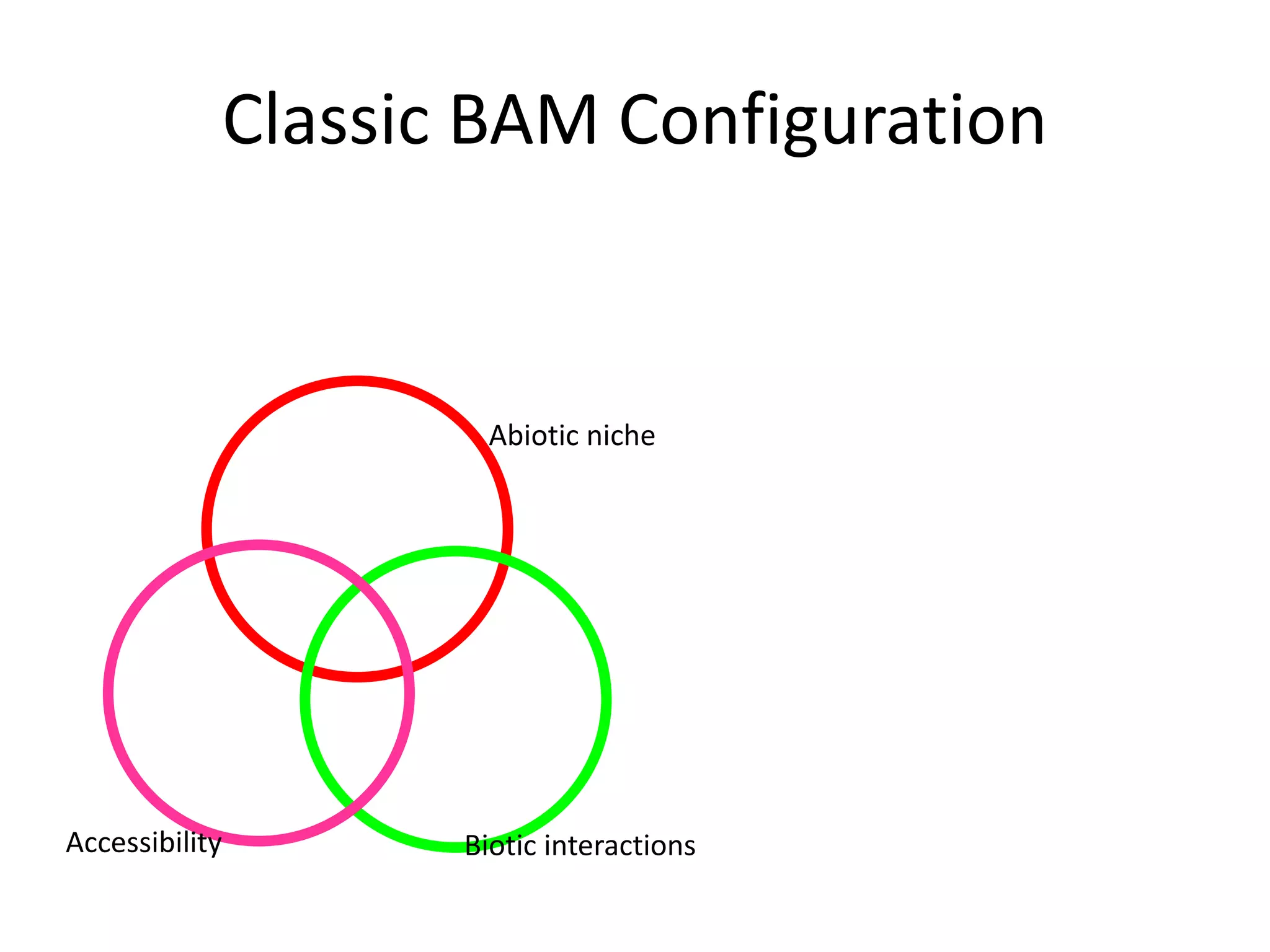
Abiotic niche
Biotic interactionsAccessibility
Classic BAM Configuration
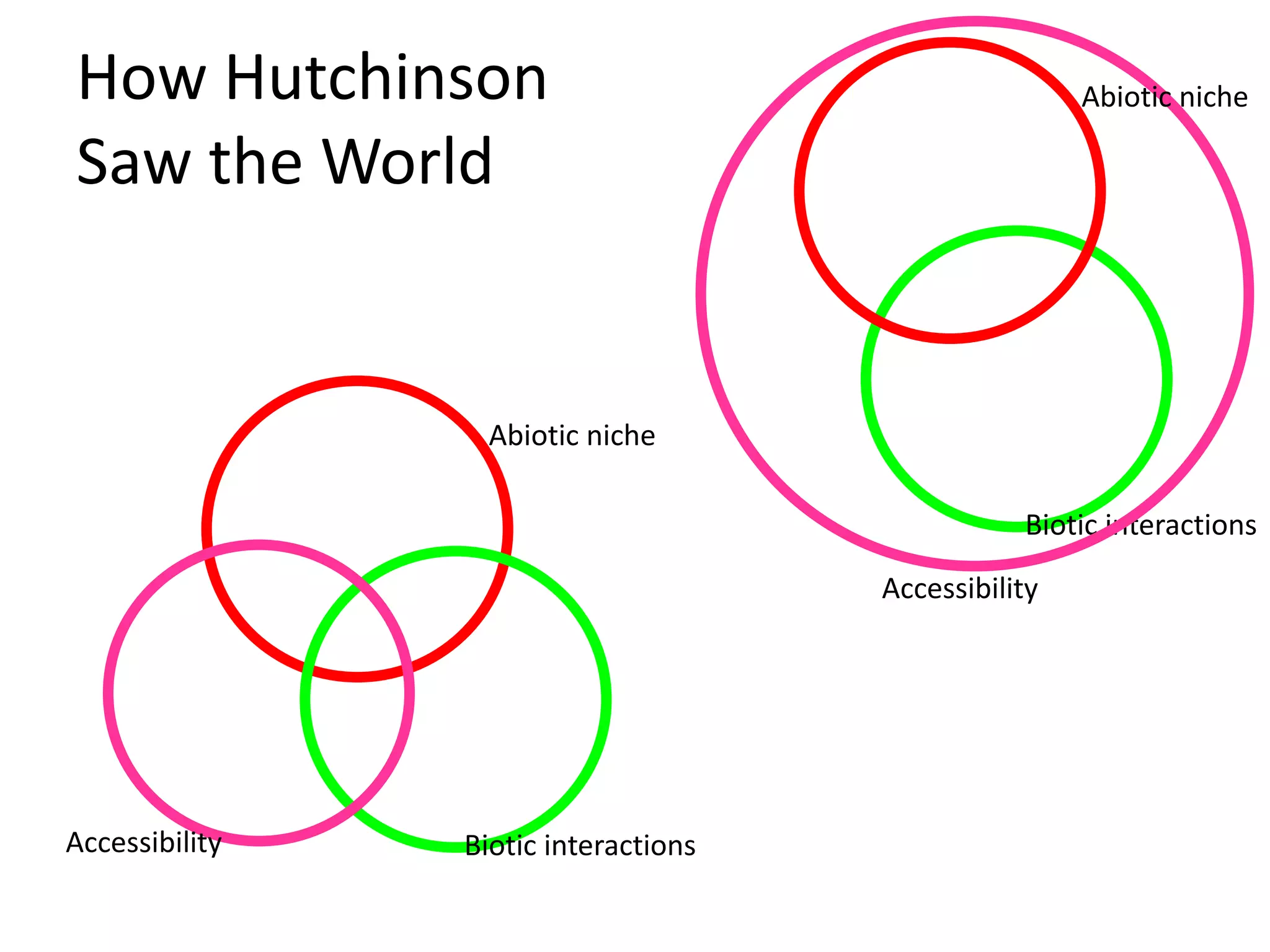
Abiotic niche
Biotic interactionsAccessibility
Biotic interactions
Accessibility
Abiotic nicheHow Hutchinson
Saw the World
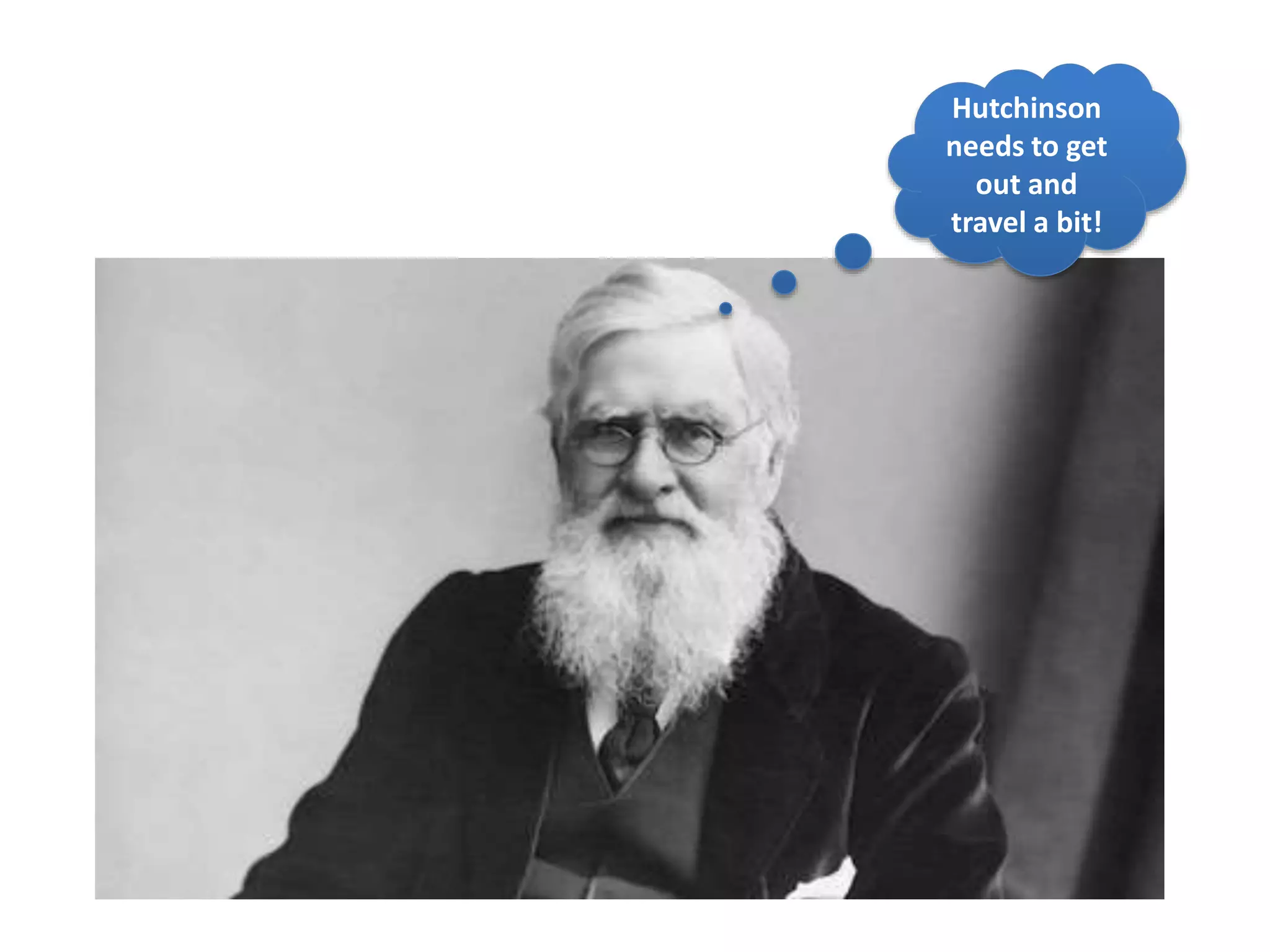
Hutchinson
needs to get
out and
travel a bit!
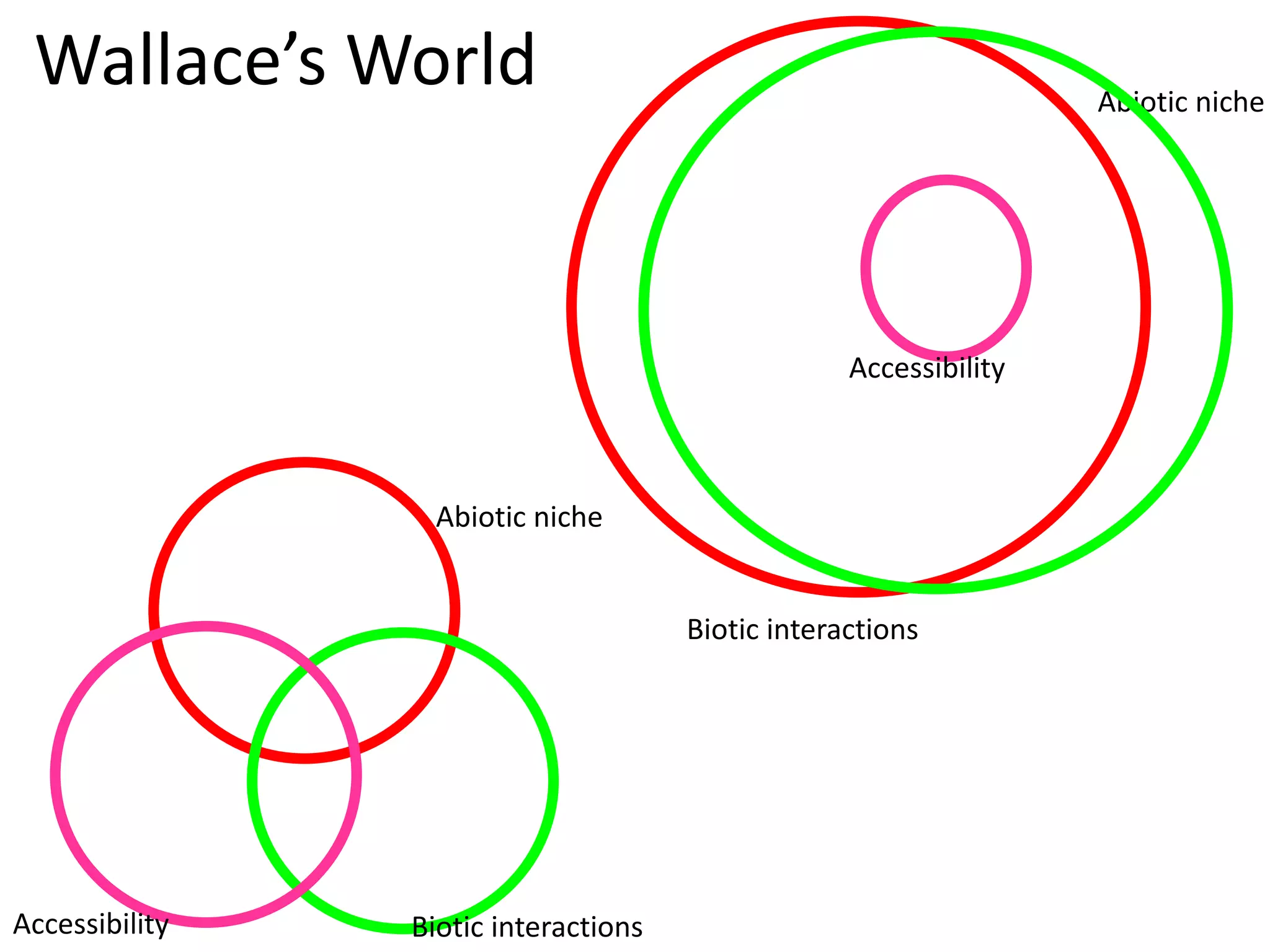
Abiotic niche
Biotic interactionsAccessibility
Abiotic niche
Biotic interactions
Accessibility
Wallace’s World
Demonstration of M Effects
• Clear demonstration of the importance of
dispersal limitation on species’ distributions
• Invasive species – originally confined to a
native distributional area
• Some transport (often human-mediated)
expands M
• Distribution expands accordingly
Abiotic niche
Biotic interactionsAccessibility
Area presenting
appropriate
combinations of
abiotic and
biotic conditions
(= potential
distribution)
Actual geographic distribution
(abiotic and biotic conditions fulfilled,
accessible to dispersers)
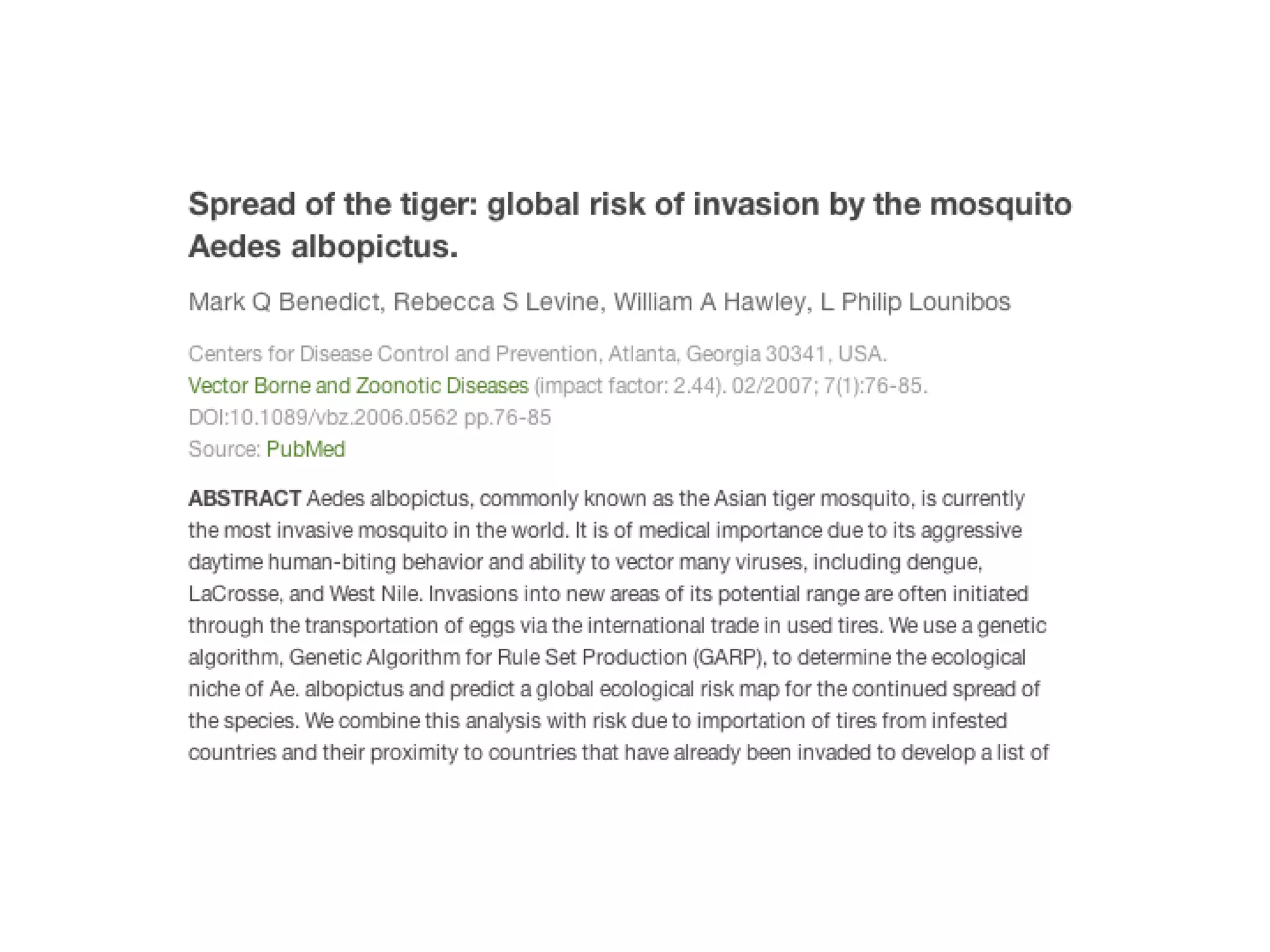
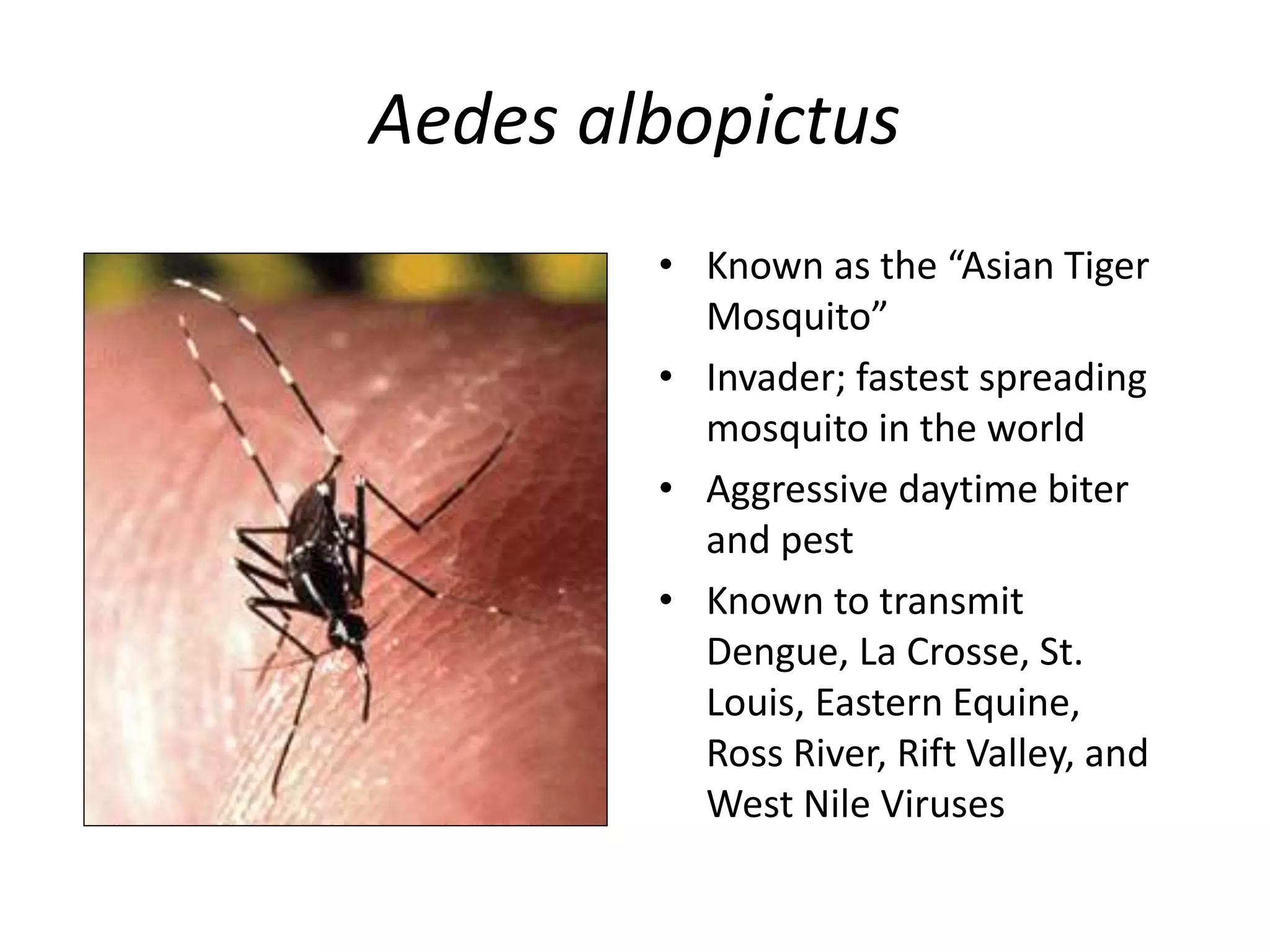
Aedes albopictus
• Known as the “Asian Tiger
Mosquito”
• Invader; fastest spreading
mosquito in the world
• Aggressive daytime biter
and pest
• Known to transmit
Dengue, La Crosse, St.
Louis, Eastern Equine,
Ross River, Rift Valley, and
West Nile Viruses
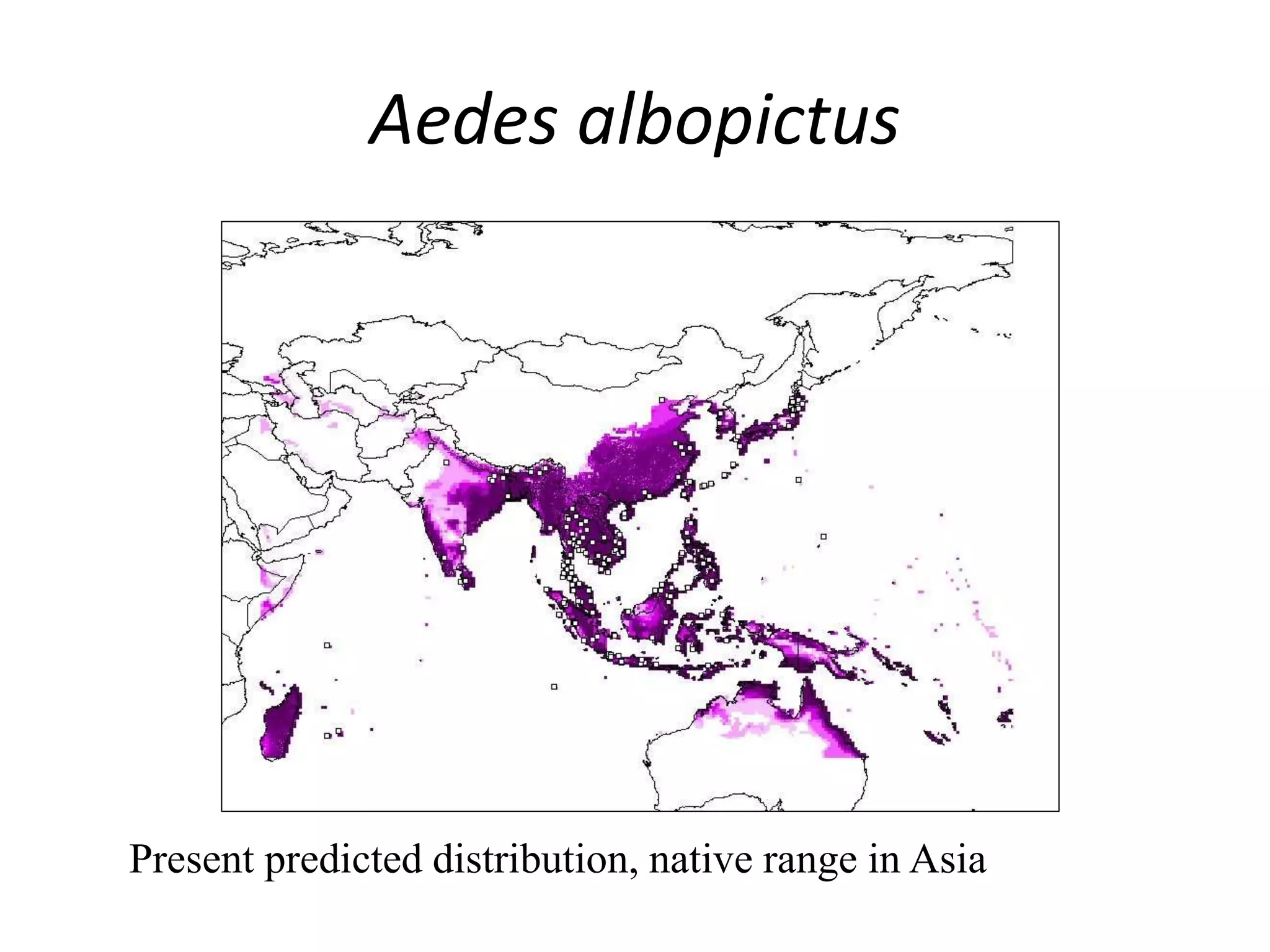
Aedes albopictus
Present predicted distribution, native range in Asia
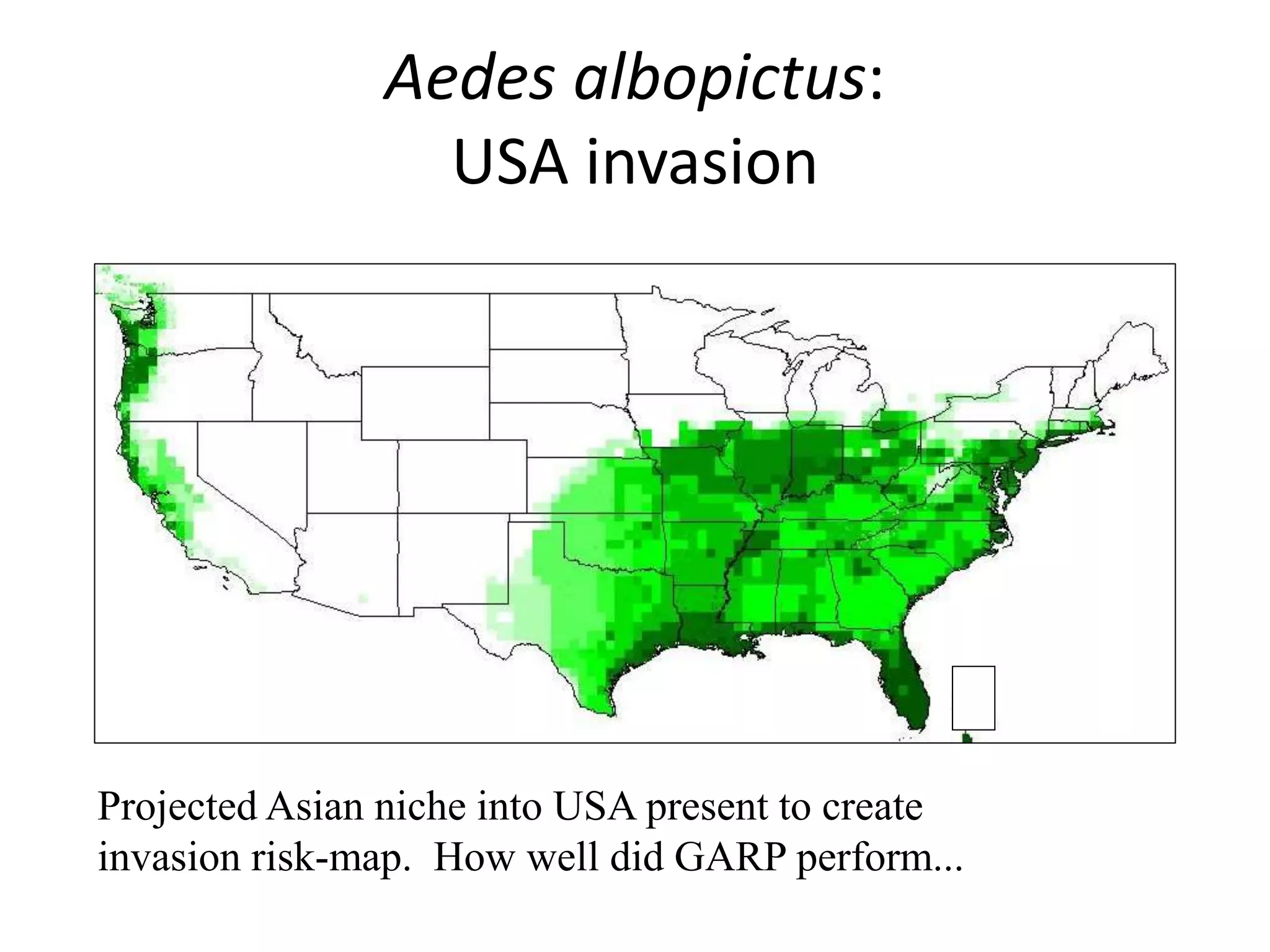
Aedes albopictus:
USA invasion
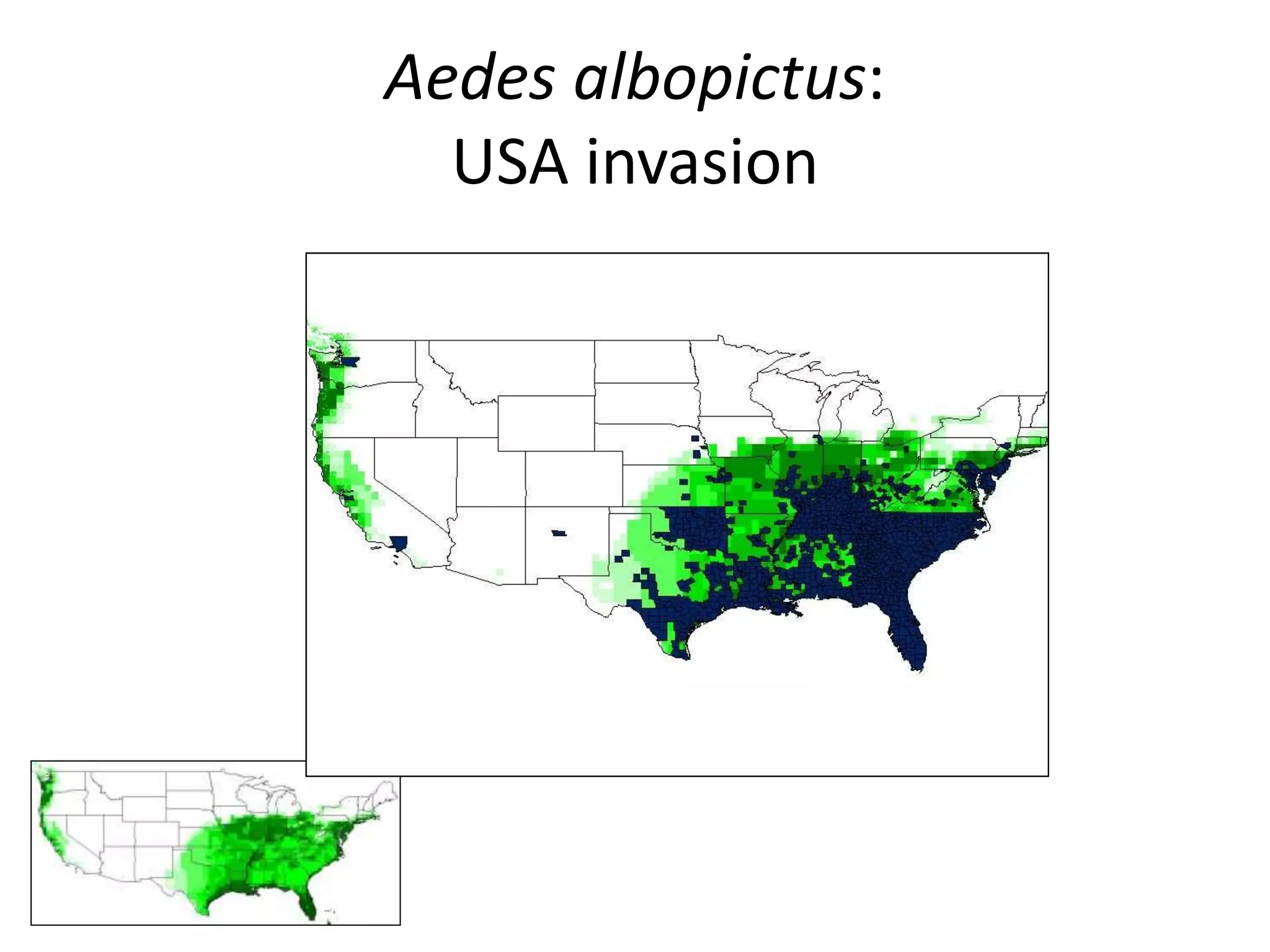
Projected Asian niche into USA present to create
invasion risk-map. How well did GARP perform...
Aedes albopictus:
USA invasion
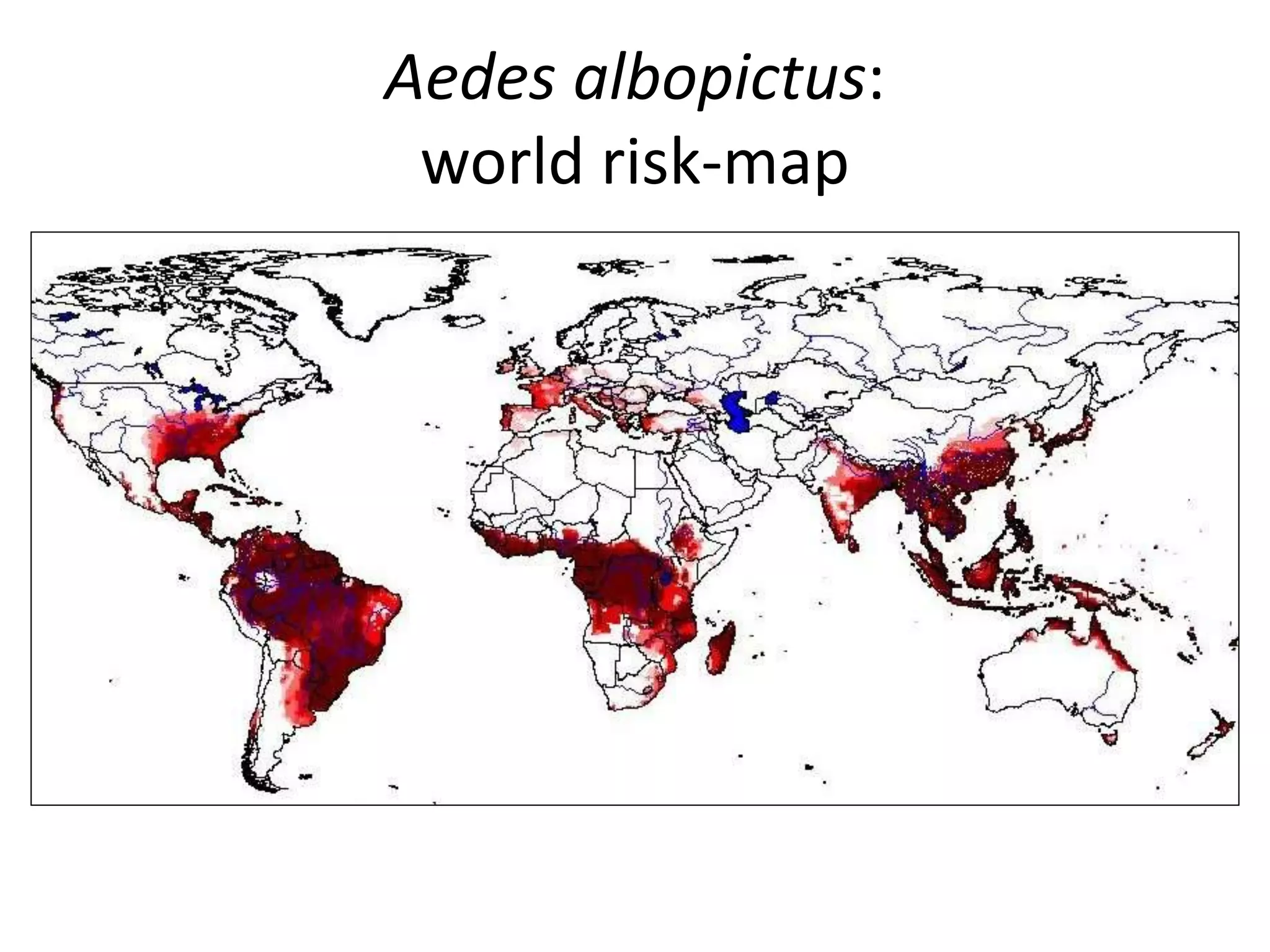
Aedes albopictus:
world risk-map
Abiotic niche
Biotic interactionsAccessibility
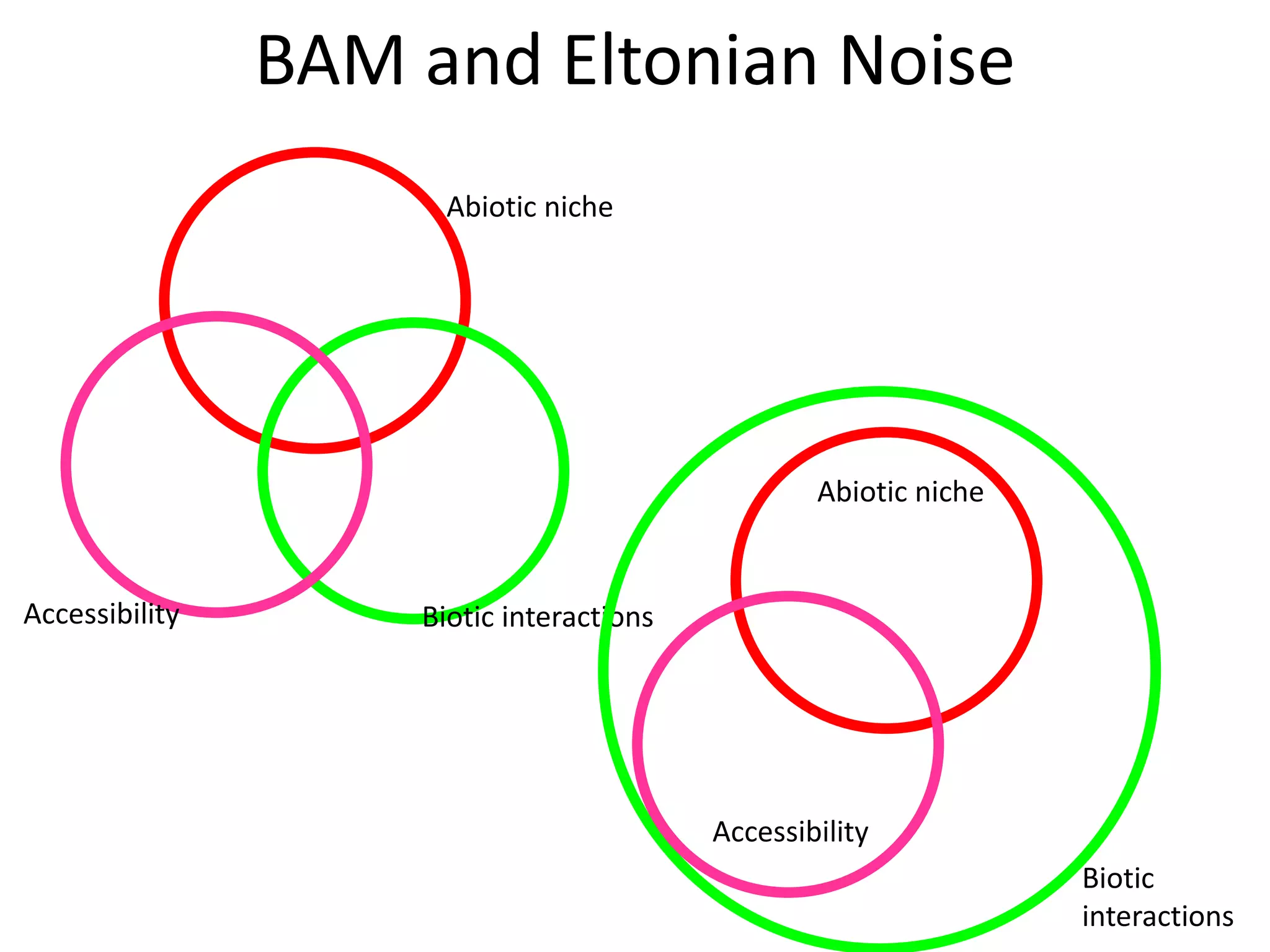
BAM and Eltonian Noise
Abiotic niche
Biotic
interactions
Accessibility
ENVIRONMENT
Five Goals of Niche Modeling?
1. ESTIMATE THE FUNDAMENTAL NICHE
2. ESTIMATE THE FUNDAMENTAL NICHE
3. ESTIMATE THE FUNDAMENTAL NICHE
4. ESTIMATE THE FUNDAMENTAL NICHE
5. ESTIMATE THE FUNDAMENTAL NICHE
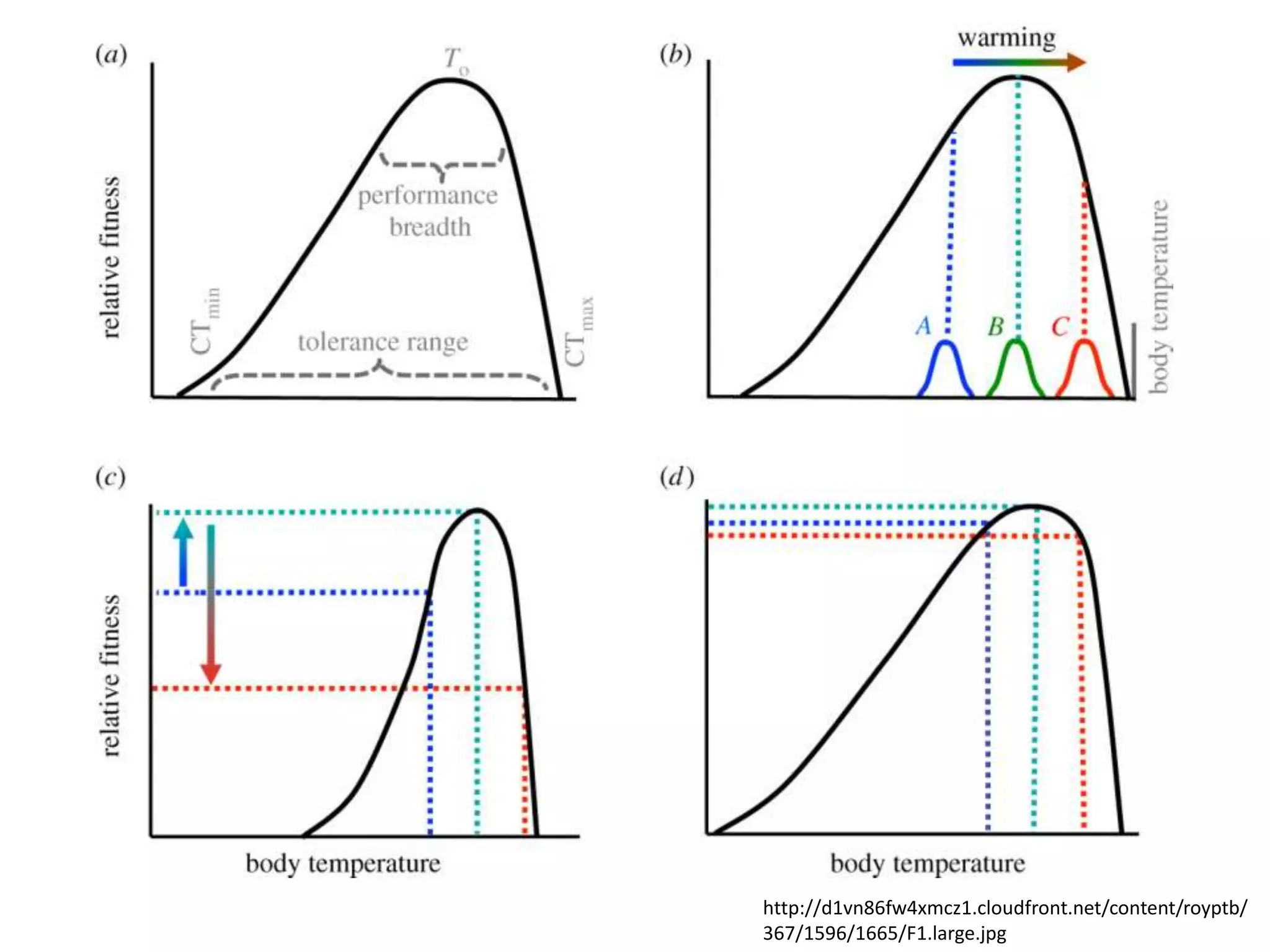
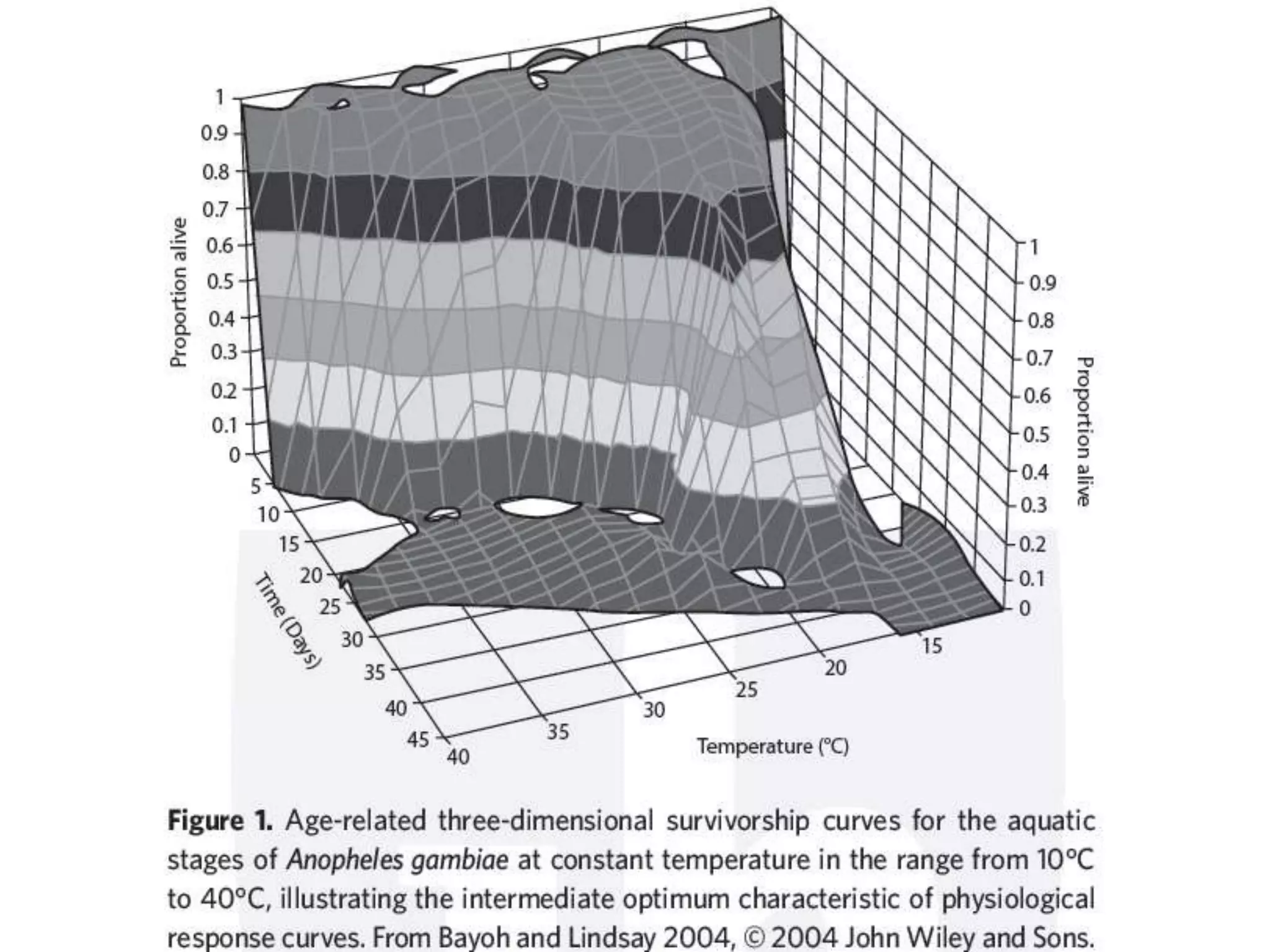
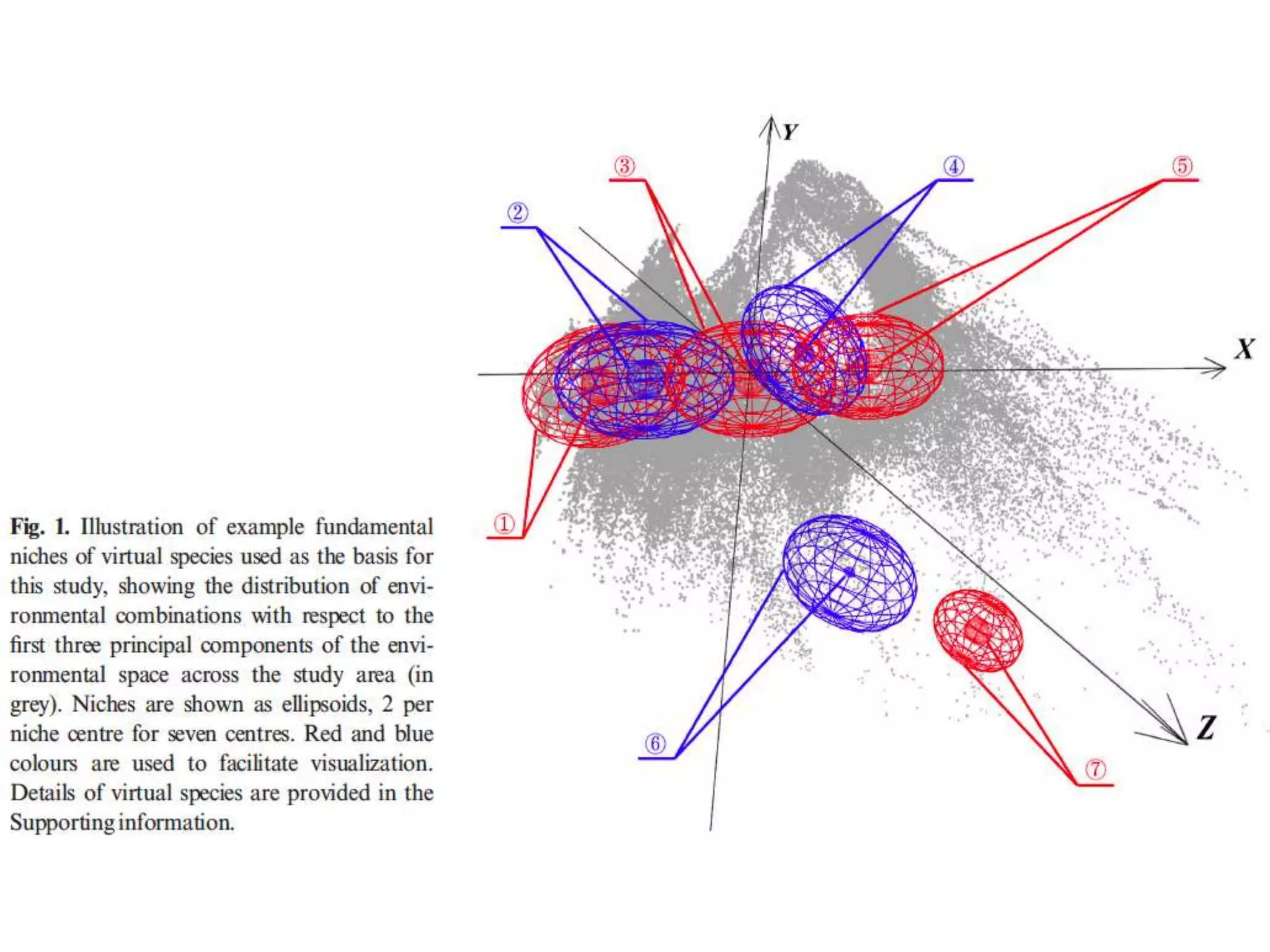
How Would the Fundamental Niche Look?
• In any one dimension, expected to be
unimodal
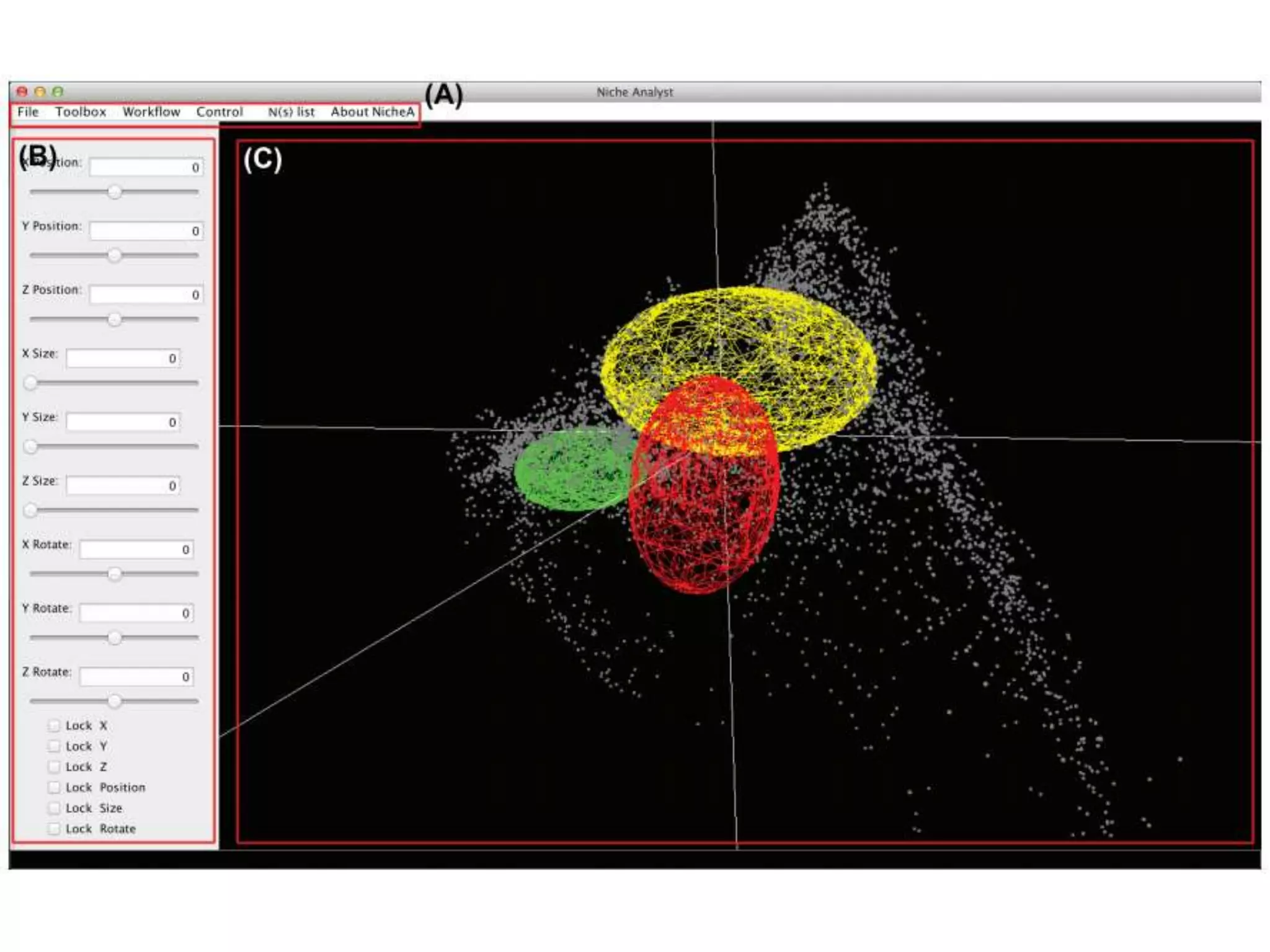
• In multiple dimensions, expected to be convex
• So, simple models are probably better
• Need to take sampling and incomplete
representation into account carefully
http://d1vn86fw4xmcz1.cloudfront.net/content/royptb/
367/1596/1665/F1.large.jpg
The Area of Distribution
G Physiological
requirements
(Abiotic)
A
Favorable biotic
environment
(Biotic)
B
Accessible to
dispersal
(Movements)
M
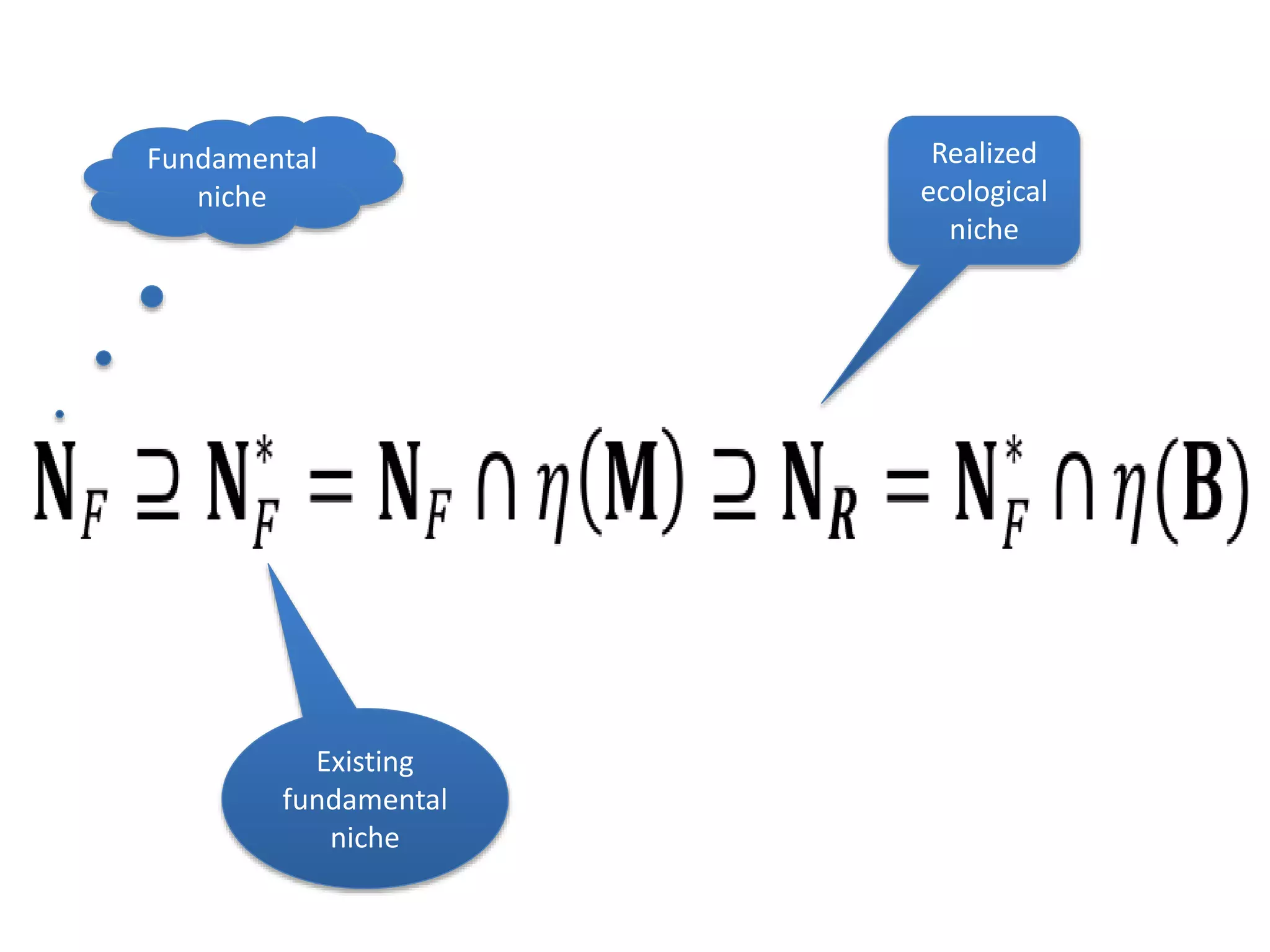
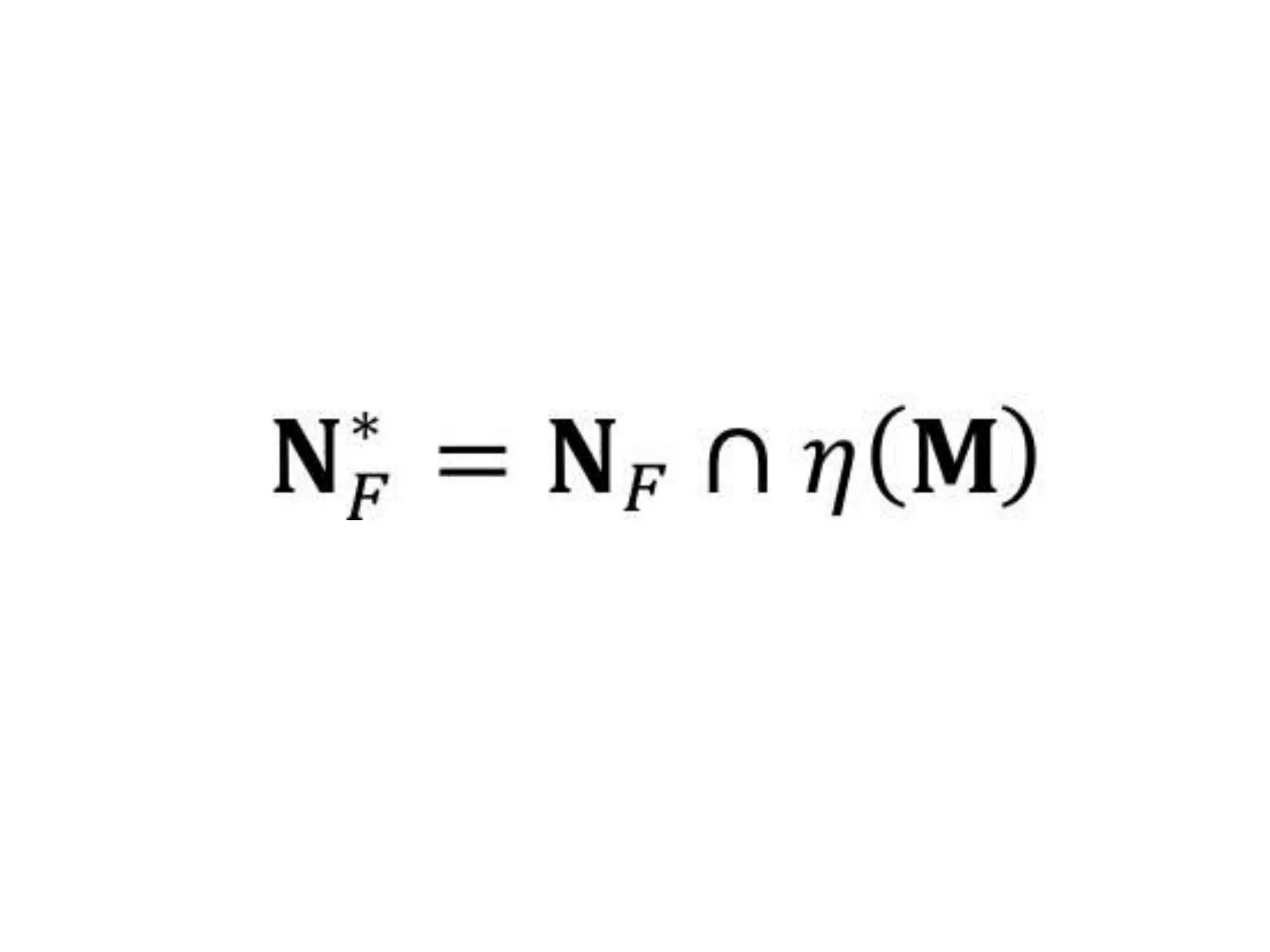
Fundamental
niche
Existing
fundamental
niche
Realized
ecological
niche
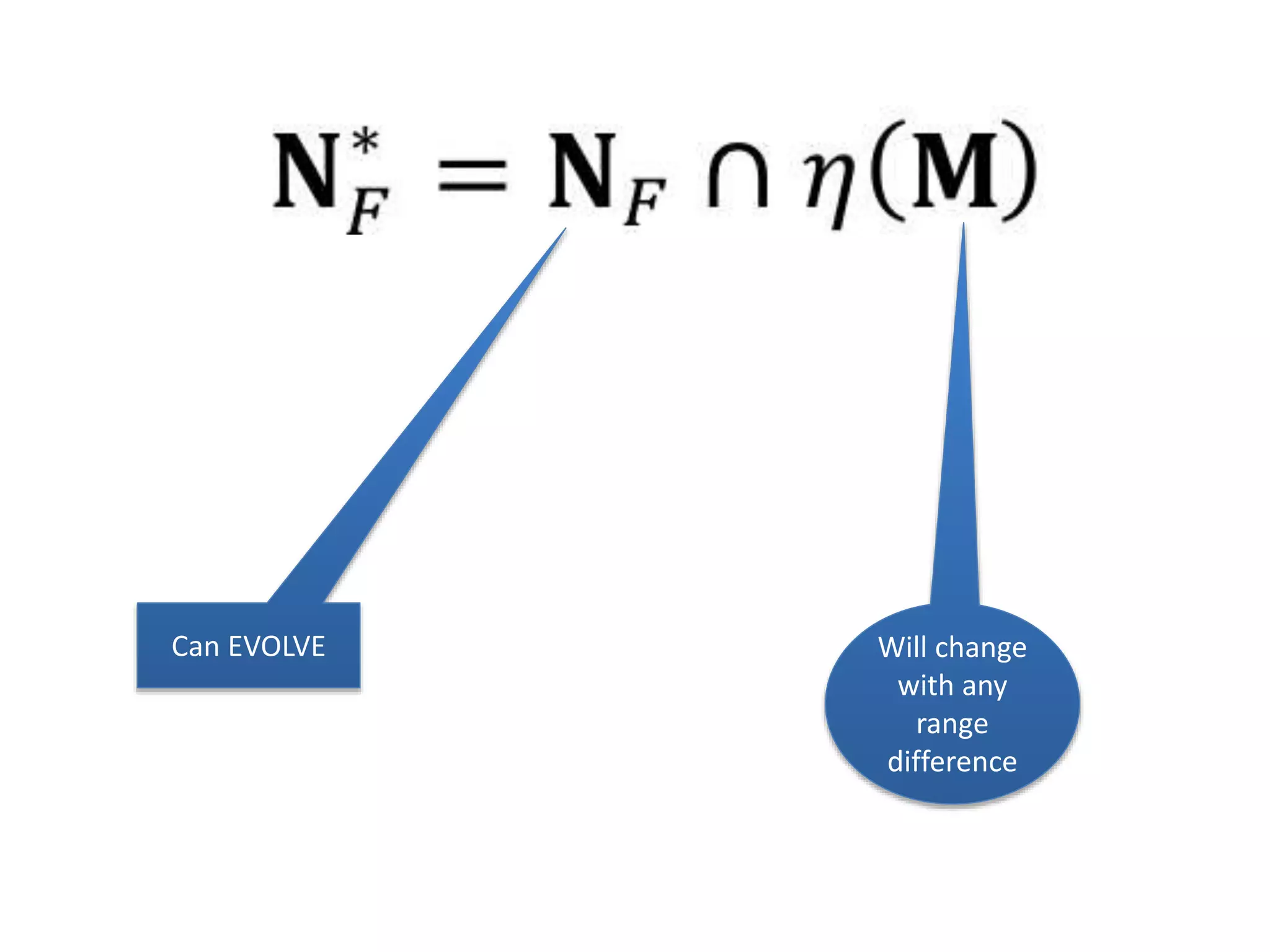
Can EVOLVE Will change
with any
range
difference
?
?
SUMMARY
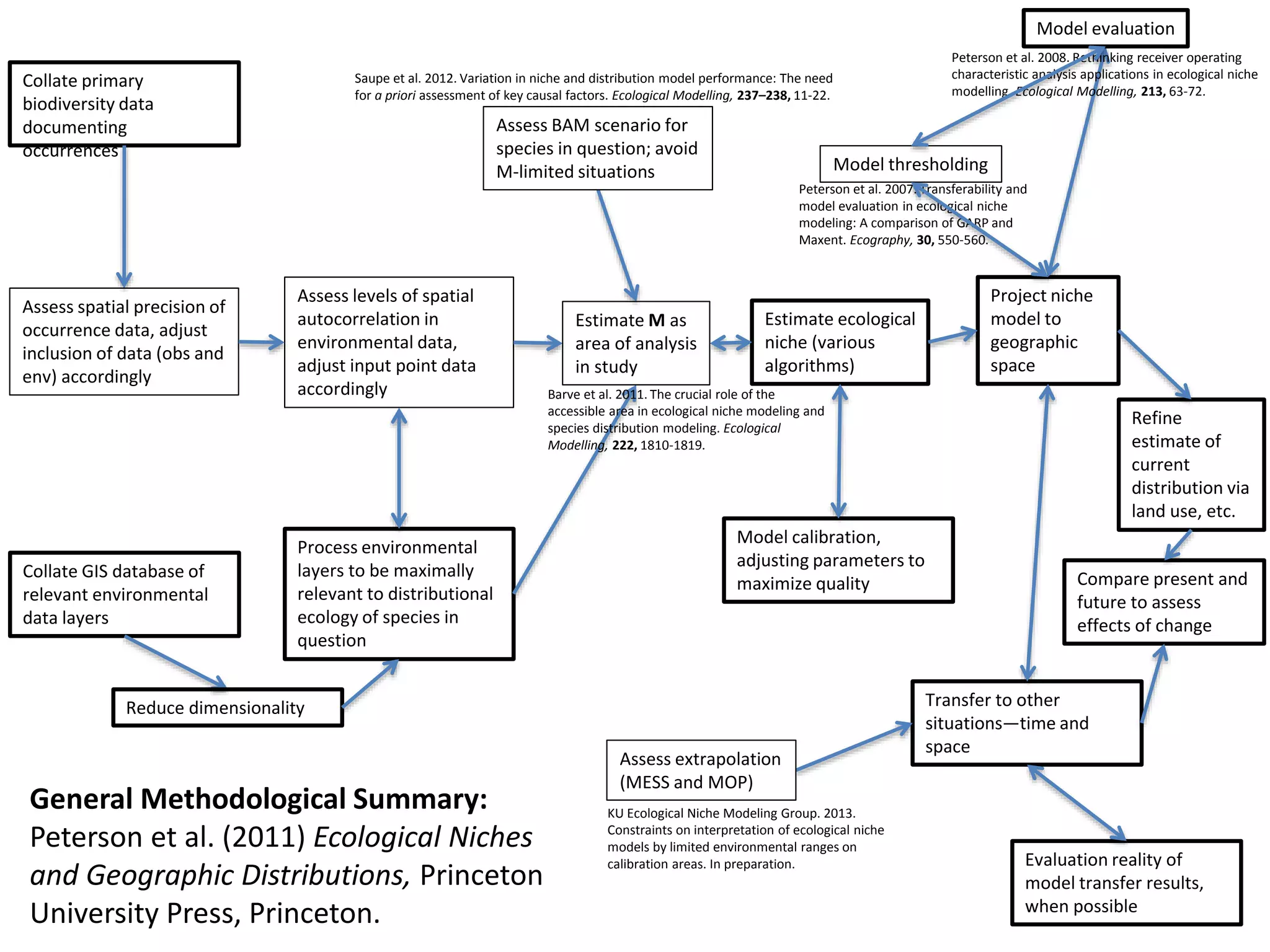
Assess levels of spatial
autocorrelation in
environmental data,
adjust input point data
accordingly
Estimate ecological
niche (various
algorithms)
Evaluation reality of
model transfer results,
when possible
Transfer to other
situations—time and
space
Project niche
model to
geographic
space
Model calibration,
adjusting parameters to
maximize quality
Collate primary
biodiversity data
documenting
occurrences
Process environmental
layers to be maximally
relevant to distributional
ecology of species in
question
Collate GIS database of
relevant environmental
data layers
Assess BAM scenario for
species in question; avoid
M-limited situations
Saupe et al. 2012. Variation in niche and distribution model performance: The need
for a priori assessment of key causal factors. Ecological Modelling, 237–238, 11-22.
Estimate M as
area of analysis
in study
Barve et al. 2011. The crucial role of the
accessible area in ecological niche modeling and
species distribution modeling. Ecological
Modelling, 222, 1810-1819.
Assess extrapolation
(MESS and MOP)
KU Ecological Niche Modeling Group. 2013.
Constraints on interpretation of ecological niche
models by limited environmental ranges on
calibration areas. In preparation.
Model evaluation
Peterson et al. 2008. Rethinking receiver operating
characteristic analysis applications in ecological niche
modelling. Ecological Modelling, 213, 63-72.
Model thresholding
Peterson et al. 2007. Transferability and
model evaluation in ecological niche
modeling: A comparison of GARP and
Maxent. Ecography, 30, 550-560.
Assess spatial precision of
occurrence data, adjust
inclusion of data (obs and
env) accordingly
General Methodological Summary:
Peterson et al. (2011) Ecological Niches
and Geographic Distributions, Princeton
University Press, Princeton.
Refine
estimate of
current
distribution via
land use, etc.
Reduce dimensionality
Compare present and
future to assess
effects of change
town@ku.edu

D1T1 overview of the theoretical foundations for ecological niche models

  • 1.
    The BAM Diagram:A Useful Heuristic A. Townsend Peterson University of Kansas
  • 3.
    Charles Elton –niche as role in communities G. Evelyn Hutchinson – multidimensional ecological niches, bionomic versus scenopoetic variables
  • 7.
    GEOGRAPHY – THEDISTRIBUTION
  • 8.
    The Area ofDistribution G Physiological requirements (Abiotic) A Favorable biotic environment (Biotic) B Accessible to dispersal (Movements) M
  • 9.
    The A andB Circles • Physiological requirements • Non-reactive variables. Uncoupled • Roughly independent of the interactions • Low “resolution” • Biotic requirements and impacts. Resource consumption, interactions, competitors, predators... • Variables interactive, dynamically coupled • High resolution A B
  • 10.
    A Useful andForgotten Distinction of Hutchinson (1978) • Scenopoetic variables. Non- interacting, slowly changing from a species point of view. Define conditions • Bionomic variables. Coupled, fast changing. Define regulation • Hutchinson´s useful distinction was quickly forgotten and then reinvented by Austin, Begon, Jackson & Overpeck, Meszena and others.
  • 11.
  • 12.
  • 13.
    Abiotic niche Biotic interactionsAccessibility Bioticinteractions Accessibility Abiotic nicheHow Hutchinson Saw the World
  • 14.
    Hutchinson needs to get outand travel a bit!
  • 16.
    Abiotic niche Biotic interactionsAccessibility Abioticniche Biotic interactions Accessibility Wallace’s World
  • 17.
    Demonstration of MEffects • Clear demonstration of the importance of dispersal limitation on species’ distributions • Invasive species – originally confined to a native distributional area • Some transport (often human-mediated) expands M • Distribution expands accordingly
  • 18.
    Abiotic niche Biotic interactionsAccessibility Areapresenting appropriate combinations of abiotic and biotic conditions (= potential distribution) Actual geographic distribution (abiotic and biotic conditions fulfilled, accessible to dispersers)
  • 20.
    Aedes albopictus • Knownas the “Asian Tiger Mosquito” • Invader; fastest spreading mosquito in the world • Aggressive daytime biter and pest • Known to transmit Dengue, La Crosse, St. Louis, Eastern Equine, Ross River, Rift Valley, and West Nile Viruses
  • 21.
    Aedes albopictus Present predicteddistribution, native range in Asia
  • 22.
    Aedes albopictus: USA invasion ProjectedAsian niche into USA present to create invasion risk-map. How well did GARP perform...
  • 23.
  • 24.
  • 26.
    Abiotic niche Biotic interactionsAccessibility BAMand Eltonian Noise Abiotic niche Biotic interactions Accessibility
  • 28.
  • 29.
    Five Goals ofNiche Modeling? 1. ESTIMATE THE FUNDAMENTAL NICHE 2. ESTIMATE THE FUNDAMENTAL NICHE 3. ESTIMATE THE FUNDAMENTAL NICHE 4. ESTIMATE THE FUNDAMENTAL NICHE 5. ESTIMATE THE FUNDAMENTAL NICHE
  • 30.
    How Would theFundamental Niche Look? • In any one dimension, expected to be unimodal • In multiple dimensions, expected to be convex • So, simple models are probably better • Need to take sampling and incomplete representation into account carefully
  • 31.
  • 34.
    The Area ofDistribution G Physiological requirements (Abiotic) A Favorable biotic environment (Biotic) B Accessible to dispersal (Movements) M
  • 36.
  • 38.
    Can EVOLVE Willchange with any range difference
  • 39.
  • 41.
  • 43.
    Assess levels ofspatial autocorrelation in environmental data, adjust input point data accordingly Estimate ecological niche (various algorithms) Evaluation reality of model transfer results, when possible Transfer to other situations—time and space Project niche model to geographic space Model calibration, adjusting parameters to maximize quality Collate primary biodiversity data documenting occurrences Process environmental layers to be maximally relevant to distributional ecology of species in question Collate GIS database of relevant environmental data layers Assess BAM scenario for species in question; avoid M-limited situations Saupe et al. 2012. Variation in niche and distribution model performance: The need for a priori assessment of key causal factors. Ecological Modelling, 237–238, 11-22. Estimate M as area of analysis in study Barve et al. 2011. The crucial role of the accessible area in ecological niche modeling and species distribution modeling. Ecological Modelling, 222, 1810-1819. Assess extrapolation (MESS and MOP) KU Ecological Niche Modeling Group. 2013. Constraints on interpretation of ecological niche models by limited environmental ranges on calibration areas. In preparation. Model evaluation Peterson et al. 2008. Rethinking receiver operating characteristic analysis applications in ecological niche modelling. Ecological Modelling, 213, 63-72. Model thresholding Peterson et al. 2007. Transferability and model evaluation in ecological niche modeling: A comparison of GARP and Maxent. Ecography, 30, 550-560. Assess spatial precision of occurrence data, adjust inclusion of data (obs and env) accordingly General Methodological Summary: Peterson et al. (2011) Ecological Niches and Geographic Distributions, Princeton University Press, Princeton. Refine estimate of current distribution via land use, etc. Reduce dimensionality Compare present and future to assess effects of change
  • 44.