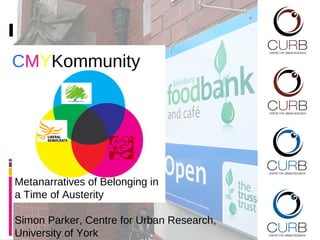
CMYKommunity
Metanarratives of Belonging in
a Time of Austerity
Simon Parker, Centre for Urban Research,
University of York
2
A shameless exercise in self-
citation...
 I propose a dynamic understanding of
community that is constituted through a
complex pattern of social identity
construction and animated through its
resistance to dominant power holders. This
thesis...explicitly refutes the communitarian
fiction that social and economic
inequalities can be evaporated in the
fellowship of contiguous space. If this paper
has one aim it is to demonstrate that nothing
could be further from the truth.
 S. Parker,Community, social identity and the structuration of power in the contemporary European
city. Part One: Towards a theory of urban structuration, CITY, VOL. 5, NO. 2, 2001, 189-202.
3
 ...a territorially bounded community is
not the product of freedom, but of
constraint.
 The capitalist division of
labour...problematizes community
insofar as it breaks the bonds between
work and place, yet at the same time it
reimposes order through the
commodification of space.
4
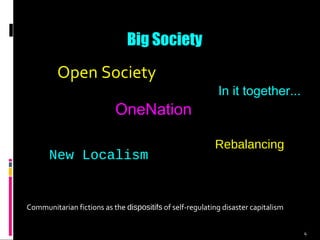
Open Society
Big Society
OneNation
New Localism
In it together...
Rebalancing
Communitarian fictions as the dispositifs of self-regulating disaster capitalism
5
repetition and difference
 Temporal-spatial instantiations of the
fictive doxa are always and
compulsively, iterative in the discourse
of the governors.
 Nation elides community as Kommunity
and hence the macro-spatial fix of class
rule.
 The city, the region, the would-be-
nation disrupt and threaten narratives of
unity through the subversion of
difference.
 The state of exception hypostatises
friend-foe dichotomies as psychic
compensation for self-castrating
capitalism [self-hating, vengeful state]
6
In this together...
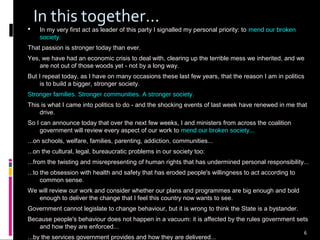
 In my very first act as leader of this party I signalled my personal priority: to mend our broken
society.
That passion is stronger today than ever.
Yes, we have had an economic crisis to deal with, clearing up the terrible mess we inherited, and we
are not out of those woods yet - not by a long way.
But I repeat today, as I have on many occasions these last few years, that the reason I am in politics
is to build a bigger, stronger society.
Stronger families. Stronger communities. A stronger society.
This is what I came into politics to do - and the shocking events of last week have renewed in me that
drive.
So I can announce today that over the next few weeks, I and ministers from across the coalition
government will review every aspect of our work to mend our broken society...
...on schools, welfare, families, parenting, addiction, communities...
...on the cultural, legal, bureaucratic problems in our society too:
...from the twisting and misrepresenting of human rights that has undermined personal responsibility...
...to the obsession with health and safety that has eroded people's willingness to act according to
common sense.
We will review our work and consider whether our plans and programmes are big enough and bold
enough to deliver the change that I feel this country now wants to see.
Government cannot legislate to change behaviour, but it is wrong to think the State is a bystander.
Because people's behaviour does not happen in a vacuum: it is affected by the rules government sets
and how they are enforced...
...by the services government provides and how they are delivered...
6
7
Open Society
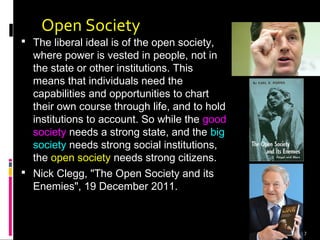
 The liberal ideal is of the open society,
where power is vested in people, not in
the state or other institutions. This
means that individuals need the
capabilities and opportunities to chart
their own course through life, and to hold
institutions to account. So while the good
society needs a strong state, and the big
society needs strong social institutions,
the open society needs strong citizens.
 Nick Clegg, "The Open Society and its
Enemies", 19 December 2011.
8
A pretty regular guy
 I was born in my local,
national health service
hospital, the same hospital
my two sons would later be
born in [the Royal Free in
Hampstead]...I went to my
local school, I went to my
local comprehensive with
people from all
backgrounds...
9
Another regular guy
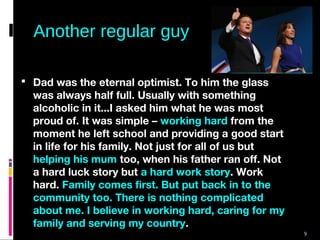
 Dad was the eternal optimist. To him the glass
was always half full. Usually with something
alcoholic in it...I asked him what he was most
proud of. It was simple – working hard from the
moment he left school and providing a good start
in life for his family. Not just for all of us but
helping his mum too, when his father ran off. Not
a hard luck story but a hard work story. Work
hard. Family comes first. But put back in to the
community too. There is nothing complicated
about me. I believe in working hard, caring for my
family and serving my country.
10
Nation is the Key
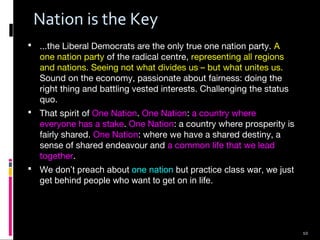
 ...the Liberal Democrats are the only true one nation party. A
one nation party of the radical centre, representing all regions
and nations. Seeing not what divides us – but what unites us.
Sound on the economy, passionate about fairness: doing the
right thing and battling vested interests. Challenging the status
quo.
 That spirit of One Nation. One Nation: a country where
everyone has a stake. One Nation: a country where prosperity is
fairly shared. One Nation: where we have a shared destiny, a
sense of shared endeavour and a common life that we lead
together.
 We don’t preach about one nation but practice class war, we just
get behind people who want to get on in life.
11
 we succeeded, because of one reason more than any other, we succeeded
because of us. We succeeded because of us, us the British people, us the
British people who welcomed the athletes from abroad, who cheered them
on. Who found ourselves talking to each other each morning about what
had happened at the Olympics the night before, in a way that we hadn’t
talked to each other before. We succeeded because we came together as a
country we worked together as a country. We joined together as a country.
That’s why we achieved more than we imagined possible. I can’t
remember a time like it in the whole
history of my lifetime. I can’t remember
a time like it, that sense of a country
united, that sense of a country that felt it
was together. That is the spirit this
Labour Party believes in.
12
Rebalancing cities
 “The time has come to disperse power more widely in Britain today.”
The Prime Minister and the Deputy Prime Minister, Coalition
Agreement, May 2010.
Empowering communities:
“We think that the best means of strengthening society is not for central government
to try and seize all the power and responsibility for itself. It is to help people and
their locally elected representatives to achieve their own ambitions. This is the
essence of the Big Society”.
Greg Clarke, Minister of State, DCLG.
13
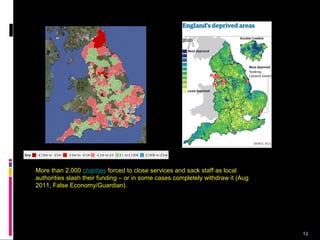
More than 2,000 charities forced to close services and sack staff as local
authorities slash their funding – or in some cases completely withdraw it (Aug
2011, False Economy/Guardian).
14
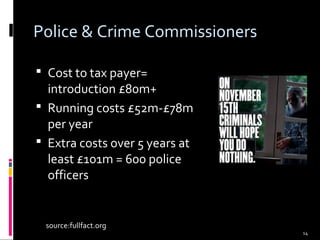
Police & Crime Commissioners
 Cost to tax payer=
introduction £80m+
 Running costs £52m-£78m
per year
 Extra costs over 5 years at
least £101m = 600 police
officers
source:fullfact.org
15
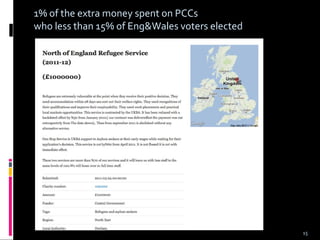
1% of the extra money spent on PCCs
who less than 15% of Eng&Wales voters elected
16
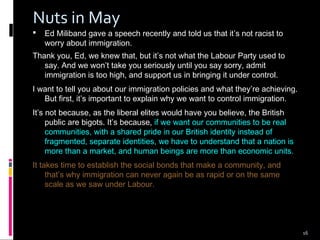
Nuts in May
 Ed Miliband gave a speech recently and told us that it’s not racist to
worry about immigration.
Thank you, Ed, we knew that, but it’s not what the Labour Party used to
say. And we won’t take you seriously until you say sorry, admit
immigration is too high, and support us in bringing it under control.
I want to tell you about our immigration policies and what they’re achieving.
But first, it’s important to explain why we want to control immigration.
It’s not because, as the liberal elites would have you believe, the British
public are bigots. It’s because, if we want our communities to be real
communities, with a shared pride in our British identity instead of
fragmented, separate identities, we have to understand that a nation is
more than a market, and human beings are more than economic units.
It takes time to establish the social bonds that make a community, and
that’s why immigration can never again be as rapid or on the same
scale as we saw under Labour.
17
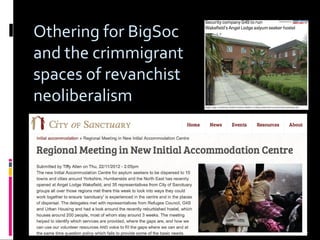
Othering for BigSoc
and the crimmigrant
spaces of revanchist
neoliberalism
18
19
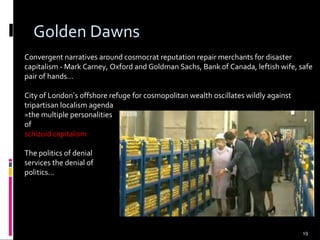
Golden Dawns
Convergent narratives around cosmocrat reputation repair merchants for disaster
capitalism - Mark Carney, Oxford and Goldman Sachs, Bank of Canada, leftish wife, safe
pair of hands...
City of London’s offshore refuge for cosmopolitan wealth oscillates wildly against
tripartisan localism agenda
=the multiple personalities
of
schizoid capitalism
The politics of denial
services the denial of
politics...
20
cK = Kommunity vs comm[on]unity
 Kicking “K” Kommunity is
the“community” of the
revanchist state
 Curly “c” community
belongs etymologically and
ideologically to the
commune and the politics
of resistance
 The task - should we
choose to accept it - is to
rescue the c from the K
 From the One to the Many

Cymkommunity: Metanarratives of Belonging in a Time of Austerity

  • 1.
    CMYKommunity Metanarratives of Belongingin a Time of Austerity Simon Parker, Centre for Urban Research, University of York
  • 2.
    2 A shameless exercisein self- citation...  I propose a dynamic understanding of community that is constituted through a complex pattern of social identity construction and animated through its resistance to dominant power holders. This thesis...explicitly refutes the communitarian fiction that social and economic inequalities can be evaporated in the fellowship of contiguous space. If this paper has one aim it is to demonstrate that nothing could be further from the truth.  S. Parker,Community, social identity and the structuration of power in the contemporary European city. Part One: Towards a theory of urban structuration, CITY, VOL. 5, NO. 2, 2001, 189-202.
  • 3.
    3  ...a territoriallybounded community is not the product of freedom, but of constraint.  The capitalist division of labour...problematizes community insofar as it breaks the bonds between work and place, yet at the same time it reimposes order through the commodification of space.
  • 4.
    4 Open Society Big Society OneNation NewLocalism In it together... Rebalancing Communitarian fictions as the dispositifs of self-regulating disaster capitalism
  • 5.
    5 repetition and difference Temporal-spatial instantiations of the fictive doxa are always and compulsively, iterative in the discourse of the governors.  Nation elides community as Kommunity and hence the macro-spatial fix of class rule.  The city, the region, the would-be- nation disrupt and threaten narratives of unity through the subversion of difference.  The state of exception hypostatises friend-foe dichotomies as psychic compensation for self-castrating capitalism [self-hating, vengeful state]
  • 6.
    6 In this together... In my very first act as leader of this party I signalled my personal priority: to mend our broken society. That passion is stronger today than ever. Yes, we have had an economic crisis to deal with, clearing up the terrible mess we inherited, and we are not out of those woods yet - not by a long way. But I repeat today, as I have on many occasions these last few years, that the reason I am in politics is to build a bigger, stronger society. Stronger families. Stronger communities. A stronger society. This is what I came into politics to do - and the shocking events of last week have renewed in me that drive. So I can announce today that over the next few weeks, I and ministers from across the coalition government will review every aspect of our work to mend our broken society... ...on schools, welfare, families, parenting, addiction, communities... ...on the cultural, legal, bureaucratic problems in our society too: ...from the twisting and misrepresenting of human rights that has undermined personal responsibility... ...to the obsession with health and safety that has eroded people's willingness to act according to common sense. We will review our work and consider whether our plans and programmes are big enough and bold enough to deliver the change that I feel this country now wants to see. Government cannot legislate to change behaviour, but it is wrong to think the State is a bystander. Because people's behaviour does not happen in a vacuum: it is affected by the rules government sets and how they are enforced... ...by the services government provides and how they are delivered... 6
  • 7.
    7 Open Society  Theliberal ideal is of the open society, where power is vested in people, not in the state or other institutions. This means that individuals need the capabilities and opportunities to chart their own course through life, and to hold institutions to account. So while the good society needs a strong state, and the big society needs strong social institutions, the open society needs strong citizens.  Nick Clegg, "The Open Society and its Enemies", 19 December 2011.
  • 8.
    8 A pretty regularguy  I was born in my local, national health service hospital, the same hospital my two sons would later be born in [the Royal Free in Hampstead]...I went to my local school, I went to my local comprehensive with people from all backgrounds...
  • 9.
    9 Another regular guy Dad was the eternal optimist. To him the glass was always half full. Usually with something alcoholic in it...I asked him what he was most proud of. It was simple – working hard from the moment he left school and providing a good start in life for his family. Not just for all of us but helping his mum too, when his father ran off. Not a hard luck story but a hard work story. Work hard. Family comes first. But put back in to the community too. There is nothing complicated about me. I believe in working hard, caring for my family and serving my country.
  • 10.
    10 Nation is theKey  ...the Liberal Democrats are the only true one nation party. A one nation party of the radical centre, representing all regions and nations. Seeing not what divides us – but what unites us. Sound on the economy, passionate about fairness: doing the right thing and battling vested interests. Challenging the status quo.  That spirit of One Nation. One Nation: a country where everyone has a stake. One Nation: a country where prosperity is fairly shared. One Nation: where we have a shared destiny, a sense of shared endeavour and a common life that we lead together.  We don’t preach about one nation but practice class war, we just get behind people who want to get on in life.
  • 11.
    11  we succeeded,because of one reason more than any other, we succeeded because of us. We succeeded because of us, us the British people, us the British people who welcomed the athletes from abroad, who cheered them on. Who found ourselves talking to each other each morning about what had happened at the Olympics the night before, in a way that we hadn’t talked to each other before. We succeeded because we came together as a country we worked together as a country. We joined together as a country. That’s why we achieved more than we imagined possible. I can’t remember a time like it in the whole history of my lifetime. I can’t remember a time like it, that sense of a country united, that sense of a country that felt it was together. That is the spirit this Labour Party believes in.
  • 12.
    12 Rebalancing cities  “Thetime has come to disperse power more widely in Britain today.” The Prime Minister and the Deputy Prime Minister, Coalition Agreement, May 2010. Empowering communities: “We think that the best means of strengthening society is not for central government to try and seize all the power and responsibility for itself. It is to help people and their locally elected representatives to achieve their own ambitions. This is the essence of the Big Society”. Greg Clarke, Minister of State, DCLG.
  • 13.
    13 More than 2,000charities forced to close services and sack staff as local authorities slash their funding – or in some cases completely withdraw it (Aug 2011, False Economy/Guardian).
  • 14.
    14 Police & CrimeCommissioners  Cost to tax payer= introduction £80m+  Running costs £52m-£78m per year  Extra costs over 5 years at least £101m = 600 police officers source:fullfact.org
  • 15.
    15 1% of theextra money spent on PCCs who less than 15% of Eng&Wales voters elected
  • 16.
    16 Nuts in May Ed Miliband gave a speech recently and told us that it’s not racist to worry about immigration. Thank you, Ed, we knew that, but it’s not what the Labour Party used to say. And we won’t take you seriously until you say sorry, admit immigration is too high, and support us in bringing it under control. I want to tell you about our immigration policies and what they’re achieving. But first, it’s important to explain why we want to control immigration. It’s not because, as the liberal elites would have you believe, the British public are bigots. It’s because, if we want our communities to be real communities, with a shared pride in our British identity instead of fragmented, separate identities, we have to understand that a nation is more than a market, and human beings are more than economic units. It takes time to establish the social bonds that make a community, and that’s why immigration can never again be as rapid or on the same scale as we saw under Labour.
  • 17.
    17 Othering for BigSoc andthe crimmigrant spaces of revanchist neoliberalism
  • 18.
  • 19.
    19 Golden Dawns Convergent narrativesaround cosmocrat reputation repair merchants for disaster capitalism - Mark Carney, Oxford and Goldman Sachs, Bank of Canada, leftish wife, safe pair of hands... City of London’s offshore refuge for cosmopolitan wealth oscillates wildly against tripartisan localism agenda =the multiple personalities of schizoid capitalism The politics of denial services the denial of politics...
  • 20.
    20 cK = Kommunityvs comm[on]unity  Kicking “K” Kommunity is the“community” of the revanchist state  Curly “c” community belongs etymologically and ideologically to the commune and the politics of resistance  The task - should we choose to accept it - is to rescue the c from the K  From the One to the Many

Editor's Notes

  • #2 Presented to the Post-Crash City: Community conference, University of York, 14 December 2012.
  • #8 George Soros is 15th wealthiest man in the world worth an estimated $19B - made his fortune from hedge funds and from speculative attacks on national currencies such as sterling from which he made over $1B during Black Wednesday 16 Sept 1992.
  • #11 1. Nick Clegg to LibDems Spring Conference 2012, 2. Ed Miliband, Labour Party Conference 2012, David Cameron, Birmingham Conference Speech 2012.
  • #13 weekly bin collections back
  • #20 Carney’s role at Sachs was to advise Russia on dealing with its financial crisis in 1998 while his firm simultaneously bet against Russia being able to pay its debts – i.e. shorting on a crash just as it has been with Greece etc.