REFORM
A new force


Dale Bassett
Andrew Haldenby
Laurie Thraves
Elizabeth Truss


February 2009
A new force


The authors
Dale Bassett is Reform’s Senior Crime Researcher.
Andrew Haldenby is Director of Reform.
Laurie Thraves is a Researcher at Reform.
Elizabeth Truss is Reform’s Deputy Director.
A new force


    Reform
    Reform is an independent, non-party think tank whose mission is to set out a better way to deliver public
    services and economic prosperity.
    We believe that by reforming the public sector, increasing investment and extending choice, high quality
    services can be made available for everyone.
    Our vision is of a Britain with 21st Century healthcare, high standards in schools, a modern and efficient
    transport system, safe streets, and a free, dynamic and competitive economy.
A new force


Dale Bassett
Andrew Haldenby
Laurie Thraves
Elizabeth Truss


February 2009
A new force


    Contents
       Executive Summary                            5
    1 The myths of policing                         7
       Myth 1: The politicisation myth              9
       Myth 2: The local force myth                 12
       Myth 3: The intelligence myth                17
       Myth 4: The scale myth                       19
       Myth 5: The serious crime myth               21
    2 The principles of reform                      24
    3 A new force                                   28
       References                                   39
       Appendix: How the forces could restructure   42
A new force


Executive summary
Without effective police reform, England and Wales will lose the fight against crime in years to come.
Serious crime is rising and mutating as new crimes emerge such as people trafficking and internet fraud,
creating entrenched social problems. But the nightmare position of the public finances means that the
police’s extravagant spending increases over the last decade cannot be sustained and will in all likelihood be
reversed. The police in England and Wales are the most expensive in the developed world – costing a fifth
higher as a share of GDP than in America.
The structure of the police presents a block to necessary reform. The “tripartite model” – with power
shared between the Home Secretary, Police Authorities and Chief Constables – means that Government
does not have effective control over national policing priorities. The 43 forces are run as fiefdoms by their
Chief Constables. To get things done, the Home Office resorts to bribing forces with sweeteners.
Five myths have defeated reforming politicians over the years:
Myth 1
Policing should not be “politicised”. In fact the police should be accountable to elected politicians. Currently
the Association of Chief Police Officers (ACPO) – a self-perpetuating oligarchy – is the key influence on police
forces, in a textbook example of producer capture. It will gain more power over appointments in the new
Policing and Crime Bill.
Myth 2
All policing is local. In fact England and Wales does have a national lead police force – the Metropolitan
Police – which is already coordinating serious crime fighting across the country. In addition national
politicians interfere in day-to day policing, preventing local leaders from answering their democratic mandate
to fight crime.
Myth 3
The 43 police forces work well together. In fact the 43 forces operate separately, in particular failing to share
information, as the Bichard Inquiry found.
Myth 4
The 43 forces generate economies of scale. In fact waste occurs at two levels: unnecessary regional
bureaucracies, and duplicated spending on serious crime at a national level.
Myth 5
The creation of the Serious Organised Crime Agency (SOCA) has solved the serious crime problem. In fact
serious crime is rising, while SOCA is a white elephant.
To move forward the reality should be acknowledged, both at a national and local level.
The Metropolitan Police is the only credible force capable of leading on national and regional serious and
organised crime. The Government confirmed this in 2008 by putting the previously abolished e-crime unit
(at a cost to the taxpayer of £7 million) with the Metropolitan Police, not SOCA.
A new force
    Executive summary


    Counter-terrorism hubs, funded by the Home Office, operated by local police forces and coordinated by
    the Metropolitan Police present an exciting model for how effective national crime fighting could work.
    The Metropolitan Police should be given a formal role leading national serious crime policing.
    A change in the accountability structure would be impractical given the dual national and local role of the
    Metropolitan Police. However, greater scrutiny should come through full operational and financial
    transparency which is currently lacking.
    Until Jacqui Smith’s retreat in December 2008, there was cross-party consensus for greater local accountability
    for policing. The principle is right: smaller policing units solve more crimes per officer than larger ones.
    Proposals for local accountability have foundered partly because they have tried to follow a one-size-fits-all
    model for the whole of England and Wales. Proposals should reflect the varying reality of local government
    arrangements in England and Wales. In most areas, the natural arrangement for policing is for higher tier
    council areas (for example County and City Councils) to hold police forces to account.
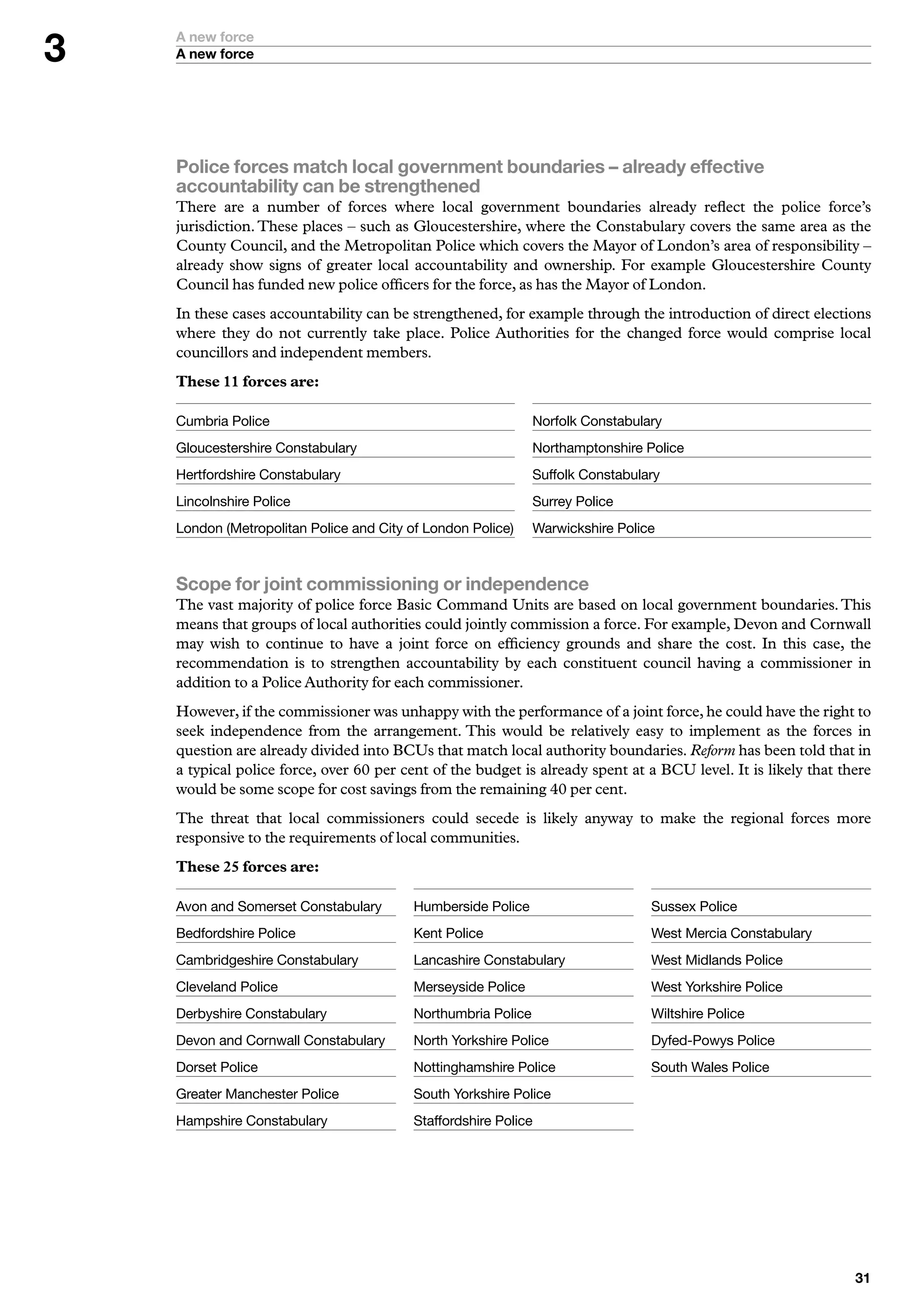
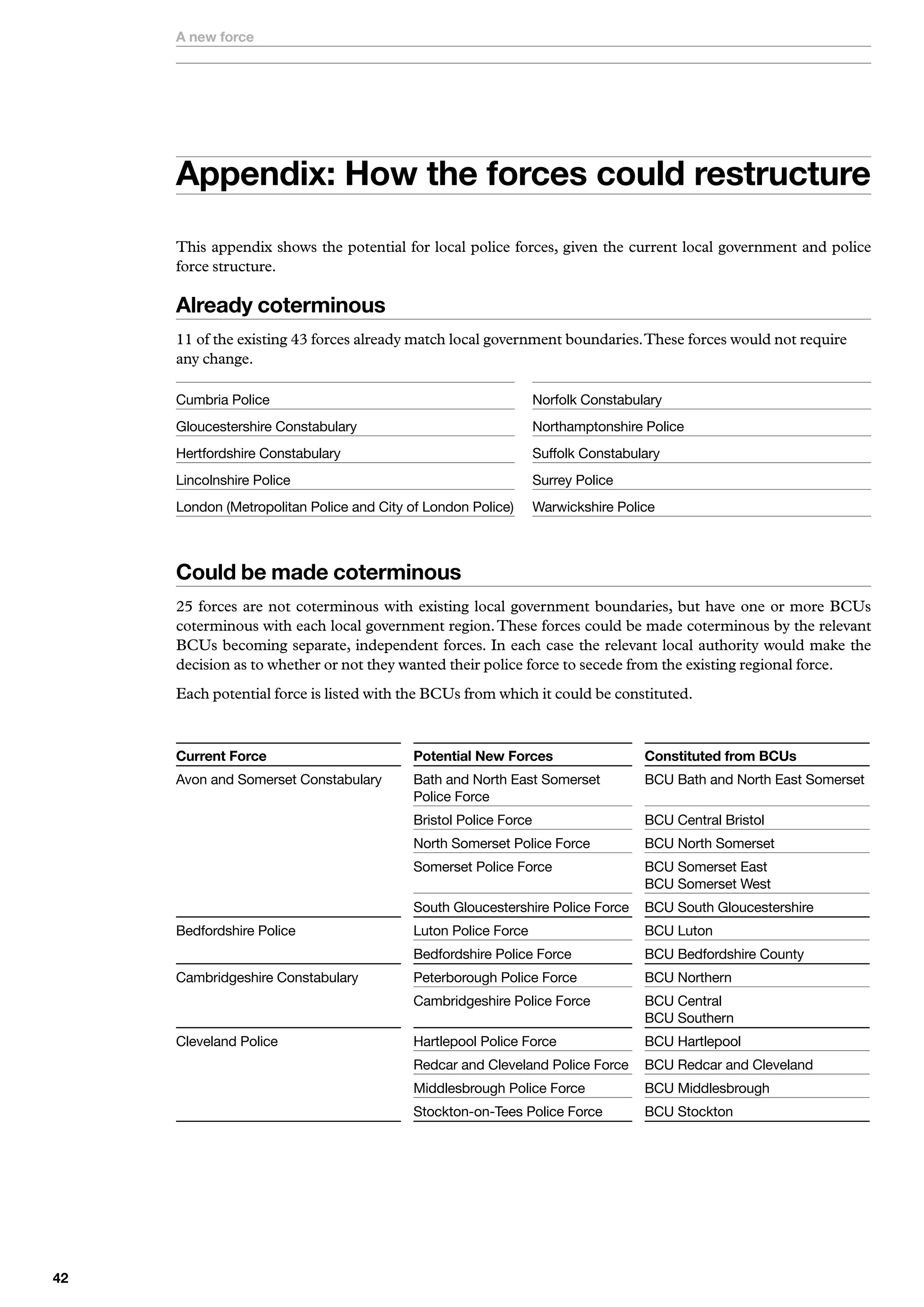
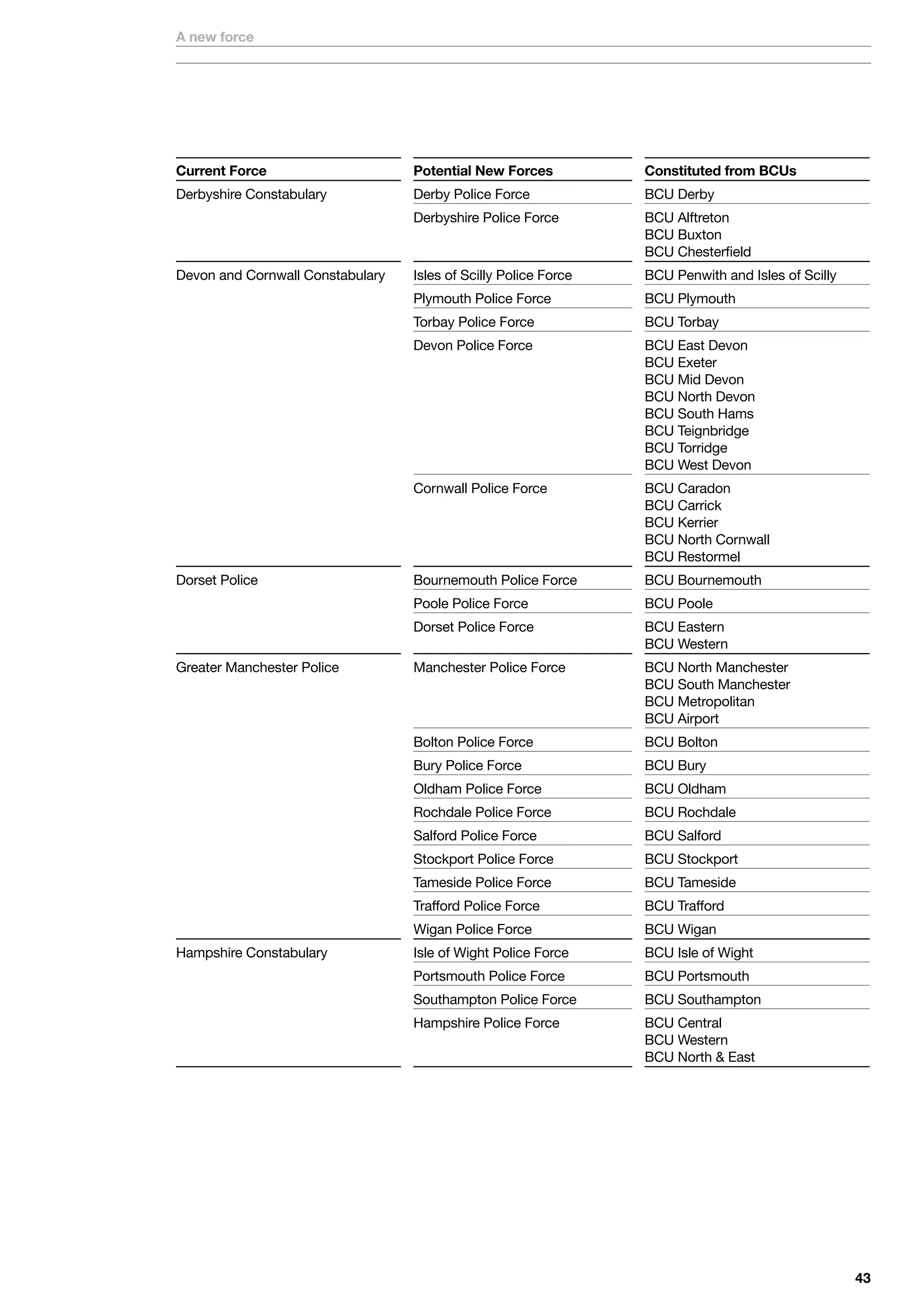
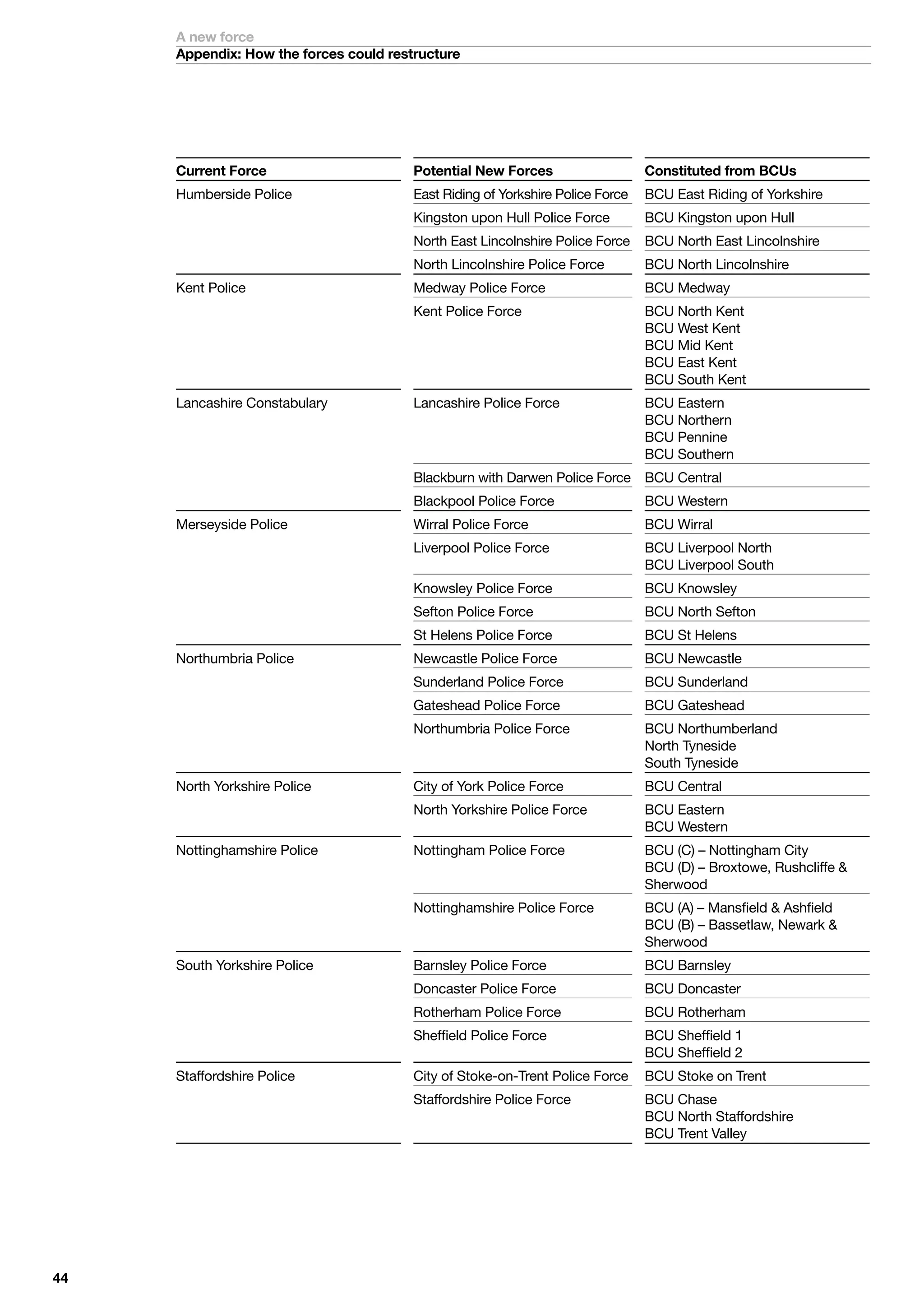
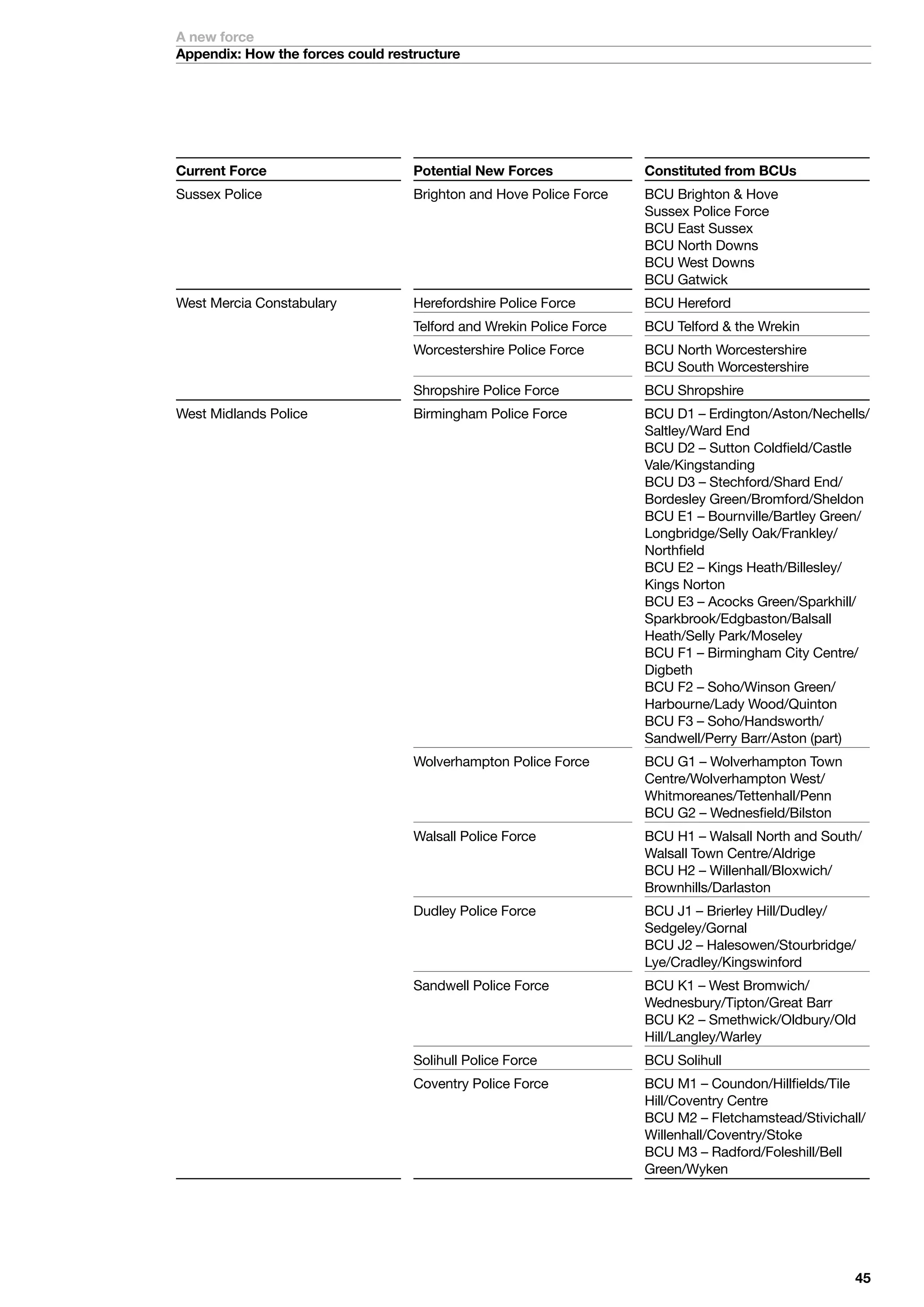
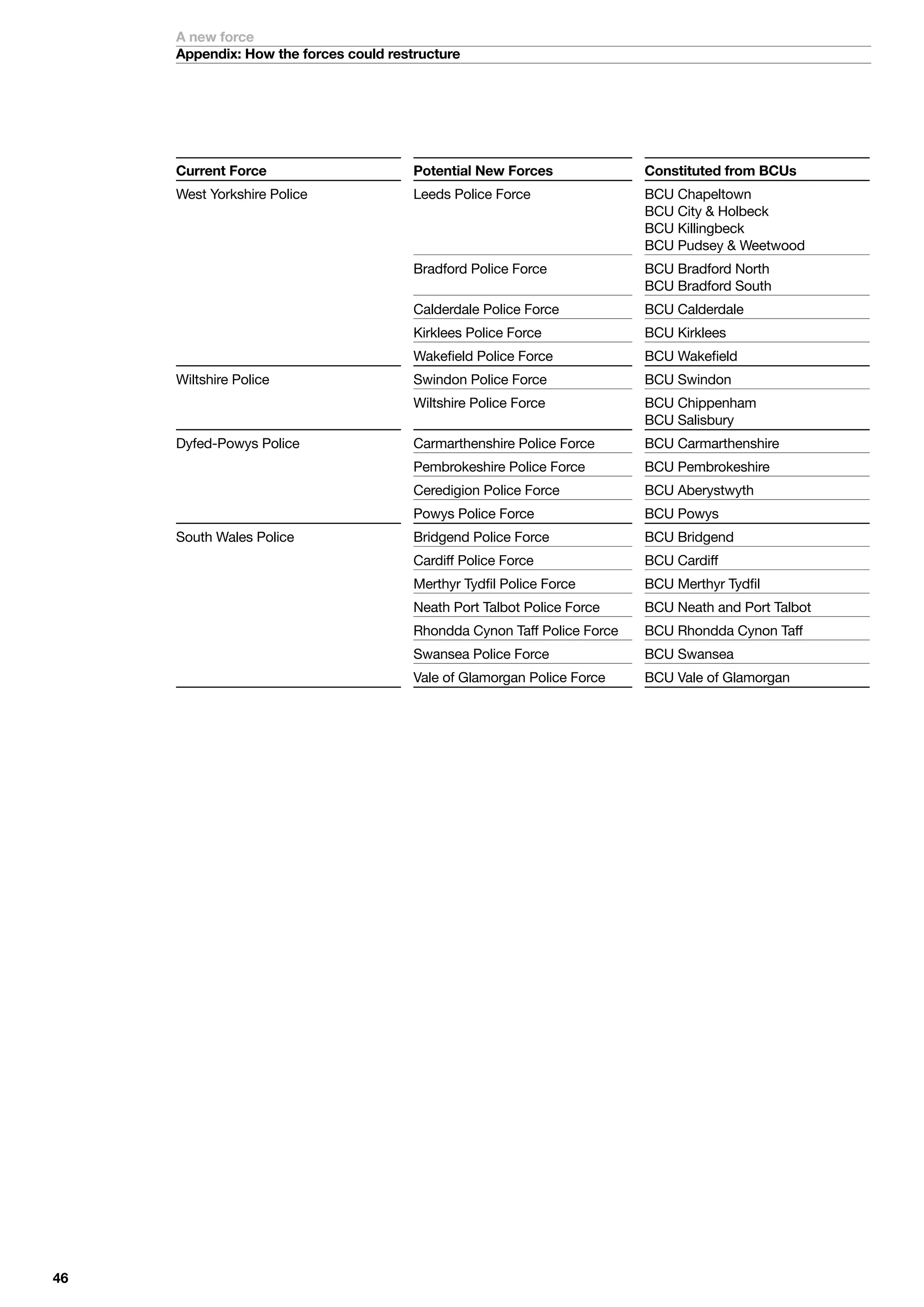
    In practice 11 forces, such as Gloucestershire, can become accountable at a county level in their current
    boundaries. 25 forces, such as WestYorkshire and Avon  Somerset, could be split to reflect local government
    boundaries; local authorities in these areas should be allowed to secede their local policing from the regional
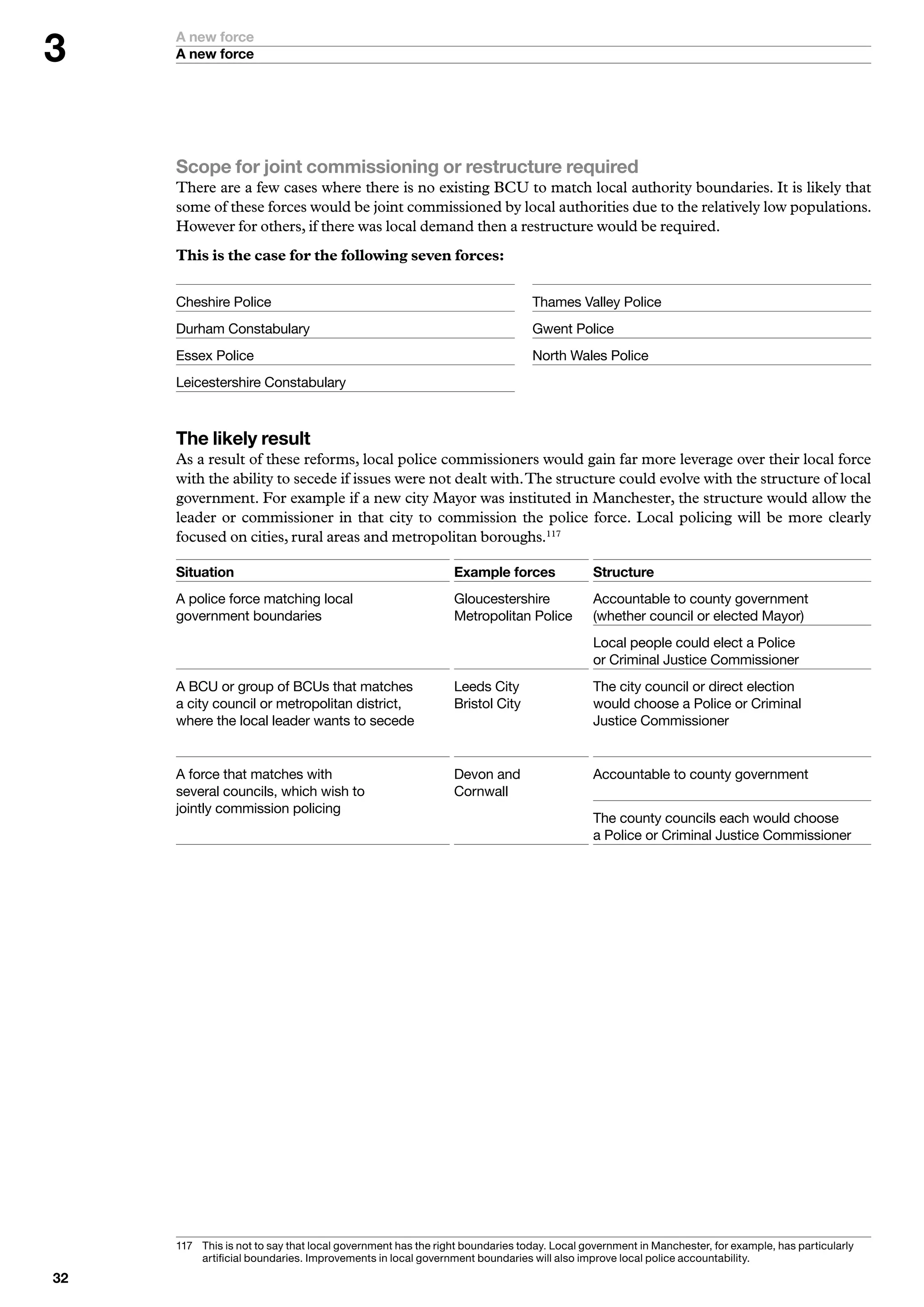
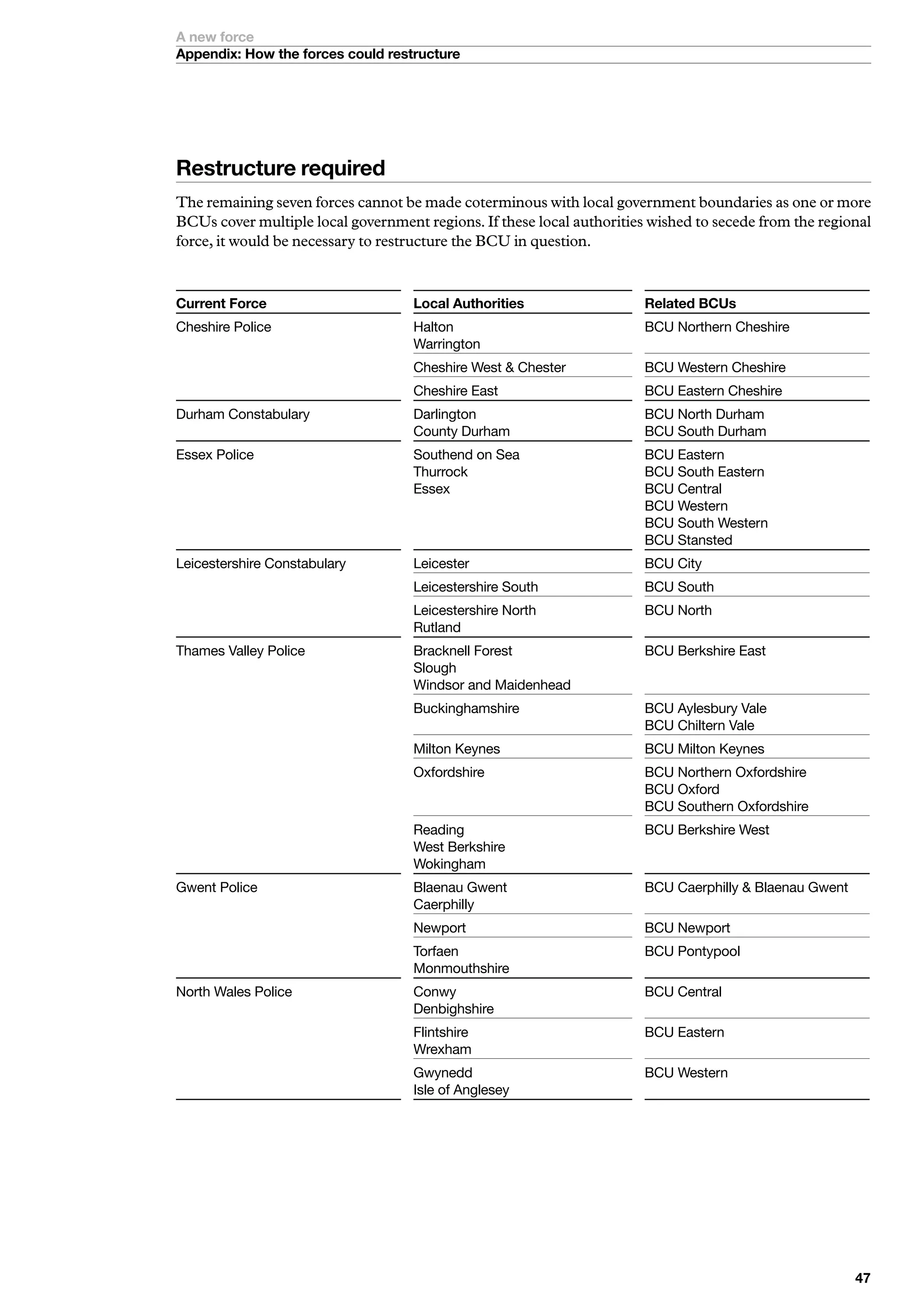
    force. Seven forces have structures that are currently incompatible with local government.
    These recommendations require a new role for the Home Office and Home Secretary. The Home Secretary
    would become, in effect, the commissioner of national policing. The Home Office should then address itself
    to becoming an excellent commissioner of serious organised crime services and abandon its role in volume
    crime fighting at a local level.
A new force


The myths of policing
Since the establishment of the “Bobby” by Sir Robert Peel, policing in Britain has been characterised by
strong emotional imagery and established practice. From Inspector Lestrade to Dixon of Dock Green to
The Bill, public imaginings of police activities are based more on popular culture than practice. This is
nothing new. The 1962 Royal Commission report on policing refers to “a certain historical sentimentality
about the police constable”.1 The public still believe in the honest officer who is independent, uses his
judgement and is an integral part of the local community.
In their discourse politicians and policymakers are similarly subject to the “smoke and mirrors” that
surround policing and its practice. Police themselves are in the grip of a powerful culture and sense of being;
in discussions with officers, Reform has frequently heard outsiders referred to as “civilians”.

Respect for the force
The British police have been regarded as the best in the world. Much of the record of the police is positive,
and a number of strong features exist in the current structure. Police officers are well-respected professionals
with high status in society.2 Police in England and Wales are relatively free of corruption in comparison with
other countries.3
The functions of police have vastly increased since the 1960s, as the service has evolved to deal with new
threats like hi-tech crime and people trafficking. There have been high-profile successes in meeting these
new challenges. The Dedicated Cheque and Plastic Crime Unit, for instance, is a partnership of officers
from the Metropolitan and City of London forces and fraud investigators that was responsible for £107
million in estimated fraud savings in 2007.4 There is strong expertise in the Metropolitan Police on serious
crime. The police are loyal and proud of their work.

Falling confidence
But there are problems. Public confidence in the police, measured by the British Crime Survey, is falling
dramatically. In 1982, 92 per cent of people had confidence in the service; in 2004 only 47 per cent did.5 A
2002 ICM poll found that 68 per cent of people thought that the police did not reflect local priorities.6 A 2007
ICM poll found that 73 per cent of the public felt that the police do not spend enough time out on the beat.7
The self-confidence of police officers is suffering. In North Wales, discontent over management style,
mounting paperwork and targets has resulted in plummeting morale.8 The top jobs no longer hold the
appeal and prestige that they once did. Investigations by The Times have found a dwindling number of
officers putting themselves forward for the position of Chief Constable.9


	   	 oyal	Commission	on	the	Police	(962),	Final Report.
     R
2	   	 uropean	Crime	and	Safety	Survey	(2005),	The Burden of Crime in the EU:	The	UK	came	seventh	out	of	8	European	countries	in	terms	
     E
     of	public	perception	of	police	performance.
	   	 iller,	J.	(200),	Police Corruption in England and Wales: An assessment of current evidence,	Home	Office:	The	report	concludes	that	
     M
     corruption	is	“limited	to	a	small	minority	of	police	staff”;	Transparency	International	(2002),	Corruption at the Local Government Level:
     the US Experience:	Local	police	corruption	is	“widespread”	in	the	US.
	   A
     	 PACS	(2008),	apacs.org.uk.
5	   	 ome	Office	(982),	British Crime Survey:	92	per	cent	of	people	rated	their	confidence	in	the	police	as	very	good	or	fairly	good;	Home	
     H
     Office	(200),	British Crime Survey:	7	per	cent	of	people	rated	their	confidence	in	the	police	as	good	or	excellent.
6	   	 oveday,	B.	and	Reid,	A.	(200),	Going local: Who should run Britain’s police force?,	Policy	Exchange.
     L
7	   	 he	Conservative	Party	(2007),	Policing for the People: Interim report of the Police Reform Taskforce.
     T
8	   Daily Post	(2008),	“North	Wales	Police	officers	suffer	low	morale	says	survey”,	9	September.
     	
9	   The Times (2008)	“Police	recruitment	crisis	as	officers	spurn	chance	to	be	chief	constables”,	9	June.
A new force
    The myths of policing


    The tripartite structure
    Police accountability in England and Wales is in theory shared between three actors: the Home Secretary,
    the Police Authorities and Chief Constables themselves.
    In England and Wales, the role of Chief Constables is embedded through the tripartite system and ACPO.
    The Home Office describes its role as working with Chief Police Officers and Police Authorities to manage
    police forces. It says that “this system prevents political interference in policing and avoids giving any single
    organisation power over the entire police service”.10
    The police are divided into 43 arbitrary regions across England and Wales. In some cases these regions
    match local government boundaries; in the majority they do not.

    The new myths
    The old myth of the Bobby has been replaced by a new set of myths about politicisation, the local copper,
    intelligence and serious crime that hold the modern force together and act as a barrier to reform. They
    stand in the way of genuine reform of the police force which would benefit the taxpayer, the public and the
    police themselves.


    0	   H
          	 ome	Office	(2008),	http://www.homeoffice.gov.uk/police/about/.
A new force
    The myths of policing


    Myth : The politicisation myth
    There is a belief that politicians can control the police, harnessing the force to reassure the public that crime is
    being reduced. Politicians try to “out-tough” each other with their talk on crime. The result is increasing
    concern that the police are becoming “politicised” and that their “operational independence” is being eroded.
    The recent Damian Green case has come to epitomise the problem. The Home Secretary, Jacqui Smith,
    approved a decision to call in the police to investigate leaks by a civil servant working in the Home Office.
    The resulting raid on Mr Green’s House of Commons offices provoked outrage amongst MPs of all stripes,
    and embroiled Ms Smith as well as Sir Paul Stephenson (then acting and now permanent Metropolitan
    Police Commissioner), Boris Johnson (Mayor of London) and Michael Martin (Speaker of the Commons)
    in a public row over the independence of the police’s operations.11

    Reality: Politicians interfere in policing practice but not the strategy
    Policing priorities are inherently “political”. Citizens have particular concerns about crime and they elect
    politicians who claim that they will address those concerns. However the lack of a clear sense of the division
    of responsibility between politicians and the police creates confusion and prevents genuine accountability.
    Police Chiefs’ day-to-day decisions are hampered by central targets determining whom to hire and fire,
    which crimes to prioritise, and how much time officers must spend on any particular task. Meanwhile
    politicians struggle to grip the strategic priorities which are heavily guarded by ACPO.

    The operational independence of the police is protected
    The operational independence of the police is not enshrined in statute.12 Further, the 1999 Patten Report
    on policing in Northern Ireland suggests that:
             “The term ‘operational independence’ is itself a large part of the problem. In a democratic society,
             all public officials must be fully accountable to the institutions of that society for the due performance
             of their functions, and a chief of police cannot be an exception. No public official, including a chief
             of police, can be said to be ‘independent’. Indeed, given the extraordinary powers conferred on the
             police, it is essential that their exercise is subject to the closest and most effective scrutiny possible.”13
    But the actual independence of police to plan and execute their own operations is well in place, and case
    law such as R v Metropolitan Police Commissioner ex p. Blackburn (1968) has confirmed that chief officers
    have final discretion as to whether or not to investigate any particular case.14

    Politicians interfere in policing practice
    Whilst politicians have steered clear of the operational independence of the police, they frequently involve
    themselves in policing practice. The tendency of politicians to “feed the fear”, frightening the electorate into
    thinking that urgent action must be taken and that the toughest-talking politician is best placed to take that
    action, fuels centralisation and has resulted in “the Home Secretary and sometimes even the Prime Minister
    taking responsibility for every assault”.15 Reform’s report The lawful society cited one academic who noted 33
    “tough on crime” initiatives between June 2001 and May 2003 alone.16
    The proliferation of targeting and central control prevents Chief Constables from exerting their influence
    where it matters. Unable to direct policing strategy and improve the effectiveness of their officers, they can
    focus on those relatively trivial issues and “pet projects” over which they do have discretion. Reform’s interviews
    have revealed numerous instances of Chief Constables’ micro-management. One example is uniform. Each
    force determines the uniform components its officers wear; one Chief will veto tunics on the grounds that
    they are impractical and not waterproof, whilst another will ban fleeces for not being smart or traditional.

    Senior officers are heavily involved in politics
    Whilst it is generally clear that there is little outright corruption in the UK, there is evidence that senior
    police officers spend time trying to influence politics and politicians spend time trying to alter police


    	   	 rince,	R.	(2008),	“Jacqui	Smith	defends	police	probe	over	whistleblower	affair”,	The Daily Telegraph,		December.
          P
    2	   	ndependent	Commission	on	Policing	for	Northern	Ireland	(999),	A new beginning: Policing in Northern Ireland:	“The	term	‘operational	
          I
          independence’	is	neither	to	be	found	in	nor	is	it	defined	in	any	legislation.”
    	   I
          	bid.
    	   R v Commissioner of the Police of the Metropolis ex parte Blackburn	(968).
          	
    5	   	 iangrande,	R.	et	al.	(2008),	The lawful society,	Reform.
          G
    6	   	 onry,	M.	(200),	Punishment and Politics.
          T
A new force
     The myths of policing


     priorities.17 Decisions on policing strategy go through ACPO committees.
     One high-profile example of political involvement was the former Metropolitan Police Commissioner, Sir
     Ian Blair, who campaigned publicly in favour of the Government’s plans to introduce identity cards and to
     allow detention without charge for 42 days. The result of this was an erosion of trust and the widespread
     questioning of Sir Ian’s independence.18

     A force of “robots”
     The result of the centralisation of policing practice is police officers who do not use discretion. This has been
     amplified by the centralisation of operational decisions and technological changes – people now interact with the
     police by phone, not in person. Force Control Rooms determine the location and response of police on the beat,
     directing them to the crime scenes which are deemed the most important. But this strategy has transferred
     management of uniformed patrol officers from police Basic Command Units (BCUs) to civilian control room
     operators.The result is that BCU Commanders have no real control over the deployment of their patrol staff.19
     This has led to the creation of a dependency culture amongst patrol officers who now just go where they are
     told. The prestige and power of junior managers such as Sergeants has been reduced to that of a highly-paid
     Constable.20 The proliferation of “civilians” in these areas has further implications. Reform has been told
     that after the Metropolitan Police centralised operations into three control rooms, staff have refused to stay
     once their hours are up, even if there is an large-scale emergency in progress.

     Tripartite risk sharing
     Accountability is diluted by the tripartite structure of police governance, which shares risk and blame across
     three parties: the Home Office, Police Authorities and Chief Constables. ACPO’s role in it is akin to the
     British Medical Association being part responsible for the running of the health service or the Association
     of Head Teachers approving education plans. ACPO’s blurred purpose and responsibility does not help.
     Shami Chakrabarti, Director of Liberty, recently said:
              “[ACPO] advises government, it sets policing policy, it campaigns for increased police powers, and
              now we learn it is engaged in commercial activities – all with a rather shady lack of accountability.”21
     ACPO’s incorporation as a private company shields it from accountability, for example through the
     Freedom of Information Act.22

     Accountability and the Metropolitan Police
     The Metropolitan Police is unique in that, as well as being London’s “local” police force, it has national
     responsibilities, in particular for counter-terrorism.23 This dual role results in confused accountability. The
     Metropolitan Police Commissioner reports both to the Home Secretary, for national serious crime, and the
     Mayor of London, for local policing. As such he is not accountable to any single person or body.

     A lack of local accountability
     The Home Office has filled the vacuum of accountability by taking more responsibility for decision-making
     along with ACPO. In other public services, such as health and education, government departments have
     also asserted their control. But these decisions have been balanced (admittedly to a very limited extent) by
     efforts to increase the power of local decision-makers, for example through greater choice of hospital for
     patients or choice of new types of school.
     Policing has not seen a comparable increase in local accountability. Part of the issue is the wider problem of
     weak local government structures in England and Wales. Because local government relies on central

     7	   	 iller,	J.	(200),	Police Corruption in England and Wales: An assessment of current evidence,	Home	Office;	The Independent	(2005),	
           M
           “Police	accused	of	lobbying	MPs	over	shooting”,	6	November:	The	aftermath	of	the	shooting	of	Jean	Charles	de	Menezes	has	shown	
           some	members	of	the	police	attempting	to	involve	themselves	with	government	policy	and	investigations.
     8	   	 aville,	S.	(2008),	“The	fall	and	fall	of	Sir	Ian	Blair”,	The Guardian,	2	October:	“Early	in	his	tenure	Blair	earned	the	reputation	for	being	a	New	
           L
           Labour	lackey.	Lobbying	first	for	identity	cards	and	later	for	detention	for	2	days	without	trial,	he	was	accused	of	being	a	mouthpiece	for	
           his	namesake,	the	then	prime	minister,	Tony	Blair.”
     9	   N
           	 orthamptonshire	Police	(2009),	Force	Communications	Centre	recruitment	website	(http://www.greatunderpressure.co.uk/fcro.html):	
           “Force	Control	Room	Operatives	direct	and	control	police	incidents	ensuring	the	timely	deployment	of	appropriate	resources	to	ensure	
           successful	resolution.”
     20	   	 rooks,	P.	(2002),	“Putting	civvies	in	the	control	room	is	asking	for	trouble”,	The Guardian,	5	October:	“If	you	put	a	civilian	in	a	job	where	
           B
           someone	has	to	think	like	a	police	officer	–	the	control	room,	for	instance	–	then	you	ask	for	trouble.	Imagine	the	army	sending	civilians	
           out	to	battlefields	to	control	a	war,	it	doesn’t	make	sense.	Well	it’s	the	same	in	the	police	service.”
     2	   	 ones,	S.	(2009),	“Police	chiefs	body	faces	calls	for	review	after	cash	revelations”,	The Guardian,	6	February.
           J
     22	   	 ssociation	of	Chief	Police	Officers	(2007),	ACPO and the Freedom of Information Act 2000:	“ACPO	is	a	private	company	and	the	Office	
           A
           of	the	Information	Commissioner	has	confirmed	that	the	Freedom	of	Information	Act	does	not	apply	to	the	Association,	since	Schedule		
           of	the	Act	does	not	include	a	definition	which	covers	ACPO.”
     2	   	 etropolitan	Police	Authority	(2008),	Policing London Annual Report 07/08.
           M
0
A new force
    The myths of policing


    government for the great majority of its income, its own accountability is blurred and uncertain.24 Equally,
    the territories of most police forces are not coterminous with local government boundaries, making it
    impossible for citizens to know who is responsible for policing in their area.25
    Proposals to increase local accountability have an unhappy history.The most recent example that foundered was
    Jacqui Smith’s plans to elect Police Authority members.26 One reason for successive Home Secretaries’ lack of
    success may be their failure to address the structural problems of local accountability, in particular the uncertain
    relationship between police and councils. The result of this is, in the words of one commentator, “a huge gap
    between how we want to be policed, how the police want to police us and how we are actually policed.”27
    The Bichard Inquiry into the murders of Holly Wells and Jessica Chapman in Soham, Cambridgeshire
    strongly criticised the “worrying” lack of “clarity of accountability” of the police.28

    The secret police
    There is a distinct lack of transparency of information available about the police. Reform has repeatedly
    found that attempts to research specifics on police budgets, strategies and accountability structures have
    been futile. Although Police Authorities do publish high-level annual budgets, there are no detailed,
    publicly-accessible accounts. There is no clear document explaining who reports into whom, particularly in
    terms of national bodies. Enquiries directly to police forces have yielded some information, but in many
    cases they have refused to help or suggested a Freedom of Information request.

    The Policing and Crime Bill
    The Policing and Crime Bill currently going through Parliament significantly tones down the pledges in the
    policing Green Paper on local accountability. Instead of endorsing the direct election of some members of
    Police Authorities the Bill calls for Police Authorities to “have regard to the views of the public”.29 Vernon
    Coaker, the Police Minister, has argued that this will “strengthen [Police Authorities’] current duty”, but
    David Ruffley, his Shadow, concluded that it represents “a very modest change”.30
    The Bill also creates a Police Senior Appointments Panel to advise the Home Secretary on the appointment
    of senior police officers.31 This would be a change from the current system where senior police officer roles
    are advertised by Police Authorities. The successful candidate is appointed by the relevant Police Authority,
    subject to approval by the Home Secretary.
    The new Panel will consist of members nominated by the Home Secretary, the Association of Police
    Authorities (APA) and ACPO. This will therefore reduce accountability since Police Authorities will have
    less of a say in order to make room for ACPO, who will in effect become responsible for appointing their
    own people. The proposed appointment structure will strengthen the “self-perpetuating oligarchy” that is
    ACPO by embedding it at all levels. Chris Grayling, the Shadow Home Secretary, commented:
              “It is strange that [the Bill] gives ACPO a statutory position in advising on appointments when the
              status of ACPO itself remains undefined. Is it an external reference group for Home Office Ministers,
              or a professional association protecting senior officers’ interests? Is it a national policing agency, or is
              it a pressure group arguing for greater police powers?”32

    Conclusion
             The problem for the police is not politicisation; it is a lack of accountability.
             The tripartite model and in particular the role of ACPO creates an accountability gap.
             Greater local political control over most police priorities would enhance accountability. It would
              clarify who is responsible for police performance (the police) and who can be changed in order to
              change those priorities (locally elected representatives).
             Better accountability will sharpen management within police forces.


    2	   D
          	 epartment	for	Communities	and	Local	Government	(2008),	http://www.communities.gov.uk/localgovernment/
          localgovernmentfinance/counciltaxes/counciltaxfacts/:	Central	government	is	providing	local	councils	in	England	with	over	£70	billion	in	
          2008/2009.	Total	local	government	revenue	expenditure	in	2008-09	is	£98.	billion.
    25	   	 eform	research:	Only		of	the		forces	are	coterminous	with	the	boundaries	of	local	government	structures	(see	Appendix).
          R
    26	   	 he Guardian	(2008),	“Labour	forced	to	ditch	police	elections	plan”,	8	December.	
          T
    27	   	 ergeant,	H.	(2008),	“The	dangerous	gap	in	policing”,	The Sunday Times,	25	May.	
          S
    28	   	 ichard,	M.	(200),	The Bichard Inquiry Report.
          B
    29	   P
          	 olicing	and	Crime	Bill	2008-09.
    0	   H
          	 ouse	of	Commons	Public	Bill	Committee	(2009),	th	Sitting,	29	January.	
    	   P
          	 olicing	and	Crime	Bill	2008-09.
    2	   H
          	 ansard	(2009),	9	January,	Col.	258.
A new force
     The myths of policing


     Myth : The local force myth
              “The civilisation of many English counties is sufficiently backward to make it hazardous for the
              Crown to part with power over the police; even if that power should be looked on as a proper
              municipal attribute, which I am inclined to doubt.”
              Lord Salisbury
     There is a belief that the 43 forces in England and Wales are independent. Chief Constables direct their
     forces, allocating funding and resources to respond to local needs and priorities. The forces are perceived to
     be strong enough and of sufficient scale to cope with the demands placed upon them.

     Reality: National policing is entrenched
     Lord Salisbury’s remark about local policing appears to have informed the attitude of the Home Office and
     ACPO. Reform has found that the UK has one of the most centralised criminal justice systems in the world.
     The centralisation phenomenon has been particularly pronounced in policing, where there has been a
     relentless drive towards government control through a many-layered management regime and the creation
     of a multitude of new national agencies such as the Police Standards Unit and the National Policing
     Improvement Agency (NPIA).33
     In reality police forces are not independent. The Home Office sets strategies and targets. ACPO directs
     national policy and commissions national services. The Metropolitan Police acts as the de facto national lead
     police force and its Commissioner, Sir Paul Stephenson, as the country’s lead police officer and adviser to
     the Home Secretary. The NPIA is also achieving some national coordination, albeit with little leverage.

     The four elements of national policing
     Effectively England and Wales already has national policing. The Metropolitan Police, the Home Office,
     ACPO and the NPIA together provide many of the functions that national police forces cover in other
     countries, albeit in a disjointed, inefficient and fragmented way.

     ACPO – the power behind the throne
     The Association of Chief Police Officers is a powerful and independent body consisting of Chief Constables,
     Deputy Chief Constables and Assistant Chief Constables. It has a major role as the primary coordinator of
     policing policy, encouraging the 43 forces in England and Wales to adopt the policies it promotes:
              “Few understand that ACPO is a private company, which happens to be funded by a Home Office
              grant and money from 44 police authorities. [It has an] important role in drafting and implementing
              policies that affect the fundamental freedoms of this country [and has been responsible for promoting
              policies including] police officers ... being equipped with 10,000 stun guns [and] the automatic number
              plate recognition camera network [being] set up to record and store data from most road journeys.”34
     ACPO has the ear of the Home Secretary and this, in combination with its influence over senior officers
     (and those wishing to become senior officers), means it is a prominent voice in determining policy. Reform’s
     interviews revealed a widespread belief that ACPO is the main party persuading forces to adopt particular
     policies. If the Home Secretary wants to ensure the adoption of a policy idea, she will “strike a bargain”
     with ACPO to ensure its implementation:
              “ACPO is the driving force behind policy, and the Home Office succumbs, either because of its
              own autocratic instincts or because the police are exceptionally good at pushing through the things
              they want.”35
     This focus of ACPO on national policy means that individual Chief Constables are left focusing on
     administrative matters and equipment choices. In fact this situation should be reversed: ACPO could
     take a useful national lead on administration and interoperability while Chief Constables focus on their
     forces’ operations.


     	   	 iangrande,	R.	et	al.	(2008),	The lawful society,	Reform.
           G
     	   	 orter,	H.	(2009),	“The	secret	police	are	watching	you”,	Comment is free,	0	February.
           P
     5	   I
           	bid.
A new force
    The myths of policing


    The Metropolitan Police – the de facto national force
    It is commonly thought that each of the 43 forces has exclusive control over all policing with their
    boundaries. In fact the Metropolitan Police has a key role as the de facto national lead police force.
    The Metropolitan Police has numerous responsibilities above and beyond those of the other 42 forces in
    England and Wales. It coordinates counter-terrorism operations, liaises with local forces on intelligence
    gathering and operations and provides “close protection” services to VIPs everywhere in the country.36
    In effect it has informal responsibility for coordinating serious and organised crime fighting across the
    country, in conjunction with SOCA.
    The Metropolitan Police also provides national services which are in effect commissioned by ACPO on
    behalf of the 43 forces.
    Mutual aid
    The Police National Information Centre (PNIC) coordinates the allocation of “mutual aid” resources
    across the country, when forces require additional police resources. It is the central point for arranging the
    supply of Police Support Units (PSUs) and specialist services (such as motorcycles or firearms) from one
    force to another, and it administers the payment system for this. The PNIC is technically part of ACPO but
    is based at New Scotland Yard and is “resourced by the Metropolitan Police Service on behalf of ACPO”.37
    Counter-terrorism hubs
    Counter Terrorism Units (CTUs) and Counter Terrorism Intelligence Units (CTIUs), established over the
    last two years, are accountable to ACPO(TAM) (ACPO’s Terrorism and Allied Matters committee) and
    coordinated by a senior Metropolitan Police Officer (known as the Senior National Coordinator).
    ACPO(TAM) is ultimately accountable to the Office for Security and Counter-Terrorism (OSCT) at the
    Home Office. Their aim is surveillance and investigation of terrorist activity across England and Wales.
    These hubs are funded by the Home Office; the officers and premises are provided by the relevant local
    force, known as the “host” force.
    The following hubs are in place:

    CTUs (investigative and surveillance capability)                       CTIUs (surveillance capability)
    West	Yorkshire                                                         East	Anglia
    West	Midlands                                                          South	West	
    Greater	Manchester                                                     Wales
    Thames	Valley	(under	construction)                                     Derbyshire


    These hubs are reported to be successful by both local and national police as they avoid a national/local
    split that a national agency would create, yet they are coordinated to effectively counter national threats.
    E-crime
    After dissolving the National Hi-Tech Crime Unit into SOCA in 2006, the Government has launched a new
    Police Central e-crime Unit (PCeU), run by the Metropolitan Police. The new unit was created, at a cost of
    £7 million, after the Home Office acknowledged that e-crime was not being properly addressed by SOCA.38


    6	   M
          	 etropolitan	Police	Service	(2008),	met.police.uk.
    7	   	 ouse	of	Commons	(999),	Minutes of Evidence Appendix 6,	Select	Committee	on	Culture,	Media	and	Sport.
          H
    8	   H
          	 ome	Office	(2008),	Press	release:	“New	£7m	specialist	e-crime	unit	launches”,	0	September;	Metropolitan	Police	Service	(2009),	
          http://www.met.police.uk/pceu/index.htm;	Pinsent	Masons	(2008),	“OUT-LAW	News:	New	computer	crime	unit	established	two	years	
          after	disbandment	of	NHTCU”,	2	October.
A new force
     The myths of policing


     The Home Office – a Faustian pact with ACPO
     Given the roadblock that ACPO and the 43 forces have presented, the Government has sought to centralise
     and mandate, subject to ACPO’s agreement. The 1964 Police Act enabled central government to take many
     powers from local government in the name of fighting corruption.39 The 1996 Police Act enabled the Home
     Secretary to set national policing priorities, leaving power resting almost exclusively between the Home
     Secretary and Chief Constables.40
     Since 2001 the Home Office has conducted a sustained campaign to take control of policing decisions. The
     Home Office published three National Policing Plans along with a variety of supporting documents, and
     established new agencies.41 Through these, the Home Office took responsibility for setting the priorities for
     police forces, for setting many of their performance targets, and for key questions of operational
     management. The result of this process was a considerable uniformity of activity across England and Wales,
     directly in line with the Home Office’s intentions.
     National Policing Plans
     The National Policing Plans were the clearest expression of the policy of centralisation. Each Plan set out a
     series of “priorities” for police forces to follow, supported by a greater number of targets, metrics or directives.


     National Policing Plans
     Home Office
     	                             Number of top level priorities                            Supporting targets
     NPP 00-0                   Four                                                       “directives”
      	                            e.g.	“Tackle	anti-social	behaviour		                      e.g.	“Chief	officers	should	work	closely		
      	                            and	disorder”	                                            with	local	partners	to	tackle	alcohol-related	
                                                                                             crime	effectively”
     NPP 00-0                   Seven (including two “themes”)                             performance metrics
     	                             e.g.	“Combat	serious	and		                                e.g.	“New	statutory	indicator	of	sanction	
     	                             organised	crime,	both	across	and		                        detection	rates	for	domestic	rates	for	
     	                             within	force	boundaries”	                                 domestic	burglary	and	violence	against		
                                                                                             the	person	by	ethnicity	of	victim”
     NPP 00-0                   Five                                                       “Statutory Performance Indicators”
     	                             e.g.	“Provide	a	citizen-focused	police		                  and  metrics	
     	                             service	which	responds	to	the	needs		                     e.g.	“Using	the	British	Crime	Survey,	
     	                             of	communities	and	individuals	…	and	                     [measure]	the	percentage	of	people	who	
                                   inspires	public	confidence	in	the	police”                 think	their	local	police	do	a	good	job”


     This proliferation of targeting and central direction inhibits local initiatives and priorities, leaving Chief
     Constables unable to exercise their prerogative to direct their force.
     Wresting more control
     The current Policing and Crime Bill contains measures that will increase central control over forces through
     new rules on collaboration. The Bill gives the Home Secretary the power not just to sanction and veto
     collaboration agreements but to give guidance and directions on which forces should collaborate and how.42
     Sir Norman Bettison, Chief Constable of the West Yorkshire Police, said:
              “Our reading of the bill is that ultimately the Home Secretary, who currently has the power, will have
              a mechanism by which to mandate collaboration.”43


     9	   P
           	 olice	Act	96:	“The	Secretary	of	State	may	cause	a	local	inquiry	to	be	held	by	a	person	appointed	by	him	into	any	matter	connected	
           with	the	policing	of	any	area”.
     0	   P
           	 olice	Act	996:	“The	Secretary	of	State	may	by	order	determine	objectives	for	the	policing	of	the	areas	of	all	police	authorities	...	The	
           Secretary	of	State	may	direct	police	authorities	to	establish	levels	of	performance	[and]	may	impose	conditions	with	which	the	
           performance	targets	must	conform,	and	different	conditions	may	be	imposed	for	different	authorities.”
     	   	 ome	Office	(2002),	National Policing Plan 2003-06;	Home	Office	(200),	National Policing Plan 2004-07;	Home	Office	(200),	National
           H
           Policing Plan 2005-08.	The	Home	Office	states	that	the	National	Policing	Plans	should	be	“seen	in	the	wider	context”	of	the	Home	Office	
           Strategic	Plans	and	policing	policy	papers.	Bodies	established	since	200	include	the	Police	Standards	Unit,	the	National	Policing	
           Improvement	Agency	and	the	Serious	Organised	Crime	Agency.
     2	   P
           	 olicing	and	Crime	Bill	2008-09:	“The	Secretary	of	State	may	give	chief	officers	or	police	authorities	guidance	about	collaboration	
           agreements	or	related	matters	…	In	discharging	their	functions,	chief	officers	and	police	authorities	must	have	regard	to	the	guidance.”
     	   H
           	 ouse	of	Commons	Public	Bill	Committee	(2009),	st	Sitting,	27	January.
A new force
    The myths of policing


    This drive towards centralisation includes giving politicians the ability to direct from the centre operational
    and practical elements of police activities. This could include, for example, the ability to create “a national
    suite of forms” or as suggested by Vernon Coaker, “you could mandate the IT systems and software that are
    used by some forces”.44 Whilst it is arguably necessary that common systems and procedures are rolled out
    across the country, it seems unlikely that Home Office Ministers, rather than senior police officers
    themselves, are best placed to decide what does and does not work.

    NPIA – the toothless quango
    The National Policing Improvement Agency (NPIA) was established in 2005 to “provide a large and diverse
    portfolio of products and services” to police across the country. Its job is to manage national infrastructure
    and encourage the adoption of standard equipment, systems and practices.45
    It has certainly had some success, spearheading the rollout of the new Airwave radio to facilitate
    communication across forces, and leading the IMPACT information-sharing programme and the
    development of the Police National Database.46
    However, although it is leading on these projects, the NPIA is powerless to enforce their adoption. The
    Police National Database, for example – which is costing around £600 million to roll out – is supposed to
    link up the computer systems of all 43 forces.47 But the NPIA has confirmed to Reform that participating in
    the new system is not compulsory.

    National funding
    The centralised model of police funding is a mess, eroding local accountability and inhibiting police forces
    from spending money where it would be most useful. It removes the incentive to spend effectively and
    efficiently, and denies local residents a say in how much they pay for their policing, and what its priorities
    should be. This disintermediation of the payment and the benefit prevents citizens from understanding
    what they pay for policing, and discourages them from taking an active part in reducing costs.
    The bulk of police resources comes from central government grants, which have increased by 58 per cent in
    the past decade.48 The amount allocated to each force is based on a complex formula which in essence tries
    to predict the level of crime in each force, based on criteria including the number of single parent
    households, the number of long-term unemployment benefit claimants, the number of bars per 100
    hectares, the amount of student housing and the number of residents in terraced accommodation.49
    The performance of a police force is not taken into account. The value of grants arising from this formula is
    then changed, multiplied by various scaling factors. An additional grant for various designated purposes is
    then added. Finally, in the case of the Metropolitan Police, a further arbitrary amount is added “in
    recognition of the Metropolitan Police’s distinct national and capital city functions”. For 2009-10 that
    amount is £202.5 million.50


    	   H
          	 ouse	of	Commons	Public	Bill	Committee	(2009),	th	Sitting,	29	January.
    5	   N
          	 ational	Policing	Improvement	Agency	(2009),	npia.police.uk.
    6	   I
          	bid.
    7	   H
          	 eath,	N.	(2009),	“Police	database	will	make	‘a	very	big	difference’”,	silicon.com,	9	February.	
    8	   	 iangrande,	R.	et	al.	(2008),	The lawful society,	Reform.
          G
    9	   	 ome	Office	(2009),	The Police Grant Report (England and Wales) 2009/10.
          H
    50	   I
          	bid.
A new force
     The myths of policing


     The “bribery culture”
     In interviews Reform has also heard evidence of a “bribery culture”, with government effectively withholding
     a particular piece of funding unless the force in question agrees to implement a given initiative. One example
     of this was the recent rollout of the national Airwave radio system, where forces that needed to replace their
     ageing systems were offered money by the Home Office to do so – but only if they opted for the
     Government’s preferred system.
     The Home Office does not publish specific figures on these financial incentives, but one Police Authority
     member suggested to Reform that up to 60 per cent of police spending – £9 billion nationwide – is targeted
     Home Office grants.

     Local funding
     It is clear that the central funding allocated to police is obscure, unaccountable and bears little resemblance
     to the effectiveness or efficiency of the force, or even historical crime levels. So what about local police
     funding? Police forces are part-funded through council tax, but:
               “While police authorities have the ability to raise additional funding locally through the council tax
               precept, this has been constrained by the 5 per cent cap on council tax increases.”51
     There is widespread variation across the country, so while Surrey raises 46 per cent of its funds (the greatest
     portion) from council tax, Northumbria raises only 12 per cent of its funds locally.52
     Although Police Authorities have some flexibility in spending their budgets, an increasing proportion remains
     ring-fenced for areas including neighbourhood policing and counter-terrorism.53 The plethora of government
     targets substantially limits police forces’ ability to spend money where it would have the most impact.
     The absence of a local funding model makes it impossible for police expenditure to be accountable to the
     local people who pay for it. The inevitable consequence of this is a “black hole” policing system, swallowing
     all the cash it is allocated with little incentive to improve results.

     Conclusion
              There is centralisation, but in the wrong areas – government has focused on operations instead of
               administration.
              Targets inhibit local initiatives and priorities.
              The Metropolitan Police is already the de facto national lead force.


     5	   	 iangrande,	R.	et	al.	(2008),	The lawful society,	Reform.
           G
     52	   	 urrey	Police	Authority	(2007),	Policing Surrey: Your council tax for policing services in 2007-08;	Northumbria	Police	Authority	(2008),	
           S
           Budget Plan 2008-09.
     5	   	 iangrande,	R.	et	al.	(2008),	The lawful society,	Reform.
           G
A new force
    The myths of policing


    Myth : The intelligence myth
    The 43-force structure is intended to cope with crimes that cross force boundaries by sharing information
    and intelligence. Roads policing, fraud and major incidents should see forces working together, sharing
    resources and cooperating in the planning and implementation of strategy. There are some good examples
    in the service of collaboration and joint arrangements.

    Reality:  fiefdoms resist action
    Denuded of a real connection with the electorate and stymied by edicts from the Home Office, police chiefs
    have sought to exert influence over the aspects of policing that are under their control. The reduction in the
    number of police forces from 123 in 1964 to 43 today has, by definition, concentrated more power in the
    hands of fewer people.54 The role was also strengthened through the 1994 Police and Magistrates Court
    Act and the 1996 Police Act. Through these Acts the size of police authorities governing local police forces
    was reduced from 35 members to 17.55 The Acts also abolished elections to Police Authorities and gave
    Chief Constables control over police budgets.56

    Poor inter-force intelligence
    The Bichard Inquiry gave a damning verdict on the state of inter-force intelligence sharing. It declared that
    “the importance everyone concerned professes to give intelligence was not borne out in reality”.57 There
    was a devastating failure of the forces involved to share information:
             “[Ian Huntley, the offender] had come to the attention of Humberside Police in relation to allegations
             of eight sexual offences from 1995 to 1999 (and had been investigated in yet another). This
             information had not emerged during the vetting check, carried out by Cambridgeshire constabulary
             at the time of Huntley’s appointment to Soham Village College late in 2001.”58
    Moreover, the IT systems which should have facilitated information-sharing were quite literally non-existent.59
    The Inquiry called for the urgent implementation of a new system to enable forces to identify intelligence
    that is held on an individual by another police force. This system, the IMPACT Nominal Index (INI) is
    now in operation but is still missing tens of millions of records.60 The new Police National Database, which
    should “replace the INI, as well as facilitate key links with other national information systems”, is yet to be
    implemented.61 And, as we have seen, adoption of this database is not even compulsory.

    Lack of agreement
    The practical consideration of achieving agreement between 43 Chief Constables is problematic. In
    interviews with Reform there has been widespread agreement that it is impossible to engage with a “seminar”
    of 43 Chief Constables; indeed there is some thinking that at least part of the motivation behind Charles
    Clarke’s “superforces” plan was the appeal of dealing with fewer Chief Constables.
    However there are some good examples of collaboration in the service. Kent and Essex, for example, have
    arrangements in a wide variety of areas. The forces have a joint procurement department and collaborate on
    marine services, specialist vehicles, a helicopter and numerous back office functions.62 There are also examples
    of cost-sharing between emergency services. Gloucestershire has one control room shared by the police, fire
    and ambulance services. In addition to saving money, this tri-service arrangement facilitated an extremely
    high level of cooperation during the 2007 floods. But while some inter-force collaboration is happening –
    largely spurred on by the threat of police force mergers – it is not enough, and it is not happening fast enough.


    5	   	 ount,	F.	(2005),	“The	police	are	listening	at	last.	But	they	won’t	like	what	we	say”,	The Daily Telegraph,	7	November.
          M
    55	   	 oveday,	B.	(2006),	Size Isn’t Everything,	Policy	Exchange.
          L
    56	   I
          	bid.
    57	   	 ichard,	M.	(200),	The Bichard Inquiry Report.
          B
    58	   I
          	bid.
    59	   I
          	bid:	“Although	national	Information	Technology	(IT)	systems	for	recording	intelligence	were	part	of	the	original	National	Strategy	for	
          Police	Information	Systems	(NSPIS)	as	long	ago	as	99,	no	such	system	exists	even	now.	It	was,	in	fact,	formally	abandoned	in	2000	
          [and]	there	are	still	no	firm	plans	for	a	national	IT	system	in	England	and	Wales.”
    60	   N
          	 ational	Policing	Improvement	Agency	(2008):	“As	of	January	2008,	a	total	of	6	million	records	were	held	on	the	system	and	it	is	
          estimated	that,	by	200,	a	total	of	0	million	records	will	be	accessible.”	(http://www.npia.police.uk/en/89.htm).
    6	   N
          	 ational	Policing	Improvement	Agency	(2008)	(http://www.npia.police.uk/en/895.htm).
    62	   	 ent	and	Essex	Police	Authorities	(2009),	Programme Manager’s Report to the Joint Statutory Committee,	0	January.
          K
A new force
     The myths of policing


     Un-joined up
     Despite some good examples of inter-force collaboration, there are far more cases of things gone awry.
     Although the Home Office strongly encourages forces to work together, it does not compel them to do so;
     as such there are occasions when rivalries and “turf wars” have taken priority over policing. The refusal of
     forces in the M4 corridor to properly collaborate on organised crime forced the Metropolitan Police to
     spearhead a regional task force to take on the issue.
     Then there are the purely logistical issues involved in having 43 forces trying to work together. Reform’s
     interviews have produced tales of incompatibilities in equipment and methods that are at best inconvenient
     and at worst life-threatening. Until the recent rollout of the Airwave radio, incompatibilities in forces’ radio
     systems meant that police cars involved in high-speed chases would lose contact with their base when they
     crossed regional borders.
     Incompatibilities between IT systems create huge additional workloads. If a lack of empty cells requires a suspect
     to be taken to another custody suite after being arrested, all of the suspect’s details must be re-entered manually.
     Even differences in training can have a major impact in the field. Officers from two forces team up to storm
     a building. But in one force they have been trained to go through the door and head left; in another force,
     they are told to run to the right. The result is, quite literally, officers falling over one another.
     What is clear is that effective communication, collaboration and action is delayed and prevented by a
     cumbersome structure that inhibits forces from working together.

     Conclusion
            There are serious flaws in collaboration, communication and compatibility
             (especially of IT systems).
            Chief Constables have repeatedly acted as a block to reform.
A new force
    The myths of policing


    Myth : The scale myth
    The history of the police has shown repeated thought that bigger is better. There have been numerous
    attempts to merge forces; the 1964 force amalgamations and Charles Clarke’s “superforces” plans are two
    prominent examples of this thinking. Successive reorganisations have promised more efficiency with
    centralisation.63 Although each force contains one or more Basic Command Units (BCUs) which provide
    the on-the-ground police operations, strategy and finance is largely decided at force level.64

    Reality: Regional forces result in waste and unaccountable spending
    The current structure introduces inefficiencies into the system by forcibly centralising expenditure which is
    best done at BCU level. And it creates waste by duplicating expenditure which would best take place at a
    national level.
    Far from creating efficiency gains, the result of force mergers and rolling centralisation has spiralling costs
    and productivity decline. Expenditure on policing has increased by over £4.5 billion in real terms since
    1997 – a real increase of 43 per cent.65 Britain’s police are the most expensive in the world. As a proportion
    of GDP, spending on policing in England and Wales is higher than every OECD country for which figures
    are available (except Scotland). For comparison, expenditure in England and Wales on the police was 0.9
    per cent of GDP in the latest year available (2005) – 20 per cent higher than the US figure of 0.75 per cent
    of GDP (2006).66

    False economies
    The artificial force boundaries encourage arbitrary centralisation of services such as call centres, which at
    face value appear to offer cost benefits and efficiency savings, but in fact have dramatic unintended
    consequences. Centralised call centres waste time and money, as operatives in regional control centres lack
    the knowledge of the area that officers at the local police station would have. Their response is delayed as
    the operative attempts to identify the location of the crime. In the best case, this would cause frustration on
    the part of the citizen attempting to interact with the police; in the worst case, lives could be put at risk.

    Small is beautiful
    Independent research shows that the myth that larger policing units are more efficient than smaller ones is
    simply not true. There is “a genuine scale effect in policing”, with different-sized BCUs – ranging from
    under 100 officers to over 1,000 – showing “a very clear negative relationship between scale efficiency and
    size”.67 In other words, smaller policing units solve more crimes per officer than larger ones.

    The cost of merging
    Merging forces to create economies of scale is not straightforward either. As we have seen there are myriad
    incompatibilities between different forces’ systems and equipment. These problems could make the cost of
    merging forces prohibitive. Indeed, in 1996 the Government looked at merging police forces but abandoned
    the plan due to the huge costs involved in homogenising systems and equipment.68
    Another problem is the funding implications that arise from a lack of coterminosity with local government
    boundaries. Different levels of council tax can cause friction as residents of one local authority can feel they
    are “subsidising” policing provision elsewhere in the force.


    6	   	 enkins,	S.	(2005),	“It’s	not	a	Blair	police	state	we	need	fear,	it’s	his	state	police”,	The Sunday Times,		November:	“The	99	reforms	
          J
          centralised	police	policy	and	finance	but	left		forces	in	place.”
    6	   	 udit	Commission	(200),	Best Foot Forward: Headquarters’ Support for Police Basic Command Units.
          A
    65	   	 iangrande,	R.	et	al.	(2008),	The lawful society,	Reform.
          G
    66	   Reform	research;	US	Department	of	Justice	(2009),	Bureau	of	Justice	Statistics.
          	
    67	   D
          	 rake,	L.	and	Simper,	R.	(2005),	“Police	Efficiency	in	Offences	Cleared:	An	Analysis	of	English	‘Basic	Command	Units’”,	International
          Review of Law and Economics,	Vol.	25	pp.	86-208;	http://inspectorates.homeoffice.gov.uk/hmic/methodologies/basic-command-
          introduction.html.
    68	   P
          	 olice	Act	996.	The	Act	provided	the	powers	for	the	Home	Secretary	to	merge	forces.
A new force
     The myths of policing


     Duplicated efforts
     Services which could sensibly be organised at a national level are not, so each of the 43 forces must
     independently develop and run their own.
     For example, there is no single national IT system that forces can use. The 43 forces pay 43 times to develop
     43 different IT systems. Not only is this clearly a waste of money but, as the Soham case indicates, the
     incompatibilities of the systems can have tragic consequences.
     The same is true of other key administrative systems such as HR and payroll. As shown earlier,
     incompatibilities in forces’ equipment, from radios to riot shields, cause practical problems – but they also
     waste cash. Bulk-buying would bring down the cost of the items in question. But the current arrangements
     prevent this even in areas where forces do want to cooperate.
     There are savings to be made in areas where buying services on a larger scale makes sense. Kent Police Authority
     has told Reform that their collaboration with Essex has generated savings of £2.8 million since 2007.69 Inter-
     force collaboration can also provide services which would otherwise be out of forces’ reach; Gloucestershire
     and Avon  Somerset share a helicopter which neither force would be able to afford on its own.
     It is clear that there is huge potential for savings to be made. But different things are better done at different
     levels. The current structure creates endemic waste by failing to provide centralised services where they are
     appropriate, and refusing to hand power to BCU Commanders where decisions are best made locally.

     Conclusion
              The 43-force structure creates a substantial amount of waste, both through inefficiencies created by
               centralising expenditure that would best be done locally, and by duplicating expenditure which
               would best take place at a national level.


     69	   	 ent	and	Essex	Police	Authorities	(2009),	Programme Manager’s Report to the Joint Statutory Committee,	0	January.
           K
0
A new force
    The myths of policing


    Myth : The serious crime myth
    When it launched in 2006 the Serious Organised Crime Agency (SOCA) was hailed as Britain’s FBI.70 It
    was to “borrow intelligence-gathering techniques from MI5 and MI6 [and] poach methods from the world
    of counter-terrorism”.71 According to its website:
             “SOCA is an intelligence-led agency with law enforcement powers and harm reduction responsibilities.
             Harm in this context is the damage caused to people and communities by serious organised crime.”72
    While the police deal with local and more minor crime, SOCA takes responsibility at a national level for
    serious and organised crime such as drug trafficking, people trafficking, money laundering and fraud.73

    Reality: Serious crime remains a problem
    Serious and organised crime presents a significant threat to the UK. The social and economic cost of serious
    organised crime, including the costs of combating it, is estimated to be £20 billion.74
    Drugs trafficking, people smuggling and gun crime are the principal elements of this serious crime, which is
    referred to as Level 2 (regional) and Level 3 (national and international).75 Level 2 also includes other
    issues such as homicide, riot control and contingencies such as flooding, major disease outbreaks and
    strategic road policing.76
    In 1998 the Home Office estimated that up to 1,420 women were trafficked into the UK. Just five years
    later this estimate had risen to 4,000.77 The End Violence against Women Campaign has said the number is
    now closer to 10,000.78
    The price of cocaine has fallen by half in the last decade, and the International Narcotics Control Board
    has warned that prices will continue to fall unless supply is curtailed.79 Heroin seized by the authorities in
    2003-04 amounted to just 12 per cent of the overall market in Britain.80
    The most recent SOCA Threat Assessment found that criminal gangs were succeeding in bringing in larger
    quantities of firearms than had previously been assessed. This has fuelled street gun crime in three force
    areas: London, Greater Manchester and the West Midlands.81
    Internet crime is a growing phenomenon, which does not respect police force or even national boundaries.
    One review estimated that there were around 35,000 identity thefts online in 2006, with an increase
    expected in future years. There were estimated to be 207,000 cases of online financial fraud in 2006, up 35
    per cent on the previous year. The review concluded: “It is clear that cybercrime is a pressing and prevalent
    social problem.”82


    70	   	 ’Neill,	S.	(2008),	“Soca	abandons	hunt	for	crime	lords”,	The Times,		May.
          O
    7	   	 ’Neill,	S.	(2008),	“Is	Soca	just	too	soft?”,	The Times,		May.
          O
    72	   S
          	 erious	Organised	Crime	Agency	(2006),	soca.gov.uk.
    7	   I
          	bid.	The	SOCA	website	lists	the	organisation’s	focuses	as	drug	trafficking,	organised	immigration	crime,	individual	and	private	sector	
          fraud,	money	laundering	and	chemical	suspicious	activity	reporting.
    7	   	 erious	Organised	Crime	Agency	(2008),	The United Kingdom Threat Assessment of Serious and Organised Crime.
          S
    75	   	bid;	HM	Inspectorate	of	Constabulary	(2005),	Closing the Gap.	Level	2	services	are	grouped	under	seven	headings:	counter	terrorism	
          I
          and	extremism;	serious	organised	and	cross	border	crime;	civil	contingencies	and	emergency	planning;	critical	incident	management;	
          major	crime	(homicide);	public	order;	and	strategic	roads	policing.	The	National	Intelligence	Model	(NIM)	describes	criminality	as	follows:	
          Level		–	local	criminality	that	can	be	managed	within	a	Basic	Command	Unit	(BCU),	Level	2	–	cross	border	issues,	usually	of	organised	
          criminals,	major	incident	affecting	more	than	one	BCU,	Level		–	Serious	crime,	terrorism	operating	at	a	national	or	international	level.
    76	   	 M	Inspectorate	of	Constabulary	(2005),	Closing the Gap.
          H
    77	   	 ouse	of	Commons (2006),	Joint Committee on Human Rights: Twenty-Sixth Report.
          H
    78	   	 aves	(2008),	Eaves information sheet – sex trafficking,	December.
          E
    79	   I
          	nternational	Narcotics	Control	Board	(2008),	Report;	BBC	News	Online	(2009),	“Cocaine	price	‘set	to	fall	more’”,	9	February.
    80	   	 euter,	P.	and	Stevens,	A.	(2007),	An Analysis of UK Drug Policy,	UK	Drug	Policy	Commission.
          R
    8	   	 erious	Organised	Crime	Agency	(2008),	The United Kingdom Threat Assessment of Serious and Organised Crime.
          S
    82	   	 afinski,	S.	(2006),	UK Cybercrime report,	Garlik.
          F
A new force
     The myths of policing


     The serious crime gap
     These threats are the responsibility of SOCA (high-level serious and organised crime) and the Metropolitan
     Police (serious and organised crime and counter-terrorism).83 However, there is a vacuum between the
     local crime dealt with by regional police forces and the organised crime dealt with by SOCA. Jan Berry,
     former Chair of the Police Federation, said:
              “There’s a whole raft of crime that’s now not even being looked at. It is not local enough to be treated
              by the local police force and not serious enough to be dealt with by SOCA. To a certain extent, the
              criminals are benefitting from the lines drawn on maps.”84
     A relentless national focus on organised crime has removed local forces’ incentives to tackle it – but without
     putting anything in their place.
     Poor information sharing and cooperation leads to a failure to deal with serious and organised crime that
     crosses BCU or force boundaries. The “gap” exists at this level because, as shown earlier, although it is
     popularly thought that there is seamless integration across police forces, this is simply not the case. The
     result is that, while minor, local crime and major, international crime are dealt with effectively, Level 2
     serious crime is not.
     The 2005 report Closing the Gap by Denis O’Connor, then HM Inspector of Constabulary, acknowledged
     that the current structure of the police service creates this problem:
              “Whilst Basic Command Unit (BCU) arrangements and neighbourhood policing provides a solid
              local platform for the future, the current 30 year old, 43 force structure of widely different sizes, and
              capabilities does not … There will be a requirement for a more efficient, integrated operating
              platform above BCU level.”85
     The report concedes that the supposed collaboration between forces is inadequate and ineffective:
              “The modest scale of collaboration to date, and the significant problems associated with it, such as
              governance and performance and accountability suggests that, at best, progress will be complex,
              slow and of limited impact.”86
     It argues that there must be a structural change in order to close the Level 2 policing gap:
              “Put simply, when viewed from the context of the range of challenges and future threats now facing
              the service and the communities it polices, the 43 force structure is no longer fit for purpose.”87

     SOCA – a white elephant
     The writing is already on the wall for SOCA, which has been described as “cautious and bureaucratic,
     overburdened with managers and inexperienced at the sharp end”.88 In interviews Reform has often heard
     SOCA described as “ineffective” and interested in “sexy” work over the nuts and bolts of organised crime.
     It lacks operationally-experienced staff; 148 former police officers – many of whom were cherry-picked to
     join the unit – retired or returned to policing within two years of moving to SOCA, complaining of a lack of
     enforcement activity.89 The Agency has effectively been “downgraded”, with its budget slashed by the
     Home Office two years after it opened for business.90
     One SOCA officer explained the problems:
              “Since SOCA started, I haven’t taken on any new investigations and haven’t been asked to develop
              any intelligence to move into an investigation. I am just purely performing email, admin tasks … It is
              bureaucratic. Its management is top-centred … I and my team are under-utilised in comparison to
              what we were doing before. In my section of the organisation, morale is probably the lowest I have
              ever known it.”91


     8	   T
           	 he	City	of	London	Police	is	the	lead	force	on	fraud.
     8	   	 he Times	(2007),	“Soca	performance	slammed”,	2	January.
           T
     85	   	 M	Inspectorate	of	Constabulary	(2005),	Closing the Gap.
           H
     86	   I
           	bid.
     87	   I
           	bid.
     88	   	 ’Neill,	S.	(2008),	“Is	Soca	just	too	soft?”,	The Times,		May.
           O
     89	   	 ’Neill,	S.	(2008),	“Soca	abandons	hunt	for	crime	lords”,	The Times,		May.	
           O
     90	   I
           	bid.
     9	   	 he Times	(2007),	“Soca	performance	slammed”,	2	January.
           T
A new force
    The myths of policing


    The missing Metropolitan Police mandate
    As shown earlier, the Metropolitan Police already has responsibility for dealing with serious crime, counter-
    terrorism and e-crime. The problem is that it does not have the formal control or resources to effectively
    coordinate serious crime policing. Sir Paul Stephenson may be the de facto “national” Chief Constable, but
    he is not in charge of everything he needs to be in charge of; he lacks a clearly defined mandate.
    The Metropolitan Police is good at fighting serious and organised crime, and has the resources to do so.
    The average number of criminal networks it disrupted rose from 3.4 per month in 2004/05 to 27.1 per
    month in 2007/08.92 However outside London there is a gap – where the Metropolitan Police does not have
    full control over serious crime fighting, but other forces do not have the resources and expertise to take on
    the mantle themselves.

    Going round in circles
    Government’s focus on total crime numbers played a major role in destroying Level 2 policing. With three
    key areas to focus on – response policing, neighbourhood policing and protective services (i.e. serious
    crime) – Chief Constables found that they got no credit for work in the latter area. Accordingly it ceased to
    be a priority. Resources were moved to a national level as Regional Crime Squads were replaced by the
    National Crime Squad. As serious crime was no longer individual forces’ responsibility, the gap was allowed
    to open.93
    Now the HMIC series of “Level 2 Gap” reports has focused attention on the problem. As a result Regional
    Intelligence Units have been established, at a substantial cost; Reform has been told that Gloucestershire
    had to raise council tax by 52 per cent to fund the rebuilding of its protective services.
    Continued confusion about serious crime fighting has created this gap in an essential area of policing
    provision, wasting vast sums of money along the way. The lack of effective national coordination of serious
    crime provision – and of a single point of leadership – will perpetuate this fudge.

    Conclusion
             SOCA has been downgraded.
             Serious crime fighting is not effectively coordinated.
             There continues to be a problem with serious crime, especially outside the London area.


    92	   	 etropolitan	Police	Service	(2005),	Annual Report 2004/05;	Metropolitan	Police	Service	(2008),	Annual Report 2007/08.
          M
    9	   B
          	 BC	News	Online	(998),	“National	squad	targets	top	criminals”,		March:	“The	[National	Crime	Squad]	is	taking	over	from	the	old	
          regional	crime	squads”.
A new force


     The principles of reform
     Policing in Britain has been insulated from change by a collection of powerful myths, equally powerful
     entrenched interests and a failure of political will. The cost of failure to address this issue head on is high. It
     has created a complex web of arrangements with little or no transparency and accountability. It is expensive.
     It has failed to deal with the rising threat of organised and supra-regional crime. There are serious problems
     with accountability and efficiency in modern policing.

     Accountability
     Striking the correct balance between efficiency and accountability is central to public service reform. Unlike
     other services such as health and education, which are consumed by individual patients or pupils, policing
     is a public good and not subject to choice as a method of providing accountability. Consumer power can
     therefore only be exercised through a popular election.

     Local accountability
     Political debate about crime in England and Wales has been restricted to point-scoring and blame games.
     The lack of accountability, and the need for politicians to be seen to be “doing something about crime” has
     created a culture of short-termism and knee-jerk reaction. It has resulted in the trading of meaningless
     statistics, accusations of interference and seemingly limitless centrally-directed initiatives.
     One Chief Constable told Reform that he is accountable to “at least a dozen” authorities, with three –
     HMIC, the Police Authority and the Audit Commission – responsible for inspecting and auditing his force.
     But accountability to many bodies actually means no accountability at all.
     These problems are shared by few other developed countries. Almost all developed countries have a federal-
     style policing structure, with local and national police having distinct and separate powers. America has the
     FBI and thousands of local police departments. Germany has a federal police force (BPOL) and 16 state
     police forces, with a national office (BKA) to liaise between the two. Italy, which does not currently have a
     federalised structure, is trying to move to one.94
     A federalised local government structure allows for direct local accountability over policing. In the US, for
     example, elected Mayors are able to appoint Police Chiefs and direct overall crime strategy.95 Election
     campaigns are frequently fought on the issue of crime. Most famously Rudolph Giuliani fought his campaign
     to become Mayor of New York City on a promise to focus the police department on shutting down petty
     crimes and nuisances to restore quality of life. This “Broken Windows” approach was hugely popular and the
     Mayor’s electoral mandate allowed him to instruct the NewYork Police Department to follow this course.96
     Giving local officers real autonomy and the power to make their own professional decisions, rather than relying
     on Whitehall edicts, would start to rebuild the relationship between the police and local people.The popularity
     in Japan of Kobans – local “police boxes” where a few officers are stationed – shows the importance of allowing
     local officers to build relationships with the community and use their own judgement.97


     9	   O
           	 rganisation	for	Security	and	Co-operation	in	Europe	(2008),	Policing	OnLine	Information	System.
     95	   	 oveday,	B.	and	Reid,	A.	(200),	Going local: Who should run Britain’s police?,	Policy	Exchange.
           L
     96	   I
           	bid.
     97	   	 iangrande,	R.	et	al.	(2008),	The lawful society,	Reform.
           G
A new force


Transparency
The police service in England and Wales suffers from opacity of information. Accounts are not published.
Command structures are not documented. Statistics are nearly impossible to come by. Attempts by Reform
to secure detailed budgets or breakdowns of expenditure from Police Authorities have revealed that this
information is not published.
Different areas of expenditure are devolved to different levels. Some BCUs have local responsibility for
road policing, for example, whilst elsewhere it is handled regionally at force level. No BCU has full control
over its staff pay, which makes up around 80 per cent of the total police budget; indeed in the current
system devolving pay to BCUs makes no sense since police numbers are centrally controlled.
Greater transparency of information about the police would make a substantial contribution to increasing
accountability. Without information on how decisions are taken and how funding is allocated it is difficult for
anybody to hold the police to account. Even politicians are hampered by a lack of readily available information.
In other countries, transparency helps to deliver accountability. An excellent demonstration of this is the
US National Institute of Justice, which was created to conduct studies based on information made available
by the Department of Justice. Many of its studies subjected long-held assumptions in policing to careful
testing and found them unsupported by the data. Those findings led to changes in policing strategies.98
One illustration of the National Institute of Justice’s impact is a study into police response time which
found that this criterion was unrelated to the probability of making an arrest or locating a witness, and
rather the length of time it takes a citizen to report a crime to the police was the deciding factor. This paved
the way for a more efficient deployment of police resources. Another was a study into the benefits of making
or not making an arrest in domestic violence cases. The study found that “arrest worked best” and led to a
change in policy in 90 per cent of police forces and over half of the 50 states.99
The introduction under Mayor Rudolph Giuliani of the “Compstat” information system in the New York
Police Department shows the effect that readily-available information can have. This system allows officers
to engage in weekly, monthly and annual crime analysis, broken down by precinct and crime type. This
information is used in weekly meetings with senior and lower-ranking officers, the Mayor, the district
attorney and other relevant officials, and facilitates detailed planning of operational strategies.100 It also
allows the Mayor to hold the Police Chief to account over delivery of his strategic priorities.

Efficiency and effectiveness
Policing involves national and local functions and many agencies. Successful reform will combine local
accountability for performance on most crime with opportunities for cooperation and cost control.

Serious crime is a national responsibility
Research has shown that there is a strong correlation between the size of a force and the quality of its serious
crime provision. Smaller forces do not have the manpower, resources or expertise to provide top-quality
services in each of the seven serious crime areas.101 The Bichard Inquiry simply said: “It is clear that a
national intelligence capability is needed.”102
The Home Secretary concedes the importance of achieving the right balance between local and national
policing, writing in her Strategic Policing Priorities for 2009-10 that “there is little benefit in increasing
public confidence through local policing and ignoring protective services”.103
With a strong national lead on serious crime, BCUs would be able to focus on local policing priorities and
the wishes of local people. They would be able to direct resources and staff to matters of direct concern to
the local population, and would have increased flexibility to home in on issues of particular local concern.


98	  	 cDonald,	W.	and	Paromchick,	S.	(996),	Transparency and the Police: External research, policing and democracy.
     M
99	  I
     	bid.
00	 	 oveday,	B.	and	Reid,	A.	(200),	Going local: Who should run Britain’s police?,	Policy	Exchange.
     L
0	 	 M	Inspectorate	of	Constabulary	(2005),	Closing the Gap:	“Size	matters:	larger	forces	are	likely	to	have	much	greater	capability	and	
     H
     resilience,	whilst	smaller	forces	in	many	cases	find	it	hard	to	provide	these	services	to	standard.”	The	report	cites	the	example	of	the	
     inadequacy	of	Murder	Investigation	Teams	in	smaller	forces:	“Where	Hybrid	Teams	exist,	and	staff	are	precepted	from	BCUs	and	other	
     Departments	there	are	often	issues	regarding	the	skills	and	experience	of	those	staff	provided.	This	can	affect	the	quality	of	the	
     investigation	and	increases	the	organisational	risk	of	failure.	Where	there	is	no	provision	in	a	force	for	a	MIT,	staff	have	to	be	extracted	
     from	day-to-day	policing	activity.”
02	 	 ichard,	M.	(200),	The Bichard Inquiry Report.
     B
0	 	 ome	Office	(2008),	Home Secretary’s Strategic Policing Priorities 2009-10.
     H
A new force
     The principles of reform


     Interoperability matters
     A failure to procure equipment and adopt practices that are interoperable leads to wasted money and time,
     and as we have seen can have a major (negative) impact on inter-force operations.
     This is changing with recent success on radio equipment, and the adoption by many forces of compatible
     items such as riot shields. But the NPIA is an indirect and inefficient way of doing this. As we have seen, it
     has no directive power and so the Government spends considerable resources cajoling forces into action.
     Responsibility for coordination and interoperability should be incorporated within the policing structure.
     There should be a national lead with directive powers –responsibility held by police, not government.

     Economies of scale
     As we have seen, there are numerous examples of inter-force collaboration and joint procurement lowering
     costs. Better use of premises and specialist and technical resources have been identified as areas for potential
     savings. Staffing, particularly in administrative areas such as IT, communications, HR and support, could
     also yield cost savings, as could unified IT services.104 HM Inspectorate of Constabulary has calculated that
     potential savings from merging existing forces could amount to up to £2.25 billion over ten years, so it
     seems reasonable to assume that at least this level of savings could be achieved.105
     A greater pressure for value for money will lead to cost reductions of this kind. That pressure will come
     from greater local accountability.

     Lessons from reform
     History is littered with failed police reform attempting to either increase efficiency or accountability. In
     1828 Robert Peel advocated a single national force but was resisted by MPs with strong local interests. He
     was allowed control of the Metropolitan Police only; oversight of policing in the rest of the country was left
     to the local watch committees.106 Subsequent Home Secretaries have made other radical attempts at reform.
     But in many cases it is senior officers who have frustrated their progress.

     A new deal with Chief Constables
     Any realistic police reform must attract the support of Chief Constables. Their powerful position and lack
     of accountability is one of the key defects of the current structure; equally, it gives them what amounts to a
     veto on reform.
     Sir Patrick Sheehy’s proposal to streamline management structures, introduce performance indicators and
     reform conditions of service was successfully resisted by the police. A mass public campaign was organised
     that culminated in a rally of 21,000 officers in Wembley Stadium. Michael Howard, the then Home
     Secretary, was forced to reject most of Sheehy’s more far reaching proposals.107
     Henry Brooke’s 1964 Police Act passed without incident because the police hierarchy had succeeded in striking
     down controversial measures, such as the creation of a national force, in their evidence to the Royal Commission
     that preceded the Act. The Royal Commission noted that testimony “from persons and organisations closely
     associated with the present system” had been particularly compelling in rejecting the idea of a national force.108
     What remained was a coup for the Chief Constables. It created new, larger forces that would be overseen by
     local authorities that were weaker and less democratic than the watch committees.109
     The new deal for Chief Constables is a quid pro quo – greater independence from Home Office direction in
     return for greater local accountability.


     0	 	 M	Inspectorate	of	Constabulary	(2005),	Closing the Gap.	
          H
     05	 I
          	bid.
     06	 	 enkins,	S.	(2006),	Thatcher and Sons: A Revolution in Three Acts.
          J
     07	 L
          	 eishman,	F.	(995),	“Reforming	the	police	in	Britain:	New	public	management,	policy	networks	and	a	tough	‘old	bill’”,	International
          Journal of Public Sector Management,	Vol.	8,	No.	.
     08	 	 oyal	Commission	on	the	Police	(962),	Final Report.
          R
     09	 	 illiams,	C.	(200),	Britain’s Police Forces: Forever Removed from Democratic Control?
          W
A new force
    The principles of reform


    Work with the grain of police culture
    The police are a proud and loyal tribe. Attempts to instil new organisations that do not fit within the police
    “family” ends in difficulty. Attempts by Tony Blair and his Home Secretaries to shake things up with the
    introduction of SOCA failed to gain traction in a powerful culture.

    Mergers fail – as does “collaboration” in the absence of other reform
    Charles Clarke’s proposed “superforce” model failed for two reasons: it angered those opposed to regional
    integration, and it would have incurred significant cost.
    The then Home Secretary proposed the merging of the 43 forces into 12 “superforces” to generate economies
    of scale and centres of expertise.110 This was a hugely unpopular proposal and Police Authorities refused to
    cooperate.111
    The plan was substantially flawed. At the most basic level, it advocated replacing 43 forces delimited by
    arbitrary boundaries with 12 forces, delimited by equally arbitrary boundaries. This arguably would result
    in some efficiencies, as described earlier, but does not solve the fundamental problem of force cooperation
    and would result in even less local connection and accountability than the current system offers.
    Opposition from the Treasury scotched the plan where local support had been secured. Merger talks
    between the Lancashire and Cumbria forces, the only two forces to volunteer for the proposed mergers,
    failed when it became clear that the Treasury would not provide the necessary finance. Funding would have
    to be secured by raising council tax. This led ACPO, the major police body in favour of mergers, to conclude
    that mergers would not take place.112
    The problem with the “superforce” model is that it was a fudge and not a proper solution. It does not solve
    the long-term structural problems, although it may hide them for a while. It was a plan designed to try and
    improve the situation to some extent without treading on too many toes (although it notably failed to
    achieve this objective). Further, it seems likely that the idea was at least to some extent politically motivated:
    a Home Secretary can deal with 12 Chief Constables much more easily than with 43.
    After abandoning the “superforces” plan the Home Office pursued a policy of “encouraging” collaboration
    between the 43 regional forces.113 This has certainly yielded some positive results. But it is not a comprehensive
    solution because it does not solve the problem of accountability, nor does it ensure that all 43 forces are
    capable of providing a full suite of high quality services efficiently and at the lowest possible cost.


    0	   	 he Times	(2005),	“Snub	for	Clarke	over	police	merge	plans”,	2	December.
           T
    	   I
           	bid.
    2	   T
           	 he Guardian	(2006),	“Clarke	rounds	on	‘weak’	Reid	for	delaying	police	mergers”,	2	July.
    	   p
           	 ublicservice.co.uk	(2007),	“Seismic	change	brings	new	fight	to	fore”,	5	November:	Tony	McNulty,	then	Minister	for	Security,	Counter-
           terrorism	and	Policing,	was	quoted	as	saying:	“To	be	perfectly	honest,	it	probably	took	the	police	family	six	months	to	get	over	the	whole	
           debate	about	mergers	…	Since	that	time	there	has	been	a	real	focus	across	the	country	on	collaboration.”
A new force


     A new force
     The police service has advantages to which other public services in England and Wales can only aspire.
     These include a sense of purpose and mission – a genuine esprit de corps. They also include the operational
     lead that is provided by the police and the strong expertise in the Metropolitan Police on serious crime.

     Constructive change is needed
     Equally the evidence leaves little doubt: that a change to existing accountability arrangements is required.
     Police forces are not accountable for performance for either serious or local crime. Like many
     unaccountable organisations, they are expensive and lacking public confidence. The Home Office’s role
     is uncomfortable – it claims some direction over forces, but cannot be an actual manager. Meanwhile
     serious and organised crime is not a political priority. It is in everyone’s interests that the current fudges
     within the system are addressed.
     One mistake of police reform has been to discuss separately reforms to local accountability and serious
     crime provision. In fact both need to taken together. If local forces take on responsibility for local crime, the
     Metropolitan Police can give serious crime the attention that it deserves.
     Another mistake has been to propose “one size fits all” solutions, which will inevitably fail given the diversity
     of England and Wales’ local characters and governance arrangements. In fact both local and national
     accountability needs to go with the grain of existing arrangements.
     The key outcomes of reform must be to clarify responsibilities for national and local policing, and to change
     the role of the Home Office. In particular:
            Local police forces should be responsible for local policing, and for sharing information on serious
             crime.
            The Metropolitan Police should be responsible for leading the response to serious and organised
             crime across England and Wales. It should use a variety of methods of joint working with other forces.
            Local commissioners based in local authorities should commission policing from local forces, holding
             individual Chief Constables to account. Scrutiny would be provided by remodelled Police Authorities.
            The Home Office should commission policing of serious and organised crime from the
             Metropolitan Police.
     The police is a highly respected public service and it is important to avoid the pitfalls that have occurred in
     health and education of demotivating professionals and confusing consumers within the service. A botched
     reform would have the potential both to fail and to lower morale further. The history of the police is littered
     with ideas conceived outside the system that failed to embed with the existing culture, SOCA being the
     most recent example.
     An approach that works with the grain of the current operations of the police is advisable. As we have seen
     historically, reform happens in fits and starts. It is important to note that the changes proposed in this
     report evolve from existing arrangements and can be implemented independently from one another.
A new force


The following table gives an outline of the changes that could take place.

Implementing reforms

Issue                        Defect in current practice                                  Proposed reform
Local	accountability	 Weak	local	accountability	for	Chief	                               Clear	accountability	to	elected		
                      Constables                                                         commissioner	of	local	policing	services
Remit	of	the	Home		          Too	wide	a	brief	for	the	Home	Secretary	       Home	Secretary	to	commission		
Secretary	                   	                                              organised	and	serious	crime	services		
                                                                            from	the	Metropolitan	Police
Operational	                 Too	much	political	meddling	in	the	“how”	of	 Full	operational	responsibility	for	police	
responsibility	              policing	and	the	consequent	diminution	of	the	 officers	codified	in	a	“constitution”,		
                             discretion	of	Chief	Constables	and	officers    in	return	for	clear	accountability	
Publication	of	costs	        High	and	opaque	costs	                                      Full	publication	of	police	accounts,		
	                            	                                                           including	sub-divisions	such	as	BCUs	
	                            	                                                           Budgets	to	be	proposed	by	local	
                                                                                         commissioners
Serious	crime	               Gaps	in	fighting	organised		                                The	Metropolitan	Police	to	lead	on	
                             and	serious	crime                                           nationwide	serious	crime
Interoperability	            Poor	interoperability,	especially		                         The	Metropolitan	Police	to	have	power		
                             around	IT                                                   to	direct	interoperability


. Strengthen local accountability
There are two key ways in which local accountability can be strengthened: by making police forces more
answerable to local leaders, and by making the electorate more directly involved in crime fighting strategies
through direct elections.
There have been genuine attempts to create local accountability over policing in England and Wales over
the last decade. The most important of these was the proposal in the 2008 Green Paper to allow citizens to
elect Crime and Policing Representatives who would represent their concerns locally.114
These proposals have foundered; they should not have. In particular, ACPO opposed the proposals on the
grounds that a greater pull from local leaders would distract from “strategic”, i.e. national, efforts.115 In fact, as
this report argues, improvements in local accountability should go hand in hand with improvements in
national policing.

The principle of local accountability
In all areas, local leaders – whether at the level of county, city or metropolitan borough councils – would be
the commissioners of their local policing, with a continuing role for Police Authorities as scrutiny bodies.
This would prevent the centralisation of policing and do much to build local sympathy for the police.
Because local government varies in England and Wales, the identity of the police commissioner should also
vary. He or she would be an elected Mayor, a council Leader or a new elected Police Commissioner or
Criminal Justice Commissioner.116

	 	 ome	Office	(2008),	From the neighbourhood to the national: policing our communities together:	“We	are	therefore	committed	to	
     H
     introducing	a	stronger	link	between	those	responsible	for	delivering	policing	and	the	public	they	serve.	We	will	legislate	to	reform	police	
     authorities,	making	them	more	democratic	and	more	effective	in	responding	to	the	needs	of	the	local	community.	We	will	retain	the	
     crucial	role	that	independent	members	play,	and	they	will	be	appointed	as	they	are	at	present	with,	as	now,	at	least	one	of	the	members	a	
     magistrate	or	‘lay	justice’.	We	will	also	retain	at	least	one	councillor	on	each	police	authority	to	ensure	we	maintain	the	important	links	and	
     relationships	with	local	government.	The	majority	on	each	police	authority	will,	however,	no	longer	be	formed	from	local	councillors	
     however.	Instead,	people	throughout	England	and	Wales	will	directly	vote	for	individuals,	known	as	Crime	and	Policing	Representatives	
     (CPRs),	to	represent	their	concerns	locally.”
5	 	 ssociation	of	Chief	Police	Officers	(2008),	ACPO Response to the Green Paper: From the neighbourhood to the national:	“In	particular,	
     A
     ACPO	urges	Government	to	reconsider	the	impact	of	the	directly	elected	local	Police	Authority	to	be	accountable	to	local	communities	
     for	policing	delivery.	At	a	time	when	Government	is	taking	steps	to	better	enable	the	delivery	of	strategic	protective	services,	this	Green	
     Paper	proposal	would	skew	policing	activity	to	the	local	with	no	compensatory	counter	weight	in	the	strategic	direction.	That	counter	
     balance	is	currently	performed	by	a	Chief	Constable	with	operational	independence	who	must	determine,	with	professional	judgement,	
     how	to	meet	the	full	spectrum	of	demands	AND	a	Police	Authority	which,	whilst	representing	local	communities,	has	a	strategic	
     responsibility	to	ensure	that	serious	harms	and	threats	affecting	the	wider	society	are	being	adequately	and	efficiently	addressed.	
     Altering	the	‘checks	and	balances’	provided	by	the	tri-partite	structure	will	greatly	damage	the	governance	of	policing.”
6	 	 iangrande,	R.	et	al.	(2008),	The lawful society,	Reform:	In	this	report	Reform	recommended	the	introduction	of	elected	local	Criminal	
     G
     Justice	Commissioners	to	oversee	all	local	criminal	justice	matters,	including	policing.	This	would	be	a	matter	for	local	referendum;	in	
     cases	where	there	is	already	an	elected	Mayor,	he	or	she	could	take	on	the	role	of	the	Criminal	Justice	Commissioner.
A new force
     A new force


     The critical factor is that the commissioner has control of the budget and is able to set a clear direction.
     Where different parties who form part of a Police Authority have different objectives there is a danger of the
     Chief Constable having less accountability and either being rudderless, or simply being able to do what he
     personally wants.

     Police forces should be accountable to local people
     The variation in local government and BCU structures mean that different arrangements are currently in
     place for different forces. The map below shows how the existing 43 forces and their BCUs relate to local
     government boundaries. Some forces are already in a good position to enhance accountability – others
     would need some changes.
     The recommendation is that local leaders and their electorates would be able to decide whether to stay within
     the existing force structure or have a more local police force, such as the Brighton City Police Force or the
     Devon County Police.

     The potential for local accountability


                                                                      Northumbria


                                                         Cumbria               Durham
                                                                                               Cleveland


             Already	matches	local	
           			
             government	boundaries                                               North Yorks


           		Scope	for	independence
                                                                                                     Humberside
                                                             Lancashire
                                                                                     West
           		Requires	restructuring                                                  Yorks
                                                                       Gtr
                                                         Mersey        Man               South
                                                                                         Yorks

                                                                 Cheshire             Derbys
                                                                                                 Notts      Lincolnshire
                                                 North
                                                 Wales

                                                                            Staffs

                                                                                               Leicester                             Norfolk

                                                                              W Mids

                                                                  West                           Northants          Cambs
                                                                  Mercia             Warwicks                                        Suffolk
                                         Dyled-Powys
                                                                                                             Beds


                                                                           Gloucs                                            Essex
                                                                                                              Herts
                                                         Gwent                          Thames Valley
                                                 South
                                                 Wales                                                                City
                                                                                                                MPA

                                                                              Wilts
                                                                                                           Surrey                Kent
                                                         Avon                           Hampshire
                                                         Somerset
                                                                                                               Sussex

                                      Devon                       Dorset
                                      Cornwall


0
A new force
    A new force


    Police forces match local government boundaries – already effective
    accountability can be strengthened
    There are a number of forces where local government boundaries already reflect the police force’s
    jurisdiction. These places – such as Gloucestershire, where the Constabulary covers the same area as the
    County Council, and the Metropolitan Police which covers the Mayor of London’s area of responsibility –
    already show signs of greater local accountability and ownership. For example Gloucestershire County
    Council has funded new police officers for the force, as has the Mayor of London.
    In these cases accountability can be strengthened, for example through the introduction of direct elections
    where they do not currently take place. Police Authorities for the changed force would comprise local
    councillors and independent members.
    These 11 forces are:

    Cumbria	Police                                            Norfolk	Constabulary
    Gloucestershire	Constabulary                              Northamptonshire	Police
    Hertfordshire	Constabulary                                Suffolk	Constabulary
    Lincolnshire	Police                                       Surrey	Police
    London	(Metropolitan	Police	and	City	of	London	Police)    Warwickshire	Police


    Scope for joint commissioning or independence
    The vast majority of police force Basic Command Units are based on local government boundaries. This
    means that groups of local authorities could jointly commission a force. For example, Devon and Cornwall
    may wish to continue to have a joint force on efficiency grounds and share the cost. In this case, the
    recommendation is to strengthen accountability by each constituent council having a commissioner in
    addition to a Police Authority for each commissioner.
    However, if the commissioner was unhappy with the performance of a joint force, he could have the right to
    seek independence from the arrangement. This would be relatively easy to implement as the forces in
    question are already divided into BCUs that match local authority boundaries. Reform has been told that in
    a typical police force, over 60 per cent of the budget is already spent at a BCU level. It is likely that there
    would be some scope for cost savings from the remaining 40 per cent.
    The threat that local commissioners could secede is likely anyway to make the regional forces more
    responsive to the requirements of local communities.
    These 25 forces are:

    Avon	and	Somerset	Constabulary       Humberside	Police                      Sussex	Police
    Bedfordshire	Police                  Kent	Police                            West	Mercia	Constabulary
    Cambridgeshire	Constabulary          Lancashire	Constabulary                West	Midlands	Police
    Cleveland	Police                     Merseyside	Police                      West	Yorkshire	Police
    Derbyshire	Constabulary	             Northumbria	Police                     Wiltshire	Police
    Devon	and	Cornwall	Constabulary      North	Yorkshire	Police                 Dyfed-Powys	Police
    Dorset	Police                        Nottinghamshire	Police                 South	Wales	Police
    Greater	Manchester	Police            South	Yorkshire	Police
    Hampshire	Constabulary               Staffordshire	Police
A new force
     A new force


     Scope for joint commissioning or restructure required
     There are a few cases where there is no existing BCU to match local authority boundaries. It is likely that
     some of these forces would be joint commissioned by local authorities due to the relatively low populations.
     However for others, if there was local demand then a restructure would be required.
     This is the case for the following seven forces:

     Cheshire	Police                                                          Thames	Valley	Police
     Durham	Constabulary                                                      Gwent	Police
     Essex	Police                                                             North	Wales	Police
     Leicestershire	Constabulary


     The likely result
     As a result of these reforms, local police commissioners would gain far more leverage over their local force
     with the ability to secede if issues were not dealt with. The structure could evolve with the structure of local
     government. For example if a new city Mayor was instituted in Manchester, the structure would allow the
     leader or commissioner in that city to commission the police force. Local policing will be more clearly
     focused on cities, rural areas and metropolitan boroughs.117

     Situation                                                Example forces               Structure
     A	police	force	matching	local		                          Gloucestershire	             Accountable	to	county	government		
     government	boundaries                                    Metropolitan	Police          (whether	council	or	elected	Mayor)
     	                                                        	                            Local	people	could	elect	a	Police		
                                                               	 		                        or	Criminal	Justice	Commissioner
     A	BCU	or	group	of	BCUs	that	matches		                    Leeds	City	                  The	city	council	or	direct	election		
     a	city	council	or	metropolitan	district,		               Bristol	City                 would	choose	a	Police	or	Criminal		
     where	the	local	leader	wants	to	secede                                                Justice	Commissioner
                                                              	
                                                               	
     A	force	that	matches	with		                              Devon	and		                  Accountable	to	county	government	
     several	councils,	which	wish	to		                        Cornwall
     jointly	commission	policing
                                                              	                            The	county	councils	each	would	choose		
                                                                                           a	Police	or	Criminal	Justice	Commissioner


     7	 	 his	is	not	to	say	that	local	government	has	the	right	boundaries	today.	Local	government	in	Manchester,	for	example,	has	particularly	
          T
          artificial	boundaries.	Improvements	in	local	government	boundaries	will	also	improve	local	police	accountability.
A new force
    A new force


    Transparent local funding
    If local accountability is to be meaningful, it has to be accompanied by real control of budgets. At present
    the majority of police budgets are funded from central government, with some local precepts raised through
    council tax. Because police forces are rarely coterminous with local government, it is not clear to local
    taxpayers where their money is being spent. In future, the body to which police forces are accountable
    should raise the majority of their policing budgets. Every force would have to publish detailed, publicly-
    accessible accounts.

    Force coordination
    There may be a concern that a greater number of forces would be harder to coordinate into joint activities,
    particularly in addressing gang and serious crime.This is already a weakness of the 43-force model. However
    the main reason for this problem is a lack of focus. Successive Home Secretaries have recognised that
    electoral popularity stems from very local visible crime fighting and therefore want to identify themselves
    with it. If local policing was no longer the responsibility of the Home Secretary, she would have to focus on
    serious and organised crime, using the capabilities of the Metropolitan Police.
    With much more transparent costs and operations in all forces, police commissioners could compare cost
    performance and drive their police forces to collaborate. Forces would also be obliged to share all of their
    intelligence and data with the Metropolitan Police, which will be facilitated with compatible systems.


    . Operational responsibility held by police officers
    Better accountability must go hand in hand with greater professional responsibility. Chief Constables have
    demanded greater autonomy and discretion. That is right – but in return, Chief Constables need to accept
    that the strategic direction will be set in conjunction with the local commissioner. This will be a key lever to
    persuade Chief Constables to back reform of the system.
    The recent debate about operational independence has resulted from confusion about what the police and
    politicians are for and what local and national government is for. Local politicians should set the objectives
    of what they want the local police force to achieve and hold it to account about how it achieves these
    objectives. If it does not, they should be able to reprimand or replace the Chief Constable.
    Operational responsibility for local police means a changed role for the Home Office. By definition it means
    that the Home Office will retreat from any operational decision-making. In particular that means an end to
    the linking of police budgets with particular operational decisions. The Metropolitan Police can take on the
    responsibility for ensuring interoperability between forces in regard to key equipment.
    By implication, it means that the Home Office should refocus its attention on serious, national crime, and
    leave operational decisions on volume crime to the police.
A new force
     A new force


     Police must be responsible for policing practice
     Chief Constables should be able to conduct policing practice – the “how” – in the way they see fit and not
     expect interference from politicians in the conduct of these operations. While Chief Constables nominally
     determine how they spend their resources, in practice they are subject to earmarks and allocations decided
     by the Home Office.
     In a useful intervention in June 2008, ACPO proposed the idea of “foundation forces”.118 Forces operating
     at a certain level would have greater freedom over budgets, both in terms of raising revenues from local
     populations and in terms of spending, in particular on salaries. This is the right direction of travel, although
     ACPO should have gone further. Forces should have full discretion over expenditure, in particular on
     manpower: to hire and fire police officers and staff, and to set pay structures and gradings.
     There would continue to be common training and professional qualifications for police officers and staff
     across the country. However, local forces would be able to hire wardens, civilian detectives and use
     volunteers as they thought appropriate.
     Coordinating intelligence on organised crime and counter-terrorism would remain a national issue, handled
     by the Metropolitan Police.

     Ensuring interoperability
     Clearly, greater discretion over operational matters needs to go hand in hand with interoperability, i.e. the
     common use of key equipment by police forces. This will become even more important if the number of
     police forces increases.
     The appropriate body to ensure interoperability is the Metropolitan Police, guiding the NPIA. It is respected
     by other police forces as a senior body; it can take a coordinating role.
     The Metropolitan Police should have the ability to direct local forces over a specified number of procedural
     and administration issues to ensure interoperability:
             IT and communications systems
             Uniform and equipment
             HR management and training
     The recent Airwave radio is a good example of how this can work.119
     Subject to the Metropolitan Police’s monitoring role, local forces could procure individually, jointly or
     nationally through the Metropolitan Police itself.
     The current practice and proposal is that NPIA and the Home Office coordinate interoperability. This is
     likely to result in less operational control by the police and a dilution of expertise in the force.


     8	 	 ssociation	of	Chief	Police	Officers	(2008),	Submission: Police Reform Green Paper, the Future of Policing:	“Foundation	forces	is	a	
          A
          concept	of	deriving	freedom	for	successful	(high	performing)	forces	to	be	released	from	aspects	of	bureaucracy	(aka	Foundation	
          Hospitals)	and	follows	on	from	the	consideration	that	across	the	public	sector,	management	control	from	the	centre	is	not	a	solution	for	
          the	future.	Foundation	forces	would	be	recognised	as	able	to	act	corporately	and	trusted	to	balance	both	short	and	long	term	
          considerations	for	the	good	of	national	and	local	policing.	Whilst	it	is	acknowledged	that	the	Home	Office,	HMIC,	APA	and	ACPO	are	
          currently	focusing	on	enhancing	localism,	reducing	bureaucracy	and	streamlining	performance	mechanisms,	foundation	forces	would	
          provide	an	opportunity	to	push	this	vision	further	for	a	small	number	of	high	performers	thus	providing	a	very	tangible	demonstration	of	
          government	commitment.	A	foundation	force	could	be	given	a	range	of	on-going	freedoms,	such	as:
     	    	      	On-going	freedom	from	headcount/other	revenue	constraints
     	    	      	Less	frequent	PPAF/APACS	reporting
     	    	      	Less/no	HMIC	inspections
     	    	      	Exemption	from	requirement	to	produce	statutory	plans/reports
     	    	      	Powers	to	charge	for	discretionary	services
     	    	      	Relaxation	of	precept	capping
     	    	      	A	degree	of	local	pay	determination.”
     9	 	 ational	Policing	Improvement	Agency	(2009),	http://www.npia.police.uk/en/0506.htm.
          N
A new force
    A new force


    The Home Office to relinquish role in local policing
    For the Home Secretary to get a better grip over serious and organised crime, she needs to relinquish
    interference and targeting in the minutiae of local policing issues such as burglary and street crime. She also
    needs to pass responsibility for issues such as interoperability to the professionals in the police force.


    . Strengthen the role of the Metropolitan Police as the lead national
    force on serious crime
    One danger in public sector reform is, when faced with a weakness in provision, to create an entirely new
    organisation where one is not needed. At worst, this duplicates effort and wastes resources without solving
    the problem itself.
    In retrospect the creation of SOCA is an example of this danger in practice. The gap in serious crime
    provision that Denis O’Connor described in 2005 is real and remains.120 The Police Superintendents’
    Association agrees that the current structure is outdated and not fit for purpose.121 But there was no need to
    create a separate agency.
    The creation of SOCA was the wrong answer to the right question. One organisation should be accountable
    for serious, national crime. The Metropolitan Police already holds many of the responsibilities of a national
    force, albeit with imperfect accountability and transparency. It commands the necessary respect from the
    other police forces; Sir Paul Stephenson is accepted as the most senior police officer in the country.
    The Metropolitan Police’s role should be enhanced and made transparent.

    Metropolitan Police should have responsibility for serious crime at a national level
    The Metropolitan Police should be answerable to the Home Secretary about whether serious and organised
    crime is being effectively tackled. It should have a leadership role on all Level 2 and 3 serious and organised
    crime across England and Wales.
    SOCA should therefore cease to exist as a separate entity. Its responsibilities should be migrated to the
    Metropolitan Police or the intelligence services as appropriate.
    Giving the Metropolitan Police formal responsibility for leading national, serious crime fighting would
    utilise its capabilities far better and provide local forces with the support they need.
    This proposal has the advantage of allowing greater focus on performance and efficiency without requiring
    a major restructuring of police forces and the consequent cost in morale and energy that this would cause.
    National funding would continue to be provided, but rather than the “fits and starts” that have characterised
    the setting up of agencies, it should be a continued stream overseen by the Home Secretary and scrutinised
    by Parliament.
    Improvements in local accountability will then be balanced by greater accountability for serious national crime.


    20	 	 M	Inspectorate	of	Constabulary	(2005),	Closing the Gap.
         H
    2	 	 olice	Superintendents’	Association	of	England	and	Wales	(2006),	Press	release:	“Police	Force	Amalgamations	–	Wasted	Opportunity”,	
         P
         	July:	“[The]	structure	[of	the	police	service]	will	remain	rooted	in	the	970s	when	there	were	no	mobile	phones,	no	internet,	no	
         cybercrime	–	we	only	had	three	television	channels	and	the	M25	had	not	been	built.	The	world	has	changed	and	so	must	policing.”
A new force
     A new force


     The practical implementation of serious crime fighting
     As described above, the Metropolitan Police is already successfully coordinating other forces in counter-
     terrorism through a series of hubs. A senior Metropolitan Police officer acts as the national coordinator of
     counter-terrorism work. The actual activity is carried out by local forces, funded by the Home Office. Thus
     local forces are funded by the Home Office and coordinated by the Metropolitan Police to investigate and
     track criminal gangs, trading guns, drugs and people. This is an ideal example of joint working which can be
     repeated in other areas of serious and organised crime.
     The one key difference in future is accountability for performance. Counter-terrorism hubs at present are
     formally accountable to a part of ACPO, ACPO(TAM). This is a poor form of accountability. It means that
     the providers of the service are accountable to chief police officers, who have little incentive in criticising the
     performance of their officers and, as described above, are insufficiently accountable under the tripartite
     structure. Instead the Metropolitan Police should be directly responsible for performance on counter-
     terrorism hubs and other coordination, accountable to the Home Secretary.
     In all cases, it is important to emphasise that local forces will retain a responsibility for information
     gathering, intelligence sharing and operations in their area. But the effort will be better organised due to the
     Metropolitan Police’s coordination.

     Resource sharing, mutual aid and specialist services
     The Metropolitan Police would continue to administer additional resource deployment, such as Police
     Support Units and specialist services, through the PNIC. These arrangements should be transparent to
     ensure that police commissioners can see that they are getting value for money.

     Accountability arrangements at the Metropolitan Police
     These reforms point towards a re-examination of accountability arrangements of the Metropolitan Police.
     As mentioned earlier the Metropolitan Police has a dual responsibility – for serious crime across England
     and Wales, and for local policing in London.
     London presents a difficulty as it is the by far the largest population centre with the greatest expertise in
     serious and organised crime in its police force.The pressure of serious crime and the need for better national
     capability is clear. And yet an independent national agency, established as SOCA, failed because it was not
     embedded in police practice.
     If accountability at the Metropolitan Police was separated between the London Mayor and the Home
     Secretary, issues of resource allocation between the national and local remit are likely to become contentious,
     effectively creating a separate national and London force. This would be expensive and is likely to reduce
     the intelligence flow between the forces.
     Therefore the current de facto situation, where the Home Secretary appoints the Metropolitan Police
     Commissioner, with the veto of the Mayor of London, whilst not ideal, seems the preferable model. There
     is a general consensus amongst academics, politicians and the police themselves.
     As per the organisation chart below, clear responsibilities for London-specific and serious crime are already
     laid out. This arrangement is already working effectively.
A new force
    A new force


    The Metropolitan Police Management Structure


               Commissioner                                                         Director of Human Resources


                                                                                    Director of Resources

               Deputy Commissioner

                                                                                    Director of Public Affairs
                                                                                     Communications

                                                                                    Director of Information


                                                                ADMINISTRATION


       Assistant                      Assistant                   Assistant                    Assistant
       Commissioner                   Commissioner                Commissioner for             Commissioner for
       for Specialist                 for the Specialist          Central Operations           Territorial Policing
       Operations                     Crime Directorate
                                                                  Responsible	for	public	      Responsible	for	London	
       Coordinates	national	          Leads	on	high-profile	      order,	operational	          borough	policing
       counter-terrorism	and	         and	serious	cases,	         support,	roads	policing,	
       security	policing	and	         intelligence	and	           aviation	security,	
       operational	delivery	          disrupting	criminal	        specialist	firearms	and	
       through	ACPO(TAM)              networks                    diplomatic	security


     SERIOUS  ORGANISED
     CRIME POLICING


        Borough Operational Command Units

       Barking	and		      Camden              Hammersmith		    Hounslow            Lewisham        Sutton
       Dagenham           Croydon             and	Fulham       Islington           Merton          Tower	Hamlets
       Barnet             Ealing              Haringey         Kensington		        Newham          Waltham	Forest
       Bexley             Enfield             Harrow           and	Chelsea         Redbridge       Wandsworth
       Brent              Greenwich           Havering         Kingston            Richmond        City	of		
       Bromley            Hackney             Hillingdon       Lambeth             Southwark       Westminster


     LONDON POLICING


    The simple change recommended for the Metropolitan Police is much better transparency. In line with
    other forces, it should publish accounts at a BCU level and produce organisation charts showing the chain
    of command.
A new force


     The Home Secretary – commissioner of national policing
     These recommendations require a new role for the Home Office and Home Secretary. The Home Secretary
     becomes, in effect, the commissioner of national policing. The Home Office should then address itself to
     becoming an excellent commissioner of serious organised crime services. This pattern would reflect the
     successful arrangements in most other developed countries.122


     Reform will deliver cost savings with minimal outlay
     Given the historically poor position of the public finances, any police reform should deliver increased value
     for money. The reforms proposed above should do so, for the following reasons.
     Most importantly the commissioners of policing will have to account more clearly for the police budgets
     that they spend. Local commissioners will have to raise funds from local taxpayers to a greater extent than
     is currently the case. The Home Secretary will account for the funding of serious crime provision.
     The most successful productivity improvement does not lie in carrying out the same services for slightly
     less input. It lies in a thorough redesign of services, which often results in innovation. Inevitably existing
     providers of services will be tempted to oppose such wide-ranging redesign. If commissioners face clear
     accountability for value for money, they are under the positive pressure to face down such opposition in the
     interests of taxpayers.
     One outcome of the reforms in this paper will be to remove the direct influence of ACPO – the provider of
     policing – from the commissioning of policing services. This will necessarily increase efficiency.
     Another is the removal of duplication and waste. In particular, under the current arrangement, the Home
     Office duplicates the efforts of local forces in regard to local crime, and SOCA duplicates the efforts of the
     Metropolitan Police.
     Lastly, the costs of national and local policing will be transparent to commissioners and taxpayers. At present
     they are highly opaque.


     A new force to crime fighting
     These proposals would bring a new force to crime fighting in England and Wales.
     Local people will become more aware of the reality and the costs of crime in their area, and more willing to
     get involved in the fight against crime. Policing will share in the benefits of the localism that is now supported
     by all major Parties: better communication with local people, greater innovation and less central political
     direction.
     Different ideas will work in different places; “kobans”, the three-to-four man police boxes used by the
     Japanese city police, will work particularly well in densely-populated urban areas. The barriers to innovation
     – producer capture and national political influence over local policing – will be removed.
     Better results on serious crime will also mean greater safety on local streets. The growth in crimes which
     have quickly become major social problems – guns, drugs and people trafficking – should go into reverse.
     The serious crime fighting force of the Metropolitan Police will be unleashed against criminal networks
     nationwide in a more concerted and coordinated way.


     22	 	 iangrande,	R.	et	al.	(2008),	The lawful society,	Reform.
          G
A new force


References
APACS (2008), apacs.org.uk.
Association of Chief Police Officers (2007), ACPO and the Freedom of Information Act 2000.
Association of Chief Police Officers (2008), ACPO Response to the Green Paper: From the neighbourhood to the
national.
Association of Chief Police Officers (2008), Submission: Police Reform Green Paper, the Future of Policing.
Audit Commission (2001), Best Foot Forward: Headquarters’ Support for Police Basic Command Units.
BBC News Online (1998), “National squad targets top criminals”, 31 March.
BBC News Online (2009), “Cocaine price ‘set to fall more’”, 19 February.
Bichard, M. (2004), The Bichard Inquiry Report.
Brooks, P. (2002), “Putting civvies in the control room is asking for trouble”, The Guardian, 15 October.
Daily Post (2008), “North Wales Police officers suffer low morale says survey”, 9 September.
Department for Communities and Local Government (2008), http://www.communities.gov.uk/
localgovernment/localgovernmentfinance/counciltaxes/counciltaxfacts/.
Drake, L. and Simper, R. (2005), “Police Efficiency in Offences Cleared: An Analysis of English ‘Basic
Command Units’”, International Review of Law and Economics, Vol. 25 pp. 186-208.
Eaves (2008), Eaves information sheet – sex trafficking, December.
European Crime and Safety Survey (2005), The Burden of Crime in the EU.
Fafinski, S. (2006), UK Cybercrime report, Garlik.
Giangrande, R. et al. (2008), The lawful society, Reform.
Hansard (2009), 19 January, Col. 258.
Heath, N. (2009), “Police database will make ‘a very big difference’”, silicon.com, 9 February.
HM Inspectorate of Constabulary (2005), Closing the Gap.
Home Office (1982), British Crime Survey.
Home Office (2002), National Policing Plan 2003-06.
Home Office (2003), National Policing Plan 2004-07.
Home Office (2004), British Crime Survey.
Home Office (2004), National Policing Plan 2005-08.
Home Office (2008), From the neighbourhood to the national: policing our communities together.
Home Office (2008), Home Secretary’s Strategic Policing Priorities 2009-10.
Home Office (2008), http://www.homeoffice.gov.uk/police/about/.
Home Office (2008), Press release: “New £7m specialist e-crime unit launches”, 30 September.
Home Office (2009), The Police Grant Report (England andWales) 2009/10.
A new force
     References


     House of Commons (1999), Minutes of Evidence Appendix 6, Select Committee on Culture, Media and Sport.
     House of Commons (2006), Joint Committee on Human Rights:Twenty-Sixth Report.
     House of Commons Public Bill Committee (2009), 1st Sitting, 27 January.
     House of Commons Public Bill Committee (2009), 4th Sitting, 29 January.
     Independent Commission on Policing for Northern Ireland (1999), A new beginning: Policing in Northern
     Ireland.
     International Narcotics Control Board (2008), Report.
     Jenkins, S. (2005), “It’s not a Blair police state we need fear, it’s his state police”, The Sunday Times, 13
     November.
     Jenkins, S. (2006), Thatcher and Sons: A Revolution in Three Acts.
     Jones, S. (2009), “Police chiefs body faces calls for review after cash revelations”, The Guardian, 16 February.
     Kent and Essex Police Authorities (2009), Programme Manager’s Report to the Joint Statutory Committee, 30
     January.
     Laville, S. (2008), “The fall and fall of Sir Ian Blair”, The Guardian, 2 October.
     Leishman, F. (1995), “Reforming the police in Britain: New public management, policy networks and a
     tough ‘old bill’”, International Journal of Public Sector Management, Vol. 8, No. 4.
     Loveday, B. (2006), Size Isn’t Everything, Policy Exchange.
     Loveday, B. and Reid, A. (2003), Going local:Who should run Britain’s police force?, Policy Exchange.
     McDonald, W. and Paromchick, S. (1996), Transparency and the Police: External research, policing and
     democracy.
     Metropolitan Police Authority (2008), Policing London Annual Report 07/08.
     Metropolitan Police Service (2005), Annual Report 2004/05.
     Metropolitan Police Service (2008), Annual Report 2007/08.
     Metropolitan Police Service (2008), met.police.uk.
     Miller, J. (2003), Police Corruption in England andWales: An assessment of current evidence, Home Office.
     Mount, F. (2005), “The police are listening at last. But they won’t like what we say”, The Daily Telegraph,
     17 November.
     National Policing Improvement Agency (2009), npia.police.uk.
     Northamptonshire Police (2009), Force Communications Centre recruitment website (http://www.
     greatunderpressure.co.uk/fcro.html).
     Northumbria Police Authority (2008), Budget Plan 2008-09.
     O’Neill, S. (2008), “Is Soca just too soft?”, The Times, 13 May.
     O’Neill, S. (2008), “Soca abandons hunt for crime lords”, The Times, 13 May.
     Organisation for Security and Co-operation in Europe (2008), Policing OnLine Information System.


0
A new force
References


Pinsent Masons (2008), “OUT-LAW News: New computer crime unit established two years after
disbandment of NHTCU”, 2 October.
Police Act 1964.
Police Act 1996.
Police Superintendents’ Association of England and Wales (2006), Press release: “Police Force
Amalgamations – Wasted Opportunity”, 1 July.
Policing and Crime Bill 2008-09.
Porter, H. (2009), “The secret police are watching you”, Comment is free, 10 February.
Prince, R. (2008), “Jacqui Smith defends police probe over whistleblower affair”, The Daily Telegraph, 4
December.
publicservice.co.uk (2007), “Seismic change brings new fight to fore”, 5 November.
R v Commissioner of the Police of the Metropolis ex parte Blackburn (1968).
Reuter, P. and Stevens, A. (2007), An Analysis of UK Drug Policy, UK Drug Policy Commission.
Royal Commission on the Police (1962), Final Report.
Sergeant, H. (2008), “The dangerous gap in policing”, The Sunday Times, 25 May.
Serious Organised Crime Agency (2006), soca.gov.uk.
Serious Organised Crime Agency (2008), The United Kingdom Threat Assessment of Serious and Organised
Crime.
Surrey Police Authority (2007), Policing Surrey:Your council tax for policing services in 2007-08.
The Conservative Party (2007), Policing for the People: Interim report of the Police Reform Taskforce.
The Guardian (2006), “Clarke rounds on ‘weak’ Reid for delaying police mergers”, 12 July.
The Guardian (2008), “Labour forced to ditch police elections plan”, 18 December.
The Independent (2005), “Police accused of lobbying MPs over shooting”, 16 November.
The Times (2005), “Snub for Clarke over police merge plans”, 23 December.
The Times (2007), “Soca performance slammed”, 24 January.
The Times (2008) “Police recruitment crisis as officers spurn chance to be chief constables”, 19 June.
Tonry, M. (2004), Punishment and Politics.
Transparency International (2002), Corruption at the Local Government Level: the US Experience.
US Department of Justice (2009), Bureau of Justice Statistics.
Williams, C. (2003), Britain’s Police Forces: Forever Removed from Democratic Control?
A new force


     Appendix: How the forces could restructure
     This appendix shows the potential for local police forces, given the current local government and police
     force structure.

     Already coterminous
     11 of the existing 43 forces already match local government boundaries. These forces would not require
     any change.

     Cumbria	Police                                              Norfolk	Constabulary
     Gloucestershire	Constabulary                                Northamptonshire	Police
     Hertfordshire	Constabulary                                  Suffolk	Constabulary
     Lincolnshire	Police                                         Surrey	Police
     London	(Metropolitan	Police	and	City	of	London	Police)      Warwickshire	Police


     Could be made coterminous
     25 forces are not coterminous with existing local government boundaries, but have one or more BCUs
     coterminous with each local government region. These forces could be made coterminous by the relevant
     BCUs becoming separate, independent forces. In each case the relevant local authority would make the
     decision as to whether or not they wanted their police force to secede from the existing regional force.
     Each potential force is listed with the BCUs from which it could be constituted.


     Current Force                        Potential New Forces                    Constituted from BCUs
     Avon	and	Somerset	Constabulary       Bath	and	North	East	Somerset	           BCU	Bath	and	North	East	Somerset	
                                          Police	Force
                                          Bristol	Police	Force                    BCU	Central	Bristol
                                          North	Somerset	Police	Force             BCU	North	Somerset
                                          Somerset	Police	Force	                  BCU	Somerset	East	
                                                                                  BCU	Somerset	West
     	                                    South	Gloucestershire	Police	Force      BCU	South	Gloucestershire
     Bedfordshire	Police                  Luton	Police	Force	                     BCU	Luton
     	                                    Bedfordshire	Police	Force               BCU	Bedfordshire	County
     Cambridgeshire	Constabulary          Peterborough	Police	Force               BCU	Northern
     	                                    Cambridgeshire	Police	Force	            BCU	Central	
                                                                                  BCU	Southern
     Cleveland	Police                     Hartlepool	Police	Force                 BCU	Hartlepool
                                          Redcar	and	Cleveland	Police	Force       BCU	Redcar	and	Cleveland
                                          Middlesbrough	Police	Force              BCU	Middlesbrough	
     	                                    Stockton-on-Tees	Police	Force           BCU	Stockton
A new force


Current Force                     Potential New Forces           Constituted from BCUs
Derbyshire	Constabulary           Derby	Police	Force             BCU	Derby
	                                 Derbyshire	Police	Force	       BCU	Alftreton	
 	                                	                              BCU	Buxton	
                                                                 BCU	Chesterfield
Devon	and	Cornwall	Constabulary   Isles	of	Scilly	Police	Force   BCU	Penwith	and	Isles	of	Scilly
                                  Plymouth	Police	Force          BCU	Plymouth
                                  Torbay	Police	Force            BCU	Torbay
                                  Devon	Police	Force	            BCU	East	Devon	
                                  	                              BCU	Exeter	
                                  	                              BCU	Mid	Devon	
                                  	                              BCU	North	Devon	
                                  	                              BCU	South	Hams	
                                  	                              BCU	Teignbridge	
                                  	                              BCU	Torridge	
                                                                 BCU	West	Devon
	                                 Cornwall	Police	Force		        BCU	Caradon	
 	                                	                              BCU	Carrick	
 	                                	                              BCU	Kerrier	
 	                                	                              BCU	North	Cornwall	
                                                                 BCU	Restormel
Dorset	Police                     Bournemouth	Police	Force       BCU	Bournemouth
                                  Poole	Police	Force             BCU	Poole
		                                Dorset	Police	Force	           BCU	Eastern	
                                                                 BCU	Western
Greater	Manchester	Police         Manchester	Police	Force	       BCU	North	Manchester	
                                  	                              BCU	South	Manchester	
                                  	                              BCU	Metropolitan	
                                                                 BCU	Airport
                                  Bolton	Police	Force            BCU	Bolton
                                  Bury	Police	Force              BCU	Bury
                                  Oldham	Police	Force            BCU	Oldham
                                  Rochdale	Police	Force          BCU	Rochdale
                                  Salford	Police	Force           BCU	Salford
                                  Stockport	Police	Force         BCU	Stockport
                                  Tameside	Police	Force          BCU	Tameside
                                  Trafford	Police	Force          BCU	Trafford
	                                 Wigan	Police	Force             BCU	Wigan
Hampshire	Constabulary            Isle	of	Wight	Police	Force     BCU	Isle	of	Wight
                                  Portsmouth	Police	Force        BCU	Portsmouth
                                  Southampton	Police	Force       BCU	Southampton
	                                 Hampshire	Police	Force	        BCU	Central	
 	                                	                              BCU	Western	
                                                                 BCU	North		East
A new force
     Appendix: How the forces could restructure


     Current Force                      Potential New Forces                   Constituted from BCUs
     Humberside	Police                  East	Riding	of	Yorkshire	Police	Force	 BCU	East	Riding	of	Yorkshire
                                        Kingston	upon	Hull	Police	Force        BCU	Kingston	upon	Hull
                                        North	East	Lincolnshire	Police	Force   BCU	North	East	Lincolnshire
     	                                  North	Lincolnshire	Police	Force        BCU	North	Lincolnshire
     Kent	Police                        Medway	Police	Force                    BCU	Medway
     	                                  Kent	Police	Force	                     BCU	North	Kent	
      	                                 	                                      BCU	West	Kent	
      	                                 	                                      BCU	Mid	Kent	
      	                                 	                                      BCU	East	Kent	
                                                                               BCU	South	Kent
     Lancashire	Constabulary            Lancashire	Police	Force	               BCU	Eastern	
                                        	                                      BCU	Northern	
                                        	                                      BCU	Pennine	
                                                                               BCU	Southern
                                        Blackburn	with	Darwen	Police	Force BCU	Central
     	                                  Blackpool	Police	Force                 BCU	Western
     Merseyside	Police                  Wirral	Police	Force                    BCU	Wirral
                                        Liverpool	Police	Force	                BCU	Liverpool	North	
                                                                               BCU	Liverpool	South
                                        Knowsley	Police	Force                  BCU	Knowsley
                                        Sefton	Police	Force                    BCU	North	Sefton
     	                                  St	Helens	Police	Force                 BCU	St	Helens
     Northumbria	Police                 Newcastle	Police	Force                 BCU	Newcastle
                                        Sunderland	Police	Force	               BCU	Sunderland
                                        Gateshead	Police	Force                 BCU	Gateshead
     	                                  Northumbria	Police	Force	              BCU	Northumberland	
      	                                 	                                      North	Tyneside	
                                                                               South	Tyneside
     North	Yorkshire	Police             City	of	York	Police	Force              BCU	Central
     	                                  North	Yorkshire	Police	Force	          BCU	Eastern	
                                                                               BCU	Western
     Nottinghamshire	Police	            Nottingham	Police	Force	               BCU	(C)	–	Nottingham	City	
     	                                  	                                      BCU	(D)	–	Broxtowe,	Rushcliffe		
     	                                                                         Sherwood
     	                                  Nottinghamshire	Police	Force	          BCU	(A)	–	Mansfield		Ashfield	
      	                                 	                                      BCU	(B)	–	Bassetlaw,	Newark		
                                                                               Sherwood
     South	Yorkshire	Police             Barnsley	Police	Force                  BCU	Barnsley
                                        Doncaster	Police	Force                 BCU	Doncaster
                                        Rotherham	Police	Force                 BCU	Rotherham
     	                                  Sheffield	Police	Force	                BCU	Sheffield		
                                                                               BCU	Sheffield	2
     Staffordshire	Police               City	of	Stoke-on-Trent	Police	Force    BCU	Stoke	on	Trent
     	                                  Staffordshire	Police	Force	            BCU	Chase	
      	                                 	                                      BCU	North	Staffordshire	
                                                                               BCU	Trent	Valley
A new force
Appendix: How the forces could restructure


Current Force                      Potential New Forces              Constituted from BCUs
Sussex	Police	                     Brighton	and	Hove	Police	Force	   BCU	Brighton		Hove	
	                                  	                                 Sussex	Police	Force	
	                                  	                                 BCU	East	Sussex	
	                                  	                                 BCU	North	Downs	
	                                  	                                 BCU	West	Downs	
                                                                     BCU	Gatwick
West	Mercia	Constabulary           Herefordshire	Police	Force        BCU	Hereford
                                   Telford	and	Wrekin	Police	Force   BCU	Telford		the	Wrekin
                                   Worcestershire	Police	Force	      BCU	North	Worcestershire	
                                                                     BCU	South	Worcestershire
	                                  Shropshire	Police	Force           BCU	Shropshire
West	Midlands	Police               Birmingham	Police	Force	          BCU	D	–	Erdington/Aston/Nechells/
                                   	                                 Saltley/Ward	End	
                                   	                                 BCU	D2	–	Sutton	Coldfield/Castle	
                                   	                                 Vale/Kingstanding	
                                   	                                 BCU	D	–	Stechford/Shard	End/
                                   	                                 Bordesley	Green/Bromford/Sheldon	
                                   	                                 BCU	E	–	Bournville/Bartley	Green/
                                   	                                 Longbridge/Selly	Oak/Frankley/
                                   	                                 Northfield	
                                   	                                 BCU	E2	–	Kings	Heath/Billesley/
                                   	                                 Kings	Norton	
                                   	                                 BCU	E	–	Acocks	Green/Sparkhill/
                                   	                                 Sparkbrook/Edgbaston/Balsall	
                                   	                                 Heath/Selly	Park/Moseley	
                                   	                                 BCU	F	–	Birmingham	City	Centre/
                                   	                                 Digbeth	
                                   	                                 BCU	F2	–	Soho/Winson	Green/
                                   	                                 Harbourne/Lady	Wood/Quinton	
                                   	                                 BCU	F	–	Soho/Handsworth/
                                                                     Sandwell/Perry	Barr/Aston	(part)
                                   Wolverhampton	Police	Force	       BCU	G	–	Wolverhampton	Town	
                                   	                                 Centre/Wolverhampton	West/
                                   	                                 Whitmoreanes/Tettenhall/Penn	
                                                                     BCU	G2	–	Wednesfield/Bilston
                                   Walsall	Police	Force	             BCU	H	–	Walsall	North	and	South/
                                   	                                 Walsall	Town	Centre/Aldrige	
                                   	                                 BCU	H2	–	Willenhall/Bloxwich/
                                                                     Brownhills/Darlaston
                                   Dudley	Police	Force	              BCU	J	–	Brierley	Hill/Dudley/
                                   	                                 Sedgeley/Gornal	
                                   	                                 BCU	J2	–	Halesowen/Stourbridge/
                                                                     Lye/Cradley/Kingswinford
                                   Sandwell	Police	Force	            BCU	K	–	West	Bromwich/
                                   	                                 Wednesbury/Tipton/Great	Barr	
                                   	                                 BCU	K2	–	Smethwick/Oldbury/Old	
                                                                     Hill/Langley/Warley
                                   Solihull	Police	Force             BCU	Solihull
	                                  Coventry	Police	Force	            BCU	M	–	Coundon/Hillfields/Tile	
 	                                 	                                 Hill/Coventry	Centre	
 	                                 	                                 BCU	M2	–	Fletchamstead/Stivichall/
 	                                 	                                 Willenhall/Coventry/Stoke	
 	                                 	                                 BCU	M	–	Radford/Foleshill/Bell	
                                                                     Green/Wyken
A new force
     Appendix: How the forces could restructure


     Current Force                      Potential New Forces              Constituted from BCUs
     West	Yorkshire	Police              Leeds	Police	Force	               BCU	Chapeltown	
                                        	                                 BCU	City		Holbeck	
                                        	                                 BCU	Killingbeck	
                                                                          BCU	Pudsey		Weetwood
                                        Bradford	Police	Force	            BCU	Bradford	North	
                                                                          BCU	Bradford	South
                                        Calderdale	Police	Force           BCU	Calderdale
                                        Kirklees	Police	Force             BCU	Kirklees
     	                                  Wakefield	Police	Force            BCU	Wakefield
     Wiltshire	Police                   Swindon	Police	Force              BCU	Swindon
     	                                  Wiltshire	Police	Force	           BCU	Chippenham	
                                                                          BCU	Salisbury
     Dyfed-Powys	Police                 Carmarthenshire	Police	Force      BCU	Carmarthenshire
                                        Pembrokeshire	Police	Force        BCU	Pembrokeshire
                                        Ceredigion	Police	Force           BCU	Aberystwyth
     	                                  Powys	Police	Force                BCU	Powys
     South	Wales	Police                 Bridgend	Police	Force             BCU	Bridgend
                                        Cardiff	Police	Force              BCU	Cardiff
                                        Merthyr	Tydfil	Police	Force       BCU	Merthyr	Tydfil
                                        Neath	Port	Talbot	Police	Force    BCU	Neath	and	Port	Talbot
                                        Rhondda	Cynon	Taff	Police	Force   BCU	Rhondda	Cynon	Taff
                                        Swansea	Police	Force              BCU	Swansea
     	                                  Vale	of	Glamorgan	Police	Force    BCU	Vale	of	Glamorgan
A new force
Appendix: How the forces could restructure


Restructure required
The remaining seven forces cannot be made coterminous with local government boundaries as one or more
BCUs cover multiple local government regions. If these local authorities wished to secede from the regional
force, it would be necessary to restructure the BCU in question.


Current Force                       Local Authorities                   Related BCUs
Cheshire	Police                     Halton	                             BCU	Northern	Cheshire	
                                    Warrington
                                    Cheshire	West		Chester             BCU	Western	Cheshire
	                                   Cheshire	East                       BCU	Eastern	Cheshire
Durham	Constabulary	                Darlington	                         BCU	North	Durham	
                                    County	Durham                       BCU	South	Durham
Essex	Police	                       Southend	on	Sea	                    BCU	Eastern	
	                                   Thurrock	                           BCU	South	Eastern	
	                                   Essex	                              BCU	Central	
	                                   	                                   BCU	Western	
	                                   	                                   BCU	South	Western	
                                                                        BCU	Stansted
Leicestershire	Constabulary         Leicester                           BCU	City
                                    Leicestershire	South                BCU	South
	                                   Leicestershire	North	               BCU	North	
                                    Rutland
Thames	Valley	Police                Bracknell	Forest	                   BCU	Berkshire	East	
                                    Slough	                             	
                                    Windsor	and	Maidenhead
                                    Buckinghamshire	                    BCU	Aylesbury	Vale	
                                                                        BCU	Chiltern	Vale
                                    Milton	Keynes	                      BCU	Milton	Keynes
                                    Oxfordshire	                        BCU	Northern	Oxfordshire	
                                    	                                   BCU	Oxford	
                                                                        BCU	Southern	Oxfordshire
	                                   Reading		                           BCU	Berkshire	West	
 	                                  West	Berkshire	                     	
                                    Wokingham
Gwent	Police                        Blaenau	Gwent	                      BCU	Caerphilly		Blaenau	Gwent	
                                    Caerphilly
                                    Newport                             BCU	Newport
	                                   Torfaen	                            BCU	Pontypool	
                                    Monmouthshire
North	Wales	Police                  Conwy	                              BCU	Central	
                                    Denbighshire
                                    Flintshire	                         BCU	Eastern	
                                    Wrexham
	                                   Gwynedd	                            BCU	Western	
                                    Isle	of	Anglesey
A new force
£20.00                           Reform                  T 020 7799 6699
                                 45 Great Peter Street   F 020 7233 4446
                                 London                  info@reform.co.uk
                                 SW1P 3LT                www.reform.co.uk


ISBN number: 978-1-905730-15-5

Sales Strategy Documentation

  • 1.
    REFORM A new force DaleBassett Andrew Haldenby Laurie Thraves Elizabeth Truss February 2009
  • 2.
    A new force Theauthors Dale Bassett is Reform’s Senior Crime Researcher. Andrew Haldenby is Director of Reform. Laurie Thraves is a Researcher at Reform. Elizabeth Truss is Reform’s Deputy Director.
  • 3.
    A new force Reform Reform is an independent, non-party think tank whose mission is to set out a better way to deliver public services and economic prosperity. We believe that by reforming the public sector, increasing investment and extending choice, high quality services can be made available for everyone. Our vision is of a Britain with 21st Century healthcare, high standards in schools, a modern and efficient transport system, safe streets, and a free, dynamic and competitive economy.
  • 4.
    A new force DaleBassett Andrew Haldenby Laurie Thraves Elizabeth Truss February 2009
  • 5.
    A new force Contents Executive Summary 5 1 The myths of policing 7 Myth 1: The politicisation myth 9 Myth 2: The local force myth 12 Myth 3: The intelligence myth 17 Myth 4: The scale myth 19 Myth 5: The serious crime myth 21 2 The principles of reform 24 3 A new force 28 References 39 Appendix: How the forces could restructure 42
  • 6.
    A new force Executivesummary Without effective police reform, England and Wales will lose the fight against crime in years to come. Serious crime is rising and mutating as new crimes emerge such as people trafficking and internet fraud, creating entrenched social problems. But the nightmare position of the public finances means that the police’s extravagant spending increases over the last decade cannot be sustained and will in all likelihood be reversed. The police in England and Wales are the most expensive in the developed world – costing a fifth higher as a share of GDP than in America. The structure of the police presents a block to necessary reform. The “tripartite model” – with power shared between the Home Secretary, Police Authorities and Chief Constables – means that Government does not have effective control over national policing priorities. The 43 forces are run as fiefdoms by their Chief Constables. To get things done, the Home Office resorts to bribing forces with sweeteners. Five myths have defeated reforming politicians over the years: Myth 1 Policing should not be “politicised”. In fact the police should be accountable to elected politicians. Currently the Association of Chief Police Officers (ACPO) – a self-perpetuating oligarchy – is the key influence on police forces, in a textbook example of producer capture. It will gain more power over appointments in the new Policing and Crime Bill. Myth 2 All policing is local. In fact England and Wales does have a national lead police force – the Metropolitan Police – which is already coordinating serious crime fighting across the country. In addition national politicians interfere in day-to day policing, preventing local leaders from answering their democratic mandate to fight crime. Myth 3 The 43 police forces work well together. In fact the 43 forces operate separately, in particular failing to share information, as the Bichard Inquiry found. Myth 4 The 43 forces generate economies of scale. In fact waste occurs at two levels: unnecessary regional bureaucracies, and duplicated spending on serious crime at a national level. Myth 5 The creation of the Serious Organised Crime Agency (SOCA) has solved the serious crime problem. In fact serious crime is rising, while SOCA is a white elephant. To move forward the reality should be acknowledged, both at a national and local level. The Metropolitan Police is the only credible force capable of leading on national and regional serious and organised crime. The Government confirmed this in 2008 by putting the previously abolished e-crime unit (at a cost to the taxpayer of £7 million) with the Metropolitan Police, not SOCA.
  • 7.
    A new force Executive summary Counter-terrorism hubs, funded by the Home Office, operated by local police forces and coordinated by the Metropolitan Police present an exciting model for how effective national crime fighting could work. The Metropolitan Police should be given a formal role leading national serious crime policing. A change in the accountability structure would be impractical given the dual national and local role of the Metropolitan Police. However, greater scrutiny should come through full operational and financial transparency which is currently lacking. Until Jacqui Smith’s retreat in December 2008, there was cross-party consensus for greater local accountability for policing. The principle is right: smaller policing units solve more crimes per officer than larger ones. Proposals for local accountability have foundered partly because they have tried to follow a one-size-fits-all model for the whole of England and Wales. Proposals should reflect the varying reality of local government arrangements in England and Wales. In most areas, the natural arrangement for policing is for higher tier council areas (for example County and City Councils) to hold police forces to account. In practice 11 forces, such as Gloucestershire, can become accountable at a county level in their current boundaries. 25 forces, such as WestYorkshire and Avon Somerset, could be split to reflect local government boundaries; local authorities in these areas should be allowed to secede their local policing from the regional force. Seven forces have structures that are currently incompatible with local government. These recommendations require a new role for the Home Office and Home Secretary. The Home Secretary would become, in effect, the commissioner of national policing. The Home Office should then address itself to becoming an excellent commissioner of serious organised crime services and abandon its role in volume crime fighting at a local level.
  • 8.
    A new force Themyths of policing Since the establishment of the “Bobby” by Sir Robert Peel, policing in Britain has been characterised by strong emotional imagery and established practice. From Inspector Lestrade to Dixon of Dock Green to The Bill, public imaginings of police activities are based more on popular culture than practice. This is nothing new. The 1962 Royal Commission report on policing refers to “a certain historical sentimentality about the police constable”.1 The public still believe in the honest officer who is independent, uses his judgement and is an integral part of the local community. In their discourse politicians and policymakers are similarly subject to the “smoke and mirrors” that surround policing and its practice. Police themselves are in the grip of a powerful culture and sense of being; in discussions with officers, Reform has frequently heard outsiders referred to as “civilians”. Respect for the force The British police have been regarded as the best in the world. Much of the record of the police is positive, and a number of strong features exist in the current structure. Police officers are well-respected professionals with high status in society.2 Police in England and Wales are relatively free of corruption in comparison with other countries.3 The functions of police have vastly increased since the 1960s, as the service has evolved to deal with new threats like hi-tech crime and people trafficking. There have been high-profile successes in meeting these new challenges. The Dedicated Cheque and Plastic Crime Unit, for instance, is a partnership of officers from the Metropolitan and City of London forces and fraud investigators that was responsible for £107 million in estimated fraud savings in 2007.4 There is strong expertise in the Metropolitan Police on serious crime. The police are loyal and proud of their work. Falling confidence But there are problems. Public confidence in the police, measured by the British Crime Survey, is falling dramatically. In 1982, 92 per cent of people had confidence in the service; in 2004 only 47 per cent did.5 A 2002 ICM poll found that 68 per cent of people thought that the police did not reflect local priorities.6 A 2007 ICM poll found that 73 per cent of the public felt that the police do not spend enough time out on the beat.7 The self-confidence of police officers is suffering. In North Wales, discontent over management style, mounting paperwork and targets has resulted in plummeting morale.8 The top jobs no longer hold the appeal and prestige that they once did. Investigations by The Times have found a dwindling number of officers putting themselves forward for the position of Chief Constable.9 oyal Commission on the Police (962), Final Report. R 2 uropean Crime and Safety Survey (2005), The Burden of Crime in the EU: The UK came seventh out of 8 European countries in terms E of public perception of police performance. iller, J. (200), Police Corruption in England and Wales: An assessment of current evidence, Home Office: The report concludes that M corruption is “limited to a small minority of police staff”; Transparency International (2002), Corruption at the Local Government Level: the US Experience: Local police corruption is “widespread” in the US. A PACS (2008), apacs.org.uk. 5 ome Office (982), British Crime Survey: 92 per cent of people rated their confidence in the police as very good or fairly good; Home H Office (200), British Crime Survey: 7 per cent of people rated their confidence in the police as good or excellent. 6 oveday, B. and Reid, A. (200), Going local: Who should run Britain’s police force?, Policy Exchange. L 7 he Conservative Party (2007), Policing for the People: Interim report of the Police Reform Taskforce. T 8 Daily Post (2008), “North Wales Police officers suffer low morale says survey”, 9 September. 9 The Times (2008) “Police recruitment crisis as officers spurn chance to be chief constables”, 9 June.
  • 9.
    A new force The myths of policing The tripartite structure Police accountability in England and Wales is in theory shared between three actors: the Home Secretary, the Police Authorities and Chief Constables themselves. In England and Wales, the role of Chief Constables is embedded through the tripartite system and ACPO. The Home Office describes its role as working with Chief Police Officers and Police Authorities to manage police forces. It says that “this system prevents political interference in policing and avoids giving any single organisation power over the entire police service”.10 The police are divided into 43 arbitrary regions across England and Wales. In some cases these regions match local government boundaries; in the majority they do not. The new myths The old myth of the Bobby has been replaced by a new set of myths about politicisation, the local copper, intelligence and serious crime that hold the modern force together and act as a barrier to reform. They stand in the way of genuine reform of the police force which would benefit the taxpayer, the public and the police themselves. 0 H ome Office (2008), http://www.homeoffice.gov.uk/police/about/.
  • 10.
    A new force The myths of policing Myth : The politicisation myth There is a belief that politicians can control the police, harnessing the force to reassure the public that crime is being reduced. Politicians try to “out-tough” each other with their talk on crime. The result is increasing concern that the police are becoming “politicised” and that their “operational independence” is being eroded. The recent Damian Green case has come to epitomise the problem. The Home Secretary, Jacqui Smith, approved a decision to call in the police to investigate leaks by a civil servant working in the Home Office. The resulting raid on Mr Green’s House of Commons offices provoked outrage amongst MPs of all stripes, and embroiled Ms Smith as well as Sir Paul Stephenson (then acting and now permanent Metropolitan Police Commissioner), Boris Johnson (Mayor of London) and Michael Martin (Speaker of the Commons) in a public row over the independence of the police’s operations.11 Reality: Politicians interfere in policing practice but not the strategy Policing priorities are inherently “political”. Citizens have particular concerns about crime and they elect politicians who claim that they will address those concerns. However the lack of a clear sense of the division of responsibility between politicians and the police creates confusion and prevents genuine accountability. Police Chiefs’ day-to-day decisions are hampered by central targets determining whom to hire and fire, which crimes to prioritise, and how much time officers must spend on any particular task. Meanwhile politicians struggle to grip the strategic priorities which are heavily guarded by ACPO. The operational independence of the police is protected The operational independence of the police is not enshrined in statute.12 Further, the 1999 Patten Report on policing in Northern Ireland suggests that: “The term ‘operational independence’ is itself a large part of the problem. In a democratic society, all public officials must be fully accountable to the institutions of that society for the due performance of their functions, and a chief of police cannot be an exception. No public official, including a chief of police, can be said to be ‘independent’. Indeed, given the extraordinary powers conferred on the police, it is essential that their exercise is subject to the closest and most effective scrutiny possible.”13 But the actual independence of police to plan and execute their own operations is well in place, and case law such as R v Metropolitan Police Commissioner ex p. Blackburn (1968) has confirmed that chief officers have final discretion as to whether or not to investigate any particular case.14 Politicians interfere in policing practice Whilst politicians have steered clear of the operational independence of the police, they frequently involve themselves in policing practice. The tendency of politicians to “feed the fear”, frightening the electorate into thinking that urgent action must be taken and that the toughest-talking politician is best placed to take that action, fuels centralisation and has resulted in “the Home Secretary and sometimes even the Prime Minister taking responsibility for every assault”.15 Reform’s report The lawful society cited one academic who noted 33 “tough on crime” initiatives between June 2001 and May 2003 alone.16 The proliferation of targeting and central control prevents Chief Constables from exerting their influence where it matters. Unable to direct policing strategy and improve the effectiveness of their officers, they can focus on those relatively trivial issues and “pet projects” over which they do have discretion. Reform’s interviews have revealed numerous instances of Chief Constables’ micro-management. One example is uniform. Each force determines the uniform components its officers wear; one Chief will veto tunics on the grounds that they are impractical and not waterproof, whilst another will ban fleeces for not being smart or traditional. Senior officers are heavily involved in politics Whilst it is generally clear that there is little outright corruption in the UK, there is evidence that senior police officers spend time trying to influence politics and politicians spend time trying to alter police rince, R. (2008), “Jacqui Smith defends police probe over whistleblower affair”, The Daily Telegraph, December. P 2 ndependent Commission on Policing for Northern Ireland (999), A new beginning: Policing in Northern Ireland: “The term ‘operational I independence’ is neither to be found in nor is it defined in any legislation.” I bid. R v Commissioner of the Police of the Metropolis ex parte Blackburn (968). 5 iangrande, R. et al. (2008), The lawful society, Reform. G 6 onry, M. (200), Punishment and Politics. T
  • 11.
    A new force The myths of policing priorities.17 Decisions on policing strategy go through ACPO committees. One high-profile example of political involvement was the former Metropolitan Police Commissioner, Sir Ian Blair, who campaigned publicly in favour of the Government’s plans to introduce identity cards and to allow detention without charge for 42 days. The result of this was an erosion of trust and the widespread questioning of Sir Ian’s independence.18 A force of “robots” The result of the centralisation of policing practice is police officers who do not use discretion. This has been amplified by the centralisation of operational decisions and technological changes – people now interact with the police by phone, not in person. Force Control Rooms determine the location and response of police on the beat, directing them to the crime scenes which are deemed the most important. But this strategy has transferred management of uniformed patrol officers from police Basic Command Units (BCUs) to civilian control room operators.The result is that BCU Commanders have no real control over the deployment of their patrol staff.19 This has led to the creation of a dependency culture amongst patrol officers who now just go where they are told. The prestige and power of junior managers such as Sergeants has been reduced to that of a highly-paid Constable.20 The proliferation of “civilians” in these areas has further implications. Reform has been told that after the Metropolitan Police centralised operations into three control rooms, staff have refused to stay once their hours are up, even if there is an large-scale emergency in progress. Tripartite risk sharing Accountability is diluted by the tripartite structure of police governance, which shares risk and blame across three parties: the Home Office, Police Authorities and Chief Constables. ACPO’s role in it is akin to the British Medical Association being part responsible for the running of the health service or the Association of Head Teachers approving education plans. ACPO’s blurred purpose and responsibility does not help. Shami Chakrabarti, Director of Liberty, recently said: “[ACPO] advises government, it sets policing policy, it campaigns for increased police powers, and now we learn it is engaged in commercial activities – all with a rather shady lack of accountability.”21 ACPO’s incorporation as a private company shields it from accountability, for example through the Freedom of Information Act.22 Accountability and the Metropolitan Police The Metropolitan Police is unique in that, as well as being London’s “local” police force, it has national responsibilities, in particular for counter-terrorism.23 This dual role results in confused accountability. The Metropolitan Police Commissioner reports both to the Home Secretary, for national serious crime, and the Mayor of London, for local policing. As such he is not accountable to any single person or body. A lack of local accountability The Home Office has filled the vacuum of accountability by taking more responsibility for decision-making along with ACPO. In other public services, such as health and education, government departments have also asserted their control. But these decisions have been balanced (admittedly to a very limited extent) by efforts to increase the power of local decision-makers, for example through greater choice of hospital for patients or choice of new types of school. Policing has not seen a comparable increase in local accountability. Part of the issue is the wider problem of weak local government structures in England and Wales. Because local government relies on central 7 iller, J. (200), Police Corruption in England and Wales: An assessment of current evidence, Home Office; The Independent (2005), M “Police accused of lobbying MPs over shooting”, 6 November: The aftermath of the shooting of Jean Charles de Menezes has shown some members of the police attempting to involve themselves with government policy and investigations. 8 aville, S. (2008), “The fall and fall of Sir Ian Blair”, The Guardian, 2 October: “Early in his tenure Blair earned the reputation for being a New L Labour lackey. Lobbying first for identity cards and later for detention for 2 days without trial, he was accused of being a mouthpiece for his namesake, the then prime minister, Tony Blair.” 9 N orthamptonshire Police (2009), Force Communications Centre recruitment website (http://www.greatunderpressure.co.uk/fcro.html): “Force Control Room Operatives direct and control police incidents ensuring the timely deployment of appropriate resources to ensure successful resolution.” 20 rooks, P. (2002), “Putting civvies in the control room is asking for trouble”, The Guardian, 5 October: “If you put a civilian in a job where B someone has to think like a police officer – the control room, for instance – then you ask for trouble. Imagine the army sending civilians out to battlefields to control a war, it doesn’t make sense. Well it’s the same in the police service.” 2 ones, S. (2009), “Police chiefs body faces calls for review after cash revelations”, The Guardian, 6 February. J 22 ssociation of Chief Police Officers (2007), ACPO and the Freedom of Information Act 2000: “ACPO is a private company and the Office A of the Information Commissioner has confirmed that the Freedom of Information Act does not apply to the Association, since Schedule of the Act does not include a definition which covers ACPO.” 2 etropolitan Police Authority (2008), Policing London Annual Report 07/08. M 0
  • 12.
    A new force The myths of policing government for the great majority of its income, its own accountability is blurred and uncertain.24 Equally, the territories of most police forces are not coterminous with local government boundaries, making it impossible for citizens to know who is responsible for policing in their area.25 Proposals to increase local accountability have an unhappy history.The most recent example that foundered was Jacqui Smith’s plans to elect Police Authority members.26 One reason for successive Home Secretaries’ lack of success may be their failure to address the structural problems of local accountability, in particular the uncertain relationship between police and councils. The result of this is, in the words of one commentator, “a huge gap between how we want to be policed, how the police want to police us and how we are actually policed.”27 The Bichard Inquiry into the murders of Holly Wells and Jessica Chapman in Soham, Cambridgeshire strongly criticised the “worrying” lack of “clarity of accountability” of the police.28 The secret police There is a distinct lack of transparency of information available about the police. Reform has repeatedly found that attempts to research specifics on police budgets, strategies and accountability structures have been futile. Although Police Authorities do publish high-level annual budgets, there are no detailed, publicly-accessible accounts. There is no clear document explaining who reports into whom, particularly in terms of national bodies. Enquiries directly to police forces have yielded some information, but in many cases they have refused to help or suggested a Freedom of Information request. The Policing and Crime Bill The Policing and Crime Bill currently going through Parliament significantly tones down the pledges in the policing Green Paper on local accountability. Instead of endorsing the direct election of some members of Police Authorities the Bill calls for Police Authorities to “have regard to the views of the public”.29 Vernon Coaker, the Police Minister, has argued that this will “strengthen [Police Authorities’] current duty”, but David Ruffley, his Shadow, concluded that it represents “a very modest change”.30 The Bill also creates a Police Senior Appointments Panel to advise the Home Secretary on the appointment of senior police officers.31 This would be a change from the current system where senior police officer roles are advertised by Police Authorities. The successful candidate is appointed by the relevant Police Authority, subject to approval by the Home Secretary. The new Panel will consist of members nominated by the Home Secretary, the Association of Police Authorities (APA) and ACPO. This will therefore reduce accountability since Police Authorities will have less of a say in order to make room for ACPO, who will in effect become responsible for appointing their own people. The proposed appointment structure will strengthen the “self-perpetuating oligarchy” that is ACPO by embedding it at all levels. Chris Grayling, the Shadow Home Secretary, commented: “It is strange that [the Bill] gives ACPO a statutory position in advising on appointments when the status of ACPO itself remains undefined. Is it an external reference group for Home Office Ministers, or a professional association protecting senior officers’ interests? Is it a national policing agency, or is it a pressure group arguing for greater police powers?”32 Conclusion The problem for the police is not politicisation; it is a lack of accountability. The tripartite model and in particular the role of ACPO creates an accountability gap. Greater local political control over most police priorities would enhance accountability. It would clarify who is responsible for police performance (the police) and who can be changed in order to change those priorities (locally elected representatives). Better accountability will sharpen management within police forces. 2 D epartment for Communities and Local Government (2008), http://www.communities.gov.uk/localgovernment/ localgovernmentfinance/counciltaxes/counciltaxfacts/: Central government is providing local councils in England with over £70 billion in 2008/2009. Total local government revenue expenditure in 2008-09 is £98. billion. 25 eform research: Only of the forces are coterminous with the boundaries of local government structures (see Appendix). R 26 he Guardian (2008), “Labour forced to ditch police elections plan”, 8 December. T 27 ergeant, H. (2008), “The dangerous gap in policing”, The Sunday Times, 25 May. S 28 ichard, M. (200), The Bichard Inquiry Report. B 29 P olicing and Crime Bill 2008-09. 0 H ouse of Commons Public Bill Committee (2009), th Sitting, 29 January. P olicing and Crime Bill 2008-09. 2 H ansard (2009), 9 January, Col. 258.
  • 13.
    A new force The myths of policing Myth : The local force myth “The civilisation of many English counties is sufficiently backward to make it hazardous for the Crown to part with power over the police; even if that power should be looked on as a proper municipal attribute, which I am inclined to doubt.” Lord Salisbury There is a belief that the 43 forces in England and Wales are independent. Chief Constables direct their forces, allocating funding and resources to respond to local needs and priorities. The forces are perceived to be strong enough and of sufficient scale to cope with the demands placed upon them. Reality: National policing is entrenched Lord Salisbury’s remark about local policing appears to have informed the attitude of the Home Office and ACPO. Reform has found that the UK has one of the most centralised criminal justice systems in the world. The centralisation phenomenon has been particularly pronounced in policing, where there has been a relentless drive towards government control through a many-layered management regime and the creation of a multitude of new national agencies such as the Police Standards Unit and the National Policing Improvement Agency (NPIA).33 In reality police forces are not independent. The Home Office sets strategies and targets. ACPO directs national policy and commissions national services. The Metropolitan Police acts as the de facto national lead police force and its Commissioner, Sir Paul Stephenson, as the country’s lead police officer and adviser to the Home Secretary. The NPIA is also achieving some national coordination, albeit with little leverage. The four elements of national policing Effectively England and Wales already has national policing. The Metropolitan Police, the Home Office, ACPO and the NPIA together provide many of the functions that national police forces cover in other countries, albeit in a disjointed, inefficient and fragmented way. ACPO – the power behind the throne The Association of Chief Police Officers is a powerful and independent body consisting of Chief Constables, Deputy Chief Constables and Assistant Chief Constables. It has a major role as the primary coordinator of policing policy, encouraging the 43 forces in England and Wales to adopt the policies it promotes: “Few understand that ACPO is a private company, which happens to be funded by a Home Office grant and money from 44 police authorities. [It has an] important role in drafting and implementing policies that affect the fundamental freedoms of this country [and has been responsible for promoting policies including] police officers ... being equipped with 10,000 stun guns [and] the automatic number plate recognition camera network [being] set up to record and store data from most road journeys.”34 ACPO has the ear of the Home Secretary and this, in combination with its influence over senior officers (and those wishing to become senior officers), means it is a prominent voice in determining policy. Reform’s interviews revealed a widespread belief that ACPO is the main party persuading forces to adopt particular policies. If the Home Secretary wants to ensure the adoption of a policy idea, she will “strike a bargain” with ACPO to ensure its implementation: “ACPO is the driving force behind policy, and the Home Office succumbs, either because of its own autocratic instincts or because the police are exceptionally good at pushing through the things they want.”35 This focus of ACPO on national policy means that individual Chief Constables are left focusing on administrative matters and equipment choices. In fact this situation should be reversed: ACPO could take a useful national lead on administration and interoperability while Chief Constables focus on their forces’ operations. iangrande, R. et al. (2008), The lawful society, Reform. G orter, H. (2009), “The secret police are watching you”, Comment is free, 0 February. P 5 I bid.
  • 14.
    A new force The myths of policing The Metropolitan Police – the de facto national force It is commonly thought that each of the 43 forces has exclusive control over all policing with their boundaries. In fact the Metropolitan Police has a key role as the de facto national lead police force. The Metropolitan Police has numerous responsibilities above and beyond those of the other 42 forces in England and Wales. It coordinates counter-terrorism operations, liaises with local forces on intelligence gathering and operations and provides “close protection” services to VIPs everywhere in the country.36 In effect it has informal responsibility for coordinating serious and organised crime fighting across the country, in conjunction with SOCA. The Metropolitan Police also provides national services which are in effect commissioned by ACPO on behalf of the 43 forces. Mutual aid The Police National Information Centre (PNIC) coordinates the allocation of “mutual aid” resources across the country, when forces require additional police resources. It is the central point for arranging the supply of Police Support Units (PSUs) and specialist services (such as motorcycles or firearms) from one force to another, and it administers the payment system for this. The PNIC is technically part of ACPO but is based at New Scotland Yard and is “resourced by the Metropolitan Police Service on behalf of ACPO”.37 Counter-terrorism hubs Counter Terrorism Units (CTUs) and Counter Terrorism Intelligence Units (CTIUs), established over the last two years, are accountable to ACPO(TAM) (ACPO’s Terrorism and Allied Matters committee) and coordinated by a senior Metropolitan Police Officer (known as the Senior National Coordinator). ACPO(TAM) is ultimately accountable to the Office for Security and Counter-Terrorism (OSCT) at the Home Office. Their aim is surveillance and investigation of terrorist activity across England and Wales. These hubs are funded by the Home Office; the officers and premises are provided by the relevant local force, known as the “host” force. The following hubs are in place: CTUs (investigative and surveillance capability) CTIUs (surveillance capability) West Yorkshire East Anglia West Midlands South West Greater Manchester Wales Thames Valley (under construction) Derbyshire These hubs are reported to be successful by both local and national police as they avoid a national/local split that a national agency would create, yet they are coordinated to effectively counter national threats. E-crime After dissolving the National Hi-Tech Crime Unit into SOCA in 2006, the Government has launched a new Police Central e-crime Unit (PCeU), run by the Metropolitan Police. The new unit was created, at a cost of £7 million, after the Home Office acknowledged that e-crime was not being properly addressed by SOCA.38 6 M etropolitan Police Service (2008), met.police.uk. 7 ouse of Commons (999), Minutes of Evidence Appendix 6, Select Committee on Culture, Media and Sport. H 8 H ome Office (2008), Press release: “New £7m specialist e-crime unit launches”, 0 September; Metropolitan Police Service (2009), http://www.met.police.uk/pceu/index.htm; Pinsent Masons (2008), “OUT-LAW News: New computer crime unit established two years after disbandment of NHTCU”, 2 October.
  • 15.
    A new force The myths of policing The Home Office – a Faustian pact with ACPO Given the roadblock that ACPO and the 43 forces have presented, the Government has sought to centralise and mandate, subject to ACPO’s agreement. The 1964 Police Act enabled central government to take many powers from local government in the name of fighting corruption.39 The 1996 Police Act enabled the Home Secretary to set national policing priorities, leaving power resting almost exclusively between the Home Secretary and Chief Constables.40 Since 2001 the Home Office has conducted a sustained campaign to take control of policing decisions. The Home Office published three National Policing Plans along with a variety of supporting documents, and established new agencies.41 Through these, the Home Office took responsibility for setting the priorities for police forces, for setting many of their performance targets, and for key questions of operational management. The result of this process was a considerable uniformity of activity across England and Wales, directly in line with the Home Office’s intentions. National Policing Plans The National Policing Plans were the clearest expression of the policy of centralisation. Each Plan set out a series of “priorities” for police forces to follow, supported by a greater number of targets, metrics or directives. National Policing Plans Home Office Number of top level priorities Supporting targets NPP 00-0 Four “directives” e.g. “Tackle anti-social behaviour e.g. “Chief officers should work closely and disorder” with local partners to tackle alcohol-related crime effectively” NPP 00-0 Seven (including two “themes”) performance metrics e.g. “Combat serious and e.g. “New statutory indicator of sanction organised crime, both across and detection rates for domestic rates for within force boundaries” domestic burglary and violence against the person by ethnicity of victim” NPP 00-0 Five “Statutory Performance Indicators” e.g. “Provide a citizen-focused police and metrics service which responds to the needs e.g. “Using the British Crime Survey, of communities and individuals … and [measure] the percentage of people who inspires public confidence in the police” think their local police do a good job” This proliferation of targeting and central direction inhibits local initiatives and priorities, leaving Chief Constables unable to exercise their prerogative to direct their force. Wresting more control The current Policing and Crime Bill contains measures that will increase central control over forces through new rules on collaboration. The Bill gives the Home Secretary the power not just to sanction and veto collaboration agreements but to give guidance and directions on which forces should collaborate and how.42 Sir Norman Bettison, Chief Constable of the West Yorkshire Police, said: “Our reading of the bill is that ultimately the Home Secretary, who currently has the power, will have a mechanism by which to mandate collaboration.”43 9 P olice Act 96: “The Secretary of State may cause a local inquiry to be held by a person appointed by him into any matter connected with the policing of any area”. 0 P olice Act 996: “The Secretary of State may by order determine objectives for the policing of the areas of all police authorities ... The Secretary of State may direct police authorities to establish levels of performance [and] may impose conditions with which the performance targets must conform, and different conditions may be imposed for different authorities.” ome Office (2002), National Policing Plan 2003-06; Home Office (200), National Policing Plan 2004-07; Home Office (200), National H Policing Plan 2005-08. The Home Office states that the National Policing Plans should be “seen in the wider context” of the Home Office Strategic Plans and policing policy papers. Bodies established since 200 include the Police Standards Unit, the National Policing Improvement Agency and the Serious Organised Crime Agency. 2 P olicing and Crime Bill 2008-09: “The Secretary of State may give chief officers or police authorities guidance about collaboration agreements or related matters … In discharging their functions, chief officers and police authorities must have regard to the guidance.” H ouse of Commons Public Bill Committee (2009), st Sitting, 27 January.
  • 16.
    A new force The myths of policing This drive towards centralisation includes giving politicians the ability to direct from the centre operational and practical elements of police activities. This could include, for example, the ability to create “a national suite of forms” or as suggested by Vernon Coaker, “you could mandate the IT systems and software that are used by some forces”.44 Whilst it is arguably necessary that common systems and procedures are rolled out across the country, it seems unlikely that Home Office Ministers, rather than senior police officers themselves, are best placed to decide what does and does not work. NPIA – the toothless quango The National Policing Improvement Agency (NPIA) was established in 2005 to “provide a large and diverse portfolio of products and services” to police across the country. Its job is to manage national infrastructure and encourage the adoption of standard equipment, systems and practices.45 It has certainly had some success, spearheading the rollout of the new Airwave radio to facilitate communication across forces, and leading the IMPACT information-sharing programme and the development of the Police National Database.46 However, although it is leading on these projects, the NPIA is powerless to enforce their adoption. The Police National Database, for example – which is costing around £600 million to roll out – is supposed to link up the computer systems of all 43 forces.47 But the NPIA has confirmed to Reform that participating in the new system is not compulsory. National funding The centralised model of police funding is a mess, eroding local accountability and inhibiting police forces from spending money where it would be most useful. It removes the incentive to spend effectively and efficiently, and denies local residents a say in how much they pay for their policing, and what its priorities should be. This disintermediation of the payment and the benefit prevents citizens from understanding what they pay for policing, and discourages them from taking an active part in reducing costs. The bulk of police resources comes from central government grants, which have increased by 58 per cent in the past decade.48 The amount allocated to each force is based on a complex formula which in essence tries to predict the level of crime in each force, based on criteria including the number of single parent households, the number of long-term unemployment benefit claimants, the number of bars per 100 hectares, the amount of student housing and the number of residents in terraced accommodation.49 The performance of a police force is not taken into account. The value of grants arising from this formula is then changed, multiplied by various scaling factors. An additional grant for various designated purposes is then added. Finally, in the case of the Metropolitan Police, a further arbitrary amount is added “in recognition of the Metropolitan Police’s distinct national and capital city functions”. For 2009-10 that amount is £202.5 million.50 H ouse of Commons Public Bill Committee (2009), th Sitting, 29 January. 5 N ational Policing Improvement Agency (2009), npia.police.uk. 6 I bid. 7 H eath, N. (2009), “Police database will make ‘a very big difference’”, silicon.com, 9 February. 8 iangrande, R. et al. (2008), The lawful society, Reform. G 9 ome Office (2009), The Police Grant Report (England and Wales) 2009/10. H 50 I bid.
  • 17.
    A new force The myths of policing The “bribery culture” In interviews Reform has also heard evidence of a “bribery culture”, with government effectively withholding a particular piece of funding unless the force in question agrees to implement a given initiative. One example of this was the recent rollout of the national Airwave radio system, where forces that needed to replace their ageing systems were offered money by the Home Office to do so – but only if they opted for the Government’s preferred system. The Home Office does not publish specific figures on these financial incentives, but one Police Authority member suggested to Reform that up to 60 per cent of police spending – £9 billion nationwide – is targeted Home Office grants. Local funding It is clear that the central funding allocated to police is obscure, unaccountable and bears little resemblance to the effectiveness or efficiency of the force, or even historical crime levels. So what about local police funding? Police forces are part-funded through council tax, but: “While police authorities have the ability to raise additional funding locally through the council tax precept, this has been constrained by the 5 per cent cap on council tax increases.”51 There is widespread variation across the country, so while Surrey raises 46 per cent of its funds (the greatest portion) from council tax, Northumbria raises only 12 per cent of its funds locally.52 Although Police Authorities have some flexibility in spending their budgets, an increasing proportion remains ring-fenced for areas including neighbourhood policing and counter-terrorism.53 The plethora of government targets substantially limits police forces’ ability to spend money where it would have the most impact. The absence of a local funding model makes it impossible for police expenditure to be accountable to the local people who pay for it. The inevitable consequence of this is a “black hole” policing system, swallowing all the cash it is allocated with little incentive to improve results. Conclusion There is centralisation, but in the wrong areas – government has focused on operations instead of administration. Targets inhibit local initiatives and priorities. The Metropolitan Police is already the de facto national lead force. 5 iangrande, R. et al. (2008), The lawful society, Reform. G 52 urrey Police Authority (2007), Policing Surrey: Your council tax for policing services in 2007-08; Northumbria Police Authority (2008), S Budget Plan 2008-09. 5 iangrande, R. et al. (2008), The lawful society, Reform. G
  • 18.
    A new force The myths of policing Myth : The intelligence myth The 43-force structure is intended to cope with crimes that cross force boundaries by sharing information and intelligence. Roads policing, fraud and major incidents should see forces working together, sharing resources and cooperating in the planning and implementation of strategy. There are some good examples in the service of collaboration and joint arrangements. Reality: fiefdoms resist action Denuded of a real connection with the electorate and stymied by edicts from the Home Office, police chiefs have sought to exert influence over the aspects of policing that are under their control. The reduction in the number of police forces from 123 in 1964 to 43 today has, by definition, concentrated more power in the hands of fewer people.54 The role was also strengthened through the 1994 Police and Magistrates Court Act and the 1996 Police Act. Through these Acts the size of police authorities governing local police forces was reduced from 35 members to 17.55 The Acts also abolished elections to Police Authorities and gave Chief Constables control over police budgets.56 Poor inter-force intelligence The Bichard Inquiry gave a damning verdict on the state of inter-force intelligence sharing. It declared that “the importance everyone concerned professes to give intelligence was not borne out in reality”.57 There was a devastating failure of the forces involved to share information: “[Ian Huntley, the offender] had come to the attention of Humberside Police in relation to allegations of eight sexual offences from 1995 to 1999 (and had been investigated in yet another). This information had not emerged during the vetting check, carried out by Cambridgeshire constabulary at the time of Huntley’s appointment to Soham Village College late in 2001.”58 Moreover, the IT systems which should have facilitated information-sharing were quite literally non-existent.59 The Inquiry called for the urgent implementation of a new system to enable forces to identify intelligence that is held on an individual by another police force. This system, the IMPACT Nominal Index (INI) is now in operation but is still missing tens of millions of records.60 The new Police National Database, which should “replace the INI, as well as facilitate key links with other national information systems”, is yet to be implemented.61 And, as we have seen, adoption of this database is not even compulsory. Lack of agreement The practical consideration of achieving agreement between 43 Chief Constables is problematic. In interviews with Reform there has been widespread agreement that it is impossible to engage with a “seminar” of 43 Chief Constables; indeed there is some thinking that at least part of the motivation behind Charles Clarke’s “superforces” plan was the appeal of dealing with fewer Chief Constables. However there are some good examples of collaboration in the service. Kent and Essex, for example, have arrangements in a wide variety of areas. The forces have a joint procurement department and collaborate on marine services, specialist vehicles, a helicopter and numerous back office functions.62 There are also examples of cost-sharing between emergency services. Gloucestershire has one control room shared by the police, fire and ambulance services. In addition to saving money, this tri-service arrangement facilitated an extremely high level of cooperation during the 2007 floods. But while some inter-force collaboration is happening – largely spurred on by the threat of police force mergers – it is not enough, and it is not happening fast enough. 5 ount, F. (2005), “The police are listening at last. But they won’t like what we say”, The Daily Telegraph, 7 November. M 55 oveday, B. (2006), Size Isn’t Everything, Policy Exchange. L 56 I bid. 57 ichard, M. (200), The Bichard Inquiry Report. B 58 I bid. 59 I bid: “Although national Information Technology (IT) systems for recording intelligence were part of the original National Strategy for Police Information Systems (NSPIS) as long ago as 99, no such system exists even now. It was, in fact, formally abandoned in 2000 [and] there are still no firm plans for a national IT system in England and Wales.” 60 N ational Policing Improvement Agency (2008): “As of January 2008, a total of 6 million records were held on the system and it is estimated that, by 200, a total of 0 million records will be accessible.” (http://www.npia.police.uk/en/89.htm). 6 N ational Policing Improvement Agency (2008) (http://www.npia.police.uk/en/895.htm). 62 ent and Essex Police Authorities (2009), Programme Manager’s Report to the Joint Statutory Committee, 0 January. K
  • 19.
    A new force The myths of policing Un-joined up Despite some good examples of inter-force collaboration, there are far more cases of things gone awry. Although the Home Office strongly encourages forces to work together, it does not compel them to do so; as such there are occasions when rivalries and “turf wars” have taken priority over policing. The refusal of forces in the M4 corridor to properly collaborate on organised crime forced the Metropolitan Police to spearhead a regional task force to take on the issue. Then there are the purely logistical issues involved in having 43 forces trying to work together. Reform’s interviews have produced tales of incompatibilities in equipment and methods that are at best inconvenient and at worst life-threatening. Until the recent rollout of the Airwave radio, incompatibilities in forces’ radio systems meant that police cars involved in high-speed chases would lose contact with their base when they crossed regional borders. Incompatibilities between IT systems create huge additional workloads. If a lack of empty cells requires a suspect to be taken to another custody suite after being arrested, all of the suspect’s details must be re-entered manually. Even differences in training can have a major impact in the field. Officers from two forces team up to storm a building. But in one force they have been trained to go through the door and head left; in another force, they are told to run to the right. The result is, quite literally, officers falling over one another. What is clear is that effective communication, collaboration and action is delayed and prevented by a cumbersome structure that inhibits forces from working together. Conclusion There are serious flaws in collaboration, communication and compatibility (especially of IT systems). Chief Constables have repeatedly acted as a block to reform.
  • 20.
    A new force The myths of policing Myth : The scale myth The history of the police has shown repeated thought that bigger is better. There have been numerous attempts to merge forces; the 1964 force amalgamations and Charles Clarke’s “superforces” plans are two prominent examples of this thinking. Successive reorganisations have promised more efficiency with centralisation.63 Although each force contains one or more Basic Command Units (BCUs) which provide the on-the-ground police operations, strategy and finance is largely decided at force level.64 Reality: Regional forces result in waste and unaccountable spending The current structure introduces inefficiencies into the system by forcibly centralising expenditure which is best done at BCU level. And it creates waste by duplicating expenditure which would best take place at a national level. Far from creating efficiency gains, the result of force mergers and rolling centralisation has spiralling costs and productivity decline. Expenditure on policing has increased by over £4.5 billion in real terms since 1997 – a real increase of 43 per cent.65 Britain’s police are the most expensive in the world. As a proportion of GDP, spending on policing in England and Wales is higher than every OECD country for which figures are available (except Scotland). For comparison, expenditure in England and Wales on the police was 0.9 per cent of GDP in the latest year available (2005) – 20 per cent higher than the US figure of 0.75 per cent of GDP (2006).66 False economies The artificial force boundaries encourage arbitrary centralisation of services such as call centres, which at face value appear to offer cost benefits and efficiency savings, but in fact have dramatic unintended consequences. Centralised call centres waste time and money, as operatives in regional control centres lack the knowledge of the area that officers at the local police station would have. Their response is delayed as the operative attempts to identify the location of the crime. In the best case, this would cause frustration on the part of the citizen attempting to interact with the police; in the worst case, lives could be put at risk. Small is beautiful Independent research shows that the myth that larger policing units are more efficient than smaller ones is simply not true. There is “a genuine scale effect in policing”, with different-sized BCUs – ranging from under 100 officers to over 1,000 – showing “a very clear negative relationship between scale efficiency and size”.67 In other words, smaller policing units solve more crimes per officer than larger ones. The cost of merging Merging forces to create economies of scale is not straightforward either. As we have seen there are myriad incompatibilities between different forces’ systems and equipment. These problems could make the cost of merging forces prohibitive. Indeed, in 1996 the Government looked at merging police forces but abandoned the plan due to the huge costs involved in homogenising systems and equipment.68 Another problem is the funding implications that arise from a lack of coterminosity with local government boundaries. Different levels of council tax can cause friction as residents of one local authority can feel they are “subsidising” policing provision elsewhere in the force. 6 enkins, S. (2005), “It’s not a Blair police state we need fear, it’s his state police”, The Sunday Times, November: “The 99 reforms J centralised police policy and finance but left forces in place.” 6 udit Commission (200), Best Foot Forward: Headquarters’ Support for Police Basic Command Units. A 65 iangrande, R. et al. (2008), The lawful society, Reform. G 66 Reform research; US Department of Justice (2009), Bureau of Justice Statistics. 67 D rake, L. and Simper, R. (2005), “Police Efficiency in Offences Cleared: An Analysis of English ‘Basic Command Units’”, International Review of Law and Economics, Vol. 25 pp. 86-208; http://inspectorates.homeoffice.gov.uk/hmic/methodologies/basic-command- introduction.html. 68 P olice Act 996. The Act provided the powers for the Home Secretary to merge forces.
  • 21.
    A new force The myths of policing Duplicated efforts Services which could sensibly be organised at a national level are not, so each of the 43 forces must independently develop and run their own. For example, there is no single national IT system that forces can use. The 43 forces pay 43 times to develop 43 different IT systems. Not only is this clearly a waste of money but, as the Soham case indicates, the incompatibilities of the systems can have tragic consequences. The same is true of other key administrative systems such as HR and payroll. As shown earlier, incompatibilities in forces’ equipment, from radios to riot shields, cause practical problems – but they also waste cash. Bulk-buying would bring down the cost of the items in question. But the current arrangements prevent this even in areas where forces do want to cooperate. There are savings to be made in areas where buying services on a larger scale makes sense. Kent Police Authority has told Reform that their collaboration with Essex has generated savings of £2.8 million since 2007.69 Inter- force collaboration can also provide services which would otherwise be out of forces’ reach; Gloucestershire and Avon Somerset share a helicopter which neither force would be able to afford on its own. It is clear that there is huge potential for savings to be made. But different things are better done at different levels. The current structure creates endemic waste by failing to provide centralised services where they are appropriate, and refusing to hand power to BCU Commanders where decisions are best made locally. Conclusion The 43-force structure creates a substantial amount of waste, both through inefficiencies created by centralising expenditure that would best be done locally, and by duplicating expenditure which would best take place at a national level. 69 ent and Essex Police Authorities (2009), Programme Manager’s Report to the Joint Statutory Committee, 0 January. K 0
  • 22.
    A new force The myths of policing Myth : The serious crime myth When it launched in 2006 the Serious Organised Crime Agency (SOCA) was hailed as Britain’s FBI.70 It was to “borrow intelligence-gathering techniques from MI5 and MI6 [and] poach methods from the world of counter-terrorism”.71 According to its website: “SOCA is an intelligence-led agency with law enforcement powers and harm reduction responsibilities. Harm in this context is the damage caused to people and communities by serious organised crime.”72 While the police deal with local and more minor crime, SOCA takes responsibility at a national level for serious and organised crime such as drug trafficking, people trafficking, money laundering and fraud.73 Reality: Serious crime remains a problem Serious and organised crime presents a significant threat to the UK. The social and economic cost of serious organised crime, including the costs of combating it, is estimated to be £20 billion.74 Drugs trafficking, people smuggling and gun crime are the principal elements of this serious crime, which is referred to as Level 2 (regional) and Level 3 (national and international).75 Level 2 also includes other issues such as homicide, riot control and contingencies such as flooding, major disease outbreaks and strategic road policing.76 In 1998 the Home Office estimated that up to 1,420 women were trafficked into the UK. Just five years later this estimate had risen to 4,000.77 The End Violence against Women Campaign has said the number is now closer to 10,000.78 The price of cocaine has fallen by half in the last decade, and the International Narcotics Control Board has warned that prices will continue to fall unless supply is curtailed.79 Heroin seized by the authorities in 2003-04 amounted to just 12 per cent of the overall market in Britain.80 The most recent SOCA Threat Assessment found that criminal gangs were succeeding in bringing in larger quantities of firearms than had previously been assessed. This has fuelled street gun crime in three force areas: London, Greater Manchester and the West Midlands.81 Internet crime is a growing phenomenon, which does not respect police force or even national boundaries. One review estimated that there were around 35,000 identity thefts online in 2006, with an increase expected in future years. There were estimated to be 207,000 cases of online financial fraud in 2006, up 35 per cent on the previous year. The review concluded: “It is clear that cybercrime is a pressing and prevalent social problem.”82 70 ’Neill, S. (2008), “Soca abandons hunt for crime lords”, The Times, May. O 7 ’Neill, S. (2008), “Is Soca just too soft?”, The Times, May. O 72 S erious Organised Crime Agency (2006), soca.gov.uk. 7 I bid. The SOCA website lists the organisation’s focuses as drug trafficking, organised immigration crime, individual and private sector fraud, money laundering and chemical suspicious activity reporting. 7 erious Organised Crime Agency (2008), The United Kingdom Threat Assessment of Serious and Organised Crime. S 75 bid; HM Inspectorate of Constabulary (2005), Closing the Gap. Level 2 services are grouped under seven headings: counter terrorism I and extremism; serious organised and cross border crime; civil contingencies and emergency planning; critical incident management; major crime (homicide); public order; and strategic roads policing. The National Intelligence Model (NIM) describes criminality as follows: Level – local criminality that can be managed within a Basic Command Unit (BCU), Level 2 – cross border issues, usually of organised criminals, major incident affecting more than one BCU, Level – Serious crime, terrorism operating at a national or international level. 76 M Inspectorate of Constabulary (2005), Closing the Gap. H 77 ouse of Commons (2006), Joint Committee on Human Rights: Twenty-Sixth Report. H 78 aves (2008), Eaves information sheet – sex trafficking, December. E 79 I nternational Narcotics Control Board (2008), Report; BBC News Online (2009), “Cocaine price ‘set to fall more’”, 9 February. 80 euter, P. and Stevens, A. (2007), An Analysis of UK Drug Policy, UK Drug Policy Commission. R 8 erious Organised Crime Agency (2008), The United Kingdom Threat Assessment of Serious and Organised Crime. S 82 afinski, S. (2006), UK Cybercrime report, Garlik. F
  • 23.
    A new force The myths of policing The serious crime gap These threats are the responsibility of SOCA (high-level serious and organised crime) and the Metropolitan Police (serious and organised crime and counter-terrorism).83 However, there is a vacuum between the local crime dealt with by regional police forces and the organised crime dealt with by SOCA. Jan Berry, former Chair of the Police Federation, said: “There’s a whole raft of crime that’s now not even being looked at. It is not local enough to be treated by the local police force and not serious enough to be dealt with by SOCA. To a certain extent, the criminals are benefitting from the lines drawn on maps.”84 A relentless national focus on organised crime has removed local forces’ incentives to tackle it – but without putting anything in their place. Poor information sharing and cooperation leads to a failure to deal with serious and organised crime that crosses BCU or force boundaries. The “gap” exists at this level because, as shown earlier, although it is popularly thought that there is seamless integration across police forces, this is simply not the case. The result is that, while minor, local crime and major, international crime are dealt with effectively, Level 2 serious crime is not. The 2005 report Closing the Gap by Denis O’Connor, then HM Inspector of Constabulary, acknowledged that the current structure of the police service creates this problem: “Whilst Basic Command Unit (BCU) arrangements and neighbourhood policing provides a solid local platform for the future, the current 30 year old, 43 force structure of widely different sizes, and capabilities does not … There will be a requirement for a more efficient, integrated operating platform above BCU level.”85 The report concedes that the supposed collaboration between forces is inadequate and ineffective: “The modest scale of collaboration to date, and the significant problems associated with it, such as governance and performance and accountability suggests that, at best, progress will be complex, slow and of limited impact.”86 It argues that there must be a structural change in order to close the Level 2 policing gap: “Put simply, when viewed from the context of the range of challenges and future threats now facing the service and the communities it polices, the 43 force structure is no longer fit for purpose.”87 SOCA – a white elephant The writing is already on the wall for SOCA, which has been described as “cautious and bureaucratic, overburdened with managers and inexperienced at the sharp end”.88 In interviews Reform has often heard SOCA described as “ineffective” and interested in “sexy” work over the nuts and bolts of organised crime. It lacks operationally-experienced staff; 148 former police officers – many of whom were cherry-picked to join the unit – retired or returned to policing within two years of moving to SOCA, complaining of a lack of enforcement activity.89 The Agency has effectively been “downgraded”, with its budget slashed by the Home Office two years after it opened for business.90 One SOCA officer explained the problems: “Since SOCA started, I haven’t taken on any new investigations and haven’t been asked to develop any intelligence to move into an investigation. I am just purely performing email, admin tasks … It is bureaucratic. Its management is top-centred … I and my team are under-utilised in comparison to what we were doing before. In my section of the organisation, morale is probably the lowest I have ever known it.”91 8 T he City of London Police is the lead force on fraud. 8 he Times (2007), “Soca performance slammed”, 2 January. T 85 M Inspectorate of Constabulary (2005), Closing the Gap. H 86 I bid. 87 I bid. 88 ’Neill, S. (2008), “Is Soca just too soft?”, The Times, May. O 89 ’Neill, S. (2008), “Soca abandons hunt for crime lords”, The Times, May. O 90 I bid. 9 he Times (2007), “Soca performance slammed”, 2 January. T
  • 24.
    A new force The myths of policing The missing Metropolitan Police mandate As shown earlier, the Metropolitan Police already has responsibility for dealing with serious crime, counter- terrorism and e-crime. The problem is that it does not have the formal control or resources to effectively coordinate serious crime policing. Sir Paul Stephenson may be the de facto “national” Chief Constable, but he is not in charge of everything he needs to be in charge of; he lacks a clearly defined mandate. The Metropolitan Police is good at fighting serious and organised crime, and has the resources to do so. The average number of criminal networks it disrupted rose from 3.4 per month in 2004/05 to 27.1 per month in 2007/08.92 However outside London there is a gap – where the Metropolitan Police does not have full control over serious crime fighting, but other forces do not have the resources and expertise to take on the mantle themselves. Going round in circles Government’s focus on total crime numbers played a major role in destroying Level 2 policing. With three key areas to focus on – response policing, neighbourhood policing and protective services (i.e. serious crime) – Chief Constables found that they got no credit for work in the latter area. Accordingly it ceased to be a priority. Resources were moved to a national level as Regional Crime Squads were replaced by the National Crime Squad. As serious crime was no longer individual forces’ responsibility, the gap was allowed to open.93 Now the HMIC series of “Level 2 Gap” reports has focused attention on the problem. As a result Regional Intelligence Units have been established, at a substantial cost; Reform has been told that Gloucestershire had to raise council tax by 52 per cent to fund the rebuilding of its protective services. Continued confusion about serious crime fighting has created this gap in an essential area of policing provision, wasting vast sums of money along the way. The lack of effective national coordination of serious crime provision – and of a single point of leadership – will perpetuate this fudge. Conclusion SOCA has been downgraded. Serious crime fighting is not effectively coordinated. There continues to be a problem with serious crime, especially outside the London area. 92 etropolitan Police Service (2005), Annual Report 2004/05; Metropolitan Police Service (2008), Annual Report 2007/08. M 9 B BC News Online (998), “National squad targets top criminals”, March: “The [National Crime Squad] is taking over from the old regional crime squads”.
  • 25.
    A new force The principles of reform Policing in Britain has been insulated from change by a collection of powerful myths, equally powerful entrenched interests and a failure of political will. The cost of failure to address this issue head on is high. It has created a complex web of arrangements with little or no transparency and accountability. It is expensive. It has failed to deal with the rising threat of organised and supra-regional crime. There are serious problems with accountability and efficiency in modern policing. Accountability Striking the correct balance between efficiency and accountability is central to public service reform. Unlike other services such as health and education, which are consumed by individual patients or pupils, policing is a public good and not subject to choice as a method of providing accountability. Consumer power can therefore only be exercised through a popular election. Local accountability Political debate about crime in England and Wales has been restricted to point-scoring and blame games. The lack of accountability, and the need for politicians to be seen to be “doing something about crime” has created a culture of short-termism and knee-jerk reaction. It has resulted in the trading of meaningless statistics, accusations of interference and seemingly limitless centrally-directed initiatives. One Chief Constable told Reform that he is accountable to “at least a dozen” authorities, with three – HMIC, the Police Authority and the Audit Commission – responsible for inspecting and auditing his force. But accountability to many bodies actually means no accountability at all. These problems are shared by few other developed countries. Almost all developed countries have a federal- style policing structure, with local and national police having distinct and separate powers. America has the FBI and thousands of local police departments. Germany has a federal police force (BPOL) and 16 state police forces, with a national office (BKA) to liaise between the two. Italy, which does not currently have a federalised structure, is trying to move to one.94 A federalised local government structure allows for direct local accountability over policing. In the US, for example, elected Mayors are able to appoint Police Chiefs and direct overall crime strategy.95 Election campaigns are frequently fought on the issue of crime. Most famously Rudolph Giuliani fought his campaign to become Mayor of New York City on a promise to focus the police department on shutting down petty crimes and nuisances to restore quality of life. This “Broken Windows” approach was hugely popular and the Mayor’s electoral mandate allowed him to instruct the NewYork Police Department to follow this course.96 Giving local officers real autonomy and the power to make their own professional decisions, rather than relying on Whitehall edicts, would start to rebuild the relationship between the police and local people.The popularity in Japan of Kobans – local “police boxes” where a few officers are stationed – shows the importance of allowing local officers to build relationships with the community and use their own judgement.97 9 O rganisation for Security and Co-operation in Europe (2008), Policing OnLine Information System. 95 oveday, B. and Reid, A. (200), Going local: Who should run Britain’s police?, Policy Exchange. L 96 I bid. 97 iangrande, R. et al. (2008), The lawful society, Reform. G
  • 26.
    A new force Transparency Thepolice service in England and Wales suffers from opacity of information. Accounts are not published. Command structures are not documented. Statistics are nearly impossible to come by. Attempts by Reform to secure detailed budgets or breakdowns of expenditure from Police Authorities have revealed that this information is not published. Different areas of expenditure are devolved to different levels. Some BCUs have local responsibility for road policing, for example, whilst elsewhere it is handled regionally at force level. No BCU has full control over its staff pay, which makes up around 80 per cent of the total police budget; indeed in the current system devolving pay to BCUs makes no sense since police numbers are centrally controlled. Greater transparency of information about the police would make a substantial contribution to increasing accountability. Without information on how decisions are taken and how funding is allocated it is difficult for anybody to hold the police to account. Even politicians are hampered by a lack of readily available information. In other countries, transparency helps to deliver accountability. An excellent demonstration of this is the US National Institute of Justice, which was created to conduct studies based on information made available by the Department of Justice. Many of its studies subjected long-held assumptions in policing to careful testing and found them unsupported by the data. Those findings led to changes in policing strategies.98 One illustration of the National Institute of Justice’s impact is a study into police response time which found that this criterion was unrelated to the probability of making an arrest or locating a witness, and rather the length of time it takes a citizen to report a crime to the police was the deciding factor. This paved the way for a more efficient deployment of police resources. Another was a study into the benefits of making or not making an arrest in domestic violence cases. The study found that “arrest worked best” and led to a change in policy in 90 per cent of police forces and over half of the 50 states.99 The introduction under Mayor Rudolph Giuliani of the “Compstat” information system in the New York Police Department shows the effect that readily-available information can have. This system allows officers to engage in weekly, monthly and annual crime analysis, broken down by precinct and crime type. This information is used in weekly meetings with senior and lower-ranking officers, the Mayor, the district attorney and other relevant officials, and facilitates detailed planning of operational strategies.100 It also allows the Mayor to hold the Police Chief to account over delivery of his strategic priorities. Efficiency and effectiveness Policing involves national and local functions and many agencies. Successful reform will combine local accountability for performance on most crime with opportunities for cooperation and cost control. Serious crime is a national responsibility Research has shown that there is a strong correlation between the size of a force and the quality of its serious crime provision. Smaller forces do not have the manpower, resources or expertise to provide top-quality services in each of the seven serious crime areas.101 The Bichard Inquiry simply said: “It is clear that a national intelligence capability is needed.”102 The Home Secretary concedes the importance of achieving the right balance between local and national policing, writing in her Strategic Policing Priorities for 2009-10 that “there is little benefit in increasing public confidence through local policing and ignoring protective services”.103 With a strong national lead on serious crime, BCUs would be able to focus on local policing priorities and the wishes of local people. They would be able to direct resources and staff to matters of direct concern to the local population, and would have increased flexibility to home in on issues of particular local concern. 98 cDonald, W. and Paromchick, S. (996), Transparency and the Police: External research, policing and democracy. M 99 I bid. 00 oveday, B. and Reid, A. (200), Going local: Who should run Britain’s police?, Policy Exchange. L 0 M Inspectorate of Constabulary (2005), Closing the Gap: “Size matters: larger forces are likely to have much greater capability and H resilience, whilst smaller forces in many cases find it hard to provide these services to standard.” The report cites the example of the inadequacy of Murder Investigation Teams in smaller forces: “Where Hybrid Teams exist, and staff are precepted from BCUs and other Departments there are often issues regarding the skills and experience of those staff provided. This can affect the quality of the investigation and increases the organisational risk of failure. Where there is no provision in a force for a MIT, staff have to be extracted from day-to-day policing activity.” 02 ichard, M. (200), The Bichard Inquiry Report. B 0 ome Office (2008), Home Secretary’s Strategic Policing Priorities 2009-10. H
  • 27.
    A new force The principles of reform Interoperability matters A failure to procure equipment and adopt practices that are interoperable leads to wasted money and time, and as we have seen can have a major (negative) impact on inter-force operations. This is changing with recent success on radio equipment, and the adoption by many forces of compatible items such as riot shields. But the NPIA is an indirect and inefficient way of doing this. As we have seen, it has no directive power and so the Government spends considerable resources cajoling forces into action. Responsibility for coordination and interoperability should be incorporated within the policing structure. There should be a national lead with directive powers –responsibility held by police, not government. Economies of scale As we have seen, there are numerous examples of inter-force collaboration and joint procurement lowering costs. Better use of premises and specialist and technical resources have been identified as areas for potential savings. Staffing, particularly in administrative areas such as IT, communications, HR and support, could also yield cost savings, as could unified IT services.104 HM Inspectorate of Constabulary has calculated that potential savings from merging existing forces could amount to up to £2.25 billion over ten years, so it seems reasonable to assume that at least this level of savings could be achieved.105 A greater pressure for value for money will lead to cost reductions of this kind. That pressure will come from greater local accountability. Lessons from reform History is littered with failed police reform attempting to either increase efficiency or accountability. In 1828 Robert Peel advocated a single national force but was resisted by MPs with strong local interests. He was allowed control of the Metropolitan Police only; oversight of policing in the rest of the country was left to the local watch committees.106 Subsequent Home Secretaries have made other radical attempts at reform. But in many cases it is senior officers who have frustrated their progress. A new deal with Chief Constables Any realistic police reform must attract the support of Chief Constables. Their powerful position and lack of accountability is one of the key defects of the current structure; equally, it gives them what amounts to a veto on reform. Sir Patrick Sheehy’s proposal to streamline management structures, introduce performance indicators and reform conditions of service was successfully resisted by the police. A mass public campaign was organised that culminated in a rally of 21,000 officers in Wembley Stadium. Michael Howard, the then Home Secretary, was forced to reject most of Sheehy’s more far reaching proposals.107 Henry Brooke’s 1964 Police Act passed without incident because the police hierarchy had succeeded in striking down controversial measures, such as the creation of a national force, in their evidence to the Royal Commission that preceded the Act. The Royal Commission noted that testimony “from persons and organisations closely associated with the present system” had been particularly compelling in rejecting the idea of a national force.108 What remained was a coup for the Chief Constables. It created new, larger forces that would be overseen by local authorities that were weaker and less democratic than the watch committees.109 The new deal for Chief Constables is a quid pro quo – greater independence from Home Office direction in return for greater local accountability. 0 M Inspectorate of Constabulary (2005), Closing the Gap. H 05 I bid. 06 enkins, S. (2006), Thatcher and Sons: A Revolution in Three Acts. J 07 L eishman, F. (995), “Reforming the police in Britain: New public management, policy networks and a tough ‘old bill’”, International Journal of Public Sector Management, Vol. 8, No. . 08 oyal Commission on the Police (962), Final Report. R 09 illiams, C. (200), Britain’s Police Forces: Forever Removed from Democratic Control? W
  • 28.
    A new force The principles of reform Work with the grain of police culture The police are a proud and loyal tribe. Attempts to instil new organisations that do not fit within the police “family” ends in difficulty. Attempts by Tony Blair and his Home Secretaries to shake things up with the introduction of SOCA failed to gain traction in a powerful culture. Mergers fail – as does “collaboration” in the absence of other reform Charles Clarke’s proposed “superforce” model failed for two reasons: it angered those opposed to regional integration, and it would have incurred significant cost. The then Home Secretary proposed the merging of the 43 forces into 12 “superforces” to generate economies of scale and centres of expertise.110 This was a hugely unpopular proposal and Police Authorities refused to cooperate.111 The plan was substantially flawed. At the most basic level, it advocated replacing 43 forces delimited by arbitrary boundaries with 12 forces, delimited by equally arbitrary boundaries. This arguably would result in some efficiencies, as described earlier, but does not solve the fundamental problem of force cooperation and would result in even less local connection and accountability than the current system offers. Opposition from the Treasury scotched the plan where local support had been secured. Merger talks between the Lancashire and Cumbria forces, the only two forces to volunteer for the proposed mergers, failed when it became clear that the Treasury would not provide the necessary finance. Funding would have to be secured by raising council tax. This led ACPO, the major police body in favour of mergers, to conclude that mergers would not take place.112 The problem with the “superforce” model is that it was a fudge and not a proper solution. It does not solve the long-term structural problems, although it may hide them for a while. It was a plan designed to try and improve the situation to some extent without treading on too many toes (although it notably failed to achieve this objective). Further, it seems likely that the idea was at least to some extent politically motivated: a Home Secretary can deal with 12 Chief Constables much more easily than with 43. After abandoning the “superforces” plan the Home Office pursued a policy of “encouraging” collaboration between the 43 regional forces.113 This has certainly yielded some positive results. But it is not a comprehensive solution because it does not solve the problem of accountability, nor does it ensure that all 43 forces are capable of providing a full suite of high quality services efficiently and at the lowest possible cost. 0 he Times (2005), “Snub for Clarke over police merge plans”, 2 December. T I bid. 2 T he Guardian (2006), “Clarke rounds on ‘weak’ Reid for delaying police mergers”, 2 July. p ublicservice.co.uk (2007), “Seismic change brings new fight to fore”, 5 November: Tony McNulty, then Minister for Security, Counter- terrorism and Policing, was quoted as saying: “To be perfectly honest, it probably took the police family six months to get over the whole debate about mergers … Since that time there has been a real focus across the country on collaboration.”
  • 29.
    A new force A new force The police service has advantages to which other public services in England and Wales can only aspire. These include a sense of purpose and mission – a genuine esprit de corps. They also include the operational lead that is provided by the police and the strong expertise in the Metropolitan Police on serious crime. Constructive change is needed Equally the evidence leaves little doubt: that a change to existing accountability arrangements is required. Police forces are not accountable for performance for either serious or local crime. Like many unaccountable organisations, they are expensive and lacking public confidence. The Home Office’s role is uncomfortable – it claims some direction over forces, but cannot be an actual manager. Meanwhile serious and organised crime is not a political priority. It is in everyone’s interests that the current fudges within the system are addressed. One mistake of police reform has been to discuss separately reforms to local accountability and serious crime provision. In fact both need to taken together. If local forces take on responsibility for local crime, the Metropolitan Police can give serious crime the attention that it deserves. Another mistake has been to propose “one size fits all” solutions, which will inevitably fail given the diversity of England and Wales’ local characters and governance arrangements. In fact both local and national accountability needs to go with the grain of existing arrangements. The key outcomes of reform must be to clarify responsibilities for national and local policing, and to change the role of the Home Office. In particular: Local police forces should be responsible for local policing, and for sharing information on serious crime. The Metropolitan Police should be responsible for leading the response to serious and organised crime across England and Wales. It should use a variety of methods of joint working with other forces. Local commissioners based in local authorities should commission policing from local forces, holding individual Chief Constables to account. Scrutiny would be provided by remodelled Police Authorities. The Home Office should commission policing of serious and organised crime from the Metropolitan Police. The police is a highly respected public service and it is important to avoid the pitfalls that have occurred in health and education of demotivating professionals and confusing consumers within the service. A botched reform would have the potential both to fail and to lower morale further. The history of the police is littered with ideas conceived outside the system that failed to embed with the existing culture, SOCA being the most recent example. An approach that works with the grain of the current operations of the police is advisable. As we have seen historically, reform happens in fits and starts. It is important to note that the changes proposed in this report evolve from existing arrangements and can be implemented independently from one another.
  • 30.
    A new force Thefollowing table gives an outline of the changes that could take place. Implementing reforms Issue Defect in current practice Proposed reform Local accountability Weak local accountability for Chief Clear accountability to elected Constables commissioner of local policing services Remit of the Home Too wide a brief for the Home Secretary Home Secretary to commission Secretary organised and serious crime services from the Metropolitan Police Operational Too much political meddling in the “how” of Full operational responsibility for police responsibility policing and the consequent diminution of the officers codified in a “constitution”, discretion of Chief Constables and officers in return for clear accountability Publication of costs High and opaque costs Full publication of police accounts, including sub-divisions such as BCUs Budgets to be proposed by local commissioners Serious crime Gaps in fighting organised The Metropolitan Police to lead on and serious crime nationwide serious crime Interoperability Poor interoperability, especially The Metropolitan Police to have power around IT to direct interoperability . Strengthen local accountability There are two key ways in which local accountability can be strengthened: by making police forces more answerable to local leaders, and by making the electorate more directly involved in crime fighting strategies through direct elections. There have been genuine attempts to create local accountability over policing in England and Wales over the last decade. The most important of these was the proposal in the 2008 Green Paper to allow citizens to elect Crime and Policing Representatives who would represent their concerns locally.114 These proposals have foundered; they should not have. In particular, ACPO opposed the proposals on the grounds that a greater pull from local leaders would distract from “strategic”, i.e. national, efforts.115 In fact, as this report argues, improvements in local accountability should go hand in hand with improvements in national policing. The principle of local accountability In all areas, local leaders – whether at the level of county, city or metropolitan borough councils – would be the commissioners of their local policing, with a continuing role for Police Authorities as scrutiny bodies. This would prevent the centralisation of policing and do much to build local sympathy for the police. Because local government varies in England and Wales, the identity of the police commissioner should also vary. He or she would be an elected Mayor, a council Leader or a new elected Police Commissioner or Criminal Justice Commissioner.116 ome Office (2008), From the neighbourhood to the national: policing our communities together: “We are therefore committed to H introducing a stronger link between those responsible for delivering policing and the public they serve. We will legislate to reform police authorities, making them more democratic and more effective in responding to the needs of the local community. We will retain the crucial role that independent members play, and they will be appointed as they are at present with, as now, at least one of the members a magistrate or ‘lay justice’. We will also retain at least one councillor on each police authority to ensure we maintain the important links and relationships with local government. The majority on each police authority will, however, no longer be formed from local councillors however. Instead, people throughout England and Wales will directly vote for individuals, known as Crime and Policing Representatives (CPRs), to represent their concerns locally.” 5 ssociation of Chief Police Officers (2008), ACPO Response to the Green Paper: From the neighbourhood to the national: “In particular, A ACPO urges Government to reconsider the impact of the directly elected local Police Authority to be accountable to local communities for policing delivery. At a time when Government is taking steps to better enable the delivery of strategic protective services, this Green Paper proposal would skew policing activity to the local with no compensatory counter weight in the strategic direction. That counter balance is currently performed by a Chief Constable with operational independence who must determine, with professional judgement, how to meet the full spectrum of demands AND a Police Authority which, whilst representing local communities, has a strategic responsibility to ensure that serious harms and threats affecting the wider society are being adequately and efficiently addressed. Altering the ‘checks and balances’ provided by the tri-partite structure will greatly damage the governance of policing.” 6 iangrande, R. et al. (2008), The lawful society, Reform: In this report Reform recommended the introduction of elected local Criminal G Justice Commissioners to oversee all local criminal justice matters, including policing. This would be a matter for local referendum; in cases where there is already an elected Mayor, he or she could take on the role of the Criminal Justice Commissioner.
  • 31.
    A new force A new force The critical factor is that the commissioner has control of the budget and is able to set a clear direction. Where different parties who form part of a Police Authority have different objectives there is a danger of the Chief Constable having less accountability and either being rudderless, or simply being able to do what he personally wants. Police forces should be accountable to local people The variation in local government and BCU structures mean that different arrangements are currently in place for different forces. The map below shows how the existing 43 forces and their BCUs relate to local government boundaries. Some forces are already in a good position to enhance accountability – others would need some changes. The recommendation is that local leaders and their electorates would be able to decide whether to stay within the existing force structure or have a more local police force, such as the Brighton City Police Force or the Devon County Police. The potential for local accountability Northumbria Cumbria Durham Cleveland Already matches local government boundaries North Yorks Scope for independence Humberside Lancashire West Requires restructuring Yorks Gtr Mersey Man South Yorks Cheshire Derbys Notts Lincolnshire North Wales Staffs Leicester Norfolk W Mids West Northants Cambs Mercia Warwicks Suffolk Dyled-Powys Beds Gloucs Essex Herts Gwent Thames Valley South Wales City MPA Wilts Surrey Kent Avon Hampshire Somerset Sussex Devon Dorset Cornwall 0
  • 32.
    A new force A new force Police forces match local government boundaries – already effective accountability can be strengthened There are a number of forces where local government boundaries already reflect the police force’s jurisdiction. These places – such as Gloucestershire, where the Constabulary covers the same area as the County Council, and the Metropolitan Police which covers the Mayor of London’s area of responsibility – already show signs of greater local accountability and ownership. For example Gloucestershire County Council has funded new police officers for the force, as has the Mayor of London. In these cases accountability can be strengthened, for example through the introduction of direct elections where they do not currently take place. Police Authorities for the changed force would comprise local councillors and independent members. These 11 forces are: Cumbria Police Norfolk Constabulary Gloucestershire Constabulary Northamptonshire Police Hertfordshire Constabulary Suffolk Constabulary Lincolnshire Police Surrey Police London (Metropolitan Police and City of London Police) Warwickshire Police Scope for joint commissioning or independence The vast majority of police force Basic Command Units are based on local government boundaries. This means that groups of local authorities could jointly commission a force. For example, Devon and Cornwall may wish to continue to have a joint force on efficiency grounds and share the cost. In this case, the recommendation is to strengthen accountability by each constituent council having a commissioner in addition to a Police Authority for each commissioner. However, if the commissioner was unhappy with the performance of a joint force, he could have the right to seek independence from the arrangement. This would be relatively easy to implement as the forces in question are already divided into BCUs that match local authority boundaries. Reform has been told that in a typical police force, over 60 per cent of the budget is already spent at a BCU level. It is likely that there would be some scope for cost savings from the remaining 40 per cent. The threat that local commissioners could secede is likely anyway to make the regional forces more responsive to the requirements of local communities. These 25 forces are: Avon and Somerset Constabulary Humberside Police Sussex Police Bedfordshire Police Kent Police West Mercia Constabulary Cambridgeshire Constabulary Lancashire Constabulary West Midlands Police Cleveland Police Merseyside Police West Yorkshire Police Derbyshire Constabulary Northumbria Police Wiltshire Police Devon and Cornwall Constabulary North Yorkshire Police Dyfed-Powys Police Dorset Police Nottinghamshire Police South Wales Police Greater Manchester Police South Yorkshire Police Hampshire Constabulary Staffordshire Police
  • 33.
    A new force A new force Scope for joint commissioning or restructure required There are a few cases where there is no existing BCU to match local authority boundaries. It is likely that some of these forces would be joint commissioned by local authorities due to the relatively low populations. However for others, if there was local demand then a restructure would be required. This is the case for the following seven forces: Cheshire Police Thames Valley Police Durham Constabulary Gwent Police Essex Police North Wales Police Leicestershire Constabulary The likely result As a result of these reforms, local police commissioners would gain far more leverage over their local force with the ability to secede if issues were not dealt with. The structure could evolve with the structure of local government. For example if a new city Mayor was instituted in Manchester, the structure would allow the leader or commissioner in that city to commission the police force. Local policing will be more clearly focused on cities, rural areas and metropolitan boroughs.117 Situation Example forces Structure A police force matching local Gloucestershire Accountable to county government government boundaries Metropolitan Police (whether council or elected Mayor) Local people could elect a Police or Criminal Justice Commissioner A BCU or group of BCUs that matches Leeds City The city council or direct election a city council or metropolitan district, Bristol City would choose a Police or Criminal where the local leader wants to secede Justice Commissioner A force that matches with Devon and Accountable to county government several councils, which wish to Cornwall jointly commission policing The county councils each would choose a Police or Criminal Justice Commissioner 7 his is not to say that local government has the right boundaries today. Local government in Manchester, for example, has particularly T artificial boundaries. Improvements in local government boundaries will also improve local police accountability.
  • 34.
    A new force A new force Transparent local funding If local accountability is to be meaningful, it has to be accompanied by real control of budgets. At present the majority of police budgets are funded from central government, with some local precepts raised through council tax. Because police forces are rarely coterminous with local government, it is not clear to local taxpayers where their money is being spent. In future, the body to which police forces are accountable should raise the majority of their policing budgets. Every force would have to publish detailed, publicly- accessible accounts. Force coordination There may be a concern that a greater number of forces would be harder to coordinate into joint activities, particularly in addressing gang and serious crime.This is already a weakness of the 43-force model. However the main reason for this problem is a lack of focus. Successive Home Secretaries have recognised that electoral popularity stems from very local visible crime fighting and therefore want to identify themselves with it. If local policing was no longer the responsibility of the Home Secretary, she would have to focus on serious and organised crime, using the capabilities of the Metropolitan Police. With much more transparent costs and operations in all forces, police commissioners could compare cost performance and drive their police forces to collaborate. Forces would also be obliged to share all of their intelligence and data with the Metropolitan Police, which will be facilitated with compatible systems. . Operational responsibility held by police officers Better accountability must go hand in hand with greater professional responsibility. Chief Constables have demanded greater autonomy and discretion. That is right – but in return, Chief Constables need to accept that the strategic direction will be set in conjunction with the local commissioner. This will be a key lever to persuade Chief Constables to back reform of the system. The recent debate about operational independence has resulted from confusion about what the police and politicians are for and what local and national government is for. Local politicians should set the objectives of what they want the local police force to achieve and hold it to account about how it achieves these objectives. If it does not, they should be able to reprimand or replace the Chief Constable. Operational responsibility for local police means a changed role for the Home Office. By definition it means that the Home Office will retreat from any operational decision-making. In particular that means an end to the linking of police budgets with particular operational decisions. The Metropolitan Police can take on the responsibility for ensuring interoperability between forces in regard to key equipment. By implication, it means that the Home Office should refocus its attention on serious, national crime, and leave operational decisions on volume crime to the police.
  • 35.
    A new force A new force Police must be responsible for policing practice Chief Constables should be able to conduct policing practice – the “how” – in the way they see fit and not expect interference from politicians in the conduct of these operations. While Chief Constables nominally determine how they spend their resources, in practice they are subject to earmarks and allocations decided by the Home Office. In a useful intervention in June 2008, ACPO proposed the idea of “foundation forces”.118 Forces operating at a certain level would have greater freedom over budgets, both in terms of raising revenues from local populations and in terms of spending, in particular on salaries. This is the right direction of travel, although ACPO should have gone further. Forces should have full discretion over expenditure, in particular on manpower: to hire and fire police officers and staff, and to set pay structures and gradings. There would continue to be common training and professional qualifications for police officers and staff across the country. However, local forces would be able to hire wardens, civilian detectives and use volunteers as they thought appropriate. Coordinating intelligence on organised crime and counter-terrorism would remain a national issue, handled by the Metropolitan Police. Ensuring interoperability Clearly, greater discretion over operational matters needs to go hand in hand with interoperability, i.e. the common use of key equipment by police forces. This will become even more important if the number of police forces increases. The appropriate body to ensure interoperability is the Metropolitan Police, guiding the NPIA. It is respected by other police forces as a senior body; it can take a coordinating role. The Metropolitan Police should have the ability to direct local forces over a specified number of procedural and administration issues to ensure interoperability: IT and communications systems Uniform and equipment HR management and training The recent Airwave radio is a good example of how this can work.119 Subject to the Metropolitan Police’s monitoring role, local forces could procure individually, jointly or nationally through the Metropolitan Police itself. The current practice and proposal is that NPIA and the Home Office coordinate interoperability. This is likely to result in less operational control by the police and a dilution of expertise in the force. 8 ssociation of Chief Police Officers (2008), Submission: Police Reform Green Paper, the Future of Policing: “Foundation forces is a A concept of deriving freedom for successful (high performing) forces to be released from aspects of bureaucracy (aka Foundation Hospitals) and follows on from the consideration that across the public sector, management control from the centre is not a solution for the future. Foundation forces would be recognised as able to act corporately and trusted to balance both short and long term considerations for the good of national and local policing. Whilst it is acknowledged that the Home Office, HMIC, APA and ACPO are currently focusing on enhancing localism, reducing bureaucracy and streamlining performance mechanisms, foundation forces would provide an opportunity to push this vision further for a small number of high performers thus providing a very tangible demonstration of government commitment. A foundation force could be given a range of on-going freedoms, such as: On-going freedom from headcount/other revenue constraints Less frequent PPAF/APACS reporting Less/no HMIC inspections Exemption from requirement to produce statutory plans/reports Powers to charge for discretionary services Relaxation of precept capping A degree of local pay determination.” 9 ational Policing Improvement Agency (2009), http://www.npia.police.uk/en/0506.htm. N
  • 36.
    A new force A new force The Home Office to relinquish role in local policing For the Home Secretary to get a better grip over serious and organised crime, she needs to relinquish interference and targeting in the minutiae of local policing issues such as burglary and street crime. She also needs to pass responsibility for issues such as interoperability to the professionals in the police force. . Strengthen the role of the Metropolitan Police as the lead national force on serious crime One danger in public sector reform is, when faced with a weakness in provision, to create an entirely new organisation where one is not needed. At worst, this duplicates effort and wastes resources without solving the problem itself. In retrospect the creation of SOCA is an example of this danger in practice. The gap in serious crime provision that Denis O’Connor described in 2005 is real and remains.120 The Police Superintendents’ Association agrees that the current structure is outdated and not fit for purpose.121 But there was no need to create a separate agency. The creation of SOCA was the wrong answer to the right question. One organisation should be accountable for serious, national crime. The Metropolitan Police already holds many of the responsibilities of a national force, albeit with imperfect accountability and transparency. It commands the necessary respect from the other police forces; Sir Paul Stephenson is accepted as the most senior police officer in the country. The Metropolitan Police’s role should be enhanced and made transparent. Metropolitan Police should have responsibility for serious crime at a national level The Metropolitan Police should be answerable to the Home Secretary about whether serious and organised crime is being effectively tackled. It should have a leadership role on all Level 2 and 3 serious and organised crime across England and Wales. SOCA should therefore cease to exist as a separate entity. Its responsibilities should be migrated to the Metropolitan Police or the intelligence services as appropriate. Giving the Metropolitan Police formal responsibility for leading national, serious crime fighting would utilise its capabilities far better and provide local forces with the support they need. This proposal has the advantage of allowing greater focus on performance and efficiency without requiring a major restructuring of police forces and the consequent cost in morale and energy that this would cause. National funding would continue to be provided, but rather than the “fits and starts” that have characterised the setting up of agencies, it should be a continued stream overseen by the Home Secretary and scrutinised by Parliament. Improvements in local accountability will then be balanced by greater accountability for serious national crime. 20 M Inspectorate of Constabulary (2005), Closing the Gap. H 2 olice Superintendents’ Association of England and Wales (2006), Press release: “Police Force Amalgamations – Wasted Opportunity”, P July: “[The] structure [of the police service] will remain rooted in the 970s when there were no mobile phones, no internet, no cybercrime – we only had three television channels and the M25 had not been built. The world has changed and so must policing.”
  • 37.
    A new force A new force The practical implementation of serious crime fighting As described above, the Metropolitan Police is already successfully coordinating other forces in counter- terrorism through a series of hubs. A senior Metropolitan Police officer acts as the national coordinator of counter-terrorism work. The actual activity is carried out by local forces, funded by the Home Office. Thus local forces are funded by the Home Office and coordinated by the Metropolitan Police to investigate and track criminal gangs, trading guns, drugs and people. This is an ideal example of joint working which can be repeated in other areas of serious and organised crime. The one key difference in future is accountability for performance. Counter-terrorism hubs at present are formally accountable to a part of ACPO, ACPO(TAM). This is a poor form of accountability. It means that the providers of the service are accountable to chief police officers, who have little incentive in criticising the performance of their officers and, as described above, are insufficiently accountable under the tripartite structure. Instead the Metropolitan Police should be directly responsible for performance on counter- terrorism hubs and other coordination, accountable to the Home Secretary. In all cases, it is important to emphasise that local forces will retain a responsibility for information gathering, intelligence sharing and operations in their area. But the effort will be better organised due to the Metropolitan Police’s coordination. Resource sharing, mutual aid and specialist services The Metropolitan Police would continue to administer additional resource deployment, such as Police Support Units and specialist services, through the PNIC. These arrangements should be transparent to ensure that police commissioners can see that they are getting value for money. Accountability arrangements at the Metropolitan Police These reforms point towards a re-examination of accountability arrangements of the Metropolitan Police. As mentioned earlier the Metropolitan Police has a dual responsibility – for serious crime across England and Wales, and for local policing in London. London presents a difficulty as it is the by far the largest population centre with the greatest expertise in serious and organised crime in its police force.The pressure of serious crime and the need for better national capability is clear. And yet an independent national agency, established as SOCA, failed because it was not embedded in police practice. If accountability at the Metropolitan Police was separated between the London Mayor and the Home Secretary, issues of resource allocation between the national and local remit are likely to become contentious, effectively creating a separate national and London force. This would be expensive and is likely to reduce the intelligence flow between the forces. Therefore the current de facto situation, where the Home Secretary appoints the Metropolitan Police Commissioner, with the veto of the Mayor of London, whilst not ideal, seems the preferable model. There is a general consensus amongst academics, politicians and the police themselves. As per the organisation chart below, clear responsibilities for London-specific and serious crime are already laid out. This arrangement is already working effectively.
  • 38.
    A new force A new force The Metropolitan Police Management Structure Commissioner Director of Human Resources Director of Resources Deputy Commissioner Director of Public Affairs Communications Director of Information ADMINISTRATION Assistant Assistant Assistant Assistant Commissioner Commissioner Commissioner for Commissioner for for Specialist for the Specialist Central Operations Territorial Policing Operations Crime Directorate Responsible for public Responsible for London Coordinates national Leads on high-profile order, operational borough policing counter-terrorism and and serious cases, support, roads policing, security policing and intelligence and aviation security, operational delivery disrupting criminal specialist firearms and through ACPO(TAM) networks diplomatic security SERIOUS ORGANISED CRIME POLICING Borough Operational Command Units Barking and Camden Hammersmith Hounslow Lewisham Sutton Dagenham Croydon and Fulham Islington Merton Tower Hamlets Barnet Ealing Haringey Kensington Newham Waltham Forest Bexley Enfield Harrow and Chelsea Redbridge Wandsworth Brent Greenwich Havering Kingston Richmond City of Bromley Hackney Hillingdon Lambeth Southwark Westminster LONDON POLICING The simple change recommended for the Metropolitan Police is much better transparency. In line with other forces, it should publish accounts at a BCU level and produce organisation charts showing the chain of command.
  • 39.
    A new force The Home Secretary – commissioner of national policing These recommendations require a new role for the Home Office and Home Secretary. The Home Secretary becomes, in effect, the commissioner of national policing. The Home Office should then address itself to becoming an excellent commissioner of serious organised crime services. This pattern would reflect the successful arrangements in most other developed countries.122 Reform will deliver cost savings with minimal outlay Given the historically poor position of the public finances, any police reform should deliver increased value for money. The reforms proposed above should do so, for the following reasons. Most importantly the commissioners of policing will have to account more clearly for the police budgets that they spend. Local commissioners will have to raise funds from local taxpayers to a greater extent than is currently the case. The Home Secretary will account for the funding of serious crime provision. The most successful productivity improvement does not lie in carrying out the same services for slightly less input. It lies in a thorough redesign of services, which often results in innovation. Inevitably existing providers of services will be tempted to oppose such wide-ranging redesign. If commissioners face clear accountability for value for money, they are under the positive pressure to face down such opposition in the interests of taxpayers. One outcome of the reforms in this paper will be to remove the direct influence of ACPO – the provider of policing – from the commissioning of policing services. This will necessarily increase efficiency. Another is the removal of duplication and waste. In particular, under the current arrangement, the Home Office duplicates the efforts of local forces in regard to local crime, and SOCA duplicates the efforts of the Metropolitan Police. Lastly, the costs of national and local policing will be transparent to commissioners and taxpayers. At present they are highly opaque. A new force to crime fighting These proposals would bring a new force to crime fighting in England and Wales. Local people will become more aware of the reality and the costs of crime in their area, and more willing to get involved in the fight against crime. Policing will share in the benefits of the localism that is now supported by all major Parties: better communication with local people, greater innovation and less central political direction. Different ideas will work in different places; “kobans”, the three-to-four man police boxes used by the Japanese city police, will work particularly well in densely-populated urban areas. The barriers to innovation – producer capture and national political influence over local policing – will be removed. Better results on serious crime will also mean greater safety on local streets. The growth in crimes which have quickly become major social problems – guns, drugs and people trafficking – should go into reverse. The serious crime fighting force of the Metropolitan Police will be unleashed against criminal networks nationwide in a more concerted and coordinated way. 22 iangrande, R. et al. (2008), The lawful society, Reform. G
  • 40.
    A new force References APACS(2008), apacs.org.uk. Association of Chief Police Officers (2007), ACPO and the Freedom of Information Act 2000. Association of Chief Police Officers (2008), ACPO Response to the Green Paper: From the neighbourhood to the national. Association of Chief Police Officers (2008), Submission: Police Reform Green Paper, the Future of Policing. Audit Commission (2001), Best Foot Forward: Headquarters’ Support for Police Basic Command Units. BBC News Online (1998), “National squad targets top criminals”, 31 March. BBC News Online (2009), “Cocaine price ‘set to fall more’”, 19 February. Bichard, M. (2004), The Bichard Inquiry Report. Brooks, P. (2002), “Putting civvies in the control room is asking for trouble”, The Guardian, 15 October. Daily Post (2008), “North Wales Police officers suffer low morale says survey”, 9 September. Department for Communities and Local Government (2008), http://www.communities.gov.uk/ localgovernment/localgovernmentfinance/counciltaxes/counciltaxfacts/. Drake, L. and Simper, R. (2005), “Police Efficiency in Offences Cleared: An Analysis of English ‘Basic Command Units’”, International Review of Law and Economics, Vol. 25 pp. 186-208. Eaves (2008), Eaves information sheet – sex trafficking, December. European Crime and Safety Survey (2005), The Burden of Crime in the EU. Fafinski, S. (2006), UK Cybercrime report, Garlik. Giangrande, R. et al. (2008), The lawful society, Reform. Hansard (2009), 19 January, Col. 258. Heath, N. (2009), “Police database will make ‘a very big difference’”, silicon.com, 9 February. HM Inspectorate of Constabulary (2005), Closing the Gap. Home Office (1982), British Crime Survey. Home Office (2002), National Policing Plan 2003-06. Home Office (2003), National Policing Plan 2004-07. Home Office (2004), British Crime Survey. Home Office (2004), National Policing Plan 2005-08. Home Office (2008), From the neighbourhood to the national: policing our communities together. Home Office (2008), Home Secretary’s Strategic Policing Priorities 2009-10. Home Office (2008), http://www.homeoffice.gov.uk/police/about/. Home Office (2008), Press release: “New £7m specialist e-crime unit launches”, 30 September. Home Office (2009), The Police Grant Report (England andWales) 2009/10.
  • 41.
    A new force References House of Commons (1999), Minutes of Evidence Appendix 6, Select Committee on Culture, Media and Sport. House of Commons (2006), Joint Committee on Human Rights:Twenty-Sixth Report. House of Commons Public Bill Committee (2009), 1st Sitting, 27 January. House of Commons Public Bill Committee (2009), 4th Sitting, 29 January. Independent Commission on Policing for Northern Ireland (1999), A new beginning: Policing in Northern Ireland. International Narcotics Control Board (2008), Report. Jenkins, S. (2005), “It’s not a Blair police state we need fear, it’s his state police”, The Sunday Times, 13 November. Jenkins, S. (2006), Thatcher and Sons: A Revolution in Three Acts. Jones, S. (2009), “Police chiefs body faces calls for review after cash revelations”, The Guardian, 16 February. Kent and Essex Police Authorities (2009), Programme Manager’s Report to the Joint Statutory Committee, 30 January. Laville, S. (2008), “The fall and fall of Sir Ian Blair”, The Guardian, 2 October. Leishman, F. (1995), “Reforming the police in Britain: New public management, policy networks and a tough ‘old bill’”, International Journal of Public Sector Management, Vol. 8, No. 4. Loveday, B. (2006), Size Isn’t Everything, Policy Exchange. Loveday, B. and Reid, A. (2003), Going local:Who should run Britain’s police force?, Policy Exchange. McDonald, W. and Paromchick, S. (1996), Transparency and the Police: External research, policing and democracy. Metropolitan Police Authority (2008), Policing London Annual Report 07/08. Metropolitan Police Service (2005), Annual Report 2004/05. Metropolitan Police Service (2008), Annual Report 2007/08. Metropolitan Police Service (2008), met.police.uk. Miller, J. (2003), Police Corruption in England andWales: An assessment of current evidence, Home Office. Mount, F. (2005), “The police are listening at last. But they won’t like what we say”, The Daily Telegraph, 17 November. National Policing Improvement Agency (2009), npia.police.uk. Northamptonshire Police (2009), Force Communications Centre recruitment website (http://www. greatunderpressure.co.uk/fcro.html). Northumbria Police Authority (2008), Budget Plan 2008-09. O’Neill, S. (2008), “Is Soca just too soft?”, The Times, 13 May. O’Neill, S. (2008), “Soca abandons hunt for crime lords”, The Times, 13 May. Organisation for Security and Co-operation in Europe (2008), Policing OnLine Information System. 0
  • 42.
    A new force References PinsentMasons (2008), “OUT-LAW News: New computer crime unit established two years after disbandment of NHTCU”, 2 October. Police Act 1964. Police Act 1996. Police Superintendents’ Association of England and Wales (2006), Press release: “Police Force Amalgamations – Wasted Opportunity”, 1 July. Policing and Crime Bill 2008-09. Porter, H. (2009), “The secret police are watching you”, Comment is free, 10 February. Prince, R. (2008), “Jacqui Smith defends police probe over whistleblower affair”, The Daily Telegraph, 4 December. publicservice.co.uk (2007), “Seismic change brings new fight to fore”, 5 November. R v Commissioner of the Police of the Metropolis ex parte Blackburn (1968). Reuter, P. and Stevens, A. (2007), An Analysis of UK Drug Policy, UK Drug Policy Commission. Royal Commission on the Police (1962), Final Report. Sergeant, H. (2008), “The dangerous gap in policing”, The Sunday Times, 25 May. Serious Organised Crime Agency (2006), soca.gov.uk. Serious Organised Crime Agency (2008), The United Kingdom Threat Assessment of Serious and Organised Crime. Surrey Police Authority (2007), Policing Surrey:Your council tax for policing services in 2007-08. The Conservative Party (2007), Policing for the People: Interim report of the Police Reform Taskforce. The Guardian (2006), “Clarke rounds on ‘weak’ Reid for delaying police mergers”, 12 July. The Guardian (2008), “Labour forced to ditch police elections plan”, 18 December. The Independent (2005), “Police accused of lobbying MPs over shooting”, 16 November. The Times (2005), “Snub for Clarke over police merge plans”, 23 December. The Times (2007), “Soca performance slammed”, 24 January. The Times (2008) “Police recruitment crisis as officers spurn chance to be chief constables”, 19 June. Tonry, M. (2004), Punishment and Politics. Transparency International (2002), Corruption at the Local Government Level: the US Experience. US Department of Justice (2009), Bureau of Justice Statistics. Williams, C. (2003), Britain’s Police Forces: Forever Removed from Democratic Control?
  • 43.
    A new force Appendix: How the forces could restructure This appendix shows the potential for local police forces, given the current local government and police force structure. Already coterminous 11 of the existing 43 forces already match local government boundaries. These forces would not require any change. Cumbria Police Norfolk Constabulary Gloucestershire Constabulary Northamptonshire Police Hertfordshire Constabulary Suffolk Constabulary Lincolnshire Police Surrey Police London (Metropolitan Police and City of London Police) Warwickshire Police Could be made coterminous 25 forces are not coterminous with existing local government boundaries, but have one or more BCUs coterminous with each local government region. These forces could be made coterminous by the relevant BCUs becoming separate, independent forces. In each case the relevant local authority would make the decision as to whether or not they wanted their police force to secede from the existing regional force. Each potential force is listed with the BCUs from which it could be constituted. Current Force Potential New Forces Constituted from BCUs Avon and Somerset Constabulary Bath and North East Somerset BCU Bath and North East Somerset Police Force Bristol Police Force BCU Central Bristol North Somerset Police Force BCU North Somerset Somerset Police Force BCU Somerset East BCU Somerset West South Gloucestershire Police Force BCU South Gloucestershire Bedfordshire Police Luton Police Force BCU Luton Bedfordshire Police Force BCU Bedfordshire County Cambridgeshire Constabulary Peterborough Police Force BCU Northern Cambridgeshire Police Force BCU Central BCU Southern Cleveland Police Hartlepool Police Force BCU Hartlepool Redcar and Cleveland Police Force BCU Redcar and Cleveland Middlesbrough Police Force BCU Middlesbrough Stockton-on-Tees Police Force BCU Stockton
  • 44.
    A new force CurrentForce Potential New Forces Constituted from BCUs Derbyshire Constabulary Derby Police Force BCU Derby Derbyshire Police Force BCU Alftreton BCU Buxton BCU Chesterfield Devon and Cornwall Constabulary Isles of Scilly Police Force BCU Penwith and Isles of Scilly Plymouth Police Force BCU Plymouth Torbay Police Force BCU Torbay Devon Police Force BCU East Devon BCU Exeter BCU Mid Devon BCU North Devon BCU South Hams BCU Teignbridge BCU Torridge BCU West Devon Cornwall Police Force BCU Caradon BCU Carrick BCU Kerrier BCU North Cornwall BCU Restormel Dorset Police Bournemouth Police Force BCU Bournemouth Poole Police Force BCU Poole Dorset Police Force BCU Eastern BCU Western Greater Manchester Police Manchester Police Force BCU North Manchester BCU South Manchester BCU Metropolitan BCU Airport Bolton Police Force BCU Bolton Bury Police Force BCU Bury Oldham Police Force BCU Oldham Rochdale Police Force BCU Rochdale Salford Police Force BCU Salford Stockport Police Force BCU Stockport Tameside Police Force BCU Tameside Trafford Police Force BCU Trafford Wigan Police Force BCU Wigan Hampshire Constabulary Isle of Wight Police Force BCU Isle of Wight Portsmouth Police Force BCU Portsmouth Southampton Police Force BCU Southampton Hampshire Police Force BCU Central BCU Western BCU North East
  • 45.
    A new force Appendix: How the forces could restructure Current Force Potential New Forces Constituted from BCUs Humberside Police East Riding of Yorkshire Police Force BCU East Riding of Yorkshire Kingston upon Hull Police Force BCU Kingston upon Hull North East Lincolnshire Police Force BCU North East Lincolnshire North Lincolnshire Police Force BCU North Lincolnshire Kent Police Medway Police Force BCU Medway Kent Police Force BCU North Kent BCU West Kent BCU Mid Kent BCU East Kent BCU South Kent Lancashire Constabulary Lancashire Police Force BCU Eastern BCU Northern BCU Pennine BCU Southern Blackburn with Darwen Police Force BCU Central Blackpool Police Force BCU Western Merseyside Police Wirral Police Force BCU Wirral Liverpool Police Force BCU Liverpool North BCU Liverpool South Knowsley Police Force BCU Knowsley Sefton Police Force BCU North Sefton St Helens Police Force BCU St Helens Northumbria Police Newcastle Police Force BCU Newcastle Sunderland Police Force BCU Sunderland Gateshead Police Force BCU Gateshead Northumbria Police Force BCU Northumberland North Tyneside South Tyneside North Yorkshire Police City of York Police Force BCU Central North Yorkshire Police Force BCU Eastern BCU Western Nottinghamshire Police Nottingham Police Force BCU (C) – Nottingham City BCU (D) – Broxtowe, Rushcliffe Sherwood Nottinghamshire Police Force BCU (A) – Mansfield Ashfield BCU (B) – Bassetlaw, Newark Sherwood South Yorkshire Police Barnsley Police Force BCU Barnsley Doncaster Police Force BCU Doncaster Rotherham Police Force BCU Rotherham Sheffield Police Force BCU Sheffield BCU Sheffield 2 Staffordshire Police City of Stoke-on-Trent Police Force BCU Stoke on Trent Staffordshire Police Force BCU Chase BCU North Staffordshire BCU Trent Valley
  • 46.
    A new force Appendix:How the forces could restructure Current Force Potential New Forces Constituted from BCUs Sussex Police Brighton and Hove Police Force BCU Brighton Hove Sussex Police Force BCU East Sussex BCU North Downs BCU West Downs BCU Gatwick West Mercia Constabulary Herefordshire Police Force BCU Hereford Telford and Wrekin Police Force BCU Telford the Wrekin Worcestershire Police Force BCU North Worcestershire BCU South Worcestershire Shropshire Police Force BCU Shropshire West Midlands Police Birmingham Police Force BCU D – Erdington/Aston/Nechells/ Saltley/Ward End BCU D2 – Sutton Coldfield/Castle Vale/Kingstanding BCU D – Stechford/Shard End/ Bordesley Green/Bromford/Sheldon BCU E – Bournville/Bartley Green/ Longbridge/Selly Oak/Frankley/ Northfield BCU E2 – Kings Heath/Billesley/ Kings Norton BCU E – Acocks Green/Sparkhill/ Sparkbrook/Edgbaston/Balsall Heath/Selly Park/Moseley BCU F – Birmingham City Centre/ Digbeth BCU F2 – Soho/Winson Green/ Harbourne/Lady Wood/Quinton BCU F – Soho/Handsworth/ Sandwell/Perry Barr/Aston (part) Wolverhampton Police Force BCU G – Wolverhampton Town Centre/Wolverhampton West/ Whitmoreanes/Tettenhall/Penn BCU G2 – Wednesfield/Bilston Walsall Police Force BCU H – Walsall North and South/ Walsall Town Centre/Aldrige BCU H2 – Willenhall/Bloxwich/ Brownhills/Darlaston Dudley Police Force BCU J – Brierley Hill/Dudley/ Sedgeley/Gornal BCU J2 – Halesowen/Stourbridge/ Lye/Cradley/Kingswinford Sandwell Police Force BCU K – West Bromwich/ Wednesbury/Tipton/Great Barr BCU K2 – Smethwick/Oldbury/Old Hill/Langley/Warley Solihull Police Force BCU Solihull Coventry Police Force BCU M – Coundon/Hillfields/Tile Hill/Coventry Centre BCU M2 – Fletchamstead/Stivichall/ Willenhall/Coventry/Stoke BCU M – Radford/Foleshill/Bell Green/Wyken
  • 47.
    A new force Appendix: How the forces could restructure Current Force Potential New Forces Constituted from BCUs West Yorkshire Police Leeds Police Force BCU Chapeltown BCU City Holbeck BCU Killingbeck BCU Pudsey Weetwood Bradford Police Force BCU Bradford North BCU Bradford South Calderdale Police Force BCU Calderdale Kirklees Police Force BCU Kirklees Wakefield Police Force BCU Wakefield Wiltshire Police Swindon Police Force BCU Swindon Wiltshire Police Force BCU Chippenham BCU Salisbury Dyfed-Powys Police Carmarthenshire Police Force BCU Carmarthenshire Pembrokeshire Police Force BCU Pembrokeshire Ceredigion Police Force BCU Aberystwyth Powys Police Force BCU Powys South Wales Police Bridgend Police Force BCU Bridgend Cardiff Police Force BCU Cardiff Merthyr Tydfil Police Force BCU Merthyr Tydfil Neath Port Talbot Police Force BCU Neath and Port Talbot Rhondda Cynon Taff Police Force BCU Rhondda Cynon Taff Swansea Police Force BCU Swansea Vale of Glamorgan Police Force BCU Vale of Glamorgan
  • 48.
    A new force Appendix:How the forces could restructure Restructure required The remaining seven forces cannot be made coterminous with local government boundaries as one or more BCUs cover multiple local government regions. If these local authorities wished to secede from the regional force, it would be necessary to restructure the BCU in question. Current Force Local Authorities Related BCUs Cheshire Police Halton BCU Northern Cheshire Warrington Cheshire West Chester BCU Western Cheshire Cheshire East BCU Eastern Cheshire Durham Constabulary Darlington BCU North Durham County Durham BCU South Durham Essex Police Southend on Sea BCU Eastern Thurrock BCU South Eastern Essex BCU Central BCU Western BCU South Western BCU Stansted Leicestershire Constabulary Leicester BCU City Leicestershire South BCU South Leicestershire North BCU North Rutland Thames Valley Police Bracknell Forest BCU Berkshire East Slough Windsor and Maidenhead Buckinghamshire BCU Aylesbury Vale BCU Chiltern Vale Milton Keynes BCU Milton Keynes Oxfordshire BCU Northern Oxfordshire BCU Oxford BCU Southern Oxfordshire Reading BCU Berkshire West West Berkshire Wokingham Gwent Police Blaenau Gwent BCU Caerphilly Blaenau Gwent Caerphilly Newport BCU Newport Torfaen BCU Pontypool Monmouthshire North Wales Police Conwy BCU Central Denbighshire Flintshire BCU Eastern Wrexham Gwynedd BCU Western Isle of Anglesey
  • 49.
  • 50.
    £20.00 Reform T 020 7799 6699 45 Great Peter Street F 020 7233 4446 London info@reform.co.uk SW1P 3LT www.reform.co.uk ISBN number: 978-1-905730-15-5