Cyber-Terrorism: Finding a Common Starting Point
By
Jeffrey Thomas Biller
B.A., March 1998, University of Washington
M.H.R., June 2004, University of Oklahoma
J.D., May 2007, University of Kansas
A Thesis submitted to
The Faculty of
The George Washington University Law School
in partial satisfaction of the requirements
for the degree of Master of Laws
May 20, 2012
Thesis directed by
Gregory E. Maggs
Professor of Law, Co-director, National Security and U.S.
Foreign Relations Law
Program
All rights reserved
INFORMATION TO ALL USERS
The quality of this reproduction is dependent on the quality of
the copy submitted.
In the unlikely event that the author did not send a complete
manuscript
and there are missing pages, these will be noted. Also, if
material had to be removed,
a note will indicate the deletion.
All rights reserved. This edition of the work is protected against
unauthorized copying under Title 17, United States Code.
ProQuest LLC.
789 East Eisenhower Parkway
P.O. Box 1346
Ann Arbor, MI 48106 - 1346
UMI 1515265
Copyright 2012 by ProQuest LLC.
UMI Number: 1515265
ii
Acknowledgements
The author appreciates the generous support of the United
States Air Force Jag Corps, for
the opportunity to study; Professor Gregory Maggs, for the
excellent feedback and
guidance; and the author’s family, for the time and occasional
solitude to complete this
paper.
iii
Disclaimer
Major Jeffrey T. Biller serves in the U.S. Air Force Judge
Advocate General’s Corps.
This paper was submitted in partial satisfaction of the
requirements for the degree of
Master of Laws in National Security and Foreign Relations at
The George Washington
University Law School. The views expressed in this paper are
solely those of the author
and do not reflect the official policy or position of the United
States Air Force,
Department of Defense or U.S. Government.
iv
Abstract
Cyber-Terrorism: Finding a Common Starting Point
Attacks on computer systems for both criminal and political
purposes are on the
rise in both the United States and around the world. Foreign
terrorist organizations are
also developing information technology skills to advance their
goals. Looking at the
convergence of these two phenomena, many prominent security
experts in both
government and private industry have rung an alarm bell
regarding the potential for acts
of cyber-terrorism. However, there is no precise definition of
cyber-terrorism under
United States law or in practice among cyber-security
academicians. The lack of a
common starting point is one of the reasons existing law fails to
directly address cyber-
terrorism.
This paper furnishes a lexicon of cyber-related malicious
activities and argues for a
common working definition of cyber-terrorism. This definition
can be both incorporated
into current counter-terror legislation and used by government
agencies to combat cyber-
terrorism. This paper arrives at that definition by analyzing the
various definitions
proposed by security experts and those in use by governmental
organizations. This paper
builds on these definitions to arrive at a new definition that is at
once broad enough to
cover the potentially unique effects of a weapon of cyber-
terrorism, while narrow enough
to exclude computer network attacks that are relatively minor in
nature. Second,
analyzing several recent cyber attacks, this paper finds that,
while we have not yet faced a
“cyber 9/11,” computer network attacks for political purposes
are on the rise and
becoming increasing complex. Third, this paper analyzes
current law related to both
cyber-crimes and terrorism, finding that while these laws are
applicable in many
v
instances, they fall short in adequately focusing on the most
important factor when
addressing cyber-terrorism: prevention. This paper concludes by
recommending that
cyber-terrorism, as defined in this paper, be incorporated into
some of our most
frequently used laws to combat terrorism.
vi
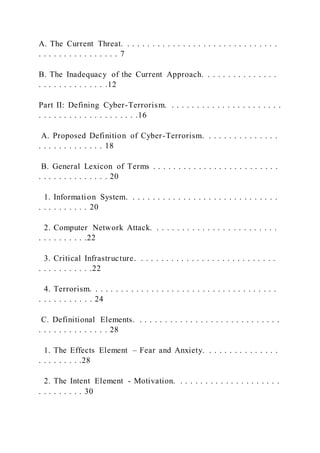
Table of Contents
Introduction. . . . . . . . . . . . . . . . . . . . . . . . . . . . . . . . . . . . . .
. . . . . . . . . . . . . . . . . . . . . . . 1
Part I: The Current Situation in Cyberspace. . . . . . . . . . . . . . . .
. . . . . . . . . . . . . . . . . . . . 6
A. The Current Threat. . . . . . . . . . . . . . . . . . . . . . . . . . . . . . .
. . . . . . . . . . . . . . . . 7
B. The Inadequacy of the Current Approach. . . . . . . . . . . . . . .
. . . . . . . . . . . . . .12
Part II: Defining Cyber-Terrorism. . . . . . . . . . . . . . . . . . . . . . .
. . . . . . . . . . . . . . . . . . . .16
A. Proposed Definition of Cyber-Terrorism. . . . . . . . . . . . . . .
. . . . . . . . . . . . . 18
B. General Lexicon of Terms . . . . . . . . . . . . . . . . . . . . . . . . .
. . . . . . . . . . . . . . 20
1. Information System. . . . . . . . . . . . . . . . . . . . . . . . . . . . . .
. . . . . . . . . . 20
2. Computer Network Attack. . . . . . . . . . . . . . . . . . . . . . . . .
. . . . . . . . . .22
3. Critical Infrastructure. . . . . . . . . . . . . . . . . . . . . . . . . . . .
. . . . . . . . . . .22
4. Terrorism. . . . . . . . . . . . . . . . . . . . . . . . . . . . . . . . . . . . .
. . . . . . . . . . . 24
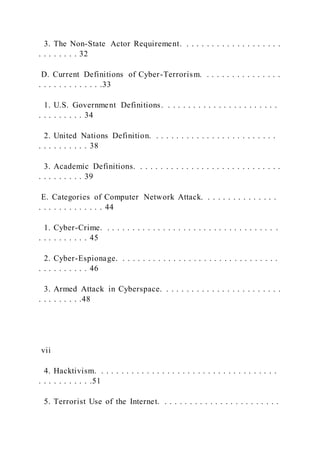
C. Definitional Elements. . . . . . . . . . . . . . . . . . . . . . . . . . . . .
. . . . . . . . . . . . . . 28
1. The Effects Element – Fear and Anxiety. . . . . . . . . . . . . . .
. . . . . . . . .28
2. The Intent Element - Motivation. . . . . . . . . . . . . . . . . . . . .
. . . . . . . . . 30
3. The Non-State Actor Requirement. . . . . . . . . . . . . . . . . . . .
. . . . . . . . 32
D. Current Definitions of Cyber-Terrorism. . . . . . . . . . . . . . . .
. . . . . . . . . . . . .33
1. U.S. Government Definitions. . . . . . . . . . . . . . . . . . . . . . .
. . . . . . . . . 34
2. United Nations Definition. . . . . . . . . . . . . . . . . . . . . . . . .
. . . . . . . . . . 38
3. Academic Definitions. . . . . . . . . . . . . . . . . . . . . . . . . . . . .
. . . . . . . . . 39
E. Categories of Computer Network Attack. . . . . . . . . . . . . . .
. . . . . . . . . . . . . 44
1. Cyber-Crime. . . . . . . . . . . . . . . . . . . . . . . . . . . . . . . . . . .
. . . . . . . . . . 45
2. Cyber-Espionage. . . . . . . . . . . . . . . . . . . . . . . . . . . . . . . .
. . . . . . . . . . 46
3. Armed Attack in Cyberspace. . . . . . . . . . . . . . . . . . . . . . . .
. . . . . . . . .48
vii
4. Hacktivism. . . . . . . . . . . . . . . . . . . . . . . . . . . . . . . . . . . .
. . . . . . . . . . .51
5. Terrorist Use of the Internet. . . . . . . . . . . . . . . . . . . . . . . .
. . . . . . . . . .53
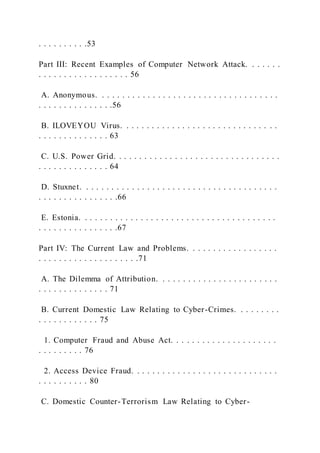
Part III: Recent Examples of Computer Network Attack. . . . . . .
. . . . . . . . . . . . . . . . . . 56
A. Anonymous. . . . . . . . . . . . . . . . . . . . . . . . . . . . . . . . . . . .
. . . . . . . . . . . . . . .56
B. ILOVEYOU Virus. . . . . . . . . . . . . . . . . . . . . . . . . . . . . . .
. . . . . . . . . . . . . . 63
C. U.S. Power Grid. . . . . . . . . . . . . . . . . . . . . . . . . . . . . . . . .
. . . . . . . . . . . . . . 64
D. Stuxnet. . . . . . . . . . . . . . . . . . . . . . . . . . . . . . . . . . . . . . .
. . . . . . . . . . . . . . . .66
E. Estonia. . . . . . . . . . . . . . . . . . . . . . . . . . . . . . . . . . . . . . .
. . . . . . . . . . . . . . . .67
Part IV: The Current Law and Problems. . . . . . . . . . . . . . . . . .
. . . . . . . . . . . . . . . . . . . .71
A. The Dilemma of Attribution. . . . . . . . . . . . . . . . . . . . . . . .
. . . . . . . . . . . . . . 71
B. Current Domestic Law Relating to Cyber-Crimes. . . . . . . . .
. . . . . . . . . . . . 75
1. Computer Fraud and Abuse Act. . . . . . . . . . . . . . . . . . . . .
. . . . . . . . . 76
2. Access Device Fraud. . . . . . . . . . . . . . . . . . . . . . . . . . . . .
. . . . . . . . . . 80
C. Domestic Counter-Terrorism Law Relating to Cyber-
Terrorism. . . . . . . . . .80
1. The Federal Crime of Terrorism. . . . . . . . . . . . . . . . . . . . .
. . . . . . . . . 80
2. Material Support to Terrorism Statutes. . . . . . . . . . . . . . . .
. . . . . . . . . 81
3. Specially Designated Global Terrorist. . . . . . . . . . . . . . . . .
. . . . . . . . .84
4. Conspiracy. . . . . . . . . . . . . . . . . . . . . . . . . . . . . . . . . . . .
. . . . . . . . . . .86
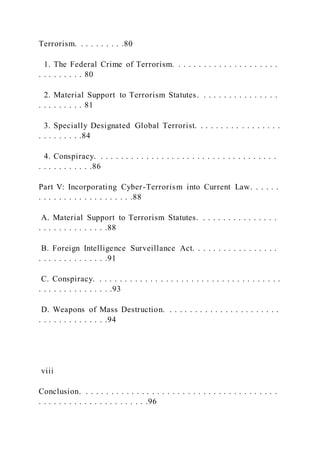
Part V: Incorporating Cyber-Terrorism into Current Law. . . . . .
. . . . . . . . . . . . . . . . . . .88
A. Material Support to Terrorism Statutes. . . . . . . . . . . . . . . .
. . . . . . . . . . . . . .88
B. Foreign Intelligence Surveillance Act. . . . . . . . . . . . . . . . .
. . . . . . . . . . . . . .91
C. Conspiracy. . . . . . . . . . . . . . . . . . . . . . . . . . . . . . . . . . . . .
. . . . . . . . . . . . . . .93
D. Weapons of Mass Destruction. . . . . . . . . . . . . . . . . . . . . . .
. . . . . . . . . . . . . .94
viii
Conclusion. . . . . . . . . . . . . . . . . . . . . . . . . . . . . . . . . . . . . . .
. . . . . . . . . . . . . . . . . . . . . .96
1
Introduction
“If I had an hour to save the world I would spend 59 minutes
defining the problem and
one minute finding solutions” - Albert Einstein
On January 5, 2012, a grand jury sitting in the Eastern District
of Virginia indicted
seven individuals and two corporations, Megaupload Limited
and Vestor Limited, with
racketeering conspiracy, conspiring to commit copyright
infringement, conspiring to
commit money laundering, and two substantive counts of
criminal copyright
infringement.1 The indictment was based upon the alleged
conspirators’ business of
profiting from the illegal sharing of copyrighted music and
video files by users of their
website, megaupload.com.2 The website was one of the most
popular on the Internet,
with approximately 150 million registered users, 50 million hits
daily, endorsements from
music superstars, and earning its founder, Kim Dotcom, $42
million in 2011.3
1 U.S. Department of Justice, Office of Public Affairs, Justice
Department Charges
Leaders of Megaupload with Widespread Online Copyright
Infringement, FBI Press
Release (Jan. 19, 2012), available at
http://www.fbi.gov/news/pressrel/press-
releases/justice-department-charges-leaders-of-megaupload-
with-widespread-online-
copyright-infringement.
2 Id.
3 Nick Perry, Popular file-sharing website Megaupload shut
down, USATODAY.COM
(Jan. 20, 2012),
http://www.usatoday.com/tech/news/story/2012-01-
19/megaupload-feds-
shutdown/52678528/1.
2
On January 19, 2012, New Zealand police arrived at the
mansion of Kim Dotcom
by helicopter to arrest him.4 Mr. Dotcom retreated into a “safe
room” where he had stored
weapons, including a sawed-off shotgun.5 The police eventually
cut their way into the
room where he was arrested.6 Following Dotcom’s arrest, three
other indicted co-
conspirators were arrested in Auckland, New Zealand at the
request of the United States.7
Additionally, more than 20 search warrants were executed in the
United States and eight
other countries, seizing approximately $50 million in assets.8
The action was “among the
largest criminal copyright cases ever brought by the United
States and directly targets the
misuse of a public content storage and distribution site to
commit and facilitate
intellectual property crime.”9
In the immediate aftermath of the arrests, one segment of the
online community
responded with what the New York Times called “digital
Molotov cocktails,”10 and
CNET called “going nuclear.”11 The hacker group Anonymous,
in apparent
dissatisfaction with the Megaload arrests, launched cyber -
attacks against the websites of
the White House, the U.S. Department of Justice (DoJ), the U.S.
Copyright Office, and
4 Ben Sisario, 4 of 7 Named in Megaupload Indictment Denied
Bail in New Zealand,
N.Y. Times (Jan. 20, 2012),
http://www.nytimes.com/2012/01/21/technology/megaupload-
indictment-internet-
piracy.html.
5 Id.
6 Id.
7 FBI Press Release, Jan. 19, 2012, supra note 1.
8 Id.
9 Id.
10 Sisario, N.Y. Times, supra note 4.
11 Molly Wood, Anonymous goes nuclear; everybody loses?,
CNET (Jan. 19, 2012),
http://news.cnet.com/8301-31322_3-57362437-256/anonymous-
goes-nuclear-everybody-
loses/ (arguing that the FBI may have goaded Anonymous into
attacking their website
with the arrests following debates about new legislation on
Internet piracy in an attempt
to turn public support away from Anonymous and similar
hacking groups).
3
several entertainment companies and trade groups.12 Across the
globe, network attacks
were up 24 percent immediately following the arrests.13
Anonymous’s cyber-attacks were
clearly politically motivated and geared towards influencing
both government and
civilian opinion. These actions were definitely crimes, but not
motivated by money or
other traditional criminal motives. Should the motivations of
such an attack affect how it
is classified under the law? Was this a cyber-crime that should
be treated like any other?
Was it an act of civil disobedience? Or, did its political
motivations make it a unique form
of terrorism?
Cyber-crimes are now a part of everyday modern life, with
estimated losses in 2009
placed at up to $1 trillion globally.14 Given the potential
criminal rewards, they are as
unlikely to be eliminated as age-old crimes such as theft or
battery. Lawmakers have
attempted to keep pace with statutes like the Computer Fraud
and Abuse Act (CFAA),
which is continually updated and criminalizes almost any crime
committed in the United
States conducted through computers or other information
systems.15 However, the
anonymity inherent in the architecture of the Internet has made
it easy for criminals to act
in cyberspace without getting caught.16 This anonymity,
combined with society’s
12 Id.
13 Id.
14 Elinor Mills, Study: Cybercrime cost firms $1 trillion
globally, CNET (Jan. 28, 2009),
http://news.cnet.com/8301-1009_3-10152246-83.html; See also
Internet Crimes
Complaint Center, 2010 Internet Crime Report, available at
http://www.ic3.gov/media/annualreport/2010_IC3Report.pdf.
15 18 U.S.C. §1030 (2006). The CFAA has been amended six
times since it became law,
in: 1988, 1994, 1996, 2001, 2002, and 2008.
16 See e.g., Thomas Crampton, Nigeria to battle Internet scams
that taint its image, N.Y.
Times (Jan. 23, 2004),
http://www.nytimes.com/2004/01/23/business/worldbusiness/23i
ht-t16_0.html (reporting
on the infamous) Nigerian Internet fraud schemes); and
4
increasing reliance on computers and computer networks have
also made possible a new
type of cyber-crime with different motivations: cyber-terrorism.
There is a growing
recognition of the threat of cyber-terrorism, and an ever-
increasing amount of proposed
legislation and academic thought is being put towards its
prevention.17 A well thought out
strategy, however, needs to start with a common working
definition of cyber-terrorism.
This paper proposes a common working definition that
legislators and government
agencies can work from, ensuring that the solutions developed
are addressed to the most
pressing problems. This proposed definition is broad enough to
cover the potentially
unique effects of a weapon of cyber-terrorism, while narrow
enough to exclude computer
network attacks that are relatively minor in nature. The
definition is carefully tailored, as
a definition that is either too broad or too narrow risks being
either irrelevant or useless.
This paper also shows how existing counter-terrorism statutes
could be amended to
incorporate the proposed definition of cyber-terrorism. Statues
included are the material
support to terrorism statutes,18 the Foreign Intelligence
Surveillance Act (FISA),19
conspiracy to kill, kidnap, maim, or injure persons or damage
property in a foreign
country,20 and the statutes addressing weapons of mass
destruction (WMD).21 By
Somini Sengupta & Jenna Wortham, U.S. Charges 7 in Online
Ad Fraud Scheme, N.Y.
Times (Nov. 9, 2011),
http://www.nytimes.com/2011/11/10/technology/us-indicts-7-in-
online-ad-fraud-scheme.html (describing a recent Internet fraud
scheme that diverted
marketing revenue to fraudulent sites by replacing real ads with
fraudulent ones).
17 See generally Susan W. Brenner, “At Light Speed” -
Attribution and Response to
Cybercrime/Terrorism/Warfare, 97 J. Crim. L. & Criminology
397 (2007) (describing
why current laws do not adequately address the issue of attack
attribution); and Aviv
Cohen, Cyberterrorism: Are we Legally Ready, 9 J. Int’l Bus. &
L. 1 (2010) (arguing for
new international conventions to govern cyber-terrorism).
18 18 U.S.C. §§ 2339A-B (2006); 50 U.S.C. § 1701 et seq.
(2006).
19 50 U.S.C. § 1801 et seq. (2006).
20 18 U.S.C. § 956 (2006).
21 50 U.S.C. § 2332A (2006).
5
incorporating cyber-terrorism into these statutes, a body of law
that has been effectively
used to combat traditional acts of terrorism would become
available to the cyber realm.
The author does not suggest that these changes, even if enacted
wholesale, would
eliminate cyber-terrorism as a threat. However, they are
examples of how a common
definition of cyber-terrorism can be used, and a piece in the
puzzle towards the most
important aspect of any type of terrorism: prevention.
Part I of this paper examines the current state of cyber threats
and why current law
is inadequate to deal with cyber-terrorism. Part II aims at
providing a definition of cyber-
terrorism. Included in this section is an examination of the
elements of this definition, a
lexicon of definitions used within that definition, an
examination of other types of cyber-
attacks, and a comparison with current definitions of cyber -
terrorism suggested by
academics or in use by government agencies. Part III examines
several recent major
cyber-attacks to determine whether they fit this definition of
cyber-terrorism. Part IV of
this paper is an overview of current domestic laws relating to
both cyber-crimes and
terrorism, and a discussion of the major stumbling block in
fighting cyber-terrorism:
attribution. Part V of this paper discusses incorporation of
cyber-terrorism into several
current counter-terrorism statutes that could be effectively used
to prevent cyber-
terrorism.
6
Part I. The Current Situation
“The very technologies that empower us to lead and create also
empower those
who would disrupt and destroy.” - 2010 National Security
Strategy
Attacks on information systems and networks have increased at
an exponential rate
in the last two decades. A 1996 GAO report found that the
Department of Defense (DoD)
faced 250,000 attempted attacks on its networks in 1995;22 in
2006 the number had risen
to 6 million; and in 2008 the number was more than 300
million.23 Looking beyond the
government, these numbers become staggering. Seventy-four
million people in the
United States were victims of cyber crime in 2010, resulting in
an estimated $32 billion
in financial losses.24 This section examines the current threats
to information systems and
explores how the current approach is inadequate to the task of
preventing a major cyber-
attack on the United States.
22 U.S. General Accounting Office, GAO/AIMD-96-84,
Information Security: Computer
Attacks at Department of Defense Pose Increasing Risks 3
(1996).
23 Scott Hamilton, Industry pulse: The unknown, Armed Forces
J.,
http://www.armedforcesjournal.com/2009/11/4268936/ (last
visited Feb. 4, 2012)
(describing the growing awareness of government and private
companies to develop a
robust cyber-security industry).
24 Norton Cybercrime Report 2011,
http://www.symantec.com/content/en/us/home_homeoffice/html/
cybercrimereport/ (last
visited Feb 4, 2012).
7
A. The Current Threat
President Barack Obama has labeled computer network attacks
“among the most
serious economic and national security risks we face as a
nation,”25 and that “America's
economic prosperity in the 21st century will depend on
cybersecurity.”26 These
statements, although serious, are tame compared to some fears
of cyber-security experts.
Leading the charge has been the former chief counterterrorism
adviser on the National
Security Council, Richard Clarke.27 In his book “Cyber War,”
Clarke describes the
potential for “a massive cyberattack on civilian infrastructure
that smacks down power
grids for weeks, halts trains, grounds aircraft, explodes
pipelines, and sets fire to
refineries.”28 Former Director of National Intelligence and
Director of the National
Security Agency, Mike McConnell, stated: “The warnings are
over. It could happen
tomorrow.”29 McConnell described the potential for such an
attack as impacting the
global economy on “an order of magnitude surpassing” 9/11.30
Whether cyber-attacks have the potential to rise to the level
just described is
certainly debatable.31 However, the facts indicate that cyber -
attacks for reasons other than
25 President Barack Obama, Remarks by the President on
Securing Our Nation’s Cyber
Infrastructure, The White House (2009),
http://www.whitehouse.gov/the-press-
office/remarks-president-securing-our-nations-cyber-
infrastructure.
26 Id.
27 Profile: Richard Clarke, BBC (Mar. 22, 2004),
http://news.bbc.co.uk/2/hi/americas/3559087.stm.
28 Richard A. Clarke & Robert Knake, Cyber War: The Next
Threat to National Security
and What to Do About It 260 (2010).
29 Max Fisher, Fmr. Intelligence Director: New Cyberattack
May Be Worse Than 9/11,
The Atlantic (Sept. 30, 2010),
http://www.theatlantic.com/politics/archive/2010/09/fmr-
intelligence-director-new-cyberattack-may-be-worse-than-9-
11/63849/.
30 Id.
31 See, e.g., Joshua Green, The Myth of Cyberterrorism Wash.
Monthly (Nov. 2002),
http://www.washingtonmonthly.com/features/2001/0211.green.h
tml (arguing the threat of
cuber-terrorism is over-hyped and focusing too heavily on
cyber-security will have a
8
money are becoming more and more prevalent. The years 2006
to 2010 saw a 650
percent increase on federal agencies.32 The rise in politically
active hacking groups, such
as Anonymous, demonstrate that the Internet is increasingly a
platform for dissenters,
domestic and foreign, to express their disagreement with the
government.33 Espionage on
information systems is rapidly rising as well.34 Even “air -
gapped”35 classified networks
are not immune, as the DOD’s classified network was
compromised in 2008 by an attack
using flash drives.36
Politically motivated cyber-attacks are not limited to
government websites. An
increasing number of attacks target corporations having policies
with which hacking
negative effect on the information technology industry); and
Derek E. Bambauer,
Conundrum, 96 Minn. L. Rev. 584, 612 (2011) (arguing that
scenes of cyber apocalypse
are overblown, but cyber threats are real and that information,
not systems should be the
focus of cyber-security); but see Richard Clarke, National
Coordinator for Security
Infrastructure Protection and Counter-terrorism, National
Security Council, Keynote
Address at the Terrorism and Business Conference: Threats to
U.S. National Security:
Proposed Partnership Initiatives Towards Preventing Cyber
Terrorist Attacks, in 12
DePaul Bus. L.J. 33 (1999) (arguing that large scale cyber-
attacks are a distinct
possibility and that the best way to respond to cyber-threats is
through the development
of public-private partnerships).
32 U.S. Gov’t Accountability Office, GAO-11-463T, Continued
Attention Needed to
Protect Our Nation's Critical Infrastructure and Federal
Information Systems (2011)
(from 5,503 incidents reported in FY 2006 to 41,776 reported in
FY 2010).
33 See e.g., Kukil Bora, Anonymous Timeline 2011: The Rise
of the Hactivist, Int’l Bus.
Times (Feb. 23, 2012),
http://www.ibtimes.com/articles/303449/20120223/anonymous-
hacking-hactivist-acta-protest-ddos-blackout.htm (charting the
increasing rate of hacking
by Anonymous).
34 Ellen Nakashima, In a world of cybertheft, U.S. names
China, Russia as main culprits,
Wash. Post (Nov. 3, 2011),
http://www.washingtonpost.com/world/national-security/us-
cyber-espionage-report-names-china-and-russia-as-main-
culprits/2011/11/02/gIQAF5fRiM_story.html (reporting on an
intelligence report to
Congress naming China and Russia as the primary culprits of
cyber-espionage).
35 “Air gapped” networks are those physically, electrically, and
electromagnetically
isolated from other networks such as the Internet.
36 William J. Lynn III, U.S. Deputy Secretary of Defense,
Defending a New Domain: The
Pentagon’s Cyberstrategy, Foreign Affairs (Sept./Oct. 2010),
available at
http://www.foreignaffairs.com/articles/66552/william-j-lynn-
iii/defending-a-new-domain
(describing defense intitiatives put in place to defend the U.S.
from cyber threats).
9
groups disagree, such as the 2010 attack on Google by a “highly
sophisticated and
targeted attack” originating from China,37 and attacks against
the music and motion
picture industries for their support of anti-copyright
infringement legislation.38 Other
attacks have had widespread effects on entire nations, such as
the 2007 attack on Estonia
by Russian hacking groups,39 and the 2009 cyber-attacks
against South Korea.40 (These
attacks are describe in Part III below.)
Every day, new components of our infrastructure are being
connected to networks,
allowing more efficient operation, but also opening those
components to computer
network attacks.41 The development of smart grid technology is
an example of this. By
placing controls of the power grid on interconnected
information systems, power can be
efficiently controlled and distributed. The security of these
systems should be made a
37 Andrew Jacobs & Miguel Helft, Google, Citing Attack,
Threatens to Exit China, N.Y.
Times (Jan. 13, 2010),
http://www.nytimes.com/2010/01/13/world/asia/13beijing.html
(discussing Google’s reaction to network attacks it says were
aimed at curbing free
speech in China).
38 See e.g., Attacks target recording industry, BBC (Sept. 20,
2010),
http://www.bbc.co.uk/news/technology-11371315.
39 A look at Estonia’s cyber attack in 2007, msnbc.com,
http://www.msnbc.msn.com/id/31801246/ns/technology_and_sci
ence-security/t/look-
estonias-cyber-attack/ (last visited Feb 4, 2012) (the cyber
attack on Estonia 2007,
discussed in Part II of this paper, was a three week assault on
Estonia’s “e-government”
following the removal of a Russian memorial in Estonia’s
capital).
40 South Korea hit by cyber attacks, BBC (Mar. 4, 2011),
http://www.bbc.co.uk/news/technology-12646052 (these attacks
were blamed by the
South Korean government on North Korea, but definitive links
were never established).
41 See e.g., Matthew L. Wald, Making Electricity Distribution
Smarter, N.Y. Times
Green Blog (April 21, 2009),
http://green.blogs.nytimes.com/2009/04/21/making-
electricity-distribution-smarter/ (discussing the spread of smart
grid technology that
increases efficiency in electrical power operations by
monitoring and controlling
electricity distribution); and Norman Announces New SCADA
Security System to
Protect Industrial Infrastructure, Market Watch (Feb. 14, 2012),
http://www.marketwatch.com/story/norman-announces-new-
scada-security-system-to-
protect-industrial-infrastructure-2012-02-14 (announcing
release of updated security
measures for pipeline SCADA systems).
10
national priority.42 However, no level of security spending will
completely eliminate
vulnerabilities, and those vulnerabilities will eventually be
exploited.43
The dramatic rise in both attacks and vulnerabilities have led
governments to
recognize the enormity of the issue, resulting in a push for
increasing mandated cyber-
security covering both government and private networks. At a
2011 hearing, Rep. Dan
Lungren, Chairman of the House Subcommittee on
Infrastructure Protection,
Cybersecurity and Security Technologies, stated that one of the
top listed concerns for
American lawmakers, intelligence officials and military leaders
is the rapidly growing
cyber threat.44 He cited the belief that a successful cyber attack
on our power grid or
communications networks could cripple our economy and
threaten national security.45
The President has established multiple task forces to evaluate
and make
recommendations for the future of cyber-security.46 British
Foreign Secretary William
Hague convened a conference on cyber attacks after criticisms
of failing to take cyber
threats seriously in his country.47 Mr Hague stated a “global
coordinated response” is
42 See generally Clarke keynote address, supra note 31.
43 See Derek E. Bambauer, Conundrum, 96 Minn. L. Rev. 584
(2011) (arguing that
information, not systems should be the focus of cyber-security).
44 Opening Statement at the Markup of H.R. 3674 “Promoting
and Enhancing
Cybersecurity and Information Sharing Effectiveness Act of
2011: Before the
Subcommittee on Infrastructure Protection, Cybersecurity and
Security Technologies,
112th Cong. (2011) (statement of Rep. Lungren, Chairman).
45 Id.
46 See generally Bill Lane, Cyber Security and
Communications, Fed. Commc’ns
Comm’n, http://www.fcc.gov/pshs/techtopics/techtopics20.html
(cataloguing executive
branch task forces focused on cyber-security).
47 GCHQ chief reports “disturbing” cyber-attacks on UK, BBC
News UK (Oct. 31,
2011), http://www.bbc.co.uk/news/uk-15516959 (following
several attacks on UK
government and technology firm computers, the UK convened a
conference with world
leaders and cyber-security experts to discuss a coordinated
global response to cyber
attacks).
11
required to combat cyber threats.48 In 2005, the European
Council adopted the European
Program for Critical Infrastructure Protection (EPCIP) to focus
on strengthening
information systems, and enhancing preparedness for attacks on
critical infrastructure.49
If, as suggested by these experts, cyber-attacks that equate to
terrorism are possible,
then there are multiple reasons to think terrorist groups will
utilize information systems
as weapons of terror. The Internet and other information
systems hold every attribute
terrorists might want to achieve their goals. The Internet is
global, anonymous, and
allows collaboration by people around the world on a single
project.50 Cyber-terrorism
may be the next logical step in the evolution of terrorism. Given
the possibility,
preventive laws should be implemented as soon as possible, not
after the first major
attack. Sen. Joseph Lieberman, while introducing the
Cybersecurity Act of 2012, stated
his belief that “time is not on our side,” and that we should act
to prevent a cyber 9/11
before it happens instead of reacting after it happens.”51
Senator Lieberman went on to
describe how he saw the threat in greater detail, stating:52
Every day rival nations, terrorist groups, criminal syndicates
and individual
hackers probe the weaknesses in our most critical computer
networks, seeking to
steal government and industrial secrets or to plant cyber agents
in the cyber
systems that control our most critical infrastructure and would
enable an enemy to
48 Id.
49 See generally, European Programme for Critical
Infrastructure Protection,
http://europa.eu/legislation_summaries/justice_freedom_securit
y/fight_against_terrorism/
l33260_en.htm (last visited Feb. 20, 2012).
50 See generally Gabriel Weimann, How Modern Terrorism
Uses the Internet, United
States Institute of Peace, Special Rep. 116 (2004) (identifying
eight different ways
terrorists use the Internet to advance their cause).
51 Opening Statement of Chairman Joseph Lieberman “Securing
America’s Future: The
Cybersecurity Act of 2012”: Before the Sen. Homeland Security
and Governmental
Affairs Committee, 112th Cong. (2012) (statement of Sen.
Lieberman, Chairman).
52 Id.
12
seize control of a city’s electric grid or water supply system
with the touch of a
key from a world away.
What if cyber-terrorist were currently planning a major attack?
What laws could be used
to combat this threat? Certainly there are laws on the books,
such as the CFAA under
which an attack could be prosecuted,53 but these laws may be
of little consequence in
attempting to prevent such an attack.
B. The Inadequacy of the Current Approach
This paper does not advocate that a cyber-apocalypse is just
around the corner; the
author will leave that judgment to intelligence and industrial
security experts. However, if
it is even possible, it would be wise to develop a preventative
approach. As this paper is
under draft, the Senate Homeland Security and Governmental
Affairs Committee are
putting forth a major piece of legislation, the Cybersecuri ty Act
of 2012.54 This bill seeks
to implement a regulatory structure on critical industry cyber -
security and promote
information sharing between private parties and government
agencies.55 Regulatory
oversight, information sharing and significant investment in
cyber-security for the
components of our national infrastructure that run on
information networks, such as
power grids, pipelines, and systems containing economic data,
are all necessary pieces in
the prevention puzzle.56 However, just as new legal tools for
law enforcement and
prosecutors were utilized in the war against terrorism, similar
legal tools should be made
available to prevent acts of cyber-terrorism.
53 18 U.S.C. §1030 (2006) (discussed infra in Part IV of this
paper).
54 Cybersecurity Act of 2012, available at
http://www.hsgac.senate.gov/.../the-
cybersecurity-act-of-2012-s-2105
55 Id.
56 See Lynn, Defending a New Domain, supra note 36.
13
This is not to say that the traditional law enforcement model
has no role to play in
catching and prosecuting those who commit cyber-crimes for
political reasons. Not all
those committing cyber-attacks for political purposes have
escaped punishment. Mitchell
Frost was sentenced to thirty months in prison following a 2007
attack against
conservative political websites such as Ann Coulter and Bill
O'Reilly.57 A college student
who hacked Sarah Palin's email account during the 2008
presidential campaign was
sentenced to a year and a day in a halfway house.58 In a
successful prosecution of an early
cyber-attack on physical infrastructure, an Australian was sent
to jail for hacking into a
waste management system and dumping millions of liters of raw
sewage into park, rivers,
and businesses.59 Perhaps the best example of traditional law
enforcement methods was
the capture of five Anonymous members in 2012.60 Following
an arrest in 2008, a New
York based hacker, Hector Monsegur agreed to assist the FBI in
tracking other members
of Anonymous in exchange for leniency at sentencing.61 His
cooperation led to the arrests
of five prominent members of Anonymous, prompting one
cyber-security expert to state:
“This is the most important roll-up of hackers ever.”62
57 Robert McMillan, Bill O’Reilly hacker gets 30 months, CSO
(Nov. 8, 2010),
http://www.csoonline.com/article/634363/bill-o-reilly-hacker-
gets-30-months.
58 Bill Poovey, Palin e-mail hacker sentenced to 1 year, 1 day,
msnbc.com (Nov. 12,
2010), http://www.msnbc.msn.com/id/40152249/ns/politics-
more_politics/t/palin-e-mail-
hacker-sentenced-year-day/ (the defendant had hoped to find
information in Palin’s
online accounts that could derail her campaign, but found
nothing helpful to that effect).
59 Tony Smith, Hacker jailed for revenge sewage attacks, The
Register (Oct. 31, 2001),
http://www.theregister.co.uk/2001/10/31/hacker_jailed_for_reve
nge_sewage/ (the
perpetrator worked for the company that installed the waste
management controlling
software and had been recently rejected for employment by the
local city council).
60 Ellen Nakashima, Peter Finn & Sari Horwitz, 5 members of
Anonymous hacking group
charged, Wash. Post (Mar. 6, 2012),
http://www.washingtonpost.com/world/national-
security/5-members-of-anonymous-hacking-group-
charged/2012/03/06/gIQAJ70FvR_story.html?hpid=z4.
61 Id.
62 Id.
14
This type of traditional law enforcement work certainly has its
place in combatting
cyber-terrorism. However, the overwhelming number of cyber
related crimes evade
detection or prosecution. There are a number of reasons for this.
One is that many large
corporations are loath to report the astounding number of
attacks they receive.63 Another
is that cyber-crimes continue to receive lower priority attention
than traditional crimes.64
However, the primary reason is that cyber-crimes are
extraordinarily difficult to attribute
to a particular culprit.65
Current cyber-crime laws, when applied to potential acts of
cyber-terrorism, also
suffer from another aspect of traditional criminal law: relying
on prosecution for
deterrence and prevention. Traditional criminal law seeks to
prevent future crimes
primarily through the deterrence of successfully catching and
prosecuting criminals. As
the head of U.S. Cyber Command, (then) Lieutenant General
Keith Alexander, put it:
63 See Ellen Nakashima & David S. Hilzenrath, Cybersecurity:
SEC outlines requirement
that companies report cyber theft and attack, Wash. Post (Oct.
20, 2011),
http://www.washingtonpost.com/world/national-
security/cybersecurity-sec-outlines-
requirement-that-companies-report-data-
breaches/2011/10/14/gIQArGjskL_story.html
(describing new Securities and Exchange Commission
guidelines for reporting losses due
to computer network attacks to corporation shareholders); see
also Paul Rosenzweig,
Information Sharing and the Cybersecurity Act of 2012,
Lawfare (Feb. 14, 2012),
http://www.lawfareblog.com/2012/02/information-sharing-and-
the-cybersecurity-act-of-
2012/ (discussing information sharing procedures in the
proposed Cybersecurity Act of
2012, designed to overcome corporate hesitancy to share
information about CNA); and
Gus Coldebella, Cyber Security Act of 2012 requires a liability
protection bug fix, The
Hill (Feb. 22, 2012), http://thehill.com/blogs/congress-
blog/technology/212049-cyber-
security-act-of-2012-requires-a-liability-protection-bug-fix
(arguing the information
procedures in the Cybersecurity Act of 2012 do not go far
enough and open corporations
to potential liability).
64 See Ron Condon, Analysis: How to catch a cyber criminal?
Do it yourself,
Sillicon.com (Apr. 24, 2006),
http://www.silicon.com/legacy/research/specialreports/ecrime/0,
3800011283,39158294,0
0.htm (arguing that, because police tend to place lower priority
on cyber-crimes,
companies that are victims of cyber-crimes should pursue cyber-
criminals using their
own resources).
65 See generally Bambauer, supra note 43.
15
“The bottom line is, the only way to deter cyber attack is to
work to catch perpetrators
and take strong and public action when we do.”66 However,
when making the leap from
traditional cyber-crime to cyber-terrorism, the stakes become
higher and prevention
becomes the most important factor.
Overall, the current focus on cyber-terrorism can be compared
to that of terrorism
before 9/11. The 9/11 Commission Report noted that the FBI
was “case-specific,
decentralized, and geared towards prosecution.”67 The report
went on to note that
“[s]ignificant FBI resources were devoted to after-the-fact
investigations of major
terrorist attacks, resulting in several prosecutions.”68 The FBI
was very good at doing
what they had always done, investigate crimes, make arrests and
then hand over the
perpetrators to the United States Attorney’s Office for
prosecutions. However, when
dealing with attackers that utilize terrorism, after-the-fact
prosecution is not an effective
deterrent. Other methods of prevention are required to stop
terrorist acts, and laws going
forward should reflect that priority. However, before a problem
can be prevented, it must
be defined.
66 Advance Questions for Lt. Gen. Keith Alexander, USA
Nominee for Commander, U.S.
Cyber Command Before the S. Armed Serv. Comm., 111th
Cong. 23 (2010).
67 9/11 Commission, Final Report of the National Commission
on Terrorist Attacks Upon
the United States, Executive Summary 13.
68 Id.
16
Part II. Defining Cyber-Terrorism
“As we know, there are known knowns; there are things we
know we know. We also
know there are known unknowns; that is to say we know there
are some things we do not
know. But there are also unknown unknowns - the ones we don't
know we don’t know.”
- Defense Secretary Donald Rumsfeld, Feb. 12, 2002
With any great problem, often the first and most difficult step
is properly defining
it, and cyber-terrorism is no exception. Cyber-terrorism is
logically sub-categorized under
both terrorism and cyber-crimes. These categories are either
relatively new phenomena,
as with cyber-crimes, or phenomena that has taken on new
historical significance, as with
terrorism. The result being the definitions of these categories
continue to be unsettled.69
Regarding cyber-crimes generally, there must be some violation
of a criminal code that
involves the use of computers or other information systems,
usually accomplished
through the Internet, but not necessarily.70 With terrorism, the
United States Government
offers multiple definitions, and internationally, there is even
less clarity on a definition of
terrorism.71
69 See Bruce Hoffman, Inside Terrorism (2d ed., Colum. U.
Press, 2006) (evaluating the
historical development of terrorism and why it is so difficult to
define).
70 See, e.g., 18 U.S.C. § 1030 (2006).
71 See Nicholas J. Perry, The Numerous Federal Definitions of
Terrorism: The Problem
of Too Many Grails, 30 J. Legis. 249 (2004) (Examining
twenty-two of the definitions for
terrorism in federal lexicon and arguing for a single definition);
see also United States v.
Yousef, 327 F.3d 56, 106 (2d. Cir. 2003) (“We regrettably are
no closer now than
eighteen years ago to an international consensus on the
definition of terrorism, or even its
proscription.”).
17
Given the evolving definitions of the broader categories, it is
no surprise that
definitions of cyber-terrorism have been equally divergent.72
Additionally, the United
States has yet to see a cyber-attack on the level of a major
terrorist attack. Without a
major event to spark public debate, lawmakers have little
incentive to define and address
this particular crime. Nevertheless, to develop a legal
framework that helps to prevent,
deter, and defend against a cyber-terrorist act, the appropriate
first step must be to
develop a practical working definition that precisely defines
what type of attacks should
be considered cyber-terrorism.
This section begins by offering a definition of cyber-terrorism
that can be used as a
common starting point for definitions in U.S. Code, as well as
those used by
governmental agencies. As this section will demonstrate, the
current definitions of cyber-
terrorism are widely divergent in the scope of actions that fall
under their definition. This
divergence makes it difficult to develop common strategies and
tactics to defeat cyber-
terrorism. This paper does not intend to suggest that all
legislations and agency mission
statements use the exact same definition of cyber-terrorism.
However, these definitions
should begin from a common starting point, from which they
may be altered to serve the
legislative or agency purpose.
This section will also examine a lexicon of terms that are
generically used to
describe different aspects of cyber-attacks. Using these
definitions, this section then
categorizes the various types of cyber-attack and explains how
they are distinguished
from this papers definition of cyber-terrorism. Next, this
paper’s definition of cyber-
72 See Mohammad Iqbal, Defining Cyberterrorism, 22 J.
Marshall J. Computer & Info. L.
397 (2004) (exploring the different definitions of cyber -
terrorism that have been
suggested).
18
terrorism is analyzed in comparison to those in existence,
discussing how they differ and
why they should yield in favor of this paper’s definition.
A. Proposed Definition of Cyber-Terrorism
Following the attacks of September 11, 2001, terrorist
organizations have faced a
full-court press by the United States and other nations who
recognize the threat posed to
their national security. Foreign Terrorist Organizations (FTO)
such as Al-Qaeda have
responded in part by utilizing the Internet for organizational and
propaganda purposes
with on-line publications such as Inspire.73 The last decade has
also seen the rise in
politically motivated hacking groups, both in the United States
and abroad.74 These
groups have become increasingly daring and sophisticated in
their attacks.75 It is logical
to assume that both these types of organizations will eventually
attempt to utilize the
Internet and other information systems as an instrument of
terror.76 Utilizing the Internet
as a weapon of terror is inexpensive, anonymous, and global. At
the same time, the
United States is becoming more reliant on technology to control
our critical
infrastructure, both physical and informational.77 According to
the DoD:
73 Marc Ambinder, Al Qaeda’s First English Language
Magazine Is Here, The Atlantic
(Jun. 30, 2010),
http://www.theatlantic.com/international/archive/2010/06/al -
qaedas-first-
english-language-magazine-is-here/59006/ (discussing
“Inspire,” Al Qaeda’s english
language newspaper).
74 See Joshua E. Keating, Shots Fired - The Ten Worst
Cyberattacks, Foreign Policy (Feb.
27, 2012),
http://www.foreignpolicy.com/articles/2012/02/24/shots_fired.
75 Id.
76 See e.g., Clay Wilson, Cong. Research Serv., RL32114,
Computer Attack and
Cyberterrorism: Vulnerabilities and Policy Issues for Congress
5 (2005). (arguing that
given the confluence of the United States’ overwhelming
military superirity, and its
reliance on technology, future adversaries are likely to attempt
acts of cyber-terrorism).
77 Kevin Coleman, The Increased Threat of Attacks on SCADA
Systems, Defense Tech,
Sep. 26, 2011, http://defensetech.org/2011/09/26/the-increased-
threat-of-attacks-on-
scada-systems/ (reporting on the increased uses of SCADA
control systems and the
increasing numbers vulnerabilities found in those systems).
19
Hackers and foreign governments are increasingly able to
launch sophisticated
intrusions into the networks and systems that control critical
civilian
infrastructure. Given the integrated nature of cyberspace,
computer-induced
failures of power grids, transportation networks, or financial
systems could cause
massive physical damage and economic disruption. DoD
operations—both at
home and abroad—are dependent on this critical
infrastructure.78
This quote hints at the existence of cyber-terrorism, but how
exactly to define it?
Most definitions of cyber-terrorism are based on two general
models: effects based
criteria and intent-based criteria.79 Many current definitions
focus on one criterion to the
exclusion or minimization of the other, with the result that the
actions covered by the
definition are either too broad or too narrow. This paper
combines the effects and intent-
based approaches, adding a requirement that the attacker be a
non-state actor, arriving at
the following definition for cyber-terrorism:
Premeditated, politically motivated computer network attacks
perpetrated against
noncombatant targets by subnational groups, designed to cause
fear or anxiety in a
civilian populace either by: a) inflicting, falsely appearing to
inflict, or threatening
to inflict, widespread damage to critical physical or
informational infrastructure,
national security related information systems, or critical
economic systems; or b)
causing, appearing to cause, or threatening to cause any type of
severe physical
damage or human casualties.
The elements and requirements contained in this definition, as
well an explanation of the
technical terms, will be discussed in the sub-sections below.
Overall, this definition intentionally mirrors the definition of
terrorism utilized in
Title 22, Chapter 38 of the U.S. Code, defining terrorism as
“premeditated, politically
motivated violence perpetrated against noncombatant targets by
subnational groups or
78 Dept. of Defense, Strategy for Operating in Cyberspace 4
(2011).
79 See Clay Wilson, Supra note 76, at 4.
20
clandestine agents,”80 in an attempt to maintain some
consistency with a commonly used
definition of terrorism in the U.S. Code. To that end, the
element of “violence” in the
definition of terrorism is replaced with a longer, more
complicated list of effects.
Although this makes the definition a bit more cumbersome, it
was necessary to ensure
both that the definition of cyber-terrorism did not become too
broad as to include minor
cyber-attacks, and to ensure that the unique ways in which
cyber-attacks can affect a
society were included. Should legislation that identifies critical
infrastructure and
economic systems, such as the Cybersecurity Act of 2012, be
enacted into law those
definitions and evaluations should be incorporated into this
definition wherever possible.
The remainder of this section will review the different terms
and elements included in the
above definition.
B. General Lexicon of Terms
The above-proposed definition included several terms that have
developed into
terms of art that should be identified. These terms build upon
definitions in law or as used
by government agencies.
1. Information System
An information system is any machine, network, or electronic
device that contains
stored information or is capable of processing data. This
intentionally broad term covers
hardware and software systems and the networks those systems
operate on, typically
referred to as “cyberspace.” Hardware systems are primarily
composed of computers,
having the broad definition given in 18 U.S.C. §1030(e)(1):
80 22 U.S.C. § 2656f(d) (2006).
21
an electronic, magnetic, optical, electrochemical, or other high
speed data
processing device performing logical, arithmetic, or storage
functions, and
includes any data storage facility or communications facility
directly related to or
operating in conjunction with such device, but such term does
not include an
automated typewriter or typesetter, a portable hand held
calculator, or other
similar device.
Cyberspace encompasses any type of network those hardware
systems operate on, and is
defined by the DoD as the “global domain within the
information environment consisting
of the interdependent network of information technology
infrastructures, including the
Internet, telecommunications networks, computer systems, and
embedded processors and
controllers.”81 Most often we think of the Internet as this
network, as this is the network
most easily accessed by an outside party and the predominant
network in the world today.
However, the object of a cyber-terrorist attack does not need to
be on the Internet, or any
network at all, as seen with the Agent.btz attack, which used
thumb drives to attack the
U.S. Government’s classified networks.82 Many critical
infrastructure components are
intentionally not connected to the Internet as a security
precaution, but remain vulnerable
to attack nevertheless.83
81 DoD Dictionary, Definition of Cyberspace,
http://www.dtic.mil/doctrine/dod_dictionary/data/c/10160.html
(last visited Feb. 4,
2012).
82 See, e.g., Kim Zetter, The Return of the Worm That Ate the
Pentagon, WIRED (Dec. 9,
2011), http://www.wired.com/dangerroom/2011/12/worm-
pentagon/ (describing a virus
that affected Department of Defense computers that spread
through the use of thumb
drives).
83 See, e.g., Ellen Nakashima, Cyber-intruder sparks massive
federal response — and
debate over dealing with threats, Wash. Post (Dec. 9, 2011),
http://www.washingtonpost.com/national/national-
security/cyber-intruder-sparks-
response-debate/2011/12/06/gIQAxLuFgO_story.html
(describing security precautions
that were meant to prevent infection of government classified
computer systems and how
those measures were circumvented).
22
2. Computer Network Attack
Computer network attack (CNA) is a broad term used to mean
any unauthorized
access, or exceeding of one’s access, to an information system
that results in damage,
enables potential future damage, or allows for future
unauthorized access to information,
on any information system. This is another intentionally broad
term meant to cover the
entire range of malicious activity that a perpetrator may take
against an information
system. The DoD defines CNA as “[a]ctions taken through the
use of computer networks
to disrupt, deny, degrade, or destroy information resident in
computers and computer
networks, or the computers and networks themselves.”84 The
definition excludes using
information systems to collect intelligence, which the DoD
defines as “Computer
Network Exploitation (CNE).”85 However, this paper will
include CNE with CNA to
keep the meaning as broad as possible. CNA will be used for the
remainder of this paper
to refer to all types of cyber-attack.
3. Critical Infrastructure
Critical infrastructure is defined in law under the Critical
Infrastructures Protection
Act of 2001 as:
systems and assets, physical or virtual, so vital to the United
States that the
incapacity or destruction of such systems and assets would have
a debilitating
impact on security, national economic security, national public
health and safety,
or any combination of those matters.86
84 Dep’t of Defense, Joint Publication 1-02, Dep’t of Defense
Dictionary of Military
Terms 83 (2010).
85 Id. at 65.
86 42 U.S.C. §5195c(e) (2006). See generally John D. Moteff,
Cong. Research Serv.,
RL30153, Critical Infrastructures: Background, Policy, and
Implementation.
23
Although an imprecise definition, examples of critical
infrastructure generally include the
power grid, telecommunication lines and towers, air traffic
control, port controls, and
primary repositories of economic data.87
The Senate Report accompanying the 1996 version of the
Computer Fraud and
Abuse Act (CFAA) recognized the potential for CNA on critical
infrastructure:
As the [National Information Infrastructure] and other network
infrastructures
continue to grow, computers will increasingly be used for
access to critical
services such as emergency response systems and air traffic
control, and will be
critical to other systems which we cannot yet anticipate.88
As government and private companies seek to become more
efficient in the operations of
critical infrastructure, these components become increasingly
dependent on computer
controls and networks for their operation.89 The dependency on
computer systems results
in an increased vulnerability to CNA. Recently, the government,
through the Department
of Homeland Security has taken an increased role in protection
of critical infrastructure
information systems.90
87 See generally, Dep’t Homeland Sec., Homeland Sec. Pres.
Directive 7: Critical
Infrastructure Identification, Prioritization, and Protection
(2003), available at
http://www.dhs.gov/xabout/laws/gc_1214597989952.shtm#0.
88 S. Rep. 104-357, at 11 (1996).
89 See, J.A. Lewis, Center for Strategic & International Studies,
Assessing the risks of
cyber terrorism, cyber war and other cyber threats (Dec. 2002),
available at
http://csis.org/files/media/csis/pubs/021101_risks_of_cyberterro
r.pdf (arguing that
attacks against critical infrastructure by cyber-weapons is
primarily a business concern,
and that the concern to national security is overstated).
90 Janet Napolitano, Sec. of Homeland Security, A Focused
Effort on Cybersecurity,
Dep’t of Homeland Security Leadership Journal (2009),
http://journal.dhs.gov/2009/06/focused-effort-on-
cybersecurity.html (describing DHS
efforts in the area of cyber-security).
24
4. Terrorism
Generically, cyber-terrorism has been defined as the use of
computers and the
Internet to engage in terrorist activity.91 Although this
definition is simple and gets at the
heart of cyber-terrorism, it also begs the question: what is
terrorism? In the last half-
century, terrorism has become a loaded term with significant
legal and moral overtones.
Congress has enacted several non-traditional laws, such as
criminalizing material support
to terrorism, that have pushed the boundaries of the
Constitution.92 Identifying a crime
with terrorism generally brings extended sentences and has due
process implications.
Therefore, defining a crime that incorporates the term
“terrorism” should be done
carefully so as to not include lesser acts that are not on the
same moral plane.
There are numerous definitions of terrorism in U.S. Code, this
paper will examine
some of the most commonly used. The U.S. Code includes the
following definition in
Title 22, Chapter 38: “[P]remeditated, politically motivated
violence perpetrated against
noncombatant targets by subnational groups or clandestine
agents.”93 Title 18 of the U.S.
Code (regarding criminal acts and criminal procedure) defines
international terrorism as:
[A]ctivities that . . . involve violent acts or acts dangerous to
human life that are a
violation of the criminal laws of the United States or of any
State, or that would
be a criminal violation if committed within the jurisdiction of
the United States or
91 See, e.g., Clay Wilson, Cong. Research Serv., RL32114,
Computer Attack and
Cyberterrorism: Vulnerabilities and Policy Issues for Congress
5 (2005) (Wilson argues
that defining any particular act as cyber-terrorism is
problematic because of the inherent
difficulties in determining the attackers identify, motive and
intent, but recognizes the
potential for cyber-terrorism).
92 See Holder v. Humanitarian Law Project, 130 U.S. 2705
(2010) (holding that 18 U.S.C.
§ 2339B, Material Support to Designated Terrorist
Organizations, did not violate the
defendant’s First Amendment rights when defendant provided
the designated foreign
terrorist organization training on peaceful dispute resolution).
93 22 U.S.C. § 2656f(d) (2006).
25
of any State; [and] appear to be intended . . . to intimidate or
coerce a civilian
population; . . . to influence the policy of a government by
intimidation or
coercion; or . . . to affect the conduct of a government by mass
destruction,
assassination, or kidnapping; and [which] occur primarily
outside the territorial
jurisdiction of the United States, or transcend national
boundaries in terms of the
means by which they are accomplished, the persons they appear
intended to
intimidate or coerce, or the locale in which their perpetrators
operate or seek
asylum.94
The U.S. Code of Federal Regulations defines terrorism as "the
unlawful use of
force and violence against persons or property to intimidate or
coerce a government, the
civilian population, or any segment thereof, in furtherance of
political or social
objectives.”95 Most definitions used by the United States
include a variation on two
elements: 1) an act of violence; and 2) the attack must be
political in nature, seeking to
influence governmental decisions; with some including
requirements that the attack must
be aimed at civilians or non-belligerents, and/or be conducted
by non-state actors.96 As
will be discussed later, cyber-terrorism is distinct enough that
terrorism need not be
precisely defined. However, the basic elements comprising most
definitions of terrorism
in use by the United States should be understood. These
elements are discussed below.
The first element, common to all definitions of terrorism, is
that there be some act
that is violent in nature or dangerous to huma n life.97 There is
no specific formula to
determine what level of violence qualifies, but it is generally
considered that the act be
94 18 U.S.C. § 2331(1) (2006).
95 28 C.F.R. § 0.85(l)
96 See e.g., Bruce Hoffman, Inside Terrorism 34 (2d ed.,
Colum. U. Press, 2006).
97 Walter Laqueur, The New Terrorism: Fanaticism and the
Arms of Mass Destruction 6
(Oxford University Press, 1999) (evaluating over a hundred
definitions of terrorism and
finding the violence requirement is one universal element).
26
violent enough to intimidate the population at large, not just the
subject of the attack.98
This intimidation, and the resulting fear or anxiety in that
society, is at the heart of
terrorism. It is what creates the “terror.” This distinction will be
important later when
examining what type of CNA has enough effect on the
population to be considered an act
of cyber-terrorism.
The second element typically required is that the attack be
political in nature,
seeking to influence a government through violent actions.99
Although there are other
crimes that are violent in nature, such as murder and mayhem,
the political element
separates terrorism from crimes with similar results, such as
murder.100 Terrorist
organizations typically have defined motivations and stated end
goals, such as the
Provisional Irish Republican Army, which desired to oust the
British Government from
Northern Ireland,101 or Al-Qaeda, which advocates for the
withdrawal of western nations
from the middle-east and the establishment of a global Islamic
caliphate.102 The terrorist
creates “terror” through acts of large-scale violence, such as a
bomb, chemical/biological
weapon, or other violent attack.103 It is this fear and threat of
further violence that is
98 See e.g., 18 U.S.C. § 2331(1) (2006).
99 See, e.g., 18 U.S.C. § 2331 (2006); and 50 U.S.C. §
1801(c)(2) (2006) (including a
requirement the act intends (A) to intimidate or coerce a
civilian population; (B) to
influence the policy of a government by intimidation or
coercion; or (C) to affect the
conduct of a government by assassination or kidnapping).
100 18 U.S.C. § 1111 (2006) (defining murder generally as the
unlawful killing of a
human being with malice aforethought).
101 See generally Ed Moloney, A Secret History of the IRA 246
(2003).
102 See Christopher M. Blanchard, Cong. Research Serv.,
RL32759, Al Qaeda:
Statements and Evolving Ideology (2007).
103 See generally Steve Bowman, Cong. Research Serv.,
RL31332, Weapons of Mass
Destruction: The Terrorist Threat (2002).
27
intended to motivate a government to change its policy toward
the intended aim of the
terrorist organization.104
The third element, which is less common in terrorism
definitions, requires non-
belligerents outside the scope of a military conflict to conduct
the violence.105 Violence
aimed directly at military personnel by belligerents is generally
not considered
terrorism.106 Examples of attacks on military outside the scope
of a conflict include the
9/11 attack on the Pentagon107 and the 1996 bombing of the
Khobar Towers complex in
Saudi Arabia.108 Acts against the military within the scope of a
conflict conducted by
belligerents, are generally considered acts of warfare, even if
they mimic terrorist
attacks.109 Cyber-attacks against military forces as part of a
broader conflict is covered
below under the category of armed attack in cyberspace. This is
just one of the various
categories of CNA that will be discussed in the next section.
104 See, e.g., Framing Terrorism: The News Media, the
Government and the Public, 3,8
(Pippa Norris, Montague Kern, & Marion Just eds., 1 ed. 2003)
(generally discussing
news coverage of terrorism and how it frames public discussion
of terrorism).
105 See Jennifer Elsea, Cong. Research Serv., RL31191,
Terrorism and the Law of War:
Trying Terrorists as War Criminals before Military
Commissions 14 (2002).
106 See e.g., 22 U.S.C. § 2656f(d)(2) (2006) (defining terrorism
as “premeditated,
politically motivated violence perpetrated against noncombatant
targets by subnational
groups or clandestine agents”).
107 Pentagon History - September 11, 2001,
http://pentagon.osd.mil/september11.html
(last visited Feb 21, 2012) (on Sept. 11, 2001, Al-Qaeda
hijacked American Airlines
flight 77 and flew it into the west side of the Pentagon, kill ing
all aboard as well as over
100 people in the Pentagon).
108 Rebecca Grant, Death in the Desert, Air Force, June 2006,
at 48 (on June 25, 1996, a
group of mostly Saudi nationals with ties to Iran and the Islamic
Movement for Change
exploded a car bomb outside the Air Force barracks in Dhahran,
Saudi Arabia, killing 19
Airman).
109 See Elsea, supra note 105, at 10-13.
28
C. Definitional Elements
This section will examine the elements contained in the
proposed definition of
cyber-terrorism and the reasons for their inclusion. Like the
traditional elements of
terrorism discussed above, cyber-terrorism should include an
intent element, an effects
element, and a requirement that the cyber-terrorist not be a non-
state actor.
1. The Effects Element – Fear and Anxiety
The effects element of cyber-terrorism requires that the CNA
cause fear or anxiety
in a civilian populace through widespread damage to critical
physical or informational
infrastructure, national security related information systems,
critical economic systems,
or that result in severe physical damage or human casualties.
This can occur through the
actual causation of these effects, by causing the appearance or
belief in these effects, or
threatening to cause these effects, as they all have the potential
to cause fear or anxiety in
a populace. Some definitions of cyber-terrorism focus solely or
predominantly on the
effects of the act, subordinating the intent of the actor. For
example, the informal, but
commonly used, definition of cyber-terrorism as “hacking with
a body count” is
indicative of this approach.110 The advantage of this definition
is that the motivation of
the attacker need not be determined. The CNA need only be
evaluated on the basis on
tangible outcomes, allowing a clear standard for determining
when a CNA rises to the
level of cyber-terrorism. If the result of the CNA is equivalent
to the fear and anxiety
caused by traditional terrorist actions, then it will be labeled an
act of cyber-terrorism.
110 Amara D. Angelica, The New Face of War, TechWeek.com
(Nov. 2, 1998),
http://www.transbay.net/~nessie/Pages/teds.html (quoting Barry
Collin).
29
Focusing on the effects of a CNA also has the advantage of
being able to
distinguish between cyber-terrorists, who are a serious threat to
national security, and
online activists who conduct minor CNA to make points,111
who are not serious threats.
An online activist may seek to influence popular or government
opinion by defacing a
military or government website, but this does not make him a
terrorist.112 Some
commonly used definitions of cyber-terrorism fail to make this
distinction. For example,
the Office of the Comptroller of the Currency defines cyber-
terrorism as “[t]he use of
computing resources against persons or property to intimidate
or coerce a government,
the civilian population, or any segment thereof, in furtherance
of political or social
objectives.”113 This definition contains no indication of how
severe the CNA would have
to be before it is defined as cyber-terrorism. Such an overbroad
definition runs the risk of
making cyber-terrorism such an overly broad term as to be
inappropriately inclusive of
misconduct not generally understood as terrorism.
Along with a tendency to be overbroad, the other problem with
most effects
elements in cyber-terrorism is they leave open the question of
effects not traditionally
associated with terrorist attacks, but that can have equally
devastating effects on society.
For example, a CNA could inflict great economic damage on a
nation without inflicting
civilian casualties by corrupting large amounts of economic
data. Definitions of
traditional terrorism typically incorporate an element of
physical damage or civilian
casualties, as these are historically the type of attacks that
produce fear and anxiety in
111 Such groups are commonly referred to as “hacktivists” and
are discussed in greater
detail below.
112 See Michelle Delio, Hacktivism and How It Got Here,
Wired (July 14, 2004),
http://www.wired.com/techbiz/it/news/2004/07/64193.
113 Office of the Comptroller of the Currency, Infrastructure
Threats from Cyber-
Terrorists 2 (Mar. 19, 1999).
30
society. However, to restrict cyber-terrorism to events where
there are civilian casualties
or large-scale physical destruction ignores a large range of
highly malicious CNA.
Therefore, physical damage or civilian casualties should not be
the sole determinant in
the effects element. It should also focus on the psychological
effect the CNA has on the
target society.
Under this paper’s definition, the “effect” element requires a
CNA that leads to
either of the following: damage traditionally associated with
terrorism, such as death,
injury, water contamination, or release of radiological material;
or damage uniquely
caused by a CNA that could have an equivalent psychological
impact on society, such as
pipeline bursts, extended power outages, take-down of air-
traffic control (ATC) systems
or major loss of economic data.114 However, the intended
effects of CNA can often be
hard to predict and distinguish, and the line between the two
can be difficult to
determine.115 Therefore, it is necessary to also have an element
of intent in a proper
definition of cyber-terrorism.
2. The Intent Element - Motivation
The intent definition requires that CNA be premeditated and
politically motivated.
Similar to effects-based definitions, there are definitions
currently in use that focus solely
on the intent of the CNA, while ignoring its motivation. A
typical intent-based definition
of cyber-terrorism is that offered by Serge Krasavin, Ph.D., of
the Computer Crime
114 See Dorothy E. Denning, Is Cyber Terror Next?, Social
Science Research Council,
Nov. 1, 2001, http://essays.ssrc.org/sept11/essays/denning.htm
(evaluating potential
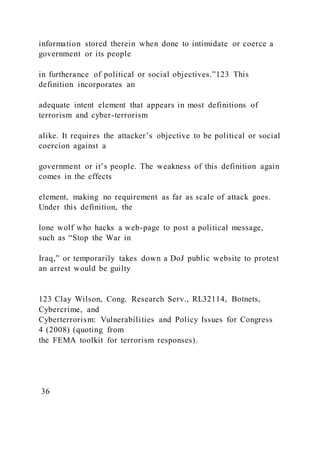
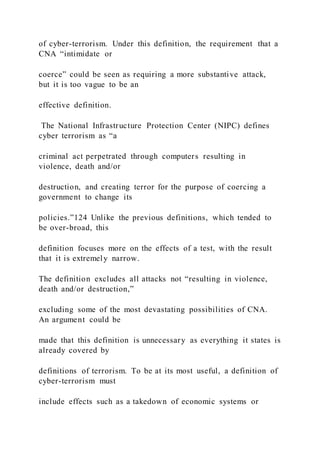
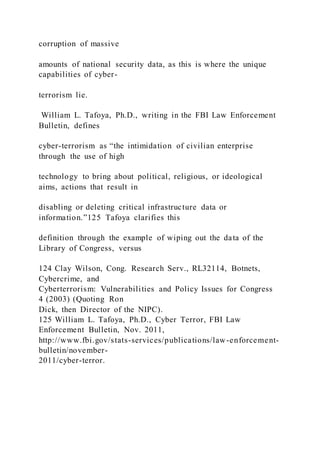
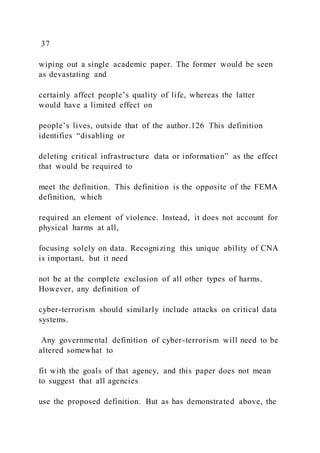
threats of cyber-terrorism in the immediate aftermath of 9/11).
115 See Martin C. Libicki, Cyberwar as a Confidence Game,
Strategie Studies Quarterly
132, 133 (Winter 2011).
31
Research Center. Dr. Krasavin defines cyber-terrorism as “use
of information technology
and means by terrorist groups and agents.”116
This definition offers a much different approach by focusing on
the actor, not the
act. Accordingly, as long as a terrorist is using the information
system towards his or her
means, it does not matter what the result of that use is. Using e-
mail to communicate with
other terrorists would be an act of cyber-terrorism. However,
the rapid spread of the
Internet around the world means there likely is not a terrorist
organization that does not
use the Internet and computers for any number of reasons.117
Thus, the category
essentially becomes redundant to that of terrorism. This
definition is an excellent
description of “terrorist use of the Internet,” but i s not helpful
in distinguishing cyber-
terrorism from other type of CNA.
The advantage of an intent-based definition is it covers the full
range of attacks
both unique to CNA, such as damaging economic data, and
similar to traditional
terrorism, such as releasing poison gas. However, an attack for
political motivations can
run the entire spectrum of CNA, including basic denial of
service attacks and government
website defacement, to potentially major attacks, such as on
SCADA controlled utilities.
Intent-based definitions, like overly broad effects-based
definitions, run the risk of
making the category of cyber-terrorism so broad it becomes
meaningless. We do not
classify the graffiti artist who spray-paints “Out of Iraq” on a
public wall as a terrorist
partly because the term would lose its meaning. The same
should hold for acts of cyber-
terrorism.
116 Serge Krasavin, Ph.D., What is Cyber-terrorism? Computer
Crime Research Center,
http://www.crime-research.org/library/Cyber-terrorism.htm (last
visited Feb 7, 2012).
117 See the following part for a discussion of terrorist use of
the Internet.
32
The most useful approach is combining an element of
motivation requiring the
CNA be premeditated and politically motivated, with the above
effects element. The term
cyber-terrorism should recognize the purpose behind the attack:
to undermine a
government or motivate it to change its policies; and it should
only recognize CNA with
adequate effects: attacks that produce fear or anxiety in the
populace. This combination
will avoid the trap of being too narrow, allowing the inclusion
of certain effects unique to
CNA, while also avoiding being too broad - excluding those
acts that are of a more trivial
nature.
3. The Non-State Actor Requirement
Although not every definition includes a requirement that
terrorist acts be
conducted by non-state actors, most acts with effects similar to
that of a terrorist act that
are attributed directly to a state are considered acts of armed
aggression. The reason is
that such an attack is likely to be dealt with in a much different
manner by governmental
agencies, and would be viewed differently by the public. For
example, if the intelligence
operative of a foreign nation were to set off a bomb in the
United States, and it was
known that this operative was acting under the control of that
foreign nation, it would be
seen as an act of armed aggression by that state and dealt with
as such. The same should
be true for cyber-terrorism. However, the exclusion of this
element is not fatal to the
definition, and may be eliminated for certain applications.
One of the prime difficulties in cyber-terrorism will be
deciding whether a state
actor is responsible for the attack. Many experts believe that
nations such as China and
Russia, who have extensive CNA capabilities, use hacking
groups not officially state
related to mask state involvement in CNA against foreign
powers. This is no new tactic in
33
the world of terrorism, as we have seen with state-sponsors of
terrorism such as Iran.118
However, the built-in anonymity of the Internet and the lack of
physical infrastructure
required to launch an attack, make this tactic even more
successful in cyberspace.
Whether a CNA is ultimately attributed to a state will depend
upon the evidence
particular to the case, and the willingness of political leaders to
place blame with state
actors. However, because the response options will be so
entirely different against a state
actor, it is more useful to categorize those attacks as something
other than cyber-
terrorism.
D. Current Definitions of Cyber-Terrorism
Having proposed a common working definition of cyber-
terrorism, this section
analyzes the definitions that have either been offered by
academics, or are in use by the
U.S. government. To start, the original definition came from
Barry C. Collin, a senior
research fellow at the Institute for Security and Intelligence in
California, in the 1980s.119
His vision of cyber-terrorism was one in which attacks
conducted through computers
mirrored the effects of traditional acts of terrorism:120
Like conventional terrorists, CyberTerrorists are out for blood.
They try to do
things like break into subway computer systems to cause a
collision or use
118 See, e.g., Cent. Intelligence Agency, The World Factbook -
Iran,
https://www.cia.gov/library/publications/the-world-
factbook/geos/ir.html (last visited Feb
29, 2012) (describing Iran’s designation as a state sponsor of
terrorism for its activities in
Lebanon and elsewhere in the world).
119 Barry C. Collin, The Future of CyberTerrorism: Where the
Physical and virtual
Worlds Converge, 11th Annual International Symposium on
Criminal Justice Issues, 15-
18 (March 1997) (as quoted by Dorothy E. Denning, Activism,
Hacktivism, and
Cyberterrorism: The Internet as a Tool for Influencing Foreign
Policy totse.com (2007),
http://www.totse2.com/totse/en/technology/cyberspace_the_new
_frontier/cyberspc.html).
120 Mohammad Iqbal, Defining Cyberterrorism, 22 J. Marshall
J. Computer & Info. L.
397, 403 (2004) (quoting Barry Collin).
34
computers to tamper with power grids or food processing.
However, unlike
suicide bombers and roof-top snipers, CyberTerrorists attack
from the comfort of
home and can be in more than one place at a time through
cyberspace. . . .
CyberTerrorism can be far more damaging, and far more
violent, than a 55-gallon
drum of fuel and fertilizer. . . . CyberTerrorists' isolation from
the results of their
actions and the consequent lack of personal risk, make them
particularly
dangerous. . . . [T]he ease and low cost of CyberTerrorism
combine to offer an
attractive tool for once-conventional sociopaths.
Following this statement, there has bee no shortage of cyber -
terrorism definitions offered.
Many contain similar elements and themes, but the broad
divergence in scope of these
definitions signals the need for a definition that can be used as a
common starting point.
This section begins by looking at definitions used by the U.S.
Government.
1. United States Government Definitions
Though not explicitly defined as cyber-terrorism, a form of it is
contained in the
U.S. Code. 18 U.S.C. §2332B(g)(5) (2006) defines the “federal
crime of terrorism” and
includes as predicate offenses two CFAA provisions, one
relating to cyber-espionage and
one related to computer damage.121 If one of those two CFAA
provisions is violated, and
if that CFAA violation “is calculated to influence or affect the
conduct of government by
intimidation or coercion, or to retaliate against government
conduct,” then it meets this
definition of terrorism.122 The implications of this provision
will be covered in greater
depth later, but it is important to recognize that Congress has
thought fit to include some
CNA in one definition of terrorism under the U.S. Code.
121 18 U.S.C. § 1030(a)(1) (relating to cyber-espionage); and
18 U.S.C. § 1030(a)(5)(A)
resulting in damage as defined in 18 U.S.C. §
1030(c)(4)(A)(i)(II) through (VI) (requiring
damage to national security related computers or if the damage
involves 10 or more
computers).
122 18 U.S.C. § 2332B(g)(5) (2006).
35
Using the example in the opening section of this paper in which
Anonymous
attacked a FBI website in retaliation for its arrest of Kim
Dotcom and others,
Anonymous’ actions meet the definition of the federal crime of
terrorism. This definition
meets the motivation element, as motivation is clearly covered
in the federal crime of
terrorism. However, it fails to sufficiently define the scope of
the attack’s effects. Under
the predicate CFAA offenses, almost any denial of service
attack against a national
security website will fall under its definition. These denial of
service attacks are serious
and should be investigated, but they do not cause fear or anxiety
in the populace. Despite
this recognition of cyber-terrorism in the criminal code, most
government agencies have
developed their own definitions of cyber-terrorism. These
definitions contain some
important differences and an attempt should be made to make
them more consistent.
The Federal Emergency Management Agency (FEMA) has
defined cyber-terrorism
as “unlawful attacks and threats of attack against computers,
networks, and the
information stored therein when done to intimidate or coerce a
government or its people
in furtherance of political or social objectives.”123 This
definition incorporates an
adequate intent element that appears in most definitions of
terrorism and cyber-terrorism
alike. It requires the attacker’s objective to be political or social
coercion against a
government or it’s people. The weakness of this definition again
comes in the effects
element, making no requirement as far as scale of attack goes.
Under this definition, the
lone wolf who hacks a web-page to post a political message,
such as “Stop the War in
Iraq,” or temporarily takes down a DoJ public website to protest
an arrest would be guilty
123 Clay Wilson, Cong. Research Serv., RL32114, Botnets,
Cybercrime, and
Cyberterrorism: Vulnerabilities and Policy Issues for Congress
4 (2008) (quoting from
the FEMA toolkit for terrorism responses).
36
of cyber-terrorism. Under this definition, the requirement that a
CNA “intimidate or
coerce” could be seen as requiring a more substantive attack,
but it is too vague to be an
effective definition.
The National Infrastructure Protection Center (NIPC) defines
cyber terrorism as “a
criminal act perpetrated through computers resulting in
violence, death and/or
destruction, and creating terror for the purpose of coercing a
government to change its
policies.”124 Unlike the previous definitions, which tended to
be over-broad, this
definition focuses more on the effects of a test, with the result
that it is extremely narrow.
The definition excludes all attacks not “resulting in violence,
death and/or destruction,”
excluding some of the most devastating possibilities of CNA.
An argument could be
made that this definition is unnecessary as everything it states is
already covered by
definitions of terrorism. To be at its most useful, a definition of
cyber-terrorism must
include effects such as a takedown of economic systems or
corruption of massive
amounts of national security data, as this is where the unique
capabilities of cyber-
terrorism lie.
William L. Tafoya, Ph.D., writing in the FBI Law Enforcement
Bulletin, defines
cyber-terrorism as “the intimidation of civilian enterprise
through the use of high
technology to bring about political, religious, or ideological
aims, actions that result in
disabling or deleting critical infrastructure data or
information.”125 Tafoya clarifies this
definition through the example of wiping out the data of the
Library of Congress, versus
124 Clay Wilson, Cong. Research Serv., RL32114, Botnets,
Cybercrime, and
Cyberterrorism: Vulnerabilities and Policy Issues for Congress
4 (2003) (Quoting Ron
Dick, then Director of the NIPC).
125 William L. Tafoya, Ph.D., Cyber Terror, FBI Law
Enforcement Bulletin, Nov. 2011,
http://www.fbi.gov/stats-services/publications/law-enforcement-
bulletin/november-
2011/cyber-terror.
37
wiping out a single academic paper. The former would be seen
as devastating and
certainly affect people’s quality of life, whereas the latter
would have a limited effect on
people’s lives, outside that of the author.126 This definition
identifies “disabling or
deleting critical infrastructure data or information” as the effect
that would be required to
meet the definition. This definition is the opposite of the FEMA
definition, which
required an element of violence. Instead, it does not account for
physical harms at all,
focusing solely on data. Recognizing this unique ability of CNA
is important, but it need
not be at the complete exclusion of all other types of harms.
However, any definition of
cyber-terrorism should similarly include attacks on critical data
systems.
Any governmental definition of cyber-terrorism will need to be
altered somewhat to
fit with the goals of that agency, and this paper does not mean
to suggest that all agencies
use the proposed definition. But as has demonstrated above, the
currently used definitions
are so divergent as to make a common government-wide
strategy to defeat cyber-
terrorism more difficult. There should, at a minimum, be a
consistency on the three basic
elements, particularly the type of effects that are included.
Consistency should also be
sought with international organizations, and although not the
focus of this paper, it is
useful to see how one major member of the international
community has defined cyber-
terrorism.
2. United Nations Definition of Cyber-terrorism
The United Nations (UN) Counter-Terrorism Implementation
Task Force (CTITF),
although not explicitly using the term cyber-terrorism,
recognizes that one of the ways a
126 Id.
38
terrorist organization may use the Internet is the “[u]se of the
Internet to perform terrorist
attacks by remotely altering information on computer systems or
disrupting the flow of
data between computer systems.”127 The CTITF goes on to
explain:128
any cyber attack qualifying as ‘terrorist’ would ultimately still
have to cause
damage in the ‘real world’: for example, by interfering with a
critical
infrastructure system to the extent of causing loss of life or
severe property
damage. However, as dependence on online data and services
increases, an attack
that resulted only in widespread interruption of the Internet
could, in future, cause
sufficient devastation to qualify as a terrorist attack. However,
categorizing such
attacks as terrorist remains controversial. The damage resulting
from such attacks,
while potentially economically significant, to date their impact
has been more on
the level of a serious annoyance.
This definition, while a bit unwieldy, does an excellent job of
recognizing that not only
should violent attacks be included, but attacks on data may also
serious enough to rise to
the level of terrorism. This definition, however, fails to address
the element of intent and
the non-state actor requirement. As governments and world
organizations have struggled
with the definition and issue of cyber-terrorism, so have
academics in the legal and
security communities.
3. Academic Definitions
Most academic interest in large scale CNA tends to focus on
cyber-warfare and the
involvement of state actors. This is logical given the greater
size and resources of
127 U.N. Counter-Terrorism Implementation Task Force, Report
of the Working Group on
Countering the Use of the Internet for Terrorist Purposes 8
(February 2009),
http://www.un.org/terrorism/pdfs/wg6-internet_rev1.pdf.
128 Id. at 9.
39
governments such as China, Russia, and the United States. Some
prominent cyber-
security experts, however, have focused on cyber-terrorism: the
possibility of large scale
CNA by non-state actors. One of the earliest, and most widely
cited academic
descriptions of cyber-terrorism comes from security expert
Dorothy Denning:129
Cyberterrorism is the convergence of terrorism and cyberspace.
It is generally
understood to mean unlawful attacks and threats of attack
against computers,
networks, and the information stored therein when done to
intimidate or coerce a
government or its people in furtherance of political or social
objectives. Further,
to qualify as cyberterrorism, an attack should result in violence
against persons or
property, or at least cause enough harm to generate fear.
Attacks that lead to death
or bodily injury, explosions, plane crashes, water
contamination, or severe
economic loss would be examples. Serious attacks against
critical infrastructures
could be acts of cyberterrorism, depending on their impact.
Attacks that disrupt
nonessential services or that are mainly a costly nuisance would
not.
Although it primarily focuses on violent acts, Denning’s
description does include attacks
that cause severe economic loss. She excludes attacks that are
minor in nature, steering
the definition towards more significant attacks. Non-violent
types of attacks may also be
covered by the phrase “or at least cause enough harm to
generate fear,”130 but it is
difficult to draw clear guidelines from this statement. It also
declines to state whether the
129 Dorothy E. Denning, Cyberterrorism: Testimony before the
Special Oversight Panel
on Terrorism, H. Comm. on the Armed Services (May 23, 2000),
http://www.cs.georgetown.edu/~denning/infosec/cyberterror.ht
ml (arguing that a
definition of cyber-terrorism should involve a component of
violence or harming of
critical infrastructure, and that, at the time, it was mostly
theoretical but could arise in the
future).
130 Id.
40
attacker must be a non-state actor. Overall, however, it is an
excellent foundation from
which to formulate a precise definition that meets the criteria of
being broad enough to
include unique CNA, such as attacks on data only, and narrow
enough to exclude monor
activist attacks.
The Center for Strategic and International Studies (CSIS)
defined cyber-terrorism
as “the use of computer network tools to shut down critical
national infrastructures (such
as energy, transportation, government operations) or to coerce
or intimidate a government
or civilian population.”131 This definition is at once both
precise: “shut down critical
national infrastructures,” and vague: “coerce or intimidate
government or civilian
populace.” It fails to define what level of coercion or
intimidation is required before it
goes from being a protest, to an act of terrorism. Although it
suggests a higher level of
attack by explicitly including critical infrastructure, it fails to
be more precise beyond that
particular category.
Kelly Gable provided a similar definition, including “efforts by
terrorists to use the
Internet to hijack computer systems, bring down the
international financial system, or
commit analogous terrorist actions in cyberspace.”132 Gable
focuses on the internati onal
finance system, as opposed to critical infrastructure, but also
includes “analogous terrorist
actions,” which clearly suggests violent acts. This definition is
useful in identifying the
need to include CNA causing drastic effects on the financial
system in any definition.
131 J.A. Lewis, Assessing the risks of cyber terrorism, cyber
war and other cyber threats,
Center for Strategic & International Studies (Dec. 2002),
http://csis.org/files/media/csis/pubs/021101_risks_of_cyberterro
r.pdf.
132 Kelly A. Gable, Cyber-Apocalypse Now: Securing the
Internet Against
Cyberterrorism and Using Universal Jurisdiction as a Deterrent,
43 Vand. J. Transnat’l
L. 57, 62 (2010).
41
Susan Brenner, another noted cyber-security expert, posits a
basic definition of
cyber-terrorism, stating: “[g]enerically, cyberterrorism consists
of using computer
technology to engage in terrorist activity.”133 Recognizing the
broad nature of this
definition, Brenner goes on to further define it in several
important ways. Brenner
excludes from cyber-terrorism attacks that originate through the
Internet, but have the end
result of large scale destruction, what she terms as a “Weapon
of Mass Destruction”
attack.134 She provides the example of hacking into the
controls of a nuclear power plant
and causing a Chernobyl style meltdown.135 Although it seems
counter-intuitive to
exclude this action from cyber-terrorism, Brenner argues that
such an attack would
primarily be remembered as a nuclear terrorist attack, not a
cyber-attack, and therefore
should not be considered cyber-terrorism.136 Brenner argues
that we do not define a car
bomb attack as automotive-terrorism, so why define a cyber-
attack as cyber-terrorism?137
It should also be noted that Brenner did not see this type of
attack as a real possibility, but
rather a conceptual problem only.138
Whereas Brenner makes a good point that CNA producing
violence is a “terrorist”
attack in the traditional sense, there is still good reason to
further classify it as a cyber-
terrorist attack, particularly if the definition is to be used as a
common working definition
133 Susan W. Brenner, “At Light Speed” - Attribution and
Response to
Cybercrime/Terrorism/Warfare, 97 J. Crim. L. & Criminology
397, 386 (2007)
(categorizing cyber-threats and focusing on attribution as the
key element to be solved in
battling those threats).
134 Id. at 390-391.
135 Id.
136 Id.
137 Id. at 391.
138 Id.
42
for government agencies. First, a separate classification is
needed to gear policy makers
and law enforcement towards appropriate methods of prevention
and response.
Prevention of a traditional terrorist attack on a nuclear plant is
vastly different from
a CNA, and will require different thought processes, security
measures, and, as this paper
later argues, changes to the law. Traditional attack prevention
involves protection of
physical security on the grounds surrounding of the plant, while
CNA prevention
involves protection of the plant’s information systems.
Similarly, a law enforcement
investigation of a traditional terrorist attack would require
vastly different techniques and
expertise than a CNA on that same plant. Staying with the
automotive analogy, law
enforcement would use substantially the same techniques to
investigate a physical
bombing of a power station whether the bomber used a vehicle
or a suicide vest to attack
the station. However, the same could not be said if the attack
was conducted through
information systems.
The second category of cyber-terrorism that Brenner proposes
is a “Weapon of
Mass Distraction.”139 This would be a CNA not with violent,
physical effects, but
psychological effects that could undermine the faith in
government.140 Brenner provides
the example of leading people to believe, through a hacked
news website, that there was a
suitcase nuclear device on a city bus, leading to mass panic and
possibly death.141
Certainly, this is a more realistic scenario than the attack on the
nuclear plant, given the
lower level of sophistication required. As previously noted,
Lulz was able to place a news
139 Id. at 391-3.
140 Id.
141 Id. at 392.
43
story on PBS that Tupac Shakur was still alive several years
after his actual death.142
Additionally, this type of attack could be accomplished
completely through the Internet,
unlike CNA against a nuclear plant, which would probably
requiring introducing the
attack from the inside.143
Because of the lower level of sophistication required, Brenner
views this type of
attack as more than a theoretical possibility. As more and more
news is relayed through
Internet news outlets, Facebook, Twitter, instant messaging and
other Internet based
sources, the potential panic that would likely result from a
“weapons of mass distraction”
attack is high. Causing the appearance of a terrorist attack
through CNA represents a
major threat that should be accounted for in any definition of of
cyber-terrorism.
Brenner’s final cyber-terrorism category is a “Weapon of Mass
Disruption.”144 This
type of attack utilizes CNA against infrastructure components
such as an electrical grid or
gas supply.145 The cyber-terrorist’s goal would be to
undermine the populace’s faith in
government by interrupting essential services.146 Brenner sees
this as a more realistic
possibility than that which produces violent, catastrophic
effects.147 These types of
attacks have been attempted with limited success, though they
have yet to cause
142 See Kevin Poulsen, Hacktivists Scorch PBS in Retaliation
for WikiLeaks
Documentary, WIRED (May 30, 2011),
http://www.wired.com/threatlevel/2011/05/lulzsec/.
143 See Nuclear Energy Institute - Plant Security,
http://www.nei.org/keyissues/safetyandsecurity/plantsecurity/
(last visited Feb 29, 2012)
(describing nuclear plant operations as isolated from the
Internet and other networks).
144 Brenner, “At Light Speed,” supra note 133, at 393-5.
145 Id.
146 Id.
147 Id.
44
widespread fear or panic.148 However, this type of attack seems
different more in terms of
scale than type from the “Weapon of Mass Destruction”
category. If a hacker could alter
the gas supply to shut it down, certainly that same hacker could
overload the gas supply
and possibly cause an explosion.
Overall, Brenner’s point was that cyber-terrorism should not be
treated on the level
of war, for the greatest potential harms were either too
theoretical or simply straight
terrorism, but should instead be treated as crime.149 However,
following Al-Qaeda’s
attacks on 9/11, terrorist attacks have become a category unto
themselves and the
response has included participation by the intelligence agencies,
law enforcement, and
the military. The threats posed by terrorism have prompted the
passage of new laws and
the development of new law enforcement techniques. If it is
possible a cyber-terrorist
attack could seriously undermine a citizenry’s faith in
government, as Brenner suggests it
could, then policy makers should identify cyber-terrorism as
unique from cyber-crime,
and devote serious attention to prevention and response.
E. Categories of Computer Network Attack
If cyber-terrorism is to be recognized as a unique type of CNA,
it is important to
examine those other types of CNA to understand how they are
distinguished. Within the
category of CNA are several sub-categories, which this paper
will distinguish by using
three factors: damage done to the target information system,
motivation of the attack, and
148 Tony Smith, Hacker jailed for revenge sewage attacks, The
Register (Oct. 31, 2001),
http://www.theregister.co.uk/2001/10/31/hacker_jailed_for_reve
nge_sewage/.
149 Brenner, “At Light Speed,” supra note 133, at 398-399.
45
identity of the attacker. By identifying each of the three factors
in a particular attack, the
attack can be categorized and response options determined.
1. Cyber-crime
This paper defines a cyber-crime as any level of CNA,
conducted by any party, for
any purpose considered illegal under domestic or international
law. This category is the
broadest category of CNA, and includes every type of CNA
outside those in an armed
conflict that do not violate the laws of war. Under U.S.
domestic law, it is essentially any
action that violates the CFAA.
Cyber-crimes need not have the information system as a target,
as the definition
includes those attacks simply using the information system as a
tool. A current definition
in use by the Computer Crime Research Center defines cyber-
crime as “crimes
committed on the Internet using the computer as either a tool or
a targeted victim.”150
Although this paper argues a CNA does not have to be
conducted through the Internet,
this definition accurately reflects that information systems can
be used to effectuate an
attack, not just serve as the target. CNAs frequently use other
means of accessing
information systems than the Internet. The Stuxnet virus, for
example, is thought to have
been placed onto information systems using an infected
removable drive, given that the
target system was not connected to the Internet.151 This is
important for a discussion of
150 Aghatise E. Joseph, Cybercrime Definition, Computer
Crime Research Center (June
28, 2006), http://www.crime-research.org/articles/joseph06/.
151 See William J. Broad, John Markoff & David E. Sanger,
Stuxnet Worm Used Against
Iran Was Tested in Israel, N. Y. Times (Jan. 15, 2011),
http://www.nytimes.com/2011/01/16/world/middleeast/16stuxne
t.html; see also Zetter,
supra note 82.
46
cyber-terrorism as many critical infrastructure components are
not connected to outside
networks as a security measure, and must be accessed through
another means.
2. Cyber-espionage
Cyber-espionage is a CNA by a state actor for the motivation
of collecting
intelligence against another state, or a government contractor of
that state dealing in
national security, which causes minimal damage or disruption to
the information system.
This definition does not incorporate non-national security
related corporate espionage, as
that is a more traditional cyber-crime. This is not to say that
corporate espionage does not
have national security implications. According to the DoD:152
Every year, an amount of intellectual property larger than that
contained in the
Library of Congress is stolen from networks maintained by U.S.
businesses,
universities, and government departments and agencies. As
military strength
ultimately depends on economic vitality, sustained intellectual
property losses
erode both U.S. military effectiveness and national
competitiveness in the global
economy.
However, the tools for dealing with traditional criminal actions
such as corporate
espionage diverge sharply from counter-intelligence.
Cyber-espionage also does not incorporate a CNA by a state
actor that causes more
than minor damage or degradation to a foreign network, which I
would classify as an
armed attack in cyberspace. Whether or not an armed attack in
cyberspace rises to the
level of an act of war is a complicated calculus that has
received much analysis from
152 Dept. of Defense, Strategy for Operating in Cyberspace 4
(2011).
47
government sources and academics alike. However, armed
attack in cyberspace is
generally not considered an acceptable practice.153 Cyber -
espionage, on the other hand, is
generally considered acceptable internationally as a form of
espionage, and it is rapidly
rising as a major national security concern.154 That
international law neither clearly
condones nor explicitly proscribes the conduct tends to support
the conclusion that
“[e]spionage is nothing but the violation of someone else's
laws.”155 States do criminalize
spying under domestic laws, applying it to any individual spies
they catch,156 but for
cyber-espionage, of course, the chances of apprehension are
remote, since states can
conduct it without putting their agents physically inside a
foreign nation.
One of the best examples of cyber-espionage was the cyber-
espionage ring known
as “Titan Rain.”157 Discovered in 2003, websites in China
targeted unclassified networks
in the DoD and other federal agencies.158 The attacks were
eventually traced to the
province of Guangdong, China, but never definitively traced to
the Chinese
153 Even though many experts suspect that the Russian
government engages in CNA, they
continually refuse to acknowledge any direct involvement. See
e.g., Estonia hit by
“Moscow cyber war,” BBC (May 17, 2007),
http://news.bbc.co.uk/2/hi/europe/6665145.stm.
154 See Chinese step up computer espionage against United
States, N.Y. Times, (Oct. 20,
2008),
http://www.nytimes.com/2008/11/20/world/americas/20iht-
spy.4.18006075.html?scp=1&sq=chinese%20computer%20espio
nage&st=cse (reporting
on a Congressional committee looking into the dramatic rise in
online theft of sensitive
information by China).
155 U.S. Intelligence Agencies and Activities: Risks and
Control of Foreign Intelligence,
Part 5: Hearing Before the H. Select Comm. on Intelligence,
94th Cong. 1767 (1975)
(statement of Mitchell Rogovin, Special Counsel to the Director
of Central Intelligence).
156 See e.g., 18 U.S.C. § 792 et seq (2006).
157 Joshua E. Keating, Shots Fired - The Ten Worst
Cyberattacks, Foreign Policy (Feb.
27, 2012),
http://www.foreignpolicy.com/articles/2012/02/24/shots_fired
(describing
Titan Rain as one of the ten worst cyber-attacks).
158 Bradley Graham, Hackers Attack Via Chinese Web Sites,
Wash. Post (Aug. 25, 2005),
http://www.washingtonpost.com/wp-
dyn/content/article/2005/08/24/AR2005082402318.html.
48
government.159 Included in the information stolen by the
cyber-spies were schematics for
NASA’s Mars Reconnaissance Orbiter, a huge collection of files
from Redstone Arsenal,
home to the Army Aviation and Missile Command, and
Falconview 3.2, the flight-
planning software used by the Army and Air Force.160 Alan
Paller, the director of the
SANS Institute, an education and research organization focusing
on cyber-security, stated
that, based upon the techniques used, the cyber-spies were
working for the Chinese
military.161 These attacks, however, were not aimed at
disrupting the operation of United
States government networks, simply obtaining information from
them. Had they
disrupted the networks to a large degree, they would be properly
categorized as an armed
attack in cyberspace.
3. Armed Attack in Cyberspace
Armed attack in cyberspace is a CNA by a state actor, or a non-
state actor under the
direction of a state actor, that causes more than minor
destruction, damage, or
degradation to an information system itself, or anything outside
the information system
that is destroyed, damaged, or degraded as a result of the CNA
through the use of an
information system. This term is often equated with cyber-
warfare, defined by Susan
Brenner as follows:162
159 See Nathan Thornburgh, The Invasion of the Chinese
Cyberspies, Time (Aug. 29,
2005),
http://www.time.com/time/printout/0,8816,1098961,00.html
(reporting on a
civilian, Shawn Carpenter, who was able to track the spies to
Guangdong while working
as an computer security analyst for Sandia National
Laboratories).
160 Id.
161 Hacker attacks in US linked to Chinese military, Breitbart
(Dec. 12, 2005),
http://www.breitbart.com/article.php?id=051212224756.jwmkvn
tb&show_article=1.
162 Susan W. Brenner, “At Light Speed” - Attribution and
Response to
Cybercrime/Terrorism/Warfare, 97 J. Crim. L. & Criminology
397, 401 (2007).
49
Cyberwarfare is the conduct of military operations by virtual
means. It consists of
nation-states' using cyberspace to achieve the same ends that
they pursue through
the use of conventional military force: achieving advantages
over a competing
nation-state or preventing a competing nation-state from
achieving advantages
over them.
This close alliance with warfare has led many to question what
kind of CNA would rise
to the level of “use of force” and trigger law of war
considerations.163 The DoD provides
a vague standard, stating that “[a]s in the physical world, a
determination of what is a
‘threat or use of force’ in cyberspace must be made in the
context in which the activity
occurs, and it involves an analysis by the affected states of the
effect and purpose of the
actions in question.”164 Charles Dunlap, former Deputy Staff
Judge Advocate of the Air
Force and current visiting professor of law at Duke University,
argues that CNA resulting
in violent effects is equivalent to armed attacks and constitutes
a use of force.165
Additionally, according to Dunlap, when there is a use of force,
the Laws of War should
apply and govern the conduct of state actors just as in
traditional warfare.166 However,
rarely have states acknowledged any role in cyber-warfare
outside of actions taken during
163 See generally Charles J. Dunlap Jr., Perspectives for Cyber
Strategists on Law for
Cyberwar, 5 Strategic Studies Quarterly 81-99 (2011), available
at:
http://scholarship.law.duke.edu/faculty_scholarship/2368
(arguing that the laws
comprising the Law of Armed Conflict as existing are adequate
to deal with the new
development of cyber-warfare).
164 Dept. of Defense, Cyberspace Policy Report: A Report to
Congress Pursuant to the
National Defense Authorization Act for Fiscal Year 2011,
Section 934 9 (Nov. 2011).
http://www.defense.gov/home/features/2011/0411_cyberstrategy
/docs/NDAA%20Sectio
n%20934%20Report_For%20webpage.pdf.
165 Siobhan Gorman & Julian E. Barnes, Cyber Combat: Act of
War, Wall St. J. (May 31,
2011),
http://online.wsj.com/article/SB10001424052702304563104576
355623135782718.html.
166 Id.
50
a declared conflict.167 Most actions that are taken by
governments are more precisely
defined as covert actions. A classic example of a covert action
in cyberspace is the
infiltration of the Stuxnet computer virus against Iran; assuming
that, as most analysts
suspect, it was launched by a nation state.168 This paper will
identify all such cyber-
attacks as armed attacks in cyberspace.
A good example of armed attack in cyberspace is the 2008
conflict between Russia
and Georgia.169 The conflict was over a province of Georgia,
South Ossetia, which sought
independence from Georgia.170 The Russian government
backed the separatists and on
August 8, 2008, the two sides clashed militarily.171 The
Georgians were pushed out of
South Ossetia on August 10 after two days of fighting the
Russian army.172 Just as the
military conflict was taking place, a shadow conflict was also
taking place on the
Internet. According to Georgian officials, Russian state-
sponsored hackers launched an
extensive CNA campaign against Georgian government
websites.173 Georgian President
Mikheil Saakashvili's website, the website of the Ministry of
Foreign Affairs, and that of
the Ministry of Defense were all forced offline as part of the
attack.174
167 See Richard A. Clarke & Robert Knake, Cyber War: The
Next Threat to National
Security and What to Do About It 69 (Reprint ed. 2011)
(describing the use of armed
attack in cyberspace by the United States Air Force in the Iraq
War).
168 See Broad, Markoff & Sanger, supra note 151.
169 Peter Finn, A Two-Sided Descent Into Full-Scale War,
Wash. Post (Aug. 17, 2008),
http://www.washingtonpost.com/wp-
dyn/content/article/2008/08/16/AR2008081600502_pf.html.
170 Id.
171 Id.
172 Id.
173 Asher Moses, Georgian Websites Forced Offline in “cyber
War,” Sydney Morning
Herald (Aug. 12, 2008),
http://www.smh.com.au/news/technology/georgian-websites-
forced-offline-in-cyber-war/2008/08/12/1218306848654.html.
174 Id.
51
This CNA was unique in that it occurred in conjunction with a
larger military
campaign. Although it did not appear to affect the military
operations, it did suppress the
Georgian government’s ability to spread information to both its
people and those
abroad.175 It is likely a harbinger of future military conflicts in
which cyber-warfare will
have an increasingly large role to play. But what if these attacks
had occurred completely
outside a military conflict and were conducted by civilians?
How should they be
categorized in that situation? The answer would likely be as
“hacktivists.”
4. Hacktivism
Hacktivists are often mixed in with cyber-terrorism, given that
the difference
between the two is in some ways only a matter of degree. The
term was coined by a
group of hackers called the Cult of the Dead Cow, who wanted
to use computer hacking
to foster human rights and free expression.176 These groups are
non-state actors who
conduct CNA with political motivations.177 The level of these
attacks, however, are
relatively minor and do not cause effects traditionally
associated with terrorism, such as:
fear or panic in the civilian populace, affect national security,
or damage critical
infrastructure, to include economic data.178 Although these
groups do commit crimes,
hacktivist groups are primarily distinguished from most cyber-
criminals through their
175 Id.
176 See Michelle Delio, Hacktivism and How It Got Here,
Wired (July 14, 2004),
http://www.wired.com/techbiz/it/news/2004/07/64193.
177 U.S. Gov't Accountability Office, Statement for the record
to the Subcommittee on
Terrorism and Homeland Security, Sen., Cybersecurity:
Continued efforts are needed to
protect information systems from evolving threats 4 (2009),
available at http://
www.defense.gov/home/features/2010/0410_cybersec/docs/d102
30t.pdf [hereinafter
GAO cyber-security statement for the record].
178 See generally Karson K. Thompson, Not Like an Egyptian:
Cybersecurity and the
Internet Kill Switch Debate, 90 Tex L. Rev. 465, 476 (2011)
(defining and providing
examples of hacktivism).
52
motivations.179 They are motivated by a desired to change a
policy, practice or mode of
thinking, as opposed to monetary gain or other traditional
criminal motivation.180
Hacktivists have participated in numerous CNA opposing (or
favoring) various groups or
causes, such as attacks on Visa and MasterCard,181 and
supporting WikiLeaks.182
Hacktivism is certainly a growing phenomenon,183 but, given
the limited nature of the
attacks as defined, probably not a major threat to national
security.184 If the damage
caused by hacktivists were to substantially increase and pose a
threat to national security,
however, they would rise to the level of cyber-terrorism.
One of the largest hacktivist operations seen to date was termed
the “50 days of
Lulz.”185 In 2011 a group of hackers going by the name of
Lulz, or Lulzsec, underwent a
concentrated number of CNA focused on political causes.186
For example, PBS’ popular
news show Frontline aired a show on Wikileaks that Lulz
disagreed with in May 2011.187
In response, Lulz hacked into the PBS website and posted a fake
news story about Tupac
179 Id.
180 See GAO cyber-security statement for the record, supra
note 177, at 4.
181 Wikileaks “data war” gathers pace, BBC (Dec. 9, 2010),
http://www.bbc.co.uk/news/technology-11935539 (Visa and
MasterCard were hit with
denial of service attacks after they withdrew their services from
Wikileaks).
182 Peter Ludlow, WikiLeaks and Hacktivist Culture, The
Nation (Sept. 15, 2010),
http://www.thenation.com/article/154780/wikileaks-and-
hacktivist-culture (discussing the
prominence of WIkileaks in the hacktivist sub-culture).
183 John P. Mello, Jr., Hacktivism Trumps Money as
Motivation for Denial-of-Service
Attacks, PCWorld, February 7, 2012,
http://www.pcworld.com/article/249442/hacktivism_trumps_mo
ney_as_motivation_for_
denialofservice_attacks.html (stating that hacktivism is the most
widespread motivation
for Distributed Denial of Service attacks on the Internet).
184 See Lewis, supra note 131.
185 See Keating, supra note 157.
186 Id.
187 See Poulsen, supra note 142.
53
Shakur being alive and living in New Zealand.188 Lulz also
posted e-mail addresses and
passwords for over 200 of PBS affiliate stations around the
country.189 The group also
took down the Central Intelligence Agency’s website and
released the personal
information of millions of Play Station Network’s users.190 At
least one leader of this
group, known as Topiary, was arrested in the Shetland Islands
for his hacking in
connection with Lulz.191 The CNA by Lulz was certainly
serious, particularly the release
of personal data for the PlayStation Network users. However, it
is a stretch to argue that
the release of personal data, in the age of Facebook, rises to the
level of terrorism. Just as
definitions of terrorism require that the effects of the act rise to
a certain level, so should
a definition of cyber-terrorism be careful to ensure these acts of
“hacktivism” are not
included.
5. Terrorist Use of the Internet
When most people think of terrorists and the Internet, they do
not think of taking
down the electric grid through a cyber-attack, they think of Al-
Qaeda posting a video
online or using the Internet to promote their message.192 The
presence of terrorist
organizations on the Internet has thus far been dominated by
terrorist organizations
utilizing the Internet for planning, coordination, propaganda,
and recruitment – what I
188 Id.
189 Id.
190 See Keating, supra note 157.
191 Josh Halliday, Charles Arthur & James Ball, LulzSec
hacking suspect “Topiary”
arrested, the Guardian (July 27, 2011),
http://www.guardian.co.uk/technology/2011/jul/27/lulzsec-
hacking-suspect-topiary-
arrested.
192 See Eben Kaplan, Terrorists and the Internet, Council on
Foreign Relations (Jan. 8,
2009), http://www.cfr.org/terrorism-and-technology/terrorists-
internet/p10005
(Discussing the advantages of the Internet to terrorist
organizations and they currently use
it).
54
will define as “terrorist use of the Internet.”193 One of the
earliest terrorist organizations
to realize the potential of the Internet was Al-Qaeda,194 and it
became one of its most
effective tools in becoming an international terrorist
organization.195 As terrorist
organizations utilize the Internet’s anonymity and flexibility, it
“erodes the ability of our
security services to hit them when they're most vulnerable,
when they're moving," said
Michael Scheuer, former chief of the CIA unit that tracked
Osama bin Laden.196 In a
similar thought, longtime State Department expert Dennis
Pluchinsky finds the global
jihad movement has become a “Web-directed" phenomenon.197
Cyberspace is an ideal platform to communicate and coordinate
activities. Its speed,
simplicity, ease of access, and anonymity makes it difficult to
monitor and control.198
There are also reports that terrorist organizations have turned to
traditional cyber-crimes
such as theft and fraud to raise funds.199 Some experts believe
that without a state
193 See Gabriel Weimann, Terror on the Internet: The New
Arena, the New Challenges (1
ed. 2006) (A study of how modern terrorist organizations
exploit the Internet to raise
funds, recruit members, plan and launch attacks, and publicize
their results). See also,
Benjamin R. Davis, Ending the Cyber Jihad: Combating
Terrorist Exploitation of the
Internet with the Rule of Law and Improved Tools for Cyber
Governance, 15 CommLaw
Conspectus 119 (2006) (arguing that the U.S. and foreign
governments, as well as
international bodies like ICANN, have failed to adequately
respond to the use of the
Internet by terrorist organizations).
194 N.Y. Times, Al Qaeda (Jan. 31, 2012),
http://topics.nytimes.com/top/reference/timestopics/organizatio
ns/a/al_qaeda/index.html?
scp=1&sq=al-qaeda%20internet&st=cse (last visited Feb 5,
2012).
195 Steve Coll & Susan B. Glasser, Terrorists Turn to the Web
as Base of Operations,
Wash. Post (Aug. 7, 2005), http://www.washingtonpost.com/wp-
dyn/content/article/2005/08/05/AR2005080501138. html
(charting Al Qaeda’s migration
from operating primarily in real space to operating in
cyberspace).
196 Id.
197 Id.
198 See Weimann, supra note 193, at 25.
199 Jon Swartz, Terrorists’ use of Internet spreads, USA Today,
Feb. 21, 2005,
http://www.usatoday.com/money/industries/technology/2005-
02-20-cyber-terror-
55
sponsor, or an influx of highly trained computer personnel, this
is as far as they will go.200
Others, including the FBI, believe Al-Qaeda may try some act
of cyber-terrorism.201
Either way, international terrorist organizations have learned
the power of the Internet
and are willing to use it in creative ways to accomplish their
objectives. However, using
information systems to further one’s organization is distinctly
different from using those
information systems as a weapon of terror. Al-Qaeda does not
need to write malicious
code or manipulate SCADA systems to help organize and fund
the organizations, or
spread propaganda. The two categories will certainly connect in
some ways, but the tools
needed to counter them are fundamentally different.
Having defined cyber-terrorism, examined the elements of that
definition, and
distinguished it from other types of CNA, the next part of this
paper will examine
examples of major CNA to determine whether those attacks
would be appropriately
categorized as cyber-terrorism.
usat_x.htm (Citing examples of terrorists organizations using
fraud on the internet to
finance their operations).
200 Mark Ward, Cyber terrorism “overhyped,” BBC, Mar. 14,
2003,
http://news.bbc.co.uk/2/hi/technology/2850541.stm (Stating the
belief of several security
experts that would-be online terrorists lack the technical
expertise and resources to
engage in cyber-terrorism).
201 Cybersecurity: Preventing Terrorist Attacks and Protecting
Privacy in Cyberspace:
Hearing Before the Subcomm. on Terrorism and Homeland Sec.
of the S. Judiciary
Comm., 111th Cong. 2 (Statement of Steven R. Chabinsky, Dep.
Asst. Dir., Cyber
Division, FBI).
56
Part III. Recent Examples of Computer Network Attack
“CIA TANGO DOWN” - 10 February 2012 Tweet by the hacker
group Anonymous
This section examines several recent major examples of CNA
to determine if they
should be classified as cyber-terrorism. Specifically, this
section examines the effects,
motives, and targets of the examples of CNA, measuring them
against the elements set
out in the definition of cyber-terrorism.
A. Anonymous
Anonymous is an affiliation of hackers who have conducted an
increasingly large
number of attacks since their beginnings around 2003.202 They
are thought to be
associated with Lulz, discussed in part II.203 Some of their
most notable targets include
private organizations such as the Church of Scientology204 and
Sony,205 as well as
government organizations from the CIA,206 to the governments
of Tunisia207 and Iran.208
202 Chris Landers, Serious Business: Anonymous Takes On
Scientology (and Doesn't
Afraid of Anything), Baltimore City Paper (Apr. 2, 2008),
http://www2.citypaper.com/columns/story.asp?id=15543
(describing a 2008 dispute
between the Church of Scientology and the hacking group
Anonymous that was a
response in part to the Church of Scientology’s claims of online
copyright infringement).
203 See Poulsen, supra note 142.
204 Id.
205 Elinor Millis, Sony sites offline after Anonymous attack
threats, CNET, Apr. 6, 2011
4:52 PM, http://news.cnet.com/8301-27080_3-20051482-
245.html (after Sony filed suit
against individuals who had “jailbroken” software for its
popular gaming system,
Anonymous launched denial of service attacks against several
sites associated with
Sony).
206 Nicole Perlroth, Anonymous Says It Knocked C.I.A. Site
Offline, N.Y. Times Bits
Blog, Feb. 10, 2012,
http://bits.blogs.nytimes.com/2012/02/ 10/anonymous-says-it-
knocked-c-i-a-site-offline/ (the attack against the CIA website
followed closely after the
57
Although many of their attacks have shown a high degree of
coordination, the nature of
the organization is somewhat informal.209 In a 2011 interview
with IT World reporter Dan
Tynan, one of the leaders of Anonymous, known as Commander
X, stated there were
approximately ten thousand members of Anonymous
worldwide.210 Commander X stated
that their targets are selected by looking at several factors,
including: 1) whether there are
already protests in place against the target; 2) if the protests are
non-violent; 3) they have
a likelihood of success; and 4) there is a clear moral
imperative.211 Commander X does
not define whose “moral imperative” guides their actions.
Clearly, Anonymous sees its actions as civil disobedience,
using the language of
morality to justify its actions. An example of this moralistic
language was the recent
launch of a cyber-campaign against Israel. On February 11,
2012, a video purportedly
released by Anonymous promised a “crusade” against Israel.212
The stated aim of
FBI arrests of the owners of a popular music downloading site,
Megaupload.com, but it
was unclear if the arrests were related to the attacks on the CIA
sites).
207 Max Read, Anonymous Attacks Tunisian Government over
Wikileaks Censorship,
Gawker (Jan. 3, 2011), http://gawker.com/5723104/anonymous-
attacks-tunisian-
government-over-wikileaks-censorship (in December 2010, the
government of Tunisia
reportedly blocked its country’s Internet users from accessing
Wikileaks, or any news
outlet that reported on the leaked cables regarding Tunisia,
prompting denial of service
attacks by Anonymous on the Tunisian government’s websites).
208 Kevin Fogarty, “Anonymous” attacks Iran, calls for
volunteers to help U.S. tornado
victims, IT World, May 2, 2011,
http://www.itworld.com/security/161241/anonymous-
attacks-iran-calls-volunteers-help-us-tornado-victims.
209 Dan Tynan, A conversation with Commander X, IT World,
Feb. 18, 2011,
http://www.itworld.com/internet/137590/conversation-
commander-x.
210 Id.
211 Id.
212 Given the nature of Anonymous announcements, it would
be easy for anyone to claim
action in their name. However, this author could find no
statement repudiating the intent
launch a CNA against Israel by Anonymous.
58
Anonymous was “systematically removing [Israel] from the
internet.”213 The video cited
Israel’s “Zionest bigotry” and population displacement as
reasons for the promised
attacks.214
Looking at these attacks, in conjunction with the attack
outlined at the beginning of
this paper, it raises the question: Is Anonymous a “hacktivist”
organization, or are they
cyber-terrorists? As already detailed, their attacks against
justice and national security
websites such as the FBI and DoJ, as well as the CIA attack,
meet the definition of a
federal crime of terrorism. But should the simple act of
temporarily taking down a
government website result in labeling a group as “terrorists?”
Looking at the elements presented in this paper’s definition of
cyber-terrorism, the
answer becomes clearer. First is the question of intent, which
Anonymous clearly meets.
The goal of Anonymous is to undermine groups and
organizations they do not agree with,
including governments.215 They also meet the requirement of
being a non-state group, as
they contain no identified ties to a state. So the last question is
whether the effects of their
attacks are designed to cause fear or anxiety in a civilian
populace through effects that
cause widespread damage to critical physical or informational
infrastructure, national
security related information systems, critical economic systems,
or that result in severe
physical damage or human casualties.
213 Donald MacIntyre, Hacking group threatens ‘crusade’
against Israel, The
Independent, Feb. 11, 2012.
214 Id.
215 Tynan, supra note 209. Commander X stated that their goal
when dealing with foreign
“dictators” is to remove them from power.
59
None of the attacks conducted by Anonymous or its affiliates
have directly caused
physical damage or human casualties,216 but they have affected
operation of web
operations for some national security related agencies through
denial of service attacks.
However, CNA resulting in the temporary takedown of
websites, such as those of the
FBI, White House, or CIA, should not be considered widespread
damage. The public
sites of these agencies, while important, are generally media
outlets and for general
notices to the public.217 Additionally, the hacked websites are
typically only down for a
brief period of time.218 Should these attacks occur during a
public emergency with
increased reliance on those sites for vital information, however,
the effects would likely
meet the definitional element of cyber-terrorism.
Anonymous has also gone so far as to eavesdrop on the phone
calls between the
FBI and Scotland Yard.219 In this CNA, Anonymous was able
to listen in on a conference
call discussing efforts against hacking groups, raising the
question of how deeply the
group had infiltrated various law enforcement agencies.220 This
infiltration should be
considered more severe than the taking down of a website, as it
could affect operations
and, potentially, national security. However, the public effects
of such actions are limited
216 See Elinor Millis, Keeping up with the hackers (chart),
CNET (Feb. 8, 2012),
http://news.cnet.com/8301-27080_3-20071830-245/keeping-up-
with-the-hackers-chart/.
217 See e.g., CIA Website, https://www.cia.gov/, last accessed
12 Feb. 2012.
218 See, e.g., Christopher Williams, Anonymous attacks FBI
website over Megaupload
raids, The Telegraph (Jan. 20, 2012),
http://www.telegraph.co.uk/technology/news/9027246/Anonymo
us-attacks-FBI-website-
over-Megaupload-raids.html (describing the Anonymous attacks
on the FBI website and
stating that the site was only don for a brief period of time,
although the sites for the
Motion Picture Association of America were down considerably
longer).
219 Leo Kelion, Hackers breach FBI-UK police call, BBC (Feb.
3, 2012),
http://www.bbc.co.uk/news/world-us-canada-16875921.
220 Id.
60
and should not be considered cyber-terrorism. Anonymous has
not limited itself to denial
of service attacks and other types of CNA may be a bit
different.
In August 2011, the Bay Area Rapid Transit (BART)
administration in San
Francisco announced that they would cut cell phone service in
tunnels as a response to
protests over the shooting of a man by BART police.221
Following this announcement,
Anonymous leaked the names, phone numbers and passwords of
BART riders.222
Although Anonymous apologized to the riders for the release of
their information, they
blamed the release on BART for having lax security
practices.223 The city of Oakland
police chief responded by calling the CNA an act of cyber -
terrorism.224 Loss of privacy
data can be of great concern to Americans, and certainly
affected these individuals lives
more than a website disruption, but does it rise to the level of
fear and anxiety?
As personal information placed on information systems
becomes more prevalent, it
also becomes more vulnerable to theft. An entire generation has
become comfortable
putting large amounts of personal information on the Internet
through Facebook, Twitter
and other social media outlets. Although most people trust that
this data is somewhat
secure, an entire industry has grown up around information
security and identity
221 David Streitfeld, Bay Area Officials Cut Cell Coverage to
Thwart Protestors, N.Y.
Times Bits Blog (Aug. 12, 2011),
http://bits.blogs.nytimes.com/2011/08/12/bay-area-
authorities-cut-cell-coverage-to-thwart-protestors/.
222 Joshua Brustein, Anonymous to BART: We Hack. We
Organize, Too, N.Y. Times Bits
Blog (Aug. 15, 2011),
http://bits.blogs.nytimes.com/2011/08/15/anonymous-to-bart-
we-
hack-we-organize-too/.
223 Id.
224 Matthew Artz, Oakland officials condemn release of
personal information by
Anonymous, San Jose Mercury News (Feb. 7, 2012),
http://www.mercurynews.com/occupy/ci_19910127.
61
protection with companies such as Lifelock, Debix, and
TrustedID.225 There seems to be
a constant flow of news stories about government agencies,
banks, and other companies
losing the privacy data of their clients or constituents.226 Has
the knowledge that so much
of our personal data is now in the hands of third parties limited
the effect of a release
such as that of Anonymous? The line is a difficult one to draw,
but in this case, with the
data limited to user names and passwords, the loss is not
substantial enough that it should
be considered cyber-terrorism.
Thus, the actions of Anonymous, while troublesome to
many,227 do not yet rise to
the level of cyber-terrorism. Their rhetoric may suggest radical
or even occasionally
violent aims, but their actions do not rise to that level.228
However, this does not mean
that as their capabilities increase they will not attempt CNA that
rises to the level of
cyber-terrorism. The National Security Agency (NSA) has
warned that by 2014,
Anonymous could have the ability to bring down portions of the
U.S. Power grid, which
225 See Bruce Schneier, The Pros and Cons of LifeLock,
WIRED (June 12, 2008),
http://www.wired.com/politics/security/commentary/securitymat
ters/2008/06/securitymat
ters_0612?currentPage=all.
226 See generally Mark Sullivan, Protect Our Data! A Digital
Consumer Bill of Rights,
PCWorld, Feb. 9, 2012,
http://www.pcworld.com/article/249558/protect_our_data_a_dig
ital_consumer_bill_of_ri
ghts.html.
227 See, e.g., Steven Musil, Interpol sweep nets 25 Anonymous
suspects, CNET (Feb. 28,
2012), http://news.cnet.com/8301-1009_3-57387203-
83/interpol-sweep-nets-25-
anonymous-suspects/ (reporting that Interpol has arrested 25
members of Anonymous
across Europe and South America in response to coordinated
attacks by the group on
websites in Colombia and Chile).
228 See Tynan, supra note 209, (in the interview with
Commander X, in response to
questions about Wikileaks founder Julian Assange, stated: “[i]f
they harm one hair upon
Julian Assange’s head, or if they destroy or damage WikiLeaks
- the PLF WILL bring
down the wrath of f***ing god on them”).
62
should be considered cyber-terrorism as a CNA on critical
infrastructure.229 NSA had
been silent regarding Anonymous to this point, making the
statement particularly
notable.230 Additionally, Anonymous announced plans to
“blackout” the Internet by
attacking the Domain Name System to protest "our irresponsible
leaders and the beloved
bankers who are starving the world for their own selfish needs
out of sheer sadistic
fun.”231 Time will tell if Anonymous truly has the intention
and capability to carry out
such attacks. Given the nature of the organizations and the
manner in which they
distribute their messages, it is difficult to determine whether
these statements are
legitimately from Anonymous. At some point in the future,
however, they may meet the
definition of a cyber-terrorist organization.
229 Siobhan Gorman, Alert on Hacker Power Play, Wall St. J.
(Feb. 21, 2012),
http://online.wsj.com/article/SB10001424052970204059804577
229390105521090.html?
mod=WSJ_hp_MIDDLENexttoWhatsNewsThird (Gen. Keith
Alexander, director of the
NSA, reportedly issued the warning in meetings with the White
House and lawmakers);
see also Elizabeth Flock, Anonymous attacks WSJ page hours
after story warning group
is getting more powerful, Wash. Post (Feb. 22, 2012),
http://www.washingtonpost.com/blogs/blogpost/post/anonymous
-attacks-wsj-page-hours-
after-story-warning-group-is-getting-more-
powerful/2012/02/22/gIQA7QlFTR_blog.html?tid=sm_twitter_w
ashingtonpost (after the
Wall Street Journal reported on Gen. Alexander’s comments
regarding Anonymous,
several Wall Street Journal Facebook pages were attacked by a
German faction of
Anonymous).
230 Kevin Fogarty, NSA: Anonymous may take down U.S.
power grid in two years, IT
World (Feb. 21, 2012),
http://www.itworld.com/security/251904/nsa-anonymous-may-
take-down-us-power-grid-two-years (stating that the NSA has
neither considered
Anonymous a major threat to national security, nor ignored
their capabilities).
231 Jeremy Kirk, Anonymous threatens to DDOS root Internet
servers, IT World (Feb. 20,
2012), http://www.itworld.com/security/251450/anonymous-
threatens-ddos-root-internet-
servers (Anonymous announced it would launch an action on
March 31, 2012 as part of
"Operation Global Blackout" that would target the root Domain
Name System (DNS)
servers, however, experts state they are not likely to be
successful).
63
B. ILOVEYOU virus
Anonymous is an example of a hacktivist group that has
generally well-defined
motivations, but whose attacks to this point are considered more
of nuisance than a true
threat to national security.232 Opposite this, are a variety of
attacks that have resulted in
damage on a larger scale, but with less defined motivations. The
ILOVEYOU virus and
variants are a prime example of this type of CNA. The
ILOVEYOU virus was estimated
to have hit 45 million users and cost billions of dollars in
damage.233 The suspected
attacker, Onel de Guzman, was apparently motivated by his
thesis on computer
vulnerabilities being rejected.234 Given a political motivation,
a physical bombing in the
United States, even if no injuries occurred, causing billions in
damages, would likely
meet the definition of an act of terrorism.235 However, a
different analysis must be used in
examining CNA. The effects of CNA are generally much more
widespread and lack the
pure shock of a physical attack. Therefore, the working
definition of cyber-terrorism
should be analyzed to determine whether an act of cyber-
terrorism has truly taken place.
Examining this paper’s definition of cyber-terrorism, the
ILOVEYOU virus fails to
rise to the level of cyber-terrorism. First, there is insufficient
evidence that the motivation
232 See e.g., David Goldman, Hacker group Anonymous is a
nuisance, not a threat,
CNNMoney (Jan. 20, 2012),
http://money.cnn.com/2012/01/20/technology/anonymous_hack/
index.htm (calling
Anonymous the “graffiti artists of the Internet”).
233 I love you Virus, Oracle ThinkQuest Education Foundation,
http://library.thinkquest.org/04oct/00460/ILoveYou.html, last
accessed 14 February
2012.
234 Mark Landler, A Filipino Linked to “Love Bug” Talks
About His License to Hack,
N.Y. Times (Oct. 21, 2000),
http://www.nytimes.com/2000/10/21/business/a-filipino-
linked-to-love-bug-talks-about-his-license-to-hack.html?src=pm
(Mr. Guzman reportedly
submitted a thesis proposal on stealing passwords to gain free
access to the Internet,
which was rejected prompting him to drop out of school).
235 See part II(B)(4) for U.S. Code definitions of terrorism.
64
of the attack was political.236 The attacks did not appear to
target government or national
security institutions.237 Additionally, no message was released
in conjunction with the
attack declaring an intent to undermine governments or
influence policy.238 Examining
the effects element, the answer is less clear. Although the attack
was not aimed at national
security systems or infrastructure, it did have a significant
effect on business239 and
affected the networks of the CIA, Pentagon, and British
Parliament.240 Given the scale of
the damage, had these attacks been politically motivated, they
would likely have risen to
the level of cyber-terrorism. However, failing the intent
element, the ILOVEYOU should
be categorized generally as a cyber-crime.
C. US Power Grid
In April 2009, U.S. officials discovered hackers from Russia,
China and other
countries had gained access to the U.S. power grid and left
behind tools that could have
destroyed system controls.241 The intrusions could not be
definitively traced to either
236 See Landler, supra note 234.
237 Id.
238 Id.
239 Id.
240 John Markoff, April 30-May 6; An “I Love You” Virus
Becomes Anything But, N.Y.
Times (May 7, 2000),
http://www.nytimes.com/2000/05/07/weekinreview/april-30-
may-
6-an-i-love-you-virus-becomes-anything-but.html (reporting
that the White House, the
Pentagon, Congress and the British House of Commo ns were
among those affected by
the ILOVEYOU virus).
241 Siobhan Gorman, Electricity Grid in U.S. Penetrated By
Spies, Wall St. J., Apr. 8,
2009,
http://online.wsj.com/article/SB123914805204099085.html
(Reporting on the
discovered intrusions into the information systems controlling
portions of the U.S. power
grid and the calls for the implementation of increased security
measures); see also James
A. Lewis, The Electrical Grid as a Target for Cyber Attack,
Center for Strategic and
International Studies, March 2010, available at
http://csis.org/files/publication/100322_ElectricalGridAsATarge
tforCyberAttack.pdf
(evaluating the risks of CNA on components of the electrical
grid system).
65
state or non-state actors.242 Nor were the motivations of the
intrusions clearly understood,
as the attacks were never actually carried out.243 Speculations
include a belief that
Russian and Chinese governments gained access so that, in the
event of a future conflict,
the grid could be shut down or otherwise affected.244
The threat to the various power grids operating in the United
States has prompted
the Energy Department to launch an initiative into protecting
the grid from CNA.245
Losing control over the power grid could have cascading effects
with disastrous
consequences for hospitals, emergency responders, defense and
law enforcement
agencies, and the financial sector, among others.246 In an
armed conflict, the power grid is
often among the first wave targets because of its ability to
debilitate a nation’s command
and control structure.247 Given the potential effect on society,
a CNA that takes down a
significant portion of a region’s power grid for any extended
period of time passes the
effects test of a cyber-terrorism event. If the 2009 intrusions
were the result of a non-state
actor, then it should be considered an act in preparation for a
cyber-terrorist attack, and
treated just as seriously as an attempted attack.
242 Id.
243 Id.
244 Id.
245 Stephen Lawton, Energy Department to analyze power grid
cyber threats, SC
Magazine (Jan. 9, 2012), http://www.scmagazine.com/energy-
department-to-analyze-
power-grid-cyber-threats/article/222399/ (reporting on the
Electric Sector Cybersecurity
Risk Management Maturity project, a federal program headed by
the Department of
Energy to find and contain gaps in the cyber security defenses
protecting the nation's
electric grid).
246 Lewis, supra note 241, at 1.
247 See Thomas E. Griffith, Jr., Strategic Attack of National
Electrical Systems, Air Power
and Maneuver Warfare, Oct. 1994, available at
http://www.comw.org/pda/fulltext/griffith.pdf (describing the
history and purpose behind
military attacks on electrical infrastructure).
66
D. Stuxnet
Between June 2009 and May 2010, a type of virus known as a
worm,248 was
discovered to have damaged Siemens supervisory control and
data acquisition (SCADA)
systems that controlled centrifuges that were part of the Iranian
nuclear program.249 The
worm most likely infected the software through the use of a
portable drive, such as a
thumb drive.250 Given the sophistication of the CNA, experts
conclude it would have
required the resources of a national government to engineer it,
and the most likely culprit
was Israel.251 Stuxnet initially spread indiscriminately, but the
virus it contained was
designed to target only a very specific type of system, and
therefore would not affect
targets other than those intended.252 Although there are no
reports of radiation leakage
from the effected sites, the NATO ambassador to Russia stated
the virus "could lead to a
new Chernobyl.”253
The Stuxnet virus should not be considered an act of cyber -
terrorism because the
prevailing opinion is that it was a covert CNA conducted by a
nation state.254 Therefore, it
is appropriately categorized as an armed attack in cyberspace.
However, it is interesting
248 A worm is a type of CNA that replicates itself and sends
those copies to other systems
it comes in contact with. Worms can carry other computer
viruses, or simply replicate
and spread to use up bandwidth.
249 John Markoff, Stuxnet Software Worm Hit 5 Industrial
Facilities in Iran, N.Y. Times
(Feb. 11, 2011),
http://www.nytimes.com/2011/02/13/science/13stuxnet.html.
250 Id.
251 See William J. Broad, John Markoff & David E. Sanger,
Stuxnet Worm Used Against
Iran Was Tested in Israel, N.Y. Times (Jan. 15, 2011),
http://www.nytimes.com/2011/01/16/world/middleeast/16stuxne
t.html (some experts
point to a secret facility in Israel’s Negev desert where they
claim Israel has a set of
nuclear centrifuges similar to Iran’s, where they tested Stuxnet).
252 Jonathen Fildes, “Nuclear virus” targets uncovered, BBC
(Feb. 15, 2011),
http://www.bbc.co.uk/news/technology-12465688.
253 Id.
254 See Broad, Markoff & Sanger, supra note 251.
67
from a cyber-terrorism perspective because it represents the
potential for future cyber-
terrorist attacks on SCADA software operating critical
infrastructure systems. That no
deaths or violence resulted from the Stuxnet virus is not a factor
weighing against
classification as cyber-terrorism. Knowing that a nuclear
facility has been targeted would
be enough to cause a state of fear for those living near an
affected facility. Were it to be
revealed that this CNA was actually the result of a non-state
actor, it should certainly be
considered cyber-terrorism.
Under almost any definition of terrorism, an attack on a nuclear
facility for political
purposes would rank as a terrorist attack.255 Given the
potentially severe consequences of
CNA on nuclear facilities, or similar facilities such as chemical
plants producing
dangerous gases, these types of attacks should receive
particularly close attention. A step
in the direction of treating sophisticated cyber-weapons with
unique potential for cyber-
terrorism, such as Stuxnet, would be to classify these weapons
as Weapons of Mass
Destruction. I will discuss how this should be done in the final
part of this paper.
E. Estonia
In April of 2007, Estonia, a former Soviet satellite state with a
large ethic Russian
minority, was one of the most wired nations in the world.256
The Estonians had pioneered
a system of “e-government,” making many government services
and functions available
255 See e.g., 18 U.S.C. § 2332B(g)(5)(i) (2006) (listing
offenses against nuclear materials
among the predicate offenses for the federal crime of terrorism).
256 Ian Traynor, Russia accused of unleashing cyberwar to
disable Estonia, the Guardian,
May 17, 2007,
http://www.guardian.co.uk/world/2007/may/17/topstories3.russi
a.
68
through the Internet.257 Estonia prided itself on both its
Internet savvy and cyber-
security.258
This was the backdrop when on April 27, 2007, the government
of Estonia moved a
Soviet-era Russian war memorial from a central square in the
capital Talinn to another
location, prompting massive protests from the ethnic Russian
minority in Estonia and
outrage from Russians abroad.259 In conjunction with the
physical protests, a three-week
wave of CNA was launched against Estonia, primarily attacking
the websites of Estonia’s
“e-government,”260 dramatically reducing the government’s
ability to function.
Combinations of different types of cyber-weapons were
inflicted upon national Internet
services.261 Included were denial of service attacks shutting
down much of the e-
government services and hacking into government and media
websites to alter their
content.262 Additionally, most of Estonia’s media outlets were
taken down by denial of
service attacks, preventing reporting on what was happening in
Estonia.263 The damage as
a result was estimated to be in the tens of millions of Euros.264
The CNA against Estonia may be the closest case of pure
cyber-terrorism yet seen.
The attacks were politically motivated and affected Estonia in a
unique way. Estonian
society was tied more deeply into the Internet than probably any
other nation at the time.
257 Clark Boyd, Estonia opens politics to the web, BBC (May
7, 2004),
http://news.bbc.co.uk/2/hi/technology/3690661.stm (following
independence from the
Soviet Union, Estonia made a nationwide push to educate
citizens in use of the Internet
and place as many government functions online as possible).
258 Traynor, supra note 256.
259 Id.
260 Id.
261 Id.
262 Id.
263 Id.
264 Ian Traynor, Web attackers used a million computers, says
Estonia, the Guardian
(May 17, 2007),
http://www.guardian.co.uk/technology/2007/may/18/news.russia
.
69
Estonia was also prepared to fend off a major CNA better than
any country. Estonia has
pride in their network security and held a feeling of
invulnerability to large scale CNA.
Although their security prevented the attack from being worse,
their feeling of
invulnerability was shattered.265
The three weeks of CNA Estonia endured was difficult for their
citizens, but the
psychological effect on the citizenry is difficult to read. Mikhel
Tammet, the chair of
Estonia's cyber-defense co-ordination committee, believed the
attack to be an act of
terrorism, stating:
This is a kind of terrorism, the act of terrorism is not to steal
from a state, or even
to conquer it. It is, as the word suggests, to sow terror itself. If
a highly IT country
cannot carry out its every day activities, like banking, it sows
terror among the
people.266
Tammet’s use of the word terrorism may have been intended to
pressure Russia into
investigating the attacks, but it may also have reflected the
anxiety of the nation as a
whole, given the unique connection, through the Internet, of the
government and people
of Estonia.267 Thus it meets the effects test not necessarily due
to the nature of the attacks,
but because of the nature of their society.
265 See Cyrus Farivar, Cyberwar I, Slate (May 22, 2007),
http://www.slate.com/articles/technology/technology/2007/05/c
yberwar_i.html
(Reporting on the lessons learned from the CNA on Estonia).
266 Adrian Blomfield, Estonia calls for Nato cyber-terrorism
strategy, The Telegraph
(May 18, 2007),
http://www.telegraph.co.uk/news/worldnews/1551963/Estonia-
calls-for-
Nato-cyber-terrorism-strategy.html.
267 Estonia hit by “Moscow cyber war,” BBC (May 17, 2007),
http://news.bbc.co.uk/2/hi/europe/6665145.stm.
70
The last remaining question in examining the CNA against
Estonia is who
conducted the attacks. Determining whether the attackers were
the Russian government
or just angry Russian civilians was never completely answered
and represents the
difficulty of determining attribution even in large-scale
attacks.268 Jaak Aaviksoo,
Estonia's defense minister, stated “[t]here is not sufficient
evidence of a [Russian]
governmental role."269 Estonia estimated at least one milli on
computers were used in the
attack. However, this many computers can be controlled were
relatively ease by a hacker
using a bot-net.270 Estonia did discover that many of the
attacks were routed through
Russian government servers, but again, this was
inconclusive.271 The ambiguity of who
conducted the CNA against Estonia is an excellent example of
the difficulty attribution
creates in classifying a CNA.
268 Ian Traynor, Web attackers used a million computers, says
Estonia, supra note 264;
but see Robert Coalson, Behind The Estonia Cyberattacks,
Radio Free Europe (Mar. 6,
2009),
http://www.rferl.org/content/Behind_The_Estonia_Cyberattacks
/1505613.html
(describing an remark by a State Duma Deputy from the pro-
Kremlin Unified Russia
party that his assistant was responsible for coordinating the
attack, but clarifying that his
assistant acted on his own).
269 Id.
270 Id.
271 Id.
71
Part IV. The Current Law and Problems
“The pessimist sees difficulty in every opportunity. The
optimist sees the opportunity in
every difficulty.” - Winston Churchill
In the previous sections this paper sought to define cyber -
terrorism and place it in
the context of some recent examples of CNA. The next question
is logically what to do
about it? To answer that question, this part first examines the
main hindrance in
combating CNA in general, and cyber-terrorism specifically:
attribution. It then examines
current domestic cyber-crime and counter-terror laws to
determine how these existing
laws might be used to counter cyber-terrorism.
A. The Dilemma of Attribution
Perhaps the greatest challenge in confronting cyber-terrorism is
the problem of
attribution: identifying the party or parties responsible for a
CNA.272 The problem of
attribution in the context of the Internet is, in large part,
inherent in the structure of the
system.273 Many hackers are now able to “spoof” Internet
Protocol Addresses, allowing
272 See Gregory N. Larsen & David A. Wheeler, Techniques
For Cyber Attack
Attribution, Inst. For Def. Analyses, 1-2 (2003) (describing
technological barriers to
correct attribution of cyber-attacks); and Stephen Dycus,
Congress’s Role in Cyber
Warfare, 4 J. Nat’l Security L. & Pol’y 155, 163 (stating that
the attribution problem
effectively eliminates traditional deterrence and response
options).
273 See Larsen & Wheeler, supra note 272, at 2-4; and Dycus,
supra note 272.
72
their CNA to appear to originate from another location.274 This
is an issue common to all
cyber-crimes and well recognized by government and private
industry alike. The DoD
states that:275 “[t]he Internet was designed to be collaborative,
rapidly expandable, and
easily adaptable to technological innovation. Information flow
took precedence over
content integrity; identity authentication was less important
than connectivity.” President
Barack Obama stated that “[t]he speed and anonymity of cyber
attacks makes
distinguishing among the actions of terrorists, criminals, and
nation states difficult.”276
The anonymity enabled by the Internet has proved remarkably
adept at foiling law
enforcement attempts at enforcing laws governing and deterring
cyber-crime.
Without the ability to catch and prosecute, there is little
deterrence for would be
cyber-criminals.277 For this reason, many jurisdictions place
harsher penalties on cyber-
crimes, in relation to similar crimes conducted without the use
of information systems.278
As the current head of U.S. Cyber Command, then Lieutenant
General Keith Alexander,
put it: “The bottom line is, the only way to deter cyber attack is
to work to catch
perpetrators and take strong and public action when we do.”279
Attribution is a necessity
274 Kelly A. Gable, Cyber-Apocalypse Now: Securing the
Internet Against
Cyberterrorism and Using Universal Jurisdiction as a Deterrent,
43 Vand. J. Transnat’l
L. 57, 102 (2010).
275 Dept. of Defense, Strategy for Operating in Cyberspace 2
(2011).
276 The White House, The National Strategy to Secure
Cyberspace 19, 64 (2003).
277 See Kathryn Stephens, A Review of the Cybersecurity
Legislative Proposal, National
Security Cyberspace Institute, 1 (2011) (reviewing 2011 U.S.
government cyber-security
initiatives).
278 Id.
279 Advance Questions for Lt. Gen. Keith Alexander, USA
Nominee for Commander,
U.S. Cyber Command Before the S. Armed Serv. Comm., 111th
Cong. 23 (2010),
available at http://armed-
services.senate.gov/statemnt/2010/04%20April/Alexander%200
4-15-10.pdf.
73
to enable traditional deterrence as well as distinguishing
between the categories of
CNA.280
Susan Brenner framed the issue of attribution elegantly,
stating: “[c]yberspace
fractures the crime scene into shards.”281 One shard is the
place, or places, where the
attack is felt. In widespread attacks such as the ILOVEYOU
virus, there may be millions
of shards worldwide.282 Additional shards include the
information systems through which
the attack was conducted.283 Expert cyber-criminals tend to
route their attack through a
maze of servers across the world to maintain anonymity.284
Finally, there are the shards of
the attackers, who may have planned and launched the attack
from multiple information
systems at multiple locations across the globe.285 And as is the
case of some Distributed
Denial of Service attacks, the attacking computers may be
operating without their owner
having any idea of the attack.286
This shattering of the crime scene can complicate efforts to
track the perpetrators
immensely. Whereas most traditional crimes require some
physical proximity between
attacker and victim, the same is not true in cyberspace. Law
enforcement agents are
forced to navigate a web of state, federal, and international
jurisdictions to trace an attack
280 See Derek E. Bambauer, Conundrum, 96 Minn. L. Rev. 584,
598 (2011) (arguing that
information, not systems should be the focus of cyber-security);
and Susan W. Brenner,
“At Light Speed” - Attribution and Response to
Cybercrime/Terrorism/Warfare, 97 J.
Crim. L. & Criminology 397, 438 (2007).
281 Brenner, “At Light Speed,” supra note 280, at 418.
282 I love you Virus, Oracle ThinkQuest Education Foundation,
http://library.thinkquest.org/04oct/00460/ILoveYou.html, last
accessed 14 February
2012.
283 Brenner, “At Light Speed,” supra note 280, at 418-9.
284 Id.
285 Id.
286 See e.g., Franz Stefan-Grady, Africa’s Cyber WMD,
Foreign Policy, Mar. 24, 2010,
http://www.foreignpolicy.com/articles/2010/03/24/africas_cyber
_wmd.
74
to its origin, and then must tie an individual or individuals to a
information system from
which the attack was launched.287 A serious result of this
fracturing is the problem of
false positives, where investigators believe that an intermediary
point of transmission to
be the originating point for the attack.288
Discussion on how to deal with the attribution dilemma has led
to many interesting
ideas, including utilizing civilian enforcement to help deter
cyber-criminals.289 For
attacks on a greater scale, some have favored imputing
attribution directly to the state
where the attack originated, under a strict liability theory.290
This is an approach some
have also suggested for traditional acts of terrorism.291 The
difficulty in applying this
theory to CNA is ease of launching an attack from any state in
the world. Would it be just
to hold Senegal responsible if an Iranian cyber-terrorist traveled
to Dakar, connected to
the Internet, and launched his attack that had been planned and
developed in Tehran? This
theory also assumes that governments around the world have the
financial or technical
capabilities to adequately monitor their networks.
287 See generally Darrel Menthe, Jurisdiction In Cyberspace: A
Theory of International
Spaces 4 Mich. Telecomm. & Tech. L. Rev. 69 (1998), available
at
http://www.mttlr.org/volfour/menthe.html (examining
jurisdictional laws and arguing
Internet jurisdiction should be analogized to Antarctica, outer
space, and the high seas,
and treated as an “international space”).
288 Brenner, “At Light Speed,” supra note 280, at 418.
289 See e.g., Brenner, “At Light Speed,” supra note 280, at 465-
74 (advocating a
redistribution of responsibility for the identification of cyber
criminals to civilians to
improve cybercrime investigations).
290 David E. Graham, Cyber Threats and the Law of War, 4 J.
Nat'l Sec. L. & Pol'y 87,
92-93 (2010) (seeking to impute responsibility to states for
attacks originating from that
state's territory); see also Matthew J. Sklerov, Solving the
Dilemma of State Responses to
Cyberattacks: A Justification for the Use of Active Defenses
Against States Who Neglect
Their Duty to Prevent, 201 Mil. L. Rev. 1 (2009) (arguing that
states use against cyber-
defenses against CNA emanating from states that do not
adequately prevent such
attacks).
291 Vincent-Joël Proulx, Babysitting Terrorists: Should States
Be Strictly Liable for
Frailing to Prevent Transborder Attacks?, 23 Berkely J. Int’l L.
615, 643-53 (2005).
75
The Chinese government has attempted to solve the attribution
problem through a
series of laws requiring that Internet users be able to be
identified.292 These laws include
mandatory registration requirements, requirements on ISPs to
track users’ activity, and
regulation of cyber cafes.293 These steps have resulted in a
general feeling among the
Chinese people that everything they say and do on the Internet
can be attributed back to
them.294 Even if these legal attempts of eliminating anonymity
on the Internet were
successful, it is highly unlikely they could be implemented in
the western world for
constitutional and human rights reasons.295
If attribution is a problem that cannot be eliminated entirely,
for a variety of
reasons, governments will not be able to rely upon deterrence as
a primary means of
prevention. So what strategies can be implemented to assist in
the ultimate goal of
preventing cyber-terrorist attacks? To help answer this question,
this section now turns to
current cyber and terrorism laws to determine their applicability
in helping to deter cyber-
terrorism.
B. Current Domestic Law Relating to Cyber-Crimes
The intent of this section is to review current laws drafted for,
or commonly applied
to, cyber-crimes to determine their applicability to cyber-
terrorism. These statutes are not
292 Marc Rotenberg, Planning for the Future of Cyber Attack
Attribution, Hearing before
the House of Representatives Committee on Science and
Technology and Subcommittee
on Technology and Innovation 2 (Jul. 15, 2010) (available at
http://scholarship.law.georgetown.edu/cgi/viewcontent.cgi?artic
le=1106&context=cong)
(reviewing Chinese Internet laws relating to attribution and
arguing they would be found
unconstitutional is implemented in the United States).
293 Id.
294 Id. at 4.
295 See generally Rotenberg, supra note 292.
76
intended as an exhaustive list of cyber related crimes, but rather
those with the most
potential to apply to cyber-terrorism.
1. Computer Fraud and Abuse Act (18 U.S.C. §1030)
The current domestic foundation for cyber crimes is the CFAA.
Originally enacted
to protect computers with a federal interest, it established
criminal liability for the use of
computers to commit trespass, make threats to others, damage
computers, commit
espionage, and the use of computers as instruments of fraud.296
The act was broadened
significantly through several amendments,297 eventually
protecting:
computers in which there is a federal interest--federal
computers, bank computers,
and computers used in or effecting interstate and foreign
commerce. It shields
them from trespassing, threats, damage, espionage, and from
being corruptly used
as instruments of fraud.298
Given that any computer likely to be affected by an act of
cyber-terrorism will somehow
be involved in interstate commerce, including any computer on
the Internet, the CFAA
effectively has blanket applicability.
There are seven distinct crimes outlawed by the CFAA.299
Although not originally
intended as an anti-terrorism statute, the Uniting and
Strengthening America by Providing
Appropriate Tools Required to Intercept and Obstruct Terrorism
Act of 2001 (Patriot Act)
added two of the below provisions to the list of offenses that, if
violated in conjunction
296 See generally Greg Pollaro, Disloyal Computer Use And
The Computer Fraud And
Abuse Act: Narrowing The Scope, 2010 Duke L. & Tech. Rev.
12 (2010).
297 Id. at 8.
298 Charles Doyle, Cong. Research Serv., RL971025,
Cybercrime: An Overview of the
Federal Computer Fraud and Abuse Statute and Related Federal
Criminal Laws 5 (2010).
299 18 U.S.C. §1030(a) (2006).
77
with a political purpose and certain violent effects, meet the
definition of a federal crime
of terrorism.300 This section discusses those provisions below,
but also reviews some of
the CFAA provisions to see how they may be used as measures
to combat acts of cyber-
terrorism on their own. Section C, below, will discuss the
implications of the federal
crime of terrorism.
§1030(a)(1) prohibits unauthorized access to a computer to
obtain national security
related information, including restricted nuclear data, and using
it to harm the United
States or aid an enemy of the United States. The provision
essentially prohibits cyber-
espionage. Although I do not include strict espionage in my
definition of cyber-terrorism,
because by nature it is clandestine and does not produce fear or
anxiety in the populace,
this statute is one of the two provisions under §2332B that can
rise to the level of a
federal crime of terrorism. The substantial penalties for a first
time offense, up to ten
years imprisonment, could make this subsection an effective
statute to prosecute under, if
an attack can be attributed.301
§1030(a)(2) applies to almost any crime involving computers,
as it prohibits
intentionally accessing a computer without authorization or
exceeding the user’s
authorized access to obtain information from any protected
computer. The statute does
require a showing that the subject has obtained information, but
this is of little import as
the Senate Report accompanying §1030(a)(2) states “the
Committee wishes to make clear
that ‘obtaining information’ in this context includes mere
observation of the data.”302 The
penalties under this §1030(a)(2) are normally misdemeanors
that can be charged as
300 18 U.S.C. § 2332B (2006).
301 18 U.S.C. §1030(c) (2006).
302 S. Rep No. 99-432 (1986), reprinted in 1986 U.S.C.C.A.N.
2479, 2484.
78
felonies with up to a five-year sentence if “the offense was
committed in furtherance of
any criminal or tortious act….”303 This statute could be used
effectively against
organizations with terrorists aspirations conducting smaller
scale or preparatory CNA for
a larger attack.
§1030(a)(3) applies to unauthorized access of U.S. government
computers.
Although this limits the applicability of the statute, it is a
simple trespass statute, not
requiring that the defendant obtain any information in the
commission of the crime.
Therefore, if the plot of a cyber-terrorist involved access to a
government computer, and
if caught while exploring that computer for vulnerabilities, this
statute could apply. The
downside to this law is that it is a misdemeanor, unless the
defendant has a prior §1030
conviction.304 §1030(a)(2-3) could be used in a manner similar
to “spitting on the
sidewalk” offenses used to combat traditional terrorism.305
§1030(a)(5) deals with computer misuse that results in damage
to the protected
computer. This is the most likely statute to be used following an
actual event of cyber-
terrorism. It has the advantage of being very broad in scope, and
has provisions for
increasing penalties when certain harms are caused by the CNA,
penalties reaching up to
20 years imprisonment or life depending on the effects of the
attack.306 Additionally, a
303 18 U.S.C. §1030(c)(2)(B) (2006).
304 18 U.S.C. §1030(c)(2) (2006).
305 Amy Goldstein, A Deliberate Strategy of Disruption;
Massive, Secretive Detention
Effort Aimed Mainly at Preventing More Terror, Wash. Post
(Nov. 4, 2001), at A1
(discussing in part Attorney General Ashcroft’s use of minor
crimes to prevent or
investigate terrorist crimes. Ashcroft stated "Robert Kennedy's
Justice Department, it is
said, would arrest mobsters spitting on the sidewalk if it would
help in the battle against
organized crime”).
306 18 U.S.C. §1030(c)(4) (2006). If the attack causes serious
bodily injury, then the
penalty is 20 years imprisonment, if death occurs as a result of
the attack the penalties
range up to life imprisonment.
79
violation of §1030(a)(5)(A) if one “knowingly causes the
transmission of a program,
information, code, or command, and as a result of such conduct,
intentionally causes
damage without authorization, to a protected computer,” also
falls under the §2332B
terrorism statute if one of the following elements is met under
§1030(c)(4)(A)(i)(II)-(VI):
(II) the modification or impairment, or potential modification or
impairment, of the
medical examination, diagnosis, treatment, or care of 1 or more
individuals; (III) physical
injury to any person; (IV) a threat to public health or safety; (V)
damage affecting a
computer used by or for an entity of the United States
Government in furtherance of the
administration of justice, national defense, or national security;
or (VI) damage affecting
10 or more protected computers during any 1-year period. Of
particular interest is
subsection (V), which would make most attacks on government
websites a terrorist act.
Additionally, subsection (VI) virtually ensures that any active
hacking group is now
guilty of terrorism.
§1030(a)(7) deals with the use of computers for extortion and
transmitting threats.
This could be useful in combatting organizations that threaten
acts of cyber-terrorism, but
without enough evidence to link them to any particular attacks.
Overall, the CFAA provides a wide range of tools for law
enforcement to charge
crimes against organizations seeking to commit acts of cyber -
terrorism. When viewed
through the lens of prevention, its main use may be at going
after groups that intelligence
suggest may be future cyber-terrorism threats before they
acquire the capabilities to pull
off such an attack. The expansive penalties possible under
§1030(a)(5) do serve to
effectively criminalize and punish any act of cyber-terrorism
(unless seeking the death
penalty). However, the CFAA is still a very traditional criminal
law. It is focused on after
80
the fact prosecution for particular instances of misconduct
where each act can be
attributed to an actor. The CFAA only prevents future
misconduct through deterrence,
which, as previously discussed, is currently inadequate in the
cyber environment.
Additional laws must be enacted that go to the heart of
prevention, not after the fact
prosecution.
2. Access Device Fraud (18 U.S.C. §1029)
Section 1029, “Fraud and related activity in connection with
access devices,”
outlaws the “production, use, possession, or trafficking of
unauthorized or counterfeit
access devices.”307 The DOJ manual on Prosecuting Computer
Crimes recommends using
the statute to prosecute those employing “phishing” emails to
obtain passwords and
financial information.308 This could be a useful statute in going
after groups who are
suspected of intending to commit acts of cyber-terrorism.
Gaining access to computer
systems would likely be an initial step in the development of
any scheme of cyber-
terrorism.
C. Domestic Counter-Terrorism Law Relating to Cyber-
Terrorism
In addition to laws pertaining to cyber-crimes specifically, a
number of laws used to
prosecute terrorism offenses may also be relevant to cyber -
terrorism. This section
examines those laws to determine their applicability.
307 18 U.S.C. §1029(a) (2006).
308 Office of Legal Education, U.S. Attorneys Office,
Prosecuting Computer Crimes 102
(2d ed. 2010).
81
1. The Federal Crime of Terrorism
The federal crime of terrorism is defined as the combination of
a violation of
offenses listed in § 2332B(g)(5)(B), and when that violation “is
calculated to influence or
affect the conduct of government by intimidation or coercion, or
to retaliate against
government conduct.”309 There are several implications to
being categorized as a federal
crime of terrorism, including: an increased statute of
limitations,310 increased maximum
term of supervised release,311 and a presumption against
release on bail.312
Being listed as a federal crime of terrorism adds some
important tools for
prosecutors that could assist in prevention of a cyber-terrorism
event. Being able to
request supervised release for life instead of five years may
help prevent someone
convicted for the first time of the predicate offenses from being
able to strike in a more
significant manner the second time around. Prevention of bail
for a defendant suspected
on trying to launch a cyber-terrorism attack may also help
prevent an attack in its early
stages. Perhaps more importantly, however, is the increased
profile such attacks could
achieve if they are classified as terrorism. Additionally
significant is that these CFAA
violations included as predicate offenses in §2332B(g)(5)(B) are
also included as
predicate offenses in the material support to terrorism statute.
309 18 U.S.C. § 2332B(g)(5) (2006).
310 18 U.S.C. § 3583 (2006). From the typical 5 years to 8
years.
311 Id. From 5 years to life.
312 18 U.S.C. § 3143(e) (2006). Charles Doyle, Cong. Research
Serv., RL971025,
Cybercrime: An Overview of the Federal Computer Fraud and
Abuse Statute and Related
Federal Criminal Laws 38 (2010).
82
2. Material Support to Terrorism Statutes
One of the most successful legal methods in combatting
terrorism, at least in terms
of prosecutions, has been the use of the material support
statutes.313 These laws work well
as a prevention method because they work to stop the flow of
resources to terrorists,
hampering terrorist organizations’ ability to carry out attacks.
Outlawing material support
to terrorists is comprised primarily of two statutes: 18 U.S.C.
§§ 2339A and 2339B
(2006). Section 2339A outlaws providing material support or
resources knowing that
support is to be used in the carrying out of a violation of certain
offenses deemed to rise
to the level of terrorism. Section 2339B outlaws providing any
support or resources to a
designated terrorist organization. I will look at them
individually to determine their
applicability to cyber-terrorism.
Section 2339A is applicable in two situations. First, if a
computer were used to
effectuate a crime that is listed as a qualifying violation under
the statute.314 Thus,
providing computer training or support to a group, knowing they
intend to use that
training to prepare for or perform an act of terrorism would be a
crime punishable up to
15 years. More directly relevant is the second situation. Two
CFAA provisions are
incorporated as predicate offenses into § 2339A. Included is
“any offense listed in section
313 Center on Law and Security, Ten Years Later: Terrorist
Trial Report Card 2001-2011,
13 (2011) available at
http://www.lawandsecurity.org/Publications/Terrorism-Trial-
Report-Card (listing 18 U.S.C. §§2339A & 2339B as the second
and third most
prosecuted terrorism related offenses, after 18 U.S.C. § 371,
Conspiracy. Since 2009,
§§2339A & 2339B have been the first and second most
prosecuted offenses).
314 The provisions included are §§ 32, 37, 81, 175, 229, 351,
831, 842 (m) or (n), 844 (f)
or (i), 930 (c), 956, 1091, 1114, 1116, 1203, 1361, 1362, 1363,
1366, 1751, 1992, 2155,
2156, 2280, 2281, 2332, 2332a, 2332b, 2332f, 2340A, or 2442
of title 18, § 236 of the
Atomic Energy Act of 1954 (42 U.S.C. § 2284), § 46502 or
60123 (b) of title 49, or any
offense listed in § 2332b (g)(5)(B) (except for sections 2339A
and 2339B) or in
preparation for, or in carrying out, the concealment of an escape
from the commission of
any such violation, or attempts or conspires to do such an act.
83
§ 2332B(g)(5)(B),” which, as seen above, includes § 1030(a)(1),
and § 1030(a)(5)(A).
Therefore, providing any kind of material support, defined as:
any property, tangible or intangible, or service, including
currency or monetary
instruments or financial securities, financial services, lodging,
training, expert
advice or assistance, safehouses, false documentation or
identification,
communications equipment, facilities, weapons, lethal
substances, explosives,
personnel (1 or more individuals who may be or include
oneself), and
transportation, except medicine or religious materials,315
knowing that this support will be used in the preparation for or
carrying out of an act of
cyber-espionage or computer damage with certain public safety
related consequences, is
prohibited and carries penalties up to 15 years imprisonment or
life if death results.
§ 2339B prohibits providing material support to designated
foreign terrorist
organizations (FTO). Under this statute, there is no requirement
that the person providing
material support know that the support is to be used in carrying
out terrorist activities.316
Additionally, financial institutions who become aware that they
have control over
accounts of a designated FTO or its agent, must freeze those
funds and report to the
Secretary of State.317 A FTO may be so designated if the
Secretary of State finds that 1)
the organization is foreign based, 2) the organization engages in
terrorist activity, and 3)
this activity threatens the security of the United States or its
nationals.318 Terrorist activity
315 18 USC § 2339A(b)(1) (2006).
316 18 U.S.C. § 2339B(a)(1) (2006).
317 18 U.S.C. § 2339B(a)(2) (2006).
318 8 U.S.C. § 1189B(a)(1) (2006).
84
is primarily defined as premeditated, politically motivated
violence perpetrated against
noncombatant targets by subnational groups or clandestine
agents.319
This statute has the obvious advantage of only requiring that
the supporter
knowingly provide support. There is no requirement, as in
§2339A, of knowing the
support is to be used to carry out terrorism. This makes it much
easier to prosecute and
therefore serves as a much greater deterrent to those who would
provide support to a
terrorist organization.
The downside of this statute, when looking at preventing cyber -
terrorism, is two-
fold. First, there is a requirement that the organization be
foreign based. It can be difficult
to define whether a cyber-terrorist organization is foreign or
domestic, given the lack of
physical infrastructure required to maintain the organization.
No training camps are
required, and the members do not even need to reside in the
same place. However, this
could cut both ways, as almost every hacking organization is, at
least in part, foreign.
Second, the definition of terrorist activity is unclear as to
whether it would include
cyber-terrorism. It does not explicitly mention CNA, and the
statute’s definition of
terrorism requires “violence.” As previously discussed, CNA
may result in fear and
anxiety among the populace without producing violent effects.
This is inconsistent with
CNA included in the federal crime of terrorism, which does not
require violent effects.320
Looking at the two material support statutes, it is unclear how
much utility they
would have in combatting cyber-terrorism. CNA is clearly
included in § 2339A, but the
applicability to § 2339B is much less clear. I will discuss in
Section VII how the material
319 22 U.S.C. § 2656f(d)(2) (2006).
320 18 U.S.C. § 2332B (2006).
85
support statutes can be amended to make them a more valuable
tool in preventing cyber-
terrorism.
3. Specially Designated Global Terrorist under EO 13224
In addition to designated FTOs, under Executive Order 13224
and related
regulations the executive branch can label terrorist groups,
individuals acting as part of a
terrorist organization, and other entities providing financial
support or assistance, as a
Specially Designated Global Terrorist (SDGT).321 The
Secretary of State, in consultation
with the Secretary of the Treasury and the Attorney General,
may designate foreign
individuals or entities determined to have committed, or pose a
significant risk of
committing, acts of terrorism that threaten the security of U.S.
nationals or the national
security, foreign policy, or economy of the U.S.322
Additionally, the Secretary of the
Treasury, in consultation with the Secretary of State and the
Attorney General, may
designate as "Specially Designated Nationals" (SDNs),
individuals or entities that are
determined: 1) To be owned or controlled by, or act for or on
behalf of an individual or
entity so designated; 2) To assist in, sponsor, or provide
financial, material, or
technological support for acts of terrorism or individuals or
entities so designated; or 3)
To be otherwise associated with certain individuals or entities
designated in or under the
Order. Most SDGTs and SDNs are foreign persons, but the late
Anwar al-Awlaki, a U.S.
Person, was designated as an SDGT.323
321 U.S. Dep’t of State, Office of the Spokesman, Foreign
Terrorist Organization
Designation Fact Sheet (Sept. 1, 2010),
http://www.state.gov/r/pa/prs/ps/2010/09/146554.htm.
322 Exec. Order No. 13,224, 66 Fed. Reg. 49079 (Sept. 25,
2001).
323 Office of Foreign Assets Control, Specially Designated
National and Blocked Persons
List 36, http://www.treasury.gov/ofac/downloads/t11sdn.pdf
(last accessed Feb. 6, 2012).
86
EO 13224 defines terrorism as an activity that involves “a
violent act or an act
dangerous to human life, property, or infrastructure; and
appears to be intended to
intimidate or coerce a civilian population, influence the policy
of a government by
intimidation or coercion, or affect the conduct of a government
by mass destruction,
assassination, kidnaping, or hostage-taking.”324 Here the
applicability to cyber-terrorism
depends upon the interpretation of “an act dangerous to human
life, property, or
infrastructure.” If data is considered property, and information
systems are considered
infrastructure, then the EO could certainly apply to cyber-
terrorism. This ambiguity,
however, could serve to inhibit the use of this tool in preventing
cyber-terrorism.
4. Conspiracy
There are two conspiracy statutes directly applicable to cyber -
terrorism: 18 U.S.C.
§ 371, conspiracy to commit an offense or to defraud the United
States; and 18 U.S.C. §
956, conspiracy to kill, kidnap, maim, or injure persons or
damage property in a foreign
country. Although not applying directly to terrorism, Section
371 was the most charged
statute relating to terrorist crimes in the ten years following
9/11.325 Given that any act of
cyber-terrorism is covered, at a minimum, under the CFAA,
there are no obstacles in
using § 371 to combat cyber-terrorism.
If, however, the DoJ chooses to use Section 956 to charge a
group conspiring to
commit an act of cyber-terrorism in a foreign country, the
statute is less than clear.
Section 956(b) criminalizes any conspiracy:
324 Exec. Order 13224 § 3(d).
325 Center on Law and Security, Ten Years Later: Terrorist
Trial Report Card 2001-2011,
13 (2011) available at
http://www.lawandsecurity.org/Publications/Terrorism-Trial-
Report-Card.
87
to damage or destroy specific property situated within a foreign
country and
belonging to a foreign government or to any political
subdivision thereof with
which the United States is at peace, or any railroad, canal,
bridge, airport, airfield,
or other public utility, public conveyance, or public structure,
or any religious,
educational, or cultural property so situated.
This statute is focused on property belonging to foreign
governments and certain
segments of infrastructure. It is unclear whether damage to the
data contained on
information systems would apply.
88
Part V. Incorporating Cyber-Terrorism into Current Law
“Better to be despised for too anxious apprehensions, than
ruined by too confident
security.” - Edmund Burke, Reflections on the Revolution in
France
Part IV examined the applicability of current cyber-crime and
counter-terror law to
counter-terrorism. This examination revealed several important
gaps in those laws that
might prevent their use in the fight against cyber-terrorism. The
previous section also
found that these laws do not provide an adequate focus on the
prevention of cyber-
terrorism. To help remedy this, part V proposes that this paper’s
definition of cyber-
terrorism be incorporated into some of the most frequently used
laws to combat terrorism,
thereby filling those gaps and providing tools to law
enforcement for the prevention of
cyber-terrorism.
A. Material Support to Terrorism Statutes
As previously discussed, the material support statutes have
proven some of the
most effective tools in the counter-terrorism toolkit. The
Department of Justice (DoJ) has
referred to the material support to terrorism statutes326 as
“[o]ne of the cornerstones of
our prosecution efforts” in the battle against terrorism.327 In
explaining the effectiveness
of the statutes, the DoJ quoted a defendant, who made the
following statement in
conversation with an informant:328
326 These statutes include 18 U.S.C. §§ 2339A & 2339B, as
well as 50 U.S.C. § 1701 et
seq.
327 U.S. Dep’t of Justice, Counterterrorism White Paper, June
22, 2006, at 14.
328 Id. at 15.
89
[T]he reason it was not organized is, couldn’t be organized as it
should’ve been, is
because we don’t have support. Everybody’s scared to give up
any money to help
us. You know what I’m saying? Because of the law that Bush
wrote about, you
know, supporting terrorism whatever the whole thing. ...
Everybody’s scared ...
[Bush] made a law that say, for instance, I left out of the
country and I fought,
right, but I wasn’t able to afford a ticket but you bought my
plane ticket, you gave
me the money to do it ... By me going and me fighting and
doing that they can, by
this new law, they can come and take you and put you in jail for
supporting what
they call terrorism.
Given the success of this tool, its full potential should be
utilized in countering cyber-
terrorism.329 The gaps previously identified in § 2339B330
should be remedied to fully
allow for designations of cyber-terrorist organizations. The two
main problems are the
definitions of terrorism,331 and the requirement that designated
organizations be
foreign.332
The first step is incorporating cyber-terrorism into the
definition of terrorism as
used in the statute regarding designation of a FTO:
“premeditated, politically motivated
violence perpetrated against noncombatant targets by
subnational groups or clandestine
329 As discussed supra, cyber-terrorism is covered under §
2339A by incorporating
provisions of the CFAA as predicate offenses.
330 What is less certain, is whether a cyber-terrorist
organization could be designated as a
FTO by the Secretary of State, as applied under § 2339B.
331 22 U.S.C. § 2656F(d)(2) (2006).
332 To be designated as a FTO, the organization in question
must meet the following
requirements: 1) the organization is a foreign organization; 2)
the organization engages in
terrorist activity; and 3) the terrorist activity or terrorism of the
organization threatens the
security of United States nationals or the national security of
the United States. 8 U.S.C.
§ 1189 (2006).
90
agents.”333 The violence requirement effectively precludes
many potential acts of cyber-
terrorism, as previously discussed. If the proposed definition of
cyber-terrorism were
included along with the definition of terrorism, the Secretary of
State could then
designate foreign organizations that engage in cyber-terrorist
activity. However,
identifying cyber-terrorist organizations as foreign is difficult
due to the attribution
dilemma. Hacker organizations such as Anonymous and Lulz are
worldwide with no
specific locus.334
Given the issue of identifying the precise locus of cyber-
terrorist organizations,
8 U.S.C. § 1189 should also be amended with respect to cyber -
terrorist organizations and
the definition of “foreign organizations.”335 If the phrase were
changed to “the
organization is a foreign organization or conducts operations
primarily through
cyberspace,” it would resolve the difficult question of whether a
cyber-terrorist group is
foreign or not. The inevitable question is why include domestic
cyber-terrorist groups,
but not other terrorist organizations? Given the problem of
attribution and tracking an
organization that operates in cyberspace, an exception should be
made. A cyber-terrorist
group may operate from different locations around the world
with no specific physical
center and may include both domestic and foreign members.
Another counter to this proposal is that outlawing material
support would have little
effect in stopping a cyber-terrorist organization. Preventing the
flow of money and
training to a group of advanced computer hackers will not
hinder operations the way it
does to a traditional terrorist group that needs to travel, needs
weapons, and needs a base
333 22 U.S.C. § 2656F(d)(2) (2006).
334 See Keating, supra note 157.
335 8 U.S.C. § 1189 (2006).
91
of operations. However, one only need look to an example of an
advanced cyber-weapon
to counter this theory. Stuxnet, the malware that did so much
damage to the Iranian
nuclear centrifuges, was estimated to have cost $1 million to
produce, and probably
needed the backing of nation states.336 If the definition of
cyber-terrorism is limited to
only those major attacks with serious effects, then it is false to
say that these attacks
would not require some level of financial and logistical support.
B. Amend FISA’s definition of international terrorism
The Foreign Intelligence Surveillance Act (FISA) was not
passed as a counter-
terrorism tool, but rather as a means to collect intelligence on
foreign powers. However,
with the rise of international terrorist organizations in the last
two decades, and
amendments such as “lone wolf” provision,337 FISA has
become an important counter-
terrorism tool. FISA’s increased importance over the last decade
is revealed in the rising
number of FISA warrants granted. In 1998, barely 800 FISA
warrants were granted.338 By
2008, that number was over 2000.339 The ability to
electronically survey those suspected
of terror is valuable to both prevent terrorist activities and lead
law enforcement to those
who support terrorism. FISA would be particularly useful
against organizations that
336 Ben Flanagan, Former CIA chief speaks out on Iran Stuxnet
attack, The National,
Dec. 15, 2011,
http://www.thenational.ae/thenationalconversation/industry-
insights/technology/former-cia-chief-speaks-out-on-iran-
stuxnet-attack (referring to
statements by Gen. Michael Hayden, former head of the
National Security Agency).
337 50 U.S.C. § 1801(b)(1)(C) (2006).
338 Report from Janet Reno, Attorney General of the U.S., to
Hon. Dennis Hastert,
Speaker of the U.S. House of Representatives (Apr. 29, 1999),
available at
http://www.fas.org/irp/agency/doj/fisa/1998rept.html.
339 Report from Ronald Weich, Assistant Attorney General of
the U.S., to Hon. Harry
Reid, Majority Leader of the U.S. Senate (May 14, 2009),
available at
http://www.fas.org/irp/agency/doj/fisa/2008rept.pdf.
92
operate primarily in the electronic realm, and therefore should
be expanded to ensure it
covers cyber-terrorism.
FISA allows for the electronic surveillance of a foreign power
for the purpose of
collecting intelligence information within the United States
without a Title III warrant.340
Included in the definition of a foreign power under the statute
are groups “engaged in
international terrorism or activities in preparation therefor.”341
Also included as an “agent
of a foreign power” under the statute is the so-called lone-wolf
provision. This provision
includes “any person other than a United States person, who
engages in international
terrorism or activities in preparation therefore.”342 However,
FISA’s definition of
“international terrorism” includes the following phrase:
“activities that involve violent
acts or acts dangerous to human life.”343 Again, this definition
is ambiguous when it
comes to applying cyber-terrorism. It could exclude a group’s
conducting cyber-terrorism
through a non-violent attack, such as destruction of financial or
national security data.
FISA should be amended to include as a foreign power groups
“engaged in
international terrorism, cyber-terrorism, or activities in
preparation thereof.” The lone
wolf provision should also be amended to include cyber-
terrorism in a similar way.
Adding cyber-terrorism to the definition of international
terrorism included in FISA
would be an important step in adding FISA as an effective tool
to prevent cyber-
terrorism.
340 50 U.S.C. § 1802 (2006).
341 50 U.S.C. § 1801(a)(4) (2006).
342 50 U.S.C. § 1801(b)(1)(C) (2006).
343 50 U.S.C. § 1801(c)(1) (2006).
93
C. Conspiracy
As discussed in the previous section, using 18 U.S.C. § 956,
conspiracy to kill,
kidnap, maim, or injure persons or damage property in a foreign
country, is defined as
follows:
to damage or destroy specific property situated within a foreign
country and
belonging to a foreign government or to any political
subdivision thereof with
which the United States is at peace, or any railroad, canal,
bridge, airport, airfield,
or other public utility, public conveyance, or public structure,
or any religious,
educational, or cultural property so situated.
Using this statute against cyber-terrorism is problematic
because it is unclear if the phrase
“to damage or destroy specific property” or “other public
utility” would include damage
to data contained in information systems.
This statute could be remedied to more clearly cover cyber -
terrorism in two
different ways, one broad and one narrow. The broad solution
would be to include
“information systems related both to foreign governments and
operation of the included
infrastructure components” in the litany of included targets.
This inclusion, however,
would include minor CNA, such as denial of service attacks.
This would violate the
serious intent of this particular statute.
The narrow solution would be to add a clause to § 956;
amending it to read: “to
damage or destroy specific property through any physical means
or act of cyber-
terrorism, situated within a foreign country and belonging to a
foreign government or to
any political subdivision thereof with which the United States is
at peace, or any railroad,
94
canal, bridge, airport, airfield, economic data system, or other
public utility, utility control
system, public conveyance, or public structure, or any religious,
educational, or cultural
property so situated.” This clause would criminalize an act of
cyber-terrorism, as defined
by this paper, directed against a foreign countries economic
systems or infrastructure
control systems, such as a SCADA control. This would be
narrower than the first option
in that it significantly narrows the qualifying types of CNA that
rise to the level of cyber-
terrorism.
D. Weapons of Mass Destruction
As seen with the Stuxnet virus, cyber-weapons can potentially
result in effects on the
same level as weapons of mass destruction (WMD). Although
WMD are often thought of
as chemical, biological, radiological, and nuclear weapons
(referred to by the acronym
CBRN), the definition under 18 U.S.C. § 2332A of a WMD is
much broader. Along with
the CBRN type weapons, the statute includes a wide variety of
destructive devices as
defined under 18 U.S.C. § 921, including bombs and grenades.
Thus, a WMD is not as
narrow a category as often thought in the public conscience.
However nowhere in
§ 2332A, or in the WMD definition under the FISA,344 is CNA
included unless it were to
cause a release of chemical, biological, or radiological
substance.
Despite this lack of statutory inclusion, there are warnings that
cyber-weapons could
be another form of WMD. As recently as January 2009, former
Director of National
Intelligence (DNI) Mike McConnell equated “cyber weapons”
with WMD when he
expressed concern about terrorists’ use of technology to degrade
the nation’s
344 50 U.S.C. § 1801(p) (2006).
95
infrastructure.345 Director McConnell noted that terrorists aim
to damage infrastructure
and that the “time is not too far off when the level of
sophistication reaches a point that
there could be strategic damage to the United States.”346
This exclusion could be easily remedied by adding cyber
weapons designed to cause
cyber-terrorism (as defined by this paper) to the statutes
including WMD in the U.S.
Code. It should again be stressed, that this definition is
designed to exclude all but the
most serious CNA from its scope. By incorporating these types
of weapons into the
definition of WMD, any use of that cyber-weapon by or against
a national of the United
States is criminalized.347 This amendment would also bring an
extra-territorial statute into
the legal arsenal of law enforcement and help address the
jurisdictional dilemma posed
by CNA. Incorporating this definition into the FISA would
bring those who develop or
proliferate in cyber-terrorism weapons under the jurisdiction of
the FISA.348
345 The Charlie Rose Show, “Interview of Mr. Mike
McConnell, Director of National
Intelligence,” PBS (Jan. 8, 2009).
346 Id.
347 50 U.S.C. § 2332A (2006).
348 50 U.S.C. § 1801 (2006).
96
Conclusion
From hacktivists who wish to make a political point by
temporarily altering
websites,349 to foreign governments and corporations wishing
to steal valuable
intellectual property,350 to common criminals wishing to steal
credit card information for
financial gain,351 the motivations behind CNA are almost as
broad as the uses of the
Internet. Given the broad range of CNA, the tendency has been
to seek legal responses
that cover these crimes as a whole. Just as non-Internet related
activities such as
espionage, theft of intellectual property, financial crimes, and
terrorism have each
developed unique legal regimes to deal with the particularities
of each crime, so have
different types of cyber-crimes. However, a notable exception is
cyber-terrorism, which
has yet to be defined in the U.S. Code.
Despite certain sections of the CFAA being listed as predicate
offenses in the
federal crime of terrorism, the resulting applicability is narrow
and does little to address
the prevention of cyber-terrorism. As terrorist organizations
become more sophisticated
in the field of information technology, it will only be a matter
of time before they attempt
349 Molly Wood, Anonymous goes nuclear; everybody loses?,
CNET.com (Jan. 19, 2012
5:40 PM), http://news.cnet.com/8301-31322_3-57362437-
256/anonymous-goes-nuclear-
everybody-loses/ (discussing the hacktivist group Anonymous’
takedown of several
government websites, include the FBI and DOJ, following the
arrest of several executives
associated with megaupload.com, a file-sharing site).
350 Nicole Perlroth, Hacked Chamber of Commerce Opposed
Cybersecurity Law, N.Y.
Times Bits Blog (Dec. 21, 2011 6:10 PM),
http://bits.blogs.nytimes.com/2011/12/21/hacked-chamber-of-
commerce-opposed-
cybersecurity-law/ (reporting on US Chamber of Commerce
claims that sensitive
economic data was accessed during a CNA originating in
China).
351 Matt Richtel, Credit Card Theft is Thriving Online as
Global Market, N.Y. Times
(May. 13, 2002),
http://www.nytimes.com/2002/05/13/business/credit-card-theft-
is-
thriving-online-as-global-
market.html?scp=2&sq=online+credit+card+theft&st=nyt
(noting that tens of thousands of credit card numbers are offered
for sale every week on
the Internet).
97
to conduct terrorist activities through information systems.
These attacks could be broad
based denial of service attacks such as the attacks on Estonia, or
they could be narrow
malware attacks on SCADA systems, such as the Stuxnet virus
in Iran.
There has not been a cyber-terrorist event as of yet in the
United States, but this
should not stop Congress from drafting legislation to help
prevent cyber-terrorism in the
United States and abroad. The first step in any such legislation
must be a careful
definition of cyber-terrorism. This paper proposes a definition
that is at once broad
enough to cover the potentially unique effects of a weapon of
cyber-terrorism, while
narrow enough to exclude computer network attacks that are
relatively minor in nature,
for a definition that is either too broad or too narrow risks being
either irrelevant or
useless.
Once a proper definition is arrived at, it can be incorporated
into existing legislation
developed in the fight against traditional terrorism. Material
support statutes, the FISA,
conspiracy, and WMD statutes all hold potential in preventing
cyber-terrorism, but must
first incorporate cyber-terrorism into their definitions and
coverage. A formal legal
definition will also allow various government agencies to
operate from a common
standard in developing tactics, techniques and procedures for
countering cyber-terrorism.
These steps will obviously not provide all the tools needed to
stop cyber-terrorists.
Increased cyber-security aimed at government and critical
infrastructure information
systems and greater information sharing are also important
requirements in stopping
cyber-terrorists. Potential laws aimed at requiring widespread
use of data encryption also
hold potential for stopping would be cyber-terrorists. But just as
the fight against
terrorism has left no stone unturned in finding ways to defeat
terrorists, so should the
98
fight against cyber-terrorists. The fact that there has not yet
been a “cyber 9/11” should
not deter government taking the extremely important steps of
defining the problem and
using the definition to amend existing counter-terrorism
statutes.

Cyber-Terrorism Finding a Common Starting Point By Je

  • 1.
    Cyber-Terrorism: Finding aCommon Starting Point By Jeffrey Thomas Biller B.A., March 1998, University of Washington M.H.R., June 2004, University of Oklahoma J.D., May 2007, University of Kansas A Thesis submitted to The Faculty of The George Washington University Law School in partial satisfaction of the requirements for the degree of Master of Laws May 20, 2012 Thesis directed by Gregory E. Maggs Professor of Law, Co-director, National Security and U.S. Foreign Relations Law Program
  • 2.
    All rights reserved INFORMATIONTO ALL USERS The quality of this reproduction is dependent on the quality of the copy submitted. In the unlikely event that the author did not send a complete manuscript and there are missing pages, these will be noted. Also, if material had to be removed, a note will indicate the deletion. All rights reserved. This edition of the work is protected against unauthorized copying under Title 17, United States Code. ProQuest LLC. 789 East Eisenhower Parkway P.O. Box 1346 Ann Arbor, MI 48106 - 1346 UMI 1515265 Copyright 2012 by ProQuest LLC. UMI Number: 1515265 ii Acknowledgements
  • 3.
    The author appreciatesthe generous support of the United States Air Force Jag Corps, for the opportunity to study; Professor Gregory Maggs, for the excellent feedback and guidance; and the author’s family, for the time and occasional solitude to complete this paper. iii Disclaimer Major Jeffrey T. Biller serves in the U.S. Air Force Judge Advocate General’s Corps. This paper was submitted in partial satisfaction of the requirements for the degree of Master of Laws in National Security and Foreign Relations at The George Washington University Law School. The views expressed in this paper are solely those of the author and do not reflect the official policy or position of the United
  • 4.
    States Air Force, Departmentof Defense or U.S. Government. iv Abstract Cyber-Terrorism: Finding a Common Starting Point Attacks on computer systems for both criminal and political purposes are on the rise in both the United States and around the world. Foreign terrorist organizations are also developing information technology skills to advance their goals. Looking at the convergence of these two phenomena, many prominent security experts in both government and private industry have rung an alarm bell regarding the potential for acts of cyber-terrorism. However, there is no precise definition of cyber-terrorism under United States law or in practice among cyber-security academicians. The lack of a
  • 5.
    common starting pointis one of the reasons existing law fails to directly address cyber- terrorism. This paper furnishes a lexicon of cyber-related malicious activities and argues for a common working definition of cyber-terrorism. This definition can be both incorporated into current counter-terror legislation and used by government agencies to combat cyber- terrorism. This paper arrives at that definition by analyzing the various definitions proposed by security experts and those in use by governmental organizations. This paper builds on these definitions to arrive at a new definition that is at once broad enough to cover the potentially unique effects of a weapon of cyber- terrorism, while narrow enough to exclude computer network attacks that are relatively minor in nature. Second, analyzing several recent cyber attacks, this paper finds that, while we have not yet faced a “cyber 9/11,” computer network attacks for political purposes are on the rise and
  • 6.
    becoming increasing complex.Third, this paper analyzes current law related to both cyber-crimes and terrorism, finding that while these laws are applicable in many v instances, they fall short in adequately focusing on the most important factor when addressing cyber-terrorism: prevention. This paper concludes by recommending that cyber-terrorism, as defined in this paper, be incorporated into some of our most frequently used laws to combat terrorism. vi Table of Contents Introduction. . . . . . . . . . . . . . . . . . . . . . . . . . . . . . . . . . . . . . . . . . . . . . . . . . . . . . . . . . . . . 1 Part I: The Current Situation in Cyberspace. . . . . . . . . . . . . . . . . . . . . . . . . . . . . . . . . . . . 6
  • 7.
    A. The CurrentThreat. . . . . . . . . . . . . . . . . . . . . . . . . . . . . . . . . . . . . . . . . . . . . . . 7 B. The Inadequacy of the Current Approach. . . . . . . . . . . . . . . . . . . . . . . . . . . . .12 Part II: Defining Cyber-Terrorism. . . . . . . . . . . . . . . . . . . . . . . . . . . . . . . . . . . . . . . . . . .16 A. Proposed Definition of Cyber-Terrorism. . . . . . . . . . . . . . . . . . . . . . . . . . . . 18 B. General Lexicon of Terms . . . . . . . . . . . . . . . . . . . . . . . . . . . . . . . . . . . . . . . 20 1. Information System. . . . . . . . . . . . . . . . . . . . . . . . . . . . . . . . . . . . . . . . 20 2. Computer Network Attack. . . . . . . . . . . . . . . . . . . . . . . . . . . . . . . . . . .22 3. Critical Infrastructure. . . . . . . . . . . . . . . . . . . . . . . . . . . . . . . . . . . . . . .22 4. Terrorism. . . . . . . . . . . . . . . . . . . . . . . . . . . . . . . . . . . . . . . . . . . . . . . . 24 C. Definitional Elements. . . . . . . . . . . . . . . . . . . . . . . . . . . . . . . . . . . . . . . . . . . 28 1. The Effects Element – Fear and Anxiety. . . . . . . . . . . . . . . . . . . . . . . .28 2. The Intent Element - Motivation. . . . . . . . . . . . . . . . . . . . . . . . . . . . . . 30
  • 8.
    3. The Non-StateActor Requirement. . . . . . . . . . . . . . . . . . . . . . . . . . . . 32 D. Current Definitions of Cyber-Terrorism. . . . . . . . . . . . . . . . . . . . . . . . . . . . .33 1. U.S. Government Definitions. . . . . . . . . . . . . . . . . . . . . . . . . . . . . . . . 34 2. United Nations Definition. . . . . . . . . . . . . . . . . . . . . . . . . . . . . . . . . . . 38 3. Academic Definitions. . . . . . . . . . . . . . . . . . . . . . . . . . . . . . . . . . . . . . 39 E. Categories of Computer Network Attack. . . . . . . . . . . . . . . . . . . . . . . . . . . . 44 1. Cyber-Crime. . . . . . . . . . . . . . . . . . . . . . . . . . . . . . . . . . . . . . . . . . . . . 45 2. Cyber-Espionage. . . . . . . . . . . . . . . . . . . . . . . . . . . . . . . . . . . . . . . . . . 46 3. Armed Attack in Cyberspace. . . . . . . . . . . . . . . . . . . . . . . . . . . . . . . . .48 vii 4. Hacktivism. . . . . . . . . . . . . . . . . . . . . . . . . . . . . . . . . . . . . . . . . . . . . . .51 5. Terrorist Use of the Internet. . . . . . . . . . . . . . . . . . . . . . . .
  • 9.
    . . .. . . . . . .53 Part III: Recent Examples of Computer Network Attack. . . . . . . . . . . . . . . . . . . . . . . . . 56 A. Anonymous. . . . . . . . . . . . . . . . . . . . . . . . . . . . . . . . . . . . . . . . . . . . . . . . . . .56 B. ILOVEYOU Virus. . . . . . . . . . . . . . . . . . . . . . . . . . . . . . . . . . . . . . . . . . . . . 63 C. U.S. Power Grid. . . . . . . . . . . . . . . . . . . . . . . . . . . . . . . . . . . . . . . . . . . . . . . 64 D. Stuxnet. . . . . . . . . . . . . . . . . . . . . . . . . . . . . . . . . . . . . . . . . . . . . . . . . . . . . . .66 E. Estonia. . . . . . . . . . . . . . . . . . . . . . . . . . . . . . . . . . . . . . . . . . . . . . . . . . . . . . .67 Part IV: The Current Law and Problems. . . . . . . . . . . . . . . . . . . . . . . . . . . . . . . . . . . . . .71 A. The Dilemma of Attribution. . . . . . . . . . . . . . . . . . . . . . . . . . . . . . . . . . . . . . 71 B. Current Domestic Law Relating to Cyber-Crimes. . . . . . . . . . . . . . . . . . . . . 75 1. Computer Fraud and Abuse Act. . . . . . . . . . . . . . . . . . . . . . . . . . . . . . 76 2. Access Device Fraud. . . . . . . . . . . . . . . . . . . . . . . . . . . . . . . . . . . . . . . 80 C. Domestic Counter-Terrorism Law Relating to Cyber-
  • 10.
    Terrorism. . .. . . . . . .80 1. The Federal Crime of Terrorism. . . . . . . . . . . . . . . . . . . . . . . . . . . . . . 80 2. Material Support to Terrorism Statutes. . . . . . . . . . . . . . . . . . . . . . . . . 81 3. Specially Designated Global Terrorist. . . . . . . . . . . . . . . . . . . . . . . . . .84 4. Conspiracy. . . . . . . . . . . . . . . . . . . . . . . . . . . . . . . . . . . . . . . . . . . . . . .86 Part V: Incorporating Cyber-Terrorism into Current Law. . . . . . . . . . . . . . . . . . . . . . . . .88 A. Material Support to Terrorism Statutes. . . . . . . . . . . . . . . . . . . . . . . . . . . . . .88 B. Foreign Intelligence Surveillance Act. . . . . . . . . . . . . . . . . . . . . . . . . . . . . . .91 C. Conspiracy. . . . . . . . . . . . . . . . . . . . . . . . . . . . . . . . . . . . . . . . . . . . . . . . . . . .93 D. Weapons of Mass Destruction. . . . . . . . . . . . . . . . . . . . . . . . . . . . . . . . . . . . .94 viii Conclusion. . . . . . . . . . . . . . . . . . . . . . . . . . . . . . . . . . . . . . . . . . . . . . . . . . . . . . . . . . . . .96
  • 11.
    1 Introduction “If I hadan hour to save the world I would spend 59 minutes defining the problem and one minute finding solutions” - Albert Einstein On January 5, 2012, a grand jury sitting in the Eastern District of Virginia indicted seven individuals and two corporations, Megaupload Limited and Vestor Limited, with racketeering conspiracy, conspiring to commit copyright infringement, conspiring to commit money laundering, and two substantive counts of criminal copyright infringement.1 The indictment was based upon the alleged conspirators’ business of profiting from the illegal sharing of copyrighted music and video files by users of their website, megaupload.com.2 The website was one of the most popular on the Internet,
  • 12.
    with approximately 150million registered users, 50 million hits daily, endorsements from music superstars, and earning its founder, Kim Dotcom, $42 million in 2011.3 1 U.S. Department of Justice, Office of Public Affairs, Justice Department Charges Leaders of Megaupload with Widespread Online Copyright Infringement, FBI Press Release (Jan. 19, 2012), available at http://www.fbi.gov/news/pressrel/press- releases/justice-department-charges-leaders-of-megaupload- with-widespread-online- copyright-infringement. 2 Id. 3 Nick Perry, Popular file-sharing website Megaupload shut down, USATODAY.COM (Jan. 20, 2012), http://www.usatoday.com/tech/news/story/2012-01- 19/megaupload-feds- shutdown/52678528/1. 2 On January 19, 2012, New Zealand police arrived at the mansion of Kim Dotcom by helicopter to arrest him.4 Mr. Dotcom retreated into a “safe room” where he had stored
  • 13.
    weapons, including asawed-off shotgun.5 The police eventually cut their way into the room where he was arrested.6 Following Dotcom’s arrest, three other indicted co- conspirators were arrested in Auckland, New Zealand at the request of the United States.7 Additionally, more than 20 search warrants were executed in the United States and eight other countries, seizing approximately $50 million in assets.8 The action was “among the largest criminal copyright cases ever brought by the United States and directly targets the misuse of a public content storage and distribution site to commit and facilitate intellectual property crime.”9 In the immediate aftermath of the arrests, one segment of the online community responded with what the New York Times called “digital Molotov cocktails,”10 and CNET called “going nuclear.”11 The hacker group Anonymous, in apparent dissatisfaction with the Megaload arrests, launched cyber - attacks against the websites of the White House, the U.S. Department of Justice (DoJ), the U.S.
  • 14.
    Copyright Office, and 4Ben Sisario, 4 of 7 Named in Megaupload Indictment Denied Bail in New Zealand, N.Y. Times (Jan. 20, 2012), http://www.nytimes.com/2012/01/21/technology/megaupload- indictment-internet- piracy.html. 5 Id. 6 Id. 7 FBI Press Release, Jan. 19, 2012, supra note 1. 8 Id. 9 Id. 10 Sisario, N.Y. Times, supra note 4. 11 Molly Wood, Anonymous goes nuclear; everybody loses?, CNET (Jan. 19, 2012), http://news.cnet.com/8301-31322_3-57362437-256/anonymous- goes-nuclear-everybody- loses/ (arguing that the FBI may have goaded Anonymous into attacking their website with the arrests following debates about new legislation on Internet piracy in an attempt to turn public support away from Anonymous and similar hacking groups). 3 several entertainment companies and trade groups.12 Across the globe, network attacks were up 24 percent immediately following the arrests.13 Anonymous’s cyber-attacks were
  • 15.
    clearly politically motivatedand geared towards influencing both government and civilian opinion. These actions were definitely crimes, but not motivated by money or other traditional criminal motives. Should the motivations of such an attack affect how it is classified under the law? Was this a cyber-crime that should be treated like any other? Was it an act of civil disobedience? Or, did its political motivations make it a unique form of terrorism? Cyber-crimes are now a part of everyday modern life, with estimated losses in 2009 placed at up to $1 trillion globally.14 Given the potential criminal rewards, they are as unlikely to be eliminated as age-old crimes such as theft or battery. Lawmakers have attempted to keep pace with statutes like the Computer Fraud and Abuse Act (CFAA), which is continually updated and criminalizes almost any crime committed in the United States conducted through computers or other information systems.15 However, the
  • 16.
    anonymity inherent inthe architecture of the Internet has made it easy for criminals to act in cyberspace without getting caught.16 This anonymity, combined with society’s 12 Id. 13 Id. 14 Elinor Mills, Study: Cybercrime cost firms $1 trillion globally, CNET (Jan. 28, 2009), http://news.cnet.com/8301-1009_3-10152246-83.html; See also Internet Crimes Complaint Center, 2010 Internet Crime Report, available at http://www.ic3.gov/media/annualreport/2010_IC3Report.pdf. 15 18 U.S.C. §1030 (2006). The CFAA has been amended six times since it became law, in: 1988, 1994, 1996, 2001, 2002, and 2008. 16 See e.g., Thomas Crampton, Nigeria to battle Internet scams that taint its image, N.Y. Times (Jan. 23, 2004), http://www.nytimes.com/2004/01/23/business/worldbusiness/23i ht-t16_0.html (reporting on the infamous) Nigerian Internet fraud schemes); and 4 increasing reliance on computers and computer networks have also made possible a new type of cyber-crime with different motivations: cyber-terrorism. There is a growing
  • 17.
    recognition of thethreat of cyber-terrorism, and an ever- increasing amount of proposed legislation and academic thought is being put towards its prevention.17 A well thought out strategy, however, needs to start with a common working definition of cyber-terrorism. This paper proposes a common working definition that legislators and government agencies can work from, ensuring that the solutions developed are addressed to the most pressing problems. This proposed definition is broad enough to cover the potentially unique effects of a weapon of cyber-terrorism, while narrow enough to exclude computer network attacks that are relatively minor in nature. The definition is carefully tailored, as a definition that is either too broad or too narrow risks being either irrelevant or useless. This paper also shows how existing counter-terrorism statutes could be amended to incorporate the proposed definition of cyber-terrorism. Statues included are the material support to terrorism statutes,18 the Foreign Intelligence Surveillance Act (FISA),19
  • 18.
    conspiracy to kill,kidnap, maim, or injure persons or damage property in a foreign country,20 and the statutes addressing weapons of mass destruction (WMD).21 By Somini Sengupta & Jenna Wortham, U.S. Charges 7 in Online Ad Fraud Scheme, N.Y. Times (Nov. 9, 2011), http://www.nytimes.com/2011/11/10/technology/us-indicts-7-in- online-ad-fraud-scheme.html (describing a recent Internet fraud scheme that diverted marketing revenue to fraudulent sites by replacing real ads with fraudulent ones). 17 See generally Susan W. Brenner, “At Light Speed” - Attribution and Response to Cybercrime/Terrorism/Warfare, 97 J. Crim. L. & Criminology 397 (2007) (describing why current laws do not adequately address the issue of attack attribution); and Aviv Cohen, Cyberterrorism: Are we Legally Ready, 9 J. Int’l Bus. & L. 1 (2010) (arguing for new international conventions to govern cyber-terrorism). 18 18 U.S.C. §§ 2339A-B (2006); 50 U.S.C. § 1701 et seq. (2006). 19 50 U.S.C. § 1801 et seq. (2006). 20 18 U.S.C. § 956 (2006). 21 50 U.S.C. § 2332A (2006). 5 incorporating cyber-terrorism into these statutes, a body of law
  • 19.
    that has beeneffectively used to combat traditional acts of terrorism would become available to the cyber realm. The author does not suggest that these changes, even if enacted wholesale, would eliminate cyber-terrorism as a threat. However, they are examples of how a common definition of cyber-terrorism can be used, and a piece in the puzzle towards the most important aspect of any type of terrorism: prevention. Part I of this paper examines the current state of cyber threats and why current law is inadequate to deal with cyber-terrorism. Part II aims at providing a definition of cyber- terrorism. Included in this section is an examination of the elements of this definition, a lexicon of definitions used within that definition, an examination of other types of cyber- attacks, and a comparison with current definitions of cyber - terrorism suggested by academics or in use by government agencies. Part III examines several recent major cyber-attacks to determine whether they fit this definition of cyber-terrorism. Part IV of
  • 20.
    this paper isan overview of current domestic laws relating to both cyber-crimes and terrorism, and a discussion of the major stumbling block in fighting cyber-terrorism: attribution. Part V of this paper discusses incorporation of cyber-terrorism into several current counter-terrorism statutes that could be effectively used to prevent cyber- terrorism. 6 Part I. The Current Situation “The very technologies that empower us to lead and create also empower those who would disrupt and destroy.” - 2010 National Security Strategy Attacks on information systems and networks have increased at an exponential rate in the last two decades. A 1996 GAO report found that the Department of Defense (DoD)
  • 21.
    faced 250,000 attemptedattacks on its networks in 1995;22 in 2006 the number had risen to 6 million; and in 2008 the number was more than 300 million.23 Looking beyond the government, these numbers become staggering. Seventy-four million people in the United States were victims of cyber crime in 2010, resulting in an estimated $32 billion in financial losses.24 This section examines the current threats to information systems and explores how the current approach is inadequate to the task of preventing a major cyber- attack on the United States. 22 U.S. General Accounting Office, GAO/AIMD-96-84, Information Security: Computer Attacks at Department of Defense Pose Increasing Risks 3 (1996). 23 Scott Hamilton, Industry pulse: The unknown, Armed Forces J., http://www.armedforcesjournal.com/2009/11/4268936/ (last visited Feb. 4, 2012) (describing the growing awareness of government and private companies to develop a
  • 22.
    robust cyber-security industry). 24Norton Cybercrime Report 2011, http://www.symantec.com/content/en/us/home_homeoffice/html/ cybercrimereport/ (last visited Feb 4, 2012). 7 A. The Current Threat President Barack Obama has labeled computer network attacks “among the most serious economic and national security risks we face as a nation,”25 and that “America's economic prosperity in the 21st century will depend on cybersecurity.”26 These statements, although serious, are tame compared to some fears of cyber-security experts. Leading the charge has been the former chief counterterrorism adviser on the National Security Council, Richard Clarke.27 In his book “Cyber War,” Clarke describes the potential for “a massive cyberattack on civilian infrastructure that smacks down power grids for weeks, halts trains, grounds aircraft, explodes pipelines, and sets fire to
  • 23.
    refineries.”28 Former Directorof National Intelligence and Director of the National Security Agency, Mike McConnell, stated: “The warnings are over. It could happen tomorrow.”29 McConnell described the potential for such an attack as impacting the global economy on “an order of magnitude surpassing” 9/11.30 Whether cyber-attacks have the potential to rise to the level just described is certainly debatable.31 However, the facts indicate that cyber - attacks for reasons other than 25 President Barack Obama, Remarks by the President on Securing Our Nation’s Cyber Infrastructure, The White House (2009), http://www.whitehouse.gov/the-press- office/remarks-president-securing-our-nations-cyber- infrastructure. 26 Id. 27 Profile: Richard Clarke, BBC (Mar. 22, 2004), http://news.bbc.co.uk/2/hi/americas/3559087.stm. 28 Richard A. Clarke & Robert Knake, Cyber War: The Next Threat to National Security and What to Do About It 260 (2010). 29 Max Fisher, Fmr. Intelligence Director: New Cyberattack May Be Worse Than 9/11, The Atlantic (Sept. 30, 2010), http://www.theatlantic.com/politics/archive/2010/09/fmr- intelligence-director-new-cyberattack-may-be-worse-than-9-
  • 24.
    11/63849/. 30 Id. 31 See,e.g., Joshua Green, The Myth of Cyberterrorism Wash. Monthly (Nov. 2002), http://www.washingtonmonthly.com/features/2001/0211.green.h tml (arguing the threat of cuber-terrorism is over-hyped and focusing too heavily on cyber-security will have a 8 money are becoming more and more prevalent. The years 2006 to 2010 saw a 650 percent increase on federal agencies.32 The rise in politically active hacking groups, such as Anonymous, demonstrate that the Internet is increasingly a platform for dissenters, domestic and foreign, to express their disagreement with the government.33 Espionage on information systems is rapidly rising as well.34 Even “air - gapped”35 classified networks are not immune, as the DOD’s classified network was compromised in 2008 by an attack using flash drives.36 Politically motivated cyber-attacks are not limited to government websites. An
  • 25.
    increasing number ofattacks target corporations having policies with which hacking negative effect on the information technology industry); and Derek E. Bambauer, Conundrum, 96 Minn. L. Rev. 584, 612 (2011) (arguing that scenes of cyber apocalypse are overblown, but cyber threats are real and that information, not systems should be the focus of cyber-security); but see Richard Clarke, National Coordinator for Security Infrastructure Protection and Counter-terrorism, National Security Council, Keynote Address at the Terrorism and Business Conference: Threats to U.S. National Security: Proposed Partnership Initiatives Towards Preventing Cyber Terrorist Attacks, in 12 DePaul Bus. L.J. 33 (1999) (arguing that large scale cyber- attacks are a distinct possibility and that the best way to respond to cyber-threats is through the development of public-private partnerships). 32 U.S. Gov’t Accountability Office, GAO-11-463T, Continued Attention Needed to Protect Our Nation's Critical Infrastructure and Federal Information Systems (2011) (from 5,503 incidents reported in FY 2006 to 41,776 reported in FY 2010). 33 See e.g., Kukil Bora, Anonymous Timeline 2011: The Rise of the Hactivist, Int’l Bus. Times (Feb. 23, 2012), http://www.ibtimes.com/articles/303449/20120223/anonymous- hacking-hactivist-acta-protest-ddos-blackout.htm (charting the increasing rate of hacking
  • 26.
    by Anonymous). 34 EllenNakashima, In a world of cybertheft, U.S. names China, Russia as main culprits, Wash. Post (Nov. 3, 2011), http://www.washingtonpost.com/world/national-security/us- cyber-espionage-report-names-china-and-russia-as-main- culprits/2011/11/02/gIQAF5fRiM_story.html (reporting on an intelligence report to Congress naming China and Russia as the primary culprits of cyber-espionage). 35 “Air gapped” networks are those physically, electrically, and electromagnetically isolated from other networks such as the Internet. 36 William J. Lynn III, U.S. Deputy Secretary of Defense, Defending a New Domain: The Pentagon’s Cyberstrategy, Foreign Affairs (Sept./Oct. 2010), available at http://www.foreignaffairs.com/articles/66552/william-j-lynn- iii/defending-a-new-domain (describing defense intitiatives put in place to defend the U.S. from cyber threats). 9 groups disagree, such as the 2010 attack on Google by a “highly sophisticated and targeted attack” originating from China,37 and attacks against the music and motion picture industries for their support of anti-copyright infringement legislation.38 Other
  • 27.
    attacks have hadwidespread effects on entire nations, such as the 2007 attack on Estonia by Russian hacking groups,39 and the 2009 cyber-attacks against South Korea.40 (These attacks are describe in Part III below.) Every day, new components of our infrastructure are being connected to networks, allowing more efficient operation, but also opening those components to computer network attacks.41 The development of smart grid technology is an example of this. By placing controls of the power grid on interconnected information systems, power can be efficiently controlled and distributed. The security of these systems should be made a 37 Andrew Jacobs & Miguel Helft, Google, Citing Attack, Threatens to Exit China, N.Y. Times (Jan. 13, 2010), http://www.nytimes.com/2010/01/13/world/asia/13beijing.html (discussing Google’s reaction to network attacks it says were aimed at curbing free speech in China). 38 See e.g., Attacks target recording industry, BBC (Sept. 20, 2010), http://www.bbc.co.uk/news/technology-11371315. 39 A look at Estonia’s cyber attack in 2007, msnbc.com, http://www.msnbc.msn.com/id/31801246/ns/technology_and_sci
  • 28.
    ence-security/t/look- estonias-cyber-attack/ (last visitedFeb 4, 2012) (the cyber attack on Estonia 2007, discussed in Part II of this paper, was a three week assault on Estonia’s “e-government” following the removal of a Russian memorial in Estonia’s capital). 40 South Korea hit by cyber attacks, BBC (Mar. 4, 2011), http://www.bbc.co.uk/news/technology-12646052 (these attacks were blamed by the South Korean government on North Korea, but definitive links were never established). 41 See e.g., Matthew L. Wald, Making Electricity Distribution Smarter, N.Y. Times Green Blog (April 21, 2009), http://green.blogs.nytimes.com/2009/04/21/making- electricity-distribution-smarter/ (discussing the spread of smart grid technology that increases efficiency in electrical power operations by monitoring and controlling electricity distribution); and Norman Announces New SCADA Security System to Protect Industrial Infrastructure, Market Watch (Feb. 14, 2012), http://www.marketwatch.com/story/norman-announces-new- scada-security-system-to- protect-industrial-infrastructure-2012-02-14 (announcing release of updated security measures for pipeline SCADA systems). 10 national priority.42 However, no level of security spending will completely eliminate
  • 29.
    vulnerabilities, and thosevulnerabilities will eventually be exploited.43 The dramatic rise in both attacks and vulnerabilities have led governments to recognize the enormity of the issue, resulting in a push for increasing mandated cyber- security covering both government and private networks. At a 2011 hearing, Rep. Dan Lungren, Chairman of the House Subcommittee on Infrastructure Protection, Cybersecurity and Security Technologies, stated that one of the top listed concerns for American lawmakers, intelligence officials and military leaders is the rapidly growing cyber threat.44 He cited the belief that a successful cyber attack on our power grid or communications networks could cripple our economy and threaten national security.45 The President has established multiple task forces to evaluate and make recommendations for the future of cyber-security.46 British Foreign Secretary William Hague convened a conference on cyber attacks after criticisms of failing to take cyber
  • 30.
    threats seriously inhis country.47 Mr Hague stated a “global coordinated response” is 42 See generally Clarke keynote address, supra note 31. 43 See Derek E. Bambauer, Conundrum, 96 Minn. L. Rev. 584 (2011) (arguing that information, not systems should be the focus of cyber-security). 44 Opening Statement at the Markup of H.R. 3674 “Promoting and Enhancing Cybersecurity and Information Sharing Effectiveness Act of 2011: Before the Subcommittee on Infrastructure Protection, Cybersecurity and Security Technologies, 112th Cong. (2011) (statement of Rep. Lungren, Chairman). 45 Id. 46 See generally Bill Lane, Cyber Security and Communications, Fed. Commc’ns Comm’n, http://www.fcc.gov/pshs/techtopics/techtopics20.html (cataloguing executive branch task forces focused on cyber-security). 47 GCHQ chief reports “disturbing” cyber-attacks on UK, BBC News UK (Oct. 31, 2011), http://www.bbc.co.uk/news/uk-15516959 (following several attacks on UK government and technology firm computers, the UK convened a conference with world leaders and cyber-security experts to discuss a coordinated global response to cyber attacks). 11
  • 31.
    required to combatcyber threats.48 In 2005, the European Council adopted the European Program for Critical Infrastructure Protection (EPCIP) to focus on strengthening information systems, and enhancing preparedness for attacks on critical infrastructure.49 If, as suggested by these experts, cyber-attacks that equate to terrorism are possible, then there are multiple reasons to think terrorist groups will utilize information systems as weapons of terror. The Internet and other information systems hold every attribute terrorists might want to achieve their goals. The Internet is global, anonymous, and allows collaboration by people around the world on a single project.50 Cyber-terrorism may be the next logical step in the evolution of terrorism. Given the possibility, preventive laws should be implemented as soon as possible, not after the first major attack. Sen. Joseph Lieberman, while introducing the Cybersecurity Act of 2012, stated his belief that “time is not on our side,” and that we should act to prevent a cyber 9/11
  • 32.
    before it happensinstead of reacting after it happens.”51 Senator Lieberman went on to describe how he saw the threat in greater detail, stating:52 Every day rival nations, terrorist groups, criminal syndicates and individual hackers probe the weaknesses in our most critical computer networks, seeking to steal government and industrial secrets or to plant cyber agents in the cyber systems that control our most critical infrastructure and would enable an enemy to 48 Id. 49 See generally, European Programme for Critical Infrastructure Protection, http://europa.eu/legislation_summaries/justice_freedom_securit y/fight_against_terrorism/ l33260_en.htm (last visited Feb. 20, 2012). 50 See generally Gabriel Weimann, How Modern Terrorism Uses the Internet, United States Institute of Peace, Special Rep. 116 (2004) (identifying eight different ways terrorists use the Internet to advance their cause). 51 Opening Statement of Chairman Joseph Lieberman “Securing America’s Future: The Cybersecurity Act of 2012”: Before the Sen. Homeland Security and Governmental Affairs Committee, 112th Cong. (2012) (statement of Sen. Lieberman, Chairman).
  • 33.
    52 Id. 12 seize controlof a city’s electric grid or water supply system with the touch of a key from a world away. What if cyber-terrorist were currently planning a major attack? What laws could be used to combat this threat? Certainly there are laws on the books, such as the CFAA under which an attack could be prosecuted,53 but these laws may be of little consequence in attempting to prevent such an attack. B. The Inadequacy of the Current Approach This paper does not advocate that a cyber-apocalypse is just around the corner; the author will leave that judgment to intelligence and industrial security experts. However, if it is even possible, it would be wise to develop a preventative approach. As this paper is under draft, the Senate Homeland Security and Governmental Affairs Committee are
  • 34.
    putting forth amajor piece of legislation, the Cybersecuri ty Act of 2012.54 This bill seeks to implement a regulatory structure on critical industry cyber - security and promote information sharing between private parties and government agencies.55 Regulatory oversight, information sharing and significant investment in cyber-security for the components of our national infrastructure that run on information networks, such as power grids, pipelines, and systems containing economic data, are all necessary pieces in the prevention puzzle.56 However, just as new legal tools for law enforcement and prosecutors were utilized in the war against terrorism, similar legal tools should be made available to prevent acts of cyber-terrorism. 53 18 U.S.C. §1030 (2006) (discussed infra in Part IV of this paper). 54 Cybersecurity Act of 2012, available at http://www.hsgac.senate.gov/.../the- cybersecurity-act-of-2012-s-2105 55 Id. 56 See Lynn, Defending a New Domain, supra note 36.
  • 35.
    13 This is notto say that the traditional law enforcement model has no role to play in catching and prosecuting those who commit cyber-crimes for political reasons. Not all those committing cyber-attacks for political purposes have escaped punishment. Mitchell Frost was sentenced to thirty months in prison following a 2007 attack against conservative political websites such as Ann Coulter and Bill O'Reilly.57 A college student who hacked Sarah Palin's email account during the 2008 presidential campaign was sentenced to a year and a day in a halfway house.58 In a successful prosecution of an early cyber-attack on physical infrastructure, an Australian was sent to jail for hacking into a waste management system and dumping millions of liters of raw sewage into park, rivers, and businesses.59 Perhaps the best example of traditional law enforcement methods was the capture of five Anonymous members in 2012.60 Following
  • 36.
    an arrest in2008, a New York based hacker, Hector Monsegur agreed to assist the FBI in tracking other members of Anonymous in exchange for leniency at sentencing.61 His cooperation led to the arrests of five prominent members of Anonymous, prompting one cyber-security expert to state: “This is the most important roll-up of hackers ever.”62 57 Robert McMillan, Bill O’Reilly hacker gets 30 months, CSO (Nov. 8, 2010), http://www.csoonline.com/article/634363/bill-o-reilly-hacker- gets-30-months. 58 Bill Poovey, Palin e-mail hacker sentenced to 1 year, 1 day, msnbc.com (Nov. 12, 2010), http://www.msnbc.msn.com/id/40152249/ns/politics- more_politics/t/palin-e-mail- hacker-sentenced-year-day/ (the defendant had hoped to find information in Palin’s online accounts that could derail her campaign, but found nothing helpful to that effect). 59 Tony Smith, Hacker jailed for revenge sewage attacks, The Register (Oct. 31, 2001), http://www.theregister.co.uk/2001/10/31/hacker_jailed_for_reve nge_sewage/ (the perpetrator worked for the company that installed the waste management controlling software and had been recently rejected for employment by the local city council). 60 Ellen Nakashima, Peter Finn & Sari Horwitz, 5 members of Anonymous hacking group
  • 37.
    charged, Wash. Post(Mar. 6, 2012), http://www.washingtonpost.com/world/national- security/5-members-of-anonymous-hacking-group- charged/2012/03/06/gIQAJ70FvR_story.html?hpid=z4. 61 Id. 62 Id. 14 This type of traditional law enforcement work certainly has its place in combatting cyber-terrorism. However, the overwhelming number of cyber related crimes evade detection or prosecution. There are a number of reasons for this. One is that many large corporations are loath to report the astounding number of attacks they receive.63 Another is that cyber-crimes continue to receive lower priority attention than traditional crimes.64 However, the primary reason is that cyber-crimes are extraordinarily difficult to attribute to a particular culprit.65 Current cyber-crime laws, when applied to potential acts of cyber-terrorism, also suffer from another aspect of traditional criminal law: relying
  • 38.
    on prosecution for deterrenceand prevention. Traditional criminal law seeks to prevent future crimes primarily through the deterrence of successfully catching and prosecuting criminals. As the head of U.S. Cyber Command, (then) Lieutenant General Keith Alexander, put it: 63 See Ellen Nakashima & David S. Hilzenrath, Cybersecurity: SEC outlines requirement that companies report cyber theft and attack, Wash. Post (Oct. 20, 2011), http://www.washingtonpost.com/world/national- security/cybersecurity-sec-outlines- requirement-that-companies-report-data- breaches/2011/10/14/gIQArGjskL_story.html (describing new Securities and Exchange Commission guidelines for reporting losses due to computer network attacks to corporation shareholders); see also Paul Rosenzweig, Information Sharing and the Cybersecurity Act of 2012, Lawfare (Feb. 14, 2012), http://www.lawfareblog.com/2012/02/information-sharing-and- the-cybersecurity-act-of- 2012/ (discussing information sharing procedures in the proposed Cybersecurity Act of 2012, designed to overcome corporate hesitancy to share information about CNA); and Gus Coldebella, Cyber Security Act of 2012 requires a liability protection bug fix, The Hill (Feb. 22, 2012), http://thehill.com/blogs/congress- blog/technology/212049-cyber-
  • 39.
    security-act-of-2012-requires-a-liability-protection-bug-fix (arguing the information proceduresin the Cybersecurity Act of 2012 do not go far enough and open corporations to potential liability). 64 See Ron Condon, Analysis: How to catch a cyber criminal? Do it yourself, Sillicon.com (Apr. 24, 2006), http://www.silicon.com/legacy/research/specialreports/ecrime/0, 3800011283,39158294,0 0.htm (arguing that, because police tend to place lower priority on cyber-crimes, companies that are victims of cyber-crimes should pursue cyber- criminals using their own resources). 65 See generally Bambauer, supra note 43. 15 “The bottom line is, the only way to deter cyber attack is to work to catch perpetrators and take strong and public action when we do.”66 However, when making the leap from traditional cyber-crime to cyber-terrorism, the stakes become higher and prevention becomes the most important factor. Overall, the current focus on cyber-terrorism can be compared to that of terrorism
  • 40.
    before 9/11. The9/11 Commission Report noted that the FBI was “case-specific, decentralized, and geared towards prosecution.”67 The report went on to note that “[s]ignificant FBI resources were devoted to after-the-fact investigations of major terrorist attacks, resulting in several prosecutions.”68 The FBI was very good at doing what they had always done, investigate crimes, make arrests and then hand over the perpetrators to the United States Attorney’s Office for prosecutions. However, when dealing with attackers that utilize terrorism, after-the-fact prosecution is not an effective deterrent. Other methods of prevention are required to stop terrorist acts, and laws going forward should reflect that priority. However, before a problem can be prevented, it must be defined. 66 Advance Questions for Lt. Gen. Keith Alexander, USA Nominee for Commander, U.S. Cyber Command Before the S. Armed Serv. Comm., 111th Cong. 23 (2010). 67 9/11 Commission, Final Report of the National Commission on Terrorist Attacks Upon
  • 41.
    the United States,Executive Summary 13. 68 Id. 16 Part II. Defining Cyber-Terrorism “As we know, there are known knowns; there are things we know we know. We also know there are known unknowns; that is to say we know there are some things we do not know. But there are also unknown unknowns - the ones we don't know we don’t know.” - Defense Secretary Donald Rumsfeld, Feb. 12, 2002 With any great problem, often the first and most difficult step is properly defining it, and cyber-terrorism is no exception. Cyber-terrorism is logically sub-categorized under both terrorism and cyber-crimes. These categories are either relatively new phenomena, as with cyber-crimes, or phenomena that has taken on new historical significance, as with terrorism. The result being the definitions of these categories
  • 42.
    continue to beunsettled.69 Regarding cyber-crimes generally, there must be some violation of a criminal code that involves the use of computers or other information systems, usually accomplished through the Internet, but not necessarily.70 With terrorism, the United States Government offers multiple definitions, and internationally, there is even less clarity on a definition of terrorism.71 69 See Bruce Hoffman, Inside Terrorism (2d ed., Colum. U. Press, 2006) (evaluating the historical development of terrorism and why it is so difficult to define). 70 See, e.g., 18 U.S.C. § 1030 (2006). 71 See Nicholas J. Perry, The Numerous Federal Definitions of Terrorism: The Problem of Too Many Grails, 30 J. Legis. 249 (2004) (Examining twenty-two of the definitions for terrorism in federal lexicon and arguing for a single definition); see also United States v. Yousef, 327 F.3d 56, 106 (2d. Cir. 2003) (“We regrettably are no closer now than eighteen years ago to an international consensus on the definition of terrorism, or even its proscription.”).
  • 43.
    17 Given the evolvingdefinitions of the broader categories, it is no surprise that definitions of cyber-terrorism have been equally divergent.72 Additionally, the United States has yet to see a cyber-attack on the level of a major terrorist attack. Without a major event to spark public debate, lawmakers have little incentive to define and address this particular crime. Nevertheless, to develop a legal framework that helps to prevent, deter, and defend against a cyber-terrorist act, the appropriate first step must be to develop a practical working definition that precisely defines what type of attacks should be considered cyber-terrorism. This section begins by offering a definition of cyber-terrorism that can be used as a common starting point for definitions in U.S. Code, as well as those used by governmental agencies. As this section will demonstrate, the current definitions of cyber- terrorism are widely divergent in the scope of actions that fall
  • 44.
    under their definition.This divergence makes it difficult to develop common strategies and tactics to defeat cyber- terrorism. This paper does not intend to suggest that all legislations and agency mission statements use the exact same definition of cyber-terrorism. However, these definitions should begin from a common starting point, from which they may be altered to serve the legislative or agency purpose. This section will also examine a lexicon of terms that are generically used to describe different aspects of cyber-attacks. Using these definitions, this section then categorizes the various types of cyber-attack and explains how they are distinguished from this papers definition of cyber-terrorism. Next, this paper’s definition of cyber- 72 See Mohammad Iqbal, Defining Cyberterrorism, 22 J. Marshall J. Computer & Info. L. 397 (2004) (exploring the different definitions of cyber - terrorism that have been suggested).
  • 45.
    18 terrorism is analyzedin comparison to those in existence, discussing how they differ and why they should yield in favor of this paper’s definition. A. Proposed Definition of Cyber-Terrorism Following the attacks of September 11, 2001, terrorist organizations have faced a full-court press by the United States and other nations who recognize the threat posed to their national security. Foreign Terrorist Organizations (FTO) such as Al-Qaeda have responded in part by utilizing the Internet for organizational and propaganda purposes with on-line publications such as Inspire.73 The last decade has also seen the rise in politically motivated hacking groups, both in the United States and abroad.74 These groups have become increasingly daring and sophisticated in their attacks.75 It is logical to assume that both these types of organizations will eventually attempt to utilize the Internet and other information systems as an instrument of
  • 46.
    terror.76 Utilizing theInternet as a weapon of terror is inexpensive, anonymous, and global. At the same time, the United States is becoming more reliant on technology to control our critical infrastructure, both physical and informational.77 According to the DoD: 73 Marc Ambinder, Al Qaeda’s First English Language Magazine Is Here, The Atlantic (Jun. 30, 2010), http://www.theatlantic.com/international/archive/2010/06/al - qaedas-first- english-language-magazine-is-here/59006/ (discussing “Inspire,” Al Qaeda’s english language newspaper). 74 See Joshua E. Keating, Shots Fired - The Ten Worst Cyberattacks, Foreign Policy (Feb. 27, 2012), http://www.foreignpolicy.com/articles/2012/02/24/shots_fired. 75 Id. 76 See e.g., Clay Wilson, Cong. Research Serv., RL32114, Computer Attack and Cyberterrorism: Vulnerabilities and Policy Issues for Congress 5 (2005). (arguing that given the confluence of the United States’ overwhelming military superirity, and its reliance on technology, future adversaries are likely to attempt acts of cyber-terrorism). 77 Kevin Coleman, The Increased Threat of Attacks on SCADA Systems, Defense Tech, Sep. 26, 2011, http://defensetech.org/2011/09/26/the-increased-
  • 47.
    threat-of-attacks-on- scada-systems/ (reporting onthe increased uses of SCADA control systems and the increasing numbers vulnerabilities found in those systems). 19 Hackers and foreign governments are increasingly able to launch sophisticated intrusions into the networks and systems that control critical civilian infrastructure. Given the integrated nature of cyberspace, computer-induced failures of power grids, transportation networks, or financial systems could cause massive physical damage and economic disruption. DoD operations—both at home and abroad—are dependent on this critical infrastructure.78 This quote hints at the existence of cyber-terrorism, but how exactly to define it? Most definitions of cyber-terrorism are based on two general models: effects based criteria and intent-based criteria.79 Many current definitions focus on one criterion to the
  • 48.
    exclusion or minimizationof the other, with the result that the actions covered by the definition are either too broad or too narrow. This paper combines the effects and intent- based approaches, adding a requirement that the attacker be a non-state actor, arriving at the following definition for cyber-terrorism: Premeditated, politically motivated computer network attacks perpetrated against noncombatant targets by subnational groups, designed to cause fear or anxiety in a civilian populace either by: a) inflicting, falsely appearing to inflict, or threatening to inflict, widespread damage to critical physical or informational infrastructure, national security related information systems, or critical economic systems; or b) causing, appearing to cause, or threatening to cause any type of severe physical damage or human casualties. The elements and requirements contained in this definition, as well an explanation of the technical terms, will be discussed in the sub-sections below.
  • 49.
    Overall, this definitionintentionally mirrors the definition of terrorism utilized in Title 22, Chapter 38 of the U.S. Code, defining terrorism as “premeditated, politically motivated violence perpetrated against noncombatant targets by subnational groups or 78 Dept. of Defense, Strategy for Operating in Cyberspace 4 (2011). 79 See Clay Wilson, Supra note 76, at 4. 20 clandestine agents,”80 in an attempt to maintain some consistency with a commonly used definition of terrorism in the U.S. Code. To that end, the element of “violence” in the definition of terrorism is replaced with a longer, more complicated list of effects. Although this makes the definition a bit more cumbersome, it was necessary to ensure both that the definition of cyber-terrorism did not become too broad as to include minor cyber-attacks, and to ensure that the unique ways in which
  • 50.
    cyber-attacks can affecta society were included. Should legislation that identifies critical infrastructure and economic systems, such as the Cybersecurity Act of 2012, be enacted into law those definitions and evaluations should be incorporated into this definition wherever possible. The remainder of this section will review the different terms and elements included in the above definition. B. General Lexicon of Terms The above-proposed definition included several terms that have developed into terms of art that should be identified. These terms build upon definitions in law or as used by government agencies. 1. Information System An information system is any machine, network, or electronic device that contains stored information or is capable of processing data. This intentionally broad term covers hardware and software systems and the networks those systems operate on, typically
  • 51.
    referred to as“cyberspace.” Hardware systems are primarily composed of computers, having the broad definition given in 18 U.S.C. §1030(e)(1): 80 22 U.S.C. § 2656f(d) (2006). 21 an electronic, magnetic, optical, electrochemical, or other high speed data processing device performing logical, arithmetic, or storage functions, and includes any data storage facility or communications facility directly related to or operating in conjunction with such device, but such term does not include an automated typewriter or typesetter, a portable hand held calculator, or other similar device. Cyberspace encompasses any type of network those hardware systems operate on, and is defined by the DoD as the “global domain within the information environment consisting
  • 52.
    of the interdependentnetwork of information technology infrastructures, including the Internet, telecommunications networks, computer systems, and embedded processors and controllers.”81 Most often we think of the Internet as this network, as this is the network most easily accessed by an outside party and the predominant network in the world today. However, the object of a cyber-terrorist attack does not need to be on the Internet, or any network at all, as seen with the Agent.btz attack, which used thumb drives to attack the U.S. Government’s classified networks.82 Many critical infrastructure components are intentionally not connected to the Internet as a security precaution, but remain vulnerable to attack nevertheless.83 81 DoD Dictionary, Definition of Cyberspace, http://www.dtic.mil/doctrine/dod_dictionary/data/c/10160.html (last visited Feb. 4, 2012). 82 See, e.g., Kim Zetter, The Return of the Worm That Ate the Pentagon, WIRED (Dec. 9, 2011), http://www.wired.com/dangerroom/2011/12/worm-
  • 53.
    pentagon/ (describing avirus that affected Department of Defense computers that spread through the use of thumb drives). 83 See, e.g., Ellen Nakashima, Cyber-intruder sparks massive federal response — and debate over dealing with threats, Wash. Post (Dec. 9, 2011), http://www.washingtonpost.com/national/national- security/cyber-intruder-sparks- response-debate/2011/12/06/gIQAxLuFgO_story.html (describing security precautions that were meant to prevent infection of government classified computer systems and how those measures were circumvented). 22 2. Computer Network Attack Computer network attack (CNA) is a broad term used to mean any unauthorized access, or exceeding of one’s access, to an information system that results in damage, enables potential future damage, or allows for future unauthorized access to information, on any information system. This is another intentionally broad term meant to cover the entire range of malicious activity that a perpetrator may take against an information
  • 54.
    system. The DoDdefines CNA as “[a]ctions taken through the use of computer networks to disrupt, deny, degrade, or destroy information resident in computers and computer networks, or the computers and networks themselves.”84 The definition excludes using information systems to collect intelligence, which the DoD defines as “Computer Network Exploitation (CNE).”85 However, this paper will include CNE with CNA to keep the meaning as broad as possible. CNA will be used for the remainder of this paper to refer to all types of cyber-attack. 3. Critical Infrastructure Critical infrastructure is defined in law under the Critical Infrastructures Protection Act of 2001 as: systems and assets, physical or virtual, so vital to the United States that the incapacity or destruction of such systems and assets would have a debilitating impact on security, national economic security, national public health and safety,
  • 55.
    or any combinationof those matters.86 84 Dep’t of Defense, Joint Publication 1-02, Dep’t of Defense Dictionary of Military Terms 83 (2010). 85 Id. at 65. 86 42 U.S.C. §5195c(e) (2006). See generally John D. Moteff, Cong. Research Serv., RL30153, Critical Infrastructures: Background, Policy, and Implementation. 23 Although an imprecise definition, examples of critical infrastructure generally include the power grid, telecommunication lines and towers, air traffic control, port controls, and primary repositories of economic data.87 The Senate Report accompanying the 1996 version of the Computer Fraud and Abuse Act (CFAA) recognized the potential for CNA on critical infrastructure: As the [National Information Infrastructure] and other network infrastructures continue to grow, computers will increasingly be used for
  • 56.
    access to critical servicessuch as emergency response systems and air traffic control, and will be critical to other systems which we cannot yet anticipate.88 As government and private companies seek to become more efficient in the operations of critical infrastructure, these components become increasingly dependent on computer controls and networks for their operation.89 The dependency on computer systems results in an increased vulnerability to CNA. Recently, the government, through the Department of Homeland Security has taken an increased role in protection of critical infrastructure information systems.90 87 See generally, Dep’t Homeland Sec., Homeland Sec. Pres. Directive 7: Critical Infrastructure Identification, Prioritization, and Protection (2003), available at http://www.dhs.gov/xabout/laws/gc_1214597989952.shtm#0. 88 S. Rep. 104-357, at 11 (1996). 89 See, J.A. Lewis, Center for Strategic & International Studies, Assessing the risks of cyber terrorism, cyber war and other cyber threats (Dec. 2002), available at
  • 57.
    http://csis.org/files/media/csis/pubs/021101_risks_of_cyberterro r.pdf (arguing that attacksagainst critical infrastructure by cyber-weapons is primarily a business concern, and that the concern to national security is overstated). 90 Janet Napolitano, Sec. of Homeland Security, A Focused Effort on Cybersecurity, Dep’t of Homeland Security Leadership Journal (2009), http://journal.dhs.gov/2009/06/focused-effort-on- cybersecurity.html (describing DHS efforts in the area of cyber-security). 24 4. Terrorism Generically, cyber-terrorism has been defined as the use of computers and the Internet to engage in terrorist activity.91 Although this definition is simple and gets at the heart of cyber-terrorism, it also begs the question: what is terrorism? In the last half- century, terrorism has become a loaded term with significant legal and moral overtones. Congress has enacted several non-traditional laws, such as criminalizing material support to terrorism, that have pushed the boundaries of the Constitution.92 Identifying a crime
  • 58.
    with terrorism generallybrings extended sentences and has due process implications. Therefore, defining a crime that incorporates the term “terrorism” should be done carefully so as to not include lesser acts that are not on the same moral plane. There are numerous definitions of terrorism in U.S. Code, this paper will examine some of the most commonly used. The U.S. Code includes the following definition in Title 22, Chapter 38: “[P]remeditated, politically motivated violence perpetrated against noncombatant targets by subnational groups or clandestine agents.”93 Title 18 of the U.S. Code (regarding criminal acts and criminal procedure) defines international terrorism as: [A]ctivities that . . . involve violent acts or acts dangerous to human life that are a violation of the criminal laws of the United States or of any State, or that would be a criminal violation if committed within the jurisdiction of the United States or 91 See, e.g., Clay Wilson, Cong. Research Serv., RL32114,
  • 59.
    Computer Attack and Cyberterrorism:Vulnerabilities and Policy Issues for Congress 5 (2005) (Wilson argues that defining any particular act as cyber-terrorism is problematic because of the inherent difficulties in determining the attackers identify, motive and intent, but recognizes the potential for cyber-terrorism). 92 See Holder v. Humanitarian Law Project, 130 U.S. 2705 (2010) (holding that 18 U.S.C. § 2339B, Material Support to Designated Terrorist Organizations, did not violate the defendant’s First Amendment rights when defendant provided the designated foreign terrorist organization training on peaceful dispute resolution). 93 22 U.S.C. § 2656f(d) (2006). 25 of any State; [and] appear to be intended . . . to intimidate or coerce a civilian population; . . . to influence the policy of a government by intimidation or coercion; or . . . to affect the conduct of a government by mass destruction, assassination, or kidnapping; and [which] occur primarily outside the territorial jurisdiction of the United States, or transcend national boundaries in terms of the
  • 60.
    means by whichthey are accomplished, the persons they appear intended to intimidate or coerce, or the locale in which their perpetrators operate or seek asylum.94 The U.S. Code of Federal Regulations defines terrorism as "the unlawful use of force and violence against persons or property to intimidate or coerce a government, the civilian population, or any segment thereof, in furtherance of political or social objectives.”95 Most definitions used by the United States include a variation on two elements: 1) an act of violence; and 2) the attack must be political in nature, seeking to influence governmental decisions; with some including requirements that the attack must be aimed at civilians or non-belligerents, and/or be conducted by non-state actors.96 As will be discussed later, cyber-terrorism is distinct enough that terrorism need not be precisely defined. However, the basic elements comprising most definitions of terrorism
  • 61.
    in use bythe United States should be understood. These elements are discussed below. The first element, common to all definitions of terrorism, is that there be some act that is violent in nature or dangerous to huma n life.97 There is no specific formula to determine what level of violence qualifies, but it is generally considered that the act be 94 18 U.S.C. § 2331(1) (2006). 95 28 C.F.R. § 0.85(l) 96 See e.g., Bruce Hoffman, Inside Terrorism 34 (2d ed., Colum. U. Press, 2006). 97 Walter Laqueur, The New Terrorism: Fanaticism and the Arms of Mass Destruction 6 (Oxford University Press, 1999) (evaluating over a hundred definitions of terrorism and finding the violence requirement is one universal element). 26 violent enough to intimidate the population at large, not just the subject of the attack.98 This intimidation, and the resulting fear or anxiety in that society, is at the heart of terrorism. It is what creates the “terror.” This distinction will be important later when
  • 62.
    examining what typeof CNA has enough effect on the population to be considered an act of cyber-terrorism. The second element typically required is that the attack be political in nature, seeking to influence a government through violent actions.99 Although there are other crimes that are violent in nature, such as murder and mayhem, the political element separates terrorism from crimes with similar results, such as murder.100 Terrorist organizations typically have defined motivations and stated end goals, such as the Provisional Irish Republican Army, which desired to oust the British Government from Northern Ireland,101 or Al-Qaeda, which advocates for the withdrawal of western nations from the middle-east and the establishment of a global Islamic caliphate.102 The terrorist creates “terror” through acts of large-scale violence, such as a bomb, chemical/biological weapon, or other violent attack.103 It is this fear and threat of further violence that is
  • 63.
    98 See e.g.,18 U.S.C. § 2331(1) (2006). 99 See, e.g., 18 U.S.C. § 2331 (2006); and 50 U.S.C. § 1801(c)(2) (2006) (including a requirement the act intends (A) to intimidate or coerce a civilian population; (B) to influence the policy of a government by intimidation or coercion; or (C) to affect the conduct of a government by assassination or kidnapping). 100 18 U.S.C. § 1111 (2006) (defining murder generally as the unlawful killing of a human being with malice aforethought). 101 See generally Ed Moloney, A Secret History of the IRA 246 (2003). 102 See Christopher M. Blanchard, Cong. Research Serv., RL32759, Al Qaeda: Statements and Evolving Ideology (2007). 103 See generally Steve Bowman, Cong. Research Serv., RL31332, Weapons of Mass Destruction: The Terrorist Threat (2002). 27 intended to motivate a government to change its policy toward the intended aim of the terrorist organization.104 The third element, which is less common in terrorism definitions, requires non- belligerents outside the scope of a military conflict to conduct the violence.105 Violence
  • 64.
    aimed directly atmilitary personnel by belligerents is generally not considered terrorism.106 Examples of attacks on military outside the scope of a conflict include the 9/11 attack on the Pentagon107 and the 1996 bombing of the Khobar Towers complex in Saudi Arabia.108 Acts against the military within the scope of a conflict conducted by belligerents, are generally considered acts of warfare, even if they mimic terrorist attacks.109 Cyber-attacks against military forces as part of a broader conflict is covered below under the category of armed attack in cyberspace. This is just one of the various categories of CNA that will be discussed in the next section. 104 See, e.g., Framing Terrorism: The News Media, the Government and the Public, 3,8 (Pippa Norris, Montague Kern, & Marion Just eds., 1 ed. 2003) (generally discussing news coverage of terrorism and how it frames public discussion of terrorism). 105 See Jennifer Elsea, Cong. Research Serv., RL31191, Terrorism and the Law of War: Trying Terrorists as War Criminals before Military
  • 65.
    Commissions 14 (2002). 106See e.g., 22 U.S.C. § 2656f(d)(2) (2006) (defining terrorism as “premeditated, politically motivated violence perpetrated against noncombatant targets by subnational groups or clandestine agents”). 107 Pentagon History - September 11, 2001, http://pentagon.osd.mil/september11.html (last visited Feb 21, 2012) (on Sept. 11, 2001, Al-Qaeda hijacked American Airlines flight 77 and flew it into the west side of the Pentagon, kill ing all aboard as well as over 100 people in the Pentagon). 108 Rebecca Grant, Death in the Desert, Air Force, June 2006, at 48 (on June 25, 1996, a group of mostly Saudi nationals with ties to Iran and the Islamic Movement for Change exploded a car bomb outside the Air Force barracks in Dhahran, Saudi Arabia, killing 19 Airman). 109 See Elsea, supra note 105, at 10-13. 28 C. Definitional Elements This section will examine the elements contained in the proposed definition of cyber-terrorism and the reasons for their inclusion. Like the traditional elements of terrorism discussed above, cyber-terrorism should include an
  • 66.
    intent element, aneffects element, and a requirement that the cyber-terrorist not be a non- state actor. 1. The Effects Element – Fear and Anxiety The effects element of cyber-terrorism requires that the CNA cause fear or anxiety in a civilian populace through widespread damage to critical physical or informational infrastructure, national security related information systems, critical economic systems, or that result in severe physical damage or human casualties. This can occur through the actual causation of these effects, by causing the appearance or belief in these effects, or threatening to cause these effects, as they all have the potential to cause fear or anxiety in a populace. Some definitions of cyber-terrorism focus solely or predominantly on the effects of the act, subordinating the intent of the actor. For example, the informal, but commonly used, definition of cyber-terrorism as “hacking with a body count” is indicative of this approach.110 The advantage of this definition is that the motivation of
  • 67.
    the attacker neednot be determined. The CNA need only be evaluated on the basis on tangible outcomes, allowing a clear standard for determining when a CNA rises to the level of cyber-terrorism. If the result of the CNA is equivalent to the fear and anxiety caused by traditional terrorist actions, then it will be labeled an act of cyber-terrorism. 110 Amara D. Angelica, The New Face of War, TechWeek.com (Nov. 2, 1998), http://www.transbay.net/~nessie/Pages/teds.html (quoting Barry Collin). 29 Focusing on the effects of a CNA also has the advantage of being able to distinguish between cyber-terrorists, who are a serious threat to national security, and online activists who conduct minor CNA to make points,111 who are not serious threats. An online activist may seek to influence popular or government opinion by defacing a
  • 68.
    military or governmentwebsite, but this does not make him a terrorist.112 Some commonly used definitions of cyber-terrorism fail to make this distinction. For example, the Office of the Comptroller of the Currency defines cyber- terrorism as “[t]he use of computing resources against persons or property to intimidate or coerce a government, the civilian population, or any segment thereof, in furtherance of political or social objectives.”113 This definition contains no indication of how severe the CNA would have to be before it is defined as cyber-terrorism. Such an overbroad definition runs the risk of making cyber-terrorism such an overly broad term as to be inappropriately inclusive of misconduct not generally understood as terrorism. Along with a tendency to be overbroad, the other problem with most effects elements in cyber-terrorism is they leave open the question of effects not traditionally associated with terrorist attacks, but that can have equally devastating effects on society. For example, a CNA could inflict great economic damage on a
  • 69.
    nation without inflicting civiliancasualties by corrupting large amounts of economic data. Definitions of traditional terrorism typically incorporate an element of physical damage or civilian casualties, as these are historically the type of attacks that produce fear and anxiety in 111 Such groups are commonly referred to as “hacktivists” and are discussed in greater detail below. 112 See Michelle Delio, Hacktivism and How It Got Here, Wired (July 14, 2004), http://www.wired.com/techbiz/it/news/2004/07/64193. 113 Office of the Comptroller of the Currency, Infrastructure Threats from Cyber- Terrorists 2 (Mar. 19, 1999). 30 society. However, to restrict cyber-terrorism to events where there are civilian casualties or large-scale physical destruction ignores a large range of highly malicious CNA. Therefore, physical damage or civilian casualties should not be the sole determinant in
  • 70.
    the effects element.It should also focus on the psychological effect the CNA has on the target society. Under this paper’s definition, the “effect” element requires a CNA that leads to either of the following: damage traditionally associated with terrorism, such as death, injury, water contamination, or release of radiological material; or damage uniquely caused by a CNA that could have an equivalent psychological impact on society, such as pipeline bursts, extended power outages, take-down of air- traffic control (ATC) systems or major loss of economic data.114 However, the intended effects of CNA can often be hard to predict and distinguish, and the line between the two can be difficult to determine.115 Therefore, it is necessary to also have an element of intent in a proper definition of cyber-terrorism. 2. The Intent Element - Motivation The intent definition requires that CNA be premeditated and politically motivated.
  • 71.
    Similar to effects-baseddefinitions, there are definitions currently in use that focus solely on the intent of the CNA, while ignoring its motivation. A typical intent-based definition of cyber-terrorism is that offered by Serge Krasavin, Ph.D., of the Computer Crime 114 See Dorothy E. Denning, Is Cyber Terror Next?, Social Science Research Council, Nov. 1, 2001, http://essays.ssrc.org/sept11/essays/denning.htm (evaluating potential threats of cyber-terrorism in the immediate aftermath of 9/11). 115 See Martin C. Libicki, Cyberwar as a Confidence Game, Strategie Studies Quarterly 132, 133 (Winter 2011). 31 Research Center. Dr. Krasavin defines cyber-terrorism as “use of information technology and means by terrorist groups and agents.”116 This definition offers a much different approach by focusing on the actor, not the act. Accordingly, as long as a terrorist is using the information system towards his or her means, it does not matter what the result of that use is. Using e-
  • 72.
    mail to communicatewith other terrorists would be an act of cyber-terrorism. However, the rapid spread of the Internet around the world means there likely is not a terrorist organization that does not use the Internet and computers for any number of reasons.117 Thus, the category essentially becomes redundant to that of terrorism. This definition is an excellent description of “terrorist use of the Internet,” but i s not helpful in distinguishing cyber- terrorism from other type of CNA. The advantage of an intent-based definition is it covers the full range of attacks both unique to CNA, such as damaging economic data, and similar to traditional terrorism, such as releasing poison gas. However, an attack for political motivations can run the entire spectrum of CNA, including basic denial of service attacks and government website defacement, to potentially major attacks, such as on SCADA controlled utilities. Intent-based definitions, like overly broad effects-based definitions, run the risk of
  • 73.
    making the categoryof cyber-terrorism so broad it becomes meaningless. We do not classify the graffiti artist who spray-paints “Out of Iraq” on a public wall as a terrorist partly because the term would lose its meaning. The same should hold for acts of cyber- terrorism. 116 Serge Krasavin, Ph.D., What is Cyber-terrorism? Computer Crime Research Center, http://www.crime-research.org/library/Cyber-terrorism.htm (last visited Feb 7, 2012). 117 See the following part for a discussion of terrorist use of the Internet. 32 The most useful approach is combining an element of motivation requiring the CNA be premeditated and politically motivated, with the above effects element. The term cyber-terrorism should recognize the purpose behind the attack: to undermine a government or motivate it to change its policies; and it should only recognize CNA with
  • 74.
    adequate effects: attacksthat produce fear or anxiety in the populace. This combination will avoid the trap of being too narrow, allowing the inclusion of certain effects unique to CNA, while also avoiding being too broad - excluding those acts that are of a more trivial nature. 3. The Non-State Actor Requirement Although not every definition includes a requirement that terrorist acts be conducted by non-state actors, most acts with effects similar to that of a terrorist act that are attributed directly to a state are considered acts of armed aggression. The reason is that such an attack is likely to be dealt with in a much different manner by governmental agencies, and would be viewed differently by the public. For example, if the intelligence operative of a foreign nation were to set off a bomb in the United States, and it was known that this operative was acting under the control of that foreign nation, it would be seen as an act of armed aggression by that state and dealt with
  • 75.
    as such. Thesame should be true for cyber-terrorism. However, the exclusion of this element is not fatal to the definition, and may be eliminated for certain applications. One of the prime difficulties in cyber-terrorism will be deciding whether a state actor is responsible for the attack. Many experts believe that nations such as China and Russia, who have extensive CNA capabilities, use hacking groups not officially state related to mask state involvement in CNA against foreign powers. This is no new tactic in 33 the world of terrorism, as we have seen with state-sponsors of terrorism such as Iran.118 However, the built-in anonymity of the Internet and the lack of physical infrastructure required to launch an attack, make this tactic even more successful in cyberspace. Whether a CNA is ultimately attributed to a state will depend upon the evidence
  • 76.
    particular to thecase, and the willingness of political leaders to place blame with state actors. However, because the response options will be so entirely different against a state actor, it is more useful to categorize those attacks as something other than cyber- terrorism. D. Current Definitions of Cyber-Terrorism Having proposed a common working definition of cyber- terrorism, this section analyzes the definitions that have either been offered by academics, or are in use by the U.S. government. To start, the original definition came from Barry C. Collin, a senior research fellow at the Institute for Security and Intelligence in California, in the 1980s.119 His vision of cyber-terrorism was one in which attacks conducted through computers mirrored the effects of traditional acts of terrorism:120 Like conventional terrorists, CyberTerrorists are out for blood. They try to do things like break into subway computer systems to cause a collision or use
  • 77.
    118 See, e.g.,Cent. Intelligence Agency, The World Factbook - Iran, https://www.cia.gov/library/publications/the-world- factbook/geos/ir.html (last visited Feb 29, 2012) (describing Iran’s designation as a state sponsor of terrorism for its activities in Lebanon and elsewhere in the world). 119 Barry C. Collin, The Future of CyberTerrorism: Where the Physical and virtual Worlds Converge, 11th Annual International Symposium on Criminal Justice Issues, 15- 18 (March 1997) (as quoted by Dorothy E. Denning, Activism, Hacktivism, and Cyberterrorism: The Internet as a Tool for Influencing Foreign Policy totse.com (2007), http://www.totse2.com/totse/en/technology/cyberspace_the_new _frontier/cyberspc.html). 120 Mohammad Iqbal, Defining Cyberterrorism, 22 J. Marshall J. Computer & Info. L. 397, 403 (2004) (quoting Barry Collin). 34 computers to tamper with power grids or food processing. However, unlike suicide bombers and roof-top snipers, CyberTerrorists attack from the comfort of home and can be in more than one place at a time through cyberspace. . . .
  • 78.
    CyberTerrorism can befar more damaging, and far more violent, than a 55-gallon drum of fuel and fertilizer. . . . CyberTerrorists' isolation from the results of their actions and the consequent lack of personal risk, make them particularly dangerous. . . . [T]he ease and low cost of CyberTerrorism combine to offer an attractive tool for once-conventional sociopaths. Following this statement, there has bee no shortage of cyber - terrorism definitions offered. Many contain similar elements and themes, but the broad divergence in scope of these definitions signals the need for a definition that can be used as a common starting point. This section begins by looking at definitions used by the U.S. Government. 1. United States Government Definitions Though not explicitly defined as cyber-terrorism, a form of it is contained in the U.S. Code. 18 U.S.C. §2332B(g)(5) (2006) defines the “federal crime of terrorism” and includes as predicate offenses two CFAA provisions, one relating to cyber-espionage and
  • 79.
    one related tocomputer damage.121 If one of those two CFAA provisions is violated, and if that CFAA violation “is calculated to influence or affect the conduct of government by intimidation or coercion, or to retaliate against government conduct,” then it meets this definition of terrorism.122 The implications of this provision will be covered in greater depth later, but it is important to recognize that Congress has thought fit to include some CNA in one definition of terrorism under the U.S. Code. 121 18 U.S.C. § 1030(a)(1) (relating to cyber-espionage); and 18 U.S.C. § 1030(a)(5)(A) resulting in damage as defined in 18 U.S.C. § 1030(c)(4)(A)(i)(II) through (VI) (requiring damage to national security related computers or if the damage involves 10 or more computers). 122 18 U.S.C. § 2332B(g)(5) (2006). 35 Using the example in the opening section of this paper in which Anonymous
  • 80.
    attacked a FBIwebsite in retaliation for its arrest of Kim Dotcom and others, Anonymous’ actions meet the definition of the federal crime of terrorism. This definition meets the motivation element, as motivation is clearly covered in the federal crime of terrorism. However, it fails to sufficiently define the scope of the attack’s effects. Under the predicate CFAA offenses, almost any denial of service attack against a national security website will fall under its definition. These denial of service attacks are serious and should be investigated, but they do not cause fear or anxiety in the populace. Despite this recognition of cyber-terrorism in the criminal code, most government agencies have developed their own definitions of cyber-terrorism. These definitions contain some important differences and an attempt should be made to make them more consistent. The Federal Emergency Management Agency (FEMA) has defined cyber-terrorism as “unlawful attacks and threats of attack against computers, networks, and the
  • 81.
    information stored thereinwhen done to intimidate or coerce a government or its people in furtherance of political or social objectives.”123 This definition incorporates an adequate intent element that appears in most definitions of terrorism and cyber-terrorism alike. It requires the attacker’s objective to be political or social coercion against a government or it’s people. The weakness of this definition again comes in the effects element, making no requirement as far as scale of attack goes. Under this definition, the lone wolf who hacks a web-page to post a political message, such as “Stop the War in Iraq,” or temporarily takes down a DoJ public website to protest an arrest would be guilty 123 Clay Wilson, Cong. Research Serv., RL32114, Botnets, Cybercrime, and Cyberterrorism: Vulnerabilities and Policy Issues for Congress 4 (2008) (quoting from the FEMA toolkit for terrorism responses). 36
  • 82.
    of cyber-terrorism. Underthis definition, the requirement that a CNA “intimidate or coerce” could be seen as requiring a more substantive attack, but it is too vague to be an effective definition. The National Infrastructure Protection Center (NIPC) defines cyber terrorism as “a criminal act perpetrated through computers resulting in violence, death and/or destruction, and creating terror for the purpose of coercing a government to change its policies.”124 Unlike the previous definitions, which tended to be over-broad, this definition focuses more on the effects of a test, with the result that it is extremely narrow. The definition excludes all attacks not “resulting in violence, death and/or destruction,” excluding some of the most devastating possibilities of CNA. An argument could be made that this definition is unnecessary as everything it states is already covered by definitions of terrorism. To be at its most useful, a definition of cyber-terrorism must include effects such as a takedown of economic systems or
  • 83.
    corruption of massive amountsof national security data, as this is where the unique capabilities of cyber- terrorism lie. William L. Tafoya, Ph.D., writing in the FBI Law Enforcement Bulletin, defines cyber-terrorism as “the intimidation of civilian enterprise through the use of high technology to bring about political, religious, or ideological aims, actions that result in disabling or deleting critical infrastructure data or information.”125 Tafoya clarifies this definition through the example of wiping out the data of the Library of Congress, versus 124 Clay Wilson, Cong. Research Serv., RL32114, Botnets, Cybercrime, and Cyberterrorism: Vulnerabilities and Policy Issues for Congress 4 (2003) (Quoting Ron Dick, then Director of the NIPC). 125 William L. Tafoya, Ph.D., Cyber Terror, FBI Law Enforcement Bulletin, Nov. 2011, http://www.fbi.gov/stats-services/publications/law-enforcement- bulletin/november- 2011/cyber-terror.
  • 84.
    37 wiping out asingle academic paper. The former would be seen as devastating and certainly affect people’s quality of life, whereas the latter would have a limited effect on people’s lives, outside that of the author.126 This definition identifies “disabling or deleting critical infrastructure data or information” as the effect that would be required to meet the definition. This definition is the opposite of the FEMA definition, which required an element of violence. Instead, it does not account for physical harms at all, focusing solely on data. Recognizing this unique ability of CNA is important, but it need not be at the complete exclusion of all other types of harms. However, any definition of cyber-terrorism should similarly include attacks on critical data systems. Any governmental definition of cyber-terrorism will need to be altered somewhat to fit with the goals of that agency, and this paper does not mean to suggest that all agencies use the proposed definition. But as has demonstrated above, the
  • 85.
    currently used definitions areso divergent as to make a common government-wide strategy to defeat cyber- terrorism more difficult. There should, at a minimum, be a consistency on the three basic elements, particularly the type of effects that are included. Consistency should also be sought with international organizations, and although not the focus of this paper, it is useful to see how one major member of the international community has defined cyber- terrorism. 2. United Nations Definition of Cyber-terrorism The United Nations (UN) Counter-Terrorism Implementation Task Force (CTITF), although not explicitly using the term cyber-terrorism, recognizes that one of the ways a 126 Id. 38
  • 86.
    terrorist organization mayuse the Internet is the “[u]se of the Internet to perform terrorist attacks by remotely altering information on computer systems or disrupting the flow of data between computer systems.”127 The CTITF goes on to explain:128 any cyber attack qualifying as ‘terrorist’ would ultimately still have to cause damage in the ‘real world’: for example, by interfering with a critical infrastructure system to the extent of causing loss of life or severe property damage. However, as dependence on online data and services increases, an attack that resulted only in widespread interruption of the Internet could, in future, cause sufficient devastation to qualify as a terrorist attack. However, categorizing such attacks as terrorist remains controversial. The damage resulting from such attacks, while potentially economically significant, to date their impact has been more on the level of a serious annoyance. This definition, while a bit unwieldy, does an excellent job of
  • 87.
    recognizing that notonly should violent attacks be included, but attacks on data may also serious enough to rise to the level of terrorism. This definition, however, fails to address the element of intent and the non-state actor requirement. As governments and world organizations have struggled with the definition and issue of cyber-terrorism, so have academics in the legal and security communities. 3. Academic Definitions Most academic interest in large scale CNA tends to focus on cyber-warfare and the involvement of state actors. This is logical given the greater size and resources of 127 U.N. Counter-Terrorism Implementation Task Force, Report of the Working Group on Countering the Use of the Internet for Terrorist Purposes 8 (February 2009), http://www.un.org/terrorism/pdfs/wg6-internet_rev1.pdf. 128 Id. at 9.
  • 88.
    39 governments such asChina, Russia, and the United States. Some prominent cyber- security experts, however, have focused on cyber-terrorism: the possibility of large scale CNA by non-state actors. One of the earliest, and most widely cited academic descriptions of cyber-terrorism comes from security expert Dorothy Denning:129 Cyberterrorism is the convergence of terrorism and cyberspace. It is generally understood to mean unlawful attacks and threats of attack against computers, networks, and the information stored therein when done to intimidate or coerce a government or its people in furtherance of political or social objectives. Further, to qualify as cyberterrorism, an attack should result in violence against persons or property, or at least cause enough harm to generate fear. Attacks that lead to death or bodily injury, explosions, plane crashes, water contamination, or severe economic loss would be examples. Serious attacks against
  • 89.
    critical infrastructures could beacts of cyberterrorism, depending on their impact. Attacks that disrupt nonessential services or that are mainly a costly nuisance would not. Although it primarily focuses on violent acts, Denning’s description does include attacks that cause severe economic loss. She excludes attacks that are minor in nature, steering the definition towards more significant attacks. Non-violent types of attacks may also be covered by the phrase “or at least cause enough harm to generate fear,”130 but it is difficult to draw clear guidelines from this statement. It also declines to state whether the 129 Dorothy E. Denning, Cyberterrorism: Testimony before the Special Oversight Panel on Terrorism, H. Comm. on the Armed Services (May 23, 2000), http://www.cs.georgetown.edu/~denning/infosec/cyberterror.ht ml (arguing that a definition of cyber-terrorism should involve a component of violence or harming of critical infrastructure, and that, at the time, it was mostly theoretical but could arise in the future). 130 Id.
  • 90.
    40 attacker must bea non-state actor. Overall, however, it is an excellent foundation from which to formulate a precise definition that meets the criteria of being broad enough to include unique CNA, such as attacks on data only, and narrow enough to exclude monor activist attacks. The Center for Strategic and International Studies (CSIS) defined cyber-terrorism as “the use of computer network tools to shut down critical national infrastructures (such as energy, transportation, government operations) or to coerce or intimidate a government or civilian population.”131 This definition is at once both precise: “shut down critical national infrastructures,” and vague: “coerce or intimidate government or civilian populace.” It fails to define what level of coercion or intimidation is required before it goes from being a protest, to an act of terrorism. Although it suggests a higher level of
  • 91.
    attack by explicitlyincluding critical infrastructure, it fails to be more precise beyond that particular category. Kelly Gable provided a similar definition, including “efforts by terrorists to use the Internet to hijack computer systems, bring down the international financial system, or commit analogous terrorist actions in cyberspace.”132 Gable focuses on the internati onal finance system, as opposed to critical infrastructure, but also includes “analogous terrorist actions,” which clearly suggests violent acts. This definition is useful in identifying the need to include CNA causing drastic effects on the financial system in any definition. 131 J.A. Lewis, Assessing the risks of cyber terrorism, cyber war and other cyber threats, Center for Strategic & International Studies (Dec. 2002), http://csis.org/files/media/csis/pubs/021101_risks_of_cyberterro r.pdf. 132 Kelly A. Gable, Cyber-Apocalypse Now: Securing the Internet Against Cyberterrorism and Using Universal Jurisdiction as a Deterrent, 43 Vand. J. Transnat’l L. 57, 62 (2010).
  • 92.
    41 Susan Brenner, anothernoted cyber-security expert, posits a basic definition of cyber-terrorism, stating: “[g]enerically, cyberterrorism consists of using computer technology to engage in terrorist activity.”133 Recognizing the broad nature of this definition, Brenner goes on to further define it in several important ways. Brenner excludes from cyber-terrorism attacks that originate through the Internet, but have the end result of large scale destruction, what she terms as a “Weapon of Mass Destruction” attack.134 She provides the example of hacking into the controls of a nuclear power plant and causing a Chernobyl style meltdown.135 Although it seems counter-intuitive to exclude this action from cyber-terrorism, Brenner argues that such an attack would primarily be remembered as a nuclear terrorist attack, not a cyber-attack, and therefore should not be considered cyber-terrorism.136 Brenner argues
  • 93.
    that we donot define a car bomb attack as automotive-terrorism, so why define a cyber- attack as cyber-terrorism?137 It should also be noted that Brenner did not see this type of attack as a real possibility, but rather a conceptual problem only.138 Whereas Brenner makes a good point that CNA producing violence is a “terrorist” attack in the traditional sense, there is still good reason to further classify it as a cyber- terrorist attack, particularly if the definition is to be used as a common working definition 133 Susan W. Brenner, “At Light Speed” - Attribution and Response to Cybercrime/Terrorism/Warfare, 97 J. Crim. L. & Criminology 397, 386 (2007) (categorizing cyber-threats and focusing on attribution as the key element to be solved in battling those threats). 134 Id. at 390-391. 135 Id. 136 Id. 137 Id. at 391. 138 Id.
  • 94.
    42 for government agencies.First, a separate classification is needed to gear policy makers and law enforcement towards appropriate methods of prevention and response. Prevention of a traditional terrorist attack on a nuclear plant is vastly different from a CNA, and will require different thought processes, security measures, and, as this paper later argues, changes to the law. Traditional attack prevention involves protection of physical security on the grounds surrounding of the plant, while CNA prevention involves protection of the plant’s information systems. Similarly, a law enforcement investigation of a traditional terrorist attack would require vastly different techniques and expertise than a CNA on that same plant. Staying with the automotive analogy, law enforcement would use substantially the same techniques to investigate a physical bombing of a power station whether the bomber used a vehicle or a suicide vest to attack the station. However, the same could not be said if the attack
  • 95.
    was conducted through informationsystems. The second category of cyber-terrorism that Brenner proposes is a “Weapon of Mass Distraction.”139 This would be a CNA not with violent, physical effects, but psychological effects that could undermine the faith in government.140 Brenner provides the example of leading people to believe, through a hacked news website, that there was a suitcase nuclear device on a city bus, leading to mass panic and possibly death.141 Certainly, this is a more realistic scenario than the attack on the nuclear plant, given the lower level of sophistication required. As previously noted, Lulz was able to place a news 139 Id. at 391-3. 140 Id. 141 Id. at 392. 43 story on PBS that Tupac Shakur was still alive several years
  • 96.
    after his actualdeath.142 Additionally, this type of attack could be accomplished completely through the Internet, unlike CNA against a nuclear plant, which would probably requiring introducing the attack from the inside.143 Because of the lower level of sophistication required, Brenner views this type of attack as more than a theoretical possibility. As more and more news is relayed through Internet news outlets, Facebook, Twitter, instant messaging and other Internet based sources, the potential panic that would likely result from a “weapons of mass distraction” attack is high. Causing the appearance of a terrorist attack through CNA represents a major threat that should be accounted for in any definition of of cyber-terrorism. Brenner’s final cyber-terrorism category is a “Weapon of Mass Disruption.”144 This type of attack utilizes CNA against infrastructure components such as an electrical grid or gas supply.145 The cyber-terrorist’s goal would be to undermine the populace’s faith in
  • 97.
    government by interruptingessential services.146 Brenner sees this as a more realistic possibility than that which produces violent, catastrophic effects.147 These types of attacks have been attempted with limited success, though they have yet to cause 142 See Kevin Poulsen, Hacktivists Scorch PBS in Retaliation for WikiLeaks Documentary, WIRED (May 30, 2011), http://www.wired.com/threatlevel/2011/05/lulzsec/. 143 See Nuclear Energy Institute - Plant Security, http://www.nei.org/keyissues/safetyandsecurity/plantsecurity/ (last visited Feb 29, 2012) (describing nuclear plant operations as isolated from the Internet and other networks). 144 Brenner, “At Light Speed,” supra note 133, at 393-5. 145 Id. 146 Id. 147 Id. 44 widespread fear or panic.148 However, this type of attack seems different more in terms of scale than type from the “Weapon of Mass Destruction” category. If a hacker could alter
  • 98.
    the gas supplyto shut it down, certainly that same hacker could overload the gas supply and possibly cause an explosion. Overall, Brenner’s point was that cyber-terrorism should not be treated on the level of war, for the greatest potential harms were either too theoretical or simply straight terrorism, but should instead be treated as crime.149 However, following Al-Qaeda’s attacks on 9/11, terrorist attacks have become a category unto themselves and the response has included participation by the intelligence agencies, law enforcement, and the military. The threats posed by terrorism have prompted the passage of new laws and the development of new law enforcement techniques. If it is possible a cyber-terrorist attack could seriously undermine a citizenry’s faith in government, as Brenner suggests it could, then policy makers should identify cyber-terrorism as unique from cyber-crime, and devote serious attention to prevention and response. E. Categories of Computer Network Attack
  • 99.
    If cyber-terrorism isto be recognized as a unique type of CNA, it is important to examine those other types of CNA to understand how they are distinguished. Within the category of CNA are several sub-categories, which this paper will distinguish by using three factors: damage done to the target information system, motivation of the attack, and 148 Tony Smith, Hacker jailed for revenge sewage attacks, The Register (Oct. 31, 2001), http://www.theregister.co.uk/2001/10/31/hacker_jailed_for_reve nge_sewage/. 149 Brenner, “At Light Speed,” supra note 133, at 398-399. 45 identity of the attacker. By identifying each of the three factors in a particular attack, the attack can be categorized and response options determined. 1. Cyber-crime This paper defines a cyber-crime as any level of CNA, conducted by any party, for any purpose considered illegal under domestic or international
  • 100.
    law. This categoryis the broadest category of CNA, and includes every type of CNA outside those in an armed conflict that do not violate the laws of war. Under U.S. domestic law, it is essentially any action that violates the CFAA. Cyber-crimes need not have the information system as a target, as the definition includes those attacks simply using the information system as a tool. A current definition in use by the Computer Crime Research Center defines cyber- crime as “crimes committed on the Internet using the computer as either a tool or a targeted victim.”150 Although this paper argues a CNA does not have to be conducted through the Internet, this definition accurately reflects that information systems can be used to effectuate an attack, not just serve as the target. CNAs frequently use other means of accessing information systems than the Internet. The Stuxnet virus, for example, is thought to have been placed onto information systems using an infected removable drive, given that the
  • 101.
    target system wasnot connected to the Internet.151 This is important for a discussion of 150 Aghatise E. Joseph, Cybercrime Definition, Computer Crime Research Center (June 28, 2006), http://www.crime-research.org/articles/joseph06/. 151 See William J. Broad, John Markoff & David E. Sanger, Stuxnet Worm Used Against Iran Was Tested in Israel, N. Y. Times (Jan. 15, 2011), http://www.nytimes.com/2011/01/16/world/middleeast/16stuxne t.html; see also Zetter, supra note 82. 46 cyber-terrorism as many critical infrastructure components are not connected to outside networks as a security measure, and must be accessed through another means. 2. Cyber-espionage Cyber-espionage is a CNA by a state actor for the motivation of collecting intelligence against another state, or a government contractor of that state dealing in national security, which causes minimal damage or disruption to the information system.
  • 102.
    This definition doesnot incorporate non-national security related corporate espionage, as that is a more traditional cyber-crime. This is not to say that corporate espionage does not have national security implications. According to the DoD:152 Every year, an amount of intellectual property larger than that contained in the Library of Congress is stolen from networks maintained by U.S. businesses, universities, and government departments and agencies. As military strength ultimately depends on economic vitality, sustained intellectual property losses erode both U.S. military effectiveness and national competitiveness in the global economy. However, the tools for dealing with traditional criminal actions such as corporate espionage diverge sharply from counter-intelligence. Cyber-espionage also does not incorporate a CNA by a state actor that causes more than minor damage or degradation to a foreign network, which I would classify as an
  • 103.
    armed attack incyberspace. Whether or not an armed attack in cyberspace rises to the level of an act of war is a complicated calculus that has received much analysis from 152 Dept. of Defense, Strategy for Operating in Cyberspace 4 (2011). 47 government sources and academics alike. However, armed attack in cyberspace is generally not considered an acceptable practice.153 Cyber - espionage, on the other hand, is generally considered acceptable internationally as a form of espionage, and it is rapidly rising as a major national security concern.154 That international law neither clearly condones nor explicitly proscribes the conduct tends to support the conclusion that “[e]spionage is nothing but the violation of someone else's laws.”155 States do criminalize spying under domestic laws, applying it to any individual spies they catch,156 but for
  • 104.
    cyber-espionage, of course,the chances of apprehension are remote, since states can conduct it without putting their agents physically inside a foreign nation. One of the best examples of cyber-espionage was the cyber- espionage ring known as “Titan Rain.”157 Discovered in 2003, websites in China targeted unclassified networks in the DoD and other federal agencies.158 The attacks were eventually traced to the province of Guangdong, China, but never definitively traced to the Chinese 153 Even though many experts suspect that the Russian government engages in CNA, they continually refuse to acknowledge any direct involvement. See e.g., Estonia hit by “Moscow cyber war,” BBC (May 17, 2007), http://news.bbc.co.uk/2/hi/europe/6665145.stm. 154 See Chinese step up computer espionage against United States, N.Y. Times, (Oct. 20, 2008), http://www.nytimes.com/2008/11/20/world/americas/20iht- spy.4.18006075.html?scp=1&sq=chinese%20computer%20espio nage&st=cse (reporting on a Congressional committee looking into the dramatic rise in online theft of sensitive information by China). 155 U.S. Intelligence Agencies and Activities: Risks and
  • 105.
    Control of ForeignIntelligence, Part 5: Hearing Before the H. Select Comm. on Intelligence, 94th Cong. 1767 (1975) (statement of Mitchell Rogovin, Special Counsel to the Director of Central Intelligence). 156 See e.g., 18 U.S.C. § 792 et seq (2006). 157 Joshua E. Keating, Shots Fired - The Ten Worst Cyberattacks, Foreign Policy (Feb. 27, 2012), http://www.foreignpolicy.com/articles/2012/02/24/shots_fired (describing Titan Rain as one of the ten worst cyber-attacks). 158 Bradley Graham, Hackers Attack Via Chinese Web Sites, Wash. Post (Aug. 25, 2005), http://www.washingtonpost.com/wp- dyn/content/article/2005/08/24/AR2005082402318.html. 48 government.159 Included in the information stolen by the cyber-spies were schematics for NASA’s Mars Reconnaissance Orbiter, a huge collection of files from Redstone Arsenal, home to the Army Aviation and Missile Command, and Falconview 3.2, the flight- planning software used by the Army and Air Force.160 Alan Paller, the director of the SANS Institute, an education and research organization focusing on cyber-security, stated
  • 106.
    that, based uponthe techniques used, the cyber-spies were working for the Chinese military.161 These attacks, however, were not aimed at disrupting the operation of United States government networks, simply obtaining information from them. Had they disrupted the networks to a large degree, they would be properly categorized as an armed attack in cyberspace. 3. Armed Attack in Cyberspace Armed attack in cyberspace is a CNA by a state actor, or a non- state actor under the direction of a state actor, that causes more than minor destruction, damage, or degradation to an information system itself, or anything outside the information system that is destroyed, damaged, or degraded as a result of the CNA through the use of an information system. This term is often equated with cyber- warfare, defined by Susan Brenner as follows:162 159 See Nathan Thornburgh, The Invasion of the Chinese
  • 107.
    Cyberspies, Time (Aug.29, 2005), http://www.time.com/time/printout/0,8816,1098961,00.html (reporting on a civilian, Shawn Carpenter, who was able to track the spies to Guangdong while working as an computer security analyst for Sandia National Laboratories). 160 Id. 161 Hacker attacks in US linked to Chinese military, Breitbart (Dec. 12, 2005), http://www.breitbart.com/article.php?id=051212224756.jwmkvn tb&show_article=1. 162 Susan W. Brenner, “At Light Speed” - Attribution and Response to Cybercrime/Terrorism/Warfare, 97 J. Crim. L. & Criminology 397, 401 (2007). 49 Cyberwarfare is the conduct of military operations by virtual means. It consists of nation-states' using cyberspace to achieve the same ends that they pursue through the use of conventional military force: achieving advantages over a competing nation-state or preventing a competing nation-state from achieving advantages over them.
  • 108.
    This close alliancewith warfare has led many to question what kind of CNA would rise to the level of “use of force” and trigger law of war considerations.163 The DoD provides a vague standard, stating that “[a]s in the physical world, a determination of what is a ‘threat or use of force’ in cyberspace must be made in the context in which the activity occurs, and it involves an analysis by the affected states of the effect and purpose of the actions in question.”164 Charles Dunlap, former Deputy Staff Judge Advocate of the Air Force and current visiting professor of law at Duke University, argues that CNA resulting in violent effects is equivalent to armed attacks and constitutes a use of force.165 Additionally, according to Dunlap, when there is a use of force, the Laws of War should apply and govern the conduct of state actors just as in traditional warfare.166 However, rarely have states acknowledged any role in cyber-warfare outside of actions taken during 163 See generally Charles J. Dunlap Jr., Perspectives for Cyber
  • 109.
    Strategists on Lawfor Cyberwar, 5 Strategic Studies Quarterly 81-99 (2011), available at: http://scholarship.law.duke.edu/faculty_scholarship/2368 (arguing that the laws comprising the Law of Armed Conflict as existing are adequate to deal with the new development of cyber-warfare). 164 Dept. of Defense, Cyberspace Policy Report: A Report to Congress Pursuant to the National Defense Authorization Act for Fiscal Year 2011, Section 934 9 (Nov. 2011). http://www.defense.gov/home/features/2011/0411_cyberstrategy /docs/NDAA%20Sectio n%20934%20Report_For%20webpage.pdf. 165 Siobhan Gorman & Julian E. Barnes, Cyber Combat: Act of War, Wall St. J. (May 31, 2011), http://online.wsj.com/article/SB10001424052702304563104576 355623135782718.html. 166 Id. 50 a declared conflict.167 Most actions that are taken by governments are more precisely defined as covert actions. A classic example of a covert action in cyberspace is the infiltration of the Stuxnet computer virus against Iran; assuming that, as most analysts
  • 110.
    suspect, it waslaunched by a nation state.168 This paper will identify all such cyber- attacks as armed attacks in cyberspace. A good example of armed attack in cyberspace is the 2008 conflict between Russia and Georgia.169 The conflict was over a province of Georgia, South Ossetia, which sought independence from Georgia.170 The Russian government backed the separatists and on August 8, 2008, the two sides clashed militarily.171 The Georgians were pushed out of South Ossetia on August 10 after two days of fighting the Russian army.172 Just as the military conflict was taking place, a shadow conflict was also taking place on the Internet. According to Georgian officials, Russian state- sponsored hackers launched an extensive CNA campaign against Georgian government websites.173 Georgian President Mikheil Saakashvili's website, the website of the Ministry of Foreign Affairs, and that of the Ministry of Defense were all forced offline as part of the attack.174
  • 111.
    167 See RichardA. Clarke & Robert Knake, Cyber War: The Next Threat to National Security and What to Do About It 69 (Reprint ed. 2011) (describing the use of armed attack in cyberspace by the United States Air Force in the Iraq War). 168 See Broad, Markoff & Sanger, supra note 151. 169 Peter Finn, A Two-Sided Descent Into Full-Scale War, Wash. Post (Aug. 17, 2008), http://www.washingtonpost.com/wp- dyn/content/article/2008/08/16/AR2008081600502_pf.html. 170 Id. 171 Id. 172 Id. 173 Asher Moses, Georgian Websites Forced Offline in “cyber War,” Sydney Morning Herald (Aug. 12, 2008), http://www.smh.com.au/news/technology/georgian-websites- forced-offline-in-cyber-war/2008/08/12/1218306848654.html. 174 Id. 51 This CNA was unique in that it occurred in conjunction with a larger military campaign. Although it did not appear to affect the military operations, it did suppress the Georgian government’s ability to spread information to both its people and those abroad.175 It is likely a harbinger of future military conflicts in
  • 112.
    which cyber-warfare will havean increasingly large role to play. But what if these attacks had occurred completely outside a military conflict and were conducted by civilians? How should they be categorized in that situation? The answer would likely be as “hacktivists.” 4. Hacktivism Hacktivists are often mixed in with cyber-terrorism, given that the difference between the two is in some ways only a matter of degree. The term was coined by a group of hackers called the Cult of the Dead Cow, who wanted to use computer hacking to foster human rights and free expression.176 These groups are non-state actors who conduct CNA with political motivations.177 The level of these attacks, however, are relatively minor and do not cause effects traditionally associated with terrorism, such as: fear or panic in the civilian populace, affect national security, or damage critical infrastructure, to include economic data.178 Although these groups do commit crimes,
  • 113.
    hacktivist groups areprimarily distinguished from most cyber- criminals through their 175 Id. 176 See Michelle Delio, Hacktivism and How It Got Here, Wired (July 14, 2004), http://www.wired.com/techbiz/it/news/2004/07/64193. 177 U.S. Gov't Accountability Office, Statement for the record to the Subcommittee on Terrorism and Homeland Security, Sen., Cybersecurity: Continued efforts are needed to protect information systems from evolving threats 4 (2009), available at http:// www.defense.gov/home/features/2010/0410_cybersec/docs/d102 30t.pdf [hereinafter GAO cyber-security statement for the record]. 178 See generally Karson K. Thompson, Not Like an Egyptian: Cybersecurity and the Internet Kill Switch Debate, 90 Tex L. Rev. 465, 476 (2011) (defining and providing examples of hacktivism). 52 motivations.179 They are motivated by a desired to change a policy, practice or mode of thinking, as opposed to monetary gain or other traditional criminal motivation.180 Hacktivists have participated in numerous CNA opposing (or
  • 114.
    favoring) various groupsor causes, such as attacks on Visa and MasterCard,181 and supporting WikiLeaks.182 Hacktivism is certainly a growing phenomenon,183 but, given the limited nature of the attacks as defined, probably not a major threat to national security.184 If the damage caused by hacktivists were to substantially increase and pose a threat to national security, however, they would rise to the level of cyber-terrorism. One of the largest hacktivist operations seen to date was termed the “50 days of Lulz.”185 In 2011 a group of hackers going by the name of Lulz, or Lulzsec, underwent a concentrated number of CNA focused on political causes.186 For example, PBS’ popular news show Frontline aired a show on Wikileaks that Lulz disagreed with in May 2011.187 In response, Lulz hacked into the PBS website and posted a fake news story about Tupac 179 Id. 180 See GAO cyber-security statement for the record, supra note 177, at 4. 181 Wikileaks “data war” gathers pace, BBC (Dec. 9, 2010),
  • 115.
    http://www.bbc.co.uk/news/technology-11935539 (Visa and MasterCardwere hit with denial of service attacks after they withdrew their services from Wikileaks). 182 Peter Ludlow, WikiLeaks and Hacktivist Culture, The Nation (Sept. 15, 2010), http://www.thenation.com/article/154780/wikileaks-and- hacktivist-culture (discussing the prominence of WIkileaks in the hacktivist sub-culture). 183 John P. Mello, Jr., Hacktivism Trumps Money as Motivation for Denial-of-Service Attacks, PCWorld, February 7, 2012, http://www.pcworld.com/article/249442/hacktivism_trumps_mo ney_as_motivation_for_ denialofservice_attacks.html (stating that hacktivism is the most widespread motivation for Distributed Denial of Service attacks on the Internet). 184 See Lewis, supra note 131. 185 See Keating, supra note 157. 186 Id. 187 See Poulsen, supra note 142. 53 Shakur being alive and living in New Zealand.188 Lulz also posted e-mail addresses and passwords for over 200 of PBS affiliate stations around the country.189 The group also took down the Central Intelligence Agency’s website and released the personal
  • 116.
    information of millionsof Play Station Network’s users.190 At least one leader of this group, known as Topiary, was arrested in the Shetland Islands for his hacking in connection with Lulz.191 The CNA by Lulz was certainly serious, particularly the release of personal data for the PlayStation Network users. However, it is a stretch to argue that the release of personal data, in the age of Facebook, rises to the level of terrorism. Just as definitions of terrorism require that the effects of the act rise to a certain level, so should a definition of cyber-terrorism be careful to ensure these acts of “hacktivism” are not included. 5. Terrorist Use of the Internet When most people think of terrorists and the Internet, they do not think of taking down the electric grid through a cyber-attack, they think of Al- Qaeda posting a video online or using the Internet to promote their message.192 The presence of terrorist organizations on the Internet has thus far been dominated by terrorist organizations
  • 117.
    utilizing the Internetfor planning, coordination, propaganda, and recruitment – what I 188 Id. 189 Id. 190 See Keating, supra note 157. 191 Josh Halliday, Charles Arthur & James Ball, LulzSec hacking suspect “Topiary” arrested, the Guardian (July 27, 2011), http://www.guardian.co.uk/technology/2011/jul/27/lulzsec- hacking-suspect-topiary- arrested. 192 See Eben Kaplan, Terrorists and the Internet, Council on Foreign Relations (Jan. 8, 2009), http://www.cfr.org/terrorism-and-technology/terrorists- internet/p10005 (Discussing the advantages of the Internet to terrorist organizations and they currently use it). 54 will define as “terrorist use of the Internet.”193 One of the earliest terrorist organizations to realize the potential of the Internet was Al-Qaeda,194 and it became one of its most effective tools in becoming an international terrorist organization.195 As terrorist
  • 118.
    organizations utilize theInternet’s anonymity and flexibility, it “erodes the ability of our security services to hit them when they're most vulnerable, when they're moving," said Michael Scheuer, former chief of the CIA unit that tracked Osama bin Laden.196 In a similar thought, longtime State Department expert Dennis Pluchinsky finds the global jihad movement has become a “Web-directed" phenomenon.197 Cyberspace is an ideal platform to communicate and coordinate activities. Its speed, simplicity, ease of access, and anonymity makes it difficult to monitor and control.198 There are also reports that terrorist organizations have turned to traditional cyber-crimes such as theft and fraud to raise funds.199 Some experts believe that without a state 193 See Gabriel Weimann, Terror on the Internet: The New Arena, the New Challenges (1 ed. 2006) (A study of how modern terrorist organizations exploit the Internet to raise funds, recruit members, plan and launch attacks, and publicize their results). See also, Benjamin R. Davis, Ending the Cyber Jihad: Combating Terrorist Exploitation of the Internet with the Rule of Law and Improved Tools for Cyber
  • 119.
    Governance, 15 CommLaw Conspectus119 (2006) (arguing that the U.S. and foreign governments, as well as international bodies like ICANN, have failed to adequately respond to the use of the Internet by terrorist organizations). 194 N.Y. Times, Al Qaeda (Jan. 31, 2012), http://topics.nytimes.com/top/reference/timestopics/organizatio ns/a/al_qaeda/index.html? scp=1&sq=al-qaeda%20internet&st=cse (last visited Feb 5, 2012). 195 Steve Coll & Susan B. Glasser, Terrorists Turn to the Web as Base of Operations, Wash. Post (Aug. 7, 2005), http://www.washingtonpost.com/wp- dyn/content/article/2005/08/05/AR2005080501138. html (charting Al Qaeda’s migration from operating primarily in real space to operating in cyberspace). 196 Id. 197 Id. 198 See Weimann, supra note 193, at 25. 199 Jon Swartz, Terrorists’ use of Internet spreads, USA Today, Feb. 21, 2005, http://www.usatoday.com/money/industries/technology/2005- 02-20-cyber-terror- 55 sponsor, or an influx of highly trained computer personnel, this is as far as they will go.200 Others, including the FBI, believe Al-Qaeda may try some act of cyber-terrorism.201
  • 120.
    Either way, internationalterrorist organizations have learned the power of the Internet and are willing to use it in creative ways to accomplish their objectives. However, using information systems to further one’s organization is distinctly different from using those information systems as a weapon of terror. Al-Qaeda does not need to write malicious code or manipulate SCADA systems to help organize and fund the organizations, or spread propaganda. The two categories will certainly connect in some ways, but the tools needed to counter them are fundamentally different. Having defined cyber-terrorism, examined the elements of that definition, and distinguished it from other types of CNA, the next part of this paper will examine examples of major CNA to determine whether those attacks would be appropriately categorized as cyber-terrorism. usat_x.htm (Citing examples of terrorists organizations using fraud on the internet to finance their operations).
  • 121.
    200 Mark Ward,Cyber terrorism “overhyped,” BBC, Mar. 14, 2003, http://news.bbc.co.uk/2/hi/technology/2850541.stm (Stating the belief of several security experts that would-be online terrorists lack the technical expertise and resources to engage in cyber-terrorism). 201 Cybersecurity: Preventing Terrorist Attacks and Protecting Privacy in Cyberspace: Hearing Before the Subcomm. on Terrorism and Homeland Sec. of the S. Judiciary Comm., 111th Cong. 2 (Statement of Steven R. Chabinsky, Dep. Asst. Dir., Cyber Division, FBI). 56 Part III. Recent Examples of Computer Network Attack “CIA TANGO DOWN” - 10 February 2012 Tweet by the hacker group Anonymous This section examines several recent major examples of CNA to determine if they should be classified as cyber-terrorism. Specifically, this section examines the effects, motives, and targets of the examples of CNA, measuring them against the elements set
  • 122.
    out in thedefinition of cyber-terrorism. A. Anonymous Anonymous is an affiliation of hackers who have conducted an increasingly large number of attacks since their beginnings around 2003.202 They are thought to be associated with Lulz, discussed in part II.203 Some of their most notable targets include private organizations such as the Church of Scientology204 and Sony,205 as well as government organizations from the CIA,206 to the governments of Tunisia207 and Iran.208 202 Chris Landers, Serious Business: Anonymous Takes On Scientology (and Doesn't Afraid of Anything), Baltimore City Paper (Apr. 2, 2008), http://www2.citypaper.com/columns/story.asp?id=15543 (describing a 2008 dispute between the Church of Scientology and the hacking group Anonymous that was a response in part to the Church of Scientology’s claims of online copyright infringement). 203 See Poulsen, supra note 142. 204 Id. 205 Elinor Millis, Sony sites offline after Anonymous attack threats, CNET, Apr. 6, 2011 4:52 PM, http://news.cnet.com/8301-27080_3-20051482- 245.html (after Sony filed suit against individuals who had “jailbroken” software for its
  • 123.
    popular gaming system, Anonymouslaunched denial of service attacks against several sites associated with Sony). 206 Nicole Perlroth, Anonymous Says It Knocked C.I.A. Site Offline, N.Y. Times Bits Blog, Feb. 10, 2012, http://bits.blogs.nytimes.com/2012/02/ 10/anonymous-says-it- knocked-c-i-a-site-offline/ (the attack against the CIA website followed closely after the 57 Although many of their attacks have shown a high degree of coordination, the nature of the organization is somewhat informal.209 In a 2011 interview with IT World reporter Dan Tynan, one of the leaders of Anonymous, known as Commander X, stated there were approximately ten thousand members of Anonymous worldwide.210 Commander X stated that their targets are selected by looking at several factors, including: 1) whether there are already protests in place against the target; 2) if the protests are non-violent; 3) they have a likelihood of success; and 4) there is a clear moral imperative.211 Commander X does
  • 124.
    not define whose“moral imperative” guides their actions. Clearly, Anonymous sees its actions as civil disobedience, using the language of morality to justify its actions. An example of this moralistic language was the recent launch of a cyber-campaign against Israel. On February 11, 2012, a video purportedly released by Anonymous promised a “crusade” against Israel.212 The stated aim of FBI arrests of the owners of a popular music downloading site, Megaupload.com, but it was unclear if the arrests were related to the attacks on the CIA sites). 207 Max Read, Anonymous Attacks Tunisian Government over Wikileaks Censorship, Gawker (Jan. 3, 2011), http://gawker.com/5723104/anonymous- attacks-tunisian- government-over-wikileaks-censorship (in December 2010, the government of Tunisia reportedly blocked its country’s Internet users from accessing Wikileaks, or any news outlet that reported on the leaked cables regarding Tunisia, prompting denial of service attacks by Anonymous on the Tunisian government’s websites). 208 Kevin Fogarty, “Anonymous” attacks Iran, calls for volunteers to help U.S. tornado victims, IT World, May 2, 2011, http://www.itworld.com/security/161241/anonymous- attacks-iran-calls-volunteers-help-us-tornado-victims.
  • 125.
    209 Dan Tynan,A conversation with Commander X, IT World, Feb. 18, 2011, http://www.itworld.com/internet/137590/conversation- commander-x. 210 Id. 211 Id. 212 Given the nature of Anonymous announcements, it would be easy for anyone to claim action in their name. However, this author could find no statement repudiating the intent launch a CNA against Israel by Anonymous. 58 Anonymous was “systematically removing [Israel] from the internet.”213 The video cited Israel’s “Zionest bigotry” and population displacement as reasons for the promised attacks.214 Looking at these attacks, in conjunction with the attack outlined at the beginning of this paper, it raises the question: Is Anonymous a “hacktivist” organization, or are they cyber-terrorists? As already detailed, their attacks against justice and national security websites such as the FBI and DoJ, as well as the CIA attack, meet the definition of a
  • 126.
    federal crime ofterrorism. But should the simple act of temporarily taking down a government website result in labeling a group as “terrorists?” Looking at the elements presented in this paper’s definition of cyber-terrorism, the answer becomes clearer. First is the question of intent, which Anonymous clearly meets. The goal of Anonymous is to undermine groups and organizations they do not agree with, including governments.215 They also meet the requirement of being a non-state group, as they contain no identified ties to a state. So the last question is whether the effects of their attacks are designed to cause fear or anxiety in a civilian populace through effects that cause widespread damage to critical physical or informational infrastructure, national security related information systems, critical economic systems, or that result in severe physical damage or human casualties. 213 Donald MacIntyre, Hacking group threatens ‘crusade’ against Israel, The Independent, Feb. 11, 2012.
  • 127.
    214 Id. 215 Tynan,supra note 209. Commander X stated that their goal when dealing with foreign “dictators” is to remove them from power. 59 None of the attacks conducted by Anonymous or its affiliates have directly caused physical damage or human casualties,216 but they have affected operation of web operations for some national security related agencies through denial of service attacks. However, CNA resulting in the temporary takedown of websites, such as those of the FBI, White House, or CIA, should not be considered widespread damage. The public sites of these agencies, while important, are generally media outlets and for general notices to the public.217 Additionally, the hacked websites are typically only down for a brief period of time.218 Should these attacks occur during a public emergency with increased reliance on those sites for vital information, however, the effects would likely
  • 128.
    meet the definitionalelement of cyber-terrorism. Anonymous has also gone so far as to eavesdrop on the phone calls between the FBI and Scotland Yard.219 In this CNA, Anonymous was able to listen in on a conference call discussing efforts against hacking groups, raising the question of how deeply the group had infiltrated various law enforcement agencies.220 This infiltration should be considered more severe than the taking down of a website, as it could affect operations and, potentially, national security. However, the public effects of such actions are limited 216 See Elinor Millis, Keeping up with the hackers (chart), CNET (Feb. 8, 2012), http://news.cnet.com/8301-27080_3-20071830-245/keeping-up- with-the-hackers-chart/. 217 See e.g., CIA Website, https://www.cia.gov/, last accessed 12 Feb. 2012. 218 See, e.g., Christopher Williams, Anonymous attacks FBI website over Megaupload raids, The Telegraph (Jan. 20, 2012), http://www.telegraph.co.uk/technology/news/9027246/Anonymo us-attacks-FBI-website- over-Megaupload-raids.html (describing the Anonymous attacks on the FBI website and stating that the site was only don for a brief period of time,
  • 129.
    although the sitesfor the Motion Picture Association of America were down considerably longer). 219 Leo Kelion, Hackers breach FBI-UK police call, BBC (Feb. 3, 2012), http://www.bbc.co.uk/news/world-us-canada-16875921. 220 Id. 60 and should not be considered cyber-terrorism. Anonymous has not limited itself to denial of service attacks and other types of CNA may be a bit different. In August 2011, the Bay Area Rapid Transit (BART) administration in San Francisco announced that they would cut cell phone service in tunnels as a response to protests over the shooting of a man by BART police.221 Following this announcement, Anonymous leaked the names, phone numbers and passwords of BART riders.222 Although Anonymous apologized to the riders for the release of their information, they blamed the release on BART for having lax security practices.223 The city of Oakland
  • 130.
    police chief respondedby calling the CNA an act of cyber - terrorism.224 Loss of privacy data can be of great concern to Americans, and certainly affected these individuals lives more than a website disruption, but does it rise to the level of fear and anxiety? As personal information placed on information systems becomes more prevalent, it also becomes more vulnerable to theft. An entire generation has become comfortable putting large amounts of personal information on the Internet through Facebook, Twitter and other social media outlets. Although most people trust that this data is somewhat secure, an entire industry has grown up around information security and identity 221 David Streitfeld, Bay Area Officials Cut Cell Coverage to Thwart Protestors, N.Y. Times Bits Blog (Aug. 12, 2011), http://bits.blogs.nytimes.com/2011/08/12/bay-area- authorities-cut-cell-coverage-to-thwart-protestors/. 222 Joshua Brustein, Anonymous to BART: We Hack. We Organize, Too, N.Y. Times Bits Blog (Aug. 15, 2011), http://bits.blogs.nytimes.com/2011/08/15/anonymous-to-bart- we-
  • 131.
    hack-we-organize-too/. 223 Id. 224 MatthewArtz, Oakland officials condemn release of personal information by Anonymous, San Jose Mercury News (Feb. 7, 2012), http://www.mercurynews.com/occupy/ci_19910127. 61 protection with companies such as Lifelock, Debix, and TrustedID.225 There seems to be a constant flow of news stories about government agencies, banks, and other companies losing the privacy data of their clients or constituents.226 Has the knowledge that so much of our personal data is now in the hands of third parties limited the effect of a release such as that of Anonymous? The line is a difficult one to draw, but in this case, with the data limited to user names and passwords, the loss is not substantial enough that it should be considered cyber-terrorism. Thus, the actions of Anonymous, while troublesome to many,227 do not yet rise to the level of cyber-terrorism. Their rhetoric may suggest radical
  • 132.
    or even occasionally violentaims, but their actions do not rise to that level.228 However, this does not mean that as their capabilities increase they will not attempt CNA that rises to the level of cyber-terrorism. The National Security Agency (NSA) has warned that by 2014, Anonymous could have the ability to bring down portions of the U.S. Power grid, which 225 See Bruce Schneier, The Pros and Cons of LifeLock, WIRED (June 12, 2008), http://www.wired.com/politics/security/commentary/securitymat ters/2008/06/securitymat ters_0612?currentPage=all. 226 See generally Mark Sullivan, Protect Our Data! A Digital Consumer Bill of Rights, PCWorld, Feb. 9, 2012, http://www.pcworld.com/article/249558/protect_our_data_a_dig ital_consumer_bill_of_ri ghts.html. 227 See, e.g., Steven Musil, Interpol sweep nets 25 Anonymous suspects, CNET (Feb. 28, 2012), http://news.cnet.com/8301-1009_3-57387203- 83/interpol-sweep-nets-25- anonymous-suspects/ (reporting that Interpol has arrested 25 members of Anonymous across Europe and South America in response to coordinated attacks by the group on websites in Colombia and Chile). 228 See Tynan, supra note 209, (in the interview with
  • 133.
    Commander X, inresponse to questions about Wikileaks founder Julian Assange, stated: “[i]f they harm one hair upon Julian Assange’s head, or if they destroy or damage WikiLeaks - the PLF WILL bring down the wrath of f***ing god on them”). 62 should be considered cyber-terrorism as a CNA on critical infrastructure.229 NSA had been silent regarding Anonymous to this point, making the statement particularly notable.230 Additionally, Anonymous announced plans to “blackout” the Internet by attacking the Domain Name System to protest "our irresponsible leaders and the beloved bankers who are starving the world for their own selfish needs out of sheer sadistic fun.”231 Time will tell if Anonymous truly has the intention and capability to carry out such attacks. Given the nature of the organizations and the manner in which they distribute their messages, it is difficult to determine whether these statements are
  • 134.
    legitimately from Anonymous.At some point in the future, however, they may meet the definition of a cyber-terrorist organization. 229 Siobhan Gorman, Alert on Hacker Power Play, Wall St. J. (Feb. 21, 2012), http://online.wsj.com/article/SB10001424052970204059804577 229390105521090.html? mod=WSJ_hp_MIDDLENexttoWhatsNewsThird (Gen. Keith Alexander, director of the NSA, reportedly issued the warning in meetings with the White House and lawmakers); see also Elizabeth Flock, Anonymous attacks WSJ page hours after story warning group is getting more powerful, Wash. Post (Feb. 22, 2012), http://www.washingtonpost.com/blogs/blogpost/post/anonymous -attacks-wsj-page-hours- after-story-warning-group-is-getting-more- powerful/2012/02/22/gIQA7QlFTR_blog.html?tid=sm_twitter_w ashingtonpost (after the Wall Street Journal reported on Gen. Alexander’s comments regarding Anonymous, several Wall Street Journal Facebook pages were attacked by a German faction of Anonymous). 230 Kevin Fogarty, NSA: Anonymous may take down U.S. power grid in two years, IT World (Feb. 21, 2012), http://www.itworld.com/security/251904/nsa-anonymous-may- take-down-us-power-grid-two-years (stating that the NSA has neither considered Anonymous a major threat to national security, nor ignored
  • 135.
    their capabilities). 231 JeremyKirk, Anonymous threatens to DDOS root Internet servers, IT World (Feb. 20, 2012), http://www.itworld.com/security/251450/anonymous- threatens-ddos-root-internet- servers (Anonymous announced it would launch an action on March 31, 2012 as part of "Operation Global Blackout" that would target the root Domain Name System (DNS) servers, however, experts state they are not likely to be successful). 63 B. ILOVEYOU virus Anonymous is an example of a hacktivist group that has generally well-defined motivations, but whose attacks to this point are considered more of nuisance than a true threat to national security.232 Opposite this, are a variety of attacks that have resulted in damage on a larger scale, but with less defined motivations. The ILOVEYOU virus and variants are a prime example of this type of CNA. The ILOVEYOU virus was estimated to have hit 45 million users and cost billions of dollars in damage.233 The suspected
  • 136.
    attacker, Onel deGuzman, was apparently motivated by his thesis on computer vulnerabilities being rejected.234 Given a political motivation, a physical bombing in the United States, even if no injuries occurred, causing billions in damages, would likely meet the definition of an act of terrorism.235 However, a different analysis must be used in examining CNA. The effects of CNA are generally much more widespread and lack the pure shock of a physical attack. Therefore, the working definition of cyber-terrorism should be analyzed to determine whether an act of cyber- terrorism has truly taken place. Examining this paper’s definition of cyber-terrorism, the ILOVEYOU virus fails to rise to the level of cyber-terrorism. First, there is insufficient evidence that the motivation 232 See e.g., David Goldman, Hacker group Anonymous is a nuisance, not a threat, CNNMoney (Jan. 20, 2012), http://money.cnn.com/2012/01/20/technology/anonymous_hack/ index.htm (calling Anonymous the “graffiti artists of the Internet”). 233 I love you Virus, Oracle ThinkQuest Education Foundation,
  • 137.
    http://library.thinkquest.org/04oct/00460/ILoveYou.html, last accessed 14February 2012. 234 Mark Landler, A Filipino Linked to “Love Bug” Talks About His License to Hack, N.Y. Times (Oct. 21, 2000), http://www.nytimes.com/2000/10/21/business/a-filipino- linked-to-love-bug-talks-about-his-license-to-hack.html?src=pm (Mr. Guzman reportedly submitted a thesis proposal on stealing passwords to gain free access to the Internet, which was rejected prompting him to drop out of school). 235 See part II(B)(4) for U.S. Code definitions of terrorism. 64 of the attack was political.236 The attacks did not appear to target government or national security institutions.237 Additionally, no message was released in conjunction with the attack declaring an intent to undermine governments or influence policy.238 Examining the effects element, the answer is less clear. Although the attack was not aimed at national security systems or infrastructure, it did have a significant effect on business239 and affected the networks of the CIA, Pentagon, and British Parliament.240 Given the scale of
  • 138.
    the damage, hadthese attacks been politically motivated, they would likely have risen to the level of cyber-terrorism. However, failing the intent element, the ILOVEYOU should be categorized generally as a cyber-crime. C. US Power Grid In April 2009, U.S. officials discovered hackers from Russia, China and other countries had gained access to the U.S. power grid and left behind tools that could have destroyed system controls.241 The intrusions could not be definitively traced to either 236 See Landler, supra note 234. 237 Id. 238 Id. 239 Id. 240 John Markoff, April 30-May 6; An “I Love You” Virus Becomes Anything But, N.Y. Times (May 7, 2000), http://www.nytimes.com/2000/05/07/weekinreview/april-30- may- 6-an-i-love-you-virus-becomes-anything-but.html (reporting that the White House, the Pentagon, Congress and the British House of Commo ns were among those affected by the ILOVEYOU virus). 241 Siobhan Gorman, Electricity Grid in U.S. Penetrated By
  • 139.
    Spies, Wall St.J., Apr. 8, 2009, http://online.wsj.com/article/SB123914805204099085.html (Reporting on the discovered intrusions into the information systems controlling portions of the U.S. power grid and the calls for the implementation of increased security measures); see also James A. Lewis, The Electrical Grid as a Target for Cyber Attack, Center for Strategic and International Studies, March 2010, available at http://csis.org/files/publication/100322_ElectricalGridAsATarge tforCyberAttack.pdf (evaluating the risks of CNA on components of the electrical grid system). 65 state or non-state actors.242 Nor were the motivations of the intrusions clearly understood, as the attacks were never actually carried out.243 Speculations include a belief that Russian and Chinese governments gained access so that, in the event of a future conflict, the grid could be shut down or otherwise affected.244 The threat to the various power grids operating in the United States has prompted the Energy Department to launch an initiative into protecting
  • 140.
    the grid fromCNA.245 Losing control over the power grid could have cascading effects with disastrous consequences for hospitals, emergency responders, defense and law enforcement agencies, and the financial sector, among others.246 In an armed conflict, the power grid is often among the first wave targets because of its ability to debilitate a nation’s command and control structure.247 Given the potential effect on society, a CNA that takes down a significant portion of a region’s power grid for any extended period of time passes the effects test of a cyber-terrorism event. If the 2009 intrusions were the result of a non-state actor, then it should be considered an act in preparation for a cyber-terrorist attack, and treated just as seriously as an attempted attack. 242 Id. 243 Id. 244 Id. 245 Stephen Lawton, Energy Department to analyze power grid cyber threats, SC Magazine (Jan. 9, 2012), http://www.scmagazine.com/energy-
  • 141.
    department-to-analyze- power-grid-cyber-threats/article/222399/ (reporting onthe Electric Sector Cybersecurity Risk Management Maturity project, a federal program headed by the Department of Energy to find and contain gaps in the cyber security defenses protecting the nation's electric grid). 246 Lewis, supra note 241, at 1. 247 See Thomas E. Griffith, Jr., Strategic Attack of National Electrical Systems, Air Power and Maneuver Warfare, Oct. 1994, available at http://www.comw.org/pda/fulltext/griffith.pdf (describing the history and purpose behind military attacks on electrical infrastructure). 66 D. Stuxnet Between June 2009 and May 2010, a type of virus known as a worm,248 was discovered to have damaged Siemens supervisory control and data acquisition (SCADA) systems that controlled centrifuges that were part of the Iranian nuclear program.249 The worm most likely infected the software through the use of a portable drive, such as a thumb drive.250 Given the sophistication of the CNA, experts
  • 142.
    conclude it wouldhave required the resources of a national government to engineer it, and the most likely culprit was Israel.251 Stuxnet initially spread indiscriminately, but the virus it contained was designed to target only a very specific type of system, and therefore would not affect targets other than those intended.252 Although there are no reports of radiation leakage from the effected sites, the NATO ambassador to Russia stated the virus "could lead to a new Chernobyl.”253 The Stuxnet virus should not be considered an act of cyber - terrorism because the prevailing opinion is that it was a covert CNA conducted by a nation state.254 Therefore, it is appropriately categorized as an armed attack in cyberspace. However, it is interesting 248 A worm is a type of CNA that replicates itself and sends those copies to other systems it comes in contact with. Worms can carry other computer viruses, or simply replicate and spread to use up bandwidth. 249 John Markoff, Stuxnet Software Worm Hit 5 Industrial Facilities in Iran, N.Y. Times
  • 143.
    (Feb. 11, 2011), http://www.nytimes.com/2011/02/13/science/13stuxnet.html. 250Id. 251 See William J. Broad, John Markoff & David E. Sanger, Stuxnet Worm Used Against Iran Was Tested in Israel, N.Y. Times (Jan. 15, 2011), http://www.nytimes.com/2011/01/16/world/middleeast/16stuxne t.html (some experts point to a secret facility in Israel’s Negev desert where they claim Israel has a set of nuclear centrifuges similar to Iran’s, where they tested Stuxnet). 252 Jonathen Fildes, “Nuclear virus” targets uncovered, BBC (Feb. 15, 2011), http://www.bbc.co.uk/news/technology-12465688. 253 Id. 254 See Broad, Markoff & Sanger, supra note 251. 67 from a cyber-terrorism perspective because it represents the potential for future cyber- terrorist attacks on SCADA software operating critical infrastructure systems. That no deaths or violence resulted from the Stuxnet virus is not a factor weighing against classification as cyber-terrorism. Knowing that a nuclear facility has been targeted would be enough to cause a state of fear for those living near an affected facility. Were it to be
  • 144.
    revealed that thisCNA was actually the result of a non-state actor, it should certainly be considered cyber-terrorism. Under almost any definition of terrorism, an attack on a nuclear facility for political purposes would rank as a terrorist attack.255 Given the potentially severe consequences of CNA on nuclear facilities, or similar facilities such as chemical plants producing dangerous gases, these types of attacks should receive particularly close attention. A step in the direction of treating sophisticated cyber-weapons with unique potential for cyber- terrorism, such as Stuxnet, would be to classify these weapons as Weapons of Mass Destruction. I will discuss how this should be done in the final part of this paper. E. Estonia In April of 2007, Estonia, a former Soviet satellite state with a large ethic Russian minority, was one of the most wired nations in the world.256 The Estonians had pioneered a system of “e-government,” making many government services
  • 145.
    and functions available 255See e.g., 18 U.S.C. § 2332B(g)(5)(i) (2006) (listing offenses against nuclear materials among the predicate offenses for the federal crime of terrorism). 256 Ian Traynor, Russia accused of unleashing cyberwar to disable Estonia, the Guardian, May 17, 2007, http://www.guardian.co.uk/world/2007/may/17/topstories3.russi a. 68 through the Internet.257 Estonia prided itself on both its Internet savvy and cyber- security.258 This was the backdrop when on April 27, 2007, the government of Estonia moved a Soviet-era Russian war memorial from a central square in the capital Talinn to another location, prompting massive protests from the ethnic Russian minority in Estonia and outrage from Russians abroad.259 In conjunction with the physical protests, a three-week wave of CNA was launched against Estonia, primarily attacking the websites of Estonia’s
  • 146.
    “e-government,”260 dramatically reducingthe government’s ability to function. Combinations of different types of cyber-weapons were inflicted upon national Internet services.261 Included were denial of service attacks shutting down much of the e- government services and hacking into government and media websites to alter their content.262 Additionally, most of Estonia’s media outlets were taken down by denial of service attacks, preventing reporting on what was happening in Estonia.263 The damage as a result was estimated to be in the tens of millions of Euros.264 The CNA against Estonia may be the closest case of pure cyber-terrorism yet seen. The attacks were politically motivated and affected Estonia in a unique way. Estonian society was tied more deeply into the Internet than probably any other nation at the time. 257 Clark Boyd, Estonia opens politics to the web, BBC (May 7, 2004), http://news.bbc.co.uk/2/hi/technology/3690661.stm (following independence from the Soviet Union, Estonia made a nationwide push to educate citizens in use of the Internet
  • 147.
    and place asmany government functions online as possible). 258 Traynor, supra note 256. 259 Id. 260 Id. 261 Id. 262 Id. 263 Id. 264 Ian Traynor, Web attackers used a million computers, says Estonia, the Guardian (May 17, 2007), http://www.guardian.co.uk/technology/2007/may/18/news.russia . 69 Estonia was also prepared to fend off a major CNA better than any country. Estonia has pride in their network security and held a feeling of invulnerability to large scale CNA. Although their security prevented the attack from being worse, their feeling of invulnerability was shattered.265 The three weeks of CNA Estonia endured was difficult for their citizens, but the psychological effect on the citizenry is difficult to read. Mikhel Tammet, the chair of Estonia's cyber-defense co-ordination committee, believed the
  • 148.
    attack to bean act of terrorism, stating: This is a kind of terrorism, the act of terrorism is not to steal from a state, or even to conquer it. It is, as the word suggests, to sow terror itself. If a highly IT country cannot carry out its every day activities, like banking, it sows terror among the people.266 Tammet’s use of the word terrorism may have been intended to pressure Russia into investigating the attacks, but it may also have reflected the anxiety of the nation as a whole, given the unique connection, through the Internet, of the government and people of Estonia.267 Thus it meets the effects test not necessarily due to the nature of the attacks, but because of the nature of their society. 265 See Cyrus Farivar, Cyberwar I, Slate (May 22, 2007), http://www.slate.com/articles/technology/technology/2007/05/c yberwar_i.html (Reporting on the lessons learned from the CNA on Estonia). 266 Adrian Blomfield, Estonia calls for Nato cyber-terrorism strategy, The Telegraph
  • 149.
    (May 18, 2007), http://www.telegraph.co.uk/news/worldnews/1551963/Estonia- calls-for- Nato-cyber-terrorism-strategy.html. 267Estonia hit by “Moscow cyber war,” BBC (May 17, 2007), http://news.bbc.co.uk/2/hi/europe/6665145.stm. 70 The last remaining question in examining the CNA against Estonia is who conducted the attacks. Determining whether the attackers were the Russian government or just angry Russian civilians was never completely answered and represents the difficulty of determining attribution even in large-scale attacks.268 Jaak Aaviksoo, Estonia's defense minister, stated “[t]here is not sufficient evidence of a [Russian] governmental role."269 Estonia estimated at least one milli on computers were used in the attack. However, this many computers can be controlled were relatively ease by a hacker using a bot-net.270 Estonia did discover that many of the attacks were routed through
  • 150.
    Russian government servers,but again, this was inconclusive.271 The ambiguity of who conducted the CNA against Estonia is an excellent example of the difficulty attribution creates in classifying a CNA. 268 Ian Traynor, Web attackers used a million computers, says Estonia, supra note 264; but see Robert Coalson, Behind The Estonia Cyberattacks, Radio Free Europe (Mar. 6, 2009), http://www.rferl.org/content/Behind_The_Estonia_Cyberattacks /1505613.html (describing an remark by a State Duma Deputy from the pro- Kremlin Unified Russia party that his assistant was responsible for coordinating the attack, but clarifying that his assistant acted on his own). 269 Id. 270 Id. 271 Id. 71 Part IV. The Current Law and Problems “The pessimist sees difficulty in every opportunity. The optimist sees the opportunity in
  • 151.
    every difficulty.” -Winston Churchill In the previous sections this paper sought to define cyber - terrorism and place it in the context of some recent examples of CNA. The next question is logically what to do about it? To answer that question, this part first examines the main hindrance in combating CNA in general, and cyber-terrorism specifically: attribution. It then examines current domestic cyber-crime and counter-terror laws to determine how these existing laws might be used to counter cyber-terrorism. A. The Dilemma of Attribution Perhaps the greatest challenge in confronting cyber-terrorism is the problem of attribution: identifying the party or parties responsible for a CNA.272 The problem of attribution in the context of the Internet is, in large part, inherent in the structure of the system.273 Many hackers are now able to “spoof” Internet Protocol Addresses, allowing
  • 152.
    272 See GregoryN. Larsen & David A. Wheeler, Techniques For Cyber Attack Attribution, Inst. For Def. Analyses, 1-2 (2003) (describing technological barriers to correct attribution of cyber-attacks); and Stephen Dycus, Congress’s Role in Cyber Warfare, 4 J. Nat’l Security L. & Pol’y 155, 163 (stating that the attribution problem effectively eliminates traditional deterrence and response options). 273 See Larsen & Wheeler, supra note 272, at 2-4; and Dycus, supra note 272. 72 their CNA to appear to originate from another location.274 This is an issue common to all cyber-crimes and well recognized by government and private industry alike. The DoD states that:275 “[t]he Internet was designed to be collaborative, rapidly expandable, and easily adaptable to technological innovation. Information flow took precedence over content integrity; identity authentication was less important than connectivity.” President Barack Obama stated that “[t]he speed and anonymity of cyber attacks makes
  • 153.
    distinguishing among theactions of terrorists, criminals, and nation states difficult.”276 The anonymity enabled by the Internet has proved remarkably adept at foiling law enforcement attempts at enforcing laws governing and deterring cyber-crime. Without the ability to catch and prosecute, there is little deterrence for would be cyber-criminals.277 For this reason, many jurisdictions place harsher penalties on cyber- crimes, in relation to similar crimes conducted without the use of information systems.278 As the current head of U.S. Cyber Command, then Lieutenant General Keith Alexander, put it: “The bottom line is, the only way to deter cyber attack is to work to catch perpetrators and take strong and public action when we do.”279 Attribution is a necessity 274 Kelly A. Gable, Cyber-Apocalypse Now: Securing the Internet Against Cyberterrorism and Using Universal Jurisdiction as a Deterrent, 43 Vand. J. Transnat’l L. 57, 102 (2010). 275 Dept. of Defense, Strategy for Operating in Cyberspace 2 (2011).
  • 154.
    276 The WhiteHouse, The National Strategy to Secure Cyberspace 19, 64 (2003). 277 See Kathryn Stephens, A Review of the Cybersecurity Legislative Proposal, National Security Cyberspace Institute, 1 (2011) (reviewing 2011 U.S. government cyber-security initiatives). 278 Id. 279 Advance Questions for Lt. Gen. Keith Alexander, USA Nominee for Commander, U.S. Cyber Command Before the S. Armed Serv. Comm., 111th Cong. 23 (2010), available at http://armed- services.senate.gov/statemnt/2010/04%20April/Alexander%200 4-15-10.pdf. 73 to enable traditional deterrence as well as distinguishing between the categories of CNA.280 Susan Brenner framed the issue of attribution elegantly, stating: “[c]yberspace fractures the crime scene into shards.”281 One shard is the place, or places, where the attack is felt. In widespread attacks such as the ILOVEYOU virus, there may be millions of shards worldwide.282 Additional shards include the
  • 155.
    information systems throughwhich the attack was conducted.283 Expert cyber-criminals tend to route their attack through a maze of servers across the world to maintain anonymity.284 Finally, there are the shards of the attackers, who may have planned and launched the attack from multiple information systems at multiple locations across the globe.285 And as is the case of some Distributed Denial of Service attacks, the attacking computers may be operating without their owner having any idea of the attack.286 This shattering of the crime scene can complicate efforts to track the perpetrators immensely. Whereas most traditional crimes require some physical proximity between attacker and victim, the same is not true in cyberspace. Law enforcement agents are forced to navigate a web of state, federal, and international jurisdictions to trace an attack 280 See Derek E. Bambauer, Conundrum, 96 Minn. L. Rev. 584, 598 (2011) (arguing that information, not systems should be the focus of cyber-security); and Susan W. Brenner,
  • 156.
    “At Light Speed”- Attribution and Response to Cybercrime/Terrorism/Warfare, 97 J. Crim. L. & Criminology 397, 438 (2007). 281 Brenner, “At Light Speed,” supra note 280, at 418. 282 I love you Virus, Oracle ThinkQuest Education Foundation, http://library.thinkquest.org/04oct/00460/ILoveYou.html, last accessed 14 February 2012. 283 Brenner, “At Light Speed,” supra note 280, at 418-9. 284 Id. 285 Id. 286 See e.g., Franz Stefan-Grady, Africa’s Cyber WMD, Foreign Policy, Mar. 24, 2010, http://www.foreignpolicy.com/articles/2010/03/24/africas_cyber _wmd. 74 to its origin, and then must tie an individual or individuals to a information system from which the attack was launched.287 A serious result of this fracturing is the problem of false positives, where investigators believe that an intermediary point of transmission to be the originating point for the attack.288 Discussion on how to deal with the attribution dilemma has led to many interesting ideas, including utilizing civilian enforcement to help deter
  • 157.
    cyber-criminals.289 For attacks ona greater scale, some have favored imputing attribution directly to the state where the attack originated, under a strict liability theory.290 This is an approach some have also suggested for traditional acts of terrorism.291 The difficulty in applying this theory to CNA is ease of launching an attack from any state in the world. Would it be just to hold Senegal responsible if an Iranian cyber-terrorist traveled to Dakar, connected to the Internet, and launched his attack that had been planned and developed in Tehran? This theory also assumes that governments around the world have the financial or technical capabilities to adequately monitor their networks. 287 See generally Darrel Menthe, Jurisdiction In Cyberspace: A Theory of International Spaces 4 Mich. Telecomm. & Tech. L. Rev. 69 (1998), available at http://www.mttlr.org/volfour/menthe.html (examining jurisdictional laws and arguing Internet jurisdiction should be analogized to Antarctica, outer space, and the high seas, and treated as an “international space”). 288 Brenner, “At Light Speed,” supra note 280, at 418.
  • 158.
    289 See e.g.,Brenner, “At Light Speed,” supra note 280, at 465- 74 (advocating a redistribution of responsibility for the identification of cyber criminals to civilians to improve cybercrime investigations). 290 David E. Graham, Cyber Threats and the Law of War, 4 J. Nat'l Sec. L. & Pol'y 87, 92-93 (2010) (seeking to impute responsibility to states for attacks originating from that state's territory); see also Matthew J. Sklerov, Solving the Dilemma of State Responses to Cyberattacks: A Justification for the Use of Active Defenses Against States Who Neglect Their Duty to Prevent, 201 Mil. L. Rev. 1 (2009) (arguing that states use against cyber- defenses against CNA emanating from states that do not adequately prevent such attacks). 291 Vincent-Joël Proulx, Babysitting Terrorists: Should States Be Strictly Liable for Frailing to Prevent Transborder Attacks?, 23 Berkely J. Int’l L. 615, 643-53 (2005). 75 The Chinese government has attempted to solve the attribution problem through a series of laws requiring that Internet users be able to be identified.292 These laws include mandatory registration requirements, requirements on ISPs to track users’ activity, and
  • 159.
    regulation of cybercafes.293 These steps have resulted in a general feeling among the Chinese people that everything they say and do on the Internet can be attributed back to them.294 Even if these legal attempts of eliminating anonymity on the Internet were successful, it is highly unlikely they could be implemented in the western world for constitutional and human rights reasons.295 If attribution is a problem that cannot be eliminated entirely, for a variety of reasons, governments will not be able to rely upon deterrence as a primary means of prevention. So what strategies can be implemented to assist in the ultimate goal of preventing cyber-terrorist attacks? To help answer this question, this section now turns to current cyber and terrorism laws to determine their applicability in helping to deter cyber- terrorism. B. Current Domestic Law Relating to Cyber-Crimes The intent of this section is to review current laws drafted for,
  • 160.
    or commonly applied to,cyber-crimes to determine their applicability to cyber- terrorism. These statutes are not 292 Marc Rotenberg, Planning for the Future of Cyber Attack Attribution, Hearing before the House of Representatives Committee on Science and Technology and Subcommittee on Technology and Innovation 2 (Jul. 15, 2010) (available at http://scholarship.law.georgetown.edu/cgi/viewcontent.cgi?artic le=1106&context=cong) (reviewing Chinese Internet laws relating to attribution and arguing they would be found unconstitutional is implemented in the United States). 293 Id. 294 Id. at 4. 295 See generally Rotenberg, supra note 292. 76 intended as an exhaustive list of cyber related crimes, but rather those with the most potential to apply to cyber-terrorism. 1. Computer Fraud and Abuse Act (18 U.S.C. §1030) The current domestic foundation for cyber crimes is the CFAA. Originally enacted to protect computers with a federal interest, it established
  • 161.
    criminal liability forthe use of computers to commit trespass, make threats to others, damage computers, commit espionage, and the use of computers as instruments of fraud.296 The act was broadened significantly through several amendments,297 eventually protecting: computers in which there is a federal interest--federal computers, bank computers, and computers used in or effecting interstate and foreign commerce. It shields them from trespassing, threats, damage, espionage, and from being corruptly used as instruments of fraud.298 Given that any computer likely to be affected by an act of cyber-terrorism will somehow be involved in interstate commerce, including any computer on the Internet, the CFAA effectively has blanket applicability. There are seven distinct crimes outlawed by the CFAA.299 Although not originally intended as an anti-terrorism statute, the Uniting and Strengthening America by Providing
  • 162.
    Appropriate Tools Requiredto Intercept and Obstruct Terrorism Act of 2001 (Patriot Act) added two of the below provisions to the list of offenses that, if violated in conjunction 296 See generally Greg Pollaro, Disloyal Computer Use And The Computer Fraud And Abuse Act: Narrowing The Scope, 2010 Duke L. & Tech. Rev. 12 (2010). 297 Id. at 8. 298 Charles Doyle, Cong. Research Serv., RL971025, Cybercrime: An Overview of the Federal Computer Fraud and Abuse Statute and Related Federal Criminal Laws 5 (2010). 299 18 U.S.C. §1030(a) (2006). 77 with a political purpose and certain violent effects, meet the definition of a federal crime of terrorism.300 This section discusses those provisions below, but also reviews some of the CFAA provisions to see how they may be used as measures to combat acts of cyber- terrorism on their own. Section C, below, will discuss the implications of the federal crime of terrorism.
  • 163.
    §1030(a)(1) prohibits unauthorizedaccess to a computer to obtain national security related information, including restricted nuclear data, and using it to harm the United States or aid an enemy of the United States. The provision essentially prohibits cyber- espionage. Although I do not include strict espionage in my definition of cyber-terrorism, because by nature it is clandestine and does not produce fear or anxiety in the populace, this statute is one of the two provisions under §2332B that can rise to the level of a federal crime of terrorism. The substantial penalties for a first time offense, up to ten years imprisonment, could make this subsection an effective statute to prosecute under, if an attack can be attributed.301 §1030(a)(2) applies to almost any crime involving computers, as it prohibits intentionally accessing a computer without authorization or exceeding the user’s authorized access to obtain information from any protected computer. The statute does
  • 164.
    require a showingthat the subject has obtained information, but this is of little import as the Senate Report accompanying §1030(a)(2) states “the Committee wishes to make clear that ‘obtaining information’ in this context includes mere observation of the data.”302 The penalties under this §1030(a)(2) are normally misdemeanors that can be charged as 300 18 U.S.C. § 2332B (2006). 301 18 U.S.C. §1030(c) (2006). 302 S. Rep No. 99-432 (1986), reprinted in 1986 U.S.C.C.A.N. 2479, 2484. 78 felonies with up to a five-year sentence if “the offense was committed in furtherance of any criminal or tortious act….”303 This statute could be used effectively against organizations with terrorists aspirations conducting smaller scale or preparatory CNA for a larger attack. §1030(a)(3) applies to unauthorized access of U.S. government computers.
  • 165.
    Although this limitsthe applicability of the statute, it is a simple trespass statute, not requiring that the defendant obtain any information in the commission of the crime. Therefore, if the plot of a cyber-terrorist involved access to a government computer, and if caught while exploring that computer for vulnerabilities, this statute could apply. The downside to this law is that it is a misdemeanor, unless the defendant has a prior §1030 conviction.304 §1030(a)(2-3) could be used in a manner similar to “spitting on the sidewalk” offenses used to combat traditional terrorism.305 §1030(a)(5) deals with computer misuse that results in damage to the protected computer. This is the most likely statute to be used following an actual event of cyber- terrorism. It has the advantage of being very broad in scope, and has provisions for increasing penalties when certain harms are caused by the CNA, penalties reaching up to 20 years imprisonment or life depending on the effects of the attack.306 Additionally, a
  • 166.
    303 18 U.S.C.§1030(c)(2)(B) (2006). 304 18 U.S.C. §1030(c)(2) (2006). 305 Amy Goldstein, A Deliberate Strategy of Disruption; Massive, Secretive Detention Effort Aimed Mainly at Preventing More Terror, Wash. Post (Nov. 4, 2001), at A1 (discussing in part Attorney General Ashcroft’s use of minor crimes to prevent or investigate terrorist crimes. Ashcroft stated "Robert Kennedy's Justice Department, it is said, would arrest mobsters spitting on the sidewalk if it would help in the battle against organized crime”). 306 18 U.S.C. §1030(c)(4) (2006). If the attack causes serious bodily injury, then the penalty is 20 years imprisonment, if death occurs as a result of the attack the penalties range up to life imprisonment. 79 violation of §1030(a)(5)(A) if one “knowingly causes the transmission of a program, information, code, or command, and as a result of such conduct, intentionally causes damage without authorization, to a protected computer,” also falls under the §2332B terrorism statute if one of the following elements is met under §1030(c)(4)(A)(i)(II)-(VI):
  • 167.
    (II) the modificationor impairment, or potential modification or impairment, of the medical examination, diagnosis, treatment, or care of 1 or more individuals; (III) physical injury to any person; (IV) a threat to public health or safety; (V) damage affecting a computer used by or for an entity of the United States Government in furtherance of the administration of justice, national defense, or national security; or (VI) damage affecting 10 or more protected computers during any 1-year period. Of particular interest is subsection (V), which would make most attacks on government websites a terrorist act. Additionally, subsection (VI) virtually ensures that any active hacking group is now guilty of terrorism. §1030(a)(7) deals with the use of computers for extortion and transmitting threats. This could be useful in combatting organizations that threaten acts of cyber-terrorism, but without enough evidence to link them to any particular attacks. Overall, the CFAA provides a wide range of tools for law
  • 168.
    enforcement to charge crimesagainst organizations seeking to commit acts of cyber - terrorism. When viewed through the lens of prevention, its main use may be at going after groups that intelligence suggest may be future cyber-terrorism threats before they acquire the capabilities to pull off such an attack. The expansive penalties possible under §1030(a)(5) do serve to effectively criminalize and punish any act of cyber-terrorism (unless seeking the death penalty). However, the CFAA is still a very traditional criminal law. It is focused on after 80 the fact prosecution for particular instances of misconduct where each act can be attributed to an actor. The CFAA only prevents future misconduct through deterrence, which, as previously discussed, is currently inadequate in the cyber environment. Additional laws must be enacted that go to the heart of prevention, not after the fact
  • 169.
    prosecution. 2. Access DeviceFraud (18 U.S.C. §1029) Section 1029, “Fraud and related activity in connection with access devices,” outlaws the “production, use, possession, or trafficking of unauthorized or counterfeit access devices.”307 The DOJ manual on Prosecuting Computer Crimes recommends using the statute to prosecute those employing “phishing” emails to obtain passwords and financial information.308 This could be a useful statute in going after groups who are suspected of intending to commit acts of cyber-terrorism. Gaining access to computer systems would likely be an initial step in the development of any scheme of cyber- terrorism. C. Domestic Counter-Terrorism Law Relating to Cyber- Terrorism In addition to laws pertaining to cyber-crimes specifically, a number of laws used to prosecute terrorism offenses may also be relevant to cyber -
  • 170.
    terrorism. This section examinesthose laws to determine their applicability. 307 18 U.S.C. §1029(a) (2006). 308 Office of Legal Education, U.S. Attorneys Office, Prosecuting Computer Crimes 102 (2d ed. 2010). 81 1. The Federal Crime of Terrorism The federal crime of terrorism is defined as the combination of a violation of offenses listed in § 2332B(g)(5)(B), and when that violation “is calculated to influence or affect the conduct of government by intimidation or coercion, or to retaliate against government conduct.”309 There are several implications to being categorized as a federal crime of terrorism, including: an increased statute of limitations,310 increased maximum term of supervised release,311 and a presumption against release on bail.312
  • 171.
    Being listed asa federal crime of terrorism adds some important tools for prosecutors that could assist in prevention of a cyber-terrorism event. Being able to request supervised release for life instead of five years may help prevent someone convicted for the first time of the predicate offenses from being able to strike in a more significant manner the second time around. Prevention of bail for a defendant suspected on trying to launch a cyber-terrorism attack may also help prevent an attack in its early stages. Perhaps more importantly, however, is the increased profile such attacks could achieve if they are classified as terrorism. Additionally significant is that these CFAA violations included as predicate offenses in §2332B(g)(5)(B) are also included as predicate offenses in the material support to terrorism statute. 309 18 U.S.C. § 2332B(g)(5) (2006). 310 18 U.S.C. § 3583 (2006). From the typical 5 years to 8 years. 311 Id. From 5 years to life.
  • 172.
    312 18 U.S.C.§ 3143(e) (2006). Charles Doyle, Cong. Research Serv., RL971025, Cybercrime: An Overview of the Federal Computer Fraud and Abuse Statute and Related Federal Criminal Laws 38 (2010). 82 2. Material Support to Terrorism Statutes One of the most successful legal methods in combatting terrorism, at least in terms of prosecutions, has been the use of the material support statutes.313 These laws work well as a prevention method because they work to stop the flow of resources to terrorists, hampering terrorist organizations’ ability to carry out attacks. Outlawing material support to terrorists is comprised primarily of two statutes: 18 U.S.C. §§ 2339A and 2339B (2006). Section 2339A outlaws providing material support or resources knowing that support is to be used in the carrying out of a violation of certain offenses deemed to rise to the level of terrorism. Section 2339B outlaws providing any support or resources to a
  • 173.
    designated terrorist organization.I will look at them individually to determine their applicability to cyber-terrorism. Section 2339A is applicable in two situations. First, if a computer were used to effectuate a crime that is listed as a qualifying violation under the statute.314 Thus, providing computer training or support to a group, knowing they intend to use that training to prepare for or perform an act of terrorism would be a crime punishable up to 15 years. More directly relevant is the second situation. Two CFAA provisions are incorporated as predicate offenses into § 2339A. Included is “any offense listed in section 313 Center on Law and Security, Ten Years Later: Terrorist Trial Report Card 2001-2011, 13 (2011) available at http://www.lawandsecurity.org/Publications/Terrorism-Trial- Report-Card (listing 18 U.S.C. §§2339A & 2339B as the second and third most prosecuted terrorism related offenses, after 18 U.S.C. § 371, Conspiracy. Since 2009, §§2339A & 2339B have been the first and second most prosecuted offenses). 314 The provisions included are §§ 32, 37, 81, 175, 229, 351, 831, 842 (m) or (n), 844 (f)
  • 174.
    or (i), 930(c), 956, 1091, 1114, 1116, 1203, 1361, 1362, 1363, 1366, 1751, 1992, 2155, 2156, 2280, 2281, 2332, 2332a, 2332b, 2332f, 2340A, or 2442 of title 18, § 236 of the Atomic Energy Act of 1954 (42 U.S.C. § 2284), § 46502 or 60123 (b) of title 49, or any offense listed in § 2332b (g)(5)(B) (except for sections 2339A and 2339B) or in preparation for, or in carrying out, the concealment of an escape from the commission of any such violation, or attempts or conspires to do such an act. 83 § 2332B(g)(5)(B),” which, as seen above, includes § 1030(a)(1), and § 1030(a)(5)(A). Therefore, providing any kind of material support, defined as: any property, tangible or intangible, or service, including currency or monetary instruments or financial securities, financial services, lodging, training, expert advice or assistance, safehouses, false documentation or identification, communications equipment, facilities, weapons, lethal substances, explosives, personnel (1 or more individuals who may be or include oneself), and
  • 175.
    transportation, except medicineor religious materials,315 knowing that this support will be used in the preparation for or carrying out of an act of cyber-espionage or computer damage with certain public safety related consequences, is prohibited and carries penalties up to 15 years imprisonment or life if death results. § 2339B prohibits providing material support to designated foreign terrorist organizations (FTO). Under this statute, there is no requirement that the person providing material support know that the support is to be used in carrying out terrorist activities.316 Additionally, financial institutions who become aware that they have control over accounts of a designated FTO or its agent, must freeze those funds and report to the Secretary of State.317 A FTO may be so designated if the Secretary of State finds that 1) the organization is foreign based, 2) the organization engages in terrorist activity, and 3) this activity threatens the security of the United States or its nationals.318 Terrorist activity
  • 176.
    315 18 USC§ 2339A(b)(1) (2006). 316 18 U.S.C. § 2339B(a)(1) (2006). 317 18 U.S.C. § 2339B(a)(2) (2006). 318 8 U.S.C. § 1189B(a)(1) (2006). 84 is primarily defined as premeditated, politically motivated violence perpetrated against noncombatant targets by subnational groups or clandestine agents.319 This statute has the obvious advantage of only requiring that the supporter knowingly provide support. There is no requirement, as in §2339A, of knowing the support is to be used to carry out terrorism. This makes it much easier to prosecute and therefore serves as a much greater deterrent to those who would provide support to a terrorist organization. The downside of this statute, when looking at preventing cyber - terrorism, is two- fold. First, there is a requirement that the organization be foreign based. It can be difficult
  • 177.
    to define whethera cyber-terrorist organization is foreign or domestic, given the lack of physical infrastructure required to maintain the organization. No training camps are required, and the members do not even need to reside in the same place. However, this could cut both ways, as almost every hacking organization is, at least in part, foreign. Second, the definition of terrorist activity is unclear as to whether it would include cyber-terrorism. It does not explicitly mention CNA, and the statute’s definition of terrorism requires “violence.” As previously discussed, CNA may result in fear and anxiety among the populace without producing violent effects. This is inconsistent with CNA included in the federal crime of terrorism, which does not require violent effects.320 Looking at the two material support statutes, it is unclear how much utility they would have in combatting cyber-terrorism. CNA is clearly included in § 2339A, but the applicability to § 2339B is much less clear. I will discuss in Section VII how the material
  • 178.
    319 22 U.S.C.§ 2656f(d)(2) (2006). 320 18 U.S.C. § 2332B (2006). 85 support statutes can be amended to make them a more valuable tool in preventing cyber- terrorism. 3. Specially Designated Global Terrorist under EO 13224 In addition to designated FTOs, under Executive Order 13224 and related regulations the executive branch can label terrorist groups, individuals acting as part of a terrorist organization, and other entities providing financial support or assistance, as a Specially Designated Global Terrorist (SDGT).321 The Secretary of State, in consultation with the Secretary of the Treasury and the Attorney General, may designate foreign individuals or entities determined to have committed, or pose a significant risk of committing, acts of terrorism that threaten the security of U.S.
  • 179.
    nationals or thenational security, foreign policy, or economy of the U.S.322 Additionally, the Secretary of the Treasury, in consultation with the Secretary of State and the Attorney General, may designate as "Specially Designated Nationals" (SDNs), individuals or entities that are determined: 1) To be owned or controlled by, or act for or on behalf of an individual or entity so designated; 2) To assist in, sponsor, or provide financial, material, or technological support for acts of terrorism or individuals or entities so designated; or 3) To be otherwise associated with certain individuals or entities designated in or under the Order. Most SDGTs and SDNs are foreign persons, but the late Anwar al-Awlaki, a U.S. Person, was designated as an SDGT.323 321 U.S. Dep’t of State, Office of the Spokesman, Foreign Terrorist Organization Designation Fact Sheet (Sept. 1, 2010), http://www.state.gov/r/pa/prs/ps/2010/09/146554.htm. 322 Exec. Order No. 13,224, 66 Fed. Reg. 49079 (Sept. 25, 2001). 323 Office of Foreign Assets Control, Specially Designated
  • 180.
    National and BlockedPersons List 36, http://www.treasury.gov/ofac/downloads/t11sdn.pdf (last accessed Feb. 6, 2012). 86 EO 13224 defines terrorism as an activity that involves “a violent act or an act dangerous to human life, property, or infrastructure; and appears to be intended to intimidate or coerce a civilian population, influence the policy of a government by intimidation or coercion, or affect the conduct of a government by mass destruction, assassination, kidnaping, or hostage-taking.”324 Here the applicability to cyber-terrorism depends upon the interpretation of “an act dangerous to human life, property, or infrastructure.” If data is considered property, and information systems are considered infrastructure, then the EO could certainly apply to cyber- terrorism. This ambiguity, however, could serve to inhibit the use of this tool in preventing cyber-terrorism.
  • 181.
    4. Conspiracy There aretwo conspiracy statutes directly applicable to cyber - terrorism: 18 U.S.C. § 371, conspiracy to commit an offense or to defraud the United States; and 18 U.S.C. § 956, conspiracy to kill, kidnap, maim, or injure persons or damage property in a foreign country. Although not applying directly to terrorism, Section 371 was the most charged statute relating to terrorist crimes in the ten years following 9/11.325 Given that any act of cyber-terrorism is covered, at a minimum, under the CFAA, there are no obstacles in using § 371 to combat cyber-terrorism. If, however, the DoJ chooses to use Section 956 to charge a group conspiring to commit an act of cyber-terrorism in a foreign country, the statute is less than clear. Section 956(b) criminalizes any conspiracy: 324 Exec. Order 13224 § 3(d). 325 Center on Law and Security, Ten Years Later: Terrorist Trial Report Card 2001-2011, 13 (2011) available at http://www.lawandsecurity.org/Publications/Terrorism-Trial-
  • 182.
    Report-Card. 87 to damage ordestroy specific property situated within a foreign country and belonging to a foreign government or to any political subdivision thereof with which the United States is at peace, or any railroad, canal, bridge, airport, airfield, or other public utility, public conveyance, or public structure, or any religious, educational, or cultural property so situated. This statute is focused on property belonging to foreign governments and certain segments of infrastructure. It is unclear whether damage to the data contained on information systems would apply. 88 Part V. Incorporating Cyber-Terrorism into Current Law
  • 183.
    “Better to bedespised for too anxious apprehensions, than ruined by too confident security.” - Edmund Burke, Reflections on the Revolution in France Part IV examined the applicability of current cyber-crime and counter-terror law to counter-terrorism. This examination revealed several important gaps in those laws that might prevent their use in the fight against cyber-terrorism. The previous section also found that these laws do not provide an adequate focus on the prevention of cyber- terrorism. To help remedy this, part V proposes that this paper’s definition of cyber- terrorism be incorporated into some of the most frequently used laws to combat terrorism, thereby filling those gaps and providing tools to law enforcement for the prevention of cyber-terrorism. A. Material Support to Terrorism Statutes As previously discussed, the material support statutes have proven some of the
  • 184.
    most effective toolsin the counter-terrorism toolkit. The Department of Justice (DoJ) has referred to the material support to terrorism statutes326 as “[o]ne of the cornerstones of our prosecution efforts” in the battle against terrorism.327 In explaining the effectiveness of the statutes, the DoJ quoted a defendant, who made the following statement in conversation with an informant:328 326 These statutes include 18 U.S.C. §§ 2339A & 2339B, as well as 50 U.S.C. § 1701 et seq. 327 U.S. Dep’t of Justice, Counterterrorism White Paper, June 22, 2006, at 14. 328 Id. at 15. 89 [T]he reason it was not organized is, couldn’t be organized as it should’ve been, is because we don’t have support. Everybody’s scared to give up any money to help us. You know what I’m saying? Because of the law that Bush wrote about, you
  • 185.
    know, supporting terrorismwhatever the whole thing. ... Everybody’s scared ... [Bush] made a law that say, for instance, I left out of the country and I fought, right, but I wasn’t able to afford a ticket but you bought my plane ticket, you gave me the money to do it ... By me going and me fighting and doing that they can, by this new law, they can come and take you and put you in jail for supporting what they call terrorism. Given the success of this tool, its full potential should be utilized in countering cyber- terrorism.329 The gaps previously identified in § 2339B330 should be remedied to fully allow for designations of cyber-terrorist organizations. The two main problems are the definitions of terrorism,331 and the requirement that designated organizations be foreign.332 The first step is incorporating cyber-terrorism into the definition of terrorism as used in the statute regarding designation of a FTO: “premeditated, politically motivated
  • 186.
    violence perpetrated againstnoncombatant targets by subnational groups or clandestine 329 As discussed supra, cyber-terrorism is covered under § 2339A by incorporating provisions of the CFAA as predicate offenses. 330 What is less certain, is whether a cyber-terrorist organization could be designated as a FTO by the Secretary of State, as applied under § 2339B. 331 22 U.S.C. § 2656F(d)(2) (2006). 332 To be designated as a FTO, the organization in question must meet the following requirements: 1) the organization is a foreign organization; 2) the organization engages in terrorist activity; and 3) the terrorist activity or terrorism of the organization threatens the security of United States nationals or the national security of the United States. 8 U.S.C. § 1189 (2006). 90 agents.”333 The violence requirement effectively precludes many potential acts of cyber- terrorism, as previously discussed. If the proposed definition of cyber-terrorism were included along with the definition of terrorism, the Secretary of State could then
  • 187.
    designate foreign organizationsthat engage in cyber-terrorist activity. However, identifying cyber-terrorist organizations as foreign is difficult due to the attribution dilemma. Hacker organizations such as Anonymous and Lulz are worldwide with no specific locus.334 Given the issue of identifying the precise locus of cyber- terrorist organizations, 8 U.S.C. § 1189 should also be amended with respect to cyber - terrorist organizations and the definition of “foreign organizations.”335 If the phrase were changed to “the organization is a foreign organization or conducts operations primarily through cyberspace,” it would resolve the difficult question of whether a cyber-terrorist group is foreign or not. The inevitable question is why include domestic cyber-terrorist groups, but not other terrorist organizations? Given the problem of attribution and tracking an organization that operates in cyberspace, an exception should be made. A cyber-terrorist group may operate from different locations around the world
  • 188.
    with no specificphysical center and may include both domestic and foreign members. Another counter to this proposal is that outlawing material support would have little effect in stopping a cyber-terrorist organization. Preventing the flow of money and training to a group of advanced computer hackers will not hinder operations the way it does to a traditional terrorist group that needs to travel, needs weapons, and needs a base 333 22 U.S.C. § 2656F(d)(2) (2006). 334 See Keating, supra note 157. 335 8 U.S.C. § 1189 (2006). 91 of operations. However, one only need look to an example of an advanced cyber-weapon to counter this theory. Stuxnet, the malware that did so much damage to the Iranian nuclear centrifuges, was estimated to have cost $1 million to produce, and probably needed the backing of nation states.336 If the definition of
  • 189.
    cyber-terrorism is limitedto only those major attacks with serious effects, then it is false to say that these attacks would not require some level of financial and logistical support. B. Amend FISA’s definition of international terrorism The Foreign Intelligence Surveillance Act (FISA) was not passed as a counter- terrorism tool, but rather as a means to collect intelligence on foreign powers. However, with the rise of international terrorist organizations in the last two decades, and amendments such as “lone wolf” provision,337 FISA has become an important counter- terrorism tool. FISA’s increased importance over the last decade is revealed in the rising number of FISA warrants granted. In 1998, barely 800 FISA warrants were granted.338 By 2008, that number was over 2000.339 The ability to electronically survey those suspected of terror is valuable to both prevent terrorist activities and lead law enforcement to those who support terrorism. FISA would be particularly useful against organizations that
  • 190.
    336 Ben Flanagan,Former CIA chief speaks out on Iran Stuxnet attack, The National, Dec. 15, 2011, http://www.thenational.ae/thenationalconversation/industry- insights/technology/former-cia-chief-speaks-out-on-iran- stuxnet-attack (referring to statements by Gen. Michael Hayden, former head of the National Security Agency). 337 50 U.S.C. § 1801(b)(1)(C) (2006). 338 Report from Janet Reno, Attorney General of the U.S., to Hon. Dennis Hastert, Speaker of the U.S. House of Representatives (Apr. 29, 1999), available at http://www.fas.org/irp/agency/doj/fisa/1998rept.html. 339 Report from Ronald Weich, Assistant Attorney General of the U.S., to Hon. Harry Reid, Majority Leader of the U.S. Senate (May 14, 2009), available at http://www.fas.org/irp/agency/doj/fisa/2008rept.pdf. 92 operate primarily in the electronic realm, and therefore should be expanded to ensure it covers cyber-terrorism. FISA allows for the electronic surveillance of a foreign power for the purpose of collecting intelligence information within the United States without a Title III warrant.340
  • 191.
    Included in thedefinition of a foreign power under the statute are groups “engaged in international terrorism or activities in preparation therefor.”341 Also included as an “agent of a foreign power” under the statute is the so-called lone-wolf provision. This provision includes “any person other than a United States person, who engages in international terrorism or activities in preparation therefore.”342 However, FISA’s definition of “international terrorism” includes the following phrase: “activities that involve violent acts or acts dangerous to human life.”343 Again, this definition is ambiguous when it comes to applying cyber-terrorism. It could exclude a group’s conducting cyber-terrorism through a non-violent attack, such as destruction of financial or national security data. FISA should be amended to include as a foreign power groups “engaged in international terrorism, cyber-terrorism, or activities in preparation thereof.” The lone wolf provision should also be amended to include cyber- terrorism in a similar way.
  • 192.
    Adding cyber-terrorism tothe definition of international terrorism included in FISA would be an important step in adding FISA as an effective tool to prevent cyber- terrorism. 340 50 U.S.C. § 1802 (2006). 341 50 U.S.C. § 1801(a)(4) (2006). 342 50 U.S.C. § 1801(b)(1)(C) (2006). 343 50 U.S.C. § 1801(c)(1) (2006). 93 C. Conspiracy As discussed in the previous section, using 18 U.S.C. § 956, conspiracy to kill, kidnap, maim, or injure persons or damage property in a foreign country, is defined as follows: to damage or destroy specific property situated within a foreign country and belonging to a foreign government or to any political subdivision thereof with
  • 193.
    which the UnitedStates is at peace, or any railroad, canal, bridge, airport, airfield, or other public utility, public conveyance, or public structure, or any religious, educational, or cultural property so situated. Using this statute against cyber-terrorism is problematic because it is unclear if the phrase “to damage or destroy specific property” or “other public utility” would include damage to data contained in information systems. This statute could be remedied to more clearly cover cyber - terrorism in two different ways, one broad and one narrow. The broad solution would be to include “information systems related both to foreign governments and operation of the included infrastructure components” in the litany of included targets. This inclusion, however, would include minor CNA, such as denial of service attacks. This would violate the serious intent of this particular statute. The narrow solution would be to add a clause to § 956; amending it to read: “to
  • 194.
    damage or destroyspecific property through any physical means or act of cyber- terrorism, situated within a foreign country and belonging to a foreign government or to any political subdivision thereof with which the United States is at peace, or any railroad, 94 canal, bridge, airport, airfield, economic data system, or other public utility, utility control system, public conveyance, or public structure, or any religious, educational, or cultural property so situated.” This clause would criminalize an act of cyber-terrorism, as defined by this paper, directed against a foreign countries economic systems or infrastructure control systems, such as a SCADA control. This would be narrower than the first option in that it significantly narrows the qualifying types of CNA that rise to the level of cyber- terrorism. D. Weapons of Mass Destruction
  • 195.
    As seen withthe Stuxnet virus, cyber-weapons can potentially result in effects on the same level as weapons of mass destruction (WMD). Although WMD are often thought of as chemical, biological, radiological, and nuclear weapons (referred to by the acronym CBRN), the definition under 18 U.S.C. § 2332A of a WMD is much broader. Along with the CBRN type weapons, the statute includes a wide variety of destructive devices as defined under 18 U.S.C. § 921, including bombs and grenades. Thus, a WMD is not as narrow a category as often thought in the public conscience. However nowhere in § 2332A, or in the WMD definition under the FISA,344 is CNA included unless it were to cause a release of chemical, biological, or radiological substance. Despite this lack of statutory inclusion, there are warnings that cyber-weapons could be another form of WMD. As recently as January 2009, former Director of National Intelligence (DNI) Mike McConnell equated “cyber weapons” with WMD when he
  • 196.
    expressed concern aboutterrorists’ use of technology to degrade the nation’s 344 50 U.S.C. § 1801(p) (2006). 95 infrastructure.345 Director McConnell noted that terrorists aim to damage infrastructure and that the “time is not too far off when the level of sophistication reaches a point that there could be strategic damage to the United States.”346 This exclusion could be easily remedied by adding cyber weapons designed to cause cyber-terrorism (as defined by this paper) to the statutes including WMD in the U.S. Code. It should again be stressed, that this definition is designed to exclude all but the most serious CNA from its scope. By incorporating these types of weapons into the definition of WMD, any use of that cyber-weapon by or against a national of the United States is criminalized.347 This amendment would also bring an
  • 197.
    extra-territorial statute into thelegal arsenal of law enforcement and help address the jurisdictional dilemma posed by CNA. Incorporating this definition into the FISA would bring those who develop or proliferate in cyber-terrorism weapons under the jurisdiction of the FISA.348 345 The Charlie Rose Show, “Interview of Mr. Mike McConnell, Director of National Intelligence,” PBS (Jan. 8, 2009). 346 Id. 347 50 U.S.C. § 2332A (2006). 348 50 U.S.C. § 1801 (2006). 96 Conclusion From hacktivists who wish to make a political point by temporarily altering websites,349 to foreign governments and corporations wishing to steal valuable intellectual property,350 to common criminals wishing to steal credit card information for
  • 198.
    financial gain,351 themotivations behind CNA are almost as broad as the uses of the Internet. Given the broad range of CNA, the tendency has been to seek legal responses that cover these crimes as a whole. Just as non-Internet related activities such as espionage, theft of intellectual property, financial crimes, and terrorism have each developed unique legal regimes to deal with the particularities of each crime, so have different types of cyber-crimes. However, a notable exception is cyber-terrorism, which has yet to be defined in the U.S. Code. Despite certain sections of the CFAA being listed as predicate offenses in the federal crime of terrorism, the resulting applicability is narrow and does little to address the prevention of cyber-terrorism. As terrorist organizations become more sophisticated in the field of information technology, it will only be a matter of time before they attempt 349 Molly Wood, Anonymous goes nuclear; everybody loses?, CNET.com (Jan. 19, 2012 5:40 PM), http://news.cnet.com/8301-31322_3-57362437-
  • 199.
    256/anonymous-goes-nuclear- everybody-loses/ (discussing thehacktivist group Anonymous’ takedown of several government websites, include the FBI and DOJ, following the arrest of several executives associated with megaupload.com, a file-sharing site). 350 Nicole Perlroth, Hacked Chamber of Commerce Opposed Cybersecurity Law, N.Y. Times Bits Blog (Dec. 21, 2011 6:10 PM), http://bits.blogs.nytimes.com/2011/12/21/hacked-chamber-of- commerce-opposed- cybersecurity-law/ (reporting on US Chamber of Commerce claims that sensitive economic data was accessed during a CNA originating in China). 351 Matt Richtel, Credit Card Theft is Thriving Online as Global Market, N.Y. Times (May. 13, 2002), http://www.nytimes.com/2002/05/13/business/credit-card-theft- is- thriving-online-as-global- market.html?scp=2&sq=online+credit+card+theft&st=nyt (noting that tens of thousands of credit card numbers are offered for sale every week on the Internet). 97 to conduct terrorist activities through information systems. These attacks could be broad based denial of service attacks such as the attacks on Estonia, or they could be narrow
  • 200.
    malware attacks onSCADA systems, such as the Stuxnet virus in Iran. There has not been a cyber-terrorist event as of yet in the United States, but this should not stop Congress from drafting legislation to help prevent cyber-terrorism in the United States and abroad. The first step in any such legislation must be a careful definition of cyber-terrorism. This paper proposes a definition that is at once broad enough to cover the potentially unique effects of a weapon of cyber-terrorism, while narrow enough to exclude computer network attacks that are relatively minor in nature, for a definition that is either too broad or too narrow risks being either irrelevant or useless. Once a proper definition is arrived at, it can be incorporated into existing legislation developed in the fight against traditional terrorism. Material support statutes, the FISA, conspiracy, and WMD statutes all hold potential in preventing cyber-terrorism, but must
  • 201.
    first incorporate cyber-terrorisminto their definitions and coverage. A formal legal definition will also allow various government agencies to operate from a common standard in developing tactics, techniques and procedures for countering cyber-terrorism. These steps will obviously not provide all the tools needed to stop cyber-terrorists. Increased cyber-security aimed at government and critical infrastructure information systems and greater information sharing are also important requirements in stopping cyber-terrorists. Potential laws aimed at requiring widespread use of data encryption also hold potential for stopping would be cyber-terrorists. But just as the fight against terrorism has left no stone unturned in finding ways to defeat terrorists, so should the 98 fight against cyber-terrorists. The fact that there has not yet been a “cyber 9/11” should not deter government taking the extremely important steps of
  • 202.
    defining the problemand using the definition to amend existing counter-terrorism statutes.