Abstract
• Cybersecurity threats have increased rapidly
due to digital transformation, cloud
computing, and IoT.
• Traditional rule-based systems fail to detect
modern and zero-day attacks.
• This work proposes a Machine Learning-based
threat detection system.
• The model analyzes network traffic to identify
malicious behavior with higher accuracy.
Introduction
• Cybersecurity protects systems, networks, and
data from cyber attacks.
• Attacks include malware, phishing, DDoS, and
insider threats.
• Machine Learning enables intelligent and
automated detection.
Problem Statement
• Increasing cyber attacks.
• High false positives in traditional IDS.
• Inability to detect unknown threats.
• Need for automated and scalable detection.
Literature Review
• ML-based IDS outperform traditional systems.
• Algorithms like SVM and Random Forest are
widely used.
• Challenges include data imbalance and real-
time detection.
Existing vs Proposed System
• Existing:
• - Rule-based IDS
• - Manual updates
• - Poor detection
• Proposed:
• - ML-based system
• - Automated learning
• - Detects unknown attacks
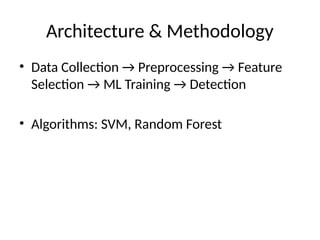
Architecture & Methodology
• Data Collection → Preprocessing → Feature
Selection → ML Training → Detection
• Algorithms: SVM, Random Forest
Results & Analysis
• Improved detection accuracy.
• Reduced false positives.
• Better performance than traditional methods.
Applications & Future Scope
• Applications:
• - Enterprise networks
• - Cloud & banking
• - IoT systems
• Future Scope:
• - Deep learning
• - Real-time detection

Cybersecurity Threat Detection Using Machine Learning

  • 1.
    Abstract • Cybersecurity threatshave increased rapidly due to digital transformation, cloud computing, and IoT. • Traditional rule-based systems fail to detect modern and zero-day attacks. • This work proposes a Machine Learning-based threat detection system. • The model analyzes network traffic to identify malicious behavior with higher accuracy.
  • 2.
    Introduction • Cybersecurity protectssystems, networks, and data from cyber attacks. • Attacks include malware, phishing, DDoS, and insider threats. • Machine Learning enables intelligent and automated detection.
  • 3.
    Problem Statement • Increasingcyber attacks. • High false positives in traditional IDS. • Inability to detect unknown threats. • Need for automated and scalable detection.
  • 4.
    Literature Review • ML-basedIDS outperform traditional systems. • Algorithms like SVM and Random Forest are widely used. • Challenges include data imbalance and real- time detection.
  • 5.
    Existing vs ProposedSystem • Existing: • - Rule-based IDS • - Manual updates • - Poor detection • Proposed: • - ML-based system • - Automated learning • - Detects unknown attacks
  • 6.
    Architecture & Methodology •Data Collection → Preprocessing → Feature Selection → ML Training → Detection • Algorithms: SVM, Random Forest
  • 7.
    Results & Analysis •Improved detection accuracy. • Reduced false positives. • Better performance than traditional methods.
  • 8.
    Applications & FutureScope • Applications: • - Enterprise networks • - Cloud & banking • - IoT systems • Future Scope: • - Deep learning • - Real-time detection