DIGITAL ABUSE
BOUNDARIES ARE ALL ABOUT RESPECT
HIGHLIGHTS
What is Digital Abuse?
Types of Abuse
Identify the abuse
How to help victims?
Safety planning
Definition:
Digital abuse is the use of technology such as texting and social networking to bully, harass,
stalk or intimidate a person. Often this behavior is a form of verbal or emotional abuse
perpetrated through technology that can look like: sending unwanted, explicit pictures,
demanding or coercing someone into sending their own explicit pictures, telling a partner who
to be friends with on Facebook, going through a partner’s phone or social media accounts to
keep tabs on them, constantly texting so that one person feels like they can’t be separated from
their phone for fear of upsetting the other.
Digital abuse in particular is especially prevalent, and often normalized, among young adults.
Like other forms of abuse, it is an attempt to control someone’s actions.
Types of Abuse
Emotional/Verbal Abuse
Physical Abuse
Stalking
Financial Abuse
Cyberbullying
Sexual Abuse
Constantly texting
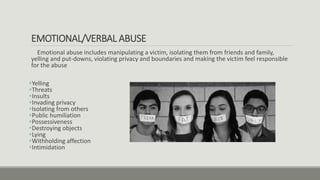
EMOTIONAL/VERBAL ABUSE
Emotional abuse includes manipulating a victim, isolating them from friends and family,
yelling and put-downs, violating privacy and boundaries and making the victim feel responsible
for the abuse
Yelling
Threats
Insults
Invading privacy
Isolating from others
Public humiliation
Possessiveness
Destroying objects
Lying
Withholding affection
Intimidation
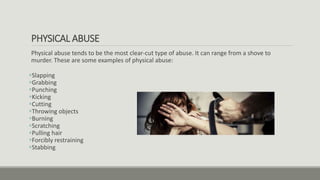
PHYSICAL ABUSE
Physical abuse tends to be the most clear-cut type of abuse. It can range from a shove to
murder. These are some examples of physical abuse:
Slapping
Grabbing
Punching
Kicking
Cutting
Throwing objects
Burning
Scratching
Pulling hair
Forcibly restraining
Stabbing
STALKING
It’s important to remember that stalking isn’t just someone following you home.
Being repeatedly watched
Following someone
Harassing someone
Unwanted gifts
Unwanted calls
Facebook messages
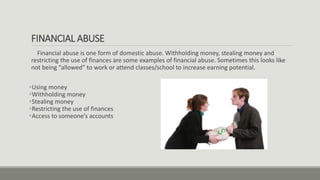
FINANCIAL ABUSE
Financial abuse is one form of domestic abuse. Withholding money, stealing money and
restricting the use of finances are some examples of financial abuse. Sometimes this looks like
not being “allowed” to work or attend classes/school to increase earning potential.
Using money
Withholding money
Stealing money
Restricting the use of finances
Access to someone’s accounts
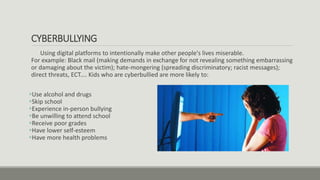
CYBERBULLYING
Using digital platforms to intentionally make other people's lives miserable.
For example: Black mail (making demands in exchange for not revealing something embarrassing
or damaging about the victim); hate-mongering (spreading discriminatory; racist messages);
direct threats, ECT.... Kids who are cyberbullied are more likely to:
Use alcohol and drugs
Skip school
Experience in-person bullying
Be unwilling to attend school
Receive poor grades
Have lower self-esteem
Have more health problems
SEXUAL ABUSE
Any action that impacts a person's ability to control their own sexual activity or the
circumstances in which sexual activity occurs. Ignoring someone's refusal to engage in sexual
activities by repeatedly using emotional, verbal or physical pressure. Sexual abuse is more than
just rape.
Unwanted penetration of any kind
Demanding sexual photos or messages
Battering that leads to rape
Voyeurism
Unwanted touching
Unwanted kissing
Sexual name-calling
Sabotaging birth control
Restricting access to condoms
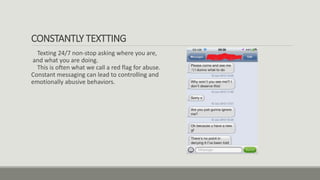
CONSTANTLY TEXTTING
Texting 24/7 non-stop asking where you are,
and what you are doing.
This is often what we call a red flag for abuse.
Constant messaging can lead to controlling and
emotionally abusive behaviors.
IDENTIFY DIGITAL ABUSE
Teens are both victims and abusers. Seeing the red flags can be difficult for an outsider. Teens
are private, and their privacy is important to them. Adults may not have access to a teen’s digital
space, like their phone or Facebook account, where much communication takes place. However,
it is possible to see red flags that are indicators that the teen is a victim or an abuser.
Sometimes, you can see changes in victim behavior as a result of the abuse. These changes
are happening because they are emotionally impacted by what’s going on. Social behavior
change like no longer getting along with friends, engaging in new risk behaviors like drinking or
drugs, grades declining, mood changes and physical marks can all be signs of abuse
The following are some red flags that might indicate that someone you know is being digitally
abuse:
VICTIM BEHAVIOR
•Social behavior changes
Examples: withdraws from activities, no longer gets along with friends, dresses differently
•New risky behaviors
Examples: drug use, alcohol, partying, sex
•Academic changes
Examples: truancy, grades decline
•Mood changes
Examples: Depression, anxiety, irritability
•Physical signs
Examples: Physical marks on victim, holes in walls of home/signs of struggle, covering up when
seasonally inappropriate
In person, on the phone or online, the way a perpetrator and victim interact can be red flags
Excessive texting, calling or other contact may mean that an abuser is trying to dominate the
victim’s attention and control how they spend their time.
Tense dramatic conversations and fighting are also indicators that something is wrong
You may see strange power dynamics in the conversation, like an abuser answering for a victim
or telling them what to do, or a victim becoming quiet in an abuser’s presence.
ABUSER BEHAVIOR
These are signs that a teen may be an abuser:
•Disrespectful conversations with peers about victim
Examples: shares private message or images with peers, degrading language, shares personal or
private information about victim
•Demonstrates anger and/or possessive behavior
Examples: yelling, aggression towards peers and/or family, constantly texting, anger when
partner is absent or busy
•History of trauma
Examples: history of substance abuse, history of violent behavior, experience of trauma and/or
family violence
HOW TO HELP VICTIMS?
62% of teens wish they were able to talk more openly with their parents. Parents have the
biggest influence on teen decisions, but they aren’t stepping up and starting these conversations.
Adults aren’t aware of how big an issue digital abuse is. In today’s society more and more time is
spent online and most parents assume their children aren’t at risk.
Adults are more likely to talk to teens about drugs, alcohol and sex than they are about digital
abuse.
It’s time for parents to start having these conversations with teens.
Teens see many adults as mentors, not just their parents. Having just one trusted adult makes a
huge difference to a teen. Everyone has a role to play in ending digital abuse.
On top of all:
• Believe them/don’t judge
• Don’t say “I told you so..”
• It’s not their fault
• Focus on the behavior not the person
• Code words
• Don’t give ultimatums
SAFETY PLAN
In any situation, it ultimately comes down to choices. You have the power to choose. You own
your choice. Each of us has a line and we must stand strong. Determining your values before
situations like these occur is crucial to making the smartest choice. When your mind is clear, you
can accurately represent your moral compass. There is no set way to avoid digital abuse but here
are some ways that you can avoid it:
Keep your passwords private: Don’t ask anyone for his or her password. There is a thin line
between sharing and snooping. You’re entitled to privacy, and password abuse is the root of
much cyber-evil.
Hit “delete” instead of “forward.”: You have the power to break the cycle of sexting and
harassment simply by choosing not to spread such messages.
Think twice before you post that picture or send that message: think about the consequences it
might have – today, next week, or the years to come.
Report abuse on Facebook: if you see or are a victim of abusive behavior. Because Facebook is
based on a real-name culture, it is important to stop people who are abusing others. Look for
“Report” links throughout the site, such as the “Report This Photo” link underneath photos and
the “Report” links in Inbox messages from people who aren’t confirmed friends.
Additionally, it’s important to know what is and is not acceptable behavior online and exercise your
“digital/privacy rights.”
You have the right to:
1. Keep your passwords to yourself
2. Keep your messages (and others’) private.
3. say “no” to friend requests (or requests for pictures, passwords, or personal info).
4. ask people to remove online pics of you.
5. ask people not to tag, copy, or change your pics.
6. stop people from posing as you or hacking your accounts.
7. choose your own friends (online and off)
8. not to answer calls, texts, or IMs if you don’t want to.
TEEN CONCERNS
When you plan to talk to a teen about abuse, you should keep their concerns in mind. Teens
have legitimate concerns about discussing abuse with adults.
They mostly fear being blamed for the abuse, being interrogated about what happened, being
made to feel guilty about their choices, an adult not believing them, or an adult telling other
people what happened.
To address these concerns, you should:
Take teens seriously. Value their experiences and feelings. Don’t dismiss or minimize what they
are going through. Believe them.
Don’t interrogate the teen. It’s difficult for victims to come forward. Don’t put them on the spot
by demanding detailed information or proof of what happened.
Support and validate. Don’t blame the victim by questioning or judging the teen’s choices or
behaviors.
The abuse is not the victim’s fault, and nothing he or she did is a reason for abuse.
Give options, not orders. The victim needs to be empowered to understand what is happening and take
ownership of their choices. You can guide them.
Be the best listener you can be. Really hear what the teen has to say without judgment or criticism.
It’s up to you to start the conversation with teens – they care that you care about what’s happening to
them, and you’ll be the one to check in and follow up.
At the same time, many teens are more comfortable talking about the details of their relationship
with someone removed from the situation. Find someone for them to talk to. Be ready with resources
and don’t take it personally, keep your opinions.
TRANSPARENCY
Many teens distrust adults and fear that an adult will take total control of the situation,
leaving the teen powerless.
Be honest with teens about what’s going on.
Share your plan. If you’re going to call the school, contact the teen’s parents, call authorities,
get the parents of the abusive teen involved or take any other action, let the teen know. Keep the
teen posted as actions are taken.
Be aware that some youth-serving professionals, like teachers, healthcare providers and
counselors, are legally obligated to report some types of abuse to authorities if they think a teen
is in danger. This is called being a mandatory reporter. These laws vary state-to-state. Make sure
teens ask who has to report what kind of information so they can decide what to share.
CONCLUSION
Each one of us can and must be an active participant, we can step up when the persons we
know are in trouble instead of standing by and letting it happen. You have the power to make a
huge difference.
MTV has create an organization in order to help teens stand up to stop virtual abuse.
If you or someone you know is victim of digital abuse, please contact:
http://www.athinline.org/

Digital abuse

  • 1.
  • 2.
    HIGHLIGHTS What is DigitalAbuse? Types of Abuse Identify the abuse How to help victims? Safety planning
  • 3.
    Definition: Digital abuse isthe use of technology such as texting and social networking to bully, harass, stalk or intimidate a person. Often this behavior is a form of verbal or emotional abuse perpetrated through technology that can look like: sending unwanted, explicit pictures, demanding or coercing someone into sending their own explicit pictures, telling a partner who to be friends with on Facebook, going through a partner’s phone or social media accounts to keep tabs on them, constantly texting so that one person feels like they can’t be separated from their phone for fear of upsetting the other. Digital abuse in particular is especially prevalent, and often normalized, among young adults. Like other forms of abuse, it is an attempt to control someone’s actions.
  • 4.
    Types of Abuse Emotional/VerbalAbuse Physical Abuse Stalking Financial Abuse Cyberbullying Sexual Abuse Constantly texting
  • 5.
    EMOTIONAL/VERBAL ABUSE Emotional abuseincludes manipulating a victim, isolating them from friends and family, yelling and put-downs, violating privacy and boundaries and making the victim feel responsible for the abuse Yelling Threats Insults Invading privacy Isolating from others Public humiliation Possessiveness Destroying objects Lying Withholding affection Intimidation
  • 6.
    PHYSICAL ABUSE Physical abusetends to be the most clear-cut type of abuse. It can range from a shove to murder. These are some examples of physical abuse: Slapping Grabbing Punching Kicking Cutting Throwing objects Burning Scratching Pulling hair Forcibly restraining Stabbing
  • 7.
    STALKING It’s important toremember that stalking isn’t just someone following you home. Being repeatedly watched Following someone Harassing someone Unwanted gifts Unwanted calls Facebook messages
  • 8.
    FINANCIAL ABUSE Financial abuseis one form of domestic abuse. Withholding money, stealing money and restricting the use of finances are some examples of financial abuse. Sometimes this looks like not being “allowed” to work or attend classes/school to increase earning potential. Using money Withholding money Stealing money Restricting the use of finances Access to someone’s accounts
  • 9.
    CYBERBULLYING Using digital platformsto intentionally make other people's lives miserable. For example: Black mail (making demands in exchange for not revealing something embarrassing or damaging about the victim); hate-mongering (spreading discriminatory; racist messages); direct threats, ECT.... Kids who are cyberbullied are more likely to: Use alcohol and drugs Skip school Experience in-person bullying Be unwilling to attend school Receive poor grades Have lower self-esteem Have more health problems
  • 10.
    SEXUAL ABUSE Any actionthat impacts a person's ability to control their own sexual activity or the circumstances in which sexual activity occurs. Ignoring someone's refusal to engage in sexual activities by repeatedly using emotional, verbal or physical pressure. Sexual abuse is more than just rape. Unwanted penetration of any kind Demanding sexual photos or messages Battering that leads to rape Voyeurism Unwanted touching Unwanted kissing Sexual name-calling Sabotaging birth control Restricting access to condoms
  • 11.
    CONSTANTLY TEXTTING Texting 24/7non-stop asking where you are, and what you are doing. This is often what we call a red flag for abuse. Constant messaging can lead to controlling and emotionally abusive behaviors.
  • 12.
    IDENTIFY DIGITAL ABUSE Teensare both victims and abusers. Seeing the red flags can be difficult for an outsider. Teens are private, and their privacy is important to them. Adults may not have access to a teen’s digital space, like their phone or Facebook account, where much communication takes place. However, it is possible to see red flags that are indicators that the teen is a victim or an abuser. Sometimes, you can see changes in victim behavior as a result of the abuse. These changes are happening because they are emotionally impacted by what’s going on. Social behavior change like no longer getting along with friends, engaging in new risk behaviors like drinking or drugs, grades declining, mood changes and physical marks can all be signs of abuse The following are some red flags that might indicate that someone you know is being digitally abuse:
  • 13.
    VICTIM BEHAVIOR •Social behaviorchanges Examples: withdraws from activities, no longer gets along with friends, dresses differently •New risky behaviors Examples: drug use, alcohol, partying, sex •Academic changes Examples: truancy, grades decline •Mood changes Examples: Depression, anxiety, irritability •Physical signs Examples: Physical marks on victim, holes in walls of home/signs of struggle, covering up when seasonally inappropriate
  • 14.
    In person, onthe phone or online, the way a perpetrator and victim interact can be red flags Excessive texting, calling or other contact may mean that an abuser is trying to dominate the victim’s attention and control how they spend their time. Tense dramatic conversations and fighting are also indicators that something is wrong You may see strange power dynamics in the conversation, like an abuser answering for a victim or telling them what to do, or a victim becoming quiet in an abuser’s presence.
  • 15.
    ABUSER BEHAVIOR These aresigns that a teen may be an abuser: •Disrespectful conversations with peers about victim Examples: shares private message or images with peers, degrading language, shares personal or private information about victim •Demonstrates anger and/or possessive behavior Examples: yelling, aggression towards peers and/or family, constantly texting, anger when partner is absent or busy •History of trauma Examples: history of substance abuse, history of violent behavior, experience of trauma and/or family violence
  • 16.
    HOW TO HELPVICTIMS? 62% of teens wish they were able to talk more openly with their parents. Parents have the biggest influence on teen decisions, but they aren’t stepping up and starting these conversations. Adults aren’t aware of how big an issue digital abuse is. In today’s society more and more time is spent online and most parents assume their children aren’t at risk. Adults are more likely to talk to teens about drugs, alcohol and sex than they are about digital abuse. It’s time for parents to start having these conversations with teens. Teens see many adults as mentors, not just their parents. Having just one trusted adult makes a huge difference to a teen. Everyone has a role to play in ending digital abuse.
  • 17.
    On top ofall: • Believe them/don’t judge • Don’t say “I told you so..” • It’s not their fault • Focus on the behavior not the person • Code words • Don’t give ultimatums
  • 18.
    SAFETY PLAN In anysituation, it ultimately comes down to choices. You have the power to choose. You own your choice. Each of us has a line and we must stand strong. Determining your values before situations like these occur is crucial to making the smartest choice. When your mind is clear, you can accurately represent your moral compass. There is no set way to avoid digital abuse but here are some ways that you can avoid it: Keep your passwords private: Don’t ask anyone for his or her password. There is a thin line between sharing and snooping. You’re entitled to privacy, and password abuse is the root of much cyber-evil. Hit “delete” instead of “forward.”: You have the power to break the cycle of sexting and harassment simply by choosing not to spread such messages. Think twice before you post that picture or send that message: think about the consequences it might have – today, next week, or the years to come. Report abuse on Facebook: if you see or are a victim of abusive behavior. Because Facebook is based on a real-name culture, it is important to stop people who are abusing others. Look for “Report” links throughout the site, such as the “Report This Photo” link underneath photos and the “Report” links in Inbox messages from people who aren’t confirmed friends.
  • 19.
    Additionally, it’s importantto know what is and is not acceptable behavior online and exercise your “digital/privacy rights.” You have the right to: 1. Keep your passwords to yourself 2. Keep your messages (and others’) private. 3. say “no” to friend requests (or requests for pictures, passwords, or personal info). 4. ask people to remove online pics of you. 5. ask people not to tag, copy, or change your pics. 6. stop people from posing as you or hacking your accounts. 7. choose your own friends (online and off) 8. not to answer calls, texts, or IMs if you don’t want to.
  • 20.
    TEEN CONCERNS When youplan to talk to a teen about abuse, you should keep their concerns in mind. Teens have legitimate concerns about discussing abuse with adults. They mostly fear being blamed for the abuse, being interrogated about what happened, being made to feel guilty about their choices, an adult not believing them, or an adult telling other people what happened. To address these concerns, you should: Take teens seriously. Value their experiences and feelings. Don’t dismiss or minimize what they are going through. Believe them. Don’t interrogate the teen. It’s difficult for victims to come forward. Don’t put them on the spot by demanding detailed information or proof of what happened. Support and validate. Don’t blame the victim by questioning or judging the teen’s choices or behaviors.
  • 21.
    The abuse isnot the victim’s fault, and nothing he or she did is a reason for abuse. Give options, not orders. The victim needs to be empowered to understand what is happening and take ownership of their choices. You can guide them. Be the best listener you can be. Really hear what the teen has to say without judgment or criticism. It’s up to you to start the conversation with teens – they care that you care about what’s happening to them, and you’ll be the one to check in and follow up. At the same time, many teens are more comfortable talking about the details of their relationship with someone removed from the situation. Find someone for them to talk to. Be ready with resources and don’t take it personally, keep your opinions.
  • 22.
    TRANSPARENCY Many teens distrustadults and fear that an adult will take total control of the situation, leaving the teen powerless. Be honest with teens about what’s going on. Share your plan. If you’re going to call the school, contact the teen’s parents, call authorities, get the parents of the abusive teen involved or take any other action, let the teen know. Keep the teen posted as actions are taken. Be aware that some youth-serving professionals, like teachers, healthcare providers and counselors, are legally obligated to report some types of abuse to authorities if they think a teen is in danger. This is called being a mandatory reporter. These laws vary state-to-state. Make sure teens ask who has to report what kind of information so they can decide what to share.
  • 23.
    CONCLUSION Each one ofus can and must be an active participant, we can step up when the persons we know are in trouble instead of standing by and letting it happen. You have the power to make a huge difference. MTV has create an organization in order to help teens stand up to stop virtual abuse. If you or someone you know is victim of digital abuse, please contact: http://www.athinline.org/