1 Codex Standard 207-1999
This Standard replaced the Standard for Whole Milk Powder, Partly Skimmed Milk Powder and Skimmed Milk Powder (A-5-1971) and
the Standard for Cream Powder, Half Cream Powder and High Fat Milk Powder (A-10-1971). Adopted in 1999. Amendments 2010, 2013.
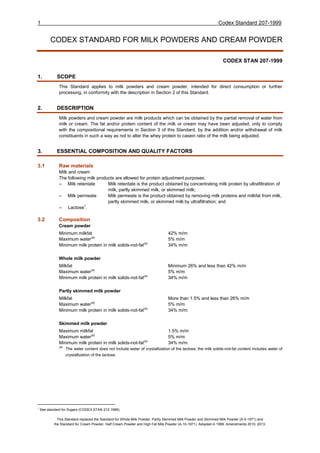
CODEX STANDARD FOR MILK POWDERS AND CREAM POWDER
CODEX STAN 207-1999
1. SCOPE
This Standard applies to milk powders and cream powder, intended for direct consumption or further
processing, in conformity with the description in Section 2 of this Standard.
2. DESCRIPTION
Milk powders and cream powder are milk products which can be obtained by the partial removal of water from
milk or cream. The fat and/or protein content of the milk or cream may have been adjusted, only to comply
with the compositional requirements in Section 3 of this Standard, by the addition and/or withdrawal of milk
constituents in such a way as not to alter the whey protein to casein ratio of the milk being adjusted.
3. ESSENTIAL COMPOSITION AND QUALITY FACTORS
3.1 Raw materials
Milk and cream
The following milk products are allowed for protein adjustment purposes:
– Milk retentate Milk retentate is the product obtained by concentrating milk protein by ultrafiltration of
milk, partly skimmed milk, or skimmed milk;
– Milk permeate Milk permeate is the product obtained by removing milk proteins and milkfat from milk,
partly skimmed milk, or skimmed milk by ultrafiltration; and
– Lactose1
.
3.2 Composition
Cream powder
Minimum milkfat 42% m/m
Maximum water(a)
5% m/m
Minimum milk protein in milk solids-not-fat(a)
34% m/m
Whole milk powder
Milkfat Minimum 26% and less than 42% m/m
Maximum water(a)
5% m/m
Minimum milk protein in milk solids-not-fat(a)
34% m/m
Partly skimmed milk powder
Milkfat More than 1.5% and less than 26% m/m
Maximum water(a)
5% m/m
Minimum milk protein in milk solids-not-fat(a)
34% m/m
Skimmed milk powder
Maximum milkfat 1.5% m/m
Maximum water(a)
5% m/m
Minimum milk protein in milk solids-not-fat(a)
34% m/m
(a)
The water content does not include water of crystallization of the lactose; the milk solids-not-fat content includes water of
crystallization of the lactose.
1
See standard for Sugars (CODEX STAN 212-1999).
2 Codex Standard 207-1999
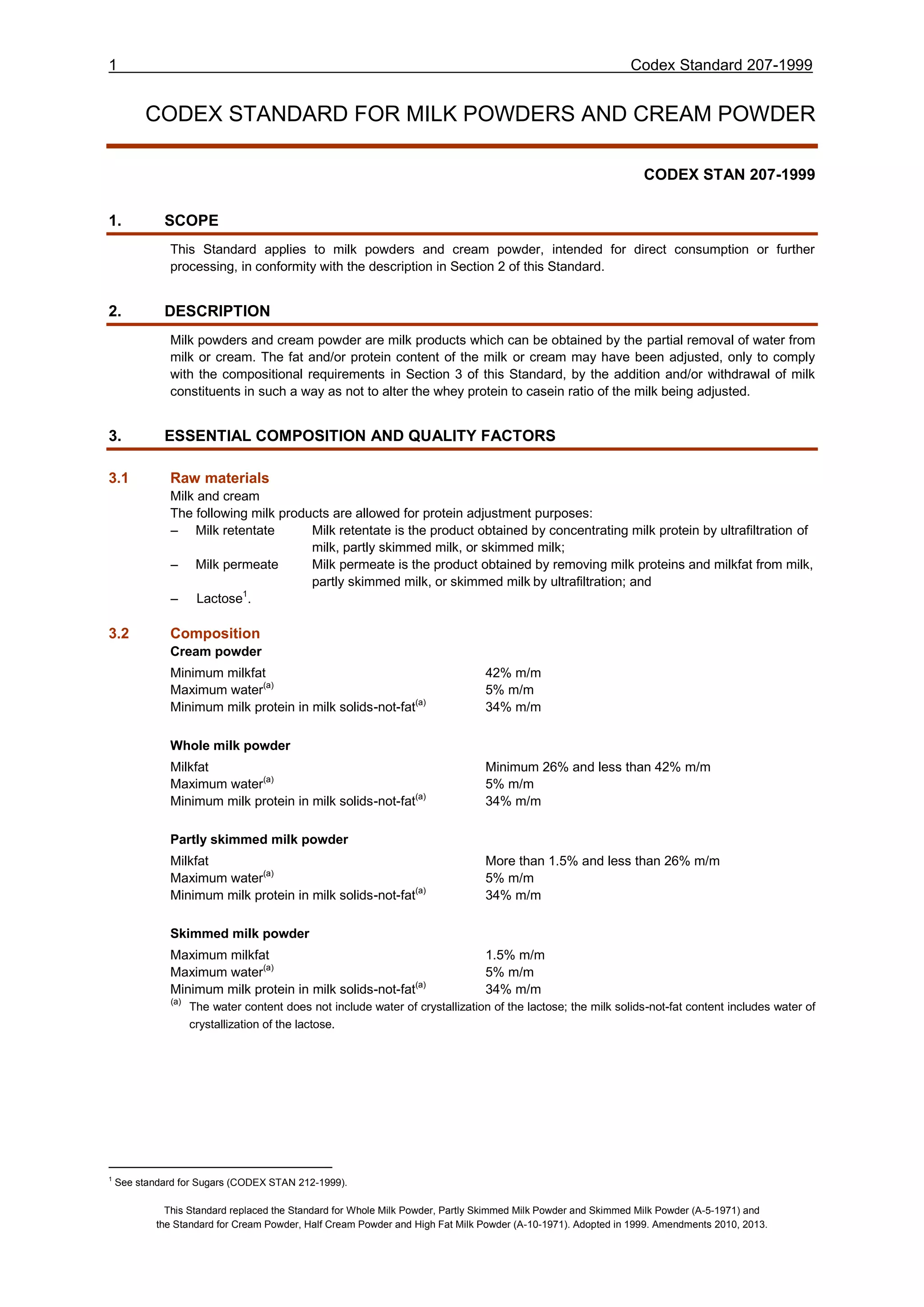
4. FOOD ADDITIVES
Only those food additives listed below may be used and only within the limits specified.
INS no. Nameof additive Maximum level
Stabilizers
331 Sodium citrates
5 000 mg/kg singly or in combination, expressed as anhydrous substances
332 Potassium citrates
Firming agents
508 Potassium chloride Limited by GMP
509 Calcium chloride Limited by GMP
Acidity regulators
339 Sodium phosphates
5 000 mg/kg singly or in combination, expressed as anhydrous substances
340 Potassium phosphates
450 Diphosphates
451 Triphosphates
452 Polyphosphates
500 Sodium carbonates
501 Potassium carbonates
Emulsifiers
322 Lecithins Limited by GMP
471 Mono- and diglycerides of fatty acids 2 500 mg/kg
Anticaking agents
170(i) Calcium carbonate
10 000 mg/kg singly or in combination
341(iii) Tricalcium phosphate
343(iii) Trimagnesium phosphate
504(i) Magnesium carbonate
530 Magnesium oxide
551 Silicon dioxide, amorphous
552 Calcium silicate
553 Magnesium silicates
554 Sodium aluminosilicate
556 Calcium aluminium silicate
Antioxidants
300 Ascorbic acid, L-
500 g/kg expressed as ascorbic acid301 Sodium ascorbate
304 Ascorbyl palmitate
320 Butylated hydroxyanisole 100 mg/kg
5. CONTAMINANTS
The products covered by this Standard shall comply with the Maximum Levels for contaminants that are
specified for the product in the General Standard for Contaminants and Toxins in Food and Feed (CODEX
STAN 193-1995).
The milk used in the manufacture of the products covered by this Standard shall comply with the Maximum
Levels for contaminants and toxins specified for milk by the General Standard for Contaminants and Toxins in
Food and Feed (CODEX STAN 193-1995) and with the maximum residue limits for veterinary drug residues
and pesticides established for milk by the CAC.
3 Codex Standard 207-1999
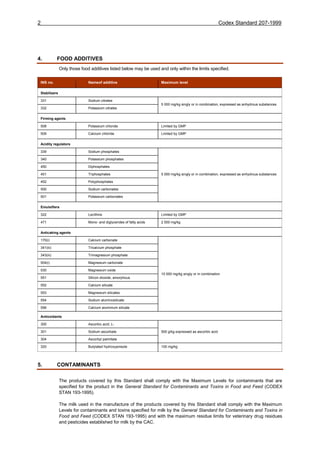
6. HYGIENE
It is recommended that the products covered by the provisions of this standard be prepared and handled in
accordance with the appropriate sections of the General Principles of Food Hygiene (CAC/RCP 1-1969), the
Code of Hygienic Practice for Milk and Milk Products (CAC/RCP 57-2004) and other relevant Codex texts
such as Codes of Hygienic Practice and Codes of Practice. The products should comply with any
microbiological criteria established in accordance with the Principles and Guidelines for the Establishment and
Application of Microbiological Criteria Related to Foods (CAC/GL 21-1997).
7. LABELLING
In addition to the provisions of the General Standard for the Labelling of Prepackaged Foods (CODEX STAN
1-1985) and the General Standard for the Use of Dairy Terms (CODEX STAN 206-1999), the following
specific provisions apply:
7.1 Name of the food
The name of the food shall be:
Cream powder
according to the composition in Section 3.2Whole milk powder
Partly skimmed milk powder
Skimmed milk powder
Partly skimmed milk powder may be designated “Semi-skimmed milk powder” provided that the content of
milkfat does not exceed 16% m/m and is not less than 14% m/m.
If allowed by national legislation or otherwise identified to the consumer in the country where the product is
sold, “whole milk powder” may be designated “full cream milk powder” and “skimmed milk powder” may be
designated “low fat milk powder”.
7.2 Declaration of milkfat content
If the consumer would be misled by the omission, the milkfat content shall be declared in a manner found
acceptable in the country of sale to the final consumer, either (i) as a percentage by mass, or (ii) in grams per
serving as quantified in the label provided that the number of servings is stated.
7.3 Declaration of milk protein
If the consumer would be misled by the omission, the milk protein content shall be declared in a manner
acceptable in the country of sale to the final consumer, either as (i) a percentage by mass, or (ii) grams per
serving as quantified in the label provided the number of servings is stated.
7.4 List of ingredients
Notwithstanding the provision of Section 4.2.1 of the General Standard for the Labelling of Prepackaged
Foods (CODEX STAN 1-1985), milk products used only for protein adjustment need not be declared.
7.5 Labelling of non-retail containers
Information required in Section 7 of this Standard and Sections 4.1 to 4.8 of the General Standard for the
Labelling of Prepackaged Foods (CODEX STAN 1-1985), and, if necessary, storage instructions, shall be
given either on the container or in accompanying documents, except that the name of the product, lot
identification, and the name and address of the manufacturer or packer shall appear on the container.
However, lot identification, and the name and address of the manufacturer or packer may be replaced by an
identification mark, provided that such a mark is clearly identifiable with the accompanying documents.
8. METHODS OF SAMPLING AND ANALYSIS
See CODEX STAN 234-1999.
ANNEX
4 Codex Standard 207-1999
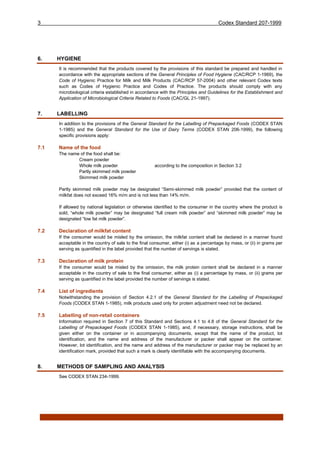
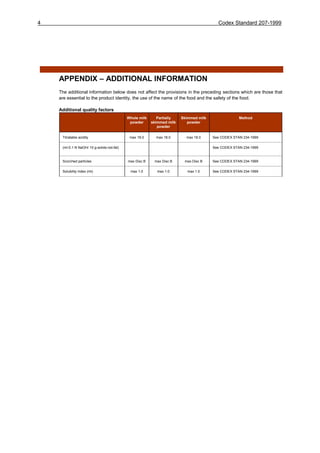
APPENDIX – ADDITIONAL INFORMATION
The additional information below does not affect the provisions in the preceding sections which are those that
are essential to the product identity, the use of the name of the food and the safety of the food.
Additional quality factors
Whole milk
powder
Partially
skimmed milk
powder
Skimmed milk
powder
Method
Titratable acidity max 18.0 max 18.0 max 18.0 See CODEX STAN 234-1999
(ml-0.1 N NaOH/ 10 g-solids-not-fat) See CODEX STAN 234-1999
Scorched particles max Disc B max Disc B max Disc B See CODEX STAN 234-1999
Solubility index (ml) max 1.0 max 1.0 max 1.0 See CODEX STAN 234-1999

Cxs 207e (1) codex standard for dry milk

  • 1.
    1 Codex Standard207-1999 This Standard replaced the Standard for Whole Milk Powder, Partly Skimmed Milk Powder and Skimmed Milk Powder (A-5-1971) and the Standard for Cream Powder, Half Cream Powder and High Fat Milk Powder (A-10-1971). Adopted in 1999. Amendments 2010, 2013. CODEX STANDARD FOR MILK POWDERS AND CREAM POWDER CODEX STAN 207-1999 1. SCOPE This Standard applies to milk powders and cream powder, intended for direct consumption or further processing, in conformity with the description in Section 2 of this Standard. 2. DESCRIPTION Milk powders and cream powder are milk products which can be obtained by the partial removal of water from milk or cream. The fat and/or protein content of the milk or cream may have been adjusted, only to comply with the compositional requirements in Section 3 of this Standard, by the addition and/or withdrawal of milk constituents in such a way as not to alter the whey protein to casein ratio of the milk being adjusted. 3. ESSENTIAL COMPOSITION AND QUALITY FACTORS 3.1 Raw materials Milk and cream The following milk products are allowed for protein adjustment purposes: – Milk retentate Milk retentate is the product obtained by concentrating milk protein by ultrafiltration of milk, partly skimmed milk, or skimmed milk; – Milk permeate Milk permeate is the product obtained by removing milk proteins and milkfat from milk, partly skimmed milk, or skimmed milk by ultrafiltration; and – Lactose1 . 3.2 Composition Cream powder Minimum milkfat 42% m/m Maximum water(a) 5% m/m Minimum milk protein in milk solids-not-fat(a) 34% m/m Whole milk powder Milkfat Minimum 26% and less than 42% m/m Maximum water(a) 5% m/m Minimum milk protein in milk solids-not-fat(a) 34% m/m Partly skimmed milk powder Milkfat More than 1.5% and less than 26% m/m Maximum water(a) 5% m/m Minimum milk protein in milk solids-not-fat(a) 34% m/m Skimmed milk powder Maximum milkfat 1.5% m/m Maximum water(a) 5% m/m Minimum milk protein in milk solids-not-fat(a) 34% m/m (a) The water content does not include water of crystallization of the lactose; the milk solids-not-fat content includes water of crystallization of the lactose. 1 See standard for Sugars (CODEX STAN 212-1999).
  • 2.
    2 Codex Standard207-1999 4. FOOD ADDITIVES Only those food additives listed below may be used and only within the limits specified. INS no. Nameof additive Maximum level Stabilizers 331 Sodium citrates 5 000 mg/kg singly or in combination, expressed as anhydrous substances 332 Potassium citrates Firming agents 508 Potassium chloride Limited by GMP 509 Calcium chloride Limited by GMP Acidity regulators 339 Sodium phosphates 5 000 mg/kg singly or in combination, expressed as anhydrous substances 340 Potassium phosphates 450 Diphosphates 451 Triphosphates 452 Polyphosphates 500 Sodium carbonates 501 Potassium carbonates Emulsifiers 322 Lecithins Limited by GMP 471 Mono- and diglycerides of fatty acids 2 500 mg/kg Anticaking agents 170(i) Calcium carbonate 10 000 mg/kg singly or in combination 341(iii) Tricalcium phosphate 343(iii) Trimagnesium phosphate 504(i) Magnesium carbonate 530 Magnesium oxide 551 Silicon dioxide, amorphous 552 Calcium silicate 553 Magnesium silicates 554 Sodium aluminosilicate 556 Calcium aluminium silicate Antioxidants 300 Ascorbic acid, L- 500 g/kg expressed as ascorbic acid301 Sodium ascorbate 304 Ascorbyl palmitate 320 Butylated hydroxyanisole 100 mg/kg 5. CONTAMINANTS The products covered by this Standard shall comply with the Maximum Levels for contaminants that are specified for the product in the General Standard for Contaminants and Toxins in Food and Feed (CODEX STAN 193-1995). The milk used in the manufacture of the products covered by this Standard shall comply with the Maximum Levels for contaminants and toxins specified for milk by the General Standard for Contaminants and Toxins in Food and Feed (CODEX STAN 193-1995) and with the maximum residue limits for veterinary drug residues and pesticides established for milk by the CAC.
  • 3.
    3 Codex Standard207-1999 6. HYGIENE It is recommended that the products covered by the provisions of this standard be prepared and handled in accordance with the appropriate sections of the General Principles of Food Hygiene (CAC/RCP 1-1969), the Code of Hygienic Practice for Milk and Milk Products (CAC/RCP 57-2004) and other relevant Codex texts such as Codes of Hygienic Practice and Codes of Practice. The products should comply with any microbiological criteria established in accordance with the Principles and Guidelines for the Establishment and Application of Microbiological Criteria Related to Foods (CAC/GL 21-1997). 7. LABELLING In addition to the provisions of the General Standard for the Labelling of Prepackaged Foods (CODEX STAN 1-1985) and the General Standard for the Use of Dairy Terms (CODEX STAN 206-1999), the following specific provisions apply: 7.1 Name of the food The name of the food shall be: Cream powder according to the composition in Section 3.2Whole milk powder Partly skimmed milk powder Skimmed milk powder Partly skimmed milk powder may be designated “Semi-skimmed milk powder” provided that the content of milkfat does not exceed 16% m/m and is not less than 14% m/m. If allowed by national legislation or otherwise identified to the consumer in the country where the product is sold, “whole milk powder” may be designated “full cream milk powder” and “skimmed milk powder” may be designated “low fat milk powder”. 7.2 Declaration of milkfat content If the consumer would be misled by the omission, the milkfat content shall be declared in a manner found acceptable in the country of sale to the final consumer, either (i) as a percentage by mass, or (ii) in grams per serving as quantified in the label provided that the number of servings is stated. 7.3 Declaration of milk protein If the consumer would be misled by the omission, the milk protein content shall be declared in a manner acceptable in the country of sale to the final consumer, either as (i) a percentage by mass, or (ii) grams per serving as quantified in the label provided the number of servings is stated. 7.4 List of ingredients Notwithstanding the provision of Section 4.2.1 of the General Standard for the Labelling of Prepackaged Foods (CODEX STAN 1-1985), milk products used only for protein adjustment need not be declared. 7.5 Labelling of non-retail containers Information required in Section 7 of this Standard and Sections 4.1 to 4.8 of the General Standard for the Labelling of Prepackaged Foods (CODEX STAN 1-1985), and, if necessary, storage instructions, shall be given either on the container or in accompanying documents, except that the name of the product, lot identification, and the name and address of the manufacturer or packer shall appear on the container. However, lot identification, and the name and address of the manufacturer or packer may be replaced by an identification mark, provided that such a mark is clearly identifiable with the accompanying documents. 8. METHODS OF SAMPLING AND ANALYSIS See CODEX STAN 234-1999. ANNEX
  • 4.
    4 Codex Standard207-1999 APPENDIX – ADDITIONAL INFORMATION The additional information below does not affect the provisions in the preceding sections which are those that are essential to the product identity, the use of the name of the food and the safety of the food. Additional quality factors Whole milk powder Partially skimmed milk powder Skimmed milk powder Method Titratable acidity max 18.0 max 18.0 max 18.0 See CODEX STAN 234-1999 (ml-0.1 N NaOH/ 10 g-solids-not-fat) See CODEX STAN 234-1999 Scorched particles max Disc B max Disc B max Disc B See CODEX STAN 234-1999 Solubility index (ml) max 1.0 max 1.0 max 1.0 See CODEX STAN 234-1999