
CITIZEN VOICE AND
ACTION

World Vision’s Approach to Social
Accountability

CORE Group Fall Meeting 2013 – Washington
DC
What is
Citizen Voice and
Action?
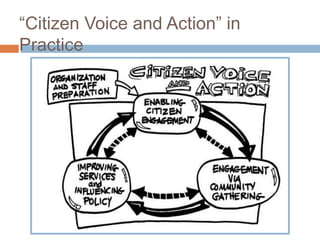
What is “Citizen Voice and Action”?
Citizen Voice and Action
is a social accountability approach
designed to improve the relationship
between communities and
government,
in order to improve services,
like health care and education,
that impact the daily lives
of children and their families.
How does
Citizen Voice and
Action
work?
“Citizen Voice and Action” in
Practice
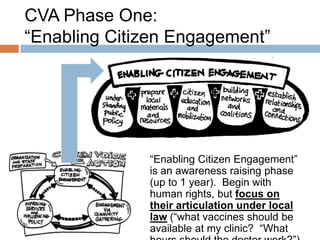
CVA Phase One:
“Enabling Citizen Engagement”

“Enabling Citizen Engagement”
is an awareness raising phase
(up to 1 year). Begin with
human rights, but focus on
their articulation under local
law (“what vaccines should be
available at my clinic? “What
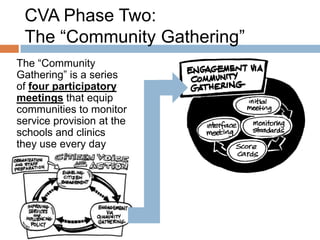
CVA Phase Two:
The “Community Gathering”
The “Community
Gathering” is a series
of four participatory
meetings that equip
communities to monitor
service provision at the
schools and clinics
they use every day
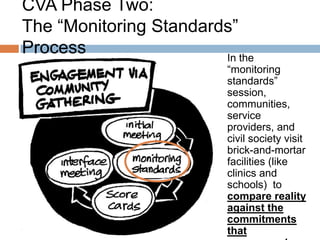
CVA Phase Two:
The “Monitoring Standards”
Process
In the

“monitoring
standards”
session,
communities,
service
providers, and
civil society visit
brick-and-mortar
facilities (like
clinics and
schools) to
compare reality
against the
commitments
that
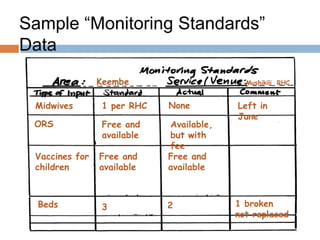
Sample “Monitoring Standards”
Data
Keembe

Mushikili RHC

Midwives

1 per RHC

None

ORS

Free and
available

Vaccines for
children

Free and
available

Available,
but with
fee
Free and
available

Beds

3

2

Left in
June

1 broken
not replaced
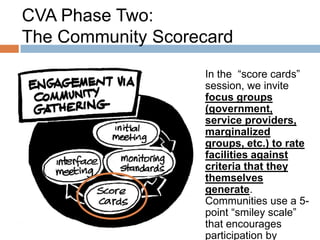
CVA Phase Two:
The Community Scorecard
In the “score cards”
session, we invite
focus groups
(government,
service providers,
marginalized
groups, etc.) to rate
facilities against
criteria that they
themselves
generate.
Communities use a 5point “smiley scale”
that encourages
participation by
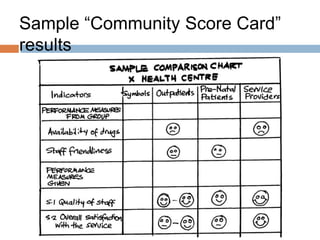
Sample “Community Score Card”
results
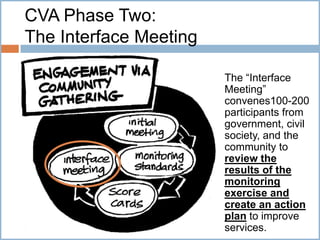
CVA Phase Two:
The Interface Meeting
The “Interface
Meeting”
convenes100-200
participants from
government, civil
society, and the
community to
review the
results of the
monitoring
exercise and
create an action
plan to improve
services.
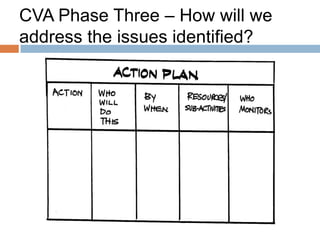
CVA Phase Three – How will we
address the issues identified?
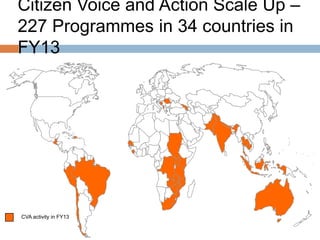
Citizen Voice and Action Scale Up –
227 Programmes in 34 countries in
FY13

CVA activity in FY13
RESULTS?
CVA’s Impact on
Child Well-Being
Social Accountability - Impact on
Health Outcomes –
Bjorkman/Svennson 2009
J-PAL researchers used Randomized Control Trials to study
the impact of an approach like Citizen Voice and Action at
50 clinics in 9 districts of Uganda:
Quality of Care. After one year, relative to comparison
villages, health facilities in treatment villages:
 Experienced a 12-minute reduction in average wait time
 Experienced a 13% reduction in absenteeism
Health Outcomes. After one year, relative to the comparison
villages, the treatment villages showed a:
 33% drop in under-five mortality
 58% increase in use of skilled birth attendants
 19% increase in number of patients seeking prenatal care
 Results holding after 4 years.
Bjorkman, M and Svensson, J, 2009. Power to the People: Evidence from a
Randomised Field Experiment on Community Based Monitoring in Uganda.
Social Accountability - Impact on
Education Outcomes – Zeitlin 2011
Oxford University researchers used Randomized Control
Trials to study the impact of the CVA Score Card in100
Ugandan primary schools. After one year, in the schools
using the CVA score card, they found:
• Test scores rose by an average of 9%
• Pupil attendance increased by 8-10%.
• Teacher absenteeism dropped by13%.
• Cost: $1.50/student

• A “standardized” score card had no significant
impact.
Andrew Zeitlin, Management and Motivation in Ugandan
Primary Schools: Impact Evaluation Final Report (2011).
Citizen Voice and Action in Uganda









In 13 of the 17 clinics where CVA has been introduced,
staff have increased; 7 of the clinics showed staff
increases of more than 2 staff.
In 3 clinics, the number of women in a month attending
for antenatal services and to give birth more than
doubled.
In 4 clinics, dedicated maternity services were initiated.
In 3 of the clinics, Prevention of Mother to Child
Transmission (PMTCT) services either started or were
expanded.
Communities, clinic staff, and local government officials
attribute the changes to increased advocacy by the
community.
Citizen Voice and Action in Zambia













4 out of 5 targeted facilities have reported deployment of
additional staff
Community members in 5 sites reported reduced waiting
hours (average reduced from 6 hours to 2 hours).
The Community of Milopa, in Lufwanyama District,
successfully pressured for the construction of a new
clinic by 2015.
Construction of clinic has resumed in Chibombo District.
# of deliveries at health centres increased by 64% in
Lufwanyama District between 2011-12.
Chibombo recorded an upward movement of 3% in
under-5 immunization between 2011 and 2012.
Governments, communities, and service providers
attribute improvements to increased engagement
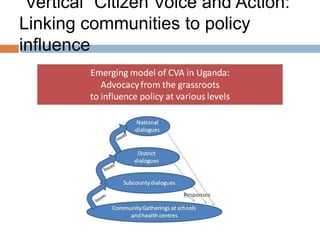
“Vertical” Citizen Voice and Action:
Linking communities to policy
influence
“Vertical” Citizen Voice and Action:
Linking communities to policy
influence

• Uganda: Practitioners used data from CVA to
demonstrate inadequate clinic staffing on MNCH.
• Result: Coalition work ultimately persuaded
parliament to forgo drastic cuts in health budget.
Prime Minister committed to hire of 6100 new
health workers.
• Armenia: Practitioners and coalition partners used
CVA data to identify problems in MoH pay structure
that were discouraging doctor visits to poor rural
areas.
Result: Policy-level reform of pay structure of
doctors.
Now for something
completely different
Playing the Investment Banker
1. Each person will be given one voucher.
2. You can invest your voucher in one of 2
accounts (a “private” or “group” account).
3. These accounts pay returns in points in different
ways.
4. Your investment is anonymous. You cannot
discuss your investment choice with other
participants.
Playing the Investment Banker
If you invest your voucher in the Private Account you will
earn:
(A) a fixed return of XX points; PLUS
(B) 1 point for every voucher that the other participants
have decided to invest in the Group Account.
If you invest your voucher in the Group Account you will
earn 1 point for every voucher that you and the other
participants have invested in the Group Account.
Instructions:
Playing the Investment Banker
Instructions:
1. Write your name on your voucher.
2. Write “Private” or “Group” on your voucher to indicate
where you will invest.
3. Pass your voucher to our broker.
Your investment is anonymous. You may not indicate
your choice to any other investor or plan your investment.
Playing the Investment Banker
1. Why did you invest as you did?
2. What if the stakes had been higher? Would higher
stakes have changed your investment behavior?
3. Do you think it would have changed the outcome if
you had had a chance to discuss with your fellow
investors prior to investing?
Playing the Investment Banker
1. Why did you invest as you did?
2. What if the stakes had been higher? Would higher
stakes have changed your investment behavior?
3. Do you think it would have changed the outcome if
you had had a chance to discuss with your fellow
investors prior to investing?
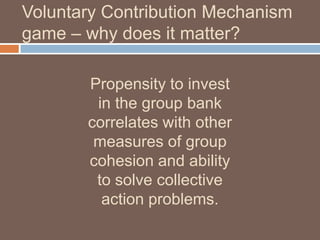
Voluntary Contribution Mechanism
game – why does it matter?
Propensity to invest
in the group bank
correlates with other
measures of group
cohesion and ability
to solve collective
action problems.
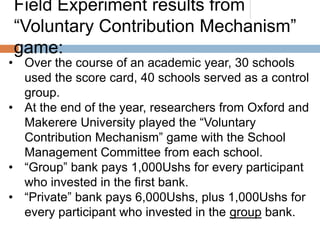
Field Experiment results from
“Voluntary Contribution Mechanism”
game:

• Over the course of an academic year, 30 schools
used the score card, 40 schools served as a control
group.
• At the end of the year, researchers from Oxford and
Makerere University played the “Voluntary
Contribution Mechanism” game with the School
Management Committee from each school.
• “Group” bank pays 1,000Ushs for every participant
who invested in the first bank.
• “Private” bank pays 6,000Ushs, plus 1,000Ushs for
every participant who invested in the group bank.
Field Experiment results from
“Voluntary Contribution Mechanism”
game:
• Participants who had participated in the score card
exercise during the school year were 16% more
likely to invest in the group bank.
• These schools also exhibited a 9% increase in test
scores, and drops in student and teacher
absenteeism by 10% and 13%, respectively.
• World Vision and Johns Hopkins SPH have
extended this study to 16 sites in four countries to
examine how CVA contributes to collective action for
health outcomes.
Collective Action among
communities: strengthening local
leadership

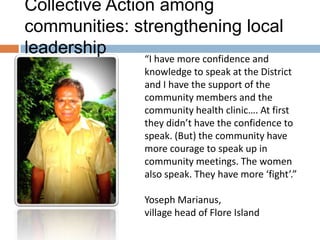
“I have more confidence and
knowledge to speak at the District
and I have the support of the
community members and the
community health clinic…. At first
they didn’t have the confidence to
speak. (But) the community have
more courage to speak up in
community meetings. The women
also speak. They have more ‘fight’.”
Yoseph Marianus,
village head of Flore Island
Thanks!

Jeff Hall
Director, Local Advocacy
World Vision International
Jeff_Hall@wvi.org
tinyurl.com/citizenvoiceandaction

CVA_Jeff Hall_10.16.13

  • 1.
    CITIZEN VOICE AND ACTION WorldVision’s Approach to Social Accountability CORE Group Fall Meeting 2013 – Washington DC
  • 2.
  • 3.
    What is “CitizenVoice and Action”? Citizen Voice and Action is a social accountability approach designed to improve the relationship between communities and government, in order to improve services, like health care and education, that impact the daily lives of children and their families.
  • 4.
    How does Citizen Voiceand Action work?
  • 5.
    “Citizen Voice andAction” in Practice
  • 6.
    CVA Phase One: “EnablingCitizen Engagement” “Enabling Citizen Engagement” is an awareness raising phase (up to 1 year). Begin with human rights, but focus on their articulation under local law (“what vaccines should be available at my clinic? “What
  • 7.
    CVA Phase Two: The“Community Gathering” The “Community Gathering” is a series of four participatory meetings that equip communities to monitor service provision at the schools and clinics they use every day
  • 8.
    CVA Phase Two: The“Monitoring Standards” Process In the “monitoring standards” session, communities, service providers, and civil society visit brick-and-mortar facilities (like clinics and schools) to compare reality against the commitments that
  • 9.
    Sample “Monitoring Standards” Data Keembe MushikiliRHC Midwives 1 per RHC None ORS Free and available Vaccines for children Free and available Available, but with fee Free and available Beds 3 2 Left in June 1 broken not replaced
  • 10.
    CVA Phase Two: TheCommunity Scorecard In the “score cards” session, we invite focus groups (government, service providers, marginalized groups, etc.) to rate facilities against criteria that they themselves generate. Communities use a 5point “smiley scale” that encourages participation by
  • 11.
  • 12.
    CVA Phase Two: TheInterface Meeting The “Interface Meeting” convenes100-200 participants from government, civil society, and the community to review the results of the monitoring exercise and create an action plan to improve services.
  • 13.
    CVA Phase Three– How will we address the issues identified?
  • 14.
    Citizen Voice andAction Scale Up – 227 Programmes in 34 countries in FY13 CVA activity in FY13
  • 15.
  • 16.
    Social Accountability -Impact on Health Outcomes – Bjorkman/Svennson 2009 J-PAL researchers used Randomized Control Trials to study the impact of an approach like Citizen Voice and Action at 50 clinics in 9 districts of Uganda: Quality of Care. After one year, relative to comparison villages, health facilities in treatment villages:  Experienced a 12-minute reduction in average wait time  Experienced a 13% reduction in absenteeism Health Outcomes. After one year, relative to the comparison villages, the treatment villages showed a:  33% drop in under-five mortality  58% increase in use of skilled birth attendants  19% increase in number of patients seeking prenatal care  Results holding after 4 years. Bjorkman, M and Svensson, J, 2009. Power to the People: Evidence from a Randomised Field Experiment on Community Based Monitoring in Uganda.
  • 17.
    Social Accountability -Impact on Education Outcomes – Zeitlin 2011 Oxford University researchers used Randomized Control Trials to study the impact of the CVA Score Card in100 Ugandan primary schools. After one year, in the schools using the CVA score card, they found: • Test scores rose by an average of 9% • Pupil attendance increased by 8-10%. • Teacher absenteeism dropped by13%. • Cost: $1.50/student • A “standardized” score card had no significant impact. Andrew Zeitlin, Management and Motivation in Ugandan Primary Schools: Impact Evaluation Final Report (2011).
  • 18.
    Citizen Voice andAction in Uganda      In 13 of the 17 clinics where CVA has been introduced, staff have increased; 7 of the clinics showed staff increases of more than 2 staff. In 3 clinics, the number of women in a month attending for antenatal services and to give birth more than doubled. In 4 clinics, dedicated maternity services were initiated. In 3 of the clinics, Prevention of Mother to Child Transmission (PMTCT) services either started or were expanded. Communities, clinic staff, and local government officials attribute the changes to increased advocacy by the community.
  • 19.
    Citizen Voice andAction in Zambia        4 out of 5 targeted facilities have reported deployment of additional staff Community members in 5 sites reported reduced waiting hours (average reduced from 6 hours to 2 hours). The Community of Milopa, in Lufwanyama District, successfully pressured for the construction of a new clinic by 2015. Construction of clinic has resumed in Chibombo District. # of deliveries at health centres increased by 64% in Lufwanyama District between 2011-12. Chibombo recorded an upward movement of 3% in under-5 immunization between 2011 and 2012. Governments, communities, and service providers attribute improvements to increased engagement
  • 20.
    “Vertical” Citizen Voiceand Action: Linking communities to policy influence
  • 21.
    “Vertical” Citizen Voiceand Action: Linking communities to policy influence • Uganda: Practitioners used data from CVA to demonstrate inadequate clinic staffing on MNCH. • Result: Coalition work ultimately persuaded parliament to forgo drastic cuts in health budget. Prime Minister committed to hire of 6100 new health workers. • Armenia: Practitioners and coalition partners used CVA data to identify problems in MoH pay structure that were discouraging doctor visits to poor rural areas. Result: Policy-level reform of pay structure of doctors.
  • 22.
  • 23.
    Playing the InvestmentBanker 1. Each person will be given one voucher. 2. You can invest your voucher in one of 2 accounts (a “private” or “group” account). 3. These accounts pay returns in points in different ways. 4. Your investment is anonymous. You cannot discuss your investment choice with other participants.
  • 24.
    Playing the InvestmentBanker If you invest your voucher in the Private Account you will earn: (A) a fixed return of XX points; PLUS (B) 1 point for every voucher that the other participants have decided to invest in the Group Account. If you invest your voucher in the Group Account you will earn 1 point for every voucher that you and the other participants have invested in the Group Account.
  • 25.
    Instructions: Playing the InvestmentBanker Instructions: 1. Write your name on your voucher. 2. Write “Private” or “Group” on your voucher to indicate where you will invest. 3. Pass your voucher to our broker. Your investment is anonymous. You may not indicate your choice to any other investor or plan your investment.
  • 26.
    Playing the InvestmentBanker 1. Why did you invest as you did? 2. What if the stakes had been higher? Would higher stakes have changed your investment behavior? 3. Do you think it would have changed the outcome if you had had a chance to discuss with your fellow investors prior to investing?
  • 27.
    Playing the InvestmentBanker 1. Why did you invest as you did? 2. What if the stakes had been higher? Would higher stakes have changed your investment behavior? 3. Do you think it would have changed the outcome if you had had a chance to discuss with your fellow investors prior to investing?
  • 28.
    Voluntary Contribution Mechanism game– why does it matter? Propensity to invest in the group bank correlates with other measures of group cohesion and ability to solve collective action problems.
  • 29.
    Field Experiment resultsfrom “Voluntary Contribution Mechanism” game: • Over the course of an academic year, 30 schools used the score card, 40 schools served as a control group. • At the end of the year, researchers from Oxford and Makerere University played the “Voluntary Contribution Mechanism” game with the School Management Committee from each school. • “Group” bank pays 1,000Ushs for every participant who invested in the first bank. • “Private” bank pays 6,000Ushs, plus 1,000Ushs for every participant who invested in the group bank.
  • 30.
    Field Experiment resultsfrom “Voluntary Contribution Mechanism” game: • Participants who had participated in the score card exercise during the school year were 16% more likely to invest in the group bank. • These schools also exhibited a 9% increase in test scores, and drops in student and teacher absenteeism by 10% and 13%, respectively. • World Vision and Johns Hopkins SPH have extended this study to 16 sites in four countries to examine how CVA contributes to collective action for health outcomes.
  • 31.
    Collective Action among communities:strengthening local leadership “I have more confidence and knowledge to speak at the District and I have the support of the community members and the community health clinic…. At first they didn’t have the confidence to speak. (But) the community have more courage to speak up in community meetings. The women also speak. They have more ‘fight’.” Yoseph Marianus, village head of Flore Island
  • 32.
    Thanks! Jeff Hall Director, LocalAdvocacy World Vision International Jeff_Hall@wvi.org tinyurl.com/citizenvoiceandaction