SERVICE ATTRIBUTES
The most important and critical aspect of customer service is the physical
distribution of the product, i.e, making the right product available at the right
place and at the right time, followed by motivating service success facilitators
like channel members to complete the physical distribution. For FMCG or mass
consumed products, wherein product distribution is dependent on the length
and breadth of the channel, customized logistics programmes tailored to suit
the needs of channel partners are required. For these programmes to be
successful, channel members need to be serviced and motivated by
manufacturers. The services extended to this trading community are different
from those required for satisfying end customers.
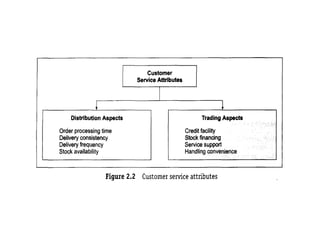
Order Process Time
This is the most important measure of customer service in physical distribution.
It is the time between the placement of an order by the buyer and the supply of
the material by the seller, against the order. This involves the supply of all the
material against the order placed within the agreed time frame without any
error in either documentation or physical supply. This customer service
attribute helps in building the long term buyer-seller relationship. The order
processing time consists of the time required for the registration of the order in
the supplier’s system after thorough technical and commercial scrutiny;
material allocation and pickup from the work in progress inventory, warehouse,
or distribution centers; packing of material; and documentation and dispatch of
material. The time elapsed in each of the activities depends on how well
coordinated the various departments are and the speed of information flow
across the logistics supply chain.
Delivery Consistency
This refers to consistency in maintaining the same delivery period over a period
of time for delivering material to the buyer. For example, against 100 repeat
orders placed during a year, if the supplier dispatches the material within the
agreed delivery time for 97 orders, then the delivery consistency is 97 per cent
and as per the present industry norms it is an excellent delivery performance.
Delivery consistency speaks about the degree of coordination in the various
logistics arms of the seller’s firm, and the efficiency and effectiveness of the
logistical supply chain. The delivery consistency from suppliers have a direct
effect on the inventory level at the buyer’s end. As a precautionary measure,
for taking care of inconsistencies in delivery, the buyer may carry excess
inventory of raw materials and components and block more funds.
Subsequently, the buyer may look for an efficient source of supply to get rid of
the inventory problem.
Delivery Frequency
Frequency of delivery is a key element in customer service. The customer does
not want to carry excess inventory but wants his operations to run without
interruptions. As a result, the customer prefers frequent deliveries in small lots.
This may increase the transportation cost, but reduces the inventory related
cost drastically, with the net effect of overall reduction in supply chain costs. In
another case, the firm may not have all the ordered items available in its stocks.
In such a situation the supplier, with the consent of the buyer, may supply
critical items first followed by a consignment of the left out items, after these
are made and are available for dispatch. The additional transportation cost may
be borne by the supplier to compensate for the buyer’s inconvenience. The
practice of frequent delivery of small lots is quite common in retail chains.
Stock Availability
Stock availability is an important measure of customer service. With the excess
stocks, the supplier may extend excellent service to the customer, but
inventory related cost reduces the profit margin of business operations. Hence,
the firm needs to strike a balance between the inventory level and the desired
customer service level through integrated logistics operations. The reduction in
stock holdings may be exercised through centralized inventory control from a
single mother warehouse, by reducing field distribution warehouses at multiple
locations. Centralization may help in controlling administrative costs, operating
costs, manpower costs and simultaneously reduce the inventory carrying costs
at various locations. Transportation cost may go up, but net savings are more
than the increase in costs.
Credit Facility
As a value added service the supplier offers credit facility to the buyer for
payment against material dispatched. This is done in order to build long term
relations with the customer and to get repeat bulk orders from the buyer. In
case credit facility is an industry trend and customers extend payment beyond
the agreed time frame, the supplier may need to consider recovering the cost
of blocked funds from the customer.
Stock Financing
Against bulk orders, in case of seasonal products, suppliers sometimes hold the
inventory for the buyer for a longer period of time. Depending on the
competition in the industry and the assurance of repeat orders from the buyer,
the supplier may hold his inventory for a longer time, bearing the carrying cost
as a value added service. This ultimately means indirectly financing the
operations of the buyer, by shifting the cost element from buyer to seller.
In the competitive logistics industry, the warehouse service supplier finances to
customers (goods depositors) by way of a loan to the extent of 30—50 per cent
of the stocks deposited. The loan is made available at rates lower than the bank
interest rates. In the Indian context, warehouses attached to cooperative sector
industries extend the loan facility to farmers to the extent of 70 per cent of the
value of the food grains deposited in the warehouse.
Service Support
This may be in terms of the technical support for product installation,
commissioning, process stabilizing, spare parts supply, or routine equipment
check up as part of annual service contact. Service support is required to keep
the down time of the equipment very low as it ultimately has a significant effect
on productivity at the customer’s end. As a value addition, the supplier may
extend technical support. not only in the area related to his products but also in
resolving technical problems in the client’s manufacturing centre or may
actively support new product development processes. In case the supplier has a
strong technical arm, he may even extend technical support to buyers in areas
unrelated to his product line.
Handling Convenience
The supplier, for convenience of material handling and storage at the
customers’ end, may develop novel methods for product unitizing, such as
pallets, boxes, cartons etc. These methods are customized to suit the existing
product handling arrangement at the customers’ end. Alternatively, the
supplier may help the customer in the installation or development of a material
handling system. This may help to reduce material handling hassles and product
damages at the buyer’s end.
VALUE ADDED LOGISTICAL SERVICES
The purpose of providing services is to deliver value to the customer for the
money he is spending in acquiring that product. For tangible products to add
value intangibles like after sales services are provided to the customer;
similarly, for intangible products to add value, the help of a tangible is taken.
For example, the ambiance in a star hotel is supported by the presence of
tangibles that speak about the quality of service being delivered. For a business
to get going some basic, minimum customer service is necessary. Basic
customer service means treating all customers equally and extending service to
build a fundamental business relationship. It is the bare minimum service
activity required for the survival of the business. The supply of spare parts, for
trouble free operation of the machinery, is a basic service capability the
machinery supplier should exhibit for his product to be considered for buying
and in order to further his relationship with the buyer.
The step ahead of offering basic services is offering zero defect services. This
involves gearing up of the business process for perfect operational
performance. In zero defect service, systems have a significant role to play.
Repetitive operations are performed without errors by automated systems.
Activities wherein speed, accuracy, and reliability are essential can be well
coordinated, monitored, and controlled through the systems approach. The
scope for errors is eliminated as the involvement of the human element in
performing activities is minimized.
The third category, and next in evolution, is value added services, which are
unique and add efficiency and effectiveness to the basic service capabilities of
the firm. With value added services the firm can deliver superior customer
value, which can be leveraged for competitiveness. These are basically tailor-
made or customized service packages for strategic customers. These services
are in addition to the basic services provided to the customer by the seller.
For example, a supplier may manage high value inventory requirement at the
customers’ end by owning the inventory carrying responsibility for the
customer’s manufacturing operation. He may open a small shop in the buyer’s
premises and keep minimum inventory to meet the customer’s daily
requirement. The supplier gets paid on a daily basis for the inventory
consumed. Thus, the supplier gets business on a continuous basis due to the
value added logistics services he is providing to the customer. The customer is
satisfied as his inventory related cost for the item is zero. The supplier is happy
as he gets repeat business and immediate realization of money for the material
supplied.
A transporter may extend services of product mixing and labeling of packs in his
trans-shipment warehouse before delivery of final product to the customer. He
may also collect money from the customer on behalf of the seller, against
delivery of each consignment. The typical value added logistical services
extended by logistics service providers are:
• Customized transportation (vehicles, perishables)
• Payment collection on delivery
• Price marking and labeling
• Product mixing and packaging (for co-promotional schemes of two products
from two different companies)
• Cross-docking (product storage for not more than 48 hours in the warehouse)
• Inventory management
• Web based consignment tracking and tracing
• Frequent deliveries in small lots
• Reverse logistics
• Load cobbling
The value added services may be categorized into customer focused services,
i.e, customized services for the customers’ specific requirement of the product
or shipment.

Customer service attributes in Supply CM.ppt

  • 1.
  • 2.
    The most importantand critical aspect of customer service is the physical distribution of the product, i.e, making the right product available at the right place and at the right time, followed by motivating service success facilitators like channel members to complete the physical distribution. For FMCG or mass consumed products, wherein product distribution is dependent on the length and breadth of the channel, customized logistics programmes tailored to suit the needs of channel partners are required. For these programmes to be successful, channel members need to be serviced and motivated by manufacturers. The services extended to this trading community are different from those required for satisfying end customers.
  • 4.
    Order Process Time Thisis the most important measure of customer service in physical distribution. It is the time between the placement of an order by the buyer and the supply of the material by the seller, against the order. This involves the supply of all the material against the order placed within the agreed time frame without any error in either documentation or physical supply. This customer service attribute helps in building the long term buyer-seller relationship. The order processing time consists of the time required for the registration of the order in the supplier’s system after thorough technical and commercial scrutiny; material allocation and pickup from the work in progress inventory, warehouse, or distribution centers; packing of material; and documentation and dispatch of material. The time elapsed in each of the activities depends on how well coordinated the various departments are and the speed of information flow across the logistics supply chain.
  • 5.
    Delivery Consistency This refersto consistency in maintaining the same delivery period over a period of time for delivering material to the buyer. For example, against 100 repeat orders placed during a year, if the supplier dispatches the material within the agreed delivery time for 97 orders, then the delivery consistency is 97 per cent and as per the present industry norms it is an excellent delivery performance. Delivery consistency speaks about the degree of coordination in the various logistics arms of the seller’s firm, and the efficiency and effectiveness of the logistical supply chain. The delivery consistency from suppliers have a direct effect on the inventory level at the buyer’s end. As a precautionary measure, for taking care of inconsistencies in delivery, the buyer may carry excess inventory of raw materials and components and block more funds. Subsequently, the buyer may look for an efficient source of supply to get rid of the inventory problem.
  • 6.
    Delivery Frequency Frequency ofdelivery is a key element in customer service. The customer does not want to carry excess inventory but wants his operations to run without interruptions. As a result, the customer prefers frequent deliveries in small lots. This may increase the transportation cost, but reduces the inventory related cost drastically, with the net effect of overall reduction in supply chain costs. In another case, the firm may not have all the ordered items available in its stocks. In such a situation the supplier, with the consent of the buyer, may supply critical items first followed by a consignment of the left out items, after these are made and are available for dispatch. The additional transportation cost may be borne by the supplier to compensate for the buyer’s inconvenience. The practice of frequent delivery of small lots is quite common in retail chains.
  • 7.
    Stock Availability Stock availabilityis an important measure of customer service. With the excess stocks, the supplier may extend excellent service to the customer, but inventory related cost reduces the profit margin of business operations. Hence, the firm needs to strike a balance between the inventory level and the desired customer service level through integrated logistics operations. The reduction in stock holdings may be exercised through centralized inventory control from a single mother warehouse, by reducing field distribution warehouses at multiple locations. Centralization may help in controlling administrative costs, operating costs, manpower costs and simultaneously reduce the inventory carrying costs at various locations. Transportation cost may go up, but net savings are more than the increase in costs.
  • 8.
    Credit Facility As avalue added service the supplier offers credit facility to the buyer for payment against material dispatched. This is done in order to build long term relations with the customer and to get repeat bulk orders from the buyer. In case credit facility is an industry trend and customers extend payment beyond the agreed time frame, the supplier may need to consider recovering the cost of blocked funds from the customer.
  • 9.
    Stock Financing Against bulkorders, in case of seasonal products, suppliers sometimes hold the inventory for the buyer for a longer period of time. Depending on the competition in the industry and the assurance of repeat orders from the buyer, the supplier may hold his inventory for a longer time, bearing the carrying cost as a value added service. This ultimately means indirectly financing the operations of the buyer, by shifting the cost element from buyer to seller. In the competitive logistics industry, the warehouse service supplier finances to customers (goods depositors) by way of a loan to the extent of 30—50 per cent of the stocks deposited. The loan is made available at rates lower than the bank interest rates. In the Indian context, warehouses attached to cooperative sector industries extend the loan facility to farmers to the extent of 70 per cent of the value of the food grains deposited in the warehouse.
  • 10.
    Service Support This maybe in terms of the technical support for product installation, commissioning, process stabilizing, spare parts supply, or routine equipment check up as part of annual service contact. Service support is required to keep the down time of the equipment very low as it ultimately has a significant effect on productivity at the customer’s end. As a value addition, the supplier may extend technical support. not only in the area related to his products but also in resolving technical problems in the client’s manufacturing centre or may actively support new product development processes. In case the supplier has a strong technical arm, he may even extend technical support to buyers in areas unrelated to his product line.
  • 11.
    Handling Convenience The supplier,for convenience of material handling and storage at the customers’ end, may develop novel methods for product unitizing, such as pallets, boxes, cartons etc. These methods are customized to suit the existing product handling arrangement at the customers’ end. Alternatively, the supplier may help the customer in the installation or development of a material handling system. This may help to reduce material handling hassles and product damages at the buyer’s end.
  • 12.
    VALUE ADDED LOGISTICALSERVICES The purpose of providing services is to deliver value to the customer for the money he is spending in acquiring that product. For tangible products to add value intangibles like after sales services are provided to the customer; similarly, for intangible products to add value, the help of a tangible is taken. For example, the ambiance in a star hotel is supported by the presence of tangibles that speak about the quality of service being delivered. For a business to get going some basic, minimum customer service is necessary. Basic customer service means treating all customers equally and extending service to build a fundamental business relationship. It is the bare minimum service activity required for the survival of the business. The supply of spare parts, for trouble free operation of the machinery, is a basic service capability the machinery supplier should exhibit for his product to be considered for buying and in order to further his relationship with the buyer.
  • 13.
    The step aheadof offering basic services is offering zero defect services. This involves gearing up of the business process for perfect operational performance. In zero defect service, systems have a significant role to play. Repetitive operations are performed without errors by automated systems. Activities wherein speed, accuracy, and reliability are essential can be well coordinated, monitored, and controlled through the systems approach. The scope for errors is eliminated as the involvement of the human element in performing activities is minimized. The third category, and next in evolution, is value added services, which are unique and add efficiency and effectiveness to the basic service capabilities of the firm. With value added services the firm can deliver superior customer value, which can be leveraged for competitiveness. These are basically tailor- made or customized service packages for strategic customers. These services are in addition to the basic services provided to the customer by the seller.
  • 14.
    For example, asupplier may manage high value inventory requirement at the customers’ end by owning the inventory carrying responsibility for the customer’s manufacturing operation. He may open a small shop in the buyer’s premises and keep minimum inventory to meet the customer’s daily requirement. The supplier gets paid on a daily basis for the inventory consumed. Thus, the supplier gets business on a continuous basis due to the value added logistics services he is providing to the customer. The customer is satisfied as his inventory related cost for the item is zero. The supplier is happy as he gets repeat business and immediate realization of money for the material supplied. A transporter may extend services of product mixing and labeling of packs in his trans-shipment warehouse before delivery of final product to the customer. He may also collect money from the customer on behalf of the seller, against delivery of each consignment. The typical value added logistical services extended by logistics service providers are:
  • 15.
    • Customized transportation(vehicles, perishables) • Payment collection on delivery • Price marking and labeling • Product mixing and packaging (for co-promotional schemes of two products from two different companies) • Cross-docking (product storage for not more than 48 hours in the warehouse) • Inventory management • Web based consignment tracking and tracing • Frequent deliveries in small lots • Reverse logistics • Load cobbling The value added services may be categorized into customer focused services, i.e, customized services for the customers’ specific requirement of the product or shipment.