“CUSTOMER” IS NOT A FOUR-LETTER WORD
        WHAT CONTINUING EDUCATION PROVIDERS CAN LEARN FROM


         UPCEA NE REGIONAL CONFERENCE


Todd Gibby, President, HE, Hobsons (@tgibby)
“CUSTOMER” IS NOT A FOUR LETTER WORD
        WHAT CONTINUING EDUCATION PROVIDERS CAN LEARN FROM


         UPCEA SOUTH REGIONAL CONFERENCE


Todd Gibby, CEO, Intelliworks
Guy Felder, Program Director, University of Houston
WHY WE AVOID THE WORD
CUSTOMER…
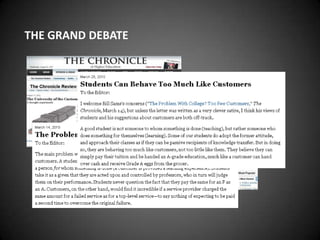
THE GRAND DEBATE
TOP TEN REASONS WHY WE DON’T SAY “CUSTOMER”

1. Education is not a business
2. See above
3. See above
4. See above
5. See above
6. See above
7. See above
8. See above
9. See above
10. See above
WHAT IS A CUSTOMER, REALLY?


 cus·tom·er Noun /kəstəmər/
 A person or organization that buys
 goods or services.
POP QUIZ

 Do you offer a service?

 Do people pay you for that service?

 Do you compete with others that offer
 a similar service?

 Do you want those who pay you for
 that service to pay you again for
 similar services?
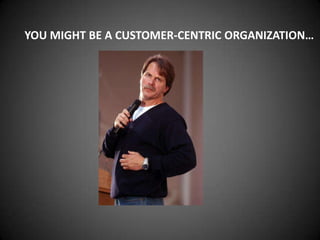
YOU MIGHT BE A CUSTOMER-CENTRIC ORGANIZATION…
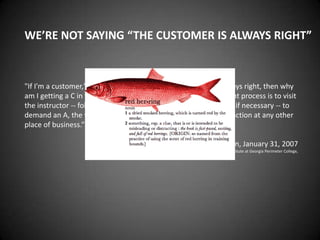
WE’RE NOT SAYING “THE CUSTOMER IS ALWAYS RIGHT”


"If I'm a customer," the student thinks, "and the customer is always right, then why
am I getting a C in this class?" The next logical step in that thought process is to visit
the instructor -- followed by the department head and the dean, if necessary -- to
demand an A, the way any other customer would demand satisfaction at any other
place of business.”

                        -Source: The Chronicle for Higher Education, January 31, 2007
                         -Rob Jenkins, associate professor of English and director of the Writers Institute at Georgia Perimeter College,
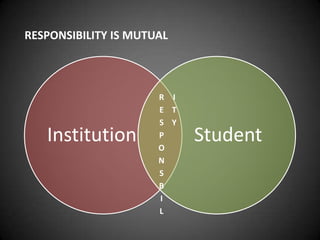
RESPONSIBILITY IS MUTUAL


                      R I
                      E T
                      S Y
   Institution        P
                      O
                            Student
                      N
                      S
                      B
                      I
                      L
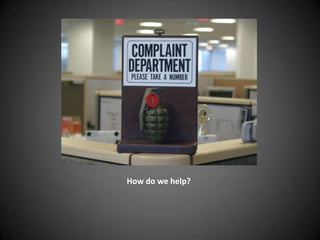
How do we help?
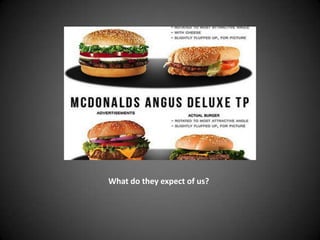
What do they expect of us?
http://www.youtube.com/watch?v=D3qltEtl7H8
WHY DOES CUSTOMER
SERVICE MATTER?
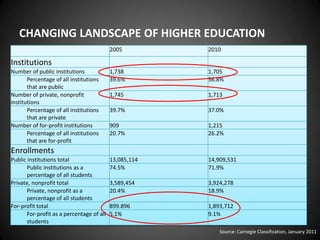
CHANGING LANDSCAPE OF HIGHER EDUCATION
                                           2005         2010

Institutions
Number of public institutions              1,738        1,705
       Percentage of all institutions      39.6%        36.8%
       that are public
Number of private, nonprofit               1,745        1,713
institutions
       Percentage of all institutions      39.7%        37.0%
       that are private
Number of for-profit institutions          909          1,215
       Percentage of all institutions      20.7%        26.2%
       that are for-profit
Enrollments
Public institutions total                  13,085,114   14,909,531
       Public institutions as a            74.5%        71.9%
       percentage of all students
Private, nonprofit total                   3,589,454    3,924,278
       Private, nonprofit as a             20.4%        18.9%
       percentage of all students
For-profit total                           899.896      1,893,712
       For-profit as a percentage of all   5.1%         9.1%
       students
                                                            Source: Carnegie Classification, January 2011
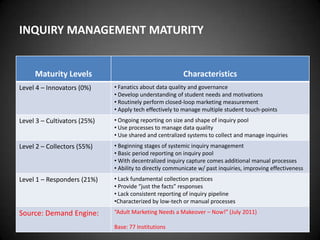
INQUIRY MANAGEMENT MATURITY


     Maturity Levels                                     Characteristics
Level 4 – Innovators (0%)     • Fanatics about data quality and governance
                              • Develop understanding of student needs and motivations
                              • Routinely perform closed-loop marketing measurement
                              • Apply tech effectively to manage multiple student touch-points
Level 3 – Cultivators (25%)   • Ongoing reporting on size and shape of inquiry pool
                              • Use processes to manage data quality
                              • Use shared and centralized systems to collect and manage inquiries
Level 2 – Collectors (55%)    • Beginning stages of systemic inquiry management
                              • Basic period reporting on inquiry pool
                              • With decentralized inquiry capture comes additional manual processes
                              • Ability to directly communicate w/ past inquiries, improving effectiveness
Level 1 – Responders (21%)    • Lack fundamental collection practices
                              • Provide “just the facts” responses
                              • Lack consistent reporting of inquiry pipeline
                              •Characterized by low-tech or manual processes
Source: Demand Engine:        “Adult Marketing Needs a Makeover – Now!” (July 2011)

                              Base: 77 Institutions
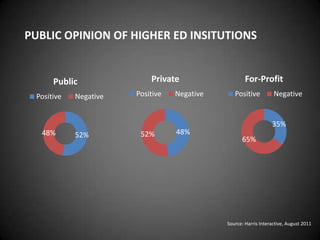
PUBLIC OPINION OF HIGHER ED INSITUTIONS


      Public               Private                   For-Profit
 Positive   Negative   Positive   Negative      Positive          Negative


                                                                 35%
  48%       52%         52%       48%
                                                   65%


                                             Source: Harris Interactive, August 2011
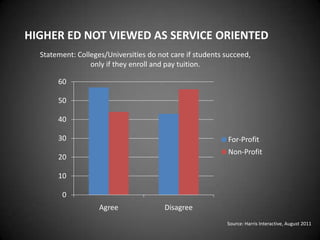
HIGHER ED NOT VIEWED AS SERVICE ORIENTED
  Statement: Colleges/Universities do not care if students succeed,
                 only if they enroll and pay tuition.

       60

       50

       40

       30                                                   For-Profit
                                                            Non-Profit
       20

       10

        0
                    Agree               Disagree
                                                           Source: Harris Interactive, August 2011
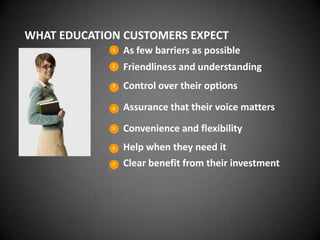
WHAT EDUCATION CUSTOMERS EXPECT
             1   As few barriers as possible
             2   Friendliness and understanding
             3   Control over their options
             4   Assurance that their voice matters
             5   Convenience and flexibility
             6   Help when they need it
             7   Clear benefit from their investment
A FEW THINGS TO NOTE FROM
AMAZON.COM (AND OTHERS)
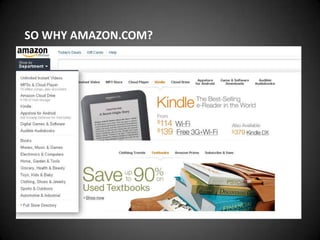
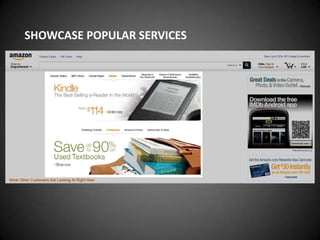
SO WHY AMAZON.COM?


1.   They basically INVENTED the idea of online service.

2.   They know how to bridge the gap between online and offline interactions.
3.   They deliver the right information at the right time to the right audience.

4.   They learn from their mistakes.

5.   They inspire others to provide even better service.
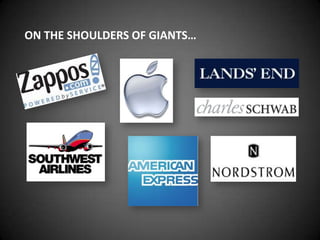
ON THE SHOULDERS OF GIANTS…
SHOWCASE POPULAR SERVICES
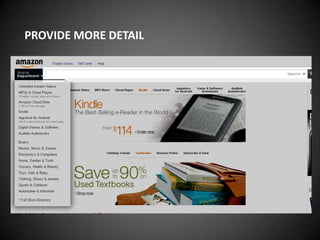
PROVIDE MORE DETAIL
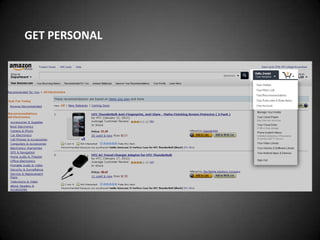
GET PERSONAL
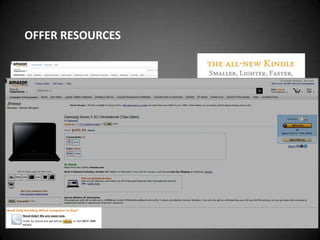
OFFER RESOURCES
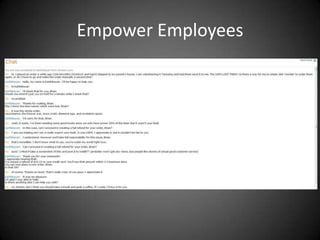
Empower Employees
http://www.youtube.com/watch?v=IwE1zb9fiVs
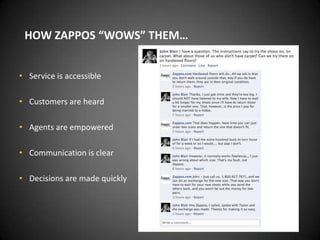
HOW ZAPPOS “WOWS” THEM…


• Service is accessible

• Customers are heard

• Agents are empowered

• Communication is clear

• Decisions are made quickly
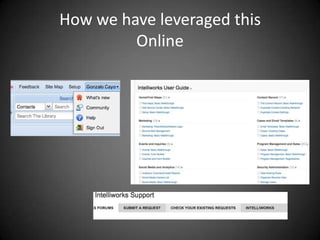
How we have leveraged this
         Online
Offline:
First Call Resolution
WHAT YOU CAN DO TO
“WOW” CUSTOMERS…
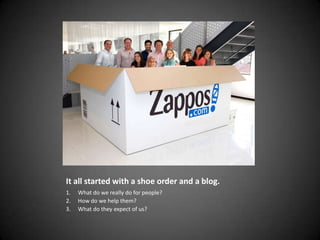
It all started with a shoe order and a blog.
1.   What do we really do for people?
2.   How do we help them?
3.   What do they expect of us?
What do we really do for people? (or who are we)
HOUSTON PICKS UP THE PHONE
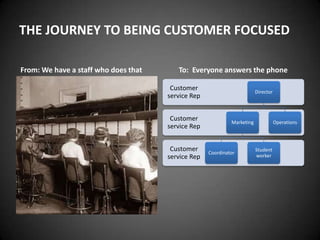
THE JOURNEY TO BEING CUSTOMER FOCUSED

From: We have a staff who does that      To: Everyone answers the phone

                                       Customer                          Director
                                      service Rep


                                       Customer              Marketing              Operations
                                      service Rep


                                       Customer     Coordinator
                                                                         Student
                                      service Rep                        worker
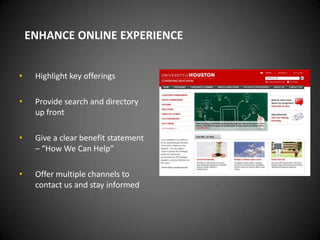
ENHANCE ONLINE EXPERIENCE


•    Highlight key offerings

•    Provide search and directory
     up front

•    Give a clear benefit statement
     – “How We Can Help”

•    Offer multiple channels to
     contact us and stay informed
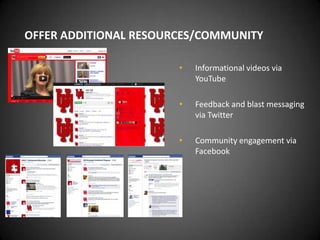
OFFER ADDITIONAL RESOURCES/COMMUNITY

                       •   Informational videos via
                           YouTube

                       •   Feedback and blast messaging
                           via Twitter

                       •   Community engagement via
                           Facebook
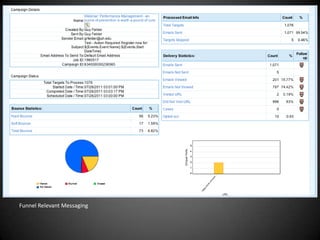
Funnel Relevant Messaging
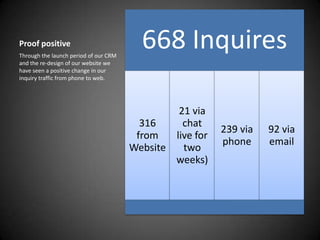
Proof positive
Through the launch period of our CRM
                                         668 Inquires
and the re-design of our website we
have seen a positive change in our
inquiry traffic from phone to web.


                                                21 via
                                         316     chat
                                                          239 via   92 via
                                        from   live for
                                                          phone     email
                                       Website   two
                                               weeks)
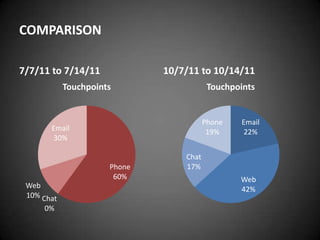
COMPARISON

7/7/11 to 7/14/11             10/7/11 to 10/14/11
            Touchpoints                   Touchpoints


                                         Phone    Email
       Email                              19%      22%
        30%

                                  Chat
                      Phone       17%
                       60%                       Web
 Web                                             42%
 10% Chat
     0%
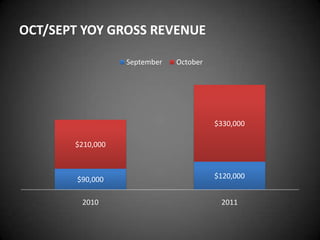
OCT/SEPT YOY GROSS REVENUE

                  September   October


                                        $330,000

       $210,000


        $90,000                         $120,000


         2010                            2011
Major Outcomes
• Funnel to conversion forecasting takes guess work out of
  filling classes

• Funnel guides marketing decisions

• Advisors and programming staff worry less about filling
  classes and more about meeting potential student’s needs

• CRM provides valid data to help leadership understand and
  make decisions about offerings
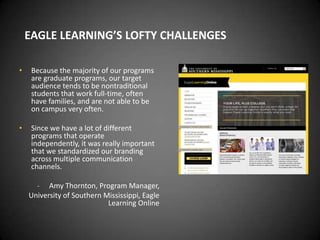
EAGLE LEARNING’S LOFTY CHALLENGES

•    Because the majority of our programs
     are graduate programs, our target
     audience tends to be nontraditional
     students that work full-time, often
     have families, and are not able to be
     on campus very often.

•    Since we have a lot of different
     programs that operate
     independently, it was really important
     that we standardized our branding
     across multiple communication
     channels.

      - Amy Thornton, Program Manager,
    University of Southern Mississippi, Eagle
                            Learning Online
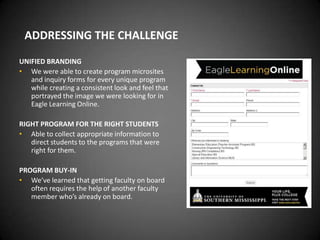
ADDRESSING THE CHALLENGE
UNIFIED BRANDING
• We were able to create program microsites
   and inquiry forms for every unique program
   while creating a consistent look and feel that
   portrayed the image we were looking for in
   Eagle Learning Online.

RIGHT PROGRAM FOR THE RIGHT STUDENTS
• Able to collect appropriate information to
   direct students to the programs that were
   right for them.

PROGRAM BUY-IN
• We’ve learned that getting faculty on board
   often requires the help of another faculty
   member who’s already on board.
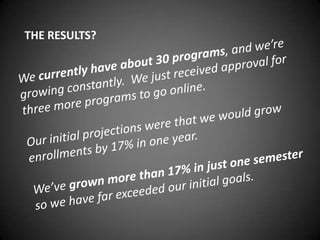
THE RESULTS?
HOW CAN WE BECOME MORE
CUSTOMER CENTRIC?
THE KEYS TO SUCCESS

1.  Know your students’ motivations
2.  Hire good communicators
3.  Build “hoop-less” admissions / financial aid processes
4.  Take a proactive approach to student advising
5.  Automate routine communications
6.  Hire faculty suited to online teaching
7.  Set and maintain high standards for student/faculty
    communication
8. Evaluate, evaluate, evaluate
9. Check your program’s vital signs regularly
10. Use cross-functional teams to develop enhancements
    and improvements


                                                  Source: American Public University System and Intelliworks
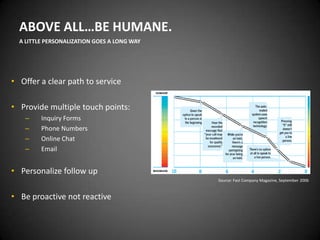
ABOVE ALL…BE HUMANE.
  A LITTLE PERSONALIZATION GOES A LONG WAY


• Offer a clear path to service

• Provide multiple touch points:
   –     Inquiry Forms
   –     Phone Numbers
   –     Online Chat
   –     Email


• Personalize follow up
                                             Source: Fast Company Magazine, September 2006


• Be proactive not reactive
AND, JUST FOR THE
RECORD…
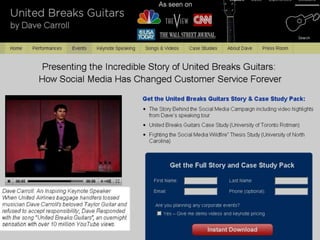
"Customer" is NOT a Four-Letter Word

"Customer" is NOT a Four-Letter Word

  • 1.
    “CUSTOMER” IS NOTA FOUR-LETTER WORD WHAT CONTINUING EDUCATION PROVIDERS CAN LEARN FROM UPCEA NE REGIONAL CONFERENCE Todd Gibby, President, HE, Hobsons (@tgibby)
  • 2.
    “CUSTOMER” IS NOTA FOUR LETTER WORD WHAT CONTINUING EDUCATION PROVIDERS CAN LEARN FROM UPCEA SOUTH REGIONAL CONFERENCE Todd Gibby, CEO, Intelliworks Guy Felder, Program Director, University of Houston
  • 4.
    WHY WE AVOIDTHE WORD CUSTOMER…
  • 5.
  • 6.
    TOP TEN REASONSWHY WE DON’T SAY “CUSTOMER” 1. Education is not a business 2. See above 3. See above 4. See above 5. See above 6. See above 7. See above 8. See above 9. See above 10. See above
  • 7.
    WHAT IS ACUSTOMER, REALLY? cus·tom·er Noun /kəstəmər/ A person or organization that buys goods or services.
  • 8.
    POP QUIZ Doyou offer a service? Do people pay you for that service? Do you compete with others that offer a similar service? Do you want those who pay you for that service to pay you again for similar services?
  • 9.
    YOU MIGHT BEA CUSTOMER-CENTRIC ORGANIZATION…
  • 10.
    WE’RE NOT SAYING“THE CUSTOMER IS ALWAYS RIGHT” "If I'm a customer," the student thinks, "and the customer is always right, then why am I getting a C in this class?" The next logical step in that thought process is to visit the instructor -- followed by the department head and the dean, if necessary -- to demand an A, the way any other customer would demand satisfaction at any other place of business.” -Source: The Chronicle for Higher Education, January 31, 2007 -Rob Jenkins, associate professor of English and director of the Writers Institute at Georgia Perimeter College,
  • 11.
    RESPONSIBILITY IS MUTUAL R I E T S Y Institution P O Student N S B I L
  • 13.
    How do wehelp?
  • 15.
    What do theyexpect of us?
  • 16.
  • 17.
  • 18.
    CHANGING LANDSCAPE OFHIGHER EDUCATION 2005 2010 Institutions Number of public institutions 1,738 1,705 Percentage of all institutions 39.6% 36.8% that are public Number of private, nonprofit 1,745 1,713 institutions Percentage of all institutions 39.7% 37.0% that are private Number of for-profit institutions 909 1,215 Percentage of all institutions 20.7% 26.2% that are for-profit Enrollments Public institutions total 13,085,114 14,909,531 Public institutions as a 74.5% 71.9% percentage of all students Private, nonprofit total 3,589,454 3,924,278 Private, nonprofit as a 20.4% 18.9% percentage of all students For-profit total 899.896 1,893,712 For-profit as a percentage of all 5.1% 9.1% students Source: Carnegie Classification, January 2011
  • 19.
    INQUIRY MANAGEMENT MATURITY Maturity Levels Characteristics Level 4 – Innovators (0%) • Fanatics about data quality and governance • Develop understanding of student needs and motivations • Routinely perform closed-loop marketing measurement • Apply tech effectively to manage multiple student touch-points Level 3 – Cultivators (25%) • Ongoing reporting on size and shape of inquiry pool • Use processes to manage data quality • Use shared and centralized systems to collect and manage inquiries Level 2 – Collectors (55%) • Beginning stages of systemic inquiry management • Basic period reporting on inquiry pool • With decentralized inquiry capture comes additional manual processes • Ability to directly communicate w/ past inquiries, improving effectiveness Level 1 – Responders (21%) • Lack fundamental collection practices • Provide “just the facts” responses • Lack consistent reporting of inquiry pipeline •Characterized by low-tech or manual processes Source: Demand Engine: “Adult Marketing Needs a Makeover – Now!” (July 2011) Base: 77 Institutions
  • 20.
    PUBLIC OPINION OFHIGHER ED INSITUTIONS Public Private For-Profit Positive Negative Positive Negative Positive Negative 35% 48% 52% 52% 48% 65% Source: Harris Interactive, August 2011
  • 21.
    HIGHER ED NOTVIEWED AS SERVICE ORIENTED Statement: Colleges/Universities do not care if students succeed, only if they enroll and pay tuition. 60 50 40 30 For-Profit Non-Profit 20 10 0 Agree Disagree Source: Harris Interactive, August 2011
  • 23.
    WHAT EDUCATION CUSTOMERSEXPECT 1 As few barriers as possible 2 Friendliness and understanding 3 Control over their options 4 Assurance that their voice matters 5 Convenience and flexibility 6 Help when they need it 7 Clear benefit from their investment
  • 24.
    A FEW THINGSTO NOTE FROM AMAZON.COM (AND OTHERS)
  • 25.
    SO WHY AMAZON.COM? 1. They basically INVENTED the idea of online service. 2. They know how to bridge the gap between online and offline interactions. 3. They deliver the right information at the right time to the right audience. 4. They learn from their mistakes. 5. They inspire others to provide even better service.

  • 26.
    ON THE SHOULDERSOF GIANTS…
  • 27.
  • 28.
  • 29.
  • 30.
  • 31.
  • 32.
  • 34.
    HOW ZAPPOS “WOWS”THEM… • Service is accessible • Customers are heard • Agents are empowered • Communication is clear • Decisions are made quickly
  • 35.
    How we haveleveraged this Online
  • 36.
  • 37.
    WHAT YOU CANDO TO “WOW” CUSTOMERS…
  • 38.
    It all startedwith a shoe order and a blog. 1. What do we really do for people? 2. How do we help them? 3. What do they expect of us?
  • 39.
    What do wereally do for people? (or who are we)
  • 40.
  • 41.
    THE JOURNEY TOBEING CUSTOMER FOCUSED From: We have a staff who does that To: Everyone answers the phone Customer Director service Rep Customer Marketing Operations service Rep Customer Coordinator Student service Rep worker
  • 42.
    ENHANCE ONLINE EXPERIENCE • Highlight key offerings • Provide search and directory up front • Give a clear benefit statement – “How We Can Help” • Offer multiple channels to contact us and stay informed
  • 43.
    OFFER ADDITIONAL RESOURCES/COMMUNITY • Informational videos via YouTube • Feedback and blast messaging via Twitter • Community engagement via Facebook
  • 44.
  • 45.
    Proof positive Through thelaunch period of our CRM 668 Inquires and the re-design of our website we have seen a positive change in our inquiry traffic from phone to web. 21 via 316 chat 239 via 92 via from live for phone email Website two weeks)
  • 46.
    COMPARISON 7/7/11 to 7/14/11 10/7/11 to 10/14/11 Touchpoints Touchpoints Phone Email Email 19% 22% 30% Chat Phone 17% 60% Web Web 42% 10% Chat 0%
  • 47.
    OCT/SEPT YOY GROSSREVENUE September October $330,000 $210,000 $90,000 $120,000 2010 2011
  • 48.
    Major Outcomes • Funnelto conversion forecasting takes guess work out of filling classes • Funnel guides marketing decisions • Advisors and programming staff worry less about filling classes and more about meeting potential student’s needs • CRM provides valid data to help leadership understand and make decisions about offerings
  • 49.
    EAGLE LEARNING’S LOFTYCHALLENGES • Because the majority of our programs are graduate programs, our target audience tends to be nontraditional students that work full-time, often have families, and are not able to be on campus very often. • Since we have a lot of different programs that operate independently, it was really important that we standardized our branding across multiple communication channels. - Amy Thornton, Program Manager, University of Southern Mississippi, Eagle Learning Online
  • 50.
    ADDRESSING THE CHALLENGE UNIFIEDBRANDING • We were able to create program microsites and inquiry forms for every unique program while creating a consistent look and feel that portrayed the image we were looking for in Eagle Learning Online. RIGHT PROGRAM FOR THE RIGHT STUDENTS • Able to collect appropriate information to direct students to the programs that were right for them. PROGRAM BUY-IN • We’ve learned that getting faculty on board often requires the help of another faculty member who’s already on board.
  • 51.
  • 52.
    HOW CAN WEBECOME MORE CUSTOMER CENTRIC?
  • 53.
    THE KEYS TOSUCCESS 1. Know your students’ motivations 2. Hire good communicators 3. Build “hoop-less” admissions / financial aid processes 4. Take a proactive approach to student advising 5. Automate routine communications 6. Hire faculty suited to online teaching 7. Set and maintain high standards for student/faculty communication 8. Evaluate, evaluate, evaluate 9. Check your program’s vital signs regularly 10. Use cross-functional teams to develop enhancements and improvements Source: American Public University System and Intelliworks
  • 54.
    ABOVE ALL…BE HUMANE. A LITTLE PERSONALIZATION GOES A LONG WAY • Offer a clear path to service • Provide multiple touch points: – Inquiry Forms – Phone Numbers – Online Chat – Email • Personalize follow up Source: Fast Company Magazine, September 2006 • Be proactive not reactive
  • 56.
    AND, JUST FORTHE RECORD…