The CMO
Coming of
Age Story:
How Digital Transformation Has
Elevated Marketing to a C-suite
Growth Driver
Global B2B Marketing Report 2023
Introduction
Digital transformation – integrating advanced
technologies into all aspects of the business – may seem
like a Chief Technology Officer remit, but with B2B
buyers demanding B2C-like experiences, orchestrating
data in service of customer-centricity increasingly lands
with Marketing leaders. What else lands with Marketing
today? Near-CEO responsibility without the authority.
The modern CMO is at a corporate crossroads – a far
cry from a half-century ago when Marketing didn't even
command a C-suite title. Today's B2B CMO must act as a
tech integrator, customer oracle, and cross-department
orchestrator.
According to an August 2023 global survey of 188
Fortune 500 B2B Marketing leaders, commissioned by
EssenceMediacom, B2B CMOs today face three primary
considerations in their ever-expanding role:
1. Am I outpacing the organisation?
2. Can customer-centric marketing shift from rhetoric
to reality?
3. Are B2B Marketing playbooks due for a rewrite?
2
Are modern B2B Marketers outpacing the
organisation?
As orchestrator of the customer experience, CMOs increasingly must serve as the
pace car for digital transformation across the entire company, yet they
frequently face institutional roadblocks.
The B2B buyer has shifted online, increasing
opportunities for connection, and reducing the
importance of the one-to-one relationship
historically managed by Sales.
In parallel, organisational growth is increasingly predicated on customer-
centricity and LTV, further shifting the customer relationship to those with a view
across the full journey - Marketing.
As Marketing has taken more responsibility for the entire customer experience,
CMOs have entered the boardroom as the voice of the customer, with 62% of the
survey respondents agreeing with the statement, “over the last few years, I have
seen a shift from a sales-owned customer experience to a marketing-owned
customer experience.”
It used to be that there would be some imaginary handoff between Marketing
and Sales, and then Marketing would exit stage right. Now we recognise that the
customer experience starts even before the customer is a customer.” – CMO,
Financial Services, US
Yet while Marketing is adapting quickly to driving growth across the customer
journey, broader organisational evolution has been slower. Functional and
department siloes, misaligned goals, weak technology implementation, and
legacy processes are restricting the extent to which Marketing can fully realise the
potential of customer-centricity.
I know we have data science, but it’s not in the local organisation, it’s in the
regional/global teams. I wouldn’t be able to relate back how this helps.”
– Head of Marketing, Manufacturing, EMEA
The total [customer] experience today is digital, so it can’t be separated across
functions. It’s an ecosystem where you manifest your brand across the chain, so
more integration is needed across the C-suite to be successful.” – Global Brand &
Marketing, Professional Services, UK
1.
3
Across the industries represented in the survey, Technology companies reported most
progress towards organisational integration, such as a large US social tech company that
has merged Customer Support and Marketing.
The customer support organisation has been moved into the marketing organisation, and
the focus has become customer experience across try, buy, onboard, expand the journey."
– Head of Integrated Marketing, Social Media Platform, US
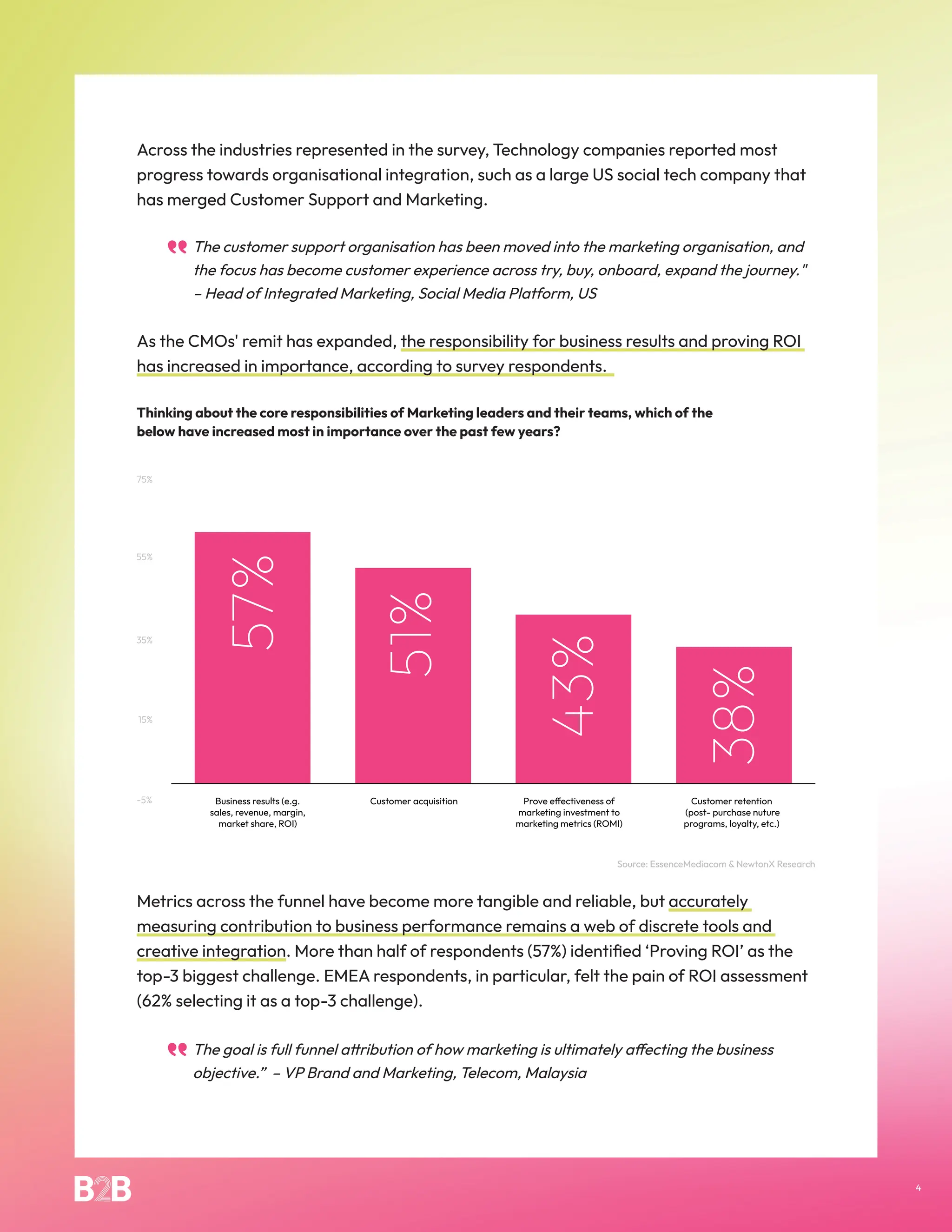
As the CMOs' remit has expanded, the responsibility for business results and proving ROI
has increased in importance, according to survey respondents.
Thinking about the core responsibilities of Marketing leaders and their teams, which of the
below have increased most in importance over the past few years?
Metrics across the funnel have become more tangible and reliable, but accurately
measuring contribution to business performance remains a web of discrete tools and
creative integration. More than half of respondents (57%) identified ‘Proving ROI’ as the
top-3 biggest challenge. EMEA respondents, in particular, felt the pain of ROI assessment
(62% selecting it as a top-3 challenge).
The goal is full funnel attribution of how marketing is ultimately affecting the business
objective.” – VP Brand and Marketing, Telecom, Malaysia
4
Source: EssenceMediacom & NewtonX Research
Implications for Marketing in
improving the velocity of
organisational readiness
The foundational business alignment in any organisation
is what defines success. Yet whilst a data-enabled
measurement framework, built upon business-wide
alignment of goals, is well-accepted best practice, it is
less commonly realised.
Eliminating the concept of ‘marketing’ goals that are
independent of, or worse, in contradiction to, sales and
business goals, requires a unified data spine that
synthesises external buyer data with owned/CRM Data,
plus a willingness to democratise that data across
departments.
At the intersection of customer experience and
business performance, marketers who have evolved into
data-driven growth teams are primed to take the lead in
modernising the approach to performance
measurement. From brand to lead generation and
business incrementality.
5
Can customer-centric Marketing shift from rhetoric
to reality?
80% of survey respondents said customer centricity has become ‘much more’ or ‘more important’
to their organisation over the past 2-3 years.
To be customer-centric, marketers must possess a complete understanding of the customer, but as
the buying journey has become more complex and anonymous, achieving a single, integrated view
of the customer has become increasingly challenging.
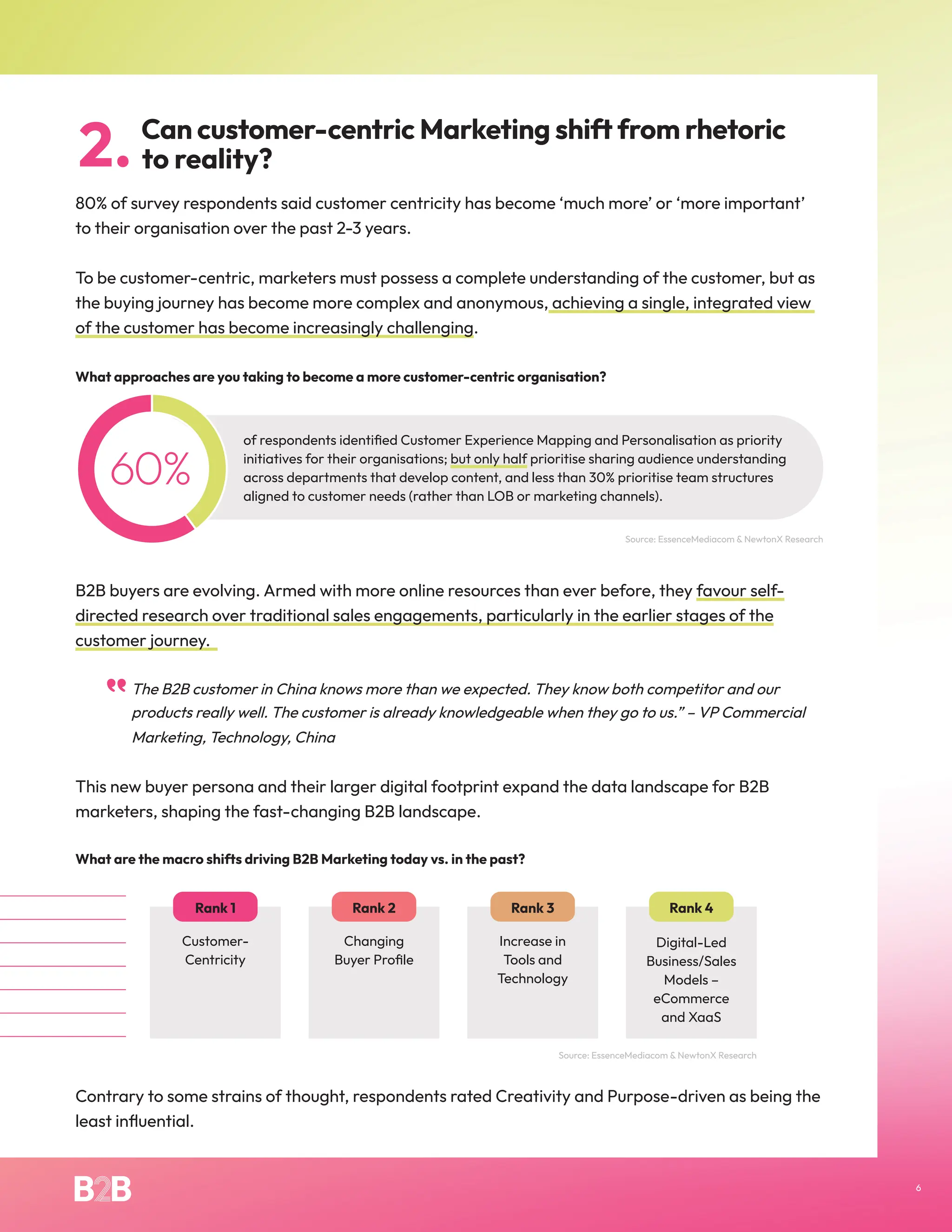
What approaches are you taking to become a more customer-centric organisation?
B2B buyers are evolving. Armed with more online resources than ever before, they favour self-
directed research over traditional sales engagements, particularly in the earlier stages of the
customer journey.
The B2B customer in China knows more than we expected. They know both competitor and our
products really well. The customer is already knowledgeable when they go to us.” – VP Commercial
Marketing, Technology, China
This new buyer persona and their larger digital footprint expand the data landscape for B2B
marketers, shaping the fast-changing B2B landscape.
What are the macro shifts driving B2B Marketing today vs. in the past?
Contrary to some strains of thought, respondents rated Creativity and Purpose-driven as being the
least influential.
2.
Rank 1 Rank 2 Rank 3 Rank 4
Digital-Led
Business/Sales
Models –
eCommerce
and XaaS
Increase in
Tools and
Technology
Changing
Buyer Profile
Customer-
Centricity
6
60%
of respondents identified Customer Experience Mapping and Personalisation as priority
initiatives for their organisations; but only half prioritise sharing audience understanding
across departments that develop content, and less than 30% prioritise team structures
aligned to customer needs (rather than LOB or marketing channels).
Source: EssenceMediacom & NewtonX Research
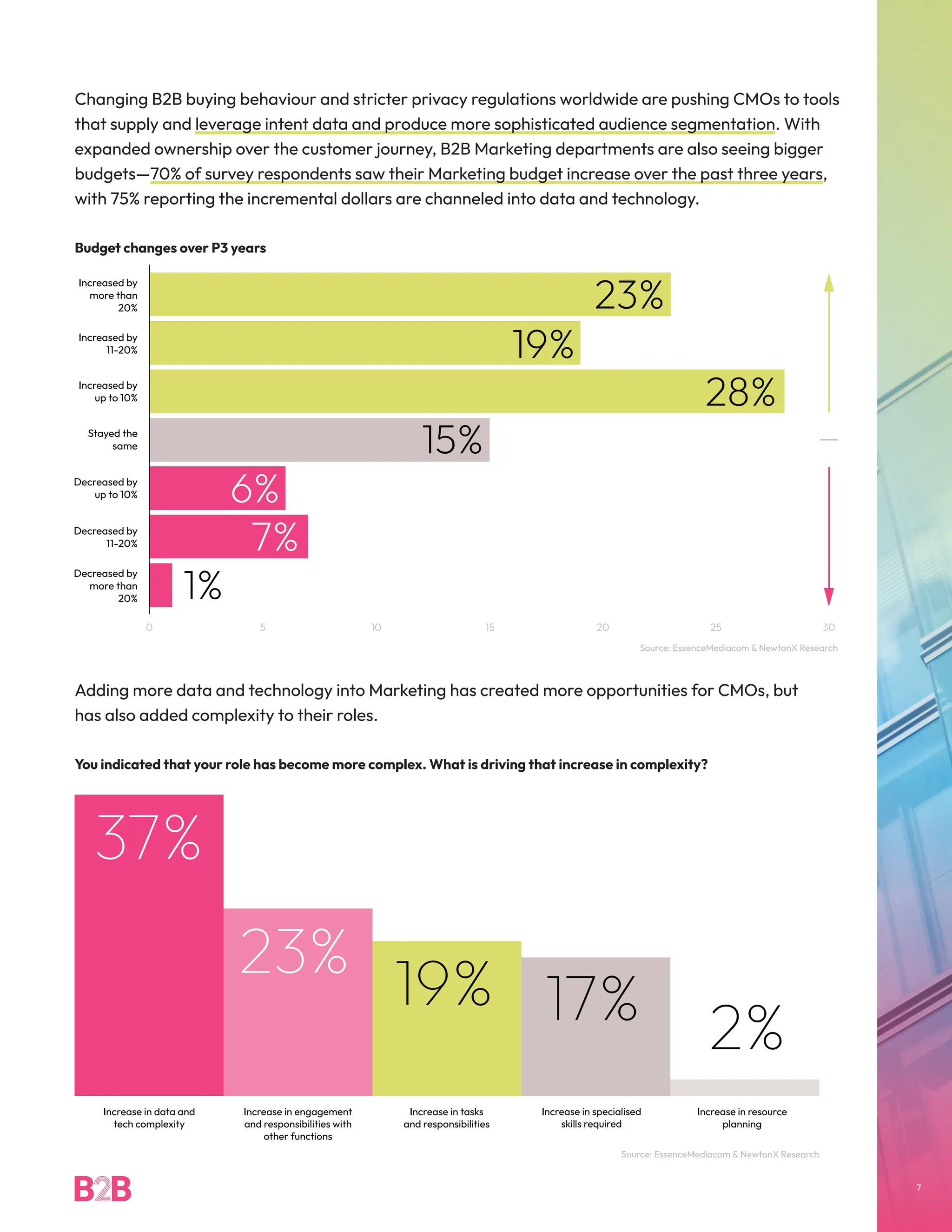
Changing B2B buying behaviour and stricter privacy regulations worldwide are pushing CMOs to tools
that supply and leverage intent data and produce more sophisticated audience segmentation. With
expanded ownership over the customer journey, B2B Marketing departments are also seeing bigger
budgets—70% of survey respondents saw their Marketing budget increase over the past three years,
with 75% reporting the incremental dollars are channeled into data and technology.
Budget changes over P3 years
Adding more data and technology into Marketing has created more opportunities for CMOs, but
has also added complexity to their roles.
You indicated that your role has become more complex. What is driving that increase in complexity?
7
Source: EssenceMediacom & NewtonX Research
Survey respondents ranked understanding the B2B
buyers’ needs across the journey as a major
challenge, particularly pronounced in Southeast
Asia. Addressing that challenge is driving significant
investment in data and tech, yet these tools remain
disconnected across departments due to conflicting
priorities and objectives.
With limited direct control
over tech infrastructure, few
respondents (10%) described
their B2B Marketing tech
stack and performance to
be mature.
You have to understand and know your client so
well that you don’t need to ask them anymore
what they want.” – CMO, Financial Services, UK
A global online retailer provided a roadmap for
achieving customer-centric marketing by
leveraging in-house machine learning models to
speed up content creation tasks. These machine
learning models and A/B testing technology
solutions enable the team to iterate and improve
content over time. With sophisticated email and
data segmentation tools, they tailor content to
individual customer segments, making the buyer
the center of their marketing strategy.
Buyers don’t want a generic value proposition.
When we build content, it’s personalisation,
dynamic fields...” – Head of Europe &Asia
Marketing, Online Retailer
8
Implications for Marketing in
driving Customer-Centricity
Customer expectations for a personalised experience
have increased. At the same time the personal Sales
relationship has declined in importance, and the barriers
to switching vendors have come down.
A risk for many, but an opportunity for marketers who
can leverage new technology like Gen-AI to help
consolidate and interrogate large, disparate customer
interactions across the organisation, from Marketing
to Customer Success, Sales and Partners, unlocking the
voice of the customer at scale.
By forging strategic partnerships with functional
leaders, particularly the CTO, marketers can help
ensure the data/tech strategy and stack are in service
of full-funnel customer experience; identifying gaps,
increasing data accessibility, and translating insights
into impact.
9
Are B2B Marketing playbooks due for a rewrite?
CMOs are tasked with spearheading a revolution in Marketing objectives, digital transformation,
and customer-centricity, which demands innovation and bold experimentation. Many CMOs,
however, still rely on legacy playbooks about what constitutes B2B Marketing or a B2B buyer,
limiting their creative approaches and differentiation.
The digital landscape is very congested - everyone is fighting for the same spot on LinkedIn."
– Global Marketing Manager, Logistics Industry, Singapore
What channel works for what segment of the market is not easy to determine. That's where it gets
complex, especially in a market like India that isn't homogenous." – CMO, Business Services, India
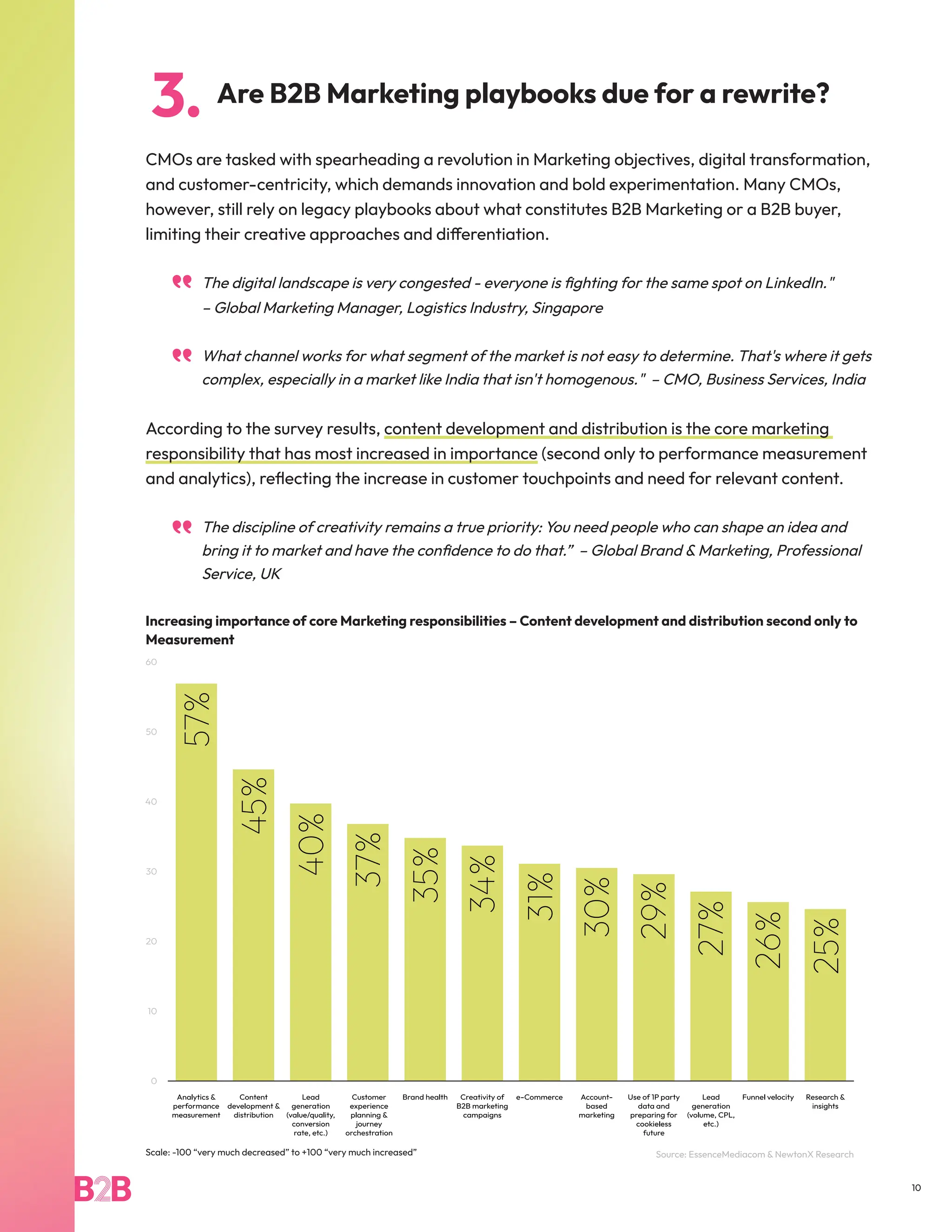
According to the survey results, content development and distribution is the core marketing
responsibility that has most increased in importance (second only to performance measurement
and analytics), reflecting the increase in customer touchpoints and need for relevant content.
The discipline of creativity remains a true priority: You need people who can shape an idea and
bring it to market and have the confidence to do that.” – Global Brand & Marketing, Professional
Service, UK
Increasing importance of core Marketing responsibilities – Content development and distribution second only to
Measurement
Scale: -100 “very much decreased” to +100 “very much increased”
3.
10
Source: EssenceMediacom & NewtonX Research
How marketers deliver content to meet the needs of new digital channels needs to
evolve.
Content delivery hasn't changed, but the format of it, how you customise it into a
bite-size, digital-friendly manner, has." – VP Marketing, Pharmaceuticals, China
One example of this is the increased focus on short video content and the needs
of a younger audience.
I've put more budget into digital… like short videos. It's more accessible to
potential customers, especially the younger generations." – CMO, Business
Services, India
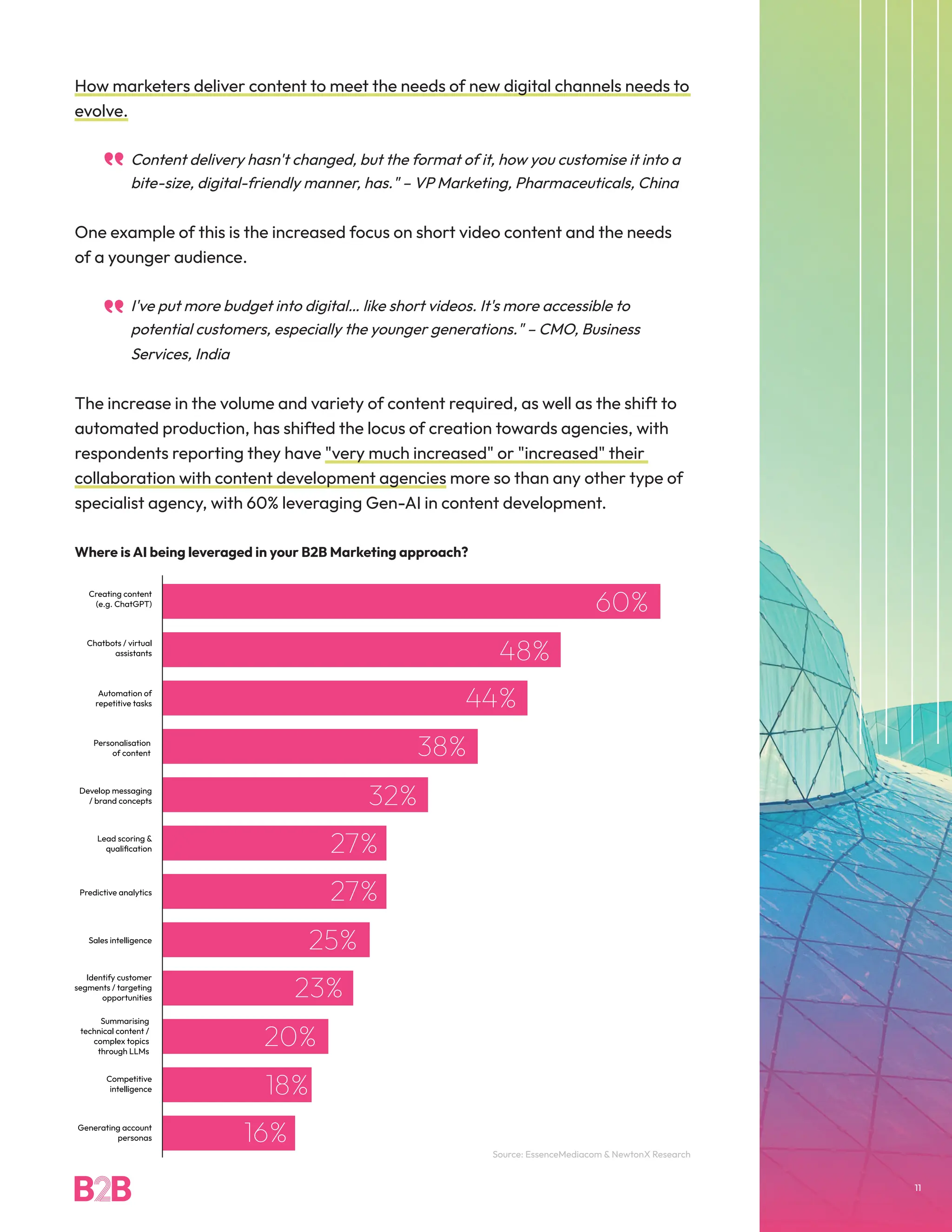
The increase in the volume and variety of content required, as well as the shift to
automated production, has shifted the locus of creation towards agencies, with
respondents reporting they have "very much increased" or "increased" their
collaboration with content development agencies more so than any other type of
specialist agency, with 60% leveraging Gen-AI in content development.
Where is AI being leveraged in your B2B Marketing approach?
11
Source: EssenceMediacom & NewtonX Research
Implications for expanding the
understanding of B2B Marketing
In a crowded online environment where marketers are
all vying for buyers’ limited attention, innovation and
experimentation are key – both in what is considered a
‘B2B channel’, the kind of content a buyer is presumed to
want, the accessibility of that content, and the appetite
for test and learn – there is no innovation without failure.
When I worked in startup or B2C, we usually spend
20% of time planning and 80% executing the
Marketing activities. I think it’s the opposite in B2B,
especially in very big organisations.” – Global
Marketing Manager, Transport & Logistics, Asia Pacific
Marketers that are evolving from a reliance on rational,
product-education messaging to ‘full-brained’
approaches that infuse behavioural science and
creativity show they understand both customer, and the
human making the decisions.
12
The Modern B2B CMO profile – Growth Orchestrator
Today’s B2B CMO is increasingly in the ‘hot seat’, expected to be the voice of the customer across
the journey and to drive tangible business outcomes.
Almost 90% of marketing leaders surveyed said their role had become “more” or “much more
complex”, reflecting the fact that the CMO is one of the shortest C-Suite tenures.
CMOs are leaned on to do a lot of cross-functional alignment, collaboration, pulling various people
together on a topic that may have nothing to do necessarily with marketing.” – CMO,
Technology, US
To shift from hot seat to spotlight, marketers must effectively helm and orchestrate a multi-
functional growth engine within their larger organisations, including branding, demand
generation, data science, ecommerce, marketing technology and CRM. The breadth of this role
presents a new set of intricacies around initiative prioritisation and resource management –
specialist recruitment, integrating diverse skills into cohesive teams, and ensuring seamless
handoffs among team members.
There seems to be an unlimited number of initiatives that marketing can do. Determining and
getting alignment around what's the best and wisest use of marketing resources can be
challenging." – CMO, Business Services, US
To match their evolving roles, CMOs are investing in talent acquisition, focusing on data and tech
competencies. Half of the Marketing leaders surveyed expect to increase their team size, with a
third reporting data and technology skills as the focus.
We need more divergent skills than ever before, and technology is the primary driver of that."
– Global Brand & Marketing, Professional Services, UK
Tech industry marketers appear to be further ahead, with 40% of those surveyed focusing on
AI and Machine-learning specialists. Across all survey respondents, analytics and performance
tracking are surging in priority.
I like to keep the core team as technical marketers, people who, if I have to have a super lean team,
are going to be able to run the tools.” –VP Marketing, Software and Technology, US
B2B Marketing is at a pivotal juncture of digital transformation; buyers are ready for a different
kind of B2B experience and the tools and capabilities are available to the marketer who can
harness them efficiently and effectively. To do so requires transforming the profile of the CMO
into one of Growth Orchestrator, inspiring other C-suite leaders to get behind customer centricity
and business impact. The path forward requires bold leadership, innovation, and a commitment to
transforming the B2B landscape.
13
Methodology
From July 19, 2023, to August 21, 2023, NewtonX on
behalf of EssenceMediacom conducted 26 in-depth
interviews and 162 questionnaires of CMOs, Vice
Presidents, and Department Heads of B2B Marketing
from across the globe - North America, EMEA, Asia
Pacific.
These Marketing leaders spent at least 40% of their
focus on B2B Marketing, worked at companies with at
least $250 million in revenue, and came from a wide
range of industries. All participants were custom
recruited by NewtonX and their identities and roles were
verified using a two-point verification process.
The executives were in the top 10 within their industry
across many sectors including Investment Banking, Food
& Beverage, Technology, Industrial Automation,
Pharmaceuticals, Logistics, Professional Services, Retail,
Health, and Beauty.
14
About EssenceMediacom
EssenceMediacom is GroupM’s newest and largest agency, committed to
delivering breakthroughs for brands in the New Communications Economy. It has
disrupted the old models across media, creative, innovation and analytics to find
new opportunities for advertisers and deliver truly integrated media solutions.
Borne out of two pioneering agencies, EssenceMediacom fuses Essence’s
performance, data, analytics and creative technology DNA with MediaCom’s
scaled multichannel audience planning and strategic media expertise.
As part of WPP, the world’s largest marketing communications services group,
and GroupM, WPP’s consolidated media investment management arm, we have
access to the richest data, most robust benchmarks and most advanced
capabilities in the market. This helps us provide comprehensive solutions to all
marketing challenges.
Our ‘breakthrough’ ambition is underpinned by our commitment to ‘continuous
learning’. We aim to ensure our people fulfil their potential by investing their
whole-person wellbeing, careers and capabilities, which in turn helps grow our
clients’ businesses.
EssenceMediacom, with 10,000 people across 120 offices in 96 markets, is one of
the world’s leading communications specialists, with billings of more than US$21
billion (Source: COMvergence, 2021). Its global client roster includes adidas,
Coca-Cola (TCCC), Dell, Google, Hasbro, Mars, NBC Universal, P&G, Richemont
and Sony.
For more information about the report or new business inquiries, please
contact EssenceMediacom’s Global B2B Practice Lead, Tara Fusco, at
tara.fusco@essencemediacom.com.
15
The world’s leading businesses find their advantage
with NewtonX.
NewtonX solves the challenges of today’s B2B
marketing and insights leaders by connecting them
with verified business expertise. The AI-driven
algorithm—the NewtonX Graph—custom recruits the
ideal audience for your business question from an
open network of 1.1 billion professionals across 140
industries. Every professional is 100% verified, so you
can make your next bold move with confidence.
To learn more, head to newtonx.com.

B2B Marketing Report 2023

  • 1.
    The CMO Coming of AgeStory: How Digital Transformation Has Elevated Marketing to a C-suite Growth Driver Global B2B Marketing Report 2023
  • 2.
    Introduction Digital transformation –integrating advanced technologies into all aspects of the business – may seem like a Chief Technology Officer remit, but with B2B buyers demanding B2C-like experiences, orchestrating data in service of customer-centricity increasingly lands with Marketing leaders. What else lands with Marketing today? Near-CEO responsibility without the authority. The modern CMO is at a corporate crossroads – a far cry from a half-century ago when Marketing didn't even command a C-suite title. Today's B2B CMO must act as a tech integrator, customer oracle, and cross-department orchestrator. According to an August 2023 global survey of 188 Fortune 500 B2B Marketing leaders, commissioned by EssenceMediacom, B2B CMOs today face three primary considerations in their ever-expanding role: 1. Am I outpacing the organisation? 2. Can customer-centric marketing shift from rhetoric to reality? 3. Are B2B Marketing playbooks due for a rewrite? 2
  • 3.
    Are modern B2BMarketers outpacing the organisation? As orchestrator of the customer experience, CMOs increasingly must serve as the pace car for digital transformation across the entire company, yet they frequently face institutional roadblocks. The B2B buyer has shifted online, increasing opportunities for connection, and reducing the importance of the one-to-one relationship historically managed by Sales. In parallel, organisational growth is increasingly predicated on customer- centricity and LTV, further shifting the customer relationship to those with a view across the full journey - Marketing. As Marketing has taken more responsibility for the entire customer experience, CMOs have entered the boardroom as the voice of the customer, with 62% of the survey respondents agreeing with the statement, “over the last few years, I have seen a shift from a sales-owned customer experience to a marketing-owned customer experience.” It used to be that there would be some imaginary handoff between Marketing and Sales, and then Marketing would exit stage right. Now we recognise that the customer experience starts even before the customer is a customer.” – CMO, Financial Services, US Yet while Marketing is adapting quickly to driving growth across the customer journey, broader organisational evolution has been slower. Functional and department siloes, misaligned goals, weak technology implementation, and legacy processes are restricting the extent to which Marketing can fully realise the potential of customer-centricity. I know we have data science, but it’s not in the local organisation, it’s in the regional/global teams. I wouldn’t be able to relate back how this helps.” – Head of Marketing, Manufacturing, EMEA The total [customer] experience today is digital, so it can’t be separated across functions. It’s an ecosystem where you manifest your brand across the chain, so more integration is needed across the C-suite to be successful.” – Global Brand & Marketing, Professional Services, UK 1. 3
  • 4.
    Across the industriesrepresented in the survey, Technology companies reported most progress towards organisational integration, such as a large US social tech company that has merged Customer Support and Marketing. The customer support organisation has been moved into the marketing organisation, and the focus has become customer experience across try, buy, onboard, expand the journey." – Head of Integrated Marketing, Social Media Platform, US As the CMOs' remit has expanded, the responsibility for business results and proving ROI has increased in importance, according to survey respondents. Thinking about the core responsibilities of Marketing leaders and their teams, which of the below have increased most in importance over the past few years? Metrics across the funnel have become more tangible and reliable, but accurately measuring contribution to business performance remains a web of discrete tools and creative integration. More than half of respondents (57%) identified ‘Proving ROI’ as the top-3 biggest challenge. EMEA respondents, in particular, felt the pain of ROI assessment (62% selecting it as a top-3 challenge). The goal is full funnel attribution of how marketing is ultimately affecting the business objective.” – VP Brand and Marketing, Telecom, Malaysia 4 Source: EssenceMediacom & NewtonX Research
  • 5.
    Implications for Marketingin improving the velocity of organisational readiness The foundational business alignment in any organisation is what defines success. Yet whilst a data-enabled measurement framework, built upon business-wide alignment of goals, is well-accepted best practice, it is less commonly realised. Eliminating the concept of ‘marketing’ goals that are independent of, or worse, in contradiction to, sales and business goals, requires a unified data spine that synthesises external buyer data with owned/CRM Data, plus a willingness to democratise that data across departments. At the intersection of customer experience and business performance, marketers who have evolved into data-driven growth teams are primed to take the lead in modernising the approach to performance measurement. From brand to lead generation and business incrementality. 5
  • 6.
    Can customer-centric Marketingshift from rhetoric to reality? 80% of survey respondents said customer centricity has become ‘much more’ or ‘more important’ to their organisation over the past 2-3 years. To be customer-centric, marketers must possess a complete understanding of the customer, but as the buying journey has become more complex and anonymous, achieving a single, integrated view of the customer has become increasingly challenging. What approaches are you taking to become a more customer-centric organisation? B2B buyers are evolving. Armed with more online resources than ever before, they favour self- directed research over traditional sales engagements, particularly in the earlier stages of the customer journey. The B2B customer in China knows more than we expected. They know both competitor and our products really well. The customer is already knowledgeable when they go to us.” – VP Commercial Marketing, Technology, China This new buyer persona and their larger digital footprint expand the data landscape for B2B marketers, shaping the fast-changing B2B landscape. What are the macro shifts driving B2B Marketing today vs. in the past? Contrary to some strains of thought, respondents rated Creativity and Purpose-driven as being the least influential. 2. Rank 1 Rank 2 Rank 3 Rank 4 Digital-Led Business/Sales Models – eCommerce and XaaS Increase in Tools and Technology Changing Buyer Profile Customer- Centricity 6 60% of respondents identified Customer Experience Mapping and Personalisation as priority initiatives for their organisations; but only half prioritise sharing audience understanding across departments that develop content, and less than 30% prioritise team structures aligned to customer needs (rather than LOB or marketing channels). Source: EssenceMediacom & NewtonX Research Source: EssenceMediacom & NewtonX Research
  • 7.
    Changing B2B buyingbehaviour and stricter privacy regulations worldwide are pushing CMOs to tools that supply and leverage intent data and produce more sophisticated audience segmentation. With expanded ownership over the customer journey, B2B Marketing departments are also seeing bigger budgets—70% of survey respondents saw their Marketing budget increase over the past three years, with 75% reporting the incremental dollars are channeled into data and technology. Budget changes over P3 years Adding more data and technology into Marketing has created more opportunities for CMOs, but has also added complexity to their roles. You indicated that your role has become more complex. What is driving that increase in complexity? 7 Source: EssenceMediacom & NewtonX Research Source: EssenceMediacom & NewtonX Research
  • 8.
    Survey respondents rankedunderstanding the B2B buyers’ needs across the journey as a major challenge, particularly pronounced in Southeast Asia. Addressing that challenge is driving significant investment in data and tech, yet these tools remain disconnected across departments due to conflicting priorities and objectives. With limited direct control over tech infrastructure, few respondents (10%) described their B2B Marketing tech stack and performance to be mature. You have to understand and know your client so well that you don’t need to ask them anymore what they want.” – CMO, Financial Services, UK A global online retailer provided a roadmap for achieving customer-centric marketing by leveraging in-house machine learning models to speed up content creation tasks. These machine learning models and A/B testing technology solutions enable the team to iterate and improve content over time. With sophisticated email and data segmentation tools, they tailor content to individual customer segments, making the buyer the center of their marketing strategy. Buyers don’t want a generic value proposition. When we build content, it’s personalisation, dynamic fields...” – Head of Europe &Asia Marketing, Online Retailer 8
  • 9.
    Implications for Marketingin driving Customer-Centricity Customer expectations for a personalised experience have increased. At the same time the personal Sales relationship has declined in importance, and the barriers to switching vendors have come down. A risk for many, but an opportunity for marketers who can leverage new technology like Gen-AI to help consolidate and interrogate large, disparate customer interactions across the organisation, from Marketing to Customer Success, Sales and Partners, unlocking the voice of the customer at scale. By forging strategic partnerships with functional leaders, particularly the CTO, marketers can help ensure the data/tech strategy and stack are in service of full-funnel customer experience; identifying gaps, increasing data accessibility, and translating insights into impact. 9
  • 10.
    Are B2B Marketingplaybooks due for a rewrite? CMOs are tasked with spearheading a revolution in Marketing objectives, digital transformation, and customer-centricity, which demands innovation and bold experimentation. Many CMOs, however, still rely on legacy playbooks about what constitutes B2B Marketing or a B2B buyer, limiting their creative approaches and differentiation. The digital landscape is very congested - everyone is fighting for the same spot on LinkedIn." – Global Marketing Manager, Logistics Industry, Singapore What channel works for what segment of the market is not easy to determine. That's where it gets complex, especially in a market like India that isn't homogenous." – CMO, Business Services, India According to the survey results, content development and distribution is the core marketing responsibility that has most increased in importance (second only to performance measurement and analytics), reflecting the increase in customer touchpoints and need for relevant content. The discipline of creativity remains a true priority: You need people who can shape an idea and bring it to market and have the confidence to do that.” – Global Brand & Marketing, Professional Service, UK Increasing importance of core Marketing responsibilities – Content development and distribution second only to Measurement Scale: -100 “very much decreased” to +100 “very much increased” 3. 10 Source: EssenceMediacom & NewtonX Research
  • 11.
    How marketers delivercontent to meet the needs of new digital channels needs to evolve. Content delivery hasn't changed, but the format of it, how you customise it into a bite-size, digital-friendly manner, has." – VP Marketing, Pharmaceuticals, China One example of this is the increased focus on short video content and the needs of a younger audience. I've put more budget into digital… like short videos. It's more accessible to potential customers, especially the younger generations." – CMO, Business Services, India The increase in the volume and variety of content required, as well as the shift to automated production, has shifted the locus of creation towards agencies, with respondents reporting they have "very much increased" or "increased" their collaboration with content development agencies more so than any other type of specialist agency, with 60% leveraging Gen-AI in content development. Where is AI being leveraged in your B2B Marketing approach? 11 Source: EssenceMediacom & NewtonX Research
  • 12.
    Implications for expandingthe understanding of B2B Marketing In a crowded online environment where marketers are all vying for buyers’ limited attention, innovation and experimentation are key – both in what is considered a ‘B2B channel’, the kind of content a buyer is presumed to want, the accessibility of that content, and the appetite for test and learn – there is no innovation without failure. When I worked in startup or B2C, we usually spend 20% of time planning and 80% executing the Marketing activities. I think it’s the opposite in B2B, especially in very big organisations.” – Global Marketing Manager, Transport & Logistics, Asia Pacific Marketers that are evolving from a reliance on rational, product-education messaging to ‘full-brained’ approaches that infuse behavioural science and creativity show they understand both customer, and the human making the decisions. 12
  • 13.
    The Modern B2BCMO profile – Growth Orchestrator Today’s B2B CMO is increasingly in the ‘hot seat’, expected to be the voice of the customer across the journey and to drive tangible business outcomes. Almost 90% of marketing leaders surveyed said their role had become “more” or “much more complex”, reflecting the fact that the CMO is one of the shortest C-Suite tenures. CMOs are leaned on to do a lot of cross-functional alignment, collaboration, pulling various people together on a topic that may have nothing to do necessarily with marketing.” – CMO, Technology, US To shift from hot seat to spotlight, marketers must effectively helm and orchestrate a multi- functional growth engine within their larger organisations, including branding, demand generation, data science, ecommerce, marketing technology and CRM. The breadth of this role presents a new set of intricacies around initiative prioritisation and resource management – specialist recruitment, integrating diverse skills into cohesive teams, and ensuring seamless handoffs among team members. There seems to be an unlimited number of initiatives that marketing can do. Determining and getting alignment around what's the best and wisest use of marketing resources can be challenging." – CMO, Business Services, US To match their evolving roles, CMOs are investing in talent acquisition, focusing on data and tech competencies. Half of the Marketing leaders surveyed expect to increase their team size, with a third reporting data and technology skills as the focus. We need more divergent skills than ever before, and technology is the primary driver of that." – Global Brand & Marketing, Professional Services, UK Tech industry marketers appear to be further ahead, with 40% of those surveyed focusing on AI and Machine-learning specialists. Across all survey respondents, analytics and performance tracking are surging in priority. I like to keep the core team as technical marketers, people who, if I have to have a super lean team, are going to be able to run the tools.” –VP Marketing, Software and Technology, US B2B Marketing is at a pivotal juncture of digital transformation; buyers are ready for a different kind of B2B experience and the tools and capabilities are available to the marketer who can harness them efficiently and effectively. To do so requires transforming the profile of the CMO into one of Growth Orchestrator, inspiring other C-suite leaders to get behind customer centricity and business impact. The path forward requires bold leadership, innovation, and a commitment to transforming the B2B landscape. 13
  • 14.
    Methodology From July 19,2023, to August 21, 2023, NewtonX on behalf of EssenceMediacom conducted 26 in-depth interviews and 162 questionnaires of CMOs, Vice Presidents, and Department Heads of B2B Marketing from across the globe - North America, EMEA, Asia Pacific. These Marketing leaders spent at least 40% of their focus on B2B Marketing, worked at companies with at least $250 million in revenue, and came from a wide range of industries. All participants were custom recruited by NewtonX and their identities and roles were verified using a two-point verification process. The executives were in the top 10 within their industry across many sectors including Investment Banking, Food & Beverage, Technology, Industrial Automation, Pharmaceuticals, Logistics, Professional Services, Retail, Health, and Beauty. 14
  • 15.
    About EssenceMediacom EssenceMediacom isGroupM’s newest and largest agency, committed to delivering breakthroughs for brands in the New Communications Economy. It has disrupted the old models across media, creative, innovation and analytics to find new opportunities for advertisers and deliver truly integrated media solutions. Borne out of two pioneering agencies, EssenceMediacom fuses Essence’s performance, data, analytics and creative technology DNA with MediaCom’s scaled multichannel audience planning and strategic media expertise. As part of WPP, the world’s largest marketing communications services group, and GroupM, WPP’s consolidated media investment management arm, we have access to the richest data, most robust benchmarks and most advanced capabilities in the market. This helps us provide comprehensive solutions to all marketing challenges. Our ‘breakthrough’ ambition is underpinned by our commitment to ‘continuous learning’. We aim to ensure our people fulfil their potential by investing their whole-person wellbeing, careers and capabilities, which in turn helps grow our clients’ businesses. EssenceMediacom, with 10,000 people across 120 offices in 96 markets, is one of the world’s leading communications specialists, with billings of more than US$21 billion (Source: COMvergence, 2021). Its global client roster includes adidas, Coca-Cola (TCCC), Dell, Google, Hasbro, Mars, NBC Universal, P&G, Richemont and Sony. For more information about the report or new business inquiries, please contact EssenceMediacom’s Global B2B Practice Lead, Tara Fusco, at tara.fusco@essencemediacom.com. 15
  • 16.
    The world’s leadingbusinesses find their advantage with NewtonX. NewtonX solves the challenges of today’s B2B marketing and insights leaders by connecting them with verified business expertise. The AI-driven algorithm—the NewtonX Graph—custom recruits the ideal audience for your business question from an open network of 1.1 billion professionals across 140 industries. Every professional is 100% verified, so you can make your next bold move with confidence. To learn more, head to newtonx.com.