CurriculumDevelopment
ApproachesandModels
TerrenceJayD.Mateo
Curriculum development is a
planned, systematic process of
creating, revising, or updating
educational programs,
encompassing courses, content,
and learning experiences to achieve
specific learning outcomes.
CURRICULUM
DEVELOPMENT
Importance of Curriculum
Development in Education
•Curriculum development is crucial in
education as it ensures a structured,
relevant, and effective learning
experience, aligning with educational
goals, promoting student success, and
empowering educators to deliver engaging
instruction.
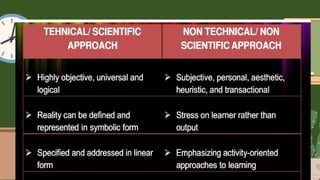
Technical-Scientific
Approach
Based on
systematic
planning and
objective
measurement
Emphasizes
efficiency, order,
and pre-
determined
objectives
Influenced
by
behaviorist
learning
theories
Technical-Scientific
Approach
 Example:
Development of
standardized tests
and structured
learning materials
•It is a way of planning a
curricula to optimize
student’s learning and
to allow them to
increase their output.
TheTylerModel
• Developed by Ralph Tyler in
1949
• It focuses on four basic
principles of curriculum and
instruction; purposes of
school, educational
experiences related to
purposes, organization of the
experiences, and evaluation
of the process.
1.PurposeofSchool
- Identify educational goals based on learner needs and
societal demands by gathering data from three sources:
subject matter, the learners and the society.
- After identifying objectives, the curriculum planners were
to refine them by filtering through two screens, the
philosophy of the school and the psychology of learning.
2.EducationalExperiencesRelatedtothe
Purposes
• Learning experiences had to take in to account
by both the previous experience and the
perceptions that the learners bring to a
situation.
• Also, the experiences were to be selected in
light of what educators know about learning
and human development.
• Choose activities that align with objectives.
3.Organizationof theExperiences
•Arrange experiences for effective learning
•The ordering of the experiences had to be
somewhat systematic so as to produce a
maximum cumulative effect.
4.Evaluationoftheprocess
•Assess learning outcomes and revise as
needed
•It is important to determine whether the
program was effective or ineffective. An
evaluation should relate to all the
objectives.
APPLICATIONOFTHE TYLERMODEL
 Used in K-12 and higher education curriculum
planning
 Focuses on clear instructional objectives
 Strengths: Structured, goal-oriented, and measurable
 Limitations: May not fully address student interests
and adaptability
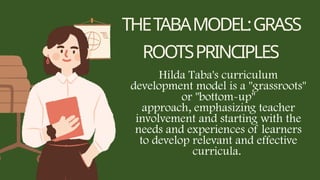
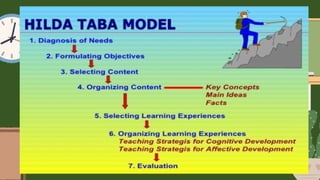
THETABAMODEL:GRASS
ROOTSPRINCIPLES
Hilda Taba's curriculum
development model is a "grassroots"
or "bottom-up"
approach, emphasizing teacher
involvement and starting with the
needs and experiences of learners
to develop relevant and effective
curricula.
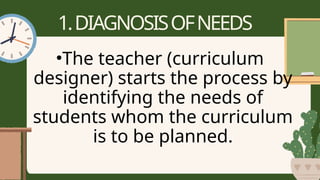
1.DIAGNOSISOFNEEDS
•The teacher (curriculum
designer) starts the process by
identifying the needs of
students whom the curriculum
is to be planned.
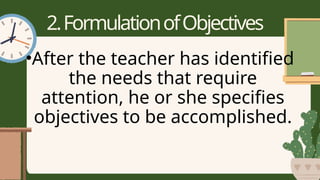
2.FormulationofObjectives
•After the teacher has identified
the needs that require
attention, he or she specifies
objectives to be accomplished.
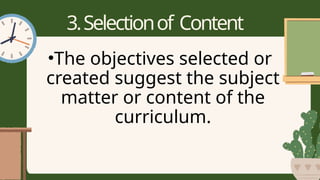
3.Selectionof Content
•The objectives selected or
created suggest the subject
matter or content of the
curriculum.
4.OrganizationofContent
•A teacher cannot just select
content, but must organize it in
some type of sequence, taking
into consideration the maturity
of the learners, their academic
achievement and their interests.
5.SelectionofLearningExperiences
•Content must be presented to
the pupils and pupils must
engage the content.
6.OrganizationofLearningActivities
•Just as content must be
sequenced and organized, so
must the learning activities.
7.EvaluationandMeansof
Evaluation
•The curriculum planner must
determine just what objectives
have been accomplished.
•Assessing effectiveness and
making improvements.
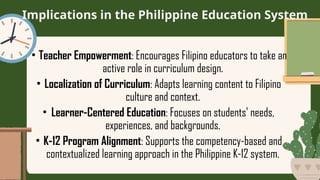
Implications in the Philippine Education System
• Teacher Empowerment: Encourages Filipino educators to take an
active role in curriculum design.
• Localization of Curriculum: Adapts learning content to Filipino
culture and context.
• Learner-Centered Education: Focuses on students' needs,
experiences, and backgrounds.
• K-12 Program Alignment: Supports the competency-based and
contextualized learning approach in the Philippine K-12 system.
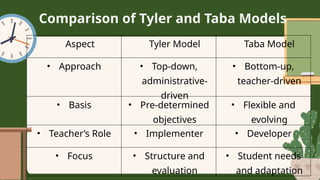
Comparison of Tyler and Taba Models
Aspect Tyler Model Taba Model
• Approach • Top-down,
administrative-
driven
• Bottom-up,
teacher-driven
• Basis • Pre-determined
objectives
• Flexible and
evolving
• Teacher’s Role • Implementer • Developer
• Focus • Structure and
evaluation
• Student needs
and adaptation
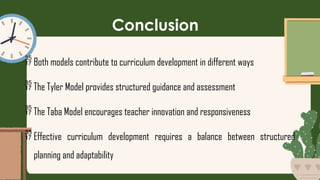
Conclusion
 Both models contribute to curriculum development in different ways
 The Tyler Model provides structured guidance and assessment
 The Taba Model encourages teacher innovation and responsiveness
 Effective curriculum development requires a balance between structured
planning and adaptability
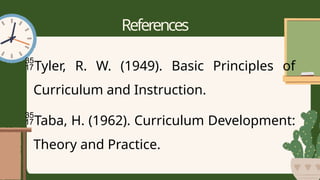
References
Tyler, R. W. (1949). Basic Principles of
Curriculum and Instruction.
Taba, H. (1962). Curriculum Development:
Theory and Practice.
NON-TECHNICAL APPROACH
•A non-technical approach to curriculum
development is a flexible, learner-centered
approach that prioritizes individual needs and
interests over predetermined objectives and
outcomes. It emphasizes a more holistic and less
structured learning experience, focusing on the
process of learning rather than a specific
product.
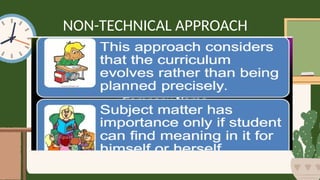
NON-TECHNICAL APPROACH
•A flexible, non-traditional learning environment
•Focuses on student choice, autonomy, and
collaboration
•Classrooms are arranged to promote interaction
and exploration
OPEN CLASSROOM MODEL
Key characteristics
•Multi-age grouping of students
•Teachers as facilitators, not lecturers
•Learning centers or stations for various activities
•No fixed seating or rigid structure
Advantages
•Encourages creativity and independence
•Supports different learning styles
•Promotes peer learning and collaboration
•Enhances motivation and engagement
Role of the Teacher
•Acts as a guide and mentor
•Designs diverse and meaningful learning activities
•Observes and supports individual progress
•Fosters a positive and inclusive classroom culture
Challenges
•Requires strong classroom management skills
•Can be noisy or chaotic without structure
•Needs careful planning and resource availability
•Not always supported by traditional school systems
GLATHORN’S NATURALISTIC MODEL
• - Developed by Allan Glatthorn
• - Emphasizes real-world, collaborative curriculum design
• - Curriculum emerges from the actual practices and needs of
stakeholders
Key Features
• - Naturalistic and non-linear process
• - Curriculum is responsive to context and environment
• - Developed through negotiation and collaboration
• - Focus on continuous improvement
Stages of Development
• 1. Situation Analysis
• 2. Collaborative Planning
• 3. Curriculum Design and Development
• 4. Implementation
• 5. Ongoing Evaluation and Revision
Role of Stakeholders
• - Teachers, administrators, students, and community members are
involved
• - Emphasizes shared decision-making
• - Ensures curriculum relevance and acceptance
Advantages
• - Encourages collaboration and ownership
• - Adapts to local context and needs
• - Promotes continuous feedback and development
Challenges
• - Can be time-consuming
• - Requires strong communication and teamwork
• - Needs flexibility in planning and implementation
Introduction to Goodlad’s Model
• - Developed by John Goodlad
• - Emphasizes the complexity and multiple levels of curriculum
• - Focuses on the relationship between curriculum theory and
classroom practice
Four Types of Curriculum
• 1. **Ideal Curriculum** – What society expects (philosophical,
national goals)
• 2. **Formal Curriculum** – Written and officially approved content
• 3. **Perceived Curriculum** – What teachers understand and
interpret
• 4. **Operational Curriculum** – What is actually taught in the
classroom
Key Principles
• - Curriculum should reflect both societal needs and classroom realities
• - Emphasizes teacher autonomy and student experiences
• - Encourages ongoing curriculum evaluation
Focus Areas
• - Curriculum planning and development
• - Classroom observation and teacher practice
• - Learner outcomes and school environment
Advantages
• - Addresses gaps between curriculum intent and practice
• - Recognizes complexity of educational systems
• - Provides a framework for curriculum improvement
Challenges
• - Translating ideal goals into classroom practice
• - Ensuring coherence across curriculum levels
• - Requires ongoing reflection and adaptation
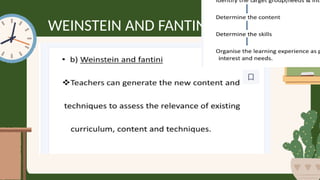
WEINSTEIN AND FANTINI MODEL
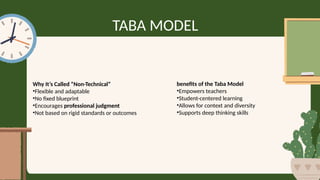
TABA MODEL
Why It’s Called “Non-Technical”
•Flexible and adaptable
•No fixed blueprint
•Encourages professional judgment
•Not based on rigid standards or outcomes
benefits of the Taba Model
•Empowers teachers
•Student-centered learning
•Allows for context and diversity
•Supports deep thinking skills
ThankYou
forattention
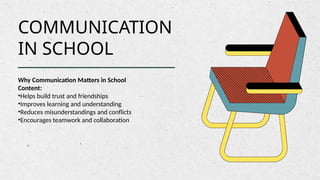
Why Communication Matters in School
Content:
•Helps build trust and friendships
•Improves learning and understanding
•Reduces misunderstandings and conflicts
•Encourages teamwork and collaboration
COMMUNICATION
IN SCHOOL
Types of School Communication
Content:
•Student to Student – friendships, teamwork
•Student to Teacher – asking questions, getting help
•Teacher to Parent – progress reports, behavior updates
•School to Community – newsletters, events
COMMUNICATION
IN SCHOOL
Benefits of Good Communication
Content (with icons or bullet points):
•Better grades
•Fewer conflicts
•Stronger school community
•More confidence and participation
COMMUNICATION
IN SCHOOL
How to Improve Communication
Content:
•Be respectful and listen actively
•Speak clearly and honestly
•Use “I” statements (e.g., "I feel…")
•Ask questions when unsure
COMMUNICATION
IN SCHOOL
COMMUNICATION
PROCESS
English Language Arts, Year 11
COMMUNICATION
It is the process that people use to
exchange significant messages and
share meaning about their ideas
and feelings with one another
(Porter and Roberts, 1976)
English Language Arts, Year 11
COMMUNICATION PROCESS
A. Message- it is typically the
verbal or nonverbal cues or
symbols that each communicator
conveys. It is the idea or
information that an individual
hopes to communicate.
COMMUNICATION PROCESS
CHANNEL- it is the vehicle, medium
or form in which a message
travels.
Form can range from light waves
of nonverbal cues to sound waves
of talking face to face, to electronic
signals in telephones and e-mail.
COMMUNICATION PROCESS
SENDER- it is the person or a
generalized source.
COMMUNICATION PROCESS
TRANSMISSION- it is the actual
sending and receiving of messages
through designated channels or
media.

CURRICULUM DEVELOPMENT TYLER AND TABA.pptx

  • 1.
  • 2.
    Curriculum development isa planned, systematic process of creating, revising, or updating educational programs, encompassing courses, content, and learning experiences to achieve specific learning outcomes. CURRICULUM DEVELOPMENT
  • 3.
    Importance of Curriculum Developmentin Education •Curriculum development is crucial in education as it ensures a structured, relevant, and effective learning experience, aligning with educational goals, promoting student success, and empowering educators to deliver engaging instruction.
  • 4.
    Technical-Scientific Approach Based on systematic planning and objective measurement Emphasizes efficiency,order, and pre- determined objectives Influenced by behaviorist learning theories
  • 5.
    Technical-Scientific Approach  Example: Development of standardizedtests and structured learning materials •It is a way of planning a curricula to optimize student’s learning and to allow them to increase their output.
  • 6.
    TheTylerModel • Developed byRalph Tyler in 1949 • It focuses on four basic principles of curriculum and instruction; purposes of school, educational experiences related to purposes, organization of the experiences, and evaluation of the process.
  • 7.
    1.PurposeofSchool - Identify educationalgoals based on learner needs and societal demands by gathering data from three sources: subject matter, the learners and the society. - After identifying objectives, the curriculum planners were to refine them by filtering through two screens, the philosophy of the school and the psychology of learning.
  • 8.
    2.EducationalExperiencesRelatedtothe Purposes • Learning experienceshad to take in to account by both the previous experience and the perceptions that the learners bring to a situation. • Also, the experiences were to be selected in light of what educators know about learning and human development. • Choose activities that align with objectives.
  • 9.
    3.Organizationof theExperiences •Arrange experiencesfor effective learning •The ordering of the experiences had to be somewhat systematic so as to produce a maximum cumulative effect.
  • 10.
    4.Evaluationoftheprocess •Assess learning outcomesand revise as needed •It is important to determine whether the program was effective or ineffective. An evaluation should relate to all the objectives.
  • 11.
    APPLICATIONOFTHE TYLERMODEL  Usedin K-12 and higher education curriculum planning  Focuses on clear instructional objectives  Strengths: Structured, goal-oriented, and measurable  Limitations: May not fully address student interests and adaptability
  • 12.
    THETABAMODEL:GRASS ROOTSPRINCIPLES Hilda Taba's curriculum developmentmodel is a "grassroots" or "bottom-up" approach, emphasizing teacher involvement and starting with the needs and experiences of learners to develop relevant and effective curricula.
  • 15.
    1.DIAGNOSISOFNEEDS •The teacher (curriculum designer)starts the process by identifying the needs of students whom the curriculum is to be planned.
  • 16.
    2.FormulationofObjectives •After the teacherhas identified the needs that require attention, he or she specifies objectives to be accomplished.
  • 17.
    3.Selectionof Content •The objectivesselected or created suggest the subject matter or content of the curriculum.
  • 18.
    4.OrganizationofContent •A teacher cannotjust select content, but must organize it in some type of sequence, taking into consideration the maturity of the learners, their academic achievement and their interests.
  • 19.
    5.SelectionofLearningExperiences •Content must bepresented to the pupils and pupils must engage the content.
  • 20.
    6.OrganizationofLearningActivities •Just as contentmust be sequenced and organized, so must the learning activities.
  • 21.
    7.EvaluationandMeansof Evaluation •The curriculum plannermust determine just what objectives have been accomplished. •Assessing effectiveness and making improvements.
  • 22.
    Implications in thePhilippine Education System • Teacher Empowerment: Encourages Filipino educators to take an active role in curriculum design. • Localization of Curriculum: Adapts learning content to Filipino culture and context. • Learner-Centered Education: Focuses on students' needs, experiences, and backgrounds. • K-12 Program Alignment: Supports the competency-based and contextualized learning approach in the Philippine K-12 system.
  • 23.
    Comparison of Tylerand Taba Models Aspect Tyler Model Taba Model • Approach • Top-down, administrative- driven • Bottom-up, teacher-driven • Basis • Pre-determined objectives • Flexible and evolving • Teacher’s Role • Implementer • Developer • Focus • Structure and evaluation • Student needs and adaptation
  • 24.
    Conclusion  Both modelscontribute to curriculum development in different ways  The Tyler Model provides structured guidance and assessment  The Taba Model encourages teacher innovation and responsiveness  Effective curriculum development requires a balance between structured planning and adaptability
  • 25.
    References Tyler, R. W.(1949). Basic Principles of Curriculum and Instruction. Taba, H. (1962). Curriculum Development: Theory and Practice.
  • 26.
    NON-TECHNICAL APPROACH •A non-technicalapproach to curriculum development is a flexible, learner-centered approach that prioritizes individual needs and interests over predetermined objectives and outcomes. It emphasizes a more holistic and less structured learning experience, focusing on the process of learning rather than a specific product.
  • 27.
  • 28.
    •A flexible, non-traditionallearning environment •Focuses on student choice, autonomy, and collaboration •Classrooms are arranged to promote interaction and exploration OPEN CLASSROOM MODEL
  • 29.
    Key characteristics •Multi-age groupingof students •Teachers as facilitators, not lecturers •Learning centers or stations for various activities •No fixed seating or rigid structure Advantages •Encourages creativity and independence •Supports different learning styles •Promotes peer learning and collaboration •Enhances motivation and engagement
  • 30.
    Role of theTeacher •Acts as a guide and mentor •Designs diverse and meaningful learning activities •Observes and supports individual progress •Fosters a positive and inclusive classroom culture Challenges •Requires strong classroom management skills •Can be noisy or chaotic without structure •Needs careful planning and resource availability •Not always supported by traditional school systems
  • 31.
    GLATHORN’S NATURALISTIC MODEL •- Developed by Allan Glatthorn • - Emphasizes real-world, collaborative curriculum design • - Curriculum emerges from the actual practices and needs of stakeholders
  • 32.
    Key Features • -Naturalistic and non-linear process • - Curriculum is responsive to context and environment • - Developed through negotiation and collaboration • - Focus on continuous improvement
  • 33.
    Stages of Development •1. Situation Analysis • 2. Collaborative Planning • 3. Curriculum Design and Development • 4. Implementation • 5. Ongoing Evaluation and Revision
  • 34.
    Role of Stakeholders •- Teachers, administrators, students, and community members are involved • - Emphasizes shared decision-making • - Ensures curriculum relevance and acceptance
  • 35.
    Advantages • - Encouragescollaboration and ownership • - Adapts to local context and needs • - Promotes continuous feedback and development
  • 36.
    Challenges • - Canbe time-consuming • - Requires strong communication and teamwork • - Needs flexibility in planning and implementation
  • 37.
    Introduction to Goodlad’sModel • - Developed by John Goodlad • - Emphasizes the complexity and multiple levels of curriculum • - Focuses on the relationship between curriculum theory and classroom practice
  • 38.
    Four Types ofCurriculum • 1. **Ideal Curriculum** – What society expects (philosophical, national goals) • 2. **Formal Curriculum** – Written and officially approved content • 3. **Perceived Curriculum** – What teachers understand and interpret • 4. **Operational Curriculum** – What is actually taught in the classroom
  • 39.
    Key Principles • -Curriculum should reflect both societal needs and classroom realities • - Emphasizes teacher autonomy and student experiences • - Encourages ongoing curriculum evaluation
  • 40.
    Focus Areas • -Curriculum planning and development • - Classroom observation and teacher practice • - Learner outcomes and school environment
  • 41.
    Advantages • - Addressesgaps between curriculum intent and practice • - Recognizes complexity of educational systems • - Provides a framework for curriculum improvement
  • 42.
    Challenges • - Translatingideal goals into classroom practice • - Ensuring coherence across curriculum levels • - Requires ongoing reflection and adaptation
  • 43.
  • 44.
    TABA MODEL Why It’sCalled “Non-Technical” •Flexible and adaptable •No fixed blueprint •Encourages professional judgment •Not based on rigid standards or outcomes benefits of the Taba Model •Empowers teachers •Student-centered learning •Allows for context and diversity •Supports deep thinking skills
  • 46.
  • 47.
    Why Communication Mattersin School Content: •Helps build trust and friendships •Improves learning and understanding •Reduces misunderstandings and conflicts •Encourages teamwork and collaboration COMMUNICATION IN SCHOOL
  • 48.
    Types of SchoolCommunication Content: •Student to Student – friendships, teamwork •Student to Teacher – asking questions, getting help •Teacher to Parent – progress reports, behavior updates •School to Community – newsletters, events COMMUNICATION IN SCHOOL
  • 49.
    Benefits of GoodCommunication Content (with icons or bullet points): •Better grades •Fewer conflicts •Stronger school community •More confidence and participation COMMUNICATION IN SCHOOL
  • 50.
    How to ImproveCommunication Content: •Be respectful and listen actively •Speak clearly and honestly •Use “I” statements (e.g., "I feel…") •Ask questions when unsure COMMUNICATION IN SCHOOL
  • 51.
  • 52.
    English Language Arts,Year 11 COMMUNICATION It is the process that people use to exchange significant messages and share meaning about their ideas and feelings with one another (Porter and Roberts, 1976)
  • 53.
    English Language Arts,Year 11 COMMUNICATION PROCESS A. Message- it is typically the verbal or nonverbal cues or symbols that each communicator conveys. It is the idea or information that an individual hopes to communicate.
  • 54.
    COMMUNICATION PROCESS CHANNEL- itis the vehicle, medium or form in which a message travels. Form can range from light waves of nonverbal cues to sound waves of talking face to face, to electronic signals in telephones and e-mail.
  • 55.
    COMMUNICATION PROCESS SENDER- itis the person or a generalized source.
  • 56.
    COMMUNICATION PROCESS TRANSMISSION- itis the actual sending and receiving of messages through designated channels or media.