CURRICULUM
MODELS/TYPES
WHAT IS CURRICULUM MODELS?
Madeus and Stafflebeam (1989)
 outline approaches
 methods
 procedures
Teaching and learning and
target the needs and
characteristics of particular
group of students.
 consist of interacting parts that serves as a guide or
procedure
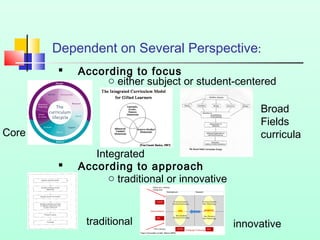
Dependent on Several Perspective:
 According to focus
o either subject or student-centered
 According to approach
o traditional or innovative
Core
Integrated
Broad
Fields
curricula
traditional innovative
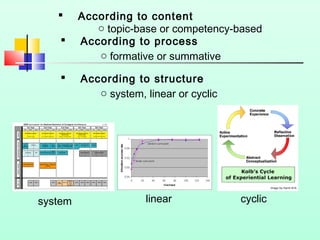
o system, linear or cyclic
 According to structure
o formative or summative
 According to process
o topic-base or competency-based
 According to content
system linear cyclic
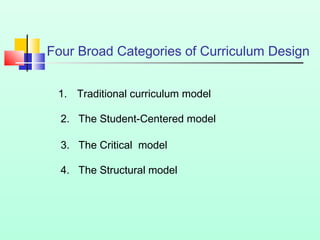
Four Broad Categories of Curriculum Design
1. Traditional curriculum model
2. The Student-Centered model
3. The Critical model
4. The Structural model
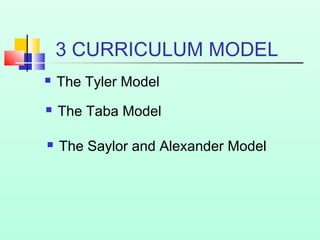
3 CURRICULUM MODEL
 The Tyler Model
 The Taba Model
 The Saylor and Alexander Model
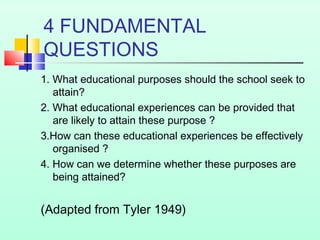
4 FUNDAMENTAL
QUESTIONS
1. What educational purposes should the school seek to
attain?
2. What educational experiences can be provided that
are likely to attain these purpose ?
3.How can these educational experiences be effectively
organised ?
4. How can we determine whether these purposes are
being attained?
(Adapted from Tyler 1949)
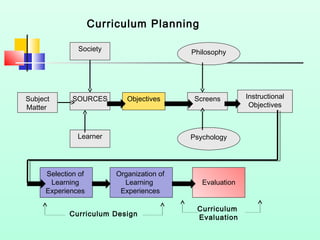
Society Philosophy
Subject
Matter
SOURCES Objectives Screens Instructional
Objectives
Learner Psychology
Selection of
Learning
Experiences
Organization of
Learning
Experiences
Evaluation
Curriculum Planning
Curriculum Design
Curriculum
Evaluation
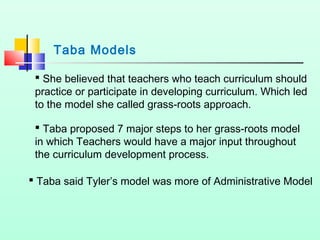
Taba Models
 She believed that teachers who teach curriculum should
practice or participate in developing curriculum. Which led
to the model she called grass-roots approach.
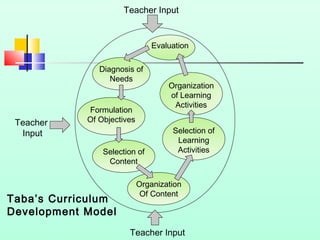
 Taba proposed 7 major steps to her grass-roots model
in which Teachers would have a major input throughout
the curriculum development process.
 Taba said Tyler’s model was more of Administrative Model
Evaluation
Formulation
Of Objectives
Diagnosis of
Needs
Selection of
Content
Organization
Of Content
Selection of
Learning
Activities
Organization
of Learning
Activities
Teacher
Input
Teacher Input
Teacher Input
Taba’s Curriculum
Development Model
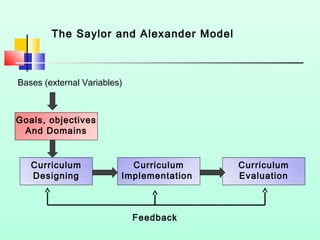
The Saylor and Alexander Model
Bases (external Variables)
Goals, objectives
And Domains
Curriculum
Implementation
Curriculum
Evaluation
Curriculum
Designing
Feedback
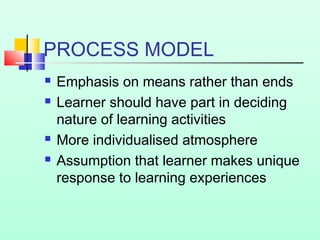
PROCESS MODEL
 Emphasis on means rather than ends
 Learner should have part in deciding
nature of learning activities
 More individualised atmosphere
 Assumption that learner makes unique
response to learning experiences
ADVANTAGES OF
PROCESS MODEL
 Emphasis on active roles of teachers
and learners
 Emphasis on learning skills
 Emphasis on certain activities as
important in themselves and for “life”
DISADVANTAGES OF
PROCESS MODEL
 Neglect of considerations of appropriate
content
 Difficulty in applying approach in some
areas
1. Overt, Explicit or Written Curriculum
TYPES OF CURRICULUM
Is usually confined to those written understandings and
directions formally designated and reviewed by
administrators, curriculum directors and teachers, often
collectively.
2. Societal Curriculum
The massive, ongoing, informal curriculum of family, peer
group, neighborhoods, churches organizations, mass,
media and other socializing forces that “educate” all of
us throughout our lives.
3. The Hidden or Covert Curriculum
Implied by structure and nature of school, which refers the
kinds and learning's of children derive from the very
nature and organizational design of the public school as
well as the behaviors and attitudes of teachers and
administrators.
4. The Null Curriculum
Which we do not teach, thus giving students the message
that these elements are not important in their educational
experiences or in our society.
5. Phantom Curriculum
The messages prevalent in an through exposure to any type
of media. These components and messages play a
major part in the enculturation of students into the
predominant meta-culture, or in acculturating students
into narrower or generational subcultures.
6. Concomitant Curriculum
This type of curriculum may be received at church, in the
context of religious expression, lessons values, ethics or
morals, molded behaviors, or social experiences based
on the family’s preferences.
7. Rhetorical Curriculum
Ideas offered by policy makers, school officials,
administrators, or politicians.
8. Curriculum-in-use
Is the actual curriculum that is delivered and presented by
each teachers.
9. Received Curriculum
Those things that students actually take out of classroom;
those concepts and content that are truly learned and
remembered.
10. The Internal Curriculum
Processes, content, knowledge combined with the
experiences and realities of the learners to create new
knowledge. While educators should be aware of this
curriculum, they have little control over the internal
curriculum since it is unique to each students.
11. The Electronic Curriculum
Those lessons learned through searching the internet for
information, or through using e-forms of communication.

curriculummodelsandtypes-140103223358-phpapp01 (2).pdf

  • 1.
  • 2.
    WHAT IS CURRICULUMMODELS? Madeus and Stafflebeam (1989)  outline approaches  methods  procedures Teaching and learning and target the needs and characteristics of particular group of students.  consist of interacting parts that serves as a guide or procedure
  • 3.
    Dependent on SeveralPerspective:  According to focus o either subject or student-centered  According to approach o traditional or innovative Core Integrated Broad Fields curricula traditional innovative
  • 4.
    o system, linearor cyclic  According to structure o formative or summative  According to process o topic-base or competency-based  According to content system linear cyclic
  • 5.
    Four Broad Categoriesof Curriculum Design 1. Traditional curriculum model 2. The Student-Centered model 3. The Critical model 4. The Structural model
  • 6.
    3 CURRICULUM MODEL The Tyler Model  The Taba Model  The Saylor and Alexander Model
  • 7.
    4 FUNDAMENTAL QUESTIONS 1. Whateducational purposes should the school seek to attain? 2. What educational experiences can be provided that are likely to attain these purpose ? 3.How can these educational experiences be effectively organised ? 4. How can we determine whether these purposes are being attained? (Adapted from Tyler 1949)
  • 8.
    Society Philosophy Subject Matter SOURCES ObjectivesScreens Instructional Objectives Learner Psychology Selection of Learning Experiences Organization of Learning Experiences Evaluation Curriculum Planning Curriculum Design Curriculum Evaluation
  • 9.
    Taba Models  Shebelieved that teachers who teach curriculum should practice or participate in developing curriculum. Which led to the model she called grass-roots approach.  Taba proposed 7 major steps to her grass-roots model in which Teachers would have a major input throughout the curriculum development process.  Taba said Tyler’s model was more of Administrative Model
  • 10.
    Evaluation Formulation Of Objectives Diagnosis of Needs Selectionof Content Organization Of Content Selection of Learning Activities Organization of Learning Activities Teacher Input Teacher Input Teacher Input Taba’s Curriculum Development Model
  • 11.
    The Saylor andAlexander Model Bases (external Variables) Goals, objectives And Domains Curriculum Implementation Curriculum Evaluation Curriculum Designing Feedback
  • 12.
    PROCESS MODEL  Emphasison means rather than ends  Learner should have part in deciding nature of learning activities  More individualised atmosphere  Assumption that learner makes unique response to learning experiences
  • 13.
    ADVANTAGES OF PROCESS MODEL Emphasis on active roles of teachers and learners  Emphasis on learning skills  Emphasis on certain activities as important in themselves and for “life”
  • 14.
    DISADVANTAGES OF PROCESS MODEL Neglect of considerations of appropriate content  Difficulty in applying approach in some areas
  • 15.
    1. Overt, Explicitor Written Curriculum TYPES OF CURRICULUM Is usually confined to those written understandings and directions formally designated and reviewed by administrators, curriculum directors and teachers, often collectively. 2. Societal Curriculum The massive, ongoing, informal curriculum of family, peer group, neighborhoods, churches organizations, mass, media and other socializing forces that “educate” all of us throughout our lives. 3. The Hidden or Covert Curriculum Implied by structure and nature of school, which refers the kinds and learning's of children derive from the very nature and organizational design of the public school as well as the behaviors and attitudes of teachers and administrators.
  • 16.
    4. The NullCurriculum Which we do not teach, thus giving students the message that these elements are not important in their educational experiences or in our society. 5. Phantom Curriculum The messages prevalent in an through exposure to any type of media. These components and messages play a major part in the enculturation of students into the predominant meta-culture, or in acculturating students into narrower or generational subcultures. 6. Concomitant Curriculum This type of curriculum may be received at church, in the context of religious expression, lessons values, ethics or morals, molded behaviors, or social experiences based on the family’s preferences. 7. Rhetorical Curriculum Ideas offered by policy makers, school officials, administrators, or politicians.
  • 17.
    8. Curriculum-in-use Is theactual curriculum that is delivered and presented by each teachers. 9. Received Curriculum Those things that students actually take out of classroom; those concepts and content that are truly learned and remembered. 10. The Internal Curriculum Processes, content, knowledge combined with the experiences and realities of the learners to create new knowledge. While educators should be aware of this curriculum, they have little control over the internal curriculum since it is unique to each students. 11. The Electronic Curriculum Those lessons learned through searching the internet for information, or through using e-forms of communication.