• Curriculum isa dynamic process. In
curriculum development, there are
always changes that occur that are
intended for improvement.
4.
Curriculum Development Process
•Curriculum development is a dynamic process involving many
different people and procedures. Development connotes changes
which is systematic. A change for the better means alteration,
modification or improvement of existing condition. To produce
positive changes, development should be purposeful, planned and
progressive. Usually it is linear and follows a logical step-by-step
fashion involving the following phases: curriculum planning,
curriculum design, curriculum implementation and curriculum
evaluation. Generally, most models involve phases.
5.
1. Curriculum planningconsiders the school
vision, mission and goals. It also includes the
philosophy or strong education belief of the
school. All of these will eventually be translated
to classroom desired learning outcomes for the
learners.
6.
2. Curriculum designingis the way curriculum is
conceptualized to include the selection and
organization of content, the selection and
organization of learning experiences or activities
and the selection of the assessment procedure
and tools to measure achieved learning
outcomes. A curriculum design will also include
the resources to be utilized and the statement of
the intended learning outcomes.
7.
3. Curriculum Implementingis putting into action the
plan which is based on the curriculum design in the
classroom setting or the learning environment. The
teacher is the facilitator of learning and together with
the learners, uses the curriculum as design guides to
what will transpire in the classroom with the end in view
of achieving the intended learning outcomes
Implementing the curriculum is where action takes
place It involves the activities that transpire in every
teacher's classroom where learning becomes an active
process.
8.
4. Curriculum evaluatingdetermines the extent to
which the desired outcomes have been achieved. This
procedure is on-going as in finding out the progress of
learning (formative) or the mastery of learning
(summative). Along the way, evaluation will determine
the factors that have hindered or supported the
implementation. It will also pinpoint where improvement
can be made and corrective measures, introduced. The
result of evaluation is very important for decision-making
of curriculum planners and implementors.
• Explain andsummarize the curriculum development process and models
1. Ralph Tyler Model: Four Basic Principles
• Also known as Tyler's Rationale, the curriculum
development model emphasizes the planning
phase. This is presented in his book Basic Principles of
Curriculum and Instruction. He posited four
fundamental principles which are illustrated as
answers to the following questions:
11.
• Explain andsummarize the curriculum development process and models
1. What education purposes should schools seek to attain?
2. What educational experiences can be provided that are likely to
attain these purposes?
3. How can these educational experiences be effectively
organized?
4. How can we determine whether these purposes are being
attained or not?
Tyler's model shows that in curriculum development, the
following considerations should be made:
1. Purposes of the school.
2. Educational experiences related to the purposes
3. Organization of the experiences
4. Evaluation of the experience
12.
• Explain andsummarize the curriculum development process and models
2. Hilda Taba Model: Grassroots Approach
• She believed that teachers should participate in
developing a curriculum. As a grassroots approach,
Taba begins from the bottom, rather than from the
top as what Tyler proposed.
13.
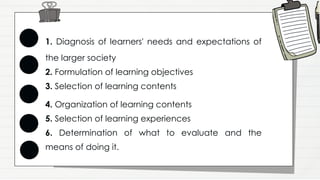
1. Diagnosis oflearners' needs and expectations of
the larger society
2. Formulation of learning objectives
3. Selection of learning contents
4. Organization of learning contents
5. Selection of learning experiences
6. Determination of what to evaluate and the
means of doing it.
14.
• Explain andsummarize the curriculum development process and models
3. Galen Saylor and William Alexander Curriculum Model
• Galen Saylor and William Alexander (1974) viewed
curriculum development as consisting of four steps.
Curriculum is "a plan for providing sets of learning
opportunities to achieve broad educational goals and
related specific objectives for an identifiable population
served by a single school center."
15.
• Explain andsummarize the curriculum development process and models
1. Goals, Objectives and Domains. Curriculum planners
begin by specifying the major educational goals and
specific objectives they wish to accomplish. Each major goal
represents a curriculum domain: personal development,
human relations, continued learning skills and specialization.
The goals, objectives and domains are identified and chosen
based on research findings accreditation standards, and
views of the different stakeholders.
16.
• Explain andsummarize the curriculum development process and models
2. Curriculum Designing. Designing a curriculum follows
after appropriate learning opportunities are determined and
how each opportunity is provided. Will the curriculum be
designed along the lines of academic disciplines, or
according to student needs and interests or along themes?
These are some of the questions that need to be answered
at this stage of the development process
17.
• Explain andsummarize the curriculum development process and models
3. Curriculum Implementation. A designed curriculum is
now ready for implementation. Teachers then prepare
instructional plans where instructional objectives are
specified and appropriate teaching methods and
strategies are utilized to achieve the desired learning
outcomes among students.
18.
• Explain andsummarize the curriculum development process and models
4. Evaluation. A comprehensive evaluation using a variety
of evaluation techniques is recommended. It should involve
the total educational programme of the school and the
curriculum plan, the effectiveness of instruction and the
achievement of students. Through the evaluation process,
curriculum planners and developers can determine
whether or not the goals of the school and the objectives of
instruction have been met.
19.
All the modelsutilized the processes of
(1) curriculum planning, (2) curriculum
designing, (3) curriculum implementing,
and (4) curriculum evaluating.