Reserve Bank of India
DISTRIBUTION OF NOTES
AND COINS IN INDIA
Currency Conference 2002
Honolulu, Hawaii
(Some slides have been added in the presentation for clarity)
Reserve Bank of India
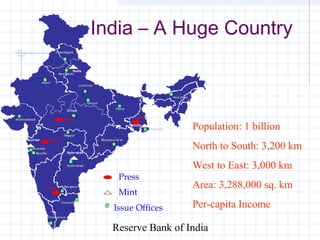
Mint
Press
Issue Offices
Chandigarh
New Delhi
Jaipur
Lucknow
Kanpur
Patna
Guwahati
Ahamadabad
Calcutta
Hyderabad
Banglore
Trivandrum
Chennai
Mumbai
Byculla
Bhuaneshwar
Nagpur
Mysore
Nasik
Dewas
Salboni
Noida
Mumbai
Hyderabad
Calcutta
Bhopal
India – A Huge Country
Population: 1 billion
North to South: 3,200 km
West to East: 3,000 km
Area: 3,288,000 sq. km
Per-capita Income
Reserve Bank of India
Distribution of Currency
-Dimension (value)
0
50000
100000
150000
200000
250000 1992
1993
1994
1995
1996
1997
1998
1999
2000
2001
2002
Rs.2,448 billion, i.e.,
US $ 49 billion currently
Reserve Bank of India
Distribution of Currency -
Dimensions (volume)
0
5000
10000
15000
20000
25000
30000
35000
40000
45000 1991
1992
1993
1994
1995
1996
1997
1998
1999
2000
2001
2002
41 billion pieces in
2002
Reserve Bank of India
Dimensions –
Enormous volume of lower denominations
% share of denominations
1,2,5
19%
20
2%
50
17%
100
29%
500
3%
1000
0%
10
30%
1,2,5
10
20
50
100
500
1000
Reserve Bank of India
Dimensions –
Too little value of the lower denominations
% share of denominations
1,2,5
1%
20
1% 50
15%
100
47%
500
28%
1000
3% 10
5% 1,2,5
10
20
50
100
500
1000
Reserve Bank of India
Agencies Involved
RBI
Banks
(chests)
MOF
Govt
Presses
Mints
Police Railways
RBI's
Presses
Reserve Bank of India
Flow of Notes & Coins
Presses
RBI Offices
Chest branches
Public
NOTES
4 Mints
4 mint-linked RBI Offices
Chest branches & RBI
Offices
Public
COINS
Reserve Bank of India
Network of Currency Chests
RBI is located only in 18 places for currency
operations
Distribution of notes and coins throughout the
country is done through designated bank
branches, called chests
Chest is a receptacle in a commercial bank to
store notes and coins on behalf of the
Reserve Bank
Deposit into chest leads to credit of the
commercial bank’s account and withdrawal,
debit
Reserve Bank of India
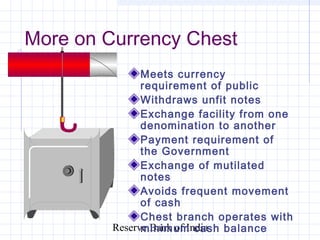
More on Currency Chest
Meets currency
requirement of public
Withdraws unfit notes
Exchange facility from one
denomination to another
Payment requirement of
the Government
Exchange of mutilated
notes
Avoids frequent movement
of cash
Chest branch operates with
minimum cash balance
Reserve Bank of India
Currency Chest Mechanism
Net deposit /withdrawal of notes and
coins at the chest is reported on daily
basis to parent Issue Office
Overall deposit or withdrawal leads to
credit or debit of bank’s account in RBI
Net withdrawal from chests means
expansion of currency and deposits
means contraction
Notes in circulation being the liability
of RBI, it adjusts its asset-liability
position centrally for such expansion or
contraction
Reserve Bank of India
Movement of Treasure
Specially built trucks for short distance
(journey completed during the day)
Railways for long distance
Guarded by police
Remittance accompanied by officials of
RBI to chests
Further movement from chest to a
branch done by the bank concerned
Reserve Bank of India
How much to print & mint
Incremental needs
Replacement needs
Reserve Needs
Statistical analysis and long-term
forecast
Printing/minting allocated between the
presses/mints and delivery schedule
decided in advance
Reserve Bank of India
Capacity of Presses & Mints
Total annual capacity of Presses: 18 bn
Can print up to 28 bn with two shifts
Total minting capacity: 4,700 mn
RBI’s annual needs:
 Notes: about 12,000 mn pieces
 Coins: about 5,000 mn pieces
Reserve Bank of India
Challenges of Distribution
Size of the country and volume of currency
Security and availability of railway wagons
when required
Political boundaries defining jurisdiction of
Issue Offices lead to sub-optimal logistics
Cross movement of currency is unavoidable
Reserve Bank of India
Mint
Press
Issue Offices
Chandigarh
New Delhi
Jaipur
Lucknow
Kanpur
Patna
Guwahati
Ahamadabad
Calcutta
Hyderabad
Banglore
Trivandrum
Chennai
Mumbai
Byculla
Bhuaneshwar
Nagpur
Mysore
Nasik
Dewas
Salboni
Noida
Mumbai
Hyderabad
Calcutta
Bhopal
Cross-movement of Currency
Fresh Notes/Coins from
Press/Mint pass on to the
banks/public only through
RBI offices – hence cross-
movement
Reserve Bank of India
Challenges of Distribution (contd)
Security- police is preoccupied with
other activities of priority
Private security is unavailable and not
favoured
Transport through railways involves
enormous coordination of logistics
Privatization of transport – introduced
recently in respect of coins only
Reserve Bank of India
Supply Bottleneck
Scarce Printing capacity for over a
decade till 1999
 Pace of replacement of old currency was
slow leading to deteriorating quality
 Inefficiencies in arranging return flow of
notes as chests hardly sorted notes as
fit/unfit
 Temporary respite through imports in
1997-98 (3.6 bn pieces)
Reserve Bank of India
Problem of plenty - the
present transition
Enough printing capacity since 1999
Governor announces clean note policy
All RBI offices receive enough fresh
note supply; vaults full with old and new
notes
Chests overflowing with soiled/unsorted
notes
An apparent impasse
Reserve Bank of India
Breaking the impasse
Capacity to process and destroy notes
in RBI needed to increase so that
 Stock of soiled notes within RBI could be
destroyed releasing vault space
 Expeditious withdrawal of notes from
chests could be initiated
Reserve Bank of India
Breaking the impasse
0
200
400
600
800
1000
1200
2001
July
2001
Sept
2001
Nov
2002
Jan
2002
Mar
Special methods
announced
enabling higher
output in
processing
Installation of
processing
systems (BPS
1060S) in 9
Offices
Shredding &
briquetting in all
offices
Million pieces
Reserve Bank of India
Coin Distribution – Some new steps
Mobile van at city centres
Distribution through milk cooperatives in the
state of Gujarat
Through Post Offices in rural areas – a
beginning made in Maharashtra
Coin dispensing machines in public places
and bank branches
Issue of notes of lower denominations to bulk
users by RBI is compulsorily accompanied by
issue of some part in coins
Reserve Bank of India
Early results
Clean Note Policy made a success
Currency processing systems have
stabilized in operation
Modernization of mints show results
Import of coins and temporary printing
of Rs.5 notes has improved the supply
position
Reserve Bank of India
Meeting the challenge of
distribution
The volume should be contained within
sustainable levels by
 Shift in printing from lower to next higher
denominations (a perceptible shift already visible)
 Coinise Rs.10 denomination
 Try out other substrate for printing – coating of
paper or polymer, although currently there is no
plan to introduce polymer notes.
Banks have been compelled to dispense with
the age-old practice of stapling of notes
Sorting of notes to get decentralized through
banks or processing centres
Reserve Bank of India
Thank you

Currency presentation

  • 1.
    Reserve Bank ofIndia DISTRIBUTION OF NOTES AND COINS IN INDIA Currency Conference 2002 Honolulu, Hawaii (Some slides have been added in the presentation for clarity)
  • 2.
    Reserve Bank ofIndia Mint Press Issue Offices Chandigarh New Delhi Jaipur Lucknow Kanpur Patna Guwahati Ahamadabad Calcutta Hyderabad Banglore Trivandrum Chennai Mumbai Byculla Bhuaneshwar Nagpur Mysore Nasik Dewas Salboni Noida Mumbai Hyderabad Calcutta Bhopal India – A Huge Country Population: 1 billion North to South: 3,200 km West to East: 3,000 km Area: 3,288,000 sq. km Per-capita Income
  • 3.
    Reserve Bank ofIndia Distribution of Currency -Dimension (value) 0 50000 100000 150000 200000 250000 1992 1993 1994 1995 1996 1997 1998 1999 2000 2001 2002 Rs.2,448 billion, i.e., US $ 49 billion currently
  • 4.
    Reserve Bank ofIndia Distribution of Currency - Dimensions (volume) 0 5000 10000 15000 20000 25000 30000 35000 40000 45000 1991 1992 1993 1994 1995 1996 1997 1998 1999 2000 2001 2002 41 billion pieces in 2002
  • 5.
    Reserve Bank ofIndia Dimensions – Enormous volume of lower denominations % share of denominations 1,2,5 19% 20 2% 50 17% 100 29% 500 3% 1000 0% 10 30% 1,2,5 10 20 50 100 500 1000
  • 6.
    Reserve Bank ofIndia Dimensions – Too little value of the lower denominations % share of denominations 1,2,5 1% 20 1% 50 15% 100 47% 500 28% 1000 3% 10 5% 1,2,5 10 20 50 100 500 1000
  • 7.
    Reserve Bank ofIndia Agencies Involved RBI Banks (chests) MOF Govt Presses Mints Police Railways RBI's Presses
  • 8.
    Reserve Bank ofIndia Flow of Notes & Coins Presses RBI Offices Chest branches Public NOTES 4 Mints 4 mint-linked RBI Offices Chest branches & RBI Offices Public COINS
  • 9.
    Reserve Bank ofIndia Network of Currency Chests RBI is located only in 18 places for currency operations Distribution of notes and coins throughout the country is done through designated bank branches, called chests Chest is a receptacle in a commercial bank to store notes and coins on behalf of the Reserve Bank Deposit into chest leads to credit of the commercial bank’s account and withdrawal, debit
  • 10.
    Reserve Bank ofIndia More on Currency Chest Meets currency requirement of public Withdraws unfit notes Exchange facility from one denomination to another Payment requirement of the Government Exchange of mutilated notes Avoids frequent movement of cash Chest branch operates with minimum cash balance
  • 11.
    Reserve Bank ofIndia Currency Chest Mechanism Net deposit /withdrawal of notes and coins at the chest is reported on daily basis to parent Issue Office Overall deposit or withdrawal leads to credit or debit of bank’s account in RBI Net withdrawal from chests means expansion of currency and deposits means contraction Notes in circulation being the liability of RBI, it adjusts its asset-liability position centrally for such expansion or contraction
  • 12.
    Reserve Bank ofIndia Movement of Treasure Specially built trucks for short distance (journey completed during the day) Railways for long distance Guarded by police Remittance accompanied by officials of RBI to chests Further movement from chest to a branch done by the bank concerned
  • 13.
    Reserve Bank ofIndia How much to print & mint Incremental needs Replacement needs Reserve Needs Statistical analysis and long-term forecast Printing/minting allocated between the presses/mints and delivery schedule decided in advance
  • 14.
    Reserve Bank ofIndia Capacity of Presses & Mints Total annual capacity of Presses: 18 bn Can print up to 28 bn with two shifts Total minting capacity: 4,700 mn RBI’s annual needs:  Notes: about 12,000 mn pieces  Coins: about 5,000 mn pieces
  • 15.
    Reserve Bank ofIndia Challenges of Distribution Size of the country and volume of currency Security and availability of railway wagons when required Political boundaries defining jurisdiction of Issue Offices lead to sub-optimal logistics Cross movement of currency is unavoidable
  • 16.
    Reserve Bank ofIndia Mint Press Issue Offices Chandigarh New Delhi Jaipur Lucknow Kanpur Patna Guwahati Ahamadabad Calcutta Hyderabad Banglore Trivandrum Chennai Mumbai Byculla Bhuaneshwar Nagpur Mysore Nasik Dewas Salboni Noida Mumbai Hyderabad Calcutta Bhopal Cross-movement of Currency Fresh Notes/Coins from Press/Mint pass on to the banks/public only through RBI offices – hence cross- movement
  • 17.
    Reserve Bank ofIndia Challenges of Distribution (contd) Security- police is preoccupied with other activities of priority Private security is unavailable and not favoured Transport through railways involves enormous coordination of logistics Privatization of transport – introduced recently in respect of coins only
  • 18.
    Reserve Bank ofIndia Supply Bottleneck Scarce Printing capacity for over a decade till 1999  Pace of replacement of old currency was slow leading to deteriorating quality  Inefficiencies in arranging return flow of notes as chests hardly sorted notes as fit/unfit  Temporary respite through imports in 1997-98 (3.6 bn pieces)
  • 19.
    Reserve Bank ofIndia Problem of plenty - the present transition Enough printing capacity since 1999 Governor announces clean note policy All RBI offices receive enough fresh note supply; vaults full with old and new notes Chests overflowing with soiled/unsorted notes An apparent impasse
  • 20.
    Reserve Bank ofIndia Breaking the impasse Capacity to process and destroy notes in RBI needed to increase so that  Stock of soiled notes within RBI could be destroyed releasing vault space  Expeditious withdrawal of notes from chests could be initiated
  • 21.
    Reserve Bank ofIndia Breaking the impasse 0 200 400 600 800 1000 1200 2001 July 2001 Sept 2001 Nov 2002 Jan 2002 Mar Special methods announced enabling higher output in processing Installation of processing systems (BPS 1060S) in 9 Offices Shredding & briquetting in all offices Million pieces
  • 22.
    Reserve Bank ofIndia Coin Distribution – Some new steps Mobile van at city centres Distribution through milk cooperatives in the state of Gujarat Through Post Offices in rural areas – a beginning made in Maharashtra Coin dispensing machines in public places and bank branches Issue of notes of lower denominations to bulk users by RBI is compulsorily accompanied by issue of some part in coins
  • 23.
    Reserve Bank ofIndia Early results Clean Note Policy made a success Currency processing systems have stabilized in operation Modernization of mints show results Import of coins and temporary printing of Rs.5 notes has improved the supply position
  • 24.
    Reserve Bank ofIndia Meeting the challenge of distribution The volume should be contained within sustainable levels by  Shift in printing from lower to next higher denominations (a perceptible shift already visible)  Coinise Rs.10 denomination  Try out other substrate for printing – coating of paper or polymer, although currently there is no plan to introduce polymer notes. Banks have been compelled to dispense with the age-old practice of stapling of notes Sorting of notes to get decentralized through banks or processing centres
  • 25.
    Reserve Bank ofIndia Thank you