Curiosity about a
Ravine
An attempt to unlock the mystery!
Welcome to Pondicherry University
Observation 1
Elevation profile along the path shown
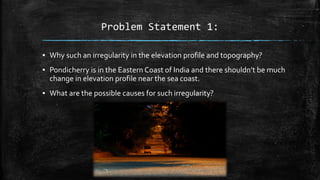
Problem Statement 1:
▪ Why such an irregularity in the elevation profile and topography?
▪ Pondicherry is in the Eastern Coast of India and there shouldn’t be much
change in elevation profile near the sea coast.
▪ What are the possible causes for such irregularity?
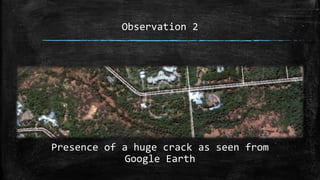
Observation 2
Presence of a huge crack as seen from
Google Earth
Field observation of the crack
Inference:
▪ On field observations suggest that this crack is a “deeply incisedV-
shaped Ravine.”
▪ This ravine seems to be extending from the central area of the
university to almost near the sea.
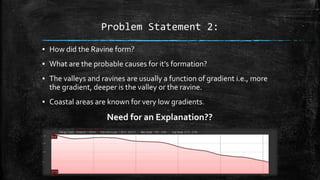
Problem Statement 2:
▪ How did the Ravine form?
▪ What are the probable causes for it’s formation?
▪ The valleys and ravines are usually a function of gradient i.e., more
the gradient, deeper is the valley or the ravine.
▪ Coastal areas are known for very low gradients.
Need for an Explanation??
Observation 3:
Observation 3:
Inference:
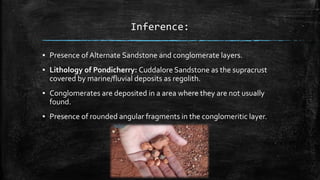
▪ Presence ofAlternate Sandstone and conglomerate layers.
▪ Lithology of Pondicherry: Cuddalore Sandstone as the supracrust
covered by marine/fluvial deposits as regolith.
▪ Conglomerates are deposited in a area where they are not usually
found.
▪ Presence of rounded angular fragments in the conglomeritic layer.
Problem Statement 3:
▪ Conglomerate forms where a sediment of rounded clasts at least two
millimeters in diameter accumulates. It takes a strong water current
to transport and shape particles this large.
▪ Streams are a function of gradient => Deposition along the stream is
also a function of gradient.
▪ Coastal areas are known for very low gradients => Only sand and silt
are deposited…. Conglomerate??
Need for an Explanation??
Thinking Board
Answer Statement 3:
▪ Conglomerate deposits => High gradient and high velocity.
▪ It is a well known as that the SouthWestern part of the Indian
Subcontinent is well elevated than the South Eastern Part.
▪ The conglomerates should be deposited somewhere in the central
part.
▪ There must be a “Shift in the slope” in the South Eastern Part that
led to the deposition of the Conglomerate.
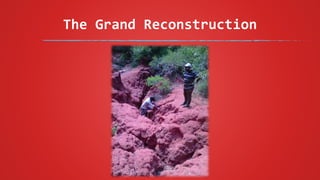
The Grand Reconstruction
Answer Statement 2 & 1:
▪ There could be a syn-sedimentary upliftment in the Eastern coast.
This explains the deposition of the conglomerate in the area.
▪ After the consolidation of the rock mass, there could be another
upliftment in the area.
▪ The torrential rain or stream flow in the area eroded the weak-zones
of the rock carving a beautiful ravine.
Clear indication of neo-tectonic activity
▪ Evidences:
1. The ravine is the major evidence to support our theory.
2. Conglomeritic Deposits also provides an indirect evidence pointing
to a change in slope of the area.
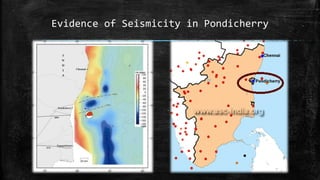
3. Recent seismic activity indicate a re-activated thrust fault system in
Pondicherry causing a M 5.5 earthquake in 2001.
Pondicherry Area Remodelled using DEM:
Evidence of Seismicity in Pondicherry
References
▪ DEM Data Courtesy: Mr. Lakshmi Ramprasath, Research Scholar,
Dept. of Earth Sciences, Pondicherry University.
▪ Murthy, G P S., Subrahmanyam, AS., Murthy, K S R., Sarma, KV L N
S., 2012, Evidence of fault reactivation off Pondicherry coast from
marine geophysical data, Current Science, 1446-1449.
▪ Ravine’s Picture courtesy :
https://sruthinlal.wordpress.com/2014/10/18/a-ravine-and-an-
adventure-one-day-at-pondy/
THANK YOU!
A presentation by:
G N S SREE BHUVAN and
CVENKATESWAR REDDY
Integrated M.Sc. (Applied Geology) 2nd year.

Curiosity_about_a_Ravine

  • 1.
    Curiosity about a Ravine Anattempt to unlock the mystery!
  • 2.
  • 3.
    Observation 1 Elevation profilealong the path shown
  • 4.
    Problem Statement 1: ▪Why such an irregularity in the elevation profile and topography? ▪ Pondicherry is in the Eastern Coast of India and there shouldn’t be much change in elevation profile near the sea coast. ▪ What are the possible causes for such irregularity?
  • 5.
    Observation 2 Presence ofa huge crack as seen from Google Earth
  • 6.
  • 7.
    Inference: ▪ On fieldobservations suggest that this crack is a “deeply incisedV- shaped Ravine.” ▪ This ravine seems to be extending from the central area of the university to almost near the sea.
  • 8.
    Problem Statement 2: ▪How did the Ravine form? ▪ What are the probable causes for it’s formation? ▪ The valleys and ravines are usually a function of gradient i.e., more the gradient, deeper is the valley or the ravine. ▪ Coastal areas are known for very low gradients. Need for an Explanation??
  • 9.
  • 10.
  • 11.
    Inference: ▪ Presence ofAlternateSandstone and conglomerate layers. ▪ Lithology of Pondicherry: Cuddalore Sandstone as the supracrust covered by marine/fluvial deposits as regolith. ▪ Conglomerates are deposited in a area where they are not usually found. ▪ Presence of rounded angular fragments in the conglomeritic layer.
  • 12.
    Problem Statement 3: ▪Conglomerate forms where a sediment of rounded clasts at least two millimeters in diameter accumulates. It takes a strong water current to transport and shape particles this large. ▪ Streams are a function of gradient => Deposition along the stream is also a function of gradient. ▪ Coastal areas are known for very low gradients => Only sand and silt are deposited…. Conglomerate?? Need for an Explanation??
  • 13.
  • 14.
    Answer Statement 3: ▪Conglomerate deposits => High gradient and high velocity. ▪ It is a well known as that the SouthWestern part of the Indian Subcontinent is well elevated than the South Eastern Part. ▪ The conglomerates should be deposited somewhere in the central part. ▪ There must be a “Shift in the slope” in the South Eastern Part that led to the deposition of the Conglomerate.
  • 15.
  • 16.
    Answer Statement 2& 1: ▪ There could be a syn-sedimentary upliftment in the Eastern coast. This explains the deposition of the conglomerate in the area. ▪ After the consolidation of the rock mass, there could be another upliftment in the area. ▪ The torrential rain or stream flow in the area eroded the weak-zones of the rock carving a beautiful ravine.
  • 17.
    Clear indication ofneo-tectonic activity ▪ Evidences: 1. The ravine is the major evidence to support our theory. 2. Conglomeritic Deposits also provides an indirect evidence pointing to a change in slope of the area. 3. Recent seismic activity indicate a re-activated thrust fault system in Pondicherry causing a M 5.5 earthquake in 2001.
  • 19.
  • 20.
    Evidence of Seismicityin Pondicherry
  • 21.
    References ▪ DEM DataCourtesy: Mr. Lakshmi Ramprasath, Research Scholar, Dept. of Earth Sciences, Pondicherry University. ▪ Murthy, G P S., Subrahmanyam, AS., Murthy, K S R., Sarma, KV L N S., 2012, Evidence of fault reactivation off Pondicherry coast from marine geophysical data, Current Science, 1446-1449. ▪ Ravine’s Picture courtesy : https://sruthinlal.wordpress.com/2014/10/18/a-ravine-and-an- adventure-one-day-at-pondy/
  • 22.
    THANK YOU! A presentationby: G N S SREE BHUVAN and CVENKATESWAR REDDY Integrated M.Sc. (Applied Geology) 2nd year.