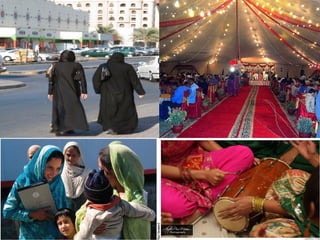
What is Culture ?
Culture1
Culture is a set of values, norms, and behaviors shared by a social group.
Values are those ideals that a society holds above all others (e.g.,
honesty, honor).
These values are the building blocks of norms, which are basic rules of
social conduct.
Another part of culture is the material objects we create.
Simply culture is way of living of people
CONCEPT
Culture is the totality of
beliefs,customs ,traditions & values
shared by the members of the
organisation.
Culture2
CHARECTERISTICS
 Every culture have its own identity
 Culture defines the internal environment
 It differentiates one co from another
 Culture is relatively stable
 It is perceived by members
 It controls attitude,behavior & performance of
the employees
Culture3
PERSPECTIVE
 Culture creates the boundary between two areas
of two different people
 Social recognition of the culture makes the co to
grow & develop
 Acts as motivator
 Culture provides stability
 It gives rise to positive attitude & behavior
 It make people development oriented
Culture4
ELEMENTS OF CULTURE
Culture5
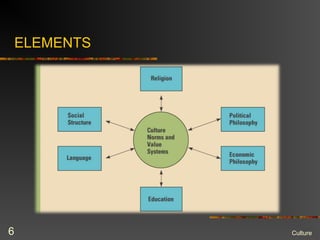
ELEMENTS
Culture6
Religion
 Religion defines how the community members
interpret their role in the universe, with this
teaching based on the local culture, so different
religions rise out of different cultures. Similarly
when members of one religion convert members
of a foreign culture often the resulting religion in
that area is affected by the host culture.
Culture7
Language
 Language is the cornerstone of culture.
 All cultures have a spoken language (even if there are
no developed forms of writing).
 People who speak the same language often share the
same culture.
 Many societies include a large number of people who
speak different languages.
 Each language can have several different dialects.
Culture8
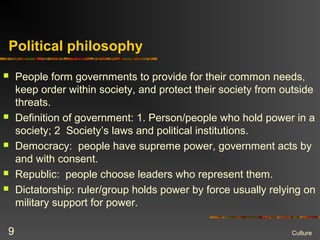
Political philosophy
 People form governments to provide for their common needs,
keep order within society, and protect their society from outside
threats.
 Definition of government: 1. Person/people who hold power in a
society; 2 Society’s laws and political institutions.
 Democracy: people have supreme power, government acts by
and with consent.
 Republic: people choose leaders who represent them.
 Dictatorship: ruler/group holds power by force usually relying on
military support for power.
Culture9
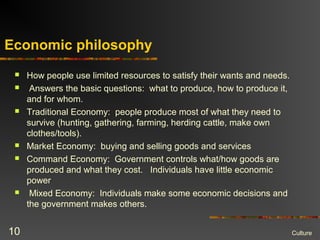
Economic philosophy
 How people use limited resources to satisfy their wants and needs.
 Answers the basic questions: what to produce, how to produce it,
and for whom.
 Traditional Economy: people produce most of what they need to
survive (hunting, gathering, farming, herding cattle, make own
clothes/tools).
 Market Economy: buying and selling goods and services
 Command Economy: Government controls what/how goods are
produced and what they cost. Individuals have little economic
power
 Mixed Economy: Individuals make some economic decisions and
the government makes others.
Culture10
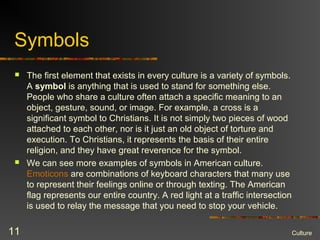
Symbols
 The first element that exists in every culture is a variety of symbols.
A symbol is anything that is used to stand for something else.
People who share a culture often attach a specific meaning to an
object, gesture, sound, or image. For example, a cross is a
significant symbol to Christians. It is not simply two pieces of wood
attached to each other, nor is it just an old object of torture and
execution. To Christians, it represents the basis of their entire
religion, and they have great reverence for the symbol.
 We can see more examples of symbols in American culture.
Emoticons are combinations of keyboard characters that many use
to represent their feelings online or through texting. The American
flag represents our entire country. A red light at a traffic intersection
is used to relay the message that you need to stop your vehicle.
Culture11
Culture12
Culture of Pakistan
Culture13
Culture14
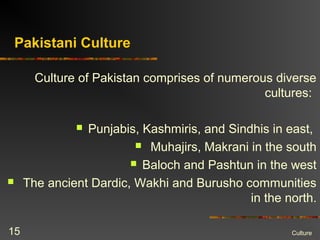
Pakistani Culture
Culture of Pakistan comprises of numerous diverse
cultures:
 Punjabis, Kashmiris, and Sindhis in east,
 Muhajirs, Makrani in the south
 Baloch and Pashtun in the west
 The ancient Dardic, Wakhi and Burusho communities
in the north.
Culture15
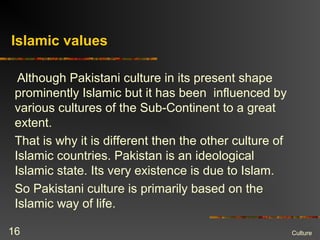
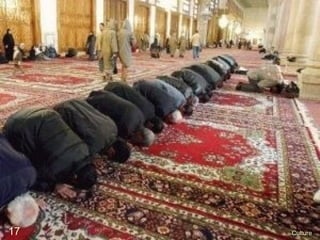
Islamic values
Although Pakistani culture in its present shape
prominently Islamic but it has been influenced by
various cultures of the Sub-Continent to a great
extent.
That is why it is different then the other culture of
Islamic countries. Pakistan is an ideological
Islamic state. Its very existence is due to Islam.
So Pakistani culture is primarily based on the
Islamic way of life.
Culture16
Culture17
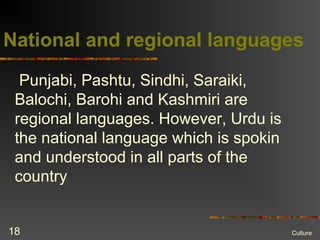
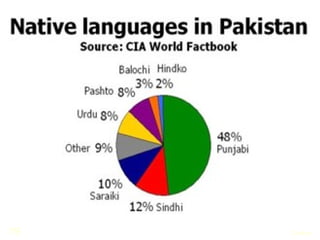
National and regional languages
Punjabi, Pashtu, Sindhi, Saraiki,
Balochi, Barohi and Kashmiri are
regional languages. However, Urdu is
the national language which is spokin
and understood in all parts of the
country
Culture18
Culture19
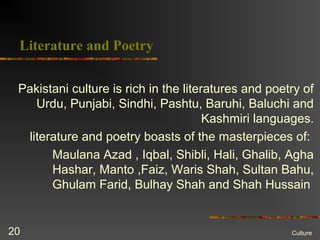
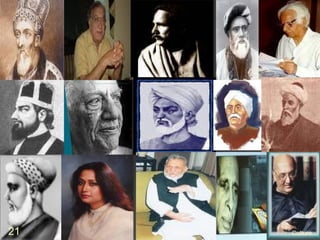
Pakistani culture is rich in the literatures and poetry of
Urdu, Punjabi, Sindhi, Pashtu, Baruhi, Baluchi and
Kashmiri languages.
literature and poetry boasts of the masterpieces of:
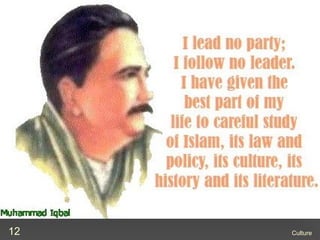
Maulana Azad , Iqbal, Shibli, Hali, Ghalib, Agha
Hashar, Manto ,Faiz, Waris Shah, Sultan Bahu,
Ghulam Farid, Bulhay Shah and Shah Hussain
Literature and Poetry
Culture20
Culture21
Pakistani music is represented by a wide variety of forms. It
ranges from traditional styles such as Qawwali and Ghazal to
more modern forms that fuse traditional Pakistani music with
Western music.
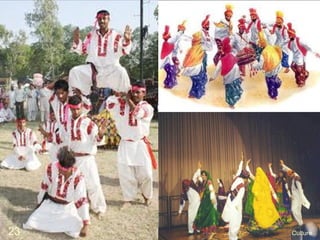
Folk dances are still popular in Pakistan and vary according to
region such as:
• Bhangra -Punjab
• Luddi - Punjab
• Attan - Folk dance of Pashtuns tribes of Pakistan including
the unique styles of Quetta and Waziristan
• Khattak Dance - Khyber Pakhtunkhwa
Music and Dance
Culture22
Culture23
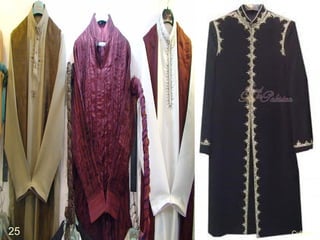
National Dresses
 Shalwar Qameez for both men and
women
 The sherwani or achkan with karakul hat
is the recommended dress for male
government employees and officials
Culture24
Culture25
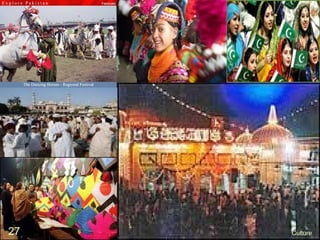
Festivals And Fairs
 Annual Urs of great saints
 Horse and Cattle shows, Polo festival,
Basant, Shab-e-Barat, Eid-ul-Fitr,
Eid-ul-Azha, Ashura, Independence day,
Death Anniversary of Quaid-e-Azam, Lok
mela, Birthday of Allama Mohammad
Iqbal, National Industrial Exhibition.
Culture26
Culture27
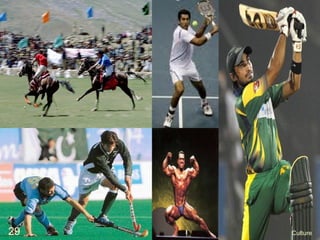
Sports and Games
Hockey Wrestling
Cricket, Athletics
Football Boxing
Badminton Lawn tennis
Squash Table tennis
Culture28
Culture29
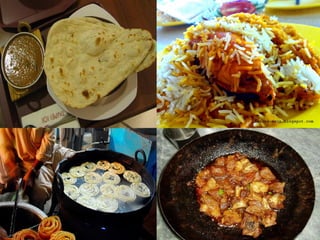
Food
 Dishes of salan, with or without meat
 Dishes of salan cooked with vegetables or lentils
 Karahi
 Biryani
 Tikka
 Naan
 Chapati
 Roti
 Grilled meat or kebabs
 Desserts
 variety of hot and cold drinks.
Culture30
Social Customs
Birth Ceremonies
Death Customs
Social cultures
Culture32
Cultureppt 120423013142-phpapp02

Cultureppt 120423013142-phpapp02

  • 1.
    What is Culture? Culture1 Culture is a set of values, norms, and behaviors shared by a social group. Values are those ideals that a society holds above all others (e.g., honesty, honor). These values are the building blocks of norms, which are basic rules of social conduct. Another part of culture is the material objects we create. Simply culture is way of living of people
  • 2.
    CONCEPT Culture is thetotality of beliefs,customs ,traditions & values shared by the members of the organisation. Culture2
  • 3.
    CHARECTERISTICS  Every culturehave its own identity  Culture defines the internal environment  It differentiates one co from another  Culture is relatively stable  It is perceived by members  It controls attitude,behavior & performance of the employees Culture3
  • 4.
    PERSPECTIVE  Culture createsthe boundary between two areas of two different people  Social recognition of the culture makes the co to grow & develop  Acts as motivator  Culture provides stability  It gives rise to positive attitude & behavior  It make people development oriented Culture4
  • 5.
  • 6.
  • 7.
    Religion  Religion defineshow the community members interpret their role in the universe, with this teaching based on the local culture, so different religions rise out of different cultures. Similarly when members of one religion convert members of a foreign culture often the resulting religion in that area is affected by the host culture. Culture7
  • 8.
    Language  Language isthe cornerstone of culture.  All cultures have a spoken language (even if there are no developed forms of writing).  People who speak the same language often share the same culture.  Many societies include a large number of people who speak different languages.  Each language can have several different dialects. Culture8
  • 9.
    Political philosophy  Peopleform governments to provide for their common needs, keep order within society, and protect their society from outside threats.  Definition of government: 1. Person/people who hold power in a society; 2 Society’s laws and political institutions.  Democracy: people have supreme power, government acts by and with consent.  Republic: people choose leaders who represent them.  Dictatorship: ruler/group holds power by force usually relying on military support for power. Culture9
  • 10.
    Economic philosophy  Howpeople use limited resources to satisfy their wants and needs.  Answers the basic questions: what to produce, how to produce it, and for whom.  Traditional Economy: people produce most of what they need to survive (hunting, gathering, farming, herding cattle, make own clothes/tools).  Market Economy: buying and selling goods and services  Command Economy: Government controls what/how goods are produced and what they cost. Individuals have little economic power  Mixed Economy: Individuals make some economic decisions and the government makes others. Culture10
  • 11.
    Symbols  The firstelement that exists in every culture is a variety of symbols. A symbol is anything that is used to stand for something else. People who share a culture often attach a specific meaning to an object, gesture, sound, or image. For example, a cross is a significant symbol to Christians. It is not simply two pieces of wood attached to each other, nor is it just an old object of torture and execution. To Christians, it represents the basis of their entire religion, and they have great reverence for the symbol.  We can see more examples of symbols in American culture. Emoticons are combinations of keyboard characters that many use to represent their feelings online or through texting. The American flag represents our entire country. A red light at a traffic intersection is used to relay the message that you need to stop your vehicle. Culture11
  • 12.
  • 13.
  • 14.
  • 15.
    Pakistani Culture Culture ofPakistan comprises of numerous diverse cultures:  Punjabis, Kashmiris, and Sindhis in east,  Muhajirs, Makrani in the south  Baloch and Pashtun in the west  The ancient Dardic, Wakhi and Burusho communities in the north. Culture15
  • 16.
    Islamic values Although Pakistaniculture in its present shape prominently Islamic but it has been influenced by various cultures of the Sub-Continent to a great extent. That is why it is different then the other culture of Islamic countries. Pakistan is an ideological Islamic state. Its very existence is due to Islam. So Pakistani culture is primarily based on the Islamic way of life. Culture16
  • 17.
  • 18.
    National and regionallanguages Punjabi, Pashtu, Sindhi, Saraiki, Balochi, Barohi and Kashmiri are regional languages. However, Urdu is the national language which is spokin and understood in all parts of the country Culture18
  • 19.
  • 20.
    Pakistani culture isrich in the literatures and poetry of Urdu, Punjabi, Sindhi, Pashtu, Baruhi, Baluchi and Kashmiri languages. literature and poetry boasts of the masterpieces of: Maulana Azad , Iqbal, Shibli, Hali, Ghalib, Agha Hashar, Manto ,Faiz, Waris Shah, Sultan Bahu, Ghulam Farid, Bulhay Shah and Shah Hussain Literature and Poetry Culture20
  • 21.
  • 22.
    Pakistani music isrepresented by a wide variety of forms. It ranges from traditional styles such as Qawwali and Ghazal to more modern forms that fuse traditional Pakistani music with Western music. Folk dances are still popular in Pakistan and vary according to region such as: • Bhangra -Punjab • Luddi - Punjab • Attan - Folk dance of Pashtuns tribes of Pakistan including the unique styles of Quetta and Waziristan • Khattak Dance - Khyber Pakhtunkhwa Music and Dance Culture22
  • 23.
  • 24.
    National Dresses  ShalwarQameez for both men and women  The sherwani or achkan with karakul hat is the recommended dress for male government employees and officials Culture24
  • 25.
  • 26.
    Festivals And Fairs Annual Urs of great saints  Horse and Cattle shows, Polo festival, Basant, Shab-e-Barat, Eid-ul-Fitr, Eid-ul-Azha, Ashura, Independence day, Death Anniversary of Quaid-e-Azam, Lok mela, Birthday of Allama Mohammad Iqbal, National Industrial Exhibition. Culture26
  • 27.
  • 28.
    Sports and Games HockeyWrestling Cricket, Athletics Football Boxing Badminton Lawn tennis Squash Table tennis Culture28
  • 29.
  • 30.
    Food  Dishes ofsalan, with or without meat  Dishes of salan cooked with vegetables or lentils  Karahi  Biryani  Tikka  Naan  Chapati  Roti  Grilled meat or kebabs  Desserts  variety of hot and cold drinks. Culture30
  • 32.
    Social Customs Birth Ceremonies DeathCustoms Social cultures Culture32