Cultural Safety
Exploring How the Concept of Cultural Safety
 Applies to Aboriginal Health and Wellness


             Simon Brascoupé
             Carleton University
   National Aboriginal Health Organization
         National Conference 2009
Key development Indicators

   Harvard University Project:
     Sovereignty Matters
     Institutions Matter
     Culture Matters
     Leadership Matters
Overview
   The goal of the research paper is to explore
    both the concept of cultural safety and its
    practical implications for policies and
    programs designed to improve the health of
    Aboriginal people and the wellness of
    Aboriginal communities.
The research paper
   defines cultural safety (and how it differs from cultural
    competence or transcultural training and practices)
   shows why it‟s important to move from the concept of
    cultural safety to the outcome of cultural safety (namely the
    success of an interaction)
   explores the idea of a shift from cultural safety for individuals
    to cultural safety at institutional and policy levels
   provides recommendations in five areas.
   Four case studies at the end of the research paper show
    how cultural safety has helped communities at risk and in
    crisis engage in healing that led to lasting change.
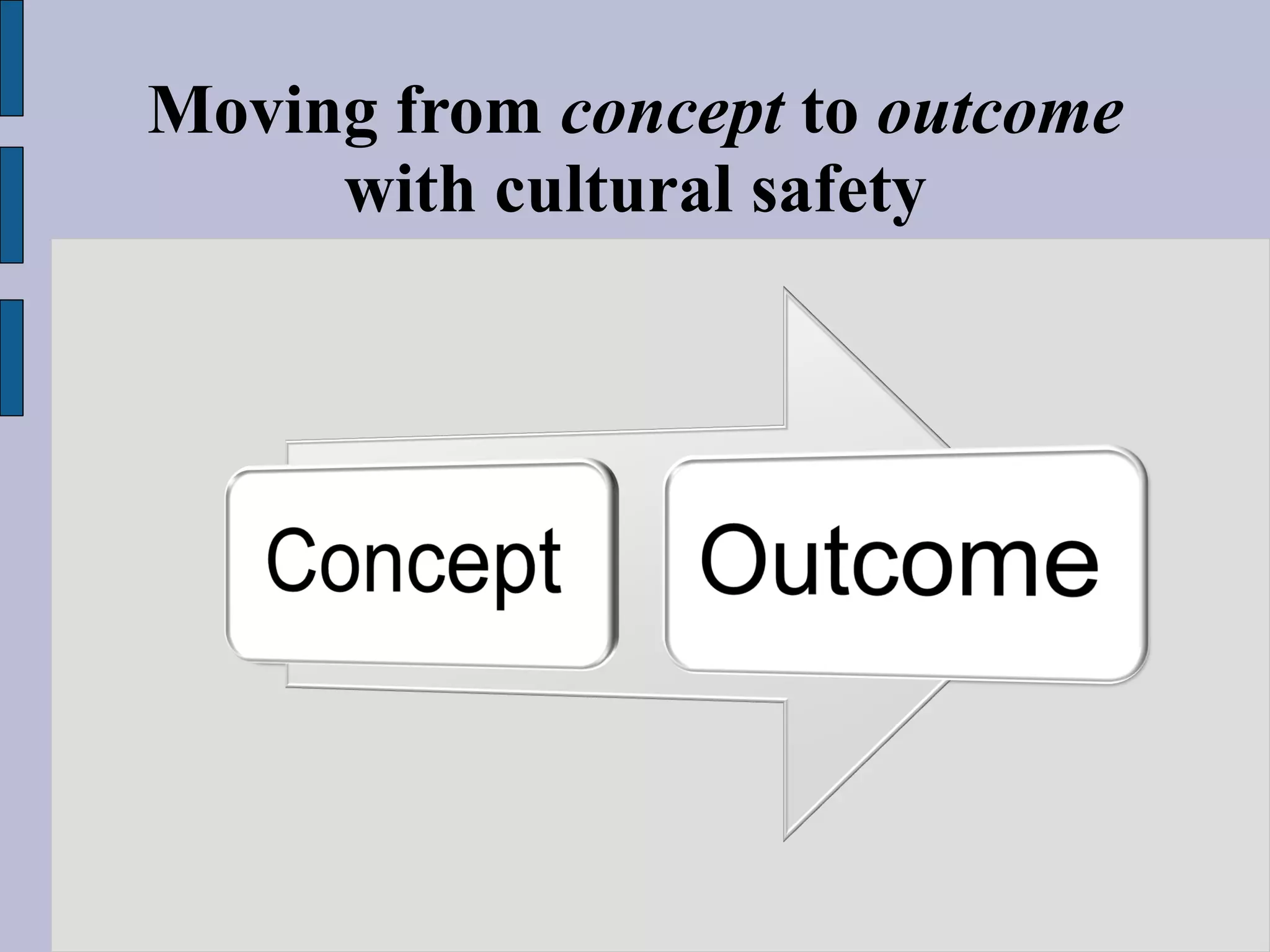
Moving from concept to outcome
     with cultural safety
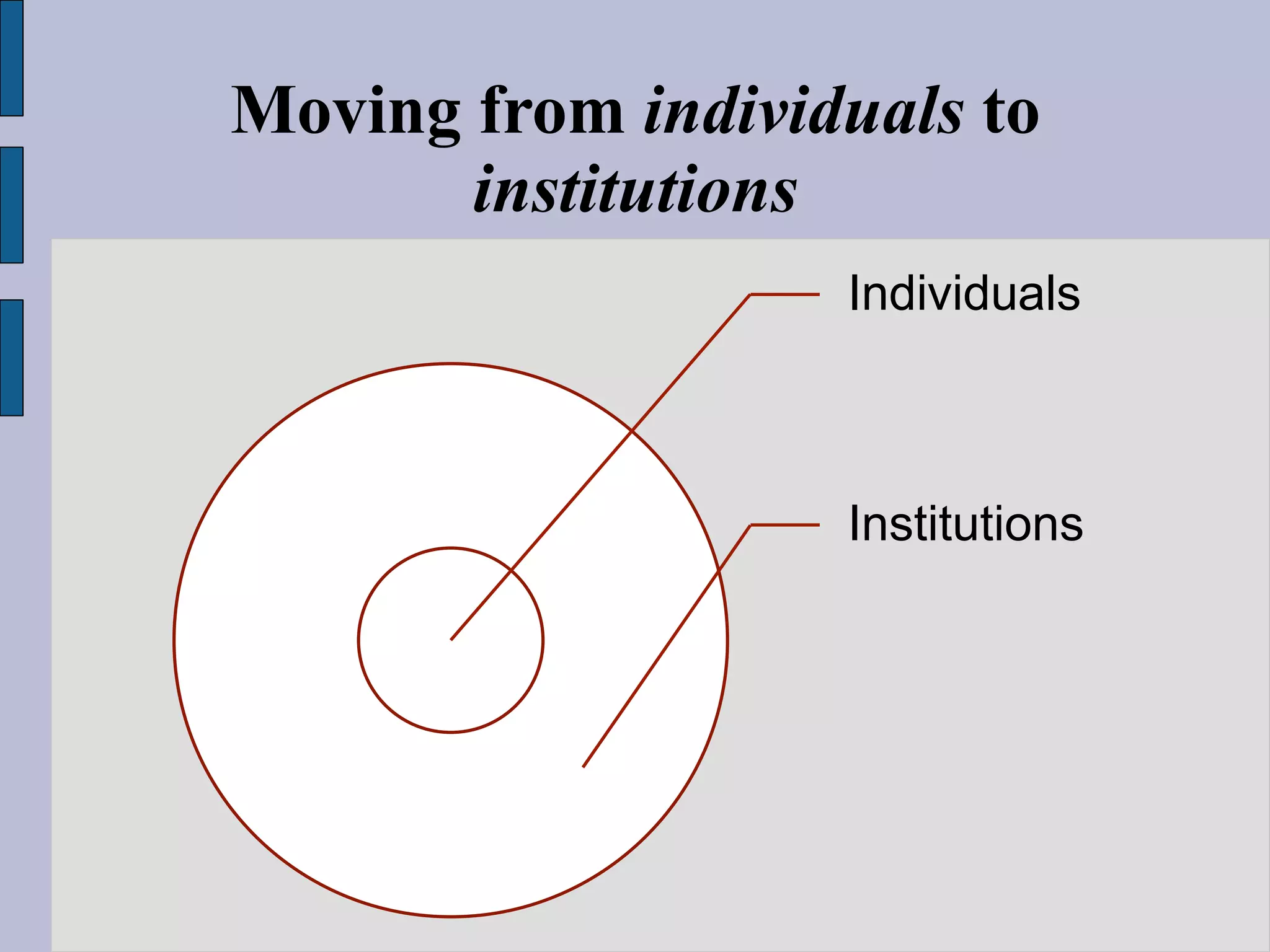
Moving from individuals to
       institutions
                   Individuals


                   Institutions
Cultural Safety

   Is a concept first developed in New Zealand to
    provide quality care within the cultural values and
    norms of the Maori.

   The concept is spreading to other fields of human
    services, like education and

   Spread to other areas of the world, particularly with
    Indigenous Peoples in former European colonies.
Cultural Unsafe Care


   Culturally unsafe practice as “any actions
    that diminish, demean or disempower the
    cultural identity and well being of an
    individual.”
                   Nursing Council of New Zealand
Colonization

   Diseases (such as influenza, small pox, measles, polio,
    diphtheria, tuberculosis and later, diabetes, heart disease and
    cancer);
   The destruction of traditional economies through the expropriation
    of traditional lands and resources;
   The undermining of traditional identity, spirituality, language and
    culture through missionization, residential schools and
    government day schools;
   The destruction of indigenous forms of governance, community
    organization and community cohesion through the imposition of
    European governmental forms; and
   The breakdown of healthy patterns of individual, family and
    community life.
                                          Mapping the Healing Journey 2002
Broader Determinants
NAHO Broader Determinants of Health
Access

Colonization

Cultural continuity

Globalization

Migration

Poverty

Self- determination

Territory
Social Determinants
   Income
   Social support networks
   Education
   Employment
   Social environments
   Physical environments
   Personal health practices and Coping skills
   Healthy child development
   Biology
   Health services
   Gender
   Culture
Social Determinants of Health
Aboriginal status
early life

education

employment and working conditions

food security

gender

health care services

housing

income and its distribution

social safety net

social exclusion

unemployment and employment security.


                SDOH National Conference list, Raphael 2003
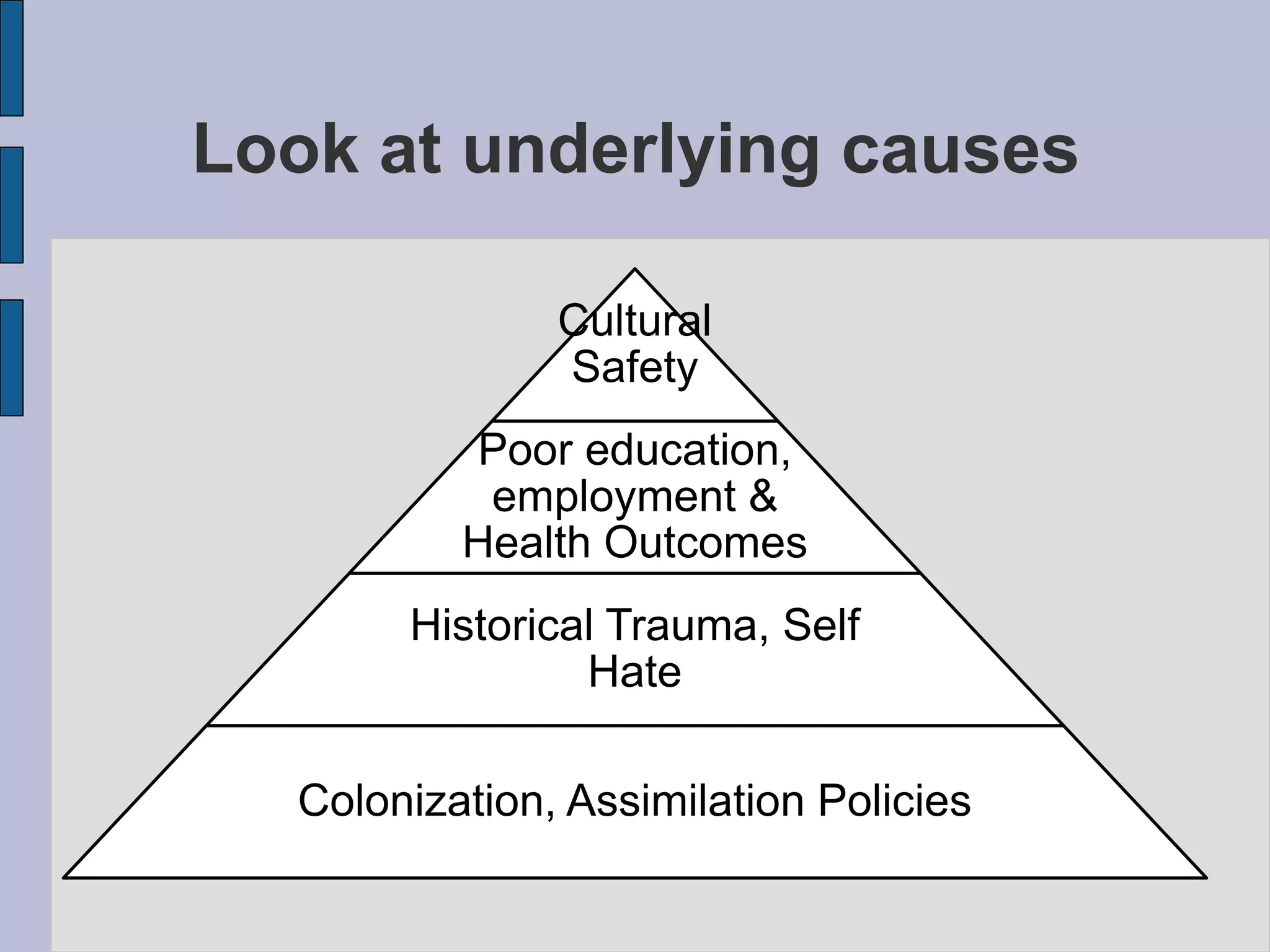
Look at underlying causes

               Cultural
               Safety
          Poor education,
           employment &
          Health Outcomes
       Historical Trauma, Self
                Hate

  Colonization, Assimilation Policies
Culturally unsafe care/teaching

   Difference in values, ethics &
    knowledge
   Negative portrayal of Aboriginal peoples
   Historical trauma & effects of
    colonization
   Basic access barriers
                                  NAHO, 2008
Cultural Competence


Cultural Competence Outcomes:
 Improved client compliance

 Improved health
Culturally Competent Organizations


   Set of values, principles & structures to work cross-
    culturally.
   Work in the cultural contexts of communities they serve.
   Work part of policy-making, administration, practice and
    service delivery
   Systematically involve clients, families and communities
   Cultural competence is a long-term developmental process
   Both individuals and organizations are at various levels of
    awareness, knowledge and skills along the cultural
    competence continuum.


                       The National Center for Cultural Competence
Cultural Competence Continuum


   Cultural destructiveness
   Cultural incapacity
   Cultural blindness
   Cultural pre-competence/Cross Cultural
   Cultural Competence
   Cultural Proficiency
   Cultural Safety
                 The National Center for Cultural Competence
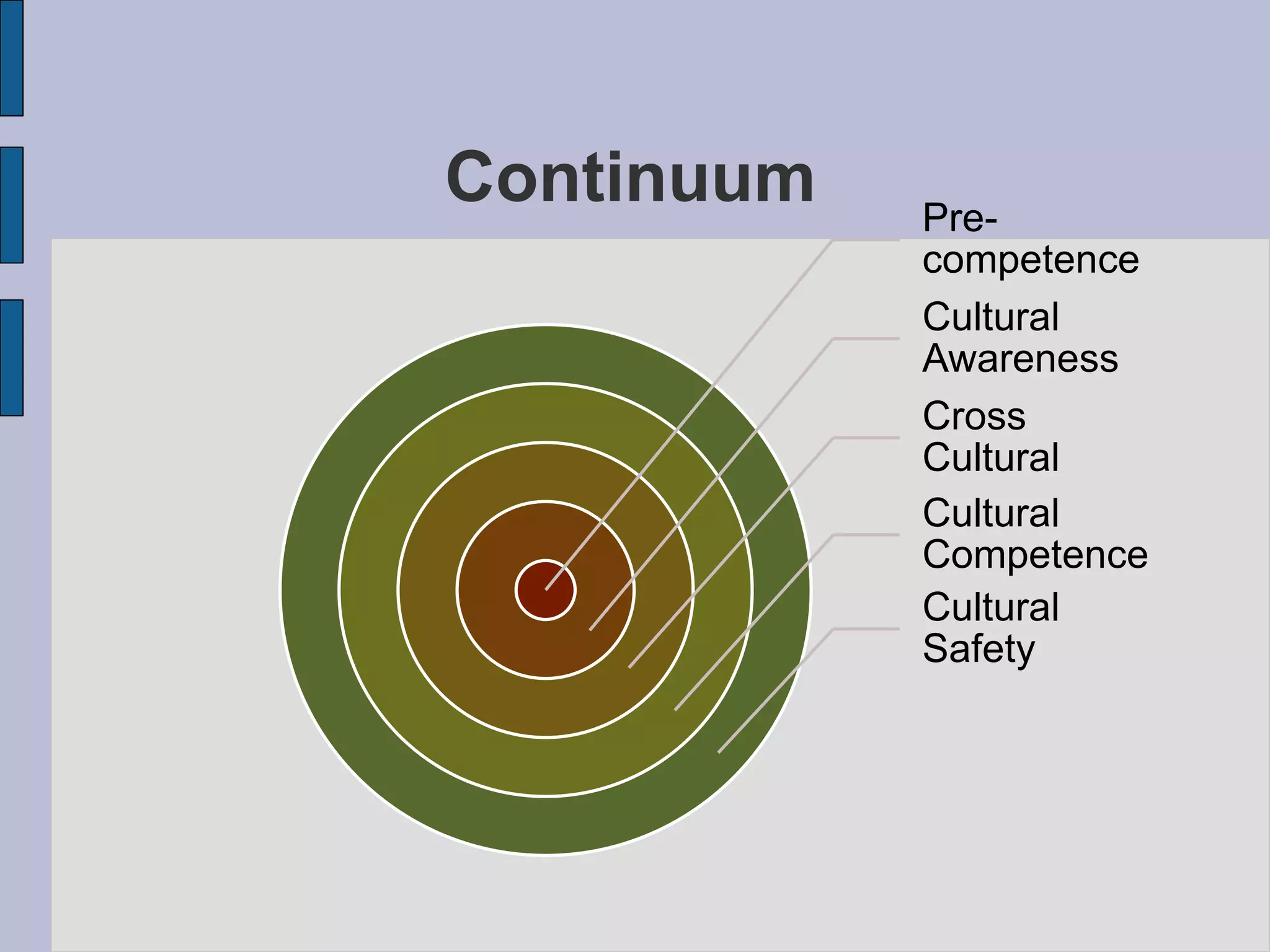
Continuum   Pre-
            competence
            Cultural
            Awareness
            Cross
            Cultural
            Cultural
            Competence
            Cultural
            Safety
Review

Review on Cultural Safety

   To provide quality care within the cultural
    values and norms of the patient.
   Culturally unsafe practice as “any actions
    that diminish, demean or disempower the
    cultural identity and well being of an
    individual.”
Cultural Safety Framework


Cultural Safety Framework:

 Cultural Safety
 Cultural Competency

 Healing and Wellness
Culturally Safe Healing

Elements of culturally safe:

   Build trusting build foundation with clients to start
    intensive treatment
   Clients rights clearly stated; code of ethics, guiding
    principles, etc
   Safe therapeutic process: plan or road map for healing
    journey
   Create comfortable place and safe atmosphere
   Reinforce safety: assistance is available throughout
    their healing journey

                       National Aboriginal Healing Foundation
Healing and Wellness


   "Healing" for many Aboriginal communities means
    recovering from the social impacts of colonization
    which have adversely affected the lives and health
    of Aboriginal peoples for generations.
   "Wellness" refers to maintaining and enhancing the
    health and well-being of individuals, families,
    communities and nations.
   The healing and wellness sought by many
    Aboriginal people today is based upon a return to
    traditional spiritual values and knowledge which
    promotes self-reliance.
Indigenous knowledge


``Indigenous knowledge is a complete knowledge
system with its own epistemology, philosophy and
scientific and logical validity…which can only be
understood by means of pedagogy traditionally
employed by the people themselves.``

                            Battiste and Henderson, 2000
Holistic Healing


Medicine Wheel teaching
 Physical

 Emotional

 Mental

 Spiritual
Healing Path

Healing Path Medicine Wheel Teaching

   Talking Lodge
   Listening & Teaching Lodge
   Healing Path Lodge
   Healing Lodge
Aboriginal Healing Movement
    In the past twenty-five years in Canada, a wide
    variety of experiences, programs and activities
    have been part of what may be described as the
    "Aboriginal healing movement". These have
    included:
   Participation in traditional healing and cultural
    activities;
   Culturally based wilderness camps and programs;
   Treatment and healing programs;
   Counseling and group work; and
   Community development initiatives.
What is healing

Levels of Healing:
 Individual

 Family

 Community


Healing is a developmental process aimed at achieving
balance within oneself, within human relationships and
between human beings and the natural and spiritual worlds.
Individual Healing Journey


   Stage 1: The Journey Begins
   Stage 2: Partial Recovery
   Stage 3: The Long Trail
   Stage 4: Transformation and Renewal
                       Mapping the Healing Journey 2002
Community Healing
The Four Seasons of Community Healing

   Stage 1: The Journey Begins (Thawing from
    the long winter)
   Stage 2: Gathering Momentum (Spring)
   Stage 3: Hitting the Wall (Summer)
   Stage 4: From Healing to Transformation
    (Fall)
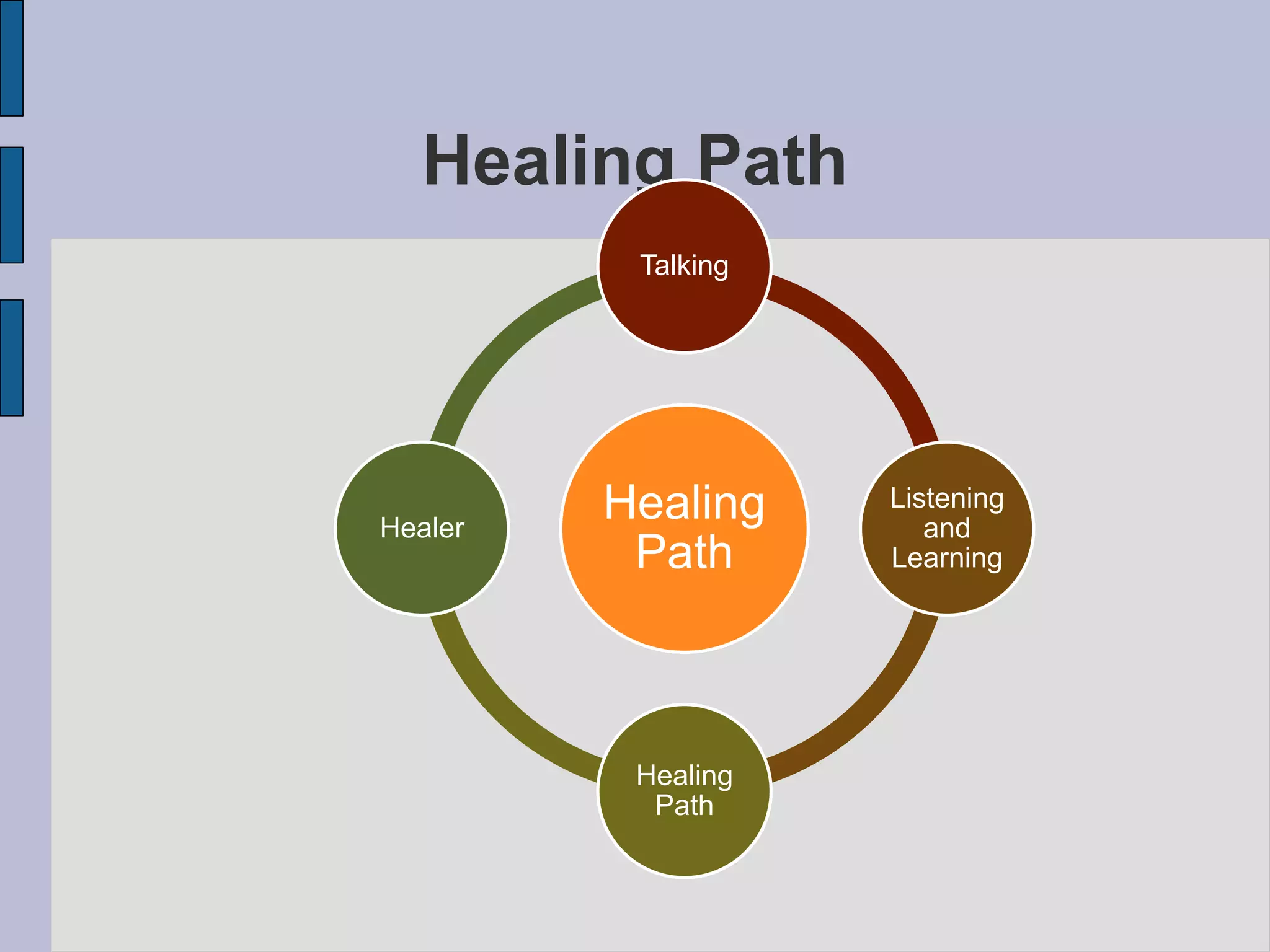
Healing Path
          Talking


Healer
         Healing    Listening
                       and
          Path      Learning


          Healing
           Path
Healing Lesson Learned
   Healing is possible for individuals and communities. Both appear to go
    through distinct stages of a healing journey.
   The healing journey is a long-term process, probably involving several
    decades.
   Healing cannot be confined to issues such as addictions, abuse or
    violence.
   Healing interventions and programs have most impact when they take
    place within the context of a wider community development plan.
   Community healing requires personal, cultural, economic, political, and
    social development initiatives woven together into a coherent, long-term,
    coordinated strategy.
   Such a coherent strategy requires integrated program development,
    funding delivery and on-going evaluation.
   Healing is directly connected to nation building. At some point, there
    needs to be a merger of program efforts between community healing
    activities and movements towards self-government and community
    development.
4 Major Challenges
There are four major challenges for providers and cultural
  competency in healthcare.

   Recognize the impacts of colonization and historical
    trauma as significant impacts on the health of First
    Nations people
   Address the challenge of communication, by better
    understanding culture and cultural difference.
   Respect First Nationas culture and traditional
    knowledge as important to First Nations health and
    well-being.
   Overcome the challenge of trust, for some, authority
    figures are immediately mistrusted.
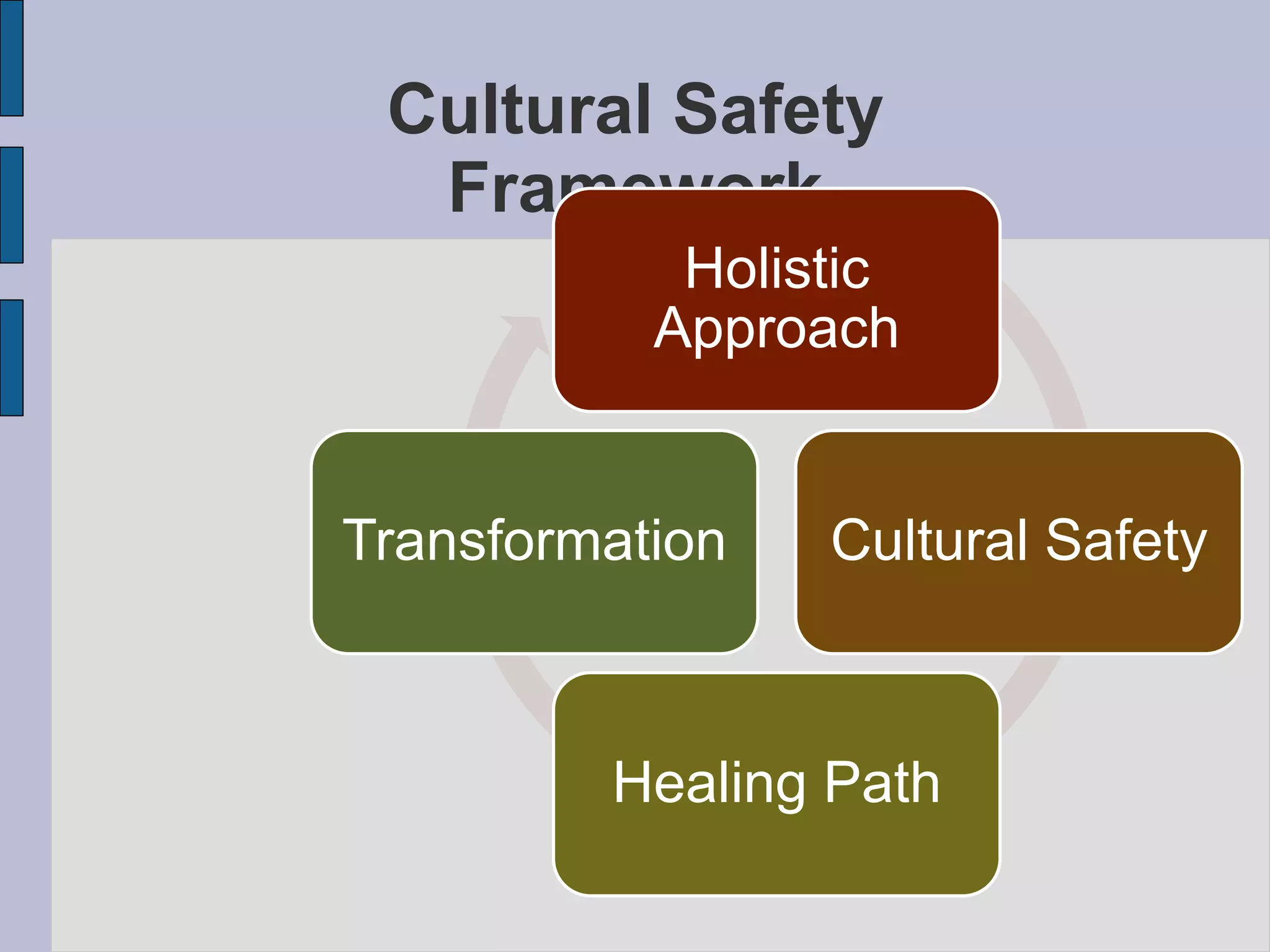
Cultural Safety
  Framework
            Holistic
           Approach


Transformation   Cultural Safety


         Healing Path
Culturally Unsafe Indicators


   Low utilization of available services
   Denial of suggestions that there is a problem
   Non-compliance‟ with referrals or prescribed
    interventions
   Reticence in interactions with practitioners
   Anger
   Low self-worth
   Complaints about lack of „cultural
    appropriateness‟ of tools and interventions
Decolonising Healthcare Education

International Findings: Recommendations for de-colonisation
   process for nursing:
  Education for all nurses include mandatory subjects in Indigenous
   history, culture, health and principles of self-determination and
   management;
  Indigenous studies are not to be included in multi-cultural studies.
   First Nations people have and are still being colonised;
  Non-indigenous university staff must have colonisation and anti-
   racist workshops;
  Aboriginal and Torres Strait Islander RNs need to be engaged as
   consultants to faculties of nursing, to act as educators and
   mentors; and
  The implementation of a process whereby Aboriginal and Torres
   Strait Islander nurses are able to learn about their own history for
   personal growth and development.
                                             Decolonization Australia, 2006
Cultural Safety Path
   Cultural safety is an important first step in building trust
   Cultural safety, like cultural competency can be taught.
   Trust is critical to development because of the mistrust and
    historical trauma caused by colonization.
   Taken from a policy perspective, whole organisations have
    become culturally safe through strategic planning and training.
   The literature provides evidence that cultural competence and
    safety result in improved health outcomes.
   A culturally safe delivery system can strengthen the capacity of
    the communities to be resilient to the stressors that push them
    from risk to crisis.
Benefits

Why Culturally Competent Health Care?
 Improve Quality of Services and outcomes

 Respond to Aboriginal needs

 Meet accreditation requirements

 Reduce liability and malpractice

 Support student/workforce diversity initiatives

 Improve retention of health human resources

 Achieve social justice
Recommendations 5 Areas


                            Training
         Education


    Strategies               Qualifications


                 Research
Recommendations
   Training
   help non-Aboriginal professionals achieve cultural competence
   teach professionals the history of the community they are working in
   teach both professionals and administrators the concept and practice of
    cultural safety
   support the creation of a body of teaching materials on cultural safety
   include cultural safety as a professional competency for all professionals
    with Aboriginal clients
   Institutions will need to have access to
   role models and case studies that show what culturally safe practices
    look like
   a training manual to support them in setting their own policies and
    training on cultural safety
   Communities will need to
   train community leaders in cultural safety
   have access to a step-by-step manual on cultural safety
Recommendations
   Qualifications and reward
   Professional qualifications will require an understanding of culturally safe
    practice
   Ways to rewards this type of competency will need to be developed
   Research
   Aboriginal institutions and communities may want to partner with academic or
    professional institutions in studies on cultural safety
   Aboriginal leaders and institutions may lobby for government support for
    research into this topic
   It will be important to create a body of data on this subject to support good
    practices and training
   Strategies
   Include cultural safety and healing strategies in all programs and policies that
    deal with the stressors that push communities from risk to crisis
   Recruit First Nations‟ students to assume health care jobs and other positions of
    authority in communities
   Leaders and communities may want to set standards and policies on cultural
    safety, through partnerships with health, education and other sectors.
Recommendations
   Education
   First Nations can work closely with colleges/universities to support the
    training of teachers and administrators in cultural safety.
   Colleges/universities can build strong links to local First Nations to gain
    new Aboriginal students.

Cultural Safety Exploring How the Concept of Cultural Safety Applies to Aboriginal Health and Wellness

  • 1.
    Cultural Safety Exploring Howthe Concept of Cultural Safety Applies to Aboriginal Health and Wellness Simon Brascoupé Carleton University National Aboriginal Health Organization National Conference 2009
  • 2.
    Key development Indicators  Harvard University Project:  Sovereignty Matters  Institutions Matter  Culture Matters  Leadership Matters
  • 3.
    Overview  The goal of the research paper is to explore both the concept of cultural safety and its practical implications for policies and programs designed to improve the health of Aboriginal people and the wellness of Aboriginal communities.
  • 4.
    The research paper  defines cultural safety (and how it differs from cultural competence or transcultural training and practices)  shows why it‟s important to move from the concept of cultural safety to the outcome of cultural safety (namely the success of an interaction)  explores the idea of a shift from cultural safety for individuals to cultural safety at institutional and policy levels  provides recommendations in five areas.  Four case studies at the end of the research paper show how cultural safety has helped communities at risk and in crisis engage in healing that led to lasting change.
  • 5.
    Moving from conceptto outcome with cultural safety
  • 6.
    Moving from individualsto institutions Individuals Institutions
  • 7.
    Cultural Safety  Is a concept first developed in New Zealand to provide quality care within the cultural values and norms of the Maori.  The concept is spreading to other fields of human services, like education and  Spread to other areas of the world, particularly with Indigenous Peoples in former European colonies.
  • 8.
    Cultural Unsafe Care  Culturally unsafe practice as “any actions that diminish, demean or disempower the cultural identity and well being of an individual.” Nursing Council of New Zealand
  • 9.
    Colonization  Diseases (such as influenza, small pox, measles, polio, diphtheria, tuberculosis and later, diabetes, heart disease and cancer);  The destruction of traditional economies through the expropriation of traditional lands and resources;  The undermining of traditional identity, spirituality, language and culture through missionization, residential schools and government day schools;  The destruction of indigenous forms of governance, community organization and community cohesion through the imposition of European governmental forms; and  The breakdown of healthy patterns of individual, family and community life. Mapping the Healing Journey 2002
  • 10.
    Broader Determinants NAHO BroaderDeterminants of Health Access Colonization Cultural continuity Globalization Migration Poverty Self- determination Territory
  • 11.
    Social Determinants  Income  Social support networks  Education  Employment  Social environments  Physical environments  Personal health practices and Coping skills  Healthy child development  Biology  Health services  Gender  Culture
  • 12.
    Social Determinants ofHealth Aboriginal status early life education employment and working conditions food security gender health care services housing income and its distribution social safety net social exclusion unemployment and employment security. SDOH National Conference list, Raphael 2003
  • 13.
    Look at underlyingcauses Cultural Safety Poor education, employment & Health Outcomes Historical Trauma, Self Hate Colonization, Assimilation Policies
  • 14.
    Culturally unsafe care/teaching  Difference in values, ethics & knowledge  Negative portrayal of Aboriginal peoples  Historical trauma & effects of colonization  Basic access barriers NAHO, 2008
  • 15.
    Cultural Competence Cultural CompetenceOutcomes:  Improved client compliance  Improved health
  • 16.
    Culturally Competent Organizations  Set of values, principles & structures to work cross- culturally.  Work in the cultural contexts of communities they serve.  Work part of policy-making, administration, practice and service delivery  Systematically involve clients, families and communities  Cultural competence is a long-term developmental process  Both individuals and organizations are at various levels of awareness, knowledge and skills along the cultural competence continuum. The National Center for Cultural Competence
  • 17.
    Cultural Competence Continuum  Cultural destructiveness  Cultural incapacity  Cultural blindness  Cultural pre-competence/Cross Cultural  Cultural Competence  Cultural Proficiency  Cultural Safety The National Center for Cultural Competence
  • 18.
    Continuum Pre- competence Cultural Awareness Cross Cultural Cultural Competence Cultural Safety
  • 19.
    Review Review on CulturalSafety  To provide quality care within the cultural values and norms of the patient.  Culturally unsafe practice as “any actions that diminish, demean or disempower the cultural identity and well being of an individual.”
  • 20.
    Cultural Safety Framework CulturalSafety Framework:  Cultural Safety  Cultural Competency  Healing and Wellness
  • 21.
    Culturally Safe Healing Elementsof culturally safe:  Build trusting build foundation with clients to start intensive treatment  Clients rights clearly stated; code of ethics, guiding principles, etc  Safe therapeutic process: plan or road map for healing journey  Create comfortable place and safe atmosphere  Reinforce safety: assistance is available throughout their healing journey National Aboriginal Healing Foundation
  • 22.
    Healing and Wellness  "Healing" for many Aboriginal communities means recovering from the social impacts of colonization which have adversely affected the lives and health of Aboriginal peoples for generations.  "Wellness" refers to maintaining and enhancing the health and well-being of individuals, families, communities and nations.  The healing and wellness sought by many Aboriginal people today is based upon a return to traditional spiritual values and knowledge which promotes self-reliance.
  • 23.
    Indigenous knowledge ``Indigenous knowledgeis a complete knowledge system with its own epistemology, philosophy and scientific and logical validity…which can only be understood by means of pedagogy traditionally employed by the people themselves.`` Battiste and Henderson, 2000
  • 24.
    Holistic Healing Medicine Wheelteaching  Physical  Emotional  Mental  Spiritual
  • 25.
    Healing Path Healing PathMedicine Wheel Teaching  Talking Lodge  Listening & Teaching Lodge  Healing Path Lodge  Healing Lodge
  • 26.
    Aboriginal Healing Movement In the past twenty-five years in Canada, a wide variety of experiences, programs and activities have been part of what may be described as the "Aboriginal healing movement". These have included:  Participation in traditional healing and cultural activities;  Culturally based wilderness camps and programs;  Treatment and healing programs;  Counseling and group work; and  Community development initiatives.
  • 27.
    What is healing Levelsof Healing:  Individual  Family  Community Healing is a developmental process aimed at achieving balance within oneself, within human relationships and between human beings and the natural and spiritual worlds.
  • 28.
    Individual Healing Journey  Stage 1: The Journey Begins  Stage 2: Partial Recovery  Stage 3: The Long Trail  Stage 4: Transformation and Renewal Mapping the Healing Journey 2002
  • 29.
    Community Healing The FourSeasons of Community Healing  Stage 1: The Journey Begins (Thawing from the long winter)  Stage 2: Gathering Momentum (Spring)  Stage 3: Hitting the Wall (Summer)  Stage 4: From Healing to Transformation (Fall)
  • 30.
    Healing Path Talking Healer Healing Listening and Path Learning Healing Path
  • 31.
    Healing Lesson Learned  Healing is possible for individuals and communities. Both appear to go through distinct stages of a healing journey.  The healing journey is a long-term process, probably involving several decades.  Healing cannot be confined to issues such as addictions, abuse or violence.  Healing interventions and programs have most impact when they take place within the context of a wider community development plan.  Community healing requires personal, cultural, economic, political, and social development initiatives woven together into a coherent, long-term, coordinated strategy.  Such a coherent strategy requires integrated program development, funding delivery and on-going evaluation.  Healing is directly connected to nation building. At some point, there needs to be a merger of program efforts between community healing activities and movements towards self-government and community development.
  • 32.
    4 Major Challenges Thereare four major challenges for providers and cultural competency in healthcare.  Recognize the impacts of colonization and historical trauma as significant impacts on the health of First Nations people  Address the challenge of communication, by better understanding culture and cultural difference.  Respect First Nationas culture and traditional knowledge as important to First Nations health and well-being.  Overcome the challenge of trust, for some, authority figures are immediately mistrusted.
  • 33.
    Cultural Safety Framework Holistic Approach Transformation Cultural Safety Healing Path
  • 34.
    Culturally Unsafe Indicators  Low utilization of available services  Denial of suggestions that there is a problem  Non-compliance‟ with referrals or prescribed interventions  Reticence in interactions with practitioners  Anger  Low self-worth  Complaints about lack of „cultural appropriateness‟ of tools and interventions
  • 35.
    Decolonising Healthcare Education InternationalFindings: Recommendations for de-colonisation process for nursing:  Education for all nurses include mandatory subjects in Indigenous history, culture, health and principles of self-determination and management;  Indigenous studies are not to be included in multi-cultural studies. First Nations people have and are still being colonised;  Non-indigenous university staff must have colonisation and anti- racist workshops;  Aboriginal and Torres Strait Islander RNs need to be engaged as consultants to faculties of nursing, to act as educators and mentors; and  The implementation of a process whereby Aboriginal and Torres Strait Islander nurses are able to learn about their own history for personal growth and development. Decolonization Australia, 2006
  • 36.
    Cultural Safety Path  Cultural safety is an important first step in building trust  Cultural safety, like cultural competency can be taught.  Trust is critical to development because of the mistrust and historical trauma caused by colonization.  Taken from a policy perspective, whole organisations have become culturally safe through strategic planning and training.  The literature provides evidence that cultural competence and safety result in improved health outcomes.  A culturally safe delivery system can strengthen the capacity of the communities to be resilient to the stressors that push them from risk to crisis.
  • 37.
    Benefits Why Culturally CompetentHealth Care?  Improve Quality of Services and outcomes  Respond to Aboriginal needs  Meet accreditation requirements  Reduce liability and malpractice  Support student/workforce diversity initiatives  Improve retention of health human resources  Achieve social justice
  • 38.
    Recommendations 5 Areas Training Education Strategies Qualifications Research
  • 39.
    Recommendations  Training  help non-Aboriginal professionals achieve cultural competence  teach professionals the history of the community they are working in  teach both professionals and administrators the concept and practice of cultural safety  support the creation of a body of teaching materials on cultural safety  include cultural safety as a professional competency for all professionals with Aboriginal clients  Institutions will need to have access to  role models and case studies that show what culturally safe practices look like  a training manual to support them in setting their own policies and training on cultural safety  Communities will need to  train community leaders in cultural safety  have access to a step-by-step manual on cultural safety
  • 40.
    Recommendations  Qualifications and reward  Professional qualifications will require an understanding of culturally safe practice  Ways to rewards this type of competency will need to be developed  Research  Aboriginal institutions and communities may want to partner with academic or professional institutions in studies on cultural safety  Aboriginal leaders and institutions may lobby for government support for research into this topic  It will be important to create a body of data on this subject to support good practices and training  Strategies  Include cultural safety and healing strategies in all programs and policies that deal with the stressors that push communities from risk to crisis  Recruit First Nations‟ students to assume health care jobs and other positions of authority in communities  Leaders and communities may want to set standards and policies on cultural safety, through partnerships with health, education and other sectors.
  • 41.
    Recommendations  Education  First Nations can work closely with colleges/universities to support the training of teachers and administrators in cultural safety.  Colleges/universities can build strong links to local First Nations to gain new Aboriginal students.