Cultural Differences  Life and Work situations SoftServe, Inc. September 2008
EQUALITY Americans work better when they are in an atmosphere in which all are considered equal and things are ‘fair’. While equality includes the equal right to seek the “the good life”, it doesn’t guarantee equality of talent or ability. SoftServe Confidential. Only for Internal Use
CONFRONTATION Discussing issues or ideas openly with other people is considered not only proper, but often a responsibility as well. Americans may bring up issues which are sensitive or embarrassing to others. In addition, Americans, particularly  in a business situation, do not spend the time on polite social talk that many other nationalities do. They often get right to the point.
INFORMALITY AND FORMALITY In most cases Americans avoid elaborate social rituals.  Most of time, they tend to treat everyone in a similar way with little concern for titles or status.
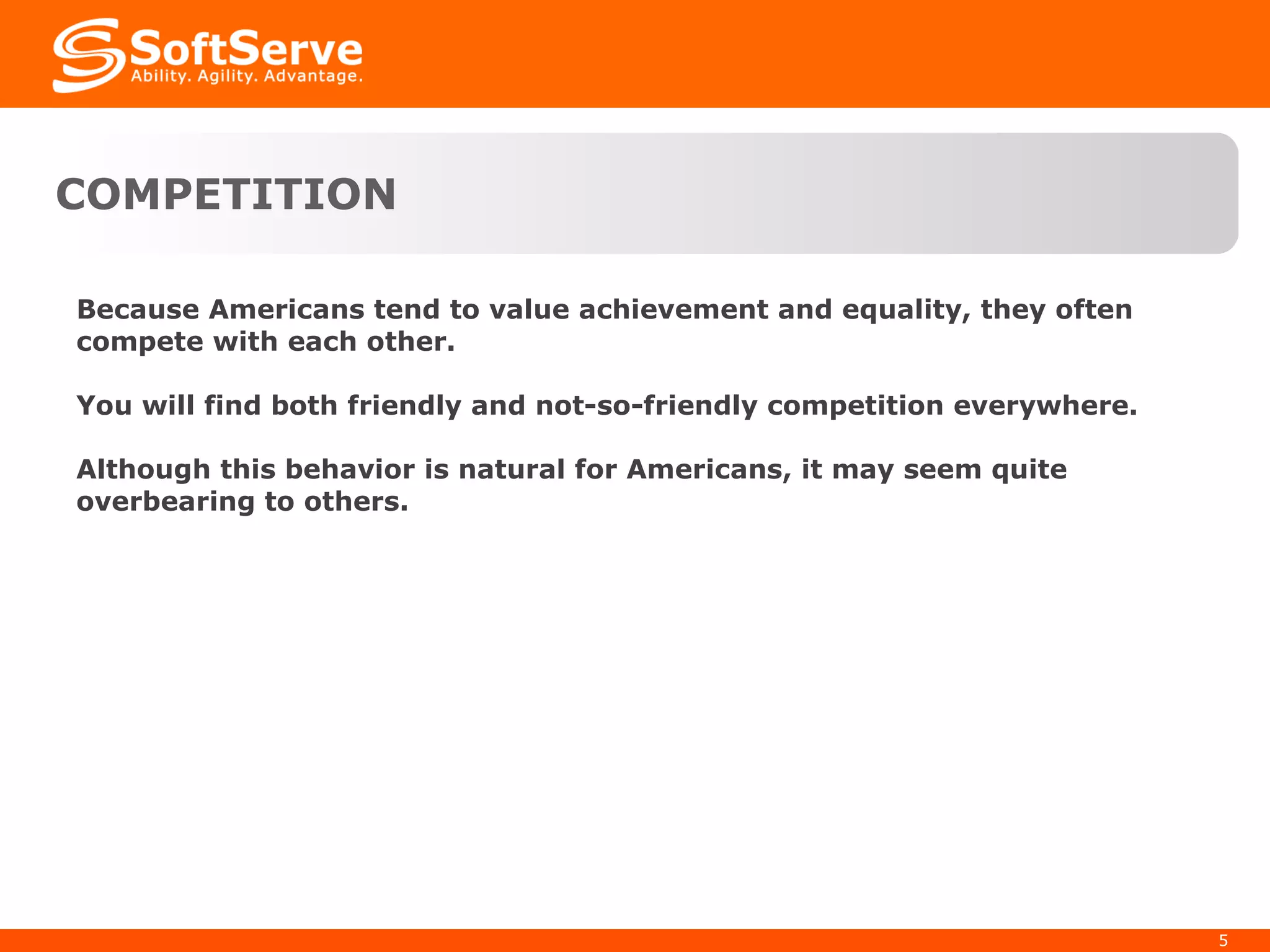
COMPETITION Because Americans tend to value achievement and equality, they often compete with each other. You will find both friendly and not-so-friendly competition everywhere. Although this behavior is natural for Americans, it may seem quite overbearing to others.
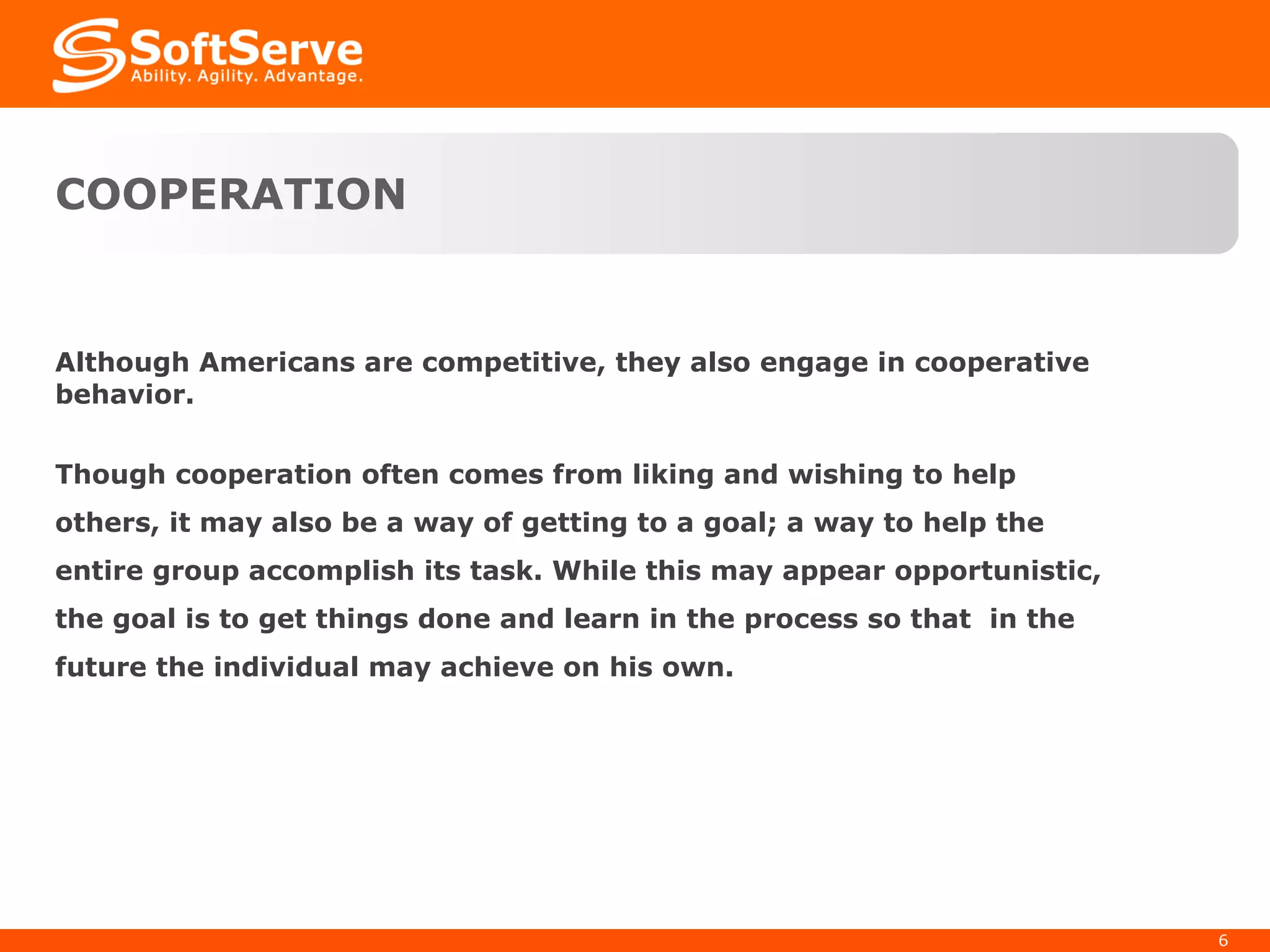
COOPERATION Although Americans are competitive, they also engage in cooperative behavior.  Though cooperation often comes from liking and wishing to help others, it may also be a way of getting to a goal; a way to help the entire group accomplish its task. While this may appear opportunistic, the goal is to get things done and learn in the process so that  in the future the individual may achieve on his own.
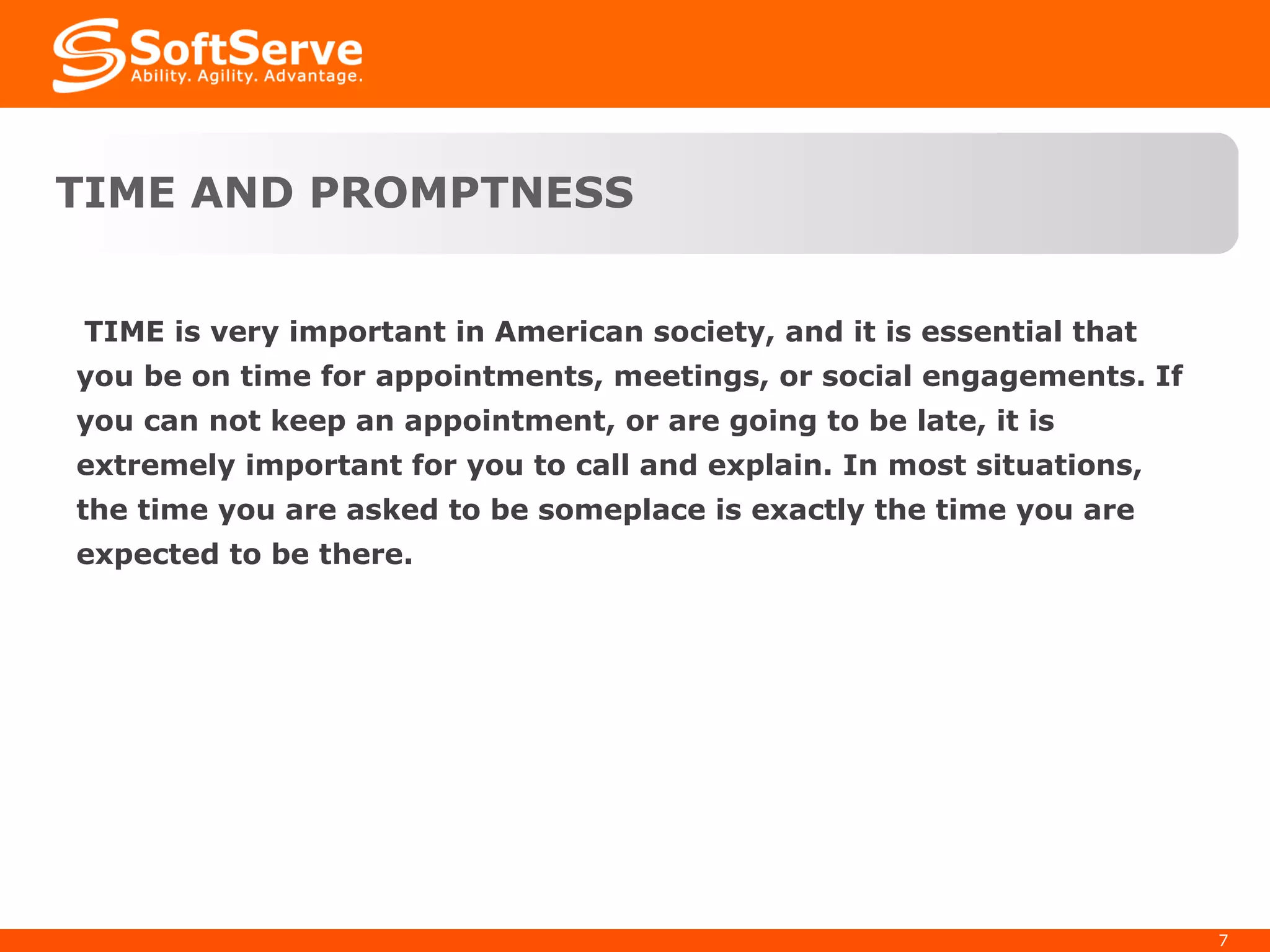
TIME is very important in American society, and it is essential that you be on time for appointments, meetings, or social engagements. If you can not keep an appointment, or are going to be late, it is extremely important for you to call and explain. In most situations, the time you are asked to be someplace is exactly the time you are expected to be there. TIME AND PROMPTNESS
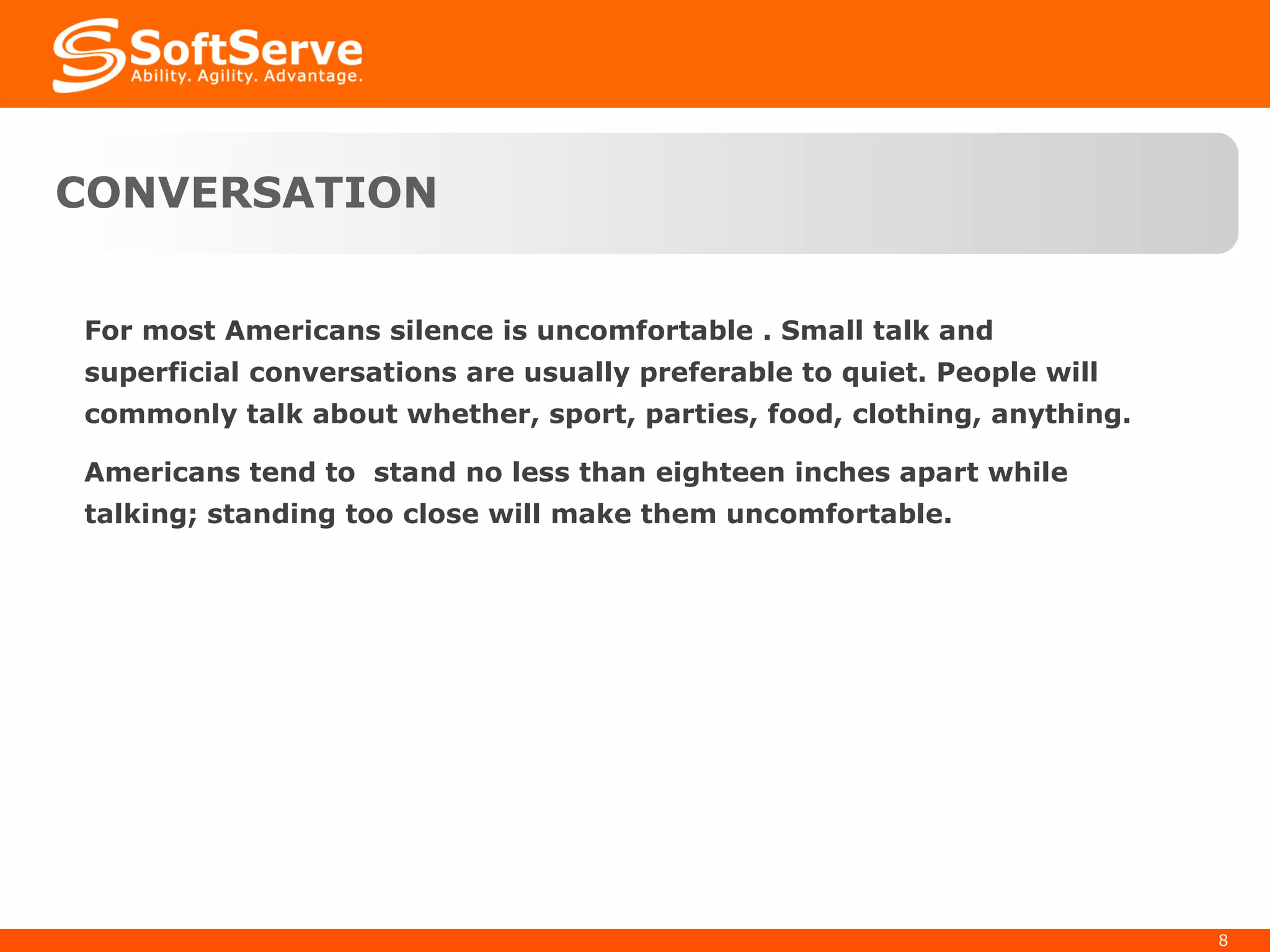
For most Americans silence is uncomfortable . Small talk and superficial conversations are usually preferable to quiet. People will commonly talk about whether, sport, parties, food, clothing, anything.  Americans tend to  stand no less than eighteen inches apart while talking; standing too close will make them uncomfortable. CONVERSATION
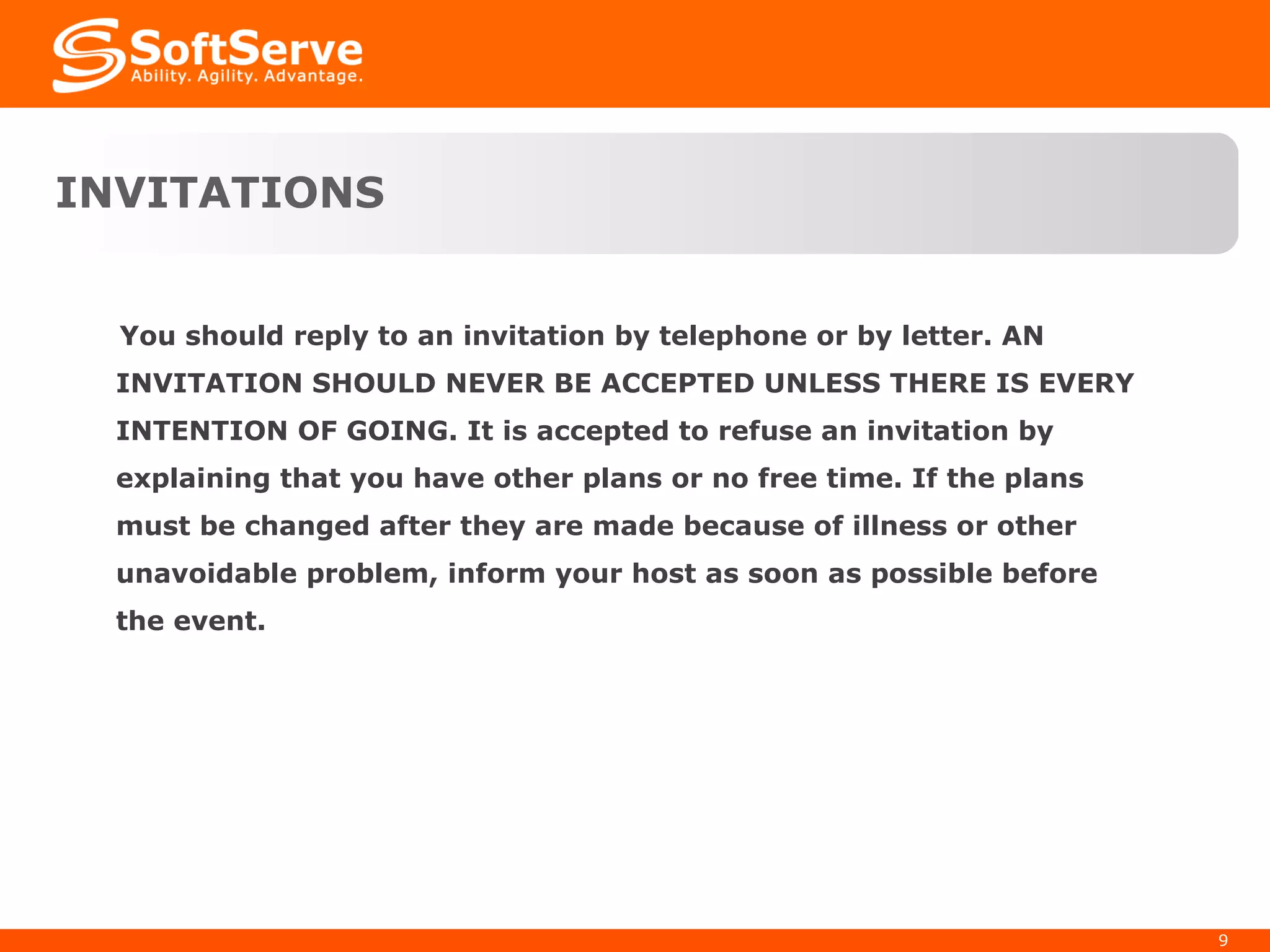
INVITATIONS  You should reply to an invitation by telephone or by letter. AN INVITATION SHOULD NEVER BE ACCEPTED UNLESS THERE IS EVERY INTENTION OF GOING. It is accepted to refuse an invitation by explaining that you have other plans or no free time. If the plans must be changed after they are made because of illness or other unavoidable problem, inform your host as soon as possible before the event.
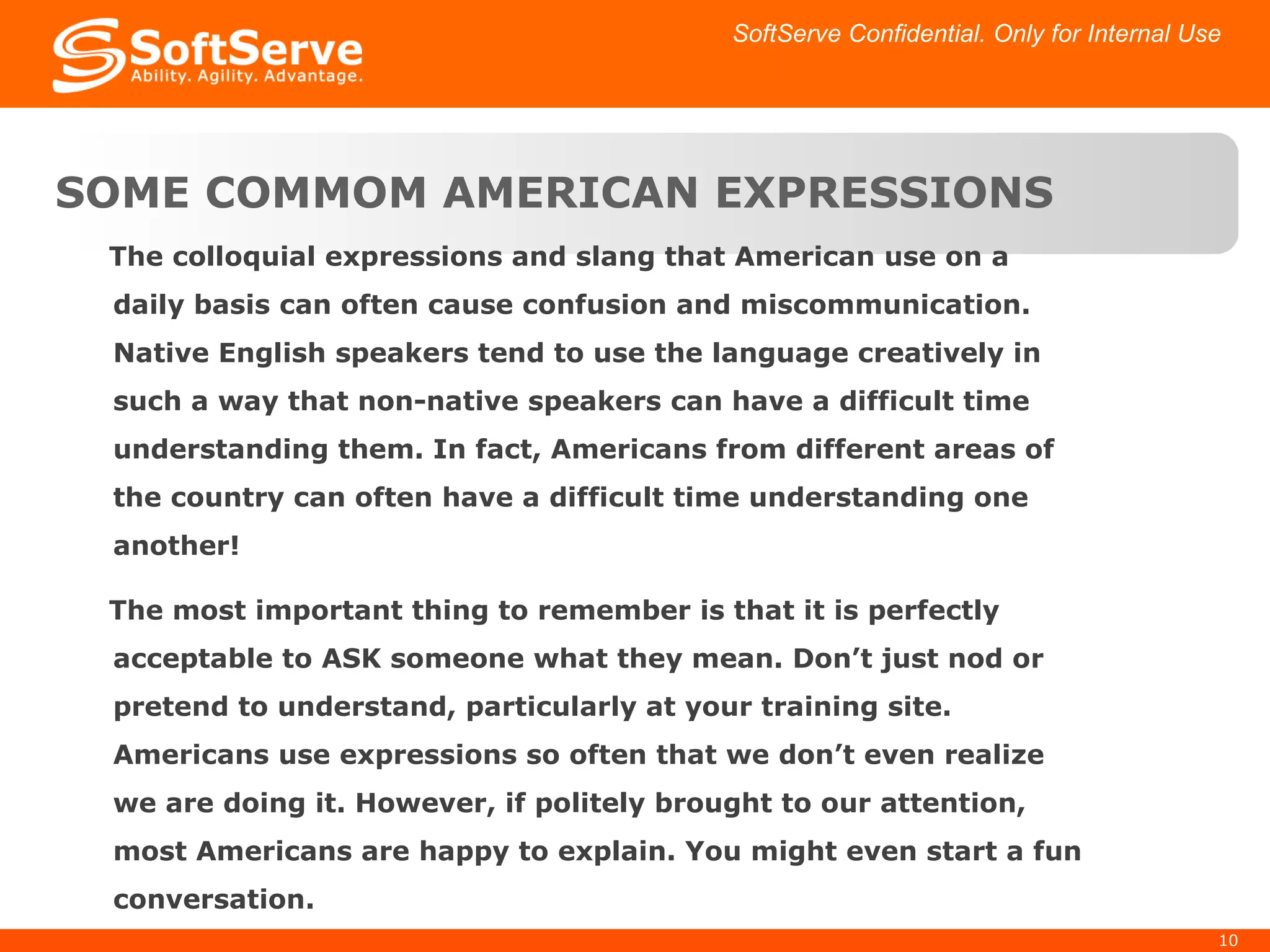
The colloquial expressions and slang that American use on a daily basis can often cause confusion and miscommunication. Native English speakers tend to use the language creatively in such a way that non-native speakers can have a difficult time understanding them. In fact, Americans from different areas of the country can often have a difficult time understanding one another! The most important thing to remember is that it is perfectly acceptable to ASK someone what they mean. Don’t just nod or pretend to understand, particularly at your training site. Americans use expressions so often that we don’t even realize we are doing it. However, if politely brought to our attention, most Americans are happy to explain. You might even start a fun conversation. SOME COMMOM AMERICAN EXPRESSIONS SoftServe Confidential. Only for Internal Use
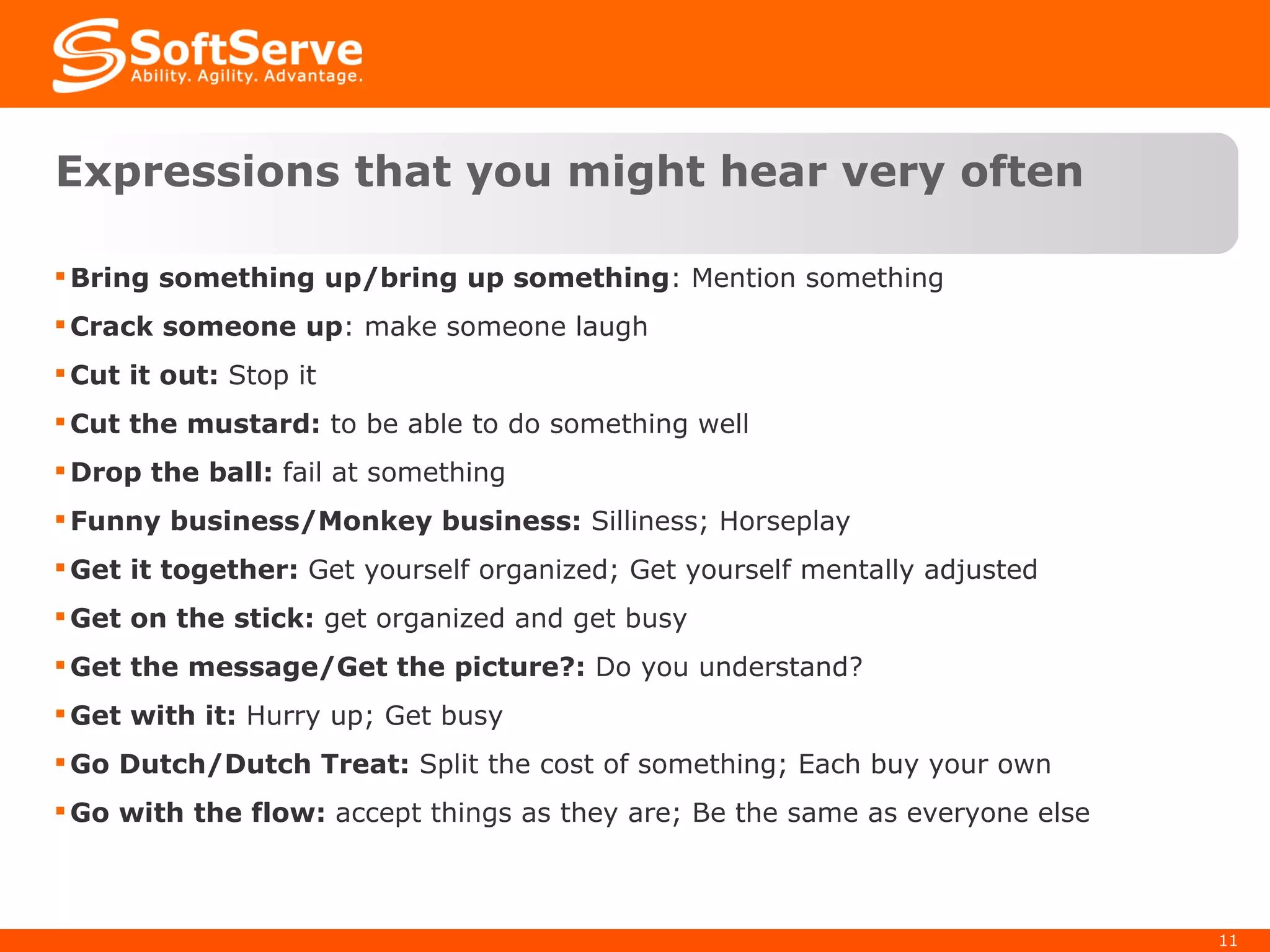
Expressions that you might hear very often Bring something up/bring up something : Mention something Crack someone up : make someone laugh Cut it out:  Stop it Cut the mustard:  to be able to do something well Drop the ball:  fail at something Funny business/Monkey business:  Silliness; Horseplay Get it together:  Get yourself organized; Get yourself mentally adjusted Get on the stick:  get organized and get busy Get the message/Get the picture?:  Do you understand? Get with it:  Hurry up; Get busy Go Dutch/Dutch Treat:  Split the cost of something; Each buy your own Go with the flow:  accept things as they are; Be the same as everyone else
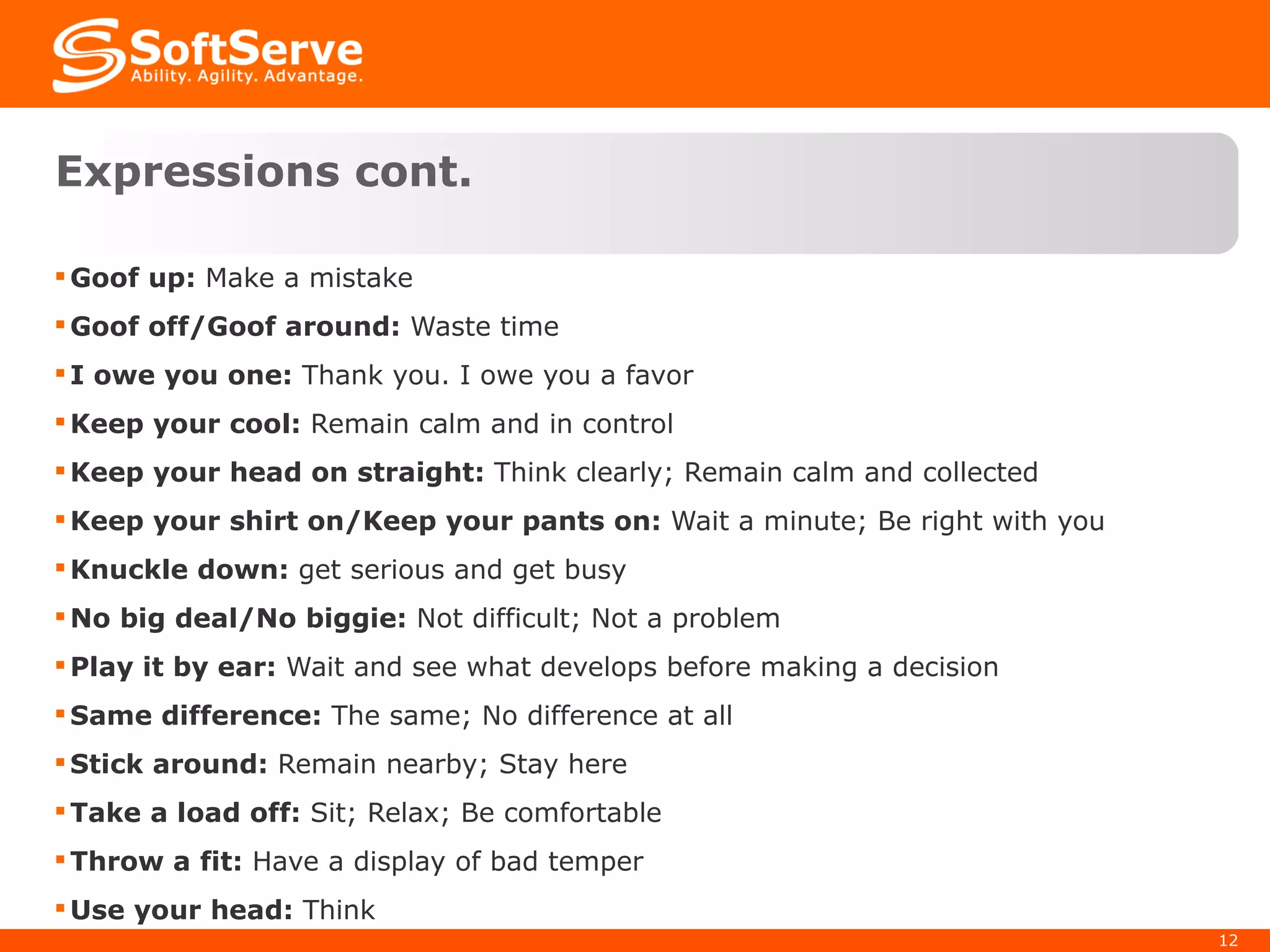
Expressions cont. Goof up:  Make a mistake Goof off/Goof around:  Waste time I owe you one:  Thank you. I owe you a favor Keep your cool:  Remain calm and in control Keep your head on straight:  Think clearly; Remain calm and collected Keep your shirt on/Keep your pants on:  Wait a minute; Be right with you Knuckle down:  get serious and get busy No big deal/No biggie:  Not difficult; Not a problem Play it by ear:  Wait and see what develops before making a decision Same difference:  The same; No difference at all Stick around:  Remain nearby; Stay here Take a load off:  Sit; Relax; Be comfortable Throw a fit:  Have a display of bad temper Use your head:  Think
Contacts Thank You! www.softservecom.com Copyright  ©  2008 SoftServe, Inc. Europe Headquarters   52 V. Velykoho Str. Lviv 79053, Ukraine Tel:  +380-32-2 40-9090 Fax:  +380-32-2 40-9080 E-mail: info@softservecom.com US Headquarters 13350 Metro Parkway, Suite 302 Fort Myers, FL 33966, USA Tel:  239-690-3111  Fax:  239-690-3116 E-mail: info@softservecom.com

Cultural differences us situations

  • 1.
    Cultural Differences Life and Work situations SoftServe, Inc. September 2008
  • 2.
    EQUALITY Americans workbetter when they are in an atmosphere in which all are considered equal and things are ‘fair’. While equality includes the equal right to seek the “the good life”, it doesn’t guarantee equality of talent or ability. SoftServe Confidential. Only for Internal Use
  • 3.
    CONFRONTATION Discussing issuesor ideas openly with other people is considered not only proper, but often a responsibility as well. Americans may bring up issues which are sensitive or embarrassing to others. In addition, Americans, particularly in a business situation, do not spend the time on polite social talk that many other nationalities do. They often get right to the point.
  • 4.
    INFORMALITY AND FORMALITYIn most cases Americans avoid elaborate social rituals. Most of time, they tend to treat everyone in a similar way with little concern for titles or status.
  • 5.
    COMPETITION Because Americanstend to value achievement and equality, they often compete with each other. You will find both friendly and not-so-friendly competition everywhere. Although this behavior is natural for Americans, it may seem quite overbearing to others.
  • 6.
    COOPERATION Although Americansare competitive, they also engage in cooperative behavior. Though cooperation often comes from liking and wishing to help others, it may also be a way of getting to a goal; a way to help the entire group accomplish its task. While this may appear opportunistic, the goal is to get things done and learn in the process so that in the future the individual may achieve on his own.
  • 7.
    TIME is veryimportant in American society, and it is essential that you be on time for appointments, meetings, or social engagements. If you can not keep an appointment, or are going to be late, it is extremely important for you to call and explain. In most situations, the time you are asked to be someplace is exactly the time you are expected to be there. TIME AND PROMPTNESS
  • 8.
    For most Americanssilence is uncomfortable . Small talk and superficial conversations are usually preferable to quiet. People will commonly talk about whether, sport, parties, food, clothing, anything. Americans tend to stand no less than eighteen inches apart while talking; standing too close will make them uncomfortable. CONVERSATION
  • 9.
    INVITATIONS Youshould reply to an invitation by telephone or by letter. AN INVITATION SHOULD NEVER BE ACCEPTED UNLESS THERE IS EVERY INTENTION OF GOING. It is accepted to refuse an invitation by explaining that you have other plans or no free time. If the plans must be changed after they are made because of illness or other unavoidable problem, inform your host as soon as possible before the event.
  • 10.
    The colloquial expressionsand slang that American use on a daily basis can often cause confusion and miscommunication. Native English speakers tend to use the language creatively in such a way that non-native speakers can have a difficult time understanding them. In fact, Americans from different areas of the country can often have a difficult time understanding one another! The most important thing to remember is that it is perfectly acceptable to ASK someone what they mean. Don’t just nod or pretend to understand, particularly at your training site. Americans use expressions so often that we don’t even realize we are doing it. However, if politely brought to our attention, most Americans are happy to explain. You might even start a fun conversation. SOME COMMOM AMERICAN EXPRESSIONS SoftServe Confidential. Only for Internal Use
  • 11.
    Expressions that youmight hear very often Bring something up/bring up something : Mention something Crack someone up : make someone laugh Cut it out: Stop it Cut the mustard: to be able to do something well Drop the ball: fail at something Funny business/Monkey business: Silliness; Horseplay Get it together: Get yourself organized; Get yourself mentally adjusted Get on the stick: get organized and get busy Get the message/Get the picture?: Do you understand? Get with it: Hurry up; Get busy Go Dutch/Dutch Treat: Split the cost of something; Each buy your own Go with the flow: accept things as they are; Be the same as everyone else
  • 12.
    Expressions cont. Goofup: Make a mistake Goof off/Goof around: Waste time I owe you one: Thank you. I owe you a favor Keep your cool: Remain calm and in control Keep your head on straight: Think clearly; Remain calm and collected Keep your shirt on/Keep your pants on: Wait a minute; Be right with you Knuckle down: get serious and get busy No big deal/No biggie: Not difficult; Not a problem Play it by ear: Wait and see what develops before making a decision Same difference: The same; No difference at all Stick around: Remain nearby; Stay here Take a load off: Sit; Relax; Be comfortable Throw a fit: Have a display of bad temper Use your head: Think
  • 13.
    Contacts Thank You!www.softservecom.com Copyright © 2008 SoftServe, Inc. Europe Headquarters 52 V. Velykoho Str. Lviv 79053, Ukraine Tel: +380-32-2 40-9090 Fax: +380-32-2 40-9080 E-mail: info@softservecom.com US Headquarters 13350 Metro Parkway, Suite 302 Fort Myers, FL 33966, USA Tel: 239-690-3111 Fax: 239-690-3116 E-mail: info@softservecom.com

Editor's Notes