Unlocking the
Power of
Algorithms
Algorithms are the foundation upon which modern computing
rests. They are precise, step-by-step instructions that guide
computers in solving complex problems efficiently.
From the simplest tasks to the most sophisticated applications,
algorithms provide the roadmap for turning ideas into reality.
This introductory exploration will delve into the core concepts
of algorithms, their essential properties, and the various ways
they can be represented, empowering you to harness their
transformative potential.
Explain the concept of algorithm
The Anatomy of a Well-Designed
Algorithm
1 Finite and Precise
A well-designed algorithm must have a defined beginning and end, with a finite number of
steps that are clearly specified and unambiguous. This ensures the algorithm can be
executed in a predictable and reliable manner.
2 Generalized Solution
Algorithms should provide a general solution to a problem, capable of handling a wide range
of inputs and scenarios, rather than being tailored to a specific case.
3 Structured Flow
Algorithms should have a logical flow of control, guiding the execution from one process to
the next in a well-defined order, ensuring the correct sequence of steps is followed.
4 Correctness
A well-designed algorithm must produce the correct solution for all valid inputs, without any
errors or unexpected behavior.
Representing Algorithms: From
Narrative to Pseudocode
Narrative Approach
The narrative approach to
algorithm representation
involves describing the problem-
solving process in a detailed,
story-like format. This method
provides a comprehensive and
in-depth understanding of the
algorithm, often including
additional context and
explanations.
Flowcharts
Flowcharts are a graphical or
symbolic representation of an
algorithm, using various shapes
and arrows to depict the step-by-
step flow of the problem-solving
process. Flowcharts offer a visual
and intuitive way to understand
the algorithm's structure and
logic.
Pseudocode
Pseudocode is an informal, high-
level description of an algorithm,
using a combination of natural
language and mathematical
notations. It provides a bridge
between the conceptual
understanding of the algorithm
and its implementation in a
programming language.
Mastering Algorithm Control Structures
1
Sequential Structures
Sequential structures are the building blocks of
algorithms, comprising input/output statements,
arithmetic operations, and variable assignments.
They ensure the correct order of execution and form
the foundation for more complex control structures.
2
Selection Structures
Selection structures, such as the if-then-else
statement, allow algorithms to make decisions based
on specific conditions. They enable the algorithm to
3
Repetition Structures
Repetition structures, or loops, enable algorithms to
repeat a series of steps a fixed number of times or
until a certain condition is met. This allows for the
efficient processing of large amounts of data or the
iterative refinement of a solution.
Sequential structures are:
1.Input statements, for example,
a.Get num1, num2
b.Read price, tax-rate
c. Accept guess
2. Output statements, for example,
d.Print total-cost
e. Display average
Sequential structures are:
3. Statements involving
arithmetic operations, such as:
a.Sum = num1 + num2
b.Average = sum  2
4. Statements that assign values
to variables, such as:
c. Count = 0
d.Maximum = 20
Selection structures are:
IF or IF-then-else statements. They allow decisions to be made, based on some condition
that evaluates to true. In the case of if-then-else, alternatives are executed if the condition
is false.
If (A > B) then
Display A
a.If (age >= 50)
Print “Old”
Else
Print “Young”
Repetition or Loop structures
Allow statements to be repeated a fixed number of times or until some condition evaluates to false. If the
number of repetitions is known beforehand, the loop structure is called a counted loop.
a. Repeat 10 times:
Print “I am good-looking”
End-repeat
If the exact number of repetitions is unknown beforehand and is based upon some condition, then the loop is
called a conditional loop. For example,
While (price  0) do
Read price
Total = total + price
End-while
The Art of Algorithm Development
Problem Analysis
Effective algorithm development begins with a
thorough understanding of the problem at hand.
Identifying the inputs, outputs, and key constraints is
crucial for designing a solution that addresses the
problem's core requirements.
Step-by-Step Planning
Algorithms are a series of precise instructions, so
laying out the individual steps necessary to reach the
desired solution is a critical part of the development
process. This systematic approach ensures the
algorithm is comprehensive and logically sound.
Iterative Refinement
Developing an algorithm is often an iterative
process, requiring testing, evaluation, and
refinement to ensure the solution is efficient,
accurate, and capable of handling edge cases. This
cycle of improvement is essential for creating a
robust and reliable algorithm.
Verification and Validation
Once an algorithm has been developed, it must be
thoroughly tested and validated to confirm that it
produces the correct output for all valid inputs. This
step helps identify and address any flaws or
limitations in the algorithm's design.
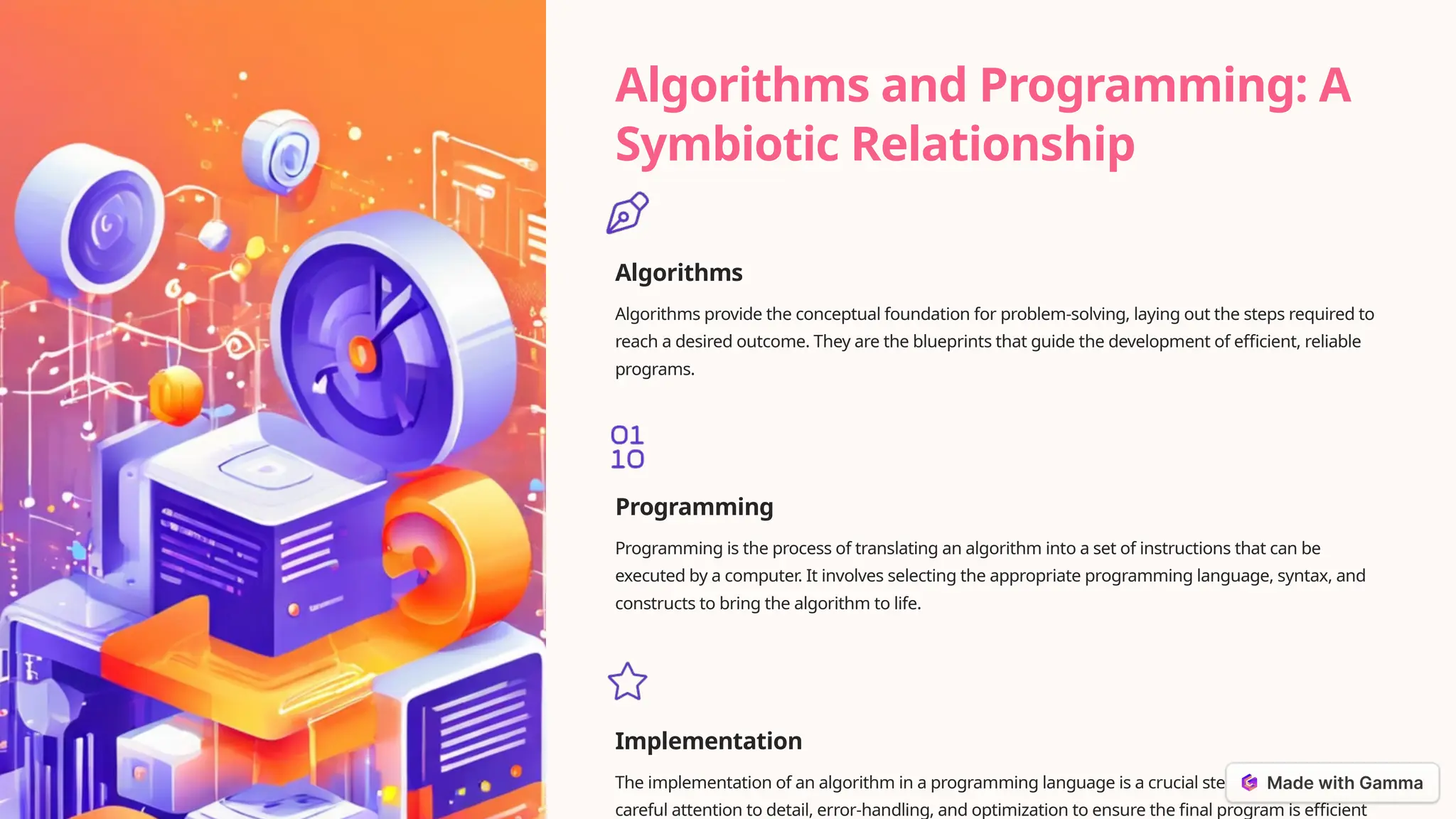
Algorithms and Programming: A
Symbiotic Relationship
Algorithms
Algorithms provide the conceptual foundation for problem-solving, laying out the steps required to
reach a desired outcome. They are the blueprints that guide the development of efficient, reliable
programs.
Programming
Programming is the process of translating an algorithm into a set of instructions that can be
executed by a computer. It involves selecting the appropriate programming language, syntax, and
constructs to bring the algorithm to life.
Implementation
The implementation of an algorithm in a programming language is a crucial step, as it requires
careful attention to detail, error-handling, and optimization to ensure the final program is efficient
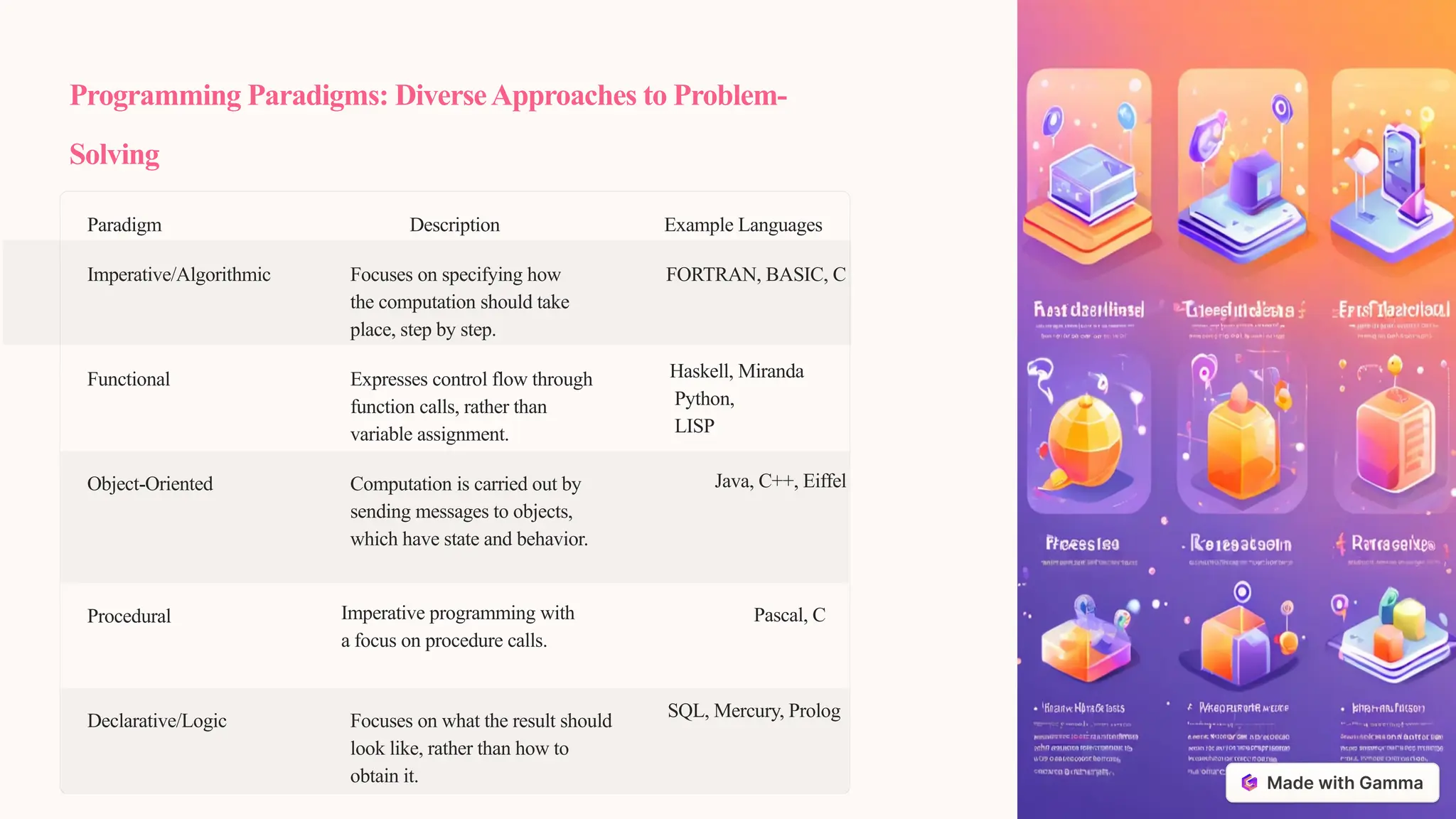
Programming Paradigms: DiverseApproaches to Problem-
Solving
Paradigm Description Example Languages
Imperative/Algorithmic Focuses on specifying how
the computation should take
place, step by step.
FORTRAN, BASIC, C
Functional Expresses control flow through
function calls, rather than
variable assignment.
Haskell, Miranda
Python,
LISP
Object-Oriented Computation is carried out by
sending messages to objects,
which have state and behavior.
Java, C++, Eiffel
Procedural Imperative programming with
a focus on procedure calls.
Pascal, C
Declarative/Logic Focuses on what the result should
look like, rather than how to
obtain it.
SQL, Mercury, Prolog
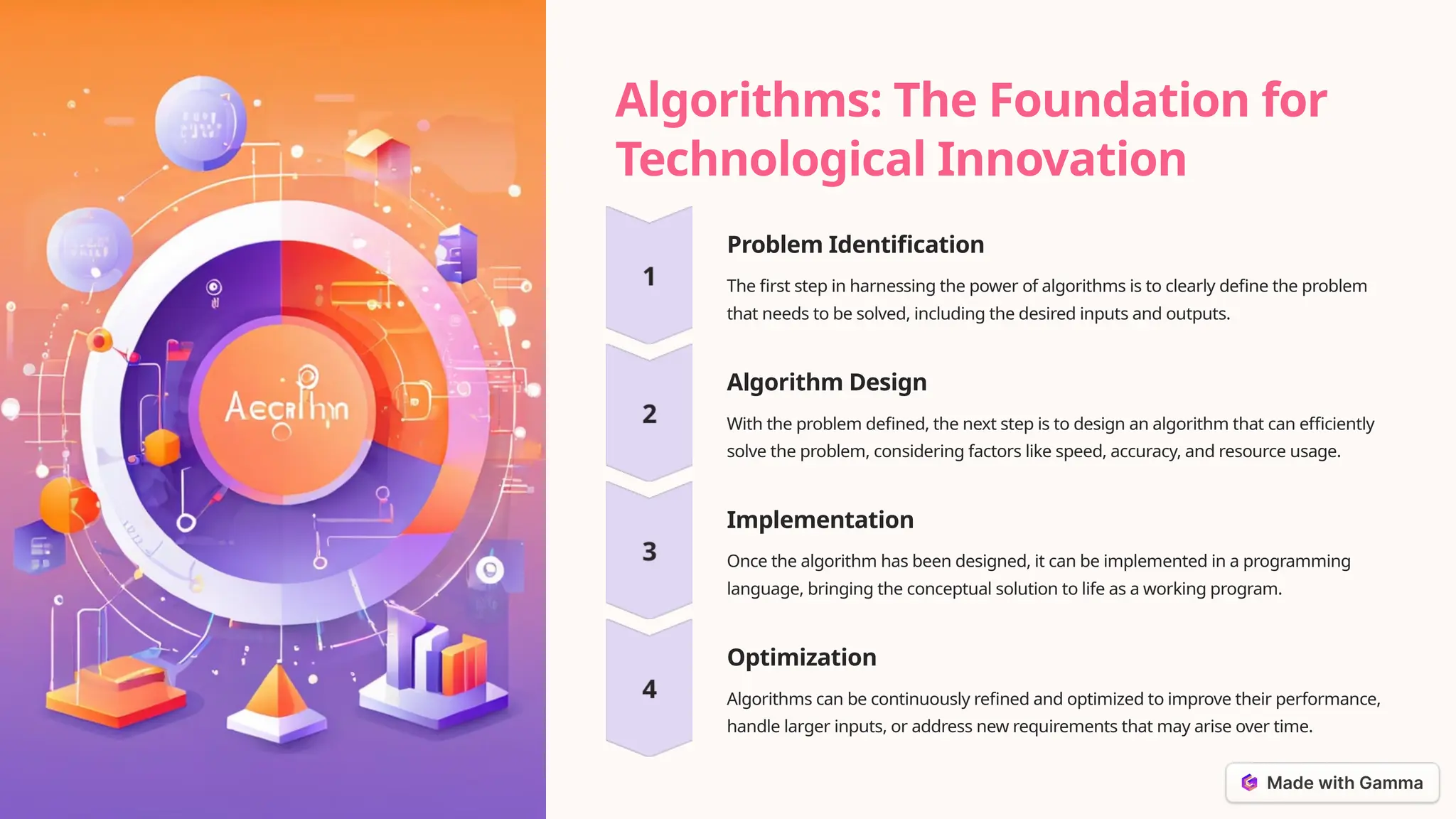
Algorithms: The Foundation for
Technological Innovation
Problem Identification
The first step in harnessing the power of algorithms is to clearly define the problem
that needs to be solved, including the desired inputs and outputs.
Algorithm Design
With the problem defined, the next step is to design an algorithm that can efficiently
solve the problem, considering factors like speed, accuracy, and resource usage.
Implementation
Once the algorithm has been designed, it can be implemented in a programming
language, bringing the conceptual solution to life as a working program.
Optimization
Algorithms can be continuously refined and optimized to improve their performance,
handle larger inputs, or address new requirements that may arise over time.
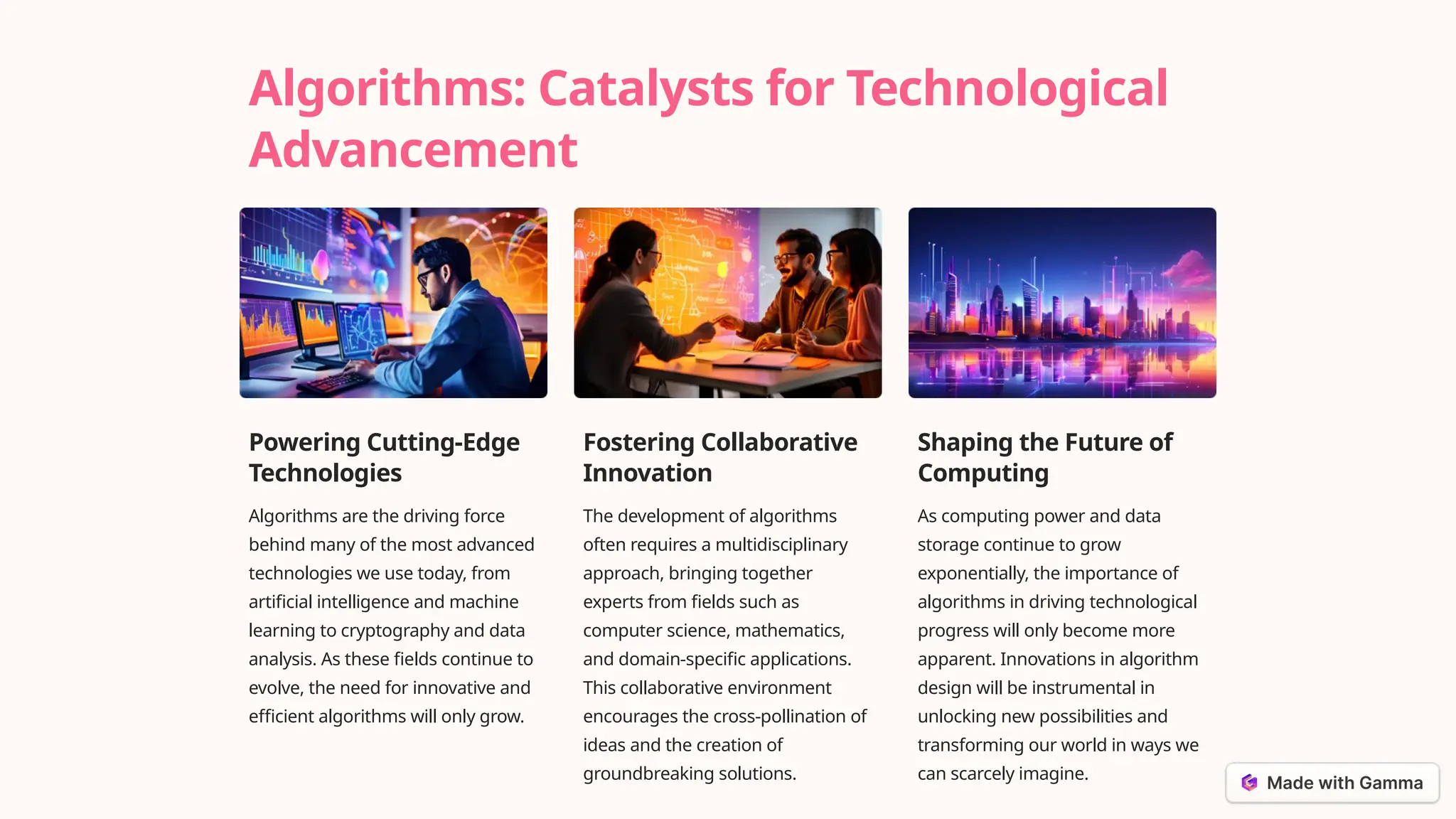
Algorithms: Catalysts for Technological
Advancement
Powering Cutting-Edge
Technologies
Algorithms are the driving force
behind many of the most advanced
technologies we use today, from
artificial intelligence and machine
learning to cryptography and data
analysis. As these fields continue to
evolve, the need for innovative and
efficient algorithms will only grow.
Fostering Collaborative
Innovation
The development of algorithms
often requires a multidisciplinary
approach, bringing together
experts from fields such as
computer science, mathematics,
and domain-specific applications.
This collaborative environment
encourages the cross-pollination of
ideas and the creation of
groundbreaking solutions.
Shaping the Future of
Computing
As computing power and data
storage continue to grow
exponentially, the importance of
algorithms in driving technological
progress will only become more
apparent. Innovations in algorithm
design will be instrumental in
unlocking new possibilities and
transforming our world in ways we
can scarcely imagine.
Embracing the Algorithmic
Revolution
Expand Your Knowledge
Dive deeper into the world of algorithms by exploring courses, books, and online
resources that delve into the latest advancements and real-world applications of this
powerful field.
Hone Your Problem-Solving Skills
Practice designing and implementing algorithms to tackle a wide range of problems,
from the simple to the complex. This will help you develop the critical thinking and
logical reasoning abilities that are essential for success in the digital age.
Contribute to Innovation
As you deepen your understanding of algorithms, consider how you can apply your
skills to solve pressing challenges or unlock new opportunities in your field of interest.
Your contributions could lead to groundbreaking innovations that transform the
world around us.

FDFDRERSFDSGAGAFGGFGFGFGFGAFDGFDGFGFFAGFGGDF

  • 1.
    Unlocking the Power of Algorithms Algorithmsare the foundation upon which modern computing rests. They are precise, step-by-step instructions that guide computers in solving complex problems efficiently. From the simplest tasks to the most sophisticated applications, algorithms provide the roadmap for turning ideas into reality. This introductory exploration will delve into the core concepts of algorithms, their essential properties, and the various ways they can be represented, empowering you to harness their transformative potential. Explain the concept of algorithm
  • 2.
    The Anatomy ofa Well-Designed Algorithm 1 Finite and Precise A well-designed algorithm must have a defined beginning and end, with a finite number of steps that are clearly specified and unambiguous. This ensures the algorithm can be executed in a predictable and reliable manner. 2 Generalized Solution Algorithms should provide a general solution to a problem, capable of handling a wide range of inputs and scenarios, rather than being tailored to a specific case. 3 Structured Flow Algorithms should have a logical flow of control, guiding the execution from one process to the next in a well-defined order, ensuring the correct sequence of steps is followed. 4 Correctness A well-designed algorithm must produce the correct solution for all valid inputs, without any errors or unexpected behavior.
  • 3.
    Representing Algorithms: From Narrativeto Pseudocode Narrative Approach The narrative approach to algorithm representation involves describing the problem- solving process in a detailed, story-like format. This method provides a comprehensive and in-depth understanding of the algorithm, often including additional context and explanations. Flowcharts Flowcharts are a graphical or symbolic representation of an algorithm, using various shapes and arrows to depict the step-by- step flow of the problem-solving process. Flowcharts offer a visual and intuitive way to understand the algorithm's structure and logic. Pseudocode Pseudocode is an informal, high- level description of an algorithm, using a combination of natural language and mathematical notations. It provides a bridge between the conceptual understanding of the algorithm and its implementation in a programming language.
  • 4.
    Mastering Algorithm ControlStructures 1 Sequential Structures Sequential structures are the building blocks of algorithms, comprising input/output statements, arithmetic operations, and variable assignments. They ensure the correct order of execution and form the foundation for more complex control structures. 2 Selection Structures Selection structures, such as the if-then-else statement, allow algorithms to make decisions based on specific conditions. They enable the algorithm to 3 Repetition Structures Repetition structures, or loops, enable algorithms to repeat a series of steps a fixed number of times or until a certain condition is met. This allows for the efficient processing of large amounts of data or the iterative refinement of a solution.
  • 5.
    Sequential structures are: 1.Inputstatements, for example, a.Get num1, num2 b.Read price, tax-rate c. Accept guess 2. Output statements, for example, d.Print total-cost e. Display average Sequential structures are: 3. Statements involving arithmetic operations, such as: a.Sum = num1 + num2 b.Average = sum  2 4. Statements that assign values to variables, such as: c. Count = 0 d.Maximum = 20
  • 6.
    Selection structures are: IFor IF-then-else statements. They allow decisions to be made, based on some condition that evaluates to true. In the case of if-then-else, alternatives are executed if the condition is false. If (A > B) then Display A a.If (age >= 50) Print “Old” Else Print “Young”
  • 7.
    Repetition or Loopstructures Allow statements to be repeated a fixed number of times or until some condition evaluates to false. If the number of repetitions is known beforehand, the loop structure is called a counted loop. a. Repeat 10 times: Print “I am good-looking” End-repeat If the exact number of repetitions is unknown beforehand and is based upon some condition, then the loop is called a conditional loop. For example, While (price  0) do Read price Total = total + price End-while
  • 8.
    The Art ofAlgorithm Development Problem Analysis Effective algorithm development begins with a thorough understanding of the problem at hand. Identifying the inputs, outputs, and key constraints is crucial for designing a solution that addresses the problem's core requirements. Step-by-Step Planning Algorithms are a series of precise instructions, so laying out the individual steps necessary to reach the desired solution is a critical part of the development process. This systematic approach ensures the algorithm is comprehensive and logically sound. Iterative Refinement Developing an algorithm is often an iterative process, requiring testing, evaluation, and refinement to ensure the solution is efficient, accurate, and capable of handling edge cases. This cycle of improvement is essential for creating a robust and reliable algorithm. Verification and Validation Once an algorithm has been developed, it must be thoroughly tested and validated to confirm that it produces the correct output for all valid inputs. This step helps identify and address any flaws or limitations in the algorithm's design.
  • 9.
    Algorithms and Programming:A Symbiotic Relationship Algorithms Algorithms provide the conceptual foundation for problem-solving, laying out the steps required to reach a desired outcome. They are the blueprints that guide the development of efficient, reliable programs. Programming Programming is the process of translating an algorithm into a set of instructions that can be executed by a computer. It involves selecting the appropriate programming language, syntax, and constructs to bring the algorithm to life. Implementation The implementation of an algorithm in a programming language is a crucial step, as it requires careful attention to detail, error-handling, and optimization to ensure the final program is efficient
  • 10.
    Programming Paradigms: DiverseApproachesto Problem- Solving Paradigm Description Example Languages Imperative/Algorithmic Focuses on specifying how the computation should take place, step by step. FORTRAN, BASIC, C Functional Expresses control flow through function calls, rather than variable assignment. Haskell, Miranda Python, LISP Object-Oriented Computation is carried out by sending messages to objects, which have state and behavior. Java, C++, Eiffel Procedural Imperative programming with a focus on procedure calls. Pascal, C Declarative/Logic Focuses on what the result should look like, rather than how to obtain it. SQL, Mercury, Prolog
  • 11.
    Algorithms: The Foundationfor Technological Innovation Problem Identification The first step in harnessing the power of algorithms is to clearly define the problem that needs to be solved, including the desired inputs and outputs. Algorithm Design With the problem defined, the next step is to design an algorithm that can efficiently solve the problem, considering factors like speed, accuracy, and resource usage. Implementation Once the algorithm has been designed, it can be implemented in a programming language, bringing the conceptual solution to life as a working program. Optimization Algorithms can be continuously refined and optimized to improve their performance, handle larger inputs, or address new requirements that may arise over time.
  • 12.
    Algorithms: Catalysts forTechnological Advancement Powering Cutting-Edge Technologies Algorithms are the driving force behind many of the most advanced technologies we use today, from artificial intelligence and machine learning to cryptography and data analysis. As these fields continue to evolve, the need for innovative and efficient algorithms will only grow. Fostering Collaborative Innovation The development of algorithms often requires a multidisciplinary approach, bringing together experts from fields such as computer science, mathematics, and domain-specific applications. This collaborative environment encourages the cross-pollination of ideas and the creation of groundbreaking solutions. Shaping the Future of Computing As computing power and data storage continue to grow exponentially, the importance of algorithms in driving technological progress will only become more apparent. Innovations in algorithm design will be instrumental in unlocking new possibilities and transforming our world in ways we can scarcely imagine.
  • 13.
    Embracing the Algorithmic Revolution ExpandYour Knowledge Dive deeper into the world of algorithms by exploring courses, books, and online resources that delve into the latest advancements and real-world applications of this powerful field. Hone Your Problem-Solving Skills Practice designing and implementing algorithms to tackle a wide range of problems, from the simple to the complex. This will help you develop the critical thinking and logical reasoning abilities that are essential for success in the digital age. Contribute to Innovation As you deepen your understanding of algorithms, consider how you can apply your skills to solve pressing challenges or unlock new opportunities in your field of interest. Your contributions could lead to groundbreaking innovations that transform the world around us.