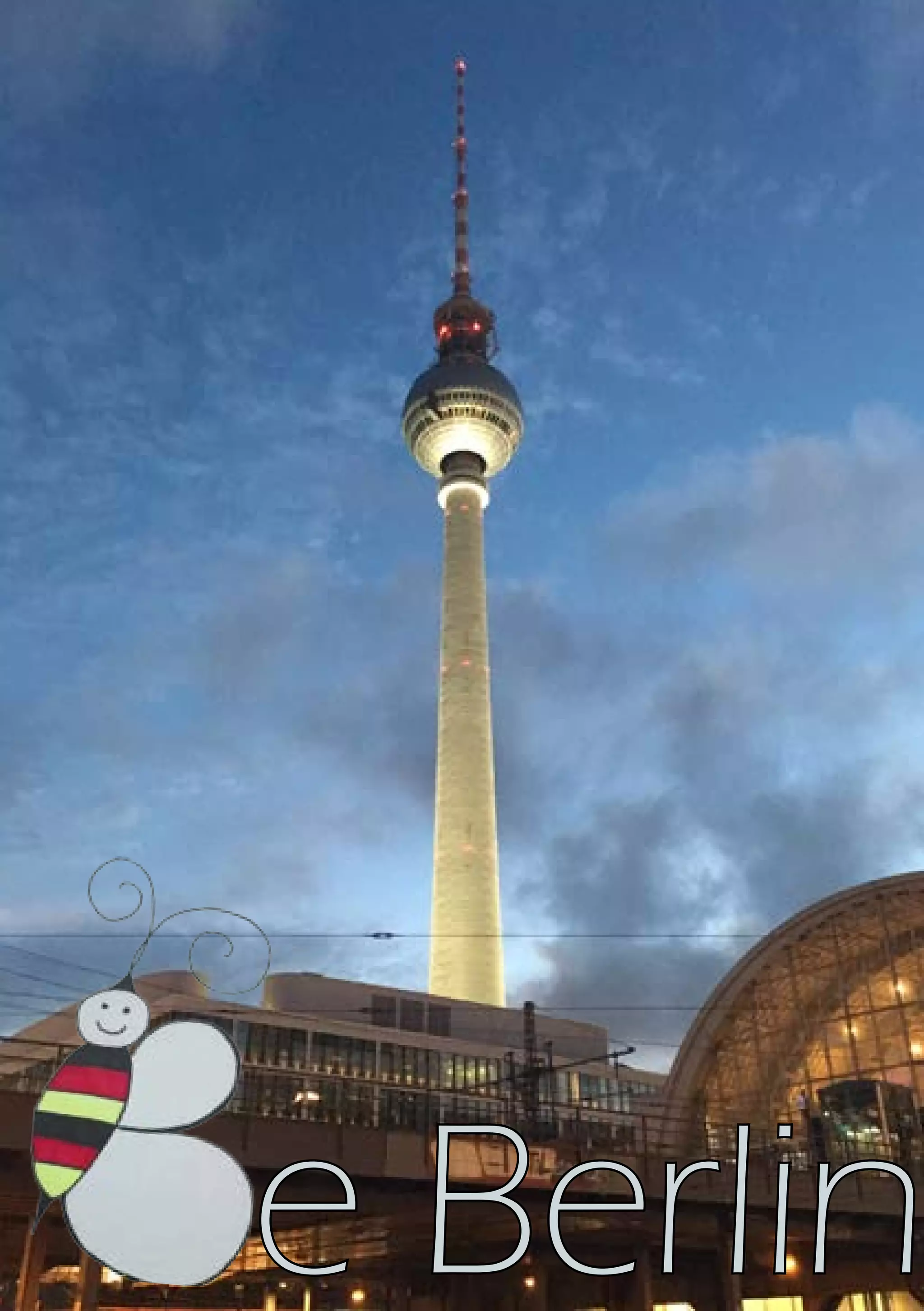
e Berlin
2
Table of Contents
Introduction 3
History 4-7
Transport 8-9
Survival Guide 10-13
Profiles 14-17
Blog
Brainy
Browsing
Bumble
Busy
Buzzing
Honey
Queeen
3
Introduction
Be Berlin doesn’t just outline the classics such as Brandenburg Gate or
Museum Island but also draws you into the buzz of local life. Even if
the infamous clubbing culture of Berlin isn’t for you, hidden cafes and
bars will show you “Bee-liners” in their natural habitat. In addition we
offer all kinds of practical tips in our survival guide and advice on how
to buzz around the city using the public transport.
As authors traveling around Berlin for one month, we have had an
un-bee-lievablely good time visiting and curating the ultimate list of
attractions. Berlin’s atmosphere is known for being open and accepting.
This translates into a variety of cultures, preferences and tastes that
culminate in their respective neighbourhoods and mix to form an
unusual but relaxed city in which everyone can enjoy themselves. We
hope this guide will be an inspiration for your own explorations.
Welcome to Be Berlin, a travel guide created by first time Berliners.
Here you’ll find what places are deemed by us, as well as seasoned
locals as must-see’s during your stay. Everyone can find something to
love in Berlin. From history buffs to foodies, night owls to nature lovers,
the city has much to offer. Whether you’re in town for just a few days,
or a few weeks, follow this guide to keep busy with a wide variety of
things to do and see.
4
History
The capital of Germany, Berlin has been at the epicentre of not just
German, but European history for the duration of the turbulent
twentieth century. The first records of the city date back to the thirteenth
century, but it grew quickly and eventually became the capital city of
the newly created country, Germany, in 1871. Berlin was home to the
Hohenzollern family who ruled over Prussia until the end of the First
World War, and the reminders of this established family can be found in
Berlin even today. The Prussian Royal family remained here until 1918,
when, immediately following Germany’s defeat in the First World War,
Kaiser Wilhelm II, the last Emperor of Germany, fled to Holland never
to return.
foreign policy of the Nazi party led to the outbreak of the Second World
Just as other European nations were, Germany was devastated by the
effects of The First World War. However, having emerged from the
immediate post-war difficulties, Germany emerged into the roaring
twenties. Between the end of 1918 and 1933, before Hitler came
to power, Germany was a true democracy. Known as the Weimar
republic, it was arguably the most democratic country in the world at
the time, with all women being able to vote, unlike in Britain and the
USA. Berlin became a hive of art, jazz, and decadence. From Cabarets to
art galleries, the city was famous for its culture, and for being the capital
of the most democratic nation in Europe. Whilst some disliked the
culture brought about by Weimar, there was little political extremism
during this period. Life seemed to be improving in Berlin until the Wall
Street Crash of 1929 which brought about the Depression.
The great depression in 1929 – the catalyst for Hitler’s eventual rise to
power in 1933 changed this. Adolf Hitler took power in 1933, ushering
in the darkest period in Berlin’s history. The Nazis also brought in laws
largely targeted at political opponents, Jews and other minorities on
the fringes of German society such as Sinti and Roma and homosexuals.
Mass persecution of these groups followed and in 1939, the aggressive
aggressive foreign policy of the Nazi party led to the outbreak
of the Second World War. Many buildings were destroyed in air
raids during the war, meaning that many of the buildings in Berlin
today are of modern design. Once the Red Army invaded Berlin,
the war was at an end, and Berlin had been virtually destroyed.
5
6
Germany’s defeat in the Second World War led to the division of
Germany and Berlin between the USSR and the allied forces. This
led to the creation of two German states in 1949: The Federal
Republic of Germany and the German Democratic Republic,
colloquially known as West and East Germany. During the cold
war, tensions between the capitalist West and communist East
heightened. This led to the building of The Berlin Wall in 1961,
encircling West Berlin to prevent East Germans seeking refuge
in the economically prosperous West. The Eastern side of the
Wall was heavily fortified with dogs and border guards, making
it nearly impossible to cross. There were countless daring escape
attempts, the majority unsuccessful, by East Berliners attempting
to gain access to the West.
The Berlin Wall fell on 9th November 1989 and proved to be a
symbolicendtothedivisionofGermany.WithGermanreunification
only recent history, large sections of the wall still stand as a memory
to the post war story of a divided Berlin and the lives the wall
claimed. Smaller reminders throughout Berlin include traffic lights:
in East and West Berlin, even today the old illustrations for traffic
light men are used.
Since reunification, Berlin has once again become a hub for
liberalism and prosperity in an ever increasing tense global
environment. A thriving arts and culture scene, Berlin is now
providing classical and contemporary exhibits, something for
everyone’s taste. Even with a dark history, a united country;
a united city, is showing the world once again that Berlin and
Germany is forward looking and open for anyone to explore.
Welcome to the modern metropolis.
7
8
Transport
Transport of Berlin- Best to Worst ways of getting around
U-Bahn and S-Bahn:
S-Bahn runs slightly less frequently than the U-Bahn and has fewer
stops, but both run from 4am – 12.30am Sun – Thurs, and 24
hours on Fridays and Saturdays. For the weekday night-owls, see
the Buses section for info on night buses.
Trams:
Trams run 24/7 with hundreds of stations around the city, meaning
this is certainly the method of transport that will drop you closest
to home, if home should fall in the Eastern districts, as the Trams
unfortunately do not venture into Western Berlin.
Buses:
Slow and less frequent than U-Bahns or Trams. If you want a
cheap sightseeing tour, simply hop on the 100 or 200 and hop off
wherever takes your fancy along route. Also, the half hourly night
buses are handy for those enjoying the Kreutzberg mid-week
nightlife, when the U-Bahns and Trams have stopped running for
the night.
Ticket Prices for U-Bahns, S-Bahns, Trams and Buses (Prices range
depending upon how many districts you travel through): More
information can be found at www.vbb.de.
Einzelfahrschein (Single) = 2.80€ – 3.40€ / 1.70€ – 2.50€
(Concessions)
Tageskarte (Day Pass) = 7€ – 7.70€ / 4.70€ – 5.30€ (Concessions)
Wochenkarte (Week Pass) = 30€ – 37.50€
Monatskarte (Monthly Pass) = 81€ – 100.50€
9
Cycling:
There is an extremely comprehensive bike lane system in the city,
and bikes are even allowed on U-Bahns, S-Bahns, Trams and Night
buses for a small Fahradkarte (Bike ticket) of 1.90€. There are
several reasonable bike rental stations around the city, including:
Fahrradstation (0180 510 800 / www.fahrradstation.com),
Prezlberger Orange Bikes (030 4435 6852 / www.orange-bikes.
de), Lila Bike (0176 9957 9089 / www.berlin-citytours-by-bike.
de). However, please take care when cycling, as although there is
usually a bike lane, the traffic can be very busy
.
Taxis and Ubers:
Avoid if you can, as this is the priciest
method of transport and usually takes
just as long due to the traffic in the
city. On a positive note, you can pay
by card if you have spent all your cash,
for a small surcharge of 1.50€. Taxis
can be ordered from 030 443 311 /
030 202 020, or you can usually flag
one down either passing by or at a taxi
rank. Driver tip is usually roughly 10%
of your fare.
10 11
Survival Guide
Survival Pack
Berlin is a large culture ridden city and you want to make sure
that you are prepared for anything that comes your way. Wheth-
er it’s learning useful German phrases, packing your suitcases or
planning your days whilst you’re in Berlin, we have you covered.
Language
Hello Hallo
Goodbye Auf Wiedersehn/Tschüs
Yes Ja
No Nein
My name is… Mein name ist…
Please Bitte
Thank you Danke
Excuse me Entschuldigung
Good morning Guten Morgen
Good day Guten Tag
Good afternoon Guten Abend
Good evening Guten Nacht
What time is the next bus? Wann fährt der nächste Bus?
One one-way/return ticket Eine einfache Fahrkarte/Rück-
fahrkarte bitte
Where is the taxi stand? Wo ist der Taxistand?
I’d like a taxi for… Ich hätte gern ein Taxi für…
Please take me to… Bitte ringen Sie mich zu…
Essential Items
The items that you will need to bring with you of course depend
on the time of year as weather will vary.
However, please find a list of items to keep you covered for all
occasions;
Suncream
If you’re doing a lot of walking around then it’s easy to catch the
sun. There’s even places in Berlin where you can sunbathe so sun
protection is recommended.
Umbrella
There can be rainy days in Berlin so an umbrella or raincoat
would be useful.
Warm Clothes
Something warm to wear for the evening’s such as a jumper or
jacket
A black outfit
Berlin’s night scene is rather unique and they like to keep it
casual, so an all black outfit is advised
Insect spray
Berlin has a lot of nature so insect spray or repellent could keep
those mozzies away
Student card
A lot of attractions do discounts for students so if you want to
save a couple of euros then a student card will do just that
Walking shoes
Plug adapter
12 13
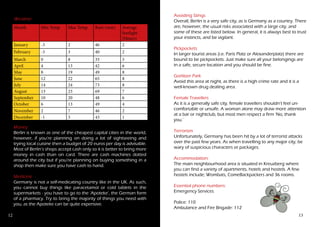
Month Min Temp Max Temp Rain (mm) Average
Sunlight
(Hours)
January -3 2 46 2
February -3 3 40 2
March 0 8 33 5
April 4 13 42 6
May 8 19 49 8
June 12 22 65 8
July 14 24 73 8
August 13 23 69 7
September 10 20 48 6
October 6 13 49 4
November 2 7 46 2
December -1 3 43 1
Avoiding Stings
Overall, Berlin is a very safe city, as is Germany as a country. There
are, however, the usual risks associated with a large city, and
some of these are listed below. In general, it is always best to trust
your instincts, and be vigilant.
Pickpockets
In larger tourist areas (i.e. Paris Platz or Alexanderplatz) there are
bound to be pickpockets. Just make sure all your belongings are
in a safe, secure location and you should be fine.
Gorlitzer Park
Avoid this area at night, as there is a high crime rate and it is a
well-known drug dealing area.
Female Travellers
As it is a generally safe city, female travellers shouldn’t feel un-
comfortable or unsafe. A woman alone may draw more attention
at a bar or nightclub, but most men respect a firm ‘No, thank
you.’
Terrorism
Unfortunately, Germany has been hit by a lot of terrorist attacks
over the past few years. As when travelling to any major city, be
wary of suspicious characters or packages.
Accommodation:
The main neighbourhood area is situated in Kreuzberg where
you can find a variety of apartments, hotels and hostels. A few
hostels include; Wombats, ComeBackpackers and 36 rooms.
Essential phone numbers:
Emergency Services
Police: 110
Ambulance and Fire Brigade: 112
Money
Berlin is known as one of the cheapest capital cities in the world,
however, if you’re planning on doing a lot of sightseeing and
trying local cuisine then a budget of 20 euros per day is advisable.
Most of Berlin’s shops accept cash only so it is better to bring more
money in cash than on card. There are cash machines dotted
around the city but if you’re planning on buying something in a
shop then make sure you have cash to hand.
Medicine
Germany is not a self-medicating country like in the UK. As such,
you cannot buy things like paracetamol or cold tablets in the
supermarkets - you have to go to the ‘Apoteke’, the German form
of a pharmacy. Try to bring the majority of things you need with
you, as the Apoteke can be quite expensive.
Weather
14 15
Name: Andrea Tang
From: Huddersfield town, in
West Yorkshire, England.
Place to Bee: Museum Island,
where five great museums are
combined together in one area
with the gorgeous green space
of Lustgarten nearby.
Impression: Berlin’s a hip,
modern and outward-looking
city, yet it still resonates with
history.
Members of the Hive
Name: Bethany Riley
From: Chorley, Lancashire
Place to bee: I particularly liked
the open air cinema as it made
for a chilled beer drinking
evening. The East Side Gallery
has also been another favourite
of mine.
Impression: My favourite thing
about Berlin is the atmosphere
– no matter where you go
you will always find a group
of people chatting and having
fun.
Name: Elisha Harley
From: Glasgow, recently
graduated from University of
Glasgow – studied English
Literature and History
Place to Bee: Friedrichshain/
Kreuzberg area – amazing
street art, cool vintage shops
and a wide variety of places to
eat.
Impression: Bustling city which
combines past and present to
create a unique place to visit.
Name: Frances Younger
From: Nottingham, England
Place to bee: Teufelsberg - it
is a prime example of Berlin’s
ingenuity, and the ability of the
people to redefine the city’s
history on their own terms.
Impression: This is a wonderful
city full of art and culture,
and it feels like a place people
live in rather than a tourist
destination.
Name: Isabelle Cadwallader
From: Liverpool
Place to bee: Tiergarten
Impression: Berlin is full of
art, culture, and history. It’s
impossible to be bored here.
16 17
Name: Jack Dainty
From: Birmingham, going into
final year studying German and
History, after being on a year
abroad in Kleve, Germany.
Place to Bee: Badeschiff – nice
and chilled atmosphere
Impression: Berlin is a city
rich in history. Lively and with
endless things to do, I could
never be bored in Berlin!
Name: Lisa Chargois
From: Austin, Texas, recently
graduated from Texas
State University, studies
communication & international
studies.
Place to bee: Kreuzberg area-all
different kinds of things to do.
From eating to nightlife and
everything in between.
Impression: Busy city with
tons of beautiful history yet
simultaneously very modern
and hip, a city for everyone!
fun.
Name: Sabah Heydon
From: Oxford, currently
studying English in Bristol
Place to Bee: Friedrichshain –
sociable and stylish. Combines
all the best Berlin has on offer:
really tasty food, cheap drinks
and a buzzing atmosphere!
Impression: A unique and
futuristic place. Remembers the
past and where it came from
but looks with optimism and
vitality towards the future.
Name: Rosalie van Onzenoort
From: Oegstgeest, the
Netherlands. I am a studying
Philosophy, Politics and
Economics in London.
Place to bee: The
Charlottenburg area. The park
is beautiful and there are some
good art galleries nearby.
Impression: Berlin is a great
place for so many things.
Everyone will find something
to their taste here.
Name: Rachel Cox
From: Portsmouth, UK.
Place to Bee: The History is so
recent and relatable. I loved
looking along the East Side
Gallery and the remaining parts
of the Berlin Wall at the art and
the survivor’s stories, beautifully
contrasted to symbolise Berlin’s
strive for peace in the face of
the unjust.
Impression: I have grown to
acquire a taste Berliner Kindl
beer at 3€ per pint.

CTR: Be Berlin

  • 1.
  • 2.
    2 Table of Contents Introduction3 History 4-7 Transport 8-9 Survival Guide 10-13 Profiles 14-17 Blog Brainy Browsing Bumble Busy Buzzing Honey Queeen 3 Introduction Be Berlin doesn’t just outline the classics such as Brandenburg Gate or Museum Island but also draws you into the buzz of local life. Even if the infamous clubbing culture of Berlin isn’t for you, hidden cafes and bars will show you “Bee-liners” in their natural habitat. In addition we offer all kinds of practical tips in our survival guide and advice on how to buzz around the city using the public transport. As authors traveling around Berlin for one month, we have had an un-bee-lievablely good time visiting and curating the ultimate list of attractions. Berlin’s atmosphere is known for being open and accepting. This translates into a variety of cultures, preferences and tastes that culminate in their respective neighbourhoods and mix to form an unusual but relaxed city in which everyone can enjoy themselves. We hope this guide will be an inspiration for your own explorations. Welcome to Be Berlin, a travel guide created by first time Berliners. Here you’ll find what places are deemed by us, as well as seasoned locals as must-see’s during your stay. Everyone can find something to love in Berlin. From history buffs to foodies, night owls to nature lovers, the city has much to offer. Whether you’re in town for just a few days, or a few weeks, follow this guide to keep busy with a wide variety of things to do and see.
  • 3.
    4 History The capital ofGermany, Berlin has been at the epicentre of not just German, but European history for the duration of the turbulent twentieth century. The first records of the city date back to the thirteenth century, but it grew quickly and eventually became the capital city of the newly created country, Germany, in 1871. Berlin was home to the Hohenzollern family who ruled over Prussia until the end of the First World War, and the reminders of this established family can be found in Berlin even today. The Prussian Royal family remained here until 1918, when, immediately following Germany’s defeat in the First World War, Kaiser Wilhelm II, the last Emperor of Germany, fled to Holland never to return. foreign policy of the Nazi party led to the outbreak of the Second World Just as other European nations were, Germany was devastated by the effects of The First World War. However, having emerged from the immediate post-war difficulties, Germany emerged into the roaring twenties. Between the end of 1918 and 1933, before Hitler came to power, Germany was a true democracy. Known as the Weimar republic, it was arguably the most democratic country in the world at the time, with all women being able to vote, unlike in Britain and the USA. Berlin became a hive of art, jazz, and decadence. From Cabarets to art galleries, the city was famous for its culture, and for being the capital of the most democratic nation in Europe. Whilst some disliked the culture brought about by Weimar, there was little political extremism during this period. Life seemed to be improving in Berlin until the Wall Street Crash of 1929 which brought about the Depression. The great depression in 1929 – the catalyst for Hitler’s eventual rise to power in 1933 changed this. Adolf Hitler took power in 1933, ushering in the darkest period in Berlin’s history. The Nazis also brought in laws largely targeted at political opponents, Jews and other minorities on the fringes of German society such as Sinti and Roma and homosexuals. Mass persecution of these groups followed and in 1939, the aggressive aggressive foreign policy of the Nazi party led to the outbreak of the Second World War. Many buildings were destroyed in air raids during the war, meaning that many of the buildings in Berlin today are of modern design. Once the Red Army invaded Berlin, the war was at an end, and Berlin had been virtually destroyed. 5
  • 4.
    6 Germany’s defeat inthe Second World War led to the division of Germany and Berlin between the USSR and the allied forces. This led to the creation of two German states in 1949: The Federal Republic of Germany and the German Democratic Republic, colloquially known as West and East Germany. During the cold war, tensions between the capitalist West and communist East heightened. This led to the building of The Berlin Wall in 1961, encircling West Berlin to prevent East Germans seeking refuge in the economically prosperous West. The Eastern side of the Wall was heavily fortified with dogs and border guards, making it nearly impossible to cross. There were countless daring escape attempts, the majority unsuccessful, by East Berliners attempting to gain access to the West. The Berlin Wall fell on 9th November 1989 and proved to be a symbolicendtothedivisionofGermany.WithGermanreunification only recent history, large sections of the wall still stand as a memory to the post war story of a divided Berlin and the lives the wall claimed. Smaller reminders throughout Berlin include traffic lights: in East and West Berlin, even today the old illustrations for traffic light men are used. Since reunification, Berlin has once again become a hub for liberalism and prosperity in an ever increasing tense global environment. A thriving arts and culture scene, Berlin is now providing classical and contemporary exhibits, something for everyone’s taste. Even with a dark history, a united country; a united city, is showing the world once again that Berlin and Germany is forward looking and open for anyone to explore. Welcome to the modern metropolis. 7
  • 5.
    8 Transport Transport of Berlin-Best to Worst ways of getting around U-Bahn and S-Bahn: S-Bahn runs slightly less frequently than the U-Bahn and has fewer stops, but both run from 4am – 12.30am Sun – Thurs, and 24 hours on Fridays and Saturdays. For the weekday night-owls, see the Buses section for info on night buses. Trams: Trams run 24/7 with hundreds of stations around the city, meaning this is certainly the method of transport that will drop you closest to home, if home should fall in the Eastern districts, as the Trams unfortunately do not venture into Western Berlin. Buses: Slow and less frequent than U-Bahns or Trams. If you want a cheap sightseeing tour, simply hop on the 100 or 200 and hop off wherever takes your fancy along route. Also, the half hourly night buses are handy for those enjoying the Kreutzberg mid-week nightlife, when the U-Bahns and Trams have stopped running for the night. Ticket Prices for U-Bahns, S-Bahns, Trams and Buses (Prices range depending upon how many districts you travel through): More information can be found at www.vbb.de. Einzelfahrschein (Single) = 2.80€ – 3.40€ / 1.70€ – 2.50€ (Concessions) Tageskarte (Day Pass) = 7€ – 7.70€ / 4.70€ – 5.30€ (Concessions) Wochenkarte (Week Pass) = 30€ – 37.50€ Monatskarte (Monthly Pass) = 81€ – 100.50€ 9 Cycling: There is an extremely comprehensive bike lane system in the city, and bikes are even allowed on U-Bahns, S-Bahns, Trams and Night buses for a small Fahradkarte (Bike ticket) of 1.90€. There are several reasonable bike rental stations around the city, including: Fahrradstation (0180 510 800 / www.fahrradstation.com), Prezlberger Orange Bikes (030 4435 6852 / www.orange-bikes. de), Lila Bike (0176 9957 9089 / www.berlin-citytours-by-bike. de). However, please take care when cycling, as although there is usually a bike lane, the traffic can be very busy . Taxis and Ubers: Avoid if you can, as this is the priciest method of transport and usually takes just as long due to the traffic in the city. On a positive note, you can pay by card if you have spent all your cash, for a small surcharge of 1.50€. Taxis can be ordered from 030 443 311 / 030 202 020, or you can usually flag one down either passing by or at a taxi rank. Driver tip is usually roughly 10% of your fare.
  • 6.
    10 11 Survival Guide SurvivalPack Berlin is a large culture ridden city and you want to make sure that you are prepared for anything that comes your way. Wheth- er it’s learning useful German phrases, packing your suitcases or planning your days whilst you’re in Berlin, we have you covered. Language Hello Hallo Goodbye Auf Wiedersehn/Tschüs Yes Ja No Nein My name is… Mein name ist… Please Bitte Thank you Danke Excuse me Entschuldigung Good morning Guten Morgen Good day Guten Tag Good afternoon Guten Abend Good evening Guten Nacht What time is the next bus? Wann fährt der nächste Bus? One one-way/return ticket Eine einfache Fahrkarte/Rück- fahrkarte bitte Where is the taxi stand? Wo ist der Taxistand? I’d like a taxi for… Ich hätte gern ein Taxi für… Please take me to… Bitte ringen Sie mich zu… Essential Items The items that you will need to bring with you of course depend on the time of year as weather will vary. However, please find a list of items to keep you covered for all occasions; Suncream If you’re doing a lot of walking around then it’s easy to catch the sun. There’s even places in Berlin where you can sunbathe so sun protection is recommended. Umbrella There can be rainy days in Berlin so an umbrella or raincoat would be useful. Warm Clothes Something warm to wear for the evening’s such as a jumper or jacket A black outfit Berlin’s night scene is rather unique and they like to keep it casual, so an all black outfit is advised Insect spray Berlin has a lot of nature so insect spray or repellent could keep those mozzies away Student card A lot of attractions do discounts for students so if you want to save a couple of euros then a student card will do just that Walking shoes Plug adapter
  • 7.
    12 13 Month MinTemp Max Temp Rain (mm) Average Sunlight (Hours) January -3 2 46 2 February -3 3 40 2 March 0 8 33 5 April 4 13 42 6 May 8 19 49 8 June 12 22 65 8 July 14 24 73 8 August 13 23 69 7 September 10 20 48 6 October 6 13 49 4 November 2 7 46 2 December -1 3 43 1 Avoiding Stings Overall, Berlin is a very safe city, as is Germany as a country. There are, however, the usual risks associated with a large city, and some of these are listed below. In general, it is always best to trust your instincts, and be vigilant. Pickpockets In larger tourist areas (i.e. Paris Platz or Alexanderplatz) there are bound to be pickpockets. Just make sure all your belongings are in a safe, secure location and you should be fine. Gorlitzer Park Avoid this area at night, as there is a high crime rate and it is a well-known drug dealing area. Female Travellers As it is a generally safe city, female travellers shouldn’t feel un- comfortable or unsafe. A woman alone may draw more attention at a bar or nightclub, but most men respect a firm ‘No, thank you.’ Terrorism Unfortunately, Germany has been hit by a lot of terrorist attacks over the past few years. As when travelling to any major city, be wary of suspicious characters or packages. Accommodation: The main neighbourhood area is situated in Kreuzberg where you can find a variety of apartments, hotels and hostels. A few hostels include; Wombats, ComeBackpackers and 36 rooms. Essential phone numbers: Emergency Services Police: 110 Ambulance and Fire Brigade: 112 Money Berlin is known as one of the cheapest capital cities in the world, however, if you’re planning on doing a lot of sightseeing and trying local cuisine then a budget of 20 euros per day is advisable. Most of Berlin’s shops accept cash only so it is better to bring more money in cash than on card. There are cash machines dotted around the city but if you’re planning on buying something in a shop then make sure you have cash to hand. Medicine Germany is not a self-medicating country like in the UK. As such, you cannot buy things like paracetamol or cold tablets in the supermarkets - you have to go to the ‘Apoteke’, the German form of a pharmacy. Try to bring the majority of things you need with you, as the Apoteke can be quite expensive. Weather
  • 8.
    14 15 Name: AndreaTang From: Huddersfield town, in West Yorkshire, England. Place to Bee: Museum Island, where five great museums are combined together in one area with the gorgeous green space of Lustgarten nearby. Impression: Berlin’s a hip, modern and outward-looking city, yet it still resonates with history. Members of the Hive Name: Bethany Riley From: Chorley, Lancashire Place to bee: I particularly liked the open air cinema as it made for a chilled beer drinking evening. The East Side Gallery has also been another favourite of mine. Impression: My favourite thing about Berlin is the atmosphere – no matter where you go you will always find a group of people chatting and having fun. Name: Elisha Harley From: Glasgow, recently graduated from University of Glasgow – studied English Literature and History Place to Bee: Friedrichshain/ Kreuzberg area – amazing street art, cool vintage shops and a wide variety of places to eat. Impression: Bustling city which combines past and present to create a unique place to visit. Name: Frances Younger From: Nottingham, England Place to bee: Teufelsberg - it is a prime example of Berlin’s ingenuity, and the ability of the people to redefine the city’s history on their own terms. Impression: This is a wonderful city full of art and culture, and it feels like a place people live in rather than a tourist destination. Name: Isabelle Cadwallader From: Liverpool Place to bee: Tiergarten Impression: Berlin is full of art, culture, and history. It’s impossible to be bored here.
  • 9.
    16 17 Name: JackDainty From: Birmingham, going into final year studying German and History, after being on a year abroad in Kleve, Germany. Place to Bee: Badeschiff – nice and chilled atmosphere Impression: Berlin is a city rich in history. Lively and with endless things to do, I could never be bored in Berlin! Name: Lisa Chargois From: Austin, Texas, recently graduated from Texas State University, studies communication & international studies. Place to bee: Kreuzberg area-all different kinds of things to do. From eating to nightlife and everything in between. Impression: Busy city with tons of beautiful history yet simultaneously very modern and hip, a city for everyone! fun. Name: Sabah Heydon From: Oxford, currently studying English in Bristol Place to Bee: Friedrichshain – sociable and stylish. Combines all the best Berlin has on offer: really tasty food, cheap drinks and a buzzing atmosphere! Impression: A unique and futuristic place. Remembers the past and where it came from but looks with optimism and vitality towards the future. Name: Rosalie van Onzenoort From: Oegstgeest, the Netherlands. I am a studying Philosophy, Politics and Economics in London. Place to bee: The Charlottenburg area. The park is beautiful and there are some good art galleries nearby. Impression: Berlin is a great place for so many things. Everyone will find something to their taste here. Name: Rachel Cox From: Portsmouth, UK. Place to Bee: The History is so recent and relatable. I loved looking along the East Side Gallery and the remaining parts of the Berlin Wall at the art and the survivor’s stories, beautifully contrasted to symbolise Berlin’s strive for peace in the face of the unjust. Impression: I have grown to acquire a taste Berliner Kindl beer at 3€ per pint.