A GUIDE TO BERLIN
WHEN IN BERLIN
download full E-Book: http://www.lulu.com/content/e-book/when-in-berlin/15080740
2
CONTENT
INTRODUCTION / 3
BERLIN’S HiSTORY / 5
TRANSPORTATION /
Survival Guide /
7
9
accommodation /
SIGHTS & MONUMENTS /
ART & CULTURE /
eating out /
bars & clubs /
SHOPPING /
GREEN SPACES /
CONTRIBUTORS /
11
12
40
62
89
92
105
113
3
From oppressed and divided, to diverse and creative, Berlin is now a place
where everybody wants to be.
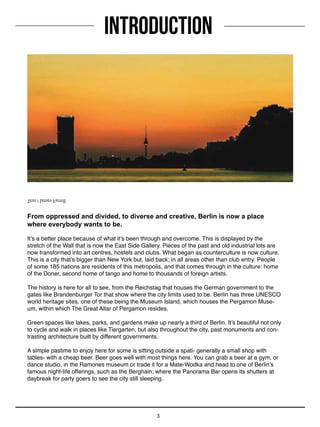
It’s a better place because of what it’s been through and overcome. This is displayed by the
stretch of the Wall that is now the East Side Gallery. Pieces of the past and old industrial lots are
now transformed into art centres, hostels and clubs. What began as counterculture is now culture.
This is a city that’s bigger than New York but, laid back; in all areas other than club entry. People
of some 185 nations are residents of this metropolis, and that comes through in the culture: home
of the Doner, second home of tango and home to thousands of foreign artists.
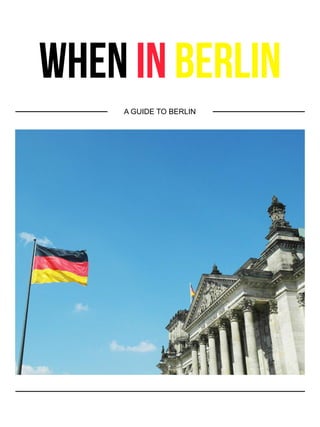
The history is here for all to see, from the Reichstag that houses the German government to the
gates like Brandenburger Tor that show where the city limits used to be. Berlin has three UNESCO
world heritage sites, one of these being the Museum Island, which houses the Pergamon Muse-
um, within which The Great Altar of Pergamon resides.
Green spaces like lakes, parks, and gardens make up nearly a third of Berlin. It’s beautiful not only
to cycle and walk in places like Tiergarten, but also throughout the city, past monuments and con-
trasting architecture built by different governments.
A simple pastime to enjoy here for some is sitting outside a spati- generally a small shop with
tables- with a cheap beer. Beer goes well with most things here. You can grab a beer at a gym, or
dance studio, in the Ramones museum or trade it for a Mate-Wodka and head to one of Berlin’s
famous night-life offerings, such as the Berghain; where the Panorama Bar opens its shutters at
daybreak for party goers to see the city still sleeping.
INTRODUCTION
Text / James Farrell
INTRODUCTION
4
Welcome to the mosaic that is Berlin. You’ll soon find yourself walking down the road next to a com-
puter science graduate who now sells things in Mauerpark Flea Market and does some Thai mas-
sage on the side, or with an engineer who spends the weekends clubbing from Friday to Sunday
and is starting to see the merits of Veganarchism.
People come to Berlin to live, party and create. That’s what makes this place what it is today. This
guide will help you get to know Berlin that little bit easier.
BERLIN’S HISTORY
5
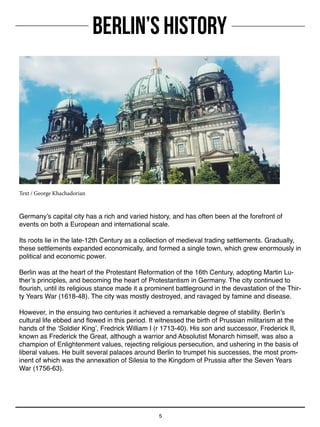
Germany’s capital city has a rich and varied history, and has often been at the forefront of
events on both a European and international scale.
Its roots lie in the late-12th Century as a collection of medieval trading settlements. Gradually,
these settlements expanded economically, and formed a single town, which grew enormously in
political and economic power.
Berlin was at the heart of the Protestant Reformation of the 16th Century, adopting Martin Lu-
ther’s principles, and becoming the heart of Protestantism in Germany. The city continued to
flourish, until its religious stance made it a prominent battleground in the devastation of the Thir-
ty Years War (1618-48). The city was mostly destroyed, and ravaged by famine and disease.
However, in the ensuing two centuries it achieved a remarkable degree of stability. Berlin’s
cultural life ebbed and flowed in this period. It witnessed the birth of Prussian militarism at the
hands of the ‘Soldier King’, Fredrick William I (r 1713-40). His son and successor, Frederick II,
known as Frederick the Great, although a warrior and Absolutist Monarch himself, was also a
champion of Enlightenment values, rejecting religious persecution, and ushering in the basis of
liberal values. He built several palaces around Berlin to trumpet his successes, the most prom-
inent of which was the annexation of Silesia to the Kingdom of Prussia after the Seven Years
War (1756-63).
Text / George Khachadorian
BERLIN’S HISTORY
6
In the aftermath of war, revolution struck Berlin, and the new Weimar Republic was pro-
claimed on 9th November 1918. Although Berlin a powerful city, Germany was economi-
cally destitute, as it struggled to acquiesce to the harsh terms of the Peace of Versailles.
In 1923, hyper-inflation ravaged the city, and social and political instability was rife. How-
ever, 1920s Berlin saw a ‘Golden Era’ of modern architecture, jazz, sexual decadence,
and artistic expression.
The Wall Street Crash ended this. Massive unemployment fostered further political ex-
tremism. People expressed their frustration by voting for extremist parties. The Nazi party
was the ultimate victor, and Hitler became Chancellor on 30 January 1933. All public and
private life was co-ordinated according to Nazi doctrine, and Berlin became the heart of a
totalitarian State. The 1936 Berlin Olympics was the most prominent attempt to showcase
Nazism’s triumphant rule over the city. Nearly all of Berlin’s substantial Jewish persecu-
tion were either forced to emigrate from the country, or became a victim of the Nazi’s gen-
ocidal ‘Final Solution to the Jewish Question’ during the war.
The Second World War ravaged Berlin like never before. The city was completely flat-
tened, and its population reduced by half. Allied forces completely occupied the city – So-
viet troops occupied the East; American, French and British troops occupied the West.
Berlin became a microcosm for a divided Germany: West Berlin, an isolated city-state of
the Federal Republic of Germany (FRG); and East Berlin, capital city of the Soviet-backed
German Democratic Republic (GDR). Thousands fled from the East, seeking greater
prosperity. In 1961, the GDR constructed the Berlin Wall to stop this, and for nearly thirty
years, Berlin remained a divided city, both politically and ideologically.
On 9th November 1989, the Wall came crashing down as one-party communist rule be-
came unsustainable, becoming a poignant symbol for the end of the Cold War. Germany
was re-unified less than a year later, Berlin once again becoming its capital city. Now,
Berlin is once again the centre of an economically powerful Germany. It has experienced
a cultural boom, and its art, fashion and music scenes are now world famous.
7
Transportation
Berlin is a huge city, one of the biggest in Europe, so it’s a must for every tourist to know the avail-
able public transport options and how to use them, otherwise it would take ages to visit all the
fancy sites recommended in this guide.
Transport
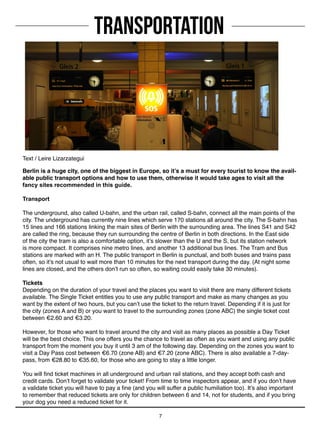
The underground, also called U-bahn, and the urban rail, called S-bahn, connect all the main points of the
city. The underground has currently nine lines which serve 170 stations all around the city. The S-bahn has
15 lines and 166 stations linking the main sites of Berlin with the surrounding area. The lines S41 and S42
are called the ring, because they run surrounding the centre of Berlin in both directions. In the East side
of the city the tram is also a comfortable option, it’s slower than the U and the S, but its station network
is more compact. It comprises nine metro lines, and another 13 additional bus lines. The Tram and Bus
stations are marked with an H. The public transport in Berlin is punctual, and both buses and trains pass
often, so it’s not usual to wait more than 10 minutes for the next transport during the day. (At night some
lines are closed, and the others don’t run so often, so waiting could easily take 30 minutes).
Tickets
Depending on the duration of your travel and the places you want to visit there are many different tickets
available. The Single Ticket entitles you to use any public transport and make as many changes as you
want by the extent of two hours, but you can’t use the ticket to the return travel. Depending if it is just for
the city (zones A and B) or you want to travel to the surrounding zones (zone ABC) the single ticket cost
between €2.60 and €3.20.
However, for those who want to travel around the city and visit as many places as possible a Day Ticket
will be the best choice. This one offers you the chance to travel as often as you want and using any public
transport from the moment you buy it until 3 am of the following day. Depending on the zones you want to
visit a Day Pass cost between €6.70 (zone AB) and €7.20 (zone ABC). There is also available a 7-day-
pass, from €28.80 to €35.60, for those who are going to stay a little longer.
You will find ticket machines in all underground and urban rail stations, and they accept both cash and
credit cards. Don’t forget to validate your ticket! From time to time inspectors appear, and if you don’t have
a validate ticket you will have to pay a fine (and you will suffer a public humiliation too). It’s also important
to remember that reduced tickets are only for children between 6 and 14, not for students, and if you bring
your dog you need a reduced ticket for it.
Text / Leire Lizarzategui
8
Transportation
Politeness
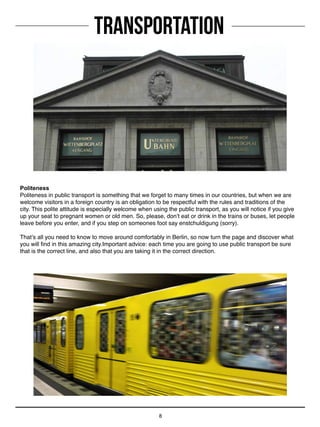
Politeness in public transport is something that we forget to many times in our countries, but when we are
welcome visitors in a foreign country is an obligation to be respectful with the rules and traditions of the
city. This polite attitude is especially welcome when using the public transport, as you will notice if you give
up your seat to pregnant women or old men. So, please, don’t eat or drink in the trains or buses, let people
leave before you enter, and if you step on someones foot say enstchuldigung (sorry).
That’s all you need to know to move around comfortably in Berlin, so now turn the page and discover what
you will find in this amazing city.Important advice: each time you are going to use public transport be sure
that is the correct line, and also that you are taking it in the correct direction.
SURVIVAL GUIDE
9
DO Try to use German as much as you can
when going out to eat or shop. Learn at least
enough to be polite to those who may not speak
English.
DO Buy a travel ticket upon arrival. One month
of unlimited public transport is approx €78. Weekly
ans daily options are also available.
DO Download the BVG app for smartphones.
This app will tell you how to get around the entire
city using public transportation.
DO Bring your student ID. This will cut most mu-
seum, monument and park visit costs in half.
DO Research clubs, restaurants and bars be-
forehand so you can hit the ground running! Blogs
like The Ex-Berliner and Unlike Berlin are also help-
ful when researching live music, cafés or events
around the city.
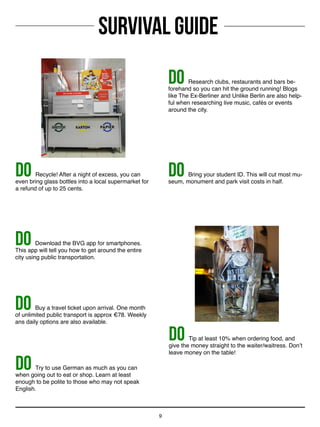
DO Recycle! After a night of excess, you can
even bring glass bottles into a local supermarket for
a refund of up to 25 cents.
DO Tip at least 10% when ordering food, and
give the money straight to the waiter/waitress. Don’t
leave money on the table!
SURVIVAL GUIDE
Hallo! 	
Hello!
Sprechen Sie Englisch? 	
Do you speak English?
Ich spreche kein Deutsch. 	
I don’t speak German.
Wo ist…? 	
Where is…?
Die Speisekarte, bitte.
The menu, please.
Bezahlen, bitte.
I’d like to pay.
Ich will nach (Mauerpark) gehen.	
I want to go to (Mauerpark).
Wieviel kostet das? 	
How much does this cost?
USEFUL PHRASES
1010
DOn’t Think you’ll make it into every club
you queue for, even if you’ve been waiting for three
hours.
DOn’t Forget to take your travel ticket with
you wherever you go. If you get caught without a
ticket (which can happen at any time), you will be
fined €40. No questions asked.
DOn’tEver greet Germans by saying “Guten
Tag!” Instead, just say “Hallo!”
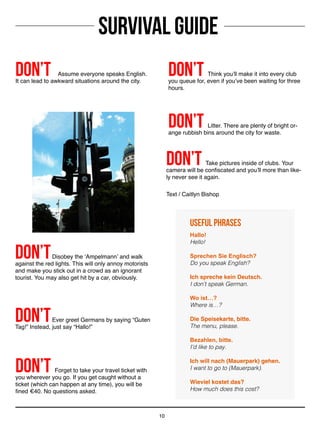
DOn’tDisobey the ‘Ampelmann’ and walk
against the red lights. This will only annoy motorists
and make you stick out in a crowd as an ignorant
tourist. You may also get hit by a car, obviously.
DOn’t Assume everyone speaks English.
It can lead to awkward situations around the city.
DOn’t Litter. There are plenty of bright or-
ange rubbish bins around the city for waste.
DOn’t Take pictures inside of clubs. Your
camera will be confiscated and you’ll more than like-
ly never see it again.
Text / Caitlyn Bishop

Curso/CTR Reisejournalismus: When in Berlin

  • 1.
    A GUIDE TOBERLIN WHEN IN BERLIN download full E-Book: http://www.lulu.com/content/e-book/when-in-berlin/15080740
  • 2.
    2 CONTENT INTRODUCTION / 3 BERLIN’SHiSTORY / 5 TRANSPORTATION / Survival Guide / 7 9 accommodation / SIGHTS & MONUMENTS / ART & CULTURE / eating out / bars & clubs / SHOPPING / GREEN SPACES / CONTRIBUTORS / 11 12 40 62 89 92 105 113
  • 3.
    3 From oppressed anddivided, to diverse and creative, Berlin is now a place where everybody wants to be. It’s a better place because of what it’s been through and overcome. This is displayed by the stretch of the Wall that is now the East Side Gallery. Pieces of the past and old industrial lots are now transformed into art centres, hostels and clubs. What began as counterculture is now culture. This is a city that’s bigger than New York but, laid back; in all areas other than club entry. People of some 185 nations are residents of this metropolis, and that comes through in the culture: home of the Doner, second home of tango and home to thousands of foreign artists. The history is here for all to see, from the Reichstag that houses the German government to the gates like Brandenburger Tor that show where the city limits used to be. Berlin has three UNESCO world heritage sites, one of these being the Museum Island, which houses the Pergamon Muse- um, within which The Great Altar of Pergamon resides. Green spaces like lakes, parks, and gardens make up nearly a third of Berlin. It’s beautiful not only to cycle and walk in places like Tiergarten, but also throughout the city, past monuments and con- trasting architecture built by different governments. A simple pastime to enjoy here for some is sitting outside a spati- generally a small shop with tables- with a cheap beer. Beer goes well with most things here. You can grab a beer at a gym, or dance studio, in the Ramones museum or trade it for a Mate-Wodka and head to one of Berlin’s famous night-life offerings, such as the Berghain; where the Panorama Bar opens its shutters at daybreak for party goers to see the city still sleeping. INTRODUCTION Text / James Farrell
  • 4.
    INTRODUCTION 4 Welcome to themosaic that is Berlin. You’ll soon find yourself walking down the road next to a com- puter science graduate who now sells things in Mauerpark Flea Market and does some Thai mas- sage on the side, or with an engineer who spends the weekends clubbing from Friday to Sunday and is starting to see the merits of Veganarchism. People come to Berlin to live, party and create. That’s what makes this place what it is today. This guide will help you get to know Berlin that little bit easier.
  • 5.
    BERLIN’S HISTORY 5 Germany’s capitalcity has a rich and varied history, and has often been at the forefront of events on both a European and international scale. Its roots lie in the late-12th Century as a collection of medieval trading settlements. Gradually, these settlements expanded economically, and formed a single town, which grew enormously in political and economic power. Berlin was at the heart of the Protestant Reformation of the 16th Century, adopting Martin Lu- ther’s principles, and becoming the heart of Protestantism in Germany. The city continued to flourish, until its religious stance made it a prominent battleground in the devastation of the Thir- ty Years War (1618-48). The city was mostly destroyed, and ravaged by famine and disease. However, in the ensuing two centuries it achieved a remarkable degree of stability. Berlin’s cultural life ebbed and flowed in this period. It witnessed the birth of Prussian militarism at the hands of the ‘Soldier King’, Fredrick William I (r 1713-40). His son and successor, Frederick II, known as Frederick the Great, although a warrior and Absolutist Monarch himself, was also a champion of Enlightenment values, rejecting religious persecution, and ushering in the basis of liberal values. He built several palaces around Berlin to trumpet his successes, the most prom- inent of which was the annexation of Silesia to the Kingdom of Prussia after the Seven Years War (1756-63). Text / George Khachadorian
  • 6.
    BERLIN’S HISTORY 6 In theaftermath of war, revolution struck Berlin, and the new Weimar Republic was pro- claimed on 9th November 1918. Although Berlin a powerful city, Germany was economi- cally destitute, as it struggled to acquiesce to the harsh terms of the Peace of Versailles. In 1923, hyper-inflation ravaged the city, and social and political instability was rife. How- ever, 1920s Berlin saw a ‘Golden Era’ of modern architecture, jazz, sexual decadence, and artistic expression. The Wall Street Crash ended this. Massive unemployment fostered further political ex- tremism. People expressed their frustration by voting for extremist parties. The Nazi party was the ultimate victor, and Hitler became Chancellor on 30 January 1933. All public and private life was co-ordinated according to Nazi doctrine, and Berlin became the heart of a totalitarian State. The 1936 Berlin Olympics was the most prominent attempt to showcase Nazism’s triumphant rule over the city. Nearly all of Berlin’s substantial Jewish persecu- tion were either forced to emigrate from the country, or became a victim of the Nazi’s gen- ocidal ‘Final Solution to the Jewish Question’ during the war. The Second World War ravaged Berlin like never before. The city was completely flat- tened, and its population reduced by half. Allied forces completely occupied the city – So- viet troops occupied the East; American, French and British troops occupied the West. Berlin became a microcosm for a divided Germany: West Berlin, an isolated city-state of the Federal Republic of Germany (FRG); and East Berlin, capital city of the Soviet-backed German Democratic Republic (GDR). Thousands fled from the East, seeking greater prosperity. In 1961, the GDR constructed the Berlin Wall to stop this, and for nearly thirty years, Berlin remained a divided city, both politically and ideologically. On 9th November 1989, the Wall came crashing down as one-party communist rule be- came unsustainable, becoming a poignant symbol for the end of the Cold War. Germany was re-unified less than a year later, Berlin once again becoming its capital city. Now, Berlin is once again the centre of an economically powerful Germany. It has experienced a cultural boom, and its art, fashion and music scenes are now world famous.
  • 7.
    7 Transportation Berlin is ahuge city, one of the biggest in Europe, so it’s a must for every tourist to know the avail- able public transport options and how to use them, otherwise it would take ages to visit all the fancy sites recommended in this guide. Transport The underground, also called U-bahn, and the urban rail, called S-bahn, connect all the main points of the city. The underground has currently nine lines which serve 170 stations all around the city. The S-bahn has 15 lines and 166 stations linking the main sites of Berlin with the surrounding area. The lines S41 and S42 are called the ring, because they run surrounding the centre of Berlin in both directions. In the East side of the city the tram is also a comfortable option, it’s slower than the U and the S, but its station network is more compact. It comprises nine metro lines, and another 13 additional bus lines. The Tram and Bus stations are marked with an H. The public transport in Berlin is punctual, and both buses and trains pass often, so it’s not usual to wait more than 10 minutes for the next transport during the day. (At night some lines are closed, and the others don’t run so often, so waiting could easily take 30 minutes). Tickets Depending on the duration of your travel and the places you want to visit there are many different tickets available. The Single Ticket entitles you to use any public transport and make as many changes as you want by the extent of two hours, but you can’t use the ticket to the return travel. Depending if it is just for the city (zones A and B) or you want to travel to the surrounding zones (zone ABC) the single ticket cost between €2.60 and €3.20. However, for those who want to travel around the city and visit as many places as possible a Day Ticket will be the best choice. This one offers you the chance to travel as often as you want and using any public transport from the moment you buy it until 3 am of the following day. Depending on the zones you want to visit a Day Pass cost between €6.70 (zone AB) and €7.20 (zone ABC). There is also available a 7-day- pass, from €28.80 to €35.60, for those who are going to stay a little longer. You will find ticket machines in all underground and urban rail stations, and they accept both cash and credit cards. Don’t forget to validate your ticket! From time to time inspectors appear, and if you don’t have a validate ticket you will have to pay a fine (and you will suffer a public humiliation too). It’s also important to remember that reduced tickets are only for children between 6 and 14, not for students, and if you bring your dog you need a reduced ticket for it. Text / Leire Lizarzategui
  • 8.
    8 Transportation Politeness Politeness in publictransport is something that we forget to many times in our countries, but when we are welcome visitors in a foreign country is an obligation to be respectful with the rules and traditions of the city. This polite attitude is especially welcome when using the public transport, as you will notice if you give up your seat to pregnant women or old men. So, please, don’t eat or drink in the trains or buses, let people leave before you enter, and if you step on someones foot say enstchuldigung (sorry). That’s all you need to know to move around comfortably in Berlin, so now turn the page and discover what you will find in this amazing city.Important advice: each time you are going to use public transport be sure that is the correct line, and also that you are taking it in the correct direction.
  • 9.
    SURVIVAL GUIDE 9 DO Tryto use German as much as you can when going out to eat or shop. Learn at least enough to be polite to those who may not speak English. DO Buy a travel ticket upon arrival. One month of unlimited public transport is approx €78. Weekly ans daily options are also available. DO Download the BVG app for smartphones. This app will tell you how to get around the entire city using public transportation. DO Bring your student ID. This will cut most mu- seum, monument and park visit costs in half. DO Research clubs, restaurants and bars be- forehand so you can hit the ground running! Blogs like The Ex-Berliner and Unlike Berlin are also help- ful when researching live music, cafés or events around the city. DO Recycle! After a night of excess, you can even bring glass bottles into a local supermarket for a refund of up to 25 cents. DO Tip at least 10% when ordering food, and give the money straight to the waiter/waitress. Don’t leave money on the table!
  • 10.
    SURVIVAL GUIDE Hallo! Hello! SprechenSie Englisch? Do you speak English? Ich spreche kein Deutsch. I don’t speak German. Wo ist…? Where is…? Die Speisekarte, bitte. The menu, please. Bezahlen, bitte. I’d like to pay. Ich will nach (Mauerpark) gehen. I want to go to (Mauerpark). Wieviel kostet das? How much does this cost? USEFUL PHRASES 1010 DOn’t Think you’ll make it into every club you queue for, even if you’ve been waiting for three hours. DOn’t Forget to take your travel ticket with you wherever you go. If you get caught without a ticket (which can happen at any time), you will be fined €40. No questions asked. DOn’tEver greet Germans by saying “Guten Tag!” Instead, just say “Hallo!” DOn’tDisobey the ‘Ampelmann’ and walk against the red lights. This will only annoy motorists and make you stick out in a crowd as an ignorant tourist. You may also get hit by a car, obviously. DOn’t Assume everyone speaks English. It can lead to awkward situations around the city. DOn’t Litter. There are plenty of bright or- ange rubbish bins around the city for waste. DOn’t Take pictures inside of clubs. Your camera will be confiscated and you’ll more than like- ly never see it again. Text / Caitlyn Bishop