1
erlin,
Bitte!B An
alternativegui
de to Berlin for
yourtwenties
3
Contents
1. INTRODUCTION
2. HISTORY
3. TRANSPORT
4. SURVIVAL GUIDE
5. PROFILES
A CTR PRODUCTION
5
Pack your suitcase and get ready to visit Berlin, Germany! Explore this historical city
and revel in a new culture. From parks, museums, and monuments to bars, cafés, and
restaurants, you won’t want to miss out. Whether you’re visiting for a weekend or stay-
ing for weeks, you’ll find yourself amazed at all that Berlin has to offer. With easy access
to every tram, reaching your desired destinations can be stress-free. Or be sure to lace
up those shoes and get ready to walk or bike almost anywhere you like in the city. Gear
up for an adventure, because with so much to do and see you’ll wonder why you hadn’t
visited sooner.
INTRODUCTION
4
3
2
1Berlin is a very diverse city and the locals
are pretty laid back. The city has an urban
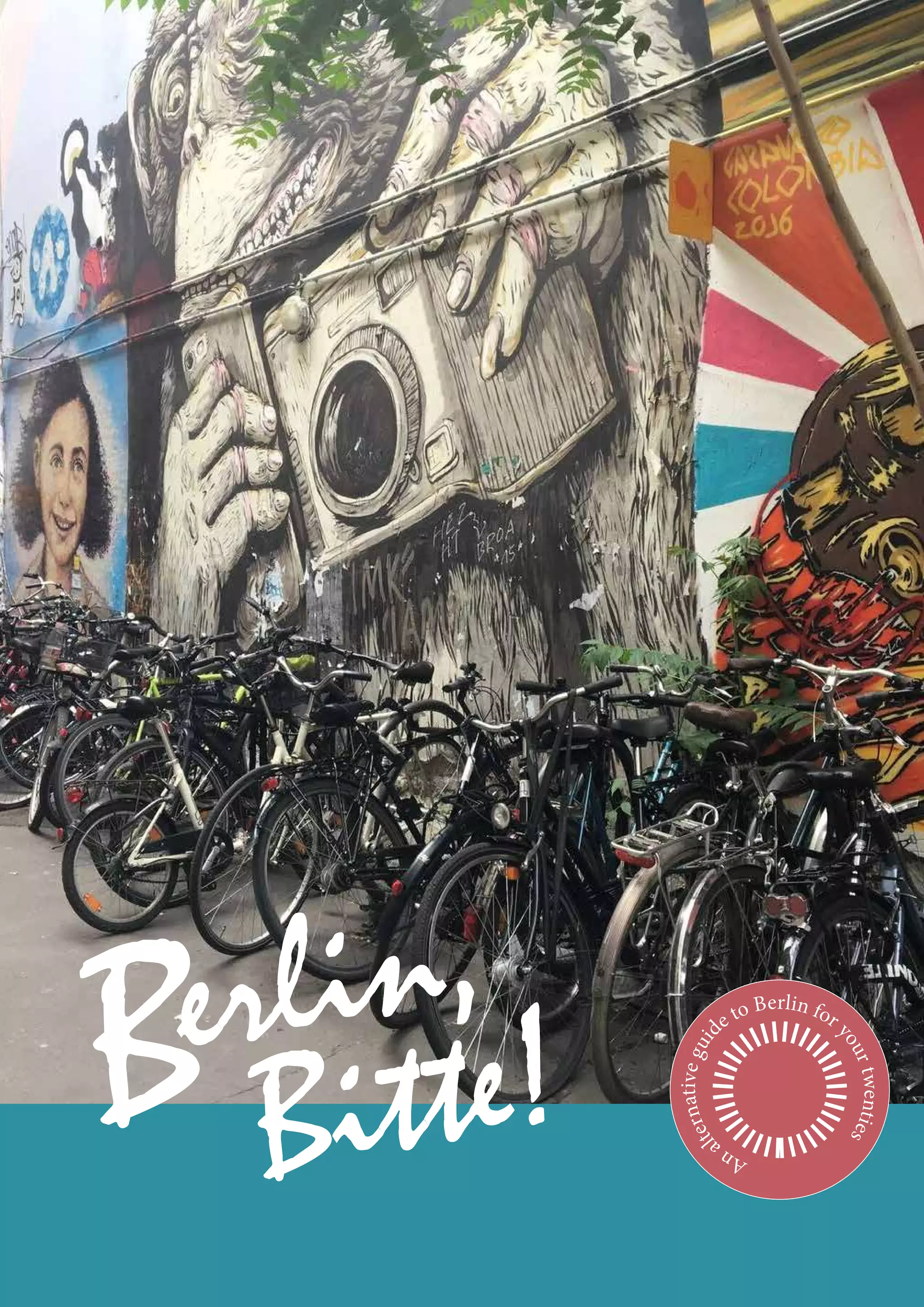
vibe with graffiti artistically drawn on
many buildings which makes for a unique
atmosphere. Covered with visionary
prints, the East Side Gallery in East Berlin
is a must see. Wander down the sidewalk
and admire the artwork whilst enjoying a
delicious kebab or an ice cream cone you
can buy at one of the many stands nearby.
Take a stroll through the parks that are
filled with beautiful greenery, historical
monuments, and people enjoying the
sunshine. Be sure to free up your day,
because these areas are huge and soaking
up the surroundings can take an entire
afternoon. Treptower Park , TierGarten,
and Tempelhofer Feld are just a few of the
many impressive grounds that you can
find whilst appreciating Germany. Don’t
forget to pack your swimsuit as some of
the parks have lakes and rivers where you
can paddleboard, canoe or jump in for a
dip.
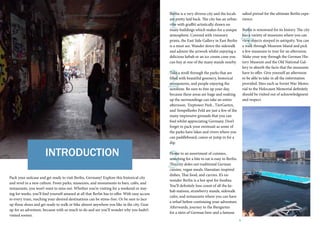
Home to an assortment of cuisines,
searching for a bite to eat is easy in Berlin.
This city doles out traditional German
cuisine, vegan meals, Hawaiian-inspired
dishes, Thai food, and curries. It’s no
wonder Berlin is a hot spot for foodies.
You’ll definitely lose count of all the ke-
bab stations, strawberry stands, sidewalk
cafes, and restaurants where you can have
a refuel before continuing your adventure.
Afterwards, journey to the Biergarten
for a stein of German beer and a famous
salted pretzel for the ultimate Berlin expe-
rience.
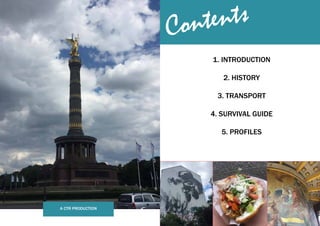
Berlin is renowned for its history. The city
has a variety of museums where you can
view objects steeped in antiquity. You can
a walk through Museum Island and pick
a few museums to tour for an afternoon.
Make your way through the German His-
tory Museum and the Old National Gal-
lery to absorb the facts that the museums
have to offer. Give yourself an afternoon
to be able to take in all the information
provided. Sites such as Soviet War Memo-
rial to the Holocaust Memorial definitely
should be visited out of acknowledgment
and respect.
7
6
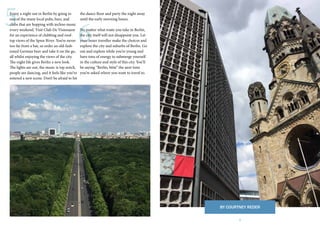
5Enjoy a night out in Berlin by going to
one of the many local pubs, bars, and
clubs that are hopping with techno music
every weekend. Visit Club De Visionaere
for an experience of clubbing and roof-
top views of the Spree River. You’re never
too far from a bar, so order an old-fash-
ioned German beer and take it on the go,
all whilst enjoying the views of the city.
The night life gives Berlin a new look.
The lights are out, the music is top notch,
people are dancing, and it feels like you’ve
entered a new scene. Don’t be afraid to hit
the dance floor and party the night away
until the early morning hours.
No matter what route you take in Berlin,
the city itself will not disappoint you. Let
your inner traveller make the choices and
explore the city and suburbs of Berlin. Go
out and explore while you’re young and
have tons of energy to submerge yourself
in the culture and style of this city. You’ll
be saying “Berlin, bitte” the next time
you’re asked where you want to travel to.
BY COURTNEY REDER
9
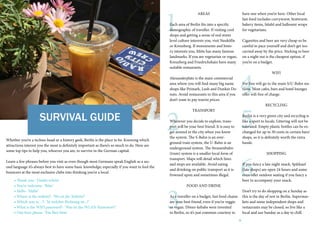
SURVIVAL GUIDE
Whether you’re a techno-head or a history geek, Berlin is the place to be. Knowing which
attractions interest you the most is definitely important as there’s so much to do. Here are
some top tips to help you, whoever you are, to survive in the German capital:
Learn a few phrases before you visit as even though most Germans speak English as a sec-
ond language it’s always best to have some basic knowledge; especially if you want to fool the
bouncers at the most exclusive clubs into thinking you’re a local.
• Thank you- ‘Danke schÖn’
• You’re welcome- ‘Bitte’
• Hello- ‘Hallo’
• Where is the toilette?- ‘Wo ist die Toilette?’
• Which way is…?- ‘In welcher Richtung ist...?’
• What is the WIFI password?- ‘Was ist das WLAN-Kennwort?’
• One beer please- ‘Ein Bier bitte’
SURVIVAL GUIDE
6
5
4
have one when you’re here. Other local
fast food includes currywurst, bratwurst,
bakery items, falafel and halloumi wraps
for vegetarians.
Cigarettes and beer are very cheap so be
careful to pace yourself and don’t get too
carried away by the price. Sticking to beer
on a night out is the cheapest option, if
you’re on a budget.
WIFI
For free wifi go to the main S/U-Bahn sta-
tions. Most cafes, bars and hotel lounges
offer wifi free of charge.
RECYCLING
Berlin is a very green city and recycling is
like a sport to locals. Littering will not be
tolerated. Empty plastic bottles can be ex-
changed for up to 30 cents in certain bars/
shops, so it is definitely worth the extra
hassle.
SHOPPING
If you fancy a late night snack, Spätkauf
(late shops) are open 24 hours and some
even offer outdoor seating if you fancy a
beer to accompany your snack.
Don’t try to do shopping on a Sunday as
this is the day of rest in Berlin. Supermar-
kets and some independent shops and
restaurants may be closed, so live like a
local and use Sunday as a day to chill.
3
2
1
AREAS
Each area of Berlin fits into a specific
demographic of traveller. If visiting cool
shops and getting a sense of real street
level culture interests you, visit Neukölln
or Kreuzberg. If monuments and histo-
ry interests you, Mitte has many famous
landmarks. If you are vegetarian or vegan,
Kreuzberg and Friedrichshain have many
suitable restaurants.
Alexanderplatz is the main commercial
area where you will find many big name
shops like Primark, Lush and Dunkin Do-
nuts. Avoid restaurants in this area if you
don’t want to pay tourist prices.
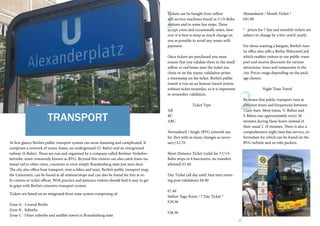
TRANSPORT
Wherever you decide to explore, trans-
port will be your best friend. It is easy to
get around in the city when you know
the system. The S-Bahn is an over-
ground train system, the U-Bahn is an
underground system. The Strassenbahn
(tram) system is a smaller local form of
transport. Maps will detail which lines
and stops are available. Avoid eating
and drinking on public transport as it is
frowned upon and sometimes illegal.
FOOD AND DRINK
As a traveller on a budget, fast food chains
are your best friend, even if you’re veggie
or vegan. Döner-kebabs were invented
in Berlin, so it’s just common courtesy to
11
8
9
107
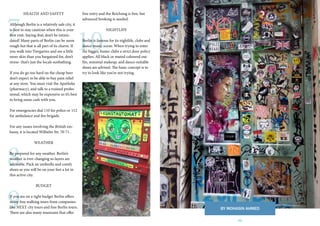
HEALTH AND SAFETY
Although Berlin is a relatively safe city, it
is best to stay cautious when this is your
first visit. Saying that, don’t be intimi-
dated! Many parts of Berlin can be seem
rough but that is all part of its charm. If
you walk into Tiergarten and see a little
more skin than you bargained for, don’t
stress- that’s just the locals sunbathing.
If you do go too hard on the cheap beer
don’t expect to be able to buy pain relief
at any store. You must visit the Apotheke
(pharmacy), and talk to a trained profes-
sional, which may be expensive so it’s best
to bring some cash with you.
For emergencies dial 110 for police or 112
for ambulance and fire brigade.
For any issues involving the British em-
bassy, it is located Wilhelm Str. 70-71 .
WEATHER
Be prepared for any weather. Berlin’s
weather is ever changing so layers are
advisable. Pack an umbrella and comfy
shoes as you will be on your feet a lot in
this active city.
BUDGET
If you are on a tight budget Berlin offers
many free walking tours from companies
like NEXT city tours and free Berlin tours.
There are also many museums that offer
free entry and the Reichstag is free, but
advanced booking is needed.
NIGHTLIFE
Berlin is famous for its nightlife, clubs and
dance music scene. When trying to enter
the bigger, busier clubs a strict door policy
applies. All black or muted coloured out-
fits, minimal makeup, and dance-suitable
shoes are advised. The basic concept is to
try to look like you’re not trying.
BY MOHASIN AHMED
13
HISTORY
An interview with Berlin
Germany’s leading star from 1871 to the present
We were lucky enough to get the inside scoop on Berlin itself. The talented actor
has a dappled past and has played many diverse roles from war veteran to pres-
ent-day techno clubber. After tentative beginnings the performer has received mixed
reviews from critics over the years and the stage line-up has defined much of the city’s
quirky and edgy character today. You will not find a brisk businessman, but a beer
loving, tattooed, scarred and artistic character that is extraordinarily easy to get along
with.
1871-1918
Tell us about your years as a child in the
limelight, and your first role as an overly
ambitious soldier. We gather that your
rendition of trench warfare was a failure -
what can you say about this time?
You could say that I was born to immedi-
ate stardom in 1871, as I was the head to
the newly formed German Reich. Initially
I was wealthy and successful in my scien-
tific endeavours, and a lavish purchaser
of the luxurious goods sold at KaDeWe.
Looking back, I think the fame went to
my head and I grew arrogant. In a rash
decision I undertook the role of conquer-
ing warrior. I met with disapproving re-
actions from France, Britain and the USA
and ultimately the scene was a drastic fail-
ure. Despite this I didn’t learn my lesson
and was to have another flop later in my
career, but we’ll get to that soon.
It sounds like your childhood was rath-
er eventful and costly. I believe that, as a
teenager you had a difficult time econom-
ically, is that correct?
Ah, yes one could say that my career as a
child actor was rather a failure economi-
cally. As a teenager I discarded the Kaiser
costume in 1918 and attempted a Weimar
Republic instead. My acting career had
not yet taken off and I was racking up
debts to the allies. Hyperinflation hit in
the 1920s and prices rose every day, which
meant that I took a break from the stage
and carted around wheelbarrows of cash
instead. I remember that this was such
a burden that I took a fancy to Hitler’s
promises for a better theatre - although
we all know how that turned out.
Your first portrayal as a soldier did not go
down well and yet you chose this char-
acter a second time. An ill-fated decision
don’t you agree?
To the detriment of many parents we can
all be rebellious as teenagers, but I went
a bit further than most. I admit that my
adolescent years are not some of my best,
and I was strongly influenced by National
Socialist peer pressure. I argued with the
city’s leaders and replaced them with Hit-
ler. I also recall that in a fit of arson I set
the Reichstag alight in 1933 and watched
like a sulky bystander while students de-
molished books and attacked the Jewish
community.
The second attempt I made at a war pro-
duction was a bit too convincing and my
intention to portray a courageous lib-
erator backfired and I came across as a
hard-handed dominator of nations. They
say you learn from your past, but it took
me two failed plays before I attempted
a new character. I still carry the scars of
bullet holes from the 1945 Battle of Berlin
scene on many of my buildings.
1918-1933
1933-1945
15
Your next undertaking was the dramatic
staging for the Cold war with an intim-
idating Iron Curtain. Could you tell the
readers more about this?
The stage was mere rubble after 1945,
and the Soviets and the USA staged their
own dramas here until 1989. This was
the longest running production and we
kept an Iron Curtain for nearly 30 years,
from 1961 until 1989. In this period I lost
my title as the capital city to Bonn, and
the theatre displayed a decisive divid-
ing wall with East Berlin in Soviet hands
and West Berlin in American hands. The
most watched American-Soviet act was
the tank standoff at Checkpoint Charlie
in 1961, and the whole world was a con-
cerned spectator. The finale came with the
destruction of the Berlin Wall, but I didn’t
part with it all and the East Side Gallery is
a keepsake of this time.
You have said that the 90s were quite de-
finitive for you and it was in this time that
you reclaimed your status as the leading
star of Germany. Please elaborate on this
statement.
It was the 90s that shaped who I am to-
day as I was re-established as the Capital
city of Germany in 1999, soon after the
country had been reunified in 1989. I
also started hosting many underground
techno raves in this time, often having to
relocate before the authorities discovered
us. After we regained our theatre the cel-
ebrations were contagious and the old in-
dustrial buildings, war bunkers and power
plants were ideal locations for our illegal
raves. I merged the characters of East and
West Berlin and became someone new
and edgier with a rebellious artistic ten-
dency. I grew an obsession with tattoos
and hipster fashion as I experimented
with alternative art.
You have had quite an adventurous life
and a turbulent career. Is there anything
else you would like your fans to know?
I have matured in my relationships with
fellow countries, and at the risk of sound-
ing self-important, I am now a world-re-
nowned figure in the global theatre. I
believe in embracing the past as it defines
who we are today and I have kept remind-
ers of this within my city. I may be wiser,
but I still know how to party the weekend
away and maintain the hipster image. I
am currently working on my next perfor-
mance so stay tuned for updates on my
upcoming role.
1945-1989
1990s
BY SAVANNA BRITTLEBANK
17
2TRANSPORT
At first glance Berlin’s public transport system can seem daunting and complicated. It
comprises a network of trams, buses, an underground (U-Bahn) and an overground
railway (S-Bahn). These are run and organised by a company called Berliner Verkehrs-
betriebe, more commonly known as BVG. Beyond this visitors can also catch trans-na-
tional rail to other cities, countries or even simply Brandenburg state just next door.
The city also offers boat transport, rent-a-bikes and taxis. Berlin’s public transport map,
the Liniennetz, can be found at all stations/stops and can also be found for free at in-
fo-centres or ticket offices. With practice and patience visitors should find it easy to get
to grips with Berlin’s extensive transport system.
Tickets are based on an integrated three zone system comprising of:
Zone A - Central Berlin
Zone B - Suburbs
Zone C - Outer suburbs and satellite towns in Brandenburg state
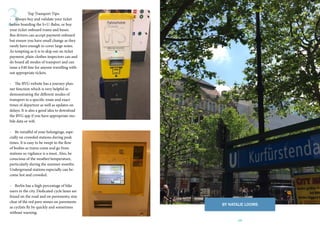
1Tickets can be bought from yellow
self-service machines found in U+S-Bahn
stations and in some bus stops. These
accept coins and occasionally notes, how-
ever it is best to keep as much change on
you as possible to avoid any issues with
payment.
Once tickets are purchased you must
ensure that you validate them in the small
yellow or red boxes near the ticket ma-
chine or on the trams; validation prints
a timestamp on the ticket. Berlin’s public
transit is run on an honour-based system
without ticket turnstiles, so it is important
to remember validation.
Ticket Type
AB
BC
ABC
Normaltarif / Single (BVG network use
for 2hrs with as many changes as neces-
sary) €2.70
Short Distance Ticket (valid for 3 U+S-
Bahn stops or 6 bus/metro, no transfers
allowed) €1.60
Day Ticket (all day until 3am next morn-
ing post validation) €6.90
€7.40
Sieben-Tage-Karte / 7 Day Ticket *
€29.50
€36.50
Monatskarte / Month Ticket *
€81.00
* prices for 7 day and monthly tickets are
subject to change by a few cent/€ yearly.
For those wanting a bargain, Berlin’s tour-
ist office also sells a Berlin WelcomeCard
which enables visitors to use public trans-
port and receive discounts for various
attractions, tours and restaurants in the
city. Prices range depending on the pack-
age chosen.
Night Time Travel
Be aware that public transport runs at
different times and frequencies between
12am-6am. Most trams, U-Bahns and
S-Bahns run approximately every 30
minutes during these hours instead of
their usual 2-10 minutes. There is also a
comprehensive night time bus service, in-
formation for which can be found on the
BVG website and on info packets.
19
3 Top Transport Tips:
- Always buy and validate your ticket
before boarding the S+U-Bahn, or buy
your ticket onboard trams and buses.
Bus drivers can accept payment onboard
but ensure you have small change as they
rarely have enough to cover large notes.
As tempting as it is to skip out on ticket
payment, plain-clothes inspectors can and
do board all modes of transport and can
issue a €40 fine for anyone travelling with-
out appropriate tickets.
- The BVG website has a journey plan-
ner function which is very helpful in
demonstrating the different modes of
transport to a specific route and exact
times of departure as well as updates on
delays. It is also a good idea to download
the BVG app if you have appropriate mo-
bile data or wifi.
- Be mindful of your belongings, espe-
cially on crowded stations during peak
times. It is easy to be swept in the flow
of bodies as trains come and go from
stations so vigilance is a must. Also, be
conscious of the weather/temperature,
particularly during the summer months.
Underground stations especially can be-
come hot and crowded.
- Berlin has a high percentage of bike
users in the city. Dedicated cycle lanes are
found on the road and on pavements; stay
clear of the red pave stones on pavements
as cyclists fly by quickly and sometimes
without warning.
BY NATALIE LOOMS
21
PROFILES
Thank you for reading our Berlin guide “Berlin, bitte!” an alternative
guide to Berlin for your twenties. Each member of the team has explored
Berlin to give you the ins and outs of Berlin’s districts, and to recommend the
best places to go on your visit to Berlin, whatever your budget. Read on to
meet the team, and enjoy our guide.
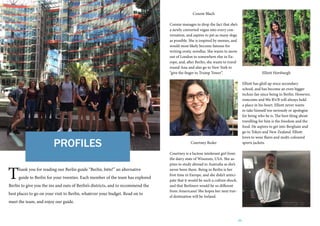
Connie Blach
Connie manages to drop the fact that she’s
a newly converted vegan into every con-
versation, and aspires to pet as many dogs
as possible. She is inspired by memes, and
would most likely become famous for
writing erotic novellas. She wants to move
out of London to somewhere else in Eu-
rope, and, after Berlin, she wants to travel
round Asia and also go to New York to
“give the finger to Trump Tower”.
Courtney Reder
Courtney is a lactose intolerant girl from
the dairy state of Wisonsin, USA. She as-
pires to study abroad in Australia as she’s
never been there. Being in Berlin is her
first time in Europe, and she didn’t antici-
pate that it would be such a culture shock,
and that Berliners would be so different
from Americans! She hopes her next trav-
el destination will be Ireland.
Elliott Horsburgh
Elliott has glo’d up since secondary
school, and has become an even bigger
techno fan since being in Berlin. However,
romcoms and 90s R’n’B will always hold
a place in his heart. Elliott never wants
to take himself too seriously or apologise
for being who he is. The best thing about
travelling for him is the freedom and the
food. He aspires to get into Berghain and
go to Tokyo and New Zealand. Elliott
loves to wear flares and multi-coloured
sports jackets.
23
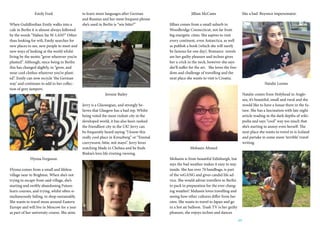
Emily Ford
When Guildfordian Emily walks into a
cafe in Berlin it is almost always followed
by the words “Haben Sie W-LAN?” Other
than looking for wifi, Emily searches for
new places to see, new people to meet and
new ways of looking at the world whilst
living by the motto “grow wherever you’re
planted”. Although, since being in Berlin
this has changed slightly, to “grow, and
wear cool clothes wherever you’re plant-
ed”. Emily can now recycle ‘the German
way’ and continues to add to her collec-
tion of grey jumpers.
Ffyona Ferguson
Ffyona comes from a small and lifeless
village near to Brighton. When she’s not
trying to escape from said village, she’s
starting and swiftly abandoning Future-
learn courses, and trying, whilst often si-
multaneously failing, to shop sustainably.
She wants to travel more around Eastern
Europe and will live in Moscow for a year
as part of her university course. She aims
to learn more languages after German
and Russian and her most frequent phrase
she’s used in Berlin is “wie bitte?”
Jerome Bailey
Jerry is a Glaswegian, and strongly be-
lieves that Glasgow has a bad rep. Whilst
being voted the most violent city in the
developed world, it has also been ranked
the friendliest city in the UK! Jerry can
be frequently heard saying “I know this
really cool place in Kreuzberg” or “Einmal
currywurst, bitte, mit mayo”. Jerry loves
watching Made in Chelsea and he finds
Binkie’s love life riveting viewing.
Jillian McCants
Jillian comes from a small suburb in
Woodbridge Connecticut, not far from
big energetic cities. She aspires to visit
every continent, even Antarctica, as well
as publish a book (which she will surely
be famous for one day). Romance novels
are her guilty pleasure and techno gives
her a crick in the neck, however she says
she’ll suffer for the art. She loves the free-
dom and challenge of travelling and the
next place she wants to visit is Croatia.
Mohasin Ahmed
Mohasin is from beautiful Edinburgh, but
says the bad weather makes it easy to stay
inside. She has over 70 handbags, is part
of the veGANG and gives candid life ad-
vice. She would advise travellers to Berlin
to pack in preparation for the ever chang-
ing weather! Mahasin loves travelling and
seeing how other cultures differ from her
own. She wants to travel to Japan and go
in a hot air balloon. Trash TV is her guilty
pleasure, she enjoys techno and dances
like a bad Beyonce impersonator.
Natalie Looms
Natalie comes from Holyhead in Angle-
sea, it’s beautiful, small and rural and she
would like to have a house there in the fu-
ture. She has a fascination with late night
article reading in the dark depths of wiki-
pedia and says “cool” way too much that
she’s starting to annoy even herself. The
next place she wants to travel to is Iceland
and partake in some more ‘terrible’ travel
writing.
25
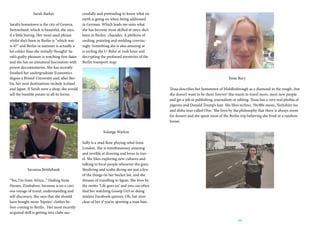
Sarah Barker
Sarah’s hometown is the city of Geneva,
Switzerland, which is beautiful, she says,
if a little boring. Her most used phrase
whilst she’s been in Berlin is “which way
is it?” and Berlin in summer is actually a
lot colder than she initially thought! Sa-
rah’s guilty pleasure is watching first dates
and she has an unnatural fascination with
prison documentaries. She has recently
finished her undergraduate Economics
degree a Bristol University and, after Ber-
lin, her next destinations include Iceland
and Japan. If Sarah were a shop, she would
sell the humble potato in all its forms.
Savanna Brittlebank
“Yes, I’m from Africa...” Hailing from
Harare, Zimbabwe, Savanna is on a curi-
ous voyage of travel, understanding and
self-discovery. She says that she should
have bought more ‘hipster’ clothes be-
fore coming to Berlin. Her most recently
acquired skill is getting into clubs suc-
cessfully and pretending to know what on
earth is going on when being addressed
in German. Which leads me onto what
she has become most skilled at since she’s
been in Berlin: charades. A plethora of
smiling, pointing and nodding convinc-
ingly. Something she is also amazing at
is surfing the U-Bahn at rush hour and
decrypting the profound mysteries of the
Berlin transport map.
Solange Warlow
Solly is a mad flute-playing rebel from
London. She is simultaneousy amazing
and terrible at drawing and loves to trav-
el. She likes exploring new cultures and
talking to local people wherever she goes.
Skydiving and scuba diving are just a few
of the things on her bucket list, and she
dreams of travelling to Japan. She lives by
the motto ‘Life goes on’ and you can often
find her watching Gossip Girl or doing
aimless Facebook quizzes. Oh, but steer
clear of her if you’re sporting a man bun.
Tessa Bury
Tessa describes her hometown of Middlesbrough as a diamond in the rough...but
she doesn’t want to be there forever! She wants to travel more, meet new people
and get a job in publishing, journalism or editing. Tessa has a very real phobia of
pigeons and Donald Trump’s hair. She likes techno, 70s/80s music, Yorkshire tea
and shiba inus called Otis. She lives by the philosophy that there is always room
for dessert and she spent most of the Berlin trip believing she lived in a rainbow
house.
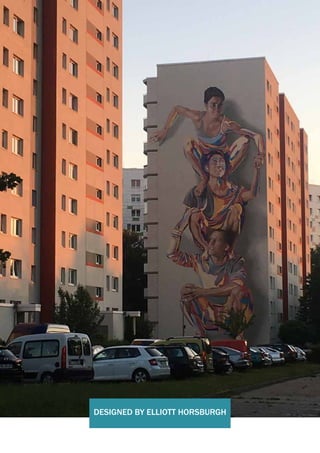
DESIGNED BY ELLIOTT HORSBURGH
full: https://berlincityguideblog.wordpress.com

CTR: Berlin Bitte !

  • 1.
  • 2.
    3 Contents 1. INTRODUCTION 2. HISTORY 3.TRANSPORT 4. SURVIVAL GUIDE 5. PROFILES A CTR PRODUCTION
  • 3.
    5 Pack your suitcaseand get ready to visit Berlin, Germany! Explore this historical city and revel in a new culture. From parks, museums, and monuments to bars, cafés, and restaurants, you won’t want to miss out. Whether you’re visiting for a weekend or stay- ing for weeks, you’ll find yourself amazed at all that Berlin has to offer. With easy access to every tram, reaching your desired destinations can be stress-free. Or be sure to lace up those shoes and get ready to walk or bike almost anywhere you like in the city. Gear up for an adventure, because with so much to do and see you’ll wonder why you hadn’t visited sooner. INTRODUCTION 4 3 2 1Berlin is a very diverse city and the locals are pretty laid back. The city has an urban vibe with graffiti artistically drawn on many buildings which makes for a unique atmosphere. Covered with visionary prints, the East Side Gallery in East Berlin is a must see. Wander down the sidewalk and admire the artwork whilst enjoying a delicious kebab or an ice cream cone you can buy at one of the many stands nearby. Take a stroll through the parks that are filled with beautiful greenery, historical monuments, and people enjoying the sunshine. Be sure to free up your day, because these areas are huge and soaking up the surroundings can take an entire afternoon. Treptower Park , TierGarten, and Tempelhofer Feld are just a few of the many impressive grounds that you can find whilst appreciating Germany. Don’t forget to pack your swimsuit as some of the parks have lakes and rivers where you can paddleboard, canoe or jump in for a dip. Home to an assortment of cuisines, searching for a bite to eat is easy in Berlin. This city doles out traditional German cuisine, vegan meals, Hawaiian-inspired dishes, Thai food, and curries. It’s no wonder Berlin is a hot spot for foodies. You’ll definitely lose count of all the ke- bab stations, strawberry stands, sidewalk cafes, and restaurants where you can have a refuel before continuing your adventure. Afterwards, journey to the Biergarten for a stein of German beer and a famous salted pretzel for the ultimate Berlin expe- rience. Berlin is renowned for its history. The city has a variety of museums where you can view objects steeped in antiquity. You can a walk through Museum Island and pick a few museums to tour for an afternoon. Make your way through the German His- tory Museum and the Old National Gal- lery to absorb the facts that the museums have to offer. Give yourself an afternoon to be able to take in all the information provided. Sites such as Soviet War Memo- rial to the Holocaust Memorial definitely should be visited out of acknowledgment and respect.
  • 4.
    7 6 5Enjoy a nightout in Berlin by going to one of the many local pubs, bars, and clubs that are hopping with techno music every weekend. Visit Club De Visionaere for an experience of clubbing and roof- top views of the Spree River. You’re never too far from a bar, so order an old-fash- ioned German beer and take it on the go, all whilst enjoying the views of the city. The night life gives Berlin a new look. The lights are out, the music is top notch, people are dancing, and it feels like you’ve entered a new scene. Don’t be afraid to hit the dance floor and party the night away until the early morning hours. No matter what route you take in Berlin, the city itself will not disappoint you. Let your inner traveller make the choices and explore the city and suburbs of Berlin. Go out and explore while you’re young and have tons of energy to submerge yourself in the culture and style of this city. You’ll be saying “Berlin, bitte” the next time you’re asked where you want to travel to. BY COURTNEY REDER
  • 5.
    9 SURVIVAL GUIDE Whether you’rea techno-head or a history geek, Berlin is the place to be. Knowing which attractions interest you the most is definitely important as there’s so much to do. Here are some top tips to help you, whoever you are, to survive in the German capital: Learn a few phrases before you visit as even though most Germans speak English as a sec- ond language it’s always best to have some basic knowledge; especially if you want to fool the bouncers at the most exclusive clubs into thinking you’re a local. • Thank you- ‘Danke schÖn’ • You’re welcome- ‘Bitte’ • Hello- ‘Hallo’ • Where is the toilette?- ‘Wo ist die Toilette?’ • Which way is…?- ‘In welcher Richtung ist...?’ • What is the WIFI password?- ‘Was ist das WLAN-Kennwort?’ • One beer please- ‘Ein Bier bitte’ SURVIVAL GUIDE 6 5 4 have one when you’re here. Other local fast food includes currywurst, bratwurst, bakery items, falafel and halloumi wraps for vegetarians. Cigarettes and beer are very cheap so be careful to pace yourself and don’t get too carried away by the price. Sticking to beer on a night out is the cheapest option, if you’re on a budget. WIFI For free wifi go to the main S/U-Bahn sta- tions. Most cafes, bars and hotel lounges offer wifi free of charge. RECYCLING Berlin is a very green city and recycling is like a sport to locals. Littering will not be tolerated. Empty plastic bottles can be ex- changed for up to 30 cents in certain bars/ shops, so it is definitely worth the extra hassle. SHOPPING If you fancy a late night snack, Spätkauf (late shops) are open 24 hours and some even offer outdoor seating if you fancy a beer to accompany your snack. Don’t try to do shopping on a Sunday as this is the day of rest in Berlin. Supermar- kets and some independent shops and restaurants may be closed, so live like a local and use Sunday as a day to chill. 3 2 1 AREAS Each area of Berlin fits into a specific demographic of traveller. If visiting cool shops and getting a sense of real street level culture interests you, visit Neukölln or Kreuzberg. If monuments and histo- ry interests you, Mitte has many famous landmarks. If you are vegetarian or vegan, Kreuzberg and Friedrichshain have many suitable restaurants. Alexanderplatz is the main commercial area where you will find many big name shops like Primark, Lush and Dunkin Do- nuts. Avoid restaurants in this area if you don’t want to pay tourist prices. TRANSPORT Wherever you decide to explore, trans- port will be your best friend. It is easy to get around in the city when you know the system. The S-Bahn is an over- ground train system, the U-Bahn is an underground system. The Strassenbahn (tram) system is a smaller local form of transport. Maps will detail which lines and stops are available. Avoid eating and drinking on public transport as it is frowned upon and sometimes illegal. FOOD AND DRINK As a traveller on a budget, fast food chains are your best friend, even if you’re veggie or vegan. Döner-kebabs were invented in Berlin, so it’s just common courtesy to
  • 6.
    11 8 9 107 HEALTH AND SAFETY AlthoughBerlin is a relatively safe city, it is best to stay cautious when this is your first visit. Saying that, don’t be intimi- dated! Many parts of Berlin can be seem rough but that is all part of its charm. If you walk into Tiergarten and see a little more skin than you bargained for, don’t stress- that’s just the locals sunbathing. If you do go too hard on the cheap beer don’t expect to be able to buy pain relief at any store. You must visit the Apotheke (pharmacy), and talk to a trained profes- sional, which may be expensive so it’s best to bring some cash with you. For emergencies dial 110 for police or 112 for ambulance and fire brigade. For any issues involving the British em- bassy, it is located Wilhelm Str. 70-71 . WEATHER Be prepared for any weather. Berlin’s weather is ever changing so layers are advisable. Pack an umbrella and comfy shoes as you will be on your feet a lot in this active city. BUDGET If you are on a tight budget Berlin offers many free walking tours from companies like NEXT city tours and free Berlin tours. There are also many museums that offer free entry and the Reichstag is free, but advanced booking is needed. NIGHTLIFE Berlin is famous for its nightlife, clubs and dance music scene. When trying to enter the bigger, busier clubs a strict door policy applies. All black or muted coloured out- fits, minimal makeup, and dance-suitable shoes are advised. The basic concept is to try to look like you’re not trying. BY MOHASIN AHMED
  • 7.
    13 HISTORY An interview withBerlin Germany’s leading star from 1871 to the present We were lucky enough to get the inside scoop on Berlin itself. The talented actor has a dappled past and has played many diverse roles from war veteran to pres- ent-day techno clubber. After tentative beginnings the performer has received mixed reviews from critics over the years and the stage line-up has defined much of the city’s quirky and edgy character today. You will not find a brisk businessman, but a beer loving, tattooed, scarred and artistic character that is extraordinarily easy to get along with. 1871-1918 Tell us about your years as a child in the limelight, and your first role as an overly ambitious soldier. We gather that your rendition of trench warfare was a failure - what can you say about this time? You could say that I was born to immedi- ate stardom in 1871, as I was the head to the newly formed German Reich. Initially I was wealthy and successful in my scien- tific endeavours, and a lavish purchaser of the luxurious goods sold at KaDeWe. Looking back, I think the fame went to my head and I grew arrogant. In a rash decision I undertook the role of conquer- ing warrior. I met with disapproving re- actions from France, Britain and the USA and ultimately the scene was a drastic fail- ure. Despite this I didn’t learn my lesson and was to have another flop later in my career, but we’ll get to that soon. It sounds like your childhood was rath- er eventful and costly. I believe that, as a teenager you had a difficult time econom- ically, is that correct? Ah, yes one could say that my career as a child actor was rather a failure economi- cally. As a teenager I discarded the Kaiser costume in 1918 and attempted a Weimar Republic instead. My acting career had not yet taken off and I was racking up debts to the allies. Hyperinflation hit in the 1920s and prices rose every day, which meant that I took a break from the stage and carted around wheelbarrows of cash instead. I remember that this was such a burden that I took a fancy to Hitler’s promises for a better theatre - although we all know how that turned out. Your first portrayal as a soldier did not go down well and yet you chose this char- acter a second time. An ill-fated decision don’t you agree? To the detriment of many parents we can all be rebellious as teenagers, but I went a bit further than most. I admit that my adolescent years are not some of my best, and I was strongly influenced by National Socialist peer pressure. I argued with the city’s leaders and replaced them with Hit- ler. I also recall that in a fit of arson I set the Reichstag alight in 1933 and watched like a sulky bystander while students de- molished books and attacked the Jewish community. The second attempt I made at a war pro- duction was a bit too convincing and my intention to portray a courageous lib- erator backfired and I came across as a hard-handed dominator of nations. They say you learn from your past, but it took me two failed plays before I attempted a new character. I still carry the scars of bullet holes from the 1945 Battle of Berlin scene on many of my buildings. 1918-1933 1933-1945
  • 8.
    15 Your next undertakingwas the dramatic staging for the Cold war with an intim- idating Iron Curtain. Could you tell the readers more about this? The stage was mere rubble after 1945, and the Soviets and the USA staged their own dramas here until 1989. This was the longest running production and we kept an Iron Curtain for nearly 30 years, from 1961 until 1989. In this period I lost my title as the capital city to Bonn, and the theatre displayed a decisive divid- ing wall with East Berlin in Soviet hands and West Berlin in American hands. The most watched American-Soviet act was the tank standoff at Checkpoint Charlie in 1961, and the whole world was a con- cerned spectator. The finale came with the destruction of the Berlin Wall, but I didn’t part with it all and the East Side Gallery is a keepsake of this time. You have said that the 90s were quite de- finitive for you and it was in this time that you reclaimed your status as the leading star of Germany. Please elaborate on this statement. It was the 90s that shaped who I am to- day as I was re-established as the Capital city of Germany in 1999, soon after the country had been reunified in 1989. I also started hosting many underground techno raves in this time, often having to relocate before the authorities discovered us. After we regained our theatre the cel- ebrations were contagious and the old in- dustrial buildings, war bunkers and power plants were ideal locations for our illegal raves. I merged the characters of East and West Berlin and became someone new and edgier with a rebellious artistic ten- dency. I grew an obsession with tattoos and hipster fashion as I experimented with alternative art. You have had quite an adventurous life and a turbulent career. Is there anything else you would like your fans to know? I have matured in my relationships with fellow countries, and at the risk of sound- ing self-important, I am now a world-re- nowned figure in the global theatre. I believe in embracing the past as it defines who we are today and I have kept remind- ers of this within my city. I may be wiser, but I still know how to party the weekend away and maintain the hipster image. I am currently working on my next perfor- mance so stay tuned for updates on my upcoming role. 1945-1989 1990s BY SAVANNA BRITTLEBANK
  • 9.
    17 2TRANSPORT At first glanceBerlin’s public transport system can seem daunting and complicated. It comprises a network of trams, buses, an underground (U-Bahn) and an overground railway (S-Bahn). These are run and organised by a company called Berliner Verkehrs- betriebe, more commonly known as BVG. Beyond this visitors can also catch trans-na- tional rail to other cities, countries or even simply Brandenburg state just next door. The city also offers boat transport, rent-a-bikes and taxis. Berlin’s public transport map, the Liniennetz, can be found at all stations/stops and can also be found for free at in- fo-centres or ticket offices. With practice and patience visitors should find it easy to get to grips with Berlin’s extensive transport system. Tickets are based on an integrated three zone system comprising of: Zone A - Central Berlin Zone B - Suburbs Zone C - Outer suburbs and satellite towns in Brandenburg state 1Tickets can be bought from yellow self-service machines found in U+S-Bahn stations and in some bus stops. These accept coins and occasionally notes, how- ever it is best to keep as much change on you as possible to avoid any issues with payment. Once tickets are purchased you must ensure that you validate them in the small yellow or red boxes near the ticket ma- chine or on the trams; validation prints a timestamp on the ticket. Berlin’s public transit is run on an honour-based system without ticket turnstiles, so it is important to remember validation. Ticket Type AB BC ABC Normaltarif / Single (BVG network use for 2hrs with as many changes as neces- sary) €2.70 Short Distance Ticket (valid for 3 U+S- Bahn stops or 6 bus/metro, no transfers allowed) €1.60 Day Ticket (all day until 3am next morn- ing post validation) €6.90 €7.40 Sieben-Tage-Karte / 7 Day Ticket * €29.50 €36.50 Monatskarte / Month Ticket * €81.00 * prices for 7 day and monthly tickets are subject to change by a few cent/€ yearly. For those wanting a bargain, Berlin’s tour- ist office also sells a Berlin WelcomeCard which enables visitors to use public trans- port and receive discounts for various attractions, tours and restaurants in the city. Prices range depending on the pack- age chosen. Night Time Travel Be aware that public transport runs at different times and frequencies between 12am-6am. Most trams, U-Bahns and S-Bahns run approximately every 30 minutes during these hours instead of their usual 2-10 minutes. There is also a comprehensive night time bus service, in- formation for which can be found on the BVG website and on info packets.
  • 10.
    19 3 Top TransportTips: - Always buy and validate your ticket before boarding the S+U-Bahn, or buy your ticket onboard trams and buses. Bus drivers can accept payment onboard but ensure you have small change as they rarely have enough to cover large notes. As tempting as it is to skip out on ticket payment, plain-clothes inspectors can and do board all modes of transport and can issue a €40 fine for anyone travelling with- out appropriate tickets. - The BVG website has a journey plan- ner function which is very helpful in demonstrating the different modes of transport to a specific route and exact times of departure as well as updates on delays. It is also a good idea to download the BVG app if you have appropriate mo- bile data or wifi. - Be mindful of your belongings, espe- cially on crowded stations during peak times. It is easy to be swept in the flow of bodies as trains come and go from stations so vigilance is a must. Also, be conscious of the weather/temperature, particularly during the summer months. Underground stations especially can be- come hot and crowded. - Berlin has a high percentage of bike users in the city. Dedicated cycle lanes are found on the road and on pavements; stay clear of the red pave stones on pavements as cyclists fly by quickly and sometimes without warning. BY NATALIE LOOMS
  • 11.
    21 PROFILES Thank you forreading our Berlin guide “Berlin, bitte!” an alternative guide to Berlin for your twenties. Each member of the team has explored Berlin to give you the ins and outs of Berlin’s districts, and to recommend the best places to go on your visit to Berlin, whatever your budget. Read on to meet the team, and enjoy our guide. Connie Blach Connie manages to drop the fact that she’s a newly converted vegan into every con- versation, and aspires to pet as many dogs as possible. She is inspired by memes, and would most likely become famous for writing erotic novellas. She wants to move out of London to somewhere else in Eu- rope, and, after Berlin, she wants to travel round Asia and also go to New York to “give the finger to Trump Tower”. Courtney Reder Courtney is a lactose intolerant girl from the dairy state of Wisonsin, USA. She as- pires to study abroad in Australia as she’s never been there. Being in Berlin is her first time in Europe, and she didn’t antici- pate that it would be such a culture shock, and that Berliners would be so different from Americans! She hopes her next trav- el destination will be Ireland. Elliott Horsburgh Elliott has glo’d up since secondary school, and has become an even bigger techno fan since being in Berlin. However, romcoms and 90s R’n’B will always hold a place in his heart. Elliott never wants to take himself too seriously or apologise for being who he is. The best thing about travelling for him is the freedom and the food. He aspires to get into Berghain and go to Tokyo and New Zealand. Elliott loves to wear flares and multi-coloured sports jackets.
  • 12.
    23 Emily Ford When GuildfordianEmily walks into a cafe in Berlin it is almost always followed by the words “Haben Sie W-LAN?” Other than looking for wifi, Emily searches for new places to see, new people to meet and new ways of looking at the world whilst living by the motto “grow wherever you’re planted”. Although, since being in Berlin this has changed slightly, to “grow, and wear cool clothes wherever you’re plant- ed”. Emily can now recycle ‘the German way’ and continues to add to her collec- tion of grey jumpers. Ffyona Ferguson Ffyona comes from a small and lifeless village near to Brighton. When she’s not trying to escape from said village, she’s starting and swiftly abandoning Future- learn courses, and trying, whilst often si- multaneously failing, to shop sustainably. She wants to travel more around Eastern Europe and will live in Moscow for a year as part of her university course. She aims to learn more languages after German and Russian and her most frequent phrase she’s used in Berlin is “wie bitte?” Jerome Bailey Jerry is a Glaswegian, and strongly be- lieves that Glasgow has a bad rep. Whilst being voted the most violent city in the developed world, it has also been ranked the friendliest city in the UK! Jerry can be frequently heard saying “I know this really cool place in Kreuzberg” or “Einmal currywurst, bitte, mit mayo”. Jerry loves watching Made in Chelsea and he finds Binkie’s love life riveting viewing. Jillian McCants Jillian comes from a small suburb in Woodbridge Connecticut, not far from big energetic cities. She aspires to visit every continent, even Antarctica, as well as publish a book (which she will surely be famous for one day). Romance novels are her guilty pleasure and techno gives her a crick in the neck, however she says she’ll suffer for the art. She loves the free- dom and challenge of travelling and the next place she wants to visit is Croatia. Mohasin Ahmed Mohasin is from beautiful Edinburgh, but says the bad weather makes it easy to stay inside. She has over 70 handbags, is part of the veGANG and gives candid life ad- vice. She would advise travellers to Berlin to pack in preparation for the ever chang- ing weather! Mahasin loves travelling and seeing how other cultures differ from her own. She wants to travel to Japan and go in a hot air balloon. Trash TV is her guilty pleasure, she enjoys techno and dances like a bad Beyonce impersonator. Natalie Looms Natalie comes from Holyhead in Angle- sea, it’s beautiful, small and rural and she would like to have a house there in the fu- ture. She has a fascination with late night article reading in the dark depths of wiki- pedia and says “cool” way too much that she’s starting to annoy even herself. The next place she wants to travel to is Iceland and partake in some more ‘terrible’ travel writing.
  • 13.
    25 Sarah Barker Sarah’s hometownis the city of Geneva, Switzerland, which is beautiful, she says, if a little boring. Her most used phrase whilst she’s been in Berlin is “which way is it?” and Berlin in summer is actually a lot colder than she initially thought! Sa- rah’s guilty pleasure is watching first dates and she has an unnatural fascination with prison documentaries. She has recently finished her undergraduate Economics degree a Bristol University and, after Ber- lin, her next destinations include Iceland and Japan. If Sarah were a shop, she would sell the humble potato in all its forms. Savanna Brittlebank “Yes, I’m from Africa...” Hailing from Harare, Zimbabwe, Savanna is on a curi- ous voyage of travel, understanding and self-discovery. She says that she should have bought more ‘hipster’ clothes be- fore coming to Berlin. Her most recently acquired skill is getting into clubs suc- cessfully and pretending to know what on earth is going on when being addressed in German. Which leads me onto what she has become most skilled at since she’s been in Berlin: charades. A plethora of smiling, pointing and nodding convinc- ingly. Something she is also amazing at is surfing the U-Bahn at rush hour and decrypting the profound mysteries of the Berlin transport map. Solange Warlow Solly is a mad flute-playing rebel from London. She is simultaneousy amazing and terrible at drawing and loves to trav- el. She likes exploring new cultures and talking to local people wherever she goes. Skydiving and scuba diving are just a few of the things on her bucket list, and she dreams of travelling to Japan. She lives by the motto ‘Life goes on’ and you can often find her watching Gossip Girl or doing aimless Facebook quizzes. Oh, but steer clear of her if you’re sporting a man bun. Tessa Bury Tessa describes her hometown of Middlesbrough as a diamond in the rough...but she doesn’t want to be there forever! She wants to travel more, meet new people and get a job in publishing, journalism or editing. Tessa has a very real phobia of pigeons and Donald Trump’s hair. She likes techno, 70s/80s music, Yorkshire tea and shiba inus called Otis. She lives by the philosophy that there is always room for dessert and she spent most of the Berlin trip believing she lived in a rainbow house.
  • 14.
    DESIGNED BY ELLIOTTHORSBURGH full: https://berlincityguideblog.wordpress.com