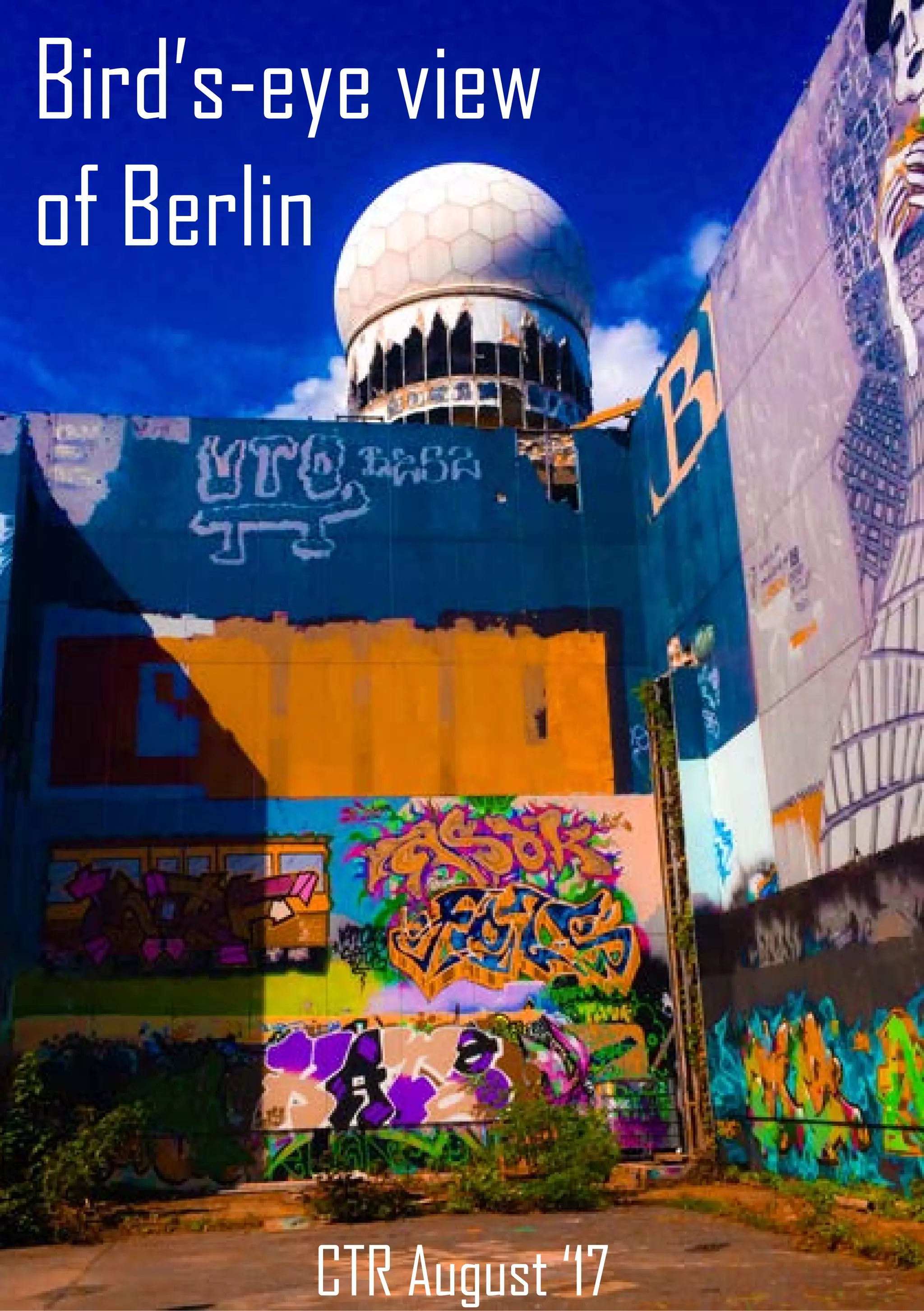
Bird’s-eye view
of Berlin
CTR August ‘17
Introduction
A big, urban metropolis, yet
cool, laid back and multicul-
tural, Berlin has something to
offer everyone with its mix of
iconic sites, rich culture, amazing
food, nightlife and outdoor fun.
Of course, the city’s rich history
cannot be ignored. Berlin has ex-
perienced more in the last centu-
ry than most - it staged a revolu-
tion, was headquarters by fascists,
bombed during World War II, di-
vided into East and West and final-
ly reunited at the turn of the 20th
century. Remnants of its turbulent
past can be found at every corner.
You can walk along the Berlin Wall,
stand in the room where the Final
Solution was planned or on a pre-
vious death strip, and of course,
visit one of the many world class
museums. 

On the cultural front,
Berlin truly came into its own in
its post-unification years. It now
has a vibrant art scene as seen
throughout its streets as well as a
growing fashion network. It is also
an increasingly growing hub for
innovative start-ups who find no
limit to creativity in the city. Not to
mention the notorious party scene
which runs practically 24/7; from
small basement clubs to techno
temples, there can be found some-
thing for every taste and budget.
Likewise, you can find moments
of calm in one of the many green
areas of the city, whether that
be in a park or by the Spree river.
We have produced this guide with
you in mind. Inside you will find
reviews of Berlin’s main hotspots
from Brandenburg Tor to Checkpoint Charlie, to a host of cafés, restau-
rants, museums, markets and other great outdoor activities. There is
truly something for everyone in this vibrant city, whether you are the art
lover, foodie, history buff, or night owl just to name a few. We do hope
you have a hawk of a time exploring some of these amazing places!
Welcome to Berlin!
Birdy Badges
Fancy Bird
Early Bird
Edu Bird
Night Bird
Foodie Bird
Culture Bird
Outdoors Bird
Shopping Bird
Tourist Bird
Budget Bird
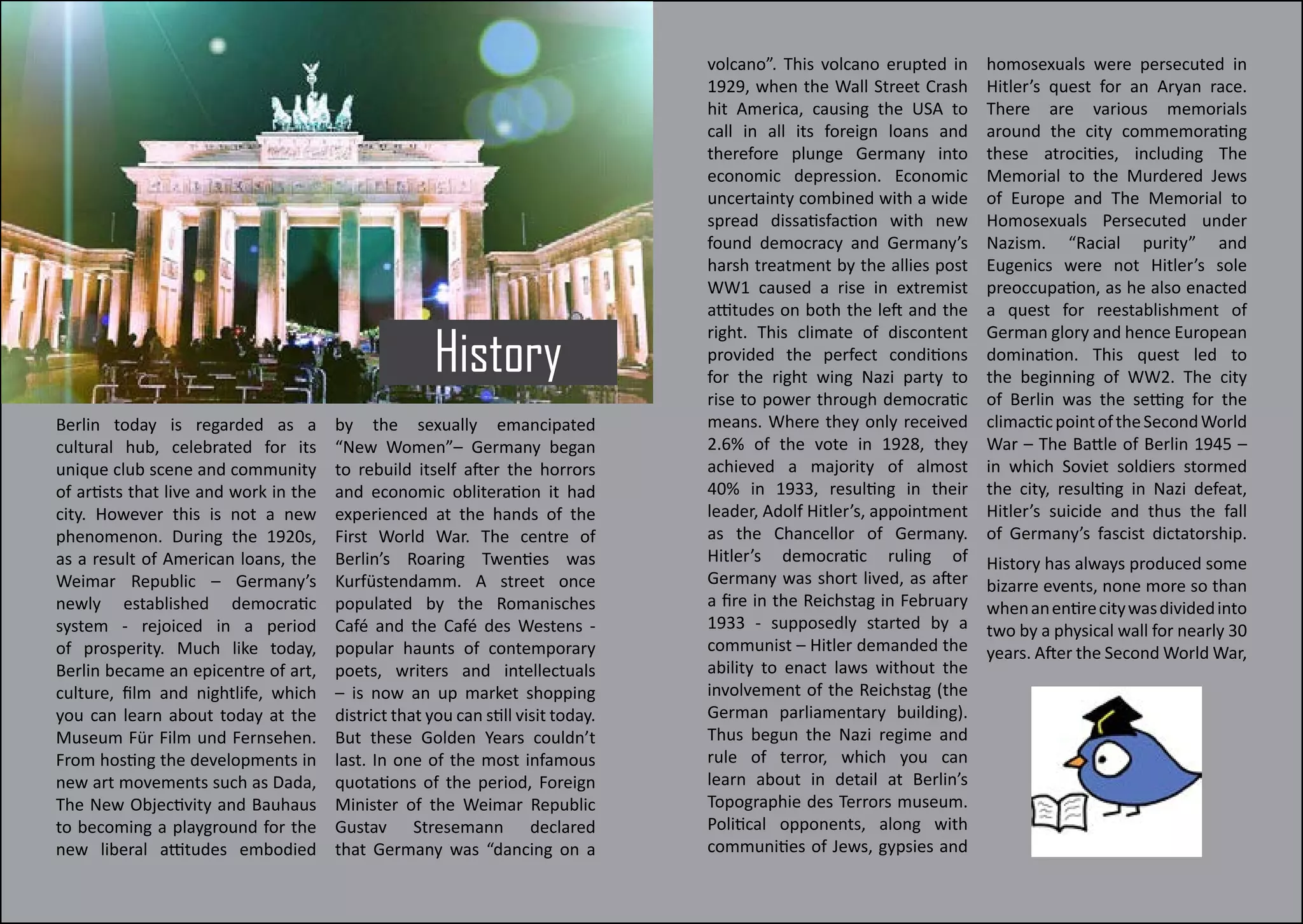
History
Berlin today is regarded as a
cultural hub, celebrated for its
unique club scene and community
of artists that live and work in the
city. However this is not a new
phenomenon. During the 1920s,
as a result of American loans, the
Weimar Republic – Germany’s
newly established democratic
system - rejoiced in a period
of prosperity. Much like today,
Berlin became an epicentre of art,
culture, film and nightlife, which
you can learn about today at the
Museum Für Film und Fernsehen.
From hosting the developments in
new art movements such as Dada,
The New Objectivity and Bauhaus
to becoming a playground for the
new liberal attitudes embodied
by the sexually emancipated
“New Women”– Germany began
to rebuild itself after the horrors
and economic obliteration it had
experienced at the hands of the
First World War. The centre of
Berlin’s Roaring Twenties was
Kurfüstendamm. A street once
populated by the Romanisches
Café and the Café des Westens -
popular haunts of contemporary
poets, writers and intellectuals
– is now an up market shopping
district that you can still visit today.
But these Golden Years couldn’t
last. In one of the most infamous
quotations of the period, Foreign
Minister of the Weimar Republic
Gustav Stresemann declared
that Germany was “dancing on a
volcano”. This volcano erupted in
1929, when the Wall Street Crash
hit America, causing the USA to
call in all its foreign loans and
therefore plunge Germany into
economic depression. Economic
uncertainty combined with a wide
spread dissatisfaction with new
found democracy and Germany’s
harsh treatment by the allies post
WW1 caused a rise in extremist
attitudes on both the left and the
right. This climate of discontent
provided the perfect conditions
for the right wing Nazi party to
rise to power through democratic
means. Where they only received
2.6% of the vote in 1928, they
achieved a majority of almost
40% in 1933, resulting in their
leader, Adolf Hitler’s, appointment
as the Chancellor of Germany.
Hitler’s democratic ruling of
Germany was short lived, as after
a fire in the Reichstag in February
1933 - supposedly started by a
communist – Hitler demanded the
ability to enact laws without the
involvement of the Reichstag (the
German parliamentary building).
Thus begun the Nazi regime and
rule of terror, which you can
learn about in detail at Berlin’s
Topographie des Terrors museum.
Political opponents, along with
communities of Jews, gypsies and
homosexuals were persecuted in
Hitler’s quest for an Aryan race.
There are various memorials
around the city commemorating
these atrocities, including The
Memorial to the Murdered Jews
of Europe and The Memorial to
Homosexuals Persecuted under
Nazism. “Racial purity” and
Eugenics were not Hitler’s sole
preoccupation, as he also enacted
a quest for reestablishment of
German glory and hence European
domination. This quest led to
the beginning of WW2. The city
of Berlin was the setting for the
climacticpointoftheSecondWorld
War – The Battle of Berlin 1945 –
in which Soviet soldiers stormed
the city, resulting in Nazi defeat,
Hitler’s suicide and thus the fall
of Germany’s fascist dictatorship.
History has always produced some
bizarre events, none more so than
whenanentirecitywasdividedinto
two by a physical wall for nearly 30
years. After the Second World War,
the whole of Germany was divided
up between the victors; the United
States, United Kingdom, France,
and Soviet Union. However when
it came to practice, a problem
quickly arose. What would happen
to Berlin, the capital of the country
that happened to be inside the
communist East Germany? A
solution was quickly devised to
divide Berlin as well between the
four powers. This in turn caused
a mass exodus from east to west;
some reports state that by 1961
nearly3millionpeoplefledtheGDR
(German Democratic Republic). To
combat this, a wall was erected
almost instantaneously during
the night of 13th August 1961,
even though the leader of the
GDR, Walter Ulbricht, explicitly
stated that there would be no
such measure in place. But when
do politicians ever go back on their
word? This action, which occurred
with no warning, divided friends,
families and loved ones, causing
people on both sides to lose their
jobs and livelihoods if trapped on
the wrong side. Two completely
different worlds co-existed side
by side, mere feet away from
each other; communism and
capitalism, east and west, the
mentality of them and us. Even
though it completely encircled
West Berlin, the objective was to
limit the East Berliners to their
sector. Their only points of contact
were limited to small number of
checkpoints, the most famous
one being Checkpoint Charlie.
The Fall of the Berlin Wall on 9th
November 1989 marked the end of
the Cold War, and by 1990 the two
halves of Germany become one
once more, reuniting with Berlin.
Moving into the 21st century,
Berlin is now regarded as a global
city, a diverse and multicultural
place that appeals to many young
people. Although the physical wall
no longer is in place, the scars of
that time remain, including the
double-bricked line that runs
through the city unmindful of
whether it cuts through the road
or pavement. Also take some time
to look around, some walls of the
older buildings have small bullet
holes, and on the pavement,
a number of bricks have been
replaced with bronze plaques
with names of Jews killed during
the Holocaust. All of these serve
as a visual reminder of the time
when our world was an entirely
different place not too long ago.
Survival Guide
In a bustling, fast-paced city like Berlin, it’s wise to get to grips with the
way things work as soon as possible to avoid being caught out in any un-
fortunate situations. This Survival Guide contains a few pieces of essen-
tial information to make your stay in the city as stress-free as possible!
Cycle Lanes - Nearly all Berlin pavements include a cycle lane, although
their red paving is only subtly different from the pedestrian path and
are easy to miss. Make sure to be aware of them as cycling is popular in
Berlin and cyclists are unlikely to stop or make way for you.
Supermarkets - When looking for essentials in Berlin, Rewe and Aldi
supermarkets are located in various places across the city and offer all
kinds of food and drink at reasonable prices. Rewe is open until 10pm,
but be aware that supermarkets do not open on Sundays. Rewe also of-
fers a loyalty card with which you can earn points and discounts on your
shopping.
Medicine - If you need any medical supplies the Apoteke is the only
place to go as medicine is not sold in any other shops. There are many
Apoteke’s all over the city which are easy to find from their bold red ‘A’
signs.
If you need to visit a doctor or hospital while you are here you need to
bring your EHIC card, passport and debit/credit card.
Recycling - Plastic bottles, glass bottles and cans can often be returned
to supermarkets in the city to be recycled in exchange for a partial re-
fund, ranging from 8-15 cents for glass and 15-25 for plastic. Look for a
symbol showing a bottle and an arrow or the words ‘mehrwegflasche’
and ‘pfandflasche’ to see if your bottle is returnable. There is also an
unofficial recycling system in the city, with people leaving their empty
bottles underneath the orange bins in the streets in order for others to
earn money from collecting and returning them.
Clubs/night life - Nightclubs are a huge part of Berlin culture, although
some are more exclusive and there are a few rules to abide by to in-
crease your chances of getting in. Wearing dark coloured, casual cloth-
ing, approaching the venue in small groups, behaving quietly and know-
ing the names of artists or DJ’s are all ways to ensure your entry to bigger
clubs such as Tresor and Berghain. Also, be aware that most clubs favour
techno music!
It’s also worth noting that drinking in the streets and public places is
legal, and fairly common, in Berlin.
Public Toilets - There are not a great number of public toilets in the city,
and those that are available usually cost around €0.50 to use, so keep-
ing small change on you can be very useful. However, most museums,
galleries and restaurants have toilets which can be used free of charge
when you are visiting.
Credit Cards - A lot of cafes, restaurants and bars around the city do
not accept credit cards, meaning that withdrawing money from a cash
machine is much easier. Some stations also do not accept card payments
for travel tickets. Also, if you are keen to keep track of your expenses,
remember to ask for a receipt as not all places will offer them otherwise.
Boroughs of Berlin - The city is divided into a number of boroughs, all
of which have different things to offer. Kreuzberg is known as the most
popular area for young people with lots of cheap bars, restaurants and
the best nightlife. Mitte is the most central area where most of the fa-
mous landmarks and tourist sights are located. There is also Charlotten-
burg, Tempelhof, Neukolln, Lichtenberg, Pankow, Treptow and Spandau,
all which offer different sights, places to eat and experiences.
Useful Phrases
Hello Hallo
Good morning/Good night Guten Morgen/Gute Nacht
Goodbye/Bye Auf Wiedersehen/Tschuss
Please Bitte
Thank you/Thanks Danke shoen/Danke
Cheers Prost
Please Bitte
Do you speak English? Sprechen Sie Englisch?
How much is this? Wieviel kostet das?
Where is..? Wo ist...?
May I have...? Darf ich... haben?
Do you take credit cards? Akzeptieren Sie Kreditkarten?
Can I have a receipt? Kann ich eine Quittung bekommen?
Entrance/Exit Eingang/Ausgang
Toilet Toiletten
Passport Reisepass
Food/Water Das Essen/Die Wasser
Train Der Zug/Die Bahn
Emergency numbers - Police: 110, Fire brigade: 112 (also call the fire
brigade for severe medical emergencies)
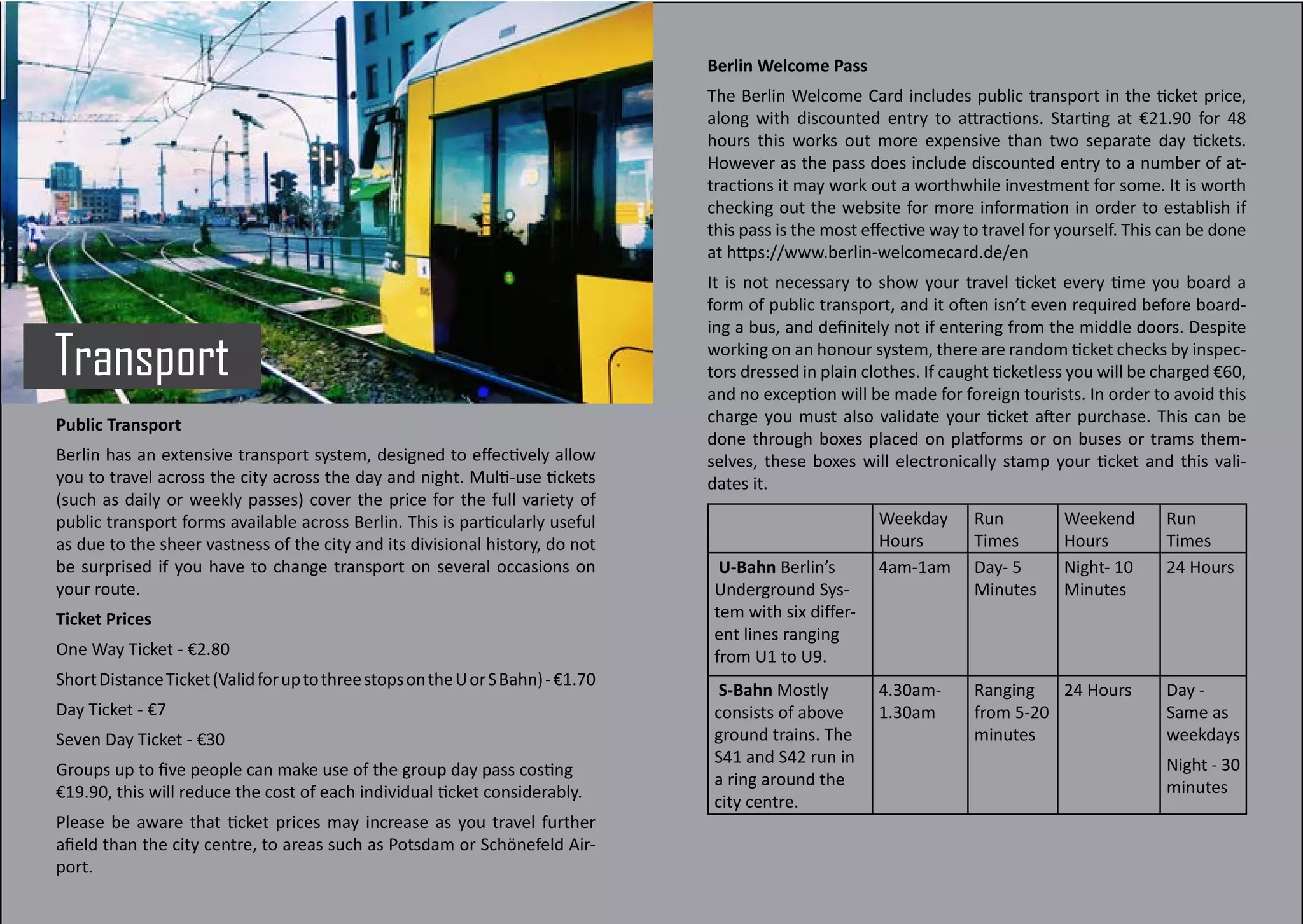
Transport
Public Transport
Berlin has an extensive transport system, designed to effectively allow
you to travel across the city across the day and night. Multi-use tickets
(such as daily or weekly passes) cover the price for the full variety of
public transport forms available across Berlin. This is particularly useful
as due to the sheer vastness of the city and its divisional history, do not
be surprised if you have to change transport on several occasions on
your route.
Ticket Prices
One Way Ticket - €2.80
ShortDistanceTicket(ValidforuptothreestopsontheUorSBahn)-€1.70
Day Ticket - €7
Seven Day Ticket - €30
Groups up to five people can make use of the group day pass costing
€19.90, this will reduce the cost of each individual ticket considerably.
Please be aware that ticket prices may increase as you travel further
afield than the city centre, to areas such as Potsdam or Schönefeld Air-
port.
Berlin Welcome Pass
The Berlin Welcome Card includes public transport in the ticket price,
along with discounted entry to attractions. Starting at €21.90 for 48
hours this works out more expensive than two separate day tickets.
However as the pass does include discounted entry to a number of at-
tractions it may work out a worthwhile investment for some. It is worth
checking out the website for more information in order to establish if
this pass is the most effective way to travel for yourself. This can be done
at https://www.berlin-welcomecard.de/en
It is not necessary to show your travel ticket every time you board a
form of public transport, and it often isn’t even required before board-
ing a bus, and definitely not if entering from the middle doors. Despite
working on an honour system, there are random ticket checks by inspec-
tors dressed in plain clothes. If caught ticketless you will be charged €60,
and no exception will be made for foreign tourists. In order to avoid this
charge you must also validate your ticket after purchase. This can be
done through boxes placed on platforms or on buses or trams them-
selves, these boxes will electronically stamp your ticket and this vali-
dates it.
Weekday
Hours
Run
Times
Weekend
Hours
Run
Times
U-Bahn Berlin’s
Underground Sys-
tem with six differ-
ent lines ranging
from U1 to U9.
4am-1am Day- 5
Minutes
Night- 10
Minutes
24 Hours
S-Bahn Mostly
consists of above
ground trains. The
S41 and S42 run in
a ring around the
city centre.
4.30am-
1.30am
Ranging
from 5-20
minutes
24 Hours Day -
Same as
weekdays
Night - 30
minutes
Weekday
Hours
Run Times Week-
end
Hours
Run
Times
Tram Mostly
present in former
East Berlin, trams
extend the route
networks of the
U-Bahn. Tramlines
are marked with
an M followed
by the tramline
number.
24 Hours Day- At least
every 10
minutes
24 Hours Same as
on week-
day
Bus Mostly cover
routes not cov-
ered by alterna-
tive public trans-
port. Bus stops are
highlighted with a
yellow and green
H. On weekday
nights nightbuses
replace the U-
Bahn and are
signified by an
N in front of the
number.
24 Hours Varies
depend-
ing on bus.
Metrobuses
run every 10
minutes.
24 Hours Same as
on Week-
day.
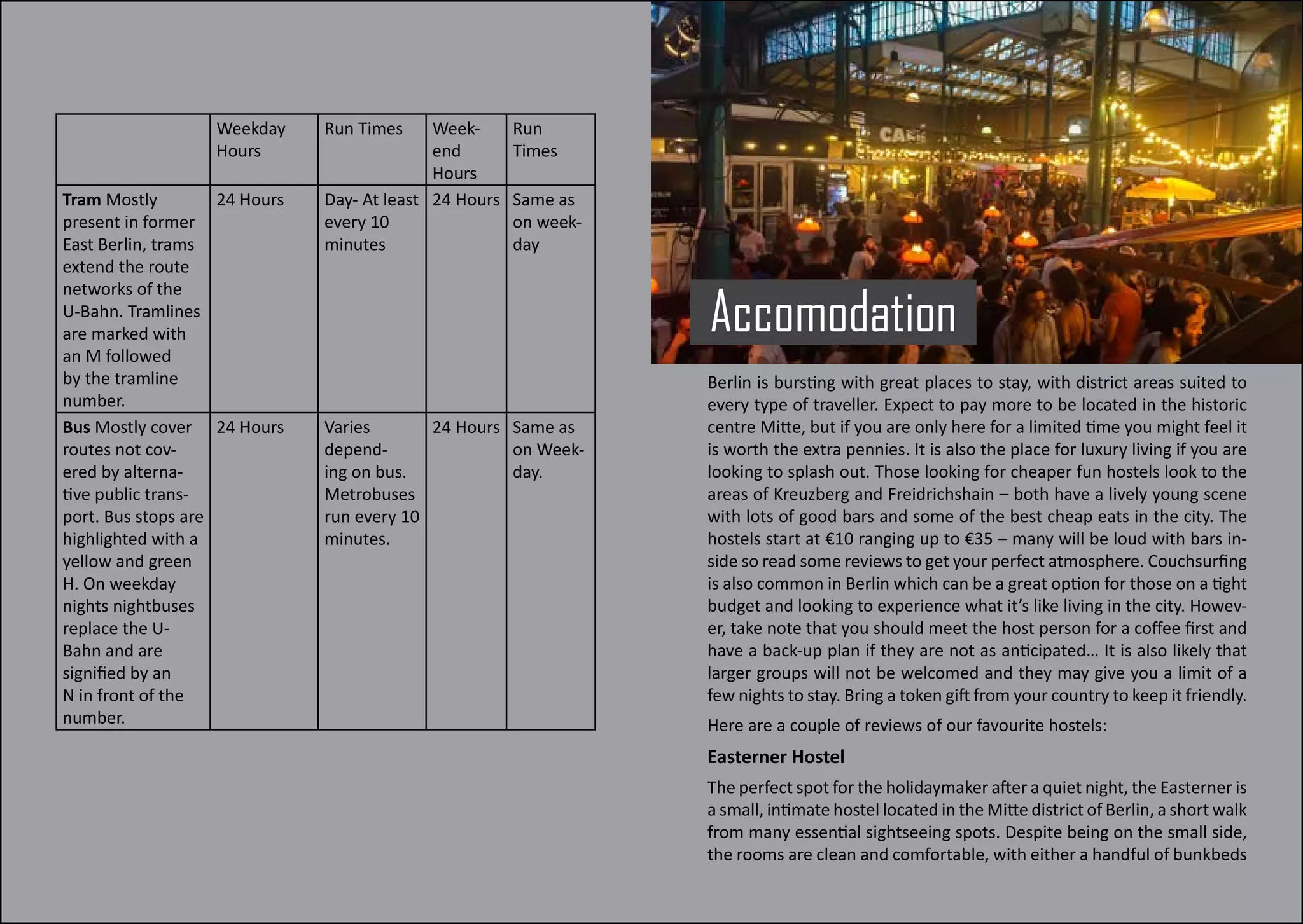
Accomodation
Berlin is bursting with great places to stay, with district areas suited to
every type of traveller. Expect to pay more to be located in the historic
centre Mitte, but if you are only here for a limited time you might feel it
is worth the extra pennies. It is also the place for luxury living if you are
looking to splash out. Those looking for cheaper fun hostels look to the
areas of Kreuzberg and Freidrichshain – both have a lively young scene
with lots of good bars and some of the best cheap eats in the city. The
hostels start at €10 ranging up to €35 – many will be loud with bars in-
side so read some reviews to get your perfect atmosphere. Couchsurfing
is also common in Berlin which can be a great option for those on a tight
budget and looking to experience what it’s like living in the city. Howev-
er, take note that you should meet the host person for a coffee first and
have a back-up plan if they are not as anticipated… It is also likely that
larger groups will not be welcomed and they may give you a limit of a
few nights to stay. Bring a token gift from your country to keep it friendly.
Here are a couple of reviews of our favourite hostels:
Easterner Hostel
The perfect spot for the holidaymaker after a quiet night, the Easterner is
a small, intimate hostel located in the Mitte district of Berlin, a short walk
from many essential sightseeing spots. Despite being on the small side,
the rooms are clean and comfortable, with either a handful of bunkbeds
or a queen size mattress. It’s not a party hostel, and only really caters for
small groups, but is ideal for solo travellers and couples. Like all good hos-
tels, there’s a fully equipped communal kitchen – this one even boasts
free tea, coffee, and sugar – and a common room where you can so-
cialise with your fellow guests. Other amenities include free Wi-Fi, laun-
dry, and hot water. These all sound like small things, but when so many
budget hostels manage to fall below the mark it’s good to be safe in the
knowledge that these creature comforts are readily available. Guests are
invited to take a free guided walking tour of Berlin, which departs from
outside the front door at around 10am – tips are of course appreciated.
Location: Novalisstrasse 14, Mitte.
Prices: €20-60, based on average rate for a standard room.
Wombat’s City Hostel
Located in the centre of Berlin, only a ten minute walk from Alexan-
derplatz station, Wombat’s City Hostel is a great choice of accom-
modation for those looking for a fun, lively stay in the city. It is close
to a number of popular sights and many of the best night life spots
and is popular among young partygoers from all over the world.
The hostel provides good value for money, although its popularity
and central location make it slightly more expensive than other hos-
tels in the area and may not suit those on the tightest budgets. It has
a range of rooms, from shared dorms with bunkbeds to double rooms
with balconies, as well as large shared kitchens, all of which are clean,
light and spacious. It also offers more than the standard hostel, with
‘womBar’, a rooftop terrace bar, which opens until 2am and has a daily
Happy Hour, providing a great place to drink, socialise and take in views
of the city. There is also a courtyard seating area on the ground floor.
It also offers all the amenities necessary for a comfortable stay, including
free internet access and a buffet breakfast, costing €4.50, and is a non-
smoking establishment. The staff are multi-lingual and very helpful, and
thereiseventhechancetorentbikesfromthereceptiontoexplorethecity.
Location: Alte Schonhauserstr. 2, D-10119
Prices: €25 - €79 (Based on average rates for a standard room)
Chloeis a 21 year old English Liter-
ature graduate from the University
of York, calling Britain’s oldest re-
corded town of Colchester home.
She enjoys film, makeup artistry,
and pretending to ge the works
she sees in front of her in art gal-
leries. Her favourite spot in Berlin
is the Shakespeare & Sons lit café.
Her favourite bird is a goldfinch.
Michalina is 22 and studies Logis-
tics of Media at the University of
Warsaw, and comes from a place
which was once the Free City of
Danzig. She likes to indulge in Net-
flix and sleep, and is happiest in
Berlin when she’s found a cheap
place to get a drink. Her favourite
bird is a swallow.
Katie is 21 and studies Classics
at the University of Bristol. She
comes from Dorset, home of the
rare bittern bird, which chooses to
make its home in Weymouth due
to the reed beds they can nest in.
She likes travelling, reading, and
cooking, particularly when one or
all is being done in Mauerpark on
a sunny Sunday afternoon. Her fa-
vourite bird is a toucan.
Shahreen is 21 years old, and sort
of comes from all over. A global
citizen with her roots in India and
Iran, two cultures filled with colour
and celebration, she has recently
BIOS
graduated with a degree in English
and Politics from the University
of York. She enjoys travelling, art,
music, and learning about new cul-
tures, and has recently struck up a
love affair with a mysterious suitor
named Mr. Alexander Platz. Her
favourite bird is a Luzon Bleeding-
Heart.
Danielle is 20 years old, and at-
tends the University of Nottingham
where she studies English Lan-
guage and Literature. She comes
from Romford, but tells everybody
she’s from London. She enjoys
travelling, reading, and cycling,
and loves taking a dip in Badeschiff
on a warm evening. Her favourite
bird is a blue tit.
Jenny is 21 and comes from Man-
chester, a city famed for its sport-
ing culture. She studies Sociology
at the University of Leeds, and has
spent a year of this abroad at the
University of Montreal. She likes
Netflix, sleep, and food, especially
if that food comes from the Thurs-
day food market at Markthalle
Neun. Her favourite bird is a pen-
guin.
Emily is 21 and recently graduat-
ed with a degree in Contemporary
Dance from Trinity Laban Conser-
vatoire of Music and Dance. She
comes from Worcester, home of
the famed Worcestershire sauce,
and likes to look round art galler-
ies, read about the Roaring Twen-
ties, and consider the metaphori-
cal dehumanising nature of city
metropoli. Her favourite thing to
do in Berlin is peruse the New Ob-
jectivity section in the Berlinische
Gallery. Her favourite bird is a
Phoenix, which is not a real bird.
Steph is a 23 year old graduate
of the University of Nottingham,
with a degree in Modern Lan-
guage Studies. She loves spending
time at the Markthalle Neun food
market, but don’t try to tempt her
with strawberries and cream – she
comes from Wimbledon, where
the tennis causes horrendous traf-
fic for two weeks of the year. She
enjoys film and television, hiking
and cooking. Her favourite bird is
a heron.
Frances is 19, and studies PPE
at the London School of Econom-
ics. She comes from Manchester,
and enjoys piano, badminton,
and travelling. Her favourite spot
in Berlin is the Tempelhof Park,
where she likes to cycle up and
down the abandoned runways or
find a nice spot to read a book. Her
favourite bird is a penguin.

CTR: Bird's-eye view of Berlin

  • 1.
  • 2.
    Introduction A big, urbanmetropolis, yet cool, laid back and multicul- tural, Berlin has something to offer everyone with its mix of iconic sites, rich culture, amazing food, nightlife and outdoor fun. Of course, the city’s rich history cannot be ignored. Berlin has ex- perienced more in the last centu- ry than most - it staged a revolu- tion, was headquarters by fascists, bombed during World War II, di- vided into East and West and final- ly reunited at the turn of the 20th century. Remnants of its turbulent past can be found at every corner. You can walk along the Berlin Wall, stand in the room where the Final Solution was planned or on a pre- vious death strip, and of course, visit one of the many world class museums. 

On the cultural front, Berlin truly came into its own in its post-unification years. It now has a vibrant art scene as seen throughout its streets as well as a growing fashion network. It is also an increasingly growing hub for innovative start-ups who find no limit to creativity in the city. Not to mention the notorious party scene which runs practically 24/7; from small basement clubs to techno temples, there can be found some- thing for every taste and budget. Likewise, you can find moments of calm in one of the many green areas of the city, whether that be in a park or by the Spree river. We have produced this guide with you in mind. Inside you will find reviews of Berlin’s main hotspots from Brandenburg Tor to Checkpoint Charlie, to a host of cafés, restau- rants, museums, markets and other great outdoor activities. There is truly something for everyone in this vibrant city, whether you are the art lover, foodie, history buff, or night owl just to name a few. We do hope you have a hawk of a time exploring some of these amazing places! Welcome to Berlin! Birdy Badges Fancy Bird Early Bird Edu Bird Night Bird Foodie Bird Culture Bird Outdoors Bird Shopping Bird Tourist Bird Budget Bird
  • 3.
    History Berlin today isregarded as a cultural hub, celebrated for its unique club scene and community of artists that live and work in the city. However this is not a new phenomenon. During the 1920s, as a result of American loans, the Weimar Republic – Germany’s newly established democratic system - rejoiced in a period of prosperity. Much like today, Berlin became an epicentre of art, culture, film and nightlife, which you can learn about today at the Museum Für Film und Fernsehen. From hosting the developments in new art movements such as Dada, The New Objectivity and Bauhaus to becoming a playground for the new liberal attitudes embodied by the sexually emancipated “New Women”– Germany began to rebuild itself after the horrors and economic obliteration it had experienced at the hands of the First World War. The centre of Berlin’s Roaring Twenties was Kurfüstendamm. A street once populated by the Romanisches Café and the Café des Westens - popular haunts of contemporary poets, writers and intellectuals – is now an up market shopping district that you can still visit today. But these Golden Years couldn’t last. In one of the most infamous quotations of the period, Foreign Minister of the Weimar Republic Gustav Stresemann declared that Germany was “dancing on a volcano”. This volcano erupted in 1929, when the Wall Street Crash hit America, causing the USA to call in all its foreign loans and therefore plunge Germany into economic depression. Economic uncertainty combined with a wide spread dissatisfaction with new found democracy and Germany’s harsh treatment by the allies post WW1 caused a rise in extremist attitudes on both the left and the right. This climate of discontent provided the perfect conditions for the right wing Nazi party to rise to power through democratic means. Where they only received 2.6% of the vote in 1928, they achieved a majority of almost 40% in 1933, resulting in their leader, Adolf Hitler’s, appointment as the Chancellor of Germany. Hitler’s democratic ruling of Germany was short lived, as after a fire in the Reichstag in February 1933 - supposedly started by a communist – Hitler demanded the ability to enact laws without the involvement of the Reichstag (the German parliamentary building). Thus begun the Nazi regime and rule of terror, which you can learn about in detail at Berlin’s Topographie des Terrors museum. Political opponents, along with communities of Jews, gypsies and homosexuals were persecuted in Hitler’s quest for an Aryan race. There are various memorials around the city commemorating these atrocities, including The Memorial to the Murdered Jews of Europe and The Memorial to Homosexuals Persecuted under Nazism. “Racial purity” and Eugenics were not Hitler’s sole preoccupation, as he also enacted a quest for reestablishment of German glory and hence European domination. This quest led to the beginning of WW2. The city of Berlin was the setting for the climacticpointoftheSecondWorld War – The Battle of Berlin 1945 – in which Soviet soldiers stormed the city, resulting in Nazi defeat, Hitler’s suicide and thus the fall of Germany’s fascist dictatorship. History has always produced some bizarre events, none more so than whenanentirecitywasdividedinto two by a physical wall for nearly 30 years. After the Second World War,
  • 4.
    the whole ofGermany was divided up between the victors; the United States, United Kingdom, France, and Soviet Union. However when it came to practice, a problem quickly arose. What would happen to Berlin, the capital of the country that happened to be inside the communist East Germany? A solution was quickly devised to divide Berlin as well between the four powers. This in turn caused a mass exodus from east to west; some reports state that by 1961 nearly3millionpeoplefledtheGDR (German Democratic Republic). To combat this, a wall was erected almost instantaneously during the night of 13th August 1961, even though the leader of the GDR, Walter Ulbricht, explicitly stated that there would be no such measure in place. But when do politicians ever go back on their word? This action, which occurred with no warning, divided friends, families and loved ones, causing people on both sides to lose their jobs and livelihoods if trapped on the wrong side. Two completely different worlds co-existed side by side, mere feet away from each other; communism and capitalism, east and west, the mentality of them and us. Even though it completely encircled West Berlin, the objective was to limit the East Berliners to their sector. Their only points of contact were limited to small number of checkpoints, the most famous one being Checkpoint Charlie. The Fall of the Berlin Wall on 9th November 1989 marked the end of the Cold War, and by 1990 the two halves of Germany become one once more, reuniting with Berlin. Moving into the 21st century, Berlin is now regarded as a global city, a diverse and multicultural place that appeals to many young people. Although the physical wall no longer is in place, the scars of that time remain, including the double-bricked line that runs through the city unmindful of whether it cuts through the road or pavement. Also take some time to look around, some walls of the older buildings have small bullet holes, and on the pavement, a number of bricks have been replaced with bronze plaques with names of Jews killed during the Holocaust. All of these serve as a visual reminder of the time when our world was an entirely different place not too long ago. Survival Guide In a bustling, fast-paced city like Berlin, it’s wise to get to grips with the way things work as soon as possible to avoid being caught out in any un- fortunate situations. This Survival Guide contains a few pieces of essen- tial information to make your stay in the city as stress-free as possible! Cycle Lanes - Nearly all Berlin pavements include a cycle lane, although their red paving is only subtly different from the pedestrian path and are easy to miss. Make sure to be aware of them as cycling is popular in Berlin and cyclists are unlikely to stop or make way for you. Supermarkets - When looking for essentials in Berlin, Rewe and Aldi supermarkets are located in various places across the city and offer all kinds of food and drink at reasonable prices. Rewe is open until 10pm, but be aware that supermarkets do not open on Sundays. Rewe also of- fers a loyalty card with which you can earn points and discounts on your shopping. Medicine - If you need any medical supplies the Apoteke is the only place to go as medicine is not sold in any other shops. There are many Apoteke’s all over the city which are easy to find from their bold red ‘A’ signs. If you need to visit a doctor or hospital while you are here you need to bring your EHIC card, passport and debit/credit card.
  • 5.
    Recycling - Plasticbottles, glass bottles and cans can often be returned to supermarkets in the city to be recycled in exchange for a partial re- fund, ranging from 8-15 cents for glass and 15-25 for plastic. Look for a symbol showing a bottle and an arrow or the words ‘mehrwegflasche’ and ‘pfandflasche’ to see if your bottle is returnable. There is also an unofficial recycling system in the city, with people leaving their empty bottles underneath the orange bins in the streets in order for others to earn money from collecting and returning them. Clubs/night life - Nightclubs are a huge part of Berlin culture, although some are more exclusive and there are a few rules to abide by to in- crease your chances of getting in. Wearing dark coloured, casual cloth- ing, approaching the venue in small groups, behaving quietly and know- ing the names of artists or DJ’s are all ways to ensure your entry to bigger clubs such as Tresor and Berghain. Also, be aware that most clubs favour techno music! It’s also worth noting that drinking in the streets and public places is legal, and fairly common, in Berlin. Public Toilets - There are not a great number of public toilets in the city, and those that are available usually cost around €0.50 to use, so keep- ing small change on you can be very useful. However, most museums, galleries and restaurants have toilets which can be used free of charge when you are visiting. Credit Cards - A lot of cafes, restaurants and bars around the city do not accept credit cards, meaning that withdrawing money from a cash machine is much easier. Some stations also do not accept card payments for travel tickets. Also, if you are keen to keep track of your expenses, remember to ask for a receipt as not all places will offer them otherwise. Boroughs of Berlin - The city is divided into a number of boroughs, all of which have different things to offer. Kreuzberg is known as the most popular area for young people with lots of cheap bars, restaurants and the best nightlife. Mitte is the most central area where most of the fa- mous landmarks and tourist sights are located. There is also Charlotten- burg, Tempelhof, Neukolln, Lichtenberg, Pankow, Treptow and Spandau, all which offer different sights, places to eat and experiences. Useful Phrases Hello Hallo Good morning/Good night Guten Morgen/Gute Nacht Goodbye/Bye Auf Wiedersehen/Tschuss Please Bitte Thank you/Thanks Danke shoen/Danke Cheers Prost Please Bitte Do you speak English? Sprechen Sie Englisch? How much is this? Wieviel kostet das? Where is..? Wo ist...? May I have...? Darf ich... haben? Do you take credit cards? Akzeptieren Sie Kreditkarten? Can I have a receipt? Kann ich eine Quittung bekommen? Entrance/Exit Eingang/Ausgang Toilet Toiletten Passport Reisepass Food/Water Das Essen/Die Wasser Train Der Zug/Die Bahn Emergency numbers - Police: 110, Fire brigade: 112 (also call the fire brigade for severe medical emergencies)
  • 6.
    Transport Public Transport Berlin hasan extensive transport system, designed to effectively allow you to travel across the city across the day and night. Multi-use tickets (such as daily or weekly passes) cover the price for the full variety of public transport forms available across Berlin. This is particularly useful as due to the sheer vastness of the city and its divisional history, do not be surprised if you have to change transport on several occasions on your route. Ticket Prices One Way Ticket - €2.80 ShortDistanceTicket(ValidforuptothreestopsontheUorSBahn)-€1.70 Day Ticket - €7 Seven Day Ticket - €30 Groups up to five people can make use of the group day pass costing €19.90, this will reduce the cost of each individual ticket considerably. Please be aware that ticket prices may increase as you travel further afield than the city centre, to areas such as Potsdam or Schönefeld Air- port. Berlin Welcome Pass The Berlin Welcome Card includes public transport in the ticket price, along with discounted entry to attractions. Starting at €21.90 for 48 hours this works out more expensive than two separate day tickets. However as the pass does include discounted entry to a number of at- tractions it may work out a worthwhile investment for some. It is worth checking out the website for more information in order to establish if this pass is the most effective way to travel for yourself. This can be done at https://www.berlin-welcomecard.de/en It is not necessary to show your travel ticket every time you board a form of public transport, and it often isn’t even required before board- ing a bus, and definitely not if entering from the middle doors. Despite working on an honour system, there are random ticket checks by inspec- tors dressed in plain clothes. If caught ticketless you will be charged €60, and no exception will be made for foreign tourists. In order to avoid this charge you must also validate your ticket after purchase. This can be done through boxes placed on platforms or on buses or trams them- selves, these boxes will electronically stamp your ticket and this vali- dates it. Weekday Hours Run Times Weekend Hours Run Times U-Bahn Berlin’s Underground Sys- tem with six differ- ent lines ranging from U1 to U9. 4am-1am Day- 5 Minutes Night- 10 Minutes 24 Hours S-Bahn Mostly consists of above ground trains. The S41 and S42 run in a ring around the city centre. 4.30am- 1.30am Ranging from 5-20 minutes 24 Hours Day - Same as weekdays Night - 30 minutes
  • 7.
    Weekday Hours Run Times Week- end Hours Run Times TramMostly present in former East Berlin, trams extend the route networks of the U-Bahn. Tramlines are marked with an M followed by the tramline number. 24 Hours Day- At least every 10 minutes 24 Hours Same as on week- day Bus Mostly cover routes not cov- ered by alterna- tive public trans- port. Bus stops are highlighted with a yellow and green H. On weekday nights nightbuses replace the U- Bahn and are signified by an N in front of the number. 24 Hours Varies depend- ing on bus. Metrobuses run every 10 minutes. 24 Hours Same as on Week- day. Accomodation Berlin is bursting with great places to stay, with district areas suited to every type of traveller. Expect to pay more to be located in the historic centre Mitte, but if you are only here for a limited time you might feel it is worth the extra pennies. It is also the place for luxury living if you are looking to splash out. Those looking for cheaper fun hostels look to the areas of Kreuzberg and Freidrichshain – both have a lively young scene with lots of good bars and some of the best cheap eats in the city. The hostels start at €10 ranging up to €35 – many will be loud with bars in- side so read some reviews to get your perfect atmosphere. Couchsurfing is also common in Berlin which can be a great option for those on a tight budget and looking to experience what it’s like living in the city. Howev- er, take note that you should meet the host person for a coffee first and have a back-up plan if they are not as anticipated… It is also likely that larger groups will not be welcomed and they may give you a limit of a few nights to stay. Bring a token gift from your country to keep it friendly. Here are a couple of reviews of our favourite hostels: Easterner Hostel The perfect spot for the holidaymaker after a quiet night, the Easterner is a small, intimate hostel located in the Mitte district of Berlin, a short walk from many essential sightseeing spots. Despite being on the small side, the rooms are clean and comfortable, with either a handful of bunkbeds
  • 8.
    or a queensize mattress. It’s not a party hostel, and only really caters for small groups, but is ideal for solo travellers and couples. Like all good hos- tels, there’s a fully equipped communal kitchen – this one even boasts free tea, coffee, and sugar – and a common room where you can so- cialise with your fellow guests. Other amenities include free Wi-Fi, laun- dry, and hot water. These all sound like small things, but when so many budget hostels manage to fall below the mark it’s good to be safe in the knowledge that these creature comforts are readily available. Guests are invited to take a free guided walking tour of Berlin, which departs from outside the front door at around 10am – tips are of course appreciated. Location: Novalisstrasse 14, Mitte. Prices: €20-60, based on average rate for a standard room. Wombat’s City Hostel Located in the centre of Berlin, only a ten minute walk from Alexan- derplatz station, Wombat’s City Hostel is a great choice of accom- modation for those looking for a fun, lively stay in the city. It is close to a number of popular sights and many of the best night life spots and is popular among young partygoers from all over the world. The hostel provides good value for money, although its popularity and central location make it slightly more expensive than other hos- tels in the area and may not suit those on the tightest budgets. It has a range of rooms, from shared dorms with bunkbeds to double rooms with balconies, as well as large shared kitchens, all of which are clean, light and spacious. It also offers more than the standard hostel, with ‘womBar’, a rooftop terrace bar, which opens until 2am and has a daily Happy Hour, providing a great place to drink, socialise and take in views of the city. There is also a courtyard seating area on the ground floor. It also offers all the amenities necessary for a comfortable stay, including free internet access and a buffet breakfast, costing €4.50, and is a non- smoking establishment. The staff are multi-lingual and very helpful, and thereiseventhechancetorentbikesfromthereceptiontoexplorethecity. Location: Alte Schonhauserstr. 2, D-10119 Prices: €25 - €79 (Based on average rates for a standard room) Chloeis a 21 year old English Liter- ature graduate from the University of York, calling Britain’s oldest re- corded town of Colchester home. She enjoys film, makeup artistry, and pretending to ge the works she sees in front of her in art gal- leries. Her favourite spot in Berlin is the Shakespeare & Sons lit café. Her favourite bird is a goldfinch. Michalina is 22 and studies Logis- tics of Media at the University of Warsaw, and comes from a place which was once the Free City of Danzig. She likes to indulge in Net- flix and sleep, and is happiest in Berlin when she’s found a cheap place to get a drink. Her favourite bird is a swallow. Katie is 21 and studies Classics at the University of Bristol. She comes from Dorset, home of the rare bittern bird, which chooses to make its home in Weymouth due to the reed beds they can nest in. She likes travelling, reading, and cooking, particularly when one or all is being done in Mauerpark on a sunny Sunday afternoon. Her fa- vourite bird is a toucan. Shahreen is 21 years old, and sort of comes from all over. A global citizen with her roots in India and Iran, two cultures filled with colour and celebration, she has recently BIOS
  • 9.
    graduated with adegree in English and Politics from the University of York. She enjoys travelling, art, music, and learning about new cul- tures, and has recently struck up a love affair with a mysterious suitor named Mr. Alexander Platz. Her favourite bird is a Luzon Bleeding- Heart. Danielle is 20 years old, and at- tends the University of Nottingham where she studies English Lan- guage and Literature. She comes from Romford, but tells everybody she’s from London. She enjoys travelling, reading, and cycling, and loves taking a dip in Badeschiff on a warm evening. Her favourite bird is a blue tit. Jenny is 21 and comes from Man- chester, a city famed for its sport- ing culture. She studies Sociology at the University of Leeds, and has spent a year of this abroad at the University of Montreal. She likes Netflix, sleep, and food, especially if that food comes from the Thurs- day food market at Markthalle Neun. Her favourite bird is a pen- guin. Emily is 21 and recently graduat- ed with a degree in Contemporary Dance from Trinity Laban Conser- vatoire of Music and Dance. She comes from Worcester, home of the famed Worcestershire sauce, and likes to look round art galler- ies, read about the Roaring Twen- ties, and consider the metaphori- cal dehumanising nature of city metropoli. Her favourite thing to do in Berlin is peruse the New Ob- jectivity section in the Berlinische Gallery. Her favourite bird is a Phoenix, which is not a real bird. Steph is a 23 year old graduate of the University of Nottingham, with a degree in Modern Lan- guage Studies. She loves spending time at the Markthalle Neun food market, but don’t try to tempt her with strawberries and cream – she comes from Wimbledon, where the tennis causes horrendous traf- fic for two weeks of the year. She enjoys film and television, hiking and cooking. Her favourite bird is a heron. Frances is 19, and studies PPE at the London School of Econom- ics. She comes from Manchester, and enjoys piano, badminton, and travelling. Her favourite spot in Berlin is the Tempelhof Park, where she likes to cycle up and down the abandoned runways or find a nice spot to read a book. Her favourite bird is a penguin.