!"
'~:~'
_ ............
5 DOT/FAA/CT-ACD32093/2
REVISED TEST PLAN FOR
OPERATIONAL EVALUATION OF INITIAL DATA LINK
TERMINAL ATC SERVICES
October 1992
Engineering, Research, and Development Service
Research Directorate for Aviation Technology
FAA Technical Center
Atlantic City International Airport, N.J. 08405
POINT OF CONTACT
NICHOLAS J. TALOTTA, ACD-320, 609-484-5302
CLARK SHINGLEDECKER, NTI, INC., 513-254-3171
1. INTRQDUCTION.
1.1 PURPQSE.
The Federal Aviation Administration (FAA) Technical Center holds
primary responsibility for defining, developing, and testing air
traffic control (ATC) services which can be effectively
transmitted to aircraft using Data Link communication
technologies. The test plan described in this document is
directed toward an operational evaluation of a group of four Data
Link terminal ATC services and functions from the perspective of
their general impact on the ATC system and on the controller user
of the services. The plan will be carried out in the context of
a broader study effort in which objectives associated with flight
deck Data Link issues also will be addressed. A coordinated, but
separate test plan is under development for the flight deck
portion of the operational evaluation.
1.2 BACKGROUND.
Data Link has the technical capability to significantly enhance
the safety and productivity of the ATC system by reducing voice
radio frequency congestion and preventing several common
communications errors. However, Data Link also will introduce a
profound change in the way in which ATC tasks are accomplished by
controllers, and in the way aircrew will receive and respond to
ATC instructions. Because of this, the ultimate success of Data
Link will be critically dependent on the extent to which it is
employed to create an effective communications system that is
fully integrated with its human users and with the full range of
tasks that they are required to perform.
Recognition of the need to consider operational suitability and
human factors issues as primary drivers of the design process
prompted the FAA Technical Center to initiate a program of manned
simulation research to guide the development of Data Link ATC
services. The overall goals of this research are to 1) define
useful Data Link services, 2) determine the user information
requirements for Data Link communications, 3) develop display
formats, data entry methods and procedures which promote
efficient controller performance, and 4) evaluate the impact of
Data Link services on both human and system performance.
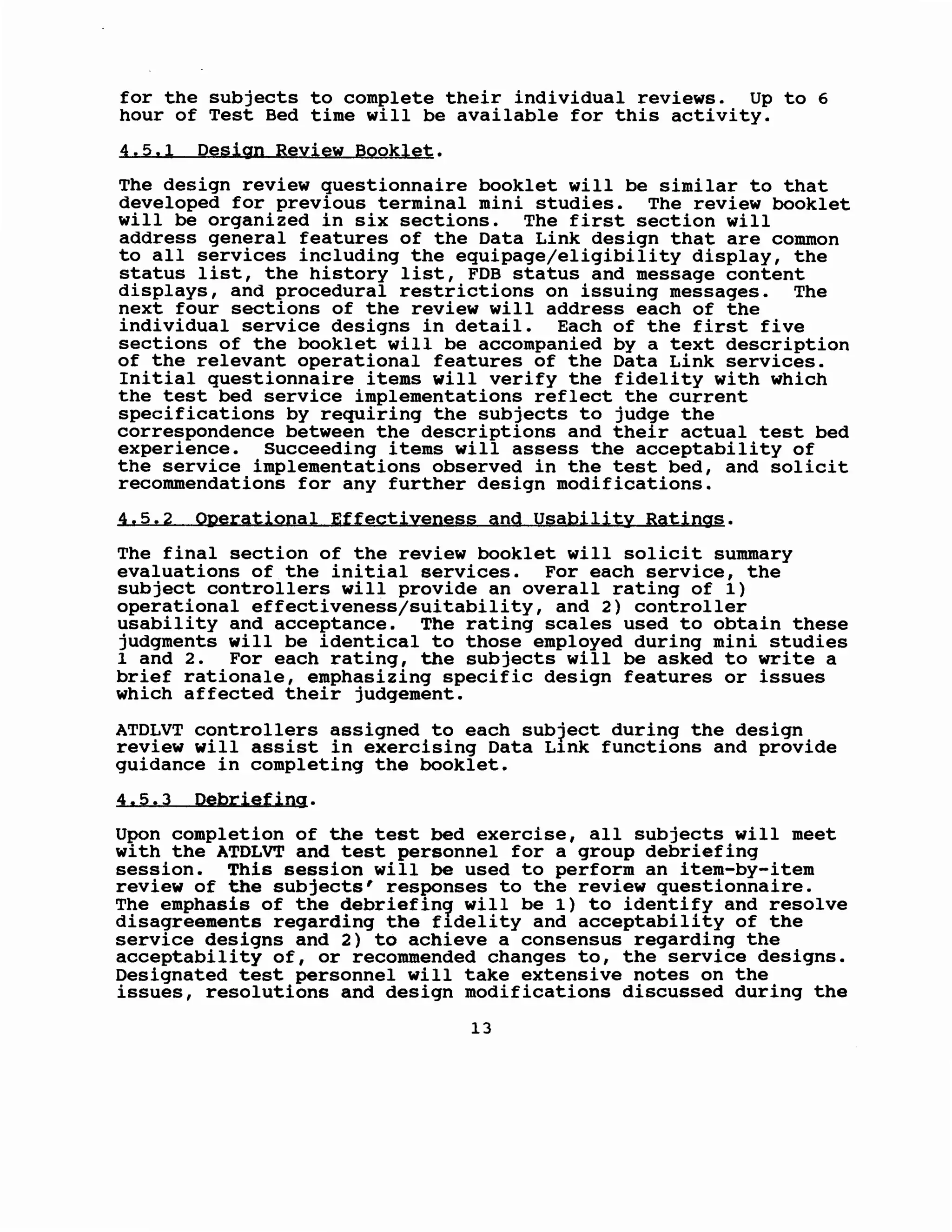
The Data Link test bed was assembled at the FAA Technical Center
to address these goals. The test bed is a laboratory facility
which uses actual NAS equipment in conjunction with simulation
computers to create a system capable of realistically exercising
Data Link applications 1n an end-to-end fashion. In its current
form, the Test Bed is composed of the NAS en route and terminal
laboratories, the Target Generation Facility (TGF), and the Data
Link laboratory. The NAS laboratory includes the HOST computer
system used for en route ATC data processing as well as its
2
primary terminal counterpart, the ARTS IliA system. Both
computers are linked to several suites of their respective
operational controller workstations which are used to display
radar data and to enter system inputs.
The NAS laboratory is linked to the TGF through the ATC
computers. The TGF permits the NAS laboratory systems to act as
functioning control facilities by providing simulated radar data
and voice radio inputs from simulation "pilots" operating from
computer terminals.
The Data Link laboratory houses a VAX 11/750 computer which acts
as an emulation of the future ground Data Link processor. The
VAX computer supports digital communication between simulation
pilots and controllers. It can also provide two-way
communication between controllers and high-fidelity aircraft
simulators or actual airborne systems using Mode s or any other
installed Data Link technology.
The central thrust of Data Link research in the test bed is
manned simulation research aimed at defining and testing designs
for ATC services. This research follows a three-stage approach
originally developed and successfully employed under the en route
portion of the Data Link program. In the Design Verification
stage, engineering tests are conducted in the Data Link Test Bed
to insure that preliminary designs for Data Link services are
faithfully reflected in operational software and hardware
components of the test bed simulation laboratories. Following
resolution of engineering issues, a series of manned simulation
studies are performed in which air traffic controllers exercise
and evaluate the Data Link ATC services.
In the Mini study stage of these experiments, iterative design
evaluations are conducted to refine controller procedures,
displays, and input requirements. Early studies are completed
under controlled, part-task simulation conditions which focus on
detailed consideration of basic design issues. As development
progresses, simulation exercises are increased in operational
fidelity to assess the robustness of the services and to obtain
reliable controller judgments of acceptability, usability and
workload effects. A fixed group of Full Performance Level (FPL)
controllers from the Air Traffic Data Link Validation Team
(ATDLVT) participate throughout the mini study stage to provide
continuity in the iterative development process.
The final, Operational Evaluation stage of the approach consists
of one or more high fidelity simulation exercises in which the
optimized service designs are exercised under a variety of
realistic operational conditions and air traffic scenarios. For
these studies, a new group of controllers with no prior Data Link
experience is recruited for participation. Measures of system
effectiveness, communications efficiency, and workload are used
3
to verify the utility and usability of the Data Link services.
The resulting data determine inputs to a Technical Data Package
(TOP) that is used to guide the development of operational Data
Link software for implementation in the National Airspace System
(NAS).
The research plan presented in this document will be followed to
conduct an operational evaluation of four terminal Data Link
services: 1) Initial Contact, 2) Terminal Information Service, 3)
Transfer of Communication, and 4) altitude, heading, and speed
control instructions using the Menu Text function. These initial
services were defined by the terminal controller subgroup of the
ATDLVT and underwent preliminary conceptual development during
exercises conducted on a rapid prototyping system at the MITRE
Corporation. In 1990, the services were implemented in the Data
Link test bed at the FAA Technical Center using operational ARTS
IIIA workstations, displays, input devices and computer systems.
Three subsequent mini studies were conducted to refine the
designs in preparation for the operational evaluation.
2. OBJECTIVES.
The primary objectives of the ATC portion of the operational
evaluation will be to:
a. Validate functional specifications and specific ARTS IIIA
designs for the initial terminal ATC Data Link services and
functions.
b. Estimate the impact of implementing the initial Data Link
services on air-ground communications activities, controller
capabilities, and ATC operations.
In conjunction with the flight deck study, a secondary objective
of the study will be to demonstrate the capabilities of the Data
Link Test Bed facilities at the FAA Technical Center to support
future hi9h fidelity, end-to-end, controller and pilot in-the-
loop stud1es of Data Link.
3. APPRQACH.
These objectives will be achieved during an 8-day study period in
which Full Performance Level (FPL) air traffic specialists will
participate in extensive training exercises and full scale
simulation testing. Data which address objective a. will be
collected using structured design review materials and debriefing
sessions following training and full scale simulation testing.
Data which address objective b. will be collected by simulation
computers during the full scale simulations, and by employing
quantified controller rating scales and questionnaires after each
of the full scale simulation test runs.
4
3.1 RATIONALE AND APPROACH TO DESIGN VALIDATION (Objective a.).
Designs for the initial terminal Data Link services were
developed using an iterative series of mini studies in which a
relatively fixed group of controllers from the ATDLVT
participated. During these studies, the ATDLVT controllers acted
as subject matter experts (SMEs), as they exercised interim
versions of the service designs in progressively more realistic
ATC scenarios. The findings from each study produced
increasingly refined versions of the designs based on a
combination the controllers' operational ATC experience as well
as their experiences in the Data Link simulations.
The design requirements which emerged from these studies are
embodied in the service desi9ns currently implemented on the ARTS
IIIA equipment in the Data L1nk Test Bed. These specific designs
have served as the primary basis for preparing a more general
functional design specification that will be used by an
implementing contractor to produce operational NAS software.
The validity of the SME approach to design development described
above is largely dependent on the extent to which the knowledge
and experience of the necessarily restricted sample of terminal
controllers on the ATDLVT is representative of that held by the
broader population of controllers currently working in
operational facilities. Because of this, the method that will be
used to validate the functional specification will involve the
participation of a new group of controllers who have had no prior
experience with the initial terminal Data Link services.
These subjects will receive extensive training on the use of the
Data Link services, and will participate in a series of high
fidelity simulation trials intended to provide them with
sufficient experience to evaluate the operational utility and
usability of the designs. The observations and judgments of
these controllers will be recorded through their completion of an
exhaustive review of all aspects of the functions and computer -
human interface incorporated in the service designs, quantified
ratings of the operational usefulness and value of the services,
and structured debriefings. The resulting data will be used to
assess the validity of the design requirements embodied in the
ARTS IIIA Data Link Test Bed implementation and recorded in the
draft functional specification.
3.2 APPROACH TO ESTIMATING DATA LINK IMPACT (Objective b.).
Prior analyses and study findings have indicated that many of the
benefits of Data Link ATC services in the terminal environment
will be directly attributable to the extent to which
implementation of the system will relieve restrictions on the
ability of controllers to efficiently deal with air traffic
demands that are created by the single channel, simplex voice
5
radio system. By increasing the communications opportunities and
options available to the controller, Data Link is expected to
permit more effective handling of air traffic when communications
are disrupted by unusual or emergency situations, high frequency
congestion, or radio system failures.
Because the impact of the terminal Data Link services will depend
upon its ability to reduce frequency congestion, the full scale
simulation runs in this study will focus on the nominal use of
Data Link to transmit repetitively used, routine messages which
currently consume a major portion of available communications
time on the radio channel. The subject controllers will be
instructed to avoid attempts to "experiment" with Data Link in
time-critical or risky situations, and to employ the system only
when they judge that it will benefit their ability to maintain
the safe and efficient control of air traffic.
Comparative test runs will be conducted under voice-only
communications and under conditions in which the radio system is
supplemented by Data Link services. To assess controller use of
the voice radio and Data Link systems, a number of metrics will
be employed during the test runs. For all runs, the simulation
computers will record the duration and frequency of voice
communications initiated by the controllers. In addition, the
content of these communications will be recorded on audio tape,
and will also be partially recoverable from records of simulation
pilot computer inputs that are made to maneuver aircraft in
response to clearances. During Data Link runs, the simulation
computer (VAX) will record the number and type of all Data Link
messages sent by each controller.
In order to determine whether any advantages produced by reduced
frequency congestion are accrued at any significant cost to
overall controller capabilities, measures of perceived workload
will be obtained after each full scale simulation run. The
Subjective Workload Assessment Technique (SWAT) workload rating
system and scaling method will be used to provide quantified,
interval level measures of controller workload under voice and
Data Link conditions.
Additional measures that will be tdken during and after each test
run-will be used to gather data 0n communications errors.
Because a predicted secondary be1f't ;t of Data Link communications
is a reduction in pilot misinterprPtations, stolen clearances,
and ambiguities, an attempt will t~ made during this study to
detect occurrences of such events. :Jhservers seated at each
sector will record obvious pilot errors in readbacks of voice
clearances, pilot requests for repe~~s or clarification of
messages sent by voice and by Dat~ : 1n~, misinterpreted
clearances as evidenced by erroneous dircraft maneuvers, and
stolen clearances. Following ear·n test run, the observers will
verify these detections with the sutJ )ect controllers and ask them
h
to describe any additional communications errors that may have
occurred, but had not been noted by the observer. The observers
also will record any comments from the subjects regarding
problems experienced with either communications system during the
test run.
After all test runs are completed, the subjects will be asked to
respond to a set of open-ended questions and rating scales.
These items will be used to solicit controller projections of
expected benefits and costs that may be associated with the use
of the initial terminal ATC services in a field implementation.
Benefit and cost dimensions that will be covered by the posttest
measures will include system safet¥, system capacity, and the
efficiency of accomplishing specif1c tasks associated with
different sectors in the terminal airspace. Controllers also
will be asked to comment on the impact of Data Link delays and
the utility of Data Link in different portions of the terminal
airspace.
4. TEST CONDUCT.
4.1 SUBJECTS.
Subjects for this study will be six FPL terminal controllers.
These subjects will have .current field radar control experience
using the ARTS IIIA system. None of the controllers will have
prior experience in ATC simulations of Data Link services.
4.2 GENERAL SCENARIO REQUIREMENTS.
The RDU airspace configuration used in Mini Studies 2 and 3 will
be used for training and testing. All testing will be conducted
using individual controllers to work each of the paired arrival,
final, and de~arture sectors. Traffic loads, and proportion of
Data Link equ1page in the aircraft fleet will be varied as
described in the training, full scale simulation, and design
review sections below.
4.3 TRAINING.
Subject training on the RDU airspace and on the use of the Data
Link system will occur over the first four days of the study. In
order to reduce classroom training requirements, the subjects
will receive written materials describing the airspace,
applicable ATC procedures, and Data Link functions at least one
week prior to arriving at the FAA Technical Center. On the first
day of the study, the subjects will be randomly assigned to
either the north or south portions of the RDU airspace and will
work only the assigned arrival, final and departure sectors
during training and testing.
The terminal ATDLVT controllers will be present during all
7
classroom and hands on training sessions to assist the subject
controllers and to answer questions about the airspace procedures
and Data Link operations.
Classroom training will be conducted in two sessions on the first
day of the study. The first 30 minute session will focus on the
RDU airspace and ATC procedures. This session will be followed
by three, 50 minute practice sessions in the Data Link Test Bed
during which voice radio communications procedures will be used.
The second 60 minute classroom session will focus on Data Link
inputs and displays. This will be followed by twenty-one, 50
minute practice sessions in which voice and Data Link
communications will be available. These sessions will be
conducted over the first through fourth days of the study as
shown in the study schedule. During these sessions each subject
will rotate through the three airspace sectors on his/her
assigned half of the airspace. A group discussion session will
be conducted on the second day of training to answer airspace or
Data Link questions.
As in all of the scenarios, air traffic loads during the practice
runs will increase over each 50 minute session. In early
practice runs, peak loads will reach 75% of airport capacity.
These peaks will increase across the four days to 100%, 125%, and
finally 145%. on Data Link runs, 80% of the aircraft in the
scenarios will be Data Link equipped.
Data Link total transaction delays during training will be
controlled by the simulation computers for those aircraft handled
by simulation pilots. The average transaction time will be 17 ±
4 seconds. For the piloted aircraft simulators participating in
the training sessions, the portion of transaction delay
attributable to the Data Link system will be simulated, but
actual pilot response times will determine the total transaction
time perceived by the controllers.
4.4 FULL SCALE SIMULATION TESTING.
As discussed in the approach section of this plan, the full scale
simulation runs will be conducted to 1) provide subjects with
additional Data Link experience as for the subsequent design
review, and 2) provide test conditions which can be used as a
basis for obtaining selected estimates of the impact of Data
Link. In addition, piloted flight simulators will form a portion
of the air traffic included in the full scale simulation runs to
provide data required for the flight deck portion of the
operational evaluation. The plan presented below accommodates
the simulation requirements of both the ATC and flight deck
studies.
Preparation for full scale testing will begin after the last
practice run, at the end of the fourth study day. During this
8
group session, the purpose of the full scale simulation runs will
be reviewed. Subjects also will be instructed to restrict the
use of Data Link to situations which help them to achieve
efficient performance, and to avoid unsafe or "experimental" use
of the system. Finally, the subjects will be introduced to the
rating instruments that will be used after each trial, and will
perform the card sort task required to generate the SWAT scales.
4.4.1 Test Design.
The full scale simulation runs will be conducted over the fifth
and sixth days of the study. Of the twelve runs, six will be
conducted under voice-only procedures, and six with the Data Link
services available in addition to voice radio. The test
scenarios used in the voice and Data Link runs will differ in
terms of the sequence and spacing of traffic, but will not differ
in traffic mix or load. For each 50 minute run, arriving and
departing traffic will build to a peak of 145% airport capacity
(estimated to be equivalent to 90% of sector capacity).
The experimental design for these test runs is illustrated in
table 1.
During the test runs, subjects will rotate through the three
sectors on their assigned side of the airport so that, each
subject will participate twice at each of the three sector types
under both Data Link and voice communication conditions. As
shown in table 1., the experimental conditions will be arranged
so that a complete replication of the design will occur on each
of the test days.
six versions of the test scenario will be created, each of which
will be used once under voice-only and once under Data Link
conditions in the order shown in the table. The ordering of the
scenarios and sequencing of sector positions was controlled to
insure that each subject will be tested only once under the same
combination of scenario, sector, and communication condition.
The use of a regular alternation of voice and Data Link trials
was dictated by the experimental requirements of the flight deck
portion of the study.
As in the practice runs, total Data Link transaction delays for
aircraft tracks driven by piloted simulators will be determined
by the performance of the subject pilots. The controlled
transaction time for the simulation (TGF) pilots will be based on
data previously collected from the piloted simulators during the
practice sessions. These transaction times will be determined by
adding a randomly selecting a value from a rectangular
distribution with a mean equal to the average pilot response time
obtained during practice and a range extending ± 1 standard
deviation, to a randomly selected value in the range of 4 to 8
seconds to account for system uplink and downlink transmission
time.
9
In all Data Link conditions, 2 percent of the attempted uplinks
Table 1.
Operational Evaluation Full
Run Communication
Order Condition
Q§Jl l
~ 1 v
2. 2 v & DL
s J. 3 v
c .i 4 v & DL
e .2 5 v
n ~ 6 v & DL
a O~Jl ~
r 2. 7 v
i ~ 8 v & DL
0 .i 9 v
J. 10 v & DL
~ 11 v
.2 12 v & DL
KEY
Subjects: Sn = South
Nn = North
Sl S2
F A
A D
D F
F A
A D
D F
A F
F D
D A
A F
F D
D A
Conditions: V = Voice Radio Only
Scale Test Design
Subject/Position
Assignment
SJ til
D A
F F
A D
D A
F F
A D
D F
A A
F D
D F
A A
F D
V & DL = Voice and Data Link Available
Control Positions: A = Arrival
D = Departure
F = Final Approach
10
N2 N3
F D
D A
A F
F D
D A
A F
A D
D F
F A
A D
D F
F A
will result in a technical failure (NAK). All successful uplinks
to simulation (pseudo) pilots will results in a WILCO. UNABLE or
TIME OUT events will not be scripted for the piloted simulators,
but may occur during testing.
4.4.2 Data Link Impact Measures.
As discussed in the approach section of this plan, a number of
measures will be collected during the full scale simulation to
obtain estimates of Data Link impact. These measures are listed
below:
Collected By Simulation System During Test Runs
(separated by sector)
- Number of push-to-talk actions
- Duration of each push-to-talk onset-offset interval
(raw data in seconds plus mean and standard
deviation for run)
- Number of Data Link messages sent
(sorted by sector, type of message and by
receiving aircraft call sign)
- Audio tape records of voice radio messages
- Total run duration in seconds
Proportion of total run duration spent on voice radio
communications by controller
- Number of aircraft that entered each sector during run
- Number of aircraft that departed each sector during run
- Number of aircraft handled ~Y sector
- Total duration of each arrival and departure flight within
the controlled airspace
In addition to the overall data t ,)r .~.,ch test run, measures of
voice radio and data link usage w 1 , • t)e grouped in consecutive 5
minute intervals in order to exam1ne the relationship between
increasing traffic load and commun 1 ,·<lt 1ons activity.
Collected By Observers Puring Test k~
1 1
- Communications Problems/Errors
- Pilot readback errors
- Pilot call backs for repeat 1 clarification
- Misinterpreted clearances - erroneous maneuver,
failure to maneuver
- Stolen clearances
Completed By Controller Between Trials
- SWAT workload rating
- Review and expansion of observer comments on errors
- Comments on any communications problems
(esp. with piloted simulators)
Posttest
- Data Link Benefits/Costs Evaluations
(Safety, Efficiency, System Capacity, etc.)
4.5 DESIGN REVIEW.
The design review will occur on the final two days of the study.
The subjects will complete the design review in the Data Link
test bed while seated at the ARTS IIIA workstations and
controlling aircraft in a simplified scenario which will permit
the them to exercise all of the Data Link services. All aircraft
in the scenario will be Data Link equipped in order to maximize
the subjects' opportunities to examine the service displays,
inputs, and procedures.
To permit observation of the failure displays, approximately 5
percent of the attempted uplinks will result in a failed
technical acknowledgement (NAK), 5 percent in a time-out (failure
of the pilot to respond to an uplink within 40 seconds), and 5
percent in an unable response from the pilot. The subjects'
primary task will be to exercise each of the Data Link services a
sufficient number of times to thoroughly evaluate the service
designs. Evaluations will be made by completing a structured
review booklet during the simulation runs.
The subjects will be informed that the object of the simulation
activity is to aid them in completing the detailed design review,
and that maintaining routine control over the moderate level (50
percent of airport capacity) of air traffic in the scenario is
secondary to this task. Subjects will be encouraged to exchange
control positions as required in order to examine services which
may not be used in some sectors. The scenario will be repeated
as required during the laboratory session to permit ample time
12
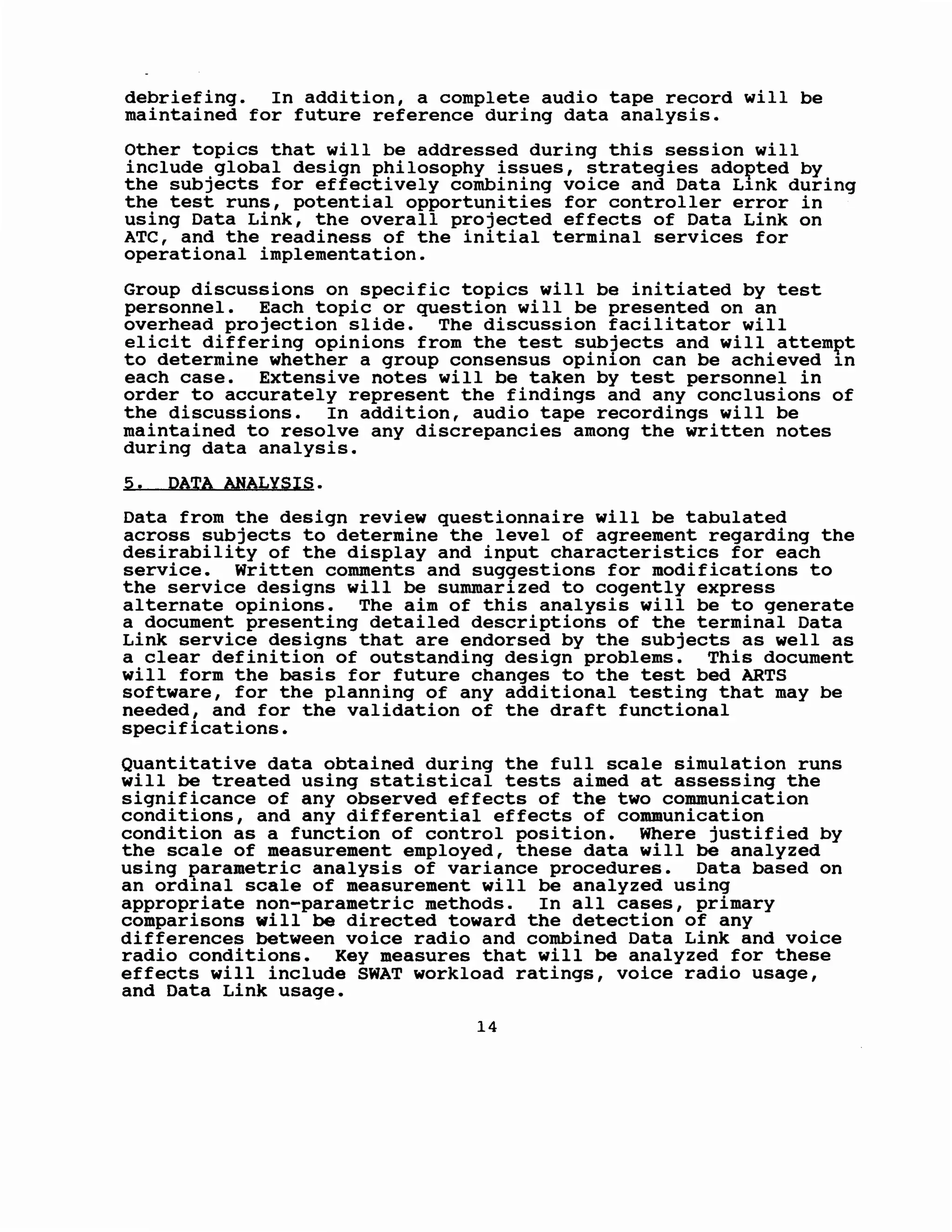
for the subjects to complete their individual reviews. Up to 6
hour of Test Bed time will be available for this activity.
4.5.1 Design Review Booklet.
The design review questionnaire booklet will be similar to that
developed for previous terminal mini studies. The review booklet
will be organized in six sections. The first section will
address general features of the Data Link design that are common
to all services including the equipage/eligibility display, the
status list, the history list, FOB status and message content
displays, and procedural restrictions on issuing messages. The
next four sections of the review will address each of the
individual service designs in detail. Each of the first five
sections of the booklet will be accompanied by a text description
of the relevant operational features of the Data Link services.
Initial questionnaire items will verify the fidelity with which
the test bed service implementations reflect the current
specifications by requiring the subjects to judge the
correspondence between the descriptions and their actual test bed
experience. Succeeding items will assess the acceptability of
the service implementations observed in the test bed, and solicit
recommendations for any further design modifications.
4.5.2 Operational Effectiveness and Usability Ratings.
The final section of the review booklet will solicit summary
evaluations of the initial services. For each service, the
subject controllers will provide an overall rating of 1)
operational effectiveness/suitability, and 2) controller
usability and acceptance. The rating scales used to obtain these
judgments will be identical to those employed during mini studies
1 and 2. For each rating, the subjects will be asked to write a
brief rationale, emphasizing specific design features or issues
which affected their judgement.
ATDLVT controllers assigned to each sub1ect during the design
review will assist in exercising Data L1nk functions and provide
guidance in completing the booklet.
4.5.3 Debriefing.
Upon completion of the test bed exercise, all subjects will meet
with the ATDLVT and test personnel for a group debriefing
session. This session will be used to perform an item-by-item
review of the subjects' responses to the review questionnaire.
The emphasis of the debriefin9 will be 1) to identify and resolve
disagreements regarding the f1delity and acceptability of the
service designs and 2) to achieve a consensus regarding the
acceptability of, or recommended changes to, the service designs.
Designated test personnel will take extensive notes on the
issues, resolutions and design modifications discussed during the
13
debriefing. In addition, a complete audio tape record will be
maintained for future reference during data analysis.
Other topics that will be addressed during this session will
include global design philosophy issues, strategies ado~ted by
the subjects for effectively combining voice and Data L1nk during
the test runs, potential opportunities for controller error in
using Data Link, the overall projected effects of Data Link on
ATC, and the readiness of the initial terminal services for
operational implementation.
Group discussions on specific topics will be initiated by test
personnel. Each topic or question will be presented on an
overhead projection slide. The discussion facilitator will
elicit differing opinions from the test subjects and will attem~t
to determine whether a group consensus opinion can be achieved 1n
each case. Extensive notes will be taken by test personnel in
order to accurately represent the findings and any conclusions of
the discussions. In addition, audio tape recordings will be
maintained to resolve any discrepancies among the written notes
during data analysis.
5. PATA ANALYSIS.
Data from the design review questionnaire will be tabulated
across subjects to determine the level of agreement regarding the
desirability of the display and input characteristics for each
service. Written comments and suggestions for modifications to
the service designs will be summarized to cogently express
alternate opinions. The aim of this analysis will be to generate
a document presenting detailed descriptions of the terminal Data
Link service designs that are endorsed by the subjects as well as
a clear definition of outstanding design problems. This document
will form the basis for future changes to the test bed ARTS
software, for the planning of any additional testing that may be
needed, and for the validation of the draft functional
specifications.
Quantitative data obtained during the full scale simulation runs
will be treated using statistical tests aimed at assessing the
significance of any observed effects of the two communication
conditions, and any differential effects of communication
condition as a function of control position. Where justified by
the scale of measurement employed, these data will be analyzed
using parametric analysis of variance procedures. Data based on
an ordinal scale of measurement will be analyzed using
appropriate non-parametric methods. In all cases, primary
comparisons will be directed toward the detection of any
differences between voice radio and combined Data Link and voice
radio conditions. Key measures that will be analyzed for these
effects will include SWAT workload ratings, voice radio usage,
and Data Link usage.
14
Ratings of controller acceptance and operational suitability
obtained after the completion of all full scale simulation
testing will be used to obtain a global estimate of the readiness
of each service design for implementation as judged by the
subjects in light of the extended simulation testing. Responses
to the questionnaire on perceived costs and benefits of the Data
Link system will be tabulated and reported as independent SME
projections of Data Link impact.
Narrative data obtained during the design review and posttest
debriefings will be summarized to reveal group consensus views.
Where such consensus is not achieved, alternative views will be
recorded along with the proportions of subjects expressing these
views.
6. SCHEDULE.
Thursday 12 November
Travel
Friday 13 November
0830 - 0930
0930 - 1000
1000 - 1200
1200 - 1300
1300 - 1400
1400 - 1700
1700 - 1715
Introduction and Review of study Goals/Plans
Classroom Airspace and Procedures Training
Test Bed Airspace and Procedures Practice
(3 Runs - Voice Only - 75% Load)
Lunch
Classroom Data Link Training
Test Bed Data Link Practice
(3 Runs - Voice and DL - 75% Load)
Airspace and Data Link Q&A
Monday 16 November
0830 - 0845
0845 - 1000
1000 - 1700
Airspace and Data Link Review and Q&A
Classroom Data Link Training
Test Bed Data Link Practice
(Voice and DL - 3 Runs 75% 1 3 Runs 100% Load)
Tuesday 17 November
1000 - 1800 Test Bed Data Link Training
(Voice and DL - 4 Runs 100% 1 2 Runs 125% Load)
Wednesday 18 November
1000 - 1700 Test Bed Data Link Training
(Voice and DL - 6 Runs 145%)
1800 - 1830 Prepare for Routine Testing
(SWAT scaling procedure and review of test
15
activities)
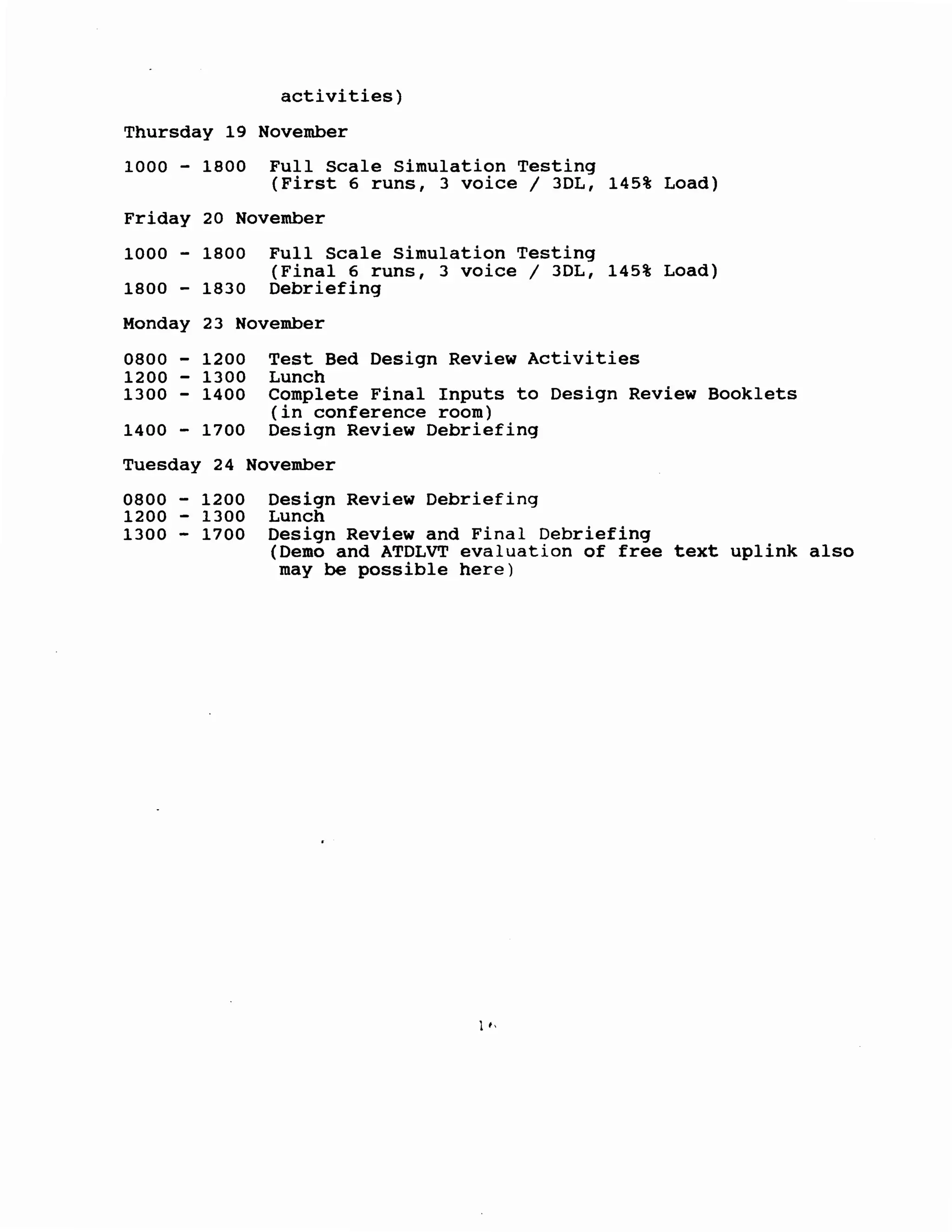
Thursday 19 November
1000 - 1800 Full Scale Simulation Testing
(First 6 runs, 3 voice 1 3DL, 145% Load)
Friday 20 November
1000 - 1800 Full Scale Simulation Testing
(Final 6 runs, 3 voice 1 3DL, 145% Load)
1800 - 1830 Debriefing
Monday 23 November
0800 - 1200
1200 - 1300
1300 - 1400
1400 - 1700
Test Bed Design Review Activities
Lunch
Complete Final Inputs to Design Review Booklets
(in conference room)
Design Review Debriefing
Tuesday 24 November
0800 - 1200
1200 - 1300
1300 - 1700
Design Review Debriefing
Lunch
Design Review and Final Debriefing
(Demo and ATDLVT evaluation of free text uplink also
may be possible here)
1,'

ct-acd32093-2

  • 1.
    !" '~:~' _ ............ 5 DOT/FAA/CT-ACD32093/2 REVISEDTEST PLAN FOR OPERATIONAL EVALUATION OF INITIAL DATA LINK TERMINAL ATC SERVICES October 1992 Engineering, Research, and Development Service Research Directorate for Aviation Technology FAA Technical Center Atlantic City International Airport, N.J. 08405
  • 2.
    POINT OF CONTACT NICHOLASJ. TALOTTA, ACD-320, 609-484-5302 CLARK SHINGLEDECKER, NTI, INC., 513-254-3171
  • 3.
    1. INTRQDUCTION. 1.1 PURPQSE. TheFederal Aviation Administration (FAA) Technical Center holds primary responsibility for defining, developing, and testing air traffic control (ATC) services which can be effectively transmitted to aircraft using Data Link communication technologies. The test plan described in this document is directed toward an operational evaluation of a group of four Data Link terminal ATC services and functions from the perspective of their general impact on the ATC system and on the controller user of the services. The plan will be carried out in the context of a broader study effort in which objectives associated with flight deck Data Link issues also will be addressed. A coordinated, but separate test plan is under development for the flight deck portion of the operational evaluation. 1.2 BACKGROUND. Data Link has the technical capability to significantly enhance the safety and productivity of the ATC system by reducing voice radio frequency congestion and preventing several common communications errors. However, Data Link also will introduce a profound change in the way in which ATC tasks are accomplished by controllers, and in the way aircrew will receive and respond to ATC instructions. Because of this, the ultimate success of Data Link will be critically dependent on the extent to which it is employed to create an effective communications system that is fully integrated with its human users and with the full range of tasks that they are required to perform. Recognition of the need to consider operational suitability and human factors issues as primary drivers of the design process prompted the FAA Technical Center to initiate a program of manned simulation research to guide the development of Data Link ATC services. The overall goals of this research are to 1) define useful Data Link services, 2) determine the user information requirements for Data Link communications, 3) develop display formats, data entry methods and procedures which promote efficient controller performance, and 4) evaluate the impact of Data Link services on both human and system performance. The Data Link test bed was assembled at the FAA Technical Center to address these goals. The test bed is a laboratory facility which uses actual NAS equipment in conjunction with simulation computers to create a system capable of realistically exercising Data Link applications 1n an end-to-end fashion. In its current form, the Test Bed is composed of the NAS en route and terminal laboratories, the Target Generation Facility (TGF), and the Data Link laboratory. The NAS laboratory includes the HOST computer system used for en route ATC data processing as well as its 2
  • 4.
    primary terminal counterpart,the ARTS IliA system. Both computers are linked to several suites of their respective operational controller workstations which are used to display radar data and to enter system inputs. The NAS laboratory is linked to the TGF through the ATC computers. The TGF permits the NAS laboratory systems to act as functioning control facilities by providing simulated radar data and voice radio inputs from simulation "pilots" operating from computer terminals. The Data Link laboratory houses a VAX 11/750 computer which acts as an emulation of the future ground Data Link processor. The VAX computer supports digital communication between simulation pilots and controllers. It can also provide two-way communication between controllers and high-fidelity aircraft simulators or actual airborne systems using Mode s or any other installed Data Link technology. The central thrust of Data Link research in the test bed is manned simulation research aimed at defining and testing designs for ATC services. This research follows a three-stage approach originally developed and successfully employed under the en route portion of the Data Link program. In the Design Verification stage, engineering tests are conducted in the Data Link Test Bed to insure that preliminary designs for Data Link services are faithfully reflected in operational software and hardware components of the test bed simulation laboratories. Following resolution of engineering issues, a series of manned simulation studies are performed in which air traffic controllers exercise and evaluate the Data Link ATC services. In the Mini study stage of these experiments, iterative design evaluations are conducted to refine controller procedures, displays, and input requirements. Early studies are completed under controlled, part-task simulation conditions which focus on detailed consideration of basic design issues. As development progresses, simulation exercises are increased in operational fidelity to assess the robustness of the services and to obtain reliable controller judgments of acceptability, usability and workload effects. A fixed group of Full Performance Level (FPL) controllers from the Air Traffic Data Link Validation Team (ATDLVT) participate throughout the mini study stage to provide continuity in the iterative development process. The final, Operational Evaluation stage of the approach consists of one or more high fidelity simulation exercises in which the optimized service designs are exercised under a variety of realistic operational conditions and air traffic scenarios. For these studies, a new group of controllers with no prior Data Link experience is recruited for participation. Measures of system effectiveness, communications efficiency, and workload are used 3
  • 5.
    to verify theutility and usability of the Data Link services. The resulting data determine inputs to a Technical Data Package (TOP) that is used to guide the development of operational Data Link software for implementation in the National Airspace System (NAS). The research plan presented in this document will be followed to conduct an operational evaluation of four terminal Data Link services: 1) Initial Contact, 2) Terminal Information Service, 3) Transfer of Communication, and 4) altitude, heading, and speed control instructions using the Menu Text function. These initial services were defined by the terminal controller subgroup of the ATDLVT and underwent preliminary conceptual development during exercises conducted on a rapid prototyping system at the MITRE Corporation. In 1990, the services were implemented in the Data Link test bed at the FAA Technical Center using operational ARTS IIIA workstations, displays, input devices and computer systems. Three subsequent mini studies were conducted to refine the designs in preparation for the operational evaluation. 2. OBJECTIVES. The primary objectives of the ATC portion of the operational evaluation will be to: a. Validate functional specifications and specific ARTS IIIA designs for the initial terminal ATC Data Link services and functions. b. Estimate the impact of implementing the initial Data Link services on air-ground communications activities, controller capabilities, and ATC operations. In conjunction with the flight deck study, a secondary objective of the study will be to demonstrate the capabilities of the Data Link Test Bed facilities at the FAA Technical Center to support future hi9h fidelity, end-to-end, controller and pilot in-the- loop stud1es of Data Link. 3. APPRQACH. These objectives will be achieved during an 8-day study period in which Full Performance Level (FPL) air traffic specialists will participate in extensive training exercises and full scale simulation testing. Data which address objective a. will be collected using structured design review materials and debriefing sessions following training and full scale simulation testing. Data which address objective b. will be collected by simulation computers during the full scale simulations, and by employing quantified controller rating scales and questionnaires after each of the full scale simulation test runs. 4
  • 6.
    3.1 RATIONALE ANDAPPROACH TO DESIGN VALIDATION (Objective a.). Designs for the initial terminal Data Link services were developed using an iterative series of mini studies in which a relatively fixed group of controllers from the ATDLVT participated. During these studies, the ATDLVT controllers acted as subject matter experts (SMEs), as they exercised interim versions of the service designs in progressively more realistic ATC scenarios. The findings from each study produced increasingly refined versions of the designs based on a combination the controllers' operational ATC experience as well as their experiences in the Data Link simulations. The design requirements which emerged from these studies are embodied in the service desi9ns currently implemented on the ARTS IIIA equipment in the Data L1nk Test Bed. These specific designs have served as the primary basis for preparing a more general functional design specification that will be used by an implementing contractor to produce operational NAS software. The validity of the SME approach to design development described above is largely dependent on the extent to which the knowledge and experience of the necessarily restricted sample of terminal controllers on the ATDLVT is representative of that held by the broader population of controllers currently working in operational facilities. Because of this, the method that will be used to validate the functional specification will involve the participation of a new group of controllers who have had no prior experience with the initial terminal Data Link services. These subjects will receive extensive training on the use of the Data Link services, and will participate in a series of high fidelity simulation trials intended to provide them with sufficient experience to evaluate the operational utility and usability of the designs. The observations and judgments of these controllers will be recorded through their completion of an exhaustive review of all aspects of the functions and computer - human interface incorporated in the service designs, quantified ratings of the operational usefulness and value of the services, and structured debriefings. The resulting data will be used to assess the validity of the design requirements embodied in the ARTS IIIA Data Link Test Bed implementation and recorded in the draft functional specification. 3.2 APPROACH TO ESTIMATING DATA LINK IMPACT (Objective b.). Prior analyses and study findings have indicated that many of the benefits of Data Link ATC services in the terminal environment will be directly attributable to the extent to which implementation of the system will relieve restrictions on the ability of controllers to efficiently deal with air traffic demands that are created by the single channel, simplex voice 5
  • 7.
    radio system. Byincreasing the communications opportunities and options available to the controller, Data Link is expected to permit more effective handling of air traffic when communications are disrupted by unusual or emergency situations, high frequency congestion, or radio system failures. Because the impact of the terminal Data Link services will depend upon its ability to reduce frequency congestion, the full scale simulation runs in this study will focus on the nominal use of Data Link to transmit repetitively used, routine messages which currently consume a major portion of available communications time on the radio channel. The subject controllers will be instructed to avoid attempts to "experiment" with Data Link in time-critical or risky situations, and to employ the system only when they judge that it will benefit their ability to maintain the safe and efficient control of air traffic. Comparative test runs will be conducted under voice-only communications and under conditions in which the radio system is supplemented by Data Link services. To assess controller use of the voice radio and Data Link systems, a number of metrics will be employed during the test runs. For all runs, the simulation computers will record the duration and frequency of voice communications initiated by the controllers. In addition, the content of these communications will be recorded on audio tape, and will also be partially recoverable from records of simulation pilot computer inputs that are made to maneuver aircraft in response to clearances. During Data Link runs, the simulation computer (VAX) will record the number and type of all Data Link messages sent by each controller. In order to determine whether any advantages produced by reduced frequency congestion are accrued at any significant cost to overall controller capabilities, measures of perceived workload will be obtained after each full scale simulation run. The Subjective Workload Assessment Technique (SWAT) workload rating system and scaling method will be used to provide quantified, interval level measures of controller workload under voice and Data Link conditions. Additional measures that will be tdken during and after each test run-will be used to gather data 0n communications errors. Because a predicted secondary be1f't ;t of Data Link communications is a reduction in pilot misinterprPtations, stolen clearances, and ambiguities, an attempt will t~ made during this study to detect occurrences of such events. :Jhservers seated at each sector will record obvious pilot errors in readbacks of voice clearances, pilot requests for repe~~s or clarification of messages sent by voice and by Dat~ : 1n~, misinterpreted clearances as evidenced by erroneous dircraft maneuvers, and stolen clearances. Following ear·n test run, the observers will verify these detections with the sutJ )ect controllers and ask them h
  • 8.
    to describe anyadditional communications errors that may have occurred, but had not been noted by the observer. The observers also will record any comments from the subjects regarding problems experienced with either communications system during the test run. After all test runs are completed, the subjects will be asked to respond to a set of open-ended questions and rating scales. These items will be used to solicit controller projections of expected benefits and costs that may be associated with the use of the initial terminal ATC services in a field implementation. Benefit and cost dimensions that will be covered by the posttest measures will include system safet¥, system capacity, and the efficiency of accomplishing specif1c tasks associated with different sectors in the terminal airspace. Controllers also will be asked to comment on the impact of Data Link delays and the utility of Data Link in different portions of the terminal airspace. 4. TEST CONDUCT. 4.1 SUBJECTS. Subjects for this study will be six FPL terminal controllers. These subjects will have .current field radar control experience using the ARTS IIIA system. None of the controllers will have prior experience in ATC simulations of Data Link services. 4.2 GENERAL SCENARIO REQUIREMENTS. The RDU airspace configuration used in Mini Studies 2 and 3 will be used for training and testing. All testing will be conducted using individual controllers to work each of the paired arrival, final, and de~arture sectors. Traffic loads, and proportion of Data Link equ1page in the aircraft fleet will be varied as described in the training, full scale simulation, and design review sections below. 4.3 TRAINING. Subject training on the RDU airspace and on the use of the Data Link system will occur over the first four days of the study. In order to reduce classroom training requirements, the subjects will receive written materials describing the airspace, applicable ATC procedures, and Data Link functions at least one week prior to arriving at the FAA Technical Center. On the first day of the study, the subjects will be randomly assigned to either the north or south portions of the RDU airspace and will work only the assigned arrival, final and departure sectors during training and testing. The terminal ATDLVT controllers will be present during all 7
  • 9.
    classroom and handson training sessions to assist the subject controllers and to answer questions about the airspace procedures and Data Link operations. Classroom training will be conducted in two sessions on the first day of the study. The first 30 minute session will focus on the RDU airspace and ATC procedures. This session will be followed by three, 50 minute practice sessions in the Data Link Test Bed during which voice radio communications procedures will be used. The second 60 minute classroom session will focus on Data Link inputs and displays. This will be followed by twenty-one, 50 minute practice sessions in which voice and Data Link communications will be available. These sessions will be conducted over the first through fourth days of the study as shown in the study schedule. During these sessions each subject will rotate through the three airspace sectors on his/her assigned half of the airspace. A group discussion session will be conducted on the second day of training to answer airspace or Data Link questions. As in all of the scenarios, air traffic loads during the practice runs will increase over each 50 minute session. In early practice runs, peak loads will reach 75% of airport capacity. These peaks will increase across the four days to 100%, 125%, and finally 145%. on Data Link runs, 80% of the aircraft in the scenarios will be Data Link equipped. Data Link total transaction delays during training will be controlled by the simulation computers for those aircraft handled by simulation pilots. The average transaction time will be 17 ± 4 seconds. For the piloted aircraft simulators participating in the training sessions, the portion of transaction delay attributable to the Data Link system will be simulated, but actual pilot response times will determine the total transaction time perceived by the controllers. 4.4 FULL SCALE SIMULATION TESTING. As discussed in the approach section of this plan, the full scale simulation runs will be conducted to 1) provide subjects with additional Data Link experience as for the subsequent design review, and 2) provide test conditions which can be used as a basis for obtaining selected estimates of the impact of Data Link. In addition, piloted flight simulators will form a portion of the air traffic included in the full scale simulation runs to provide data required for the flight deck portion of the operational evaluation. The plan presented below accommodates the simulation requirements of both the ATC and flight deck studies. Preparation for full scale testing will begin after the last practice run, at the end of the fourth study day. During this 8
  • 10.
    group session, thepurpose of the full scale simulation runs will be reviewed. Subjects also will be instructed to restrict the use of Data Link to situations which help them to achieve efficient performance, and to avoid unsafe or "experimental" use of the system. Finally, the subjects will be introduced to the rating instruments that will be used after each trial, and will perform the card sort task required to generate the SWAT scales. 4.4.1 Test Design. The full scale simulation runs will be conducted over the fifth and sixth days of the study. Of the twelve runs, six will be conducted under voice-only procedures, and six with the Data Link services available in addition to voice radio. The test scenarios used in the voice and Data Link runs will differ in terms of the sequence and spacing of traffic, but will not differ in traffic mix or load. For each 50 minute run, arriving and departing traffic will build to a peak of 145% airport capacity (estimated to be equivalent to 90% of sector capacity). The experimental design for these test runs is illustrated in table 1. During the test runs, subjects will rotate through the three sectors on their assigned side of the airport so that, each subject will participate twice at each of the three sector types under both Data Link and voice communication conditions. As shown in table 1., the experimental conditions will be arranged so that a complete replication of the design will occur on each of the test days. six versions of the test scenario will be created, each of which will be used once under voice-only and once under Data Link conditions in the order shown in the table. The ordering of the scenarios and sequencing of sector positions was controlled to insure that each subject will be tested only once under the same combination of scenario, sector, and communication condition. The use of a regular alternation of voice and Data Link trials was dictated by the experimental requirements of the flight deck portion of the study. As in the practice runs, total Data Link transaction delays for aircraft tracks driven by piloted simulators will be determined by the performance of the subject pilots. The controlled transaction time for the simulation (TGF) pilots will be based on data previously collected from the piloted simulators during the practice sessions. These transaction times will be determined by adding a randomly selecting a value from a rectangular distribution with a mean equal to the average pilot response time obtained during practice and a range extending ± 1 standard deviation, to a randomly selected value in the range of 4 to 8 seconds to account for system uplink and downlink transmission time. 9
  • 11.
    In all DataLink conditions, 2 percent of the attempted uplinks Table 1. Operational Evaluation Full Run Communication Order Condition Q§Jl l ~ 1 v 2. 2 v & DL s J. 3 v c .i 4 v & DL e .2 5 v n ~ 6 v & DL a O~Jl ~ r 2. 7 v i ~ 8 v & DL 0 .i 9 v J. 10 v & DL ~ 11 v .2 12 v & DL KEY Subjects: Sn = South Nn = North Sl S2 F A A D D F F A A D D F A F F D D A A F F D D A Conditions: V = Voice Radio Only Scale Test Design Subject/Position Assignment SJ til D A F F A D D A F F A D D F A A F D D F A A F D V & DL = Voice and Data Link Available Control Positions: A = Arrival D = Departure F = Final Approach 10 N2 N3 F D D A A F F D D A A F A D D F F A A D D F F A
  • 12.
    will result ina technical failure (NAK). All successful uplinks to simulation (pseudo) pilots will results in a WILCO. UNABLE or TIME OUT events will not be scripted for the piloted simulators, but may occur during testing. 4.4.2 Data Link Impact Measures. As discussed in the approach section of this plan, a number of measures will be collected during the full scale simulation to obtain estimates of Data Link impact. These measures are listed below: Collected By Simulation System During Test Runs (separated by sector) - Number of push-to-talk actions - Duration of each push-to-talk onset-offset interval (raw data in seconds plus mean and standard deviation for run) - Number of Data Link messages sent (sorted by sector, type of message and by receiving aircraft call sign) - Audio tape records of voice radio messages - Total run duration in seconds Proportion of total run duration spent on voice radio communications by controller - Number of aircraft that entered each sector during run - Number of aircraft that departed each sector during run - Number of aircraft handled ~Y sector - Total duration of each arrival and departure flight within the controlled airspace In addition to the overall data t ,)r .~.,ch test run, measures of voice radio and data link usage w 1 , • t)e grouped in consecutive 5 minute intervals in order to exam1ne the relationship between increasing traffic load and commun 1 ,·<lt 1ons activity. Collected By Observers Puring Test k~ 1 1
  • 13.
    - Communications Problems/Errors -Pilot readback errors - Pilot call backs for repeat 1 clarification - Misinterpreted clearances - erroneous maneuver, failure to maneuver - Stolen clearances Completed By Controller Between Trials - SWAT workload rating - Review and expansion of observer comments on errors - Comments on any communications problems (esp. with piloted simulators) Posttest - Data Link Benefits/Costs Evaluations (Safety, Efficiency, System Capacity, etc.) 4.5 DESIGN REVIEW. The design review will occur on the final two days of the study. The subjects will complete the design review in the Data Link test bed while seated at the ARTS IIIA workstations and controlling aircraft in a simplified scenario which will permit the them to exercise all of the Data Link services. All aircraft in the scenario will be Data Link equipped in order to maximize the subjects' opportunities to examine the service displays, inputs, and procedures. To permit observation of the failure displays, approximately 5 percent of the attempted uplinks will result in a failed technical acknowledgement (NAK), 5 percent in a time-out (failure of the pilot to respond to an uplink within 40 seconds), and 5 percent in an unable response from the pilot. The subjects' primary task will be to exercise each of the Data Link services a sufficient number of times to thoroughly evaluate the service designs. Evaluations will be made by completing a structured review booklet during the simulation runs. The subjects will be informed that the object of the simulation activity is to aid them in completing the detailed design review, and that maintaining routine control over the moderate level (50 percent of airport capacity) of air traffic in the scenario is secondary to this task. Subjects will be encouraged to exchange control positions as required in order to examine services which may not be used in some sectors. The scenario will be repeated as required during the laboratory session to permit ample time 12
  • 14.
    for the subjectsto complete their individual reviews. Up to 6 hour of Test Bed time will be available for this activity. 4.5.1 Design Review Booklet. The design review questionnaire booklet will be similar to that developed for previous terminal mini studies. The review booklet will be organized in six sections. The first section will address general features of the Data Link design that are common to all services including the equipage/eligibility display, the status list, the history list, FOB status and message content displays, and procedural restrictions on issuing messages. The next four sections of the review will address each of the individual service designs in detail. Each of the first five sections of the booklet will be accompanied by a text description of the relevant operational features of the Data Link services. Initial questionnaire items will verify the fidelity with which the test bed service implementations reflect the current specifications by requiring the subjects to judge the correspondence between the descriptions and their actual test bed experience. Succeeding items will assess the acceptability of the service implementations observed in the test bed, and solicit recommendations for any further design modifications. 4.5.2 Operational Effectiveness and Usability Ratings. The final section of the review booklet will solicit summary evaluations of the initial services. For each service, the subject controllers will provide an overall rating of 1) operational effectiveness/suitability, and 2) controller usability and acceptance. The rating scales used to obtain these judgments will be identical to those employed during mini studies 1 and 2. For each rating, the subjects will be asked to write a brief rationale, emphasizing specific design features or issues which affected their judgement. ATDLVT controllers assigned to each sub1ect during the design review will assist in exercising Data L1nk functions and provide guidance in completing the booklet. 4.5.3 Debriefing. Upon completion of the test bed exercise, all subjects will meet with the ATDLVT and test personnel for a group debriefing session. This session will be used to perform an item-by-item review of the subjects' responses to the review questionnaire. The emphasis of the debriefin9 will be 1) to identify and resolve disagreements regarding the f1delity and acceptability of the service designs and 2) to achieve a consensus regarding the acceptability of, or recommended changes to, the service designs. Designated test personnel will take extensive notes on the issues, resolutions and design modifications discussed during the 13
  • 15.
    debriefing. In addition,a complete audio tape record will be maintained for future reference during data analysis. Other topics that will be addressed during this session will include global design philosophy issues, strategies ado~ted by the subjects for effectively combining voice and Data L1nk during the test runs, potential opportunities for controller error in using Data Link, the overall projected effects of Data Link on ATC, and the readiness of the initial terminal services for operational implementation. Group discussions on specific topics will be initiated by test personnel. Each topic or question will be presented on an overhead projection slide. The discussion facilitator will elicit differing opinions from the test subjects and will attem~t to determine whether a group consensus opinion can be achieved 1n each case. Extensive notes will be taken by test personnel in order to accurately represent the findings and any conclusions of the discussions. In addition, audio tape recordings will be maintained to resolve any discrepancies among the written notes during data analysis. 5. PATA ANALYSIS. Data from the design review questionnaire will be tabulated across subjects to determine the level of agreement regarding the desirability of the display and input characteristics for each service. Written comments and suggestions for modifications to the service designs will be summarized to cogently express alternate opinions. The aim of this analysis will be to generate a document presenting detailed descriptions of the terminal Data Link service designs that are endorsed by the subjects as well as a clear definition of outstanding design problems. This document will form the basis for future changes to the test bed ARTS software, for the planning of any additional testing that may be needed, and for the validation of the draft functional specifications. Quantitative data obtained during the full scale simulation runs will be treated using statistical tests aimed at assessing the significance of any observed effects of the two communication conditions, and any differential effects of communication condition as a function of control position. Where justified by the scale of measurement employed, these data will be analyzed using parametric analysis of variance procedures. Data based on an ordinal scale of measurement will be analyzed using appropriate non-parametric methods. In all cases, primary comparisons will be directed toward the detection of any differences between voice radio and combined Data Link and voice radio conditions. Key measures that will be analyzed for these effects will include SWAT workload ratings, voice radio usage, and Data Link usage. 14
  • 16.
    Ratings of controlleracceptance and operational suitability obtained after the completion of all full scale simulation testing will be used to obtain a global estimate of the readiness of each service design for implementation as judged by the subjects in light of the extended simulation testing. Responses to the questionnaire on perceived costs and benefits of the Data Link system will be tabulated and reported as independent SME projections of Data Link impact. Narrative data obtained during the design review and posttest debriefings will be summarized to reveal group consensus views. Where such consensus is not achieved, alternative views will be recorded along with the proportions of subjects expressing these views. 6. SCHEDULE. Thursday 12 November Travel Friday 13 November 0830 - 0930 0930 - 1000 1000 - 1200 1200 - 1300 1300 - 1400 1400 - 1700 1700 - 1715 Introduction and Review of study Goals/Plans Classroom Airspace and Procedures Training Test Bed Airspace and Procedures Practice (3 Runs - Voice Only - 75% Load) Lunch Classroom Data Link Training Test Bed Data Link Practice (3 Runs - Voice and DL - 75% Load) Airspace and Data Link Q&A Monday 16 November 0830 - 0845 0845 - 1000 1000 - 1700 Airspace and Data Link Review and Q&A Classroom Data Link Training Test Bed Data Link Practice (Voice and DL - 3 Runs 75% 1 3 Runs 100% Load) Tuesday 17 November 1000 - 1800 Test Bed Data Link Training (Voice and DL - 4 Runs 100% 1 2 Runs 125% Load) Wednesday 18 November 1000 - 1700 Test Bed Data Link Training (Voice and DL - 6 Runs 145%) 1800 - 1830 Prepare for Routine Testing (SWAT scaling procedure and review of test 15
  • 17.
    activities) Thursday 19 November 1000- 1800 Full Scale Simulation Testing (First 6 runs, 3 voice 1 3DL, 145% Load) Friday 20 November 1000 - 1800 Full Scale Simulation Testing (Final 6 runs, 3 voice 1 3DL, 145% Load) 1800 - 1830 Debriefing Monday 23 November 0800 - 1200 1200 - 1300 1300 - 1400 1400 - 1700 Test Bed Design Review Activities Lunch Complete Final Inputs to Design Review Booklets (in conference room) Design Review Debriefing Tuesday 24 November 0800 - 1200 1200 - 1300 1300 - 1700 Design Review Debriefing Lunch Design Review and Final Debriefing (Demo and ATDLVT evaluation of free text uplink also may be possible here) 1,'