Unit – IV
Special Concrete Mixes
• Concrete is by definition a composite material consisting essentially of a
binding medium and aggregate particles, and it can take many forms.
• Special types of concrete are those with out-of-the-ordinary properties
or those produced by unusual techniques.
• These concretes do have advantages as well as disadvantages.
Special Concrete Mixes
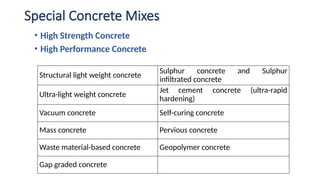
• High Strength Concrete
• High Performance Concrete
Structural light weight concrete
Sulphur concrete and Sulphur
infiltrated concrete
Ultra-light weight concrete
Jet cement concrete (ultra-rapid
hardening)
Vacuum concrete Self-curing concrete
Mass concrete Pervious concrete
Waste material-based concrete Geopolymer concrete
Gap graded concrete
• High-strength concrete is typically recognized as concrete with a 28-day cylinder
compressive strength greater than 40 MPa.
• High-strength concrete can resist loads that normal-strength concrete cannot.
Need of High Strength Concrete
• To put concrete in service at earlier age. (e.g. road or bridge opening)
• To build high-rise structures by reducing cross-section.
• To enhance the durability of long-span structures, e.g. bridge span.
• To fulfil the specific need of structure such as durability, flexural strength etc.
High Strength Concrete
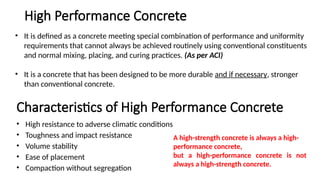
• It is defined as a concrete meeting special combination of performance and uniformity
requirements that cannot always be achieved routinely using conventional constituents
and normal mixing, placing, and curing practices. (As per ACI)
• It is a concrete that has been designed to be more durable and if necessary, stronger
than conventional concrete.
Characteristics of High Performance Concrete
• High resistance to adverse climatic conditions
• Toughness and impact resistance
• Volume stability
• Ease of placement
• Compaction without segregation
High Performance Concrete
A high-strength concrete is always a high-
performance concrete,
but a high-performance concrete is not
always a high-strength concrete.
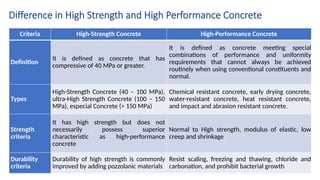
Difference in High Strength and High Performance Concrete
Criteria High-Strength Concrete High-Performance Concrete
Definition
It is defined as concrete that has
compressive of 40 MPa or greater.
It is defined as concrete meeting special
combinations of performance and uniformity
requirements that cannot always be achieved
routinely when using conventional constituents and
normal.
Types
High-Strength Concrete (40 – 100 MPa),
ultra-High Strength Concrete (100 – 150
MPa), especial Concrete (> 150 MPa)
Chemical resistant concrete, early drying concrete,
water-resistant concrete, heat resistant concrete,
and impact and abrasion resistant concrete.
Strength
criteria
It has high strength but does not
necessarily possess superior
characteristic as high-performance
concrete
Normal to High strength, modulus of elastic, low
creep and shrinkage
Durability
criteria
Durability of high strength is commonly
improved by adding pozzolanic materials
Resist scaling, freezing and thawing, chloride and
carbonation, and prohibit bacterial growth
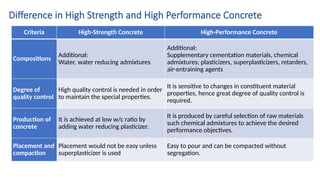
Difference in High Strength and High Performance Concrete
Criteria High-Strength Concrete High-Performance Concrete
Compositions
Additional:
Water, water reducing admixtures
Additional:
Supplementary cementation materials, chemical
admixtures; plasticizers, superplasticizers, retarders,
air-entraining agents
Degree of
quality control
High quality control is needed in order
to maintain the special properties.
It is sensitive to changes in constituent material
properties, hence great degree of quality control is
required.
Production of
concrete
It is achieved at low w/c ratio by
adding water reducing plasticizer.
It is produced by careful selection of raw materials
such chemical admixtures to achieve the desired
performance objectives.
Placement and
compaction
Placement would not be easy unless
superplasticizer is used
Easy to pour and can be compacted without
segregation.
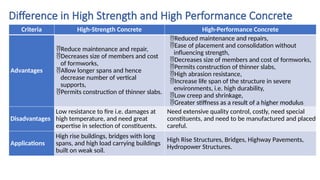
Difference in High Strength and High Performance Concrete
Criteria High-Strength Concrete High-Performance Concrete
Advantages
Reduce maintenance and repair,
Decreases size of members and cost
of formworks,
Allow longer spans and hence
decrease number of vertical
supports,
Permits construction of thinner slabs.
Reduced maintenance and repairs,
Ease of placement and consolidation without
influencing strength,
Decreases size of members and cost of formworks,
Permits construction of thinner slabs,
High abrasion resistance,
Increase life span of the structure in severe
environments, i.e. high durability,
Low creep and shrinkage,
Greater stiffness as a result of a higher modulus
Disadvantages
Low resistance to fire i.e. damages at
high temperature, and need great
expertise in selection of constituents.
Need extensive quality control, costly, need special
constituents, and need to be manufactured and placed
careful.
Applications
High rise buildings, bridges with long
spans, and high load carrying buildings
built on weak soil.
High Rise Structures, Bridges, Highway Pavements,
Hydropower Structures.
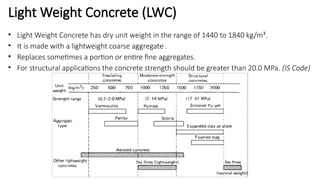
• Light Weight Concrete has dry unit weight in the range of 1440 to 1840 kg/m³.
• It is made with a lightweight coarse aggregate .
• Replaces sometimes a portion or entire fine aggregates.
• For structural applications the concrete strength should be greater than 20.0 MPa. (IS Code)
Light Weight Concrete (LWC)
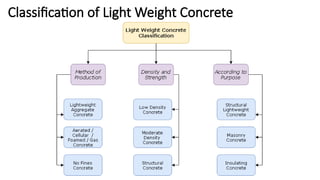
Classification of Light Weight Concrete
Ultra Light Weight Concrete
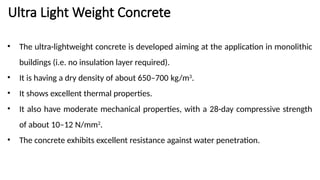
• The ultra-lightweight concrete is developed aiming at the application in monolithic
buildings (i.e. no insulation layer required).
• It is having a dry density of about 650–700 kg/m3
.
• It shows excellent thermal properties.
• It also have moderate mechanical properties, with a 28-day compressive strength
of about 10–12 N/mm2
.
• The concrete exhibits excellent resistance against water penetration.
Advantages of Light Weight Concrete
• Reduced dead load and allows longer span to be poured. This save both labour
and time.
• Reduction of dead load, faster building rates and lower haulage and handling
costs.
• The use of LWC has sometimes made it possible to proceed with the design
which otherwise would have been abandoned because of excessive weight.
• Most building materials such as clay bricks the haulage load is limited not by
volume but by weight. With suitable design containers much larger volumes of
LWC can haul economically.
• It is having relatively low thermal conductivity, to the need for reducing fuel
consumption while maintaining comfort conditions buildings. A 125 mm thick
solid wall of aerated concrete will give thermal insulation about four times
greater than that of a 230 mm clay brick wall.
Uses of Light Weight Concrete
• Screeds and thickening for general purposes especially to floors roofs and other
structural members.
• Screeds and walls where timber has to be attached by nailing.
• Casting structural steel to protect it against fire and corrosion or as a covering for
architectural purposes.
• Heat insulation on roofs.
• Construction of partition walls and panel walls in frame structures.
• Fixing bricks to receive nails from joinery, principally in domestic or domestic type
construction.
• General insulation of walls, water pipes etc.
• Surface rendered for external walls of small houses.
Durability of Light Weight Concrete
 Chemical attack is combined with groundwater, sulfate, polluted air, and spillage of
reactive liquids. LWC has no special resistant to these agencies. It is not
recommended for use below damp-course. A chemical aspect of durability is the
stability of the material itself, particularly at the presence of moisture.
 Physical stresses to which LWC is exposed are principally frost action, shrinkage and
temperature stresses. Stressing may be due to the drying shrinkage of the concrete
or to differential thermal movements between dissimilar materials or to other
phenomena of a similar nature. Drying shrinkage commonly causes cracking of LWC
if suitable precautions are not taken.
 Mechanical damage can result from abrasion or impact excessive loading of flexural
members. The lightest grades of LWC are relatively soft so that they subject to some
abrasion were they not for other reasons protected by rendering.
Vacuum Concrete
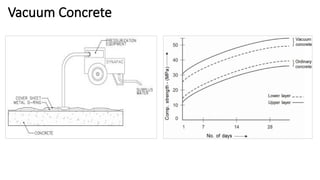
• In the usual manner, a concrete mix with good workability is placed.
• Fresh concrete contains the system of water-filled channels.
• Vacuum concrete is the type of concrete in which the excess water is removed for
improving concrete strength.
• The water is removed by use of vacuum mats connected to a vacuum pump.
• This results in water being extracted from a certain depth of the concrete.
• The final water cement ratio before setting is reduced and controls the strength.
• Vacuum concrete has a higher strength, higher density and lower permeability with
increased durability.
Vacuum Concrete
Vacuum Concrete
Advantages of Vacuum Concrete
 The final strength of concrete is increased by about 25% than normal concrete.
 The permeability of concrete is sufficiently decreased.
 It stiffens rapidly so that the formworks can be removed in early age of casting.
 In a precast factory as the forms can be reused at frequent intervals, this concrete
is of considerable economic value.
 The bond strength is about 20% higher than normal concrete.
 The density of vacuum concrete is higher than normal concrete.
 The surface is entirely free from pitting and the uppermost layer is highly resistant
to abrasion.
 It bonds well to old concrete and can, therefore, be used for resurfacing road slabs
and other repair works.
Mass Concrete
• As per ACI, mass concrete is any volume of concrete with dimensions large enough to
require that measures be taken to cope with generation of heat from hydration of the
cement and attendant volume change to minimize cracking.
• The one characteristic that distinguishes mass concrete from other concrete work is
thermal behavior.
• The cement-water reaction causes the temperature to rise within a large concrete mass.
• Mass concrete is normally placed in dams, bridge foundations, bridge piers, mat
foundations, pile caps, thick walls, and tunnel linings. Mass concrete may or may not be
reinforced depending upon the intended purpose of the structure.
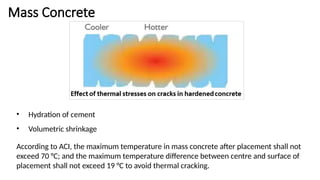
Mass Concrete
• Hydration of cement
• Volumetric shrinkage
According to ACI, the maximum temperature in mass concrete after placement shall not
exceed 70 °C; and the maximum temperature difference between centre and surface of
placement shall not exceed 19 °C to avoid thermal cracking.
Measures to reduce cracks in Mass Concrete
 Limiting the cement content by replacing cement with slag/fly ash
 Increasing the size of coarse aggregates,
 Limiting placement temperature,
 Cooling system,
 Limiting size of pour and
 Proper curing arrangements.
Waste material based Concrete
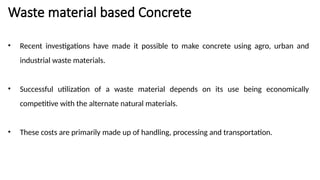
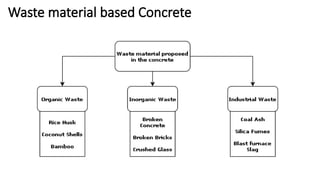
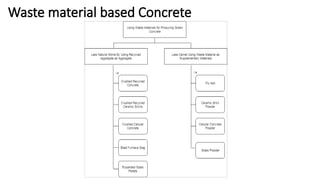
• Recent investigations have made it possible to make concrete using agro, urban and
industrial waste materials.
• Successful utilization of a waste material depends on its use being economically
competitive with the alternate natural materials.
• These costs are primarily made up of handling, processing and transportation.
Waste material based Concrete
Use of Waste material in Concrete
 Need for safe and economic disposal of waste materials.
 The use of waste materials saves natural resources and dumping spaces, and helps to
maintain a clean environment.
 The current concrete construction practice is thought unsustainable, which cause green-
house effects leading to global warming.
 Research is being conducted for waste materials like- rubber Tyre, e-waste, waste plastic,
demolished constituents, waste water etc.
Gap Graded Concrete
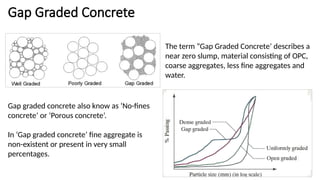
The term “Gap Graded Concrete’ describes a
near zero slump, material consisting of OPC,
coarse aggregates, less fine aggregates and
water.
Gap graded concrete also know as ‘No-fines
concrete’ or ‘Porous concrete’.
In ‘Gap graded concrete’ fine aggregate is
non-existent or present in very small
percentages.
Gap Graded Concrete
• It has high porosity allowing free drainage.
• It also shows less segregation controlled by fine aggregates.
• It permit lower water/cement ratios (0.28 to 0.40) and develop required strength with
lower cement factors.
• Creep and shrinkage are also less in gap graded concrete than in comparable standard
mixes.
Gap graded concrete is one of the measures used for Groundwater recharge. It filters water
from rainfall or storm and can reduce pollutant loads entering into the rivers, streams etc.
This concrete also allows the transfer of water and air to root systems of the trees.
Gap Graded Concrete
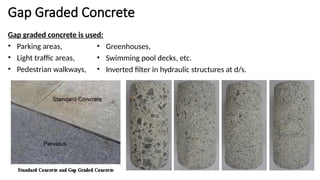
Gap graded concrete is used:
• Parking areas,
• Light traffic areas,
• Pedestrian walkways,
• Greenhouses,
• Swimming pool decks, etc.
• Inverted filter in hydraulic structures at d/s.
Gap Graded Concrete
Advantages :
 Reduce creep and shrinkage
 Requirement of sand reduced by 26 to 40%
 Specific area of total aggregates will be
reduced due to less sand
 Requires less cement as net volume of voids is
reduced
 Decreasing flooding possibilities in urban
areas,
 Recharging groundwater level,
 Reducing puddles on the road,
 Improving water quality through percolation,
 Heat and sound absorption
Disadvantages:
 Low strength due to high porosity
 High maintenance is required
 Due to low strength limited use in
structural load bearing
Sulphur Concrete
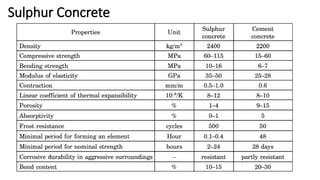
• Sulphur concrete uses sulphur as the binding agent for aggregate and therefore replaces
the cement and water of a regular concrete mix.
• Process of the sulphur concrete manufacture is based on the “hot” technology. All the
mixed components are heated until 140–150C.
• The technology of the sulphur concrete is very similar to the technology of the asphalt
concrete.
• The sulphur used in the sulphur concrete production can be mixed with any type of
traditional aggregate (4mm and below size).
• Sulphur concrete can be applied both for non-reinforced elements and for reinforced
elements
Sulphur Concrete
Advantages of Sulphur Concrete
 High strength and fatigue resistance;
 Extremely rapid set and strength gain (in around 24 hrs);
 Cost-effective substitute for Portland cement concrete in certain applications;
 Excellent corrosion resistance against almost all acids and salts;
 High durability in harsh environments such as salt or acidic solutions;
 Remeltable and reusable without changing its chemical properties;
 Possibility of applying all kind of wastes either as binder or as filler;
 Relatively safe to use.
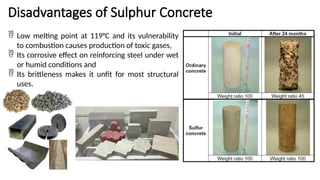
Disadvantages of Sulphur Concrete
 Low melting point at 119°C and its vulnerability
to combustion causes production of toxic gases,
 Its corrosive effect on reinforcing steel under wet
or humid conditions and
 Its brittleness makes it unfit for most structural
uses.
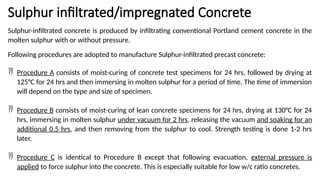
Sulphur infiltrated/impregnated Concrete
Sulphur-infiltrated concrete is produced by infiltrating conventional Portland cement concrete in the
molten sulphur with or without pressure.
Following procedures are adopted to manufacture Sulphur-infiltrated precast concrete:
 Procedure A consists of moist-curing of concrete test specimens for 24 hrs, followed by drying at
125°C for 24 hrs and then immersing in molten sulphur for a period of time. The time of immersion
will depend on the type and size of specimen.
 Procedure B consists of moist-curing of lean concrete specimens for 24 hrs, drying at 130°C for 24
hrs, immersing in molten sulphur under vacuum for 2 hrs, releasing the vacuum and soaking for an
additional 0.5 hrs, and then removing from the sulphur to cool. Strength testing is done 1-2 hrs
later.
 Procedure C is identical to Procedure B except that following evacuation, external pressure is
applied to force sulphur into the concrete. This is especially suitable for low w/c ratio concretes.
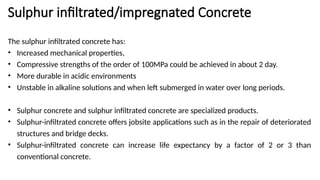
Sulphur infiltrated/impregnated Concrete
The sulphur infiltrated concrete has:
• Increased mechanical properties,
• Compressive strengths of the order of 100MPa could be achieved in about 2 day.
• More durable in acidic environments
• Unstable in alkaline solutions and when left submerged in water over long periods.
• Sulphur concrete and sulphur infiltrated concrete are specialized products.
• Sulphur-infiltrated concrete offers jobsite applications such as in the repair of deteriorated
structures and bridge decks.
• Sulphur-infiltrated concrete can increase life expectancy by a factor of 2 or 3 than
conventional concrete.
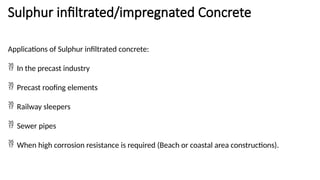
Sulphur infiltrated/impregnated Concrete
Applications of Sulphur infiltrated concrete:
 In the precast industry
 Precast roofing elements
 Railway sleepers
 Sewer pipes
 When high corrosion resistance is required (Beach or coastal area constructions).
Jet cement concrete (Ultra-Rapid Hardening Concrete)
• Normal concrete cannot be hardened well under zero temperatures.
• Therefore some admixtures needs to be added to prevent the frost damage and to
ensure the proper hardening of concrete.
• In such situations, jet cement concrete (Ultra-rapid Hardening-URHC) may be used.
• URHC develops the required compressive strength at a material age of 3 hours.
• URHC cannot be used for applications that require a bending strength of 10 N/mm2
or
more.
• URHC has been widely used for the repairing works of concrete structures.
• OPC with additional lime stone (tri-calcium silicate) causes concrete to harden rapidly.
Jet cement concrete (Ultra-Rapid Hardening Concrete)
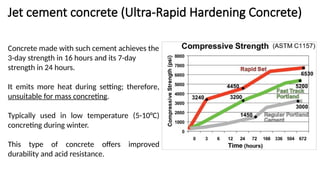
Concrete made with such cement achieves the
3-day strength in 16 hours and its 7-day
strength in 24 hours.
It emits more heat during setting; therefore,
unsuitable for mass concreting.
Typically used in low temperature (5-10°C)
concreting during winter.
This type of concrete offers improved
durability and acid resistance.
Jet cement concrete (Ultra-Rapid Hardening Concrete)
Advantages of UHRC:
 It requires a short period of curing.
 It is resistant to sulphate attacks.
 Shrinkage is reduced during curing and hardening of cement.
 It is used in areas like road pavements so that the traffic can be opened early.
 It is also used in manufacturing precast slabs, posts, electric poles, concreting in cold
countries.
 It gains high strength in the early days and the formwork can be removed earlier.
 It is a very durable.
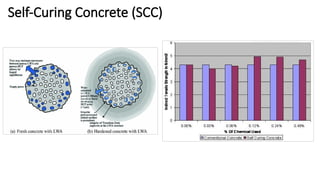
Self-Curing Concrete (SCC)
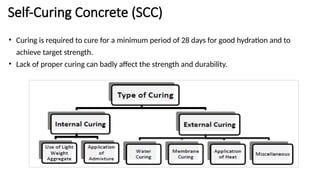
• Curing is required to cure for a minimum period of 28 days for good hydration and to
achieve target strength.
• Lack of proper curing can badly affect the strength and durability.
Self-Curing Concrete (SCC)
There are two major methods available for internal curing of concrete.
• The first method uses saturated porous lightweight aggregate to supply an internal source
of water, which can replace the water consumed by chemical shrinkage during cement
hydration.
• The second method uses admixtures which reduces the evaporation of water from the
surface of concrete and also helps in water retention. Self-curing concrete is a type of
concrete with a special ability to reduce autogenous shrinkage responsible for early-stage
cracking.
Self-Curing Concrete (SCC)
Advantages of Self-Curing Concrete (SCC)
• It is the alternate concrete in desert regions where major scarcity of water is there.
• Slump value rise with increase in the quantity of self-curing admixture.
• Self-Curing concrete contains the water to hydrate all the cement.
• SCC provides water to keep the relative humidity (RH) high.
• SCC eliminates largely autogenous shrinkage.
• Strength of SCC is on par with conventional concrete.
• SCC is the answer to many problems faced due to lack of proper curing
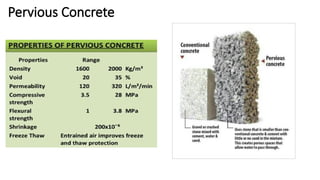
Pervious Concrete
Pervious concrete (also called porous concrete, permeable concrete, no fines concrete and
porous pavement) is a special type of concrete with a high porosity.
The high porosity is attained by a highly interconnected void.
Pervious concrete consists of cement, coarse aggregate (size should be 9.5 mm to 12.5 mm)
and water with little to no fine aggregates. The addition of a small amount of sand will
increase the strength. The mixture has a W/C ratio of 0.28 to 0.40 with a void content of 15%
to 25%.
Pervious concrete has a common strength of 4 to 10 MPa though strengths up to 28 MPa can
be reached.
Slump and air content tests are not applicable to pervious concrete because of the unique
composition.
Pervious Concrete
Pervious Concrete
Disadvantages:
 Extended curing time
 Limited use in heavy traffic areas
 Frequent maintenance is required
 Compressive strength is low
 Special care needs to be taken in
expansive soils and high
groundwater conditions.
Geopolymer Concrete
• Geopolymer concrete is a type of concrete that is made by reacting aluminate and silicate
bearing materials with a (caustic) activator.
• Waste materials such as fly ash or ground granulated blast furnace slag (GGBS)
are used in this concrete.
• The use of this concrete helps to reduce the stock of wastes and also reduces
carbon emission by reducing Portland cement demand.
• It is significantly more environmentally friendly than standard concrete.
• This concrete gains its compressive strength (upto 70MPa) rapidly and faster
than ordinary Portland cement concrete.
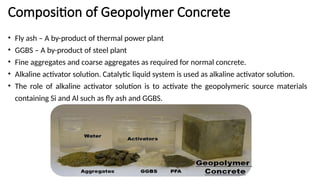
Composition of Geopolymer Concrete
• Fly ash – A by-product of thermal power plant
• GGBS – A by-product of steel plant
• Fine aggregates and coarse aggregates as required for normal concrete.
• Alkaline activator solution. Catalytic liquid system is used as alkaline activator solution.
• The role of alkaline activator solution is to activate the geopolymeric source materials
containing Si and Al such as fly ash and GGBS.
Properties of Geopolymer Concrete
• The drying shrinkage of is much less compared to Normal concrete. Hence can be used as
concrete structural members.
• It has low heat of hydration in comparison with Normal concrete.
• The fire resistance is considerably better than Normal concrete.
• It has chloride permeability rating of ‘low’ to ‘very low’ as per ASTM 1202C.
• It offers better protection to reinforcement steel from corrosion as compared to
traditional cement concrete.
• This concrete are found to possess very high acid resistance when tested under exposure
to 2% and 10% sulphuric acids.
Advantages of Geopolymer Concrete
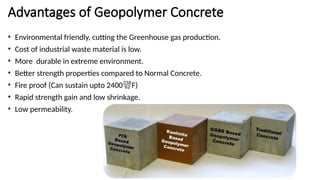
• Environmental friendly, cutting the Greenhouse gas production.
• Cost of industrial waste material is low.
• More durable in extreme environment.
• Better strength properties compared to Normal Concrete.
• Fire proof (Can sustain upto 2400F)
• Rapid strength gain and low shrinkage.
• Low permeability.
Applications of Geopolymer Concrete
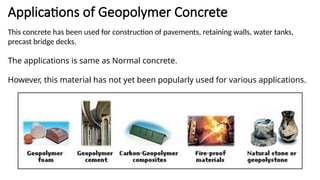
This concrete has been used for construction of pavements, retaining walls, water tanks,
precast bridge decks.
The applications is same as Normal concrete.
However, this material has not yet been popularly used for various applications.
CT - Unit – IV Presentation (1).pgggggggptx

CT - Unit – IV Presentation (1).pgggggggptx

  • 1.
    Unit – IV SpecialConcrete Mixes
  • 2.
    Special Concrete Mixes •Concrete is by definition a composite material consisting essentially of a binding medium and aggregate particles, and it can take many forms. • Special types of concrete are those with out-of-the-ordinary properties or those produced by unusual techniques. • These concretes do have advantages as well as disadvantages.
  • 3.
    Special Concrete Mixes •High Strength Concrete • High Performance Concrete Structural light weight concrete Sulphur concrete and Sulphur infiltrated concrete Ultra-light weight concrete Jet cement concrete (ultra-rapid hardening) Vacuum concrete Self-curing concrete Mass concrete Pervious concrete Waste material-based concrete Geopolymer concrete Gap graded concrete
  • 4.
    • High-strength concreteis typically recognized as concrete with a 28-day cylinder compressive strength greater than 40 MPa. • High-strength concrete can resist loads that normal-strength concrete cannot. Need of High Strength Concrete • To put concrete in service at earlier age. (e.g. road or bridge opening) • To build high-rise structures by reducing cross-section. • To enhance the durability of long-span structures, e.g. bridge span. • To fulfil the specific need of structure such as durability, flexural strength etc. High Strength Concrete
  • 5.
    • It isdefined as a concrete meeting special combination of performance and uniformity requirements that cannot always be achieved routinely using conventional constituents and normal mixing, placing, and curing practices. (As per ACI) • It is a concrete that has been designed to be more durable and if necessary, stronger than conventional concrete. Characteristics of High Performance Concrete • High resistance to adverse climatic conditions • Toughness and impact resistance • Volume stability • Ease of placement • Compaction without segregation High Performance Concrete A high-strength concrete is always a high- performance concrete, but a high-performance concrete is not always a high-strength concrete.
  • 6.
    Difference in HighStrength and High Performance Concrete Criteria High-Strength Concrete High-Performance Concrete Definition It is defined as concrete that has compressive of 40 MPa or greater. It is defined as concrete meeting special combinations of performance and uniformity requirements that cannot always be achieved routinely when using conventional constituents and normal. Types High-Strength Concrete (40 – 100 MPa), ultra-High Strength Concrete (100 – 150 MPa), especial Concrete (> 150 MPa) Chemical resistant concrete, early drying concrete, water-resistant concrete, heat resistant concrete, and impact and abrasion resistant concrete. Strength criteria It has high strength but does not necessarily possess superior characteristic as high-performance concrete Normal to High strength, modulus of elastic, low creep and shrinkage Durability criteria Durability of high strength is commonly improved by adding pozzolanic materials Resist scaling, freezing and thawing, chloride and carbonation, and prohibit bacterial growth
  • 7.
    Difference in HighStrength and High Performance Concrete Criteria High-Strength Concrete High-Performance Concrete Compositions Additional: Water, water reducing admixtures Additional: Supplementary cementation materials, chemical admixtures; plasticizers, superplasticizers, retarders, air-entraining agents Degree of quality control High quality control is needed in order to maintain the special properties. It is sensitive to changes in constituent material properties, hence great degree of quality control is required. Production of concrete It is achieved at low w/c ratio by adding water reducing plasticizer. It is produced by careful selection of raw materials such chemical admixtures to achieve the desired performance objectives. Placement and compaction Placement would not be easy unless superplasticizer is used Easy to pour and can be compacted without segregation.
  • 8.
    Difference in HighStrength and High Performance Concrete Criteria High-Strength Concrete High-Performance Concrete Advantages Reduce maintenance and repair, Decreases size of members and cost of formworks, Allow longer spans and hence decrease number of vertical supports, Permits construction of thinner slabs. Reduced maintenance and repairs, Ease of placement and consolidation without influencing strength, Decreases size of members and cost of formworks, Permits construction of thinner slabs, High abrasion resistance, Increase life span of the structure in severe environments, i.e. high durability, Low creep and shrinkage, Greater stiffness as a result of a higher modulus Disadvantages Low resistance to fire i.e. damages at high temperature, and need great expertise in selection of constituents. Need extensive quality control, costly, need special constituents, and need to be manufactured and placed careful. Applications High rise buildings, bridges with long spans, and high load carrying buildings built on weak soil. High Rise Structures, Bridges, Highway Pavements, Hydropower Structures.
  • 9.
    • Light WeightConcrete has dry unit weight in the range of 1440 to 1840 kg/m³. • It is made with a lightweight coarse aggregate . • Replaces sometimes a portion or entire fine aggregates. • For structural applications the concrete strength should be greater than 20.0 MPa. (IS Code) Light Weight Concrete (LWC)
  • 10.
    Classification of LightWeight Concrete
  • 11.
    Ultra Light WeightConcrete • The ultra-lightweight concrete is developed aiming at the application in monolithic buildings (i.e. no insulation layer required). • It is having a dry density of about 650–700 kg/m3 . • It shows excellent thermal properties. • It also have moderate mechanical properties, with a 28-day compressive strength of about 10–12 N/mm2 . • The concrete exhibits excellent resistance against water penetration.
  • 12.
    Advantages of LightWeight Concrete • Reduced dead load and allows longer span to be poured. This save both labour and time. • Reduction of dead load, faster building rates and lower haulage and handling costs. • The use of LWC has sometimes made it possible to proceed with the design which otherwise would have been abandoned because of excessive weight. • Most building materials such as clay bricks the haulage load is limited not by volume but by weight. With suitable design containers much larger volumes of LWC can haul economically. • It is having relatively low thermal conductivity, to the need for reducing fuel consumption while maintaining comfort conditions buildings. A 125 mm thick solid wall of aerated concrete will give thermal insulation about four times greater than that of a 230 mm clay brick wall.
  • 13.
    Uses of LightWeight Concrete • Screeds and thickening for general purposes especially to floors roofs and other structural members. • Screeds and walls where timber has to be attached by nailing. • Casting structural steel to protect it against fire and corrosion or as a covering for architectural purposes. • Heat insulation on roofs. • Construction of partition walls and panel walls in frame structures. • Fixing bricks to receive nails from joinery, principally in domestic or domestic type construction. • General insulation of walls, water pipes etc. • Surface rendered for external walls of small houses.
  • 14.
    Durability of LightWeight Concrete  Chemical attack is combined with groundwater, sulfate, polluted air, and spillage of reactive liquids. LWC has no special resistant to these agencies. It is not recommended for use below damp-course. A chemical aspect of durability is the stability of the material itself, particularly at the presence of moisture.  Physical stresses to which LWC is exposed are principally frost action, shrinkage and temperature stresses. Stressing may be due to the drying shrinkage of the concrete or to differential thermal movements between dissimilar materials or to other phenomena of a similar nature. Drying shrinkage commonly causes cracking of LWC if suitable precautions are not taken.  Mechanical damage can result from abrasion or impact excessive loading of flexural members. The lightest grades of LWC are relatively soft so that they subject to some abrasion were they not for other reasons protected by rendering.
  • 15.
    Vacuum Concrete • Inthe usual manner, a concrete mix with good workability is placed. • Fresh concrete contains the system of water-filled channels. • Vacuum concrete is the type of concrete in which the excess water is removed for improving concrete strength. • The water is removed by use of vacuum mats connected to a vacuum pump. • This results in water being extracted from a certain depth of the concrete. • The final water cement ratio before setting is reduced and controls the strength. • Vacuum concrete has a higher strength, higher density and lower permeability with increased durability.
  • 16.
  • 17.
  • 18.
    Advantages of VacuumConcrete  The final strength of concrete is increased by about 25% than normal concrete.  The permeability of concrete is sufficiently decreased.  It stiffens rapidly so that the formworks can be removed in early age of casting.  In a precast factory as the forms can be reused at frequent intervals, this concrete is of considerable economic value.  The bond strength is about 20% higher than normal concrete.  The density of vacuum concrete is higher than normal concrete.  The surface is entirely free from pitting and the uppermost layer is highly resistant to abrasion.  It bonds well to old concrete and can, therefore, be used for resurfacing road slabs and other repair works.
  • 19.
    Mass Concrete • Asper ACI, mass concrete is any volume of concrete with dimensions large enough to require that measures be taken to cope with generation of heat from hydration of the cement and attendant volume change to minimize cracking. • The one characteristic that distinguishes mass concrete from other concrete work is thermal behavior. • The cement-water reaction causes the temperature to rise within a large concrete mass. • Mass concrete is normally placed in dams, bridge foundations, bridge piers, mat foundations, pile caps, thick walls, and tunnel linings. Mass concrete may or may not be reinforced depending upon the intended purpose of the structure.
  • 20.
    Mass Concrete • Hydrationof cement • Volumetric shrinkage According to ACI, the maximum temperature in mass concrete after placement shall not exceed 70 °C; and the maximum temperature difference between centre and surface of placement shall not exceed 19 °C to avoid thermal cracking.
  • 21.
    Measures to reducecracks in Mass Concrete  Limiting the cement content by replacing cement with slag/fly ash  Increasing the size of coarse aggregates,  Limiting placement temperature,  Cooling system,  Limiting size of pour and  Proper curing arrangements.
  • 22.
    Waste material basedConcrete • Recent investigations have made it possible to make concrete using agro, urban and industrial waste materials. • Successful utilization of a waste material depends on its use being economically competitive with the alternate natural materials. • These costs are primarily made up of handling, processing and transportation.
  • 23.
  • 24.
  • 25.
    Use of Wastematerial in Concrete  Need for safe and economic disposal of waste materials.  The use of waste materials saves natural resources and dumping spaces, and helps to maintain a clean environment.  The current concrete construction practice is thought unsustainable, which cause green- house effects leading to global warming.  Research is being conducted for waste materials like- rubber Tyre, e-waste, waste plastic, demolished constituents, waste water etc.
  • 26.
    Gap Graded Concrete Theterm “Gap Graded Concrete’ describes a near zero slump, material consisting of OPC, coarse aggregates, less fine aggregates and water. Gap graded concrete also know as ‘No-fines concrete’ or ‘Porous concrete’. In ‘Gap graded concrete’ fine aggregate is non-existent or present in very small percentages.
  • 27.
    Gap Graded Concrete •It has high porosity allowing free drainage. • It also shows less segregation controlled by fine aggregates. • It permit lower water/cement ratios (0.28 to 0.40) and develop required strength with lower cement factors. • Creep and shrinkage are also less in gap graded concrete than in comparable standard mixes. Gap graded concrete is one of the measures used for Groundwater recharge. It filters water from rainfall or storm and can reduce pollutant loads entering into the rivers, streams etc. This concrete also allows the transfer of water and air to root systems of the trees.
  • 28.
    Gap Graded Concrete Gapgraded concrete is used: • Parking areas, • Light traffic areas, • Pedestrian walkways, • Greenhouses, • Swimming pool decks, etc. • Inverted filter in hydraulic structures at d/s.
  • 29.
    Gap Graded Concrete Advantages:  Reduce creep and shrinkage  Requirement of sand reduced by 26 to 40%  Specific area of total aggregates will be reduced due to less sand  Requires less cement as net volume of voids is reduced  Decreasing flooding possibilities in urban areas,  Recharging groundwater level,  Reducing puddles on the road,  Improving water quality through percolation,  Heat and sound absorption Disadvantages:  Low strength due to high porosity  High maintenance is required  Due to low strength limited use in structural load bearing
  • 30.
    Sulphur Concrete • Sulphurconcrete uses sulphur as the binding agent for aggregate and therefore replaces the cement and water of a regular concrete mix. • Process of the sulphur concrete manufacture is based on the “hot” technology. All the mixed components are heated until 140–150C. • The technology of the sulphur concrete is very similar to the technology of the asphalt concrete. • The sulphur used in the sulphur concrete production can be mixed with any type of traditional aggregate (4mm and below size). • Sulphur concrete can be applied both for non-reinforced elements and for reinforced elements
  • 31.
  • 32.
    Advantages of SulphurConcrete  High strength and fatigue resistance;  Extremely rapid set and strength gain (in around 24 hrs);  Cost-effective substitute for Portland cement concrete in certain applications;  Excellent corrosion resistance against almost all acids and salts;  High durability in harsh environments such as salt or acidic solutions;  Remeltable and reusable without changing its chemical properties;  Possibility of applying all kind of wastes either as binder or as filler;  Relatively safe to use.
  • 33.
    Disadvantages of SulphurConcrete  Low melting point at 119°C and its vulnerability to combustion causes production of toxic gases,  Its corrosive effect on reinforcing steel under wet or humid conditions and  Its brittleness makes it unfit for most structural uses.
  • 34.
    Sulphur infiltrated/impregnated Concrete Sulphur-infiltratedconcrete is produced by infiltrating conventional Portland cement concrete in the molten sulphur with or without pressure. Following procedures are adopted to manufacture Sulphur-infiltrated precast concrete:  Procedure A consists of moist-curing of concrete test specimens for 24 hrs, followed by drying at 125°C for 24 hrs and then immersing in molten sulphur for a period of time. The time of immersion will depend on the type and size of specimen.  Procedure B consists of moist-curing of lean concrete specimens for 24 hrs, drying at 130°C for 24 hrs, immersing in molten sulphur under vacuum for 2 hrs, releasing the vacuum and soaking for an additional 0.5 hrs, and then removing from the sulphur to cool. Strength testing is done 1-2 hrs later.  Procedure C is identical to Procedure B except that following evacuation, external pressure is applied to force sulphur into the concrete. This is especially suitable for low w/c ratio concretes.
  • 35.
    Sulphur infiltrated/impregnated Concrete Thesulphur infiltrated concrete has: • Increased mechanical properties, • Compressive strengths of the order of 100MPa could be achieved in about 2 day. • More durable in acidic environments • Unstable in alkaline solutions and when left submerged in water over long periods. • Sulphur concrete and sulphur infiltrated concrete are specialized products. • Sulphur-infiltrated concrete offers jobsite applications such as in the repair of deteriorated structures and bridge decks. • Sulphur-infiltrated concrete can increase life expectancy by a factor of 2 or 3 than conventional concrete.
  • 36.
    Sulphur infiltrated/impregnated Concrete Applicationsof Sulphur infiltrated concrete:  In the precast industry  Precast roofing elements  Railway sleepers  Sewer pipes  When high corrosion resistance is required (Beach or coastal area constructions).
  • 37.
    Jet cement concrete(Ultra-Rapid Hardening Concrete) • Normal concrete cannot be hardened well under zero temperatures. • Therefore some admixtures needs to be added to prevent the frost damage and to ensure the proper hardening of concrete. • In such situations, jet cement concrete (Ultra-rapid Hardening-URHC) may be used. • URHC develops the required compressive strength at a material age of 3 hours. • URHC cannot be used for applications that require a bending strength of 10 N/mm2 or more. • URHC has been widely used for the repairing works of concrete structures. • OPC with additional lime stone (tri-calcium silicate) causes concrete to harden rapidly.
  • 38.
    Jet cement concrete(Ultra-Rapid Hardening Concrete) Concrete made with such cement achieves the 3-day strength in 16 hours and its 7-day strength in 24 hours. It emits more heat during setting; therefore, unsuitable for mass concreting. Typically used in low temperature (5-10°C) concreting during winter. This type of concrete offers improved durability and acid resistance.
  • 39.
    Jet cement concrete(Ultra-Rapid Hardening Concrete) Advantages of UHRC:  It requires a short period of curing.  It is resistant to sulphate attacks.  Shrinkage is reduced during curing and hardening of cement.  It is used in areas like road pavements so that the traffic can be opened early.  It is also used in manufacturing precast slabs, posts, electric poles, concreting in cold countries.  It gains high strength in the early days and the formwork can be removed earlier.  It is a very durable.
  • 40.
    Self-Curing Concrete (SCC) •Curing is required to cure for a minimum period of 28 days for good hydration and to achieve target strength. • Lack of proper curing can badly affect the strength and durability.
  • 41.
    Self-Curing Concrete (SCC) Thereare two major methods available for internal curing of concrete. • The first method uses saturated porous lightweight aggregate to supply an internal source of water, which can replace the water consumed by chemical shrinkage during cement hydration. • The second method uses admixtures which reduces the evaporation of water from the surface of concrete and also helps in water retention. Self-curing concrete is a type of concrete with a special ability to reduce autogenous shrinkage responsible for early-stage cracking.
  • 42.
  • 43.
    Advantages of Self-CuringConcrete (SCC) • It is the alternate concrete in desert regions where major scarcity of water is there. • Slump value rise with increase in the quantity of self-curing admixture. • Self-Curing concrete contains the water to hydrate all the cement. • SCC provides water to keep the relative humidity (RH) high. • SCC eliminates largely autogenous shrinkage. • Strength of SCC is on par with conventional concrete. • SCC is the answer to many problems faced due to lack of proper curing
  • 44.
    Pervious Concrete Pervious concrete(also called porous concrete, permeable concrete, no fines concrete and porous pavement) is a special type of concrete with a high porosity. The high porosity is attained by a highly interconnected void. Pervious concrete consists of cement, coarse aggregate (size should be 9.5 mm to 12.5 mm) and water with little to no fine aggregates. The addition of a small amount of sand will increase the strength. The mixture has a W/C ratio of 0.28 to 0.40 with a void content of 15% to 25%. Pervious concrete has a common strength of 4 to 10 MPa though strengths up to 28 MPa can be reached. Slump and air content tests are not applicable to pervious concrete because of the unique composition.
  • 45.
  • 46.
    Pervious Concrete Disadvantages:  Extendedcuring time  Limited use in heavy traffic areas  Frequent maintenance is required  Compressive strength is low  Special care needs to be taken in expansive soils and high groundwater conditions.
  • 47.
    Geopolymer Concrete • Geopolymerconcrete is a type of concrete that is made by reacting aluminate and silicate bearing materials with a (caustic) activator. • Waste materials such as fly ash or ground granulated blast furnace slag (GGBS) are used in this concrete. • The use of this concrete helps to reduce the stock of wastes and also reduces carbon emission by reducing Portland cement demand. • It is significantly more environmentally friendly than standard concrete. • This concrete gains its compressive strength (upto 70MPa) rapidly and faster than ordinary Portland cement concrete.
  • 48.
    Composition of GeopolymerConcrete • Fly ash – A by-product of thermal power plant • GGBS – A by-product of steel plant • Fine aggregates and coarse aggregates as required for normal concrete. • Alkaline activator solution. Catalytic liquid system is used as alkaline activator solution. • The role of alkaline activator solution is to activate the geopolymeric source materials containing Si and Al such as fly ash and GGBS.
  • 49.
    Properties of GeopolymerConcrete • The drying shrinkage of is much less compared to Normal concrete. Hence can be used as concrete structural members. • It has low heat of hydration in comparison with Normal concrete. • The fire resistance is considerably better than Normal concrete. • It has chloride permeability rating of ‘low’ to ‘very low’ as per ASTM 1202C. • It offers better protection to reinforcement steel from corrosion as compared to traditional cement concrete. • This concrete are found to possess very high acid resistance when tested under exposure to 2% and 10% sulphuric acids.
  • 50.
    Advantages of GeopolymerConcrete • Environmental friendly, cutting the Greenhouse gas production. • Cost of industrial waste material is low. • More durable in extreme environment. • Better strength properties compared to Normal Concrete. • Fire proof (Can sustain upto 2400F) • Rapid strength gain and low shrinkage. • Low permeability.
  • 51.
    Applications of GeopolymerConcrete This concrete has been used for construction of pavements, retaining walls, water tanks, precast bridge decks. The applications is same as Normal concrete. However, this material has not yet been popularly used for various applications.