Prospective Study of Surgical Care Scale-Up in a Rural, Resource-Limited SettingSelwyn Rogers, MD, MSc andDuncan Maru, MD, PHDOctober 4, 2011Center for Surgery and Public HealthNyaya Health
Goals and OutlineGoal: to think through methodological issues in surgical research implementation; better metrics
 Overview of Problem, Methods: 25 minutes
 Group Discussion of Metrics: 60 minutes
 Wrap-up: 5 minutes1
Conflicts of InterestWe report no financial conflicts of interest.  As with any scientific or service endeavor, we have significant intellectual interests at stake, though we hope to remain objective and self-reflective.2
The Need: Implementation Gap in Surgical Care Two billlion people, a third of the global population, live in areas with less than one operating room per 100,000 people
 Globally, approximately 11% of death and disability are attributable to surgical diseases3
The Problem: Deploying Surgical Care WHO has produced Integrated Management for Emergency and Essential Surgical Care, and this has been utilized in several sites
 But: no studies have yet prospectively studied the implementation process4
Our Proposal: A Prospective, Implementation Research StudyProspectively study the implementation of an IMEESC-plus protocol at a district hospital in rural Nepal.
IMEESC: WHO’s current model
IMEESC-plus: includes community-based follow-up and hospital-based quality improvement methods
Study the process using mixed quantitative and qualitative methodologies at the hospital-, staff-, and patient levels
Focus on cesarean sections and soft-tissue injuries5
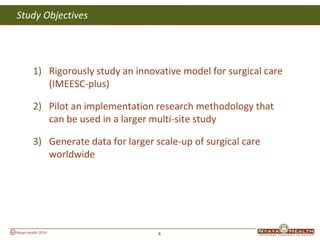
Study ObjectivesRigorously study an innovative model for surgical care (IMEESC-plus)Pilot an implementation research methodology that can be used in a larger multi-site studyGenerate data for larger scale-up of surgical care worldwide6
Setting: Bayalpata HospitalInfrastructure development and capacity building, not care provision aloneGovernment collaboration: Government partnership contract for 5 years signed June 2009 – June 2014, on a government-owned complexCurrently one of the highest levels of clinical care in the Far West (2 million people)Over 75,000 patients seen to date
The ease with which young people die in Achham and the ease with which it is accepted continues to horrify me. -RumaRajbhandari, MD, MPH, March 22, 2011.8
Implementation science done well should be able to enhance, not compromise, both service and research quality.9
Good study design involves collecting the right amount of data, hopefully nothing less but certainly nothing more.  10
Implementation OverviewBuild off existing hospital + CHW network
MD-GP/generalist-run operative services
Not general anesthesia– only spinal, local, regional
Cases outside scope of practice referred 6-14 hours away11
Study ObjectivesRigorously study an innovative model for Surgical Care (IMEESC-plus)Pilot an implementation research methodology that can be used in a larger multi-site studyGenerate data for larger scale-up of Surgical Care worldwide12
Specific Aim 1: Description of ImplementationTo describe the logistics of the implementation process of IMEESC-Plus: the conditions with which patients present and the financial, staffing, pharmaceutical, and consumable supply inputs required to address these conditions.  What basic implementation parameters can one expect?  What parameters matter for planning purposes?13
Specific Aim 1: Description of ImplementationNature of surgical disease
Financial inputs

Csph talk

  • 1.
    Prospective Study ofSurgical Care Scale-Up in a Rural, Resource-Limited SettingSelwyn Rogers, MD, MSc andDuncan Maru, MD, PHDOctober 4, 2011Center for Surgery and Public HealthNyaya Health
  • 2.
    Goals and OutlineGoal:to think through methodological issues in surgical research implementation; better metrics
  • 3.
    Overview ofProblem, Methods: 25 minutes
  • 4.
    Group Discussionof Metrics: 60 minutes
  • 5.
    Wrap-up: 5minutes1
  • 6.
    Conflicts of InterestWereport no financial conflicts of interest. As with any scientific or service endeavor, we have significant intellectual interests at stake, though we hope to remain objective and self-reflective.2
  • 7.
    The Need: ImplementationGap in Surgical Care Two billlion people, a third of the global population, live in areas with less than one operating room per 100,000 people
  • 8.
    Globally, approximately11% of death and disability are attributable to surgical diseases3
  • 9.
    The Problem: DeployingSurgical Care WHO has produced Integrated Management for Emergency and Essential Surgical Care, and this has been utilized in several sites
  • 10.
    But: nostudies have yet prospectively studied the implementation process4
  • 11.
    Our Proposal: AProspective, Implementation Research StudyProspectively study the implementation of an IMEESC-plus protocol at a district hospital in rural Nepal.
  • 12.
  • 13.
    IMEESC-plus: includes community-basedfollow-up and hospital-based quality improvement methods
  • 14.
    Study the processusing mixed quantitative and qualitative methodologies at the hospital-, staff-, and patient levels
  • 15.
    Focus on cesareansections and soft-tissue injuries5
  • 16.
    Study ObjectivesRigorously studyan innovative model for surgical care (IMEESC-plus)Pilot an implementation research methodology that can be used in a larger multi-site studyGenerate data for larger scale-up of surgical care worldwide6
  • 17.
    Setting: Bayalpata HospitalInfrastructuredevelopment and capacity building, not care provision aloneGovernment collaboration: Government partnership contract for 5 years signed June 2009 – June 2014, on a government-owned complexCurrently one of the highest levels of clinical care in the Far West (2 million people)Over 75,000 patients seen to date
  • 18.
    The ease withwhich young people die in Achham and the ease with which it is accepted continues to horrify me. -RumaRajbhandari, MD, MPH, March 22, 2011.8
  • 19.
    Implementation science donewell should be able to enhance, not compromise, both service and research quality.9
  • 20.
    Good study designinvolves collecting the right amount of data, hopefully nothing less but certainly nothing more. 10
  • 21.
    Implementation OverviewBuild offexisting hospital + CHW network
  • 22.
  • 23.
    Not general anesthesia–only spinal, local, regional
  • 24.
    Cases outside scopeof practice referred 6-14 hours away11
  • 25.
    Study ObjectivesRigorously studyan innovative model for Surgical Care (IMEESC-plus)Pilot an implementation research methodology that can be used in a larger multi-site studyGenerate data for larger scale-up of Surgical Care worldwide12
  • 26.
    Specific Aim 1:Description of ImplementationTo describe the logistics of the implementation process of IMEESC-Plus: the conditions with which patients present and the financial, staffing, pharmaceutical, and consumable supply inputs required to address these conditions. What basic implementation parameters can one expect? What parameters matter for planning purposes?13
  • 27.
    Specific Aim 1:Description of ImplementationNature of surgical disease
  • 28.