THE ROLE OF CSO IN
EFFECTIVE PROJECT
PLANNING


           Consultant
            Nudrat Mufti
DEFINATION OF CIVIL SOCIETY
 ORGANIZATIONS
   CSOs can be defined to include
   all non-market and non-state
      organisations in which people
         organise themselves to
               pursue
      shared interests in the public
              domain.
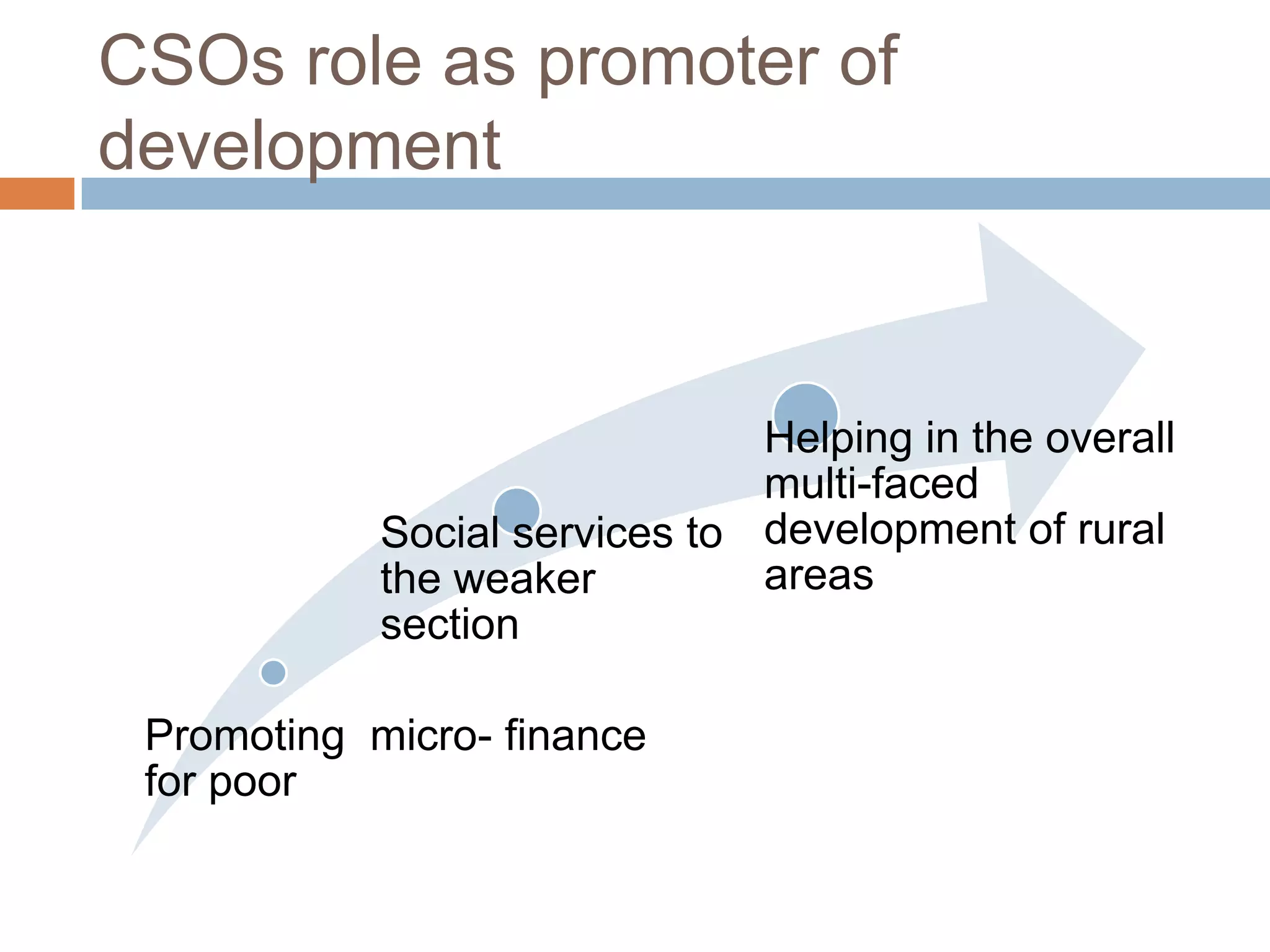
CSOs role as promoter of
development


                               Helping in the overall
                               multi-faced
            Social services to development of rural
            the weaker         areas
            section

 Promoting micro- finance
 for poor
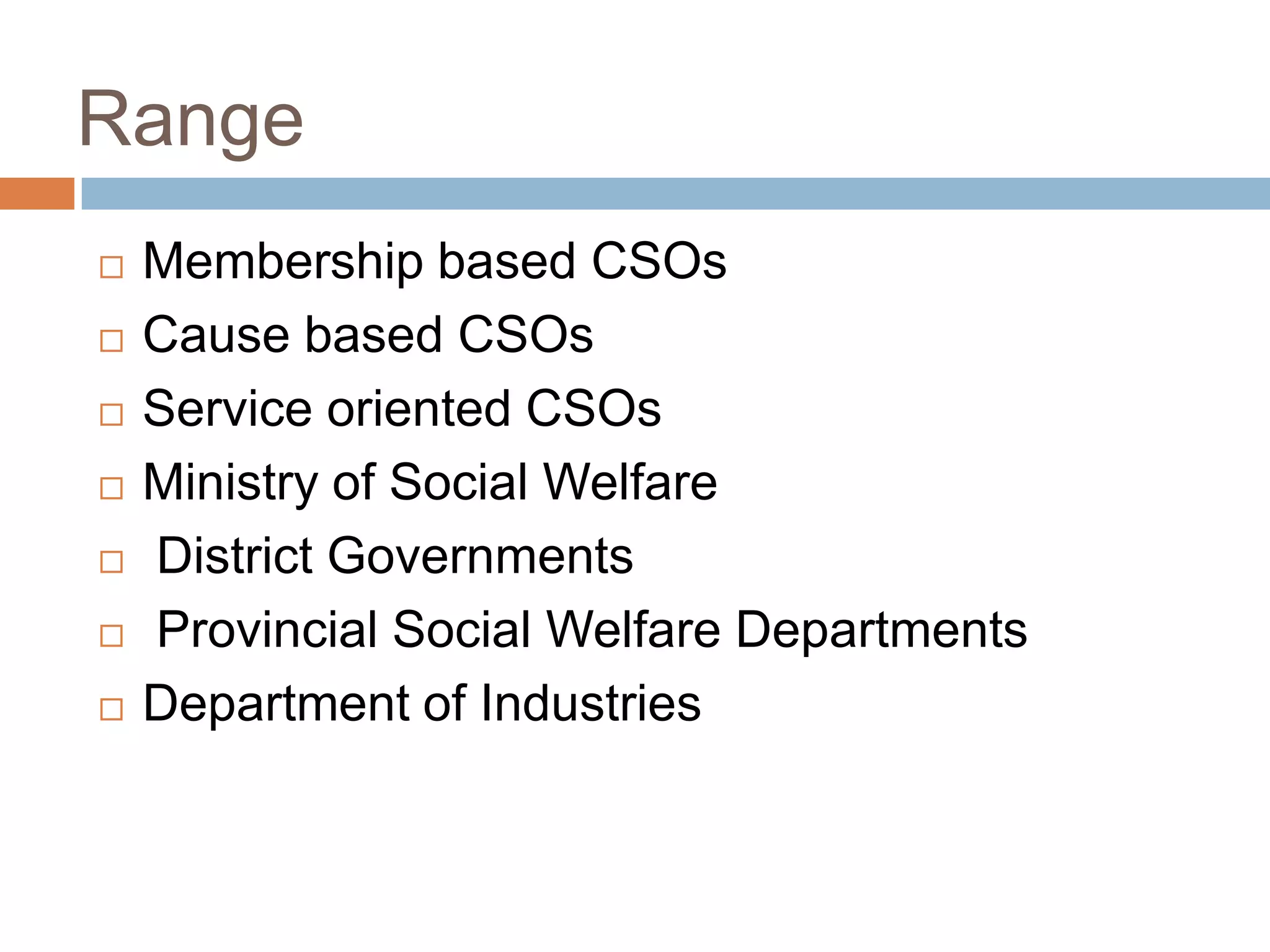
Range
   Membership based CSOs
   Cause based CSOs
   Service oriented CSOs
   Ministry of Social Welfare
   District Governments
   Provincial Social Welfare Departments
   Department of Industries
Projects/Kinds
   Community Village associations
   Health ,Education /Environmental group
   Women‟s right groups
   Farmer associations
   Faith based associations
   Labour union
   Cooperatives professionals
   Chamber of commerce
   Non-profit media
   Independent research institutions
   Poverty alleviation organizations

NGO / CIVIL SOCIETY
ORGANIZATION
   NGO was defined on February 27, 1950, by the
    resolution 288 (X) of the ECOSOC and stands for
    a non-governmental organization. Non-
    governmental organizations are created by legal
    persons who are not part of the government.
    Although NGO funds are mostly raised by the
    government, they maintain a non-governmental
    position, and eliminate the need for a government
    council. This type of organization is also known as
    a civil society organization.
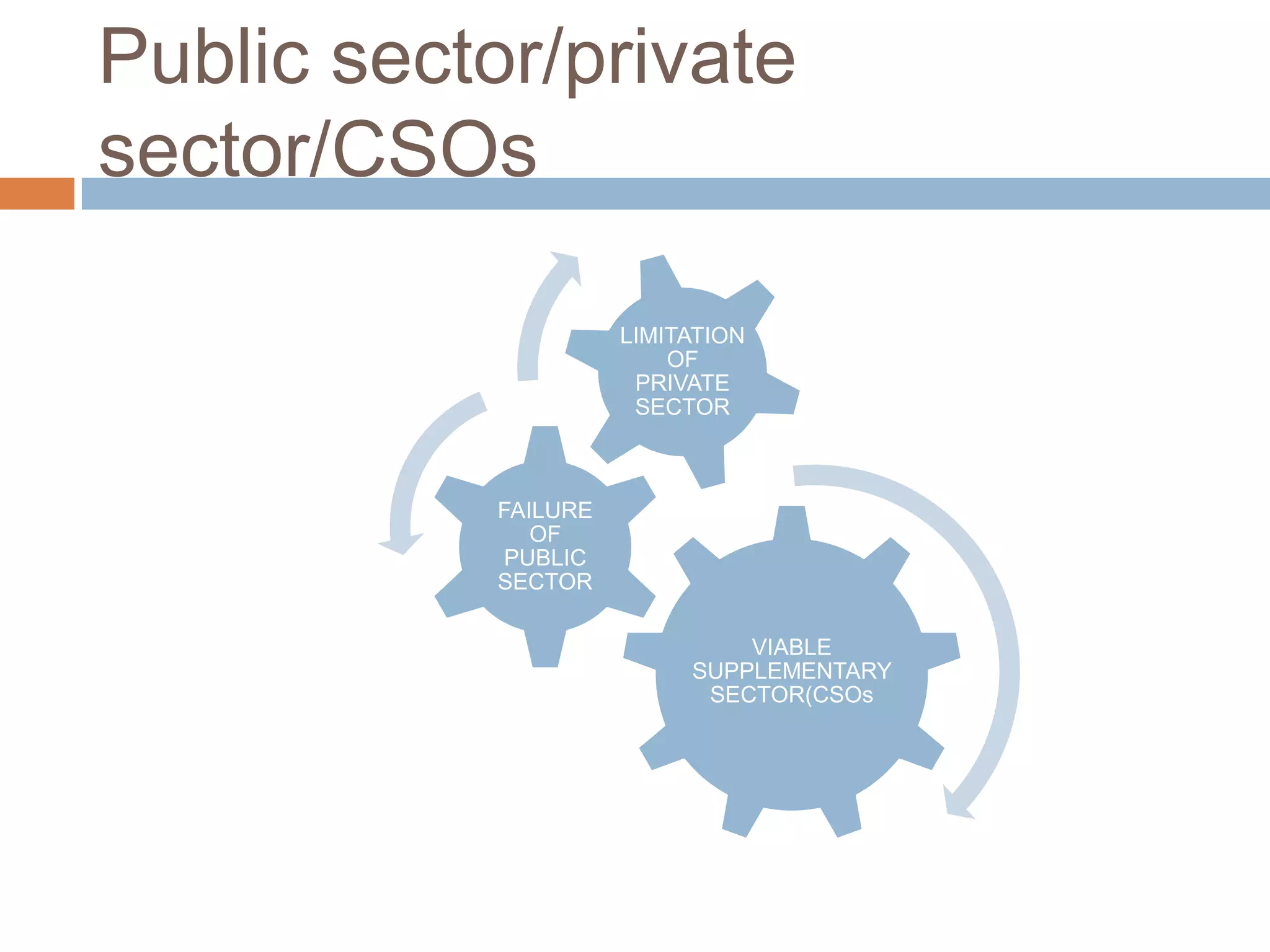
Public sector/private
sector/CSOs

                      LIMITATION
                          OF
                       PRIVATE
                       SECTOR


            FAILURE
               OF
            PUBLIC
            SECTOR

                               VIABLE
                           SUPPLEMENTARY
                            SECTOR(CSOs
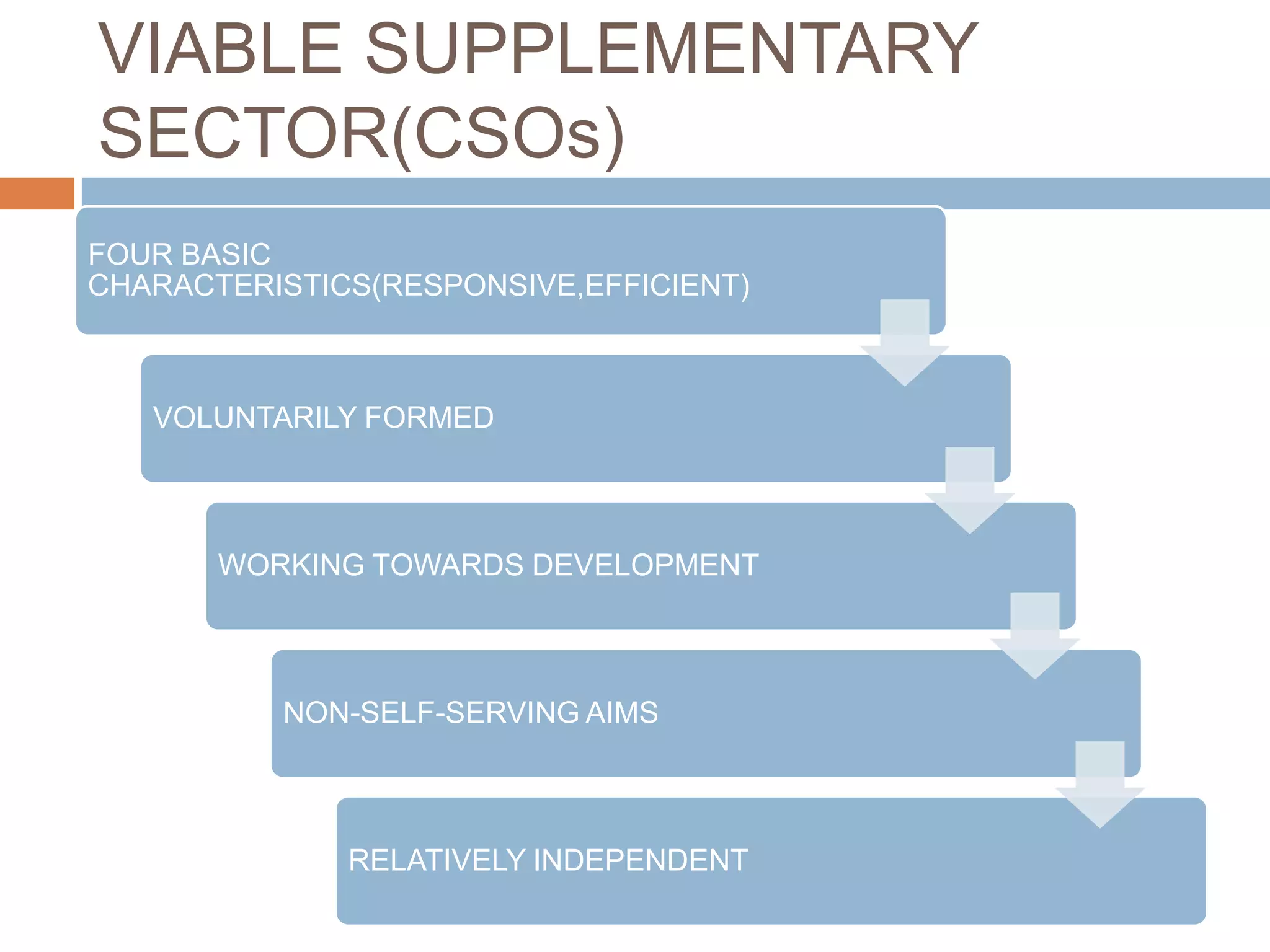
VIABLE SUPPLEMENTARY
SECTOR(CSOs)
FOUR BASIC
CHARACTERISTICS(RESPONSIVE,EFFICIENT)


   VOLUNTARILY FORMED


       WORKING TOWARDS DEVELOPMENT


          NON-SELF-SERVING AIMS


              RELATIVELY INDEPENDENT
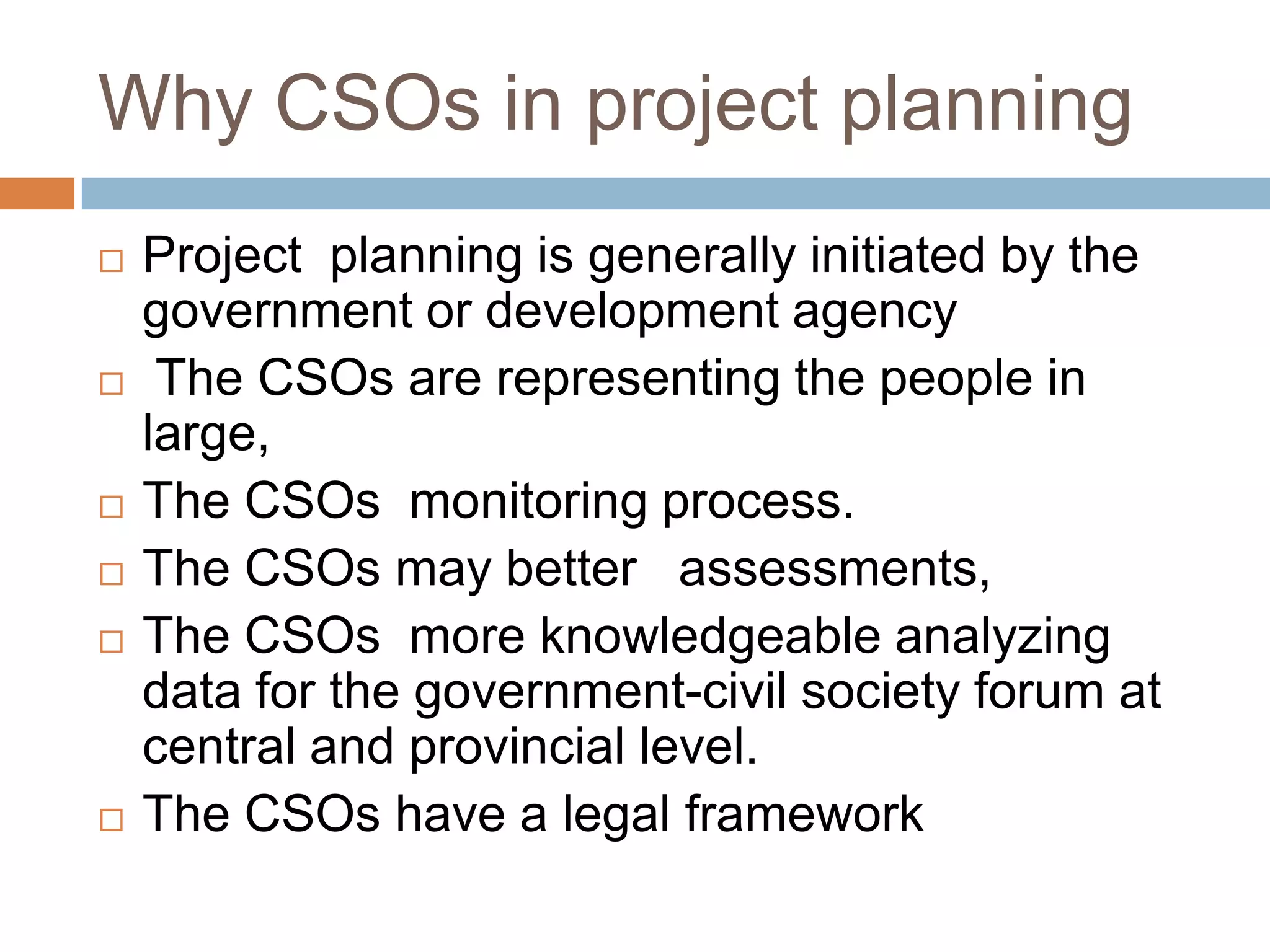
Why CSOs in project planning
   Project planning is generally initiated by the
    government or development agency
    The CSOs are representing the people in
    large,
   The CSOs monitoring process.
   The CSOs may better assessments,
   The CSOs more knowledgeable analyzing
    data for the government-civil society forum at
    central and provincial level.
   The CSOs have a legal framework
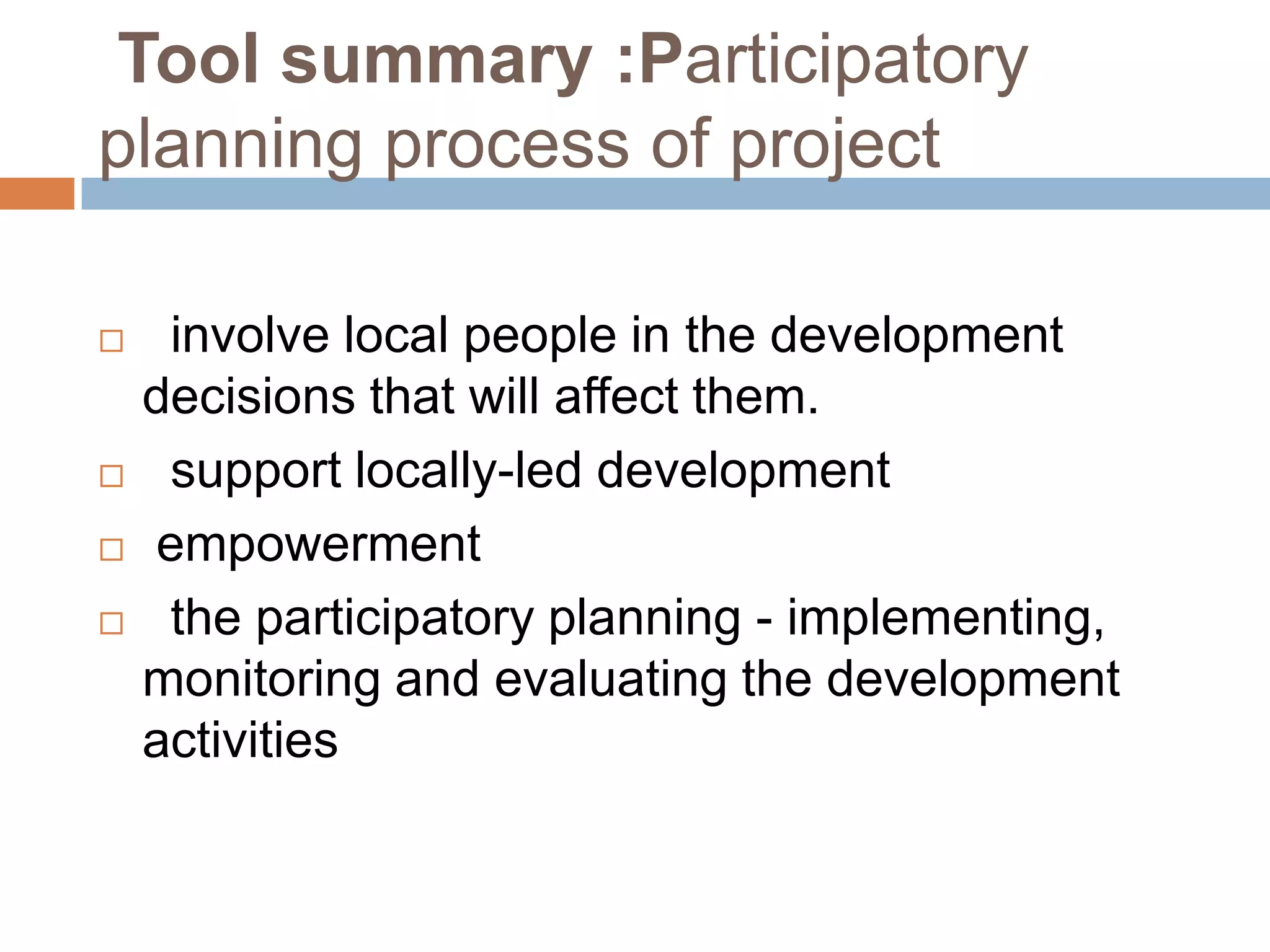
Tool summary :Participatory
planning process of project

    involve local people in the development
    decisions that will affect them.
    support locally-led development
   empowerment
    the participatory planning - implementing,
    monitoring and evaluating the development
    activities
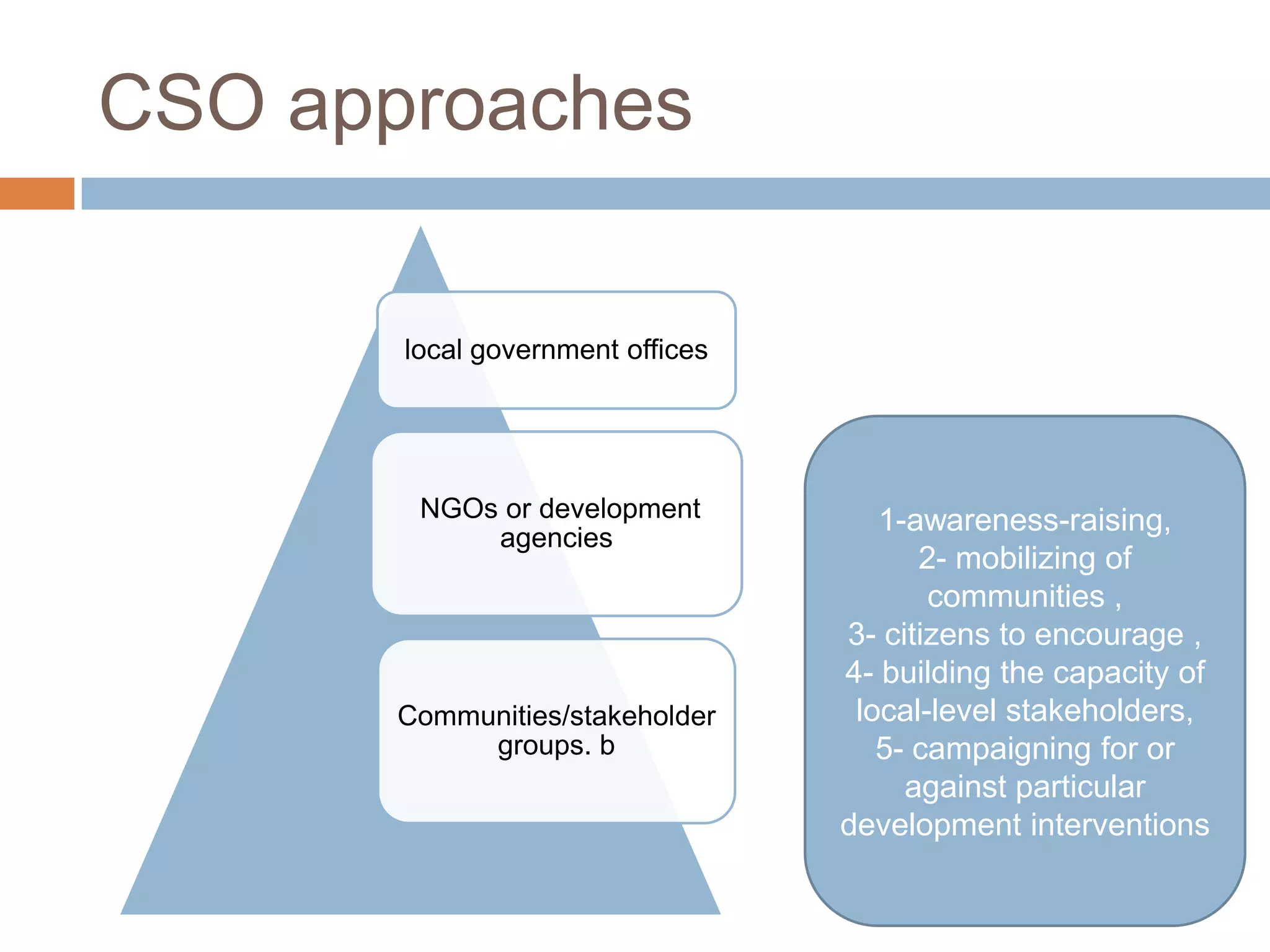
CSO approaches

       local government offices


        NGOs or development          1-awareness-raising,
            agencies
                                        2- mobilizing of
                                         communities ,
                                  3- citizens to encourage ,
                                  4- building the capacity of
       Communities/stakeholder     local-level stakeholders,
            groups. b                5- campaigning for or
                                       against particular
                                  development interventions
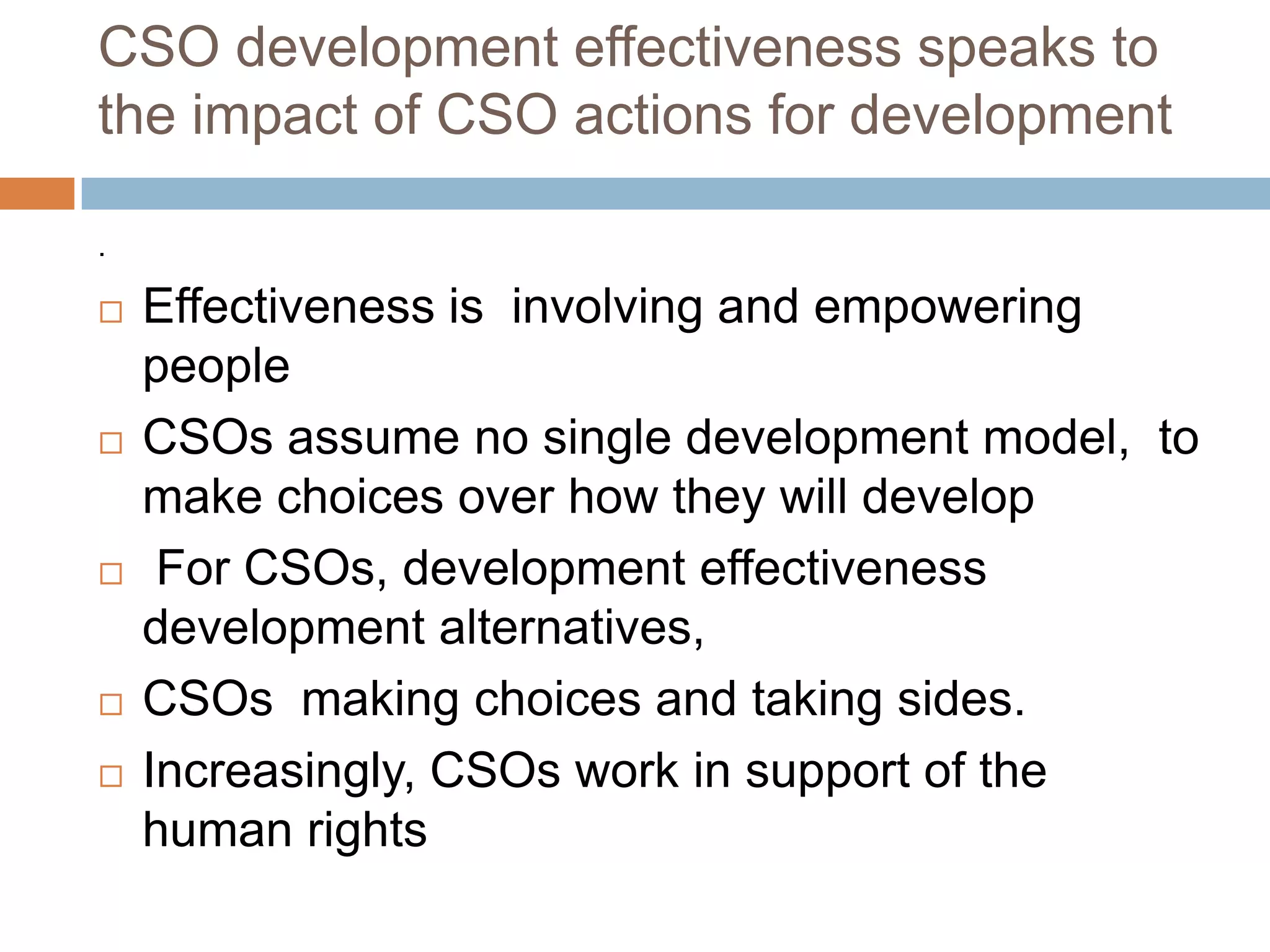
CSO development effectiveness speaks to
the impact of CSO actions for development

.

   Effectiveness is involving and empowering
    people
   CSOs assume no single development model, to
    make choices over how they will develop
    For CSOs, development effectiveness
    development alternatives,
   CSOs making choices and taking sides.
   Increasingly, CSOs work in support of the
    human rights
Tools available for development
planning

   Information-sharing s newspaper, radio, and
    television or electronic media
    Consultation tools: as round tables, public
    hearings, town meetings, community debates,
    focus groups, or electronic conferencing, surveys,
    opinion polls etc.
    Collaborative planning tools: stakeholder
    representation on decision-making bodies,
    establishment of local-level planning committees,
    participatory budgeting, or finance schemes to
    fund community-managed development;
    community mapping, priority ranking and wealth
CSO & local governments
   accountable to their citizens
 legal requirements for citizen participation in local
   government planning
 involve citizens in setting the development
   strategies of the local government and deciding
   on resource allocation
    local governments lack the fund
, CSOs role local needs, mobilizing greater
   resources, and building the capacity of local
   government staff to use participatory methods
   and approaches
How is this being achieved

   The members of CSOs at central and provincial
    level are trained to strengthen their capacities in
    link policy with implementation at local level.
   Training and analytical information is also
    provided to improve CSOs
   Governments (Government - Civil Society
    Forum) at provincial level.
   The activities represent a new focus
   Research and investigation capacity is stimulated
    through the support to the scientific journal.
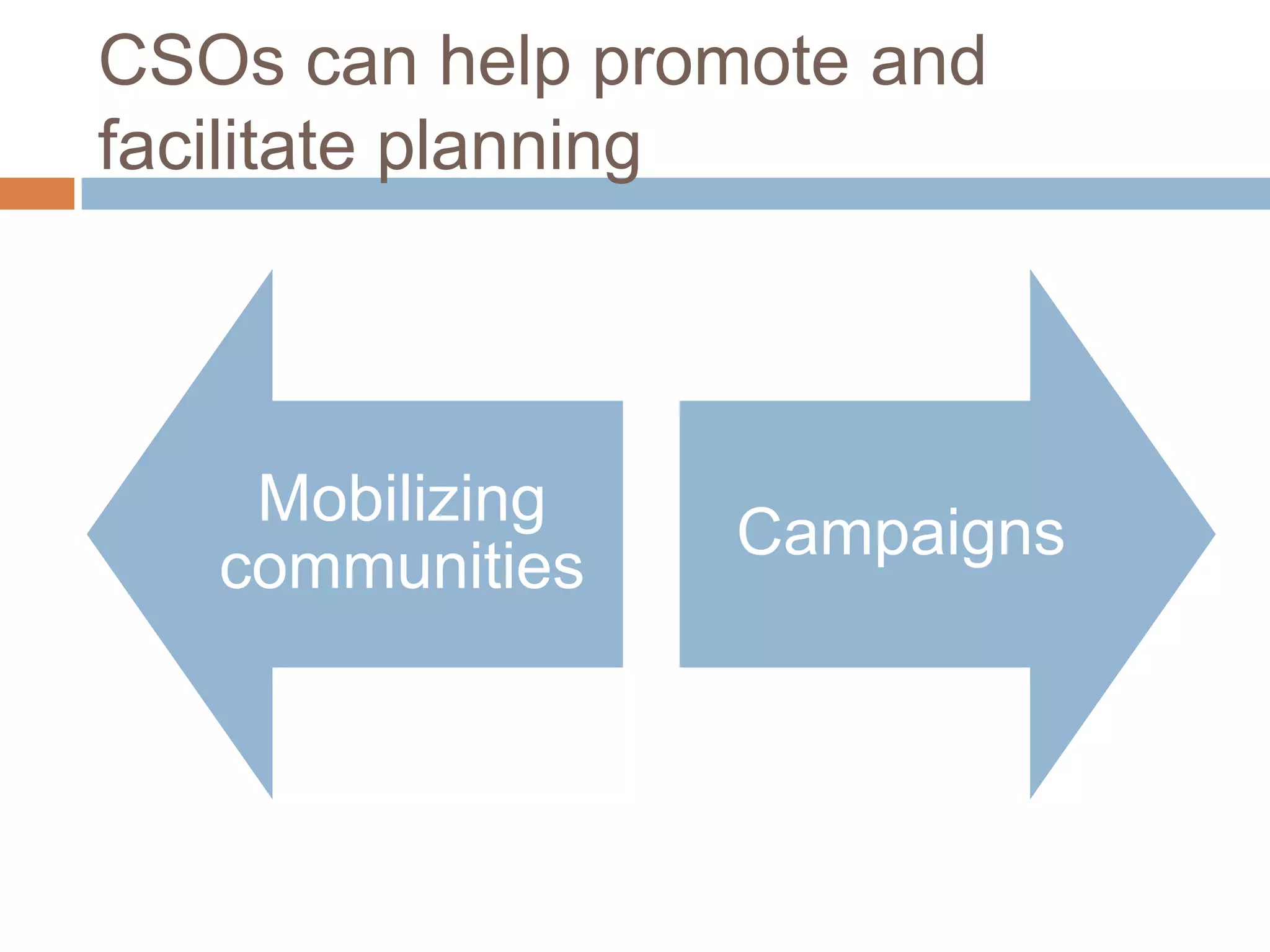
CSOs can help promote and
facilitate planning


    Mobilizing
                 Campaigns
   communities
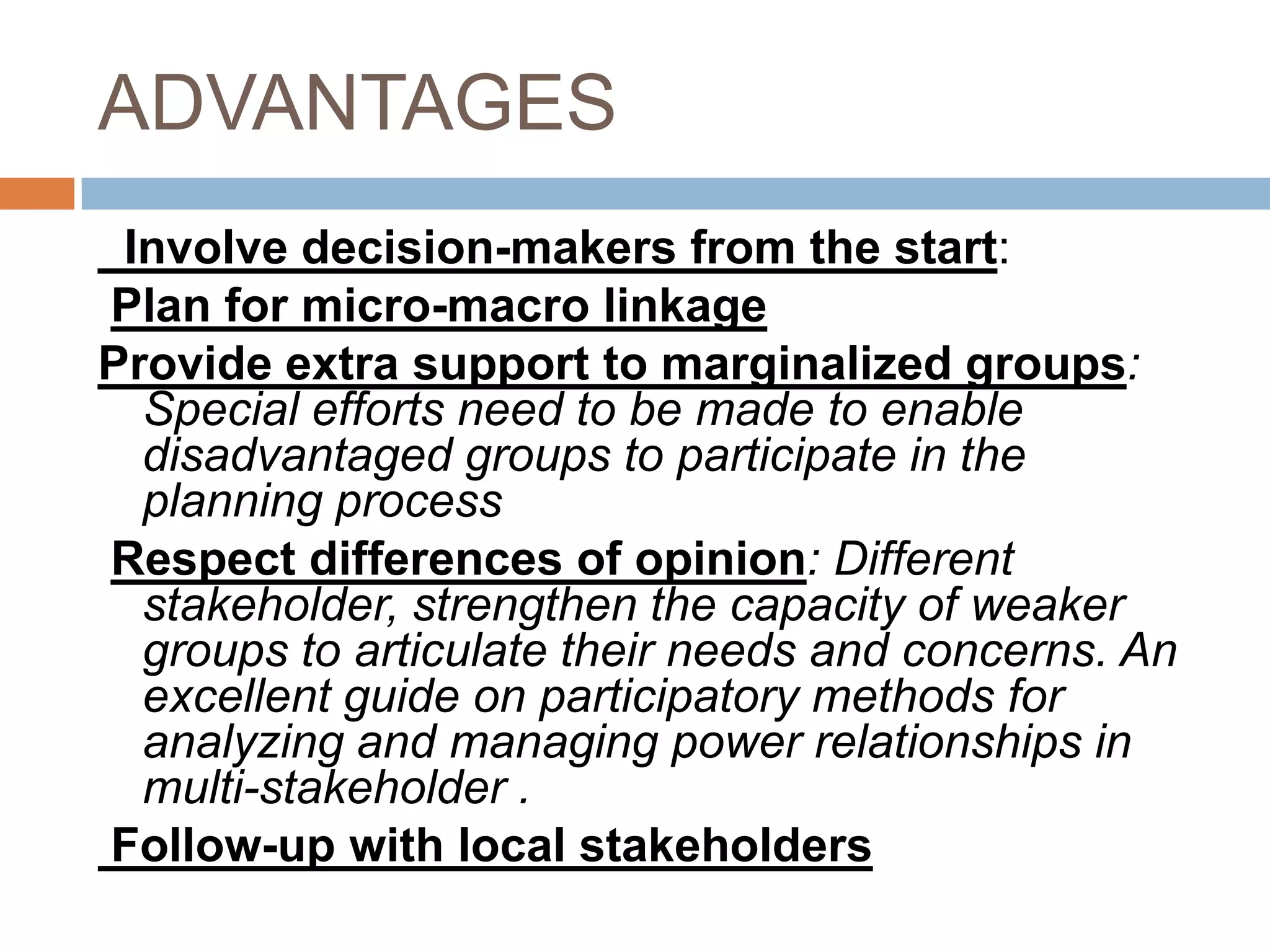
ADVANTAGES
 Involve decision-makers from the start:
Plan for micro-macro linkage
Provide extra support to marginalized groups:
  Special efforts need to be made to enable
  disadvantaged groups to participate in the
  planning process
Respect differences of opinion: Different
  stakeholder, strengthen the capacity of weaker
  groups to articulate their needs and concerns. An
  excellent guide on participatory methods for
  analyzing and managing power relationships in
  multi-stakeholder .
Follow-up with local stakeholders
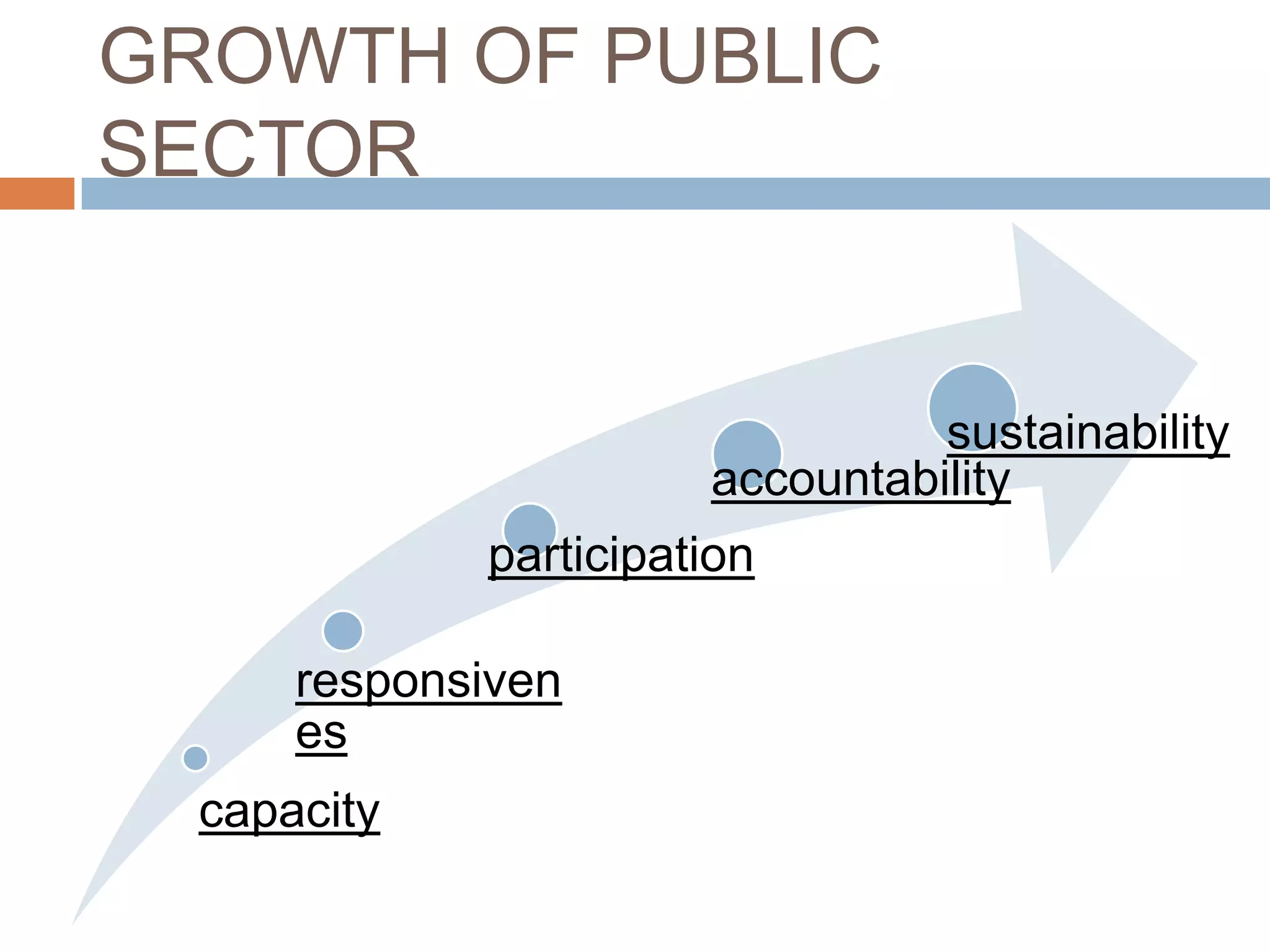
GROWTH OF PUBLIC
SECTOR


                                 sustainability
                       accountability
             participation

      responsiven
      es
  capacity
LEGAL COVERAGE
International Framework for CSO
Development Effectiveness
8 Istanbul principles
International and Regional Human
Rights Agreements
International Covenant on Civil and Political
Rights (ICCPR) etc
The International Framework for
CSO Development
   The Istanbul Principles are the foundation for the
    International Framework for CSO Development
    Effectiveness, adopted in June 2011 at the
    Second Global Assembly in Siem Reap,
    Cambodia. The Framework sets out guidance for
    interpreting and aligning CSO practices with the
    Istanbul Principles in diverse local and sectoral
    settings. The “Toolkit for Implementation of the
    Istanbul Principles”, with further elaboration of
    guidance and indicators, will enable CSO actors
    to adapt and work with the Framework in the
    context of their organizational mandates and
    program realities.
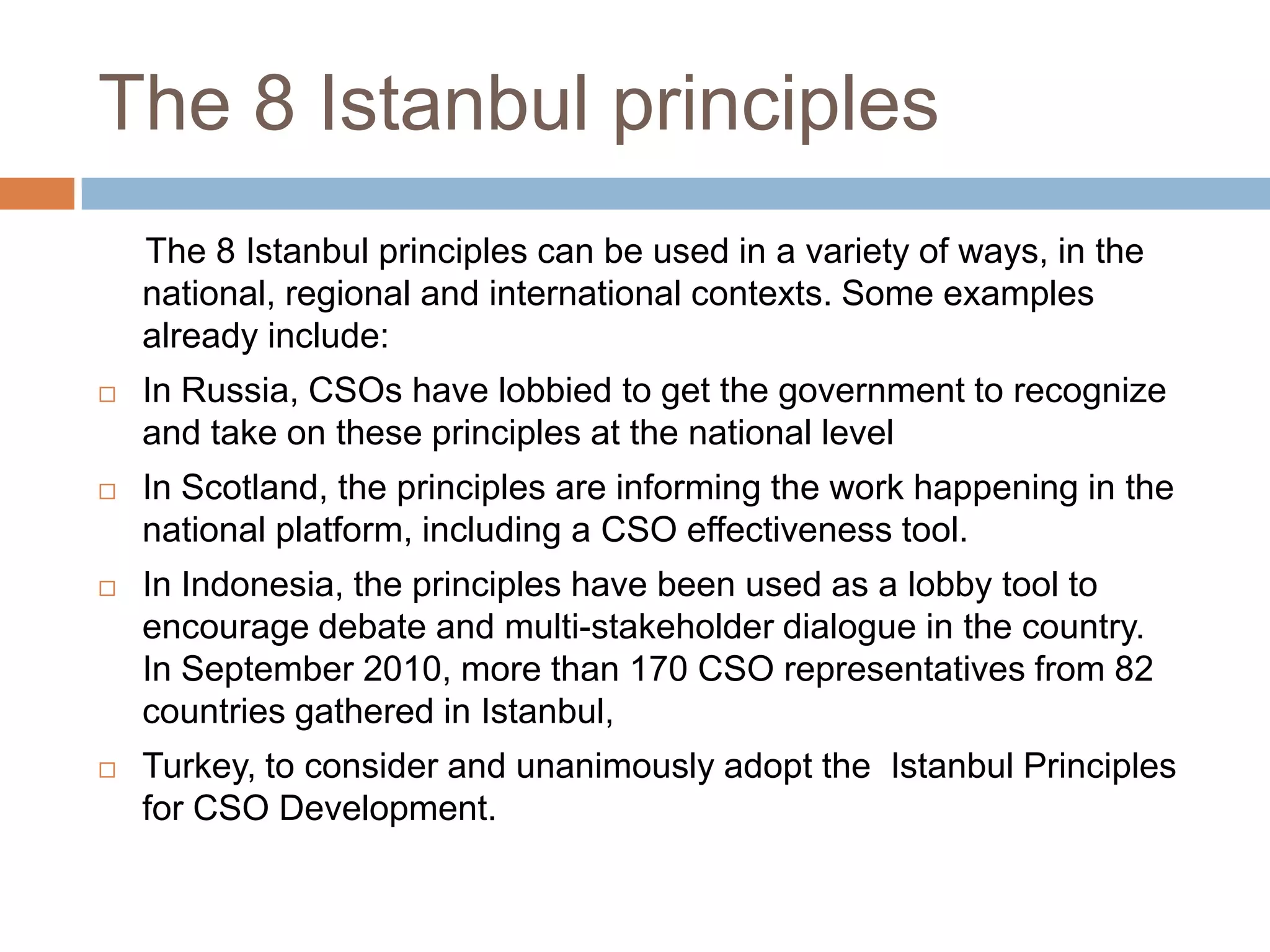
The 8 Istanbul principles
    The 8 Istanbul principles can be used in a variety of ways, in the
    national, regional and international contexts. Some examples
    already include:
   In Russia, CSOs have lobbied to get the government to recognize
    and take on these principles at the national level
   In Scotland, the principles are informing the work happening in the
    national platform, including a CSO effectiveness tool.
   In Indonesia, the principles have been used as a lobby tool to
    encourage debate and multi-stakeholder dialogue in the country.
    In September 2010, more than 170 CSO representatives from 82
    countries gathered in Istanbul,
   Turkey, to consider and unanimously adopt the Istanbul Principles
    for CSO Development.
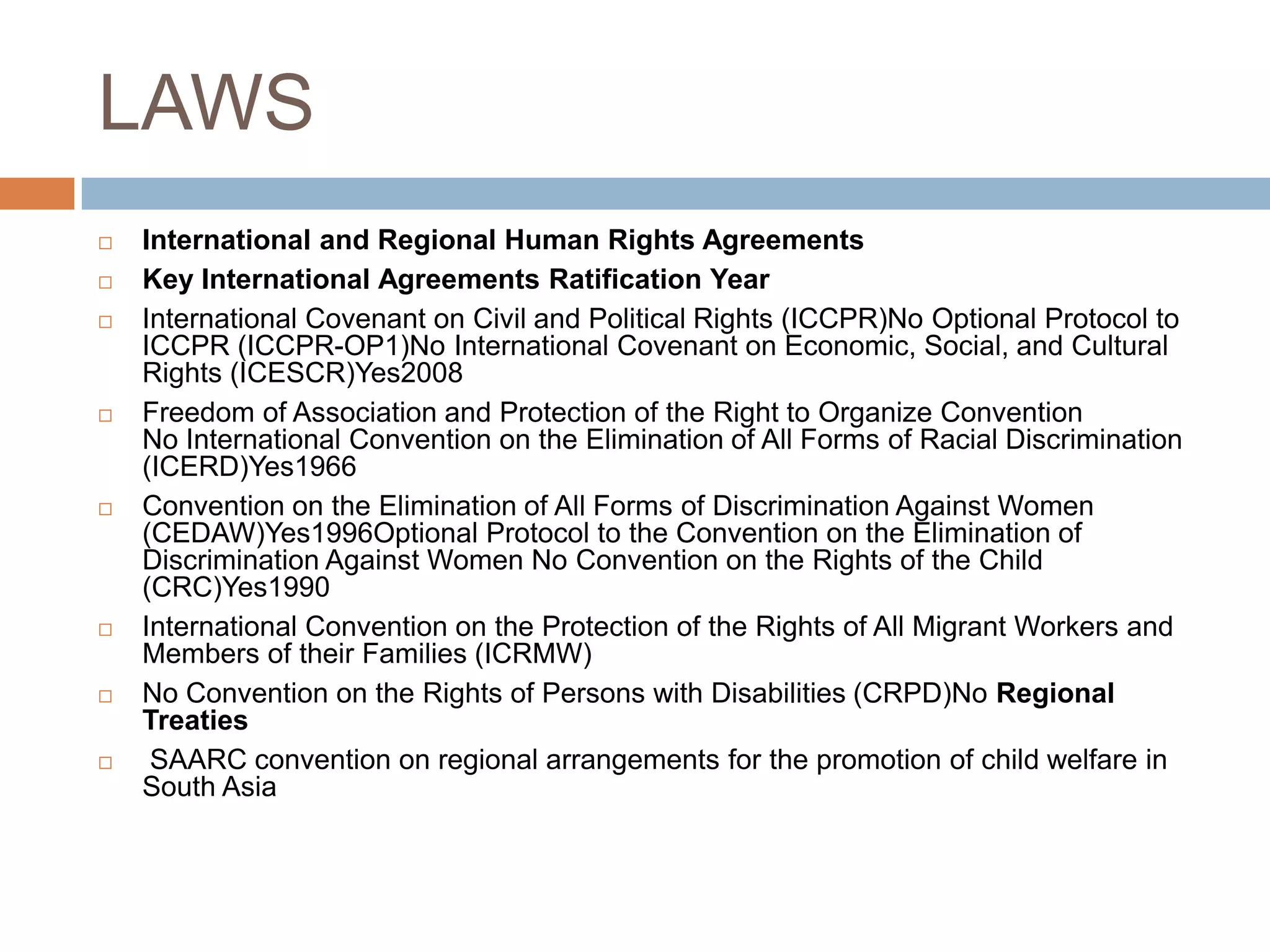
LAWS
   International and Regional Human Rights Agreements
   Key International Agreements Ratification Year
   International Covenant on Civil and Political Rights (ICCPR)No Optional Protocol to
    ICCPR (ICCPR-OP1)No International Covenant on Economic, Social, and Cultural
    Rights (ICESCR)Yes2008
   Freedom of Association and Protection of the Right to Organize Convention
    No International Convention on the Elimination of All Forms of Racial Discrimination
    (ICERD)Yes1966
   Convention on the Elimination of All Forms of Discrimination Against Women
    (CEDAW)Yes1996Optional Protocol to the Convention on the Elimination of
    Discrimination Against Women No Convention on the Rights of the Child
    (CRC)Yes1990
   International Convention on the Protection of the Rights of All Migrant Workers and
    Members of their Families (ICRMW)
   No Convention on the Rights of Persons with Disabilities (CRPD)No Regional
    Treaties
    SAARC convention on regional arrangements for the promotion of child welfare in
    South Asia
The Constitution of Pakistan (1973) recognizes the right of
    individuals to associate with others to pursue common goals as
    an inalienable fundamental right. Relevant constitutional
    provisions include

    Article 15 [Freedom of movement]: .
    Article 16 [Freedom of assembly]
    Article 17 [Freedom of association]:
        Every citizen shall have the right to form associations or unions.
        Every citizen, not being in the service of Pakistan, shall have the right to form or
         be a member of a political party,
        Every political party shall account for the source of its funds in accordance with
         law.]
        Every political party shall, subject to law, hold intra-party elections to elect its
         office-bearers and party leaders.]
    Article 19 [Freedom of speech]: Every citizen shall have the right to freedom of
     speech and expression, and there shall be freedom of the press,
    Article 20 [Freedom of profess religion and to manage religious
     institutions]: Subject to law, public order and morality:
        every citizen shall have the right to profess, practice and propagate his religion;
    Article 25 [Equality of citizens]: (1)All citizens are equal before law and are entitled
     to equal protection of law. (2)There shall be no discrimination on the basis of sex
     alone. .
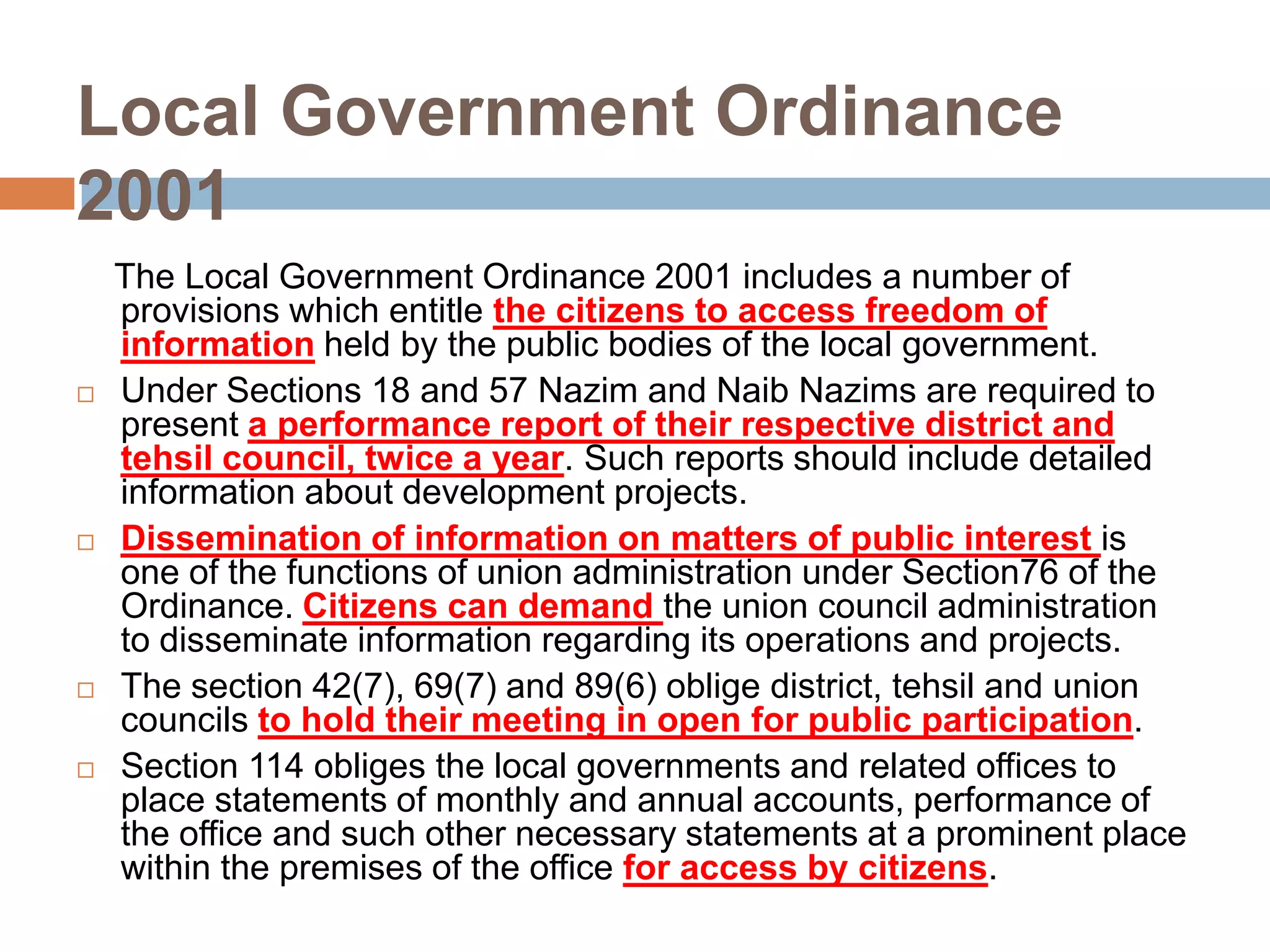
Local Government Ordinance
2001
    The Local Government Ordinance 2001 includes a number of
    provisions which entitle the citizens to access freedom of
    information held by the public bodies of the local government.
   Under Sections 18 and 57 Nazim and Naib Nazims are required to
    present a performance report of their respective district and
    tehsil council, twice a year. Such reports should include detailed
    information about development projects.
   Dissemination of information on matters of public interest is
    one of the functions of union administration under Section76 of the
    Ordinance. Citizens can demand the union council administration
    to disseminate information regarding its operations and projects.
   The section 42(7), 69(7) and 89(6) oblige district, tehsil and union
    councils to hold their meeting in open for public participation.
   Section 114 obliges the local governments and related offices to
    place statements of monthly and annual accounts, performance of
    the office and such other necessary statements at a prominent place
    within the premises of the office for access by citizens.
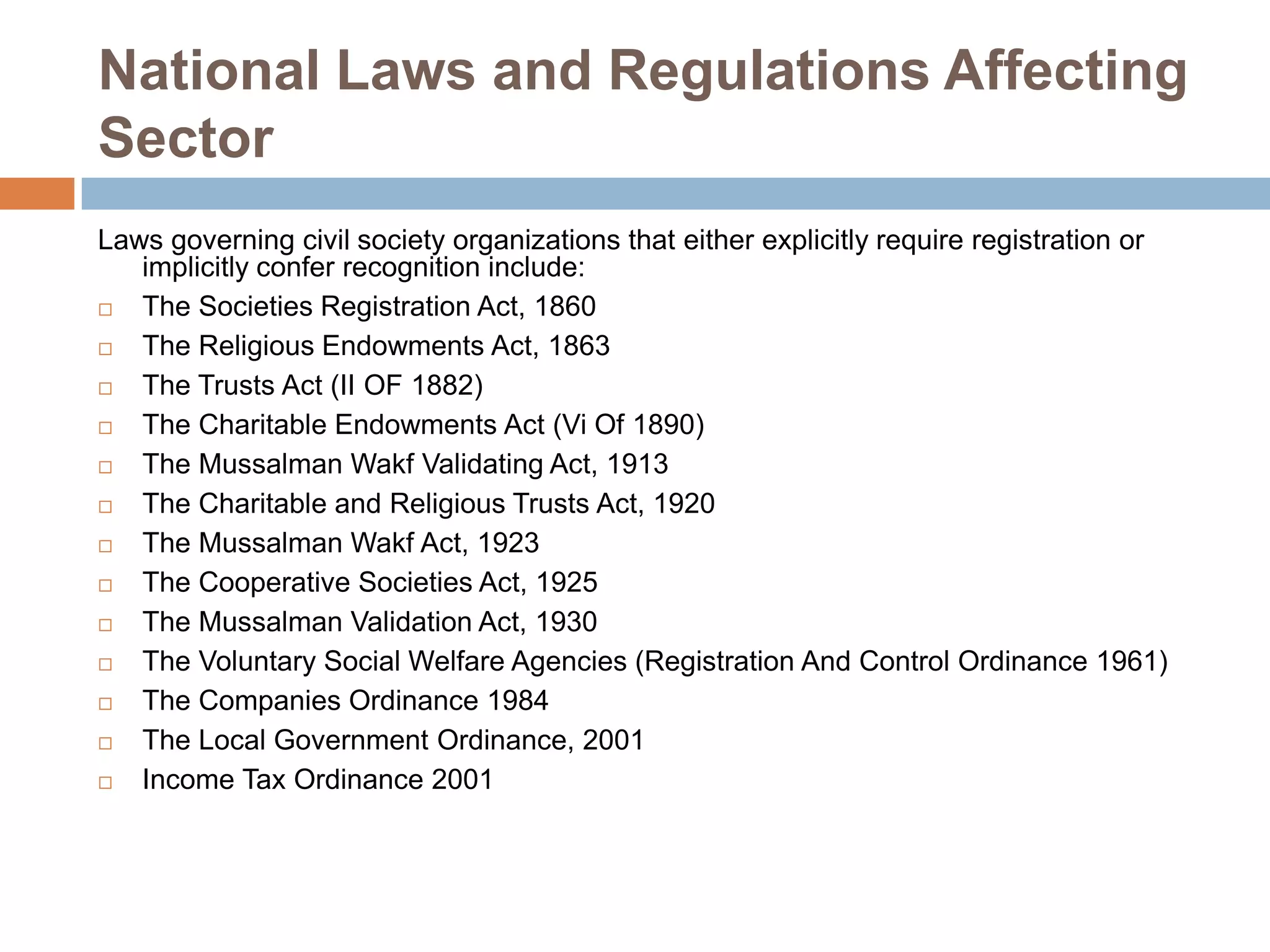
National Laws and Regulations Affecting
Sector
Laws governing civil society organizations that either explicitly require registration or
   implicitly confer recognition include:
  The Societies Registration Act, 1860
  The Religious Endowments Act, 1863
  The Trusts Act (II OF 1882)
  The Charitable Endowments Act (Vi Of 1890)
  The Mussalman Wakf Validating Act, 1913
  The Charitable and Religious Trusts Act, 1920
  The Mussalman Wakf Act, 1923
  The Cooperative Societies Act, 1925
  The Mussalman Validation Act, 1930
  The Voluntary Social Welfare Agencies (Registration And Control Ordinance 1961)
  The Companies Ordinance 1984
  The Local Government Ordinance, 2001
  Income Tax Ordinance 2001
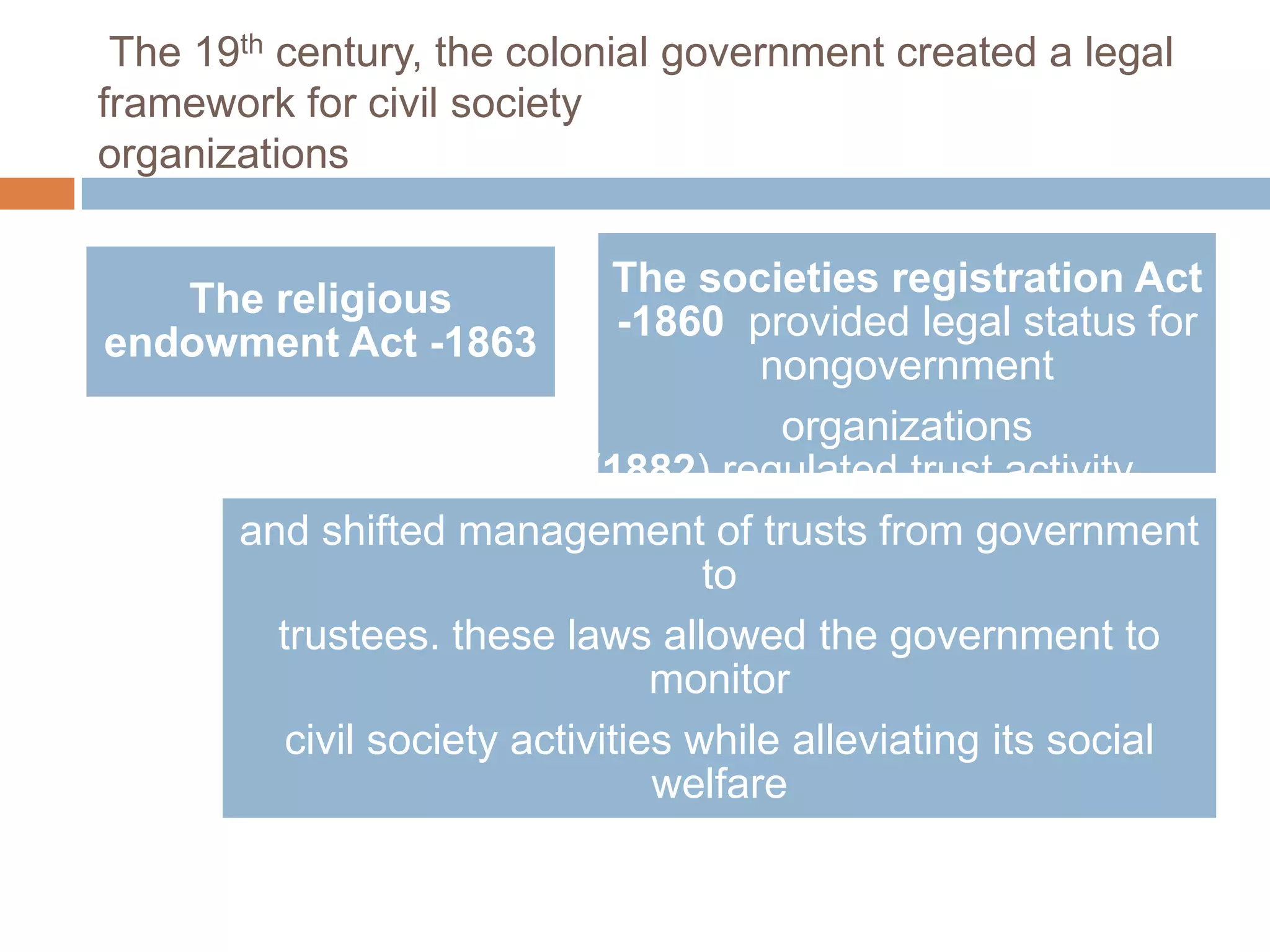
The 19th century, the colonial government created a legal
framework for civil society
organizations


   The religious              The societies registration Act
endowment Act -1863            -1860 provided legal status for
                                       nongovernment
                                        organizations
            The trust Act (1882) regulated trust activity
       and shifted management of trusts from government
                                    to
         trustees. these laws allowed the government to
                                 monitor
          civil society activities while alleviating its social
                                 welfare
                                 burden.
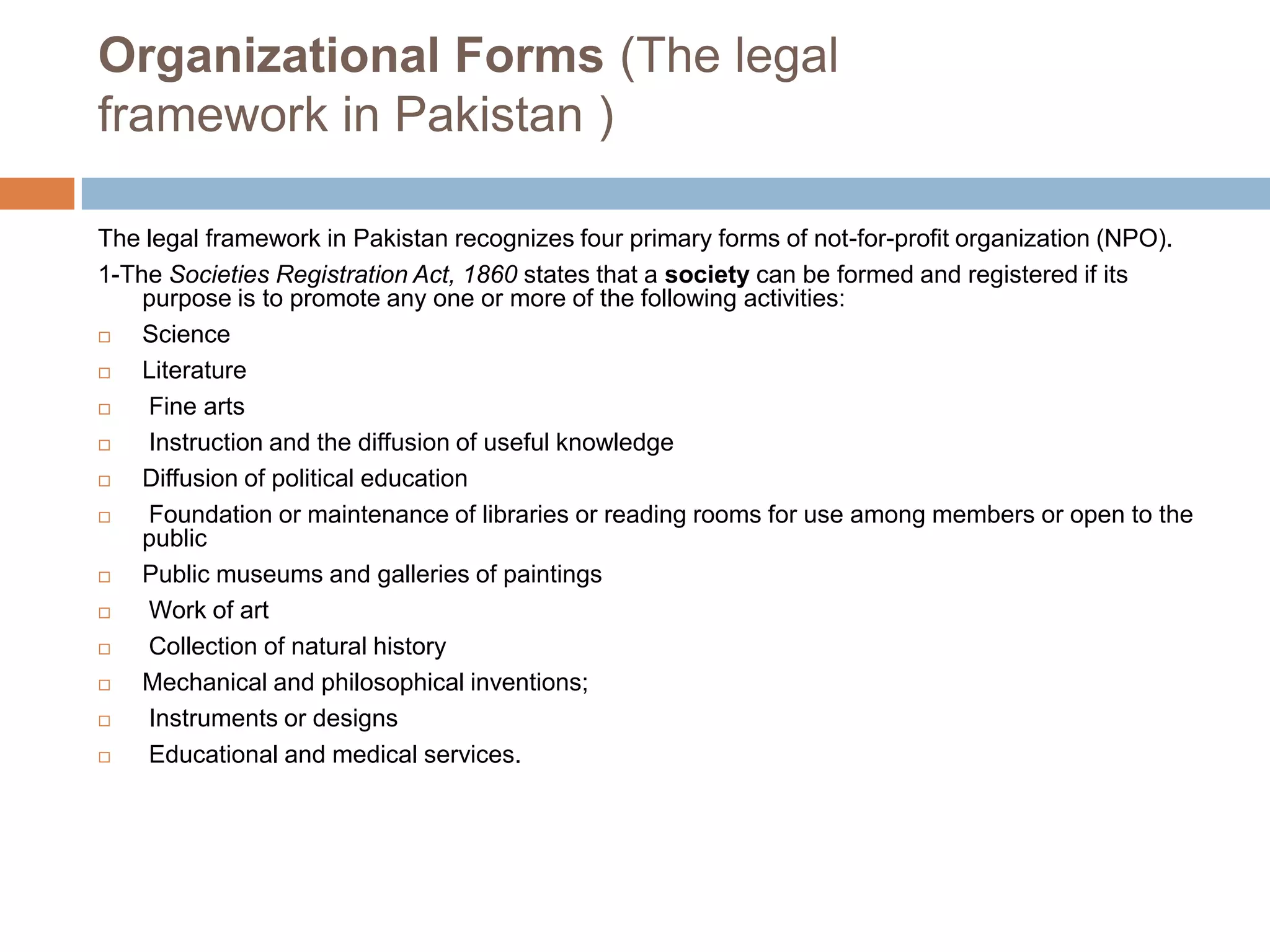
Organizational Forms (The legal
framework in Pakistan )

The legal framework in Pakistan recognizes four primary forms of not-for-profit organization (NPO).
1-The Societies Registration Act, 1860 states that a society can be formed and registered if its
    purpose is to promote any one or more of the following activities:
   Science
   Literature
   Fine arts
   Instruction and the diffusion of useful knowledge
   Diffusion of political education
   Foundation or maintenance of libraries or reading rooms for use among members or open to the
    public
   Public museums and galleries of paintings
   Work of art
   Collection of natural history
   Mechanical and philosophical inventions;
   Instruments or designs
   Educational and medical services.
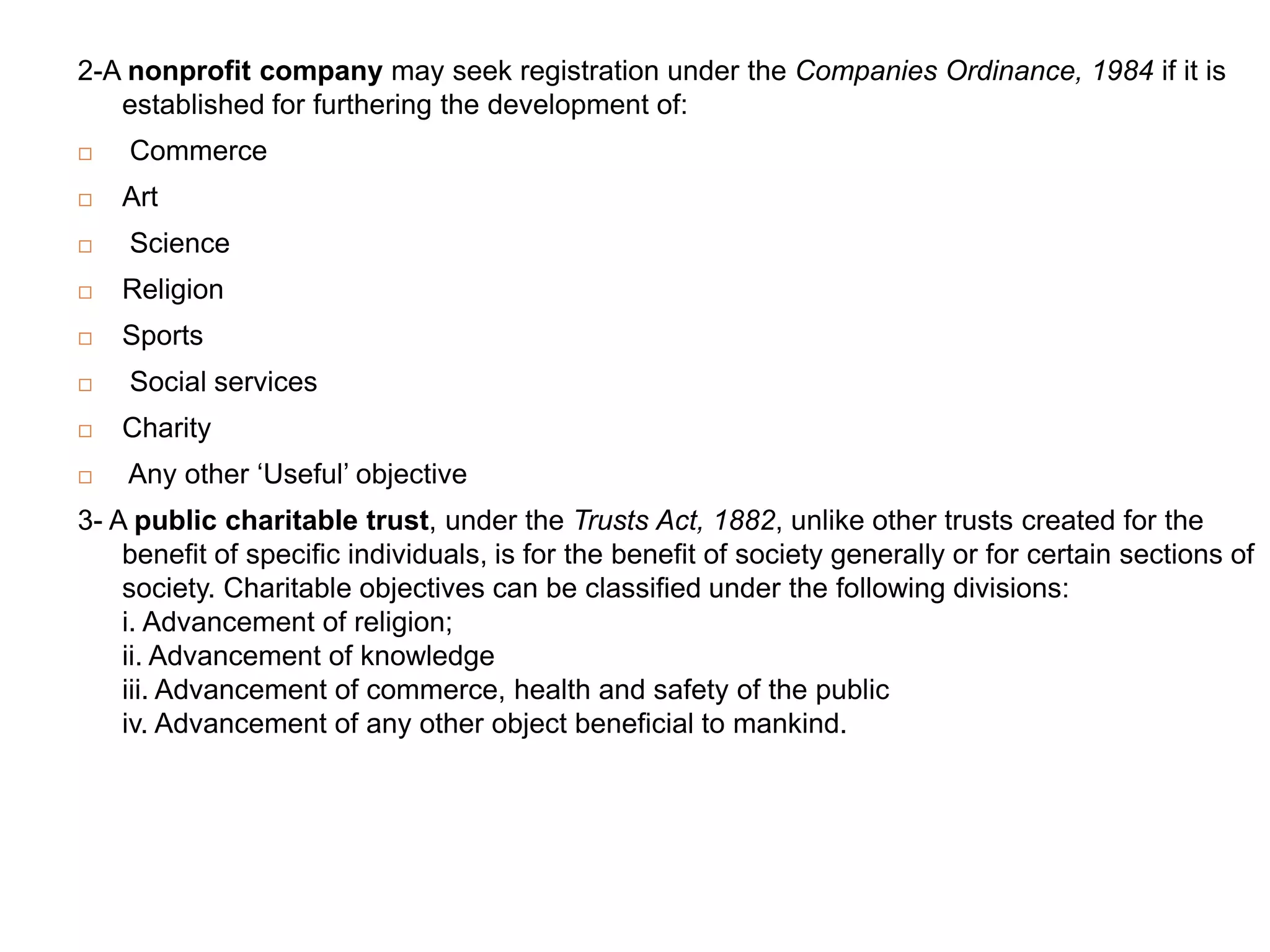
2-A nonprofit company may seek registration under the Companies Ordinance, 1984 if it is
   established for furthering the development of:
   Commerce
   Art
   Science
   Religion
   Sports
   Social services
   Charity
   Any other „Useful‟ objective
3- A public charitable trust, under the Trusts Act, 1882, unlike other trusts created for the
    benefit of specific individuals, is for the benefit of society generally or for certain sections of
    society. Charitable objectives can be classified under the following divisions:
    i. Advancement of religion;
    ii. Advancement of knowledge
    iii. Advancement of commerce, health and safety of the public
    iv. Advancement of any other object beneficial to mankind.
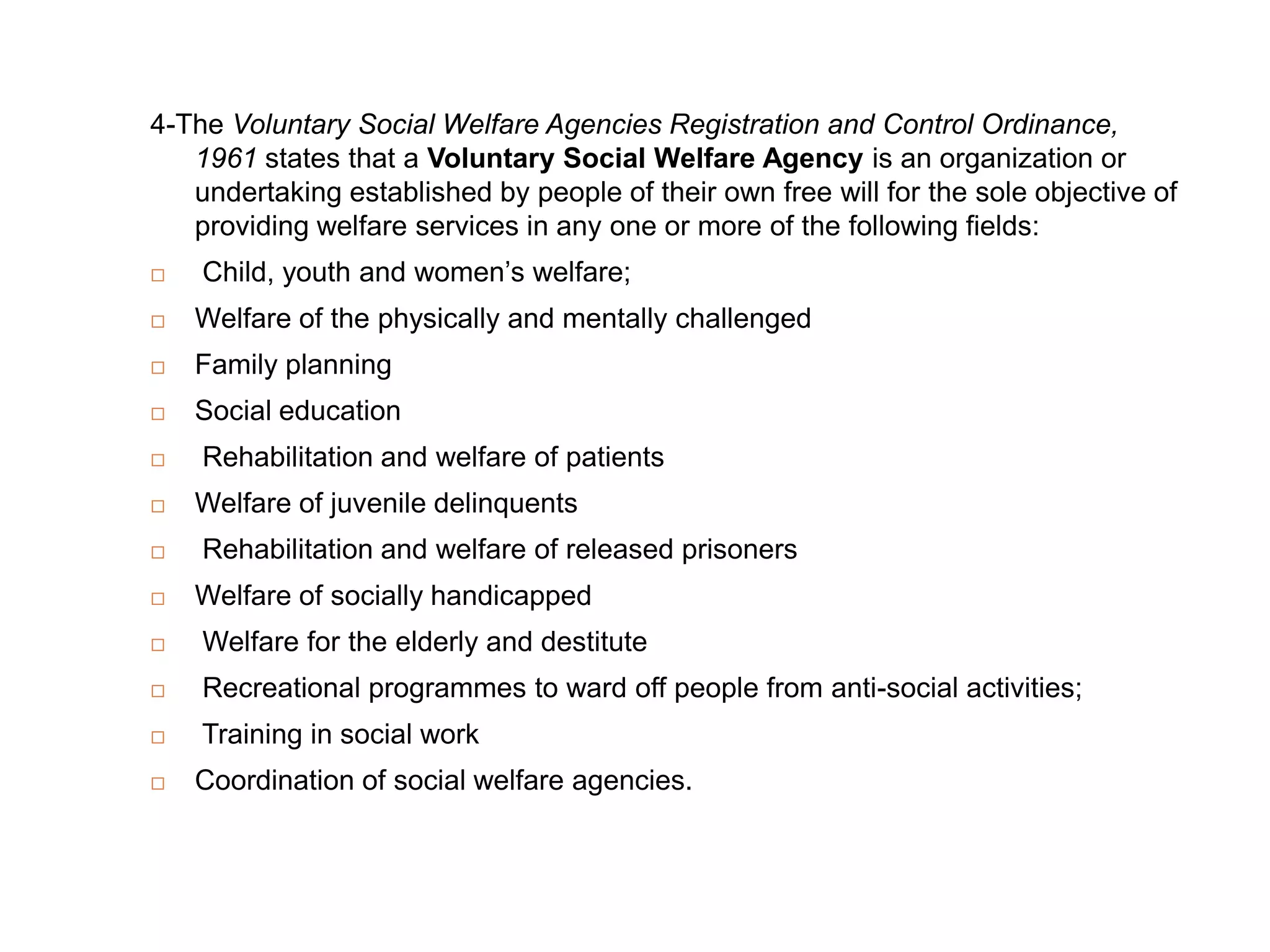
4-The Voluntary Social Welfare Agencies Registration and Control Ordinance,
   1961 states that a Voluntary Social Welfare Agency is an organization or
   undertaking established by people of their own free will for the sole objective of
   providing welfare services in any one or more of the following fields:
   Child, youth and women‟s welfare;
   Welfare of the physically and mentally challenged
   Family planning
   Social education
   Rehabilitation and welfare of patients
   Welfare of juvenile delinquents
   Rehabilitation and welfare of released prisoners
   Welfare of socially handicapped
   Welfare for the elderly and destitute
   Recreational programmes to ward off people from anti-social activities;
   Training in social work
   Coordination of social welfare agencies.
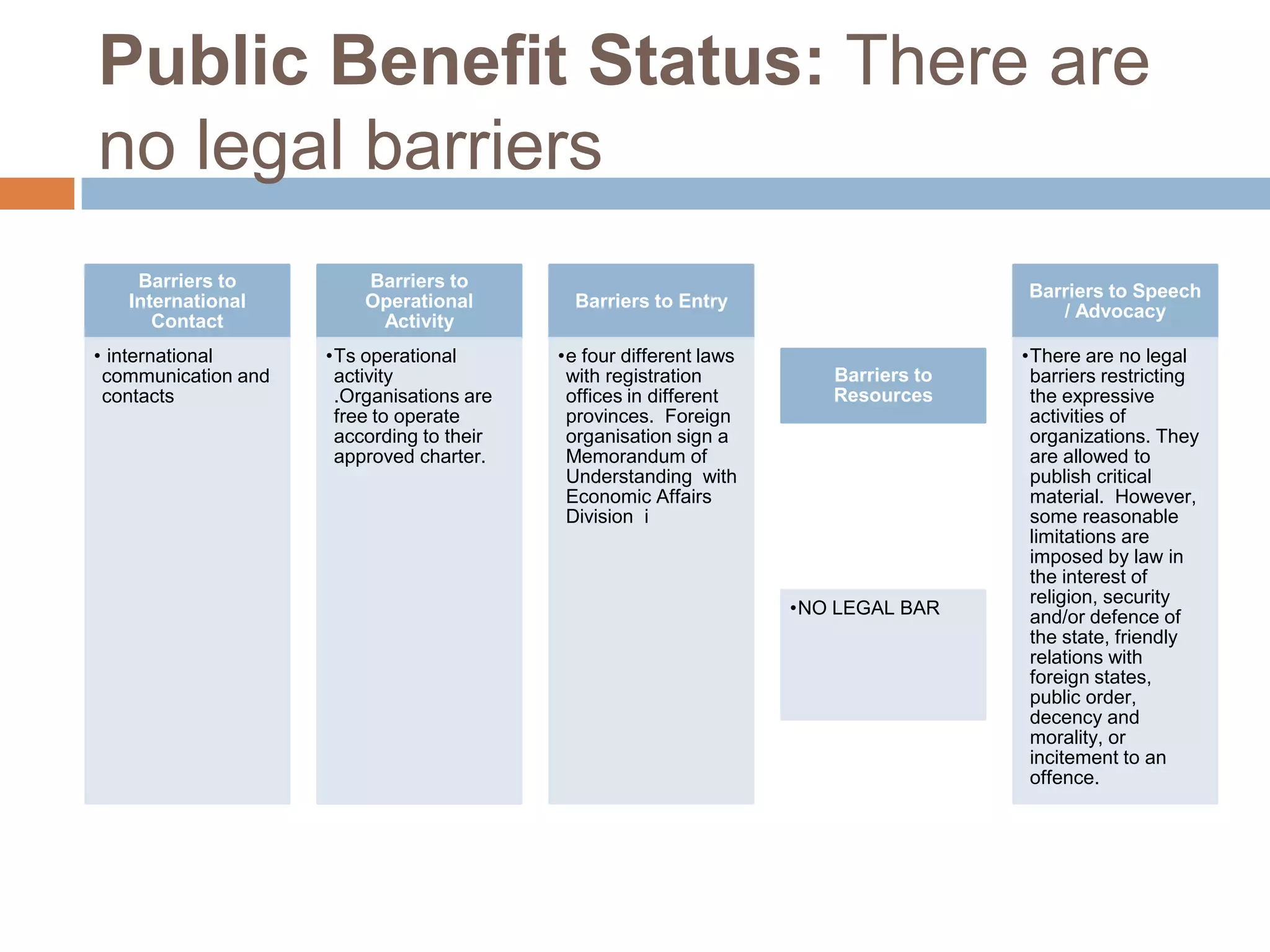
Public Benefit Status: There are
no legal barriers
    Barriers to          Barriers to
                                                                                     Barriers to Speech
   International         Operational         Barriers to Entry
                                                                                        / Advocacy
      Contact             Activity
• international      •Ts operational       •e four different laws                    •There are no legal
 communication and    activity              with registration          Barriers to    barriers restricting
 contacts             .Organisations are    offices in different       Resources      the expressive
                      free to operate       provinces. Foreign                        activities of
                      according to their    organisation sign a                       organizations. They
                      approved charter.     Memorandum of                             are allowed to
                                            Understanding with                        publish critical
                                            Economic Affairs                          material. However,
                                            Division i                                some reasonable
                                                                                      limitations are
                                                                                      imposed by law in
                                                                                      the interest of
                                                                                      religion, security
                                                                    •NO LEGAL BAR     and/or defence of
                                                                                      the state, friendly
                                                                                      relations with
                                                                                      foreign states,
                                                                                      public order,
                                                                                      decency and
                                                                                      morality, or
                                                                                      incitement to an
                                                                                      offence.
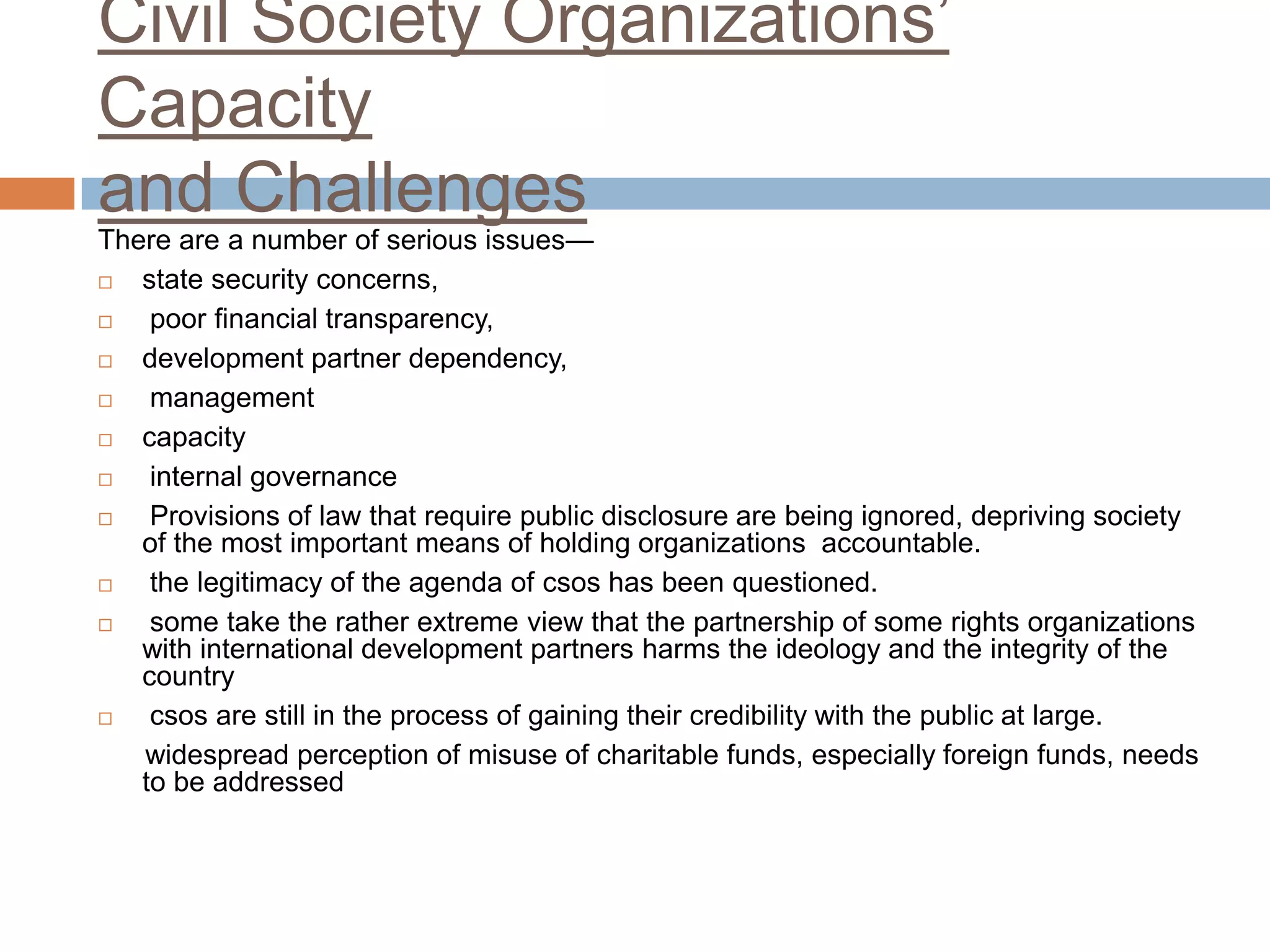
Civil Society Organizations‟
Capacity
and Challenges
There are a number of serious issues—
  state security concerns,
   poor financial transparency,
  development partner dependency,
   management
  capacity
   internal governance
   Provisions of law that require public disclosure are being ignored, depriving society
   of the most important means of holding organizations accountable.
   the legitimacy of the agenda of csos has been questioned.
   some take the rather extreme view that the partnership of some rights organizations
   with international development partners harms the ideology and the integrity of the
   country
   csos are still in the process of gaining their credibility with the public at large.
   widespread perception of misuse of charitable funds, especially foreign funds, needs
   to be addressed
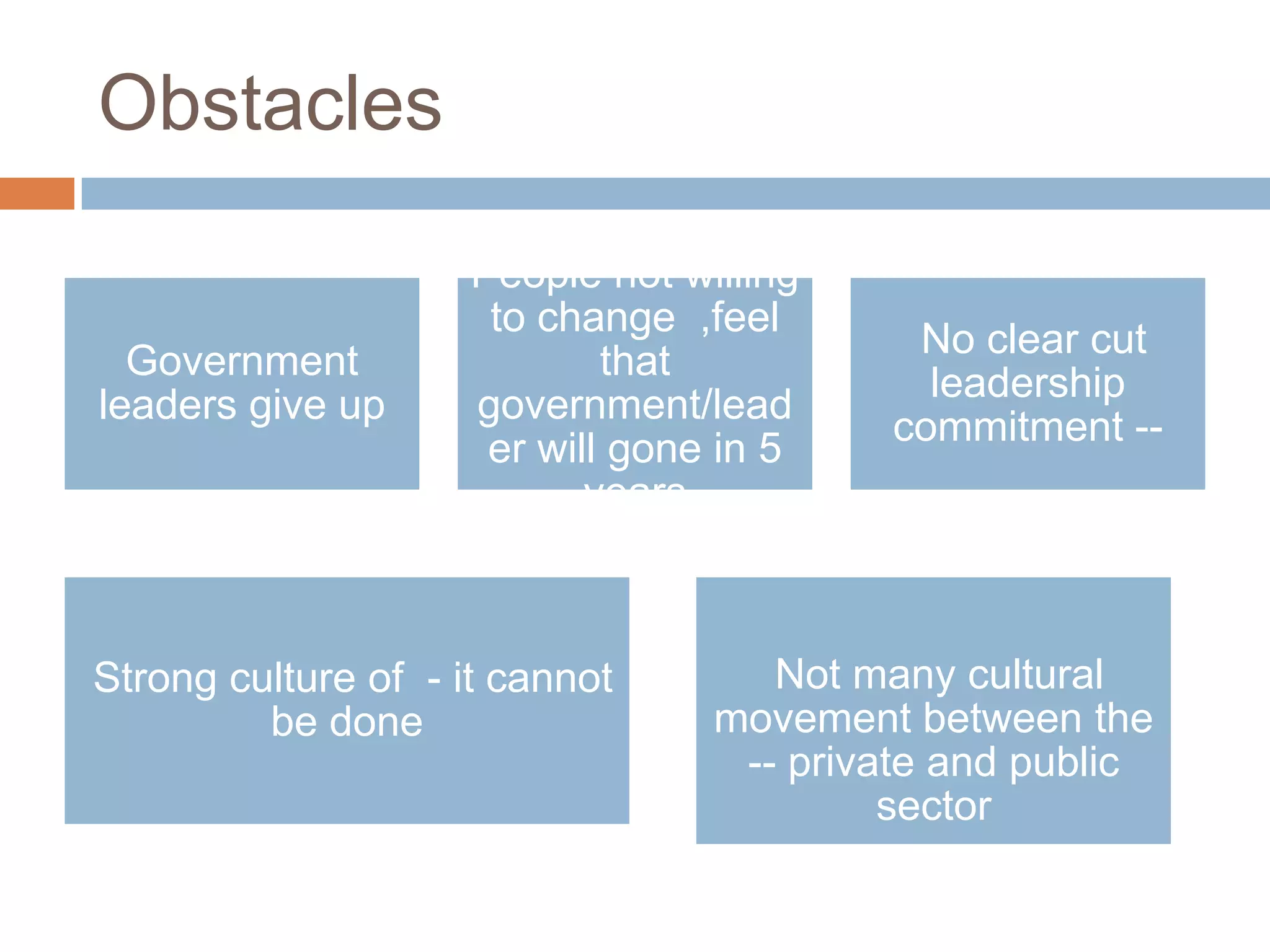
Obstacles

                     People not willing
                      to change ,feel
                                           No clear cut
  Government                 that
                                            leadership
leaders give up      government/lead
                                          commitment --
                      er will gone in 5
                            years


Strong culture of - it cannot        Not many cultural
         be done                  movement between the
                                   -- private and public
                                           sector
reference
   civicUs. Pakistan NGo forum. code of conduct for NGos and cbos.
    Available: www.civicus.org/new/media/PN Available:
    www.civicus.org/new/media/PNf%2
    f%20code%20of%20conduct%20Pakistan.doc"NGO Laws in Sub-Saharan
    Africa"
    June 2011 (Read Online) (Download PDF)
   Volume 3, Issue 2 - "Special Issue: An Interview with Maina Kiai, the New
    United Nations Special Rapporteur on the Rights to Freedom of Peaceful
    Assembly and of Association"
    June 2011 (Read Online) (Download PDF)
   Volume 3, Issue 1 - "Arab Spring: An Opportunity for Greater Freedom of
    Association and Assembly in Tunisia and Egypt?"
    June 2011 (Read Online) (Download PDF)
   Volume 2, Issue 4 - "Freedom of Assembly"
    April 2011 (Read Online) (Download PDF)
   Volume 2, Issue 3 - "Enabling Reform: Lessons Learned From Progressive
    NGO Legal Initiatives"
    December Global Trends in NGO Law. Complementing the International
    Journal of Not-for-Profit Law

Project planning

  • 1.
    THE ROLE OFCSO IN EFFECTIVE PROJECT PLANNING Consultant Nudrat Mufti
  • 2.
    DEFINATION OF CIVILSOCIETY ORGANIZATIONS CSOs can be defined to include all non-market and non-state organisations in which people organise themselves to pursue shared interests in the public domain.
  • 3.
    CSOs role aspromoter of development Helping in the overall multi-faced Social services to development of rural the weaker areas section Promoting micro- finance for poor
  • 4.
    Range  Membership based CSOs  Cause based CSOs  Service oriented CSOs  Ministry of Social Welfare  District Governments  Provincial Social Welfare Departments  Department of Industries
  • 5.
    Projects/Kinds  Community Village associations  Health ,Education /Environmental group  Women‟s right groups  Farmer associations  Faith based associations  Labour union  Cooperatives professionals  Chamber of commerce  Non-profit media  Independent research institutions  Poverty alleviation organizations 
  • 6.
    NGO / CIVILSOCIETY ORGANIZATION  NGO was defined on February 27, 1950, by the resolution 288 (X) of the ECOSOC and stands for a non-governmental organization. Non- governmental organizations are created by legal persons who are not part of the government. Although NGO funds are mostly raised by the government, they maintain a non-governmental position, and eliminate the need for a government council. This type of organization is also known as a civil society organization.
  • 7.
    Public sector/private sector/CSOs LIMITATION OF PRIVATE SECTOR FAILURE OF PUBLIC SECTOR VIABLE SUPPLEMENTARY SECTOR(CSOs
  • 8.
    VIABLE SUPPLEMENTARY SECTOR(CSOs) FOUR BASIC CHARACTERISTICS(RESPONSIVE,EFFICIENT) VOLUNTARILY FORMED WORKING TOWARDS DEVELOPMENT NON-SELF-SERVING AIMS RELATIVELY INDEPENDENT
  • 9.
    Why CSOs inproject planning  Project planning is generally initiated by the government or development agency  The CSOs are representing the people in large,  The CSOs monitoring process.  The CSOs may better assessments,  The CSOs more knowledgeable analyzing data for the government-civil society forum at central and provincial level.  The CSOs have a legal framework
  • 10.
    Tool summary :Participatory planningprocess of project  involve local people in the development decisions that will affect them.  support locally-led development  empowerment  the participatory planning - implementing, monitoring and evaluating the development activities
  • 11.
    CSO approaches local government offices NGOs or development 1-awareness-raising, agencies 2- mobilizing of communities , 3- citizens to encourage , 4- building the capacity of Communities/stakeholder local-level stakeholders, groups. b 5- campaigning for or against particular development interventions
  • 12.
    CSO development effectivenessspeaks to the impact of CSO actions for development .  Effectiveness is involving and empowering people  CSOs assume no single development model, to make choices over how they will develop  For CSOs, development effectiveness development alternatives,  CSOs making choices and taking sides.  Increasingly, CSOs work in support of the human rights
  • 13.
    Tools available fordevelopment planning  Information-sharing s newspaper, radio, and television or electronic media  Consultation tools: as round tables, public hearings, town meetings, community debates, focus groups, or electronic conferencing, surveys, opinion polls etc.  Collaborative planning tools: stakeholder representation on decision-making bodies, establishment of local-level planning committees, participatory budgeting, or finance schemes to fund community-managed development; community mapping, priority ranking and wealth
  • 14.
    CSO & localgovernments  accountable to their citizens  legal requirements for citizen participation in local government planning  involve citizens in setting the development strategies of the local government and deciding on resource allocation  local governments lack the fund , CSOs role local needs, mobilizing greater resources, and building the capacity of local government staff to use participatory methods and approaches
  • 15.
    How is thisbeing achieved  The members of CSOs at central and provincial level are trained to strengthen their capacities in link policy with implementation at local level.  Training and analytical information is also provided to improve CSOs  Governments (Government - Civil Society Forum) at provincial level.  The activities represent a new focus  Research and investigation capacity is stimulated through the support to the scientific journal.
  • 16.
    CSOs can helppromote and facilitate planning Mobilizing Campaigns communities
  • 17.
    ADVANTAGES Involve decision-makersfrom the start: Plan for micro-macro linkage Provide extra support to marginalized groups: Special efforts need to be made to enable disadvantaged groups to participate in the planning process Respect differences of opinion: Different stakeholder, strengthen the capacity of weaker groups to articulate their needs and concerns. An excellent guide on participatory methods for analyzing and managing power relationships in multi-stakeholder . Follow-up with local stakeholders
  • 18.
    GROWTH OF PUBLIC SECTOR sustainability accountability participation responsiven es capacity
  • 19.
    LEGAL COVERAGE International Frameworkfor CSO Development Effectiveness 8 Istanbul principles International and Regional Human Rights Agreements International Covenant on Civil and Political Rights (ICCPR) etc
  • 20.
    The International Frameworkfor CSO Development  The Istanbul Principles are the foundation for the International Framework for CSO Development Effectiveness, adopted in June 2011 at the Second Global Assembly in Siem Reap, Cambodia. The Framework sets out guidance for interpreting and aligning CSO practices with the Istanbul Principles in diverse local and sectoral settings. The “Toolkit for Implementation of the Istanbul Principles”, with further elaboration of guidance and indicators, will enable CSO actors to adapt and work with the Framework in the context of their organizational mandates and program realities.
  • 21.
    The 8 Istanbulprinciples The 8 Istanbul principles can be used in a variety of ways, in the national, regional and international contexts. Some examples already include:  In Russia, CSOs have lobbied to get the government to recognize and take on these principles at the national level  In Scotland, the principles are informing the work happening in the national platform, including a CSO effectiveness tool.  In Indonesia, the principles have been used as a lobby tool to encourage debate and multi-stakeholder dialogue in the country. In September 2010, more than 170 CSO representatives from 82 countries gathered in Istanbul,  Turkey, to consider and unanimously adopt the Istanbul Principles for CSO Development.
  • 22.
    LAWS  International and Regional Human Rights Agreements  Key International Agreements Ratification Year  International Covenant on Civil and Political Rights (ICCPR)No Optional Protocol to ICCPR (ICCPR-OP1)No International Covenant on Economic, Social, and Cultural Rights (ICESCR)Yes2008  Freedom of Association and Protection of the Right to Organize Convention No International Convention on the Elimination of All Forms of Racial Discrimination (ICERD)Yes1966  Convention on the Elimination of All Forms of Discrimination Against Women (CEDAW)Yes1996Optional Protocol to the Convention on the Elimination of Discrimination Against Women No Convention on the Rights of the Child (CRC)Yes1990  International Convention on the Protection of the Rights of All Migrant Workers and Members of their Families (ICRMW)  No Convention on the Rights of Persons with Disabilities (CRPD)No Regional Treaties  SAARC convention on regional arrangements for the promotion of child welfare in South Asia
  • 23.
    The Constitution ofPakistan (1973) recognizes the right of individuals to associate with others to pursue common goals as an inalienable fundamental right. Relevant constitutional provisions include  Article 15 [Freedom of movement]: .  Article 16 [Freedom of assembly]  Article 17 [Freedom of association]:  Every citizen shall have the right to form associations or unions.  Every citizen, not being in the service of Pakistan, shall have the right to form or be a member of a political party,  Every political party shall account for the source of its funds in accordance with law.]  Every political party shall, subject to law, hold intra-party elections to elect its office-bearers and party leaders.]  Article 19 [Freedom of speech]: Every citizen shall have the right to freedom of speech and expression, and there shall be freedom of the press,  Article 20 [Freedom of profess religion and to manage religious institutions]: Subject to law, public order and morality:  every citizen shall have the right to profess, practice and propagate his religion;  Article 25 [Equality of citizens]: (1)All citizens are equal before law and are entitled to equal protection of law. (2)There shall be no discrimination on the basis of sex alone. .
  • 24.
    Local Government Ordinance 2001 The Local Government Ordinance 2001 includes a number of provisions which entitle the citizens to access freedom of information held by the public bodies of the local government.  Under Sections 18 and 57 Nazim and Naib Nazims are required to present a performance report of their respective district and tehsil council, twice a year. Such reports should include detailed information about development projects.  Dissemination of information on matters of public interest is one of the functions of union administration under Section76 of the Ordinance. Citizens can demand the union council administration to disseminate information regarding its operations and projects.  The section 42(7), 69(7) and 89(6) oblige district, tehsil and union councils to hold their meeting in open for public participation.  Section 114 obliges the local governments and related offices to place statements of monthly and annual accounts, performance of the office and such other necessary statements at a prominent place within the premises of the office for access by citizens.
  • 25.
    National Laws andRegulations Affecting Sector Laws governing civil society organizations that either explicitly require registration or implicitly confer recognition include:  The Societies Registration Act, 1860  The Religious Endowments Act, 1863  The Trusts Act (II OF 1882)  The Charitable Endowments Act (Vi Of 1890)  The Mussalman Wakf Validating Act, 1913  The Charitable and Religious Trusts Act, 1920  The Mussalman Wakf Act, 1923  The Cooperative Societies Act, 1925  The Mussalman Validation Act, 1930  The Voluntary Social Welfare Agencies (Registration And Control Ordinance 1961)  The Companies Ordinance 1984  The Local Government Ordinance, 2001  Income Tax Ordinance 2001
  • 26.
    The 19th century,the colonial government created a legal framework for civil society organizations The religious The societies registration Act endowment Act -1863 -1860 provided legal status for nongovernment organizations The trust Act (1882) regulated trust activity and shifted management of trusts from government to trustees. these laws allowed the government to monitor civil society activities while alleviating its social welfare burden.
  • 27.
    Organizational Forms (Thelegal framework in Pakistan ) The legal framework in Pakistan recognizes four primary forms of not-for-profit organization (NPO). 1-The Societies Registration Act, 1860 states that a society can be formed and registered if its purpose is to promote any one or more of the following activities:  Science  Literature  Fine arts  Instruction and the diffusion of useful knowledge  Diffusion of political education  Foundation or maintenance of libraries or reading rooms for use among members or open to the public  Public museums and galleries of paintings  Work of art  Collection of natural history  Mechanical and philosophical inventions;  Instruments or designs  Educational and medical services.
  • 28.
    2-A nonprofit companymay seek registration under the Companies Ordinance, 1984 if it is established for furthering the development of:  Commerce  Art  Science  Religion  Sports  Social services  Charity  Any other „Useful‟ objective 3- A public charitable trust, under the Trusts Act, 1882, unlike other trusts created for the benefit of specific individuals, is for the benefit of society generally or for certain sections of society. Charitable objectives can be classified under the following divisions: i. Advancement of religion; ii. Advancement of knowledge iii. Advancement of commerce, health and safety of the public iv. Advancement of any other object beneficial to mankind.
  • 29.
    4-The Voluntary SocialWelfare Agencies Registration and Control Ordinance, 1961 states that a Voluntary Social Welfare Agency is an organization or undertaking established by people of their own free will for the sole objective of providing welfare services in any one or more of the following fields:  Child, youth and women‟s welfare;  Welfare of the physically and mentally challenged  Family planning  Social education  Rehabilitation and welfare of patients  Welfare of juvenile delinquents  Rehabilitation and welfare of released prisoners  Welfare of socially handicapped  Welfare for the elderly and destitute  Recreational programmes to ward off people from anti-social activities;  Training in social work  Coordination of social welfare agencies.
  • 30.
    Public Benefit Status:There are no legal barriers Barriers to Barriers to Barriers to Speech International Operational Barriers to Entry / Advocacy Contact Activity • international •Ts operational •e four different laws •There are no legal communication and activity with registration Barriers to barriers restricting contacts .Organisations are offices in different Resources the expressive free to operate provinces. Foreign activities of according to their organisation sign a organizations. They approved charter. Memorandum of are allowed to Understanding with publish critical Economic Affairs material. However, Division i some reasonable limitations are imposed by law in the interest of religion, security •NO LEGAL BAR and/or defence of the state, friendly relations with foreign states, public order, decency and morality, or incitement to an offence.
  • 31.
    Civil Society Organizations‟ Capacity andChallenges There are a number of serious issues—  state security concerns,  poor financial transparency,  development partner dependency,  management  capacity  internal governance  Provisions of law that require public disclosure are being ignored, depriving society of the most important means of holding organizations accountable.  the legitimacy of the agenda of csos has been questioned.  some take the rather extreme view that the partnership of some rights organizations with international development partners harms the ideology and the integrity of the country  csos are still in the process of gaining their credibility with the public at large. widespread perception of misuse of charitable funds, especially foreign funds, needs to be addressed
  • 32.
    Obstacles People not willing to change ,feel No clear cut Government that leadership leaders give up government/lead commitment -- er will gone in 5 years Strong culture of - it cannot Not many cultural be done movement between the -- private and public sector
  • 33.
    reference  civicUs. Pakistan NGo forum. code of conduct for NGos and cbos. Available: www.civicus.org/new/media/PN Available: www.civicus.org/new/media/PNf%2 f%20code%20of%20conduct%20Pakistan.doc"NGO Laws in Sub-Saharan Africa" June 2011 (Read Online) (Download PDF)  Volume 3, Issue 2 - "Special Issue: An Interview with Maina Kiai, the New United Nations Special Rapporteur on the Rights to Freedom of Peaceful Assembly and of Association" June 2011 (Read Online) (Download PDF)  Volume 3, Issue 1 - "Arab Spring: An Opportunity for Greater Freedom of Association and Assembly in Tunisia and Egypt?" June 2011 (Read Online) (Download PDF)  Volume 2, Issue 4 - "Freedom of Assembly" April 2011 (Read Online) (Download PDF)  Volume 2, Issue 3 - "Enabling Reform: Lessons Learned From Progressive NGO Legal Initiatives" December Global Trends in NGO Law. Complementing the International Journal of Not-for-Profit Law