Corporate Responsibility
Report 2014
2014 at a Glance
Corporate Responsibility at Credit Suisse
As one of the world’s leading banks, we are committed to delivering our financial experience and expertise to
corporate, institutional and government clients and to high-net-worth individuals worldwide, in addition to af­fluent
and retail clients in Switzerland. We believe that our responsible approach to business is a key factor determining
our long-term success. We have a broad understanding of our duties as a financial services provider, member
of society and employer. Our approach also reflects our commitment to protecting the environment. The following
key figures provide an overview of our diverse activities in the area of corporate responsibility in 2014:
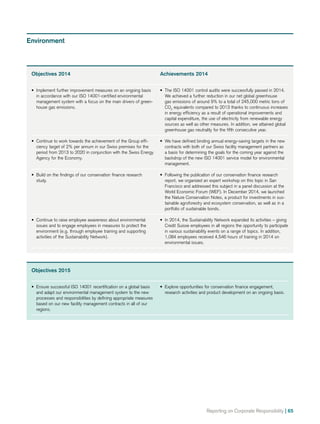
Environment
gigawatt-hours of energy were saved
globally as a result of increasing our
server virtualization rate to 60% world­-
wide over the past 4 years
hours of video conferencing were
used as an alternative to business travel,
helping to reduce our CO2
emissions
Economy and Society
Around 156 billion 73,468 Over 6 billion
Swiss francs is Credit Suisse’s volume
of loans outstanding in Switzerland at
end-2014
hours were dedicated to skills-based
volunteering by our employees
Swiss francs is the value of goods,
services and licenses purchased in
2014 from suppliers globally
employees were trained in environmental
management
173,36249
Employer
of all vacancies were filled
through internal appointments
individuals from over 150 different
nations work at Credit Suisse
young talents are taking part in
our training programs in Switzerland
45,80042% 1,200
1,084
Banking
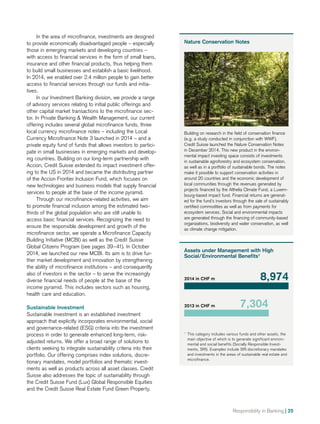
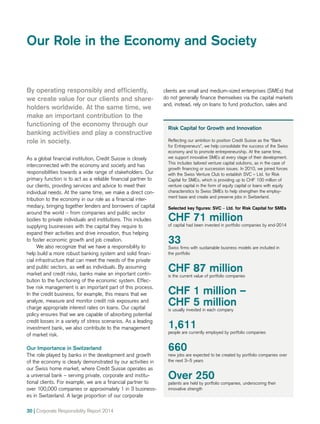
8,974 million10571
transactions or client relationships were
assessed for potential environmental and
social risks
Business Conduct Behaviors were intro-
duced to guide our employees in their
daily work and to help reduce the poten-
tial for operational or conduct losses
Swiss francs is our volume of assets
under management with high social and
environmental benefits
Credit Suisse is making a contribution to economic growth and social
development across all of its regions. These efforts include its microfinance
projects, which have provided over 2.4 million people at the base of the
income pyramid with access to improved financial services – including
through mobile banks.
For more information about the art on the cover, view the video at:
www.credit-suisse.com/ar/video2014
Credit Suisse Annual Reporting Suite
Company
Profile 2014
Annual Report
The Annual Report is a detailed pres-
entation of the Group’s annual finan-
cial statements, company structure,
corporate governance and compensa-
tion practices, treasury and risk man-
agement framework and a review of
our operating and financial results.
Company Profile
The Company Profile contains a
summary of Credit Suisse’s strategic
direction, an overview of its organi­
zation and a brief description of its
key businesses.
Corporate Responsibility Report
The Corporate Responsibility Report
provides a detailed presentation on
how the Group assumes its various
responsibilities as a bank towards
society and the environment. This
publication is complemented by the
Responsibility Chronicle, which adds a
multimedia dimension to our reporting.
Annual Report 2014
Credit Suisse Group AG
Corporate Responsibility
Report 2014
Contents
For the purposes of this report, unless the context otherwise requires, the terms “Credit Suisse Group,” “Credit Suisse,” “the
Group,” “we,” “us” and “our” mean Credit Suisse Group AG and its consolidated subsidiaries. The business of Credit Suisse AG,
the Swiss bank subsidiary of the Group, is substantially similar to the Group, and we use these terms to refer to both when
the subject is the same or substantially similar. We use the term “the Bank” when we are referring only to Credit Suisse AG, the
Swiss bank subsidiary of the Group, and its consolidated subsidiaries.
Foreword 2
Our Understanding of Corporate Responsibility 4
Responsibility in Banking 10
Trust and Expertise 11
Corporate Governance 17
Risk Management and Sustainability 18
Sustainable Products and Services 23
Responsibility in Society 29
Our Role in the Economy and Society 30
Our Social Commitments 36
Responsibility as an Employer 42
Responsibility as an Employer 43
Responsibility for the Environment 49
Environment 50
Reporting on Corporate Responsibility 56
2 | Corporate Responsibility Report 2014
Foreword
Dear Reader
2014 was a challenging year for Credit Suisse but also a
period of progress. In May 2014, we reached a final settle-
ment regarding all outstanding US cross-border matters.
We deeply regret the past misconduct that led to this
settlement. The resolution of this legacy issue marked an
important turning point for our bank. The continued trust
and support of our clients and the dedication of our
employees during this difficult period helped us to mitigate
the impact of the settlement on our business and financial
results. We have since re­­focused our resources on serving
our clients, driving our strategy forward and implementing
the targeted growth initiatives that we have defined.
To retain the trust of our clients, shareholders and
other stakeholders, we must continue to consistently deliv-
er on our business objectives. We also strive to set an
example in terms of compliance and professional stan­dards.
We are therefore emphasizing the culture of integrity, per-
sonal accountability and compliance within Credit Suisse.
In addition to our Code of Conduct, which sets out binding
ethical values and professional standards for all employees
worldwide, we introduced a set of Business Conduct
Behaviors in 2014 to guide our employees in their daily
activities and to help reduce the potential for operational
or conduct losses resulting from breaches of ethical stan­
dards or the failure to identify, escalate and resolve prob-
lems at an early stage.
Credit Suisse is committed to creating value for our
clients, shareholders and employees. We also strive to
take the needs and interests of other stakeholders in soci-
ety into account. We believe that it is only by pursuing a
responsible and forward-looking approach to business that
we can achieve long-term success.
The entire finance industry was confronted with a
more uncertain and volatile economic, political and market
environment in 2014. In addition, more stringent regulatory
requirements increased the cost of doing business, forcing
many banks to adapt their strategies and business activ­
ities to the new operating environment. Against this back-
drop, we remain committed to our integrated business
model that combines our Private Banking & Wealth Man-
agement business with Investment Banking. The close
collaboration between these two divisions enables us to
offer clients our profound experience in wealth management
on the one hand, and global capital markets access and
expertise on the other – meeting their need for sophisticat-
ed financial solutions.
We took further steps through 2014 to help us
respond to stricter new regulations on capital, leverage,
and global recovery and resolution planning. As the operat-
ing environment evolves, we are making efforts to adapt
our business, including our continued move towards a more
balanced distribution of capital between our two divisions
and the implementation of growth initiatives in our Private
Banking & Wealth Management business. Given the
progress made, we decided that now is the appropriate
time for the CEO succession. On March 10, 2015, we
announced that the Board of Directors has appointed
Tidjane Thiam as the new CEO of Credit Suisse Group,
effective at the end of June 2015. Tidjane Thiam currently
serves as Group Chief Executive of the UK-based financial
services company Prudential plc and has extensive inter­
national experience, including in wealth and asset manage-
ment. In the meantime, we and our leadership team are
focused on a flawless transition.
In 2014, Credit Suisse also continued to participate
in the regulatory reform dialogue. Examples include our
involvement in consultations on subjects such as the new
Total Loss-Absorbing Capacity (TLAC) standard, as well
as our role as a co-founder of the Swiss Finance Council,
which represents the interests of internationally active
Swiss banks within the European Union. As part of these
efforts, we once again underscored our view that new reg-
ulations should help to strengthen the stability of the finan-
cial system without restricting the ability of banks to per-
form key economic functions, including supplying capital to
companies to finance growth, innovation and job creation.
Recognizing that our bank is an integral part of the
economy and society, we strive to conduct our business
responsibly and have policies in place to manage the
broader social and environmental impacts of our activities.
We also uphold key international agreements that promote
responsible business practices such as the UN Global
Compact, of which we were one of the first signatories.
Our social commitments range from the provision of
targeted financial support for charitable institutions to our
collaboration with selected partner organizations worldwide
Foreword | 3
as well as the promotion of employee volunteering. Follow-
ing the success of our Youth Unemployment Initiative in
Switzerland over the last four years, we launched the new
association “Check Your Chance” in 2014, transitioning
the initiative to an independent national platform. During
the year, Credit Suisse also launched a Signature Program
on Financial Education for Girls in Brazil, China, India and
Rwanda, and we successfully continued our activities in
the area of microfinance.
Environmental and climate protection represent an­-
other important dimension of our corporate responsibilities
and we have long incorporated these aspects into our
business and operations. In our client-facing activities,
we have further expanded our range of sustainable prod-
ucts and services in response to the growing demand
from clients for investments that are compatible with their
personal values and objectives. In this context, we also
signed the Principles for Responsible Investment (PRI) in
2014, thereby pledging to incorporate environmental, social
and governance (ESG) criteria into our investment deci-
sions. To identify potential environmental and social risks
in our banking business, we conduct our Reputational Risk
Review Process. At an operational level, Credit Suisse
continues to take steps to promote the efficient use of
resources, reduce our environmental footprint and comply
with green standards.
To deliver on our wide-ranging responsibilities as a
bank, we require an in-depth understanding of the needs
and interests of all our stakeholders. In 2014, we therefore
discussed the issues identified in our Materiality Assess-
ment with groups of stakeholders in Zurich and New York.
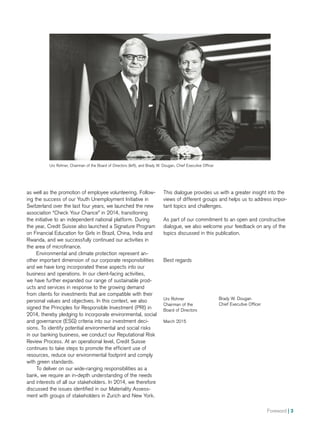
Urs Rohner, Chairman of the Board of Directors (left), and Brady W. Dougan, Chief Executive Officer
This dialogue provides us with a greater insight into the
views of different groups and helps us to address impor-
tant topics and challenges.
As part of our commitment to an open and constructive
dialogue, we also welcome your feedback on any of the
topics discussed in this publication.
Best regards
Urs Rohner
Chairman of the
Board of Directors
March 2015
Brady W. Dougan
Chief Executive Officer
4 | Corporate Responsibility Report 2014
Our Understanding
of Corporate
Responsibility
Business Model and Strategy
Credit Suisse operates as an integrated global bank with
two business divisions, Private Banking & Wealth Manage-
ment and Investment Banking. We are committed to deliv-
ering our financial experience and expertise to corporate,
institutional and government clients and high-net-worth
individuals worldwide, in addition to affluent and retail
clients in Switzerland. Our global structure comprises four
regions: Switzerland; Europe, Middle East and Africa
(EMEA); Americas; and Asia Pacific. Founded in 1856,
we have operations in more than 50 countries and employ
45,800 individuals from over 150 different nations (see
enclosed Company Profile).
To ensure our bank’s success, our strategy is built
on the following six pillars:
•• Client Focus
•• Employees
•• Capital, Leverage and Risk Management
•• Efficiency
•• Collaboration
•• Corporate Responsibility
Corporate Responsibility at Credit Suisse
For Credit Suisse, corporate responsibility is about creating
sustainable value for clients, shareholders, employees and
other stakeholders. We comply with the ethical values and
professional standards set out in our Code of Conduct in
every aspect of our work – including in our relationship with
stakeholders. We do so based on our broad understanding
of our duties as a financial services provider and employer
and as an integral part of the economy and society. Our
approach also reflects our commitment to protecting the
environment.
As a global bank, our main focus is on running our
business responsibly and profitably. We are aware of the
high standards demanded of us and we are committed
to engaging in an open dialogue with our various stakehol­
ders (see pages 8–9). This enables us to actively identify
their needs and interests, to develop appropriate solutions
and to take account of key challenges when further
developing our strategy. We believe that our responsible
approach to business is a key factor determining our long-
term success and helps to promote an understanding
of the important role we play in the economy and society.
credit-suisse.com/responsibility
Our Understanding of Corporate Responsibility | 5
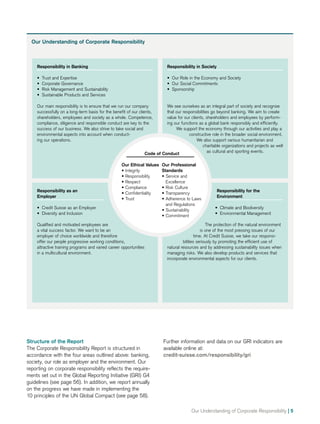
Our Understanding of Corporate Responsibility
Responsibility in Banking
•• Trust and Expertise
•• Corporate Governance
•• Risk Management and Sustainability
•• Sustainable Products and Services
Our main responsibility is to ensure that we run our company
successfully on a long-term basis for the benefit of our clients,
shareholders, employees and society as a whole. Competence,
compliance, diligence and responsible conduct are key to the
success of our business. We also strive to take social and
environmental aspects into account when conduct-
ing our operations.
Responsibility as an
Employer
•• Credit Suisse as an Employer
•• Diversity and Inclusion
Qualified and motivated employees are
a vital success factor. We want to be an
employer of choice worldwide and therefore
offer our people progressive working conditions,
attractive training programs and varied career opportunities
in a multicultural environment.
Responsibility in Society
•• Our Role in the Economy and Society
•• Our Social Commitments
•• Sponsorship
We see ourselves as an integral part of society and recognize
that our responsibilities go beyond banking. We aim to create
value for our clients, shareholders and employees by perform-
ing our functions as a global bank responsibly and efficiently.
We support the economy through our activities and play a
constructive role in the broader social environment.
We also support various humanitarian and
charitable organizations and projects as well
as cultural and sporting events.
Responsibility for the
Environment
•• Climate and Biodiversity
•• Environmental Management
The protection of the natural environment
is one of the most pressing issues of our
time. At Credit Suisse, we take our responsi­-
bi­lities seriously by promoting the efficient use of
natural resources and by addressing sustainability issues when
managing risks. We also develop products and services that
incorporate environmental aspects for our clients.
Structure of the Report
The Corporate Responsibility Report is structured in
accordance with the four areas outlined above: banking,
society, our role as employer and the environment. Our
reporting on corporate responsibility reflects the require-
ments set out in the Global Reporting Initiative (GRI) G4
guidelines (see page 56). In addition, we report annually
on the progress we have made in implementing the
10 principles of the UN Global Compact (see page 58).
Further information and data on our GRI indicators are
available online at:
credit-suisse.com/responsibility/gri
Code of Conduct
Our Ethical Values
•• Integrity
•• Responsibility
•• Respect
•• Compliance
•• Confidentiality
•• Trust
Our Professional
Standards
•• Service and
Excellence
•• Risk Culture
•• Transparency
•• Adherence to Laws
and Regulations
•• Sustainability
•• Commitment
6 | Corporate Responsibility Report 2014
Credit Suisse Materiality Assessment
Material issues Importance
Financial System Stability systemic risk / “Too Big to Fail” (TBTF) / capital and liquidity regulations /
TLAC (Total Loss-Absorbing Capacity) / legal entity structure
Culture of Compliance
and Conduct
compliance with laws and regulations / prevention of money laundering
and terrorist financing / anti-corruption / combating financial market crime
(e.g. fraud, anti-competitive practices, bribery) / sanctions compliance /
tax compliance / Code of Conduct
Company Performance
and Stability
business strategy / financial results / share price / dividends / capital,
liquidity and funding position / stability of the company / operational
risk (incl. business continuity management) / cost efficiency
Consumer and Investor
Protection
suitability and appropriateness / data security / privacy / retrocessions /
transparency of fees
Incentives and Compen­
sation Policy
responsible approach to compensation / executive compensation /
criteria for incentives / deferral, clawbacks
Corporate Governance operational structure / governance framework / management team /
voting rights
Quality of Services and
Advice
advisory process, relationship managers / range and quality of products
and services / expertise (e.g. research, advisory) / performance and
pricing of products and services
Environmental and Social
Risk Management
environmental management system / process for identification and
assessment of environmental, social and governance issues (ESG issues) /
policies for sensitive industries / impacts on ecosystems and landscapes
(incl. biodiversity, climate and energy, agriculture and forestry) / human
rights / Equator Principles / responsible supply chain management
Talent Management workforce composition / health and safety / training and skills management /
diversity and inclusion / non-discrimination / deployments / work-life
balance / attracting and retaining talent
Contribution to Economy purchasing, sourcing / tax contribution / lending to small and
medium-sized enterprises (SME)
Social Commitments employee engagement, including skills-based volunteering / philanthropy /
“militia” system of politics in our Swiss home market
Sustainable Investments sustainable products and services / impact investment, microfinance
	 Relevance to stakeholders (average)
	 Impact on Credit Suisse
	Range of external stakeholder views
Our Understanding of Corporate Responsibility | 7
Credit Suisse Materiality Assessment
The materiality assessment forms part of our dialogue with
stakeholders (see pages 8–9). By communicating with our
stakeholders about key topics, we gain a better under-
standing of their different views and perspectives. This, in
turn, enables us to actively address important issues and
challenges and to report on them transparently.
The key issues were identified in a three-stage process
comprising identification, prioritization and review. When
performing this assessment, we relied on information from
a number of sources, including monitoring tools, sustain­
ability frameworks, internal records and comprehensive
media monitoring. In 2014, we also discussed the list of
issues with representatives of selected external organiza-
tions and internal experts. During this process, we held
stakeholder consultations with investors and representatives
of rating agencies, non-governmental organizations (NGOs),
international organizations, academics and members of
key industry associations in Zurich and New York. These
discussions provided valuable feedback on whether Credit
Suisse had identified topics that are of relevance to our
stakeholders and on the extent to which their definition and
the relevance assigned to each respective issue is in line
with the views of participating stakeholders.
Following this process, the list of issues was updated
and, where necessary, revised. The materiality assessment
is not an exhaustive list of the topics raised by stakehol­
ders. Instead, it focuses on the issues that are of greatest
importance to them and to our business. The findings
reflect average values resulting from an assessment of
our stakeholders’ views and their range of expectations
towards us as a bank.
The findings of the materiality assessment also form
the basis for the inclusion of individual aspects of our cor-
porate responsibility in our reporting. We plan to continue
reviewing the list of relevant issues in the future in order to
identify new trends and to determine their significance for
our stakeholders and our business.
The materiality assessment is available online at:
credit-suisse.com/responsibility/
materialityassessment
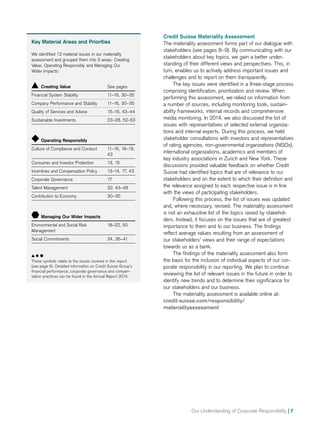
Key Material Areas and Priorities
We identified 12 material issues in our materiality
assessment and grouped them into 3 areas: Creating
Value, Operating Responsibly and Managing Our
Wider Impacts:
	 Creating Value See pages
Financial System Stability 11–16, 30–35
Company Performance and Stability 11–16, 30–35
Quality of Services and Advice 15–16, 43–44
Sustainable Investments 23–28, 52–53
	Operating Responsibly
Culture of Compliance and Conduct 11–16, 18–19,
43
Consumer and Investor Protection 13, 15
Incentives and Compensation Policy 13–14, 17, 43
Corporate Governance 17
Talent Management 32, 43–48
Contribution to Economy 30–35
	Managing Our Wider Impacts
Environmental and Social Risk
Management
18–22, 50
Social Commitments 34, 36–41
These symbols relate to the issues covered in this report
(see page 6). Detailed information on Credit Suisse Group’s
financial performance, corporate governance and compen­
sation practices can be found in the Annual Report 2014.
8 | Corporate Responsibility Report 2014
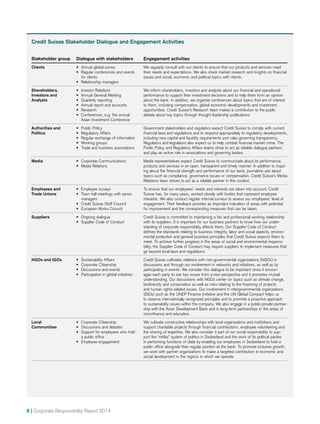
Credit Suisse Stakeholder Dialogue and Engagement Activities
Stakeholder group Dialogue with stakeholders Engagement activities
Clients •• Annual global survey
•• Regular conferences and events
for clients
•• Relationship managers
We regularly consult with our clients to ensure that our products and services meet
their needs and expectations. We also share market research and insights on financial
issues and social, economic and political topics with clients.
Shareholders,
Investors and
Analysts
•• Investor Relations
•• Annual General Meeting
•• Quarterly reporting
•• Annual report and accounts
•• Research
•• Conferences, e.g. the annual
Asian Investment Conference
We inform shareholders, investors and analysts about our financial and operational
performance to support their investment decisions and to help them form an opinion
about the bank. In addition, we organize conferences about topics that are of interest
to them, including compensation, global economic developments and investment
opportunities. Credit Suisse’s Research team makes a contribution to the public
debate about key topics through thought leadership publications.
Authorities and
Politics
•• Public Policy
•• Regulatory Affairs
•• Regular exchange of information
•• Working groups
•• Trade and business associations	
Government stakeholders and regulators expect Credit Suisse to comply with current
financial laws and regulations and to respond appropriately to regulatory developments,
including new capital and liquidity requirements and rules governing transparency.
Regulators and legislators also expect us to help combat financial market crime. The
Public Policy and Regulatory Affairs teams strive to act as reliable dialogue partners
and play an active role in associations and governing bodies.
Media •• Corporate Communications
•• Media Relations
Media representatives expect Credit Suisse to communicate about its performance,
products and services in an open, transparent and timely manner. In addition to inquir-
ing about the financial strength and performance of our bank, journalists ask about
topics such as compliance, governance issues or compensation. Credit Suisse’s Media
Relations team strives to act as a reliable partner in this context.
Employees and
Trade Unions
•• Employee surveys
•• Town hall meetings with senior
managers
•• Credit Suisse Staff Council
•• European Works Council
To ensure that our employees’ needs and interests are taken into account, Credit
Suisse has, for many years, worked closely with bodies that represent employee
interests. We also conduct regular internal surveys to assess our employees’ level of
engagement. Their feedback provides an important indication of areas with potential
for improvement and the corresponding measures that can be taken.
Suppliers •• Ongoing dialogue
•• Supplier Code of Conduct
Credit Suisse is committed to maintaining a fair and professional working relationship
with its suppliers. It is important for our business partners to know how our under-
standing of corporate responsibility affects them. Our Supplier Code of Conduct
defines the standards relating to business integrity, labor and social aspects, environ-
mental protection and general business principles that Credit Suisse expects them to
meet. To achieve further progress in the areas of social and environmental responsi-
bility, the Supplier Code of Conduct may require suppliers to implement measures that
go beyond local laws and regulations.
NGOs and IGOs •• Sustainability Affairs
•• Corporate Citizenship
•• Discussions and events
•• Participation in global initiatives
Credit Suisse cultivates relations with non-governmental organizations (NGOs) in
discussions and through our involvement in networks and initiatives, as well as by
participating in events. We consider this dialogue to be important since it encour-
ages each party to see key issues from a new perspective and it promotes mutual
understanding. Our discussions with NGOs center on topics such as climate change,
biodiversity and conservation as well as risks relating to the financing of projects
and human rights-­related issues. Our involvement in intergovernmental organizations
(IGOs) such as the UNEP Finance Initiative and the UN Global Compact helps us
to observe internationally recognized principles and to promote a proactive approach
to sustainability issues within the company. We also engage in a public-private partner-
ship with the Asian Development Bank and in long-term partnerships in the areas of
microfinance and education.
Local
Communities
•• Corporate Citizenship
•• Discussions and debates
•• Support for employees who hold
a public office
•• Employee engagement
We cultivate constructive relationships with local organizations and institutions and
support charitable projects through financial contributions, employee volunteering and
the sharing of expertise. We also consider it part of our social responsibility to sup-
port the “militia” system of politics in Switzerland and the work of its political parties
in performing functions of state by enabling our employees in Switzerland to hold a
public office alongside their regular position at the bank. To promote inclusive growth,
we work with partner organizations to make a targeted contribution to economic and
social development in the regions in which we operate.
Our Understanding of Corporate Responsibility | 9
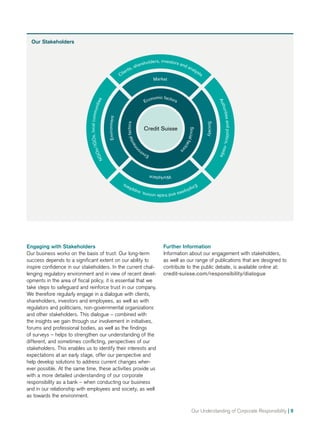
Our Stakeholders
Authoritiesandpolitics,media
Society
Socialfactor
s
Economic factors
Clients, shareholders, investors and analysts
Environment
NGOs/IGOs,localcommunities
Workplace
Enviro
nmentalfactors
Market
Credit Suisse
Employeesandtradeunions,suppliers
Engaging with Stakeholders
Our business works on the basis of trust: Our long-term
success depends to a significant extent on our ability to
inspire confidence in our stakeholders. In the current chal-
lenging regulatory environment and in view of recent devel-
opments in the area of fiscal policy, it is essential that we
take steps to safeguard and reinforce trust in our company.
We therefore regularly engage in a dialogue with clients,
shareholders, investors and employees, as well as with
regulators and politicians, non-governmental organizations
and other stakeholders. This dialogue – combined with
the insights we gain through our involvement in initiatives,
forums and professional bodies, as well as the findings
of surveys – helps to strengthen our understanding of the
different, and sometimes conflicting, perspectives of our
stakeholders. This enables us to identify their interests and
expectations at an early stage, offer our perspective and
help develop solutions to address current changes wher­
ever possible. At the same time, these activities provide us
with a more detailed understanding of our corporate
responsibility as a bank – when conducting our business
and in our relationship with employees and society, as well
as towards the environment.
Further Information
Information about our engagement with stakeholders,
as well as our range of publications that are designed to
contribute to the public debate, is available online at:
credit-suisse.com/responsibility/dialogue
10 | Corporate Responsibility Report 2014
Responsibility in
Banking
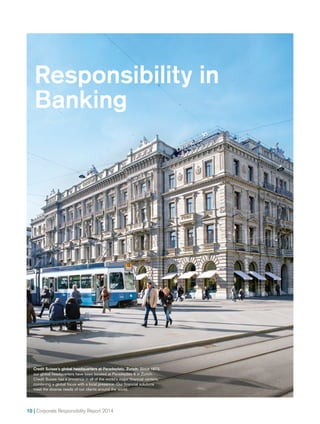
Credit Suisse’s global headquarters at Paradeplatz, Zurich: Since 1873,
our global headquarters have been located at Paradeplatz 8 in Zurich.
Credit Suisse has a presence in all of the world’s major financial centers,
combining a global focus with a local presence. Our financial solutions
meet the diverse needs of our clients around the world.
Responsibility in Banking | 11
Trust and Expertise
We offer our clients high-quality service
and advice, actively support regulatory
reforms and maintain a rigorous com-
pliance and control culture, thus helping
to reinforce confidence in our bank.
2014 was a challenging year for Credit Suisse but
also a period of progress. Looking back, the final
settlement we reached in May 2014 regarding all
outstanding US cross-border matters marked a turning
point for our bank. It was extremely important for
Credit Suisse to be able to resolve its most significant
and longstanding legacy litigation issue relating to past
misconduct, which we deeply regret. The continued
trust and support of our clients and the dedication of
our employees during this difficult period helped us to
mitigate the impact of the settlement on our business
and financial results. Our settlement in March 2014
with the Federal Housing Finance Agency also consti-
tuted the resolution of our single largest investor lawsuit
in the mortgage space (see page 16). We are, never­
theless, still in the process of resolving certain other
litigation issues – predominantly mortgage-related matters
dating back to before the financial crisis.
Evolving Our Business Model
The banking industry was confronted with a more
uncertain and volatile economic, political and market
environment in 2014. At the same time, the introduc-
tion of stricter regulatory requirements – particularly in
the areas of capital and liquidity – increased the cost
of doing business. To continue operating efficiently
against this challenging backdrop, many financial institu-
tions around the globe had to further adapt their strate-
gies and business activities to the new industry land-
scape.
Credit Suisse also further evolved its business model
in 2014. In particular, we continued to move toward a
more balanced distribution of capital between our two
divisions. This included winding down or exiting non-
strategic businesses and positions in order to reallocate
resources to areas with growth potential. In our Private
Banking & Wealth Management division, for example,
we have launched targeted revenue growth initiatives
after having focused on improving efficiency in recent
years. As part of these initiatives, we intensified our activi-
ties in the emerging markets – including in Asia Pacific,
which we regard as an important growth region. We also
took steps to increase lending to the ultra-high-net-worth
individual (UHNWI) client segment. A number of other ini­
tiatives are being rolled out in Private Banking & Wealth
Management to tailor our offering to changing client needs
(see page 16).
Swiss Financial Market Strategy
In Switzerland, the Brunetti II group of experts presented its
final report in December 2014. The report focused on four key
areas: the regulatory process and its implementation, market
access, the tax environment for financial transactions, and
macroeconomic risks. The group of experts’ recommendations
on reforms relating to macroeconomic risks are of particular
significance for the Swiss big banks since their main focus is on
the “Too Big to Fail” (TBTF) issue. Credit Suisse was pleased to
note that the group of experts acknowledged the effectiveness
of Switzerland’s existing TBTF regime and does not consider
a fundamental realignment of the current rules for big banks
to be necessary. At the same time, the group of experts
re­commended that the regime should be further enhanced with
mandatory Total Loss-Absorbing Capacity (TLAC) requirements.
We strongly support this approach, together with the need for
international consistency to prevent competitive disadvantages.
Switzerland has already implemented what we believe is a very
effective regulatory framework, under which high-trigger and
low-trigger contingent convertible instruments are recognized
as eligible capital. Credit Suisse has made significant progress
towards meeting these requirements and was one of the first
banks to issue such contingent convertible instruments in the
market. We plan to begin issuing TLAC-eligible bail-in debt from
entities linked to the Group holding company to enable a single
point of entry bail-in resolution strategy.
12 | Corporate Responsibility Report 2014
In the Investment Banking division, we continued to
implement our client-focused and capital-efficient business
model, prioritizing high market share and high-returning
businesses where we have a competitive advantage and
can benefit from synergies with Private Banking & Wealth
Management. As part of this process, we exited the com-
modities trading business and significantly reduced the
size of our macro business in 2014.
The execution of the capital measures we announced
in May 2014 was another key area of focus in the second
half of the year that helped to offset the negative impact
of the charge relating to the final settlement of all out-
standing US cross-border matters on our capital ratios.
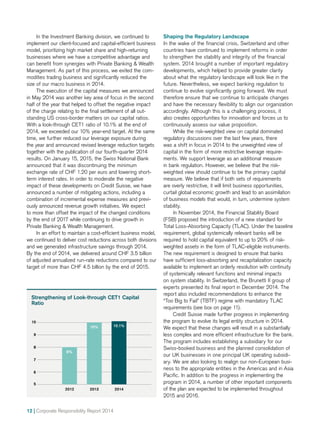
With a look-through CET1 ratio of 10.1% at the end of
2014, we exceeded our 10% year-end target. At the same
time, we further reduced our leverage exposure during
the year and announced revised leverage reduction targets
together with the publication of our fourth-quarter 2014
results. On January 15, 2015, the Swiss National Bank
announced that it was discontinuing the minimum
exchange rate of CHF 1.20 per euro and lowering short-
term interest rates. In order to moderate the negative
impact of these developments on Credit Suisse, we have
announced a number of mitigating actions, including a
combination of incremental expense measures and previ-
ously announced revenue growth initiatives. We expect
to more than offset the impact of the changed conditions
by the end of 2017 while continuing to drive growth in
Private Banking & Wealth Management.
In an effort to maintain a cost-efficient business model,
we continued to deliver cost reductions across both divisions
and we generated infrastructure savings through 2014.
By the end of 2014, we delivered around CHF 3.5 billion
of adjusted annualized run-rate reductions compared to our
target of more than CHF 4.5 billion by the end of 2015.
Shaping the Regulatory Landscape
In the wake of the financial crisis, Switzerland and other
countries have continued to implement reforms in order
to strengthen the stability and integrity of the financial
system. 2014 brought a number of important regulatory
developments, which helped to provide greater clarity
about what the regulatory landscape will look like in the
future. Nevertheless, we expect banking regulation to
continue to evolve significantly going forward. We must
therefore ensure that we continue to anticipate changes
and have the necessary flexibility to align our organization
accordingly. Although this is a challenging process, it
also creates opportunities for innovation and forces us to
continuously assess our value proposition.
While the risk-weighted view on capital dominated
regulatory discussions over the last few years, there
was a shift in focus in 2014 to the unweighted view of
capital in the form of more restrictive leverage require-
ments. We support leverage as an additional measure
in bank regulation. However, we believe that the risk-
weighted view should continue to be the primary capital
measure. We believe that if both sets of requirements
are overly restrictive, it will limit business opportunities,
curtail global economic growth and lead to an assimilation
of business models that would, in turn, undermine system
stability.
In November 2014, the Financial Stability Board
(FSB) proposed the introduction of a new standard for
Total Loss-Absorbing Capacity (TLAC). Under the baseline
requirement, global systemically relevant banks will be
required to hold capital equivalent to up to 20% of risk-
weighted assets in the form of TLAC-eligible instruments.
The new requirement is designed to ensure that banks
have sufficient loss-absorbing and recapitalization capacity
available to implement an orderly resolution with continuity
of systemically relevant functions and minimal impacts
on system stability. In Switzerland, the Brunetti II group of
experts presented its final report in December 2014. The
report also included recommendations to enhance the
“Too Big to Fail” (TBTF) regime with mandatory TLAC
requirements (see box on page 11).
Credit Suisse made further progress in implementing
the program to evolve its legal entity structure in 2014.
We expect that these changes will result in a substantially
less complex and more efficient infrastructure for the bank.
The program includes establishing a subsidiary for our
Swiss-booked business and the planned consolidation of
our UK businesses in one principal UK operating subsidi-
ary. We are also looking to realign our non-European busi-
ness to the appropriate entities in the Americas and in Asia
Pacific. In addition to the progress in implementing the
program in 2014, a number of other important components
of the plan are expected to be imple­mented throughout
2015 and 2016.
Strengthening of Look-through CET1 Capital
Ratio
5
6
7
8
9
10
2012 2013 2014
10.1%10%
8%
Responsibility in Banking | 13
Financial Integrity
Another important subject for the banking industry and
Credit Suisse in 2014 was the focus on litigation issues
(see pages 11 and 16) as regulators and authorities
imposed record financial penalties on institutions around
the globe to address past transgressions. At Credit
Suisse, we strive to rule out all forms of misconduct with-
in our company, have a strict compliance and control cul-
ture and a zero tolerance approach to unethical behavior.
Recognizing the critical role of employees in helping
to preserve financial integrity, we demand the highest
standards of personal accountability and ethical conduct
from each member of our workforce. Since many opera-
tional risk incidents are identified or resolved as a result
of employee diligence, we introduced a set of Business
Conduct Behaviors in 2014. They give our employees
guidance in their daily activities in order to help reduce the
potential for operational or conduct losses resulting from
breaches of ethical standards or missed opportunities to
identify, escalate and resolve problems at an early stage.
These behaviors are grouped into three categories: Ethical
Behavior, Thoughtful Behavior and Learning from Mistakes.
We manage service and infrastructure disruption risks
through our Business Continuity Management Plan, our
Technology Risk Management Program and other contin-
gency and resiliency plans. Ensuring that the confidentiali-
ty, integrity and availability of information assets are pro-
tected is critical to our operations.
We also strive to prevent the improper use of products
and services by third parties. As part of our efforts to fulfill
our due diligence requirements, we implement strict inter-
nal controls, cooperate with the relevant authorities and
issue rules governing topics such as business relations
with politically exposed persons (PEP) and the prevention
of money laundering and terrorist financing.
To protect against the risk of corruption, we have
implemented and consistently work to enhance our global
standards relating to corruption prevention. We apply a
range of policies, procedures and internal controls, such as
screening third parties who conduct business for or on
behalf of Credit Suisse and carrying out dedicated controls
related to gifts and entertainment, internships, charitable
contributions and sponsorship. Furthermore, the bank is
actively involved in the development and implementation
of industry standards to combat money laundering and
corruption. One example is Credit Suisse’s participation in
the Wolfsberg Group, which reflects our commitment to
implementing its anti-money laundering and anti-bribery
standards while also staying abreast of important develop-
ments. Employees are required to regularly complete man-
datory online training on topics such as the prevention of
money laundering, terrorist financing, corruption and com-
pliance with economic sanctions. In addition, we require
that they report cases of potential legal, regulatory or
ethical misconduct to their line managers or the Legal and
Compliance area. Employees worldwide also have the
option of calling our Integrity Hotline, where they can
report such issues anonymously. Meanwhile, the Internal
Audit department systematically monitors compliance
with internal and external principles, policies and guidelines.
Employee infractions are subject to escalation and
assessment processes that are known to all relevant parties,
including employees, line management, risk management
and control functions, and senior management bodies,
among others. Regional Disciplinary Review Committees
(DRCs) have been established to provide a framework to
ensure that the bank’s articulated standards of professional
conduct, policies and procedures are adhered to and
consistently enforced on a continuous basis across all four
Regulatory Developments
Various legislative reforms are being implemented worldwide
with the aim of increasing the stability and integrity of the global
financial system. We consider it important to be actively involved
in shaping global and international standards and to comply with
them when they are implemented.
Initiatives that are of particular relevance for Credit Suisse
address the following issues:
•• Prudent capital and liquidity standards for systemically
relevant banks (Basel III, Capital Requirements Directive IV,
Total Loss-Absorbing Capacity requirements, proposals by the
Swiss Brunetti II group of experts).
•• Actions to improve the recoverability and resolvability of
banking groups (development of recovery and resolution
plans [RRPs], European Commission draft legislative pro-
posal on bank structural reform, UK Banking Reform Act,
proposals by the Swiss Brunetti II group of experts).
•• Strengthening of investor and consumer protection and
increased market transparency (Dodd-Frank Act in the US;
MiFID [Markets in Financial Instruments Directive] and EMIR
[European Market Infrastructure Regulation] directives in
Europe; legislation governing financial services, financial insti-
tutions and financial market infrastructure in Switzerland).
•• Strengthening of shareholder rights (implementation of
“Minder Initiative” in Switzerland: The provisional ordinance
approved by the Swiss Federal Council entered into effect
on January 1, 2014; the Ordinance against Excessive
Compensation with respect to Listed Stock Corporations
[Compensation Ordinance] implements the initiative until
the final legal implementation is approved by the Swiss parlia-
ment and enters into force).
•• Compensation systems (G-20, FSB [Financial Stability Board],
FINMA [Swiss Financial Market Supervisory Authority], imple-
mentation of “Minder Initiative”).
•• Taxation (Art. 26 of OECD model agreement [Organisation for
Economic Cooperation and Development]; US FATCA legisla-
tion [Foreign Account Tax Compliance Act], implementation of
standard for the automatic exchange of information; signing of
OECD/Council of Europe Convention).
14 | Corporate Responsibility Report 2014
regions, subject to local differences. The DRCs are
designed to execute their mandate by providing an inde-
pendent review and, where necessary, participating in or
challenging decisions about measures to sanction employ-
ee misconduct. Disciplinary measures range from various
forms of warnings to termination of employment and,
depending on severity, are taken into consideration for
performance evaluation and promotions and are a factor in
the calculation of variable compensation awards or malus/
clawback claims. Each DRC formally oversees annual year-
end compensation and performance review processes, and
outcomes are reported to the Compensation Committee
for review. The Audit Committee and the Capital Allocation
and Risk Management Committee are provided with quar-
terly management information regarding the number and
categories of misconduct identified and disciplinary actions
taken. All employees as well as members of the Board of
Directors are obligated to adhere to Credit Suisse’s Code
of Conduct and participate in targeted training courses
that include, but are not limited to, developments in the
finance industry such as anti-corruption and risk manage-
ment measures.
Commitment to Tax Compliance
Credit Suisse has long been pursuing a strategy that
focuses on tax compliance and we continued to make
significant progress in addressing legacy tax issues in
2014. This regularization process resulted in outflows
from our European cross-border business during the year.
In addition, one of the guiding principles set out in our
Code of Conduct is that we do not assist in any activities
that are intended to breach tax obligations. We therefore
support measures that can reasonably be implemented to
ensure that all inflows into banks consist of tax-compliant
assets. We believe that tax compliance is the duty of
each individual and we therefore supply our clients with
the documentation they require to comply with tax regula-
tions. Furthermore, we only offer clients products and
services that are compliant with the rules in their home
country.
In Switzerland, efforts to build a tax-compliant and
internationally accepted financial center included the inter-
governmental agreement between Switzerland and the
US that facilitated the implementation of the US Foreign
Account Tax Compliance Act (FATCA) in July 2014.
This law aims to achieve a broad exchange of information
and transparency regarding the offshore accounts of
US taxpayers by requiring all non-US financial institutions
worldwide to regularly and automatically notify the US
authorities about the identity and assets of US clients.
Credit Suisse welcomes the FATCA agreement that was
signed by Switzerland with the US in mid-2014 and we
believe that the facilitation included in the agreement is of
vital importance for the Swiss finance industry.
In terms of the trend towards increased access to
cross-border bank data by international tax authorities, the
Swiss Federal Council approved a declaration in November
2014 on Switzerland joining the multilateral agreement on
the automatic exchange of information (AEI) in tax matters.
Switzerland belongs to a group of states that plan to start
collecting data in 2017, with the first exchange of informa-
tion in 2018. Credit Suisse welcomes the Swiss govern-
ment’s commitments in this area and its strategy of actively
participating in this development in the area of international
tax cooperation.
A Global Approach to Banking
We are a global bank and offer products and services on a
cross-border basis as well as on a local basis, referred to as
onshore banking. In response to evolving client needs, Credit
Suisse has been expanding its global presence and onshore
services in targeted markets for many years. We are now active
in more than 50 countries worldwide, including our Swiss home
market. Our Private Banking & Wealth Management division
operates 21 booking centers globally, which means that we can
administer our clients’ assets in their home country or in another
international hub. At the same time, the Swiss financial center
remains attractive to international clients in view of its numerous
strengths, including its efficient system of universal banking −
with the hallmarks of expertise, reliability and quality − as
well as favorable framework conditions such as political and
economic stability, first-class services and highly qualified
employees. The banking services offered out of Switzerland
are therefore expected to remain important – particularly in
response to the needs of sophisticated clients in emerging
markets. Ensuring strict compliance with all applicable legis­
lation when offering cross-border services is an essential part
of our business model at Credit Suisse. We have been working
intensively for years towards the goal of ensuring that all our
activities adhere to the applicable rules and regulations in
Switzerland and abroad.
Responsibility in Banking | 15
Global Service Monitor Program:
Evaluating Client Satisfaction
92%of our Private Banking clients are satisfied with our services.
55%
92%
37%
8%
2014
	Very satisfied
	Satisfied
	Not satisfied
High-Quality Service and Advice
We regularly review the suitability and appropriateness of
the advice we offer – testing and documenting the quality
of our investment recommendations to assess whether
our clients have the knowledge and experience to under-
stand the associated risks. Our advisory process incorpo-
rates sophisticated analytical tools that can identify the
counterparty risks and potential returns in client portfolios
to provide an objective basis for client investment deci-
sions. Credit Suisse has been committed to strengthen-
ing investor protection for a number of years and has
invested in the related systems, processes and employee
training – including a mandatory certification program for
relationship managers (see page 44). We also fundamen-
tally support the project to develop a Federal Financial
Services Act that addresses important concerns about
investor protection and will bring Swiss legislation into line
with international standards. Ultimately, this can be
expected to facilitate cross-border activities as well as
market access for Swiss financial services providers.
Spotlight on Client Satisfaction
Our Client Insight Management team in Private Banking &
Wealth Management conducts a Global Service Monitor
Program to assess our clients’ overall level of satisfaction
with our service and advice and to identify scope for
improvement. Based on the feedback received from over
13,000 clients, prospects, service users and subscribers
worldwide, we initiate improvements on an individual basis
or at market, divisional or regional level. The results of
the 2014 Global Service Monitor Program indicated that
92% of our clients are satisfied with our services (see
chart).
This chapter addresses the following issues (see pages 6–7):
	 Financial System Stability; Company Performance and Stability;
Quality of Services and Advice
	Culture of Compliance and Conduct; Consumer and Investor
Protection
credit-suisse.com/responsibility/banking
16 | Corporate Responsibility Report 2014
Challenges and Responses 2014
Challenge: What progress was made in
addressing legacy legal issues in 2014?
Response: Credit Suisse put some signifi-
cant legacy issues behind it during the year
but is, nevertheless, still in the process of
resolving certain litigation issues – predomi-
nantly mortgage-related matters dating
back to before the financial crisis. As to
the previously disclosed matters relating to
LIBOR and the foreign exchange markets,
to date, Credit Suisse has not seen evi-
dence to suggest that it is likely to have
material exposure in connection with
these issues. In May 2014, Credit Suisse
announced a final settlement regarding
all outstanding US cross-border matters.
The settlement included a payment total­-
ing around USD 2.8 billion, as well as the
entry of a guilty plea by Credit Suisse’s
Swiss banking entity, Credit Suisse AG.
The settlement brought to a conclusion the
most significant and longstanding regulatory
and litigation issue for Credit Suisse. We
deeply regret the past misconduct that led
to this settlement. Having this matter fully
resolved is an important step forward for
us. We have since refocused our resources
on serving our clients, driving our strategy
forward and implementing the targeted
growth initiatives that we have defined. Our
settlement in March 2014 with the Fede­ral
Housing Finance Agency also constituted
the resolution of our largest investor
law­-suit in the mortgage space. In view of
developments in industry-wide litigation and
investigations in the US relating to mortgag-
es in 2015, Credit Suisse announced on
February 27, 2015, that it had increased its
mortgage-related litigation provisions.
Challenge: How is the trend towards
digitalization impacting the banking
business and how is Credit Suisse
responding to this development?
Response: We have been following the
impact of digitalization on the industry for
a number of years – particularly in areas
such as payment operations, wealth man-
agement, corporate and retail banking and
lending. What is clear is that the evolving
digital landscape has resulted in a profound
shift in the way clients interact with their
bank. To that end, we are investing sub-
stantially in capabilities to keep us closer to
our current and next generation of clients,
who are increasingly demanding real-time,
mobile technologies for every aspect of
their banking relationship. Our digital
private banking initiative, which is being
rolled out globally from the first quarter of
2015, has a key role to play in this context.
It is expected to deliver a sophisticated,
cutting-edge multi-channel experience to
clients. Through this interactive banking
technology, we expect clients to gain
improved access to the knowledge and
insights of our integrated bank and to
identify and act on the information that
is most important to them whenever and
wherever they choose. We believe that if
we can manage the complexity of wealth
management via an intelligent, web-based
platform and deliver our offering in a user-
friendly and policy-compliant way, we can
gain a significant competitive advantage.
Challenge: Which measures is Credit
Suisse taking to address the evolving
needs of private clients in today’s chal-
lenging environment?
Response: A number of targeted growth
initiatives are underway in Private Banking
& Wealth Management to tailor our offering
to changing client needs. One example is
our new advisory offering Credit Suisse
Invest, which is being rolled out in selected
markets from the first half of 2015. The
focus is on flexibility and transparency, since
clients select the investment solution best
suited to their needs and receive a clearly
defined range of services. In addition, they
benefit from an attractive pricing model with
substantially lower transaction and custody
fees.
	 Credit Suisse also refreshed its discre-
tionary mandates to provide clients with
a simpler, more transparent and more
competitively priced offering based on
our enhanced investment process from
November 2014. A further program is our
Strategic Client Initiative, established for our
UHNWI clients globally, which is expected
to enable us to deliver best-in-class ideas
and solutions and the entire offering of the
integrated bank to this key segment.
Challenge: Dark pools came under
increased media scrutiny in 2014. What
is Credit Suisse’s response to criti-
cisms about their use?
Response: “Dark pools” is a colloquial term
for Alternative Trading Systems (ATS),
which are automated crossing platforms.
Credit Suisse believes that offering access
to ATS liquidity provides benefits to insti-
tutional investors, such as the potential to
reduce their trading costs. Credit Suisse
offers clients ATS in several different
regions, including Crossfinder in the US,
which is registered with and regulated by
the US Securities and Exchange Com-
mission (SEC). In 2014, the SEC Chair
and other global regulators spoke about
re-evaluating the current market structure,
including “dark pools”, and we fully support
this effort.
Directors also takes account of international legislative and
best practice developments.
Managing Risk
Our Risk Management function plays a central role by
promoting a disciplined risk culture and the necessary
transparency to support management in defining a suitable
risk profile. It is instrumental in ensuring a prudent and
intelligent approach to risk-taking that balances risks and
returns and optimizes the allocation of capital across the
Group. A proactive risk management culture and the use
of state-of-the-art quantitative and qualitative tools help to
minimize the potential for undesired risk exposures in our
operations. Further information can be found in the Annual
Report 2014 of Credit Suisse Group or at:
credit-suisse.com/responsibility/governance
This chapter addresses the following issue (see pages 6–7):
	Sustainable Investments
By acting with integrity, fairness and
transparency, we can inspire trust in
our clients, shareholders, employees
and other stakeholders.
Our corporate governance complies with internationally
accepted standards. We adhere to the principles set out
in the Swiss Code of Best Practice of Corporate Gover­
nance, including its appendix stipulating recommendations
on the process of compensation of the Board of Directors
and Executive Board. Due to our primary listing on the
SIX Swiss Exchange, we are subject to the SIX Directive
on Information Relating to Corporate Governance. Our
shares are also listed on the New York Stock Exchange
(NYSE) in the form of American Depositary Shares, mean-
ing that we are subject to certain US rules and regulations.
Governance Framework
The corporate governance guidelines adopted by the
Board of Directors aim to promote an understanding of
our governance structure. Our Articles of Association,
Code of Conduct, Organizational Guidelines and Regula-
tions, the Charters of the Board of Directors and our
global Compensation Policy are also important in this con-
text. The Code of Conduct is binding on all employees and
members of the Board of Directors. Employees must also
comply with all legal, regulatory and internal requirements
and with strict standards of professional conduct at all
times. Compliance is a critical consideration when hiring
employees, developing training tools and defining process-
es and rules. It is also vital to our supervisory and control
systems.
Shareholder Rights
We encourage investors to participate in the Annual General
Meeting and to exercise their voting rights. To support
them in the decision-making process, we provide accurate
and transparent disclosures in our reporting publications.
We strive to produce precise, reliable and compre­hensible
financial reports that clearly explain our performance,
mission and strategy. We also seek to pursue responsible
and balanced compensation practices that ensure a pru-
dent approach to risk-taking and align employee and
shareholder interests, thus incentivizing the creation of
sustainable shareholder value (see box). The Board of
Responsible Approach to Compensation
The objectives of the Group’s compensation policy include attrac-
ting and retaining employees and motivating them to achieve
results with integrity and fairness. Based on shareholder input
and emerging practices in the area of executive compensation,
we made significant changes to our executive compensation
framework in 2012, which continued to form the basis for
Executive Board compensation for 2014. Key elements include
individual targets and caps on incentive compensation linked to
the achievement of challenging performance targets, as well as
deferred short-term and long-term incentive awards for Executive
Board members, subject in part to future performance vesting
conditions. In general, deferred variable awards for 2014 were
granted in the form of share awards, a proportion of which are
subject to performance-based malus provisions and Contingent
Capital Awards (CCAs). For the Group as a whole, the total com-
pensation and benefits expense was CHF 11.3 billion for 2014,
stable compared to 2013. Variable compensation awarded for
2014 was CHF 3.3 billion, down 9% compared to 2013. Due
to the substantial impact of the US cross-border settlement, the
individuals who were members of the Board of Directors and the
Executive Board at the time of the settlement voluntarily agreed
to a reduction of 25% of total compensation and 20% of variable
compensation, respectively, with respect to the amounts that
would otherwise have been awarded for 2014. In accordance
with the Swiss Ordinance Against Excessive Compensation with
respect to listed Stock Corporations, the Group will submit Board
and Executive Board compensation recommendations for binding
votes by shareholders for the first time at the AGM in 2015.
Corporate Governance
Responsibility in Banking | 17
18 | Corporate Responsibility Report 2014
national Finance Corporation (IFC). Around 80 finan­­cial
institutions have adopted the EP, thereby committing
to review impact assessment reports on related projects
before agreeing to provide financing or advisory services.
These financial institutions require clients to take concrete
measures to mitigate the potential negative impacts of
these projects on people or the environment (e.g. by
reducing air, water or soil pollution or by consulting with
and/or involving the local community). Credit Suisse was
one of the first banks to sign up to the EP in 2003, and
we have also played an important role in the development
of the most recent version of the framework, the EP3.
Following Credit Suisse’s transition to the EP3 in 2013,
they are now being used for all applicable transactions,
including project finance and project-related corporate
loans.
Since 2008, we have also been applying the Carbon
Principles to our financing activities in the US power gen-
eration sector. Under this voluntary industry standard,
banks use an enhanced due diligence process to assess
and take account of regulatory risks relating to CO2
emis-
sions. We did not lead any transactions that were subject
to the Carbon Principles in 2014.
Respecting Human Rights
We strive to assume our responsibilities in the area of
human rights in accordance with the International Bill of
Human Rights, as well as the principles on human and labor
rights set out in the UN Global Compact. We incorporate
related principles into our own policies and take account of
them in our business activities. Equally, we expect our busi-
ness partners to recognize and uphold human rights. In
September 2014, Credit Suisse also published its State-
ment on Human Rights, describing the foundations of our
commitment to respect human rights and the approaches,
processes and tools we use to implement it.
When implementing our commitment in this area,
we take account of the UN “Protect, Respect and Reme-
dy” framework. This reference point for the business and
human rights debate describes the duty of states to pro-
tect human rights, the responsibility of corporations to
respect human rights, and the shared obligation to provide
access to effective remedy for people harmed by business
activities. Guidance on the implementation of this frame-
work is provided by the Guiding Principles on Business and
Human Rights issued by the UN in 2011.
To achieve long-term success, it is essen-
tial that we pursue a responsible approach
to business. We expect our employees
to act professionally, with integrity and in
compliance with applicable laws, regula-
tions, due diligence requirements and
industry standards. In addition, we take
account of sustainability issues through
our risk review process.
It is essential that we display a high degree of risk aware-
ness and operate responsibly in all areas of our business.
Credit Suisse therefore expects employees to act profes-
sionally, fairly and prudently at all times. Our Code of
Conduct defines six ethical values and six professional
stan­dards that are binding on all employees and members
of the Board of Directors (see page 5). The obligation to
observe the Code of Conduct is prescribed in each
employment contract and is incorporated into the annual
performance review process for our employees.
Sustainability as an Integral Part of Our Business
Our commitment to sustainability and to taking account
of environmental and social issues in our business activities
represents one of the professional standards in our Code
of Conduct. We have also published a Statement on Sus-
tainability that defines the objectives and principles under-
lying our commitment to sustainability. It refers to the inter-
national agreements that Credit Suisse has voluntarily
pledged to uphold, such as the UN Global Compact with
its 10 principles in the areas of human rights, labor stan­
dards, environmental protection and anti-corruption efforts,
as well as the United Nations Environment Programme
Finance Initiative (UNEP FI).
Voluntary Industry Standards – Equator Principles
In addition to adopting international sustainability agree-
ments, Credit Suisse follows voluntary industry standards
that set out specific due diligence requirements for certain
areas of business. They include the Equator Principles
(EP) – a framework for the management of environmental
and social risks that is applied by banks when financing
major industrial and infrastructure projects and is based
on the environmental and social standards of the Inter­
Risk Management and Sustainability
Responsibility in Banking | 19
Working with other financial institutions, Credit Suisse
co-initiated the Thun Group of Banks in 2011. The informal
working group aims to promote a better understanding
of what the UN Guiding Principles mean for the banking
sector. As a result of this work, the Thun Group published
a discussion paper on this subject in October 2013. In
June 2014, the Thun Group also held a stakeholder event
addressing topics including the question of access to
remedy.
We have identified three levels at which our business
activities can have an impact on stakeholders and that
we can therefore influence. Credit Suisse’s most direct link
to human rights issues is in our working relationship with
our employees, and this is consequently the area in which
we can exercise the greatest influence. We also strive to
ensure the protection of human rights when working with
suppliers and external service providers (see box). Our
financial products and services represent the third area
in which we may have to address human rights issues. The
provision of financial services such as lending or the issu-
ance of debt or equity may be linked to negative impacts,
particularly if they support the business activities of clients
that could potentially affect human rights (such as harming
the safety, health or livelihood of local communities). Credit
Suisse examines aspects of transactions that are sensitive
from a human rights perspective using a clearly defined risk
review process (see page 20). We encourage our stake-
holders to report cases in which our products and services
may have an impact on human rights.
After signing the Walk Free pledge – a commitment
by companies to eliminate all forms of modern slavery from
their businesses and supply chains – in 2013, we took
steps to further increase awareness of human rights issues
among Credit Suisse front office employees in 2014. To
keep abreast of human rights discussions, we also partici-
pate in the corresponding UNEP FI working group. In
December 2014, we once again took part in the UN Forum
on Business and Human Rights, at which represen­tatives
of the Thun Group of Banks participated in a panel discus-
sion about the financial sector and human rights.
Sector Policies and Guidelines
Certain industries are particularly sensitive from a social
or environmental perspective. These include oil and gas,
mining, hydropower, nuclear power, controversial weapons,
forestry and agribusiness, as well as palm oil production.
We have defined specific global policies and guidelines in
order to assess potential transactions with clients in these
industries, taking into account standards developed by
international organizations such as the UN and the World
Bank. The issues covered include:
•• Compliance with industry-specific, internationally recog-
nized standards on the environment and human rights
•• Measures to assess and reduce the environmental
impact of operations
•• Protection of the health and safety of company employ-
ees and surrounding communities
•• Respect for the human rights of the local population
Our policies also set out activities and business practices
that Credit Suisse explicitly will not finance. Exceptions
may only be granted in individual cases in accordance with
our Reputational Risk Review Process (RRRP). A summary
of our policies and guidelines can be found online at:
credit-suisse.com/sectorpolicies
To further integrate topics such as climate change, bio­
diversity, the scarcity of resources and human rights into
our risk assessments, we continually update our sector
policies and guidelines in line with the latest developments
and challenges. We also conducted a study about the
power generation sector in 2014. The study focused on
Code of Conduct for Suppliers
and “Know Your Supplier”
Credit Suisse strives to maintain a fair and professional business
relationship with its service providers and suppliers. In return,
we expect our partners to address risks responsibly and to con-
duct their business in a socially and environmentally responsible
manner that complies with applicable laws, regulations and
ethical standards. In 2010, we therefore introduced a Supplier
Code of Conduct that defines our requirements relating to busi-
ness integrity and ethics, environmental protection, labor and
social standards, as well as general business principles and
management systems. These standards may exceed local
legis­lative requirements in certain cases.
	 In 2012, Credit Suisse rolled out its “Know Your Supplier” risk
assessment process globally. This structured process examines
aspects such as the environmental and employment standards of
our suppliers and service providers. It is based on global research
into environmental issues and labor law and forms an integral part
of the procurement process. Risks are assessed using a range
of criteria, and risk mitigation measures are implemented where
necessary. Specific clauses covering environmental requirements
and labor standards that are to be adhered to by our suppliers
have been updated and will be used in supplier contracts for
some goods and services.
20 | Corporate Responsibility Report 2014
Transactions assessed on the basis of
potential environmental and human rights
risks in 2014
Assessment of Sustainability Risks within
the Reputational Risk Review Process
Decision by Regional CEO (or the EMEA Reputa-
tional Risk Committee, respectively) or CRO
(approval/approval with conditions/rejection)
Decision by Regional Reputational Risk Approver
(approval/approval with conditions/rejection)
Aspects to be checked according to policies
and guidelines
Analysis of environmental
and social aspects of client
operations
Analysis of transaction Analysis
of various
risk-specific
aspects
Inquiry into the identity and
activities of the potential client
Consideration of the regulatory,
political and social context
Internal specialist unit
Sustainability Affairs
Potential risk with regard
to environmental and social
impact
Various
specialist units
Other potential
risks
	77% approved
	15% approved with
conditions
	8% rejected or not
pursued
571
transactions
assessed
Optional escalation
the environmental and social risks that transactions in
this sector may entail, with a particular emphasis on three
power generation technologies: coal, hydroelectric and
nuclear. The study considered practices in use within the
financial industry, including development finance institu-
tions, with a view to refining our internal power sector
guidelines.
Bank-wide Risk Review Process
If there are grounds to believe that a potential transaction
or client relationship could pose an unacceptable risk or is
not compatible with our existing agreements or internal
guidelines, Credit Suisse conducts a bank-wide, standard-
ized Reputational Risk Review Process (RRRP), involving
independent external specialists where appropriate. Poten-
tial risks may arise from a variety of sources, including the
nature and purpose of a proposed transaction or service,
the identity or activities of a potential client, and the regu-
latory or political climate in which the business will be
transacted.
Assessing Sustainability Risks
Environment or human rights-related risks are also consid-
ered and examined prior to or within the bank-wide RRRP.
If a transaction poses a risk of this nature, the internal Sus-
tainability Affairs specialist unit conducts this review pro-
cess to evaluate whether the potential client complies with
the relevant industry standards and whether the transaction
is compatible with Credit Suisse’s policies and guidelines
for sensitive sectors. Based on the outcome of this analy-
sis, Sustainability Affairs submits its findings to a Regional
Reputational Risk Approver, who is independent from the
area of business in question and has the authority to
approve, reject or impose conditions on our participation in
a transaction or on the provision of a specific service. In the
case of particularly complex or cross-regional transactions,
the decision may be referred to the Regional CEO1
or the
Chief Risk Officer.
The most senior governing body responsible for the
oversight of review processes and policies and the discus-
sion of reputational risks and sustainability issues is the
Reputational Risk Sustainability Committee (RRSC). The
RRSC consists of members of the Executive Board and
the heads of cross-divisional specialist units (such as
Legal & Compliance, Public Policy, Risk Management,
Sustainability Affairs and Corporate Communications). It is
chaired by the bank’s Chief Risk Officer and supported by
four Regional Reputational Risk Councils or Committees.
In 2014, Sustainability Affairs analyzed a total of
571 transactions or client relationships as part of the
Reputational Risk Review Process to assess environmen-
1
	 or the EMEA Reputational Risk Committee in the case of the Europe,
Middle East and Africa region.
1. Risk classification and responsibility
2. Assessment and recommendation
3. Review and decision
Responsibility in Banking | 21
Dialogue about Sustainability and Due Diligence
Requirements
Credit Suisse engages in an ongoing dialogue with a range
of stakeholder groups on sustainability issues that are rele-
vant to the bank. In 2014, we held discussions about topics
such as business and human rights, conservation finance
and the role of environmental, social and governance (ESG)
criteria in banking. We also organized a roundtable event
in New York on environmental and social risk management
in investment banking and spoke at an event in Amsterdam
at which other banks and non-governmental organizations
(NGOs) discussed the role of banks in society. In addition,
Credit Suisse participated in the annual events relating to
the Equator Principles and UNEP FI. At these events, key
topics and case studies were discussed by practitioners
across the financial services industry to share knowledge
and best practice.
Sustainability Risk Assessments in 2014
Transactions assessed¹ 	 Equator Principles transactions²
2014 2013 2014 2013
Number3
Volume4
Number3
Volume4
By region 571 519 2 267 8 455
Switzerland 211 188 1 17 1 50
Europe, Middle East and Africa 99 111 1 250 3 200
Americas 99 77 0 0 2 100
Asia Pacific 162 143 0 0 2 105
By sector 571 519 2 267 8 455
Mining 148 158 0 0 6 355
Forestry and agribusiness 57 39 0 0 0 0
Oil and gas 142 113 0 0 1 50
Power generation and transmission 47 36 1 17 0 0
Chemicals 19 17 0 0 0 0
Defense 31 35 0 0 0 0
Infrastructure and transportation 44 58 1 250 1 50
Other 83 63 0 0 0 0
For a comprehensive disclosure in accordance with Equator Principles 3 requirements, see: credit-suisse.com/equatorprinciples
1
	 Including Equator Principles transactions.
2
	 Equator Principles transactions are divided into different risk categories (A–C; A being the highest risk), and additional clarifications and actions are
initiated if required by the degree of risk involved. In 2014, 1 transaction was classified as category A (2 in 2013), 0 as category B (5 in 2013)
and 1 as category C (1 in 2013).
3
	 From 2014, the Equator Principles require reporting on transactions that reached financial close in the reporting year. A comparison between the
figures for 2013 and 2014 is thus not possible, as the figures reported for 2013 concern all transactions screened in that year.
4
	 In USD million.
tal or human rights-related risks. In total, 440 (77%) were
approved, 88 (15%) were approved subject to certain con-
ditions, and 43 (8%) were rejected (e.g. due to non-com-
pliance with the standards prescribed by Credit Suisse) or
not pursued further. Where transactions were not pursued,
this was due, among other things, to adverse market
conditions or the fact that significant additional investiga-
tions would have been required to assess compliance with
our sustainability standards. These statistics exclude
potential transactions or business relationships that were
not formally reviewed because they were immediately
identified by the relationship manager or his or her line
manager as being non-compliant with the bank’s require-
ments and guidelines and were therefore rejected at the
outset.
22 | Corporate Responsibility Report 2014
Challenges and
Responses 2014
Challenge: From time to time, Credit Suisse has
to make decisions about controversial transactions
where opinions about the potential environmental
and social impacts can differ widely, depending on
the perspective and point of view of a party. How
does Credit Suisse approach this challenge?
Response: Companies operating in sensitive sectors
frequently play a key economic role in the global supply
of commodities and energy and are often important
employers in economically underdeveloped regions. At
the same time, the projects and activities of companies
such as these can, in some cases, have a significant
impact on the climate, biodiversity, water resources
or inhabitants of a specific area. We are aware of the
tensions that can potentially arise in this context, and
we seek to identify and manage them. We strive to meet
high standards when examining the related risks and
considering the interests of different stakeholders.
Challenge: Credit Suisse regularly engages
with NGOs on environmental and social topics.
How­­ever, there can be fundamental differences
between the objectives of an NGO and the man-
date of a corporation. How does Credit Suisse
respond to the differing views that these groups
of stake­holders may have?
Response: To conduct a constructive dialogue with
NGOs, we take part in events and discussions on
relevant topics and also engage with them bilaterally.
Even if opinions may differ, we consider this dialogue
to be important since it encourages each party to see
issues from a different perspective and it promotes
mutual understanding. Examples of this dialogue in
2014 include our participation in the UN Forum on
Business and Human Rights and discussions with civil
society organizations as part of our engagement in the
Thun Group of Banks. Furthermore, we supported the
development of the WWF guide “ESG Integration for
Banks”.
Challenge: How can Credit Suisse evolve its
policies on sensitive industries to reflect changing
attitudes about what constitutes acceptable social
and environmental risks and impacts in a way
that is consistent with the desire of clients to have
stable and predictable frameworks?
Response: Through our membership of various organ-
izations (e.g. Equator Principles, the Thun Group of
Banks and the UN Global Compact) and by regularly
engaging with different stakeholder groups, including
our clients, we participate in the dialogue about environ­
mental and social topics and thus regularly review how
we run our operations and conduct our business against
this background. As a result, we continually update
our sector policies and guidelines in line with the latest
developments and challenges and identify environmental,
societal or regulatory trends to which we can apply our
expertise as financial intermediaries in order to address
them.
Training and Knowledge-Sharing
We provide employee training to ensure that the expertise
required to address environmental and human rights risks is
firmly embedded within our company and to raise employee
awareness about these topics. Our training concept con-
cerning the management of sustainability risks consists of
three modules: general training about Credit Suisse and
sustainability; information about the Reputational Risk
Review Process for employees with client contact; and
sector-specific training for relationship managers serving
clients in sensitive industries. Intranet-based e-learning
modules complement this approach. Special training ses-
sions that are tailored to the needs of client-facing units
remained a key priority in 2014 and were held at various
locations or via teleconference. A total of 690 emplo­-
yees received training in sustainability risks (not including
e-learning modules) during the year.
As a response to the growing need to build capacity
among financial institutions in emerging markets in the
field of sustainable finance, Credit Suisse supported the
development of the WWF guide “ESG Integration for
Banks”, which was published in August 2014. We also
shared our experience during implementation workshops in
Singapore, Malaysia and Thailand that were supported by
the relevant national stock exchanges.
This chapter addresses the following issues (see pages 6–7):
	Culture of Compliance and Conduct
	Environmental and Social Risk Management
credit-suisse.com/responsibility/banking
Responsibility in Banking | 23
investment strategies, financial planning and reporting,
and foundations management. We also offer the creation
of subfoundations for clients under one of Credit Suisse’s
umbrella charitable foundations: Accentus, Empiris and
Symphasis in Switzerland or SymAsia in Singapore. Since
they were established, the Swiss umbrella foundations
have distributed a total of more than CHF 80 million to
over 1,800 charitable initiatives in Switzerland and other
countries. In Singapore, SymAsia has received over
USD 45 million in donor-advised funds and has gifted
around USD 22 million since it was established in 2010.
In 2014, Accentus, Empiris and Symphasis carried out
over 280 projects in developing countries and in Switzer-
land. Their projects in developing countries focused on
educational opportunities and the environment, while in
Switzerland, the foundations’ activities centered on cultural
history, youth sports and platforms to promote the social
integration of people with illnesses or disabilities as well as
individuals from disadvantaged backgrounds. The Empiris
foundation supported important research projects focusing
on diseases such as cancer, Parkinson’s and Alzheimer’s
disease. SymAsia has supported a wide variety of causes
ranging from education through bursaries to empowering
underprivileged women through vocational courses.
Impact Investment and Microfinance
In the field of impact investment, Credit Suisse offers solu-
tions that generate a tangible social and/or environmental
impact alongside a financial return and currently has assets
under management of over USD 2.6 billion in this area. For
instance, we invest in small and medium-sized businesses
across different sectors that pursue social and/or environ-
mental objectives by providing them with the capital they
need to grow. Together with our clients, we also support
small farmers with no direct access to finance or to mar-
kets for their produce. We help them increase the yield
of their harvesting and achieve better trading conditions.
To date, we have provided direct support to more than
50,000 small farmers worldwide. In 2014, we launched
our first Higher Education Note to give more than 500
talented students in developing countries access to higher
education. Another new development was the launch of
the Nature Conservation Notes, an impact investment
product that focuses on nature conservation and sustaina-
ble agricultural production (see box on page 25).
The demand from clients for investments
that incorporate economic, environmental
and social aspects is growing steadily.
At Credit Suisse, we offer a broad range
of products and services that give inves-
tors access to sustainable investment
opportunities.
To accommodate the increasing demand for investment
opportunities that meet our clients’ personal values and
objectives, we further expanded our bank-wide range of
products and services that focus on environmental and
social themes in 2014. Our sustainable products and ser-
vices include index solutions, discretionary mandates and
model portfolios, as well as thematic investments and
responsible investment products across all asset classes,
such as green real estate and conservation finance.
The corresponding investment instruments cover a variety
of risk/return profiles. Credit Suisse also partners with
experts from research institutes, non-governmental or­-
ganizations (NGOs) and leading think-tanks when develop-
ing products and other offerings in the field of sustainable
investments.
We design investment solutions that are based on the
three-pillar Philanthropy Services  Responsible Investment
(PSRI) framework (see page 24). The relevant teams
help clients to consider social and environmental objectives
when managing their wealth by, for example, setting up
philanthropic structures, investing in products in the areas
of impact investment and microfinance or integrating sus-
tainability criteria into their investment portfolios.
Philanthropy Services
Credit Suisse’s Regional Philanthropy Advisors work
clo­sely with clients to help them incorporate their personal
values and social objectives into their engagement and
investment strategy. Taking account of their needs and
resources, our specialists seek to identify the most appro-
priate vehicles to meet their philanthropic objectives.
Individual advice on strategic giving includes the evaluation
and selection of existing projects, the establishment of
charitable structures – including foundations and trusts –
and the ongoing provision of advice to these charitable
foundations and trusts on governance issues, grant-making,
Sustainable Products and Services
24 | Corporate Responsibility Report 2014
Philanthropy Services  Responsible Investment at Credit Suisse
Philanthropy Services
The main goal is social and environ-
mental support, and change through
charitable giving
Credit Suisse’s Philanthropy Advisory
Services work with our clients to identify
the most appropriate strategies for them
to meet their philanthropic goals through:
•• Strategic giving: We provide indi­-
vi­dual advice on short-term charitable
giving as well as long-term philan-
thropic giving. The latter includes
advice on the evaluation, selection,
implementation and monitoring of
charitable projects.
•• Advice for charitable engagement:
We offer tailor-made solutions for
the establishment of a client’s own
charitable foundation. For existing
charitable foundations, we provide
advisory services relating to investment
strategies, grant-making and gover­
nance issues as well as financial
planning and reporting. Furthermore,
our subsidiary Credit Suisse Trust
offers the set-up and administration
of charitable trusts.
•• Charitable client foundations:
Empiris, Accentus, Symphasis and
SymAsia: an alternative for clients to
creating a charitable foundation of
their own. This offering is targeted at
clients who prefer to delegate setting
up and managing their charitable
foundation yet still wish to determine
the projects supported. Credit Suisse
assumes the foundations’ operating
costs. More information is available at:
credit-suisse.com/clientfoundations
Sustainable Investment
The main goal is risk-adjusted finan-
cial returns with investments that
meet sustainability criteria
Sustainable investment explicitly in­­-
cor­porates environmental, social and
governance (ESG) criteria into the
investment process in order to generate
long-term risk-adjusted returns:
•• Defining sustainable investment
opportunities: The sustainable
investment universe is defined
through the appli­cation of ESG cri-
teria – including negative screening,
norm-based screening, and positive/
best-in-class screening. The strategy
specified applies to the entire range
of investable products chosen by the
investor and excludes any companies
that do not meet the defined criteria.
•• Portfolio Engineering: Following the
definition of the sustainable investment
universe, we optimize portfolio struc-
ture and asset allocation based on the
client’s personal values and risk/return
profile.
•• Credit Suisse has also addressed
the topic of sustainability through, for
example, the Credit Suisse Fund (Lux)
Global Responsible Equities and the
CS Real Estate Fund Green Property,
as well as through index solutions, dis-
cretionary mandates, model portfolios
and thematic investments. Our Global
Research team develops sustainable
investment strategies based on the
selection of stocks.
Impact Investment
The main goal is social and environ-
mental impact, combined with finan-
cial returns
In the field of impact investment, Credit
Suisse offers solutions that generate
a tangible social/environmental impact
alongside a financial return, each target-
ing a different sector:
•• Microfinance: Support for people at
the base of the income pyramid by
providing them with access to financial
services. Credit Suisse has been a
leader in microfinance since 2002,
managing over USD 2 billion of assets
that are used to fund microfinance
institutions. Through the Credit Suisse
Foundation, we support microfinance
institutions by developing their ability
to provide their clients with more
diverse products and services to meet
their specific needs.
•• Sustainable agriculture and fair
trade: We promote responsible pro-
duction methods by supporting small
farmers in achieving better trading
conditions and by guaranteeing a mini-
mum price for their produce.
•• Social enterprises in health care
and education: Financial support for
small and medium-sized businesses
that pursue social objectives.
•• Conservation Finance: Creation of
new, long-term and diversified sources
of revenue that can play a major role
in ensuring biodiversity conservation
and the health of natural ecosystems.
•• Higher Education: Support for
high-potential students with no access
to funding. We provide them with
access to tertiary education, therefore
offering better employment prospects
and opportunities for higher income.
Social return Financial return
Responsible Investment
Responsibility in Banking | 25
Assets under Management with High
Social/Environmental Benefits¹
1
	 This category includes various funds and other assets, the
main objective of which is to generate significant environ-
mental and social benefits (Socially Responsible Invest-
ments, SRI). Examples include SRI discretionary mandates
and investments in the areas of sustainable real estate and
microfinance.
2014 in CHF m
2013 in CHF m
8,974
7,304
Nature Conservation Notes
Building on research in the field of conservation finance
(e.g. a study conducted in conjunction with WWF),
Credit Suisse launched the Nature Conservation Notes
in December 2014. This new product in the environ-
mental impact investing space consists of investments
in sustainable agroforestry and ecosystem conservation,
as well as in a portfolio of sustainable bonds. The notes
make it possible to support conservation activities in
around 20 countries and the economic development of
local communities through the revenues generated by
projects financed by the Althelia Climate Fund, a Luxem-
bourg-based impact fund. Financial returns are generat-
ed for the fund’s investors through the sale of sustainably
certified commodities as well as from payments for
ecosystem services. Social and environmental impacts
are generated through the financing of community-based
organizations, biodiversity and water conservation, as well
as climate change mitigation.
In the area of microfinance, investments are designed
to provide economically disadvantaged people – especially
those in emerging markets and developing countries –
with access to financial services in the form of small loans,
insurance and other financial products, thus helping them
to build small businesses and establish a basic livelihood.
In 2014, we enabled over 2.4 million people to gain better
access to financial services through our funds and initia-
tives.
In our Investment Banking division, we provide a range
of advisory services relating to initial public offerings and
other capital market transactions to the microfinance sec-
tor. In Private Banking  Wealth Management, our current
offering includes several global microfinance funds, three
local currency microfinance notes – including the Local
Currency Microfinance Note 3 launched in 2014 – and a
private equity fund of funds that allows investors to partici-
pate in small businesses in emerging markets and develop-
ing countries. Building on our long-term partnership with
Accion, Credit Suisse extended its impact investment offer-
ing to the US in 2014 and became the distributing partner
of the Accion Frontier Inclusion Fund, which focuses on
new technologies and business models that supply financial
services to people at the base of the income pyramid.
Through our microfinance-related activities, we aim
to promote financial inclusion among the estimated two-
thirds of the global population who are still unable to
access basic financial services. Recognizing the need to
ensure the responsible development and growth of the
microfinance sector, we operate a Microfinance Capacity
Building Initiative (MCBI) as well as the Credit Suisse
Global Citizens Program (see pages 39–41). In October
2014, we launched our new MCBI. Its aim is to drive fur-
ther market development and innovation by strengthening
the ability of microfinance institutions – and consequently
also of investors in the sector – to serve the increasingly
diverse financial needs of people at the base of the
income pyramid. This includes sectors such as housing,
health care and education.
Sustainable Investment
Sustainable investment is an established investment
approach that explicitly incorporates environmental, social
and governance-related (ESG) criteria into the investment
process in order to generate enhanced long-term, risk-
adjusted returns. We offer a broad range of solutions to
clients seeking to integrate sustainability criteria into their
portfolio. Our offering comprises index solutions, discre-
tionary mandates, model portfolios and thematic invest-
ments as well as products across all asset classes. Credit
Suisse also addresses the topic of sustainability through
the Credit Suisse Fund (Lux) Global Responsible Equities
and the Credit Suisse Real Estate Fund Green Property.
26 | Corporate Responsibility Report 2014
Credit Suisse Sustainability and Thematic Indices
Index Name Description
Credit Suisse Social Awareness Index 60 businesses considered socially aware, as determined by the MSCI ESG (Environ­
mental, Social and Governance) Research Impact Monitor
Credit Suisse Global Warming Index 40 businesses that are active in renewable fuels or electricity, emissions limitation or
demand management
Credit Suisse Water Index 30 businesses in the fields of water generation, preservation, infrastructure, treatment and
desalination
Renewable Energy Index Switzerland Economic indicator for turnover, order backlogs, delivery periods, inventories and employ-
ment in the sustainable energy solutions sector
Credit Suisse Lesbian, Gay, Bisexual and
Transgender (LGBT) Equality Portfolio and
Index
Includes businesses that have proactive and industry-leading LGBT policies and that both
enforce and foster equitable treatment and non-discrimination
In 2014, we signed up to the Principles for Respon­
sible Investment (PRI), emphasizing our commitment to
acting in the best long-term interests of our clients by
further incorporating ESG criteria into our investment
processes and decisions. In addition to financial data,
investment managers also look at non-financial ESG
information to gain a more complete picture of a company
and its operations and thus make better investment
decisions. Credit Suisse has been actively involved in the
area of ESG integration for over 10 years, and this PRI
commitment will provide us with an opportunity to
advance these efforts based on a widely established
industry framework.
Our commitment to the PRI goes beyond our Asset
Management business to include our Wealth Management
Clients and Corporate  Institutional Clients businesses
within the Private Banking  Wealth Management division.
To support the PRI implementation process, port­folio
managers, investment analysts, research analysts and
dedicated responsible investment professionals work
together in a cross-departmental team that covers multi-
ple asset classes and geographies. We also participate
in various initiatives such as the Forum Nachhaltige
Geldan­lagen (FNG), the Association for Sustainable 
Respon­sible Investment in Asia (ASrIA) and the Global
Real Estate Sustainability Benchmark. Credit Suisse
also engages directly with companies on ESG matters.
Through our dialogue with a range of companies, we
advise them on important ESG issues and encourage
more transparent disclosure in this area.
Sustainable Real Estate
With over CHF 41 billion of assets under management at
the end of 2014 and a portfolio of around 1,300 proper-
ties across 20 countries, Credit Suisse Real Estate Asset
Management (REAM) is one of the world’s largest real
estate fund managers. REAM regards sustainability as an
essential requirement when managing and developing its
real estate holdings. For example, it is currently working
with Siemens Switzerland and Wincasa on a project to
systematically reduce CO2
emissions at around 1,000 of
its properties. The goal is to reduce their total energy
consumption by approximately 13,000 metric tons of CO2
compared to 2010 levels. Commencing in 2015, REAM
will have access to tools that will enable it to check the
energy consumption and CO2
emissions of these buildings
online and in real time. More information on the project is
available at:
credit-suisse.com/sustainableinvestments
Volatile energy prices combined with stricter regulation
are increasingly impacting the real estate business. REAM
pursues an active sustainability strategy to address these
challenges. In order to assess its sustainability perfor-
mance, REAM became a member of the Global Real
Estate Sustainability Benchmark (GRESB) in 2014. This
industry-driven organization is committed to assessing the
sustainability performance of public, private and direct
real estate portfolios.
More than 630 Real Estate Fund Managers and Real
Estate Asset Managers currently participate in GRESB,
representing a property value of over USD 2.1 trillion.
GRESB assesses the performance of companies based on
indicators that mainly focus on energy, carbon and water
consumption, as well as the generation of waste. Another
key question is whether the companies that are assessed
already have a sustainability strategy and the way in which
that strategy is put into practice. In June 2014, we partici-
pated in the GRESB ranking process with all our Swiss
managed funds, four of which were assigned a Green Star
Award in recognition of their leading sustainability perfor-
mance in their respective peer groups.
Responsibility in Banking | 27
Barrier-Free Access to Credit Suisse Banking
Services
We are committed to making our products and services acces-
sible to all our clients. Our employees are therefore trained to
respond to the needs of clients with disabilities. Since 2008, we
have installed 509 talking ATMs throughout Switzerland, and we
have made further enhancements to them in order to meet the
needs of individuals with severely impaired vision. For example,
voice output in German, French, Italian and English is triggered
automatically when clients with visual impairments plug their
headphones into one of the machines. In addition, tactile function
keys have been added to some of our ATMs, which are marked
with a headphone symbol. At selected locations in Switzerland,
more than 50 ATMs have been positioned at a height that
makes them easily accessible to wheelchair users. Furthermore,
entrances to our branches and office complexes are gradually
being improved and made more accessible to people with disabil-
ities. Credit Suisse also offers bank statements in braille or large
print upon request. Our intranet platform provides barrier-free
access to online information and applications for employees with
visual impairments.
credit-suisse.com/accessibility
Research Publications
Credit Suisse Research Institute
How do economic, social, environmental and demographic trends
shape global markets? As the bank’s thought leadership platform,
the Credit Suisse Research Institute conducts studies on a variety
of relevant topics, either in collabo-
ration with independent academics
or with contributions from renowned
international experts. For example,
its 2014 “Global Wealth Report”
presented detailed data on the global
distribution of wealth, and the publi-
cation “Latin America: The long road”
analyzed economic developments
in the region. The Research Institute’s
publications are made available both
to our clients and the general public.
Investment Research
Economists, strategists and investment specialists worldwide
publish regular global economic assessments and market
outlooks with specific investment
recommendations in a range of daily,
weekly and monthly reports. Although
the publications are targeted primarily
at clients, members of the public with
an interest in these topics also make
use of the reports. In Global Investor,
we publish regular studies about
current issues and long-term trends
such as the multipolar world, as well
as their potential impacts on the
financial markets and investments.
Renewable Energy Project Finance
Our Investment Banking division serves clients through
a range of transactions, including initial public offerings,
mergers and acquisitions, project finance, debt and equity
underwriting, investments and other financial services.
Our expertise is diversified across various renewable
energy technologies, including solar, wind, geothermal,
biomass, biofuels, fuel cells and energy efficiency.
The Power and Renewables Group was involved in
over 15 cleantech transactions with an aggregate volume
of over USD 1.9 billion in 2013 and 2014. Recent invest-
ment banking transactions include: advising on the merger
of Hanwha SolarOne with Q Cells; a USD 203 million
concurrent bond and follow-on offering for Trina Solar;
the USD 330 million initial public offering of Vivint Solar,
a residential solar company; and Canadian Solar’s
USD 265 million concurrent convertible bond and follow-
on offering. Credit Suisse also followed the inaugural
securitization of solar assets for SolarCity in 2014 with
the second and third transaction that consisted of
USD 70.2 million and USD 201.5 million of notes, respec-
tively. Finally, we served as the sole financial advisor for
Canadian Solar’s acquisition of Recurrent Energy, a leading
North American solar energy developer.
We are also continuing to support the fuel cell sector
through our investments in Bloom Energy’s portfolios of
proprietary fuel-cell power-generating systems. Since
2009, a collaboration between our Strategic Transactions
Group and our Global Markets Solution Group has commit-
ted capital to 17 renewable energy opportunities with an
aggregate commitment value of around USD 1.7 billion.
Research
Throughout 2014, we continued to conduct sustainability-
related research across our divisions. For example, Invest-
ment Strategy  Research in the Private Banking  Wealth
28 | Corporate Responsibility Report 2014
Management division published an in-depth report on glob-
al megatrends, with sustainability featuring as one of three
key trends alongside demographics and the transition to a
multipolar world. The results were presented to a broad
audience of investors and clients as part of a global con-
ference series on megatrends, with events hosted in Sin-
gapore, London and New York. Two related topics –
resource efficiency and adaptability – featured prominently
among our Top Investment Ideas in Private Banking 
Wealth Management.
The Securities Research and Analytics department
in our Investment Banking division continued to provide
in-depth reporting and stock coverage. This included pub-
lishing the “ESG Spotlight”, a weekly newsletter capturing
ESG-related research by Credit Suisse analysts and rele-
vant newsflow. The Credit Suisse Research Institute revis-
ited the topic of gender diversity, further extending its
analysis of board structure and corporate performance to
include senior management representation. In this context,
it introduced the Credit Suisse Gender 3000 database
(see box on page 46). In addition, the bank published
a study about the investment behavior of the wealthiest
5% of African Americans in conjunction with Brandeis
University in 2014.
This chapter addresses the following issue (see pages 6–7):
	Sustainable Investments
credit-suisse.com/responsibility/banking
Challenges and
Responses 2014
Challenge: Which measures is Credit Suisse tak-
ing to meet the growing demand for responsible
investment products that meet both financial and
social/sustainability objectives?
Response: In the area of impact investments, we have
developed a platform of thematic solutions to address
a range of needs in developing countries as well as the
interest from investors. This includes providing financing
for microfinance institutions, helping students in devel-
oping countries to access higher education, funding fair
trade cooperatives and contributing to environmental
protection. In order to deliver both a social impact and a
financial return, we partner with specialist organizations
that provide technical expertise on the ground, such as
NGOs, social enterprises and investment managers. We
also ensure that investee companies strengthen their
own ability to increase outreach to low-income house-
holds and develop new products and services to support
the further development of the industry. Our employees
can contribute to the development of these new prod-
ucts through multiple expertise-sharing programs such
as the Global Citizens Program, thus leveraging their
skills, entrepreneurial drive and social commitments. In
the area of sustainable investments, we have fine-tuned
our offering with a range of solutions that cover different
client needs. Credit Suisse Real Estate Asset Manage-
ment participated in a ranking by the industry-driven
organization GRESB, where four of its funds received
a Green Star Award in recognition of their leading sus-
tainability performance. We also offer certain clients a
regular portfolio assessment and review based on sus-
tainability criteria.
29
Central Park in New York City: As an integral part of society, Credit Suisse
assumes its responsibilities at a variety of levels. We strive to run our
business in a way that creates value for all our stakeholders so that both
the economy and society benefit from our activities.
Responsibility in
Society
30 | Corporate Responsibility Report 2014
clients are small and medium-sized enterprises (SMEs) that
do not generally finance themselves via the capital markets
and, instead, rely on loans to fund production, sales and
By operating responsibly and efficiently,
we create value for our clients and share-
holders worldwide. At the same time, we
make an important contribution to the
functioning of the economy through our
banking activities and play a constructive
role in society.
As a global financial institution, Credit Suisse is closely
interconnected with the economy and society and has
responsibilities towards a wide range of stakeholders. Our
primary function is to act as a reliable financial partner to
our clients, providing services and advice to meet their
individual needs. At the same time, we make a direct con-
tribution to the economy in our role as a financial inter­
mediary, bringing together lenders and borrowers of capital
around the world – from companies and public sector
bodies to private individuals and institutions. This includes
supplying businesses with the capital they require to
expand their activities and drive innovation, thus helping
to foster economic growth and job creation.
We also recognize that we have a responsibility to
help build a more robust banking system and solid finan-
cial infrastructure that can meet the needs of the private
and public sectors, as well as individuals. By assuming
market and credit risks, banks make an important contri-
bution to the functioning of the economic system. Effec-
tive risk management is an important part of this process.
In the credit business, for example, this means that we
analyze, measure and monitor credit risk exposures and
charge appropriate interest rates on loans. Our capital
policy ensures that we are capable of absorbing potential
credit losses in a variety of stress scenarios. As a leading
investment bank, we also contribute to the management
of market risk.
Our Importance in Switzerland
The role played by banks in the development and growth
of the economy is clearly demonstrated by our activities in
our Swiss home market, where Credit Suisse operates as
a universal bank – serving private, corporate and institu-
tional clients. For example, we are a financial partner to
over 100,000 companies or approximately 1 in 3 business-
es in Switzerland. A large proportion of our corporate
Our Role in the Economy and Society
Risk Capital for Growth and Innovation
Reflecting our ambition to position Credit Suisse as the “Bank
for Entrepreneurs”, we help consolidate the success of the Swiss
economy and to promote entrepreneurship. At the same time,
we support innovative SMEs at every stage of their development.
This includes tailored venture capital solutions, as in the case of
growth financing or succession issues. In 2010, we joined forces
with the Swiss Venture Club to establish SVC – Ltd. for Risk
Capital for SMEs, which is providing up to CHF 100 million of
venture capital in the form of equity capital or loans with equity
characteristics to Swiss SMEs to help strengthen the employ-
ment base and create and preserve jobs in Switzerland.
Selected key figures: SVC – Ltd. for Risk Capital for SMEs
CHF 71 million
of capital had been invested in portfolio companies by end-2014
33
Swiss firms with sustainable business models are included in
the portfolio
CHF 87 million
is the current value of portfolio companies
CHF 1 million –
CHF 5 million
is usually invested in each company
1,611
people are currently employed by portfolio companies
660
new jobs are expected to be created by portfolio companies over
the next 3–5 years
Over 250
patents are held by portfolio companies, underscoring their
innovative strength
investment. Reflecting our aspiration to position Credit
Suisse as the “Bank for Entrepreneurs”, we support these
companies by operating a fair and reliable lending policy.
Despite evolving market conditions, our lending practices
have remained essentially unchanged. We determine risk
premiums and pricing based on a set of qualitative and
quantitative criteria, which take account of factors such
as the borrower’s business model and potential for growth,
the quality of its management team, the risks involved for
the lender, and the client relationship as a whole. In 2014,
we remained one of the leading providers of unsecured
loans to Swiss businesses. Many Swiss SMEs export and
import products and services and therefore need the
support of a global bank in their daily operations as well
as when expanding their geographical reach. In response
to these requirements, we not only provide financing but
also offer investment and cash management products
and services, as well as financial risk management solu-
tions. Switzerland is one of the world’s most competitive
Responsibility in Society | 31
Supporting the Swiss Political System
In our home market of Switzerland, we not
only engage in an open dialogue with poli-
ticians that involves the regular exchange
of information and ideas but also actively
support the functioning of the Swiss “militia”
system of politics, where Swiss citizens
assume roles in political bodies at federal,
cantonal or community level alongside their
regular professions. Consequently, Swiss
members of parliament are not professional
politicians and the parties do not receive
state funding.
	 Credit Suisse helps to strengthen this
system of politics and to promote political
diversity by making financial contributions
available to political parties that request
funding, irrespective of their political agen-
da and position. This financial support does
not give rise to any obligations among the
political parties that receive it. The only
factor that influences the support given by
the bank is the number of parliamentary
mandates held by each party at cantonal
and federal level: To be eligible, a party
must have at least five seats in the Federal
Assembly (Swiss parliament). This transpar-
ent approach – based on objective criteria
– enables Credit Suisse to make a politi-
cally neutral contribution to support the
work of the parties in performing functions
of state. Credit Suisse makes a maximum
of CHF 1 million of financial support availa-
ble each year for this purpose, correspon-
ding to around CHF 200,000 for each of
the largest parties. This is a long-term
commitment and is reviewed regularly. This
support is exclusive to Credit Suisse’s home
market; Credit Suisse does not offer finan­
cial support to political parties in other
countries. In the US, however, employees
have the option of making voluntary private
donations within the bank through a Political
Action Committee.
Holders of Public Office
In addition, Credit Suisse offers working
time arrangements to employees in Swit-
zerland who hold an elected public office
alongside their role at the bank. These
individuals are permitted to devote up to
20 % of their working hours to a public
role while receiving their full salary from the
bank – irrespective of their party affiliation
and views. Each year, Credit Suisse’s Pub-
lic Policy department organizes a meeting
for around 360 employees who hold an
elected public office. This annual event en­­
ables them to take part in workshops and to
engage in discussions with their colleagues
and Credit Suisse’s top management. In
2014, the meeting focused on topics such
as financial market policy and the safe-
guarding of market access, as well as suc-
cess factors in the case of mergers between
municipalities in Switzerland.
economies. In addition to many Swiss SMEs and corpo­
rations that operate successfully in the global marketplace,
it is home to a number of multinational foreign companies,
which are an important driver of the country’s growth
and prosperity. Credit Suisse is a long-term strategic finan-
cial partner to these companies, offering them support
and expertise to help them operate effectively and access
global markets.
A number of activities that Credit Suisse performs in
Switzerland are viewed as systemically relevant due to their
importance for the functioning of the economy. They
include the execution of payment transactions and the
domestic deposit-taking business, as well as lending oper-
ations. At the end of 2014, Credit Suisse had around
CHF 156 billion of loans outstanding, including mortgages
and loans to private sector companies, the public sector
and private clients.
We also actively engaged in a dialogue with politicians,
regulators and legislators in Switzerland concerning the
32 | Corporate Responsibility Report 2014
development of a strategy to preserve the competitiveness
of the financial center (see page 35). The efforts to inter-
nationalize the Chinese currency – the renminbi – which
have progressed successfully so far are a further example
of the results of this dialogue. The goal is to put in place
appropriate conditions to enable the Swiss financial center to
establish itself as a renminbi hub. Credit Suisse also engag-
es in a dialogue about appropriate financial market regulation
at an international level and in our key target markets.
Across all regions of Switzerland, we make a sub-
stantial contribution to economic output and employment
in our role as an employer, purchaser and investor. The
production of goods and services that the bank needs, the
construction and extension of our premises, and consumer
spending by our employees generate added value and
help to preserve jobs at thousands of companies – mainly
Swiss SMEs – that act as our suppliers.
Credit Suisse as an Employer
Credit Suisse employs around 45,800 people in more than
50 countries worldwide. Of our total workforce, around
17,100 employees are based in Switzerland – making us
one of the largest employers in our home market. The bank
offers employees progressive working conditions, com­­-
pe­titive compensation and interesting career opportunities
across a range of businesses (see pages 43–48).
To invest in the future, we also offer a variety of
training programs for young people who are interested in
a career in finance. In Switzerland, for example, 220 new
trainees embarked on apprenticeships at Credit Suisse and
around 100 high school graduates completed our Junior
Banking Program in 2014. Outside Switzerland, we enable
young people to gain their first professional experience in
full-time positions or internships (see page 45).
Our Importance as a Client, Contractual Partner
and Taxpayer
Credit Suisse also makes an indirect contribution to the
economy in a variety of ways, including in our role as a
consumer. In 2014, we purchased over CHF 6 billion of
goods, services and licenses from suppliers across our four
regions: Switzerland, the Europe, Middle East and
Africa (EMEA) region, Americas and Asia Pacific. We are
committed to pursuing a responsible approach to business
by, for example, requiring our major suppliers to meet strict
standards in areas such as business ethics and integrity,
employee health and safety or environmental protection, as
defined in our Supplier Code of Conduct (see page 19).
The establishment of reliable relationships with supply part-
ners helps to ensure the quality and value of the products
and services we source.
We also make a contribution in our role as a taxpayer.
Over the past five years, Credit Suisse has paid an annual
average of CHF 0.8 billion in corporate income tax world-
Credit Suisse Youth Unemployment Initiative
When youth unemployment in Switzerland reached a historic
high of 5.4% in 2009, Credit Suisse decided to take action and
launched the Youth Unemployment Initiative, which invested up
to CHF 30 million to support projects run by six partner organi­
zations. These projects are designed to help young people to
embark on a career. Following a four-year development phase,
the six programs are working efficiently and effectively and are
making a long-term contribution towards reducing the shortage
of skilled professionals in Switzerland. In view of this success,
Credit Suisse and the SVC Foundation for Entrepreneurship
have jointly launched the new association “Check Your Chance”,
transitioning the Youth Unemployment Initiative into an independ-
ent national platform that will be supported by the State Secre-
tariat for Economic Affairs (SECO), ensuring the independent
continuation of the programs.
Over 8,300
young people received training and individual advice
About 70%
of all program participants were able to embark on a career
or benefited from professional training and development
opportunities
Over 5,300
young people successfully completed a program
Over 3,200
young people subsequently secured permanent employment
Over 1,000
people obtained fixed-term positions
Over 1,000
people embarked on training
Dialogue with Various Bodies, Business Associations and Umbrella Organizations
Credit Suisse participates in industry asso-
ciations, umbrella organizations, financial
center bodies and chambers of commerce
around the world.1
Examples include:
•• economiesuisse: This umbrella orga­
nization represents the interests of Swiss
businesses in the political process and
works to create an optimal operating
environment. We are represented on its
Executive Board and play a role in expert
commissions and committees − including
at an international level in the Business
and Industry Advisory Committee to the
OECD and in BUSINESSEUROPE.
•• European Financial Services Round
Table (EFR): The EFR supports the
formation of a single European market
for financial services and encourages
national and European opinion leaders to
work toward the development of inter-
nationally consistent financial regulations
and supervision.
•• Global Financial Markets Association
(GFMA): The GFMA was established
to create a discussion forum for global
issues relating to the financial sector.
We are active in the regional arms of
the GFMA: Association for Financial
Markets in Europe (AFME) in Europe,
Securities Industry and Financial Markets
Association (SIFMA) in the US, and Asia
Securities Industry and Financial Markets
Association (ASIFMA) in Asia.
•• Institute of International Finance
(IIF): The IIF brings together internation-
al financial institutions, including banks
and insurance companies. We are an
active member of its Board of Directors
and various committees and working
groups, including the Special Commit-
tee for Effective Regulation, which is
headed by Credit Suisse, as well as the
Cross-Border Resolution Working Group.
•• International Chamber of Commerce
(ICC): As a member of the ICC, we are
committed to promoting free internation-
al trade and we participate in working
groups on the topics of banks, economic
policy, energy and climate issues and
in the Swiss National Committee (ICC
Switzerland).
•• International Swaps and Derivatives
Association (ISDA): As a member of
ISDA, we are committed to promoting
safe and efficient derivatives markets.
Credit Suisse is represented on the
Board of Directors and is involved in
ISDA’s work on various regulatory issues
(e.g. the European Market Infrastructure
Regulation).
•• Swiss Association of Employers: This
overarching employer organization repre-
sents the interests of employers across
all industries and regions. Credit Suisse
is represented on its Board of Directors.
•• Swiss Bankers Association (SBA):
Credit Suisse is represented on the SBA
Board of Directors and in its specialist
committees. Through our role in the
SBA, we also participate in the European
Banking Federation.
•• Swiss Finance Council (SFC): The
Swiss Finance Council was co-founded
by Credit Suisse in 2013 to engage in
a dialogue about policy developments in
finance at a European and international
level. It will represent the interests of
internationally active Swiss financial insti-
tutions and provide a platform to share
their experience, expertise and knowl-
edge through a permanent representa-
tive office in Brussels. Credit Suisse is
represented on the Board of the Swiss
Finance Council.
•• World Economic Forum (WEF): We
have been a member of the WEF for
over 20 years and have been a strategic
partner since 2006. The forum provides
a platform for leading economic experts,
politicians, academics and journalists
from around the globe to come together
to debate the most pressing issues fac-
ing the global economy. Credit Suisse
is actively involved in various WEF ini-
tiatives and projects on topics such as
financial inclusion.
A list of Credit Suisse’s main memberships
can be found at:
credit-suisse.com/network
1
	 The names of people who perform functions of public interest within these associations are listed in the publicly accessible areas of the respective
associations’ websites. The corresponding information can generally be found in the “About Us”, “Board of Directors”, “Governing Bodies” and/or
“Committees” sections of the websites.
wide. The bank is also subject to other taxes that are not
related to income, which totaled around CHF 0.4 billion in
2014 alone.
Cultivating an Open Dialogue
Credit Suisse engages in discussions with a wide range of
stakeholders – from politicians, legislators and regulators to
representatives of the business community and society –
to understand the issues that are important to them and to
help find constructive solutions to current challenges (see
pages 8 – 9). This dialogue has grown increasingly impor-
tant in recent years in view of international developments
and discussions surrounding the role of the finance indus-
try and the global economy (see page 13).
We are also a member of associations and umbrella
organizations that represent the interests of industry par­
ticipants in a number of areas (see box). A large proportion
of the expertise they require to perform their activities is
contributed by managers and specialists from member
organizations who participate in the committees and work-
ing groups of these associations and umbrella organiza-
tions. A further example of our dialogue with stakeholders
Responsibility in Society | 33
34 | Corporate Responsibility Report 2014
is our participation in the Brunetti II group of experts
appointed by the Swiss Federal Council to further develop
Switzerland’s financial market strategy with the aim of
preserving its competitiveness and ensuring it is well posi-
tioned for the future. The group of experts presented its
final report in December 2014 (see page 11).
Contributing to the Public Debate
We produce publications, analyses and specialist articles
on economic, political and social issues, as well as com-
missioning studies from independent research institutions
on a range of topics. In addition to serving as a point of
reference for clients and investors, these publications
attract the interest of politicians, business representatives
and the media – thus contributing to the public debate.
One example is our Worry Barometer, which Credit Suisse
has published annually for the past 38 years. It is based on
the findings of a representative survey of Swiss citizens
that assesses the issues that are of greatest concern to
the public to ascertain how they perceive the current eco-
nomic situation in Switzerland as well as the country’s
social and political institutions. The survey results help to
gauge the mood in the country and are an important
source of information on current social and economic
trends. The 2014 survey identified unemployment, immi-
gration issues and pensions as the main topics of concern
Our Sponsorship Commitments
For more than 30 years, sponsorship has had a prominent place
in Credit Suisse’s corporate and communications strategies. As a
sponsor, we focus on the areas of sport and culture – assigning
particular importance to the promotion of young talent. Like in every
other aspect of our business, our emphasis here is on quality, sus-
tainability and partnership. Through our sponsorship commitments,
we offer our clients and members of the public the opportunity to
enjoy performances by our partners at a range of cultural and sport-
ing events. This not only enables us to strengthen relationships with
existing and potential clients but to also further raise our profile in
the market. At the same time, the financial resources that we make
available to our partners allow them to concentrate on planning and
realizing their objectives.
	 Our cultural sponsorship activities are aimed at supporting
individuals, organizations and institutions in the fields of classical
music and the fine arts. For example, we promote international
cultural exchanges by supporting international tours by our partner
orchestras – the New York Philharmonic and the Sydney Symphony
Orchestra. We also lend our support to various leading museums
by providing funding for exhibitions of international importance.
Our partners include the National Gallery in London and the Taipei
Fine Arts Museum, as well as numerous museums in Switzerland.
With the Prix Credit Suisse Jeunes Solistes and the Credit Suisse
Young Artist Award, the Credit Suisse Foundation helps young art-
ists around the world to develop their talents and skills by providing
prize money for the winner as well as the opportunity to perform
at the Lucerne Festival. Our sports sponsorship activities – which
center on Switzerland – focus on the areas of football, golf and
equestrianism. As the main sponsor of the Swiss Football Associ-
ation, we have been successfully supporting all junior and senior
national teams in both men’s and women’s football since 1993.
In addition, the Swiss tennis star Roger Federer has served as a
global ambassador for Credit Suisse since 2009. Each year, we
provide USD 1 million of funding to the Roger Federer Foundation
in connection with this partnership. The foundation promotes early
learning opportunities and primary education in the southern region
of Africa and provides out-of-school support for children from
underprivileged backgrounds in Switzerland.
credit-suisse.com/sponsorship
to the Swiss public. In addition to the Worry Barometer,
we issued the publication “Kompass für die Schweiz”,
which featured a collection of essays in which renowned
authors from the worlds of business and politics present
their views on questions about Switzerland’s future.
As part of our contribution to the public debate, we
published the latest issue of the study “Switzerland as a
Financial Center: Strengthening Competitiveness through
the Combined Efforts of Politics and the Private Sector” in
August 2014. Further information on the Swiss financial
center can also be found in the app and leaflet “Switzer-
land and Credit Suisse”, which are available at:
credit-suisse.com/financialcenter
In 2014, we carried out our fifth annual Youth Barometer
survey of around 1,000 young people aged between
16 and 25 in Switzerland, Brazil, the US and Singapore.
The results provide an insight into the lifestyle, problems
and attitudes of young people in these four countries.
The latest Youth Barometer highlighted the extent to which
young people act and think digitally, with 90% describing
the Internet as a significant or indispensable part of their
lives. These findings give us a better understanding of the
needs of our younger generation of clients and employees.
The full survey results are available at:
credit-suisse.com/youthbarometer
Broader Social Commitments
We consider it important to help promote social cohesion
and stability and we therefore engage in a range of social
initiatives in the regions in which we operate. In the context
of our Youth Unemployment Initiative in Switzerland, for
example, we invested up to a total of CHF 30 million to
improve the employment prospects of young people (see
page 37). Our collaboration with partner organizations
around the globe is supplemented by the volunteer work of
many Credit Suisse employees.
In 2014, 17,995 of our employees around the world
volunteered 190,790 hours to help charitable causes (see
page 41). Our cultural and sports sponsorship activities
add another dimension to our social commitments (see box
on page 34).
This chapter addresses the following issues (see pages 6–7):
	Financial System Stability; Company Performance and Stability
	Talent Management; Contribution to Economy
	Social Commitments
credit-suisse.com/responsibility/society
Challenges and
Responses 2014
Challenge: Which measures can be taken to
secure the long-term competitiveness of the
Swiss financial center?
Response: In 2014, we continued to engage in a
dialogue with politicians, regulators and legislators
about the development of a strategy to preserve and
enhance the quality, stability and integrity of the Swiss
financial center, thus increasing its competitiveness.
Our participation in the Brunetti II group of experts
appointed by the Swiss Federal Council to further de-
velop Switzerland’s financial market strategy, in which
Credit Suisse was represented by the Chairman of our
Board of Directors Urs Rohner, should be highlighted
in particular in this context. In addition to the further
development of the “Too Big to Fail” regime to bring
it into line with international standards, we believe that
action must be taken to secure access to EU and global
markets in the short and medium term and to improve
this access in the longer term. We believe it is also im-
portant for Switzerland to swiftly implement the global
standard for the automatic exchange of information and
we therefore made a constructive contribution toward
the related measures in Switzerland in 2014. As a final
point, it is important to ensure that the favorable con-
ditions in Switzerland – such as legal certainty, the tax
environment and the available infrastructure – are pre-
served. Credit Suisse published the second edition of its
study “Switzerland as a Financial Center. Strengthening
Competitiveness through the Combined Efforts of Poli-
tics and the Private Sector” in August 2014. The study
centers on four success factors and 14 recommenda-
tions for action. With this study, Credit Suisse intends to
make a constructive contribution to the discussion about
Switzerland’s future as a financial center.
Responsibility in Society | 35
36 | Corporate Responsibility Report 2014
Our Social Commitments
Credit Suisse and its employees have
been committed to addressing social
challenges for many years. Working with
partner organizations, we support charita-
ble and humanitarian projects around the
world.
Companies can only achieve long-term success if they
operate in an economically stable and socially cohesive
environment. Credit Suisse is committed to acting as a
reliable partner beyond its core activities and to making
a contribution to inclusive economic growth and social
development across all its regions. We have therefore
entered into a long-term strategic partnership with selec­-
ted organizations. Through our global education and micro­
finance initiatives, for example, we support the realization
of internationally recognized development goals in emerg-
ing and developing countries.
We also address current social challenges such as
youth unemployment and access to education through var­
ious local programs. As an employer, we strive to assume
our social responsibilities by encouraging our employees to
lend their support to worthwhile causes, thus complement-
ing the financial contributions made to partner organiza-
tions by the bank. We offer all employees the opportunity
to dedicate up to four days on full pay to take part in
charitable projects run by our local partners in the areas
of education, environmental protection, health care and
social issues. These engagements contribute to our
employees’ personal development and, at the same time,
help to strengthen our corporate culture. In addition,
suitably qualified employees are given the opportunity to
work on international projects to increase the capacity
of our global microfinance and education partners as part
of Credit Suisse’s Global Citizens Program (see page 41).
Global Strategy, Regional Implementation
Our aim is to implement our strategy in the area of social
commitment as effectively as possible in all our regions,
ensuring that our resources are deployed efficiently and
that the projects we support generate long-term benefits.
To guarantee the success of these efforts, we cooperate
with partners that understand the conditions in the individ-
ual regions and can execute projects that are specifically
tailored to the respective local needs. Through our founda-
tions and committees in our four regions we work closely
with more than 870 partner organizations worldwide.
The Credit Suisse Foundation allocates funds to our
Global Education Initiative and Microfinance Capacity
Building Initiative and manages our Disaster Relief Fund.
In Switzerland, the Foundation makes charitable donations
to educational and cultural projects through the Jubilee
Fund and works closely with Corporate Citizenship Switzer-
land, which coordinates employee volunteering (see page
41). In the Americas and in our Europe, Middle East and
Africa (EMEA) region, this role is performed by the Credit
Suisse Americas Foundation, the Credit Suisse EMEA
Foundation and the two regional Corporate Citizenship
teams, respectively. Meanwhile, the Asia Pacific (APAC)
Philanthropy Committee directs charitable projects across
our APAC region and Corporate Citizenship APAC drives
employee volunteering with regional partners.
Focus on Microfinance and Education
We regard microfinance and education as an effective
means of driving inclusive growth and of helping people to
help themselves. Credit Suisse therefore launched its Global
Education Initiative in 2008. Based on its success, we
refreshed the main focus of the initiative in 2014 to better
align it with our business and the Microfinance Capacity
Building Initiative launched in 2008. This resulted in the
creation of the new Signature Program “Financial Education
for Girls” that is being implemented by Plan International
and is supported by technical expertise from Aflatoun (see
page 40). Through our microfinance initiative, we foster
market development and innovation by strengthening micro-
finance institutions’ management capabilities, processes
and products to help people at the base of the income
pyramid gain better access to financial services. We also
adapted the strategic focus of this initiative in 2014 to be
able to better address the increasingly diverse needs of
low-income households, such as housing and education,
through our programs (see page 39). Both our education
and microfinance initiatives work closely with our Philan-
thropy Services and Responsible Investment team to
achieve an even bigger impact (see pages 23 – 26).
Disaster Relief
The Disaster Relief Fund responds to natural disasters by
providing immediate financial support as well as the funds
needed to assist affected regions in the longer term. In
Responsibility in Society | 37
2014, the APAC Philanthropy Committee approved the
continuation of the Disaster Relief Fund’s support for the
local relief partner Chikyu No Gakkou in its rehabilitation
efforts in the Tohoku region of Japan affected by the 2011
earthquake and tsunami. In addition, Credit Suisse volun-
teers provided support for the victims of Typhoon Haiyan
in the Philippines (see page 38).
Social Commitments in our Regions
Our main focus in Switzerland is on the transfer of know­
ledge. For example, our employees took part in mentoring
programs for students at the University of St. Gallen in
2014 and helped graduates of the Zurich University of the
Arts to plan start-up companies (see page 38). In 2009,
Credit Suisse launched its Youth Unemployment Initiative
and pledged a total of up to CHF 30 million for projects
offering specific support to young people (see page 32).
We consider it important for these programs to continue
beyond the initiative’s end in March 2015. Together with
six partner organizations, we are working to transform
the initiative into an independent national platform. Credit
Suisse and the SVC Foundation for Entrepreneurship have
jointly launched the new association “Check Your Chance”
specifically for this purpose.
In the EMEA region, our efforts to help underprivi-
leged children and young people are focused on education.
Our goal is to ensure that their social background does not
prevent them from receiving a good education and securing
future employment (see page 38). We have extended our
partnership with City Year UK and its education program
for socially disadvantaged schools by five years in order
to help expand its activities to five cities outside London,
benefiting 70,000 children and young people across the
UK. Meanwhile, employees donated GBP 1.2 million to
Parkinson UK, the UK Charity of the Year 2014. This
money will be invested in research into the development
of dementia in patients with Parkinson’s disease.
The support we provide in the Americas region
centers on organizations in which our employees are
personally engaged and on those that create educational
opportunities for disadvantaged young people. In 2014,
52% of our employees engaged in volunteering. Since
2010, growing numbers of employees have assumed a
role on the Boards of our partner organizations, and some
300 employees are currently applying their specialized
knowledge of finance and governance in the non-profit
sector. Through the Americas Education Program, we also
lend our support to schools in socially disadvantaged
areas.
The APAC region encompasses both countries af­-
fec­t­ed by severe poverty and more advanced economies.
In developing countries, our social commitments focus on
the areas of education and microfinance, with a particular
emphasis on education programs for socially disadvan-
taged children or those living with a disability. In developed
countries, our engagements are designed to close gaps
in established education systems so that children with dis-
abilities or learning difficulties receive better support. We
also encourage our employees to share their expertise with
our partner organizations by participating in volunteering
programs. For example, our employees have provided
support in the areas of IT, strategy and marketing to the
Cambodian Children’s Fund and the Cathy Freeman
Foundation in Australia – which are both longstanding
partners of Credit Suisse – while mentoring programs for
schoolchildren and students were carried out in Hong
Kong and Singapore.
This chapter addresses the following issue (see pages 6–7):
	Social Commitments
credit-suisse.com/responsibility/society
Challenges and
Responses 2014
Challenge: How can we ensure that our Corporate
Citizenship initiatives are effectively contributing to
economic and social development in developing coun­-
tries and emerging markets?
Response: For many years, we have supported efforts to achieve
internationally recognized development goals through our global
initiatives in education and microfinance. In 2014, we adapted
the focus of our two global initiatives. We launched a new Signa-
ture Program on Financial Education for Girls, aligning the Global
Education Initiative with the bank’s core business (see page 40),
and we expanded the scope of the Microfinance Capacity Build-
ing Initiative to better meet the requirements of a constantly
changing industry and the diverse needs of clients at the base
of the pyramid (see page 39). With our skills-based volunteering
programs, we focus on the transfer of skills and knowledge
between our employees and partner organizations. These pro-
grams not only help to build the capacity of our partner organiza-
tions but also enable our employees to make targeted use
of their expertise while providing them with a valuable learning
and leadership experience (see page 41).
Challenge: How does Credit Suisse create impactful initia-
tives that are self-sustaining in the long term?
Response: In addition to our global initiatives, we address current
social challenges through various local programs. For example,
when youth unemployment in Switzerland reached a historic high
in 2009, we launched our Youth Unemployment Initiative. After
delivering successful results for four years through this initiative,
we co-founded the association “Check Your Chance”, tran­si­
tio­n­ing the Youth Unemployment Initiative into an independent
national platform that will be supported by the State Secretariat
for Economic Affairs (SECO), ensuring the independent continu-
ation of the programs (see page 32).
38 | Corporate Responsibility Report 2014
Selected projects in 20141
“
1
For a list of selected projects in the regions in 2014, see: credit-suisse.com/responsibility/projects
Partnership with Gawad Kalinga in the Philippines
2014 was the second year of our successful partnership with the
aid organization Gawad Kalinga. Credit Suisse offered financial aid
to fund a learning center as well as an education program that will
prepare 30 children each year for the transition to primary school.
Credit Suisse volunteers from the region were actively involved in
the construction of the learning center. Employees from our Manila
office have regularly visited the center to support English learning
activities. Donations totaling close to USD 350,000 made by Credit
Suisse and its employees following Typhoon Haiyan were given to
Gawad Kalinga to fund the construction of a village with 50 homes.
Employees from Hong Kong, Singapore and Manila also assisted
in the reconstruction effort in Leyte – a village in the Philippines
severely damaged by the typhoon.
Sponsors and Mentors for School Students in New York
The programs run by the organization Student Sponsor Partners
address the high school dropout problem in New York. Students
from low-income families who are at risk of dropping out of school
are assigned a sponsor and a mentor – ensuring they receive a
good education and personal advice. Since 1997, Credit Suisse
employees and the bank have jointly donated over USD 5.5 mil-
lion to the organization. They have also volunteered more than
14,000 hours of their time as mentors since 2004. At their annual
Founder’s Dinner in April 2014, Credit Suisse was recognized for
the many years of support it has given to the organization. The
event brought together employees from across the bank as well as
clients and partners, who helped to raise a record USD 2.2 million
for Student Sponsor Partners.
New Prospects for Young People in the UK
Fight for Peace supports young people living in communities that
suffer from crime and violence or who have dropped out of school.
These individuals are offered holistic support based on targeted
measures such as supervised physical training along with education
and career guidance, underpinned by personal development. Fight
for Peace was founded in Brazil in 2000 and launched in London
in 2007. Its aim is to break the cycle of crime and violence. The
Credit Suisse EMEA Foundation has supported Fight for Peace in
the expansion of its activities that began in 2014. Our employees
are also involved in the organization as volunteer mentors.
“Incubator for Cultural Entrepreneurship” in Switzerland
Credit Suisse employees worked together with the Zurich University
of the Arts to assist graduates in setting up a company through
the “Incubator for Cultural Entrepreneurship” program. This program
supports the development of ideas, products and services until
they are ready for the market and helps graduates to establish their
own businesses. The young entrepreneurs’ vision forms the starting
point for this collaboration, and they are offered advice and exper-
tise. The “Incubator for Cultural Entrepreneurship” was a pilot pro-
ject and is expected to be further expanded in view of its success
and the positive feedback from participants.
Responsibility in Society | 39
Microfinance
Credit Suisse is building on its effort to combine initiatives,
expertise and resources from every part of the bank to
create lasting value for clients, microfinance institutions
and smallholder farmers.
Financial Inclusion
The Accion Frontier Inclusion Fund (AFIF) is an impact
investment fund that aims to catalyze new approaches to
financial inclusion by investing in financial technology com-
panies that develop innovative ways of bringing financial
products and services to unbanked and underbanked
people. These efforts are designed to enhance the effi-
ciency, reach and scope of financial offerings in develop-
ing countries and to broaden traditional microfinance
approaches. The fund invests primarily in scalable compa-
nies that aim to generate both competitive financial returns
and a sustainable social impact. Building on its long-term
partnership with Accion, the bank is also a partner of the
AFIF.
More information on this topic is available at:
credit-suisse.com/responsibility/initiatives
Microfinance Capacity Building Initiative:
Expanding Scope
Microfinance involves providing small or very small loans
and other financial services to microenterprises and low-
income households in developing countries and emerging
economies. It is an effective means of helping people to
help themselves and increases financial inclusion around
the world. At the same time, microfinance generates both
a social return and a financial return for investors (see page
25). Together with experienced partners, Credit Suisse
has been developing innovative solutions to link the top of
the income pyramid with its base for more than a decade.
In addition to providing effective support for microfinance
institutions and social enterprises, we have recognized the
need for more diverse products and services to meet the
different needs of clients at the base of the economic
pyramid. The Microfinance Capacity Building Initiative has
launched a portfolio of new projects for 2014 to 2017 in
areas such as agriculture, housing and education in con-
junction with our partners Accion, FINCA International,
Opportunity International, Swiss Capacity Building Initiative
with Habitat for Humanity, Swisscontact and Women’s
World Banking.
30 Years of FINCA
In October 2014, our partner FINCA celebrated its 30th
anniversary with an event at the Houses of Parliament in
London, which was hosted by Credit Suisse. FINCA today
has a loan portfolio of USD 1 billion. Building on its many
years of experience in the field of microfinance, FINCA
intends to develop a number of new social enterprises in
the areas of health care, education and agriculture in the
future. With the launch of the Sustainable Agriculture Initia-
tive as part of the Microfinance Capacity Building Initiative,
1
	 Figures reported this year reflect both the outreach for programs ending in 2014 and those launched in 2014.
Microfinance – Selected Figures for 20141
Over 8,000
local employees of microfinance
institutions trained
Over 2.4
million
people with access to improved
financial services
74
microfinance institutions
benefited from our support
36
countries in which the
Micro­finance Capacity Building
Initiative is active
40 | Corporate Responsibility Report 2014
Global Education Initiative: A New Focus
We believe that education is one of the keys to economic
growth. Credit Suisse’s Global Education Initiative, which is
complemented by existing educational activities in our four
regions, supports a variety of programs run by our interna-
tional partners to improve access to education and the
quality of educational opportunities. To ensure a sustaina-
ble impact, these organizations work with communities and
educational authorities at a local, regional and national
level.
In 2014 we rolled out a new education program,
based on the success of the bank’s Global Education Ini­­-
ti­a­tive, that focuses on financial education for girls. The
program has been launched in conjunction with the global
organizations Plan International and Aflatoun. Aligned with
both the Microfinance Capacity Building Initiative and the
core business of Credit Suisse, the program builds on
Plan’s expertise in enabling girls to access quality educa-
tion and on the expertise of Aflatoun, which specializes
in the development of social and financial skills curricula
and teaching methods. The program aims to improve the
financial education and life skills of 100,000 adolescent
girls in Brazil, China, India and Rwanda and to enable
them to have improved access to and transition through
secondary school.
We have also continued our cooperation with our part-
ners Room to Read and Teach for All – supporting their
education programs in various regions of the world. Since
its launch in 2008, the Global Education Initiative has had
a sustainable impact on the work of all our partners in
education. One example is our partnership with Camfed in
Ghana and Zambia, which enabled the organization to pilot
and roll out innovations in its educational activities. Exam-
ples include science, maths and technology camps for
girls, which are now a flagship program and have delivered
significant improvements in girls’ academic performance
and self-confidence. Another focus has been on Informa-
tion Communication Technology (ICT) capacity building
in schools. This has now been fully implemented and is
being leveraged by government investment in ICT. As part
of our Global Citizens Program (see page 41), our employ-
ees have developed a “Staying Safe Online” toolkit, thus
making an important contribution towards improving the
understanding of risks related to the increasing use of
mobile phones and the Internet.
Read the interview with Jeroo Billimoria, founder of our partner
organization Aflatoun, about how financial literacy can spark change:
credit-suisse.com/responsibility/interview
More information on this topic is available at:
credit-suisse.com/responsibility/initiatives
Education
Global Education Initiative – Selected Figures for 2008–2014
103,510
students have benefited from improved
access to education and/or improved
quality of education
15,722
teachers trained
499
schools that have benefited
from our support
38
countries in which the Global
Education Initiative is active
We enter into partnerships with organizations to facilitate
the volunteer work of our employees. In 2014, we contin-
ued to focus on volunteering programs that promote the
transfer of skills and knowledge between our staff and our
partners. This allows our employees to use their expertise
for the benefit of our partner organizations, as well as pro-
viding them the opportunity to foster their own skills and
professional development.
Global Citizens Program: Five Years of Success
The Global Citizens Program offers suitably qualified
employees the opportunity to share their expertise with our
education and microfinance partners around the world,
particularly in developing countries and emerging markets.
This unique leadership and development program sends
employees on assignments lasting between one week and
three months. Over the last five years, 171 specialists from
Employee Engagement
various areas of our business have worked as volunteers
with our partner organizations on the ground – helping to
develop processes, strategies or projects in areas such as
risk, IT, human resources and marketing. In this way, they
have shared valuable insights with these organizations,
which are often confronted with major challenges due, for
example, to rapid expansion or the need to develop new
offerings. In return, employees participating in the Global
Citizens Program benefit from a unique and enriching
development experience that provides an opportunity for
them to strengthen their professional and personal compe-
tencies and their leadership skills.
Read an article and watch a video about the Global Citizens Program at:
credit-suisse.com/responsibility/globalcitizens
More information on this topic is available at:
credit-suisse.com/responsibility/initiatives
Volunteering Worldwide
Selected partner
organizations worldwide
APAC
3,788
volunteers
34,102
hours dedicated to
volunteering
Switzerland
4,410
volunteers
62,270
hours dedicated to
volunteering
EMEA
4,644
volunteers
49,883
hours dedicated to
volunteering
Americas
5,153
volunteers
44,535
hours dedicated to
volunteering
Global
17,995
volunteers
190,790
hours dedicated to
volunteering
Responsibility in Society | 41Responsibility in Society | 41
42 | Corporate Responsibility Report 2014
Credit Suisse’s headquarters in London, Canary Wharf:
To position our bank as an attractive and reliable employer, Credit
Suisse aims to offer employees progressive working conditions –
including modern workspaces, interesting training programs and
diverse career opportunities in an international environment.
Responsibility
as an Employer
Responsibility as an Employer | 43
Responsibility as an Employer
Our long-term success depends on our
ability to inspire trust and generate client
satisfaction. To achieve this, we require
qualified, responsible and motivated
employees.
The success of our company ultimately depends on the
skills and experience of our employees. For our business
to continue to perform well, we must offer our clients
best-in-class products and services. We can only realize
this goal by continuously strengthening our position as an
employer of choice in order to attract and retain the most
talented professionals. At the same time, demographic
changes are intensifying the global competition for highly
qualified employees. At Credit Suisse, we offer interesting
lines of work, progressive employment conditions and
wide-ranging training and development opportunities. As
a result, our employees benefit from attractive long-term
career prospects in an international working environment,
and we are able to retain their knowledge and experience
within the bank and to grow our human capital from
within. Our Human Capital strategy reflects our main
business objectives and is based on three pillars: building
a partnership culture, improving the ability of client-facing
employees to serve and support clients in a changing
environment and promoting the development of talent
within the bank through our “Grow Your Own” initiative.
A Culture of Performance and Development
Our employees’ performance objectives are aligned with
the bank’s strategy, which places clients at the center of
all that we do. We measure our employees’ performance
based on the scale of their contribution to the achievement
of our business goals. A consistent performance manage-
ment system enables line managers to assess the perfor-
mance and development potential of employees on an
annual basis. In addition, a total of 74% of our employees
have drawn up a longer-term personal development plan.
Various training courses instruct line managers on how to
give team members the best possible support in achieving
their professional objectives. In 2014, we also assessed
and documented the potential of 86% of our employees in
order to systematically identify and track their potential to
assume future functions.
We offer our employees market-driven and competitive
rates of pay based on performance-related compensation
structures. In doing so, we not only take account of
employee interests but also consider our obligations towards
our shareholders and regulators. Our compensation plans
are developed in close consultation with shareholders and
in accordance with regulatory requirements (see page 17).
Another way in which we recognize outstanding perfor-
mance is by presenting our annual CEO Leadership Awards
in different categories: Overall Leadership, Client Leader-
ship, Leadership in Compliance  Control, Leadership in
Innovation, Leadership in Diversity  Inclusion and Leader-
ship in Corporate Citizenship.
Strengthening Our Corporate Culture
A partnership culture is of fundamental importance to our
success. Our Global Leadership Council, which consists
of 207 senior leaders from across the bank, specifically
addresses this topic. Its activities focus on fostering dia-
logue between the CEO, the Executive Board, the Board
of Directors and the Council members. In 2014, the mem-
bers of the Global Leadership Council discussed cross-
regional and cross-divisional challenges and opportunities
in 33 meetings, helping to ensure the optimal execution
of our business strategy.
In order to build our leadership pipeline, we also provide
ongoing development opportunities for senior executives.
Credit Suisse’s own Talent Agency has identified 45 Man-
aging Directors across different regions and divisions who
receive targeted support to prepare them to assume poten-
tially expanded management roles in the future.
In 2014, we laid the foundations for the long-term
transformation of our culture with the launch of a global
initiative consisting of a set of Business Conduct Behaviors
that are in line with our Code of Conduct and that our
employees are expected to observe in their day-to-day
activities. We are integrating these Behaviors into our
global human resources and business practices, as well as
our performance management system.
Client Skills and Compliance
Our employee training and development programs enable
us to enhance the quality of our service and advisory offer-
ing and to continuously adapt our business to changing
market and client needs. All of our relationship managers
44 | Corporate Responsibility Report 2014
Employee Facts and Figures
as of December 31, 2014
Employment contracts
45,800employees with permanent
contracts (full-time equivalents)
4,140employees with fixed-term
contracts (full-time equivalents)
35%proportion of female employ-
ees (full-time equivalents)
37%proportion of female employ-
ees (number of employees)
17%proportion of women in senior
management positions (Man-
aging Directors and Directors)
Proportion of women:
Board of Directors/Executive Board
2 of 13members of the
Board of Directors
1 of 10members of the
Executive Board
Part-time work
24%of all female employees
8%of all male employees
Employee turnover
2014: voluntary turnover 9.9% / involuntary turnover 4.8%
2013: voluntary turnover 9.1% / involuntary turnover 6.1 %
Internal mobility
Over 4,600employees assumed a new
role within the bank in 2014
42%of all vacancies within Credit
Suisse globally were filled
through internal appointments
53%of senior management
positions were filled internally
250positions were filled through
the “Internals First” initiative
in Private Banking  Wealth Management complete our
Frontline Training certification program to ensure that we
provide clients with clear and comprehensive information
about products, explain potential investment risks and
returns, and tailor our advice to their individual needs.
Since the program’s launch four years ago, around
5,000 relationship managers have obtained certification.
The 10 employees who achieved the best results in the
Swiss and international programs were officially recog-
nized during a certification ceremony in October 2014.
To enable employees to share their knowledge and experi-
ence with one another, we also organize a variety of
events and training where they can share best practices
and improve their advisory competences.
Credit Suisse offers all employees a wide range of
internal training programs that take the form of traditional
classroom instruction, e-learning and video-based courses
(see page 46). Our mandatory study modules cover topics
such as the prevention of money laundering, trade sanc-
tions, records management and IT risks and ensure that
our employees remain informed about continuously evolv-
ing external requirements. Depending on their content,
these mandatory modules may include tests that have to
be completed by specific groups of employees or by Credit
Suisse’s entire workforce. In 2014, we achieved a 99.9%
completion rate for mandatory training. In addition, all
relationship managers complete courses on cross-border
business activities that inform them about the regulatory
requirements and country-specific practices in individual
markets. In 2014, we developed over 150 new study mod-
ules about subjects such as phishing, operational risks
and data protection. Each employee completes at least
three mandatory modules a year, depending on their area
of responsibility.
Internal Mobility
We encourage our employees to explore opportunities with-
in the bank and to gain experience by working abroad or in
different business areas as part of their professional and
personal development. By rolling out the initiative “Internals
First” in Switzerland and in the Asia Pacific region, we are
building on our positive experiences with this initiative, which
was launched in the US and UK in 2013. When positions
become available within the bank, “Internals First” ensures
that suitably qualified employees are notified about these
vacancies. The initiative forms part of our “Grow Your
Own” strategy, which is designed to cultivate and mobilize
talent across Credit Suisse and to create an environment
that offers long-term opportunities for development.
Investing in Campus Recruiting
Our “Grow Your Own” strategy is aimed at recruiting prom-
ising young professionals and offering them attractive
career opportunities to encourage them to stay with the
Number of Employees:
Full-time equivalents as of December 31, 2014
By Division
	Private Banking  Wealth Management²: 26,100
	Investment Banking³: 19,400
By Region
	Switzerland: 17,100
	EMEA: 9,900
	Americas: 10,900
	Asia Pacific: 7,900
1
	 Including 300 positions in the Corporate Center and exclud-
ing fixed-term contracts.
2
	 Full-time equivalents, including Shared Services employees
who work for Private Banking  Wealth Management.
3
	 Full-time equivalents, including Shared Services employees
who work for Investment Banking.
Employee split by age
	1.1%  20 years (apprentices)
	21.2% from 20 to 29 years
	36.1% from 30 to 39 years
	27.5% from 40 to 49 years
	12.8% from 50 to 59 years
	1.3%  59 years
Responsibility as an Employer | 45
company in the long term. We give employees advice on
career planning and support them by providing a wide
range of career opportunities within the bank.
Our long-term target is that at least 50% of all exter-
nal hires will be entry-level candidates. In 2014, 47% of
external hires were candidates who were starting their
careers, meaning they were either directly out of school or
university (19%) or had less than two years of professional
experience (28%). Credit Suisse works closely with lead-
ing schools and universities around the world in the area
of campus recruiting. For example, we support the Mas-
ter’s Program in Banking and Finance at the University of
St. Gallen together with other banks. We also hold numer-
ous events for various target groups in order to engage
and attract new graduates to our company.
We provide a diverse range of options for young people
seeking to gain their first professional experience in full-
time positions or internships in all our regions. Further-
more, Credit Suisse runs various programs to help young
people from diverse backgrounds to embark on a career in
finance. We have been running programs of this nature in
the US and Australia for many years. In the UK, our
award-winning “Steps to Success” program gives five
top-performing students an insight into the world of finance
by providing four-to-six-week internships and helping to
fund their tuition fees (see page 46).
Promoting Young Talent in Switzerland
In Switzerland, we run a number of programs to help young
people enter a career in finance. For example, we trained
250 new university graduates through our Career Start
Program in our Swiss home market, and we offered 150
internships for students. Moreover, we trained a total of
100 high school graduates in our Junior Banking Program
in 2014. These programs last between 12 and 24 months.
Credit Suisse is committed to providing high-quality appren-
ticeships and, in particular, to ensuring that apprentices
are offered a position within the bank once they have suc-
cessfully completed their training. In total, 1,200 young
talents are enrolled on training programs; around 700 of
them are enrolled in commercial or IT apprenticeships. We
have a high level of success in training these individuals;
our apprentices in 2014 had a 96% success rate, and sub-
sequently 74% of them went on to work for Credit Suisse.
During the year, 220 young people began an apprentice-
ship at Credit Suisse.
Diversity and Inclusion
The diversity of our workforce and the different skills,
mindsets, knowledge and experience of our employees
give us a better understanding of client needs, cultural
aspects and regional markets, as well as opening up a
broader range of business opportunities. Credit Suisse
today employs people from 163 different nations. We are
Total:
45,800
employees
Total:
45,800
employees1
46 | Corporate Responsibility Report 2014
Credit Suisse Gender 3000 Study
In September 2014, the Credit Suisse Research Institute pub-
lished a study confirming that there is a strong link between
gender diversity at Board level and in the top management of
companies and corporate performance. The study shows that
looking at over 3,000 companies globally, those organizations
with a larger proportion of women in their top management
outperformed those with a low proportion over both a two-year
and a five-year period.
Diversity and Inclusion: Awards
•• Ranked fourth overall in the Diversity Index published by the
Institute for Financial Services Zug (IFZ), ranked first among
providers of financial services in Switzerland
•• Recognized as one of the top 50 employers for women in the
UK (The Times) for the fourth consecutive year
•• “Steps to Success” graduate program recognized as winner
of TARGETJobs Advancement of Social Mobility in Graduate
Recruitment Award
•• Shortlisted for the Women in Banking  Finance Team
Diversity Award (UK)
•• Achieved the maximum score in the Corporate Equality Index
published annually by the Human Rights Campaign that
assesses the performance of 500 companies in recognizing
the LGBT rights of employees, consumers and investors
Talent Development in 2014
73,500 participants in instructor-led courses
67,700 classroom-delivered training days
570 classroom leadership training sessions
19 hours of training per employee
(average)
83% level of satisfaction among course
participants (average)
680,000 participants in e-learning courses,
including mandatory modules
committed to providing equal opportunities for all employ-
ees – irrespective of factors such as ethnicity or nationality,
gender, sexual orientation, religion, age, marital or family
status, or disability.
Our internal experts work closely with our businesses
across all regions to ensure that our diversity and inclusion
framework – based on the four pillars mentoring, external
partnerships, employee networks and regional councils –
is firmly embedded in our corporate culture. They advise
managers on the planning and implementation of internal
structures and measures that are needed in order to offer
an inclusive working environment that is free from discri­mi­
nation and to take the specific needs of clients into
account in our product and service offering. In all four of
our regions, councils headed by our regional CEOs are
responsible for ensuring that we systematically improve our
diversity profile and that we implement appropriate mea­
sures. In 2014, Credit Suisse participated for the second
time in the Swiss Diversity Index survey and once again
received various awards in recognition of our efforts in the
area of diversity and inclusion.
Advancement of Women and Mentoring
We want to ensure appropriate female representation in
management positions. We therefore take specific steps
to train, support and appoint female professionals, particu-
larly when filling vacancies within the bank. Along with
other companies based in Switzerland, Credit Suisse is a
founding member of Advance, an organization that aims
to improve the proportion of women in leading positions
by increasing their opportunities for advancement. To
this end, we have committed ourselves to increasing the
number of women in management positions (Managing
Director and Director titles) to 20% by 2020.
In the course of 2014, we also launched our “Real
Returns” initiative in the Americas and Europe, Middle East
and Africa (EMEA) regions. The program is designed to
reengage well-qualified women who are looking to restart
their careers after an extended absence. The participants
work on projects that allow them to draw on their exper-
tise, interests and abilities, to refresh their knowledge and
to benefit from the advice of a mentor. A total of 29
women participated in this three-month program in 2014,
and we hired 11 of them and extended contracts to 8
other participants. The second iteration of “Real Returns”
will launch in 2015 and will be expanded to include
Switzerland.
Additional examples of mentoring programs carried out in
2014:
•• Switzerland: A total of 100 women began a one-
year cross-divisional mentoring program. In addition,
55 female employees from all levels of the company
Responsibility as an Employer | 47
took part in workshops on topics relating to the
advancement of women.
•• EMEA: Continuation of a program in which senior man-
agers were appointed to act as mentors to 200 female
employees across the bank.
•• Our Reverse Mentoring program brings employees from
the Next Generation network aged between 20 and 30
together with members of the 50+ network in order to
promote cross-generational dialogue within our company.
•• Americas: a one-year Multicultural Mentoring Advisory
Group was run for 13 Black Directors (male and female).
Networks to Promote Knowledge Sharing
We currently support multiple internal employee networks
worldwide that serve as a platform for the exchange of
knowledge and experience, fostering mutual understanding
and helping to strengthen our corporate culture. The net-
works within the bank, which are run by employees on
a voluntary basis, are dedicated to addressing the interests
of women, families, LGBT individuals, people with disa­bi­l­
ities, US veterans, the older and younger generations,
and employees from various ethnic backgrounds. In 2014,
these networks organized more than 600 events world-
wide. We also held a 50+ theme week in Zurich that
focused on the potential of older employees and the
opportunities available to them in order to take account
of the impacts of demographic change both now and in
the future.
We are committed to cooperating with external organi-
zations in the field of diversity and inclusion. Organizations
and events supported in 2014 are listed here:
credit-suisse.com/responsibility/partnerships
Attractive Working Environment and Flexibility
We consider it important to offer our employees modern
and flexible working models. Our office environment, which
has been designed according to the Smart Working con-
cept, allows employees to choose their workspace based
on their needs at a specific point in time. Around 9,000
employees now work in Smart Working environments in
different regions.
At Credit Suisse, we assign the utmost importance
to employee health and safety and have internal policies in
place to ensure our employment conditions meet the high-
est standards. Specialized teams based in each of the
bank’s four regions ensure that continuous safety improve-
ments are made in accordance with local legal require-
ments. In 2011, Credit Suisse became the first Swiss finan-
cial services provider to be assigned the OHSAS 18001
certification (Occupational Health and Safety Assessment
Series).
To ensure that our employees’ needs and interests
are properly taken into account and to promote dialogue
Employee Opinions Are Important to Us
We conduct an employee engagement survey in conjunction
with an independent consulting firm every two years to assess
employee satisfaction and gain a better understanding of the
views of our employees on work-related topics. The results
provide a picture of our strengths and of opportunities for us to
improve, as well as enabling us to gauge our progress since the
last survey. In the course of 2014, our regions and divisions ana-
lyzed the results of the 2013 survey and identified the main top-
ics to be addressed at a global, divisional and regional level. For
example, one division established a committee to promote devel-
opment opportunities, career advancement and internal mobility
and to improve cross-divisional communication in response to
the survey findings. The committee was also assigned the role of
developing a feedback process that gives employees the option
of discussing any concerns with parties other than their direct line
manager. The next employee engagement survey will be carried
out in the spring of 2015.
between employees and managers, Credit Suisse has
worked closely with organizations such as the European
Works Council and the Credit Suisse Staff Council in
Switzerland for many years. In consultation with various
specialist units, we have developed offerings that help our
employees to combine their professional and personal
commitments as effectively as possible. They include:
•• Flexible working arrangements, such as part-time
positions, job sharing, compressed working weeks and
home working
•• Maternity, paternity and adoption leave
•• Advice on personal, health and financial problems
•• Since 2012, we have also offered support for employees
in Switzerland who wish to care for sick or disabled
relatives; this includes the provision of information and
events, referrals to specialist support centers and advice
on flexible working arrangements
•• In the UK, employees are able to make use of a free
emergency childcare service as well as an Employee
Assistance Program to support employees with their
personal and professional well-being
•• Nursing rooms for mothers
•• Multifaith prayer rooms
•• A varied offering to promote employee health and
well-being in the workplace, encompassing the areas of
exercise, healthy eating and stress management
•• Benefits such as pension provision and study grants
48 | Corporate Responsibility Report 2014
Challenges and Responses 2014
Challenge: Make responsible use of resources and ensure
that our work is performed by employees in the most
appropriate locations. What impact does this have on the
structure of the company?
Response: In view of the ongoing transformation of the finan-
cial services industry, low interest rates and rising costs, we
transferred additional services from regional headquarters to our
captive Centers of Excellence (CoEs) around the world in 2014.
This meant that we reduced the number of positions in regional
headquarters while at the same time moving functions and ser-
vices to our captive CoEs, which now account for 17% of our
workforce. We are actively strengthening the role of our CoEs
by assigning them functions with greater responsibility and by
providing targeted training to further enhance the expertise and
management skills of our employees. These measures provide
increased career development opportunities and help us to attract
and retain the best talent for our CoEs (see box).
Challenge: Despite growing in size, the world’s population
is also aging. How does Credit Suisse address this demo-
graphic change in its role as a global employer?
Response: We are implementing targeted steps to strengthen
our own workforce through our “Grow Your Own” strategy and
our range of recruitment programs. Young professionals are
today seeking varied career opportunities. As part of our com-
mitment to internal mobility, we strive to provide them with new
experiences throughout their careers, including assignments in
international locations or in different business areas (see page
44). We believe the availability of wide-ranging development
opportunities within the company not only enhances our ability to
attract and retain a larger pool of talent but also provides employ-
ees with a greater range of experiences to improve their skills.
In the mid term, Credit Suisse will also need to develop effec-
tive strategies to retain and attract older and more experienced
employees.
Challenge: Why did the number of apprenticeships offered
by Credit Suisse in Switzerland decrease in 2014?
Response: The number of apprenticeships was adapted in
response to structural changes in the banking sector and the
adjustment of our business model. Our main focus is on pro-
viding high-quality training. We noted that in 2014, the number
of applications submitted for apprenticeships directly after the
summer vacation was lower than in previous years. Young people
today have access to a range of opportunities for further training
immediately after completing their apprenticeship and this makes
it more difficult to retain them within the company. Our primary
objective is to provide high-quality apprenticeships and to ensure
that we can offer interested apprentices a position within the
bank: we remain committed to providing further employment for
a large number of apprentices once they have successfully com­
pleted their training.
Impact of Cost Reduction Measures
As previously announced, we plan to reduce costs by more
than CHF 4.5 billion by the end of 2015 compared to the cost
run rate for the first half of 2011. The changing regulatory and
market environment and the resulting increase in costs make it
even more important to further adjust our operating efficiency.
By the end of 2014, we delivered around CHF 3.5 billion in run-
rate cost savings, and we expect to achieve our 2015 target.
These savings will be complemented by expected incremental
cost reductions of CHF 200 million by end-2017, which we
announced in February 2015 as part of our measures to offset
the impact of the changed currency and interest rate environ-
ment in Switzerland following the announcement by the Swiss
National Bank on January 15, 2015, that it was discontinuing
the minimum exchange rate of CHF 1.20 per euro and lowering
short-term interest rates. The around CHF 3.5 billion of savings
that we already achieved were generated through a reduction
in infrastructure costs as well as a number of efficiency meas-
ures in Private Banking  Wealth Management and Investment
Banking. These measures also included a reduction of our
global workforce, which took place across all business areas and
regions. Throughout this process, we have worked closely with
bodies that represent employee interests, such as the European
Works Council and the Credit Suisse Staff Council, to address
the needs of the affected individuals. We assist them in the
search for a new position and strive to minimize the impact of the
reduction in employee numbers through internal transfers and
natural turnover. The Credit Suisse Staff Council has confirmed
that we are assuming our social responsibility and are offering a
good package of measures to assist affected employees. During
2014, we deployed further services to our captive Centers of
Excellence (CoEs) around the globe and to outsourcing vendors.
We expect the strategic importance of our captive CoEs to
increase further and anticipate that our captive CoEs in Poland
and India will continue to expand.
This chapter addresses the following issues (see pages 6–7):
	Quality of Services and Advice
	Talent Management; Culture of Compliance and Conduct; Incentives
and Compensation Policy
credit-suisse.com/responsibility/employer
49
Responsibility
for the Environment
Causeway Bay in Hong Kong: Located on the north side of Hong Kong
Island, Causeway Bay has developed from a marine village into an impor-
tant neighborhood of one of the world’s largest cities.
	 In view of the major environmental challenges of our time, Credit Suisse
takes environmental impacts into account when conducting its business
and developing products and services. We also implement operational
mea­sures to improve our environmental performance.
50 | Corporate Responsibility Report 2014
Environment
We take environmental impacts into
account when conducting our business
by developing sustainable products and
services and addressing sustainability
issues when managing risks. The imple-
mentation of various operational mea­
sures enables us to improve our environ-
mental performance.
Credit Suisse is convinced that it is in the interests of
both our organization and our clients to develop and sup-
port measures that facilitate the transition to a sustainable
economy in order to avert environmental, social and eco-
nomic harm. Our commitment to more sustainable busi-
ness practices is based on our Code of Conduct, which
lists “Sustainability” as one of our six professional stan­
dards (see page 5). Our Statement on Sustainability,
which is based on the Code of Conduct and explains our
aims relating to the balancing of economic, environmental
and social issues when performing our activities as a
bank, is another important pillar of our commitment to
sustainability.
Risk Review Process and Product Offering
Credit Suisse takes environmental aspects into account
when managing transaction-related risks. We use our
internal risk review process to assess whether projects
or client activities may pose a risk to the environment, the
climate, biodiversity or human rights (see page 20), and
we have developed and implemented specific policies and
guidelines for sensitive industries (see pages 19–20).
As a bank, we can also make a contribution to environ-
mental protection by offering our clients a broad range
of sustainable products and services, thus opening up
sources of capital for the development of future markets
(see pages 23–28).
Climate Change
The Intergovernmental Panel on Climate Change (IPCC)
approved the Synthesis Report of its Fifth Assessment
Report at a meeting in Copenhagen in November 2014.
The Assessment Report provides an overview of new
scientific findings on climate change. It states that unless
decisive action is taken, global warming will, by the end
of the 21st century, lead to a significantly higher risk of
severe and irreversible harm to the environment.
Credit Suisse has been active in the area of climate
protection for more than 15 years. The Credit Suisse
Cares for Climate initiative helps us to make an active
contribution to climate protection. We reached an impor-
tant milestone in 2006 when we became the first major
company in Switzerland to achieve greenhouse gas
Raising Employee Awareness
of Environmental Issues
The need to make responsible use of natural resources is set
out in our Code of Conduct. We actively inform employees about
environmental issues and give them the opportunity to make a
personal contribution to environmental protection.
•• Earth Hour: Credit Suisse participated in WWF’s Earth Hour
again in 2014 by switching off the lights in 55 of our office
buildings globally. During this symbolic annual climate initiative,
thousands of cities, towns and buildings worldwide turn off
their lights for one hour.
•• bike to work: In 2014, 63 teams of Credit Suisse employees
registered to take part in this campaign – which took place in
June across Switzerland – and cycled over 30,000 km.
•• Sustainability Network: Credit Suisse launched the Sustain-
ability Network in 2012. By 2014, over 2,300 employees in all
regions had signed up for this internal platform, which enables
them to take part in a range of sustainability events. In 2014,
topics such as sustain­able waste management, organic food,
water and sustainability in the workplace were discussed at
these events.
•• Training: Credit Suisse, together with various service providers,
conducted 4,546 hours of training on environmental manage-
ment to 1,084 employees in 2014.
Responsibility for the Environment | 51
Global Greenhouse Gas Neutrality – Our Four-Pillar Strategy
neutrality. Since 2010, we have been greenhouse gas
neutral worldwide.
We also participate in the international dialogue
about the environment in order to gain insights that can
help us to develop strategies for sustainable, climate-
friendly business practices. For example, Credit Suisse is
an active member of the International Chamber of Com-
merce (ICC) Environment and Energy Commission, which
was involved in the process leading up to the Lima Climate
Change Conference of December 2014 (COP20) and
the development of the post-2015 Sustainable Develop-
ment Goals. For four years, we have been hosting the
Lifefair Forum event series in Zurich at which climate
issues are regularly discussed, among other topics. In
2014, these included practical approaches to energy effi-
ciency as well as Switzerland’s climate policy in the context
of the global debate. We also held discussions with various
non-governmental organizations (NGOs) about a variety
of environmental matters, such as sustainable fishing,
agriculture and palm oil production.
Credit Suisse also promotes sustainable building meth-
ods. With a Swiss portfolio of more than 1.1 million square
meters of energy-consuming floor space, as defined by the
Swiss Minergie standard, the bank is one of Switzerland’s
largest investors in environmentally friendly residential and
commercial buildings. Our own “greenproperty” label has
been applied to approximately 900,000 square meters of
floor space as of end-2014 (including pending certifica-
Reduction of own energy
and material consumption
1. Optimizing Operations
Efficiency gains and reduction
of energy consumption through
optimization of installations
Reduction of own green-
house gas emissions
2. Capital Expenditure
Reduction of energy consump-
tion through energy-saving
investments
Compensation of remain-
ing greenhouse gas emis-
sions
4. Compensation
Purchase of emissions
reduction certificates
Greenhouse
gas neutrality
Reduction of greenhouse
gas emissions each time
energy is consumed
3. Substitution
Use of climate-friendly energy
sources
Credit Suisse first achieved global green-
house gas neutrality in 2010. To this end,
we pursue a four-pillar strategy based on
operational efficiency improvements, capital
expenditure, substitution and compensation.
In 2014, we took action on a number of
fronts to continue implementing this stra­
tegy. As a result, our net global greenhouse
gas emissions decreased by around 9%
to 245,000 metric tons of CO2
equivalents
during the year. By purchasing emissions
reduction certificates (ERCs) in addition to
these measures, we achieved greenhouse
gas neutrality.
Portfolio of purchased emissions reduction certificates (ERCs) 2014
	Wind power 32%
	Biomass/biogas power 22%
	Geothermal power 22%
	Hydropower 18%
	Photovoltaic power 6%
52 | Corporate Responsibility Report 2014
Measures Related to Our Four-Pillar Strategy
1. Optimizing Operations
Energy consumption represents by far the
largest direct climate-related impact that
Credit Suisse has on the environment. The
optimization of operations to increase ener-
gy efficiency is therefore a key component
of our environmental strategy to achieve
a sustained reduction in greenhouse gas
emissions.
2. Capital Expenditure
We also reduce our greenhouse gas emis-
sions by investing in energy-saving technol-
ogies. When constructing new premises or
renovating existing buildings, we focus on
installing energy-saving heating, air-con-
ditioning and ventilation systems, and we
use highly efficient insulation in our building
materials. We also invest in energy-saving
technologies for our IT infrastructure, as
well as switching to renewable energy
sources when upgrading heating systems,
installing high-efficiency lighting with LED
technology and using energy-optimized
cooling systems in computer centers.
3. Substitution
When concluding new electricity supply
contracts, we verify that climate-friendly
energy sources such as wind power, hydro-
power and solar energy are included in the
mix and, where possible, we replace fossil
fuels with renewable forms of energy. As
a result, all the electricity used at our loca-
tions in Switzerland in 2014 was derived
from renewable sources. In many of our
other locations in the EMEA, Americas
and Asia Pacific regions, electricity from
renewable sources accounts for part of
the energy mix provided by local utilities.
In 2014, Credit Suisse consumed a total
of 271 million kilowatt-hours of electricity
generated from renewable sources. This
corresponds to 56% of our global electricity
consumption.
4. Compensation
Through the optimization of operations, in­-
vestments in energy-saving systems and
the replacement of fossil fuels with renew-
able energies, we are able to significantly
reduce the level of greenhouse gas emis-
sions resulting from our business activities.
However, it is not possible to eliminate them
entirely. We therefore offset our remaining
emissions by purchasing emissions reduc-
tion certificates (ERCs). Last year, we once
again offset all of our net greenhouse gas
emissions from operational activities, includ-
ing global business travel (245,000 metric
tons of CO2
equivalents), in this way. Our
ERC portfolio included projects involving
wind power, hydropower, geothermal power,
photovoltaic power and biomass/biogas
power. 40% of the ERCs met the Gold
Standard, and the remainder came from
climate protection projects verified by inde-
pendent third parties. The total cost was
CHF 455,000, or CHF 10 per employee.
For examples of environmental manage-
ment in our four regions see page 53 and:
credit-suisse.com/
environmentalmanagement
Detailed information about Credit Suisse’s
four-pillar strategy can be found online at:
credit-suisse.com/4pillarstrategy
tions). At locations used for operational purposes by
Credit Suisse, energy-consuming floor space – as defined
by the Swiss Minergie standard – totals approximately
120,000 square meters.
Following a study entitled “Decarbonizing Swiss Real
Estate” that we published in 2012 in conjunction with WWF,
Credit Suisse Real Estate Asset Management (REAM) is
currently working on a five-year program to systematically
reduce CO2
emissions. It is designed to record and
enhance the energy efficiency of the global real estate
portfolio – which comprises more than 1,000 buildings –
and to lower CO2
output by at least 10 % or 13,000 metric
tons by 2015 relative to 2010 levels (see page 26).
Biodiversity and Natural Capital
Our commitment to sustainable development includes our
efforts to protect biodiversity. We therefore aim to contrib-
ute to discussions about ways of measuring natural capital
and to include these considerations in our business opera-
tions.
In 2014, we strengthened our activities in the area of
conservation finance in particular. We believe that the capi-
tal invested in an ecosystem not only allows for the long-
term protection of the underlying natural value but can also
generate a financial return for investors. In early 2014,
Credit Suisse published a study co-authored with WWF
and McKinsey that looked at innovative private sector
financing structures in the field of conservation. In addition,
we organized an expert workshop on this topic in San
Francisco and addressed this subject in a panel discussion
during the World Economic Forum (WEF) in Davos. Build-
ing on the conservation finance research study, Credit
Suisse launched the Nature Conservation Notes in Decem-
ber 2014. This product, which is the first of its kind, con-
Responsibility for the Environment | 53
Environmental Management in the Regions: Examples of Measures Taken in 2014
Switzerland
Improvements in operational efficiency
and the use of efficient information tech-
nology at our Swiss data centers led to a
reduction in costs in 2014. At the Uetlihof
data center in Zurich, we further reduced
the amount of energy used and continued
to optimize our cooling systems. We also
achieved savings at our data center in
Horgen. These measures contributed
to a further reduction of 3% in power
consumption across our Swiss premises.
Europe, Middle East and Africa
Throughout the EMEA region, we have
achieved in excess of 9,500 megawatt-
hours (approximately 8%) of savings in
electricity consumption through energy
initiatives, the continuous commissioning
of existing mechanical infrastructure and
the selected isolation of redundant infra­
structure. This amounts to savings of
CHF 1.5 million in electricity utility costs.
All these achievements were driven by
operational changes, without the need for
any capital investment by Credit Suisse.
Americas
The newly renovated floors at Eleven
Madison Avenue feature a state-of-the-art
lighting system, with LED fixtures, modern
control systems and daylight harvesting.
This has reduced energy expenses related
to lighting by approximately 7%.
Asia Pacific
As part of our Real Estate Strategy and
the consolidation of space, we were able
to achieve cost savings in two locations
in Singapore. In our ONE@Changi City
building, total savings of an estimated
CHF 4 million were achieved as a result
of the early surrender of three floors.
Meanwhile, at our One Raffles Quay
location, we have achieved savings of
approximately CHF 15 million through
subletting. These efforts mean that space
is being put to maximum use, while opti-
mizing the working environment and inter-
action space for all employees.
Global Measures
In 2014, we further optimized our global IT
infrastructure through increased server virtu-
alization and we switched off the equivalent
of 4,458 physical servers. As a result, our
virtualization rate increased to 60% in 2014
(71% in Switzerland). This led to a reduc-
tion of around 49 gigawatt-hours globally
over a four-year period.
A comprehensive list of environmental
management measures in all our regions is
available online at:
credit-suisse.com/
environmentalmanagement
sists of investments in sustainable agroforestry and eco-
system conservation, as well as in a portfolio of sustaina-
ble bonds (see box on page 25).
In 2014, Credit Suisse was involved in the Social
Capital Markets (SOCAP) conference, where we partici-
pated in a panel discussion on the evolution of conser­
vation finance. At the International Union for Conservation
of Nature (IUCN) World Parks Congress, Credit Suisse
co-sponsored the Conservation Finance Pavilion and host-
ed a number of events at or around the conference. Fur-
thermore, Credit Suisse is taking part in the Cross-Sector
Biodiversity Initiative (CSBI), a partnership established to
develop and share best practices related to biodiversity
and ecosystem services across the extractive and financial
services sectors. Credit Suisse supported the CSBI in
developing the initiative’s approach to stakeholder engage-
ment. Credit Suisse was also a supporting partner of the
Forests Asia Summit 2014 in Jakarta, where we gave a
keynote speech on the topic “Investing in sustainable land-
scapes”.
In order to consider biodiversity-related issues when
conducting our business activities, we have also incorpo-
rated this topic into our industry-specific policies and
guidelines. This ensures that we can assess the potential
environmental risks posed by transactions across various
sectors, including the palm oil industry. Our active role in
the Roundtable on Sustainable Palm Oil (RSPO) reflects
this commitment. We also contributed to enhancing trans-
parency in the palm oil industry in 2014 as a member
of the Technical Advisory Group of the Zoological Society
of London’s Sustainable Palm Oil Transparency Toolkit
(SPOTT) project.
Environmental Management
Credit Suisse is committed to making more efficient use of
natural resources and to reducing greenhouse gas emis-
sions. We focus on energy management because energy
consumption is the area in which our operations have by
far the greatest impact on the environment. Credit Suisse’s
environmental management system defines responsibilities
54 | Corporate Responsibility Report 2014
Credit Suisse’s Greenhouse Gas Emissions in 2014
1
	 Greenhouse gas emissions for 2012, 2013 and 2014 are based on net emissions, taking into account the composition of energy purchased from
various sources. For the EMEA region, surplus hydropower certificates from the Switzerland region were taken into account in the electricity model.
Global gross greenhouse gas emissions in accordance with the DEFRA guidelines for the UK were 344,000 metric tons in 2012; 285,000 metric
tons in 2013; and 289,000 metric tons in 2014. When recording data for 2014, minor adjustments to the data for 2012 and 2013 were also included
in the analysis.
2
	 Full-time equivalents as of December 31, 2014: 17,100 (Switzerland); 	9,900 (EMEA); 10,900 (Americas); 7,900 (Asia Pacific)
2012 2013 2014
Switzerland2
150,000
100,000
50,000
0
EMEA2
2012 2013 2014
Americas2
2012 2013 2014
Asia Pacific2
2012 2013 2014
Key Performance Indicators for Environmental Management1
2014 20132
20122
Absolute per FTE3
Absolute per FTE3
Absolute per FTE3
Energy (MWh) 576,000 12.4 633,000 13.5 696,000 14.3
Business travel (km) 531,389,000 11,500 528,312,000 11,300 561,843,000 11,600
Paper (t) 4,400 0.10 5,200 0.11 5,600 0.11
Water (m3
) 1,021,000 22 1,136,900 24 1,326,400 27
Waste (t) 12,100 0.26 11,600 0.25 13,500 0.28
Greenhouse gas emissions4
(CO2
equivalents in metric tons) 244,900 5.3 268,700 5.7 325,100 6.7
1
	 According to VfU standard (rounded figures).
2
	 Minor adjustments made to 2012 and 2013 basic data sets.
3
	 Employees (full-time equivalents).
4
	 Net greenhouse gas emissions.
	Energy use of buildings 70%
	Business travel 25%
	Paper, waste, water 5%
Regional Breakdown of Greenhouse Gas Emissions1
(in metric tons of CO2
equivalents)
Total:
244,900
Responsibility for the Environment | 55
Challenges and
Responses 2014
Challenge: How does Credit Suisse adapt its
business and products and services in anticipation
of potential developments in international climate
negotiations?
Response: Credit Suisse takes account of climate-
related risks in transactions through the Reputational
Risk Review Process (see page 20), conducts research
on climate topics and offers a range of products and
services that incorporate environmental aspects (see
pages 23–28). As a signatory to the Principles for
Responsible Investment, we are also committed to fur-
ther incorporating environmental, social and governance
(ESG) criteria into our investment processes and
decisions. We engage in a dialogue on the topic of
climate change and business through our membership
of committees and working groups of the International
Chamber of Commerce and economiesuisse, for exam-
ple, and through our role as a presenting partner of the
Lifefair Forum (see page 51).
Challenge: How can Credit Suisse, as a financial
services provider, underscore the importance of
preserving the world’s biodiversity and natural
capital?
Response: In 2014, we strengthened our activities in
the area of conservation finance through which capital
is invested in an ecosystem in order to generate one
or several cash flows. We believe that by conducting
research and developing products in this field, we are
contributing to the long-term protection of natural capital
while also generating a financial return for investors.
Our industry-specific policies and guidelines (see pages
19–20) also take account of biodiversity-related issues.
Furthermore, we have contributed to the development of
the Natural Capital Protocol framework to enable com-
panies to better measure, value and manage their direct
and indirect interactions with natural capital.
and processes and, combined with appropriate operational
measures, helps us to conserve resources, reduce environ-
mental impacts and lower costs. In 1997, Credit Suisse
was the first bank in the world to achieve ISO 14001
certification, and we have continued to refine and develop
our environmental management system ever since. Where
appropriate, we also involve external service providers and
suppliers in these efforts (see box on page 19). In 2014,
we once again passed the annual audit of our environ­
mental management system, which was carried out by the
external certification company SGS.
Reducing our Environmental Footprint
In addition to measures to improve the energy efficiency
of our buildings (see box on page 53), we took steps in
other areas in 2014 to reduce our environmental footprint.
Business travel poses a challenge for us as a global bank.
While it is often essential to maintain direct contact with
clients, business travel accounts for 25% of our global
greenhouse gas emissions. To reduce the number of busi-
ness flights taken, we require employees to travel by train
when covering shorter distances, and we encourage the
use of telephone and video conferencing. As a result, the
global use of specially equipped video conferencing rooms
rose by 26% to 173,362 hours in 2014. In addition, the
use of desktop video conferencing rose to 122,277 hours.
In line with our strategy to achieve global greenhouse gas
neutrality, we also purchase greenhouse gas neutral tickets
for air travel that offset all the emissions from our interna-
tional business travel through emissions reduction certifi-
cates (ERCs). In 2014, we offset around 56,000 metric
tons of greenhouse gas emissions by purchasing this type
of ticket.
Commuting at a regional level also has an impact on
the environment. New working models that enable our
employees to work from home from time to time help
reduce traffic-related emissions. Although the paperless
office still remains a vision for the future, we are commit-
ted to further improving our environmental performance in
this area. Our efforts include using paper produced from
forests that are managed sustainably in line with the
Forest Stewardship Council (FSC) criteria; this already
accounts for 84% of internal paper consumption in
Switzer­land.
This chapter addresses the following issues (see pages 6–7):
	Sustainable Investments
	Environmental and Social Risk Management
credit-suisse.com/responsibility/environment
56 | Corporate Responsibility Report 2014
Reporting on
Corporate
Responsibility
Credit Suisse aims to create long-term value for clients,
shareholders and employees, as well as other stakehold-
ers. These efforts are based on our commitment to pur­
suing a responsible approach to business. Through our
reporting on corporate responsibility, we inform our stake-
holders openly and transparently about the ways in which
we address economic, environmental and social challenges
in our daily business activities and about the principles
that guide us in our work. These principles are set out in
our Code of Conduct (see page 5) and in the Group-wide
Statement on Sustainability. They apply to all our activities
and to our relationship with our stakeholders. Further
information can be found online at:
credit-suisse.com/sustainabilitycommitments
Scope of the Report
This report forms an integral part of our annual reporting
suite (see inside front cover for details on all three compo-
nents) and focuses on the financial year 2014. It explains
how our commitments in the area of corporate responsi­
bility are put into practice as a key component of our oper-
ations and it provides an overview of our principal activities
and milestones in 2014. It also documents the measures
we have put in place and the progress we have made in
implementing the 10 principles of the UN Global Compact
(see page 58). Unless otherwise stated, the information
in this report relates to Credit Suisse globally (all regions
and divisions).
The contents of the report, along with additional
information, are also published on the Internet together
with the Responsibility Chronicle. This Chronicle adds a
multimedia dimension to our reporting on the topic of
corporate responsi­bility, with more in-depth reports, videos
and picture galleries that offer additional insights into our
global projects and initiatives. Comprehensive information
about our efforts relating to corporate responsibility can
be found online at:
credit-suisse.com/responsibility
Global Reporting Initiative
Our reporting on corporate responsibility reflects the
requirements set out in the Global Reporting Initiative
(GRI) – a voluntary standard for reporting on sustainability.
The GRI guidelines help to increase transparency, uni­-
for­mity and comparability in this area. Credit Suisse’s 2014
reporting on corporate responsibility was, for the first time,
produced in accordance with the “Core” option of the GRI
G4 Guidelines. As in previous years, selected indicators of
our GRI-based disclosure on corporate responsibility will be
externally assessed and independently assured by SGS.
Further details regarding our GRI indicators and the exter-
nal review are available at:
credit-suisse.com/responsibility/gri
Reporting on Corporate Responsibility | 57
Sustainability Networks and Initiatives
Association for Sustainable and Responsible
Investment in Asia (ASrIA)
As a member of ASrIA, we are committed to
promoting sustainable investment in Asia and to
playing our part in the exchange of information
on this topic.
Equator Principles
When financing major industrial and infrastructure
projects, we observe the Equator Principles
based on the environmental and social standards
of the International Finance Corporation (IFC). We
were one of the first companies to sign up to this
voluntary industry standard in 2003 and have been
involved in its Steering Committee since 2010.
Öbu – Network for Sustainable Business
Öbu, which comprises around 400 Swiss compa-
nies, promotes the sharing of knowledge among
its members and campaigns for the development
of a political framework that enables businesses to
work sustainably and profitably.
Principles for Responsible Investment (PRI)
By adopting this voluntary, investor-led industry
standard, over 1,300 financial services providers
pledge to take account of environmental, social
and governance (ESG) criteria when making
investment decisions.
Roundtable on Sustainable Palm Oil (RSPO)
The RSPO promotes the cultivation and use of
sustainable palm oil products by applying global
standards and involving stakeholder groups. As a
member of the RSPO in the “Banks and Investors”
category, we pledge to support the organization’s
objectives.
UN Environment Programme Finance
Initiative (UNEP FI)
Over 200 financial services providers participate
in this initiative with the aim of promoting a sus-
tainable approach to business within the financial
sector. Credit Suisse was one of the first signa­
tories to the UNEP Statement by Financial Institu-
tions in 1992.
UN Global Compact
Over 8,000 businesses from 145 countries
have pledged to uphold the 10 principles relating
to human rights, labor standards, environmental
protection and anti-corruption efforts defined in
the UN Global Compact. In 2000, Credit Suisse
became one of the first companies to sign up
to this leading international agreement on respon-
sible business practices. We report annually on
the progress made (see page 58).
Materiality Assessment
Our ability to inspire trust in our stakeholders is a key
factor determining Credit Suisse’s long-term success. To
gain and maintain their trust, we must first have a detailed
understanding of their concerns and expectations. We
therefore seek to engage in a dialogue with stakeholders
through discussions and at events, as well as by actively
participating in initiatives, forums and associations. In line
with the GRI Guidelines, we once again performed a
materiality assessment in 2014 to further strengthen our
understanding of our stakeholders’ views and interests.
This enabled us to capture their different perspectives in a
consolidated manner and to identify the issues that are
most important for our stakeholders and our business
activities (see pages 6–7). This report addresses all of the
issues that were identified as material in this assessment.
Roundtable on Sustainable Palm Oil
Feedback and Suggestions
We regard our reporting on corporate responsibility as
an important basis for our dialogue with stakeholders and
welcome any feedback about our activities. Send your
comments via e-mail or engage with us on social media:
responsibility.corporate@credit-suisse.com
credit-suisse.com/socialmedia
58 | Corporate Responsibility Report 2014
Implementation of the 10 Principles of the UN Global Compact
The 10 Principles of the UN Global Compact Implementation at Credit Suisse See pages
Human Rights
Principle 1 Businesses should support and respect the
protection of internationally proclaimed human
rights; and
•• Involvement in the formulation of sector-specific
recommendations for the application of the UN Guiding
Principles on Business and Human Rights (Thun
Group of Banks)
•• Publication of our Statement on Human Rights
18–22
18–22
Principle 2 make sure that they are not complicit in
human rights abuses.
•• Application of the Reputational Risk Review Process
•• Implementation of sector-specific policies
18–22
18–22
Labor
Principle 3 Businesses should uphold the freedom of
association and the effective recognition of
the right to collective bargaining;
•• Credit Suisse Staff Council in Switzerland (internal employee
representation)
•• European Works Council
42–48
8
Principle 4 the elimination of all forms of forced and
compulsory labor;
•• Supply Management: Credit Suisse Supplier Code of Conduct
•• Signing of the Walk Free pledge combating all forms
of modern slavery
19
19
Principle 5 the effective abolition of child labor; and •• Implementation of sector-specific policies
•• Supply Management: Credit Suisse Supplier Code of Conduct
19
19
Principle 6 the elimination of discrimination in respect
of employment and occupation.
•• Diversity and Inclusion
•• Accessibility
45–46
27
Environment
Principle 7 Businesses should support a precautionary
approach to environmental challenges;
•• Application of the Reputational Risk Review Process
•• Implementation of sector-specific policies
18–22
18–22
Principle 8 undertake initiatives to promote greater
environmental responsibility; and
•• Global greenhouse gas neutrality since 2010
•• ISO 14001-certified environmental management system
•• Credit Suisse Cares for Climate initiative
49–55
53–55
50–51
Principle 9 encourage the development and diffusion of
environmentally friendly technologies.
•• Use of clean energy technologies in our operations
•• Offering of sustainable products and services
49–55
23–28
Anti-Corruption
Principle 10 Businesses should work against corruption in
all its forms, including extortion and bribery.
•• Active member of the Wolfsberg Group
•• Further development of internal standards and training for
employees
13–14
13–14
Reporting on Corporate Responsibility | 59
Sustainability Ratings Assigned to Credit Suisse in 2014
Ratings Credit Suisse
Bloomberg Green Banks Ranking1
9th place (out of top 20 banks)
CDP2
92 points (disclosure score; rating scale 1 to 100; industry average: 75)
B performance (implementation score; rating scale A to C)
MSCI ESG Research Intangible Value
Assessment3
BBB
(rating scale: AAA to CCC)
RobecoSAM 73% (industry average: 45%)
economic dimension: 67%; environmental dimension: 84%; social dimension: 72%
Sustainalytics 66 points (rating scale: 1 to 100)
(85th percentile; rated 20 out of 126)
1
	 The ranking assesses the efforts made by financial institutions to invest in environmentally friendly energy sources and reduce their own
CO2
emissions.
2
	 CDP represents institutional investors with invested assets of around USD 95 trillion; its aim is to offer transparent guidance to investors on
climate-related opportunities and risks for companies.
3
	 In the case of financial services providers, the focus is on the stability of the financial system, employee development, and the assessment
of environmental risks when providing financing.
Sustainability Indices 2014
Indices Brief Description Credit Suisse
Dow Jones Sustainability
World Index (DJSI World)
Global best-in-class approach: the top 10% of the
2,500 largest companies in the SP Global Broad
Market IndexSM
that lead the field in terms of sus-
tainability.
Credit Suisse has been a constituent of the
Dow Jones Sustainability World Index since it was
launched in 1999.
Dow Jones Sustainability
Europe Index
(DJSI Europe)
European best-in-class approach: the top 20% of
the 600 largest European companies in the SP
Global Broad Market IndexSM
that lead the field in
terms of sustainability.
Credit Suisse has been a constituent of the
European Index of the Dow Jones Sustainability
Indices since it was launched in 2001.
FTSE4Good Index Companies that meet globally recognized corporate
responsibility standards.
Credit Suisse has been a constituent of the FTSE-
4Good Index Series since it was launched in 2001.
Sustainability Ratings and Indices
Investors are increasingly taking sustainability criteria into
account alongside key financial indicators when making
investment decisions. The analyses and ratings produced
by specialized sustainability rating agencies and index
providers – which assess companies according to environ-
mental, social and governance (ESG) criteria – serve as a
guide in this context. Credit Suisse has been included in
leading sustainability indices, such as the FTSE4Good
Index and the Dow Jones Sustainability World Index (DJSI
World), for a number of years. 2014 marked the 15th anni-
versary of the DJSI World, and Credit Suisse is one of only
16 companies that have been a constituent of the index
since it was launched in 1999. The Credit Suisse Group
share is therefore also included in various sustainability
funds.
60 | Corporate Responsibility Report 2014
Objectives 2014	 Achievements 2014
•• Further improve the capital efficiency of our businesses and
continue to reduce risk-weighted assets.
•• In light of the ongoing discussions about Total Loss-Absorbing
Capacity (TLAC) and the leverage ratio, we further adapted our
capital structure in 2014.
•• When implementing our legal entity program, the focus in
2014 will be on completing the designs and on ensuring we
can realize our future implementation plans.
•• The program includes establishing a subsidiary for our Swiss-
booked business and the planned consolidation of our UK
businesses in one principal UK operating subsidiary. We are also
looking to realign our non-European business to the appropriate
entities in the Americas and in Asia Pacific. We made progress
in implementing the program in 2014 and a number of other
important components of the plan are expected to be implemented
throughout 2015 and 2016.
•• Our designs are intended to maximize flexibility in terms of the
booking of the business to enable us to meet future regulatory
changes as efficiently and effectively as possible.
•• In 2014, we will work to finalize the bail-in debt strategy and
establish the corresponding funding structure.
•• Credit Suisse is working closely with the relevant regulators to final-
ize and implement this strategy. We were also actively involved in the
development of a global TLAC standard and the further development
of the Swiss “Too Big to Fail” regime. We plan to begin issuing
TLAC-eligible bail-in debt from entities linked to the Group holding
company to enable a single point of entry bail-in resolution strategy.
•• The regulatory environment is undergoing fast and fundamental
changes. Credit Suisse aims to actively contribute to shaping
new regulations. At the same time, we plan to strengthen our
existing robust framework. This will enable the bank to effec-
tively monitor and control compliance with new regulations
like FATCA and MiFID II as well as the implementation of the
Dodd-Frank Act.
•• We assign the utmost importance to ensuring that regulations
are fully and promptly implemented and complied with. As part of
our forward-looking approach, we continuously analyze regulatory
developments at a national, regional and international level and
assess their impact on our banking business. We play a construc-
tive role in policy formation. For example, we took part in various
consultations at a national level (e.g. the Swiss Federal Financial
Services Act [FIDLEG], the UK’s Fair and Effective Markets
Review), at regional level (e.g. EU’s MiFID II/MiFIR Level 2)
and at international level (FSB TLAC). In addition, Credit Suisse
was represented in the Swiss Brunetti II group of experts by the
Chairman of its Board of Directors and participated in its work at
the level of individual working groups.
•• We will continue to invest in measures and processes designed
to prevent compliance breaches, thus reducing the number of
disciplinary incidents and ensuring good conduct.
•• We continued to strengthen our compliance and control culture
in 2014 with a particular focus on the critical role of employees
in helping to preserve financial integrity. Measures included the
introduction of a set of Business Conduct Behaviors to guide
employees in their daily activities and to help reduce the potential
for operational or conduct losses resulting from breaches of ethical
standards or the failure to identify, escalate and resolve problems
at an early stage. In addition, we continued to enhance our moni-
toring, surveillance and supervisory framework.
Achievements 2014 and Objectives 2015
Banking
Reporting on Corporate Responsibility | 61
Objectives 2014	 Achievements 2014
•• Help to build up the Swiss Finance Council to foster dialogue
around policy developments in finance at a European and inter-
national level.
•• The Swiss Finance Council’s office in Brussels is now operational
and the Council has commenced its work.
•• Implement and apply the updated Equator Principles risk man-
agement framework (EP3) in our sustainability risk assessment
processes.
•• The EP3 framework was used for all applicable transactions.
Training on the identification of applicable transactions and on
EP3 implementation is carried out with front office employees
on an ongoing basis.
•• Implement the recommendations of the Thun Group of Banks
discussion paper on how to address human rights issues in
the bank’s core business activities based on the gap analysis
conducted.
•• We have published our Statement on Human Rights and further
implemented our commitment to the Walk Free Pledge through
awareness raising and training sessions. In an NGO study on the
implementation of the UN Guiding Principles for Business and
Human Rights among 32 banks, we were ranked second.
•• Evaluate emerging environmental and social risks in the energy
sector and update guidelines where appropriate.
•• In 2014, we analyzed environmental and social risks in power sec-
tor transactions, specifically focusing on three power generation
technologies: coal, hydroelectric and nuclear. Our study considered
practices in use within the financial industry, including development
finance institutions, with a view to refining our internal power sector
guidelines.
•• Further develop offering of solutions in impact investment by
expanding into additional themes beyond microfinance, work
with not-for-profit partners, generate new opportunities and
attract more private capital to the industry.
•• We have launched a white paper and developed a new product in
the field of higher education. In the field of conservation finance,
we launched the Nature Conservation Notes in December 2014.
We have continued to conduct research and to pursue the develop-
ment of products in areas such as sustainable agriculture and fair
trade and the support of small and medium-sized enterprises.
Objectives 2015
•• Pursue systematic efforts to implement “Too Big to Fail” regula-
tions that apply to Credit Suisse through 2015.
•• Continue to actively shape current and new regulatory projects
in 2015 at a national and international level.
•• Continue to raise awareness about human rights and
broader sustainability risk issues relating to potential business
transactions.
•• Make updates and refinements to Credit Suisse’s guidance on how
to manage environmental and social risks in power sector finance.
•• Develop further solutions and new products in the area of
sustainable investment, such as social entrepreneurship and higher
education. Expand into new impact investment themes.
•• Launch of a European real estate sustainability fund.
62 | Corporate Responsibility Report 2014
Objectives 2014	 Achievements 2014
•• Support further measures to strengthen Switzerland’s position
as a financial center and a center of research and industry.
•• Credit Suisse is involved in various associations, umbrella organi-
zations and other bodies and has made a constructive contribution
to discussions on a range of topics. In addition, the bank published
the second edition of its study “Switzerland as a Financial Center.
Strengthening Competitiveness through the
Combined Efforts of Politics and the Private Sector” in summer
2014. Credit Suisse also actively supported efforts to establish
Switzerland as a renminbi hub.
•• Continue to engage in a dialogue with political representatives
and regulators, and actively participate in industry associations
and working groups to develop solutions to strengthen the
stability of the financial system, including cross-border resolu-
tion.
•• In 2014, Credit Suisse engaged in an active exchange of ideas
with politicians and regulators, as well as other institutions, and
proposed solutions. For example, we were involved in the consul­
tation held by the Financial Stability Board on the topic of
Total Loss-Absorbing Capacity (which ended in February 2015).
•• Involvement in a group of experts appointed by the Swiss
Federal Council to help formulate efficient solutions for the
further development of the Swiss financial market strategy.
•• Economic risks, market access, taxes and regulatory processes
were the main topics addressed by the Brunetti II group of experts.
Credit Suisse contributed its views on all of these areas, working
closely with other institutions represented in the group of experts.
•• Development of additional skills-based volunteering opportu-
nities to have a positive impact on society by creating win-win
scenarios for our partners, our employees and the bank.
•• We further expanded our range of skills-based volunteering oppor-
tunities across all regions. Over the last five years, more than
170 employees have supported our partner organizations as part of
the Global Citizens Program, helping to develop processes, strat-
egies or projects with their specific expertise. In the Americas, we
improved our offering for employees who apply their expertise by
serving on the boards of partner organizations. In addition, in our
Center of Excellence in Poland we enhanced our capacity to coor-
dinate employee volunteering.
•• The new Global Education Initiative Signature Program will
focus on financial education for girls in order to align the initia-
tive more closely with the bank’s core competencies.
•• In 2014, the “Financial Education for Girls” initiative was success-
fully rolled out in Brazil, China, India and Rwanda. The focus of
this first year was on curriculum development or adaptation as well
as on the start of teacher training by our partner organizations Plan
International and Aflatoun.
•• Pursue innovative partnerships, e.g. with the Asian Develop-
ment Bank’s Inclusive Business Initiative, to support, through
grants and employee expertise, the capacity building of busi-
nesses that operate on a commercially sustainable basis
while achieving social impact at scale.
•• We further expanded our partnership with the Asian Development
Bank. In connection with the Global Citizens Program, Credit
Suisse employees supported the Asian Development Bank in
various projects, helping its Inclusive Business Initiative to reach
scale and enhancing its impact in the Asia Pacific region.
•• Launch of the new grant cycle of the Microfinance Capacity
Building Initiative in 2014, building on the success of the
previous two cycles.
•• We realigned the Microfinance Capacity Building Initiative in
2014. To take account of the changing financial needs of low-
income households, we collaborated with our six microfinance
partners Accion, FINCA International, Opportunity International,
Swiss Capacity Building Initiative with Habitat for Humanity,
Swisscontact and Women’s World Banking to launch a number
of additional projects in areas such as education, agriculture and
housing.
Economy and Society
Reporting on Corporate Responsibility | 63
Objectives 2015
•• Active participation in the further development of Swiss financial
market regulation – particularly the measures to implement
the recommendations of the Brunetti II group of experts for the
further development of financial market strategy.
•• Ensure successful implementation of the new cycles of the
Global Education Initiative, primarily providing financial education
for girls, and the Microfinance Capacity Building Initiative, offer-
ing targeted financial services that more specifically address the
needs of microfinance clients, helping our partners to expand
their impact.
•• Contribute to the strengthening of Credit Suisse’s corporate
culture and make a broader social contribution by offering employ-
ees volunteering opportunities where they can use their expertise
to help build capacity at our partner organizations. This allows our
employees to develop their own personal and professional skills
while raising their awareness for social and economic challenges
in other sectors of society.
64 | Corporate Responsibility Report 2014
Objectives 2015
•• Continue to use compensation programs that focus on align-
ing the long-term interests of employees with the interests of
shareholders and our obligations to regulators, e.g. by deferring
a significant proportion of discretionary variable incentive com-
pensation and by using instruments that are subject to malus
or clawback provisions based on performance and conduct
criteria.
•• Roll out the refreshed competency model which forms part of
our performance management system so that it reflects our set
of Business Conduct Behaviors; define the basis to assess
competencies, development needs, appropriate awareness and
management of all types of risk in the actions and personal
conduct that each of our employees exhibits in daily interactions
with clients and colleagues.
Objectives 2014	 Achievements 2014
•• Targeted promotion of hiring junior talent in 2014: 50% of all
external hires at entry level, 50% experienced professionals.
•• Strategic priorities and regulatory compliance required the intensi-
fied external hiring of critical expertise in 2014. Credit Suisse was
nevertheless able to hire 47% of all new joiners at junior level, i.e.
talents that recently graduated. We filled 70% of all junior vacan-
cies with entry-level hires, thus offering over 2,600 young talents
attractive opportunities to start their professional career.
•• Continue to use compensation programs that focus on align-
ing the long-term interests of employees with the interests of
shareholders and the bank, e.g. by deferring a significant
proportion of discretionary variable incentive compensation and
by using instruments that are subject to clawback provisions
based on performance criteria.
•• In 2014, we continued to deliver internationally competitive com-
pensation and instruments. While share awards were still the
predominant form of deferred compensation, we also introduced
Contingent Capital Awards, thus addressing shareholders’ con-
cerns regarding the dilution impact of share awards while also
offering employees attractive diversification. At the 2014 Annual
General Meeting, we obtained the support of over 80% of our
shareholders in the non-binding vote for the 2013 Compensation
Report. We continue to assess the compensation market develop-
ments and also carefully monitor external feedback as we prepare
for binding votes on compensation for members of the Board of
Directors and Executive Board for the first time at the 2015 Annual
General Meeting, as required by the Swiss Ordinance Against
Excessive Compensation.
•• Target the 300 managers in the bank with the largest spans
of control in relation to the number of employees they super-
vise directly and indirectly, drawing on analysis from the 2013
employee engagement survey and cascade improvement mea­
sures through the ranks. Engage more than 3,300 managers
to address specific concerns at divisional and functional level
as well as team leaders to ensure they have perspective on the
motivation and morale of their team, and can develop activities
in response to the reports.
•• In the course of 2014, more than 300 high-leverage managers
who lead 70% of the organization were identified. This group has
identified challenges and measures to lead the organization more
effectively – in particular with regard to the transformation of the
banking industry and various change projects within our bank. After
identifying key topics such as “Attrition” and “Grow Your Own”,
we held global forums in which these high-leverage managers
were invited to discuss the key topics with subject matter experts.
More than 3,500 managers and leaders at all levels have been
invited to leadership initiatives on a variety of topics – all targeted
to increase the level of engagement of their staff.
Employer
Reporting on Corporate Responsibility | 65
Objectives 2015
•• Ensure successful ISO 14001 recertification on a global basis
and adapt our environmental management system to the new
processes and responsibilities by defining appropriate measures
based on our new facility management contracts in all of our
regions.
•• Explore opportunities for conservation finance engagement,
research activities and product development on an ongoing basis.
Objectives 2014	 Achievements 2014
•• Implement further improvement measures on an ongoing basis
in accordance with our ISO 14001-certified environmental
management system with a focus on the main drivers of green-
house gas emissions.
•• The ISO 14001 control audits were successfully passed in 2014.
We achieved a further reduction in our net global greenhouse
gas emissions of around 9% to a total of 245,000 metric tons of
CO2
equivalents compared to 2013 thanks to continuous increases
in energy efficiency as a result of operational improvements and
capital expenditure, the use of electricity from renewable energy
sources as well as other measures. In addition, we attained global
greenhouse gas neutrality for the fifth consecutive year.
•• Continue to work towards the achievement of the Group effi-
ciency target of 2% per annum in our Swiss premises for the
period from 2013 to 2020 in conjunction with the Swiss Energy
Agency for the Economy.
•• We have defined binding annual energy-saving targets in the new
contracts with both of our Swiss facility management partners as
a basis for determining the goals for the coming year against the
backdrop of the new ISO 14001 service model for environmental
management.
•• Build on the findings of our conservation finance research
study.
•• Following the publication of our conservation finance research
report, we organized an expert workshop on this topic in San
Francisco and addressed this subject in a panel discussion at the
World Economic Forum (WEF). In December 2014, we launched
the Nature Conservation Notes, a product for investments in sus-
tainable agroforestry and ecosystem conservation, as well as in a
portfolio of sustainable bonds.
•• Continue to raise employee awareness about environmental
issues and to engage employees in measures to protect the
environment (e.g. through employee training and supporting
activities of the Sustainability Network).
•• In 2014, the Sustainability Network expanded its activities – giving
Credit Suisse employees in all regions the opportunity to participate
in various sustainability events on a range of topics. In addition,
1,084 employees received 4,546 hours of training in 2014 on
environmental issues.
Environment
Cautionary Statement Regarding Forward-Looking Information
This report contains statements that constitute forward-looking statements. In addition, in the future we, and others on
our behalf, may make statements that constitute forward-looking statements. Such forward-looking statements may
include, without limitation, statements relating to the following:
•• our plans, objectives or goals;
•• our future economic performance or prospects;
•• the potential effect on our future performance of certain contingencies; and
•• assumptions underlying any such statements.
Words such as “believes,” “anticipates,” “expects,” “intends” and “plans” and similar expressions are intended to identify
forward-looking statements but are not the exclusive means of identifying such statements. We do not intend to update
these forward-looking statements except as may be required by applicable securities laws. By their very nature, for-
ward-looking statements involve inherent risks and uncertainties, both general and specific, and risks exist that predic-
tions, forecasts, projections and other outcomes described or implied in forward-looking statements will not be achieved.
We caution you that a number of important factors could cause results to differ materially from the plans, objectives,
expectations, estimates and intentions expressed in such forward-looking statements. These factors include:
•• the ability to maintain sufficient liquidity and access capital markets;
•• market volatility and interest rate fluctuations and developments affecting interest rate levels;
•• the strength of the global economy in general and the strength of the economies of the countries in which we conduct
our operations, in particular the risk of continued slow economic recovery or downturn in the US or other developed
countries in 2015 and beyond;
•• the direct and indirect impacts of deterioration or slow recovery in residential and commercial real estate markets;
•• adverse rating actions by credit rating agencies in respect of us, sovereign issuers, structured credit products or other
credit-related exposures;
•• the ability to achieve our strategic objectives, including improved performance, reduced risks, lower costs and more
efficient use of capital;
•• the ability of counterparties to meet their obligations to us;
•• the effects of, and changes in, fiscal, monetary, exchange rate, trade and tax policies, as well as currency fluctuations;
•• political and social developments, including war, civil unrest or terrorist activity;
•• the possibility of foreign exchange controls, expropriation, nationalization or confiscation of assets in countries in which
we conduct our operations;
•• operational factors such as systems failure, human error, or the failure to implement procedures properly;
•• actions taken by regulators with respect to our business and practices and possible resulting changes to our business
organization, practices and policies in countries in which we conduct our operations;
•• the effects of changes in laws, regulations or accounting policies or practices in countries in which we conduct our
operations;
•• competition or changes in our competitive position in geographic and business areas in which we conduct our operations;
•• the ability to retain and recruit qualified personnel;
•• the ability to maintain our reputation and promote our brand;
•• the ability to increase market share and control expenses;
•• technological changes;
•• the timely development and acceptance of our new products and services and the perceived overall value of these
products and services by users;
•• acquisitions, including the ability to integrate acquired businesses successfully, and divestitures, including the ability to
sell non-core assets;
•• the adverse resolution of litigation, regulatory proceedings and other contingencies;
•• the ability to achieve our cost efficiency goals and cost targets; and
•• our success at managing the risks involved in the foregoing.
We caution you that the foregoing list of important factors is not exclusive. When evaluating forward-looking statements,
you should carefully consider the foregoing factors and other uncertainties and events, including the information set forth
in “Risk factors” in I – Information on the company – Risk factors in our Annual Report 2014.
All expense reduction metrics against 6M11 annualized total expenses are measured at constant foreign exchange rates
and exclude realignment and other significant expense items and variable compensation expenses.
As of January 1, 2013, Basel III was implemented in Switzerland along with the Swiss “Too Big to Fail” legislation and
regulations thereunder. Our related disclosures are in accordance with our current interpretation of such requirements,
including relevant assumptions. Changes in the interpretation of these requirements in Switzerland or in any of our
assumptions or estimates could result in different numbers from those shown herein. Capital and ratio amounts for peri-
ods prior to 2013 herein are based on estimates, which are calculated as if the Basel III framework had been in place in
Switzerland during such periods.
	 Unless otherwise noted, leverage ratio, leverage exposure and total capital amounts included herein are based on the
current FINMA framework. The Swiss leverage ratio is calculated as Swiss total eligible capital, divided by a three-month
average leverage exposure, which consists of balance sheet assets, off-balance sheet exposures, which consist of
guarantees and commitments, and regulatory adjustments, which include cash collateral netting reversals and derivative
add-ons.
	 BIS leverage amounts are calculated based on our interpretation of, and assumptions and estimates related to, the
BIS requirements as implemented by FINMA that are effective for the first quarter of 2015, and the application of
those requirements on our fourth quarter of 2014 results. Changes in these requirements or any of our interpretations,
assumptions or estimates would result in different numbers from those shown here. BIS leverage exposure target
assumes foreign exchange rates of USD/CHF and EUR/CHF as of January 30, 2015.
	 Return on equity for strategic results is calculated by dividing annualized strategic net income by average strategic
shareholders’ equity (derived by deducting 10% of non-strategic risk-weighted assets from reported shareholders’
equity). Return on regulatory capital is calculated using income after tax and capital allocated based on the average of
10% of average risk-weighted assets and 2.4% of average leverage exposure.
Inquiries
Credit Suisse AG
Public Policy and Sustainability Affairs
Tel. +41 44 333 50 50
sustainability.affairs@credit-suisse.com
Credit Suisse AG
Corporate Communications
Tel. +41 844 33 88 44
media.relations@credit-suisse.com
Photography: Luxwerk (Cover, 10, 42),
Alberto Venzago (3),
Credit Suisse (11, 27, 35, 39, 50, 53),
Getty Images (14, 19, 25, 29, 49, 52),
Keystone / Peter Klaunzer (31),
Fotolia (32), Marcel Grubenmann (34),
Erica Tsui (38), Harry Dowdney (38),
Student Sponsor Partner (38), Zürcher
Hochschule der Künste ZHdK (38),
Plan International (40)
Design: Source Associates AG
Printer: Neidhart + Schön AG
Paper: Z-Offset, 90 g/m2
(content);
Z-Offset, 150 g/m2
(inside cover);
MultiArt Silk, 350 g/m2
(outside cover)
Credit Suisse Group
Paradeplatz 8
8070 Zurich
Switzerland
Tel. +41 44 212 16 16
www.credit-suisse.com
5511084

Corporate Responsibility Report 2014

  • 1.
  • 2.
    2014 at aGlance Corporate Responsibility at Credit Suisse As one of the world’s leading banks, we are committed to delivering our financial experience and expertise to corporate, institutional and government clients and to high-net-worth individuals worldwide, in addition to af­fluent and retail clients in Switzerland. We believe that our responsible approach to business is a key factor determining our long-term success. We have a broad understanding of our duties as a financial services provider, member of society and employer. Our approach also reflects our commitment to protecting the environment. The following key figures provide an overview of our diverse activities in the area of corporate responsibility in 2014: Environment gigawatt-hours of energy were saved globally as a result of increasing our server virtualization rate to 60% world­- wide over the past 4 years hours of video conferencing were used as an alternative to business travel, helping to reduce our CO2 emissions Economy and Society Around 156 billion 73,468 Over 6 billion Swiss francs is Credit Suisse’s volume of loans outstanding in Switzerland at end-2014 hours were dedicated to skills-based volunteering by our employees Swiss francs is the value of goods, services and licenses purchased in 2014 from suppliers globally employees were trained in environmental management 173,36249 Employer of all vacancies were filled through internal appointments individuals from over 150 different nations work at Credit Suisse young talents are taking part in our training programs in Switzerland 45,80042% 1,200 1,084 Banking 8,974 million10571 transactions or client relationships were assessed for potential environmental and social risks Business Conduct Behaviors were intro- duced to guide our employees in their daily work and to help reduce the poten- tial for operational or conduct losses Swiss francs is our volume of assets under management with high social and environmental benefits
  • 3.
    Credit Suisse ismaking a contribution to economic growth and social development across all of its regions. These efforts include its microfinance projects, which have provided over 2.4 million people at the base of the income pyramid with access to improved financial services – including through mobile banks. For more information about the art on the cover, view the video at: www.credit-suisse.com/ar/video2014
  • 4.
    Credit Suisse AnnualReporting Suite Company Profile 2014 Annual Report The Annual Report is a detailed pres- entation of the Group’s annual finan- cial statements, company structure, corporate governance and compensa- tion practices, treasury and risk man- agement framework and a review of our operating and financial results. Company Profile The Company Profile contains a summary of Credit Suisse’s strategic direction, an overview of its organi­ zation and a brief description of its key businesses. Corporate Responsibility Report The Corporate Responsibility Report provides a detailed presentation on how the Group assumes its various responsibilities as a bank towards society and the environment. This publication is complemented by the Responsibility Chronicle, which adds a multimedia dimension to our reporting. Annual Report 2014 Credit Suisse Group AG Corporate Responsibility Report 2014
  • 5.
    Contents For the purposesof this report, unless the context otherwise requires, the terms “Credit Suisse Group,” “Credit Suisse,” “the Group,” “we,” “us” and “our” mean Credit Suisse Group AG and its consolidated subsidiaries. The business of Credit Suisse AG, the Swiss bank subsidiary of the Group, is substantially similar to the Group, and we use these terms to refer to both when the subject is the same or substantially similar. We use the term “the Bank” when we are referring only to Credit Suisse AG, the Swiss bank subsidiary of the Group, and its consolidated subsidiaries. Foreword 2 Our Understanding of Corporate Responsibility 4 Responsibility in Banking 10 Trust and Expertise 11 Corporate Governance 17 Risk Management and Sustainability 18 Sustainable Products and Services 23 Responsibility in Society 29 Our Role in the Economy and Society 30 Our Social Commitments 36 Responsibility as an Employer 42 Responsibility as an Employer 43 Responsibility for the Environment 49 Environment 50 Reporting on Corporate Responsibility 56
  • 6.
    2 | CorporateResponsibility Report 2014 Foreword Dear Reader 2014 was a challenging year for Credit Suisse but also a period of progress. In May 2014, we reached a final settle- ment regarding all outstanding US cross-border matters. We deeply regret the past misconduct that led to this settlement. The resolution of this legacy issue marked an important turning point for our bank. The continued trust and support of our clients and the dedication of our employees during this difficult period helped us to mitigate the impact of the settlement on our business and financial results. We have since re­­focused our resources on serving our clients, driving our strategy forward and implementing the targeted growth initiatives that we have defined. To retain the trust of our clients, shareholders and other stakeholders, we must continue to consistently deliv- er on our business objectives. We also strive to set an example in terms of compliance and professional stan­dards. We are therefore emphasizing the culture of integrity, per- sonal accountability and compliance within Credit Suisse. In addition to our Code of Conduct, which sets out binding ethical values and professional standards for all employees worldwide, we introduced a set of Business Conduct Behaviors in 2014 to guide our employees in their daily activities and to help reduce the potential for operational or conduct losses resulting from breaches of ethical stan­ dards or the failure to identify, escalate and resolve prob- lems at an early stage. Credit Suisse is committed to creating value for our clients, shareholders and employees. We also strive to take the needs and interests of other stakeholders in soci- ety into account. We believe that it is only by pursuing a responsible and forward-looking approach to business that we can achieve long-term success. The entire finance industry was confronted with a more uncertain and volatile economic, political and market environment in 2014. In addition, more stringent regulatory requirements increased the cost of doing business, forcing many banks to adapt their strategies and business activ­ ities to the new operating environment. Against this back- drop, we remain committed to our integrated business model that combines our Private Banking & Wealth Man- agement business with Investment Banking. The close collaboration between these two divisions enables us to offer clients our profound experience in wealth management on the one hand, and global capital markets access and expertise on the other – meeting their need for sophisticat- ed financial solutions. We took further steps through 2014 to help us respond to stricter new regulations on capital, leverage, and global recovery and resolution planning. As the operat- ing environment evolves, we are making efforts to adapt our business, including our continued move towards a more balanced distribution of capital between our two divisions and the implementation of growth initiatives in our Private Banking & Wealth Management business. Given the progress made, we decided that now is the appropriate time for the CEO succession. On March 10, 2015, we announced that the Board of Directors has appointed Tidjane Thiam as the new CEO of Credit Suisse Group, effective at the end of June 2015. Tidjane Thiam currently serves as Group Chief Executive of the UK-based financial services company Prudential plc and has extensive inter­ national experience, including in wealth and asset manage- ment. In the meantime, we and our leadership team are focused on a flawless transition. In 2014, Credit Suisse also continued to participate in the regulatory reform dialogue. Examples include our involvement in consultations on subjects such as the new Total Loss-Absorbing Capacity (TLAC) standard, as well as our role as a co-founder of the Swiss Finance Council, which represents the interests of internationally active Swiss banks within the European Union. As part of these efforts, we once again underscored our view that new reg- ulations should help to strengthen the stability of the finan- cial system without restricting the ability of banks to per- form key economic functions, including supplying capital to companies to finance growth, innovation and job creation. Recognizing that our bank is an integral part of the economy and society, we strive to conduct our business responsibly and have policies in place to manage the broader social and environmental impacts of our activities. We also uphold key international agreements that promote responsible business practices such as the UN Global Compact, of which we were one of the first signatories. Our social commitments range from the provision of targeted financial support for charitable institutions to our collaboration with selected partner organizations worldwide
  • 7.
    Foreword | 3 aswell as the promotion of employee volunteering. Follow- ing the success of our Youth Unemployment Initiative in Switzerland over the last four years, we launched the new association “Check Your Chance” in 2014, transitioning the initiative to an independent national platform. During the year, Credit Suisse also launched a Signature Program on Financial Education for Girls in Brazil, China, India and Rwanda, and we successfully continued our activities in the area of microfinance. Environmental and climate protection represent an­- other important dimension of our corporate responsibilities and we have long incorporated these aspects into our business and operations. In our client-facing activities, we have further expanded our range of sustainable prod- ucts and services in response to the growing demand from clients for investments that are compatible with their personal values and objectives. In this context, we also signed the Principles for Responsible Investment (PRI) in 2014, thereby pledging to incorporate environmental, social and governance (ESG) criteria into our investment deci- sions. To identify potential environmental and social risks in our banking business, we conduct our Reputational Risk Review Process. At an operational level, Credit Suisse continues to take steps to promote the efficient use of resources, reduce our environmental footprint and comply with green standards. To deliver on our wide-ranging responsibilities as a bank, we require an in-depth understanding of the needs and interests of all our stakeholders. In 2014, we therefore discussed the issues identified in our Materiality Assess- ment with groups of stakeholders in Zurich and New York. Urs Rohner, Chairman of the Board of Directors (left), and Brady W. Dougan, Chief Executive Officer This dialogue provides us with a greater insight into the views of different groups and helps us to address impor- tant topics and challenges. As part of our commitment to an open and constructive dialogue, we also welcome your feedback on any of the topics discussed in this publication. Best regards Urs Rohner Chairman of the Board of Directors March 2015 Brady W. Dougan Chief Executive Officer
  • 8.
    4 | CorporateResponsibility Report 2014 Our Understanding of Corporate Responsibility Business Model and Strategy Credit Suisse operates as an integrated global bank with two business divisions, Private Banking & Wealth Manage- ment and Investment Banking. We are committed to deliv- ering our financial experience and expertise to corporate, institutional and government clients and high-net-worth individuals worldwide, in addition to affluent and retail clients in Switzerland. Our global structure comprises four regions: Switzerland; Europe, Middle East and Africa (EMEA); Americas; and Asia Pacific. Founded in 1856, we have operations in more than 50 countries and employ 45,800 individuals from over 150 different nations (see enclosed Company Profile). To ensure our bank’s success, our strategy is built on the following six pillars: •• Client Focus •• Employees •• Capital, Leverage and Risk Management •• Efficiency •• Collaboration •• Corporate Responsibility Corporate Responsibility at Credit Suisse For Credit Suisse, corporate responsibility is about creating sustainable value for clients, shareholders, employees and other stakeholders. We comply with the ethical values and professional standards set out in our Code of Conduct in every aspect of our work – including in our relationship with stakeholders. We do so based on our broad understanding of our duties as a financial services provider and employer and as an integral part of the economy and society. Our approach also reflects our commitment to protecting the environment. As a global bank, our main focus is on running our business responsibly and profitably. We are aware of the high standards demanded of us and we are committed to engaging in an open dialogue with our various stakehol­ ders (see pages 8–9). This enables us to actively identify their needs and interests, to develop appropriate solutions and to take account of key challenges when further developing our strategy. We believe that our responsible approach to business is a key factor determining our long- term success and helps to promote an understanding of the important role we play in the economy and society. credit-suisse.com/responsibility
  • 9.
    Our Understanding ofCorporate Responsibility | 5 Our Understanding of Corporate Responsibility Responsibility in Banking •• Trust and Expertise •• Corporate Governance •• Risk Management and Sustainability •• Sustainable Products and Services Our main responsibility is to ensure that we run our company successfully on a long-term basis for the benefit of our clients, shareholders, employees and society as a whole. Competence, compliance, diligence and responsible conduct are key to the success of our business. We also strive to take social and environmental aspects into account when conduct- ing our operations. Responsibility as an Employer •• Credit Suisse as an Employer •• Diversity and Inclusion Qualified and motivated employees are a vital success factor. We want to be an employer of choice worldwide and therefore offer our people progressive working conditions, attractive training programs and varied career opportunities in a multicultural environment. Responsibility in Society •• Our Role in the Economy and Society •• Our Social Commitments •• Sponsorship We see ourselves as an integral part of society and recognize that our responsibilities go beyond banking. We aim to create value for our clients, shareholders and employees by perform- ing our functions as a global bank responsibly and efficiently. We support the economy through our activities and play a constructive role in the broader social environment. We also support various humanitarian and charitable organizations and projects as well as cultural and sporting events. Responsibility for the Environment •• Climate and Biodiversity •• Environmental Management The protection of the natural environment is one of the most pressing issues of our time. At Credit Suisse, we take our responsi­- bi­lities seriously by promoting the efficient use of natural resources and by addressing sustainability issues when managing risks. We also develop products and services that incorporate environmental aspects for our clients. Structure of the Report The Corporate Responsibility Report is structured in accordance with the four areas outlined above: banking, society, our role as employer and the environment. Our reporting on corporate responsibility reflects the require- ments set out in the Global Reporting Initiative (GRI) G4 guidelines (see page 56). In addition, we report annually on the progress we have made in implementing the 10 principles of the UN Global Compact (see page 58). Further information and data on our GRI indicators are available online at: credit-suisse.com/responsibility/gri Code of Conduct Our Ethical Values •• Integrity •• Responsibility •• Respect •• Compliance •• Confidentiality •• Trust Our Professional Standards •• Service and Excellence •• Risk Culture •• Transparency •• Adherence to Laws and Regulations •• Sustainability •• Commitment
  • 10.
    6 | CorporateResponsibility Report 2014 Credit Suisse Materiality Assessment Material issues Importance Financial System Stability systemic risk / “Too Big to Fail” (TBTF) / capital and liquidity regulations / TLAC (Total Loss-Absorbing Capacity) / legal entity structure Culture of Compliance and Conduct compliance with laws and regulations / prevention of money laundering and terrorist financing / anti-corruption / combating financial market crime (e.g. fraud, anti-competitive practices, bribery) / sanctions compliance / tax compliance / Code of Conduct Company Performance and Stability business strategy / financial results / share price / dividends / capital, liquidity and funding position / stability of the company / operational risk (incl. business continuity management) / cost efficiency Consumer and Investor Protection suitability and appropriateness / data security / privacy / retrocessions / transparency of fees Incentives and Compen­ sation Policy responsible approach to compensation / executive compensation / criteria for incentives / deferral, clawbacks Corporate Governance operational structure / governance framework / management team / voting rights Quality of Services and Advice advisory process, relationship managers / range and quality of products and services / expertise (e.g. research, advisory) / performance and pricing of products and services Environmental and Social Risk Management environmental management system / process for identification and assessment of environmental, social and governance issues (ESG issues) / policies for sensitive industries / impacts on ecosystems and landscapes (incl. biodiversity, climate and energy, agriculture and forestry) / human rights / Equator Principles / responsible supply chain management Talent Management workforce composition / health and safety / training and skills management / diversity and inclusion / non-discrimination / deployments / work-life balance / attracting and retaining talent Contribution to Economy purchasing, sourcing / tax contribution / lending to small and medium-sized enterprises (SME) Social Commitments employee engagement, including skills-based volunteering / philanthropy / “militia” system of politics in our Swiss home market Sustainable Investments sustainable products and services / impact investment, microfinance Relevance to stakeholders (average) Impact on Credit Suisse Range of external stakeholder views
  • 11.
    Our Understanding ofCorporate Responsibility | 7 Credit Suisse Materiality Assessment The materiality assessment forms part of our dialogue with stakeholders (see pages 8–9). By communicating with our stakeholders about key topics, we gain a better under- standing of their different views and perspectives. This, in turn, enables us to actively address important issues and challenges and to report on them transparently. The key issues were identified in a three-stage process comprising identification, prioritization and review. When performing this assessment, we relied on information from a number of sources, including monitoring tools, sustain­ ability frameworks, internal records and comprehensive media monitoring. In 2014, we also discussed the list of issues with representatives of selected external organiza- tions and internal experts. During this process, we held stakeholder consultations with investors and representatives of rating agencies, non-governmental organizations (NGOs), international organizations, academics and members of key industry associations in Zurich and New York. These discussions provided valuable feedback on whether Credit Suisse had identified topics that are of relevance to our stakeholders and on the extent to which their definition and the relevance assigned to each respective issue is in line with the views of participating stakeholders. Following this process, the list of issues was updated and, where necessary, revised. The materiality assessment is not an exhaustive list of the topics raised by stakehol­ ders. Instead, it focuses on the issues that are of greatest importance to them and to our business. The findings reflect average values resulting from an assessment of our stakeholders’ views and their range of expectations towards us as a bank. The findings of the materiality assessment also form the basis for the inclusion of individual aspects of our cor- porate responsibility in our reporting. We plan to continue reviewing the list of relevant issues in the future in order to identify new trends and to determine their significance for our stakeholders and our business. The materiality assessment is available online at: credit-suisse.com/responsibility/ materialityassessment Key Material Areas and Priorities We identified 12 material issues in our materiality assessment and grouped them into 3 areas: Creating Value, Operating Responsibly and Managing Our Wider Impacts: Creating Value See pages Financial System Stability 11–16, 30–35 Company Performance and Stability 11–16, 30–35 Quality of Services and Advice 15–16, 43–44 Sustainable Investments 23–28, 52–53 Operating Responsibly Culture of Compliance and Conduct 11–16, 18–19, 43 Consumer and Investor Protection 13, 15 Incentives and Compensation Policy 13–14, 17, 43 Corporate Governance 17 Talent Management 32, 43–48 Contribution to Economy 30–35 Managing Our Wider Impacts Environmental and Social Risk Management 18–22, 50 Social Commitments 34, 36–41 These symbols relate to the issues covered in this report (see page 6). Detailed information on Credit Suisse Group’s financial performance, corporate governance and compen­ sation practices can be found in the Annual Report 2014.
  • 12.
    8 | CorporateResponsibility Report 2014 Credit Suisse Stakeholder Dialogue and Engagement Activities Stakeholder group Dialogue with stakeholders Engagement activities Clients •• Annual global survey •• Regular conferences and events for clients •• Relationship managers We regularly consult with our clients to ensure that our products and services meet their needs and expectations. We also share market research and insights on financial issues and social, economic and political topics with clients. Shareholders, Investors and Analysts •• Investor Relations •• Annual General Meeting •• Quarterly reporting •• Annual report and accounts •• Research •• Conferences, e.g. the annual Asian Investment Conference We inform shareholders, investors and analysts about our financial and operational performance to support their investment decisions and to help them form an opinion about the bank. In addition, we organize conferences about topics that are of interest to them, including compensation, global economic developments and investment opportunities. Credit Suisse’s Research team makes a contribution to the public debate about key topics through thought leadership publications. Authorities and Politics •• Public Policy •• Regulatory Affairs •• Regular exchange of information •• Working groups •• Trade and business associations Government stakeholders and regulators expect Credit Suisse to comply with current financial laws and regulations and to respond appropriately to regulatory developments, including new capital and liquidity requirements and rules governing transparency. Regulators and legislators also expect us to help combat financial market crime. The Public Policy and Regulatory Affairs teams strive to act as reliable dialogue partners and play an active role in associations and governing bodies. Media •• Corporate Communications •• Media Relations Media representatives expect Credit Suisse to communicate about its performance, products and services in an open, transparent and timely manner. In addition to inquir- ing about the financial strength and performance of our bank, journalists ask about topics such as compliance, governance issues or compensation. Credit Suisse’s Media Relations team strives to act as a reliable partner in this context. Employees and Trade Unions •• Employee surveys •• Town hall meetings with senior managers •• Credit Suisse Staff Council •• European Works Council To ensure that our employees’ needs and interests are taken into account, Credit Suisse has, for many years, worked closely with bodies that represent employee interests. We also conduct regular internal surveys to assess our employees’ level of engagement. Their feedback provides an important indication of areas with potential for improvement and the corresponding measures that can be taken. Suppliers •• Ongoing dialogue •• Supplier Code of Conduct Credit Suisse is committed to maintaining a fair and professional working relationship with its suppliers. It is important for our business partners to know how our under- standing of corporate responsibility affects them. Our Supplier Code of Conduct defines the standards relating to business integrity, labor and social aspects, environ- mental protection and general business principles that Credit Suisse expects them to meet. To achieve further progress in the areas of social and environmental responsi- bility, the Supplier Code of Conduct may require suppliers to implement measures that go beyond local laws and regulations. NGOs and IGOs •• Sustainability Affairs •• Corporate Citizenship •• Discussions and events •• Participation in global initiatives Credit Suisse cultivates relations with non-governmental organizations (NGOs) in discussions and through our involvement in networks and initiatives, as well as by participating in events. We consider this dialogue to be important since it encour- ages each party to see key issues from a new perspective and it promotes mutual understanding. Our discussions with NGOs center on topics such as climate change, biodiversity and conservation as well as risks relating to the financing of projects and human rights-­related issues. Our involvement in intergovernmental organizations (IGOs) such as the UNEP Finance Initiative and the UN Global Compact helps us to observe internationally recognized principles and to promote a proactive approach to sustainability issues within the company. We also engage in a public-private partner- ship with the Asian Development Bank and in long-term partnerships in the areas of microfinance and education. Local Communities •• Corporate Citizenship •• Discussions and debates •• Support for employees who hold a public office •• Employee engagement We cultivate constructive relationships with local organizations and institutions and support charitable projects through financial contributions, employee volunteering and the sharing of expertise. We also consider it part of our social responsibility to sup- port the “militia” system of politics in Switzerland and the work of its political parties in performing functions of state by enabling our employees in Switzerland to hold a public office alongside their regular position at the bank. To promote inclusive growth, we work with partner organizations to make a targeted contribution to economic and social development in the regions in which we operate.
  • 13.
    Our Understanding ofCorporate Responsibility | 9 Our Stakeholders Authoritiesandpolitics,media Society Socialfactor s Economic factors Clients, shareholders, investors and analysts Environment NGOs/IGOs,localcommunities Workplace Enviro nmentalfactors Market Credit Suisse Employeesandtradeunions,suppliers Engaging with Stakeholders Our business works on the basis of trust: Our long-term success depends to a significant extent on our ability to inspire confidence in our stakeholders. In the current chal- lenging regulatory environment and in view of recent devel- opments in the area of fiscal policy, it is essential that we take steps to safeguard and reinforce trust in our company. We therefore regularly engage in a dialogue with clients, shareholders, investors and employees, as well as with regulators and politicians, non-governmental organizations and other stakeholders. This dialogue – combined with the insights we gain through our involvement in initiatives, forums and professional bodies, as well as the findings of surveys – helps to strengthen our understanding of the different, and sometimes conflicting, perspectives of our stakeholders. This enables us to identify their interests and expectations at an early stage, offer our perspective and help develop solutions to address current changes wher­ ever possible. At the same time, these activities provide us with a more detailed understanding of our corporate responsibility as a bank – when conducting our business and in our relationship with employees and society, as well as towards the environment. Further Information Information about our engagement with stakeholders, as well as our range of publications that are designed to contribute to the public debate, is available online at: credit-suisse.com/responsibility/dialogue
  • 14.
    10 | CorporateResponsibility Report 2014 Responsibility in Banking Credit Suisse’s global headquarters at Paradeplatz, Zurich: Since 1873, our global headquarters have been located at Paradeplatz 8 in Zurich. Credit Suisse has a presence in all of the world’s major financial centers, combining a global focus with a local presence. Our financial solutions meet the diverse needs of our clients around the world.
  • 15.
    Responsibility in Banking| 11 Trust and Expertise We offer our clients high-quality service and advice, actively support regulatory reforms and maintain a rigorous com- pliance and control culture, thus helping to reinforce confidence in our bank. 2014 was a challenging year for Credit Suisse but also a period of progress. Looking back, the final settlement we reached in May 2014 regarding all outstanding US cross-border matters marked a turning point for our bank. It was extremely important for Credit Suisse to be able to resolve its most significant and longstanding legacy litigation issue relating to past misconduct, which we deeply regret. The continued trust and support of our clients and the dedication of our employees during this difficult period helped us to mitigate the impact of the settlement on our business and financial results. Our settlement in March 2014 with the Federal Housing Finance Agency also consti- tuted the resolution of our single largest investor lawsuit in the mortgage space (see page 16). We are, never­ theless, still in the process of resolving certain other litigation issues – predominantly mortgage-related matters dating back to before the financial crisis. Evolving Our Business Model The banking industry was confronted with a more uncertain and volatile economic, political and market environment in 2014. At the same time, the introduc- tion of stricter regulatory requirements – particularly in the areas of capital and liquidity – increased the cost of doing business. To continue operating efficiently against this challenging backdrop, many financial institu- tions around the globe had to further adapt their strate- gies and business activities to the new industry land- scape. Credit Suisse also further evolved its business model in 2014. In particular, we continued to move toward a more balanced distribution of capital between our two divisions. This included winding down or exiting non- strategic businesses and positions in order to reallocate resources to areas with growth potential. In our Private Banking & Wealth Management division, for example, we have launched targeted revenue growth initiatives after having focused on improving efficiency in recent years. As part of these initiatives, we intensified our activi- ties in the emerging markets – including in Asia Pacific, which we regard as an important growth region. We also took steps to increase lending to the ultra-high-net-worth individual (UHNWI) client segment. A number of other ini­ tiatives are being rolled out in Private Banking & Wealth Management to tailor our offering to changing client needs (see page 16). Swiss Financial Market Strategy In Switzerland, the Brunetti II group of experts presented its final report in December 2014. The report focused on four key areas: the regulatory process and its implementation, market access, the tax environment for financial transactions, and macroeconomic risks. The group of experts’ recommendations on reforms relating to macroeconomic risks are of particular significance for the Swiss big banks since their main focus is on the “Too Big to Fail” (TBTF) issue. Credit Suisse was pleased to note that the group of experts acknowledged the effectiveness of Switzerland’s existing TBTF regime and does not consider a fundamental realignment of the current rules for big banks to be necessary. At the same time, the group of experts re­commended that the regime should be further enhanced with mandatory Total Loss-Absorbing Capacity (TLAC) requirements. We strongly support this approach, together with the need for international consistency to prevent competitive disadvantages. Switzerland has already implemented what we believe is a very effective regulatory framework, under which high-trigger and low-trigger contingent convertible instruments are recognized as eligible capital. Credit Suisse has made significant progress towards meeting these requirements and was one of the first banks to issue such contingent convertible instruments in the market. We plan to begin issuing TLAC-eligible bail-in debt from entities linked to the Group holding company to enable a single point of entry bail-in resolution strategy.
  • 16.
    12 | CorporateResponsibility Report 2014 In the Investment Banking division, we continued to implement our client-focused and capital-efficient business model, prioritizing high market share and high-returning businesses where we have a competitive advantage and can benefit from synergies with Private Banking & Wealth Management. As part of this process, we exited the com- modities trading business and significantly reduced the size of our macro business in 2014. The execution of the capital measures we announced in May 2014 was another key area of focus in the second half of the year that helped to offset the negative impact of the charge relating to the final settlement of all out- standing US cross-border matters on our capital ratios. With a look-through CET1 ratio of 10.1% at the end of 2014, we exceeded our 10% year-end target. At the same time, we further reduced our leverage exposure during the year and announced revised leverage reduction targets together with the publication of our fourth-quarter 2014 results. On January 15, 2015, the Swiss National Bank announced that it was discontinuing the minimum exchange rate of CHF 1.20 per euro and lowering short- term interest rates. In order to moderate the negative impact of these developments on Credit Suisse, we have announced a number of mitigating actions, including a combination of incremental expense measures and previ- ously announced revenue growth initiatives. We expect to more than offset the impact of the changed conditions by the end of 2017 while continuing to drive growth in Private Banking & Wealth Management. In an effort to maintain a cost-efficient business model, we continued to deliver cost reductions across both divisions and we generated infrastructure savings through 2014. By the end of 2014, we delivered around CHF 3.5 billion of adjusted annualized run-rate reductions compared to our target of more than CHF 4.5 billion by the end of 2015. Shaping the Regulatory Landscape In the wake of the financial crisis, Switzerland and other countries have continued to implement reforms in order to strengthen the stability and integrity of the financial system. 2014 brought a number of important regulatory developments, which helped to provide greater clarity about what the regulatory landscape will look like in the future. Nevertheless, we expect banking regulation to continue to evolve significantly going forward. We must therefore ensure that we continue to anticipate changes and have the necessary flexibility to align our organization accordingly. Although this is a challenging process, it also creates opportunities for innovation and forces us to continuously assess our value proposition. While the risk-weighted view on capital dominated regulatory discussions over the last few years, there was a shift in focus in 2014 to the unweighted view of capital in the form of more restrictive leverage require- ments. We support leverage as an additional measure in bank regulation. However, we believe that the risk- weighted view should continue to be the primary capital measure. We believe that if both sets of requirements are overly restrictive, it will limit business opportunities, curtail global economic growth and lead to an assimilation of business models that would, in turn, undermine system stability. In November 2014, the Financial Stability Board (FSB) proposed the introduction of a new standard for Total Loss-Absorbing Capacity (TLAC). Under the baseline requirement, global systemically relevant banks will be required to hold capital equivalent to up to 20% of risk- weighted assets in the form of TLAC-eligible instruments. The new requirement is designed to ensure that banks have sufficient loss-absorbing and recapitalization capacity available to implement an orderly resolution with continuity of systemically relevant functions and minimal impacts on system stability. In Switzerland, the Brunetti II group of experts presented its final report in December 2014. The report also included recommendations to enhance the “Too Big to Fail” (TBTF) regime with mandatory TLAC requirements (see box on page 11). Credit Suisse made further progress in implementing the program to evolve its legal entity structure in 2014. We expect that these changes will result in a substantially less complex and more efficient infrastructure for the bank. The program includes establishing a subsidiary for our Swiss-booked business and the planned consolidation of our UK businesses in one principal UK operating subsidi- ary. We are also looking to realign our non-European busi- ness to the appropriate entities in the Americas and in Asia Pacific. In addition to the progress in implementing the program in 2014, a number of other important components of the plan are expected to be imple­mented throughout 2015 and 2016. Strengthening of Look-through CET1 Capital Ratio 5 6 7 8 9 10 2012 2013 2014 10.1%10% 8%
  • 17.
    Responsibility in Banking| 13 Financial Integrity Another important subject for the banking industry and Credit Suisse in 2014 was the focus on litigation issues (see pages 11 and 16) as regulators and authorities imposed record financial penalties on institutions around the globe to address past transgressions. At Credit Suisse, we strive to rule out all forms of misconduct with- in our company, have a strict compliance and control cul- ture and a zero tolerance approach to unethical behavior. Recognizing the critical role of employees in helping to preserve financial integrity, we demand the highest standards of personal accountability and ethical conduct from each member of our workforce. Since many opera- tional risk incidents are identified or resolved as a result of employee diligence, we introduced a set of Business Conduct Behaviors in 2014. They give our employees guidance in their daily activities in order to help reduce the potential for operational or conduct losses resulting from breaches of ethical standards or missed opportunities to identify, escalate and resolve problems at an early stage. These behaviors are grouped into three categories: Ethical Behavior, Thoughtful Behavior and Learning from Mistakes. We manage service and infrastructure disruption risks through our Business Continuity Management Plan, our Technology Risk Management Program and other contin- gency and resiliency plans. Ensuring that the confidentiali- ty, integrity and availability of information assets are pro- tected is critical to our operations. We also strive to prevent the improper use of products and services by third parties. As part of our efforts to fulfill our due diligence requirements, we implement strict inter- nal controls, cooperate with the relevant authorities and issue rules governing topics such as business relations with politically exposed persons (PEP) and the prevention of money laundering and terrorist financing. To protect against the risk of corruption, we have implemented and consistently work to enhance our global standards relating to corruption prevention. We apply a range of policies, procedures and internal controls, such as screening third parties who conduct business for or on behalf of Credit Suisse and carrying out dedicated controls related to gifts and entertainment, internships, charitable contributions and sponsorship. Furthermore, the bank is actively involved in the development and implementation of industry standards to combat money laundering and corruption. One example is Credit Suisse’s participation in the Wolfsberg Group, which reflects our commitment to implementing its anti-money laundering and anti-bribery standards while also staying abreast of important develop- ments. Employees are required to regularly complete man- datory online training on topics such as the prevention of money laundering, terrorist financing, corruption and com- pliance with economic sanctions. In addition, we require that they report cases of potential legal, regulatory or ethical misconduct to their line managers or the Legal and Compliance area. Employees worldwide also have the option of calling our Integrity Hotline, where they can report such issues anonymously. Meanwhile, the Internal Audit department systematically monitors compliance with internal and external principles, policies and guidelines. Employee infractions are subject to escalation and assessment processes that are known to all relevant parties, including employees, line management, risk management and control functions, and senior management bodies, among others. Regional Disciplinary Review Committees (DRCs) have been established to provide a framework to ensure that the bank’s articulated standards of professional conduct, policies and procedures are adhered to and consistently enforced on a continuous basis across all four Regulatory Developments Various legislative reforms are being implemented worldwide with the aim of increasing the stability and integrity of the global financial system. We consider it important to be actively involved in shaping global and international standards and to comply with them when they are implemented. Initiatives that are of particular relevance for Credit Suisse address the following issues: •• Prudent capital and liquidity standards for systemically relevant banks (Basel III, Capital Requirements Directive IV, Total Loss-Absorbing Capacity requirements, proposals by the Swiss Brunetti II group of experts). •• Actions to improve the recoverability and resolvability of banking groups (development of recovery and resolution plans [RRPs], European Commission draft legislative pro- posal on bank structural reform, UK Banking Reform Act, proposals by the Swiss Brunetti II group of experts). •• Strengthening of investor and consumer protection and increased market transparency (Dodd-Frank Act in the US; MiFID [Markets in Financial Instruments Directive] and EMIR [European Market Infrastructure Regulation] directives in Europe; legislation governing financial services, financial insti- tutions and financial market infrastructure in Switzerland). •• Strengthening of shareholder rights (implementation of “Minder Initiative” in Switzerland: The provisional ordinance approved by the Swiss Federal Council entered into effect on January 1, 2014; the Ordinance against Excessive Compensation with respect to Listed Stock Corporations [Compensation Ordinance] implements the initiative until the final legal implementation is approved by the Swiss parlia- ment and enters into force). •• Compensation systems (G-20, FSB [Financial Stability Board], FINMA [Swiss Financial Market Supervisory Authority], imple- mentation of “Minder Initiative”). •• Taxation (Art. 26 of OECD model agreement [Organisation for Economic Cooperation and Development]; US FATCA legisla- tion [Foreign Account Tax Compliance Act], implementation of standard for the automatic exchange of information; signing of OECD/Council of Europe Convention).
  • 18.
    14 | CorporateResponsibility Report 2014 regions, subject to local differences. The DRCs are designed to execute their mandate by providing an inde- pendent review and, where necessary, participating in or challenging decisions about measures to sanction employ- ee misconduct. Disciplinary measures range from various forms of warnings to termination of employment and, depending on severity, are taken into consideration for performance evaluation and promotions and are a factor in the calculation of variable compensation awards or malus/ clawback claims. Each DRC formally oversees annual year- end compensation and performance review processes, and outcomes are reported to the Compensation Committee for review. The Audit Committee and the Capital Allocation and Risk Management Committee are provided with quar- terly management information regarding the number and categories of misconduct identified and disciplinary actions taken. All employees as well as members of the Board of Directors are obligated to adhere to Credit Suisse’s Code of Conduct and participate in targeted training courses that include, but are not limited to, developments in the finance industry such as anti-corruption and risk manage- ment measures. Commitment to Tax Compliance Credit Suisse has long been pursuing a strategy that focuses on tax compliance and we continued to make significant progress in addressing legacy tax issues in 2014. This regularization process resulted in outflows from our European cross-border business during the year. In addition, one of the guiding principles set out in our Code of Conduct is that we do not assist in any activities that are intended to breach tax obligations. We therefore support measures that can reasonably be implemented to ensure that all inflows into banks consist of tax-compliant assets. We believe that tax compliance is the duty of each individual and we therefore supply our clients with the documentation they require to comply with tax regula- tions. Furthermore, we only offer clients products and services that are compliant with the rules in their home country. In Switzerland, efforts to build a tax-compliant and internationally accepted financial center included the inter- governmental agreement between Switzerland and the US that facilitated the implementation of the US Foreign Account Tax Compliance Act (FATCA) in July 2014. This law aims to achieve a broad exchange of information and transparency regarding the offshore accounts of US taxpayers by requiring all non-US financial institutions worldwide to regularly and automatically notify the US authorities about the identity and assets of US clients. Credit Suisse welcomes the FATCA agreement that was signed by Switzerland with the US in mid-2014 and we believe that the facilitation included in the agreement is of vital importance for the Swiss finance industry. In terms of the trend towards increased access to cross-border bank data by international tax authorities, the Swiss Federal Council approved a declaration in November 2014 on Switzerland joining the multilateral agreement on the automatic exchange of information (AEI) in tax matters. Switzerland belongs to a group of states that plan to start collecting data in 2017, with the first exchange of informa- tion in 2018. Credit Suisse welcomes the Swiss govern- ment’s commitments in this area and its strategy of actively participating in this development in the area of international tax cooperation. A Global Approach to Banking We are a global bank and offer products and services on a cross-border basis as well as on a local basis, referred to as onshore banking. In response to evolving client needs, Credit Suisse has been expanding its global presence and onshore services in targeted markets for many years. We are now active in more than 50 countries worldwide, including our Swiss home market. Our Private Banking & Wealth Management division operates 21 booking centers globally, which means that we can administer our clients’ assets in their home country or in another international hub. At the same time, the Swiss financial center remains attractive to international clients in view of its numerous strengths, including its efficient system of universal banking − with the hallmarks of expertise, reliability and quality − as well as favorable framework conditions such as political and economic stability, first-class services and highly qualified employees. The banking services offered out of Switzerland are therefore expected to remain important – particularly in response to the needs of sophisticated clients in emerging markets. Ensuring strict compliance with all applicable legis­ lation when offering cross-border services is an essential part of our business model at Credit Suisse. We have been working intensively for years towards the goal of ensuring that all our activities adhere to the applicable rules and regulations in Switzerland and abroad.
  • 19.
    Responsibility in Banking| 15 Global Service Monitor Program: Evaluating Client Satisfaction 92%of our Private Banking clients are satisfied with our services. 55% 92% 37% 8% 2014 Very satisfied Satisfied Not satisfied High-Quality Service and Advice We regularly review the suitability and appropriateness of the advice we offer – testing and documenting the quality of our investment recommendations to assess whether our clients have the knowledge and experience to under- stand the associated risks. Our advisory process incorpo- rates sophisticated analytical tools that can identify the counterparty risks and potential returns in client portfolios to provide an objective basis for client investment deci- sions. Credit Suisse has been committed to strengthen- ing investor protection for a number of years and has invested in the related systems, processes and employee training – including a mandatory certification program for relationship managers (see page 44). We also fundamen- tally support the project to develop a Federal Financial Services Act that addresses important concerns about investor protection and will bring Swiss legislation into line with international standards. Ultimately, this can be expected to facilitate cross-border activities as well as market access for Swiss financial services providers. Spotlight on Client Satisfaction Our Client Insight Management team in Private Banking & Wealth Management conducts a Global Service Monitor Program to assess our clients’ overall level of satisfaction with our service and advice and to identify scope for improvement. Based on the feedback received from over 13,000 clients, prospects, service users and subscribers worldwide, we initiate improvements on an individual basis or at market, divisional or regional level. The results of the 2014 Global Service Monitor Program indicated that 92% of our clients are satisfied with our services (see chart). This chapter addresses the following issues (see pages 6–7): Financial System Stability; Company Performance and Stability; Quality of Services and Advice Culture of Compliance and Conduct; Consumer and Investor Protection credit-suisse.com/responsibility/banking
  • 20.
    16 | CorporateResponsibility Report 2014 Challenges and Responses 2014 Challenge: What progress was made in addressing legacy legal issues in 2014? Response: Credit Suisse put some signifi- cant legacy issues behind it during the year but is, nevertheless, still in the process of resolving certain litigation issues – predomi- nantly mortgage-related matters dating back to before the financial crisis. As to the previously disclosed matters relating to LIBOR and the foreign exchange markets, to date, Credit Suisse has not seen evi- dence to suggest that it is likely to have material exposure in connection with these issues. In May 2014, Credit Suisse announced a final settlement regarding all outstanding US cross-border matters. The settlement included a payment total­- ing around USD 2.8 billion, as well as the entry of a guilty plea by Credit Suisse’s Swiss banking entity, Credit Suisse AG. The settlement brought to a conclusion the most significant and longstanding regulatory and litigation issue for Credit Suisse. We deeply regret the past misconduct that led to this settlement. Having this matter fully resolved is an important step forward for us. We have since refocused our resources on serving our clients, driving our strategy forward and implementing the targeted growth initiatives that we have defined. Our settlement in March 2014 with the Fede­ral Housing Finance Agency also constituted the resolution of our largest investor law­-suit in the mortgage space. In view of developments in industry-wide litigation and investigations in the US relating to mortgag- es in 2015, Credit Suisse announced on February 27, 2015, that it had increased its mortgage-related litigation provisions. Challenge: How is the trend towards digitalization impacting the banking business and how is Credit Suisse responding to this development? Response: We have been following the impact of digitalization on the industry for a number of years – particularly in areas such as payment operations, wealth man- agement, corporate and retail banking and lending. What is clear is that the evolving digital landscape has resulted in a profound shift in the way clients interact with their bank. To that end, we are investing sub- stantially in capabilities to keep us closer to our current and next generation of clients, who are increasingly demanding real-time, mobile technologies for every aspect of their banking relationship. Our digital private banking initiative, which is being rolled out globally from the first quarter of 2015, has a key role to play in this context. It is expected to deliver a sophisticated, cutting-edge multi-channel experience to clients. Through this interactive banking technology, we expect clients to gain improved access to the knowledge and insights of our integrated bank and to identify and act on the information that is most important to them whenever and wherever they choose. We believe that if we can manage the complexity of wealth management via an intelligent, web-based platform and deliver our offering in a user- friendly and policy-compliant way, we can gain a significant competitive advantage. Challenge: Which measures is Credit Suisse taking to address the evolving needs of private clients in today’s chal- lenging environment? Response: A number of targeted growth initiatives are underway in Private Banking & Wealth Management to tailor our offering to changing client needs. One example is our new advisory offering Credit Suisse Invest, which is being rolled out in selected markets from the first half of 2015. The focus is on flexibility and transparency, since clients select the investment solution best suited to their needs and receive a clearly defined range of services. In addition, they benefit from an attractive pricing model with substantially lower transaction and custody fees. Credit Suisse also refreshed its discre- tionary mandates to provide clients with a simpler, more transparent and more competitively priced offering based on our enhanced investment process from November 2014. A further program is our Strategic Client Initiative, established for our UHNWI clients globally, which is expected to enable us to deliver best-in-class ideas and solutions and the entire offering of the integrated bank to this key segment. Challenge: Dark pools came under increased media scrutiny in 2014. What is Credit Suisse’s response to criti- cisms about their use? Response: “Dark pools” is a colloquial term for Alternative Trading Systems (ATS), which are automated crossing platforms. Credit Suisse believes that offering access to ATS liquidity provides benefits to insti- tutional investors, such as the potential to reduce their trading costs. Credit Suisse offers clients ATS in several different regions, including Crossfinder in the US, which is registered with and regulated by the US Securities and Exchange Com- mission (SEC). In 2014, the SEC Chair and other global regulators spoke about re-evaluating the current market structure, including “dark pools”, and we fully support this effort.
  • 21.
    Directors also takesaccount of international legislative and best practice developments. Managing Risk Our Risk Management function plays a central role by promoting a disciplined risk culture and the necessary transparency to support management in defining a suitable risk profile. It is instrumental in ensuring a prudent and intelligent approach to risk-taking that balances risks and returns and optimizes the allocation of capital across the Group. A proactive risk management culture and the use of state-of-the-art quantitative and qualitative tools help to minimize the potential for undesired risk exposures in our operations. Further information can be found in the Annual Report 2014 of Credit Suisse Group or at: credit-suisse.com/responsibility/governance This chapter addresses the following issue (see pages 6–7): Sustainable Investments By acting with integrity, fairness and transparency, we can inspire trust in our clients, shareholders, employees and other stakeholders. Our corporate governance complies with internationally accepted standards. We adhere to the principles set out in the Swiss Code of Best Practice of Corporate Gover­ nance, including its appendix stipulating recommendations on the process of compensation of the Board of Directors and Executive Board. Due to our primary listing on the SIX Swiss Exchange, we are subject to the SIX Directive on Information Relating to Corporate Governance. Our shares are also listed on the New York Stock Exchange (NYSE) in the form of American Depositary Shares, mean- ing that we are subject to certain US rules and regulations. Governance Framework The corporate governance guidelines adopted by the Board of Directors aim to promote an understanding of our governance structure. Our Articles of Association, Code of Conduct, Organizational Guidelines and Regula- tions, the Charters of the Board of Directors and our global Compensation Policy are also important in this con- text. The Code of Conduct is binding on all employees and members of the Board of Directors. Employees must also comply with all legal, regulatory and internal requirements and with strict standards of professional conduct at all times. Compliance is a critical consideration when hiring employees, developing training tools and defining process- es and rules. It is also vital to our supervisory and control systems. Shareholder Rights We encourage investors to participate in the Annual General Meeting and to exercise their voting rights. To support them in the decision-making process, we provide accurate and transparent disclosures in our reporting publications. We strive to produce precise, reliable and compre­hensible financial reports that clearly explain our performance, mission and strategy. We also seek to pursue responsible and balanced compensation practices that ensure a pru- dent approach to risk-taking and align employee and shareholder interests, thus incentivizing the creation of sustainable shareholder value (see box). The Board of Responsible Approach to Compensation The objectives of the Group’s compensation policy include attrac- ting and retaining employees and motivating them to achieve results with integrity and fairness. Based on shareholder input and emerging practices in the area of executive compensation, we made significant changes to our executive compensation framework in 2012, which continued to form the basis for Executive Board compensation for 2014. Key elements include individual targets and caps on incentive compensation linked to the achievement of challenging performance targets, as well as deferred short-term and long-term incentive awards for Executive Board members, subject in part to future performance vesting conditions. In general, deferred variable awards for 2014 were granted in the form of share awards, a proportion of which are subject to performance-based malus provisions and Contingent Capital Awards (CCAs). For the Group as a whole, the total com- pensation and benefits expense was CHF 11.3 billion for 2014, stable compared to 2013. Variable compensation awarded for 2014 was CHF 3.3 billion, down 9% compared to 2013. Due to the substantial impact of the US cross-border settlement, the individuals who were members of the Board of Directors and the Executive Board at the time of the settlement voluntarily agreed to a reduction of 25% of total compensation and 20% of variable compensation, respectively, with respect to the amounts that would otherwise have been awarded for 2014. In accordance with the Swiss Ordinance Against Excessive Compensation with respect to listed Stock Corporations, the Group will submit Board and Executive Board compensation recommendations for binding votes by shareholders for the first time at the AGM in 2015. Corporate Governance Responsibility in Banking | 17
  • 22.
    18 | CorporateResponsibility Report 2014 national Finance Corporation (IFC). Around 80 finan­­cial institutions have adopted the EP, thereby committing to review impact assessment reports on related projects before agreeing to provide financing or advisory services. These financial institutions require clients to take concrete measures to mitigate the potential negative impacts of these projects on people or the environment (e.g. by reducing air, water or soil pollution or by consulting with and/or involving the local community). Credit Suisse was one of the first banks to sign up to the EP in 2003, and we have also played an important role in the development of the most recent version of the framework, the EP3. Following Credit Suisse’s transition to the EP3 in 2013, they are now being used for all applicable transactions, including project finance and project-related corporate loans. Since 2008, we have also been applying the Carbon Principles to our financing activities in the US power gen- eration sector. Under this voluntary industry standard, banks use an enhanced due diligence process to assess and take account of regulatory risks relating to CO2 emis- sions. We did not lead any transactions that were subject to the Carbon Principles in 2014. Respecting Human Rights We strive to assume our responsibilities in the area of human rights in accordance with the International Bill of Human Rights, as well as the principles on human and labor rights set out in the UN Global Compact. We incorporate related principles into our own policies and take account of them in our business activities. Equally, we expect our busi- ness partners to recognize and uphold human rights. In September 2014, Credit Suisse also published its State- ment on Human Rights, describing the foundations of our commitment to respect human rights and the approaches, processes and tools we use to implement it. When implementing our commitment in this area, we take account of the UN “Protect, Respect and Reme- dy” framework. This reference point for the business and human rights debate describes the duty of states to pro- tect human rights, the responsibility of corporations to respect human rights, and the shared obligation to provide access to effective remedy for people harmed by business activities. Guidance on the implementation of this frame- work is provided by the Guiding Principles on Business and Human Rights issued by the UN in 2011. To achieve long-term success, it is essen- tial that we pursue a responsible approach to business. We expect our employees to act professionally, with integrity and in compliance with applicable laws, regula- tions, due diligence requirements and industry standards. In addition, we take account of sustainability issues through our risk review process. It is essential that we display a high degree of risk aware- ness and operate responsibly in all areas of our business. Credit Suisse therefore expects employees to act profes- sionally, fairly and prudently at all times. Our Code of Conduct defines six ethical values and six professional stan­dards that are binding on all employees and members of the Board of Directors (see page 5). The obligation to observe the Code of Conduct is prescribed in each employment contract and is incorporated into the annual performance review process for our employees. Sustainability as an Integral Part of Our Business Our commitment to sustainability and to taking account of environmental and social issues in our business activities represents one of the professional standards in our Code of Conduct. We have also published a Statement on Sus- tainability that defines the objectives and principles under- lying our commitment to sustainability. It refers to the inter- national agreements that Credit Suisse has voluntarily pledged to uphold, such as the UN Global Compact with its 10 principles in the areas of human rights, labor stan­ dards, environmental protection and anti-corruption efforts, as well as the United Nations Environment Programme Finance Initiative (UNEP FI). Voluntary Industry Standards – Equator Principles In addition to adopting international sustainability agree- ments, Credit Suisse follows voluntary industry standards that set out specific due diligence requirements for certain areas of business. They include the Equator Principles (EP) – a framework for the management of environmental and social risks that is applied by banks when financing major industrial and infrastructure projects and is based on the environmental and social standards of the Inter­ Risk Management and Sustainability
  • 23.
    Responsibility in Banking| 19 Working with other financial institutions, Credit Suisse co-initiated the Thun Group of Banks in 2011. The informal working group aims to promote a better understanding of what the UN Guiding Principles mean for the banking sector. As a result of this work, the Thun Group published a discussion paper on this subject in October 2013. In June 2014, the Thun Group also held a stakeholder event addressing topics including the question of access to remedy. We have identified three levels at which our business activities can have an impact on stakeholders and that we can therefore influence. Credit Suisse’s most direct link to human rights issues is in our working relationship with our employees, and this is consequently the area in which we can exercise the greatest influence. We also strive to ensure the protection of human rights when working with suppliers and external service providers (see box). Our financial products and services represent the third area in which we may have to address human rights issues. The provision of financial services such as lending or the issu- ance of debt or equity may be linked to negative impacts, particularly if they support the business activities of clients that could potentially affect human rights (such as harming the safety, health or livelihood of local communities). Credit Suisse examines aspects of transactions that are sensitive from a human rights perspective using a clearly defined risk review process (see page 20). We encourage our stake- holders to report cases in which our products and services may have an impact on human rights. After signing the Walk Free pledge – a commitment by companies to eliminate all forms of modern slavery from their businesses and supply chains – in 2013, we took steps to further increase awareness of human rights issues among Credit Suisse front office employees in 2014. To keep abreast of human rights discussions, we also partici- pate in the corresponding UNEP FI working group. In December 2014, we once again took part in the UN Forum on Business and Human Rights, at which represen­tatives of the Thun Group of Banks participated in a panel discus- sion about the financial sector and human rights. Sector Policies and Guidelines Certain industries are particularly sensitive from a social or environmental perspective. These include oil and gas, mining, hydropower, nuclear power, controversial weapons, forestry and agribusiness, as well as palm oil production. We have defined specific global policies and guidelines in order to assess potential transactions with clients in these industries, taking into account standards developed by international organizations such as the UN and the World Bank. The issues covered include: •• Compliance with industry-specific, internationally recog- nized standards on the environment and human rights •• Measures to assess and reduce the environmental impact of operations •• Protection of the health and safety of company employ- ees and surrounding communities •• Respect for the human rights of the local population Our policies also set out activities and business practices that Credit Suisse explicitly will not finance. Exceptions may only be granted in individual cases in accordance with our Reputational Risk Review Process (RRRP). A summary of our policies and guidelines can be found online at: credit-suisse.com/sectorpolicies To further integrate topics such as climate change, bio­ diversity, the scarcity of resources and human rights into our risk assessments, we continually update our sector policies and guidelines in line with the latest developments and challenges. We also conducted a study about the power generation sector in 2014. The study focused on Code of Conduct for Suppliers and “Know Your Supplier” Credit Suisse strives to maintain a fair and professional business relationship with its service providers and suppliers. In return, we expect our partners to address risks responsibly and to con- duct their business in a socially and environmentally responsible manner that complies with applicable laws, regulations and ethical standards. In 2010, we therefore introduced a Supplier Code of Conduct that defines our requirements relating to busi- ness integrity and ethics, environmental protection, labor and social standards, as well as general business principles and management systems. These standards may exceed local legis­lative requirements in certain cases. In 2012, Credit Suisse rolled out its “Know Your Supplier” risk assessment process globally. This structured process examines aspects such as the environmental and employment standards of our suppliers and service providers. It is based on global research into environmental issues and labor law and forms an integral part of the procurement process. Risks are assessed using a range of criteria, and risk mitigation measures are implemented where necessary. Specific clauses covering environmental requirements and labor standards that are to be adhered to by our suppliers have been updated and will be used in supplier contracts for some goods and services.
  • 24.
    20 | CorporateResponsibility Report 2014 Transactions assessed on the basis of potential environmental and human rights risks in 2014 Assessment of Sustainability Risks within the Reputational Risk Review Process Decision by Regional CEO (or the EMEA Reputa- tional Risk Committee, respectively) or CRO (approval/approval with conditions/rejection) Decision by Regional Reputational Risk Approver (approval/approval with conditions/rejection) Aspects to be checked according to policies and guidelines Analysis of environmental and social aspects of client operations Analysis of transaction Analysis of various risk-specific aspects Inquiry into the identity and activities of the potential client Consideration of the regulatory, political and social context Internal specialist unit Sustainability Affairs Potential risk with regard to environmental and social impact Various specialist units Other potential risks 77% approved 15% approved with conditions 8% rejected or not pursued 571 transactions assessed Optional escalation the environmental and social risks that transactions in this sector may entail, with a particular emphasis on three power generation technologies: coal, hydroelectric and nuclear. The study considered practices in use within the financial industry, including development finance institu- tions, with a view to refining our internal power sector guidelines. Bank-wide Risk Review Process If there are grounds to believe that a potential transaction or client relationship could pose an unacceptable risk or is not compatible with our existing agreements or internal guidelines, Credit Suisse conducts a bank-wide, standard- ized Reputational Risk Review Process (RRRP), involving independent external specialists where appropriate. Poten- tial risks may arise from a variety of sources, including the nature and purpose of a proposed transaction or service, the identity or activities of a potential client, and the regu- latory or political climate in which the business will be transacted. Assessing Sustainability Risks Environment or human rights-related risks are also consid- ered and examined prior to or within the bank-wide RRRP. If a transaction poses a risk of this nature, the internal Sus- tainability Affairs specialist unit conducts this review pro- cess to evaluate whether the potential client complies with the relevant industry standards and whether the transaction is compatible with Credit Suisse’s policies and guidelines for sensitive sectors. Based on the outcome of this analy- sis, Sustainability Affairs submits its findings to a Regional Reputational Risk Approver, who is independent from the area of business in question and has the authority to approve, reject or impose conditions on our participation in a transaction or on the provision of a specific service. In the case of particularly complex or cross-regional transactions, the decision may be referred to the Regional CEO1 or the Chief Risk Officer. The most senior governing body responsible for the oversight of review processes and policies and the discus- sion of reputational risks and sustainability issues is the Reputational Risk Sustainability Committee (RRSC). The RRSC consists of members of the Executive Board and the heads of cross-divisional specialist units (such as Legal & Compliance, Public Policy, Risk Management, Sustainability Affairs and Corporate Communications). It is chaired by the bank’s Chief Risk Officer and supported by four Regional Reputational Risk Councils or Committees. In 2014, Sustainability Affairs analyzed a total of 571 transactions or client relationships as part of the Reputational Risk Review Process to assess environmen- 1 or the EMEA Reputational Risk Committee in the case of the Europe, Middle East and Africa region. 1. Risk classification and responsibility 2. Assessment and recommendation 3. Review and decision
  • 25.
    Responsibility in Banking| 21 Dialogue about Sustainability and Due Diligence Requirements Credit Suisse engages in an ongoing dialogue with a range of stakeholder groups on sustainability issues that are rele- vant to the bank. In 2014, we held discussions about topics such as business and human rights, conservation finance and the role of environmental, social and governance (ESG) criteria in banking. We also organized a roundtable event in New York on environmental and social risk management in investment banking and spoke at an event in Amsterdam at which other banks and non-governmental organizations (NGOs) discussed the role of banks in society. In addition, Credit Suisse participated in the annual events relating to the Equator Principles and UNEP FI. At these events, key topics and case studies were discussed by practitioners across the financial services industry to share knowledge and best practice. Sustainability Risk Assessments in 2014 Transactions assessed¹ Equator Principles transactions² 2014 2013 2014 2013 Number3 Volume4 Number3 Volume4 By region 571 519 2 267 8 455 Switzerland 211 188 1 17 1 50 Europe, Middle East and Africa 99 111 1 250 3 200 Americas 99 77 0 0 2 100 Asia Pacific 162 143 0 0 2 105 By sector 571 519 2 267 8 455 Mining 148 158 0 0 6 355 Forestry and agribusiness 57 39 0 0 0 0 Oil and gas 142 113 0 0 1 50 Power generation and transmission 47 36 1 17 0 0 Chemicals 19 17 0 0 0 0 Defense 31 35 0 0 0 0 Infrastructure and transportation 44 58 1 250 1 50 Other 83 63 0 0 0 0 For a comprehensive disclosure in accordance with Equator Principles 3 requirements, see: credit-suisse.com/equatorprinciples 1 Including Equator Principles transactions. 2 Equator Principles transactions are divided into different risk categories (A–C; A being the highest risk), and additional clarifications and actions are initiated if required by the degree of risk involved. In 2014, 1 transaction was classified as category A (2 in 2013), 0 as category B (5 in 2013) and 1 as category C (1 in 2013). 3 From 2014, the Equator Principles require reporting on transactions that reached financial close in the reporting year. A comparison between the figures for 2013 and 2014 is thus not possible, as the figures reported for 2013 concern all transactions screened in that year. 4 In USD million. tal or human rights-related risks. In total, 440 (77%) were approved, 88 (15%) were approved subject to certain con- ditions, and 43 (8%) were rejected (e.g. due to non-com- pliance with the standards prescribed by Credit Suisse) or not pursued further. Where transactions were not pursued, this was due, among other things, to adverse market conditions or the fact that significant additional investiga- tions would have been required to assess compliance with our sustainability standards. These statistics exclude potential transactions or business relationships that were not formally reviewed because they were immediately identified by the relationship manager or his or her line manager as being non-compliant with the bank’s require- ments and guidelines and were therefore rejected at the outset.
  • 26.
    22 | CorporateResponsibility Report 2014 Challenges and Responses 2014 Challenge: From time to time, Credit Suisse has to make decisions about controversial transactions where opinions about the potential environmental and social impacts can differ widely, depending on the perspective and point of view of a party. How does Credit Suisse approach this challenge? Response: Companies operating in sensitive sectors frequently play a key economic role in the global supply of commodities and energy and are often important employers in economically underdeveloped regions. At the same time, the projects and activities of companies such as these can, in some cases, have a significant impact on the climate, biodiversity, water resources or inhabitants of a specific area. We are aware of the tensions that can potentially arise in this context, and we seek to identify and manage them. We strive to meet high standards when examining the related risks and considering the interests of different stakeholders. Challenge: Credit Suisse regularly engages with NGOs on environmental and social topics. How­­ever, there can be fundamental differences between the objectives of an NGO and the man- date of a corporation. How does Credit Suisse respond to the differing views that these groups of stake­holders may have? Response: To conduct a constructive dialogue with NGOs, we take part in events and discussions on relevant topics and also engage with them bilaterally. Even if opinions may differ, we consider this dialogue to be important since it encourages each party to see issues from a different perspective and it promotes mutual understanding. Examples of this dialogue in 2014 include our participation in the UN Forum on Business and Human Rights and discussions with civil society organizations as part of our engagement in the Thun Group of Banks. Furthermore, we supported the development of the WWF guide “ESG Integration for Banks”. Challenge: How can Credit Suisse evolve its policies on sensitive industries to reflect changing attitudes about what constitutes acceptable social and environmental risks and impacts in a way that is consistent with the desire of clients to have stable and predictable frameworks? Response: Through our membership of various organ- izations (e.g. Equator Principles, the Thun Group of Banks and the UN Global Compact) and by regularly engaging with different stakeholder groups, including our clients, we participate in the dialogue about environ­ mental and social topics and thus regularly review how we run our operations and conduct our business against this background. As a result, we continually update our sector policies and guidelines in line with the latest developments and challenges and identify environmental, societal or regulatory trends to which we can apply our expertise as financial intermediaries in order to address them. Training and Knowledge-Sharing We provide employee training to ensure that the expertise required to address environmental and human rights risks is firmly embedded within our company and to raise employee awareness about these topics. Our training concept con- cerning the management of sustainability risks consists of three modules: general training about Credit Suisse and sustainability; information about the Reputational Risk Review Process for employees with client contact; and sector-specific training for relationship managers serving clients in sensitive industries. Intranet-based e-learning modules complement this approach. Special training ses- sions that are tailored to the needs of client-facing units remained a key priority in 2014 and were held at various locations or via teleconference. A total of 690 emplo­- yees received training in sustainability risks (not including e-learning modules) during the year. As a response to the growing need to build capacity among financial institutions in emerging markets in the field of sustainable finance, Credit Suisse supported the development of the WWF guide “ESG Integration for Banks”, which was published in August 2014. We also shared our experience during implementation workshops in Singapore, Malaysia and Thailand that were supported by the relevant national stock exchanges. This chapter addresses the following issues (see pages 6–7): Culture of Compliance and Conduct Environmental and Social Risk Management credit-suisse.com/responsibility/banking
  • 27.
    Responsibility in Banking| 23 investment strategies, financial planning and reporting, and foundations management. We also offer the creation of subfoundations for clients under one of Credit Suisse’s umbrella charitable foundations: Accentus, Empiris and Symphasis in Switzerland or SymAsia in Singapore. Since they were established, the Swiss umbrella foundations have distributed a total of more than CHF 80 million to over 1,800 charitable initiatives in Switzerland and other countries. In Singapore, SymAsia has received over USD 45 million in donor-advised funds and has gifted around USD 22 million since it was established in 2010. In 2014, Accentus, Empiris and Symphasis carried out over 280 projects in developing countries and in Switzer- land. Their projects in developing countries focused on educational opportunities and the environment, while in Switzerland, the foundations’ activities centered on cultural history, youth sports and platforms to promote the social integration of people with illnesses or disabilities as well as individuals from disadvantaged backgrounds. The Empiris foundation supported important research projects focusing on diseases such as cancer, Parkinson’s and Alzheimer’s disease. SymAsia has supported a wide variety of causes ranging from education through bursaries to empowering underprivileged women through vocational courses. Impact Investment and Microfinance In the field of impact investment, Credit Suisse offers solu- tions that generate a tangible social and/or environmental impact alongside a financial return and currently has assets under management of over USD 2.6 billion in this area. For instance, we invest in small and medium-sized businesses across different sectors that pursue social and/or environ- mental objectives by providing them with the capital they need to grow. Together with our clients, we also support small farmers with no direct access to finance or to mar- kets for their produce. We help them increase the yield of their harvesting and achieve better trading conditions. To date, we have provided direct support to more than 50,000 small farmers worldwide. In 2014, we launched our first Higher Education Note to give more than 500 talented students in developing countries access to higher education. Another new development was the launch of the Nature Conservation Notes, an impact investment product that focuses on nature conservation and sustaina- ble agricultural production (see box on page 25). The demand from clients for investments that incorporate economic, environmental and social aspects is growing steadily. At Credit Suisse, we offer a broad range of products and services that give inves- tors access to sustainable investment opportunities. To accommodate the increasing demand for investment opportunities that meet our clients’ personal values and objectives, we further expanded our bank-wide range of products and services that focus on environmental and social themes in 2014. Our sustainable products and ser- vices include index solutions, discretionary mandates and model portfolios, as well as thematic investments and responsible investment products across all asset classes, such as green real estate and conservation finance. The corresponding investment instruments cover a variety of risk/return profiles. Credit Suisse also partners with experts from research institutes, non-governmental or­- ganizations (NGOs) and leading think-tanks when develop- ing products and other offerings in the field of sustainable investments. We design investment solutions that are based on the three-pillar Philanthropy Services Responsible Investment (PSRI) framework (see page 24). The relevant teams help clients to consider social and environmental objectives when managing their wealth by, for example, setting up philanthropic structures, investing in products in the areas of impact investment and microfinance or integrating sus- tainability criteria into their investment portfolios. Philanthropy Services Credit Suisse’s Regional Philanthropy Advisors work clo­sely with clients to help them incorporate their personal values and social objectives into their engagement and investment strategy. Taking account of their needs and resources, our specialists seek to identify the most appro- priate vehicles to meet their philanthropic objectives. Individual advice on strategic giving includes the evaluation and selection of existing projects, the establishment of charitable structures – including foundations and trusts – and the ongoing provision of advice to these charitable foundations and trusts on governance issues, grant-making, Sustainable Products and Services
  • 28.
    24 | CorporateResponsibility Report 2014 Philanthropy Services Responsible Investment at Credit Suisse Philanthropy Services The main goal is social and environ- mental support, and change through charitable giving Credit Suisse’s Philanthropy Advisory Services work with our clients to identify the most appropriate strategies for them to meet their philanthropic goals through: •• Strategic giving: We provide indi­- vi­dual advice on short-term charitable giving as well as long-term philan- thropic giving. The latter includes advice on the evaluation, selection, implementation and monitoring of charitable projects. •• Advice for charitable engagement: We offer tailor-made solutions for the establishment of a client’s own charitable foundation. For existing charitable foundations, we provide advisory services relating to investment strategies, grant-making and gover­ nance issues as well as financial planning and reporting. Furthermore, our subsidiary Credit Suisse Trust offers the set-up and administration of charitable trusts. •• Charitable client foundations: Empiris, Accentus, Symphasis and SymAsia: an alternative for clients to creating a charitable foundation of their own. This offering is targeted at clients who prefer to delegate setting up and managing their charitable foundation yet still wish to determine the projects supported. Credit Suisse assumes the foundations’ operating costs. More information is available at: credit-suisse.com/clientfoundations Sustainable Investment The main goal is risk-adjusted finan- cial returns with investments that meet sustainability criteria Sustainable investment explicitly in­­- cor­porates environmental, social and governance (ESG) criteria into the investment process in order to generate long-term risk-adjusted returns: •• Defining sustainable investment opportunities: The sustainable investment universe is defined through the appli­cation of ESG cri- teria – including negative screening, norm-based screening, and positive/ best-in-class screening. The strategy specified applies to the entire range of investable products chosen by the investor and excludes any companies that do not meet the defined criteria. •• Portfolio Engineering: Following the definition of the sustainable investment universe, we optimize portfolio struc- ture and asset allocation based on the client’s personal values and risk/return profile. •• Credit Suisse has also addressed the topic of sustainability through, for example, the Credit Suisse Fund (Lux) Global Responsible Equities and the CS Real Estate Fund Green Property, as well as through index solutions, dis- cretionary mandates, model portfolios and thematic investments. Our Global Research team develops sustainable investment strategies based on the selection of stocks. Impact Investment The main goal is social and environ- mental impact, combined with finan- cial returns In the field of impact investment, Credit Suisse offers solutions that generate a tangible social/environmental impact alongside a financial return, each target- ing a different sector: •• Microfinance: Support for people at the base of the income pyramid by providing them with access to financial services. Credit Suisse has been a leader in microfinance since 2002, managing over USD 2 billion of assets that are used to fund microfinance institutions. Through the Credit Suisse Foundation, we support microfinance institutions by developing their ability to provide their clients with more diverse products and services to meet their specific needs. •• Sustainable agriculture and fair trade: We promote responsible pro- duction methods by supporting small farmers in achieving better trading conditions and by guaranteeing a mini- mum price for their produce. •• Social enterprises in health care and education: Financial support for small and medium-sized businesses that pursue social objectives. •• Conservation Finance: Creation of new, long-term and diversified sources of revenue that can play a major role in ensuring biodiversity conservation and the health of natural ecosystems. •• Higher Education: Support for high-potential students with no access to funding. We provide them with access to tertiary education, therefore offering better employment prospects and opportunities for higher income. Social return Financial return Responsible Investment
  • 29.
    Responsibility in Banking| 25 Assets under Management with High Social/Environmental Benefits¹ 1 This category includes various funds and other assets, the main objective of which is to generate significant environ- mental and social benefits (Socially Responsible Invest- ments, SRI). Examples include SRI discretionary mandates and investments in the areas of sustainable real estate and microfinance. 2014 in CHF m 2013 in CHF m 8,974 7,304 Nature Conservation Notes Building on research in the field of conservation finance (e.g. a study conducted in conjunction with WWF), Credit Suisse launched the Nature Conservation Notes in December 2014. This new product in the environ- mental impact investing space consists of investments in sustainable agroforestry and ecosystem conservation, as well as in a portfolio of sustainable bonds. The notes make it possible to support conservation activities in around 20 countries and the economic development of local communities through the revenues generated by projects financed by the Althelia Climate Fund, a Luxem- bourg-based impact fund. Financial returns are generat- ed for the fund’s investors through the sale of sustainably certified commodities as well as from payments for ecosystem services. Social and environmental impacts are generated through the financing of community-based organizations, biodiversity and water conservation, as well as climate change mitigation. In the area of microfinance, investments are designed to provide economically disadvantaged people – especially those in emerging markets and developing countries – with access to financial services in the form of small loans, insurance and other financial products, thus helping them to build small businesses and establish a basic livelihood. In 2014, we enabled over 2.4 million people to gain better access to financial services through our funds and initia- tives. In our Investment Banking division, we provide a range of advisory services relating to initial public offerings and other capital market transactions to the microfinance sec- tor. In Private Banking Wealth Management, our current offering includes several global microfinance funds, three local currency microfinance notes – including the Local Currency Microfinance Note 3 launched in 2014 – and a private equity fund of funds that allows investors to partici- pate in small businesses in emerging markets and develop- ing countries. Building on our long-term partnership with Accion, Credit Suisse extended its impact investment offer- ing to the US in 2014 and became the distributing partner of the Accion Frontier Inclusion Fund, which focuses on new technologies and business models that supply financial services to people at the base of the income pyramid. Through our microfinance-related activities, we aim to promote financial inclusion among the estimated two- thirds of the global population who are still unable to access basic financial services. Recognizing the need to ensure the responsible development and growth of the microfinance sector, we operate a Microfinance Capacity Building Initiative (MCBI) as well as the Credit Suisse Global Citizens Program (see pages 39–41). In October 2014, we launched our new MCBI. Its aim is to drive fur- ther market development and innovation by strengthening the ability of microfinance institutions – and consequently also of investors in the sector – to serve the increasingly diverse financial needs of people at the base of the income pyramid. This includes sectors such as housing, health care and education. Sustainable Investment Sustainable investment is an established investment approach that explicitly incorporates environmental, social and governance-related (ESG) criteria into the investment process in order to generate enhanced long-term, risk- adjusted returns. We offer a broad range of solutions to clients seeking to integrate sustainability criteria into their portfolio. Our offering comprises index solutions, discre- tionary mandates, model portfolios and thematic invest- ments as well as products across all asset classes. Credit Suisse also addresses the topic of sustainability through the Credit Suisse Fund (Lux) Global Responsible Equities and the Credit Suisse Real Estate Fund Green Property.
  • 30.
    26 | CorporateResponsibility Report 2014 Credit Suisse Sustainability and Thematic Indices Index Name Description Credit Suisse Social Awareness Index 60 businesses considered socially aware, as determined by the MSCI ESG (Environ­ mental, Social and Governance) Research Impact Monitor Credit Suisse Global Warming Index 40 businesses that are active in renewable fuels or electricity, emissions limitation or demand management Credit Suisse Water Index 30 businesses in the fields of water generation, preservation, infrastructure, treatment and desalination Renewable Energy Index Switzerland Economic indicator for turnover, order backlogs, delivery periods, inventories and employ- ment in the sustainable energy solutions sector Credit Suisse Lesbian, Gay, Bisexual and Transgender (LGBT) Equality Portfolio and Index Includes businesses that have proactive and industry-leading LGBT policies and that both enforce and foster equitable treatment and non-discrimination In 2014, we signed up to the Principles for Respon­ sible Investment (PRI), emphasizing our commitment to acting in the best long-term interests of our clients by further incorporating ESG criteria into our investment processes and decisions. In addition to financial data, investment managers also look at non-financial ESG information to gain a more complete picture of a company and its operations and thus make better investment decisions. Credit Suisse has been actively involved in the area of ESG integration for over 10 years, and this PRI commitment will provide us with an opportunity to advance these efforts based on a widely established industry framework. Our commitment to the PRI goes beyond our Asset Management business to include our Wealth Management Clients and Corporate Institutional Clients businesses within the Private Banking Wealth Management division. To support the PRI implementation process, port­folio managers, investment analysts, research analysts and dedicated responsible investment professionals work together in a cross-departmental team that covers multi- ple asset classes and geographies. We also participate in various initiatives such as the Forum Nachhaltige Geldan­lagen (FNG), the Association for Sustainable Respon­sible Investment in Asia (ASrIA) and the Global Real Estate Sustainability Benchmark. Credit Suisse also engages directly with companies on ESG matters. Through our dialogue with a range of companies, we advise them on important ESG issues and encourage more transparent disclosure in this area. Sustainable Real Estate With over CHF 41 billion of assets under management at the end of 2014 and a portfolio of around 1,300 proper- ties across 20 countries, Credit Suisse Real Estate Asset Management (REAM) is one of the world’s largest real estate fund managers. REAM regards sustainability as an essential requirement when managing and developing its real estate holdings. For example, it is currently working with Siemens Switzerland and Wincasa on a project to systematically reduce CO2 emissions at around 1,000 of its properties. The goal is to reduce their total energy consumption by approximately 13,000 metric tons of CO2 compared to 2010 levels. Commencing in 2015, REAM will have access to tools that will enable it to check the energy consumption and CO2 emissions of these buildings online and in real time. More information on the project is available at: credit-suisse.com/sustainableinvestments Volatile energy prices combined with stricter regulation are increasingly impacting the real estate business. REAM pursues an active sustainability strategy to address these challenges. In order to assess its sustainability perfor- mance, REAM became a member of the Global Real Estate Sustainability Benchmark (GRESB) in 2014. This industry-driven organization is committed to assessing the sustainability performance of public, private and direct real estate portfolios. More than 630 Real Estate Fund Managers and Real Estate Asset Managers currently participate in GRESB, representing a property value of over USD 2.1 trillion. GRESB assesses the performance of companies based on indicators that mainly focus on energy, carbon and water consumption, as well as the generation of waste. Another key question is whether the companies that are assessed already have a sustainability strategy and the way in which that strategy is put into practice. In June 2014, we partici- pated in the GRESB ranking process with all our Swiss managed funds, four of which were assigned a Green Star Award in recognition of their leading sustainability perfor- mance in their respective peer groups.
  • 31.
    Responsibility in Banking| 27 Barrier-Free Access to Credit Suisse Banking Services We are committed to making our products and services acces- sible to all our clients. Our employees are therefore trained to respond to the needs of clients with disabilities. Since 2008, we have installed 509 talking ATMs throughout Switzerland, and we have made further enhancements to them in order to meet the needs of individuals with severely impaired vision. For example, voice output in German, French, Italian and English is triggered automatically when clients with visual impairments plug their headphones into one of the machines. In addition, tactile function keys have been added to some of our ATMs, which are marked with a headphone symbol. At selected locations in Switzerland, more than 50 ATMs have been positioned at a height that makes them easily accessible to wheelchair users. Furthermore, entrances to our branches and office complexes are gradually being improved and made more accessible to people with disabil- ities. Credit Suisse also offers bank statements in braille or large print upon request. Our intranet platform provides barrier-free access to online information and applications for employees with visual impairments. credit-suisse.com/accessibility Research Publications Credit Suisse Research Institute How do economic, social, environmental and demographic trends shape global markets? As the bank’s thought leadership platform, the Credit Suisse Research Institute conducts studies on a variety of relevant topics, either in collabo- ration with independent academics or with contributions from renowned international experts. For example, its 2014 “Global Wealth Report” presented detailed data on the global distribution of wealth, and the publi- cation “Latin America: The long road” analyzed economic developments in the region. The Research Institute’s publications are made available both to our clients and the general public. Investment Research Economists, strategists and investment specialists worldwide publish regular global economic assessments and market outlooks with specific investment recommendations in a range of daily, weekly and monthly reports. Although the publications are targeted primarily at clients, members of the public with an interest in these topics also make use of the reports. In Global Investor, we publish regular studies about current issues and long-term trends such as the multipolar world, as well as their potential impacts on the financial markets and investments. Renewable Energy Project Finance Our Investment Banking division serves clients through a range of transactions, including initial public offerings, mergers and acquisitions, project finance, debt and equity underwriting, investments and other financial services. Our expertise is diversified across various renewable energy technologies, including solar, wind, geothermal, biomass, biofuels, fuel cells and energy efficiency. The Power and Renewables Group was involved in over 15 cleantech transactions with an aggregate volume of over USD 1.9 billion in 2013 and 2014. Recent invest- ment banking transactions include: advising on the merger of Hanwha SolarOne with Q Cells; a USD 203 million concurrent bond and follow-on offering for Trina Solar; the USD 330 million initial public offering of Vivint Solar, a residential solar company; and Canadian Solar’s USD 265 million concurrent convertible bond and follow- on offering. Credit Suisse also followed the inaugural securitization of solar assets for SolarCity in 2014 with the second and third transaction that consisted of USD 70.2 million and USD 201.5 million of notes, respec- tively. Finally, we served as the sole financial advisor for Canadian Solar’s acquisition of Recurrent Energy, a leading North American solar energy developer. We are also continuing to support the fuel cell sector through our investments in Bloom Energy’s portfolios of proprietary fuel-cell power-generating systems. Since 2009, a collaboration between our Strategic Transactions Group and our Global Markets Solution Group has commit- ted capital to 17 renewable energy opportunities with an aggregate commitment value of around USD 1.7 billion. Research Throughout 2014, we continued to conduct sustainability- related research across our divisions. For example, Invest- ment Strategy Research in the Private Banking Wealth
  • 32.
    28 | CorporateResponsibility Report 2014 Management division published an in-depth report on glob- al megatrends, with sustainability featuring as one of three key trends alongside demographics and the transition to a multipolar world. The results were presented to a broad audience of investors and clients as part of a global con- ference series on megatrends, with events hosted in Sin- gapore, London and New York. Two related topics – resource efficiency and adaptability – featured prominently among our Top Investment Ideas in Private Banking Wealth Management. The Securities Research and Analytics department in our Investment Banking division continued to provide in-depth reporting and stock coverage. This included pub- lishing the “ESG Spotlight”, a weekly newsletter capturing ESG-related research by Credit Suisse analysts and rele- vant newsflow. The Credit Suisse Research Institute revis- ited the topic of gender diversity, further extending its analysis of board structure and corporate performance to include senior management representation. In this context, it introduced the Credit Suisse Gender 3000 database (see box on page 46). In addition, the bank published a study about the investment behavior of the wealthiest 5% of African Americans in conjunction with Brandeis University in 2014. This chapter addresses the following issue (see pages 6–7): Sustainable Investments credit-suisse.com/responsibility/banking Challenges and Responses 2014 Challenge: Which measures is Credit Suisse tak- ing to meet the growing demand for responsible investment products that meet both financial and social/sustainability objectives? Response: In the area of impact investments, we have developed a platform of thematic solutions to address a range of needs in developing countries as well as the interest from investors. This includes providing financing for microfinance institutions, helping students in devel- oping countries to access higher education, funding fair trade cooperatives and contributing to environmental protection. In order to deliver both a social impact and a financial return, we partner with specialist organizations that provide technical expertise on the ground, such as NGOs, social enterprises and investment managers. We also ensure that investee companies strengthen their own ability to increase outreach to low-income house- holds and develop new products and services to support the further development of the industry. Our employees can contribute to the development of these new prod- ucts through multiple expertise-sharing programs such as the Global Citizens Program, thus leveraging their skills, entrepreneurial drive and social commitments. In the area of sustainable investments, we have fine-tuned our offering with a range of solutions that cover different client needs. Credit Suisse Real Estate Asset Manage- ment participated in a ranking by the industry-driven organization GRESB, where four of its funds received a Green Star Award in recognition of their leading sus- tainability performance. We also offer certain clients a regular portfolio assessment and review based on sus- tainability criteria.
  • 33.
    29 Central Park inNew York City: As an integral part of society, Credit Suisse assumes its responsibilities at a variety of levels. We strive to run our business in a way that creates value for all our stakeholders so that both the economy and society benefit from our activities. Responsibility in Society
  • 34.
    30 | CorporateResponsibility Report 2014 clients are small and medium-sized enterprises (SMEs) that do not generally finance themselves via the capital markets and, instead, rely on loans to fund production, sales and By operating responsibly and efficiently, we create value for our clients and share- holders worldwide. At the same time, we make an important contribution to the functioning of the economy through our banking activities and play a constructive role in society. As a global financial institution, Credit Suisse is closely interconnected with the economy and society and has responsibilities towards a wide range of stakeholders. Our primary function is to act as a reliable financial partner to our clients, providing services and advice to meet their individual needs. At the same time, we make a direct con- tribution to the economy in our role as a financial inter­ mediary, bringing together lenders and borrowers of capital around the world – from companies and public sector bodies to private individuals and institutions. This includes supplying businesses with the capital they require to expand their activities and drive innovation, thus helping to foster economic growth and job creation. We also recognize that we have a responsibility to help build a more robust banking system and solid finan- cial infrastructure that can meet the needs of the private and public sectors, as well as individuals. By assuming market and credit risks, banks make an important contri- bution to the functioning of the economic system. Effec- tive risk management is an important part of this process. In the credit business, for example, this means that we analyze, measure and monitor credit risk exposures and charge appropriate interest rates on loans. Our capital policy ensures that we are capable of absorbing potential credit losses in a variety of stress scenarios. As a leading investment bank, we also contribute to the management of market risk. Our Importance in Switzerland The role played by banks in the development and growth of the economy is clearly demonstrated by our activities in our Swiss home market, where Credit Suisse operates as a universal bank – serving private, corporate and institu- tional clients. For example, we are a financial partner to over 100,000 companies or approximately 1 in 3 business- es in Switzerland. A large proportion of our corporate Our Role in the Economy and Society Risk Capital for Growth and Innovation Reflecting our ambition to position Credit Suisse as the “Bank for Entrepreneurs”, we help consolidate the success of the Swiss economy and to promote entrepreneurship. At the same time, we support innovative SMEs at every stage of their development. This includes tailored venture capital solutions, as in the case of growth financing or succession issues. In 2010, we joined forces with the Swiss Venture Club to establish SVC – Ltd. for Risk Capital for SMEs, which is providing up to CHF 100 million of venture capital in the form of equity capital or loans with equity characteristics to Swiss SMEs to help strengthen the employ- ment base and create and preserve jobs in Switzerland. Selected key figures: SVC – Ltd. for Risk Capital for SMEs CHF 71 million of capital had been invested in portfolio companies by end-2014 33 Swiss firms with sustainable business models are included in the portfolio CHF 87 million is the current value of portfolio companies CHF 1 million – CHF 5 million is usually invested in each company 1,611 people are currently employed by portfolio companies 660 new jobs are expected to be created by portfolio companies over the next 3–5 years Over 250 patents are held by portfolio companies, underscoring their innovative strength
  • 35.
    investment. Reflecting ouraspiration to position Credit Suisse as the “Bank for Entrepreneurs”, we support these companies by operating a fair and reliable lending policy. Despite evolving market conditions, our lending practices have remained essentially unchanged. We determine risk premiums and pricing based on a set of qualitative and quantitative criteria, which take account of factors such as the borrower’s business model and potential for growth, the quality of its management team, the risks involved for the lender, and the client relationship as a whole. In 2014, we remained one of the leading providers of unsecured loans to Swiss businesses. Many Swiss SMEs export and import products and services and therefore need the support of a global bank in their daily operations as well as when expanding their geographical reach. In response to these requirements, we not only provide financing but also offer investment and cash management products and services, as well as financial risk management solu- tions. Switzerland is one of the world’s most competitive Responsibility in Society | 31 Supporting the Swiss Political System In our home market of Switzerland, we not only engage in an open dialogue with poli- ticians that involves the regular exchange of information and ideas but also actively support the functioning of the Swiss “militia” system of politics, where Swiss citizens assume roles in political bodies at federal, cantonal or community level alongside their regular professions. Consequently, Swiss members of parliament are not professional politicians and the parties do not receive state funding. Credit Suisse helps to strengthen this system of politics and to promote political diversity by making financial contributions available to political parties that request funding, irrespective of their political agen- da and position. This financial support does not give rise to any obligations among the political parties that receive it. The only factor that influences the support given by the bank is the number of parliamentary mandates held by each party at cantonal and federal level: To be eligible, a party must have at least five seats in the Federal Assembly (Swiss parliament). This transpar- ent approach – based on objective criteria – enables Credit Suisse to make a politi- cally neutral contribution to support the work of the parties in performing functions of state. Credit Suisse makes a maximum of CHF 1 million of financial support availa- ble each year for this purpose, correspon- ding to around CHF 200,000 for each of the largest parties. This is a long-term commitment and is reviewed regularly. This support is exclusive to Credit Suisse’s home market; Credit Suisse does not offer finan­ cial support to political parties in other countries. In the US, however, employees have the option of making voluntary private donations within the bank through a Political Action Committee. Holders of Public Office In addition, Credit Suisse offers working time arrangements to employees in Swit- zerland who hold an elected public office alongside their role at the bank. These individuals are permitted to devote up to 20 % of their working hours to a public role while receiving their full salary from the bank – irrespective of their party affiliation and views. Each year, Credit Suisse’s Pub- lic Policy department organizes a meeting for around 360 employees who hold an elected public office. This annual event en­­ ables them to take part in workshops and to engage in discussions with their colleagues and Credit Suisse’s top management. In 2014, the meeting focused on topics such as financial market policy and the safe- guarding of market access, as well as suc- cess factors in the case of mergers between municipalities in Switzerland. economies. In addition to many Swiss SMEs and corpo­ rations that operate successfully in the global marketplace, it is home to a number of multinational foreign companies, which are an important driver of the country’s growth and prosperity. Credit Suisse is a long-term strategic finan- cial partner to these companies, offering them support and expertise to help them operate effectively and access global markets. A number of activities that Credit Suisse performs in Switzerland are viewed as systemically relevant due to their importance for the functioning of the economy. They include the execution of payment transactions and the domestic deposit-taking business, as well as lending oper- ations. At the end of 2014, Credit Suisse had around CHF 156 billion of loans outstanding, including mortgages and loans to private sector companies, the public sector and private clients. We also actively engaged in a dialogue with politicians, regulators and legislators in Switzerland concerning the
  • 36.
    32 | CorporateResponsibility Report 2014 development of a strategy to preserve the competitiveness of the financial center (see page 35). The efforts to inter- nationalize the Chinese currency – the renminbi – which have progressed successfully so far are a further example of the results of this dialogue. The goal is to put in place appropriate conditions to enable the Swiss financial center to establish itself as a renminbi hub. Credit Suisse also engag- es in a dialogue about appropriate financial market regulation at an international level and in our key target markets. Across all regions of Switzerland, we make a sub- stantial contribution to economic output and employment in our role as an employer, purchaser and investor. The production of goods and services that the bank needs, the construction and extension of our premises, and consumer spending by our employees generate added value and help to preserve jobs at thousands of companies – mainly Swiss SMEs – that act as our suppliers. Credit Suisse as an Employer Credit Suisse employs around 45,800 people in more than 50 countries worldwide. Of our total workforce, around 17,100 employees are based in Switzerland – making us one of the largest employers in our home market. The bank offers employees progressive working conditions, com­­- pe­titive compensation and interesting career opportunities across a range of businesses (see pages 43–48). To invest in the future, we also offer a variety of training programs for young people who are interested in a career in finance. In Switzerland, for example, 220 new trainees embarked on apprenticeships at Credit Suisse and around 100 high school graduates completed our Junior Banking Program in 2014. Outside Switzerland, we enable young people to gain their first professional experience in full-time positions or internships (see page 45). Our Importance as a Client, Contractual Partner and Taxpayer Credit Suisse also makes an indirect contribution to the economy in a variety of ways, including in our role as a consumer. In 2014, we purchased over CHF 6 billion of goods, services and licenses from suppliers across our four regions: Switzerland, the Europe, Middle East and Africa (EMEA) region, Americas and Asia Pacific. We are committed to pursuing a responsible approach to business by, for example, requiring our major suppliers to meet strict standards in areas such as business ethics and integrity, employee health and safety or environmental protection, as defined in our Supplier Code of Conduct (see page 19). The establishment of reliable relationships with supply part- ners helps to ensure the quality and value of the products and services we source. We also make a contribution in our role as a taxpayer. Over the past five years, Credit Suisse has paid an annual average of CHF 0.8 billion in corporate income tax world- Credit Suisse Youth Unemployment Initiative When youth unemployment in Switzerland reached a historic high of 5.4% in 2009, Credit Suisse decided to take action and launched the Youth Unemployment Initiative, which invested up to CHF 30 million to support projects run by six partner organi­ zations. These projects are designed to help young people to embark on a career. Following a four-year development phase, the six programs are working efficiently and effectively and are making a long-term contribution towards reducing the shortage of skilled professionals in Switzerland. In view of this success, Credit Suisse and the SVC Foundation for Entrepreneurship have jointly launched the new association “Check Your Chance”, transitioning the Youth Unemployment Initiative into an independ- ent national platform that will be supported by the State Secre- tariat for Economic Affairs (SECO), ensuring the independent continuation of the programs. Over 8,300 young people received training and individual advice About 70% of all program participants were able to embark on a career or benefited from professional training and development opportunities Over 5,300 young people successfully completed a program Over 3,200 young people subsequently secured permanent employment Over 1,000 people obtained fixed-term positions Over 1,000 people embarked on training
  • 37.
    Dialogue with VariousBodies, Business Associations and Umbrella Organizations Credit Suisse participates in industry asso- ciations, umbrella organizations, financial center bodies and chambers of commerce around the world.1 Examples include: •• economiesuisse: This umbrella orga­ nization represents the interests of Swiss businesses in the political process and works to create an optimal operating environment. We are represented on its Executive Board and play a role in expert commissions and committees − including at an international level in the Business and Industry Advisory Committee to the OECD and in BUSINESSEUROPE. •• European Financial Services Round Table (EFR): The EFR supports the formation of a single European market for financial services and encourages national and European opinion leaders to work toward the development of inter- nationally consistent financial regulations and supervision. •• Global Financial Markets Association (GFMA): The GFMA was established to create a discussion forum for global issues relating to the financial sector. We are active in the regional arms of the GFMA: Association for Financial Markets in Europe (AFME) in Europe, Securities Industry and Financial Markets Association (SIFMA) in the US, and Asia Securities Industry and Financial Markets Association (ASIFMA) in Asia. •• Institute of International Finance (IIF): The IIF brings together internation- al financial institutions, including banks and insurance companies. We are an active member of its Board of Directors and various committees and working groups, including the Special Commit- tee for Effective Regulation, which is headed by Credit Suisse, as well as the Cross-Border Resolution Working Group. •• International Chamber of Commerce (ICC): As a member of the ICC, we are committed to promoting free internation- al trade and we participate in working groups on the topics of banks, economic policy, energy and climate issues and in the Swiss National Committee (ICC Switzerland). •• International Swaps and Derivatives Association (ISDA): As a member of ISDA, we are committed to promoting safe and efficient derivatives markets. Credit Suisse is represented on the Board of Directors and is involved in ISDA’s work on various regulatory issues (e.g. the European Market Infrastructure Regulation). •• Swiss Association of Employers: This overarching employer organization repre- sents the interests of employers across all industries and regions. Credit Suisse is represented on its Board of Directors. •• Swiss Bankers Association (SBA): Credit Suisse is represented on the SBA Board of Directors and in its specialist committees. Through our role in the SBA, we also participate in the European Banking Federation. •• Swiss Finance Council (SFC): The Swiss Finance Council was co-founded by Credit Suisse in 2013 to engage in a dialogue about policy developments in finance at a European and international level. It will represent the interests of internationally active Swiss financial insti- tutions and provide a platform to share their experience, expertise and knowl- edge through a permanent representa- tive office in Brussels. Credit Suisse is represented on the Board of the Swiss Finance Council. •• World Economic Forum (WEF): We have been a member of the WEF for over 20 years and have been a strategic partner since 2006. The forum provides a platform for leading economic experts, politicians, academics and journalists from around the globe to come together to debate the most pressing issues fac- ing the global economy. Credit Suisse is actively involved in various WEF ini- tiatives and projects on topics such as financial inclusion. A list of Credit Suisse’s main memberships can be found at: credit-suisse.com/network 1 The names of people who perform functions of public interest within these associations are listed in the publicly accessible areas of the respective associations’ websites. The corresponding information can generally be found in the “About Us”, “Board of Directors”, “Governing Bodies” and/or “Committees” sections of the websites. wide. The bank is also subject to other taxes that are not related to income, which totaled around CHF 0.4 billion in 2014 alone. Cultivating an Open Dialogue Credit Suisse engages in discussions with a wide range of stakeholders – from politicians, legislators and regulators to representatives of the business community and society – to understand the issues that are important to them and to help find constructive solutions to current challenges (see pages 8 – 9). This dialogue has grown increasingly impor- tant in recent years in view of international developments and discussions surrounding the role of the finance indus- try and the global economy (see page 13). We are also a member of associations and umbrella organizations that represent the interests of industry par­ ticipants in a number of areas (see box). A large proportion of the expertise they require to perform their activities is contributed by managers and specialists from member organizations who participate in the committees and work- ing groups of these associations and umbrella organiza- tions. A further example of our dialogue with stakeholders Responsibility in Society | 33
  • 38.
    34 | CorporateResponsibility Report 2014 is our participation in the Brunetti II group of experts appointed by the Swiss Federal Council to further develop Switzerland’s financial market strategy with the aim of preserving its competitiveness and ensuring it is well posi- tioned for the future. The group of experts presented its final report in December 2014 (see page 11). Contributing to the Public Debate We produce publications, analyses and specialist articles on economic, political and social issues, as well as com- missioning studies from independent research institutions on a range of topics. In addition to serving as a point of reference for clients and investors, these publications attract the interest of politicians, business representatives and the media – thus contributing to the public debate. One example is our Worry Barometer, which Credit Suisse has published annually for the past 38 years. It is based on the findings of a representative survey of Swiss citizens that assesses the issues that are of greatest concern to the public to ascertain how they perceive the current eco- nomic situation in Switzerland as well as the country’s social and political institutions. The survey results help to gauge the mood in the country and are an important source of information on current social and economic trends. The 2014 survey identified unemployment, immi- gration issues and pensions as the main topics of concern Our Sponsorship Commitments For more than 30 years, sponsorship has had a prominent place in Credit Suisse’s corporate and communications strategies. As a sponsor, we focus on the areas of sport and culture – assigning particular importance to the promotion of young talent. Like in every other aspect of our business, our emphasis here is on quality, sus- tainability and partnership. Through our sponsorship commitments, we offer our clients and members of the public the opportunity to enjoy performances by our partners at a range of cultural and sport- ing events. This not only enables us to strengthen relationships with existing and potential clients but to also further raise our profile in the market. At the same time, the financial resources that we make available to our partners allow them to concentrate on planning and realizing their objectives. Our cultural sponsorship activities are aimed at supporting individuals, organizations and institutions in the fields of classical music and the fine arts. For example, we promote international cultural exchanges by supporting international tours by our partner orchestras – the New York Philharmonic and the Sydney Symphony Orchestra. We also lend our support to various leading museums by providing funding for exhibitions of international importance. Our partners include the National Gallery in London and the Taipei Fine Arts Museum, as well as numerous museums in Switzerland. With the Prix Credit Suisse Jeunes Solistes and the Credit Suisse Young Artist Award, the Credit Suisse Foundation helps young art- ists around the world to develop their talents and skills by providing prize money for the winner as well as the opportunity to perform at the Lucerne Festival. Our sports sponsorship activities – which center on Switzerland – focus on the areas of football, golf and equestrianism. As the main sponsor of the Swiss Football Associ- ation, we have been successfully supporting all junior and senior national teams in both men’s and women’s football since 1993. In addition, the Swiss tennis star Roger Federer has served as a global ambassador for Credit Suisse since 2009. Each year, we provide USD 1 million of funding to the Roger Federer Foundation in connection with this partnership. The foundation promotes early learning opportunities and primary education in the southern region of Africa and provides out-of-school support for children from underprivileged backgrounds in Switzerland. credit-suisse.com/sponsorship to the Swiss public. In addition to the Worry Barometer, we issued the publication “Kompass für die Schweiz”, which featured a collection of essays in which renowned authors from the worlds of business and politics present their views on questions about Switzerland’s future. As part of our contribution to the public debate, we published the latest issue of the study “Switzerland as a Financial Center: Strengthening Competitiveness through the Combined Efforts of Politics and the Private Sector” in August 2014. Further information on the Swiss financial center can also be found in the app and leaflet “Switzer- land and Credit Suisse”, which are available at: credit-suisse.com/financialcenter In 2014, we carried out our fifth annual Youth Barometer survey of around 1,000 young people aged between 16 and 25 in Switzerland, Brazil, the US and Singapore. The results provide an insight into the lifestyle, problems and attitudes of young people in these four countries. The latest Youth Barometer highlighted the extent to which young people act and think digitally, with 90% describing the Internet as a significant or indispensable part of their lives. These findings give us a better understanding of the needs of our younger generation of clients and employees. The full survey results are available at: credit-suisse.com/youthbarometer
  • 39.
    Broader Social Commitments Weconsider it important to help promote social cohesion and stability and we therefore engage in a range of social initiatives in the regions in which we operate. In the context of our Youth Unemployment Initiative in Switzerland, for example, we invested up to a total of CHF 30 million to improve the employment prospects of young people (see page 37). Our collaboration with partner organizations around the globe is supplemented by the volunteer work of many Credit Suisse employees. In 2014, 17,995 of our employees around the world volunteered 190,790 hours to help charitable causes (see page 41). Our cultural and sports sponsorship activities add another dimension to our social commitments (see box on page 34). This chapter addresses the following issues (see pages 6–7): Financial System Stability; Company Performance and Stability Talent Management; Contribution to Economy Social Commitments credit-suisse.com/responsibility/society Challenges and Responses 2014 Challenge: Which measures can be taken to secure the long-term competitiveness of the Swiss financial center? Response: In 2014, we continued to engage in a dialogue with politicians, regulators and legislators about the development of a strategy to preserve and enhance the quality, stability and integrity of the Swiss financial center, thus increasing its competitiveness. Our participation in the Brunetti II group of experts appointed by the Swiss Federal Council to further de- velop Switzerland’s financial market strategy, in which Credit Suisse was represented by the Chairman of our Board of Directors Urs Rohner, should be highlighted in particular in this context. In addition to the further development of the “Too Big to Fail” regime to bring it into line with international standards, we believe that action must be taken to secure access to EU and global markets in the short and medium term and to improve this access in the longer term. We believe it is also im- portant for Switzerland to swiftly implement the global standard for the automatic exchange of information and we therefore made a constructive contribution toward the related measures in Switzerland in 2014. As a final point, it is important to ensure that the favorable con- ditions in Switzerland – such as legal certainty, the tax environment and the available infrastructure – are pre- served. Credit Suisse published the second edition of its study “Switzerland as a Financial Center. Strengthening Competitiveness through the Combined Efforts of Poli- tics and the Private Sector” in August 2014. The study centers on four success factors and 14 recommenda- tions for action. With this study, Credit Suisse intends to make a constructive contribution to the discussion about Switzerland’s future as a financial center. Responsibility in Society | 35
  • 40.
    36 | CorporateResponsibility Report 2014 Our Social Commitments Credit Suisse and its employees have been committed to addressing social challenges for many years. Working with partner organizations, we support charita- ble and humanitarian projects around the world. Companies can only achieve long-term success if they operate in an economically stable and socially cohesive environment. Credit Suisse is committed to acting as a reliable partner beyond its core activities and to making a contribution to inclusive economic growth and social development across all its regions. We have therefore entered into a long-term strategic partnership with selec­- ted organizations. Through our global education and micro­ finance initiatives, for example, we support the realization of internationally recognized development goals in emerg- ing and developing countries. We also address current social challenges such as youth unemployment and access to education through var­ ious local programs. As an employer, we strive to assume our social responsibilities by encouraging our employees to lend their support to worthwhile causes, thus complement- ing the financial contributions made to partner organiza- tions by the bank. We offer all employees the opportunity to dedicate up to four days on full pay to take part in charitable projects run by our local partners in the areas of education, environmental protection, health care and social issues. These engagements contribute to our employees’ personal development and, at the same time, help to strengthen our corporate culture. In addition, suitably qualified employees are given the opportunity to work on international projects to increase the capacity of our global microfinance and education partners as part of Credit Suisse’s Global Citizens Program (see page 41). Global Strategy, Regional Implementation Our aim is to implement our strategy in the area of social commitment as effectively as possible in all our regions, ensuring that our resources are deployed efficiently and that the projects we support generate long-term benefits. To guarantee the success of these efforts, we cooperate with partners that understand the conditions in the individ- ual regions and can execute projects that are specifically tailored to the respective local needs. Through our founda- tions and committees in our four regions we work closely with more than 870 partner organizations worldwide. The Credit Suisse Foundation allocates funds to our Global Education Initiative and Microfinance Capacity Building Initiative and manages our Disaster Relief Fund. In Switzerland, the Foundation makes charitable donations to educational and cultural projects through the Jubilee Fund and works closely with Corporate Citizenship Switzer- land, which coordinates employee volunteering (see page 41). In the Americas and in our Europe, Middle East and Africa (EMEA) region, this role is performed by the Credit Suisse Americas Foundation, the Credit Suisse EMEA Foundation and the two regional Corporate Citizenship teams, respectively. Meanwhile, the Asia Pacific (APAC) Philanthropy Committee directs charitable projects across our APAC region and Corporate Citizenship APAC drives employee volunteering with regional partners. Focus on Microfinance and Education We regard microfinance and education as an effective means of driving inclusive growth and of helping people to help themselves. Credit Suisse therefore launched its Global Education Initiative in 2008. Based on its success, we refreshed the main focus of the initiative in 2014 to better align it with our business and the Microfinance Capacity Building Initiative launched in 2008. This resulted in the creation of the new Signature Program “Financial Education for Girls” that is being implemented by Plan International and is supported by technical expertise from Aflatoun (see page 40). Through our microfinance initiative, we foster market development and innovation by strengthening micro- finance institutions’ management capabilities, processes and products to help people at the base of the income pyramid gain better access to financial services. We also adapted the strategic focus of this initiative in 2014 to be able to better address the increasingly diverse needs of low-income households, such as housing and education, through our programs (see page 39). Both our education and microfinance initiatives work closely with our Philan- thropy Services and Responsible Investment team to achieve an even bigger impact (see pages 23 – 26). Disaster Relief The Disaster Relief Fund responds to natural disasters by providing immediate financial support as well as the funds needed to assist affected regions in the longer term. In
  • 41.
    Responsibility in Society| 37 2014, the APAC Philanthropy Committee approved the continuation of the Disaster Relief Fund’s support for the local relief partner Chikyu No Gakkou in its rehabilitation efforts in the Tohoku region of Japan affected by the 2011 earthquake and tsunami. In addition, Credit Suisse volun- teers provided support for the victims of Typhoon Haiyan in the Philippines (see page 38). Social Commitments in our Regions Our main focus in Switzerland is on the transfer of know­ ledge. For example, our employees took part in mentoring programs for students at the University of St. Gallen in 2014 and helped graduates of the Zurich University of the Arts to plan start-up companies (see page 38). In 2009, Credit Suisse launched its Youth Unemployment Initiative and pledged a total of up to CHF 30 million for projects offering specific support to young people (see page 32). We consider it important for these programs to continue beyond the initiative’s end in March 2015. Together with six partner organizations, we are working to transform the initiative into an independent national platform. Credit Suisse and the SVC Foundation for Entrepreneurship have jointly launched the new association “Check Your Chance” specifically for this purpose. In the EMEA region, our efforts to help underprivi- leged children and young people are focused on education. Our goal is to ensure that their social background does not prevent them from receiving a good education and securing future employment (see page 38). We have extended our partnership with City Year UK and its education program for socially disadvantaged schools by five years in order to help expand its activities to five cities outside London, benefiting 70,000 children and young people across the UK. Meanwhile, employees donated GBP 1.2 million to Parkinson UK, the UK Charity of the Year 2014. This money will be invested in research into the development of dementia in patients with Parkinson’s disease. The support we provide in the Americas region centers on organizations in which our employees are personally engaged and on those that create educational opportunities for disadvantaged young people. In 2014, 52% of our employees engaged in volunteering. Since 2010, growing numbers of employees have assumed a role on the Boards of our partner organizations, and some 300 employees are currently applying their specialized knowledge of finance and governance in the non-profit sector. Through the Americas Education Program, we also lend our support to schools in socially disadvantaged areas. The APAC region encompasses both countries af­- fec­t­ed by severe poverty and more advanced economies. In developing countries, our social commitments focus on the areas of education and microfinance, with a particular emphasis on education programs for socially disadvan- taged children or those living with a disability. In developed countries, our engagements are designed to close gaps in established education systems so that children with dis- abilities or learning difficulties receive better support. We also encourage our employees to share their expertise with our partner organizations by participating in volunteering programs. For example, our employees have provided support in the areas of IT, strategy and marketing to the Cambodian Children’s Fund and the Cathy Freeman Foundation in Australia – which are both longstanding partners of Credit Suisse – while mentoring programs for schoolchildren and students were carried out in Hong Kong and Singapore. This chapter addresses the following issue (see pages 6–7): Social Commitments credit-suisse.com/responsibility/society Challenges and Responses 2014 Challenge: How can we ensure that our Corporate Citizenship initiatives are effectively contributing to economic and social development in developing coun­- tries and emerging markets? Response: For many years, we have supported efforts to achieve internationally recognized development goals through our global initiatives in education and microfinance. In 2014, we adapted the focus of our two global initiatives. We launched a new Signa- ture Program on Financial Education for Girls, aligning the Global Education Initiative with the bank’s core business (see page 40), and we expanded the scope of the Microfinance Capacity Build- ing Initiative to better meet the requirements of a constantly changing industry and the diverse needs of clients at the base of the pyramid (see page 39). With our skills-based volunteering programs, we focus on the transfer of skills and knowledge between our employees and partner organizations. These pro- grams not only help to build the capacity of our partner organiza- tions but also enable our employees to make targeted use of their expertise while providing them with a valuable learning and leadership experience (see page 41). Challenge: How does Credit Suisse create impactful initia- tives that are self-sustaining in the long term? Response: In addition to our global initiatives, we address current social challenges through various local programs. For example, when youth unemployment in Switzerland reached a historic high in 2009, we launched our Youth Unemployment Initiative. After delivering successful results for four years through this initiative, we co-founded the association “Check Your Chance”, tran­si­ tio­n­ing the Youth Unemployment Initiative into an independent national platform that will be supported by the State Secretariat for Economic Affairs (SECO), ensuring the independent continu- ation of the programs (see page 32).
  • 42.
    38 | CorporateResponsibility Report 2014 Selected projects in 20141 “ 1 For a list of selected projects in the regions in 2014, see: credit-suisse.com/responsibility/projects Partnership with Gawad Kalinga in the Philippines 2014 was the second year of our successful partnership with the aid organization Gawad Kalinga. Credit Suisse offered financial aid to fund a learning center as well as an education program that will prepare 30 children each year for the transition to primary school. Credit Suisse volunteers from the region were actively involved in the construction of the learning center. Employees from our Manila office have regularly visited the center to support English learning activities. Donations totaling close to USD 350,000 made by Credit Suisse and its employees following Typhoon Haiyan were given to Gawad Kalinga to fund the construction of a village with 50 homes. Employees from Hong Kong, Singapore and Manila also assisted in the reconstruction effort in Leyte – a village in the Philippines severely damaged by the typhoon. Sponsors and Mentors for School Students in New York The programs run by the organization Student Sponsor Partners address the high school dropout problem in New York. Students from low-income families who are at risk of dropping out of school are assigned a sponsor and a mentor – ensuring they receive a good education and personal advice. Since 1997, Credit Suisse employees and the bank have jointly donated over USD 5.5 mil- lion to the organization. They have also volunteered more than 14,000 hours of their time as mentors since 2004. At their annual Founder’s Dinner in April 2014, Credit Suisse was recognized for the many years of support it has given to the organization. The event brought together employees from across the bank as well as clients and partners, who helped to raise a record USD 2.2 million for Student Sponsor Partners. New Prospects for Young People in the UK Fight for Peace supports young people living in communities that suffer from crime and violence or who have dropped out of school. These individuals are offered holistic support based on targeted measures such as supervised physical training along with education and career guidance, underpinned by personal development. Fight for Peace was founded in Brazil in 2000 and launched in London in 2007. Its aim is to break the cycle of crime and violence. The Credit Suisse EMEA Foundation has supported Fight for Peace in the expansion of its activities that began in 2014. Our employees are also involved in the organization as volunteer mentors. “Incubator for Cultural Entrepreneurship” in Switzerland Credit Suisse employees worked together with the Zurich University of the Arts to assist graduates in setting up a company through the “Incubator for Cultural Entrepreneurship” program. This program supports the development of ideas, products and services until they are ready for the market and helps graduates to establish their own businesses. The young entrepreneurs’ vision forms the starting point for this collaboration, and they are offered advice and exper- tise. The “Incubator for Cultural Entrepreneurship” was a pilot pro- ject and is expected to be further expanded in view of its success and the positive feedback from participants.
  • 43.
    Responsibility in Society| 39 Microfinance Credit Suisse is building on its effort to combine initiatives, expertise and resources from every part of the bank to create lasting value for clients, microfinance institutions and smallholder farmers. Financial Inclusion The Accion Frontier Inclusion Fund (AFIF) is an impact investment fund that aims to catalyze new approaches to financial inclusion by investing in financial technology com- panies that develop innovative ways of bringing financial products and services to unbanked and underbanked people. These efforts are designed to enhance the effi- ciency, reach and scope of financial offerings in develop- ing countries and to broaden traditional microfinance approaches. The fund invests primarily in scalable compa- nies that aim to generate both competitive financial returns and a sustainable social impact. Building on its long-term partnership with Accion, the bank is also a partner of the AFIF. More information on this topic is available at: credit-suisse.com/responsibility/initiatives Microfinance Capacity Building Initiative: Expanding Scope Microfinance involves providing small or very small loans and other financial services to microenterprises and low- income households in developing countries and emerging economies. It is an effective means of helping people to help themselves and increases financial inclusion around the world. At the same time, microfinance generates both a social return and a financial return for investors (see page 25). Together with experienced partners, Credit Suisse has been developing innovative solutions to link the top of the income pyramid with its base for more than a decade. In addition to providing effective support for microfinance institutions and social enterprises, we have recognized the need for more diverse products and services to meet the different needs of clients at the base of the economic pyramid. The Microfinance Capacity Building Initiative has launched a portfolio of new projects for 2014 to 2017 in areas such as agriculture, housing and education in con- junction with our partners Accion, FINCA International, Opportunity International, Swiss Capacity Building Initiative with Habitat for Humanity, Swisscontact and Women’s World Banking. 30 Years of FINCA In October 2014, our partner FINCA celebrated its 30th anniversary with an event at the Houses of Parliament in London, which was hosted by Credit Suisse. FINCA today has a loan portfolio of USD 1 billion. Building on its many years of experience in the field of microfinance, FINCA intends to develop a number of new social enterprises in the areas of health care, education and agriculture in the future. With the launch of the Sustainable Agriculture Initia- tive as part of the Microfinance Capacity Building Initiative, 1 Figures reported this year reflect both the outreach for programs ending in 2014 and those launched in 2014. Microfinance – Selected Figures for 20141 Over 8,000 local employees of microfinance institutions trained Over 2.4 million people with access to improved financial services 74 microfinance institutions benefited from our support 36 countries in which the Micro­finance Capacity Building Initiative is active
  • 44.
    40 | CorporateResponsibility Report 2014 Global Education Initiative: A New Focus We believe that education is one of the keys to economic growth. Credit Suisse’s Global Education Initiative, which is complemented by existing educational activities in our four regions, supports a variety of programs run by our interna- tional partners to improve access to education and the quality of educational opportunities. To ensure a sustaina- ble impact, these organizations work with communities and educational authorities at a local, regional and national level. In 2014 we rolled out a new education program, based on the success of the bank’s Global Education Ini­­- ti­a­tive, that focuses on financial education for girls. The program has been launched in conjunction with the global organizations Plan International and Aflatoun. Aligned with both the Microfinance Capacity Building Initiative and the core business of Credit Suisse, the program builds on Plan’s expertise in enabling girls to access quality educa- tion and on the expertise of Aflatoun, which specializes in the development of social and financial skills curricula and teaching methods. The program aims to improve the financial education and life skills of 100,000 adolescent girls in Brazil, China, India and Rwanda and to enable them to have improved access to and transition through secondary school. We have also continued our cooperation with our part- ners Room to Read and Teach for All – supporting their education programs in various regions of the world. Since its launch in 2008, the Global Education Initiative has had a sustainable impact on the work of all our partners in education. One example is our partnership with Camfed in Ghana and Zambia, which enabled the organization to pilot and roll out innovations in its educational activities. Exam- ples include science, maths and technology camps for girls, which are now a flagship program and have delivered significant improvements in girls’ academic performance and self-confidence. Another focus has been on Informa- tion Communication Technology (ICT) capacity building in schools. This has now been fully implemented and is being leveraged by government investment in ICT. As part of our Global Citizens Program (see page 41), our employ- ees have developed a “Staying Safe Online” toolkit, thus making an important contribution towards improving the understanding of risks related to the increasing use of mobile phones and the Internet. Read the interview with Jeroo Billimoria, founder of our partner organization Aflatoun, about how financial literacy can spark change: credit-suisse.com/responsibility/interview More information on this topic is available at: credit-suisse.com/responsibility/initiatives Education Global Education Initiative – Selected Figures for 2008–2014 103,510 students have benefited from improved access to education and/or improved quality of education 15,722 teachers trained 499 schools that have benefited from our support 38 countries in which the Global Education Initiative is active
  • 45.
    We enter intopartnerships with organizations to facilitate the volunteer work of our employees. In 2014, we contin- ued to focus on volunteering programs that promote the transfer of skills and knowledge between our staff and our partners. This allows our employees to use their expertise for the benefit of our partner organizations, as well as pro- viding them the opportunity to foster their own skills and professional development. Global Citizens Program: Five Years of Success The Global Citizens Program offers suitably qualified employees the opportunity to share their expertise with our education and microfinance partners around the world, particularly in developing countries and emerging markets. This unique leadership and development program sends employees on assignments lasting between one week and three months. Over the last five years, 171 specialists from Employee Engagement various areas of our business have worked as volunteers with our partner organizations on the ground – helping to develop processes, strategies or projects in areas such as risk, IT, human resources and marketing. In this way, they have shared valuable insights with these organizations, which are often confronted with major challenges due, for example, to rapid expansion or the need to develop new offerings. In return, employees participating in the Global Citizens Program benefit from a unique and enriching development experience that provides an opportunity for them to strengthen their professional and personal compe- tencies and their leadership skills. Read an article and watch a video about the Global Citizens Program at: credit-suisse.com/responsibility/globalcitizens More information on this topic is available at: credit-suisse.com/responsibility/initiatives Volunteering Worldwide Selected partner organizations worldwide APAC 3,788 volunteers 34,102 hours dedicated to volunteering Switzerland 4,410 volunteers 62,270 hours dedicated to volunteering EMEA 4,644 volunteers 49,883 hours dedicated to volunteering Americas 5,153 volunteers 44,535 hours dedicated to volunteering Global 17,995 volunteers 190,790 hours dedicated to volunteering Responsibility in Society | 41Responsibility in Society | 41
  • 46.
    42 | CorporateResponsibility Report 2014 Credit Suisse’s headquarters in London, Canary Wharf: To position our bank as an attractive and reliable employer, Credit Suisse aims to offer employees progressive working conditions – including modern workspaces, interesting training programs and diverse career opportunities in an international environment. Responsibility as an Employer
  • 47.
    Responsibility as anEmployer | 43 Responsibility as an Employer Our long-term success depends on our ability to inspire trust and generate client satisfaction. To achieve this, we require qualified, responsible and motivated employees. The success of our company ultimately depends on the skills and experience of our employees. For our business to continue to perform well, we must offer our clients best-in-class products and services. We can only realize this goal by continuously strengthening our position as an employer of choice in order to attract and retain the most talented professionals. At the same time, demographic changes are intensifying the global competition for highly qualified employees. At Credit Suisse, we offer interesting lines of work, progressive employment conditions and wide-ranging training and development opportunities. As a result, our employees benefit from attractive long-term career prospects in an international working environment, and we are able to retain their knowledge and experience within the bank and to grow our human capital from within. Our Human Capital strategy reflects our main business objectives and is based on three pillars: building a partnership culture, improving the ability of client-facing employees to serve and support clients in a changing environment and promoting the development of talent within the bank through our “Grow Your Own” initiative. A Culture of Performance and Development Our employees’ performance objectives are aligned with the bank’s strategy, which places clients at the center of all that we do. We measure our employees’ performance based on the scale of their contribution to the achievement of our business goals. A consistent performance manage- ment system enables line managers to assess the perfor- mance and development potential of employees on an annual basis. In addition, a total of 74% of our employees have drawn up a longer-term personal development plan. Various training courses instruct line managers on how to give team members the best possible support in achieving their professional objectives. In 2014, we also assessed and documented the potential of 86% of our employees in order to systematically identify and track their potential to assume future functions. We offer our employees market-driven and competitive rates of pay based on performance-related compensation structures. In doing so, we not only take account of employee interests but also consider our obligations towards our shareholders and regulators. Our compensation plans are developed in close consultation with shareholders and in accordance with regulatory requirements (see page 17). Another way in which we recognize outstanding perfor- mance is by presenting our annual CEO Leadership Awards in different categories: Overall Leadership, Client Leader- ship, Leadership in Compliance Control, Leadership in Innovation, Leadership in Diversity Inclusion and Leader- ship in Corporate Citizenship. Strengthening Our Corporate Culture A partnership culture is of fundamental importance to our success. Our Global Leadership Council, which consists of 207 senior leaders from across the bank, specifically addresses this topic. Its activities focus on fostering dia- logue between the CEO, the Executive Board, the Board of Directors and the Council members. In 2014, the mem- bers of the Global Leadership Council discussed cross- regional and cross-divisional challenges and opportunities in 33 meetings, helping to ensure the optimal execution of our business strategy. In order to build our leadership pipeline, we also provide ongoing development opportunities for senior executives. Credit Suisse’s own Talent Agency has identified 45 Man- aging Directors across different regions and divisions who receive targeted support to prepare them to assume poten- tially expanded management roles in the future. In 2014, we laid the foundations for the long-term transformation of our culture with the launch of a global initiative consisting of a set of Business Conduct Behaviors that are in line with our Code of Conduct and that our employees are expected to observe in their day-to-day activities. We are integrating these Behaviors into our global human resources and business practices, as well as our performance management system. Client Skills and Compliance Our employee training and development programs enable us to enhance the quality of our service and advisory offer- ing and to continuously adapt our business to changing market and client needs. All of our relationship managers
  • 48.
    44 | CorporateResponsibility Report 2014 Employee Facts and Figures as of December 31, 2014 Employment contracts 45,800employees with permanent contracts (full-time equivalents) 4,140employees with fixed-term contracts (full-time equivalents) 35%proportion of female employ- ees (full-time equivalents) 37%proportion of female employ- ees (number of employees) 17%proportion of women in senior management positions (Man- aging Directors and Directors) Proportion of women: Board of Directors/Executive Board 2 of 13members of the Board of Directors 1 of 10members of the Executive Board Part-time work 24%of all female employees 8%of all male employees Employee turnover 2014: voluntary turnover 9.9% / involuntary turnover 4.8% 2013: voluntary turnover 9.1% / involuntary turnover 6.1 % Internal mobility Over 4,600employees assumed a new role within the bank in 2014 42%of all vacancies within Credit Suisse globally were filled through internal appointments 53%of senior management positions were filled internally 250positions were filled through the “Internals First” initiative in Private Banking Wealth Management complete our Frontline Training certification program to ensure that we provide clients with clear and comprehensive information about products, explain potential investment risks and returns, and tailor our advice to their individual needs. Since the program’s launch four years ago, around 5,000 relationship managers have obtained certification. The 10 employees who achieved the best results in the Swiss and international programs were officially recog- nized during a certification ceremony in October 2014. To enable employees to share their knowledge and experi- ence with one another, we also organize a variety of events and training where they can share best practices and improve their advisory competences. Credit Suisse offers all employees a wide range of internal training programs that take the form of traditional classroom instruction, e-learning and video-based courses (see page 46). Our mandatory study modules cover topics such as the prevention of money laundering, trade sanc- tions, records management and IT risks and ensure that our employees remain informed about continuously evolv- ing external requirements. Depending on their content, these mandatory modules may include tests that have to be completed by specific groups of employees or by Credit Suisse’s entire workforce. In 2014, we achieved a 99.9% completion rate for mandatory training. In addition, all relationship managers complete courses on cross-border business activities that inform them about the regulatory requirements and country-specific practices in individual markets. In 2014, we developed over 150 new study mod- ules about subjects such as phishing, operational risks and data protection. Each employee completes at least three mandatory modules a year, depending on their area of responsibility. Internal Mobility We encourage our employees to explore opportunities with- in the bank and to gain experience by working abroad or in different business areas as part of their professional and personal development. By rolling out the initiative “Internals First” in Switzerland and in the Asia Pacific region, we are building on our positive experiences with this initiative, which was launched in the US and UK in 2013. When positions become available within the bank, “Internals First” ensures that suitably qualified employees are notified about these vacancies. The initiative forms part of our “Grow Your Own” strategy, which is designed to cultivate and mobilize talent across Credit Suisse and to create an environment that offers long-term opportunities for development. Investing in Campus Recruiting Our “Grow Your Own” strategy is aimed at recruiting prom- ising young professionals and offering them attractive career opportunities to encourage them to stay with the
  • 49.
    Number of Employees: Full-timeequivalents as of December 31, 2014 By Division Private Banking Wealth Management²: 26,100 Investment Banking³: 19,400 By Region Switzerland: 17,100 EMEA: 9,900 Americas: 10,900 Asia Pacific: 7,900 1 Including 300 positions in the Corporate Center and exclud- ing fixed-term contracts. 2 Full-time equivalents, including Shared Services employees who work for Private Banking Wealth Management. 3 Full-time equivalents, including Shared Services employees who work for Investment Banking. Employee split by age 1.1% 20 years (apprentices) 21.2% from 20 to 29 years 36.1% from 30 to 39 years 27.5% from 40 to 49 years 12.8% from 50 to 59 years 1.3% 59 years Responsibility as an Employer | 45 company in the long term. We give employees advice on career planning and support them by providing a wide range of career opportunities within the bank. Our long-term target is that at least 50% of all exter- nal hires will be entry-level candidates. In 2014, 47% of external hires were candidates who were starting their careers, meaning they were either directly out of school or university (19%) or had less than two years of professional experience (28%). Credit Suisse works closely with lead- ing schools and universities around the world in the area of campus recruiting. For example, we support the Mas- ter’s Program in Banking and Finance at the University of St. Gallen together with other banks. We also hold numer- ous events for various target groups in order to engage and attract new graduates to our company. We provide a diverse range of options for young people seeking to gain their first professional experience in full- time positions or internships in all our regions. Further- more, Credit Suisse runs various programs to help young people from diverse backgrounds to embark on a career in finance. We have been running programs of this nature in the US and Australia for many years. In the UK, our award-winning “Steps to Success” program gives five top-performing students an insight into the world of finance by providing four-to-six-week internships and helping to fund their tuition fees (see page 46). Promoting Young Talent in Switzerland In Switzerland, we run a number of programs to help young people enter a career in finance. For example, we trained 250 new university graduates through our Career Start Program in our Swiss home market, and we offered 150 internships for students. Moreover, we trained a total of 100 high school graduates in our Junior Banking Program in 2014. These programs last between 12 and 24 months. Credit Suisse is committed to providing high-quality appren- ticeships and, in particular, to ensuring that apprentices are offered a position within the bank once they have suc- cessfully completed their training. In total, 1,200 young talents are enrolled on training programs; around 700 of them are enrolled in commercial or IT apprenticeships. We have a high level of success in training these individuals; our apprentices in 2014 had a 96% success rate, and sub- sequently 74% of them went on to work for Credit Suisse. During the year, 220 young people began an apprentice- ship at Credit Suisse. Diversity and Inclusion The diversity of our workforce and the different skills, mindsets, knowledge and experience of our employees give us a better understanding of client needs, cultural aspects and regional markets, as well as opening up a broader range of business opportunities. Credit Suisse today employs people from 163 different nations. We are Total: 45,800 employees Total: 45,800 employees1
  • 50.
    46 | CorporateResponsibility Report 2014 Credit Suisse Gender 3000 Study In September 2014, the Credit Suisse Research Institute pub- lished a study confirming that there is a strong link between gender diversity at Board level and in the top management of companies and corporate performance. The study shows that looking at over 3,000 companies globally, those organizations with a larger proportion of women in their top management outperformed those with a low proportion over both a two-year and a five-year period. Diversity and Inclusion: Awards •• Ranked fourth overall in the Diversity Index published by the Institute for Financial Services Zug (IFZ), ranked first among providers of financial services in Switzerland •• Recognized as one of the top 50 employers for women in the UK (The Times) for the fourth consecutive year •• “Steps to Success” graduate program recognized as winner of TARGETJobs Advancement of Social Mobility in Graduate Recruitment Award •• Shortlisted for the Women in Banking Finance Team Diversity Award (UK) •• Achieved the maximum score in the Corporate Equality Index published annually by the Human Rights Campaign that assesses the performance of 500 companies in recognizing the LGBT rights of employees, consumers and investors Talent Development in 2014 73,500 participants in instructor-led courses 67,700 classroom-delivered training days 570 classroom leadership training sessions 19 hours of training per employee (average) 83% level of satisfaction among course participants (average) 680,000 participants in e-learning courses, including mandatory modules committed to providing equal opportunities for all employ- ees – irrespective of factors such as ethnicity or nationality, gender, sexual orientation, religion, age, marital or family status, or disability. Our internal experts work closely with our businesses across all regions to ensure that our diversity and inclusion framework – based on the four pillars mentoring, external partnerships, employee networks and regional councils – is firmly embedded in our corporate culture. They advise managers on the planning and implementation of internal structures and measures that are needed in order to offer an inclusive working environment that is free from discri­mi­ nation and to take the specific needs of clients into account in our product and service offering. In all four of our regions, councils headed by our regional CEOs are responsible for ensuring that we systematically improve our diversity profile and that we implement appropriate mea­ sures. In 2014, Credit Suisse participated for the second time in the Swiss Diversity Index survey and once again received various awards in recognition of our efforts in the area of diversity and inclusion. Advancement of Women and Mentoring We want to ensure appropriate female representation in management positions. We therefore take specific steps to train, support and appoint female professionals, particu- larly when filling vacancies within the bank. Along with other companies based in Switzerland, Credit Suisse is a founding member of Advance, an organization that aims to improve the proportion of women in leading positions by increasing their opportunities for advancement. To this end, we have committed ourselves to increasing the number of women in management positions (Managing Director and Director titles) to 20% by 2020. In the course of 2014, we also launched our “Real Returns” initiative in the Americas and Europe, Middle East and Africa (EMEA) regions. The program is designed to reengage well-qualified women who are looking to restart their careers after an extended absence. The participants work on projects that allow them to draw on their exper- tise, interests and abilities, to refresh their knowledge and to benefit from the advice of a mentor. A total of 29 women participated in this three-month program in 2014, and we hired 11 of them and extended contracts to 8 other participants. The second iteration of “Real Returns” will launch in 2015 and will be expanded to include Switzerland. Additional examples of mentoring programs carried out in 2014: •• Switzerland: A total of 100 women began a one- year cross-divisional mentoring program. In addition, 55 female employees from all levels of the company
  • 51.
    Responsibility as anEmployer | 47 took part in workshops on topics relating to the advancement of women. •• EMEA: Continuation of a program in which senior man- agers were appointed to act as mentors to 200 female employees across the bank. •• Our Reverse Mentoring program brings employees from the Next Generation network aged between 20 and 30 together with members of the 50+ network in order to promote cross-generational dialogue within our company. •• Americas: a one-year Multicultural Mentoring Advisory Group was run for 13 Black Directors (male and female). Networks to Promote Knowledge Sharing We currently support multiple internal employee networks worldwide that serve as a platform for the exchange of knowledge and experience, fostering mutual understanding and helping to strengthen our corporate culture. The net- works within the bank, which are run by employees on a voluntary basis, are dedicated to addressing the interests of women, families, LGBT individuals, people with disa­bi­l­ ities, US veterans, the older and younger generations, and employees from various ethnic backgrounds. In 2014, these networks organized more than 600 events world- wide. We also held a 50+ theme week in Zurich that focused on the potential of older employees and the opportunities available to them in order to take account of the impacts of demographic change both now and in the future. We are committed to cooperating with external organi- zations in the field of diversity and inclusion. Organizations and events supported in 2014 are listed here: credit-suisse.com/responsibility/partnerships Attractive Working Environment and Flexibility We consider it important to offer our employees modern and flexible working models. Our office environment, which has been designed according to the Smart Working con- cept, allows employees to choose their workspace based on their needs at a specific point in time. Around 9,000 employees now work in Smart Working environments in different regions. At Credit Suisse, we assign the utmost importance to employee health and safety and have internal policies in place to ensure our employment conditions meet the high- est standards. Specialized teams based in each of the bank’s four regions ensure that continuous safety improve- ments are made in accordance with local legal require- ments. In 2011, Credit Suisse became the first Swiss finan- cial services provider to be assigned the OHSAS 18001 certification (Occupational Health and Safety Assessment Series). To ensure that our employees’ needs and interests are properly taken into account and to promote dialogue Employee Opinions Are Important to Us We conduct an employee engagement survey in conjunction with an independent consulting firm every two years to assess employee satisfaction and gain a better understanding of the views of our employees on work-related topics. The results provide a picture of our strengths and of opportunities for us to improve, as well as enabling us to gauge our progress since the last survey. In the course of 2014, our regions and divisions ana- lyzed the results of the 2013 survey and identified the main top- ics to be addressed at a global, divisional and regional level. For example, one division established a committee to promote devel- opment opportunities, career advancement and internal mobility and to improve cross-divisional communication in response to the survey findings. The committee was also assigned the role of developing a feedback process that gives employees the option of discussing any concerns with parties other than their direct line manager. The next employee engagement survey will be carried out in the spring of 2015. between employees and managers, Credit Suisse has worked closely with organizations such as the European Works Council and the Credit Suisse Staff Council in Switzerland for many years. In consultation with various specialist units, we have developed offerings that help our employees to combine their professional and personal commitments as effectively as possible. They include: •• Flexible working arrangements, such as part-time positions, job sharing, compressed working weeks and home working •• Maternity, paternity and adoption leave •• Advice on personal, health and financial problems •• Since 2012, we have also offered support for employees in Switzerland who wish to care for sick or disabled relatives; this includes the provision of information and events, referrals to specialist support centers and advice on flexible working arrangements •• In the UK, employees are able to make use of a free emergency childcare service as well as an Employee Assistance Program to support employees with their personal and professional well-being •• Nursing rooms for mothers •• Multifaith prayer rooms •• A varied offering to promote employee health and well-being in the workplace, encompassing the areas of exercise, healthy eating and stress management •• Benefits such as pension provision and study grants
  • 52.
    48 | CorporateResponsibility Report 2014 Challenges and Responses 2014 Challenge: Make responsible use of resources and ensure that our work is performed by employees in the most appropriate locations. What impact does this have on the structure of the company? Response: In view of the ongoing transformation of the finan- cial services industry, low interest rates and rising costs, we transferred additional services from regional headquarters to our captive Centers of Excellence (CoEs) around the world in 2014. This meant that we reduced the number of positions in regional headquarters while at the same time moving functions and ser- vices to our captive CoEs, which now account for 17% of our workforce. We are actively strengthening the role of our CoEs by assigning them functions with greater responsibility and by providing targeted training to further enhance the expertise and management skills of our employees. These measures provide increased career development opportunities and help us to attract and retain the best talent for our CoEs (see box). Challenge: Despite growing in size, the world’s population is also aging. How does Credit Suisse address this demo- graphic change in its role as a global employer? Response: We are implementing targeted steps to strengthen our own workforce through our “Grow Your Own” strategy and our range of recruitment programs. Young professionals are today seeking varied career opportunities. As part of our com- mitment to internal mobility, we strive to provide them with new experiences throughout their careers, including assignments in international locations or in different business areas (see page 44). We believe the availability of wide-ranging development opportunities within the company not only enhances our ability to attract and retain a larger pool of talent but also provides employ- ees with a greater range of experiences to improve their skills. In the mid term, Credit Suisse will also need to develop effec- tive strategies to retain and attract older and more experienced employees. Challenge: Why did the number of apprenticeships offered by Credit Suisse in Switzerland decrease in 2014? Response: The number of apprenticeships was adapted in response to structural changes in the banking sector and the adjustment of our business model. Our main focus is on pro- viding high-quality training. We noted that in 2014, the number of applications submitted for apprenticeships directly after the summer vacation was lower than in previous years. Young people today have access to a range of opportunities for further training immediately after completing their apprenticeship and this makes it more difficult to retain them within the company. Our primary objective is to provide high-quality apprenticeships and to ensure that we can offer interested apprentices a position within the bank: we remain committed to providing further employment for a large number of apprentices once they have successfully com­ pleted their training. Impact of Cost Reduction Measures As previously announced, we plan to reduce costs by more than CHF 4.5 billion by the end of 2015 compared to the cost run rate for the first half of 2011. The changing regulatory and market environment and the resulting increase in costs make it even more important to further adjust our operating efficiency. By the end of 2014, we delivered around CHF 3.5 billion in run- rate cost savings, and we expect to achieve our 2015 target. These savings will be complemented by expected incremental cost reductions of CHF 200 million by end-2017, which we announced in February 2015 as part of our measures to offset the impact of the changed currency and interest rate environ- ment in Switzerland following the announcement by the Swiss National Bank on January 15, 2015, that it was discontinuing the minimum exchange rate of CHF 1.20 per euro and lowering short-term interest rates. The around CHF 3.5 billion of savings that we already achieved were generated through a reduction in infrastructure costs as well as a number of efficiency meas- ures in Private Banking Wealth Management and Investment Banking. These measures also included a reduction of our global workforce, which took place across all business areas and regions. Throughout this process, we have worked closely with bodies that represent employee interests, such as the European Works Council and the Credit Suisse Staff Council, to address the needs of the affected individuals. We assist them in the search for a new position and strive to minimize the impact of the reduction in employee numbers through internal transfers and natural turnover. The Credit Suisse Staff Council has confirmed that we are assuming our social responsibility and are offering a good package of measures to assist affected employees. During 2014, we deployed further services to our captive Centers of Excellence (CoEs) around the globe and to outsourcing vendors. We expect the strategic importance of our captive CoEs to increase further and anticipate that our captive CoEs in Poland and India will continue to expand. This chapter addresses the following issues (see pages 6–7): Quality of Services and Advice Talent Management; Culture of Compliance and Conduct; Incentives and Compensation Policy credit-suisse.com/responsibility/employer
  • 53.
    49 Responsibility for the Environment CausewayBay in Hong Kong: Located on the north side of Hong Kong Island, Causeway Bay has developed from a marine village into an impor- tant neighborhood of one of the world’s largest cities. In view of the major environmental challenges of our time, Credit Suisse takes environmental impacts into account when conducting its business and developing products and services. We also implement operational mea­sures to improve our environmental performance.
  • 54.
    50 | CorporateResponsibility Report 2014 Environment We take environmental impacts into account when conducting our business by developing sustainable products and services and addressing sustainability issues when managing risks. The imple- mentation of various operational mea­ sures enables us to improve our environ- mental performance. Credit Suisse is convinced that it is in the interests of both our organization and our clients to develop and sup- port measures that facilitate the transition to a sustainable economy in order to avert environmental, social and eco- nomic harm. Our commitment to more sustainable busi- ness practices is based on our Code of Conduct, which lists “Sustainability” as one of our six professional stan­ dards (see page 5). Our Statement on Sustainability, which is based on the Code of Conduct and explains our aims relating to the balancing of economic, environmental and social issues when performing our activities as a bank, is another important pillar of our commitment to sustainability. Risk Review Process and Product Offering Credit Suisse takes environmental aspects into account when managing transaction-related risks. We use our internal risk review process to assess whether projects or client activities may pose a risk to the environment, the climate, biodiversity or human rights (see page 20), and we have developed and implemented specific policies and guidelines for sensitive industries (see pages 19–20). As a bank, we can also make a contribution to environ- mental protection by offering our clients a broad range of sustainable products and services, thus opening up sources of capital for the development of future markets (see pages 23–28). Climate Change The Intergovernmental Panel on Climate Change (IPCC) approved the Synthesis Report of its Fifth Assessment Report at a meeting in Copenhagen in November 2014. The Assessment Report provides an overview of new scientific findings on climate change. It states that unless decisive action is taken, global warming will, by the end of the 21st century, lead to a significantly higher risk of severe and irreversible harm to the environment. Credit Suisse has been active in the area of climate protection for more than 15 years. The Credit Suisse Cares for Climate initiative helps us to make an active contribution to climate protection. We reached an impor- tant milestone in 2006 when we became the first major company in Switzerland to achieve greenhouse gas Raising Employee Awareness of Environmental Issues The need to make responsible use of natural resources is set out in our Code of Conduct. We actively inform employees about environmental issues and give them the opportunity to make a personal contribution to environmental protection. •• Earth Hour: Credit Suisse participated in WWF’s Earth Hour again in 2014 by switching off the lights in 55 of our office buildings globally. During this symbolic annual climate initiative, thousands of cities, towns and buildings worldwide turn off their lights for one hour. •• bike to work: In 2014, 63 teams of Credit Suisse employees registered to take part in this campaign – which took place in June across Switzerland – and cycled over 30,000 km. •• Sustainability Network: Credit Suisse launched the Sustain- ability Network in 2012. By 2014, over 2,300 employees in all regions had signed up for this internal platform, which enables them to take part in a range of sustainability events. In 2014, topics such as sustain­able waste management, organic food, water and sustainability in the workplace were discussed at these events. •• Training: Credit Suisse, together with various service providers, conducted 4,546 hours of training on environmental manage- ment to 1,084 employees in 2014.
  • 55.
    Responsibility for theEnvironment | 51 Global Greenhouse Gas Neutrality – Our Four-Pillar Strategy neutrality. Since 2010, we have been greenhouse gas neutral worldwide. We also participate in the international dialogue about the environment in order to gain insights that can help us to develop strategies for sustainable, climate- friendly business practices. For example, Credit Suisse is an active member of the International Chamber of Com- merce (ICC) Environment and Energy Commission, which was involved in the process leading up to the Lima Climate Change Conference of December 2014 (COP20) and the development of the post-2015 Sustainable Develop- ment Goals. For four years, we have been hosting the Lifefair Forum event series in Zurich at which climate issues are regularly discussed, among other topics. In 2014, these included practical approaches to energy effi- ciency as well as Switzerland’s climate policy in the context of the global debate. We also held discussions with various non-governmental organizations (NGOs) about a variety of environmental matters, such as sustainable fishing, agriculture and palm oil production. Credit Suisse also promotes sustainable building meth- ods. With a Swiss portfolio of more than 1.1 million square meters of energy-consuming floor space, as defined by the Swiss Minergie standard, the bank is one of Switzerland’s largest investors in environmentally friendly residential and commercial buildings. Our own “greenproperty” label has been applied to approximately 900,000 square meters of floor space as of end-2014 (including pending certifica- Reduction of own energy and material consumption 1. Optimizing Operations Efficiency gains and reduction of energy consumption through optimization of installations Reduction of own green- house gas emissions 2. Capital Expenditure Reduction of energy consump- tion through energy-saving investments Compensation of remain- ing greenhouse gas emis- sions 4. Compensation Purchase of emissions reduction certificates Greenhouse gas neutrality Reduction of greenhouse gas emissions each time energy is consumed 3. Substitution Use of climate-friendly energy sources Credit Suisse first achieved global green- house gas neutrality in 2010. To this end, we pursue a four-pillar strategy based on operational efficiency improvements, capital expenditure, substitution and compensation. In 2014, we took action on a number of fronts to continue implementing this stra­ tegy. As a result, our net global greenhouse gas emissions decreased by around 9% to 245,000 metric tons of CO2 equivalents during the year. By purchasing emissions reduction certificates (ERCs) in addition to these measures, we achieved greenhouse gas neutrality. Portfolio of purchased emissions reduction certificates (ERCs) 2014 Wind power 32% Biomass/biogas power 22% Geothermal power 22% Hydropower 18% Photovoltaic power 6%
  • 56.
    52 | CorporateResponsibility Report 2014 Measures Related to Our Four-Pillar Strategy 1. Optimizing Operations Energy consumption represents by far the largest direct climate-related impact that Credit Suisse has on the environment. The optimization of operations to increase ener- gy efficiency is therefore a key component of our environmental strategy to achieve a sustained reduction in greenhouse gas emissions. 2. Capital Expenditure We also reduce our greenhouse gas emis- sions by investing in energy-saving technol- ogies. When constructing new premises or renovating existing buildings, we focus on installing energy-saving heating, air-con- ditioning and ventilation systems, and we use highly efficient insulation in our building materials. We also invest in energy-saving technologies for our IT infrastructure, as well as switching to renewable energy sources when upgrading heating systems, installing high-efficiency lighting with LED technology and using energy-optimized cooling systems in computer centers. 3. Substitution When concluding new electricity supply contracts, we verify that climate-friendly energy sources such as wind power, hydro- power and solar energy are included in the mix and, where possible, we replace fossil fuels with renewable forms of energy. As a result, all the electricity used at our loca- tions in Switzerland in 2014 was derived from renewable sources. In many of our other locations in the EMEA, Americas and Asia Pacific regions, electricity from renewable sources accounts for part of the energy mix provided by local utilities. In 2014, Credit Suisse consumed a total of 271 million kilowatt-hours of electricity generated from renewable sources. This corresponds to 56% of our global electricity consumption. 4. Compensation Through the optimization of operations, in­- vestments in energy-saving systems and the replacement of fossil fuels with renew- able energies, we are able to significantly reduce the level of greenhouse gas emis- sions resulting from our business activities. However, it is not possible to eliminate them entirely. We therefore offset our remaining emissions by purchasing emissions reduc- tion certificates (ERCs). Last year, we once again offset all of our net greenhouse gas emissions from operational activities, includ- ing global business travel (245,000 metric tons of CO2 equivalents), in this way. Our ERC portfolio included projects involving wind power, hydropower, geothermal power, photovoltaic power and biomass/biogas power. 40% of the ERCs met the Gold Standard, and the remainder came from climate protection projects verified by inde- pendent third parties. The total cost was CHF 455,000, or CHF 10 per employee. For examples of environmental manage- ment in our four regions see page 53 and: credit-suisse.com/ environmentalmanagement Detailed information about Credit Suisse’s four-pillar strategy can be found online at: credit-suisse.com/4pillarstrategy tions). At locations used for operational purposes by Credit Suisse, energy-consuming floor space – as defined by the Swiss Minergie standard – totals approximately 120,000 square meters. Following a study entitled “Decarbonizing Swiss Real Estate” that we published in 2012 in conjunction with WWF, Credit Suisse Real Estate Asset Management (REAM) is currently working on a five-year program to systematically reduce CO2 emissions. It is designed to record and enhance the energy efficiency of the global real estate portfolio – which comprises more than 1,000 buildings – and to lower CO2 output by at least 10 % or 13,000 metric tons by 2015 relative to 2010 levels (see page 26). Biodiversity and Natural Capital Our commitment to sustainable development includes our efforts to protect biodiversity. We therefore aim to contrib- ute to discussions about ways of measuring natural capital and to include these considerations in our business opera- tions. In 2014, we strengthened our activities in the area of conservation finance in particular. We believe that the capi- tal invested in an ecosystem not only allows for the long- term protection of the underlying natural value but can also generate a financial return for investors. In early 2014, Credit Suisse published a study co-authored with WWF and McKinsey that looked at innovative private sector financing structures in the field of conservation. In addition, we organized an expert workshop on this topic in San Francisco and addressed this subject in a panel discussion during the World Economic Forum (WEF) in Davos. Build- ing on the conservation finance research study, Credit Suisse launched the Nature Conservation Notes in Decem- ber 2014. This product, which is the first of its kind, con-
  • 57.
    Responsibility for theEnvironment | 53 Environmental Management in the Regions: Examples of Measures Taken in 2014 Switzerland Improvements in operational efficiency and the use of efficient information tech- nology at our Swiss data centers led to a reduction in costs in 2014. At the Uetlihof data center in Zurich, we further reduced the amount of energy used and continued to optimize our cooling systems. We also achieved savings at our data center in Horgen. These measures contributed to a further reduction of 3% in power consumption across our Swiss premises. Europe, Middle East and Africa Throughout the EMEA region, we have achieved in excess of 9,500 megawatt- hours (approximately 8%) of savings in electricity consumption through energy initiatives, the continuous commissioning of existing mechanical infrastructure and the selected isolation of redundant infra­ structure. This amounts to savings of CHF 1.5 million in electricity utility costs. All these achievements were driven by operational changes, without the need for any capital investment by Credit Suisse. Americas The newly renovated floors at Eleven Madison Avenue feature a state-of-the-art lighting system, with LED fixtures, modern control systems and daylight harvesting. This has reduced energy expenses related to lighting by approximately 7%. Asia Pacific As part of our Real Estate Strategy and the consolidation of space, we were able to achieve cost savings in two locations in Singapore. In our ONE@Changi City building, total savings of an estimated CHF 4 million were achieved as a result of the early surrender of three floors. Meanwhile, at our One Raffles Quay location, we have achieved savings of approximately CHF 15 million through subletting. These efforts mean that space is being put to maximum use, while opti- mizing the working environment and inter- action space for all employees. Global Measures In 2014, we further optimized our global IT infrastructure through increased server virtu- alization and we switched off the equivalent of 4,458 physical servers. As a result, our virtualization rate increased to 60% in 2014 (71% in Switzerland). This led to a reduc- tion of around 49 gigawatt-hours globally over a four-year period. A comprehensive list of environmental management measures in all our regions is available online at: credit-suisse.com/ environmentalmanagement sists of investments in sustainable agroforestry and eco- system conservation, as well as in a portfolio of sustaina- ble bonds (see box on page 25). In 2014, Credit Suisse was involved in the Social Capital Markets (SOCAP) conference, where we partici- pated in a panel discussion on the evolution of conser­ vation finance. At the International Union for Conservation of Nature (IUCN) World Parks Congress, Credit Suisse co-sponsored the Conservation Finance Pavilion and host- ed a number of events at or around the conference. Fur- thermore, Credit Suisse is taking part in the Cross-Sector Biodiversity Initiative (CSBI), a partnership established to develop and share best practices related to biodiversity and ecosystem services across the extractive and financial services sectors. Credit Suisse supported the CSBI in developing the initiative’s approach to stakeholder engage- ment. Credit Suisse was also a supporting partner of the Forests Asia Summit 2014 in Jakarta, where we gave a keynote speech on the topic “Investing in sustainable land- scapes”. In order to consider biodiversity-related issues when conducting our business activities, we have also incorpo- rated this topic into our industry-specific policies and guidelines. This ensures that we can assess the potential environmental risks posed by transactions across various sectors, including the palm oil industry. Our active role in the Roundtable on Sustainable Palm Oil (RSPO) reflects this commitment. We also contributed to enhancing trans- parency in the palm oil industry in 2014 as a member of the Technical Advisory Group of the Zoological Society of London’s Sustainable Palm Oil Transparency Toolkit (SPOTT) project. Environmental Management Credit Suisse is committed to making more efficient use of natural resources and to reducing greenhouse gas emis- sions. We focus on energy management because energy consumption is the area in which our operations have by far the greatest impact on the environment. Credit Suisse’s environmental management system defines responsibilities
  • 58.
    54 | CorporateResponsibility Report 2014 Credit Suisse’s Greenhouse Gas Emissions in 2014 1 Greenhouse gas emissions for 2012, 2013 and 2014 are based on net emissions, taking into account the composition of energy purchased from various sources. For the EMEA region, surplus hydropower certificates from the Switzerland region were taken into account in the electricity model. Global gross greenhouse gas emissions in accordance with the DEFRA guidelines for the UK were 344,000 metric tons in 2012; 285,000 metric tons in 2013; and 289,000 metric tons in 2014. When recording data for 2014, minor adjustments to the data for 2012 and 2013 were also included in the analysis. 2 Full-time equivalents as of December 31, 2014: 17,100 (Switzerland); 9,900 (EMEA); 10,900 (Americas); 7,900 (Asia Pacific) 2012 2013 2014 Switzerland2 150,000 100,000 50,000 0 EMEA2 2012 2013 2014 Americas2 2012 2013 2014 Asia Pacific2 2012 2013 2014 Key Performance Indicators for Environmental Management1 2014 20132 20122 Absolute per FTE3 Absolute per FTE3 Absolute per FTE3 Energy (MWh) 576,000 12.4 633,000 13.5 696,000 14.3 Business travel (km) 531,389,000 11,500 528,312,000 11,300 561,843,000 11,600 Paper (t) 4,400 0.10 5,200 0.11 5,600 0.11 Water (m3 ) 1,021,000 22 1,136,900 24 1,326,400 27 Waste (t) 12,100 0.26 11,600 0.25 13,500 0.28 Greenhouse gas emissions4 (CO2 equivalents in metric tons) 244,900 5.3 268,700 5.7 325,100 6.7 1 According to VfU standard (rounded figures). 2 Minor adjustments made to 2012 and 2013 basic data sets. 3 Employees (full-time equivalents). 4 Net greenhouse gas emissions. Energy use of buildings 70% Business travel 25% Paper, waste, water 5% Regional Breakdown of Greenhouse Gas Emissions1 (in metric tons of CO2 equivalents) Total: 244,900
  • 59.
    Responsibility for theEnvironment | 55 Challenges and Responses 2014 Challenge: How does Credit Suisse adapt its business and products and services in anticipation of potential developments in international climate negotiations? Response: Credit Suisse takes account of climate- related risks in transactions through the Reputational Risk Review Process (see page 20), conducts research on climate topics and offers a range of products and services that incorporate environmental aspects (see pages 23–28). As a signatory to the Principles for Responsible Investment, we are also committed to fur- ther incorporating environmental, social and governance (ESG) criteria into our investment processes and decisions. We engage in a dialogue on the topic of climate change and business through our membership of committees and working groups of the International Chamber of Commerce and economiesuisse, for exam- ple, and through our role as a presenting partner of the Lifefair Forum (see page 51). Challenge: How can Credit Suisse, as a financial services provider, underscore the importance of preserving the world’s biodiversity and natural capital? Response: In 2014, we strengthened our activities in the area of conservation finance through which capital is invested in an ecosystem in order to generate one or several cash flows. We believe that by conducting research and developing products in this field, we are contributing to the long-term protection of natural capital while also generating a financial return for investors. Our industry-specific policies and guidelines (see pages 19–20) also take account of biodiversity-related issues. Furthermore, we have contributed to the development of the Natural Capital Protocol framework to enable com- panies to better measure, value and manage their direct and indirect interactions with natural capital. and processes and, combined with appropriate operational measures, helps us to conserve resources, reduce environ- mental impacts and lower costs. In 1997, Credit Suisse was the first bank in the world to achieve ISO 14001 certification, and we have continued to refine and develop our environmental management system ever since. Where appropriate, we also involve external service providers and suppliers in these efforts (see box on page 19). In 2014, we once again passed the annual audit of our environ­ mental management system, which was carried out by the external certification company SGS. Reducing our Environmental Footprint In addition to measures to improve the energy efficiency of our buildings (see box on page 53), we took steps in other areas in 2014 to reduce our environmental footprint. Business travel poses a challenge for us as a global bank. While it is often essential to maintain direct contact with clients, business travel accounts for 25% of our global greenhouse gas emissions. To reduce the number of busi- ness flights taken, we require employees to travel by train when covering shorter distances, and we encourage the use of telephone and video conferencing. As a result, the global use of specially equipped video conferencing rooms rose by 26% to 173,362 hours in 2014. In addition, the use of desktop video conferencing rose to 122,277 hours. In line with our strategy to achieve global greenhouse gas neutrality, we also purchase greenhouse gas neutral tickets for air travel that offset all the emissions from our interna- tional business travel through emissions reduction certifi- cates (ERCs). In 2014, we offset around 56,000 metric tons of greenhouse gas emissions by purchasing this type of ticket. Commuting at a regional level also has an impact on the environment. New working models that enable our employees to work from home from time to time help reduce traffic-related emissions. Although the paperless office still remains a vision for the future, we are commit- ted to further improving our environmental performance in this area. Our efforts include using paper produced from forests that are managed sustainably in line with the Forest Stewardship Council (FSC) criteria; this already accounts for 84% of internal paper consumption in Switzer­land. This chapter addresses the following issues (see pages 6–7): Sustainable Investments Environmental and Social Risk Management credit-suisse.com/responsibility/environment
  • 60.
    56 | CorporateResponsibility Report 2014 Reporting on Corporate Responsibility Credit Suisse aims to create long-term value for clients, shareholders and employees, as well as other stakehold- ers. These efforts are based on our commitment to pur­ suing a responsible approach to business. Through our reporting on corporate responsibility, we inform our stake- holders openly and transparently about the ways in which we address economic, environmental and social challenges in our daily business activities and about the principles that guide us in our work. These principles are set out in our Code of Conduct (see page 5) and in the Group-wide Statement on Sustainability. They apply to all our activities and to our relationship with our stakeholders. Further information can be found online at: credit-suisse.com/sustainabilitycommitments Scope of the Report This report forms an integral part of our annual reporting suite (see inside front cover for details on all three compo- nents) and focuses on the financial year 2014. It explains how our commitments in the area of corporate responsi­ bility are put into practice as a key component of our oper- ations and it provides an overview of our principal activities and milestones in 2014. It also documents the measures we have put in place and the progress we have made in implementing the 10 principles of the UN Global Compact (see page 58). Unless otherwise stated, the information in this report relates to Credit Suisse globally (all regions and divisions). The contents of the report, along with additional information, are also published on the Internet together with the Responsibility Chronicle. This Chronicle adds a multimedia dimension to our reporting on the topic of corporate responsi­bility, with more in-depth reports, videos and picture galleries that offer additional insights into our global projects and initiatives. Comprehensive information about our efforts relating to corporate responsibility can be found online at: credit-suisse.com/responsibility Global Reporting Initiative Our reporting on corporate responsibility reflects the requirements set out in the Global Reporting Initiative (GRI) – a voluntary standard for reporting on sustainability. The GRI guidelines help to increase transparency, uni­- for­mity and comparability in this area. Credit Suisse’s 2014 reporting on corporate responsibility was, for the first time, produced in accordance with the “Core” option of the GRI G4 Guidelines. As in previous years, selected indicators of our GRI-based disclosure on corporate responsibility will be externally assessed and independently assured by SGS. Further details regarding our GRI indicators and the exter- nal review are available at: credit-suisse.com/responsibility/gri
  • 61.
    Reporting on CorporateResponsibility | 57 Sustainability Networks and Initiatives Association for Sustainable and Responsible Investment in Asia (ASrIA) As a member of ASrIA, we are committed to promoting sustainable investment in Asia and to playing our part in the exchange of information on this topic. Equator Principles When financing major industrial and infrastructure projects, we observe the Equator Principles based on the environmental and social standards of the International Finance Corporation (IFC). We were one of the first companies to sign up to this voluntary industry standard in 2003 and have been involved in its Steering Committee since 2010. Öbu – Network for Sustainable Business Öbu, which comprises around 400 Swiss compa- nies, promotes the sharing of knowledge among its members and campaigns for the development of a political framework that enables businesses to work sustainably and profitably. Principles for Responsible Investment (PRI) By adopting this voluntary, investor-led industry standard, over 1,300 financial services providers pledge to take account of environmental, social and governance (ESG) criteria when making investment decisions. Roundtable on Sustainable Palm Oil (RSPO) The RSPO promotes the cultivation and use of sustainable palm oil products by applying global standards and involving stakeholder groups. As a member of the RSPO in the “Banks and Investors” category, we pledge to support the organization’s objectives. UN Environment Programme Finance Initiative (UNEP FI) Over 200 financial services providers participate in this initiative with the aim of promoting a sus- tainable approach to business within the financial sector. Credit Suisse was one of the first signa­ tories to the UNEP Statement by Financial Institu- tions in 1992. UN Global Compact Over 8,000 businesses from 145 countries have pledged to uphold the 10 principles relating to human rights, labor standards, environmental protection and anti-corruption efforts defined in the UN Global Compact. In 2000, Credit Suisse became one of the first companies to sign up to this leading international agreement on respon- sible business practices. We report annually on the progress made (see page 58). Materiality Assessment Our ability to inspire trust in our stakeholders is a key factor determining Credit Suisse’s long-term success. To gain and maintain their trust, we must first have a detailed understanding of their concerns and expectations. We therefore seek to engage in a dialogue with stakeholders through discussions and at events, as well as by actively participating in initiatives, forums and associations. In line with the GRI Guidelines, we once again performed a materiality assessment in 2014 to further strengthen our understanding of our stakeholders’ views and interests. This enabled us to capture their different perspectives in a consolidated manner and to identify the issues that are most important for our stakeholders and our business activities (see pages 6–7). This report addresses all of the issues that were identified as material in this assessment. Roundtable on Sustainable Palm Oil Feedback and Suggestions We regard our reporting on corporate responsibility as an important basis for our dialogue with stakeholders and welcome any feedback about our activities. Send your comments via e-mail or engage with us on social media: responsibility.corporate@credit-suisse.com credit-suisse.com/socialmedia
  • 62.
    58 | CorporateResponsibility Report 2014 Implementation of the 10 Principles of the UN Global Compact The 10 Principles of the UN Global Compact Implementation at Credit Suisse See pages Human Rights Principle 1 Businesses should support and respect the protection of internationally proclaimed human rights; and •• Involvement in the formulation of sector-specific recommendations for the application of the UN Guiding Principles on Business and Human Rights (Thun Group of Banks) •• Publication of our Statement on Human Rights 18–22 18–22 Principle 2 make sure that they are not complicit in human rights abuses. •• Application of the Reputational Risk Review Process •• Implementation of sector-specific policies 18–22 18–22 Labor Principle 3 Businesses should uphold the freedom of association and the effective recognition of the right to collective bargaining; •• Credit Suisse Staff Council in Switzerland (internal employee representation) •• European Works Council 42–48 8 Principle 4 the elimination of all forms of forced and compulsory labor; •• Supply Management: Credit Suisse Supplier Code of Conduct •• Signing of the Walk Free pledge combating all forms of modern slavery 19 19 Principle 5 the effective abolition of child labor; and •• Implementation of sector-specific policies •• Supply Management: Credit Suisse Supplier Code of Conduct 19 19 Principle 6 the elimination of discrimination in respect of employment and occupation. •• Diversity and Inclusion •• Accessibility 45–46 27 Environment Principle 7 Businesses should support a precautionary approach to environmental challenges; •• Application of the Reputational Risk Review Process •• Implementation of sector-specific policies 18–22 18–22 Principle 8 undertake initiatives to promote greater environmental responsibility; and •• Global greenhouse gas neutrality since 2010 •• ISO 14001-certified environmental management system •• Credit Suisse Cares for Climate initiative 49–55 53–55 50–51 Principle 9 encourage the development and diffusion of environmentally friendly technologies. •• Use of clean energy technologies in our operations •• Offering of sustainable products and services 49–55 23–28 Anti-Corruption Principle 10 Businesses should work against corruption in all its forms, including extortion and bribery. •• Active member of the Wolfsberg Group •• Further development of internal standards and training for employees 13–14 13–14
  • 63.
    Reporting on CorporateResponsibility | 59 Sustainability Ratings Assigned to Credit Suisse in 2014 Ratings Credit Suisse Bloomberg Green Banks Ranking1 9th place (out of top 20 banks) CDP2 92 points (disclosure score; rating scale 1 to 100; industry average: 75) B performance (implementation score; rating scale A to C) MSCI ESG Research Intangible Value Assessment3 BBB (rating scale: AAA to CCC) RobecoSAM 73% (industry average: 45%) economic dimension: 67%; environmental dimension: 84%; social dimension: 72% Sustainalytics 66 points (rating scale: 1 to 100) (85th percentile; rated 20 out of 126) 1 The ranking assesses the efforts made by financial institutions to invest in environmentally friendly energy sources and reduce their own CO2 emissions. 2 CDP represents institutional investors with invested assets of around USD 95 trillion; its aim is to offer transparent guidance to investors on climate-related opportunities and risks for companies. 3 In the case of financial services providers, the focus is on the stability of the financial system, employee development, and the assessment of environmental risks when providing financing. Sustainability Indices 2014 Indices Brief Description Credit Suisse Dow Jones Sustainability World Index (DJSI World) Global best-in-class approach: the top 10% of the 2,500 largest companies in the SP Global Broad Market IndexSM that lead the field in terms of sus- tainability. Credit Suisse has been a constituent of the Dow Jones Sustainability World Index since it was launched in 1999. Dow Jones Sustainability Europe Index (DJSI Europe) European best-in-class approach: the top 20% of the 600 largest European companies in the SP Global Broad Market IndexSM that lead the field in terms of sustainability. Credit Suisse has been a constituent of the European Index of the Dow Jones Sustainability Indices since it was launched in 2001. FTSE4Good Index Companies that meet globally recognized corporate responsibility standards. Credit Suisse has been a constituent of the FTSE- 4Good Index Series since it was launched in 2001. Sustainability Ratings and Indices Investors are increasingly taking sustainability criteria into account alongside key financial indicators when making investment decisions. The analyses and ratings produced by specialized sustainability rating agencies and index providers – which assess companies according to environ- mental, social and governance (ESG) criteria – serve as a guide in this context. Credit Suisse has been included in leading sustainability indices, such as the FTSE4Good Index and the Dow Jones Sustainability World Index (DJSI World), for a number of years. 2014 marked the 15th anni- versary of the DJSI World, and Credit Suisse is one of only 16 companies that have been a constituent of the index since it was launched in 1999. The Credit Suisse Group share is therefore also included in various sustainability funds.
  • 64.
    60 | CorporateResponsibility Report 2014 Objectives 2014 Achievements 2014 •• Further improve the capital efficiency of our businesses and continue to reduce risk-weighted assets. •• In light of the ongoing discussions about Total Loss-Absorbing Capacity (TLAC) and the leverage ratio, we further adapted our capital structure in 2014. •• When implementing our legal entity program, the focus in 2014 will be on completing the designs and on ensuring we can realize our future implementation plans. •• The program includes establishing a subsidiary for our Swiss- booked business and the planned consolidation of our UK businesses in one principal UK operating subsidiary. We are also looking to realign our non-European business to the appropriate entities in the Americas and in Asia Pacific. We made progress in implementing the program in 2014 and a number of other important components of the plan are expected to be implemented throughout 2015 and 2016. •• Our designs are intended to maximize flexibility in terms of the booking of the business to enable us to meet future regulatory changes as efficiently and effectively as possible. •• In 2014, we will work to finalize the bail-in debt strategy and establish the corresponding funding structure. •• Credit Suisse is working closely with the relevant regulators to final- ize and implement this strategy. We were also actively involved in the development of a global TLAC standard and the further development of the Swiss “Too Big to Fail” regime. We plan to begin issuing TLAC-eligible bail-in debt from entities linked to the Group holding company to enable a single point of entry bail-in resolution strategy. •• The regulatory environment is undergoing fast and fundamental changes. Credit Suisse aims to actively contribute to shaping new regulations. At the same time, we plan to strengthen our existing robust framework. This will enable the bank to effec- tively monitor and control compliance with new regulations like FATCA and MiFID II as well as the implementation of the Dodd-Frank Act. •• We assign the utmost importance to ensuring that regulations are fully and promptly implemented and complied with. As part of our forward-looking approach, we continuously analyze regulatory developments at a national, regional and international level and assess their impact on our banking business. We play a construc- tive role in policy formation. For example, we took part in various consultations at a national level (e.g. the Swiss Federal Financial Services Act [FIDLEG], the UK’s Fair and Effective Markets Review), at regional level (e.g. EU’s MiFID II/MiFIR Level 2) and at international level (FSB TLAC). In addition, Credit Suisse was represented in the Swiss Brunetti II group of experts by the Chairman of its Board of Directors and participated in its work at the level of individual working groups. •• We will continue to invest in measures and processes designed to prevent compliance breaches, thus reducing the number of disciplinary incidents and ensuring good conduct. •• We continued to strengthen our compliance and control culture in 2014 with a particular focus on the critical role of employees in helping to preserve financial integrity. Measures included the introduction of a set of Business Conduct Behaviors to guide employees in their daily activities and to help reduce the potential for operational or conduct losses resulting from breaches of ethical standards or the failure to identify, escalate and resolve problems at an early stage. In addition, we continued to enhance our moni- toring, surveillance and supervisory framework. Achievements 2014 and Objectives 2015 Banking
  • 65.
    Reporting on CorporateResponsibility | 61 Objectives 2014 Achievements 2014 •• Help to build up the Swiss Finance Council to foster dialogue around policy developments in finance at a European and inter- national level. •• The Swiss Finance Council’s office in Brussels is now operational and the Council has commenced its work. •• Implement and apply the updated Equator Principles risk man- agement framework (EP3) in our sustainability risk assessment processes. •• The EP3 framework was used for all applicable transactions. Training on the identification of applicable transactions and on EP3 implementation is carried out with front office employees on an ongoing basis. •• Implement the recommendations of the Thun Group of Banks discussion paper on how to address human rights issues in the bank’s core business activities based on the gap analysis conducted. •• We have published our Statement on Human Rights and further implemented our commitment to the Walk Free Pledge through awareness raising and training sessions. In an NGO study on the implementation of the UN Guiding Principles for Business and Human Rights among 32 banks, we were ranked second. •• Evaluate emerging environmental and social risks in the energy sector and update guidelines where appropriate. •• In 2014, we analyzed environmental and social risks in power sec- tor transactions, specifically focusing on three power generation technologies: coal, hydroelectric and nuclear. Our study considered practices in use within the financial industry, including development finance institutions, with a view to refining our internal power sector guidelines. •• Further develop offering of solutions in impact investment by expanding into additional themes beyond microfinance, work with not-for-profit partners, generate new opportunities and attract more private capital to the industry. •• We have launched a white paper and developed a new product in the field of higher education. In the field of conservation finance, we launched the Nature Conservation Notes in December 2014. We have continued to conduct research and to pursue the develop- ment of products in areas such as sustainable agriculture and fair trade and the support of small and medium-sized enterprises. Objectives 2015 •• Pursue systematic efforts to implement “Too Big to Fail” regula- tions that apply to Credit Suisse through 2015. •• Continue to actively shape current and new regulatory projects in 2015 at a national and international level. •• Continue to raise awareness about human rights and broader sustainability risk issues relating to potential business transactions. •• Make updates and refinements to Credit Suisse’s guidance on how to manage environmental and social risks in power sector finance. •• Develop further solutions and new products in the area of sustainable investment, such as social entrepreneurship and higher education. Expand into new impact investment themes. •• Launch of a European real estate sustainability fund.
  • 66.
    62 | CorporateResponsibility Report 2014 Objectives 2014 Achievements 2014 •• Support further measures to strengthen Switzerland’s position as a financial center and a center of research and industry. •• Credit Suisse is involved in various associations, umbrella organi- zations and other bodies and has made a constructive contribution to discussions on a range of topics. In addition, the bank published the second edition of its study “Switzerland as a Financial Center. Strengthening Competitiveness through the Combined Efforts of Politics and the Private Sector” in summer 2014. Credit Suisse also actively supported efforts to establish Switzerland as a renminbi hub. •• Continue to engage in a dialogue with political representatives and regulators, and actively participate in industry associations and working groups to develop solutions to strengthen the stability of the financial system, including cross-border resolu- tion. •• In 2014, Credit Suisse engaged in an active exchange of ideas with politicians and regulators, as well as other institutions, and proposed solutions. For example, we were involved in the consul­ tation held by the Financial Stability Board on the topic of Total Loss-Absorbing Capacity (which ended in February 2015). •• Involvement in a group of experts appointed by the Swiss Federal Council to help formulate efficient solutions for the further development of the Swiss financial market strategy. •• Economic risks, market access, taxes and regulatory processes were the main topics addressed by the Brunetti II group of experts. Credit Suisse contributed its views on all of these areas, working closely with other institutions represented in the group of experts. •• Development of additional skills-based volunteering opportu- nities to have a positive impact on society by creating win-win scenarios for our partners, our employees and the bank. •• We further expanded our range of skills-based volunteering oppor- tunities across all regions. Over the last five years, more than 170 employees have supported our partner organizations as part of the Global Citizens Program, helping to develop processes, strat- egies or projects with their specific expertise. In the Americas, we improved our offering for employees who apply their expertise by serving on the boards of partner organizations. In addition, in our Center of Excellence in Poland we enhanced our capacity to coor- dinate employee volunteering. •• The new Global Education Initiative Signature Program will focus on financial education for girls in order to align the initia- tive more closely with the bank’s core competencies. •• In 2014, the “Financial Education for Girls” initiative was success- fully rolled out in Brazil, China, India and Rwanda. The focus of this first year was on curriculum development or adaptation as well as on the start of teacher training by our partner organizations Plan International and Aflatoun. •• Pursue innovative partnerships, e.g. with the Asian Develop- ment Bank’s Inclusive Business Initiative, to support, through grants and employee expertise, the capacity building of busi- nesses that operate on a commercially sustainable basis while achieving social impact at scale. •• We further expanded our partnership with the Asian Development Bank. In connection with the Global Citizens Program, Credit Suisse employees supported the Asian Development Bank in various projects, helping its Inclusive Business Initiative to reach scale and enhancing its impact in the Asia Pacific region. •• Launch of the new grant cycle of the Microfinance Capacity Building Initiative in 2014, building on the success of the previous two cycles. •• We realigned the Microfinance Capacity Building Initiative in 2014. To take account of the changing financial needs of low- income households, we collaborated with our six microfinance partners Accion, FINCA International, Opportunity International, Swiss Capacity Building Initiative with Habitat for Humanity, Swisscontact and Women’s World Banking to launch a number of additional projects in areas such as education, agriculture and housing. Economy and Society
  • 67.
    Reporting on CorporateResponsibility | 63 Objectives 2015 •• Active participation in the further development of Swiss financial market regulation – particularly the measures to implement the recommendations of the Brunetti II group of experts for the further development of financial market strategy. •• Ensure successful implementation of the new cycles of the Global Education Initiative, primarily providing financial education for girls, and the Microfinance Capacity Building Initiative, offer- ing targeted financial services that more specifically address the needs of microfinance clients, helping our partners to expand their impact. •• Contribute to the strengthening of Credit Suisse’s corporate culture and make a broader social contribution by offering employ- ees volunteering opportunities where they can use their expertise to help build capacity at our partner organizations. This allows our employees to develop their own personal and professional skills while raising their awareness for social and economic challenges in other sectors of society.
  • 68.
    64 | CorporateResponsibility Report 2014 Objectives 2015 •• Continue to use compensation programs that focus on align- ing the long-term interests of employees with the interests of shareholders and our obligations to regulators, e.g. by deferring a significant proportion of discretionary variable incentive com- pensation and by using instruments that are subject to malus or clawback provisions based on performance and conduct criteria. •• Roll out the refreshed competency model which forms part of our performance management system so that it reflects our set of Business Conduct Behaviors; define the basis to assess competencies, development needs, appropriate awareness and management of all types of risk in the actions and personal conduct that each of our employees exhibits in daily interactions with clients and colleagues. Objectives 2014 Achievements 2014 •• Targeted promotion of hiring junior talent in 2014: 50% of all external hires at entry level, 50% experienced professionals. •• Strategic priorities and regulatory compliance required the intensi- fied external hiring of critical expertise in 2014. Credit Suisse was nevertheless able to hire 47% of all new joiners at junior level, i.e. talents that recently graduated. We filled 70% of all junior vacan- cies with entry-level hires, thus offering over 2,600 young talents attractive opportunities to start their professional career. •• Continue to use compensation programs that focus on align- ing the long-term interests of employees with the interests of shareholders and the bank, e.g. by deferring a significant proportion of discretionary variable incentive compensation and by using instruments that are subject to clawback provisions based on performance criteria. •• In 2014, we continued to deliver internationally competitive com- pensation and instruments. While share awards were still the predominant form of deferred compensation, we also introduced Contingent Capital Awards, thus addressing shareholders’ con- cerns regarding the dilution impact of share awards while also offering employees attractive diversification. At the 2014 Annual General Meeting, we obtained the support of over 80% of our shareholders in the non-binding vote for the 2013 Compensation Report. We continue to assess the compensation market develop- ments and also carefully monitor external feedback as we prepare for binding votes on compensation for members of the Board of Directors and Executive Board for the first time at the 2015 Annual General Meeting, as required by the Swiss Ordinance Against Excessive Compensation. •• Target the 300 managers in the bank with the largest spans of control in relation to the number of employees they super- vise directly and indirectly, drawing on analysis from the 2013 employee engagement survey and cascade improvement mea­ sures through the ranks. Engage more than 3,300 managers to address specific concerns at divisional and functional level as well as team leaders to ensure they have perspective on the motivation and morale of their team, and can develop activities in response to the reports. •• In the course of 2014, more than 300 high-leverage managers who lead 70% of the organization were identified. This group has identified challenges and measures to lead the organization more effectively – in particular with regard to the transformation of the banking industry and various change projects within our bank. After identifying key topics such as “Attrition” and “Grow Your Own”, we held global forums in which these high-leverage managers were invited to discuss the key topics with subject matter experts. More than 3,500 managers and leaders at all levels have been invited to leadership initiatives on a variety of topics – all targeted to increase the level of engagement of their staff. Employer
  • 69.
    Reporting on CorporateResponsibility | 65 Objectives 2015 •• Ensure successful ISO 14001 recertification on a global basis and adapt our environmental management system to the new processes and responsibilities by defining appropriate measures based on our new facility management contracts in all of our regions. •• Explore opportunities for conservation finance engagement, research activities and product development on an ongoing basis. Objectives 2014 Achievements 2014 •• Implement further improvement measures on an ongoing basis in accordance with our ISO 14001-certified environmental management system with a focus on the main drivers of green- house gas emissions. •• The ISO 14001 control audits were successfully passed in 2014. We achieved a further reduction in our net global greenhouse gas emissions of around 9% to a total of 245,000 metric tons of CO2 equivalents compared to 2013 thanks to continuous increases in energy efficiency as a result of operational improvements and capital expenditure, the use of electricity from renewable energy sources as well as other measures. In addition, we attained global greenhouse gas neutrality for the fifth consecutive year. •• Continue to work towards the achievement of the Group effi- ciency target of 2% per annum in our Swiss premises for the period from 2013 to 2020 in conjunction with the Swiss Energy Agency for the Economy. •• We have defined binding annual energy-saving targets in the new contracts with both of our Swiss facility management partners as a basis for determining the goals for the coming year against the backdrop of the new ISO 14001 service model for environmental management. •• Build on the findings of our conservation finance research study. •• Following the publication of our conservation finance research report, we organized an expert workshop on this topic in San Francisco and addressed this subject in a panel discussion at the World Economic Forum (WEF). In December 2014, we launched the Nature Conservation Notes, a product for investments in sus- tainable agroforestry and ecosystem conservation, as well as in a portfolio of sustainable bonds. •• Continue to raise employee awareness about environmental issues and to engage employees in measures to protect the environment (e.g. through employee training and supporting activities of the Sustainability Network). •• In 2014, the Sustainability Network expanded its activities – giving Credit Suisse employees in all regions the opportunity to participate in various sustainability events on a range of topics. In addition, 1,084 employees received 4,546 hours of training in 2014 on environmental issues. Environment
  • 70.
    Cautionary Statement RegardingForward-Looking Information This report contains statements that constitute forward-looking statements. In addition, in the future we, and others on our behalf, may make statements that constitute forward-looking statements. Such forward-looking statements may include, without limitation, statements relating to the following: •• our plans, objectives or goals; •• our future economic performance or prospects; •• the potential effect on our future performance of certain contingencies; and •• assumptions underlying any such statements. Words such as “believes,” “anticipates,” “expects,” “intends” and “plans” and similar expressions are intended to identify forward-looking statements but are not the exclusive means of identifying such statements. We do not intend to update these forward-looking statements except as may be required by applicable securities laws. By their very nature, for- ward-looking statements involve inherent risks and uncertainties, both general and specific, and risks exist that predic- tions, forecasts, projections and other outcomes described or implied in forward-looking statements will not be achieved. We caution you that a number of important factors could cause results to differ materially from the plans, objectives, expectations, estimates and intentions expressed in such forward-looking statements. These factors include: •• the ability to maintain sufficient liquidity and access capital markets; •• market volatility and interest rate fluctuations and developments affecting interest rate levels; •• the strength of the global economy in general and the strength of the economies of the countries in which we conduct our operations, in particular the risk of continued slow economic recovery or downturn in the US or other developed countries in 2015 and beyond; •• the direct and indirect impacts of deterioration or slow recovery in residential and commercial real estate markets; •• adverse rating actions by credit rating agencies in respect of us, sovereign issuers, structured credit products or other credit-related exposures; •• the ability to achieve our strategic objectives, including improved performance, reduced risks, lower costs and more efficient use of capital; •• the ability of counterparties to meet their obligations to us; •• the effects of, and changes in, fiscal, monetary, exchange rate, trade and tax policies, as well as currency fluctuations; •• political and social developments, including war, civil unrest or terrorist activity; •• the possibility of foreign exchange controls, expropriation, nationalization or confiscation of assets in countries in which we conduct our operations; •• operational factors such as systems failure, human error, or the failure to implement procedures properly; •• actions taken by regulators with respect to our business and practices and possible resulting changes to our business organization, practices and policies in countries in which we conduct our operations; •• the effects of changes in laws, regulations or accounting policies or practices in countries in which we conduct our operations; •• competition or changes in our competitive position in geographic and business areas in which we conduct our operations; •• the ability to retain and recruit qualified personnel; •• the ability to maintain our reputation and promote our brand; •• the ability to increase market share and control expenses; •• technological changes; •• the timely development and acceptance of our new products and services and the perceived overall value of these products and services by users; •• acquisitions, including the ability to integrate acquired businesses successfully, and divestitures, including the ability to sell non-core assets; •• the adverse resolution of litigation, regulatory proceedings and other contingencies; •• the ability to achieve our cost efficiency goals and cost targets; and •• our success at managing the risks involved in the foregoing. We caution you that the foregoing list of important factors is not exclusive. When evaluating forward-looking statements, you should carefully consider the foregoing factors and other uncertainties and events, including the information set forth in “Risk factors” in I – Information on the company – Risk factors in our Annual Report 2014. All expense reduction metrics against 6M11 annualized total expenses are measured at constant foreign exchange rates and exclude realignment and other significant expense items and variable compensation expenses. As of January 1, 2013, Basel III was implemented in Switzerland along with the Swiss “Too Big to Fail” legislation and regulations thereunder. Our related disclosures are in accordance with our current interpretation of such requirements, including relevant assumptions. Changes in the interpretation of these requirements in Switzerland or in any of our assumptions or estimates could result in different numbers from those shown herein. Capital and ratio amounts for peri- ods prior to 2013 herein are based on estimates, which are calculated as if the Basel III framework had been in place in Switzerland during such periods. Unless otherwise noted, leverage ratio, leverage exposure and total capital amounts included herein are based on the current FINMA framework. The Swiss leverage ratio is calculated as Swiss total eligible capital, divided by a three-month average leverage exposure, which consists of balance sheet assets, off-balance sheet exposures, which consist of guarantees and commitments, and regulatory adjustments, which include cash collateral netting reversals and derivative add-ons. BIS leverage amounts are calculated based on our interpretation of, and assumptions and estimates related to, the BIS requirements as implemented by FINMA that are effective for the first quarter of 2015, and the application of those requirements on our fourth quarter of 2014 results. Changes in these requirements or any of our interpretations, assumptions or estimates would result in different numbers from those shown here. BIS leverage exposure target assumes foreign exchange rates of USD/CHF and EUR/CHF as of January 30, 2015. Return on equity for strategic results is calculated by dividing annualized strategic net income by average strategic shareholders’ equity (derived by deducting 10% of non-strategic risk-weighted assets from reported shareholders’ equity). Return on regulatory capital is calculated using income after tax and capital allocated based on the average of 10% of average risk-weighted assets and 2.4% of average leverage exposure. Inquiries Credit Suisse AG Public Policy and Sustainability Affairs Tel. +41 44 333 50 50 sustainability.affairs@credit-suisse.com Credit Suisse AG Corporate Communications Tel. +41 844 33 88 44 media.relations@credit-suisse.com Photography: Luxwerk (Cover, 10, 42), Alberto Venzago (3), Credit Suisse (11, 27, 35, 39, 50, 53), Getty Images (14, 19, 25, 29, 49, 52), Keystone / Peter Klaunzer (31), Fotolia (32), Marcel Grubenmann (34), Erica Tsui (38), Harry Dowdney (38), Student Sponsor Partner (38), Zürcher Hochschule der Künste ZHdK (38), Plan International (40) Design: Source Associates AG Printer: Neidhart + Schön AG Paper: Z-Offset, 90 g/m2 (content); Z-Offset, 150 g/m2 (inside cover); MultiArt Silk, 350 g/m2 (outside cover)
  • 72.
    Credit Suisse Group Paradeplatz8 8070 Zurich Switzerland Tel. +41 44 212 16 16 www.credit-suisse.com 5511084