
Cryptographic storage
for people in a hurry
               Graham Lee
 Smartphone security boffin, Fuzzy Aliens Ltd.


                                 fuzzyaliens.com
Cryptographic storage
for people in a hurry
               Graham Lee
 Smartphone security boffin, Fuzzy Aliens Ltd.
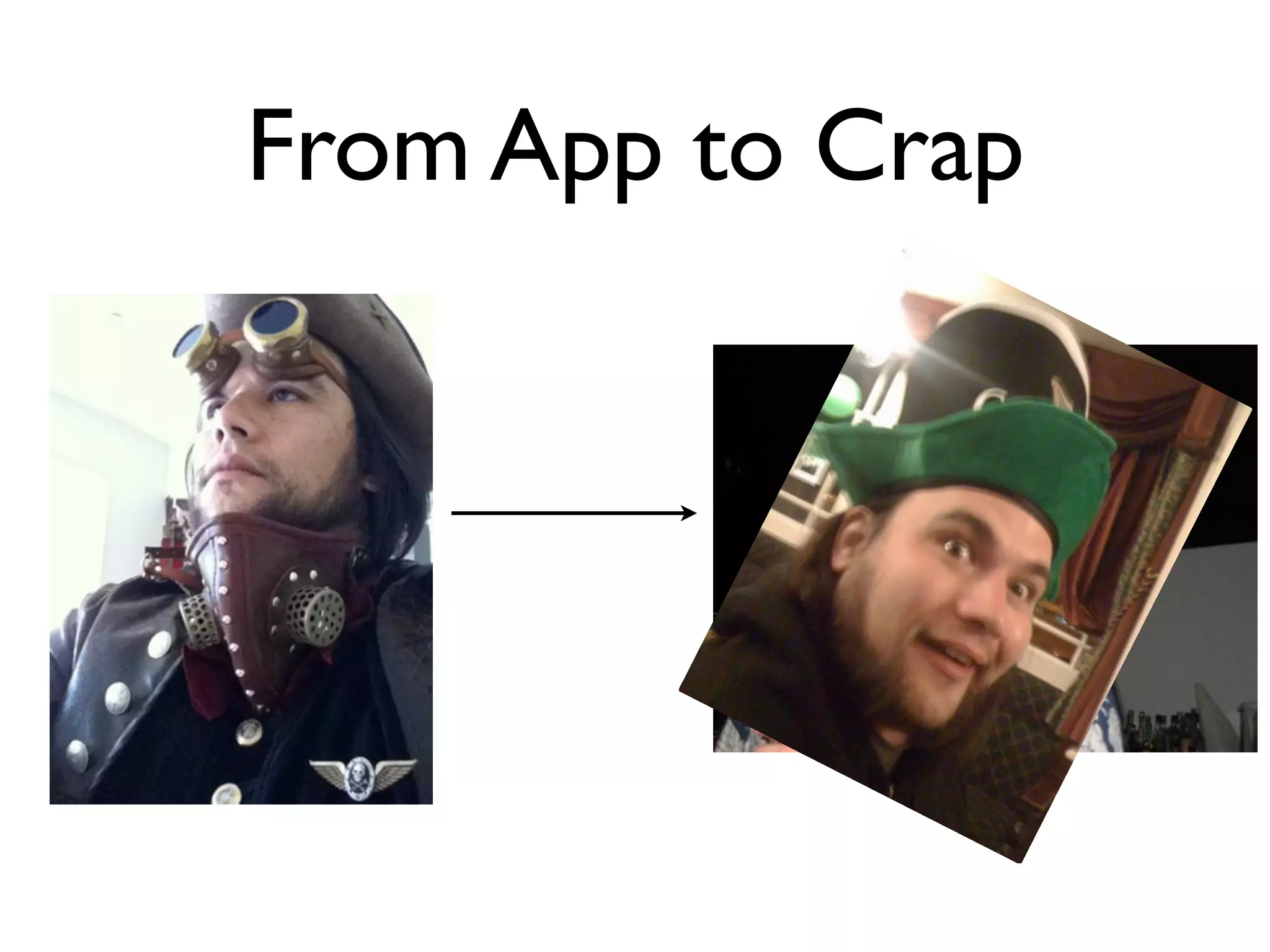
From App to Crap
From App to Crap
Nut[the problem]shell
• Want to store data
Nut[the problem]shell
• Want to store data
• But it must be secret
Nut[the problem]shell
• Want to store data
• But it must be secret
 • if the phone is stolen
Nut[the problem]shell
• Want to store data
• But it must be secret
 • if the phone is stolen
 • if the iTunes backup is stolen
Nut[the problem]shell
• Want to store data
• But it must be secret
 • if the phone is stolen
 • if the iTunes backup is stolen
• It must be tamper-proof
Nut[the problem]shell
• Want to store data
• But it must be secret
 • if the phone is stolen
 • if the iTunes backup is stolen
• It must be tamper-proof
• …to some extent
Solution: aescrypt
Solution: aescrypt
• Unencumbered (public domain) format and
  freeware implementation at http://
  aescrypt.org
Solution: aescrypt
• Unencumbered (public domain) format and
  freeware implementation at http://
  aescrypt.org
• Not just you using it
Solution: aescrypt
• Unencumbered (public domain) format and
  freeware implementation at http://
  aescrypt.org
• Not just you using it
• Mac, iOS, more
Solution: aescrypt
• Unencumbered (public domain) format and
  freeware implementation at http://
  aescrypt.org
• Not just you using it
• Mac, iOS, more
• Let’s start at byte 0 :-)
‘AES0020’


• Magic number
• Tells you the version of the crypto format
Meet a Data
Metadata
Metadata

• Arbitrary ‘extensions’ section
Metadata

• Arbitrary ‘extensions’ section
• Creator ID, creation date…
Metadata

• Arbitrary ‘extensions’ section
• Creator ID, creation date…
• …as long as that stuff isn’t a secret
What’s our vector,
               Victor?
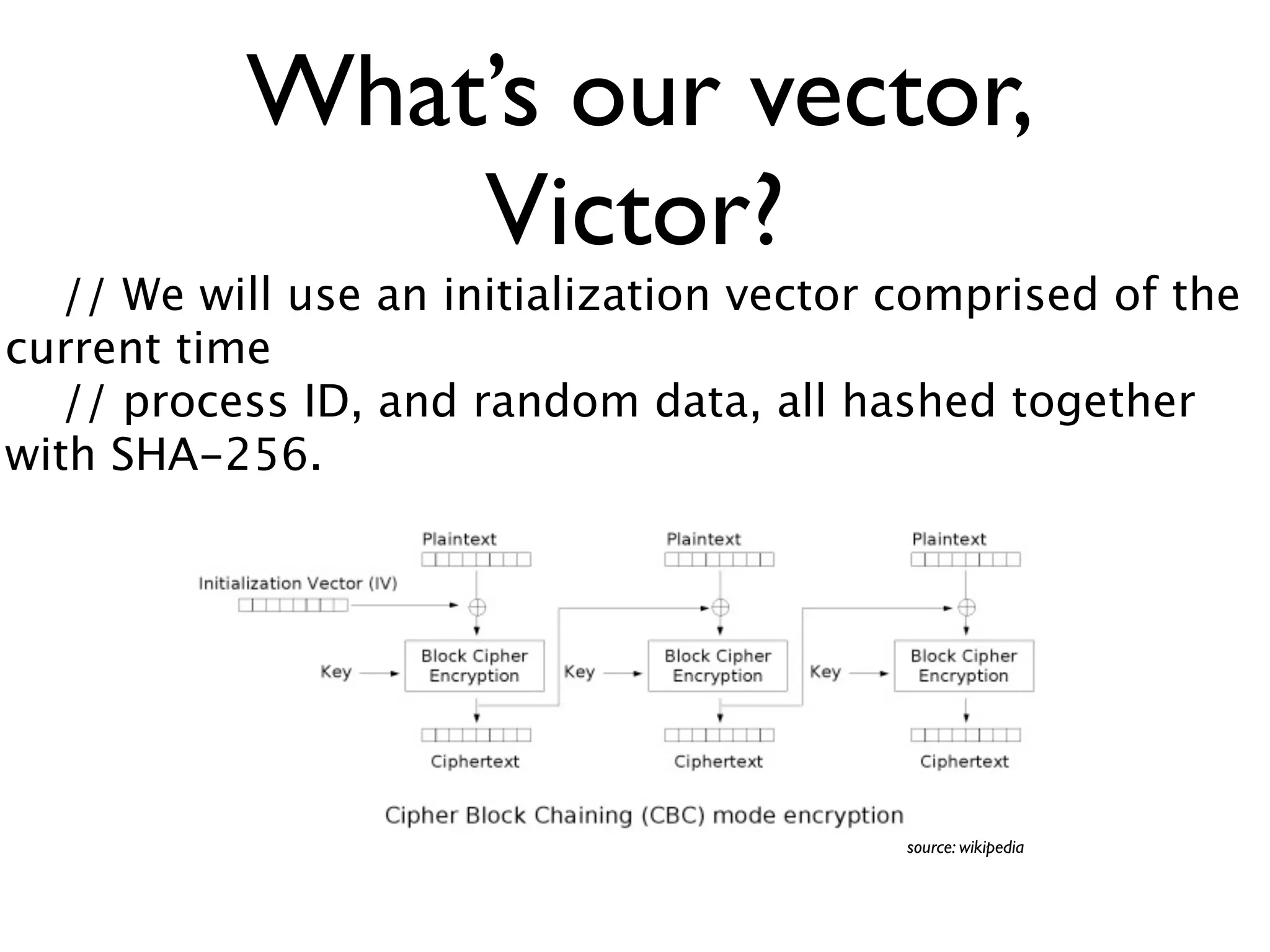
   // We will use an initialization vector comprised of the
current time
   // process ID, and random data, all hashed together
with SHA-256.


                                           source: wikipedia
You can’t come in here unless
     you say “Swordfish”
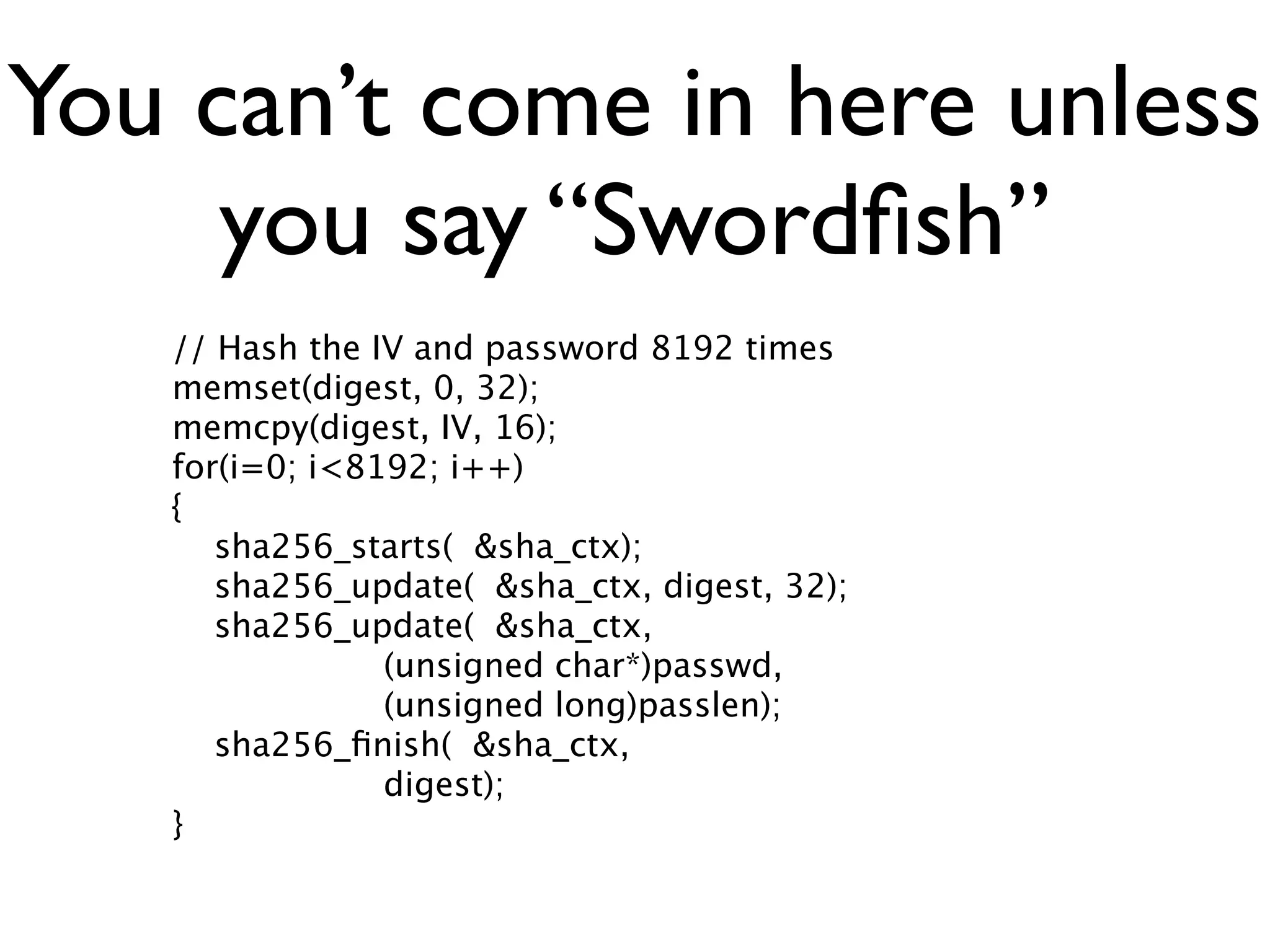
   // Hash the IV and password 8192 times
   memset(digest, 0, 32);
   memcpy(digest, IV, 16);
   for(i=0; i<8192; i++)
   {
      sha256_starts( &sha_ctx);
      sha256_update( &sha_ctx, digest, 32);
      sha256_update( &sha_ctx,
                (unsigned char*)passwd,
                (unsigned long)passlen);
      sha256_finish( &sha_ctx,
                digest);
   }
Cutty say 'e can't HANG!

 • The key we just derived is not used to
   encrypt the plaintext file
 • Instead, it’s used to encrypt a key, which is
   itself used to encrypt the file.
 • …why?
Irony: Eminem tribute act
singing “the real slim shady”
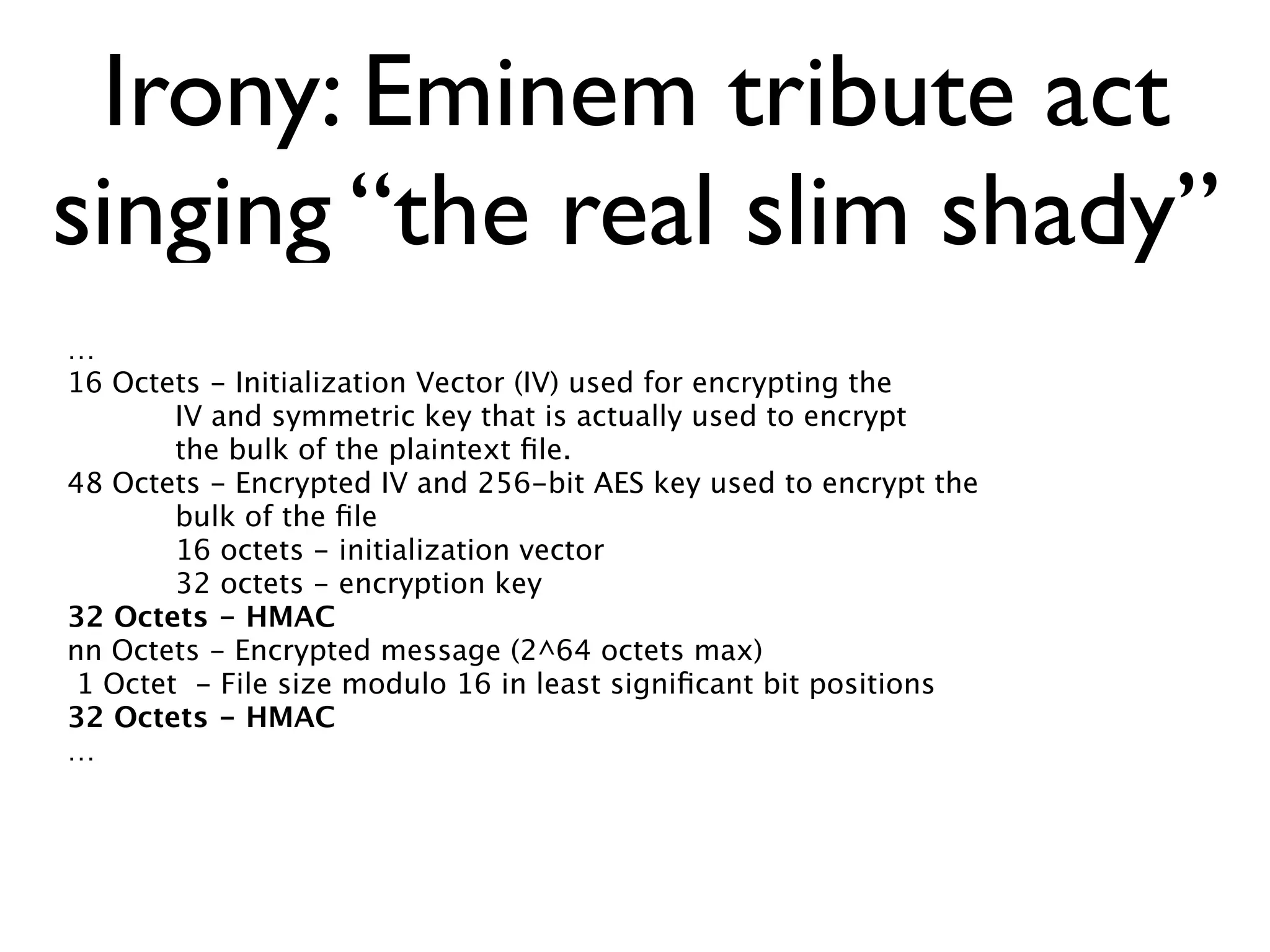
…
16 Octets - Initialization Vector (IV) used for encrypting the
        IV and symmetric key that is actually used to encrypt
        the bulk of the plaintext file.
48 Octets - Encrypted IV and 256-bit AES key used to encrypt the
        bulk of the file
        16 octets - initialization vector
        32 octets - encryption key
32 Octets - HMAC
nn Octets - Encrypted message (2^64 octets max)
 1 Octet - File size modulo 16 in least significant bit positions
32 Octets - HMAC
…
Filler material
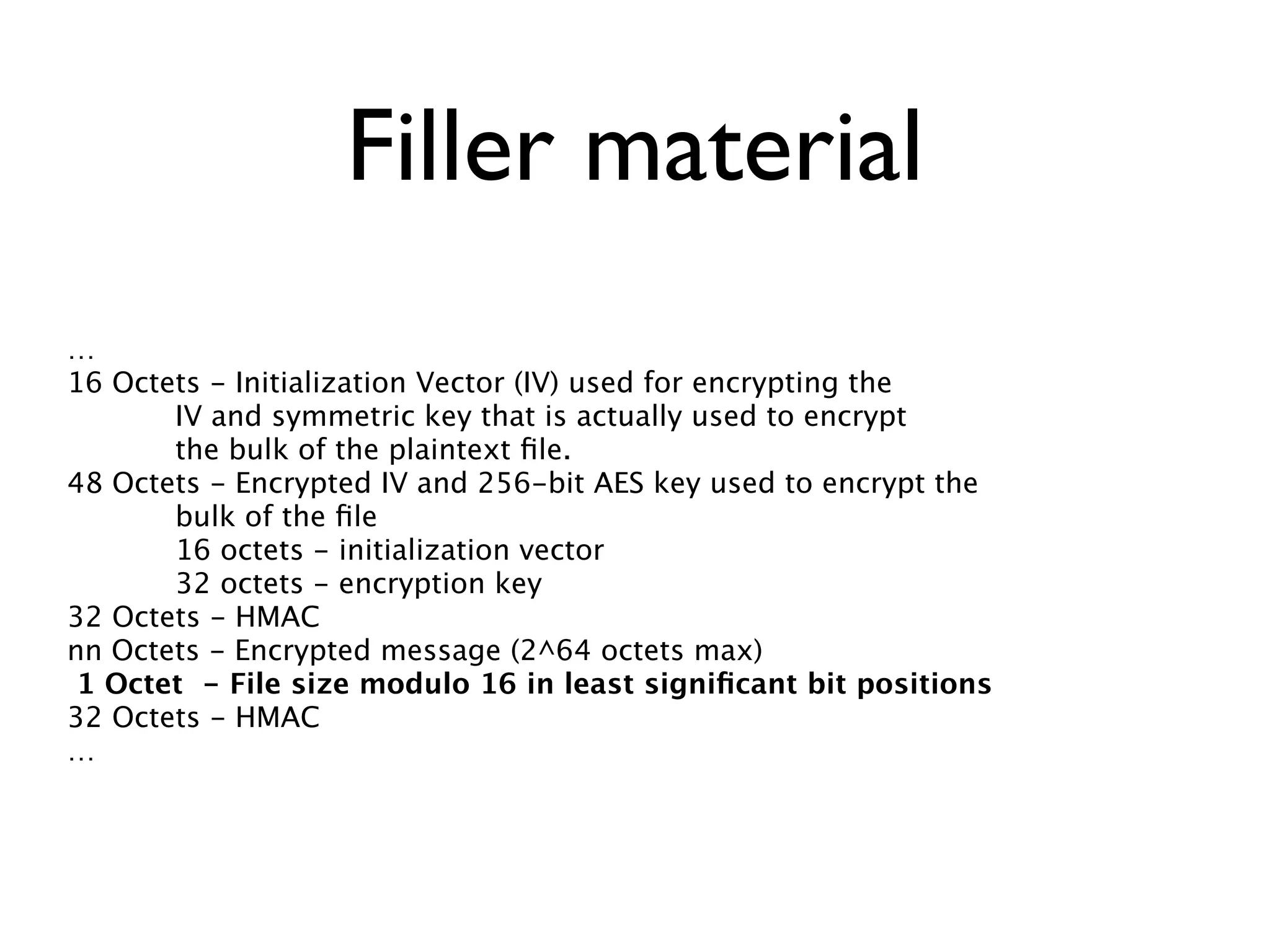
…
16 Octets - Initialization Vector (IV) used for encrypting the
       IV and symmetric key that is actually used to encrypt
       the bulk of the plaintext file.
48 Octets - Encrypted IV and 256-bit AES key used to encrypt the
       bulk of the file
       16 octets - initialization vector
       32 octets - encryption key
32 Octets - HMAC
nn Octets - Encrypted message (2^64 octets max)
 1 Octet - File size modulo 16 in least significant bit positions
32 Octets - HMAC
…
To the Question Pit!
     @iamleeg
To the Question Pit!
     @iamleeg


              fuzzyaliens.com

Crypto storage

  • 2.
    Cryptographic storage for peoplein a hurry Graham Lee Smartphone security boffin, Fuzzy Aliens Ltd. fuzzyaliens.com
  • 3.
    Cryptographic storage for peoplein a hurry Graham Lee Smartphone security boffin, Fuzzy Aliens Ltd.
  • 4.
  • 5.
  • 6.
  • 7.
  • 8.
    Nut[the problem]shell • Wantto store data • But it must be secret
  • 9.
    Nut[the problem]shell • Wantto store data • But it must be secret • if the phone is stolen
  • 10.
    Nut[the problem]shell • Wantto store data • But it must be secret • if the phone is stolen • if the iTunes backup is stolen
  • 11.
    Nut[the problem]shell • Wantto store data • But it must be secret • if the phone is stolen • if the iTunes backup is stolen • It must be tamper-proof
  • 12.
    Nut[the problem]shell • Wantto store data • But it must be secret • if the phone is stolen • if the iTunes backup is stolen • It must be tamper-proof • …to some extent
  • 13.
  • 14.
    Solution: aescrypt • Unencumbered(public domain) format and freeware implementation at http:// aescrypt.org
  • 15.
    Solution: aescrypt • Unencumbered(public domain) format and freeware implementation at http:// aescrypt.org • Not just you using it
  • 16.
    Solution: aescrypt • Unencumbered(public domain) format and freeware implementation at http:// aescrypt.org • Not just you using it • Mac, iOS, more
  • 17.
    Solution: aescrypt • Unencumbered(public domain) format and freeware implementation at http:// aescrypt.org • Not just you using it • Mac, iOS, more • Let’s start at byte 0 :-)
  • 18.
    ‘AES0020’ • Magic number •Tells you the version of the crypto format
  • 19.
  • 22.
  • 23.
  • 24.
    Metadata • Arbitrary ‘extensions’section • Creator ID, creation date…
  • 25.
    Metadata • Arbitrary ‘extensions’section • Creator ID, creation date… • …as long as that stuff isn’t a secret
  • 26.
    What’s our vector, Victor? // We will use an initialization vector comprised of the current time // process ID, and random data, all hashed together with SHA-256. source: wikipedia
  • 27.
    You can’t comein here unless you say “Swordfish” // Hash the IV and password 8192 times memset(digest, 0, 32); memcpy(digest, IV, 16); for(i=0; i<8192; i++) { sha256_starts( &sha_ctx); sha256_update( &sha_ctx, digest, 32); sha256_update( &sha_ctx, (unsigned char*)passwd, (unsigned long)passlen); sha256_finish( &sha_ctx, digest); }
  • 28.
    Cutty say 'ecan't HANG!
  • 29.
    Cutty say 'ecan't HANG! • The key we just derived is not used to encrypt the plaintext file • Instead, it’s used to encrypt a key, which is itself used to encrypt the file. • …why?
  • 30.
    Irony: Eminem tributeact singing “the real slim shady” … 16 Octets - Initialization Vector (IV) used for encrypting the IV and symmetric key that is actually used to encrypt the bulk of the plaintext file. 48 Octets - Encrypted IV and 256-bit AES key used to encrypt the bulk of the file 16 octets - initialization vector 32 octets - encryption key 32 Octets - HMAC nn Octets - Encrypted message (2^64 octets max) 1 Octet - File size modulo 16 in least significant bit positions 32 Octets - HMAC …
  • 31.
    Filler material … 16 Octets- Initialization Vector (IV) used for encrypting the IV and symmetric key that is actually used to encrypt the bulk of the plaintext file. 48 Octets - Encrypted IV and 256-bit AES key used to encrypt the bulk of the file 16 octets - initialization vector 32 octets - encryption key 32 Octets - HMAC nn Octets - Encrypted message (2^64 octets max) 1 Octet - File size modulo 16 in least significant bit positions 32 Octets - HMAC …
  • 32.
    To the QuestionPit! @iamleeg
  • 33.
    To the QuestionPit! @iamleeg fuzzyaliens.com

Editor's Notes

  • #2 \n
  • #3 \n
  • #4 \n
  • #5 \n
  • #6 \n
  • #7 \n
  • #8 Yes, so there is the NSFileProtection encryption. However, the ability to use that to actually protect data depends on the user having a passcode lock enabled, and you can&amp;#x2019;t test for that in your app. If you can&amp;#x2019;t enforce that all of your users comply with a particular passcode policy, you must implement your own protection mechanism.\n
  • #9 Yes, so there is the NSFileProtection encryption. However, the ability to use that to actually protect data depends on the user having a passcode lock enabled, and you can&amp;#x2019;t test for that in your app. If you can&amp;#x2019;t enforce that all of your users comply with a particular passcode policy, you must implement your own protection mechanism.\n
  • #10 Yes, so there is the NSFileProtection encryption. However, the ability to use that to actually protect data depends on the user having a passcode lock enabled, and you can&amp;#x2019;t test for that in your app. If you can&amp;#x2019;t enforce that all of your users comply with a particular passcode policy, you must implement your own protection mechanism.\n
  • #11 Yes, so there is the NSFileProtection encryption. However, the ability to use that to actually protect data depends on the user having a passcode lock enabled, and you can&amp;#x2019;t test for that in your app. If you can&amp;#x2019;t enforce that all of your users comply with a particular passcode policy, you must implement your own protection mechanism.\n
  • #12 Yes, so there is the NSFileProtection encryption. However, the ability to use that to actually protect data depends on the user having a passcode lock enabled, and you can&amp;#x2019;t test for that in your app. If you can&amp;#x2019;t enforce that all of your users comply with a particular passcode policy, you must implement your own protection mechanism.\n
  • #13 Yes, so there is the NSFileProtection encryption. However, the ability to use that to actually protect data depends on the user having a passcode lock enabled, and you can&amp;#x2019;t test for that in your app. If you can&amp;#x2019;t enforce that all of your users comply with a particular passcode policy, you must implement your own protection mechanism.\n
  • #14 The main problem with creating any new crypto format is the chance that you&amp;#x2019;ll introduce new vulnerabilities by misusing the crypto primitives, even if those primitives themselves are bug-free. Sidestep that risk and reduce development time by choosing an existing solution: but notice that solutions like GPG and OpenPGP have licensing restrictions that are incompatible with the app stores.\n
  • #15 The main problem with creating any new crypto format is the chance that you&amp;#x2019;ll introduce new vulnerabilities by misusing the crypto primitives, even if those primitives themselves are bug-free. Sidestep that risk and reduce development time by choosing an existing solution: but notice that solutions like GPG and OpenPGP have licensing restrictions that are incompatible with the app stores.\n
  • #16 The main problem with creating any new crypto format is the chance that you&amp;#x2019;ll introduce new vulnerabilities by misusing the crypto primitives, even if those primitives themselves are bug-free. Sidestep that risk and reduce development time by choosing an existing solution: but notice that solutions like GPG and OpenPGP have licensing restrictions that are incompatible with the app stores.\n
  • #17 The main problem with creating any new crypto format is the chance that you&amp;#x2019;ll introduce new vulnerabilities by misusing the crypto primitives, even if those primitives themselves are bug-free. Sidestep that risk and reduce development time by choosing an existing solution: but notice that solutions like GPG and OpenPGP have licensing restrictions that are incompatible with the app stores.\n
  • #18 This basically just exists to let you know you&amp;#x2019;re looking at the correct kind of file.\n
  • #19 Don&amp;#x2019;t spend too much time on this slide, you cretin :-P\n
  • #20 Don&amp;#x2019;t spend too much time on this slide, you cretin :-P\n
  • #21 Don&amp;#x2019;t spend too much time on this slide, you cretin :-P\n
  • #22 Remember not to leak any information in the metadata that should be a secret. For example: keeping photographs of a protest confidential may not be enough for a user if the photo timestamp and geolocation make their attendance public.\n
  • #23 Remember not to leak any information in the metadata that should be a secret. For example: keeping photographs of a protest confidential may not be enough for a user if the photo timestamp and geolocation make their attendance public.\n
  • #24 Remember not to leak any information in the metadata that should be a secret. For example: keeping photographs of a protest confidential may not be enough for a user if the photo timestamp and geolocation make their attendance public.\n
  • #25 Remember not to leak any information in the metadata that should be a secret. For example: keeping photographs of a protest confidential may not be enough for a user if the photo timestamp and geolocation make their attendance public.\n
  • #26 \n
  • #27 \n
  • #28 \n
  • #29 The point of the HMAC is to provide integrity checking. There&amp;#x2019;s no real attack against AES in the case of tampered ciphertext - you can replace real data with garbage, but you can&amp;#x2019;t replace real data with other real data. The point of this HMAC is that it&amp;#x2019;s the quickest way to verify that the key was recovered correctly.\n
  • #30 Notice that this is one of two choices: PKCS#7 padding is the other option.\n
  • #31 \n