CRRT- Continuous Renal
ReplacementTherapy
• Continuous renal replacement therapies (CRRTs)
involve either dialysis (diffusion-based solute removal)
or filtration (convection-based solute and water
removal) treatments that operate in a continuous mode
• Variations of CRRT might run 12 to 14 hours, especially
during daytime periods of full staffing. This regimen has
become more prevalent in Europe and has been called
"go slow dialysis“ or SLED – slow low efficiency dialysis
• The major advantage of continuous therapy is the
slower rate of solute or fluid removal per unit of time.
Thus, CRRT is generally better tolerated than
conventional therapy, since many of the complications
of intermittent hemodialysis are related to the rapid
rate of solute and fluid loss.
3.
Terminology
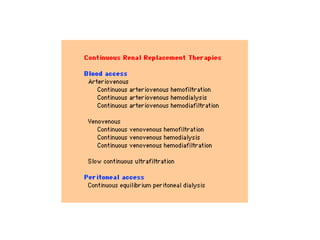
• Arteriovenous (AV)refers to the use of an arterial catheter
that allows blood to flow into the extracorporeal circuit by
virtue of the systemic blood pressure. A venous catheter is
placed for return. Venovenous (VV) is an alternative modality
in which both catheters or one dual lumen catheter are placed
in veins. An extracorporeal blood pump is required to circulate
blood through the extracorporeal circuit.
• Venovenous access, on the other hand, does not require
arterial access, involves less systemic anticoagulation, uses
only one dual lumen catheter, and has faster and more
reliable blood flow than with arterial access. The only
disadvantage is the requirement for an extracorporeal blood
pump.
4.
Terminology – Con’t
•Hemodialysis (HD) refers to the transport process by which a solute
passively diffuses down its concentration gradient from one fluid
compartment (either blood or dialysate) into the other
• Hemofiltration (HF) refers to the use of a hydrostatic pressure
gradient to induce the filtration (or convection) of plasma water across
the membrane of the hemofilter. The frictional forces between water
and solutes (called solvent drag) results in the convective transport of
small and middle molecular weight solutes (less than 5000 Daltons) in
the same direction as water. Substitution fluid is usually required to
prevent excessive fluid removal.
• The process of HF itself removes smaller solutes (such as urea and
electrolytes) in roughly the same concentration as the plasma. There
is therefore no change in the plasma concentrations of these solutes
by HF, in contrast to those achieved by HD. However, the
administration of substitution fluid will lower by dilution the plasma
concentrations of those solutes (such as urea and creatinine) not
present in the substitution fluid.
5.
Terminology – Con’t
•CVVH uses venous access to remove fluid and solutes by convection.
Its per hour efficiency of solute removal is generally quite low, since
no diffusion occurs. Thus, 24 hour/day operation or the addition of
enhancing techniques is required.
• Chronic hemofiltration, although not commonly used in North America
as a chronic renal replacement therapy, offers some advantages
compared with conventional hemodialysis, including a more
physiologic process
• Slow continuous ultrafiltration or SCUF is strictly a dehydrating
procedure with no intent to substantially remove solute. Access can be
arteriovenous or venovenous. SCUF is similar to CAVH or CVVH except
that the ultrafiltration rate is held at a lower rate; thus, SCUF is
primarily used when the fluid removal goals are modest.
6.
Terminology – Con’t
•CVVHD is similar to CVVH with two exceptions: dialysate is
run at a low flow rate countercurrent to the direction of blood
flow; and the ultrafiltration rate is not maximized to protect
against the development of hypotension. Fluid removal is
slower than with CAVH alone, but a greater reduction in solute
concentration is achieved.
• CVVHDF is similar to CAVHD except that ultrafiltration is
allowed at a rate beyond that necessary to reestablish
euvolemia. From the viewpoint of solute removal, CAVHDF
combines diffusion to aggressively removal small solutes with
convection to remove large solutes. Because the volume of
fluid ultrafiltered is so large, replacement fluid must be given
to maintain euvolemia.
7.
Choice of Therapy
•The choice of modality is dependent upon several factors including availability,
the expertise of the clinician, hemodynamic stability, vascular access, and
whether the primary need is for fluid and/or solute removal. The last factor is
often an important determinant, since each of these procedures is associated
with a different rate of solute and water removal.
• SCUF, CVVH, or CAVH can be used if fluid removal is the primary goal. We
generally prefer venovenous access because of its more predictable blood flow
rate.
• CVVHD will probably be more effective than CVVH in the highly catabolic patient
with a large small solute load.
• One of the forms of HDF, with its convective removal of larger solutes, may be
desirable in the patient with sepsis in whom an ancillary goal is the removal of
inflammatory mediators
• In CVVHD and CVVHDF, dialysate flow rates are lower than blood flow rates.
This allows for complete saturation of the dialysate with solutes. The limiting
factor for solute removal by diffusion is the dialysate flow rate and not the blood
flow rate as with conventional hemodialysis.