CROWDFUNDING AND INNOVATION
DR CLAIRE INGRAM BOGUSZ, STOCKHOLM SCHOOL OF ECONOMICS
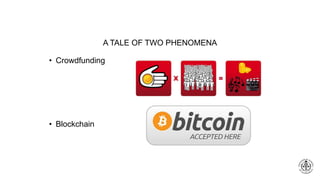
A TALE OF TWO PHENOMENA
• Crowdfunding
• Blockchain
SCHEDULE TODAY
What is Crowdfunding?
Background and research
Who adds what?
What is Blockchain?
Convergence?
Image: FundedByMe
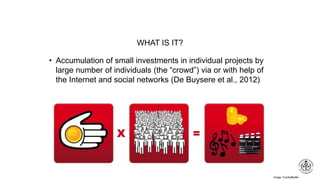
WHAT IS IT?
• Accumulation of small investments in individual projects by
large number of individuals (the “crowd”) via or with help of
the Internet and social networks (De Buysere et al., 2012)
A FEW KINDS...
• Three of significant size
• Donation- and reward-based
• Equity-based
• Debt/loan based (also called peer to peer lending/peer to business lending)
• (But also royalty-based)
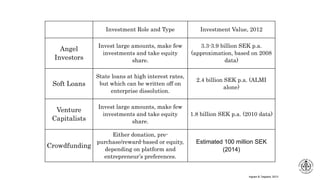
Investment Role and Type Investment Value, 2012
Angel
Investors
Invest large amounts, make few
investments and take equity
share.
3.3-3.9 billion SEK p.a.
(approximation, based on 2008
data)
Soft Loans
State loans at high interest rates,
but which can be written off on
enterprise dissolution.
2.4 billion SEK p.a. (ALMI
alone)
Venture
Capitalists
Invest large amounts, make few
investments and take equity
share.
1.8 billion SEK p.a. (2010 data)
Crowdfunding
Either donation, pre-
purchase/reward-based or equity,
depending on platform and
entrepreneur’s preferences.
Estimated 100 million SEK
(2014)
Ingram & Teigland, 2013
TWO-SIDED PLATFORM
• On the one hand, entrepreneurs
• But also The Crowd ≈ potential investors
• Need to attract both – with the same platform
• Both add value
WHAT DOES (CROWD)FUNDING LOOK LIKE? (DISCUSSION)
SO WHOM ADDS WHAT? AND WHY?
(DISCUSSION)
• ”The Crowd” • Entrepreneurs
Image: http://blog.getnarrative.com/
MOTIVATION(S) TO INVEST
• Four main motivations have been identified when it comes to reward-based
• 1) to collect rewards, 2) to help others, 3) to be a part of a community, 4) and
support a cause (Gerber, Hui, & Kuo, 2012).
• Equity- and debt-based projects primarily attract investors who are interested in
a return on their investment (Cholakova & Clarysse, 2015)
• “The Crowd” able to infer creditworthiness (Iver et al. 2016)
• Track record important (Gompers et al. 2010)
• Generally reliant on similar signals to professional investors (e.g. Mollick, 2013)
• Early success = vital (Vismara, 2016)
EVERYONE LOVES A NARRATIVE
• Manning and Bejanaro (2017) identify two different narrative styles:
• The “ongoing journey”, which frames a project as a shared long-term journey
fuelled by “creative initial ideas and a bold vision”, and
• The “results-in-progress”, framed as a slow “progression of accomplishments”
• Also evident in debt-based crowdfunding (Allison et al. 2015)
• Although TMI (Kim et al. 2016)
DEMOCRATISING?
• It has been hoped that the digital phenomenon might erode the dominance of
white men in both entrepreneurship and financing.
• Greenberg and Mollick (2016) find that women are considerably more likely to
successful raise capital than male founders.
• Interestingly, they note that this primarily because of an unusually large
number of women driving technology projects (an industry considered male-
dominated), and is thus dependent a small segment of female backers.
• Another study found that men both seek, and obtain, significantly higher levels of
capital than women for their projects.
• Women-led projects were more likely to successfully raise funds, even after
controlling for category and goal amount (Marom, Robb, & Sade, 2016)
• What about other minorities?
IS FINANCIAL CAPITAL ENOUGH?
AND WHY? (DISCUSSION)
• While prior investment operated as a signal as to project quality, as discussed
previously, this signal was more effective where investors provided detailed
(offline) information about themselves (Burtch et al., 2013).
-> looks like Social Capital
• Leaders obtain rewards for initiating lending, and their active participation on the
platform for instance by promoting projects, increased the success probability of
these projects (Hildebrand, Puri, & Rocholl, 2016)
-> also Social Capital
• What about Human Capital?
LIMITS TO CROWDFUNDING?
(DISCUSSION)
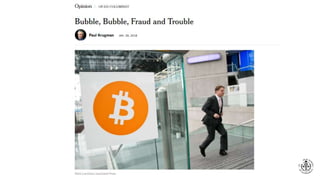
BITCOIN
• Digital/crypto currency
• Developed by one individual/team, maintained and expanded on through OS
development
• Supra-national Bitcoin Foundation (political and development body)
• Large number of spin-offs
• Both ”currency” and mode of transaction
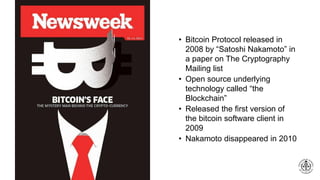
• Bitcoin Protocol released in
2008 by “Satoshi Nakamoto” in
a paper on The Cryptography
Mailing list
• Open source underlying
technology called “the
Blockchain”
• Released the first version of
the bitcoin software client in
2009
• Nakamoto disappeared in 2010
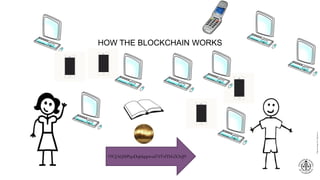
19UJAQMPqxDqhkppwzd1YFtfTbLiX3rjJ9
ClipartimagebyCliparts.co
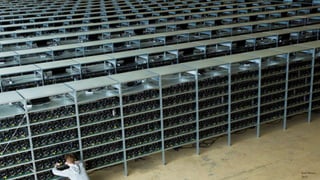
HOW THE BLOCKCHAIN WORKS
KnCMiner,
2015
USES / CHARACTERISTICS
• Robust
• Unalterable
• Democratic
• Distributed
• Automated
• Global
PROBLEMS AND POSSIBILITIES?
(DISCUSSION)
• Entrepreneurs • Investors
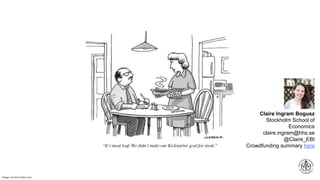
Image via NewYorker.com
Claire Ingram Bogusz
Stockholm School of
Economics
claire.ingram@hhs.se
@Claire_EBI
Crowdfunding summary here

Crowdfunding and a Digital Innovation Though Experiment

  • 1.
    CROWDFUNDING AND INNOVATION DRCLAIRE INGRAM BOGUSZ, STOCKHOLM SCHOOL OF ECONOMICS
  • 2.
    A TALE OFTWO PHENOMENA • Crowdfunding • Blockchain
  • 3.
    SCHEDULE TODAY What isCrowdfunding? Background and research Who adds what? What is Blockchain? Convergence?
  • 4.
    Image: FundedByMe WHAT ISIT? • Accumulation of small investments in individual projects by large number of individuals (the “crowd”) via or with help of the Internet and social networks (De Buysere et al., 2012)
  • 5.
    A FEW KINDS... •Three of significant size • Donation- and reward-based • Equity-based • Debt/loan based (also called peer to peer lending/peer to business lending) • (But also royalty-based)
  • 6.
    Investment Role andType Investment Value, 2012 Angel Investors Invest large amounts, make few investments and take equity share. 3.3-3.9 billion SEK p.a. (approximation, based on 2008 data) Soft Loans State loans at high interest rates, but which can be written off on enterprise dissolution. 2.4 billion SEK p.a. (ALMI alone) Venture Capitalists Invest large amounts, make few investments and take equity share. 1.8 billion SEK p.a. (2010 data) Crowdfunding Either donation, pre- purchase/reward-based or equity, depending on platform and entrepreneur’s preferences. Estimated 100 million SEK (2014) Ingram & Teigland, 2013
  • 7.
    TWO-SIDED PLATFORM • Onthe one hand, entrepreneurs • But also The Crowd ≈ potential investors • Need to attract both – with the same platform • Both add value
  • 8.
    WHAT DOES (CROWD)FUNDINGLOOK LIKE? (DISCUSSION)
  • 9.
    SO WHOM ADDSWHAT? AND WHY? (DISCUSSION) • ”The Crowd” • Entrepreneurs
  • 11.
  • 12.
    MOTIVATION(S) TO INVEST •Four main motivations have been identified when it comes to reward-based • 1) to collect rewards, 2) to help others, 3) to be a part of a community, 4) and support a cause (Gerber, Hui, & Kuo, 2012). • Equity- and debt-based projects primarily attract investors who are interested in a return on their investment (Cholakova & Clarysse, 2015) • “The Crowd” able to infer creditworthiness (Iver et al. 2016) • Track record important (Gompers et al. 2010) • Generally reliant on similar signals to professional investors (e.g. Mollick, 2013) • Early success = vital (Vismara, 2016)
  • 13.
    EVERYONE LOVES ANARRATIVE • Manning and Bejanaro (2017) identify two different narrative styles: • The “ongoing journey”, which frames a project as a shared long-term journey fuelled by “creative initial ideas and a bold vision”, and • The “results-in-progress”, framed as a slow “progression of accomplishments” • Also evident in debt-based crowdfunding (Allison et al. 2015) • Although TMI (Kim et al. 2016)
  • 14.
    DEMOCRATISING? • It hasbeen hoped that the digital phenomenon might erode the dominance of white men in both entrepreneurship and financing. • Greenberg and Mollick (2016) find that women are considerably more likely to successful raise capital than male founders. • Interestingly, they note that this primarily because of an unusually large number of women driving technology projects (an industry considered male- dominated), and is thus dependent a small segment of female backers. • Another study found that men both seek, and obtain, significantly higher levels of capital than women for their projects. • Women-led projects were more likely to successfully raise funds, even after controlling for category and goal amount (Marom, Robb, & Sade, 2016) • What about other minorities?
  • 15.
    IS FINANCIAL CAPITALENOUGH? AND WHY? (DISCUSSION) • While prior investment operated as a signal as to project quality, as discussed previously, this signal was more effective where investors provided detailed (offline) information about themselves (Burtch et al., 2013). -> looks like Social Capital • Leaders obtain rewards for initiating lending, and their active participation on the platform for instance by promoting projects, increased the success probability of these projects (Hildebrand, Puri, & Rocholl, 2016) -> also Social Capital • What about Human Capital?
  • 16.
  • 18.
    BITCOIN • Digital/crypto currency •Developed by one individual/team, maintained and expanded on through OS development • Supra-national Bitcoin Foundation (political and development body) • Large number of spin-offs • Both ”currency” and mode of transaction
  • 19.
    • Bitcoin Protocolreleased in 2008 by “Satoshi Nakamoto” in a paper on The Cryptography Mailing list • Open source underlying technology called “the Blockchain” • Released the first version of the bitcoin software client in 2009 • Nakamoto disappeared in 2010
  • 20.
  • 21.
  • 22.
    USES / CHARACTERISTICS •Robust • Unalterable • Democratic • Distributed • Automated • Global
  • 25.
  • 26.
    Image via NewYorker.com ClaireIngram Bogusz Stockholm School of Economics claire.ingram@hhs.se @Claire_EBI Crowdfunding summary here

Editor's Notes

  • #22 Requires massive servers and computer power to maintain—hard work done by machines, not humans. This could be any server room in the world—but is larger. Is KNC miner’s bitcoin mining farm in Norrland. Move into discussion of Bitcoin and Blockchain.