CrowdSourcing 
Perspectives from the 
Miller Heiman Sales Performance Summit 
Joe Galvin 
Chief Research Officer 
MHI Research Institute 
Anne Petrik 
Director of Member Experience 
MHI Research Institute
Drawing from 
everything you’ve 
heard during the 
Summit, let’s share the 
best of the best from 
your perspective.
What are the best 
practices you are taking 
back to your 
organizations to apply 
immediately?
Let the collaboration begin!
Segmentation is essential…by 
vertical markets., functional 
discipline, offering....If you 
don’t segment, your 
resources get spread too thin.
Training isn’t just 
for the sales team. 
In a team selling 
environment, 
everybody needs 
to understand the 
process.
Technology is always 
advancing. It can help drive 
collaboration across the 
enterprise.
Know the strength of your sales 
technologies. Chatter isn’t right for every 
buyer, stage or opportunity.
In a team-selling environment, 
everyone’s compensation plans and 
quotas need to be aligned to the 
same goals.
Frontline sales managers need to be 
taught the art of aligning teams.
Leverage your well-respected, top 
performers to teach everyone how 
to sell as a team.
If you’re going to sell through 
teams, assign roles and make sure 
everyone understands what they 
are accountable for.
Identify how long 
opportunities should stay at 
each stage. Flag opportunities 
that have gone stale.
The customer experience suffers 
when opportunities are allowed 
to go stale.
Collaborate with customers, too. 
Make them part of your “sales 
team.”
To maintain momentum and energy, share success stories 
in a standardized format.
Use the Blue Sheets when 
preparing the team, especially 
senior management, to step 
into an opportunity.
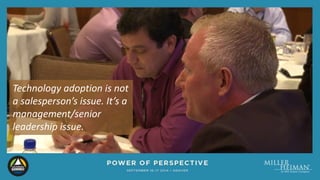
Technology adoption is not 
a salesperson’s issue. It’s a 
management/senior 
leadership issue.
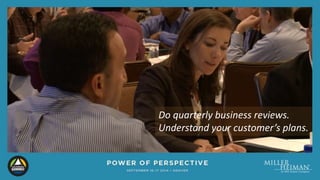
Do quarterly business reviews. 
Understand your customer’s plans.
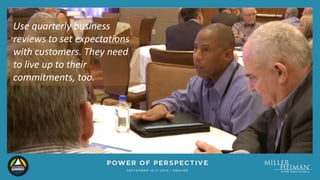
Use quarterly business 
reviews to set expectations 
with customers. They need 
to live up to their 
commitments, too.
You need to measure the 
cost of your customer 
relationships. Otherwise, 
how do you know which 
are truly your best 
customers?
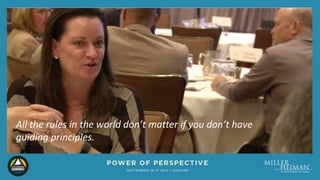
All the rules in the world don’t matter if you don’t have 
guiding principles.
Collaboration 
12 Best Practices You Can Start Using Today
Climb to the top of any mountain, and it seems like you can see forever. (On a clear day, at least.) The same 
is true of the Sales Performance Summit. This year, collaboration was a key theme throughout – both in 
sessions as well as hallway conversations. Collaboration certainly took center stage at the end of the 
conference when we asked attendees to share best practices from their own organizations. Here’s just some 
of what they told us. 
#1 Segmentation is essential. Segmentation isn’t just a marketing technique. Taking a one-size-fits-all 
approach to customers doesn’t work. On the other hand, the team’s efforts get spread thin when they are 
called on to create one-off content and messages that address the needs of specific customers. Segmenting 
by vertical markets, buyer roles, buying need and other criteria helps sales leaders and supporting functions 
focus their resources to drive productivity. 
#2 Sales training isn’t just for sales. If you’re trying to encourage a team-selling environment where sales 
professionals collaborate with people across the organization, then everybody needs to understand the sales 
process. By ensuring everyone understands the customer management strategies, you don’t waste time 
bringing people up to speed on process and terminology. 
#3 Leverage new technologies. There’s always something new that can help your sales professionals better 
penetrate accounts, gather intelligence or drive collaboration across the team and with customers. The best 
sales leaders are always exploring new technologies to discover ways to drive productivity and gain the 
competitive advantage.
#4 Collaboration requires leadership. Leverage your well-respected top performers by asking them to show 
others how to work in a collaborative environment. They don’t need to teach a class. Leadership by example 
works great. Compensation plans and performance metrics also encourage this behavior. 
#5 Collaboration requires planning. When you assign teams, make sure everyone understands their role. 
This is especially important when you bring in sales leadership. Since they aren’t normally part of the defined 
sales process, they need to understand exactly when you need them and what role they need to serve. 
Remember, they may be in charge of the company, but the sales executive is in charge of the opportunity. 
#6 Make customers your focus. When your sales professionals visit prospects, do they say “here’s what we 
do”? Or do they ask questions to understand what’s important to the customer? When done well , customers 
and sales professionals start to collaborate on defining the solution. 
#7 Always measure. When an opportunity lingers too long at any particular stage, it isn’t good for funnel 
health. It can also potentially damage the customer experience. They may want to move forward, but something 
is holding them back. It’s the job of the sales professional to find a way around the obstacle. If you don’t know 
how long an opportunity normally remains at each stage of the process, you won’t know when one is stuck.
#8 Tap into the collective wisdom. Individually, a salesperson’s knowledge is limited to his personal 
experiences. Collectively, you’ll find there is real wisdom in the team. You can leverage that wisdom by 
grouping sales professionals into teams and having them do account reviews with each other. Not only will 
they learn from each other, they’ll gain coaching experience. Mix up the teams every six months or so to 
keep the ideas fresh. 
#9 Know who’s on your team. In every opportunity, the sales professional needs to know who they will 
call on for sales support. Briefing team members ahead of time will reduce the number of “audibles,” 
strategy changes, called in the field. It will also reduce the number of embarrassing fumbles made by 
team members who haven’t had time to learn the plays. 
#10 Blue Sheets aren’t just for sales. Each individual on the team, whether they have a “sales role” or 
not, should review and understand the Miller Heiman Blue and Green Sheets before they take part in an 
active opportunity. Blue and Green Sheets are the team playbooks.
#11 Technology adoption requires leadership. Technology adoption isn’t a salesperson issue. It’s a 
management/leadership issue. If your sales team isn’t leveraging the technology, sales leadership needs to 
do a root cause analysis. More often than not, you’ll discover one of two things: Your customer 
management strategies aren’t supported by the technology, and it’s getting in the way of selling. Or worse, 
your sales management is setting a poor example by not using the technology themselves. 
#12 Focus on the customers that count. You need to measure the ROI of a relationship to know who 
your best customers are. Some customers will ask for far more value than they return in terms of sales 
expenses, hand-holding by support resources and a hundred other little things that can add up quickly. No 
matter how much business a customer brings in, if they cost more than they bring in, they aren’t a 
customer worth keeping. 
Like the view from the top of a mountain, this Summit is a truly inspiring and valuable experience. The 
collective energy generated during this session serves as a great reminder of the benefits of collaboration 
and why collaboration is a best practice of World-Class Sales Performers.
See you at the 2015 Summit! 
2015 MHI Global Sales Performance Summit 
October 20-21 l Savannah, GA 
www.millerheiman.com/summit

Power of Perspective: Crowdsourced_Blog

  • 1.
    CrowdSourcing Perspectives fromthe Miller Heiman Sales Performance Summit Joe Galvin Chief Research Officer MHI Research Institute Anne Petrik Director of Member Experience MHI Research Institute
  • 2.
    Drawing from everythingyou’ve heard during the Summit, let’s share the best of the best from your perspective.
  • 3.
    What are thebest practices you are taking back to your organizations to apply immediately?
  • 4.
  • 5.
    Segmentation is essential…by vertical markets., functional discipline, offering....If you don’t segment, your resources get spread too thin.
  • 6.
    Training isn’t just for the sales team. In a team selling environment, everybody needs to understand the process.
  • 7.
    Technology is always advancing. It can help drive collaboration across the enterprise.
  • 8.
    Know the strengthof your sales technologies. Chatter isn’t right for every buyer, stage or opportunity.
  • 9.
    In a team-sellingenvironment, everyone’s compensation plans and quotas need to be aligned to the same goals.
  • 10.
    Frontline sales managersneed to be taught the art of aligning teams.
  • 11.
    Leverage your well-respected,top performers to teach everyone how to sell as a team.
  • 12.
    If you’re goingto sell through teams, assign roles and make sure everyone understands what they are accountable for.
  • 13.
    Identify how long opportunities should stay at each stage. Flag opportunities that have gone stale.
  • 14.
    The customer experiencesuffers when opportunities are allowed to go stale.
  • 15.
    Collaborate with customers,too. Make them part of your “sales team.”
  • 16.
    To maintain momentumand energy, share success stories in a standardized format.
  • 17.
    Use the BlueSheets when preparing the team, especially senior management, to step into an opportunity.
  • 18.
    Technology adoption isnot a salesperson’s issue. It’s a management/senior leadership issue.
  • 19.
    Do quarterly businessreviews. Understand your customer’s plans.
  • 20.
    Use quarterly business reviews to set expectations with customers. They need to live up to their commitments, too.
  • 21.
    You need tomeasure the cost of your customer relationships. Otherwise, how do you know which are truly your best customers?
  • 22.
    All the rulesin the world don’t matter if you don’t have guiding principles.
  • 23.
    Collaboration 12 BestPractices You Can Start Using Today
  • 24.
    Climb to thetop of any mountain, and it seems like you can see forever. (On a clear day, at least.) The same is true of the Sales Performance Summit. This year, collaboration was a key theme throughout – both in sessions as well as hallway conversations. Collaboration certainly took center stage at the end of the conference when we asked attendees to share best practices from their own organizations. Here’s just some of what they told us. #1 Segmentation is essential. Segmentation isn’t just a marketing technique. Taking a one-size-fits-all approach to customers doesn’t work. On the other hand, the team’s efforts get spread thin when they are called on to create one-off content and messages that address the needs of specific customers. Segmenting by vertical markets, buyer roles, buying need and other criteria helps sales leaders and supporting functions focus their resources to drive productivity. #2 Sales training isn’t just for sales. If you’re trying to encourage a team-selling environment where sales professionals collaborate with people across the organization, then everybody needs to understand the sales process. By ensuring everyone understands the customer management strategies, you don’t waste time bringing people up to speed on process and terminology. #3 Leverage new technologies. There’s always something new that can help your sales professionals better penetrate accounts, gather intelligence or drive collaboration across the team and with customers. The best sales leaders are always exploring new technologies to discover ways to drive productivity and gain the competitive advantage.
  • 25.
    #4 Collaboration requiresleadership. Leverage your well-respected top performers by asking them to show others how to work in a collaborative environment. They don’t need to teach a class. Leadership by example works great. Compensation plans and performance metrics also encourage this behavior. #5 Collaboration requires planning. When you assign teams, make sure everyone understands their role. This is especially important when you bring in sales leadership. Since they aren’t normally part of the defined sales process, they need to understand exactly when you need them and what role they need to serve. Remember, they may be in charge of the company, but the sales executive is in charge of the opportunity. #6 Make customers your focus. When your sales professionals visit prospects, do they say “here’s what we do”? Or do they ask questions to understand what’s important to the customer? When done well , customers and sales professionals start to collaborate on defining the solution. #7 Always measure. When an opportunity lingers too long at any particular stage, it isn’t good for funnel health. It can also potentially damage the customer experience. They may want to move forward, but something is holding them back. It’s the job of the sales professional to find a way around the obstacle. If you don’t know how long an opportunity normally remains at each stage of the process, you won’t know when one is stuck.
  • 26.
    #8 Tap intothe collective wisdom. Individually, a salesperson’s knowledge is limited to his personal experiences. Collectively, you’ll find there is real wisdom in the team. You can leverage that wisdom by grouping sales professionals into teams and having them do account reviews with each other. Not only will they learn from each other, they’ll gain coaching experience. Mix up the teams every six months or so to keep the ideas fresh. #9 Know who’s on your team. In every opportunity, the sales professional needs to know who they will call on for sales support. Briefing team members ahead of time will reduce the number of “audibles,” strategy changes, called in the field. It will also reduce the number of embarrassing fumbles made by team members who haven’t had time to learn the plays. #10 Blue Sheets aren’t just for sales. Each individual on the team, whether they have a “sales role” or not, should review and understand the Miller Heiman Blue and Green Sheets before they take part in an active opportunity. Blue and Green Sheets are the team playbooks.
  • 27.
    #11 Technology adoptionrequires leadership. Technology adoption isn’t a salesperson issue. It’s a management/leadership issue. If your sales team isn’t leveraging the technology, sales leadership needs to do a root cause analysis. More often than not, you’ll discover one of two things: Your customer management strategies aren’t supported by the technology, and it’s getting in the way of selling. Or worse, your sales management is setting a poor example by not using the technology themselves. #12 Focus on the customers that count. You need to measure the ROI of a relationship to know who your best customers are. Some customers will ask for far more value than they return in terms of sales expenses, hand-holding by support resources and a hundred other little things that can add up quickly. No matter how much business a customer brings in, if they cost more than they bring in, they aren’t a customer worth keeping. Like the view from the top of a mountain, this Summit is a truly inspiring and valuable experience. The collective energy generated during this session serves as a great reminder of the benefits of collaboration and why collaboration is a best practice of World-Class Sales Performers.
  • 28.
    See you atthe 2015 Summit! 2015 MHI Global Sales Performance Summit October 20-21 l Savannah, GA www.millerheiman.com/summit