PRACTICES
FOR 2022
SALES
TOP 12
PRACTICES
Shifts to the market and the way we
work has ultimately widened the gap
between buyers and sellers, impacting
win-rates and revenue.
What is really going to boost average-performing
sales organizations to world-class status?
Our recent research has pinpointed the top 12
sales practices of world-class sales organizations
– from culture to processes, and from talent
to technology.
These 12 practices are all directly linked to
tangible, quantifiable results. And while there
are many other sales practices you can adopt
to improve your sales results, these 12 will
drive the greatest impact on performance.
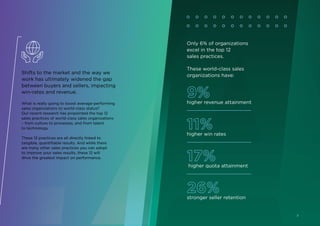
Only 6% of organizations
excel in the top 12
sales practices.
These world-class sales
organizations have:
9%
higher revenue attainment
11%
higher win rates
17%
higher quota attainment
26%
stronger seller retention
2
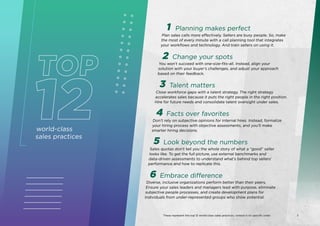
These represent the top 12 world-class sales practices, ranked in no specific order
TOP
12
world-class
sales practices
Planning makes perfect
Plan sales calls more effectively. Sellers are busy people. So, make
the most of every minute with a call planning tool that integrates
your workflows and technology. And train sellers on using it.
Change your spots
You won’t succeed with one-size-fits-all. Instead, align your
solution with your buyer’s challenges, and adjust your approach
based on their feedback.
Talent matters
Close workforce gaps with a talent strategy. The right strategy
accelerates sales because it puts the right people in the right position.
Hire for future needs and consolidate talent oversight under sales.
Facts over favorites
Don’t rely on subjective opinions for internal hires. Instead, formalize
your hiring process with objective assessments, and you’ll make
smarter hiring decisions.
Look beyond the numbers
Sales quotas don’t tell you the whole story of what a “good” seller
looks like. To get the full picture, use external benchmarks and
data-driven assessments to understand what’s behind top sellers’
performance and how to replicate this.
Embrace difference
Diverse, inclusive organizations perform better than their peers.
Ensure your sales leaders and managers lead with purpose, eliminate
subjective people processes, and create development plans for
individuals from under‑represented groups who show potential.
3
2
4
5
6
1
3
These represent the top 12 world-class sales practices, ranked in no specific order
Quality not quantity
Improve your data quality by cleansing your existing CRM data. Then set a
framework that governs where and how you store your data, defines what
data you collect and retain, and assigns ownership of your data strategy.
Don’t guess, know
Establish a rigorous sales forecasting process. Stop relying on gut instincts
and move toward an objective approach that relies on your CRM data.
Schedule regular forecast reviews to keep everything up to date.
Never stop learning
Formalize the coaching process. The most effective coaching is
well‑structured, planned, and calendared. Define what coaching is,
then set a consistent schedule.
Big data, big wins
Use data to predict performance. Use it right and you’ll know
with certainty how deals move, identify sellers’ weaknesses to address
with targeted coaching, and replicate winning selling behaviors across
your salesforce.
Collaborate to dominate
Align sales management, operations, and enablement. These three
functions often operate independently. Create a coalition by finding new
ways to work together, creating an environment that welcomes dialogue.
Get on the same page
Align sales, marketing, and customer service. These teams frequently
operate from a silo. To ensure these groups maintain their focus on
your buyer, share data and set up regular meetings.
7
8
9
10
11
12
4
KEY INSIGHTS
1
We effectively use call
planning tools to prepare
for customer interactions.
Planning
makes
perfect
Planning
makes
perfect
Sellers typically spend 20% of their time
planning their calls. That cuts into the
already limited time in their schedule —
30% — devoted to selling.
World-class organizations take advantage of
call planning tools to reduce the time sellers
spend preparing for sales calls. And with an
average of 6.2 buying influences involved in
a sale, their sellers make the most of their
call preparation to tailor their interactions
so they can stand out from the pack.
WHERE TO START
» Choose the right call planning tool.
The most effective tool is quite simply
the tool your sellers will use. This might
be a checklist, a template, or methodology
that allows sellers to gather information to
share and use to win deals.
» Integrate the tool with your workflow
and technology. Sellers won’t use tools
that don’t connect seamlessly with their
workflows. If your tool adds tedious steps
that aren’t meaningful or can’t integrate
with your existing tech stack, sellers will
be less likely to use it.
» Train and coach your sellers on how to
use call planning tools. To drive greater
adoption, show your sellers how call
planning tools can help them quickly
figure out how to address each buyer
persona. Sales managers can help sellers
save additional time by focusing their
call planning efforts on calls that require
documented, formal planning.
ALL
24%
agree
WORLD-CLASS
74%
agree
5
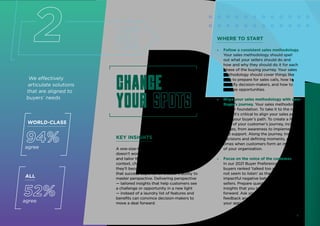
We effectively
articulate solutions
that are aligned to
buyers’ needs.
KEY INSIGHTS
A one-size-fits-all approach to buyers
doesn’t work. When sellers work backward
and tailor their solution to the buyer’s
context, challenges, and desired outcome,
they’ll become more successful. Part of
that success depends on a seller’s ability to
master perspective. Delivering perspective
— tailored insights that help customers see
a challenge or opportunity in a new light
— instead of a laundry list of features and
benefits can convince decision-makers to
move a deal forward.
WHERE TO START
» Follow a consistent sales methodology.
Your sales methodology should spell
out what your sellers should do and
how and why they should do it for each
phase of the buying journey. Your sales
methodology should cover things like
how to prepare for sales calls, how to
identify decision-makers, and how to
analyze opportunities.
» Align your sales methodology with your
buyer’s journey. Your sales methodology
is your foundation. To take it to the next
level, it’s critical to align your sales process
with your buyer’s path. To create a formal
map of your customer’s journey, include all
stages, from awareness to implementation
and support. Along the journey, track
decisions and defining moments, or the
times when customers form an impression
of your organization.
» Focus on the voice of the customer.
In our 2021 Buyer Preferences Study,
buyers ranked ‘talked too much, did
not seem to listen’ as the second most
impactful negative behavior exhibited by
sellers. Prepare questions that will elicit
insights that you need to move your deal
forward. Ask your buying influences for
feedback and use their input to refine
your approach.
ALL
52%
agree
2
Change
your spots
Change
your spots
WORLD-CLASS
94%
agree
6
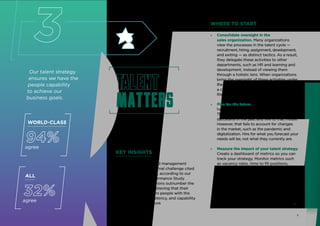
Our talent strategy
ensures we have the
people capability
to achieve our
business goals.
Talent
matters
Talent
matters
KEY INSIGHTS
Talent gaps in sales and management
teams are the top internal challenge cited
by sales organizations, according to our
2020‑2021 Sales Performance Study.
World‑class organizations outnumber the
rest three to one in believing that their
talent strategy delivers people with the
right capacity, competency, and capability
to succeed in the future..
WHERE TO START
» Consolidate oversight in the
sales organization. Many organizations
view the processes in the talent cycle —
recruitment, hiring, assignment, development,
and exiting — as distinct tactics. As a result,
they delegate these activities to other
departments, such as HR and learning and
development, instead of viewing them
through a holistic lens. When organizations
bring the oversight of these activities under
the sales organization’s umbrella, they develop
a clearer vision that enables success against
the business goals of the sales organization.
» Plan for the future. Many sales organizations
have a backward-looking view of hiring.
They tend to look at what’s made them
successful in the past and hire to that model.
However, that fails to account for changes
in the market, such as the pandemic and
digitalization. Hire for what you forecast your
needs will be, not what they currently are.
» Measure the impact of your talent strategy.
Create a dashboard of metrics so you can
track your strategy. Monitor metrics such
as vacancy rates, time to fill positions,
percentage of positions filled internally
and externally, time between hire date
and full-quota productivity, engagement
levels, and voluntary and involuntary
attrition. Supplement this objective data
with qualitative feedback from new hires,
exit interviews, and clients. Every quarter,
review your data and refine your strategy.
ALL
32%
agree
3
WORLD-CLASS
94%
agree
7
KEY INSIGHTS
Even before COVID-19, it took an average of
four months to fill an open position. And once
filled, it took nine months to get a new hire up
to full productivity. Now, the timeline is longer,
and it’s even harder — and costlier — to recruit
external talent.
When organizations have an effective process
that identifies internal candidates, it saves time
and money. But perhaps most importantly,
these candidates are already embedded in your
workflows, values, and culture, relieving some
of the onboarding pressure. The key is to create
a systematic, repeatable process for identifying
internal candidates who will excel in new roles.
ALL
30%
agree
4 WHERE TO START
» Formalize the internal hiring process.
Sales directors and sales managers
have a large sphere of influence, so the
ramifications of a bad managerial hire can
cascade through the sales organization.
Yet many organizations take an informal
approach to internal hiring because they’re
comfortable hiring a known quantity.
The process for hiring from within should
be as formal as your external process,
using candidate profiles and data.
» Look deeper than the sales numbers.
Sales organizations often promote their
top sellers to manager roles. But this
isn’t always the most logical progression
because the two roles differ significantly.
A data-driven assessment can better
identify candidates with the competencies
and drivers that will enable them to lead.
» Build a pipeline of future leaders.
Employees who want to advance their
careers need to know that their employer
is investing in their development. Internal
assessments can help you recognize
gaps in skills and competencies that
you can fill with additional training and
coaching opportunities. When you help
your sales team identify their strengths
and weaknesses, they’ll be able to set
clearer goals for improvement. They’ll also
be more engaged, be more likely to stay
with your organization, and be primed for
future opportunities.
We have an effective
process to identify
candidates for roles from
within our organization
prior to filling roles through
external methods.
Facts over
favorites
Facts over
favorites
WORLD-CLASS
94%
agree
8
We have a clear,
externally informed
understanding of what
“good” looks like for
each of our sales roles.
KEY INSIGHTS
In many sales organizations, achieving quota
is enough to convince sales leaders that their
sellers are “good.” In others, leaders define
“good” in terms of how sales reps sound when
talking to a buyer or in how well they reflect
the competencies and personalities of sellers
who have excelled in the past. Some look
for a particular set of industry expertise
or sales experience.
World-class sales organizations use objective
data to measure the traits and capabilities
of their top performers. This gives them
a solid foundation to base their hiring
and development decisions, to replicate
winning behaviors in their other sellers.
ALL
33%
agree
5 WHERE TO START
» Assess your sellers’ performance.
Assessment data is critical to
understanding what “good” looks
like. It’s even more important as the
definition of “good” continues to evolve.
Assessments can inform your hiring and
development strategies by revealing the
traits, drivers, and behaviors that make
your top performers excel.
» Update your job profiles and
job descriptions. Your market and
selling model have likely changed in the
pandemic and with digital transformation.
List the key attributes that you think
your organization will need to thrive in
the future. Study adjacent industries
to determine what types of skills are
prevalent or emerging and consider
whether those skills are relevant to
your industry.
» Create personalized learning journeys.
A detailed assessment can reveal
your sellers’ skill gaps as well as their
preferences for learning and coaching
techniques. Some sellers may prefer to
learn with others; others prefer to learn
independently. Some will be self-directed;
others will want clear direction on how to
achieve their goals. Using data to develop
a personalized learning strategy ensures
that your sellers will receive information in
the way that’s most meaningful to them,
accelerating their growth.
Look beyond
the numbers
WORLD-CLASS
94%
agree
9
Our sales organization’s
internal culture is both
diverse and inclusive.
Embrace
difference
KEY INSIGHTS
Sales organizations that are diverse and
inclusive report stronger metrics than their
peers across the board. And adhering
to diversity, equity, and inclusion (DE&I)
practices has the greatest impact on
reducing voluntary turnover.
Achieving DE&I goals is a process — there’s
no easy fix. There isn’t a singular initiative
or program you can implement and check
the box. Instead, you’ll need a foundation of
values and goals, that are transparent and
reinforced, to create lasting change.
ALL
54%
agree
6 WHERE TO START
» Lead with purpose. Your sales leaders and
managers must articulate your purpose
and model the behaviors you want to see
throughout the organization. Leaders
and managers need to exhibit inclusive
behaviors. Their goal should be creating
a culture where employees feel physically
and emotionally safe, are given access to
opportunity, are listened to, and are able
to challenge others’ positions.
» Eliminate bias. Subjective hiring,
promotion, and retention processes
can be breeding grounds for conscious
and unconscious bias. A data‑driven,
skills‑based system can help eliminate
bias and ensure those hired and rising
through the ranks have the training and
tools they need to reach the next level.
» Identify people in underrepresented
groups who show potential. Offer them
development opportunities and start a
growth planning process for them. With
training, coaching, and sponsorship, you
can fast-track their development and
ready them for leadership roles.
Embrace
difference
WORLD-CLASS
94%
agree
10
Our sales organization
is highly confident in
our CRM data.
Quality not
quantity
Quality not
quantity
KEY INSIGHTS
Garbage in, garbage out: that’s the status quo
for many sales organizations. They simply
don’t have the right data practices to yield
high-quality insights. And, since the average
sales organization has 10 sales technologies,
many sales organizations are generating
useless data streams that can’t help them
understand their customers or market.
Organizations need to earn the return on their
investment in these systems. One way to do
that is by developing a sales data strategy
that turns data into an asset. Organizations
that develop clear data strategies have higher
win rates and quota attainment than those
that don’t.
ALL
27%
agree
7
WORLD-CLASS
83%
agree
WHERE TO START
» Choose your data. The first step is to decide
what problems your data can help you solve.
Then choose how to collect and analyze your
data as well as what metrics to measure.
» Establish a data governance framework.
With so much data at your disposal, it’s
necessary to develop a way to manage
your data universe. A formal framework
will improve your data quality. To set a
framework, assign responsibility for data
ownership and management tasks, including
data entry; define where your organization
stores its data; ensure data quality through
steps such as deduplication, cleansing,
and augmentation; and decide which tools
and resources, such as dashboards and
predictive analytics, to invest in.
» Assign leaders for your sales data strategy.
Consistent oversight is necessary to ensure
that you follow through on your strategy.
Sales leaders should delegate ownership
of different parts of the strategy, such
as data security to your IT team and tool
selection to your sales operations team.
A data governance committee, composed
of representatives from across your
sales organization, should evaluate your
progress and look for gaps in your program.
The committee should also periodically
review your strategy, including your systems
and technology, processes, data roles and
responsibilities, data quality, and data usage,
to assess the need for change.
11
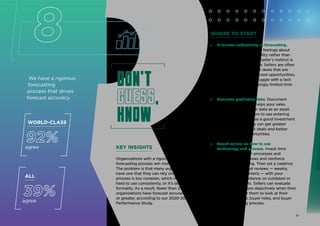
We have a rigorous
forecasting
process that drives
forecast accuracy.
Don't
guess,
know
Don't
guess,
know
KEY INSIGHTS
Organizations with a rigorous sales
forecasting process win more deals.
The problem is that many organizations don’t
have one that they can rely on. Either their
process is too complex, which makes it
hard to use consistently, or it’s lacking in
formality. As a result, fewer than 25% of sales
organizations have forecast accuracy of 75%
or greater, according to our 2020-2021 Sales
Performance Study.
ALL
39%
agree
8
WORLD-CLASS
92%
agree
WHERE TO START
» Eliminate subjectivity in forecasting.
Sellers often rely on gut feelings about
an opportunity’s possibility rather than
objective data. While a seller’s instinct is
an asset, it’s not reliable. Sellers are often
too subjective on those deals that are
close-but-not-quite-closed opportunities,
particularly as they struggle with a lack
of pipeline and increasingly limited time
to sell.
» Generate predictive data. Document
a data strategy that helps your sales
organization use your data as an asset.
Encourage your sellers to see entering
data into your CRM as a good investment
of their time, so they can get greater
visibility into current deals and better
predict future opportunities.
» Coach sellers on how to use
technology and process. Invest time
in developing clear processes and
technology workflows and reinforce
them with coaching. Then set a cadence
for regular forecast reviews — weekly,
monthly, and quarterly — with your
sellers to avoid reliance on outdated or
inaccurate reports. Sellers can evaluate
opportunities more objectively when their
managers coach them to look at their
prior experience, buyer roles, and buyer
decision‑making process.
12
Managers consistently
coach salespeople
to higher levels
of performance.
Never stop
learning
KEY INSIGHTS
Most sales managers coach their sellers
— if you define “coaching” as interacting
with their sellers. But most don’t do so
consistently or with a clear goal in mind.
Few sales managers do more than help
their sellers close individual opportunities.
When sales managers coach well, their
sales reps are more likely to make their
goals. But too many coaches employ a
random or informal approach. Effective
coaching has a clear plan, schedule, and
strategy. Without a consistent approach
to coaching, even the most effective sales
managers lose their impact.
ALL
41%
agree
9
9 WHERE TO START
» Define what coaching is. Sales organizations
often use “coaching” to describe any
manager‑seller interaction. Others use it to
refer to working on account strategies, such
as setting pricing or competing with a rival.
But coaching is broader than that. Coaching
is a leadership skill that sales managers use to
develop a seller’s full potential over the long
term. They use their social, communication, and
questioning skills to show sellers opportunities
for improvement. There are five types of
strategic coaching conversations: lead and
opportunity, skills and behaviors, funnel,
account, and territory.
» Follow a consistent, defined coaching process.
Even if sales organizations have a formal
coaching process, they still often leave the
process up to their sales managers. Random
and informal approaches won’t work — and
they won’t develop your managers’ coaching
skills. A formal approach defines areas for
coaching, develops a coaching process
connected to the buyer’s journey, requires sales
managers to improve their sales coaching skills,
and monitors the impact of sales coaching.
» Focus on quality, not quantity. Sales managers
with many direct reports often think they don’t
have enough time to coach. But it’s not about
the time managers spend; it’s the substance of
the coaching that matters. Effective coaching
reinforces your sales methodology and process
and models the same skills that sellers can use
to build stronger relationships with buyers.
WORLD-CLASS
94%
agree
13
10
We use sales analytics
to measure and predict
sales performance.
KEY INSIGHTS
CRM systems and supporting sales technology
platforms give sales leaders access to rich
amounts of data — the challenge is to
extract insights from this data that you can
use to measure and improve your sellers’
performance. If you’ve got high adoption
of your sales technology tools, particularly
your CRM, and if you’ve implemented a data
governance strategy, it’s time for the next step.
Advanced sales analytics technology can offer
your sellers specific guidance about how to
increase the likelihood of a sale. These insights
help sellers improve win rates and perform
consistently at a high level.
ALL
37%
agree
WORLD-CLASS
91%
agree
WHERE TO START
» Look for patterns. Analyze your data to
see how opportunities move along the
buyer’s journey. Evaluate what actions
led to desired outcomes as well as losses.
With these insights, you’ll be able to
pinpoint techniques that result in a desired
outcome and which opportunities take the
longest to move through the pipeline.
» Replicate your sales approach. If you
have a consistent sales methodology,
you’ll be able to use your data to analyze
successful deals. Most importantly the
methodology you use should allow you
to know which data is meaningful and
therefore deals can be reviewed along
the path to closing. Known leading
vs lagging indicators provide a better
approach than searching randomly for
patterns. Sellers who consistently engage
in the right behaviors to get to the best
customer outcome will be easy to find
as will those who do not.
» Identify gaps that require coaching.
Analytics can highlight sellers’ weaknesses.
For example, accounts can be at risk if a
seller has a narrow reach or span in the
account. This can be seen in the account
management system or CRM. The sales
manager who is easily able to identify this
issue can coach a seller on how to identify
and work with a range of buying influences
who are key decision makers to improve
the likelihood of success.
Big data,
big wins
Big data,
big wins
14
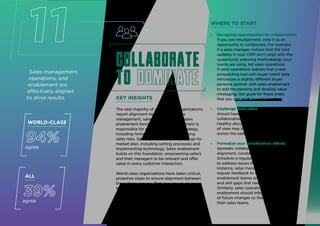
Sales management,
operations, and
enablement are
effectively aligned
to drive results.
Collaborate
to dominate
KEY INSIGHTS
The vast majority of world-class organizations
report alignment between their sales
management, sales operations, and sales
enablement functions. Sales management is
responsible for executing the sales strategy,
including hiring, developing, and retaining
sales reps. Sales operations sets up the go-to-
market plan, including setting processes and
implementing technology. Sales enablement
builds on this foundation, empowering sellers
and their managers to be relevant and offer
value in every customer interaction.
World-class organizations have taken critical,
proactive steps to ensure alignment between
these three groups. That requires much more
than having all three report to a CSO or
CRO. It requires constant collaboration and
checking in, even if all three are operating on
separate tracks at full speed.
ALL
39%
agree
11 WHERE TO START
» Recognize opportunities for collaboration.
If you see misalignment, view it as an
opportunity to collaborate. For example,
if a sales manager notices that the field
updates in your CRM don’t align with the
opportunity planning methodology your
teams are using, tell sales operations.
If sales operations realizes that a new
prospecting tool with buyer intent data
introduces a slightly different buyer
persona, partner with sales enablement
to add the persona and develop value
messaging. Set goals for these areas
that you can work toward together.
» Challenge each other. Each group
should have a unique perspective, and
collaboration doesn’t mandate agreement.
Healthy discussions on each group’s point
of view may improve innovation and clarity
across the sales organization.
» Formalize your collaboration efforts.
Sporadic collaboration doesn’t foster
alignment; constant collaboration will.
Schedule a regular cadence of meetings
to address issues that often arise. For
instance, sales managers need to provide
regular feedback to the operations and
enablement teams on process adjustments
and skill gaps that need to be addressed.
Similarly, sales operations and sales
enablement should inform sales managers
of future changes so that they can support
their sales teams.
Collaborate
to dominate
WORLD-CLASS
94%
agree
15
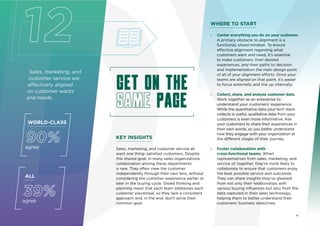
Sales, marketing, and
customer service are
effectively aligned
on customer wants
and needs.
Get on the
same page
KEY INSIGHTS
Sales, marketing, and customer service all
want one thing: satisfied customers. Despite
this shared goal, in many sales organizations,
collaboration among these departments
is rare. They often view the customer
independently through their own lens, without
considering the customer experience earlier or
later in the buying cycle. Siloed thinking and
planning mean that each team addresses each
customer piecemeal, so they lack a consistent
approach and, in the end, don’t serve their
common goal.
ALL
39%
agree
12
WORLD-CLASS
90%
agree
WHERE TO START
» Center everything you do on your customer.
A primary obstacle to alignment is a
functional, siloed mindset. To ensure
effective alignment regarding what
customers want and need, it’s essential
to make customers, their desired
experiences, and their paths to decision
and implementation the main design point
of all of your alignment efforts. Once your
teams are aligned on that point, it’s easier
to focus externally and line up internally.
» Collect, share, and analyze customer data.
Work together as an enterprise to
understand your customers’ experience.
While the quantitative data your tech stack
collects is useful, qualitative data from your
customers is even more informative. Ask
your customers to share their experiences in
their own words, so you better understand
how they engage with your organization at
the different stages of their journey.
» Foster collaboration with
cross‑functional teams. When
representatives from sales, marketing, and
service sit together, they’re more likely to
collaborate to ensure that customers enjoy
the best possible service and outcomes.
They can share insights they’ve gleaned
from not only their relationships with
various buying influences but also from the
data captured in their sales technology,
helping them to better understand their
customers’ business objectives.
16
Conclusion
The message that we’ve gleaned from compiling the top 12 sales practices
that contribute to world-class sales results is that they all of which boil
down to finding and investing in the right people and making it easier for
those people to excel in their role.
But this was also the message of the Great
Resignation, millions of people quit their
jobs to look for the next opportunity.
If you aren’t developing your new hires,
building a diverse and inclusive culture,
or offering technology and tools that make
work easier, your sellers will simply move on
to the next opportunity where they will find
someone willing to invest in them.
It can be daunting to consider making all
of these improvements at once. We don’t
suggest tackling more than one or two sales
practices at a time. And there is no single
correct starting place.
We recommend that you start in one of two
areas: either the sales practice that’s easiest
to address that will yield the biggest payoff or
the opportunity that’s causing you the most
pain. Obtaining alignment between sales,
marketing, and service will likely be a heavier
lift than using call planning tools effectively
or implementing more consistent coaching.
If you succeed in one area, you’ll gather
momentum as well as support to continue
striving toward world-class status.
If you’re ready to start your journey to become
world-class, we can help. We’ll help you assess
your sales organization against these 12 best
practices and recommend how you can start
transforming your sales organization today, so
you can close the gap between where you are
and where you need to be.
Contact us
to learn more.
kornferry.com
17
(Practices are not ranked)
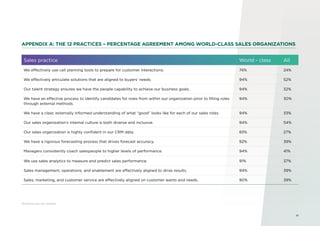
APPENDIX A: THE 12 PRACTICES – PERCENTAGE AGREEMENT AMONG WORLD-CLASS SALES ORGANIZATIONS
Sales practice World - class All
We effectively use call planning tools to prepare for customer interactions. 74% 24%
We effectively articulate solutions that are aligned to buyers’ needs. 94% 52%
Our talent strategy ensures we have the people capability to achieve our business goals. 94% 32%
We have an effective process to identify candidates for roles from within our organization prior to filling roles
through external methods.
94% 30%
We have a clear, externally informed understanding of what “good” looks like for each of our sales roles. 94% 33%
Our sales organization’s internal culture is both diverse and inclusive. 94% 54%
Our sales organization is highly confident in our CRM data. 83% 27%
We have a rigorous forecasting process that drives forecast accuracy. 92% 39%
Managers consistently coach salespeople to higher levels of performance. 94% 41%
We use sales analytics to measure and predict sales performance. 91% 37%
Sales management, operations, and enablement are effectively aligned to drive results. 94% 39%
Sales, marketing, and customer service are effectively aligned on customer wants and needs. 90% 39%
18
APPENDIX B: STUDY METHODOLOGY
In this study we surveyed more than 1,100 global sales
respondents who answered 60+ practice questions from
April to June 2021. We analyzed responses from 911 sales
leaders.2
Our global B2B respondents spanned a range
of industries, with particularly strong representation from
the technology, manufacturing, professional services,
and industrial/chemical sectors.
We then correlated the 60+ sales practices with seven key
operational metrics. Using this correlation, we determined
the top 12 world-class practices that have the strongest
connection to sales success at the organizational level.
After identifying the top 12 practices, we then identified
those organizations that responded “agree” or “strongly
agree” in at least 10 of the 12 practices. The result of this
qualification process is that 5.8% of our study population
is in this year’s world-class segment. These world-class
sales organizations significantly outperform other study
participants, reporting 8.9% higher revenue attainment,
17.0% higher quota attainment, and 11.4% higher win rates.
2 For relevance to our readership, we excluded small and microbusinesses.
19
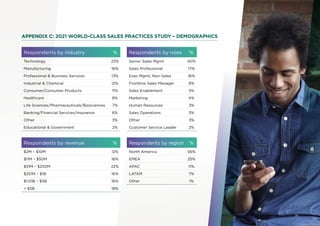
APPENDIX C: 2021 WORLD-CLASS SALES PRACTICES STUDY – DEMOGRAPHICS
Respondents by industry %
Technology 23%
Manufacturing 16%
Professional & Business Services 13%
Industrial & Chemical 12%
Consumer/Consumer Products 11%
Healthcare 8%
Life Sciences/Pharmaceuticals/Boisciences 7%
Banking/Financial Services/Insurance 6%
Other 3%
Educational & Government 2%
Respondents by roles %
Senior Sales Mgmt 40%
Sales Professional 17%
Exec Mgmt, Non-Sales 16%
Frontline Sales Manager 8%
Sales Enablement 5%
Marketing 4%
Human Resources 3%
Sales Operations 3%
Other 3%
Customer Service Leader 2%
Respondents by revenue %
$2M – $10M 12%
$11M – $50M 16%
$51M – $250M 22%
$251M – $1B 16%
$1.01B – $5B 16%
> $5B 18%
Respondents by region %
North America 56%
EMEA 25%
APAC 11%
LATAM 7%
Other 1%
20
Korn Ferry is a global organizational consulting firm.
We work with our clients to design optimal
organization structures, roles, and responsibilities.
We help them hire the right people and advise
them on how to reward and motivate their
workforce while developing professionals as they
navigate and advance their careers. Our 7,000
experts in more than 50 countries deliver on five
core areas: Organization Strategy, Assessment
and Succession, Talent Acquisition, Leadership
Development, and Total Rewards.
© 2022 Korn Ferry. All Rights Reserved.
When you bring together world
class sales practices with proven
sales methodology powered by
the Intelligence Cloud, you get
more than information. You get
actionable insights, housed in a
repeatable, consistent framework
that can help your sales team
manage their time, prioritize the
right deals and close more sales.
To learn more about Sales
Effectiveness Solutions powered
by Korn Ferry Intelligence Cloud,
contact us kornferry.com

Ebook-KFIC-12-top-sales-practices-2022.pdf

  • 1.
  • 2.
    Shifts to themarket and the way we work has ultimately widened the gap between buyers and sellers, impacting win-rates and revenue. What is really going to boost average-performing sales organizations to world-class status? Our recent research has pinpointed the top 12 sales practices of world-class sales organizations – from culture to processes, and from talent to technology. These 12 practices are all directly linked to tangible, quantifiable results. And while there are many other sales practices you can adopt to improve your sales results, these 12 will drive the greatest impact on performance. Only 6% of organizations excel in the top 12 sales practices. These world-class sales organizations have: 9% higher revenue attainment 11% higher win rates 17% higher quota attainment 26% stronger seller retention 2
  • 3.
    These represent thetop 12 world-class sales practices, ranked in no specific order TOP 12 world-class sales practices Planning makes perfect Plan sales calls more effectively. Sellers are busy people. So, make the most of every minute with a call planning tool that integrates your workflows and technology. And train sellers on using it. Change your spots You won’t succeed with one-size-fits-all. Instead, align your solution with your buyer’s challenges, and adjust your approach based on their feedback. Talent matters Close workforce gaps with a talent strategy. The right strategy accelerates sales because it puts the right people in the right position. Hire for future needs and consolidate talent oversight under sales. Facts over favorites Don’t rely on subjective opinions for internal hires. Instead, formalize your hiring process with objective assessments, and you’ll make smarter hiring decisions. Look beyond the numbers Sales quotas don’t tell you the whole story of what a “good” seller looks like. To get the full picture, use external benchmarks and data-driven assessments to understand what’s behind top sellers’ performance and how to replicate this. Embrace difference Diverse, inclusive organizations perform better than their peers. Ensure your sales leaders and managers lead with purpose, eliminate subjective people processes, and create development plans for individuals from under‑represented groups who show potential. 3 2 4 5 6 1 3
  • 4.
    These represent thetop 12 world-class sales practices, ranked in no specific order Quality not quantity Improve your data quality by cleansing your existing CRM data. Then set a framework that governs where and how you store your data, defines what data you collect and retain, and assigns ownership of your data strategy. Don’t guess, know Establish a rigorous sales forecasting process. Stop relying on gut instincts and move toward an objective approach that relies on your CRM data. Schedule regular forecast reviews to keep everything up to date. Never stop learning Formalize the coaching process. The most effective coaching is well‑structured, planned, and calendared. Define what coaching is, then set a consistent schedule. Big data, big wins Use data to predict performance. Use it right and you’ll know with certainty how deals move, identify sellers’ weaknesses to address with targeted coaching, and replicate winning selling behaviors across your salesforce. Collaborate to dominate Align sales management, operations, and enablement. These three functions often operate independently. Create a coalition by finding new ways to work together, creating an environment that welcomes dialogue. Get on the same page Align sales, marketing, and customer service. These teams frequently operate from a silo. To ensure these groups maintain their focus on your buyer, share data and set up regular meetings. 7 8 9 10 11 12 4
  • 5.
    KEY INSIGHTS 1 We effectivelyuse call planning tools to prepare for customer interactions. Planning makes perfect Planning makes perfect Sellers typically spend 20% of their time planning their calls. That cuts into the already limited time in their schedule — 30% — devoted to selling. World-class organizations take advantage of call planning tools to reduce the time sellers spend preparing for sales calls. And with an average of 6.2 buying influences involved in a sale, their sellers make the most of their call preparation to tailor their interactions so they can stand out from the pack. WHERE TO START » Choose the right call planning tool. The most effective tool is quite simply the tool your sellers will use. This might be a checklist, a template, or methodology that allows sellers to gather information to share and use to win deals. » Integrate the tool with your workflow and technology. Sellers won’t use tools that don’t connect seamlessly with their workflows. If your tool adds tedious steps that aren’t meaningful or can’t integrate with your existing tech stack, sellers will be less likely to use it. » Train and coach your sellers on how to use call planning tools. To drive greater adoption, show your sellers how call planning tools can help them quickly figure out how to address each buyer persona. Sales managers can help sellers save additional time by focusing their call planning efforts on calls that require documented, formal planning. ALL 24% agree WORLD-CLASS 74% agree 5
  • 6.
    We effectively articulate solutions thatare aligned to buyers’ needs. KEY INSIGHTS A one-size-fits-all approach to buyers doesn’t work. When sellers work backward and tailor their solution to the buyer’s context, challenges, and desired outcome, they’ll become more successful. Part of that success depends on a seller’s ability to master perspective. Delivering perspective — tailored insights that help customers see a challenge or opportunity in a new light — instead of a laundry list of features and benefits can convince decision-makers to move a deal forward. WHERE TO START » Follow a consistent sales methodology. Your sales methodology should spell out what your sellers should do and how and why they should do it for each phase of the buying journey. Your sales methodology should cover things like how to prepare for sales calls, how to identify decision-makers, and how to analyze opportunities. » Align your sales methodology with your buyer’s journey. Your sales methodology is your foundation. To take it to the next level, it’s critical to align your sales process with your buyer’s path. To create a formal map of your customer’s journey, include all stages, from awareness to implementation and support. Along the journey, track decisions and defining moments, or the times when customers form an impression of your organization. » Focus on the voice of the customer. In our 2021 Buyer Preferences Study, buyers ranked ‘talked too much, did not seem to listen’ as the second most impactful negative behavior exhibited by sellers. Prepare questions that will elicit insights that you need to move your deal forward. Ask your buying influences for feedback and use their input to refine your approach. ALL 52% agree 2 Change your spots Change your spots WORLD-CLASS 94% agree 6
  • 7.
    Our talent strategy ensureswe have the people capability to achieve our business goals. Talent matters Talent matters KEY INSIGHTS Talent gaps in sales and management teams are the top internal challenge cited by sales organizations, according to our 2020‑2021 Sales Performance Study. World‑class organizations outnumber the rest three to one in believing that their talent strategy delivers people with the right capacity, competency, and capability to succeed in the future.. WHERE TO START » Consolidate oversight in the sales organization. Many organizations view the processes in the talent cycle — recruitment, hiring, assignment, development, and exiting — as distinct tactics. As a result, they delegate these activities to other departments, such as HR and learning and development, instead of viewing them through a holistic lens. When organizations bring the oversight of these activities under the sales organization’s umbrella, they develop a clearer vision that enables success against the business goals of the sales organization. » Plan for the future. Many sales organizations have a backward-looking view of hiring. They tend to look at what’s made them successful in the past and hire to that model. However, that fails to account for changes in the market, such as the pandemic and digitalization. Hire for what you forecast your needs will be, not what they currently are. » Measure the impact of your talent strategy. Create a dashboard of metrics so you can track your strategy. Monitor metrics such as vacancy rates, time to fill positions, percentage of positions filled internally and externally, time between hire date and full-quota productivity, engagement levels, and voluntary and involuntary attrition. Supplement this objective data with qualitative feedback from new hires, exit interviews, and clients. Every quarter, review your data and refine your strategy. ALL 32% agree 3 WORLD-CLASS 94% agree 7
  • 8.
    KEY INSIGHTS Even beforeCOVID-19, it took an average of four months to fill an open position. And once filled, it took nine months to get a new hire up to full productivity. Now, the timeline is longer, and it’s even harder — and costlier — to recruit external talent. When organizations have an effective process that identifies internal candidates, it saves time and money. But perhaps most importantly, these candidates are already embedded in your workflows, values, and culture, relieving some of the onboarding pressure. The key is to create a systematic, repeatable process for identifying internal candidates who will excel in new roles. ALL 30% agree 4 WHERE TO START » Formalize the internal hiring process. Sales directors and sales managers have a large sphere of influence, so the ramifications of a bad managerial hire can cascade through the sales organization. Yet many organizations take an informal approach to internal hiring because they’re comfortable hiring a known quantity. The process for hiring from within should be as formal as your external process, using candidate profiles and data. » Look deeper than the sales numbers. Sales organizations often promote their top sellers to manager roles. But this isn’t always the most logical progression because the two roles differ significantly. A data-driven assessment can better identify candidates with the competencies and drivers that will enable them to lead. » Build a pipeline of future leaders. Employees who want to advance their careers need to know that their employer is investing in their development. Internal assessments can help you recognize gaps in skills and competencies that you can fill with additional training and coaching opportunities. When you help your sales team identify their strengths and weaknesses, they’ll be able to set clearer goals for improvement. They’ll also be more engaged, be more likely to stay with your organization, and be primed for future opportunities. We have an effective process to identify candidates for roles from within our organization prior to filling roles through external methods. Facts over favorites Facts over favorites WORLD-CLASS 94% agree 8
  • 9.
    We have aclear, externally informed understanding of what “good” looks like for each of our sales roles. KEY INSIGHTS In many sales organizations, achieving quota is enough to convince sales leaders that their sellers are “good.” In others, leaders define “good” in terms of how sales reps sound when talking to a buyer or in how well they reflect the competencies and personalities of sellers who have excelled in the past. Some look for a particular set of industry expertise or sales experience. World-class sales organizations use objective data to measure the traits and capabilities of their top performers. This gives them a solid foundation to base their hiring and development decisions, to replicate winning behaviors in their other sellers. ALL 33% agree 5 WHERE TO START » Assess your sellers’ performance. Assessment data is critical to understanding what “good” looks like. It’s even more important as the definition of “good” continues to evolve. Assessments can inform your hiring and development strategies by revealing the traits, drivers, and behaviors that make your top performers excel. » Update your job profiles and job descriptions. Your market and selling model have likely changed in the pandemic and with digital transformation. List the key attributes that you think your organization will need to thrive in the future. Study adjacent industries to determine what types of skills are prevalent or emerging and consider whether those skills are relevant to your industry. » Create personalized learning journeys. A detailed assessment can reveal your sellers’ skill gaps as well as their preferences for learning and coaching techniques. Some sellers may prefer to learn with others; others prefer to learn independently. Some will be self-directed; others will want clear direction on how to achieve their goals. Using data to develop a personalized learning strategy ensures that your sellers will receive information in the way that’s most meaningful to them, accelerating their growth. Look beyond the numbers WORLD-CLASS 94% agree 9
  • 10.
    Our sales organization’s internalculture is both diverse and inclusive. Embrace difference KEY INSIGHTS Sales organizations that are diverse and inclusive report stronger metrics than their peers across the board. And adhering to diversity, equity, and inclusion (DE&I) practices has the greatest impact on reducing voluntary turnover. Achieving DE&I goals is a process — there’s no easy fix. There isn’t a singular initiative or program you can implement and check the box. Instead, you’ll need a foundation of values and goals, that are transparent and reinforced, to create lasting change. ALL 54% agree 6 WHERE TO START » Lead with purpose. Your sales leaders and managers must articulate your purpose and model the behaviors you want to see throughout the organization. Leaders and managers need to exhibit inclusive behaviors. Their goal should be creating a culture where employees feel physically and emotionally safe, are given access to opportunity, are listened to, and are able to challenge others’ positions. » Eliminate bias. Subjective hiring, promotion, and retention processes can be breeding grounds for conscious and unconscious bias. A data‑driven, skills‑based system can help eliminate bias and ensure those hired and rising through the ranks have the training and tools they need to reach the next level. » Identify people in underrepresented groups who show potential. Offer them development opportunities and start a growth planning process for them. With training, coaching, and sponsorship, you can fast-track their development and ready them for leadership roles. Embrace difference WORLD-CLASS 94% agree 10
  • 11.
    Our sales organization ishighly confident in our CRM data. Quality not quantity Quality not quantity KEY INSIGHTS Garbage in, garbage out: that’s the status quo for many sales organizations. They simply don’t have the right data practices to yield high-quality insights. And, since the average sales organization has 10 sales technologies, many sales organizations are generating useless data streams that can’t help them understand their customers or market. Organizations need to earn the return on their investment in these systems. One way to do that is by developing a sales data strategy that turns data into an asset. Organizations that develop clear data strategies have higher win rates and quota attainment than those that don’t. ALL 27% agree 7 WORLD-CLASS 83% agree WHERE TO START » Choose your data. The first step is to decide what problems your data can help you solve. Then choose how to collect and analyze your data as well as what metrics to measure. » Establish a data governance framework. With so much data at your disposal, it’s necessary to develop a way to manage your data universe. A formal framework will improve your data quality. To set a framework, assign responsibility for data ownership and management tasks, including data entry; define where your organization stores its data; ensure data quality through steps such as deduplication, cleansing, and augmentation; and decide which tools and resources, such as dashboards and predictive analytics, to invest in. » Assign leaders for your sales data strategy. Consistent oversight is necessary to ensure that you follow through on your strategy. Sales leaders should delegate ownership of different parts of the strategy, such as data security to your IT team and tool selection to your sales operations team. A data governance committee, composed of representatives from across your sales organization, should evaluate your progress and look for gaps in your program. The committee should also periodically review your strategy, including your systems and technology, processes, data roles and responsibilities, data quality, and data usage, to assess the need for change. 11
  • 12.
    We have arigorous forecasting process that drives forecast accuracy. Don't guess, know Don't guess, know KEY INSIGHTS Organizations with a rigorous sales forecasting process win more deals. The problem is that many organizations don’t have one that they can rely on. Either their process is too complex, which makes it hard to use consistently, or it’s lacking in formality. As a result, fewer than 25% of sales organizations have forecast accuracy of 75% or greater, according to our 2020-2021 Sales Performance Study. ALL 39% agree 8 WORLD-CLASS 92% agree WHERE TO START » Eliminate subjectivity in forecasting. Sellers often rely on gut feelings about an opportunity’s possibility rather than objective data. While a seller’s instinct is an asset, it’s not reliable. Sellers are often too subjective on those deals that are close-but-not-quite-closed opportunities, particularly as they struggle with a lack of pipeline and increasingly limited time to sell. » Generate predictive data. Document a data strategy that helps your sales organization use your data as an asset. Encourage your sellers to see entering data into your CRM as a good investment of their time, so they can get greater visibility into current deals and better predict future opportunities. » Coach sellers on how to use technology and process. Invest time in developing clear processes and technology workflows and reinforce them with coaching. Then set a cadence for regular forecast reviews — weekly, monthly, and quarterly — with your sellers to avoid reliance on outdated or inaccurate reports. Sellers can evaluate opportunities more objectively when their managers coach them to look at their prior experience, buyer roles, and buyer decision‑making process. 12
  • 13.
    Managers consistently coach salespeople tohigher levels of performance. Never stop learning KEY INSIGHTS Most sales managers coach their sellers — if you define “coaching” as interacting with their sellers. But most don’t do so consistently or with a clear goal in mind. Few sales managers do more than help their sellers close individual opportunities. When sales managers coach well, their sales reps are more likely to make their goals. But too many coaches employ a random or informal approach. Effective coaching has a clear plan, schedule, and strategy. Without a consistent approach to coaching, even the most effective sales managers lose their impact. ALL 41% agree 9 9 WHERE TO START » Define what coaching is. Sales organizations often use “coaching” to describe any manager‑seller interaction. Others use it to refer to working on account strategies, such as setting pricing or competing with a rival. But coaching is broader than that. Coaching is a leadership skill that sales managers use to develop a seller’s full potential over the long term. They use their social, communication, and questioning skills to show sellers opportunities for improvement. There are five types of strategic coaching conversations: lead and opportunity, skills and behaviors, funnel, account, and territory. » Follow a consistent, defined coaching process. Even if sales organizations have a formal coaching process, they still often leave the process up to their sales managers. Random and informal approaches won’t work — and they won’t develop your managers’ coaching skills. A formal approach defines areas for coaching, develops a coaching process connected to the buyer’s journey, requires sales managers to improve their sales coaching skills, and monitors the impact of sales coaching. » Focus on quality, not quantity. Sales managers with many direct reports often think they don’t have enough time to coach. But it’s not about the time managers spend; it’s the substance of the coaching that matters. Effective coaching reinforces your sales methodology and process and models the same skills that sellers can use to build stronger relationships with buyers. WORLD-CLASS 94% agree 13
  • 14.
    10 We use salesanalytics to measure and predict sales performance. KEY INSIGHTS CRM systems and supporting sales technology platforms give sales leaders access to rich amounts of data — the challenge is to extract insights from this data that you can use to measure and improve your sellers’ performance. If you’ve got high adoption of your sales technology tools, particularly your CRM, and if you’ve implemented a data governance strategy, it’s time for the next step. Advanced sales analytics technology can offer your sellers specific guidance about how to increase the likelihood of a sale. These insights help sellers improve win rates and perform consistently at a high level. ALL 37% agree WORLD-CLASS 91% agree WHERE TO START » Look for patterns. Analyze your data to see how opportunities move along the buyer’s journey. Evaluate what actions led to desired outcomes as well as losses. With these insights, you’ll be able to pinpoint techniques that result in a desired outcome and which opportunities take the longest to move through the pipeline. » Replicate your sales approach. If you have a consistent sales methodology, you’ll be able to use your data to analyze successful deals. Most importantly the methodology you use should allow you to know which data is meaningful and therefore deals can be reviewed along the path to closing. Known leading vs lagging indicators provide a better approach than searching randomly for patterns. Sellers who consistently engage in the right behaviors to get to the best customer outcome will be easy to find as will those who do not. » Identify gaps that require coaching. Analytics can highlight sellers’ weaknesses. For example, accounts can be at risk if a seller has a narrow reach or span in the account. This can be seen in the account management system or CRM. The sales manager who is easily able to identify this issue can coach a seller on how to identify and work with a range of buying influences who are key decision makers to improve the likelihood of success. Big data, big wins Big data, big wins 14
  • 15.
    Sales management, operations, and enablementare effectively aligned to drive results. Collaborate to dominate KEY INSIGHTS The vast majority of world-class organizations report alignment between their sales management, sales operations, and sales enablement functions. Sales management is responsible for executing the sales strategy, including hiring, developing, and retaining sales reps. Sales operations sets up the go-to- market plan, including setting processes and implementing technology. Sales enablement builds on this foundation, empowering sellers and their managers to be relevant and offer value in every customer interaction. World-class organizations have taken critical, proactive steps to ensure alignment between these three groups. That requires much more than having all three report to a CSO or CRO. It requires constant collaboration and checking in, even if all three are operating on separate tracks at full speed. ALL 39% agree 11 WHERE TO START » Recognize opportunities for collaboration. If you see misalignment, view it as an opportunity to collaborate. For example, if a sales manager notices that the field updates in your CRM don’t align with the opportunity planning methodology your teams are using, tell sales operations. If sales operations realizes that a new prospecting tool with buyer intent data introduces a slightly different buyer persona, partner with sales enablement to add the persona and develop value messaging. Set goals for these areas that you can work toward together. » Challenge each other. Each group should have a unique perspective, and collaboration doesn’t mandate agreement. Healthy discussions on each group’s point of view may improve innovation and clarity across the sales organization. » Formalize your collaboration efforts. Sporadic collaboration doesn’t foster alignment; constant collaboration will. Schedule a regular cadence of meetings to address issues that often arise. For instance, sales managers need to provide regular feedback to the operations and enablement teams on process adjustments and skill gaps that need to be addressed. Similarly, sales operations and sales enablement should inform sales managers of future changes so that they can support their sales teams. Collaborate to dominate WORLD-CLASS 94% agree 15
  • 16.
    Sales, marketing, and customerservice are effectively aligned on customer wants and needs. Get on the same page KEY INSIGHTS Sales, marketing, and customer service all want one thing: satisfied customers. Despite this shared goal, in many sales organizations, collaboration among these departments is rare. They often view the customer independently through their own lens, without considering the customer experience earlier or later in the buying cycle. Siloed thinking and planning mean that each team addresses each customer piecemeal, so they lack a consistent approach and, in the end, don’t serve their common goal. ALL 39% agree 12 WORLD-CLASS 90% agree WHERE TO START » Center everything you do on your customer. A primary obstacle to alignment is a functional, siloed mindset. To ensure effective alignment regarding what customers want and need, it’s essential to make customers, their desired experiences, and their paths to decision and implementation the main design point of all of your alignment efforts. Once your teams are aligned on that point, it’s easier to focus externally and line up internally. » Collect, share, and analyze customer data. Work together as an enterprise to understand your customers’ experience. While the quantitative data your tech stack collects is useful, qualitative data from your customers is even more informative. Ask your customers to share their experiences in their own words, so you better understand how they engage with your organization at the different stages of their journey. » Foster collaboration with cross‑functional teams. When representatives from sales, marketing, and service sit together, they’re more likely to collaborate to ensure that customers enjoy the best possible service and outcomes. They can share insights they’ve gleaned from not only their relationships with various buying influences but also from the data captured in their sales technology, helping them to better understand their customers’ business objectives. 16
  • 17.
    Conclusion The message thatwe’ve gleaned from compiling the top 12 sales practices that contribute to world-class sales results is that they all of which boil down to finding and investing in the right people and making it easier for those people to excel in their role. But this was also the message of the Great Resignation, millions of people quit their jobs to look for the next opportunity. If you aren’t developing your new hires, building a diverse and inclusive culture, or offering technology and tools that make work easier, your sellers will simply move on to the next opportunity where they will find someone willing to invest in them. It can be daunting to consider making all of these improvements at once. We don’t suggest tackling more than one or two sales practices at a time. And there is no single correct starting place. We recommend that you start in one of two areas: either the sales practice that’s easiest to address that will yield the biggest payoff or the opportunity that’s causing you the most pain. Obtaining alignment between sales, marketing, and service will likely be a heavier lift than using call planning tools effectively or implementing more consistent coaching. If you succeed in one area, you’ll gather momentum as well as support to continue striving toward world-class status. If you’re ready to start your journey to become world-class, we can help. We’ll help you assess your sales organization against these 12 best practices and recommend how you can start transforming your sales organization today, so you can close the gap between where you are and where you need to be. Contact us to learn more. kornferry.com 17

  • 18.
    (Practices are notranked) APPENDIX A: THE 12 PRACTICES – PERCENTAGE AGREEMENT AMONG WORLD-CLASS SALES ORGANIZATIONS Sales practice World - class All We effectively use call planning tools to prepare for customer interactions. 74% 24% We effectively articulate solutions that are aligned to buyers’ needs. 94% 52% Our talent strategy ensures we have the people capability to achieve our business goals. 94% 32% We have an effective process to identify candidates for roles from within our organization prior to filling roles through external methods. 94% 30% We have a clear, externally informed understanding of what “good” looks like for each of our sales roles. 94% 33% Our sales organization’s internal culture is both diverse and inclusive. 94% 54% Our sales organization is highly confident in our CRM data. 83% 27% We have a rigorous forecasting process that drives forecast accuracy. 92% 39% Managers consistently coach salespeople to higher levels of performance. 94% 41% We use sales analytics to measure and predict sales performance. 91% 37% Sales management, operations, and enablement are effectively aligned to drive results. 94% 39% Sales, marketing, and customer service are effectively aligned on customer wants and needs. 90% 39% 18
  • 19.
    APPENDIX B: STUDYMETHODOLOGY In this study we surveyed more than 1,100 global sales respondents who answered 60+ practice questions from April to June 2021. We analyzed responses from 911 sales leaders.2 Our global B2B respondents spanned a range of industries, with particularly strong representation from the technology, manufacturing, professional services, and industrial/chemical sectors. We then correlated the 60+ sales practices with seven key operational metrics. Using this correlation, we determined the top 12 world-class practices that have the strongest connection to sales success at the organizational level. After identifying the top 12 practices, we then identified those organizations that responded “agree” or “strongly agree” in at least 10 of the 12 practices. The result of this qualification process is that 5.8% of our study population is in this year’s world-class segment. These world-class sales organizations significantly outperform other study participants, reporting 8.9% higher revenue attainment, 17.0% higher quota attainment, and 11.4% higher win rates. 2 For relevance to our readership, we excluded small and microbusinesses. 19
  • 20.
    APPENDIX C: 2021WORLD-CLASS SALES PRACTICES STUDY – DEMOGRAPHICS Respondents by industry % Technology 23% Manufacturing 16% Professional & Business Services 13% Industrial & Chemical 12% Consumer/Consumer Products 11% Healthcare 8% Life Sciences/Pharmaceuticals/Boisciences 7% Banking/Financial Services/Insurance 6% Other 3% Educational & Government 2% Respondents by roles % Senior Sales Mgmt 40% Sales Professional 17% Exec Mgmt, Non-Sales 16% Frontline Sales Manager 8% Sales Enablement 5% Marketing 4% Human Resources 3% Sales Operations 3% Other 3% Customer Service Leader 2% Respondents by revenue % $2M – $10M 12% $11M – $50M 16% $51M – $250M 22% $251M – $1B 16% $1.01B – $5B 16% > $5B 18% Respondents by region % North America 56% EMEA 25% APAC 11% LATAM 7% Other 1% 20
  • 21.
    Korn Ferry isa global organizational consulting firm. We work with our clients to design optimal organization structures, roles, and responsibilities. We help them hire the right people and advise them on how to reward and motivate their workforce while developing professionals as they navigate and advance their careers. Our 7,000 experts in more than 50 countries deliver on five core areas: Organization Strategy, Assessment and Succession, Talent Acquisition, Leadership Development, and Total Rewards. © 2022 Korn Ferry. All Rights Reserved. When you bring together world class sales practices with proven sales methodology powered by the Intelligence Cloud, you get more than information. You get actionable insights, housed in a repeatable, consistent framework that can help your sales team manage their time, prioritize the right deals and close more sales. To learn more about Sales Effectiveness Solutions powered by Korn Ferry Intelligence Cloud, contact us kornferry.com