©2012 HP Confidential1
Hasan Fehmi GENCER – AVEA
19 March 2012
O
Antalya Turkey
19 – 20 March 2012
HP REVENUE INTELLIGENCE
USER FORUM
©2012 HP Confidential2 ©2012 HP Confidential2
HP REVENUE INTELLIGENCE
USER FORUM
Antalya Turkey
19 – 20 March 2012
Credit Risk Management
©2012 HP Confidential3
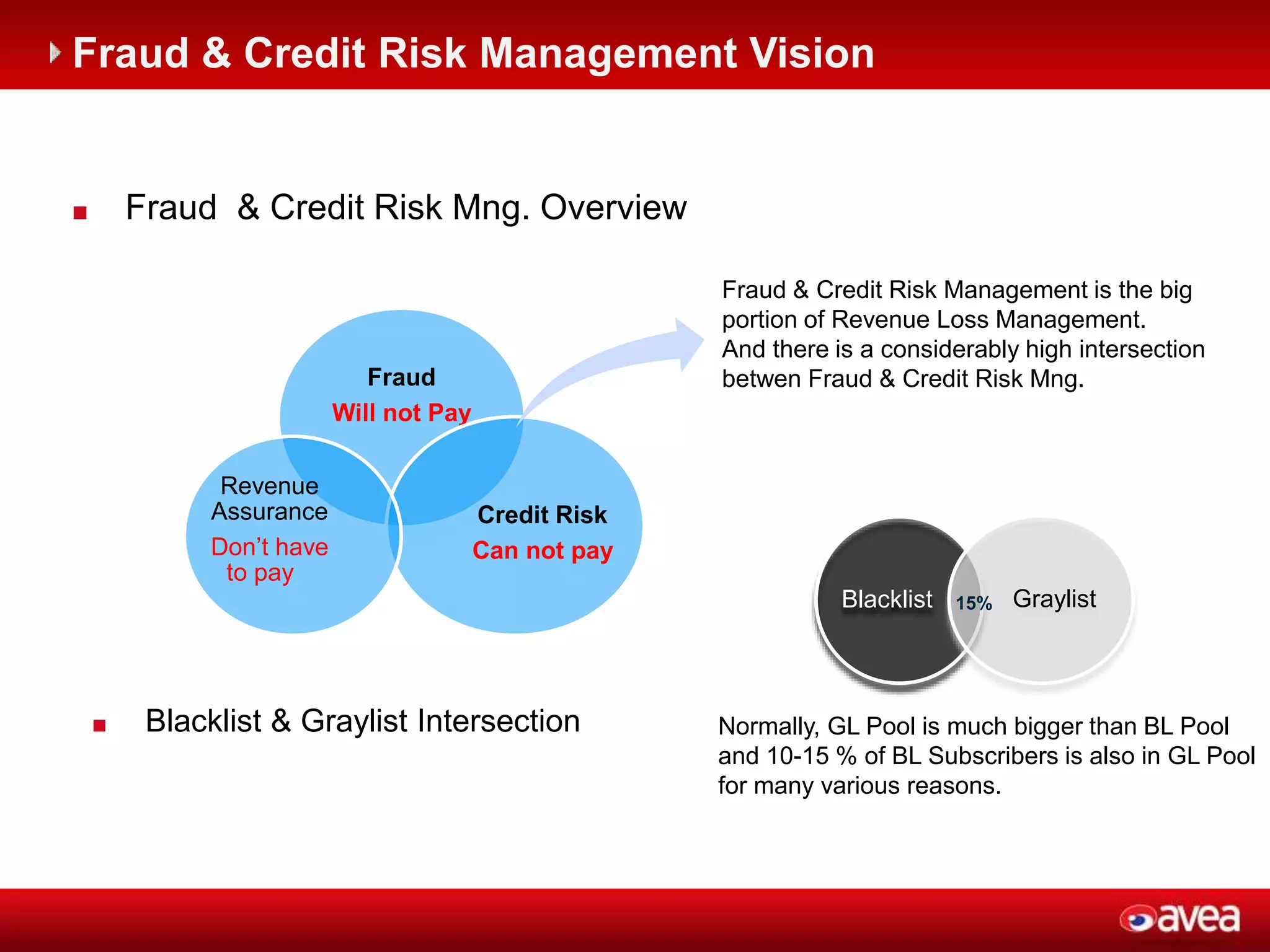
 Fraud & Credit Risk Mng. Overview
Fraud
Will not Pay
Credit Risk
Can not pay
Revenue
Assurance
Don’t have
to pay
Fraud & Credit Risk Management is the big
portion of Revenue Loss Management.
And there is a considerably high intersection
betwen Fraud & Credit Risk Mng.
 Blacklist & Graylist Intersection
Blacklist Graylist
Normally, GL Pool is much bigger than BL Pool
and 10-15 % of BL Subscribers is also in GL Pool
for many various reasons.
15%
Fraud & Credit Risk Management Vision
©2012 HP Confidential4
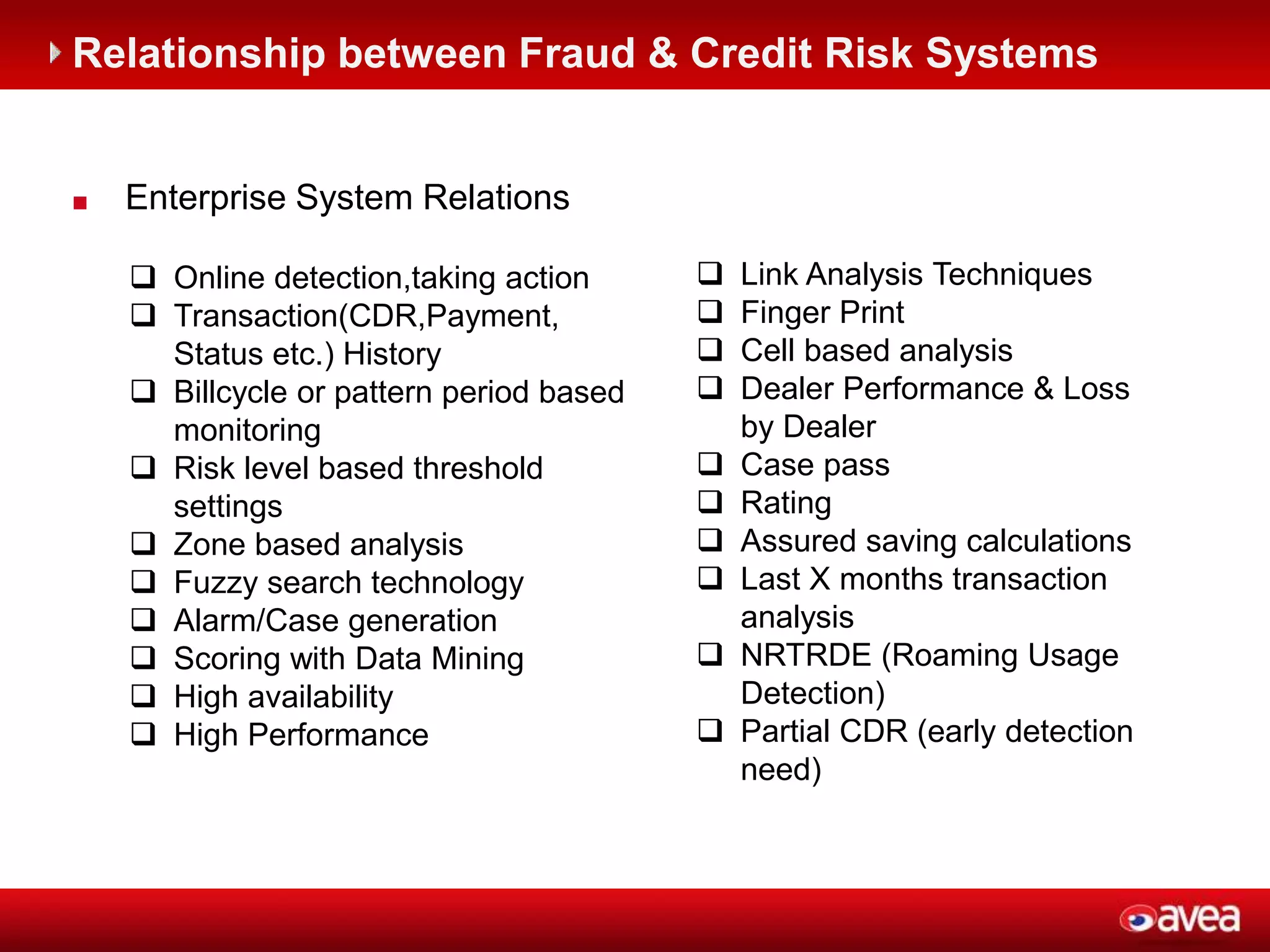
 Enterprise System Relations
 Online detection,taking action
 Transaction(CDR,Payment,
Status etc.) History
 Billcycle or pattern period based
monitoring
 Risk level based threshold
settings
 Zone based analysis
 Fuzzy search technology
 Alarm/Case generation
 Scoring with Data Mining
 High availability
 High Performance
 Link Analysis Techniques
 Finger Print
 Cell based analysis
 Dealer Performance & Loss
by Dealer
 Case pass
 Rating
 Assured saving calculations
 Last X months transaction
analysis
 NRTRDE (Roaming Usage
Detection)
 Partial CDR (early detection
need)
Relationship between Fraud & Credit Risk Systems
Credit Risk Management Solutions
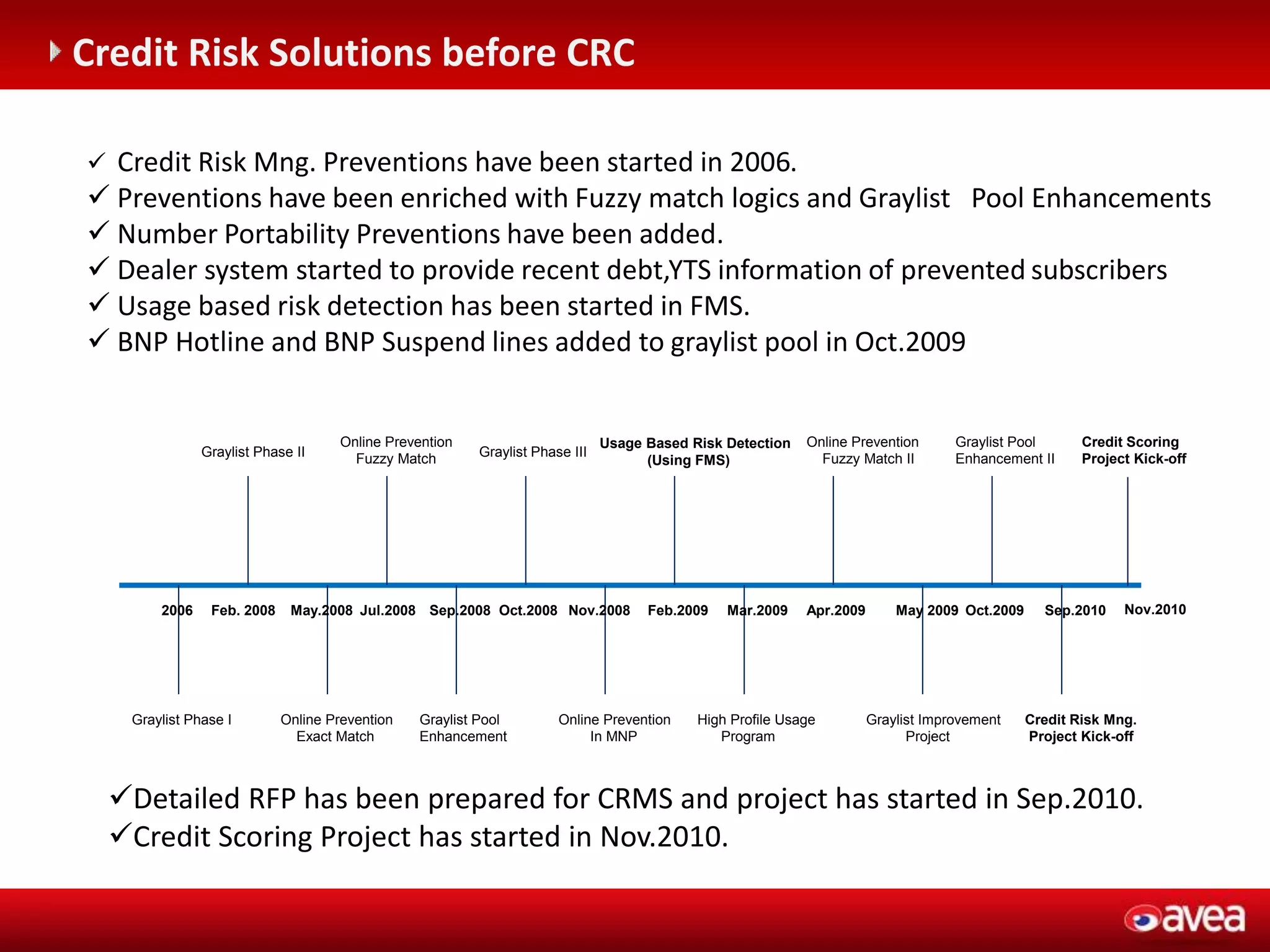
2006 Feb. 2008 May.2008 Jul.2008 Sep.2008 Oct.2008 Nov.2008 Feb.2009 Mar.2009 Apr.2009 May 2009 Oct.2009 Sep.2010
Graylist Phase I
Graylist Phase II
Online Prevention
Exact Match
Online Prevention
Fuzzy Match
Graylist Pool
Enhancement
Graylist Phase III
Online Prevention
In MNP
Usage Based Risk Detection
(Using FMS)
High Profile Usage
Program
Online Prevention
Fuzzy Match II
Graylist Improvement
Project
Graylist Pool
Enhancement II
Credit Risk Mng.
Project Kick-off
 Credit Risk Mng. Preventions have been started in 2006.
 Preventions have been enriched with Fuzzy match logics and Graylist Pool Enhancements
 Number Portability Preventions have been added.
 Dealer system started to provide recent debt,YTS information of prevented subscribers
 Usage based risk detection has been started in FMS.
 BNP Hotline and BNP Suspend lines added to graylist pool in Oct.2009
Credit Scoring
Project Kick-off
Nov.2010
Credit Risk Solutions before CRC
Detailed RFP has been prepared for CRMS and project has started in Sep.2010.
Credit Scoring Project has started in Nov.2010.
C (entegrasyonu gerektirir)
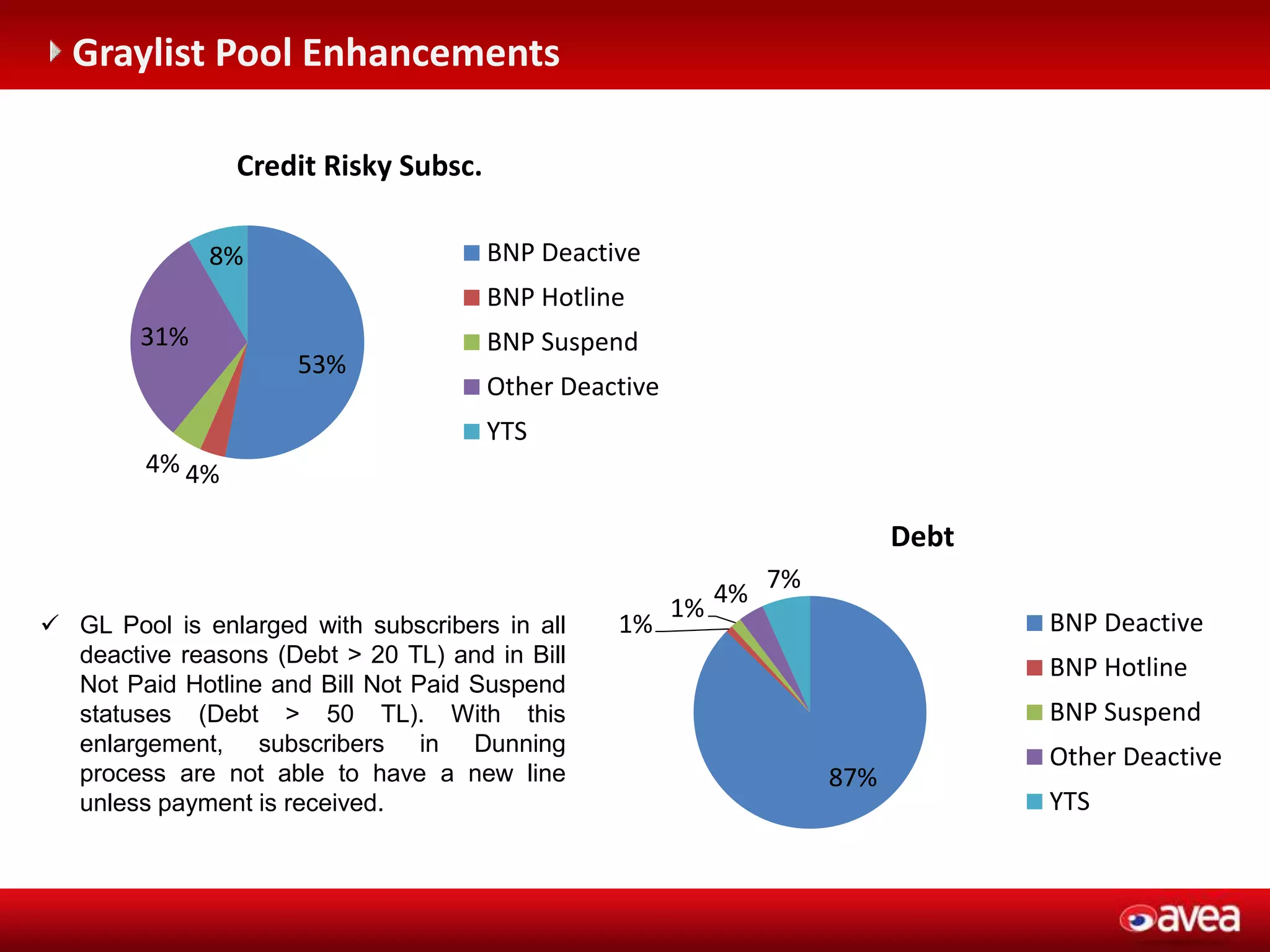
Graylist Pool Enhancements
53%
4%4%
31%
8%
Credit Risky Subsc.
BNP Deactive
BNP Hotline
BNP Suspend
Other Deactive
YTS
87%
1%
1%
4%
7%
Debt
BNP Deactive
BNP Hotline
BNP Suspend
Other Deactive
YTS
 GL Pool is enlarged with subscribers in all
deactive reasons (Debt > 20 TL) and in Bill
Not Paid Hotline and Bill Not Paid Suspend
statuses (Debt > 50 TL). With this
enlargement, subscribers in Dunning
process are not able to have a new line
unless payment is received.
C (entegrasyonu gerektirir)
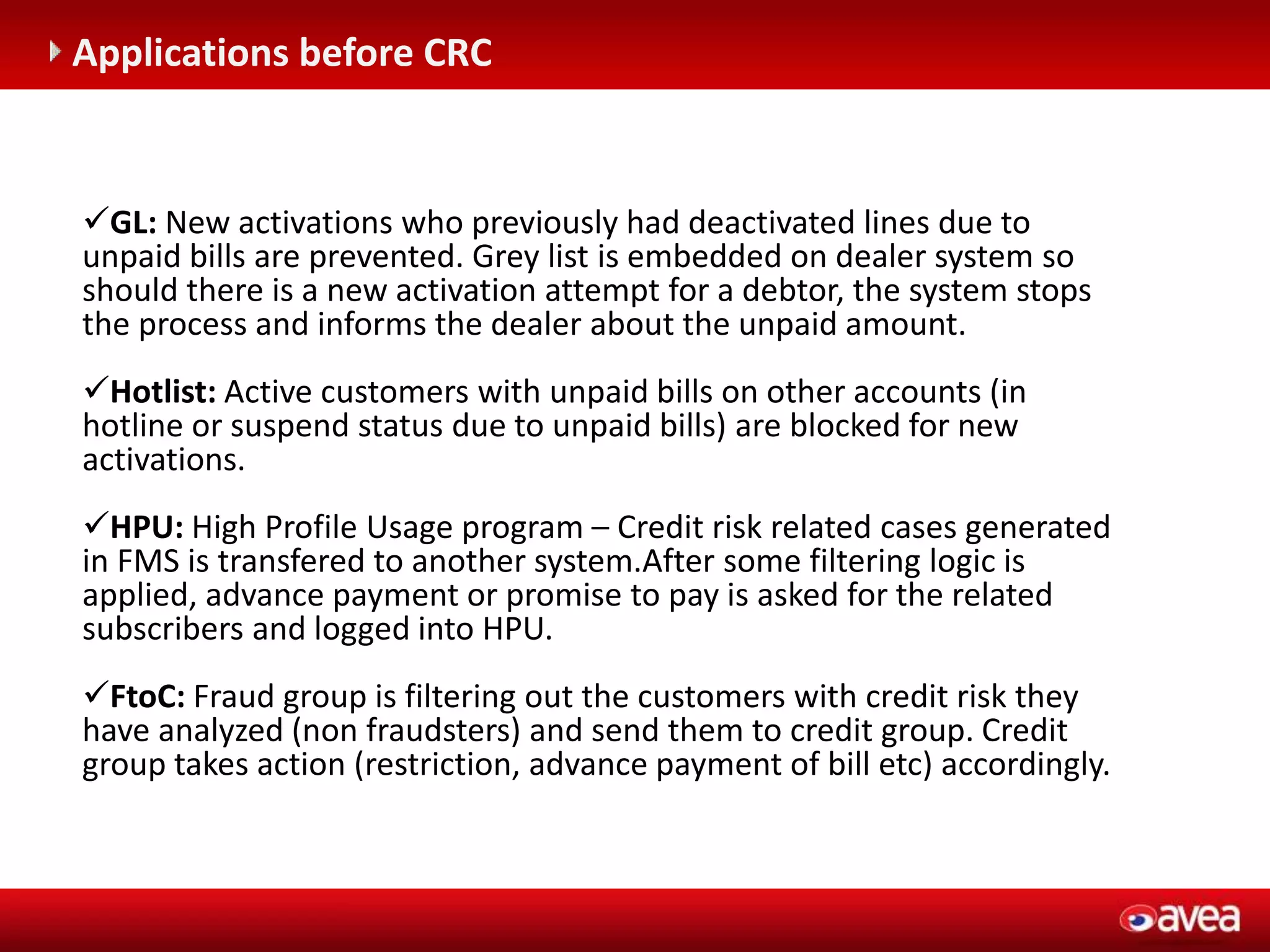
Applications before CRC
GL: New activations who previously had deactivated lines due to
unpaid bills are prevented. Grey list is embedded on dealer system so
should there is a new activation attempt for a debtor, the system stops
the process and informs the dealer about the unpaid amount.
Hotlist: Active customers with unpaid bills on other accounts (in
hotline or suspend status due to unpaid bills) are blocked for new
activations.
HPU: High Profile Usage program – Credit risk related cases generated
in FMS is transfered to another system.After some filtering logic is
applied, advance payment or promise to pay is asked for the related
subscribers and logged into HPU.
FtoC: Fraud group is filtering out the customers with credit risk they
have analyzed (non fraudsters) and send them to credit group. Credit
group takes action (restriction, advance payment of bill etc) accordingly.
C (entegrasyonu gerektirir)
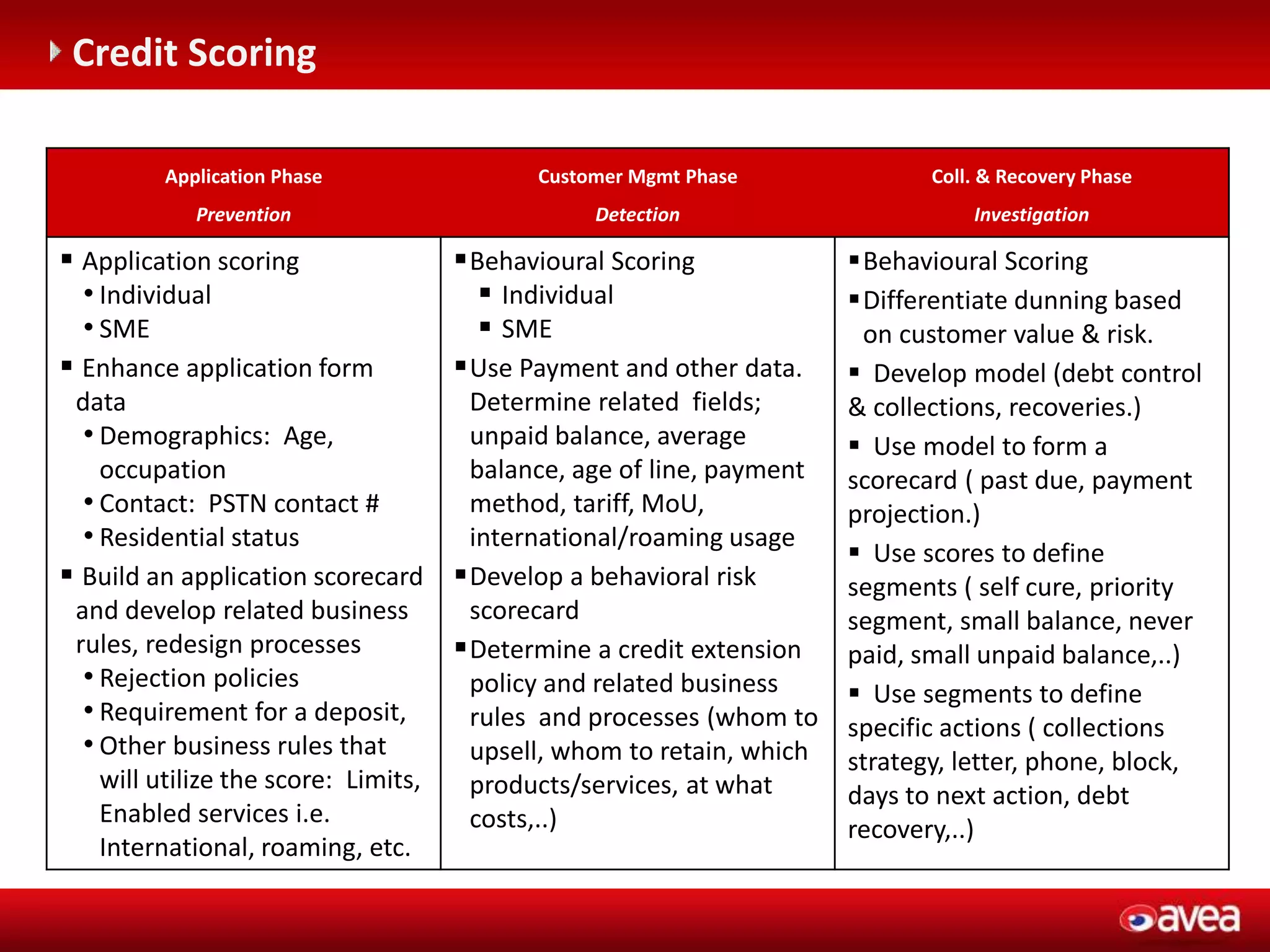
Credit Scoring
Application Phase
Prevention
Customer Mgmt Phase
Detection
Coll. & Recovery Phase
Investigation
 Application scoring
• Individual
• SME
 Enhance application form
data
• Demographics: Age,
occupation
• Contact: PSTN contact #
• Residential status
 Build an application scorecard
and develop related business
rules, redesign processes
• Rejection policies
• Requirement for a deposit,
• Other business rules that
will utilize the score: Limits,
Enabled services i.e.
International, roaming, etc.
Behavioural Scoring
 Individual
 SME
Use Payment and other data.
Determine related fields;
unpaid balance, average
balance, age of line, payment
method, tariff, MoU,
international/roaming usage
Develop a behavioral risk
scorecard
Determine a credit extension
policy and related business
rules and processes (whom to
upsell, whom to retain, which
products/services, at what
costs,..)
Behavioural Scoring
Differentiate dunning based
on customer value & risk.
 Develop model (debt control
& collections, recoveries.)
 Use model to form a
scorecard ( past due, payment
projection.)
 Use scores to define
segments ( self cure, priority
segment, small balance, never
paid, small unpaid balance,..)
 Use segments to define
specific actions ( collections
strategy, letter, phone, block,
days to next action, debt
recovery,..)
C (entegrasyonu gerektirir)
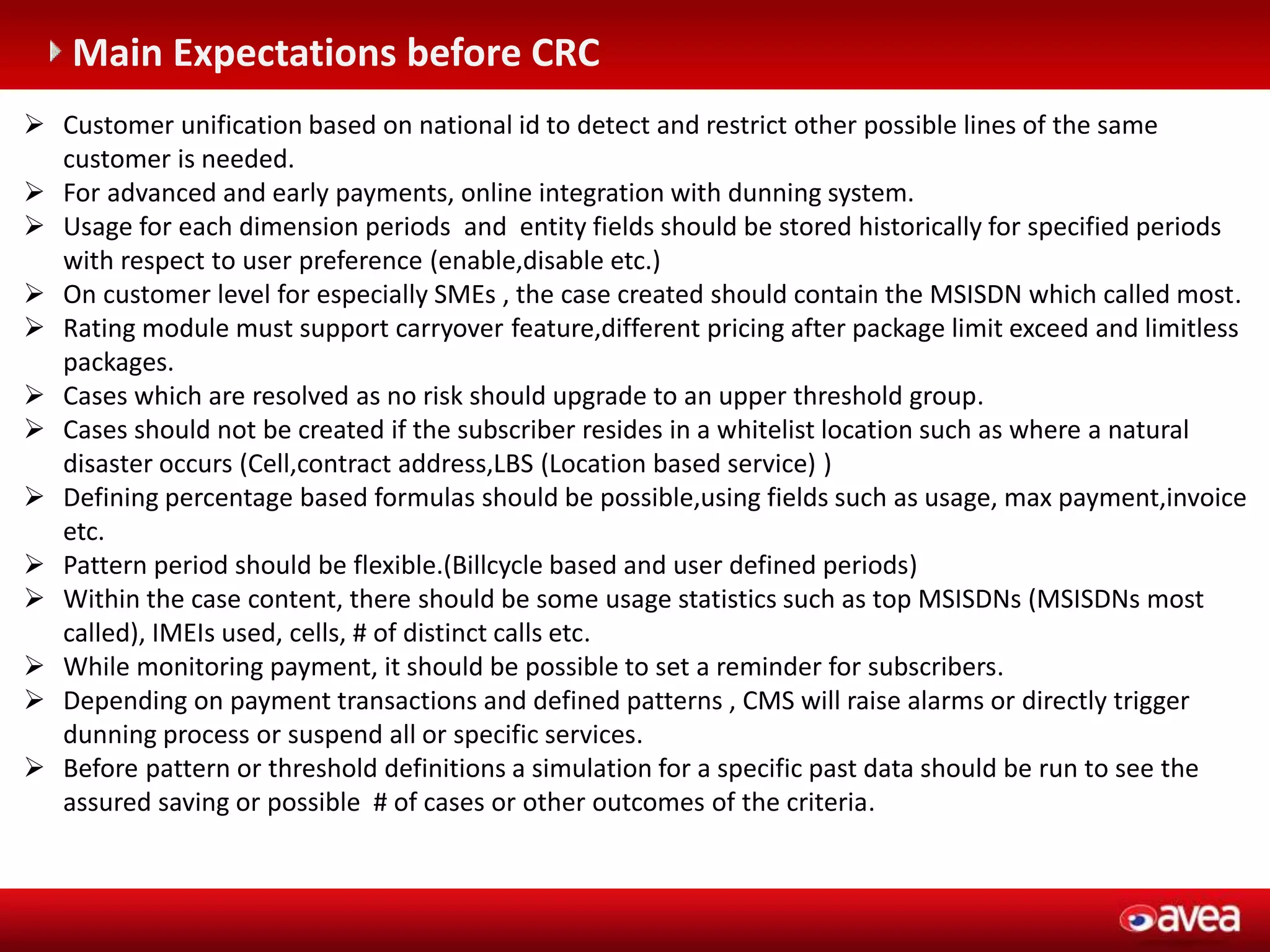
Main Expectations before CRC
 Customer unification based on national id to detect and restrict other possible lines of the same
customer is needed.
 For advanced and early payments, online integration with dunning system.
 Usage for each dimension periods and entity fields should be stored historically for specified periods
with respect to user preference (enable,disable etc.)
 On customer level for especially SMEs , the case created should contain the MSISDN which called most.
 Rating module must support carryover feature,different pricing after package limit exceed and limitless
packages.
 Cases which are resolved as no risk should upgrade to an upper threshold group.
 Cases should not be created if the subscriber resides in a whitelist location such as where a natural
disaster occurs (Cell,contract address,LBS (Location based service) )
 Defining percentage based formulas should be possible,using fields such as usage, max payment,invoice
etc.
 Pattern period should be flexible.(Billcycle based and user defined periods)
 Within the case content, there should be some usage statistics such as top MSISDNs (MSISDNs most
called), IMEIs used, cells, # of distinct calls etc.
 While monitoring payment, it should be possible to set a reminder for subscribers.
 Depending on payment transactions and defined patterns , CMS will raise alarms or directly trigger
dunning process or suspend all or specific services.
 Before pattern or threshold definitions a simulation for a specific past data should be run to see the
assured saving or possible # of cases or other outcomes of the criteria.
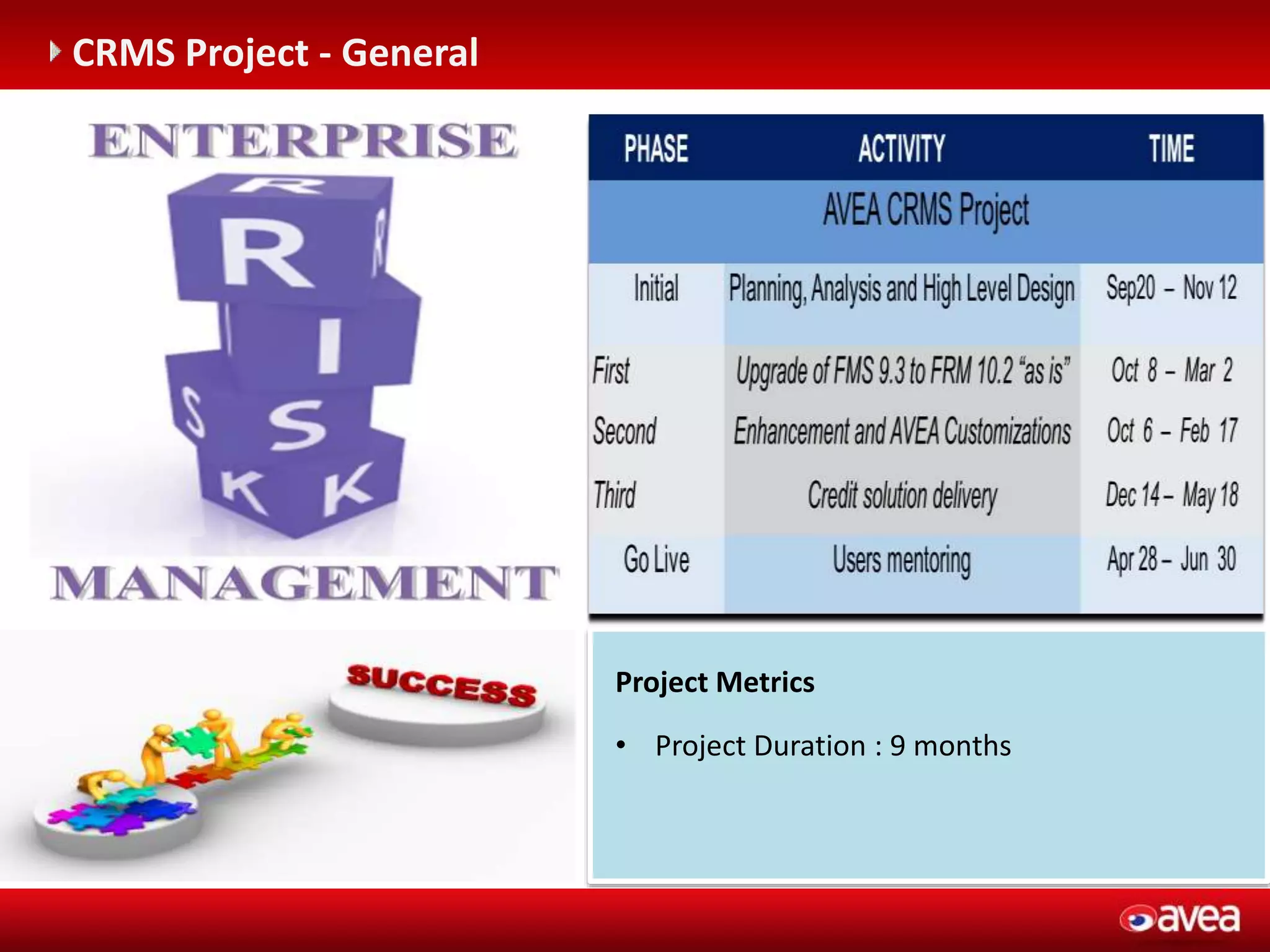
Project Metrics
• Project Duration : 9 months
CRMS Project - General
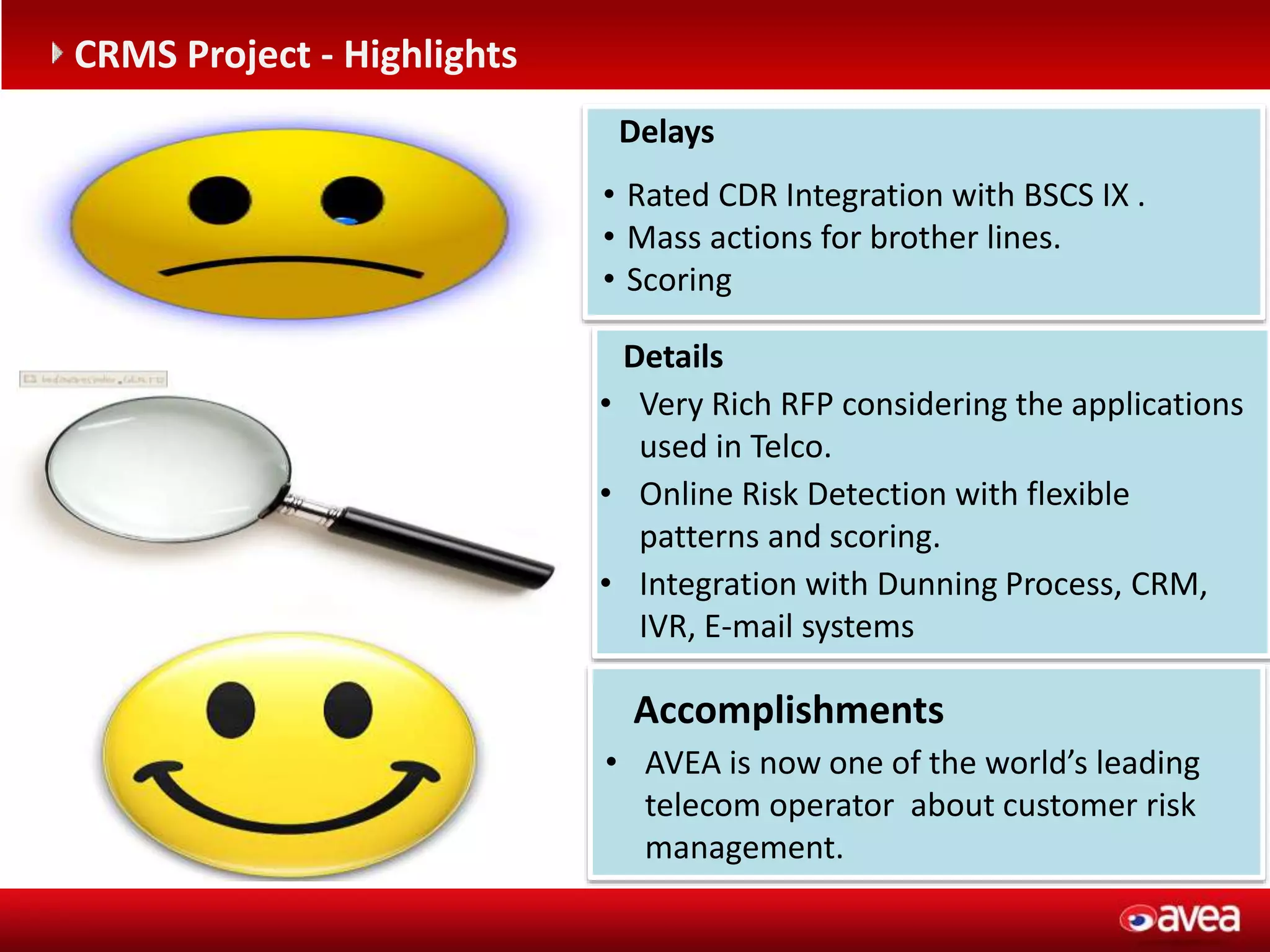
Accomplishments
• AVEA is now one of the world’s leading
telecom operator about customer risk
management.
Delays
• Rated CDR Integration with BSCS IX .
• Mass actions for brother lines.
• Scoring
Details
• Very Rich RFP considering the applications
used in Telco.
• Online Risk Detection with flexible
patterns and scoring.
• Integration with Dunning Process, CRM,
IVR, E-mail systems
CRMS Project - Highlights
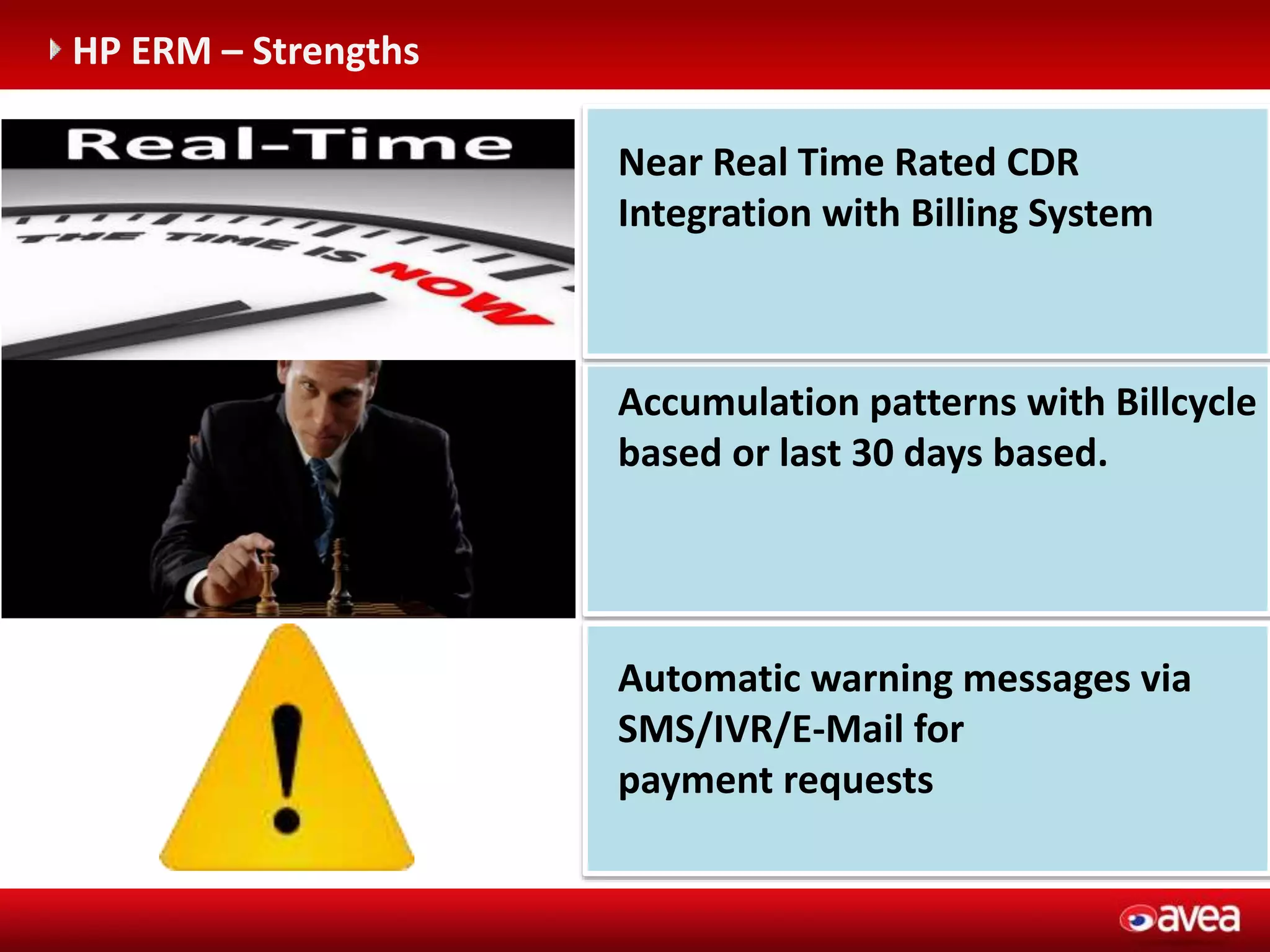
Automatic warning messages via
SMS/IVR/E-Mail for
payment requests
Near Real Time Rated CDR
Integration with Billing System
Accumulation patterns with Billcycle
based or last 30 days based.
HP ERM – Strengths
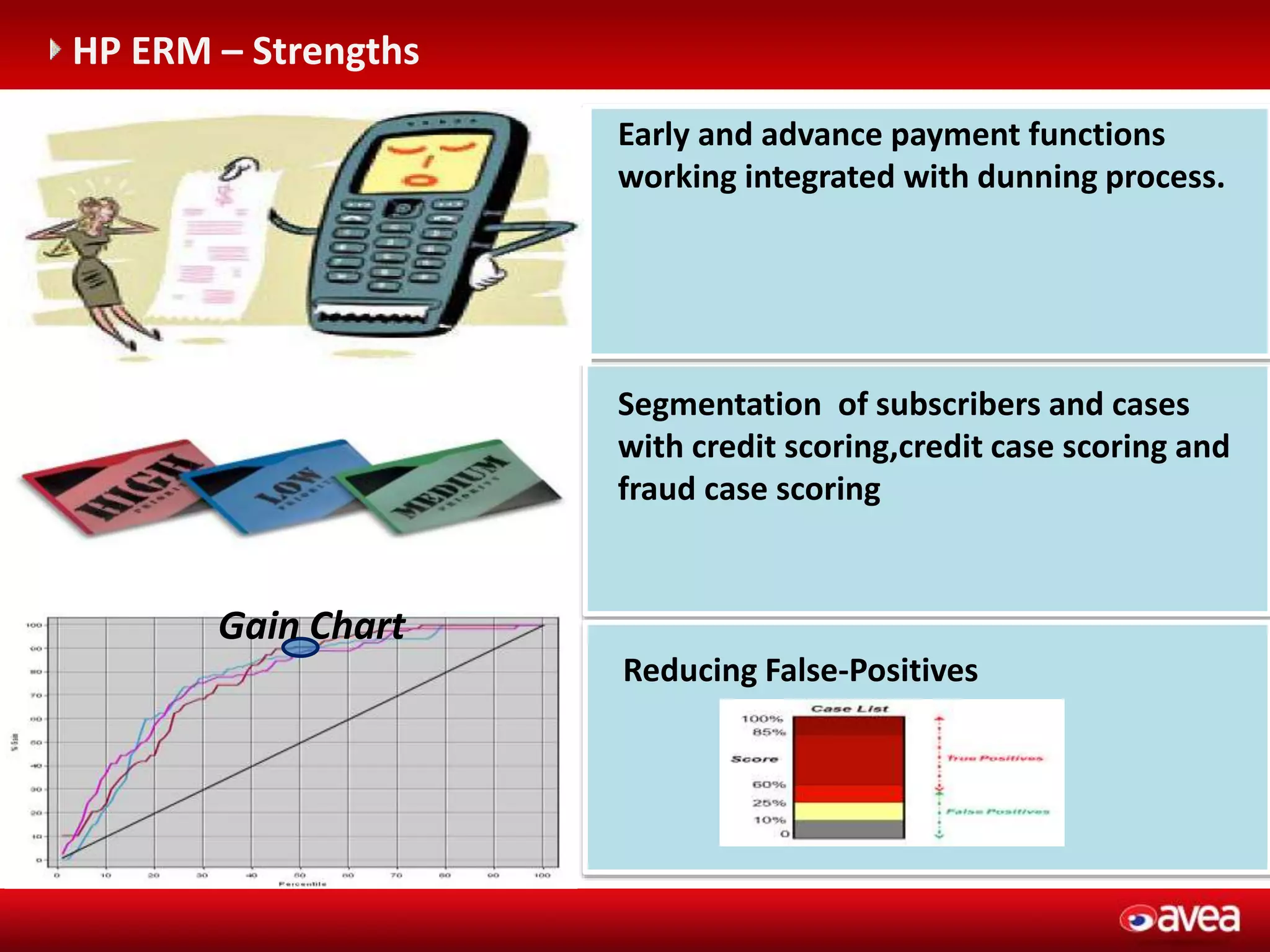
Early and advance payment functions
working integrated with dunning process.
Segmentation of subscribers and cases
with credit scoring,credit case scoring and
fraud case scoring
HP ERM – Strengths
Gain Chart
Reducing False-Positives
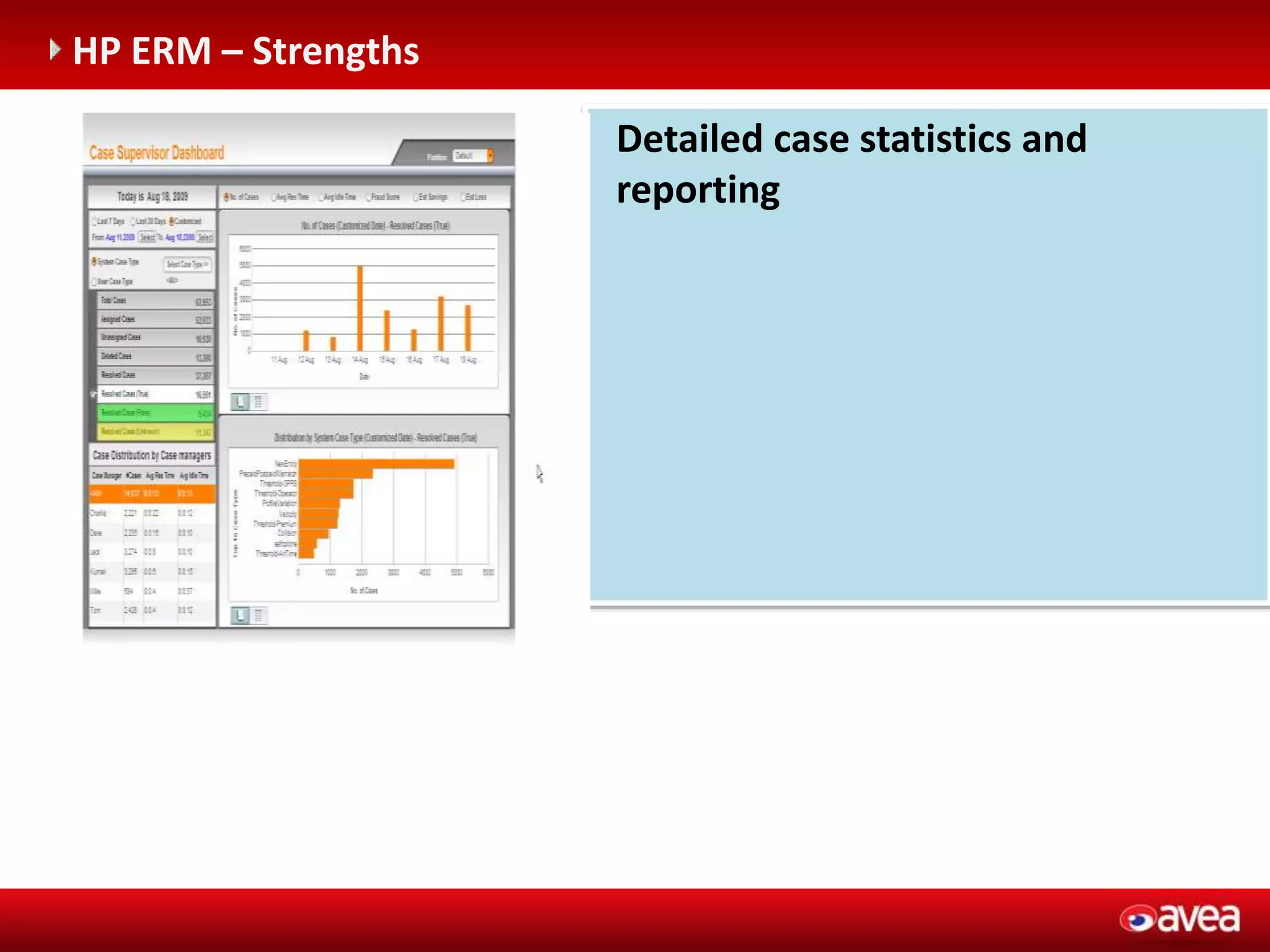
Detailed case statistics and
reporting
HP ERM – Strengths
HP ERM – Strengths
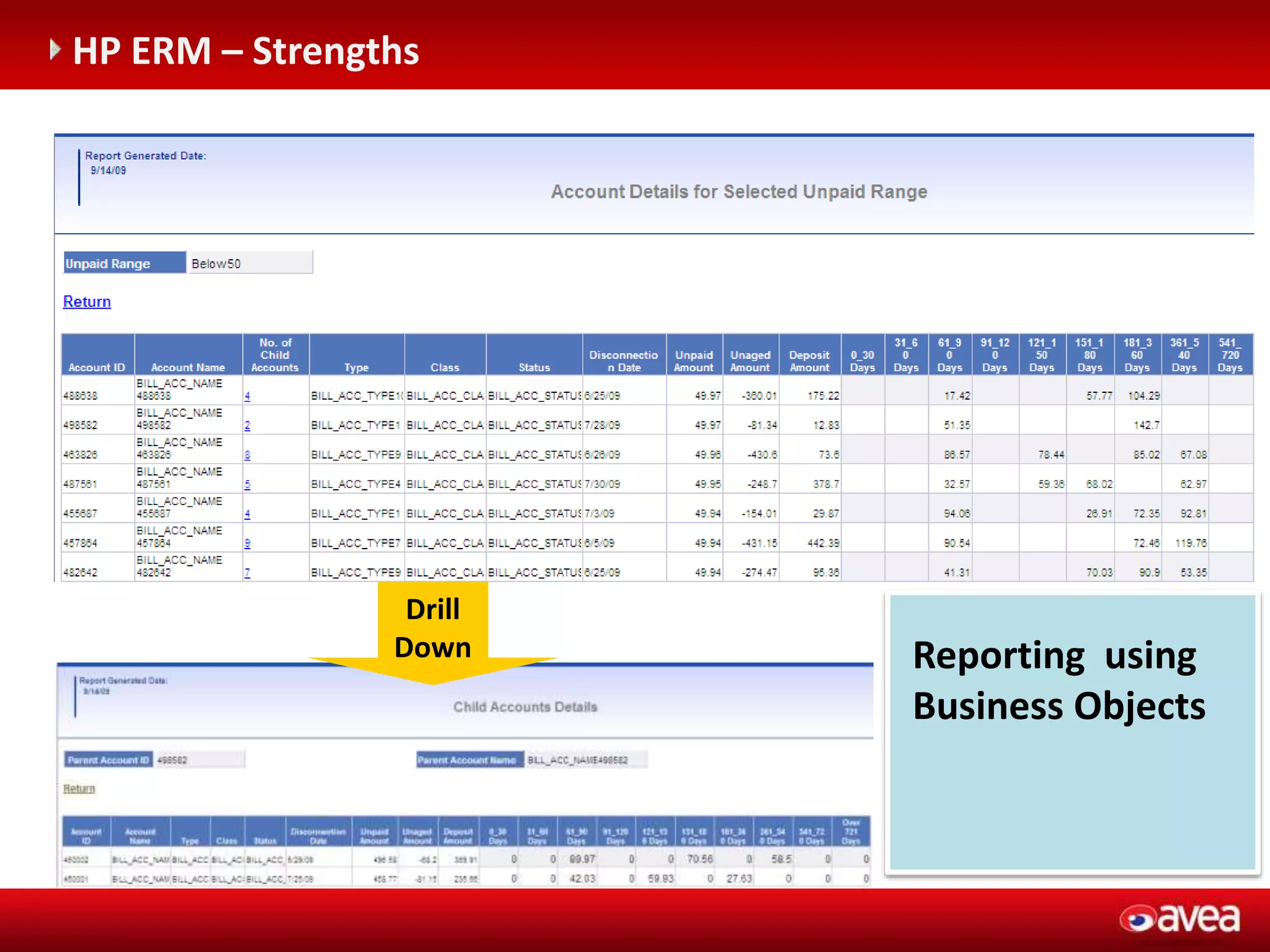
Drill
Down Reporting using
Business Objects
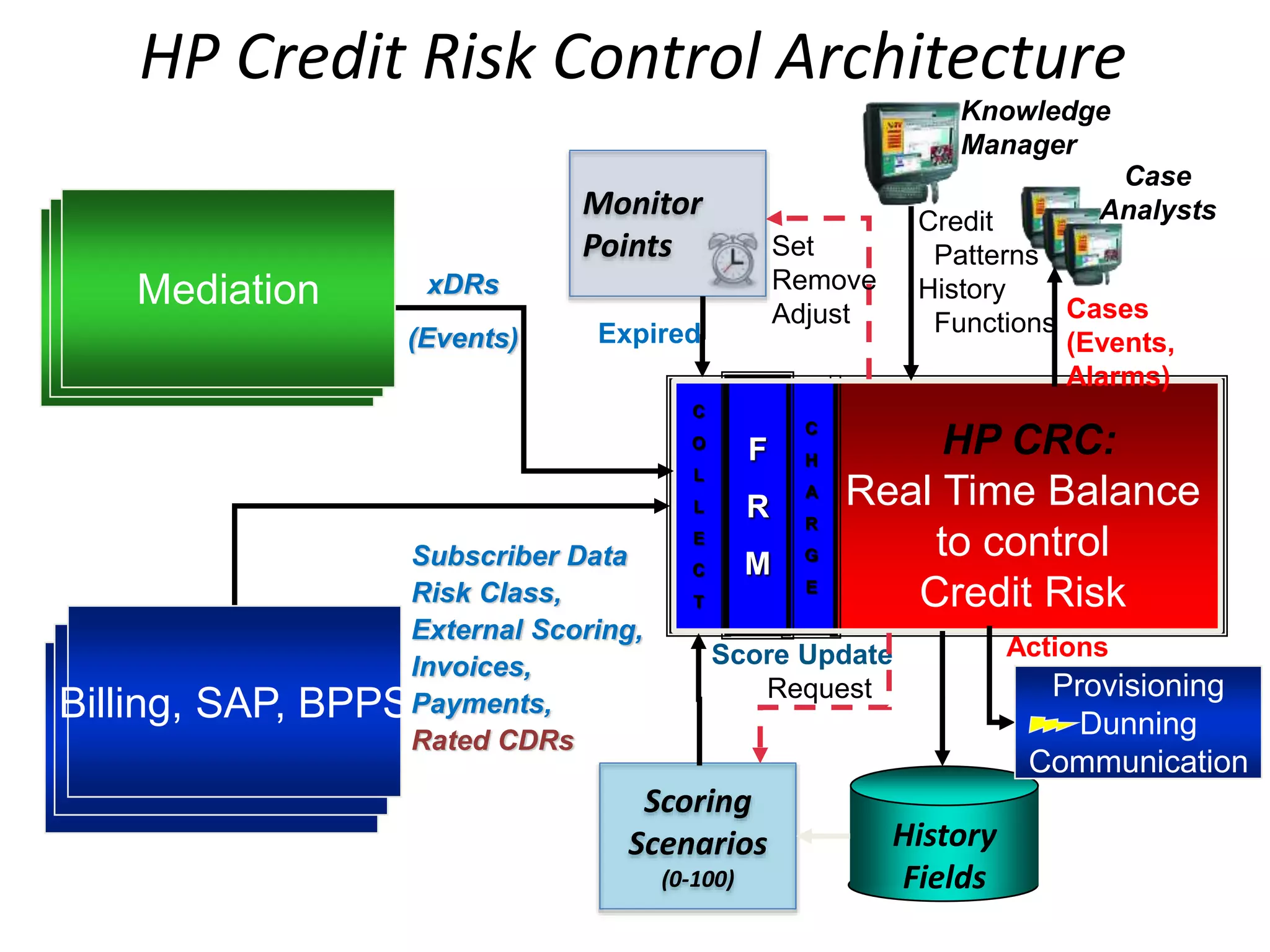
HP CRC:
Real Time Balance
to control
Credit Risk
C
O
L
L
E
C
T
C
H
A
R
G
E
F
R
M
HP Credit Risk Control Architecture
History
Fields
Knowledge
Manager
Credit
Patterns
History
Functions
Case
Analysts
Cases
(Events,
Alarms)
Monitor
Points Set
Remove
Adjust
Expired
Scoring
Scenarios
(0-100)
Score Update
Request Provisioning
Dunning
Communication
Actions
Subscriber Data
Risk Class,
External Scoring,
Invoices,
Payments,
Rated CDRsCRMCRMBilling, SAP, BPPS
xDRs
(Events)
Mediation
C (entegrasyonu gerektirir)
Credit Risk Operations – Examples
 10.000 cases per month , $ 1 milion payment request
C (entegrasyonu gerektirir)
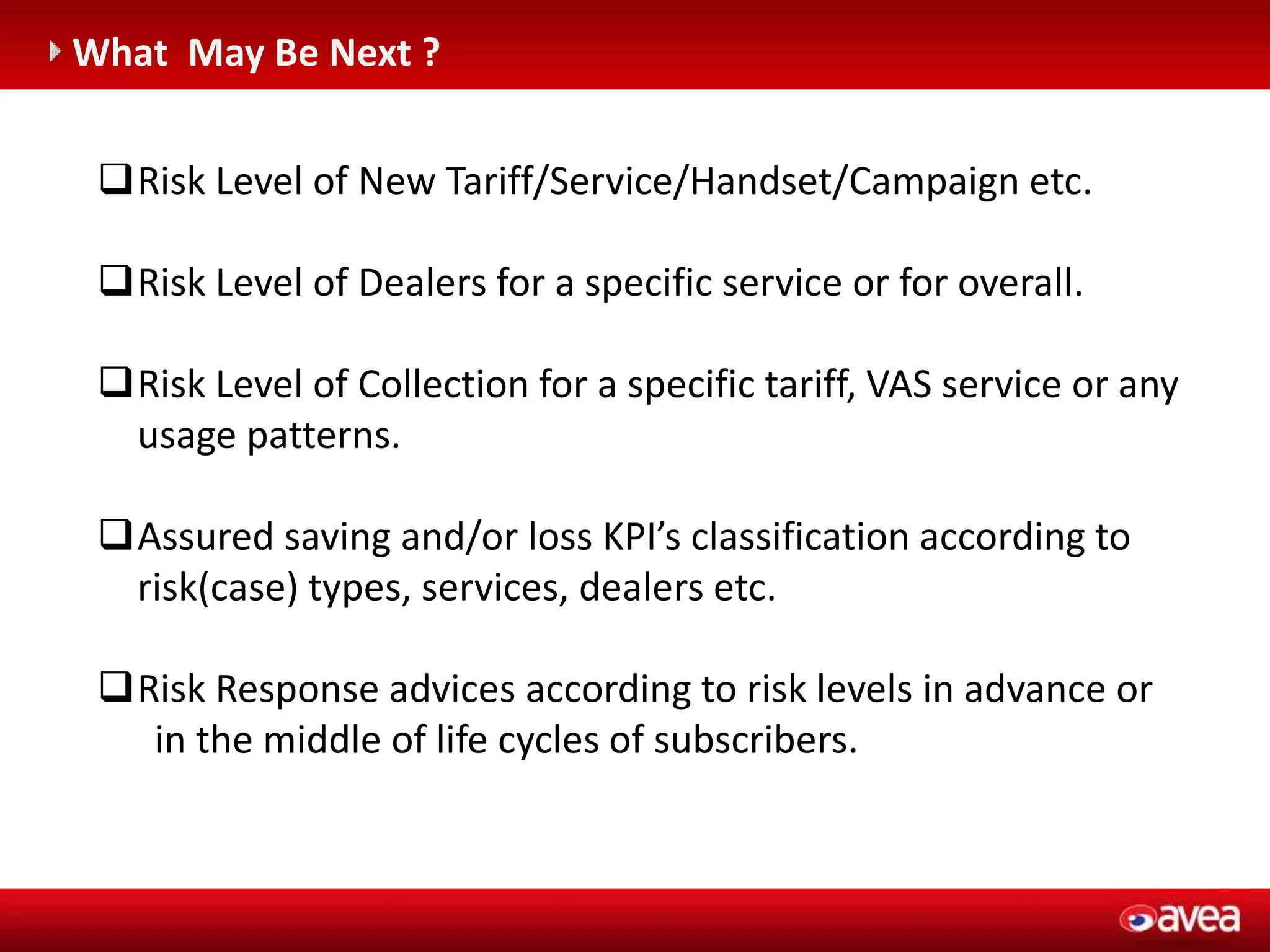
What May Be Next ?
Risk Level of New Tariff/Service/Handset/Campaign etc.
Risk Level of Dealers for a specific service or for overall.
Risk Level of Collection for a specific tariff, VAS service or any
usage patterns.
Assured saving and/or loss KPI’s classification according to
risk(case) types, services, dealers etc.
Risk Response advices according to risk levels in advance or
in the middle of life cycles of subscribers.
©2012 HP Confidential19 ©2012 HP Confidential19
Q&A

CRMS_Project-JF-edits

  • 1.
    ©2012 HP Confidential1 HasanFehmi GENCER – AVEA 19 March 2012 O Antalya Turkey 19 – 20 March 2012 HP REVENUE INTELLIGENCE USER FORUM
  • 2.
    ©2012 HP Confidential2©2012 HP Confidential2 HP REVENUE INTELLIGENCE USER FORUM Antalya Turkey 19 – 20 March 2012 Credit Risk Management
  • 3.
    ©2012 HP Confidential3 Fraud & Credit Risk Mng. Overview Fraud Will not Pay Credit Risk Can not pay Revenue Assurance Don’t have to pay Fraud & Credit Risk Management is the big portion of Revenue Loss Management. And there is a considerably high intersection betwen Fraud & Credit Risk Mng.  Blacklist & Graylist Intersection Blacklist Graylist Normally, GL Pool is much bigger than BL Pool and 10-15 % of BL Subscribers is also in GL Pool for many various reasons. 15% Fraud & Credit Risk Management Vision
  • 4.
    ©2012 HP Confidential4 Enterprise System Relations  Online detection,taking action  Transaction(CDR,Payment, Status etc.) History  Billcycle or pattern period based monitoring  Risk level based threshold settings  Zone based analysis  Fuzzy search technology  Alarm/Case generation  Scoring with Data Mining  High availability  High Performance  Link Analysis Techniques  Finger Print  Cell based analysis  Dealer Performance & Loss by Dealer  Case pass  Rating  Assured saving calculations  Last X months transaction analysis  NRTRDE (Roaming Usage Detection)  Partial CDR (early detection need) Relationship between Fraud & Credit Risk Systems
  • 5.
    Credit Risk ManagementSolutions 2006 Feb. 2008 May.2008 Jul.2008 Sep.2008 Oct.2008 Nov.2008 Feb.2009 Mar.2009 Apr.2009 May 2009 Oct.2009 Sep.2010 Graylist Phase I Graylist Phase II Online Prevention Exact Match Online Prevention Fuzzy Match Graylist Pool Enhancement Graylist Phase III Online Prevention In MNP Usage Based Risk Detection (Using FMS) High Profile Usage Program Online Prevention Fuzzy Match II Graylist Improvement Project Graylist Pool Enhancement II Credit Risk Mng. Project Kick-off  Credit Risk Mng. Preventions have been started in 2006.  Preventions have been enriched with Fuzzy match logics and Graylist Pool Enhancements  Number Portability Preventions have been added.  Dealer system started to provide recent debt,YTS information of prevented subscribers  Usage based risk detection has been started in FMS.  BNP Hotline and BNP Suspend lines added to graylist pool in Oct.2009 Credit Scoring Project Kick-off Nov.2010 Credit Risk Solutions before CRC Detailed RFP has been prepared for CRMS and project has started in Sep.2010. Credit Scoring Project has started in Nov.2010.
  • 6.
    C (entegrasyonu gerektirir) GraylistPool Enhancements 53% 4%4% 31% 8% Credit Risky Subsc. BNP Deactive BNP Hotline BNP Suspend Other Deactive YTS 87% 1% 1% 4% 7% Debt BNP Deactive BNP Hotline BNP Suspend Other Deactive YTS  GL Pool is enlarged with subscribers in all deactive reasons (Debt > 20 TL) and in Bill Not Paid Hotline and Bill Not Paid Suspend statuses (Debt > 50 TL). With this enlargement, subscribers in Dunning process are not able to have a new line unless payment is received.
  • 7.
    C (entegrasyonu gerektirir) Applicationsbefore CRC GL: New activations who previously had deactivated lines due to unpaid bills are prevented. Grey list is embedded on dealer system so should there is a new activation attempt for a debtor, the system stops the process and informs the dealer about the unpaid amount. Hotlist: Active customers with unpaid bills on other accounts (in hotline or suspend status due to unpaid bills) are blocked for new activations. HPU: High Profile Usage program – Credit risk related cases generated in FMS is transfered to another system.After some filtering logic is applied, advance payment or promise to pay is asked for the related subscribers and logged into HPU. FtoC: Fraud group is filtering out the customers with credit risk they have analyzed (non fraudsters) and send them to credit group. Credit group takes action (restriction, advance payment of bill etc) accordingly.
  • 8.
    C (entegrasyonu gerektirir) CreditScoring Application Phase Prevention Customer Mgmt Phase Detection Coll. & Recovery Phase Investigation  Application scoring • Individual • SME  Enhance application form data • Demographics: Age, occupation • Contact: PSTN contact # • Residential status  Build an application scorecard and develop related business rules, redesign processes • Rejection policies • Requirement for a deposit, • Other business rules that will utilize the score: Limits, Enabled services i.e. International, roaming, etc. Behavioural Scoring  Individual  SME Use Payment and other data. Determine related fields; unpaid balance, average balance, age of line, payment method, tariff, MoU, international/roaming usage Develop a behavioral risk scorecard Determine a credit extension policy and related business rules and processes (whom to upsell, whom to retain, which products/services, at what costs,..) Behavioural Scoring Differentiate dunning based on customer value & risk.  Develop model (debt control & collections, recoveries.)  Use model to form a scorecard ( past due, payment projection.)  Use scores to define segments ( self cure, priority segment, small balance, never paid, small unpaid balance,..)  Use segments to define specific actions ( collections strategy, letter, phone, block, days to next action, debt recovery,..)
  • 9.
    C (entegrasyonu gerektirir) MainExpectations before CRC  Customer unification based on national id to detect and restrict other possible lines of the same customer is needed.  For advanced and early payments, online integration with dunning system.  Usage for each dimension periods and entity fields should be stored historically for specified periods with respect to user preference (enable,disable etc.)  On customer level for especially SMEs , the case created should contain the MSISDN which called most.  Rating module must support carryover feature,different pricing after package limit exceed and limitless packages.  Cases which are resolved as no risk should upgrade to an upper threshold group.  Cases should not be created if the subscriber resides in a whitelist location such as where a natural disaster occurs (Cell,contract address,LBS (Location based service) )  Defining percentage based formulas should be possible,using fields such as usage, max payment,invoice etc.  Pattern period should be flexible.(Billcycle based and user defined periods)  Within the case content, there should be some usage statistics such as top MSISDNs (MSISDNs most called), IMEIs used, cells, # of distinct calls etc.  While monitoring payment, it should be possible to set a reminder for subscribers.  Depending on payment transactions and defined patterns , CMS will raise alarms or directly trigger dunning process or suspend all or specific services.  Before pattern or threshold definitions a simulation for a specific past data should be run to see the assured saving or possible # of cases or other outcomes of the criteria.
  • 10.
    Project Metrics • ProjectDuration : 9 months CRMS Project - General
  • 11.
    Accomplishments • AVEA isnow one of the world’s leading telecom operator about customer risk management. Delays • Rated CDR Integration with BSCS IX . • Mass actions for brother lines. • Scoring Details • Very Rich RFP considering the applications used in Telco. • Online Risk Detection with flexible patterns and scoring. • Integration with Dunning Process, CRM, IVR, E-mail systems CRMS Project - Highlights
  • 12.
    Automatic warning messagesvia SMS/IVR/E-Mail for payment requests Near Real Time Rated CDR Integration with Billing System Accumulation patterns with Billcycle based or last 30 days based. HP ERM – Strengths
  • 13.
    Early and advancepayment functions working integrated with dunning process. Segmentation of subscribers and cases with credit scoring,credit case scoring and fraud case scoring HP ERM – Strengths Gain Chart Reducing False-Positives
  • 14.
    Detailed case statisticsand reporting HP ERM – Strengths
  • 15.
    HP ERM –Strengths Drill Down Reporting using Business Objects
  • 16.
    HP CRC: Real TimeBalance to control Credit Risk C O L L E C T C H A R G E F R M HP Credit Risk Control Architecture History Fields Knowledge Manager Credit Patterns History Functions Case Analysts Cases (Events, Alarms) Monitor Points Set Remove Adjust Expired Scoring Scenarios (0-100) Score Update Request Provisioning Dunning Communication Actions Subscriber Data Risk Class, External Scoring, Invoices, Payments, Rated CDRsCRMCRMBilling, SAP, BPPS xDRs (Events) Mediation
  • 17.
    C (entegrasyonu gerektirir) CreditRisk Operations – Examples  10.000 cases per month , $ 1 milion payment request
  • 18.
    C (entegrasyonu gerektirir) WhatMay Be Next ? Risk Level of New Tariff/Service/Handset/Campaign etc. Risk Level of Dealers for a specific service or for overall. Risk Level of Collection for a specific tariff, VAS service or any usage patterns. Assured saving and/or loss KPI’s classification according to risk(case) types, services, dealers etc. Risk Response advices according to risk levels in advance or in the middle of life cycles of subscribers.
  • 19.
    ©2012 HP Confidential19©2012 HP Confidential19 Q&A