Order to Cash
Overview
Training
Koushik Bagchi
ikoushik@gmail.com
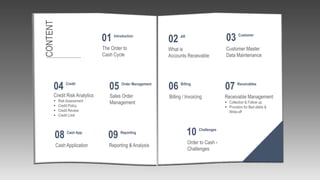
CONTENT
01 Introduction
The Order to
Cash Cycle
02 AR
What is
Accounts Receivable
03 Customer
Customer Master
Data Maintenance
04 Credit
Credit Risk Analytics
 Risk Assessment
 Credit Policy
 Credit Review
 Credit Limit
05 Order Management
Sales Order
Management
06 Billing
Billing / Invoicing
07 Receivables
Receivable Management
 Collection & Follow up
 Provision for Bad debts &
Write-off
08 Cash App
Cash Application
09 Reporting
Reporting & Analysis
10 Challenges
Order to Cash -
Challenges
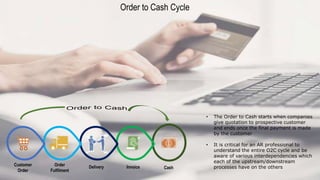
• The Order to Cash starts when companies
give quotation to prospective customer
and ends once the final payment is made
by the customer
• It is critical for an AR professional to
understand the entire O2C cycle and be
aware of various interdependencies which
each of the upstream/downstream
processes have on the others
Order to Cash Cycle
Customer
Order
Order
Fulfilment
Delivery Invoice Cash
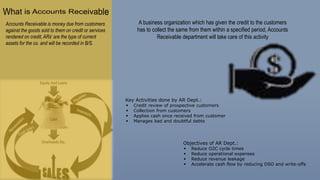
Key Activities done by AR Dept.:
 Credit review of prospective customers
 Collection from customers
 Applies cash once received from customer
 Manages bad and doubtful debts
Accounts Receivable is money due from customers
against the goods sold to them on credit or services
rendered on credit, ARs’ are the type of current
assets for the co. and will be recorded in B/S.
A business organization which has given the credit to the customers
has to collect the same from them within a specified period, Accounts
Receivable department will take care of this activity
Objectives of AR Dept.:
 Reduce O2C cycle times
 Reduce operational expenses
 Reduce revenue leakage
 Accelerate cash flow by reducing DSO and write-offs
Steps Involved:
• Receive request from Customer / Sales team, through email, fax etc.
• Check for duplicate in ERP, if found duplicate - inform customer / sales team
• Check for availability of required details - Name, Tax ID, Address etc.
• Create customer in ERP
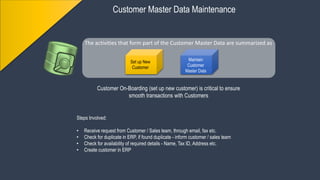
Customer On-Boarding (set up new customer) is critical to ensure
smooth transactions with Customers
Customer Master Data Maintenance
The activities that form part of the Customer Master Data are summarized as
Set up New
Customer
Maintain
Customer
Master Data
Credit Risk - refers to the risk that borrower will fail to make payments which he is obligated to do,
this risk is borne by the lender (companies), impacts could be lost principal and interest / disruption
to C/F & collection costs
Customer is asked to provide all relevant documents & Financial statements, which is evaluated
through relevant models/scorecards to determine the financial stability of the borrower (customer)
Result of which would help deciding the term of business and credit limits with the customer
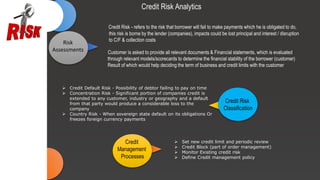
Credit Risk Analytics
 Set new credit limit and periodic review
 Credit Block (part of order management)
 Monitor Existing credit risk
 Define Credit management policy
 Credit Default Risk - Possibility of debtor failing to pay on time
 Concentration Risk - Significant portion of companies credit is
extended to any customer, industry or geography and a default
from that party would produce a considerable loss to the
company
 Country Risk - When sovereign state default on its obligations Or
freezes foreign currency payments
Risk
Assessments
Credit Risk
Classification
Credit
Management
Processes
Credit Policy - Policy gives guidelines for deciding on the credit period allowable and the credit limit in term of amount of credit.
These issues normally consider the creditworthiness & financial strength of prospective customer and accordingly decide as to
what amount and for which period the credit can be offered
Credit Review Process
While doing the credit review of the prospective customers, the company assesses:
 Ability of the customer to pay (Financial Risk) - Risk is normally measured using the profitability ratios, such as NP ratio / GP ratio /
ROI etc.
 Timing Risk (Ability to pay on time) - Judgement can be taken based on Cash flow position of the customer, cash flow and liquidity
ratios are used to judge the liquidity positions (current ratio, quick ratio, debt to equity ratio etc.)
 Willingness or intentions of the customer to pay - The willingness and compliance to pay can be assessed by trade references and
keeping a record of customer history of dealing with the firm
At the end of the credit review process the company will fix up the credit limit for the customer !
Credit Policy And Review
Credit Limit - Includes below:
 Credit Period - Duration allowed to the customer for granting credit
 Credit Amount - Maximum limit of amount for credit allowed to a customer, for example - if a customer carries a credit limit of $ 10,000,
we can continue to make credit sale to that customer as long as the total outstanding credit to the customer does not exceed $ 10,000
Credit Terms :
 Open Credit - This means that dues would be paid by the customer after a specified duration, credit term is expressed using the
term ‘Net + No. of days’. If open credit shown as “Net 30”, it means customer is liable to pay within/up to 30 days from the date of invoice.
Open credit does not mean credit term is open or infinite
 Partial Pre payment and partial credit - Term 25:75 means 25% to be pre paid and 75 % on credit based on term
 Payment upon delivery, Letter of Credit, Bank Guarantee, Prepayment etc.
Types of Discounts & Allowances :
 Early Pay - “2/10 Net 30”
 Quantity Discount - Discounts on large quantity ordered
 Seasonal Discount - Slack period of Off season discount
 Rebate - Price reduction given to customer as a part of a scheme generally after the sale happens
Credit Limit
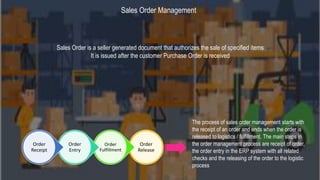
Sales Order Management
Sales Order is a seller generated document that authorizes the sale of specified items
It is issued after the customer Purchase Order is received
The process of sales order management starts with
the receipt of an order and ends when the order is
released to logistics / fulfillment. The main steps in
the order management process are receipt of order,
the order entry in the ERP system with all related
checks and the releasing of the order to the logistic
process
Order
Release
Order
Fulfillment
Order
Entry
Order
Receipt
Main objective is the timely production of a unique faultless
document that is compliant with local regulation and agreement
Main content of Invoice:
• Detailed description of Product/Services
purchased by customer
• Quantities
• Rates
• Total amount due, due dates
• Customer name and address, Tax ID etc.
Billing Or invoicing
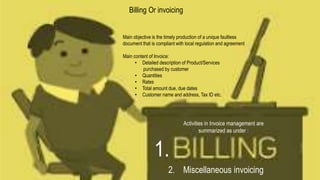
Activities in Invoice management are
summarized as under :
1.
2. Miscellaneous invoicing
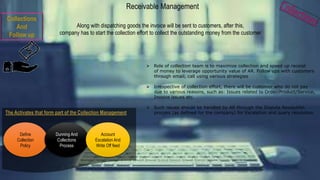
Along with dispatching goods the invoice will be sent to customers, after this,
company has to start the collection effort to collect the outstanding money from the customer
 Role of collection team is to maximize collection and speed up receipt
of money to leverage opportunity value of AR. Follow ups with customers
through email, call using various strategies
 Irrespective of collection effort, there will be customer who do not pay
due to various reasons, such as: Issues related to Order/Product/Service,
Invoice issues etc.
 Such issues should be handled by AR through the Dispute Resolution
process (as defined for the company) for Escalation and query resolution
Receivable Management
Collections
And
Follow up
Define
Collection
Policy
Dunning And
Collections
Process
Account
Escalation And
Write Off feed
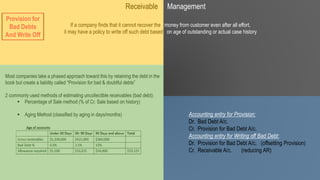
If a company finds that it cannot recover the money from customer even after all effort,
it may have a policy to write off such debt based on age of outstanding or actual case history
Most companies take a phased approach toward this by retaining the debt in the
book but create a liability called “Provision for bad & doubtful debts”
2 commonly used methods of estimating uncollectible receivables (bad debt):
 Percentage of Sale method (% of Cr. Sale based on history)
 Aging Method (classified by aging in days/months)
Receivable Management
Provision for
Bad Debts
And Write Off
Accounting entry for Provision:
Dr. Bad Debt A/c.
Cr. Provision for Bad Debt A/c.
Accounting entry for Writing off Bad Debt:
Dr. Provision for Bad Debt A/c. (offsetting Provision)
Cr. Receivable A/c. (reducing AR)
The objective of the cash application process is to ensure that incoming payments received from
customers are banked immediately and allocated accurately to the customers’ accounts, and to ensure
that defaulted incoming payments (checks refused by bank) are identified and followed up immediately.
Starting point for the cash application process is the bank statement showing the latest cash movements.
The cash application process reconciles all the incoming and outgoing flows as shown on the daily bank
statement and post the reconciled items to the ERP system
Cash Application
Cash App
E-Bank
Statements
Solve
unapplied /
unidentified
items
Cash App
Cheque
Payments
Activities in Cash Application
 Every receipt should be applied against the invoice for which payment is
being made (using remittance)
 In case remittance is not provided, money could be temporarily parked to by
applying it to customer as an on account payment
 If customer name is also not known, receipt should be kept in suspense
account. However missing details should be identified on priority to apply
receipt against the invoice
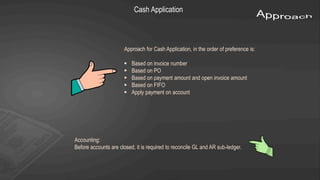
Approach for Cash Application, in the order of preference is:
 Based on invoice number
 Based on PO
 Based on payment amount and open invoice amount
 Based on FIFO
 Apply payment on account
Cash Application
Accounting:
Before accounts are closed, it is required to reconcile GL and AR sub-ledger.
To ensure proper quality monitoring of O2C process a series of metrics can be used to keep track of
the process performance, some of them are :
 Accuracy percentage of activities
 Days Sales Outstanding (DSO) - No. of days it takes on average to collect from customers
 Past due percentage
 Aged outstanding
 TAT & Productivity metrics
Reporting And Analytics
DSO =
𝑇𝑜𝑡𝑎𝑙 𝑅𝑒𝑐𝑒𝑖𝑣𝑎𝑏𝑙𝑒
𝑇𝑜𝑡𝑎𝑙 𝐶𝑟𝑒𝑑𝑖𝑡 𝑆𝑎𝑙𝑒𝑠
∗ 𝐷𝑎𝑦𝑠 𝑖𝑛 𝑆𝑎𝑙𝑒𝑠fx
Objectives FY 19 Goals Actuals
Over 60 Days Balance < or = 5% < 5%
Over 150 Days Balance < or = 1.5% < 1.5%
DSO 65 Days 70 Days
WHT Balance < or = 7% 5 %
Unapplied Cash $100 K $50 K
Example of SLA Metrics for Accounts Receivable
Reporting And Analytics
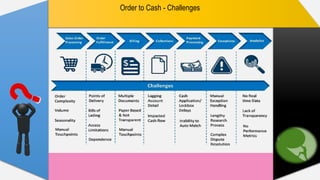
Order to Cash - Challenges
Thank You
Koushik Bagchi
ikoushik@gmail.com

Order to Cash Overview - Training

  • 1.
    Order to Cash Overview Training KoushikBagchi ikoushik@gmail.com
  • 2.
    CONTENT 01 Introduction The Orderto Cash Cycle 02 AR What is Accounts Receivable 03 Customer Customer Master Data Maintenance 04 Credit Credit Risk Analytics  Risk Assessment  Credit Policy  Credit Review  Credit Limit 05 Order Management Sales Order Management 06 Billing Billing / Invoicing 07 Receivables Receivable Management  Collection & Follow up  Provision for Bad debts & Write-off 08 Cash App Cash Application 09 Reporting Reporting & Analysis 10 Challenges Order to Cash - Challenges
  • 3.
    • The Orderto Cash starts when companies give quotation to prospective customer and ends once the final payment is made by the customer • It is critical for an AR professional to understand the entire O2C cycle and be aware of various interdependencies which each of the upstream/downstream processes have on the others Order to Cash Cycle Customer Order Order Fulfilment Delivery Invoice Cash
  • 4.
    Key Activities doneby AR Dept.:  Credit review of prospective customers  Collection from customers  Applies cash once received from customer  Manages bad and doubtful debts Accounts Receivable is money due from customers against the goods sold to them on credit or services rendered on credit, ARs’ are the type of current assets for the co. and will be recorded in B/S. A business organization which has given the credit to the customers has to collect the same from them within a specified period, Accounts Receivable department will take care of this activity Objectives of AR Dept.:  Reduce O2C cycle times  Reduce operational expenses  Reduce revenue leakage  Accelerate cash flow by reducing DSO and write-offs
  • 5.
    Steps Involved: • Receiverequest from Customer / Sales team, through email, fax etc. • Check for duplicate in ERP, if found duplicate - inform customer / sales team • Check for availability of required details - Name, Tax ID, Address etc. • Create customer in ERP Customer On-Boarding (set up new customer) is critical to ensure smooth transactions with Customers Customer Master Data Maintenance The activities that form part of the Customer Master Data are summarized as Set up New Customer Maintain Customer Master Data
  • 6.
    Credit Risk -refers to the risk that borrower will fail to make payments which he is obligated to do, this risk is borne by the lender (companies), impacts could be lost principal and interest / disruption to C/F & collection costs Customer is asked to provide all relevant documents & Financial statements, which is evaluated through relevant models/scorecards to determine the financial stability of the borrower (customer) Result of which would help deciding the term of business and credit limits with the customer Credit Risk Analytics  Set new credit limit and periodic review  Credit Block (part of order management)  Monitor Existing credit risk  Define Credit management policy  Credit Default Risk - Possibility of debtor failing to pay on time  Concentration Risk - Significant portion of companies credit is extended to any customer, industry or geography and a default from that party would produce a considerable loss to the company  Country Risk - When sovereign state default on its obligations Or freezes foreign currency payments Risk Assessments Credit Risk Classification Credit Management Processes
  • 7.
    Credit Policy -Policy gives guidelines for deciding on the credit period allowable and the credit limit in term of amount of credit. These issues normally consider the creditworthiness & financial strength of prospective customer and accordingly decide as to what amount and for which period the credit can be offered Credit Review Process While doing the credit review of the prospective customers, the company assesses:  Ability of the customer to pay (Financial Risk) - Risk is normally measured using the profitability ratios, such as NP ratio / GP ratio / ROI etc.  Timing Risk (Ability to pay on time) - Judgement can be taken based on Cash flow position of the customer, cash flow and liquidity ratios are used to judge the liquidity positions (current ratio, quick ratio, debt to equity ratio etc.)  Willingness or intentions of the customer to pay - The willingness and compliance to pay can be assessed by trade references and keeping a record of customer history of dealing with the firm At the end of the credit review process the company will fix up the credit limit for the customer ! Credit Policy And Review
  • 8.
    Credit Limit -Includes below:  Credit Period - Duration allowed to the customer for granting credit  Credit Amount - Maximum limit of amount for credit allowed to a customer, for example - if a customer carries a credit limit of $ 10,000, we can continue to make credit sale to that customer as long as the total outstanding credit to the customer does not exceed $ 10,000 Credit Terms :  Open Credit - This means that dues would be paid by the customer after a specified duration, credit term is expressed using the term ‘Net + No. of days’. If open credit shown as “Net 30”, it means customer is liable to pay within/up to 30 days from the date of invoice. Open credit does not mean credit term is open or infinite  Partial Pre payment and partial credit - Term 25:75 means 25% to be pre paid and 75 % on credit based on term  Payment upon delivery, Letter of Credit, Bank Guarantee, Prepayment etc. Types of Discounts & Allowances :  Early Pay - “2/10 Net 30”  Quantity Discount - Discounts on large quantity ordered  Seasonal Discount - Slack period of Off season discount  Rebate - Price reduction given to customer as a part of a scheme generally after the sale happens Credit Limit
  • 9.
    Sales Order Management SalesOrder is a seller generated document that authorizes the sale of specified items It is issued after the customer Purchase Order is received The process of sales order management starts with the receipt of an order and ends when the order is released to logistics / fulfillment. The main steps in the order management process are receipt of order, the order entry in the ERP system with all related checks and the releasing of the order to the logistic process Order Release Order Fulfillment Order Entry Order Receipt
  • 10.
    Main objective isthe timely production of a unique faultless document that is compliant with local regulation and agreement Main content of Invoice: • Detailed description of Product/Services purchased by customer • Quantities • Rates • Total amount due, due dates • Customer name and address, Tax ID etc. Billing Or invoicing Activities in Invoice management are summarized as under : 1. 2. Miscellaneous invoicing
  • 11.
    Along with dispatchinggoods the invoice will be sent to customers, after this, company has to start the collection effort to collect the outstanding money from the customer  Role of collection team is to maximize collection and speed up receipt of money to leverage opportunity value of AR. Follow ups with customers through email, call using various strategies  Irrespective of collection effort, there will be customer who do not pay due to various reasons, such as: Issues related to Order/Product/Service, Invoice issues etc.  Such issues should be handled by AR through the Dispute Resolution process (as defined for the company) for Escalation and query resolution Receivable Management Collections And Follow up Define Collection Policy Dunning And Collections Process Account Escalation And Write Off feed
  • 12.
    If a companyfinds that it cannot recover the money from customer even after all effort, it may have a policy to write off such debt based on age of outstanding or actual case history Most companies take a phased approach toward this by retaining the debt in the book but create a liability called “Provision for bad & doubtful debts” 2 commonly used methods of estimating uncollectible receivables (bad debt):  Percentage of Sale method (% of Cr. Sale based on history)  Aging Method (classified by aging in days/months) Receivable Management Provision for Bad Debts And Write Off Accounting entry for Provision: Dr. Bad Debt A/c. Cr. Provision for Bad Debt A/c. Accounting entry for Writing off Bad Debt: Dr. Provision for Bad Debt A/c. (offsetting Provision) Cr. Receivable A/c. (reducing AR)
  • 13.
    The objective ofthe cash application process is to ensure that incoming payments received from customers are banked immediately and allocated accurately to the customers’ accounts, and to ensure that defaulted incoming payments (checks refused by bank) are identified and followed up immediately. Starting point for the cash application process is the bank statement showing the latest cash movements. The cash application process reconciles all the incoming and outgoing flows as shown on the daily bank statement and post the reconciled items to the ERP system Cash Application Cash App E-Bank Statements Solve unapplied / unidentified items Cash App Cheque Payments Activities in Cash Application  Every receipt should be applied against the invoice for which payment is being made (using remittance)  In case remittance is not provided, money could be temporarily parked to by applying it to customer as an on account payment  If customer name is also not known, receipt should be kept in suspense account. However missing details should be identified on priority to apply receipt against the invoice
  • 14.
    Approach for CashApplication, in the order of preference is:  Based on invoice number  Based on PO  Based on payment amount and open invoice amount  Based on FIFO  Apply payment on account Cash Application Accounting: Before accounts are closed, it is required to reconcile GL and AR sub-ledger.
  • 15.
    To ensure properquality monitoring of O2C process a series of metrics can be used to keep track of the process performance, some of them are :  Accuracy percentage of activities  Days Sales Outstanding (DSO) - No. of days it takes on average to collect from customers  Past due percentage  Aged outstanding  TAT & Productivity metrics Reporting And Analytics DSO = 𝑇𝑜𝑡𝑎𝑙 𝑅𝑒𝑐𝑒𝑖𝑣𝑎𝑏𝑙𝑒 𝑇𝑜𝑡𝑎𝑙 𝐶𝑟𝑒𝑑𝑖𝑡 𝑆𝑎𝑙𝑒𝑠 ∗ 𝐷𝑎𝑦𝑠 𝑖𝑛 𝑆𝑎𝑙𝑒𝑠fx
  • 16.
    Objectives FY 19Goals Actuals Over 60 Days Balance < or = 5% < 5% Over 150 Days Balance < or = 1.5% < 1.5% DSO 65 Days 70 Days WHT Balance < or = 7% 5 % Unapplied Cash $100 K $50 K Example of SLA Metrics for Accounts Receivable Reporting And Analytics
  • 17.
    Order to Cash- Challenges
  • 18.