The Learning Relationship
If you’re my customer and I get you to talk to me, and I remember what you tell me, then I get
smarter and smarter about you. I know something about you, my competitors don’t know. So I can
do things for you, my competitors cant. Before long, you can get something from me you cant get
anywhere else, for any price. At the very least, you’d have to start all over somewhere else, but
starting over is more costly than staying with me, so as long as you like and trust me to look out
for your best interests.
Customers are every company’s source of revenue
No company will ever realize income from any other entity except customer it has has now and the
customers it will have in the future. Thus in many ways a firm’s most valuable asset is its
customers base, and given over new and unfolding technological capabilities to recognize, measure
and manage relationships with each of those customers individually, a forward-thinking firm must
focus on deliberately preserving and increasing the value of that customer base.
How to increase the value of your customer’s base?
Get – Keep – Grow
Get:
Acquire profitable customers
Keep:
Retain profitable customers
Win Back profitable customers
Eliminate unprofitable customers
Grow:
Upsell additional products in a solution
Cross-Sell other products to customers
Referral and word-of-mouth benefits
Reduce service and operational costs
Customer Strategy is both an operational and analytical process:
Operational CRM focuses on the software installations and the changes in the process affecting
the day-to-day operations of a firm-operations that will produce and deliver different treatments to
different customers.
Analytical CRM focuses on the strategic planning needed to build customer value as well
as the cultural, measurement and organizational changes required to implement that strategy
successful.
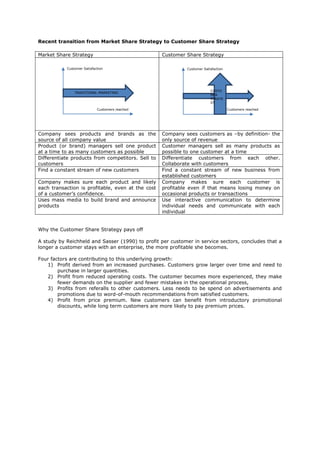
Recent transition from Market Share Strategy to Customer Share Strategy
Market Share Strategy

Customer Share Strategy

Customer Satisfaction

TRADITIONAL MARKETING

Customers reached

Company sees products and brands as the
source of all company value
Product (or brand) managers sell one product
at a time to as many customers as possible
Differentiate products from competitors. Sell to
customers
Find a constant stream of new customers
Company makes sure each product and likely
each transaction is profitable, even at the cost
of a customer’s confidence.
Uses mass media to build brand and announce
products

Customer Satisfaction

CUSTO
MER
STRATE
GY
Customers reached

Company sees customers as –by definition- the
only source of revenue
Customer managers sell as many products as
possible to one customer at a time
Differentiate customers from each other.
Collaborate with customers
Find a constant stream of new business from
established customers
Company makes sure each customer is
profitable even if that means losing money on
occasional products or transactions
Use interactive communication to determine
individual needs and communicate with each
individual

Why the Customer Share Strategy pays off
A study by Reichheld and Sasser (1990) to profit per customer in service sectors, concludes that a
longer a customer stays with an enterprise, the more profitable she becomes.
Four factors are contributing to this underlying growth:
1) Profit derived from an increased purchases. Customers grow larger over time and need to
purchase in larger quantities.
2) Profit from reduced operating costs. The customer becomes more experienced, they make
fewer demands on the supplier and fewer mistakes in the operational process,
3) Profits from referalls to other customers. Less needs to be spend on advertisements and
promotions due to word-of-mouth recommendations from satisfied customers.
4) Profit from price premium. New customers can benefit from introductory promotional
discounts, while long term customers are more likely to pay premium prices.

Crm strategy

  • 1.
    The Learning Relationship Ifyou’re my customer and I get you to talk to me, and I remember what you tell me, then I get smarter and smarter about you. I know something about you, my competitors don’t know. So I can do things for you, my competitors cant. Before long, you can get something from me you cant get anywhere else, for any price. At the very least, you’d have to start all over somewhere else, but starting over is more costly than staying with me, so as long as you like and trust me to look out for your best interests. Customers are every company’s source of revenue No company will ever realize income from any other entity except customer it has has now and the customers it will have in the future. Thus in many ways a firm’s most valuable asset is its customers base, and given over new and unfolding technological capabilities to recognize, measure and manage relationships with each of those customers individually, a forward-thinking firm must focus on deliberately preserving and increasing the value of that customer base. How to increase the value of your customer’s base? Get – Keep – Grow Get: Acquire profitable customers Keep: Retain profitable customers Win Back profitable customers Eliminate unprofitable customers Grow: Upsell additional products in a solution Cross-Sell other products to customers Referral and word-of-mouth benefits Reduce service and operational costs Customer Strategy is both an operational and analytical process: Operational CRM focuses on the software installations and the changes in the process affecting the day-to-day operations of a firm-operations that will produce and deliver different treatments to different customers. Analytical CRM focuses on the strategic planning needed to build customer value as well as the cultural, measurement and organizational changes required to implement that strategy successful.
  • 2.
    Recent transition fromMarket Share Strategy to Customer Share Strategy Market Share Strategy Customer Share Strategy Customer Satisfaction TRADITIONAL MARKETING Customers reached Company sees products and brands as the source of all company value Product (or brand) managers sell one product at a time to as many customers as possible Differentiate products from competitors. Sell to customers Find a constant stream of new customers Company makes sure each product and likely each transaction is profitable, even at the cost of a customer’s confidence. Uses mass media to build brand and announce products Customer Satisfaction CUSTO MER STRATE GY Customers reached Company sees customers as –by definition- the only source of revenue Customer managers sell as many products as possible to one customer at a time Differentiate customers from each other. Collaborate with customers Find a constant stream of new business from established customers Company makes sure each customer is profitable even if that means losing money on occasional products or transactions Use interactive communication to determine individual needs and communicate with each individual Why the Customer Share Strategy pays off A study by Reichheld and Sasser (1990) to profit per customer in service sectors, concludes that a longer a customer stays with an enterprise, the more profitable she becomes. Four factors are contributing to this underlying growth: 1) Profit derived from an increased purchases. Customers grow larger over time and need to purchase in larger quantities. 2) Profit from reduced operating costs. The customer becomes more experienced, they make fewer demands on the supplier and fewer mistakes in the operational process, 3) Profits from referalls to other customers. Less needs to be spend on advertisements and promotions due to word-of-mouth recommendations from satisfied customers. 4) Profit from price premium. New customers can benefit from introductory promotional discounts, while long term customers are more likely to pay premium prices.