


in 20 minutesMBA Thesis DefenseDocent: Dr. Charles M. Savage and Prof. Dr. Thomas StädterAuthor: Dipl. Ing. (FH) Guido Oswald - 178501
Agenda What 	is CRM 2.0? Why 	should I care? How 	can I achieve it?21.09.2009Guido Oswald2
Agenda What 	is CRM 2.0? Why 	should I care? How 	can I achieve it?21.09.2009Guido Oswald3
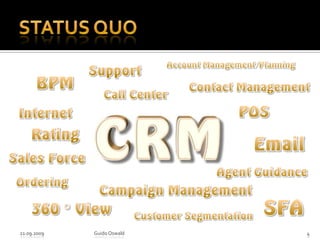
Status Quo21.09.2009Guido Oswald4Account Management/PlanningSupportBPMContact ManagementCall CenterPOSInternetRatingEmailSales ForceAgent GuidanceOrderingCampaign ManagementSFA360 ° ViewCustomer Segmentation
Status Quo21.09.2009Guido Oswald5Account Management/PlanningSupportBPMContact ManagementCall CenterPOSInternetRatingEmailSales ForceAgent GuidanceOrderingCampaign ManagementSFA360 ° ViewCustomer Segmentation
CRM 2.0 – A Definition Customer Relationship Model 2.0 (CRM 2.0) is the advancement of traditional Customer Relationship Management (CRM) caused by the rise of the Social Web (Web 2.0) and the resulting empowerment of consumers. CRM 2.0 will establish a meaningful conversation with customers and thus profoundly change the level of trust on both sides. The result is a fruitful collaboration, co-creation and knowledge sharing community. Customers are becoming real advocates for a product or brand. 21.09.2009Guido Oswald6
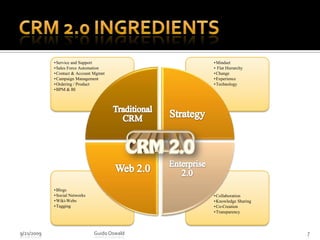
CRM 2.0 Ingredients9/21/2009Guido Oswald7
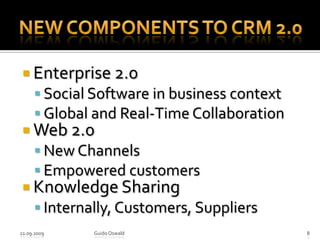
New components to CRM 2.0Enterprise 2.0Social Software in business contextGlobal and Real-Time CollaborationWeb 2.0New ChannelsEmpowered customersKnowledge SharingInternally, Customers, Suppliers21.09.2009Guido Oswald8
Customer EmpowermentInformation SharingCollaborationWord of MouthSocial NetworksBlogs / Micro-BlogsPodcasts / Vodcasts21.09.2009Guido Oswald9
Customers are not Transactions21.09.2009Guido Oswald10anymore…
Agenda What 	is CRM 2.0? Why 	should I care?How 	can I achieve it?21.09.2009Guido Oswald11
We are in the middle of aBusiness Revolution21.09.2009Guido Oswald12
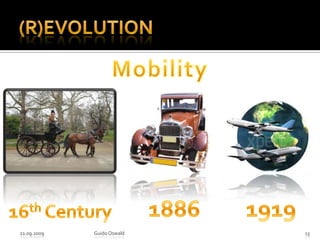
(R)evolution21.09.2009Guido Oswald13Mobility1886191916th Century
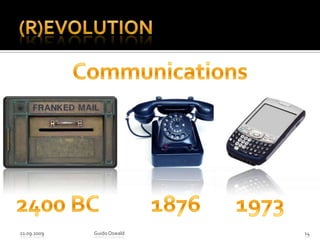
(R)evolution21.09.2009Guido Oswald14Communications2400 BC18761973
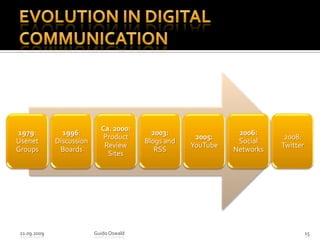
Evolution in digital communication21.09.2009Guido Oswald15
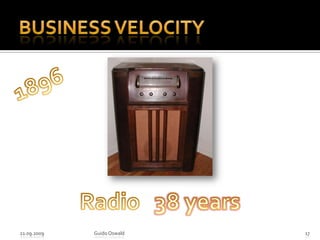
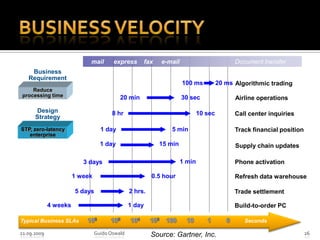
Business Velocity21.09.2009Guido Oswald16Years it took to reach a market audience of 50 million
Business Velocity21.09.2009Guido Oswald171896Radio38 years
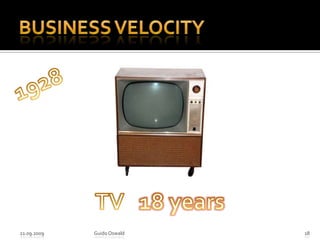
Business Velocity21.09.2009Guido Oswald181928TV18 years
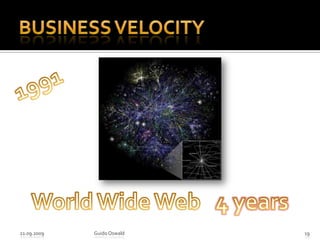
Business Velocity21.09.2009Guido Oswald191991World Wide Web   4 years
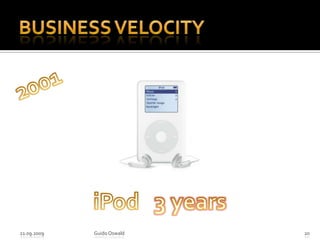
Business Velocity21.09.2009Guido Oswald202001iPod  3 years
Business Velocity21.09.2009Guido Oswald212003MySpace  2.5 years
Business Velocity21.09.2009Guido Oswald222004Facebook2 years
Business Velocity21.09.2009Guido Oswald232006Twitter ?? years
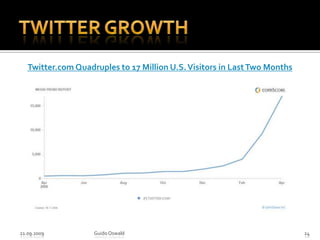
Twitter Growth21.09.2009Guido Oswald24Twitter.com Quadruples to 17 Million U.S. Visitors in Last Two Months
Business Velocity21.09.2009Guido Oswald252009???
Business Velocity21.09.2009Guido Oswald26Algorithmic trading100 ms20 msAirline operations20 min30 secCall center inquiries 8 hr10 secTrack financial position5 min1 day15 min1 daySupply chain updatesPhone activation3 days1 minRefresh data warehouse 1 week0.5 hourTrade settlement5 days2 hrs.Build-to-order PC 4 weeks1 day   mail	  express    fax     e-mail		            Document transferBusinessRequirementReduce processing timeDesign StrategySTP, zero-latency enterprise Typical Business SLAs106	  105      104      103    100      10        1         0  SecondsSource: Gartner, Inc.
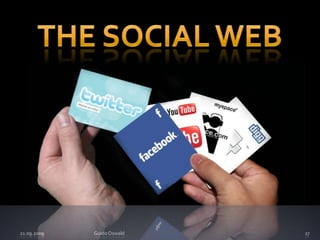
21.09.2009Guido Oswald27The Social Web
The customer in Control21.09.2009Guido Oswald28
The customer in Control21.09.2009Guido Oswald29
The customer in Control21.09.2009Guido Oswald30
The customer in Control21.09.2009Guido Oswald31
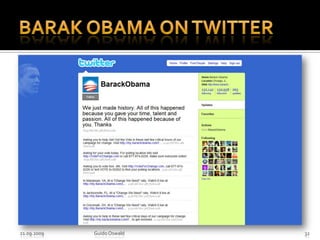
Barak Obama on twitter21.09.2009Guido Oswald32
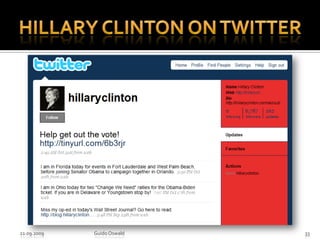
Hillary Clinton on twitter21.09.2009Guido Oswald33
Why care ?Changing Business Climate and EconomyShorter Product Cycles (TTM)Technology Advances (Web 2.0) Changing Buying Behavior Increasing number of (Sales) Channels Products and Services become Commodity New (free) Alternatives for BuyersOnly loyal customers can ensure profits21.09.2009Guido Oswald34
The customer in ControlCustomers take control of...Whom they communicate withWhat they communicate aboutTheir buying experienceThe information they shareThe channel they useThe technology they use21.09.2009Guido Oswald35
Agenda What 	is CRM 2.0? Why 	should I care? How 	can I achieve it?21.09.2009Guido Oswald36
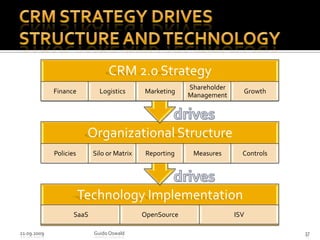
CRM strategy drives structure and technology21.09.2009Guido Oswald37drivesdrives
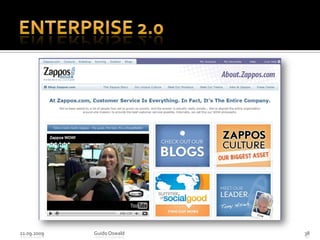
Enterprise 2.021.09.2009Guido Oswald38
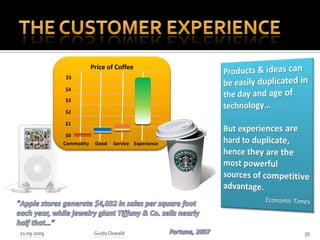
the Customer Experience21.09.2009Guido Oswald39Price of Coffee$5$4$3$2$1$0Commodity     Good     Service    ExperienceProducts & ideas can be easily duplicated in the day and age of technology…But experiences are hard to duplicate, hence they are the most powerfulsources of competitive advantage.Economic Times"Apple stores generate $4,032 in sales per square foot each year, while jewelry giant Tiffany & Co. sells nearly half that…” 			       Fortune, 2007
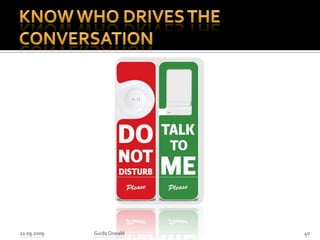
Know who drives the conversation21.09.2009Guido Oswald40
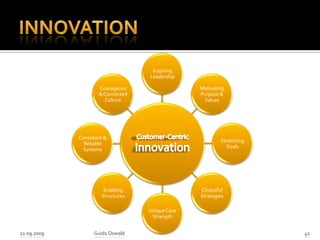
Innovation21.09.2009Guido Oswald41
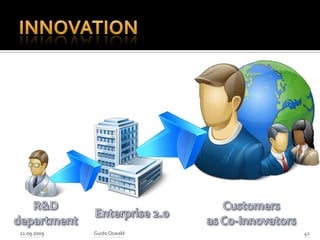
Innovation21.09.2009Guido Oswald42R&DdepartmentCustomersas Co-InnovatorsEnterprise 2.0
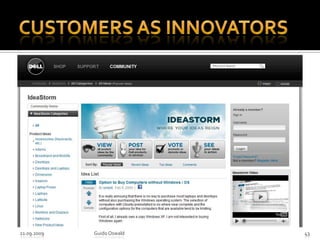
Customers as Innovators21.09.2009Guido Oswald43
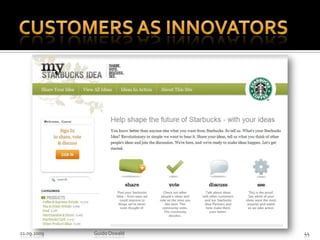
Customers as Innovators21.09.2009Guido Oswald44
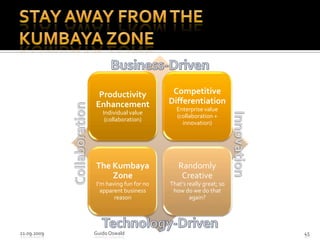
Stay away from the Kumbaya Zone21.09.2009Guido Oswald45Business-DrivenCollaborationInnovationTechnology-Driven
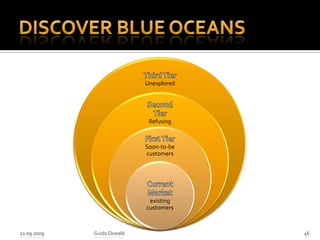
Discover Blue Oceans21.09.2009Guido Oswald46
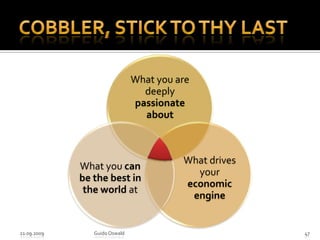
Cobbler, stick to thy last21.09.2009Guido Oswald47
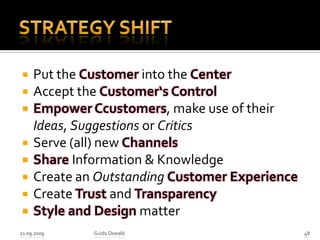
Strategy ShiftPut the Customer into the CenterAccepttheCustomer‘sControlEmpowerCcustomers, makeuseoftheirIdeas, SuggestionsorCriticsServe (all) newChannelsShare Information & KnowledgeCreate an Outstanding Customer ExperienceCreate Trust and TransparencyStyle and Design matter21.09.2009Guido Oswald48
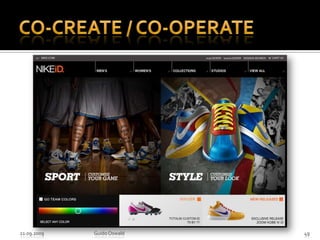
Co-Create / Co-operate21.09.2009Guido Oswald49
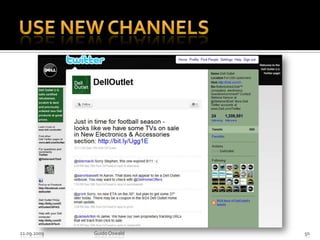
Use new Channels21.09.2009Guido Oswald50
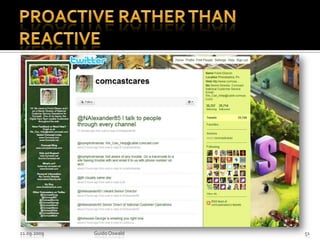
Proactive rather than reactive21.09.2009Guido Oswald51
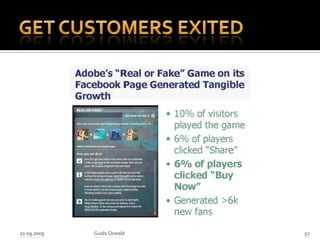
Get customers exited21.09.2009Guido Oswald52
Do Not Forget...CopyrightAuthorshipIdentityEthicsAestheticsRethoricsGovernancePrivacyCommerce21.09.2009Guido Oswald53
What do you think?21.09.2009Guido Oswald54
BakckupSlides21.09.2009Guido Oswald55
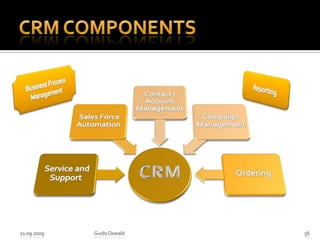
CRM Components21.09.2009Guido Oswald56Business Process ManagementReporting
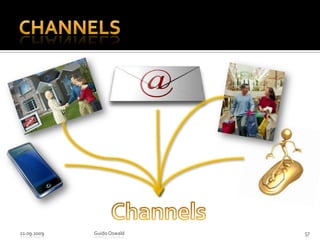
Channels21.09.2009Guido Oswald57Channels
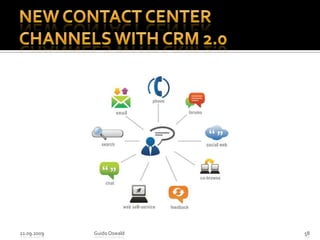
New Contact Center channelswith CRM 2.021.09.2009Guido Oswald58
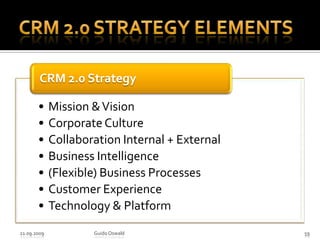
CRM 2.0 Strategy Elements21.09.2009Guido Oswald59
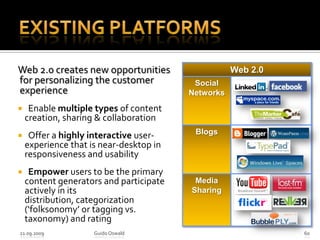
Existing PlatformsWeb 2.0 creates new opportunities for personalizing the customer experienceEnable multiple types of content creation, sharing & collaborationOffer a highly interactive user-experience that is near-desktop in responsiveness and usability Empower users to be the primary content generators and participate actively in its distribution, categorization (‘folksonomy’ or tagging vs. taxonomy) and rating21.09.2009Guido Oswald60
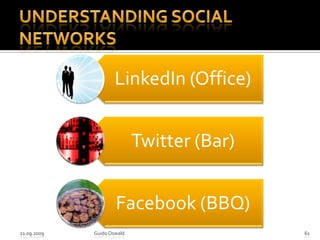
Understanding Social Networks21.09.2009Guido Oswald61
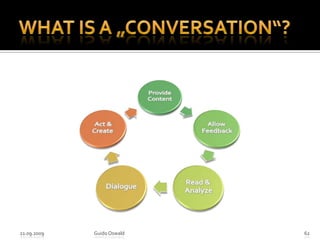
What is a „Conversation“?21.09.2009Guido Oswald62
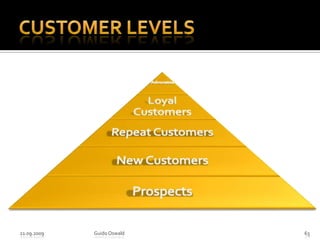
Customer levels21.09.2009Guido Oswald63
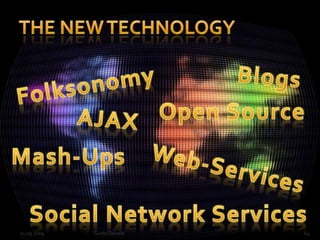
The new Technology21.09.2009Guido Oswald64BlogsFolksonomyOpen SourceAJAXMash-UpsWeb-ServicesSocial Network Services
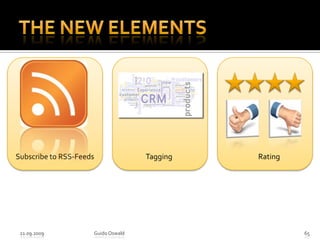
The new Elements21.09.2009Guido Oswald65Subscribe to RSS-FeedsTaggingRating
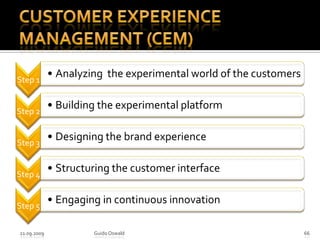
Customer Experience Management (CEM)21.09.2009Guido Oswald66
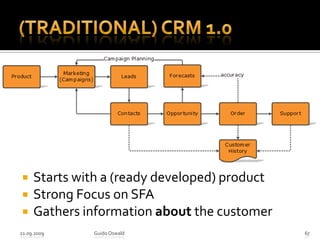
(traditional) CRM 1.0Starts with a (ready developed) productStrong Focus on SFAGathers information about the customer21.09.2009Guido Oswald67
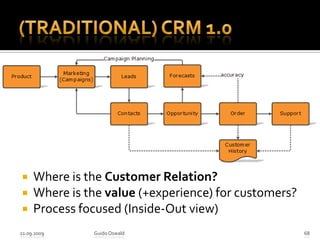
(traditional) CRM 1.0Where is the Customer Relation?Where is the value (+experience) for customers?Process focused (Inside-Out view)21.09.2009Guido Oswald68
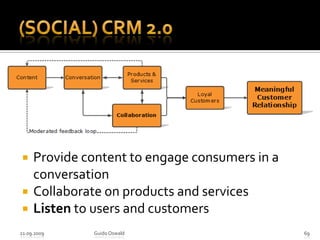
(Social) CRM 2.0Provide content to engage consumers in a conversationCollaborate on products and servicesListen to users and customers21.09.2009Guido Oswald69
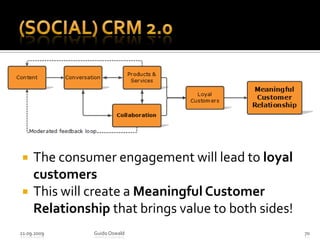
(Social) CRM 2.0The consumer engagement will lead to loyal customersThis will create a Meaningful Customer Relationship that brings value to both sides!21.09.2009Guido Oswald70
WHO should care?21.09.2009Guido Oswald71High VolumeLow MarginComplex Sales
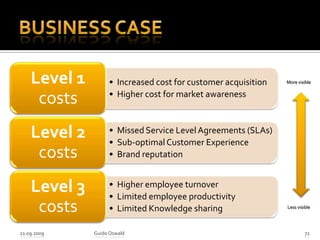
Business Case21.09.2009Guido Oswald72More visibleLess visible
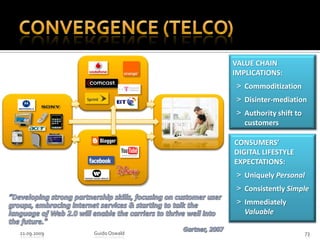
Convergence (Telco)21.09.2009Guido Oswald73VALUE CHAIN IMPLICATIONS:Commoditization
Disinter-mediation
Authority shift to customersCONSUMERS’    DIGITAL LIFESTYLE EXPECTATIONS:Uniquely Personal
Consistently Simple
Immediately Valuable“Developing strong partnership skills, focusing on customer user groups, embracing internet services & starting to talk the language of Web 2.0 will enable the carriers to thrive well into the future." Gartner, 2007
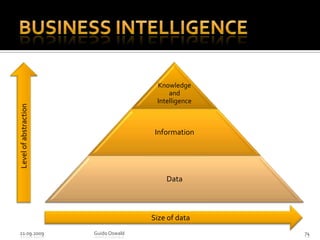
Business Intelligence21.09.2009Guido Oswald74Level of abstractionSize of data
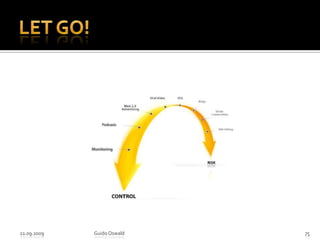
Let go!21.09.2009Guido Oswald75
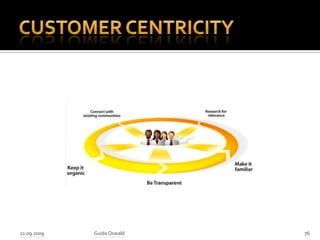
Customer Centricity21.09.2009Guido Oswald76
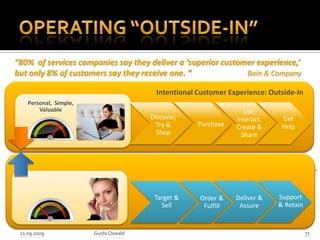
Operating “Outside-In”21.09.2009Guido Oswald77“80%  of services companies say they deliver a ‘superior customer experience,’ but only 8% of customers say they receive one. “                            Bain & CompanyIntentional Customer Experience: Outside-InPersonal,  Simple,  ValuableDiscover, Try & ShopUse,          Interact,  Create & ShareGet  HelpPurchaseAd Hoc Experience: Inside-OutAverage Handling Time,  Mean Time to Repair,  Average Revenue Per User,Support& RetainTarget & SellDeliver & AssureOrder & Fulfill
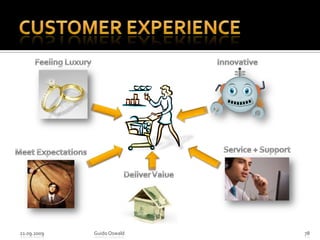
Customer Experience21.09.2009Guido Oswald78InnovativeFeeling LuxuryService + SupportMeet ExpectationsDeliver Value
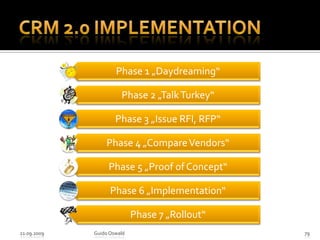
CRM 2.0 Implementation21.09.2009Guido Oswald79
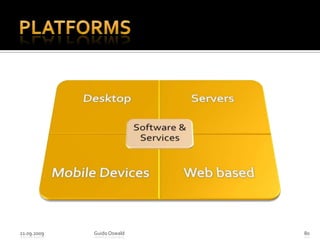
Platforms21.09.2009Guido Oswald80
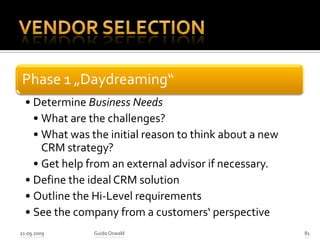
Vendor Selection21.09.2009Guido Oswald81
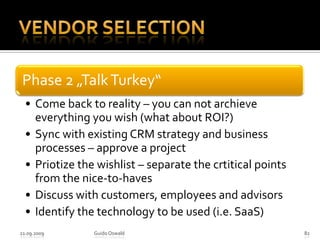
Vendor Selection21.09.2009Guido Oswald82
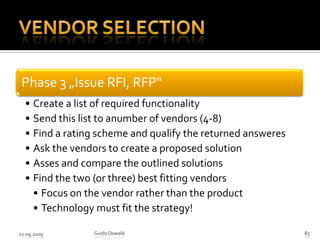
Vendor Selection21.09.2009Guido Oswald83
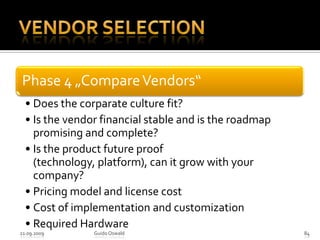
Vendor Selection21.09.2009Guido Oswald84
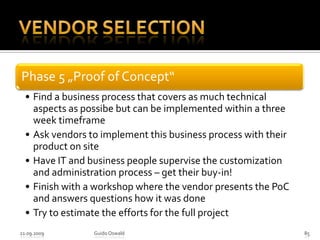
Vendor Selection21.09.2009Guido Oswald85
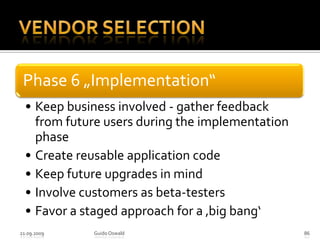
Vendor Selection21.09.2009Guido Oswald86
Vendor Selection21.09.2009Guido Oswald87
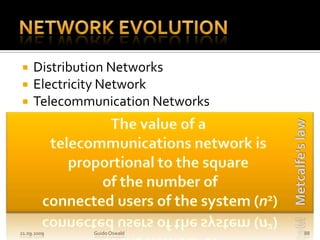
Network EvolutionDistribution NetworksElectricity NetworkTelecommunication Networks21.09.2009Guido Oswald88The value of a telecommunications network is proportional to the square of the number of connected users of the system (n2) Metcalfe's law

CRM 2.0 By Guido Oswald

Editor's Notes

  • #3 Similartothestructureofthethesis5 CRM 2.0 – A DEFINITION 6 BUSINESS IMPLICATIONS 7 IMPLEMENTING CUSTOMER RELATIONSHIP MODEL 2.0
  • #4 Customer Relationship Model 2.0 (CRM 2.0) is the advancement of traditional Customer Relationship Management (CRM) caused by the rise of the Social Web (Web 2.0) and the resulting empowerment of consumers. CRM 2.0 will establish a meaningful conversation with customers and thus profoundly change the level of trust on both sides. The result is a fruitful collaboration, co-creation and knowledge sharing community. Customers are becoming real advocates for a product or brand. NEXT: Status Quo - Traditional CRM
  • #5 ComponentsSupportContact ManagementSales Force AutomationAccount ManagementCampaign ManagementOrderingBusiness Process ManagementChannelsCall CenterSales Force (Direct Sales)InternetEmailPoint of Sales (Shop)Buzzwords360° View of the customerCustomer Segmentation (for campaigns)Rating (Gold-Silver-Bronce customers)Agent Guidance (Scripting, Process Automation)Next: Version 1 of CRM
  • #6 Not 100% customer centric - INSIDE OUT view (company – customer) – All about managing the customerNext: CRM 2.0 Definition
  • #7 Model insteadof Management – conflictingwith CRM 2.0 - newhierarchy, end of COMAND AND CONTROLWeb 2.0 as technological catalystEmpowerment of customers through GLOBAL and INSTANT COLLABORATION and EASY ACCESS to dataLEVERAGE customers knowledge and innovation powerCustomers become Advocates and SPREAD THE WORD for a product or brand (VIRAL MARKETING)NEXT: CRM 2.0 Ingredients
  • #8 Traditional CRM plus Web 2.0 and Enterprise 2.0 – Even more a strategyandmindsetthanbefore!Web 2.0 Technology is a catalystfor a global change in businessbehaviorEnterprise 2.0 - Web 2.0 inspiredapplicationsfor large enterprises (Intranet) – Instant Messaging, Social Networks, Wiki-Webs, etc.NEXT: New Components to CRM 2.0
  • #9 Enterprise 2.0Web 2.0 inspired applications for large enterprises (Intranet) – Instant Messaging, Social Networks, Wiki-Webs, etc.CollaborationBlogsPodcastsIT survey: Innovation moved from #10 to #3 (2007 -> 2008)Collaborate on new products, new features, new services and productenhancements, business process enhancement, etcListen to customer feedbackKnowledge SharingMore than Knowledge ManagementREALTIME !Share development/product ideas and progress with customers, suppliers ( -> changes in Supply Change Management, SCM)Retrieve and utilize customer feedbackNext: Customer Empowerment
  • #11 Build relationships with customersPrerquisite: 360 degree view (all data available)`NEXT: WHY should I care?
  • #12 Simple Answer – Wearecurrentlygoingthrough a Business Revolution! (Agriculturalrevolution -> First and Second Industrial Revolution -> Information society / knowledgeeconomy )Web 2.0 has (and will..) changedhowwe do businessHardtorecognizewhenyouare in themiddleof such a revolution (seeexamples)Next: Business Revolution
  • #13 Simple Answer – Wearecurrentlygoingthrough a Business Revolution! Deep SOCIETY CHANGES (Agriculturalrevolution -> First and Second Industrial Revolution -> Information society / KNOWLEDGE ECONOMY )Web 2.0 has (and will..) changedhowwe do businessHardtorecognizewhenyouare in themiddleof such a revolution (seeexamples)Best istovisualizetheimpactwithhistoricaldevelopmentsthat DRAMATICALLY CHANGED THE WAY WE LIVE AND DO BUSINESSNext: ®Evolution (Mobility & Communications)
  • #14 Get mobilecarriage (Romans 200 a.c.) - automobile (Gottlieb Daimler) – Airplane (The first commercial flights took place between the United States and Canada in 1919 )
  • #15 CommunicateThe first documented use of an organized courier service for the diffusion of written documents is in Egypt, where Pharaohs used couriers for the diffusion of their decrees in the territory of the State (2400 BC). 10 March 1876 — The first successful telephone transmission of clear speech using a liquid transmitter when Bell spoke into his device, “Mr. Watson, come here, I want to see you.” and Watson heard each word distinctly.
  • #16 (dramatically) Increasing number of usersUser numbersincreasefasterandfaster…NEXT: Business Velocity
  • #20 As of June 30, 2008, 1.463 billion people use the Internet according to Internet World Stats.[6]On August 6, 1991, CERN publicized the new World Wide Web project. The Web was invented by English scientist Tim Berners-Lee in 1989.
  • #22 MySpace is a social networkingwebsite with an interactive, user-submitted network of friends, personal profiles, blogs, groups, photos, music and videos for teenagers and adults internationally. Its headquarters are in Beverly Hills, California, USA,[1] where it shares an office building with its immediate owner, Fox Interactive Media; which is owned by News Corporation, which has its headquarters in New York City. In June 2006, MySpace was the most popular social networking site in the United States.[2] According to comScore, MySpace was overtaken internationally by main competitor Facebook in April 2008, based on monthly unique visitors.[3] The company employs 300 staff[4] and does not disclose revenues or profits separately from News Corporation. The 100 millionth account was created on August 6, 2006[5] in the Netherlands[6] and the site counted approximately 106 million accounts on September 8, 2006,[7]. MySpace.com attracts 230,000 new users per day.[8]
  • #24 Hardtotellthe real usernumbersfortwitter
  • #25 Visitornumberquadrupled in onlytwomonth (liitlebithype – not all registered users on twitterareactive…)
  • #26 There will bemoreplatformsrisinglikeFacebookandTwitter in thefuture…andit will beevenfasterthanbeforeNEXT: Customer Expectationshavechangedas well…
  • #28 Customer takescontrolCustomers activelycollaborateandshareinformationwithmillionsofother potential customerstakesthe „Word ofMouth“ to a wholenewlevelAffectsthebusiness!!NEXT: Customer in control
  • #29 Music Industry (EMI, Sony, Universal Music Group, Warner)
  • #30 TV stations
  • #31 Encyclopedias like Brockhaus, Encyclopædia Britannica
  • #32 NewspapersNEXT: Microbloggingexample: Barak Obama
  • #33 US Electioncampaign in 2008Notethat Obama isfollowingasmanypplasarefollowinghimNEXT: Hillary Clinton (followingno-one!)
  • #34 NEXT: summingup
  • #35 Sum-UpBusiness aspects to CRM 2.0 De-Commodify possible... Not necessary to buy luxury – but need to feel luxuryGlobalization: on business side AND customer sideBuying behaviour: Personalization, Customer Experience, Opinion influencersSales Channels: Social Networks, Blogs, Wikis, Mobile DevicesAlternatives: Why Brockhaus when able to browse Wikipedia?Loyal Customers: twice the cost to attract new customers instead of retaining existing customersNext: Customer in Control
  • #36 FollowingtheempowermentofcustomersAcceptthatthecustomeris in controlNext: Howcan I achieveit?
  • #37 Next: History – Components of Customer Relationship Management
  • #40 Few things pay so handsomely as a great experience. 2 companies stand out as harnessing the customer experience for the better. Starbucks and Apple have not only profited from their unique customer-focused brands, but have also set the pace for their respective industries.Starbucks proved that, by providing customers freedom to personalize their coffee order—e.g., a non-fat, decaf, venti mocha latte—by actually calling them by name when said order was ready, and providing a consistent, Wi-Fi connected and practically ubiquitous environment to order & enjoy their beverage in, customers—& profits—would follow. In fact, the company took a cup of coffee from commonplace commodity to a premium luxury item that customers today will pay as much as 500% more for. Similarly, Apple started its ascent from virtual extinction by designing its iPod (& other products) from the customer perspective, making it easy for the device to become a centerpiece of personal expression. But then the company went one step farther. It bucked established storefront sales & merchandizing conventions & built its own stores from the ground up, featuring open space, spare product displays, free product support & roving payment-takers. The result? The most profitable storefront in the world. According to Fortune magazine, Apple stores generate $4,032 in sales per square foot each year, while jewelry giant Tiffany & Company sells nearly half that—$2,666 per square foot per year.When we think about SPs, they are in an even better position than companies like Starbucks and Apple to profit from delivering a great experience. SPs are unique in that they have the potential to tap into what their customers want, where their customers are, what they need & how they would like it delivered. But if SPs have this invaluable customer knowledge & insight, why do most struggle to retain their high value customers & grow their market share? What is stopping them from delivering the experiences their customers seek?... Next: Strategy Shift
  • #41 Put Customer in control / Accept that customers ARE in Control
  • #42 Traditionally Innovation happens in a dedicated R&D department – disconnectedfromthe outside worldandconsumerdemandInnovation hastobeextendedthroughoutthecompanyandthecustomerbasePROSUMERSCustomers become “prosumers” by co-creating goods and services rather than simply consuming the end product‖ (Tapscott & Williams 2006) Innovation is ALIGNED with DEMAND
  • #43 CRM 2.0 expands the source for innovation from the R&D department to the whole enterprise and further to the whole customer base!Alignedwiththe Customer DemandNEXT: Kumbaya Zone
  • #44 Up to date IdeaStorm has delivered 12,197 ideas, 85,461 comments and Dell has implemented 355 ideas that originated out of this community (data from July 29, 2009).
  • #45 NEXT: SOME WORD OF CAUTION (Kumbaya Zone)
  • #46 Yarmis, J., 2008. First Steps in Social Media and Networking: Avoiding the Kumbaya Zone AMR Research.
  • #47 Three Tiers of “Noncustomers”Do not limit the sources for innovation or ideas to the existing customer baseRISK: Market of oneKim, W.C. and Mauborgne, R., 2005. Blue ocean strategy : how to create uncontested market space and make the competition irrelevant. Boston, Mass.: Harvard Business School Press.
  • #48 SchusterbleibbeiDeinenLeistenHedgehog concept (“Good to Great”, Jim Collins)Customer centricity and innovation centricity – but keep business in mindDon’t bend yourself byhookorbycrook
  • #49 Customer in center = Outside in View, Collaborate vs. ManageRecognize that the customer relationship encompasses information-seeking and information-contributing behavior   current CRM: Customer strategy is part of corporate strategy  - Contemporary CRM: Customer strategy IS corporate strategyNext: Operating „Outside IN“ (or Technology)
  • #50 Nike iD (collaborate with customers to create new and custom sneakers)
  • #51 Dell sells ‘old’ models via special deals announced only on Twitter – exclusive dealsGenerated >$1 Million in thefirst Holiday Sales
  • #52 Frank EliasonHelpedComcast‘s Customer SatisfactionScores Jump 9% in Q1 – LargestGain in Cable!Frank has become the “Face” for Comcast on TwitterActively monitoring social media and engaging in customer conversations
  • #53 Facebook channel of Adobe – 6% conversion rate
  • #57 Traditional CRM consists of several Components:Service and SupportSales Force AutomationContact ManagementAccount ManagementCampaign ManagementOrderingBusiness Process ManagementReporting
  • #58 Customer contacts can happen via different Channels:Call CentreSales Force (Direct Sales)InternetEmailPoint of Sales (Shop)
  • #61 Web 2.0 creates new types of social behavior and connection between peopleSocial NetworksEnable users to easily create & share content and personal connections6% of north Americans use social networking sites regularly, up from 4% in 2004LinkedIn has >12M usersMySpace has >60M users. No. 1 growing web property in 2006 and no. 1 in site “stickiness”BlogsEasy to use tools enable users to create personal web presences, update frequently with textual & multimedia content and solicit reader community participation (comments, talkbacks)8% of north Americans regularly bog. 54% of those are under 30y. More than 2/3s of global bog action is in non-English languages; 15% is in Chinese. >60M bogs are tracked by Technocratic service on Internet“moblogging”: blogging directly from the mobile, often w/ picsMedia SharingServices enabling users to upload, tag & share photos, videos, music and graphic artYouTube serves more than 100M videos a day. (still, most viewed content is licensed e.g. CBS) Flickr has 100M photosNext: Adapt and enhance CRM to Customer Relationship Model 2.0
  • #63 The hard part is establishing new business processes & change the corporate mindset.How is success measured – what are the matrices?
  • #67 Schmitt, B. (2003). Customer experience management : a revolutionary approach to connecting with your customers. New York, Wiley.
  • #74 Example from the Telecommunications industry (optional)Not so long ago, SPs operated in well-defined industries & could set themselves apart with lower costs or higher-quality products & servicesBut these days of the communications utilities are now long goneTraditional services have become commoditized, while Web 2.0 & convergence are fundamentally changing the way people use communications. And in turn, have accelerated the move to the digital lifestyle where customers are constantly connected via multiple media - voice, video, text, chat, etc. and believe they should be able to go anywhere, do anything & have their communications & entertainment technologies follow them.In this new era, the value chain has become increasingly fragmented with new device & application vendors as well as web 2.0 environments entering the fold every day & forming equally strong, if not stronger relationships, with the end consumer As a result SPs run the risk of disintermediation in what used to be “their” value chainBut is has also put the consumer in the driver seat. Consumers today are more empowered then ever before & have unlimited choice as to who they form relationships with & where they spend their dollars. As a result of all of these factors, we are seeing an evolution in consumer expectations.Consumers no longer want services they want “experiences” that are uniquely personal to them, that are simple and intuitive, and deliver immediate value.As authority in the value chain shifts to the consumer and their expectations evolve, the value of the experience can not be underestimated…. (transition to next slide)Next: Customer Experience (or Strategy Shift)
  • #78 Operating “Outside-In” Enables the Intentional Customer ExperienceHere we see business processes at the bottom from the service providers view – target & sell, order & fulfill, deliver & assure etc. and at the top the same processes from the customer’s perspective – discover, try and shop, purchase, use, interact create & share, etc. So when the SP is focused on capturing an order, the customer is concerned with having a purchase experience that is simple, convenient & best meets their personal needsThe SP does not measure the customer experience using the same parameters as the customer either. Where a SP in an ordering process is concerned with metrics such as time to order completion and order fallout rates; the customer is measuring her experience by whether or not she was provided purchase options that made her experience simple, personal & delivered immediate valueGiven these disconnects between the SP & customers’ perspectives, it is not surprising that the customer experience is an adhoc & unintended outcome of the SP’s operationsHowever, many SPs recognize the importance of the customer experience, and the need to change they way they operate to become more in-tune with their customers’ needs and expectations. In fact almost every major SP worldwide has initiated transformation plans to some degree that have increasing emphasis on the customer experience. Next: Technology
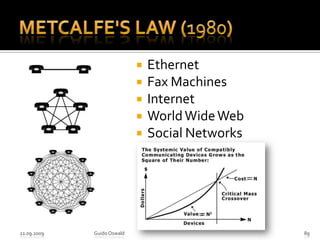
  • #90 >1 billion users of WWWInitial slide from Metcalfe (1980) -> CRITICAL MASS -> high entry barrier for followers in Social Networking
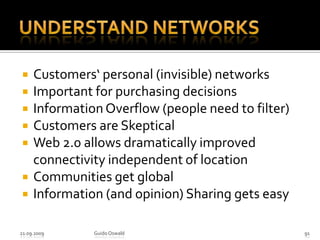
  • #92 Customers‘ personal (invisible) networks to friends, family, colleagues, etc. (from Anatomy of Buzz)
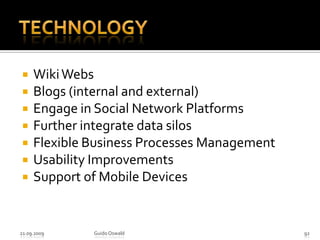
  • #93 Howto implement CRM 2.0? – Technology can only support a CRM 2.0 strategy...Social Network Platforms -> OpenSocial (from Google)Data Silos -> Master Data management (MDM)Business Processes Management -> SOA, ESBUsability Improvements -> Ajax, Web clients, Single Sign-on (OpenID)Mobile devices -> iPhone, Mobile Phones, PDAs (also Xbox, PS3, Wii, etc)Next: Questions