1. Presentation
- Meaning of Decisive Reasoning
- Significance in Training
2. Three characteristics of critical thinkers.
3. Classroom Strategies for Critical Thinking in Educational Settings:
4. Improved Critical thinking
- Further developed Independent direction
- Long lasting Learning
5. Problems in Promoting Critical Thinking:
6. Skills for critical thinking
7. Decisive Reasoning Appraisal
- Strategies for Assessing Decisive Reasoning
8. Contribution of technology to the development of critical thinking
9. Achievement Stories
- Instances of Instructive Organizations Advancing Decisive Reasoning
10. Future Patterns in Decisive Reasoning Schooling
- Developing Educating Techniques
- Joining of Arising Advancements
11. Tending to misperception
12. Developing a Decisive Reasoning Society
- Building a Steady Climate
- Joint effort between Teachers, Understudies, and Guardians
13. The Worldwide Viewpoint
- Decisive Reasoning on a Worldwide Scale
- Culturally diverse Contemplations
14. Reactions and Counterarguments
- Tending to Wariness
- Shielding the Worth of Decisive Reasoning in Schooling
15. Conclusion
- Sum up Central issues
- Underscore the Continuous Pertinence of Decisive Reasoning in Schooling
Title:
Decisive Reasoning in Schooling: Supporting Personalities for a
Unique World
1-Introduction:
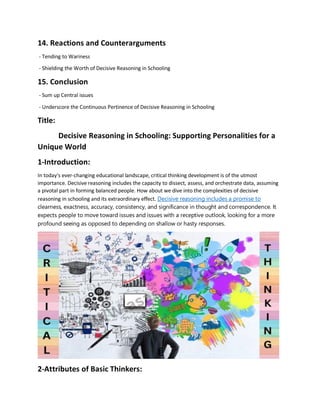
In today's ever-changing educational landscape, critical thinking development is of the utmost
importance. Decisive reasoning includes the capacity to dissect, assess, and orchestrate data, assuming
a pivotal part in forming balanced people. How about we dive into the complexities of decisive
reasoning in schooling and its extraordinary effect. Decisive reasoning includes a promise to
clearness, exactness, accuracy, consistency, and significance in thought and correspondence. It
expects people to move toward issues and issues with a receptive outlook, looking for a more
profound seeing as opposed to depending on shallow or hasty responses.
2-Attributes of Basic Thinkers:
Analytical skills, openness to new ideas, and inquisitiveness are just a few of the unique qualities of
critical thinkers. These characteristics establish the groundwork for developing a mentality that goes
past repetition retention, empowering understudies to address and investigate.
3-Critical Thinking in the Classroom:
Instructors perceive the meaning of coordinating decisive reasoning into the educational plan.
Homeroom procedures, for example, issue based learning and Socratic addressing, give stages to
understudies to apply decisive reasoning abilities in true situations. In the classroom, fostering critical
thinking involves creating an environment where students are encouraged to question, analyze, and
synthesize information. Teachers can employ effective questioning techniques, facilitate open
discussions, and integrate real-world applications of academic concepts
4-Advantages of Decisive Reasoning in Education:
The advantages are numerous and include enhanced problem-solving and decision-making abilities.
Decisive reasoning cultivates a culture of long lasting picking up, planning understudies for the
intricacies of the cutting edge world.
5-Promoting Critical Thinking Challenges:
Regardless of its benefits, challenges continue, including protection from change and an absence of
preparing for teachers. Conquering these obstacles requires a deliberate exertion from instructive
establishments and policymakers.
6-Skills for Critical Thinking Development:
Intuitive learning exercises and genuine applications act as impetuses for creating decisive reasoning
abilities. Active encounters and cooperative activities engage understudies to think fundamentally and
innovatively.
7-Decisive Reasoning Assessment:
Compelling appraisal strategies, for example, contextual analyses and intelligent diaries, give
experiences into understudies' decisive reasoning skills. These apparatuses empower instructors to
tailor their methodology and address individual necessities.
8-Contribution of technology to the development of critical thinking:
. In order to bridge the gap between traditional and contemporary teaching methods, educational apps
and online resources provide interactive platforms for students to participate in critical thinking
exercises.
9-Achievement Stories:
Critical thinking has been successfully taught in numerous educational establishments around the world.
These examples of overcoming adversity act as rousing instances of the positive results of focusing on
decisive reasoning in training.
10-Future Patterns in Decisive Reasoning Education:
Teaching techniques are also changing with education. Embracing arising advancements and creative
methodologies guarantees that decisive reasoning training stays important and versatile to the
necessities of people in the future.
11-Tending to Misconceptions:
Normal misinterpretations about decisive reasoning frequently impede its execution. Tending to these
mistaken assumptions is fundamental in conveying the genuine worth and effect of decisive reasoning in
schooling.
12-Developing a Decisive Reasoning Culture:
It is essential to create a supportive setting that encourages educators, students, and parents to work
together. Developing a culture that values decisive reasoning encourages a comprehensive instructive
encounter.
13-The Worldwide Perspective:
Decisive reasoning isn't bound to borders. Looking at decisive reasoning on a worldwide scale and taking
into account multifaceted varieties enhances the instructive experience, planning understudies for a
different world.
14-Reactions and Counterarguments:
While some may suspiciously see decisive reasoning, shielding its worth is basic. Tending to reactions
and introducing counterarguments cement the underpinning of decisive reasoning in schooling.
15-Conclusion:
All in all, the embodiment of decisive reasoning in training couldn't possibly be more significant. We
prepare future generations for success in a world that is rapidly changing by cultivating minds that are
capable of analysis, inquiry, and innovation.
FAQs:
1 What is decisive reasoning, and for what reason is it significant in education?
- Decisive reasoning is the capacity to break down and assess data, fundamental for critical thinking and
dynamic in different settings. It's urgent in training to get ready understudies for the intricacies of the
advanced world.
2. How could teachers advance decisive reasoning in the classroom?
- Instructors can advance decisive reasoning through intelligent exercises, true applications,
and cultivating a climate that supports addressing and investigation.
3. Are there challenges in executing decisive reasoning in education?
- Indeed, moves incorporate protection from change and an absence of preparing for instructors.
Beating these obstacles requires cooperative endeavors from instructive establishments.
4. How does innovation add to cultivating basic thinking?
Technology bridges the gap between traditional and contemporary teaching methods by providing
educational tools and platforms that encourage students to engage in critical thinking activities.
5. What are what's to come patterns in decisive reasoning education?
- Future patterns incorporate developing showing strategies, joining of arising innovations, and a
proceeded with accentuation on certifiable applications.
……………………….THANK YOU…………………………….

critical thinking in education.pdf

  • 1.
    1. Presentation - Meaningof Decisive Reasoning - Significance in Training 2. Three characteristics of critical thinkers. 3. Classroom Strategies for Critical Thinking in Educational Settings: 4. Improved Critical thinking - Further developed Independent direction - Long lasting Learning 5. Problems in Promoting Critical Thinking: 6. Skills for critical thinking 7. Decisive Reasoning Appraisal - Strategies for Assessing Decisive Reasoning 8. Contribution of technology to the development of critical thinking 9. Achievement Stories - Instances of Instructive Organizations Advancing Decisive Reasoning 10. Future Patterns in Decisive Reasoning Schooling - Developing Educating Techniques - Joining of Arising Advancements 11. Tending to misperception 12. Developing a Decisive Reasoning Society - Building a Steady Climate - Joint effort between Teachers, Understudies, and Guardians 13. The Worldwide Viewpoint - Decisive Reasoning on a Worldwide Scale - Culturally diverse Contemplations
  • 2.
    14. Reactions andCounterarguments - Tending to Wariness - Shielding the Worth of Decisive Reasoning in Schooling 15. Conclusion - Sum up Central issues - Underscore the Continuous Pertinence of Decisive Reasoning in Schooling Title: Decisive Reasoning in Schooling: Supporting Personalities for a Unique World 1-Introduction: In today's ever-changing educational landscape, critical thinking development is of the utmost importance. Decisive reasoning includes the capacity to dissect, assess, and orchestrate data, assuming a pivotal part in forming balanced people. How about we dive into the complexities of decisive reasoning in schooling and its extraordinary effect. Decisive reasoning includes a promise to clearness, exactness, accuracy, consistency, and significance in thought and correspondence. It expects people to move toward issues and issues with a receptive outlook, looking for a more profound seeing as opposed to depending on shallow or hasty responses. 2-Attributes of Basic Thinkers:
  • 3.
    Analytical skills, opennessto new ideas, and inquisitiveness are just a few of the unique qualities of critical thinkers. These characteristics establish the groundwork for developing a mentality that goes past repetition retention, empowering understudies to address and investigate. 3-Critical Thinking in the Classroom: Instructors perceive the meaning of coordinating decisive reasoning into the educational plan. Homeroom procedures, for example, issue based learning and Socratic addressing, give stages to understudies to apply decisive reasoning abilities in true situations. In the classroom, fostering critical thinking involves creating an environment where students are encouraged to question, analyze, and synthesize information. Teachers can employ effective questioning techniques, facilitate open discussions, and integrate real-world applications of academic concepts 4-Advantages of Decisive Reasoning in Education: The advantages are numerous and include enhanced problem-solving and decision-making abilities. Decisive reasoning cultivates a culture of long lasting picking up, planning understudies for the intricacies of the cutting edge world. 5-Promoting Critical Thinking Challenges: Regardless of its benefits, challenges continue, including protection from change and an absence of preparing for teachers. Conquering these obstacles requires a deliberate exertion from instructive establishments and policymakers. 6-Skills for Critical Thinking Development:
  • 4.
    Intuitive learning exercisesand genuine applications act as impetuses for creating decisive reasoning abilities. Active encounters and cooperative activities engage understudies to think fundamentally and innovatively. 7-Decisive Reasoning Assessment: Compelling appraisal strategies, for example, contextual analyses and intelligent diaries, give experiences into understudies' decisive reasoning skills. These apparatuses empower instructors to tailor their methodology and address individual necessities. 8-Contribution of technology to the development of critical thinking: . In order to bridge the gap between traditional and contemporary teaching methods, educational apps and online resources provide interactive platforms for students to participate in critical thinking exercises. 9-Achievement Stories: Critical thinking has been successfully taught in numerous educational establishments around the world. These examples of overcoming adversity act as rousing instances of the positive results of focusing on decisive reasoning in training. 10-Future Patterns in Decisive Reasoning Education: Teaching techniques are also changing with education. Embracing arising advancements and creative methodologies guarantees that decisive reasoning training stays important and versatile to the necessities of people in the future. 11-Tending to Misconceptions:
  • 5.
    Normal misinterpretations aboutdecisive reasoning frequently impede its execution. Tending to these mistaken assumptions is fundamental in conveying the genuine worth and effect of decisive reasoning in schooling. 12-Developing a Decisive Reasoning Culture: It is essential to create a supportive setting that encourages educators, students, and parents to work together. Developing a culture that values decisive reasoning encourages a comprehensive instructive encounter. 13-The Worldwide Perspective: Decisive reasoning isn't bound to borders. Looking at decisive reasoning on a worldwide scale and taking into account multifaceted varieties enhances the instructive experience, planning understudies for a different world. 14-Reactions and Counterarguments: While some may suspiciously see decisive reasoning, shielding its worth is basic. Tending to reactions and introducing counterarguments cement the underpinning of decisive reasoning in schooling. 15-Conclusion: All in all, the embodiment of decisive reasoning in training couldn't possibly be more significant. We prepare future generations for success in a world that is rapidly changing by cultivating minds that are capable of analysis, inquiry, and innovation. FAQs: 1 What is decisive reasoning, and for what reason is it significant in education? - Decisive reasoning is the capacity to break down and assess data, fundamental for critical thinking and dynamic in different settings. It's urgent in training to get ready understudies for the intricacies of the advanced world. 2. How could teachers advance decisive reasoning in the classroom? - Instructors can advance decisive reasoning through intelligent exercises, true applications, and cultivating a climate that supports addressing and investigation. 3. Are there challenges in executing decisive reasoning in education? - Indeed, moves incorporate protection from change and an absence of preparing for instructors. Beating these obstacles requires cooperative endeavors from instructive establishments. 4. How does innovation add to cultivating basic thinking?
  • 6.
    Technology bridges thegap between traditional and contemporary teaching methods by providing educational tools and platforms that encourage students to engage in critical thinking activities. 5. What are what's to come patterns in decisive reasoning education? - Future patterns incorporate developing showing strategies, joining of arising innovations, and a proceeded with accentuation on certifiable applications. ……………………….THANK YOU…………………………….