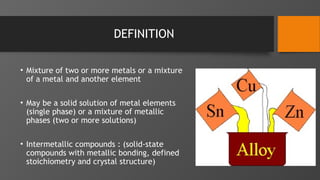
DEFINITION
• Mixture oftwo or more metals or a mixture
of a metal and another element
• May be a solid solution of metal elements
(single phase) or a mixture of metallic
phases (two or more solutions)
• Intermetallic compounds : (solid-state
compounds with metallic bonding, defined
stoichiometry and crystal structure)
ALLOY THEORY
Some metalsare used in pure form (99.99%)
• Copper (very high conductivity)
• Aluminum (bright metallic surface-decoration)
Expensive & difficult processing
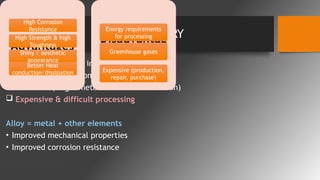
Alloy = metal + other elements
• Improved mechanical properties
• Improved corrosion resistance
Advantages
High Corrosion
Resistance
High Strength & high
Toughness
Shiny / aesthetic
appearance
Better Heat
conduction/dissipation
Disadvantag
es
Energy requirements
for processing
Greenhouse gases
Expensive (production,
repair, purchase)
6.
PROPERTIES
• Mechanical propertiesare different as
those of the individual elements
• Pure metals : mostly are softer &
weaker as compared to their alloys
Example: steel, solder, brass etc.
• aluminum(soft metal) + copper(soft) =
hard and strong aluminum alloy
• Carbon + iron = steel [iron: 35ksi ;
maraging steel: 350ksi]
• Chromium + steel = stainless steel
(corrosion resistant steel)
HUME - ROTHERYRULES
Solubility of one element in another
1. Diameter of atoms must not differ by 15%
2. Same crystal structure
3. No appreciable difference in electronegativities
4. Same valence Element Atomic
Radius
Crystal
Structure
Electro-
negativity
Valence Solid Solubility
with Copper
Copper 0.128 FCC 1.8 +2 --
Zinc 0.133 HCP 1.7 +2 High
Lead 0.175 FCC 1.6 +2, +4 Very low
Silicon 0.117 Diamond cubic 1.8 +4 Moderate
Aluminum 0.143 FCC 1.5 +3 Moderate
Nickel 0.125 FCC 1.8 +2 High
Cu-Ni system:
Substitutional
solid solution
IRON - IRONCARBIDE PHASE DIAGRAM
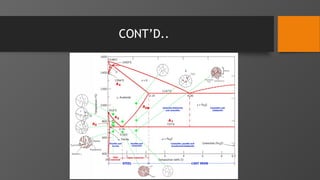
α-ferrite:
Carbon in BCC (α) iron ; 0.02% at 723o
C
Austenite (ỳ):
C in FCC (ỳ) iron ;
2.08% at 1148o
C
δ-ferrite:
Carbon in BCC (δ) iron ; 0.09% at 1465o
C
Cementite (Fe3C) :
Intermetallic ; C = 6.67%
REFERENCES
1. Alloy Steels-Propertiesand Use edited by Eduardo Valencia Morales
(2011)
2. Materials Science & Engineering by William F. Smith, Javad Hashmi & Ravi
Prakash (4th
Edition)
3. Introduction to Physical Metallurgy by Sidney H. Avner (2nd
Edition)
4. Engineering materials, Properties & Applications of Metals & Alloys by
C.P. Sharma
#5 solid solution consists of atoms of at least two different types; the solute atoms occupy either Substitutional or interstitial positions in the solvent lattice, and the
crystal structure of the solvent is maintained.
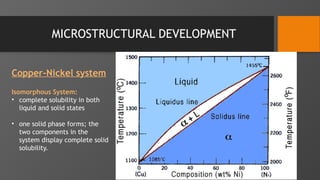
The phase diagram is a crucial part of metallurgy - it shows the equilibrium states of a mixture, so that given a temperature and composition, it is possible to calculate which phases will be formed, and in what quantities.
#6 Strengthening: Impurity atoms go into the solid solution. Lattice strains are imposed on the host atoms. Lattice strain filed interactions between dislocation and impurities result in restricted movement of dislocations. Increased yield strength.
#7 Alloying a metal is done by combining it with one or more other elements that often enhance its properties. For example, the combination of carbon with iron produces steel, which is stronger than iron, its primary element.
The electrical and thermal conductivity of alloys is usually lower than that of the pure metals.
The physical properties, such as density, reactivity, Young's modulus of an alloy may not differ greatly from those of its base element, but engineering properties such as tensile strength, ductility, and shear strength may be substantially different from those of the constituent materials. This is sometimes a result of the sizes of the atoms in the alloy, because larger atoms exert a compressive force on neighboring atoms, and smaller atoms exert a tensile force on their neighbors, helping the alloy resist deformation.
Sometimes alloys may exhibit marked differences in behavior even when small amounts of one element are present. For example, impurities in semiconducting ferromagnetic alloys lead to different properties, as first predicted by White, Hogan, Suhl, Tian Abrie and Nakamura
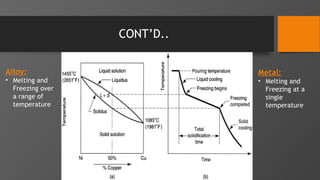
Unlike pure metals, most alloys do not have a single melting point, but a melting range during which the material is a mixture of solid and liquid phases (a slush). The temperature at which melting begins is called the solidus, and the temperature when melting is just complete is called the liquidus. For many alloys there is a particular alloy proportion (in some cases more than one), called either a eutectic mixture or a peritectic composition, which gives the alloy a unique and low melting point, and no liquid/solid slush transition.
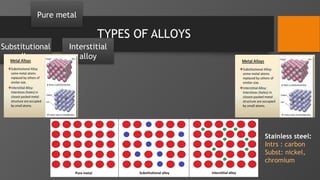
#9 Depending on the atomic arrangement that forms the alloy.
Substitutional: solute substitutes the solvent in the crystal lattice without structural changes.
Interstitial: solute does not occupy the sites in the lattice of the solvent but resides in crystallographic pores.
Transformational: A completely new lattice is formed. Usually occurs as a result of intermetallic compound formation.
When a molten metal is mixed with another substance, there are two mechanisms that can cause an alloy to form, called atom exchange and the interstitial mechanism.
The relative size of each element in the mix plays a primary role in determining which mechanism will occur. When the atoms are relatively similar in size, the atom exchange method usually happens, where some of the atoms composing the metallic crystals are substituted with atoms of the other constituent. This is called a substitutional alloy. Examples of substitutional alloys include bronze and brass, in which some of the copper atoms are substituted with either tin or zinc atoms respectively.
In the case of the interstitial mechanism, one atom is usually much smaller than the other and can not successfully substitute for the other type of atom in the crystals of the base metal. Instead, the smaller atoms become trapped in the spaces between the atoms of the crystal matrix, called the interstices. This is referred to as an interstitial alloy. Steel is an example of an interstitial alloy, because the very small carbon atoms fit into interstices of the iron matrix.
Stainless steel is an example of a combination of interstitial and substitutional alloys, because the carbon atoms fit into the interstices, but some of the iron atoms are substituted by nickel and chromium atoms
#10 In homogeneous alloys, atoms of the different elements are distributed uniformly. Examples include brass, bronze, and the coinage alloys.
Heterogeneous alloys, such as tin-lead solder and the mercury amalgam sometimes used to fill teeth, consist of a mixture of crystalline phases with different compositions.
Intermetallics: solid-state compound having metallic bonding, defined stoichiometry and ordered crystal structure (hard, brittle, high melting point – Ni3Al)
Superalloys is a name for a group of alloys that retain high strength at elevated temperatures. High creep resistance, high performance alloy, high corrosion resistance, surface stability etc.
Cast irons are classified on the basis of the form of carbon, matrix and microstructure and applications.
Chilled cast iron: It is obtained by thick castings cooled rapidly. White cast iron at the case and Grey cast iron at the core.
Meehanite: a class of cast iron obtained by treating molten metal by calcium silicide.
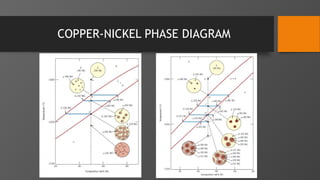
#11 The liquidus and solidus lines intersect at the two composition extremities; that is, at the temperatures corresponding to the melting points of pure copper (1085 °C, or 1981 °F) and pure nickel (1455 °C, or 2644 °F). Because pure metals melt at a constant temperature, pure copper remains a solid until its melting point of 1085 °C (1981 °F) is reached on heating. The solid-to-liquid transformation then occurs and no further heating is possible until the transformation is complete. However, for any composition other than the pure components, melting will occur over a range of temperatures between the solidus and liquidus lines. For example, on heating a composition of 50wt%Cu-50wt%Ni, melting begins at approximately 1250 °C (2280 °F) and the amount of liquid increases until approximately 1315 °C (2400° F) is reached, at which point the alloy is completely liquid.
#12 Binary phase diagrams are maps that represent the relationships between temperature and the compositions & quantities of phases at equilibrium.
Equilibrium:
#13 Alpha and delta ferrite both have BCC crystal structure but due to greater lattice constant delta ferrite has a slight distorted (tetragonal) structure crystal structure (BCT).


![PROPERTIES
• Mechanical properties are different as
those of the individual elements
• Pure metals : mostly are softer &
weaker as compared to their alloys
Example: steel, solder, brass etc.
• aluminum(soft metal) + copper(soft) =
hard and strong aluminum alloy
• Carbon + iron = steel [iron: 35ksi ;
maraging steel: 350ksi]
• Chromium + steel = stainless steel
(corrosion resistant steel)](https://image.slidesharecdn.com/alloytheorymicrostructuraldevelopment-250521142834-bdc4140d/85/Alloy-Theory-Microstructural-Development-pptx-6-320.jpg)






![Lect 01 [Unit-01] Alsdasaasdasdadaloys.pptx](https://cdn.slidesharecdn.com/ss_thumbnails/lect01unit-01alloys-240626044443-4b9a0486-thumbnail.jpg?width=640&height=640&fit=bounds)


