Well?
• Though 92%ofacademics surveyed indicated that it
was important for students to be able to think and
learn in a manner that stimulates a change in their
perspectives, 54% of students surveyed indicated that
they felt as though “they have not yet been provided
the opportunity to do so” (UWA, 2017).
• According to one university lecturer interviewed in
Lloyd and Bahr’s (2010, p. 13) qualitative research, ‘we
expect students to do it [think critically], but now you
are questioning me on my understanding of it, I
wonder if I understand it myself’.
• Lloyd and Bahr’s research further revealed that while
37% of academics instructing or assessing CT in
university courses at least acknowledge the
dispositional and self-regulatory aspects of CT, only
47% described CT in terms of involving processes or
What Is
Critical
Thinking?
4.
Critical thinking isa metacognitive process, consisting of a number of
skills and dispositions, that, through purposeful, self-regulatory
reflective judgment, increases the chances of producing a logical
solution to a problem or a valid conclusion to an argument.
5.
Disposition
toward ct
…the extentto which an individual is disposed, inclined
or
willing to perform a given thinking skill
• A person with strong disposition towards critical
thinking
has the consistent internal motivation to engage
problems
and make decisions by using critical thinking, meaning:
• the person consistently values critical thinking
• believes that using critical thinking skills offers the
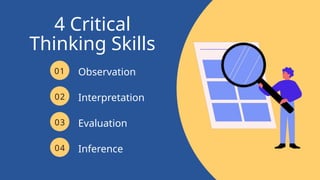
Observation means payingclose attention to
what is around you and the information you
are taking in. Notice what details stand out to
you. Can you recognize any patterns or trends?
Being observant helps students quickly identify
problems and possible solutions.
Observation
01
8.
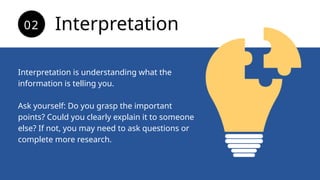
Interpretation is understandingwhat the
information is telling you.
Ask yourself: Do you grasp the important
points? Could you clearly explain it to someone
else? If not, you may need to ask questions or
complete more research.
Interpretation
02
9.
Evaluation and analysisare important aspects
of critical thinking. Not only do you need to
understand the information, but you also need
to identify what is important to solve the
problem or make a decision.
It is also the ability to ask relevant questions,
gather facts from trustworthy sources, and
assess your research.
Evaluation
03
10.
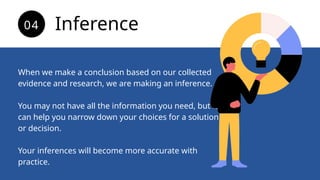
When we makea conclusion based on our collected
evidence and research, we are making an inference.
You may not have all the information you need, but it
can help you narrow down your choices for a solution
or decision.
Your inferences will become more accurate with
practice.
Inference
04
11.
• Increases confidencein our ability to analyze and
evaluate information
• Helps us make informed decisions, problem solve,
and cope with challenges
• Empowers us to trust the choices and decisions we
make
• Aids us in adapting to changes more effectively and
positively
• Improves our ability to recognize facts, opinions,
and misinformation
importance of critical thinking
12.
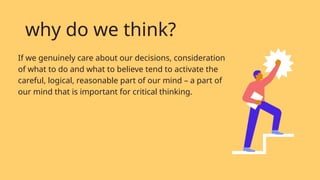
If we genuinelycare about our decisions, consideration
of what to do and what to believe tend to activate the
careful, logical, reasonable part of our mind – a part of
our mind that is important for critical thinking.
why do we think?
13.
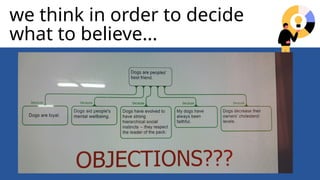
Not only scientiststhink carefully and logically. We all do this whenever we
care about our decisions.
Consider an important decision: “I should buy a dog”
• Because I’ve always had dogs and I love them
• Because dogs are peoples’ best friend
• Because I can go out walking every evening, keep fit and meet other
people with dogs
• But walking my dog every evening will mean I cannot pursue my new
hobby
• But I’ll feel guilty if I’m forced to leave my dog alone in the house all day
we think in order to
decide what to do...
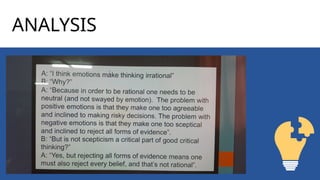
Questioning our beliefs...adding
butto because
When deciding what to believe, we need to be careful not to focus only on reasons for
accepting our beliefs (confirmation bias).
• We need to question our beliefs and the reasons we provide as a basis for our beliefs -
we need to be sceptical.
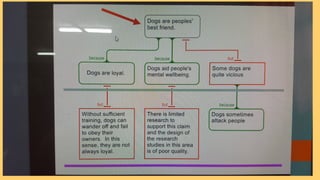
• Are dogs really peoples’ best friend. What would make you disbelieve?
17.
ANALYSIS
Since asking youthe reasons for why think,
we have been conducting the skill of analysis.
• Simply, when we analyse information, we are
identifying claims, their reasons and their objections,
as well as rebuttals.
Successful analysis yields the structure of an
argument, problem, and/or solution.

![Well?
• Though 92%of academics surveyed indicated that it
was important for students to be able to think and
learn in a manner that stimulates a change in their
perspectives, 54% of students surveyed indicated that
they felt as though “they have not yet been provided
the opportunity to do so” (UWA, 2017).
• According to one university lecturer interviewed in
Lloyd and Bahr’s (2010, p. 13) qualitative research, ‘we
expect students to do it [think critically], but now you
are questioning me on my understanding of it, I
wonder if I understand it myself’.
• Lloyd and Bahr’s research further revealed that while
37% of academics instructing or assessing CT in
university courses at least acknowledge the
dispositional and self-regulatory aspects of CT, only
47% described CT in terms of involving processes or
What Is
Critical
Thinking?](https://image.slidesharecdn.com/criticalthinkinganintroduction-250701015022-2936a8ea/85/CRITICAL-THINKING-AN-INTRODUCTION-CRITICAL-THINKING-AN-INTRODUCTION-3-320.jpg)