CRITICAL
THINKING
CITIZEN
ASSESSMENT
MODEL
WP2 Workshop, Athens, 02/02/2023
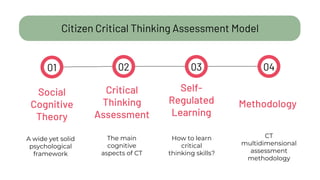
Citizen Critical Thinking Assessment Model
A wide yet solid
psychological
framework
Social
Cognitive
Theory
Critical
Thinking
Assessment
The main
cognitive
aspects of CT
04
03
01 02
How to learn
critical
thinking skills?
Self-
Regulated
Learning
Methodology
CT
multidimensional
assessment
methodology
Citizen Critical Thinking Assessment Model
A wide yet solid
psychological
framework
Social
Cognitive
Theory
01
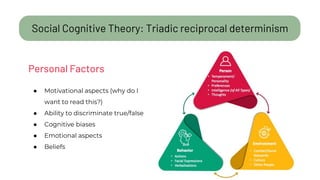
Social Cognitive Theory: Triadic reciprocal determinism
● Motivational aspects (why do I
want to read this?)
● Ability to discriminate true/false
● Cognitive biases
● Emotional aspects
● Beliefs
Personal Factors
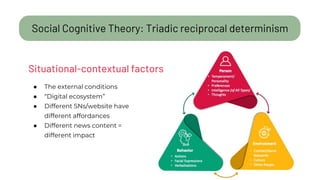
Social Cognitive Theory: Triadic reciprocal determinism
● The external conditions
● “Digital ecosystem”
● Different SNs/website have
different affordances
● Different news content =
different impact
Situational-contextual factors
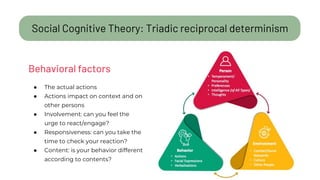
Social Cognitive Theory: Triadic reciprocal determinism
● The actual actions
● Actions impact on context and on
other persons
● Involvement: can you feel the
urge to react/engage?
● Responsiveness: can you take the
time to check your reaction?
● Content: is your behavior different
according to contents?
Behavioral factors
Citizen Critical Thinking Assessment Model
Critical
Thinking
Assessment
The main
cognitive
aspects of CT
02
Critical thinking assessment
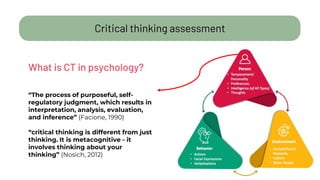
“The process of purposeful, self-
regulatory judgment, which results in
interpretation, analysis, evaluation,
and inference” (Facione, 1990)
“critical thinking is different from just
thinking. It is metacognitive - it
involves thinking about your
thinking” (Nosich, 2012)
What is CT in psychology?
Critical thinking assessment & coaching
Six cognitive skills of critical thinking (Delphi reference panel, 1990)
Cognitive
Skills of
Critical
Thinking
Interpretation
to comprehend and
express the meaning
of statements
Evaluation
to assess the credibility
of statements
Inference
to educe consequences
from the appropriate
statements
(Self-regulation)
conscious monitoring of
one's cognitive activities
Analysis
to identify the relationships
among different statements
Explanation
to justify appropriately
one’s own reasoning
Critical thinking assessment
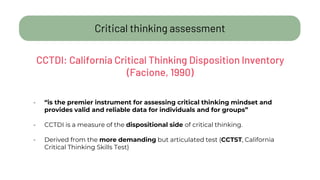
- “is the premier instrument for assessing critical thinking mindset and
provides valid and reliable data for individuals and for groups”
- CCTDI is a measure of the dispositional side of critical thinking.
- Derived from the more demanding but articulated test (CCTST, California
Critical Thinking Skills Test)
CCTDI: California Critical Thinking Disposition Inventory
(Facione, 1990)
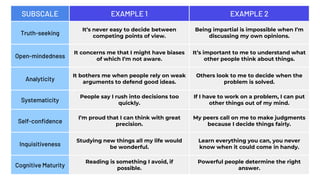
CCTDI Example Items for Each CCTDI subscale
SUBSCALE EXAMPLE 1 EXAMPLE 2
Truth-seeking
It’s never easy to decide between
competing points of view.
Being impartial is impossible when I’m
discussing my own opinions.
Open-mindedness
It concerns me that I might have biases
of which I’m not aware.
It’s important to me to understand what
other people think about things.
Analyticity
It bothers me when people rely on weak
arguments to defend good ideas.
Others look to me to decide when the
problem is solved.
Systematicity
People say I rush into decisions too
quickly.
If I have to work on a problem, I can put
other things out of my mind.
Self-confidence
I’m proud that I can think with great
precision.
My peers call on me to make judgments
because I decide things fairly.
Inquisitiveness
Studying new things all my life would
be wonderful.
Learn everything you can, you never
know when it could come in handy.
Cognitive Maturity
Reading is something I avoid, if
possible.
Powerful people determine the right
answer.
Citizen Critical Thinking Assessment Model
03
How to learn
critical
thinking skills?
Self-
Regulated
Learning
Self-regulated learning of critical thinking skills
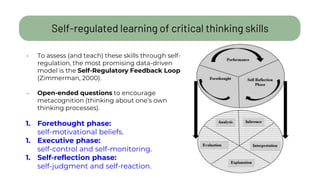
- To assess (and teach) these skills through self-
regulation, the most promising data-driven
model is the Self-Regulatory Feedback Loop
(Zimmerman, 2000).
- Open-ended questions to encourage
metacognition (thinking about one’s own
thinking processes).
1. Forethought phase:
self-motivational beliefs.
1. Executive phase:
self-control and self-monitoring.
1. Self-reflection phase:
self-judgment and self-reaction.
Self-regulated learning of critical thinking skills
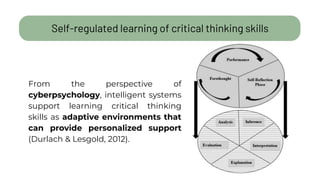
From the perspective of
cyberpsychology, intelligent systems
support learning critical thinking
skills as adaptive environments that
can provide personalized support
(Durlach & Lesgold, 2012).
Citizen Critical Thinking Assessment Model
CT
multidimensional
assessment
methodology
04
Methodology
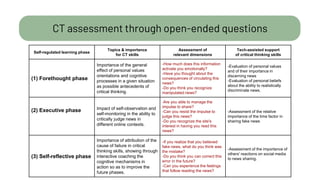
CT assessment through open-ended questions
Self-regulated learning phase
Topics & importance
for CT skills
Assessment of
relevant dimensions
Tech-assisted support
of critical thinking skills
(1) Forethought phase
Importance of the general
effect of personal values
orientations and cognitive
processes in a given situation
as possible antecedents of
critical thinking.
-How much does this information
activate you emotionally?
-Have you thought about the
consequences of circulating this
news?
-Do you think you recognize
manipulated news?
-Evaluation of personal values
and of their importance in
discerning news
-Evaluation of personal beliefs
about the ability to realistically
discriminate news.
(2) Executive phase Impact of self-observation and
self-monitoring in the ability to
critically judge news in
different online contexts.
-Are you able to manage the
impulse to share?
-Can you resist the impulse to
judge this news?
-Do you recognize the site's
interest in having you read this
news?
-Assessment of the relative
importance of the time factor in
sharing fake news
(3) Self-reflective phase
Importance of attribution of the
cause of failure in critical
thinking skills, showing through
interactive coaching the
cognitive mechanisms in
action so as to improve the
future phases.
-If you realize that you believed
fake news, what do you think was
the mistake?
-Do you think you can correct this
error in the future?
-Can you experience the feelings
that follow reading the news?
-Assessment of the importance of
others' reactions on social media
to news sharing.
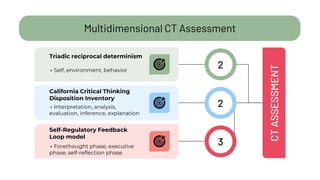
Multidimensional CT Assessment
2
CT
ASSESSMENT
2
Triadic reciprocal determinism
→ Self, environment, behavior
California Critical Thinking
Disposition Inventory
→ Interpretation, analysis,
evaluation, inference, explanation
Self-Regulatory Feedback
Loop model
→ Forethought phase, executive
phase, self-reflection phase
3
THANK YOU!
Uninettuno University, 02/02/2023

Critical Thinking Assessment Model.pptx

  • 1.
  • 2.
    Citizen Critical ThinkingAssessment Model A wide yet solid psychological framework Social Cognitive Theory Critical Thinking Assessment The main cognitive aspects of CT 04 03 01 02 How to learn critical thinking skills? Self- Regulated Learning Methodology CT multidimensional assessment methodology
  • 3.
    Citizen Critical ThinkingAssessment Model A wide yet solid psychological framework Social Cognitive Theory 01
  • 4.
    Social Cognitive Theory:Triadic reciprocal determinism ● Motivational aspects (why do I want to read this?) ● Ability to discriminate true/false ● Cognitive biases ● Emotional aspects ● Beliefs Personal Factors
  • 5.
    Social Cognitive Theory:Triadic reciprocal determinism ● The external conditions ● “Digital ecosystem” ● Different SNs/website have different affordances ● Different news content = different impact Situational-contextual factors
  • 6.
    Social Cognitive Theory:Triadic reciprocal determinism ● The actual actions ● Actions impact on context and on other persons ● Involvement: can you feel the urge to react/engage? ● Responsiveness: can you take the time to check your reaction? ● Content: is your behavior different according to contents? Behavioral factors
  • 7.
    Citizen Critical ThinkingAssessment Model Critical Thinking Assessment The main cognitive aspects of CT 02
  • 8.
    Critical thinking assessment “Theprocess of purposeful, self- regulatory judgment, which results in interpretation, analysis, evaluation, and inference” (Facione, 1990) “critical thinking is different from just thinking. It is metacognitive - it involves thinking about your thinking” (Nosich, 2012) What is CT in psychology?
  • 9.
    Critical thinking assessment& coaching Six cognitive skills of critical thinking (Delphi reference panel, 1990) Cognitive Skills of Critical Thinking Interpretation to comprehend and express the meaning of statements Evaluation to assess the credibility of statements Inference to educe consequences from the appropriate statements (Self-regulation) conscious monitoring of one's cognitive activities Analysis to identify the relationships among different statements Explanation to justify appropriately one’s own reasoning
  • 10.
    Critical thinking assessment -“is the premier instrument for assessing critical thinking mindset and provides valid and reliable data for individuals and for groups” - CCTDI is a measure of the dispositional side of critical thinking. - Derived from the more demanding but articulated test (CCTST, California Critical Thinking Skills Test) CCTDI: California Critical Thinking Disposition Inventory (Facione, 1990)
  • 11.
    CCTDI Example Itemsfor Each CCTDI subscale SUBSCALE EXAMPLE 1 EXAMPLE 2 Truth-seeking It’s never easy to decide between competing points of view. Being impartial is impossible when I’m discussing my own opinions. Open-mindedness It concerns me that I might have biases of which I’m not aware. It’s important to me to understand what other people think about things. Analyticity It bothers me when people rely on weak arguments to defend good ideas. Others look to me to decide when the problem is solved. Systematicity People say I rush into decisions too quickly. If I have to work on a problem, I can put other things out of my mind. Self-confidence I’m proud that I can think with great precision. My peers call on me to make judgments because I decide things fairly. Inquisitiveness Studying new things all my life would be wonderful. Learn everything you can, you never know when it could come in handy. Cognitive Maturity Reading is something I avoid, if possible. Powerful people determine the right answer.
  • 12.
    Citizen Critical ThinkingAssessment Model 03 How to learn critical thinking skills? Self- Regulated Learning
  • 13.
    Self-regulated learning ofcritical thinking skills - To assess (and teach) these skills through self- regulation, the most promising data-driven model is the Self-Regulatory Feedback Loop (Zimmerman, 2000). - Open-ended questions to encourage metacognition (thinking about one’s own thinking processes). 1. Forethought phase: self-motivational beliefs. 1. Executive phase: self-control and self-monitoring. 1. Self-reflection phase: self-judgment and self-reaction.
  • 14.
    Self-regulated learning ofcritical thinking skills From the perspective of cyberpsychology, intelligent systems support learning critical thinking skills as adaptive environments that can provide personalized support (Durlach & Lesgold, 2012).
  • 15.
    Citizen Critical ThinkingAssessment Model CT multidimensional assessment methodology 04 Methodology
  • 16.
    CT assessment throughopen-ended questions Self-regulated learning phase Topics & importance for CT skills Assessment of relevant dimensions Tech-assisted support of critical thinking skills (1) Forethought phase Importance of the general effect of personal values orientations and cognitive processes in a given situation as possible antecedents of critical thinking. -How much does this information activate you emotionally? -Have you thought about the consequences of circulating this news? -Do you think you recognize manipulated news? -Evaluation of personal values and of their importance in discerning news -Evaluation of personal beliefs about the ability to realistically discriminate news. (2) Executive phase Impact of self-observation and self-monitoring in the ability to critically judge news in different online contexts. -Are you able to manage the impulse to share? -Can you resist the impulse to judge this news? -Do you recognize the site's interest in having you read this news? -Assessment of the relative importance of the time factor in sharing fake news (3) Self-reflective phase Importance of attribution of the cause of failure in critical thinking skills, showing through interactive coaching the cognitive mechanisms in action so as to improve the future phases. -If you realize that you believed fake news, what do you think was the mistake? -Do you think you can correct this error in the future? -Can you experience the feelings that follow reading the news? -Assessment of the importance of others' reactions on social media to news sharing.
  • 17.
    Multidimensional CT Assessment 2 CT ASSESSMENT 2 Triadicreciprocal determinism → Self, environment, behavior California Critical Thinking Disposition Inventory → Interpretation, analysis, evaluation, inference, explanation Self-Regulatory Feedback Loop model → Forethought phase, executive phase, self-reflection phase 3
  • 18.