
EDjEconomic Development Journal
THE IEDC
Volume 6 / Number 4 / Fall 2007734 15th Street, NW Suite 900 • Washington, DC 20005
Critical Steps in the
Cluster Building Process
By Neil Reid, Michael C. Carroll, and Bruce W. Smith
THE ART AND SCIENCE OF CLUSTER-BASED ECONOMIC DEVELOPMENT
Economic development efforts organized around the concept of industrial clusters are increasingly
popular. One of the challenges facing communities wishing to adopt such a strategy is the lack
of a standard methodology that can be implemented once potential cluster industries have been
identified. This article provides such a methodology. The methodology described in this
article has been developed as the result of the authors’ experience in developing a
very successful greenhouse cluster in northwest Ohio. It is designed to assist any
industrial cluster that is in the very early stages of implementation.
Advertisement
For nearly 40 years, IEDC’s Advisory Services and Research (ASR)
department has provided customized solutions for communities’ economic
development challenges. With access to more than 4,500 members, we
deliver practical economic development advice and solutions to local, state
and federal clients. Our cost-effective services focus on:
For more information, contact Ed Gilliland, CEcD at 202-942-9461 or
egilliland@iedconline.org
• Strategic Planning
• Organizational Development &
Program Analysis
• Business Retention, Expansion
and Attraction
• Neighborhood & Commercial
Revitalization
• Real Estate Development
and Reuse
B R I N G I E D C T O Y O U R C O M M U N I T Y
IEDC PANEL ADVISORY SERVICES
Economic Development Journal / Fall 2007 / Volume 6 / Number 4 44
INTRODUCTION
undreds of communities around
the world have implemented
cluster-based economic develop-
ment (CBED) programs (Solvell
et al. 2003). Products ranging from
thoroughbred horses (Akoorie 2000) to Formula
One racing cars (Henry and Pinch 2001) are
being produced by industries that are part of an
industrial cluster. Starting and maintaining an
industrial cluster are challenging processes.
In an earlier Economic Development Journal
article, we examined the challenges in initiating
and maintaining a greenhouse industry cluster in
northwest Ohio (Reid and Carroll 2006). The
northwest Ohio greenhouse cluster was formally
launched in January 2005. Since its inception, we
have had the opportunity to reflect on the process
of starting and managing a successful industrial
cluster. In this article, we would like to share these
reflections. In particular, we suggest a methodolo-
gy for moving a cluster from identification to
implementation. This methodology outlines a
series of steps that are taken once a particular indus-
try has been identified as a target of cluster-based eco-
nomic development.
Numerous methods exist for identifying which
industries might be legitimate candidates for a
cluster-based economic development strategy.
They can be identified through an analysis of
industries that currently drive a local economy.
Target industries can also emerge from political
and industry interests. For example, the impetus
for the development of a northwest Ohio green-
house cluster resulted from strong interest on the
part of the local Congresswoman to make the local
greenhouse industry more competitive.
Interest on the part of a local industry can also
provide the genesis for the development of an
industrial cluster. For example, in northwest Ohio,
businesses engaged in providing architectural,
engineering, and construction services are in the
very early stages of developing a cluster-based
strategy for their industry.
Previous research has provided methodologies
for identifying target industries (Feser et al. 2005,
Rey et al. 2005) and has addressed the critical issue
of financing (Osama and Popper 2006). However,
there have been few attempts at providing a com-
prehensive and integrated methodology for cluster
implementation.
CLUSTER-BASED ECONOMIC DEVELOPMENT
To provide a context for the methodology pre-
sented here, it is necessary to understand our con-
critical steps in the
CLUSTER BUILDING PROCESS
By Neil Reid, Michael C. Carroll, and Bruce W. Smith
THE ART AND SCIENCE OF CLUSTER-BASED ECONOMIC DEVELOPMENT
Economic development efforts organized around the concept of industrial clusters are increasingly popular. One
of the challenges facing communities wishing to adopt such a strategy is the lack of a standard methodology that
can be implemented once potential cluster industries have been identified. This article provides such a methodol-
ogy. The methodology described in this article has been developed as the result of the authors’ experience in
developing a very successful greenhouse cluster in northwest Ohio. It is designed to assist any industrial cluster
that is in the very early stages of implementation.
h
Neil Reid is Director of the Urban
Affairs Center, University of Toledo,
Toledo, OH (neil.reid@utoledo.edu).
Michael C. Carroll is Director of the
Center for Regional Development
(mcarroll@bgsu,edu) and
Bruce W. Smith is a Research
Fellow at the Center for Regional
Development (bsmith4@bgsu.edu),
Bowling Green State University,
Bowling Green, OH.
Northwest Ohio windmills. The region is in the process of developing an industrial cluster around
emerging alternative energy technologies.
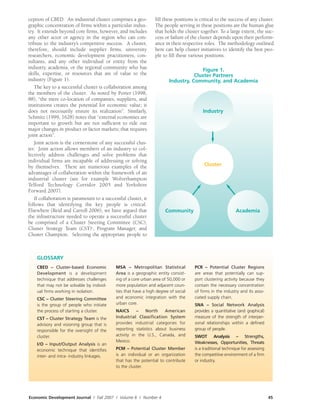
ception of CBED. An industrial cluster comprises a geo-
graphic concentration of firms within a particular indus-
try. It extends beyond core firms, however, and includes
any other actor or agency in the region who can con-
tribute to the industry’s competitive success. A cluster,
therefore, should include supplier firms, university
researchers, economic development practitioners, con-
sultants, and any other individual or entity from the
industry, academia, or the regional community who has
skills, expertise, or resources that are of value to the
industry (Figure 1).
The key to a successful cluster is collaboration among
the members of the cluster. As noted by Porter (1998,
88), “the mere co-location of companies, suppliers, and
institutions creates the potential for economic value; it
does not necessarily ensure its realization”. Similarly,
Schmitz (1999, 1628) notes that “external economies are
important to growth but are not sufficient to ride out
major changes in product or factor markets; that requires
joint action”.
Joint action is the cornerstone of any successful clus-
ter. Joint action allows members of an industry to col-
lectively address challenges and solve problems that
individual firms are incapable of addressing or solving
by themselves. There are numerous examples of the
advantages of collaboration within the framework of an
industrial cluster (see for example Wolverhampton
Telford Technology Corridor 2005 and Yorkshire
Forward 2007).
If collaboration is paramount to a successful cluster, it
follows that identifying the key people is critical.
Elsewhere (Reid and Carroll 2006), we have argued that
the infrastructure needed to operate a successful cluster
be comprised of a Cluster Steering Committee (CSC),
Cluster Strategy Team (CST)1
, Program Manager, and
Cluster Champion. Selecting the appropriate people to
fill these positions is critical to the success of any cluster.
The people serving in these positions are the human glue
that holds the cluster together. To a large extent, the suc-
cess or failure of the cluster depends upon their perform-
ance in their respective roles. The methodology outlined
here can help cluster initiatives to identify the best peo-
ple to fill these various positions.
Economic Development Journal / Fall 2007 / Volume 6 / Number 4 45
GLOSSARY
CBED – Cluster-based Economic
Development is a development
technique that addresses challenges
that may not be solvable by individ-
ual firms working in isolation.
CSC – Cluster Steering Committee
is the group of people who initiate
the process of starting a cluster.
CST – Cluster Strategy Team is the
advisory and visioning group that is
responsible for the oversight of the
cluster.
I/O – Input/Output Analysis is an
economic technique that identifies
inter- and intra- industry linkages.
MSA – Metropolitan Statistical
Area is a geographic entity consist-
ing of a core urban area of 50,000 or
more population and adjacent coun-
ties that have a high degree of social
and economic integration with the
urban core.
NAICS – North American
Industrial Classification System
provides industrial categories for
reporting statistics about business
activity in the U.S., Canada, and
Mexico.
PCM – Potential Cluster Member
is an individual or an organization
that has the potential to contribute
to the cluster.
PCR – Potential Cluster Regions
are areas that potentially can sup-
port clustering activity because they
contain the necessary concentration
of firms in the industry and its asso-
ciated supply chain.
SNA – Social Network Analysis
provides a quantitative (and graphical)
measure of the strength of interper-
sonal relationships within a defined
group of people.
SWOT Analysis – Strengths,
Weaknesses, Opportunities, Threats
is a traditional technique for assessing
the competitive environment of a firm
or industry.
Figure 1.
Cluster Partners
Industry, Community, and Academia
Industry
Cluster
Community Academia
Economic Development Journal / Fall 2007 / Volume 6 / Number 4 46
KEY STEPS IN FORMING A CLUSTER
In this section, we describe the step-by-step method-
ology that a new cluster initiative utilizes. This method-
ology should be implemented after a particular industry
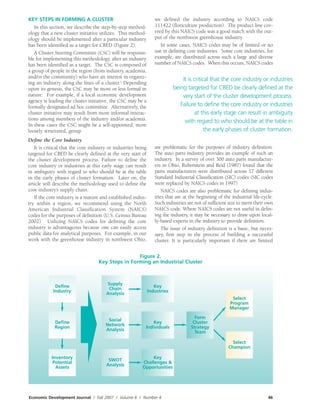
has been identified as a target for CBED (Figure 2).
A Cluster Steering Committee (CSC) will be responsi-
ble for implementing this methodology, after an industry
has been identified as a target. The CSC is composed of
a group of people in the region (from industry, academia,
and/or the community) who have an interest in organiz-
ing an industry along the lines of a cluster.2
Depending
upon its genesis, the CSC may be more or less formal in
nature. For example, if a local economic development
agency is leading the cluster initiative, the CSC may be a
formally designated ad hoc committee. Alternatively, the
cluster initiative may result from more informal interac-
tions among members of the industry and/or academia.
In these cases the CSC might be a self-appointed, more
loosely structured, group.
Define the Core Industry
It is critical that the core industry or industries being
targeted for CBED be clearly defined at the very start of
the cluster development process. Failure to define the
core industry or industries at this early stage can result
in ambiguity with regard to who should be at the table
in the early phases of cluster formation. Later on, the
article will describe the methodology used to define the
core industry’s supply chain.
If the core industry is a mature and established indus-
try within a region, we recommend using the North
American Industrial Classification System (NAICS)
codes for the purposes of definition (U.S. Census Bureau
2002). Utilizing NAICS codes for defining the core
industry is advantageous because one can easily access
public data for analytical purposes. For example, in our
work with the greenhouse industry in northwest Ohio,
we defined the industry according to NAICS code
111422 (floriculture production). The product line cov-
ered by this NAICS code was a good match with the out-
put of the northwest greenhouse industry.
In some cases, NAICS codes may be of limited or no
use in defining core industries. Some core industries, for
example, are distributed across such a large and diverse
number of NAICS codes. When this occurs, NAICS codes
are problematic for the purposes of industry definition.
The auto parts industry provides an example of such an
industry. In a survey of over 300 auto parts manufactur-
ers in Ohio, Rubenstein and Reid (1987) found that the
parts manufacturers were distributed across 17 different
Standard Industrial Classification (SIC) codes (SIC codes
were replaced by NAICS codes in 1997)
NAICS codes are also problematic for defining indus-
tries that are at the beginning of the industrial life-cycle.
Such industries are not of sufficient size to merit their own
NAICS code. Where NAICS codes are not useful in defin-
ing the industry, it may be necessary to draw upon local-
ly-based experts in the industry to provide definition.
The issue of industry definition is a basic, but neces-
sary, first step in the process of building a successful
cluster. It is particularly important if there are limited
Figure 2.
Key Steps in Forming an Industrial Cluster
Inventory
Potential
Assets
Key
Industries
Key
Challenges &
Opportunities
Select
Program
Manager
Select
Champion
It is critical that the core industry or industries
being targeted for CBED be clearly defined at the
very start of the cluster development process.
Failure to define the core industry or industries
at this early stage can result in ambiguity
with regard to who should be at the table in
the early phases of cluster formation.
Define
Industry
Define
Region
Supply
Chain
Analysis
Social
Network
Analysis
SWOT
Analysis
Key
Individuals
Form
Cluster
Strategy
Team
Economic Development Journal / Fall 2007 / Volume 6 / Number 4 47
resources to support cluster development. Concise defi-
nition of the core industry or industries permits efficient
allocation of limited financial resources. It also facilitates
efficient use of human resources by helping to identify
who should and who should not be involved in the plan-
ning for cluster implementation.
Define the Potential Cluster Region
It is important to define the geographic region within
which the potential cluster is going to function. Our
strategy is to identify the “spatial footprint” of potential
cluster regions (PCR). PCRs are areas that potentially
can support clustering activities because they contain the
necessary concentration of firms in the industry and its
associated supply chain. PCR builds on the notion that
spatial concentration is a necessary, but not sufficient,
condition underlying CBED policy.
We recognize that a CBED is a network driven econom-
ic strategy that stresses collaboration among firms in the
core industry, local suppliers, local government, and sup-
port institutions such as universities, think tanks, and
development agencies. Consequently, a PCR only has the
potential to be a cluster due to the co-location criterion.
From this perspective, the examination of industry loca-
tion patterns to delineate PCRs should be the initial step
in a CBED, thereby eliminating the likelihood of failed
cluster projects due to the lack of critical mass.
There are two basic approaches to delineating the
PCRs. The easiest method is to choose a predefined
region. A metropolitan statistical area (MSA), for exam-
ple, is generally accepted by many analysts as an opera-
tional definition of a regional economy (Mayer 2005).
In specific cases, local economic developers may have
a broader definition of the regional economy. For exam-
ple, in northwest Ohio, the regional economy is defined
as comprising an 11-county area. This reflects the serv-
ice area of northwest Ohio’s two primary regional eco-
nomic development agencies - the Regional Growth
Partnership (RGP) and the Northwest Ohio Regional
Economic Development (NORED) organization.
(Regional Growth Partnership, 2007). This definition is
geographically larger than the Toledo MSA which com-
prises only four counties.
Another method of defining the potential cluster
region is to derive it empirically using industry data to
define the geographic footprint of the industry. Every
industry has a unique spatial footprint, which may not
conform to predefined regions. Some industrial spatial
footprints are localized, encompassing a small number of
counties, such as the greenhouse industry, while others
are more geographically expansive covering a larger
region, such as the auto industry. There are a number of
quantitative methodologies relying primarily on census
data, which can be used to define the geographic foot-
print of potential cluster industries (see for example
Feser et al 2005, Miller et al 2001).
Our personal preference in defining PCRs is to use a
methodology that combines the strengths of location quo-
tients and measures of local spatial autocorrelation, such
as Getis-Ord Gi*. Location quotients measure the degree
of industrial specialization within a county compared to
the nation. In contrast, Gi* measures spatial autocorrela-
tion at the local level and it identifies “hot spots”, or con-
centrations in spatial distributions in which counties and
their neighbors have similar values of a given phenomena.
A high Gi* value indicates that high values are clus-
tered near each other, whereas a low Gi* value is indica-
tive of low values being near each other (Wong and Lee,
2005). In this approach, a potential cluster region has
location quotients greater than one and significantly high
Gi* values. Thus a potential cluster region is composed
of counties which are more specialized in an industry
than is the nation, and its neighbors also contain concen-
trations of that industry.
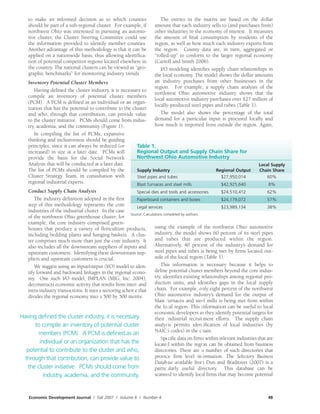
Figure 3 illustrates the output that can be produced
using our methodology. In Figure 3 the counties identi-
fied as “Auto PCR” have the potential to be members of
a regional automotive cluster. The geographic reach is
extensive for the counties that could be part of an auto-
motive cluster in the states of Illinois, Indiana, Michigan,
and Ohio.
In reality, the region identified is probably too geo-
graphically large to operate as a single functional cluster.
However, the information provided by this analysis
could be used by a sub-region within the four-state area
Figure 3.
Potential Auto Cluster Regions in Four
Upper Midwestern States
Auto PCR
Auto Periphery
Auto Specialized Counties
Auto-free
Economic Development Journal / Fall 2007 / Volume 6 / Number 4 48
to make an informed decision as to which counties
should be part of a sub-regional cluster. For example, if
northwest Ohio was interested in pursuing an automo-
tive cluster, the Cluster Steering Committee could use
the information provided to identify member counties.
Another advantage of this methodology is that it can be
applied on a nationwide basis, thus allowing identifica-
tion of potential competitor regions located elsewhere in
the country. The national clusters can be viewed as “geo-
graphic benchmarks” for monitoring industry trends.
Inventory Potential Cluster Members
Having defined the cluster industry, it is necessary to
compile an inventory of potential cluster members
(PCM). A PCM is defined as an individual or an organ-
ization that has the potential to contribute to the cluster
and who, through that contribution, can provide value
to the cluster initiative. PCMs should come from indus-
try, academia, and the community (Figure 1).
In compiling the list of PCMs, expansive
thinking and inclusiveness should be guiding
principles, since it can always be reduced (or
increased) in size at a later date. PCMs will
provide the basis for the Social Network
Analysis that will be conducted at a later date.
The list of PCMs should be compiled by the
Cluster Strategy Team, in consultation with
regional industrial experts.
Conduct Supply Chain Analysis
The industry definition adopted in the first
step of this methodology represents the core
industries of the industrial cluster. In the case
of the northwest Ohio greenhouse cluster, for
example, the core industry comprised green-
houses that produce a variety of floriculture products,
including bedding plants and hanging baskets. A clus-
ter comprises much more than just the core industry. It
also includes all the downstream suppliers of inputs and
upstream customers. Identifying these downstream sup-
pliers and upstream customers is crucial.
We suggest using an input/output (I/O) model to iden-
tify forward and backward linkages in the regional econo-
my. One such I/O model, IMPLAN (MIG, Inc. 2004),
deconstructs economic activity that results from inter- and
intra-industry transactions. It uses a sectoring scheme that
divides the regional economy into a 500 by 500 matrix.
The entries in the matrix are based on the dollar
amount that each industry sells to (and purchases from)
other industries in the economy of interest. It measures
the amount of final consumption by residents of the
region, as well as how much each industry exports from
the region. County data are, in turn, aggregated or
“rolled-up” to conform to the larger regional economy
(Carroll and Smith 2006).
I/O modeling identifies supply chain relationships in
the local economy. The model shows the dollar amounts
an industry purchases from other businesses in the
region. For example, a supply chain analysis of the
northwest Ohio automotive industry shows that the
local automotive industry purchases over $27 million of
locally-produced steel pipes and tubes (Table 1).
The model also shows the percentage of the total
demand for a particular input is procured locally and
how much is imported from outside the region. Again,
using the example of the northwest Ohio automotive
industry, the model shows 60 percent of its steel pipes
and tubes that are produced within the region.
Alternatively, 40 percent of the industry’s demand for
steel pipes and tubes is being met by firms located out-
side of the local region (Table 1).
This information is necessary because it helps to
define potential cluster members beyond the core indus-
try, identifies existing relationships among regional pro-
duction units, and identifies gaps in the local supply
chain. For example, only eight percent of the northwest
Ohio automotive industry’s demand for the output of
blast furnaces and steel mills is being met from within
the local region. This information can be useful to local
economic developers as they identify potential targets for
their industrial recruitment efforts. The supply chain
analysis permits identification of local industries (by
NAICS codes) in the chain.
Specific data on firms within relevant industries that are
located within the region can be obtained from business
directories. There are a number of such directories that
provide firm level information. The Selectory Business
Database available from Dun and Bradstreet (2007) is a
particularly useful directory. This database can be
scanned to identify local firms that may become potential
Having defined the cluster industry, it is necessary
to compile an inventory of potential cluster
members (PCM). A PCM is defined as an
individual or an organization that has the
potential to contribute to the cluster and who,
through that contribution, can provide value to
the cluster initiative. PCMs should come from
industry, academia, and the community.
Table 1.
Regional Output and Supply Chain Share for
Northwest Ohio Automotive Industry
Local Supply
Supply Industry Regional Output Chain Share
Steel pipes and tubes $27,950,014 60%
Blast furnaces and steel mills $42,925,640 8%
Special dies and tools and accessories $24,510,412 62%
Paperboard containers and boxes $24,179,072 57%
Legal services $23,989,134 38%
Source: Calculations completed by authors.
Economic Development Journal / Fall 2007 / Volume 6 / Number 4 49
cluster members. This information can be utilized to
update the established list of potential cluster members.
Conduct a Social Network Analysis
The foundation of any successful cluster initiative is
human relationships. Identifying the people who have the
most appropriate relationships is critical. Critical relation-
ships are those which are based on trust and respect.
In his book, The Tipping Point, Malcolm Gladwell
(2003) identifies three types of key individuals –
mavens, connectors, and salesmen. Connectors are peo-
ple who are well connected. They know a lot of people
within and beyond their industry. Mavens are individuals
who have an expansive knowledge base about their
particular industry. Salesmen are individuals with good
persuasion skills.
It should be noted that different authors use varying
terminology to describe what Gladwell refers to as con-
nectors, mavens, and salesmen. For example, DeSantis
(2006) uses the term bridger in place of Gladwell’s con-
nector. The critical issue is not the terminology. Rather,
it is identifying the people who have the connections,
knowledge, and inter-personal skills that are basic to the
successful development of an industrial cluster.
Identifying key people, as well as relationships among
cluster members, can be accomplished with social net-
work analysis (SNA). SNA provides a quantitative meas-
ure of the nature and strength of inter-personal relation-
ships within a defined group of people. These relation-
ships are revealed by asking potential cluster members
questions about their business-oriented social networks.
For example, in the northwest Ohio greenhouse indus-
try we asked all potential cluster members:
During the last 12 months, with regard to your work
in the greenhouse industry:
1. Who have you worked with on a project?
2. Who has given you advice or support?
3. Who has given you new ideas?
The data collected from this survey are analyzed using
specialized software that allows production of a series of
network maps (Figure 4) and summary statistics. In
mapping the northwest Ohio greenhouse industry, we
used InFlow software. InFlow is a commercially available
software that can be purchased as part of a package that
includes consultant training in both social network
analysis and software use (orgnet.com 2007).
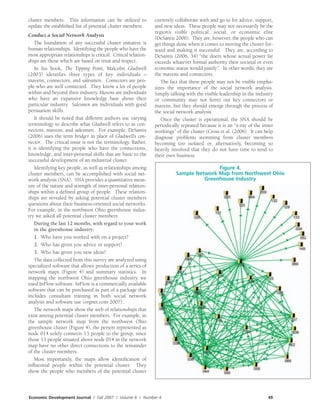
The network maps show the web of relationships that
exist among potential cluster members. For example, in
the sample network map from the northwest Ohio
greenhouse cluster (Figure 4), the person represented as
node 014 solely connects 13 people to the group, since
those 13 people situated above node 014 in the network
map have no other direct connections to the remainder
of the cluster members.
Most importantly, the maps allow identification of
influential people within the potential cluster. They
show the people who members of the potential cluster
currently collaborate with and go to for advice, support,
and new ideas. These people may not necessarily be the
region’s visible political, social, or economic elite
(DeSantis 2006). They are, however, the people who can
get things done when it comes to moving the cluster for-
ward and making it successful. They are, according to
DeSantis (2006, 34) “the doers whose actual power far
exceeds whatever formal authority their societal or even
economic status would justify”. In other words, they are
the mavens and connectors.
The fact that these people may not be visible empha-
sizes the importance of the social network analysis.
Simply talking with the visible leadership in the industry
or community may not ferret out key connectors or
mavens, but they should emerge through the process of
the social network analysis.
Once the cluster is operational, the SNA should be
periodically repeated because it is an “x-ray of the inner
workings” of the cluster (Cross et al. (2006). It can help
diagnose problems stemming from cluster members
becoming too isolated or, alternatively, becoming so
heavily involved that they do not have time to tend to
their own business.
Figure 4.
Sample Network Map from Northwest Ohio
Greenhouse Industry
Conduct SWOT Analysis
The next step is to complete a SWOT (Strengths,
Weaknesses, Opportunities, and Threats) Analysis.
SWOT analysis has a long history as a strategic planning
tool. It is useful with respect to developing an industri-
al cluster because it can provide focus for the Cluster
Strategy Team as it develops action step priorities for the
cluster. The results of a sample SWOT analysis are illus-
trated in Table 2.
The information and data that are necessary to com-
plete the SWOT analysis can be obtained by a variety of
methods including surveys, interviews, focus groups,
reading trade journals, and conducting quantitative
analysis (e.g. shift share analysis). All potential cluster
members should be invited to provide their input to the
SWOT analysis (US Department of Agriculture 1994).
Select Cluster Strategy Team, Program Manager,
and Champion
Having completed the supply chain, social network,
and SWOT analyses, the Cluster Strategy Team (CST)
can be created from the mavens, connectors, and sales-
men identified by the SNA. Ideally, the CST should com-
prise 10-12 individuals (CLOE 2006), and be represen-
tative of industry, academia, and the community.
Representation from all appropriate groups is consis-
tent with the idea of a cluster being a venue for innova-
tions and problem solving as a result of the cross-fertil-
ization of ideas of people from varied points of view. We
recommend that 50 percent of the CST comprise indi-
viduals from industry, with the remaining 50 percent
being divided evenly between academia and the com-
munity. Having half of the CST membership from indus-
try ensures that the CST is firmly focused on the needs
of the industry.
For a cluster initiative to be successful, it is critical
that the needs of the industry be its primary priority.
With the CST established, the role of the Cluster
Steering Committee (CSC) begins to diminish.
The CST is charged with oversight of the cluster. The
first job of the CST is to hire both a Cluster Program
Manager and Cluster Champion. We have described
both of these positions in detail elsewhere (see Reid and
Carroll 2006).
Briefly, the Program Manager is charged with the day
to day running of the cluster. This person should under-
stand the process of economic development; be able to
communicate effectively with members of industry, aca-
demia, and the general community; and have the ability
to rally disparate groups of people around the common
goal of developing the cluster.
The Champion is the cluster’s field agent and spends
much of his or her time visiting and talking with cluster
members (particularly firms). One of the Champion’s
major functions is to identify opportunities for collabo-
ration among cluster members and to work with the
Program Manager in implementing collaborations.
The Champion should have experience and knowledge
of working in the industry and should be someone who is
highly respected and trusted by cluster members. The
choice of individual to fill the role of Champion should
have wide acceptability among members of the cluster.
The ideal Champion should be a salesman, a maven,
and a connector. For example, in the early days of the
cluster the Champion will be required to sell the advan-
tages of cluster participation to cluster members. As the
cluster matures, the Champion will likely interface, as a
salesman, with political and community leaders, suppli-
ers, and other key organizations on behalf of the cluster.
Implement and Manage the Cluster
With the essential personnel now in place, it is time
to implement and manage the cluster. In other words, it
is time to move from having a potential cluster to having
a functioning cluster. Again, we have described this
process elsewhere (Reid and Carroll 2006).
In brief, the CST should meet monthly. There should
be monthly membership meetings that are open to all
interested stakeholders. Monthly CST meetings should
be held during the week preceding the membership
meeting. At these meetings, the agenda for the member-
ship meeting should be established. Both the Program
Manager and Champion should attend monthly CST
Economic Development Journal / Fall 2007 / Volume 6 / Number 4 50
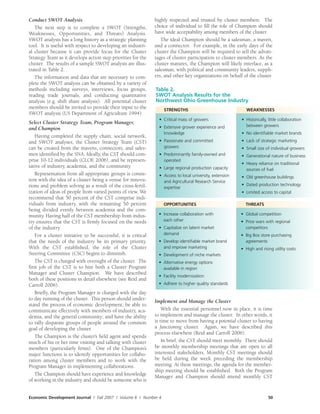
Table 2.
SWOT Analysis Results for the
Northwest Ohio Greenhouse Industry
STRENGTHS
• Critical mass of growers
• Extensive grower experience and
knowledge
• Passionate and committed
growers
• Predominantly family-owned and
operated
• Large regional production capacity
• Access to local university, extension
and Agricultural Research Service
expertise
WEAKNESSES
• Historically, little collaboration
between growers
• No identifiable market brands
• Lack of strategic marketing
• Small size of individual growers
• Generational nature of business
• Heavy reliance on traditional
sources of fuel
• Old greenhouse buildings
• Dated production technology
• Limited access to capital
OPPORTUNITIES
• Increase collaboration with
each other
• Capitalize on latent market
demand
• Develop identifiable market brand
and improve marketing
• Development of niche markets
• Alternative energy options
available in region
• Facility modernization
• Adhere to higher quality standards
THREATS
• Global competition
• Price wars with regional
competitors
• Big Box store purchasing
agreements
• High and rising utility costs
Economic Development Journal / Fall 2007 / Volume 6 / Number 4 51
meetings. On the issue of cluster membership, the CST
should decide on the membership rules and also on
whether the cluster should have formal status, such as
501(c)3 tax exempt legal status.
It is critical that the newly formed cluster get off to a
successful start. The CST should identify some early
cluster projects that satisfy two key criteria. First, they
should have a high probability of success. Second, they
should demonstrate the value of the cluster initiative to
cluster members.
CONCLUSIONS
We have outlined in this article a step-by-step
methodology for identifying and implementing Cluster
Based Economic Development. Creating the human
infrastructure is critical to operating a successful cluster
initiative. However, some “spadework” is necessary
before focusing on the human
element. For example, the
appropriate geographic region
must be delineated and inter-
industry relationships examined
through a supply chain analysis
to capture the key industrial
components of the cluster.
These steps can be accom-
plished by academics who have
a proclivity for applied research.
In terms of human infrastruc-
ture, much of what we have
described hinges on finding the
right people to fill the positions
of Strategy Team members,
Program Manager, and
Champion. The right people are crucial to the success
of any cluster initiative. This is because a successful
cluster is predicated on healthy human relationships.
This is why Social Network Analysis is such a critical
component of this methodology.
Social Network Analysis will contribute to the identi-
fication of people with the qualities necessary to be
Strategy Team members, Program Manager, or
Champion. Equally important, the Social Network
Analysis provides empirical evidence of the complex
web of social relationships among cluster members. In
order to strengthen the cluster, those social relationships
must be fostered.
The authors developed the methodology outlined in
this article as they went through the process of forming
the northwest Ohio greenhouse cluster. The methodol-
ogy, however, can be applied to any potential industrial
cluster. In northwest Ohio, for example, there is inter-
est in applying this methodology to the development of
a number of other emerging clusters. These include
alternative energy and architecture, construction, and
engineering services. The methodology is also being
considered as a tool to assist in the development of a
greenhouse cluster in southeastern Michigan.
The development of a successful industrial cluster is
both an art and a science. Human relationships play a
critical role. On the other hand, it is also vital to have a
rigorous analysis of available industry data to inform key
decisions. The methodology described in this article rec-
ognizes the importance of both of these aspects of a suc-
cessful cluster.
Regardless of the economic strength of an industry in
a region, a cluster strategy will fail if critical human rela-
tionships are not properly understood and nurtured.
This is why social network analysis is such a critical part
of the methodology. At the same time, a cluster strategy
cannot be successful without precise definition of an
industry’s economic structure, geographic footprint,
challenges to be faced, and opportunities for growth.
ACKNOWLEDGEMENTS
The authors would like to thank Joe Perlaky, Deb Smith, and
Sue Wuest for providing photographs for this article. The
United States Department of Agriculture funded the develop-
ment of the greenhouse cluster that is referenced in this article.
The development of a successful industrial cluster is
both an art and a science. Human relationships play a
critical role. On the other hand, it is also vital to have a
rigorous analysis of available industry data to inform
key decisions. The
methodology
described in this
article recognizes the
importance of both of
these aspects of a
successful cluster.
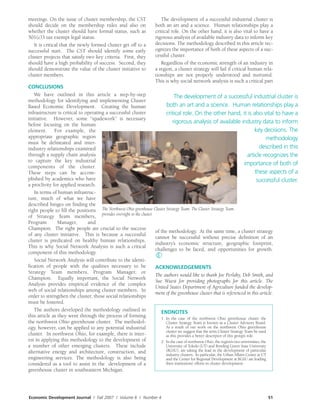
The Northwest Ohio greenhouse Cluster Strategy Team: The Cluster Strategy Team
provides oversight to the cluster.
ENDNOTES
1 In the case of the northwest Ohio greenhouse cluster the
Cluster Strategy Team is known as a Cluster Advisory Board.
As a result of our work on the northwest Ohio greenhouse
cluster we suggest that the term Cluster Strategy Team be used
as this provides a better descriptor of this group’s role.
2 In the case of northwest Ohio, the region’s two universities, the
University of Toledo (UT) and Bowling Green State University
(BGSU), are taking the lead in the development of particular
industry clusters. In particular, the Urban Affairs Center at UT
and the Center for Regional Development at BGSU are leading
their institutions’ efforts in cluster development.
Economic Development Journal / Fall 2007 / Volume 6 / Number 4 52
REFERENCES
Akoorie, M.E.M. (2000). Organizational Clusters in a Resource-based
Industry: Empirical Evidence from New Zealand. In Milford B. Green
and Rod B. McNaughton (eds.). Industrial Networks and Proximity.
Burlington, VT: Ashgate, 133-164.
Carroll, M. C. and B.W. Smith. (2006). The Role of GIS in Economic
Impact Studies. Papers of the Applied Geography Conferences, 29: 400-
407.
CLOE. (2006). Cluster Management Guide – Guidelines for the
Development and Management of Cluster Initiatives. Clusters Linked
Over Europe. www.clusterforum.org. Last accessed November 2,
2007.
Cross, R. T Laseter, A. Parker, and G. Velasquez. (2006). Using Social
Network Analysis to Improve Communities of Practice. California
Management Review, 49: 32-60.
DeSantis, M. (2006). Purposeful Networking. Economic Development
Journal, 5(1): 30-38.
Dun & Bradstreet. (2007). Selectory Business Database. Dun &
Bradstreet. www.selectory.com. Last accessed November 2, 2007.
Feser, E. Sweeney, S, Renski H (2005).A Descriptive Analysis of Discrete
U.S. Industrial Complexes. Journal of Regional Science, 395-419.
Gladwell, M. (2003). The Tipping Point. New York: Little, Brown and
Company.
Henry, N. and S. Pinch. (2001). Neo-Marshallian Nodes, Institutional
Thickness, and Britain’s ‘Motor Sport Valley’: Thick or Thin.
Environment and Planning A, 33: 1169-1183.
Mayer, H. (2005). Cluster Monitor. Economic Development Journal,
4(4): 40-53.
MIG, Inc. (2004). IMPLAN User’s Guide. Stillwater, MN: Minnesota
IMPAN Group.
Miller P, R. Botham. R. Martin, and B. Moore. (2001). Business Clusters
in the UK: A First Assessment. Department of Trade and Industry,
London
Orgnet.com. (2007). www.orgnet.com. Last accessed November 2, 2007.
Osama, A. and S.W. Popper. (2006). Creating Economic Clusters.
Economic Development Journal, 5(4): 6-13.
Porter, M. E. (1998). Clusters and the new economics of competition.
Harvard Business Review, November-December, 77-90.
Rey, S.J., J.C. Duque, O. Smirnov, Y. Kim, and P. Stephens. (2005).
Identifying Value-Added Industry Clusters in San Diego County.
Regional Analysis Laboratory Technical Report: REGAL 050615.
Reid, N. and M.C. Carroll. (2006). Structuring a Successful
Greenhouse Cluster in Northwest Ohio. Economic Development
Journal, 5(4): 42-48.
Rubenstein, J.M. and N. Reid. (1987). Ohio’s Motor Vehicle Industry:
Industrial Change and Geographical Implications. Miami
Geographical Research Papers, No. 1, Oxford, Ohio, Department of
Geography, Miami University.
Regional Growth Partnership. (2007). www.rgp.org. Last accessed
November 2, 2007.
Schmitz, H. (1999). Global competition and local cooperation:
Success and failure in the Sinos Valley, Brazil. World Development,
27(9): 1627-1650.
Solvell, O., G. Lindqvist, and C. Ketels. (2003). The Cluster Initiative
Greenbook. Ivory Tower AB: Stockholm.
U.S. Census Bureau. (2002). North American Industrial Classification
System (NAICS). U.S. Census Bureau.
http://www.census.gov/epcd/www/naics.html. Last accessed
November 2, 2007.
U.S. Department of Agriculture. (1994). Strategic Planning Handbook
for Cooperatives. Rural Business Cooperative Service, Cooperative
Information Report 48.
U.S. Department of Commerce. (2003). State and Local Personal
Income, State Annual Estimates, 2003. Bureau of Economic Analysis.
http://www.bea.gov/regional/index.htm#state. Last accessed
November 2, 2007.
Wolverhampton Telford Technology Corridor. (2005). Local
Companies Collaborate to Fight Low Cost, Overseas Competition.
Cluster Focus Newsletter, Summer. www.ae-cluster.co.uk. Last
accessed November 2, 2007.
Wong D. and J. Lee. (2005) Statistical Analysis of Geographic
Information with ArcView GIS and ArcGIS. John Wiley & Sons, Inc,
Hoboken, NJ
Yorkshire Forward. (2007). Innovative Partnerships Recognized at
Awards. Business Newsletter, January. www.yorkshireforward.com.
Last accessed November 2, 2007.
For nearly 40 years, IEDC’s Advisory Services and Research (ASR)
department has provided customized solutions for communities’ economic
development challenges. With access to more than 4,500 members, we
deliver practical economic development advice and solutions to local, state
and federal clients. Our cost-effective services focus on:
For more information, contact Ed Gilliland, CEcD at 202-942-9461 or
egilliland@iedconline.org
• Strategic Planning
• Organizational Development &
Program Analysis
• Business Retention, Expansion
and Attraction
• Neighborhood & Commercial
Revitalization
• Real Estate Development
and Reuse
B R I N G I E D C T O Y O U R C O M M U N I T Y
IEDC PANEL ADVISORY SERVICES

Critical Steps in Cluster Development

  • 1.
    EDjEconomic Development Journal THEIEDC Volume 6 / Number 4 / Fall 2007734 15th Street, NW Suite 900 • Washington, DC 20005 Critical Steps in the Cluster Building Process By Neil Reid, Michael C. Carroll, and Bruce W. Smith THE ART AND SCIENCE OF CLUSTER-BASED ECONOMIC DEVELOPMENT Economic development efforts organized around the concept of industrial clusters are increasingly popular. One of the challenges facing communities wishing to adopt such a strategy is the lack of a standard methodology that can be implemented once potential cluster industries have been identified. This article provides such a methodology. The methodology described in this article has been developed as the result of the authors’ experience in developing a very successful greenhouse cluster in northwest Ohio. It is designed to assist any industrial cluster that is in the very early stages of implementation. Advertisement For nearly 40 years, IEDC’s Advisory Services and Research (ASR) department has provided customized solutions for communities’ economic development challenges. With access to more than 4,500 members, we deliver practical economic development advice and solutions to local, state and federal clients. Our cost-effective services focus on: For more information, contact Ed Gilliland, CEcD at 202-942-9461 or egilliland@iedconline.org • Strategic Planning • Organizational Development & Program Analysis • Business Retention, Expansion and Attraction • Neighborhood & Commercial Revitalization • Real Estate Development and Reuse B R I N G I E D C T O Y O U R C O M M U N I T Y IEDC PANEL ADVISORY SERVICES
  • 2.
    Economic Development Journal/ Fall 2007 / Volume 6 / Number 4 44 INTRODUCTION undreds of communities around the world have implemented cluster-based economic develop- ment (CBED) programs (Solvell et al. 2003). Products ranging from thoroughbred horses (Akoorie 2000) to Formula One racing cars (Henry and Pinch 2001) are being produced by industries that are part of an industrial cluster. Starting and maintaining an industrial cluster are challenging processes. In an earlier Economic Development Journal article, we examined the challenges in initiating and maintaining a greenhouse industry cluster in northwest Ohio (Reid and Carroll 2006). The northwest Ohio greenhouse cluster was formally launched in January 2005. Since its inception, we have had the opportunity to reflect on the process of starting and managing a successful industrial cluster. In this article, we would like to share these reflections. In particular, we suggest a methodolo- gy for moving a cluster from identification to implementation. This methodology outlines a series of steps that are taken once a particular indus- try has been identified as a target of cluster-based eco- nomic development. Numerous methods exist for identifying which industries might be legitimate candidates for a cluster-based economic development strategy. They can be identified through an analysis of industries that currently drive a local economy. Target industries can also emerge from political and industry interests. For example, the impetus for the development of a northwest Ohio green- house cluster resulted from strong interest on the part of the local Congresswoman to make the local greenhouse industry more competitive. Interest on the part of a local industry can also provide the genesis for the development of an industrial cluster. For example, in northwest Ohio, businesses engaged in providing architectural, engineering, and construction services are in the very early stages of developing a cluster-based strategy for their industry. Previous research has provided methodologies for identifying target industries (Feser et al. 2005, Rey et al. 2005) and has addressed the critical issue of financing (Osama and Popper 2006). However, there have been few attempts at providing a com- prehensive and integrated methodology for cluster implementation. CLUSTER-BASED ECONOMIC DEVELOPMENT To provide a context for the methodology pre- sented here, it is necessary to understand our con- critical steps in the CLUSTER BUILDING PROCESS By Neil Reid, Michael C. Carroll, and Bruce W. Smith THE ART AND SCIENCE OF CLUSTER-BASED ECONOMIC DEVELOPMENT Economic development efforts organized around the concept of industrial clusters are increasingly popular. One of the challenges facing communities wishing to adopt such a strategy is the lack of a standard methodology that can be implemented once potential cluster industries have been identified. This article provides such a methodol- ogy. The methodology described in this article has been developed as the result of the authors’ experience in developing a very successful greenhouse cluster in northwest Ohio. It is designed to assist any industrial cluster that is in the very early stages of implementation. h Neil Reid is Director of the Urban Affairs Center, University of Toledo, Toledo, OH (neil.reid@utoledo.edu). Michael C. Carroll is Director of the Center for Regional Development (mcarroll@bgsu,edu) and Bruce W. Smith is a Research Fellow at the Center for Regional Development (bsmith4@bgsu.edu), Bowling Green State University, Bowling Green, OH. Northwest Ohio windmills. The region is in the process of developing an industrial cluster around emerging alternative energy technologies.
  • 3.
    ception of CBED.An industrial cluster comprises a geo- graphic concentration of firms within a particular indus- try. It extends beyond core firms, however, and includes any other actor or agency in the region who can con- tribute to the industry’s competitive success. A cluster, therefore, should include supplier firms, university researchers, economic development practitioners, con- sultants, and any other individual or entity from the industry, academia, or the regional community who has skills, expertise, or resources that are of value to the industry (Figure 1). The key to a successful cluster is collaboration among the members of the cluster. As noted by Porter (1998, 88), “the mere co-location of companies, suppliers, and institutions creates the potential for economic value; it does not necessarily ensure its realization”. Similarly, Schmitz (1999, 1628) notes that “external economies are important to growth but are not sufficient to ride out major changes in product or factor markets; that requires joint action”. Joint action is the cornerstone of any successful clus- ter. Joint action allows members of an industry to col- lectively address challenges and solve problems that individual firms are incapable of addressing or solving by themselves. There are numerous examples of the advantages of collaboration within the framework of an industrial cluster (see for example Wolverhampton Telford Technology Corridor 2005 and Yorkshire Forward 2007). If collaboration is paramount to a successful cluster, it follows that identifying the key people is critical. Elsewhere (Reid and Carroll 2006), we have argued that the infrastructure needed to operate a successful cluster be comprised of a Cluster Steering Committee (CSC), Cluster Strategy Team (CST)1 , Program Manager, and Cluster Champion. Selecting the appropriate people to fill these positions is critical to the success of any cluster. The people serving in these positions are the human glue that holds the cluster together. To a large extent, the suc- cess or failure of the cluster depends upon their perform- ance in their respective roles. The methodology outlined here can help cluster initiatives to identify the best peo- ple to fill these various positions. Economic Development Journal / Fall 2007 / Volume 6 / Number 4 45 GLOSSARY CBED – Cluster-based Economic Development is a development technique that addresses challenges that may not be solvable by individ- ual firms working in isolation. CSC – Cluster Steering Committee is the group of people who initiate the process of starting a cluster. CST – Cluster Strategy Team is the advisory and visioning group that is responsible for the oversight of the cluster. I/O – Input/Output Analysis is an economic technique that identifies inter- and intra- industry linkages. MSA – Metropolitan Statistical Area is a geographic entity consist- ing of a core urban area of 50,000 or more population and adjacent coun- ties that have a high degree of social and economic integration with the urban core. NAICS – North American Industrial Classification System provides industrial categories for reporting statistics about business activity in the U.S., Canada, and Mexico. PCM – Potential Cluster Member is an individual or an organization that has the potential to contribute to the cluster. PCR – Potential Cluster Regions are areas that potentially can sup- port clustering activity because they contain the necessary concentration of firms in the industry and its asso- ciated supply chain. SNA – Social Network Analysis provides a quantitative (and graphical) measure of the strength of interper- sonal relationships within a defined group of people. SWOT Analysis – Strengths, Weaknesses, Opportunities, Threats is a traditional technique for assessing the competitive environment of a firm or industry. Figure 1. Cluster Partners Industry, Community, and Academia Industry Cluster Community Academia
  • 4.
    Economic Development Journal/ Fall 2007 / Volume 6 / Number 4 46 KEY STEPS IN FORMING A CLUSTER In this section, we describe the step-by-step method- ology that a new cluster initiative utilizes. This method- ology should be implemented after a particular industry has been identified as a target for CBED (Figure 2). A Cluster Steering Committee (CSC) will be responsi- ble for implementing this methodology, after an industry has been identified as a target. The CSC is composed of a group of people in the region (from industry, academia, and/or the community) who have an interest in organiz- ing an industry along the lines of a cluster.2 Depending upon its genesis, the CSC may be more or less formal in nature. For example, if a local economic development agency is leading the cluster initiative, the CSC may be a formally designated ad hoc committee. Alternatively, the cluster initiative may result from more informal interac- tions among members of the industry and/or academia. In these cases the CSC might be a self-appointed, more loosely structured, group. Define the Core Industry It is critical that the core industry or industries being targeted for CBED be clearly defined at the very start of the cluster development process. Failure to define the core industry or industries at this early stage can result in ambiguity with regard to who should be at the table in the early phases of cluster formation. Later on, the article will describe the methodology used to define the core industry’s supply chain. If the core industry is a mature and established indus- try within a region, we recommend using the North American Industrial Classification System (NAICS) codes for the purposes of definition (U.S. Census Bureau 2002). Utilizing NAICS codes for defining the core industry is advantageous because one can easily access public data for analytical purposes. For example, in our work with the greenhouse industry in northwest Ohio, we defined the industry according to NAICS code 111422 (floriculture production). The product line cov- ered by this NAICS code was a good match with the out- put of the northwest greenhouse industry. In some cases, NAICS codes may be of limited or no use in defining core industries. Some core industries, for example, are distributed across such a large and diverse number of NAICS codes. When this occurs, NAICS codes are problematic for the purposes of industry definition. The auto parts industry provides an example of such an industry. In a survey of over 300 auto parts manufactur- ers in Ohio, Rubenstein and Reid (1987) found that the parts manufacturers were distributed across 17 different Standard Industrial Classification (SIC) codes (SIC codes were replaced by NAICS codes in 1997) NAICS codes are also problematic for defining indus- tries that are at the beginning of the industrial life-cycle. Such industries are not of sufficient size to merit their own NAICS code. Where NAICS codes are not useful in defin- ing the industry, it may be necessary to draw upon local- ly-based experts in the industry to provide definition. The issue of industry definition is a basic, but neces- sary, first step in the process of building a successful cluster. It is particularly important if there are limited Figure 2. Key Steps in Forming an Industrial Cluster Inventory Potential Assets Key Industries Key Challenges & Opportunities Select Program Manager Select Champion It is critical that the core industry or industries being targeted for CBED be clearly defined at the very start of the cluster development process. Failure to define the core industry or industries at this early stage can result in ambiguity with regard to who should be at the table in the early phases of cluster formation. Define Industry Define Region Supply Chain Analysis Social Network Analysis SWOT Analysis Key Individuals Form Cluster Strategy Team
  • 5.
    Economic Development Journal/ Fall 2007 / Volume 6 / Number 4 47 resources to support cluster development. Concise defi- nition of the core industry or industries permits efficient allocation of limited financial resources. It also facilitates efficient use of human resources by helping to identify who should and who should not be involved in the plan- ning for cluster implementation. Define the Potential Cluster Region It is important to define the geographic region within which the potential cluster is going to function. Our strategy is to identify the “spatial footprint” of potential cluster regions (PCR). PCRs are areas that potentially can support clustering activities because they contain the necessary concentration of firms in the industry and its associated supply chain. PCR builds on the notion that spatial concentration is a necessary, but not sufficient, condition underlying CBED policy. We recognize that a CBED is a network driven econom- ic strategy that stresses collaboration among firms in the core industry, local suppliers, local government, and sup- port institutions such as universities, think tanks, and development agencies. Consequently, a PCR only has the potential to be a cluster due to the co-location criterion. From this perspective, the examination of industry loca- tion patterns to delineate PCRs should be the initial step in a CBED, thereby eliminating the likelihood of failed cluster projects due to the lack of critical mass. There are two basic approaches to delineating the PCRs. The easiest method is to choose a predefined region. A metropolitan statistical area (MSA), for exam- ple, is generally accepted by many analysts as an opera- tional definition of a regional economy (Mayer 2005). In specific cases, local economic developers may have a broader definition of the regional economy. For exam- ple, in northwest Ohio, the regional economy is defined as comprising an 11-county area. This reflects the serv- ice area of northwest Ohio’s two primary regional eco- nomic development agencies - the Regional Growth Partnership (RGP) and the Northwest Ohio Regional Economic Development (NORED) organization. (Regional Growth Partnership, 2007). This definition is geographically larger than the Toledo MSA which com- prises only four counties. Another method of defining the potential cluster region is to derive it empirically using industry data to define the geographic footprint of the industry. Every industry has a unique spatial footprint, which may not conform to predefined regions. Some industrial spatial footprints are localized, encompassing a small number of counties, such as the greenhouse industry, while others are more geographically expansive covering a larger region, such as the auto industry. There are a number of quantitative methodologies relying primarily on census data, which can be used to define the geographic foot- print of potential cluster industries (see for example Feser et al 2005, Miller et al 2001). Our personal preference in defining PCRs is to use a methodology that combines the strengths of location quo- tients and measures of local spatial autocorrelation, such as Getis-Ord Gi*. Location quotients measure the degree of industrial specialization within a county compared to the nation. In contrast, Gi* measures spatial autocorrela- tion at the local level and it identifies “hot spots”, or con- centrations in spatial distributions in which counties and their neighbors have similar values of a given phenomena. A high Gi* value indicates that high values are clus- tered near each other, whereas a low Gi* value is indica- tive of low values being near each other (Wong and Lee, 2005). In this approach, a potential cluster region has location quotients greater than one and significantly high Gi* values. Thus a potential cluster region is composed of counties which are more specialized in an industry than is the nation, and its neighbors also contain concen- trations of that industry. Figure 3 illustrates the output that can be produced using our methodology. In Figure 3 the counties identi- fied as “Auto PCR” have the potential to be members of a regional automotive cluster. The geographic reach is extensive for the counties that could be part of an auto- motive cluster in the states of Illinois, Indiana, Michigan, and Ohio. In reality, the region identified is probably too geo- graphically large to operate as a single functional cluster. However, the information provided by this analysis could be used by a sub-region within the four-state area Figure 3. Potential Auto Cluster Regions in Four Upper Midwestern States Auto PCR Auto Periphery Auto Specialized Counties Auto-free
  • 6.
    Economic Development Journal/ Fall 2007 / Volume 6 / Number 4 48 to make an informed decision as to which counties should be part of a sub-regional cluster. For example, if northwest Ohio was interested in pursuing an automo- tive cluster, the Cluster Steering Committee could use the information provided to identify member counties. Another advantage of this methodology is that it can be applied on a nationwide basis, thus allowing identifica- tion of potential competitor regions located elsewhere in the country. The national clusters can be viewed as “geo- graphic benchmarks” for monitoring industry trends. Inventory Potential Cluster Members Having defined the cluster industry, it is necessary to compile an inventory of potential cluster members (PCM). A PCM is defined as an individual or an organ- ization that has the potential to contribute to the cluster and who, through that contribution, can provide value to the cluster initiative. PCMs should come from indus- try, academia, and the community (Figure 1). In compiling the list of PCMs, expansive thinking and inclusiveness should be guiding principles, since it can always be reduced (or increased) in size at a later date. PCMs will provide the basis for the Social Network Analysis that will be conducted at a later date. The list of PCMs should be compiled by the Cluster Strategy Team, in consultation with regional industrial experts. Conduct Supply Chain Analysis The industry definition adopted in the first step of this methodology represents the core industries of the industrial cluster. In the case of the northwest Ohio greenhouse cluster, for example, the core industry comprised green- houses that produce a variety of floriculture products, including bedding plants and hanging baskets. A clus- ter comprises much more than just the core industry. It also includes all the downstream suppliers of inputs and upstream customers. Identifying these downstream sup- pliers and upstream customers is crucial. We suggest using an input/output (I/O) model to iden- tify forward and backward linkages in the regional econo- my. One such I/O model, IMPLAN (MIG, Inc. 2004), deconstructs economic activity that results from inter- and intra-industry transactions. It uses a sectoring scheme that divides the regional economy into a 500 by 500 matrix. The entries in the matrix are based on the dollar amount that each industry sells to (and purchases from) other industries in the economy of interest. It measures the amount of final consumption by residents of the region, as well as how much each industry exports from the region. County data are, in turn, aggregated or “rolled-up” to conform to the larger regional economy (Carroll and Smith 2006). I/O modeling identifies supply chain relationships in the local economy. The model shows the dollar amounts an industry purchases from other businesses in the region. For example, a supply chain analysis of the northwest Ohio automotive industry shows that the local automotive industry purchases over $27 million of locally-produced steel pipes and tubes (Table 1). The model also shows the percentage of the total demand for a particular input is procured locally and how much is imported from outside the region. Again, using the example of the northwest Ohio automotive industry, the model shows 60 percent of its steel pipes and tubes that are produced within the region. Alternatively, 40 percent of the industry’s demand for steel pipes and tubes is being met by firms located out- side of the local region (Table 1). This information is necessary because it helps to define potential cluster members beyond the core indus- try, identifies existing relationships among regional pro- duction units, and identifies gaps in the local supply chain. For example, only eight percent of the northwest Ohio automotive industry’s demand for the output of blast furnaces and steel mills is being met from within the local region. This information can be useful to local economic developers as they identify potential targets for their industrial recruitment efforts. The supply chain analysis permits identification of local industries (by NAICS codes) in the chain. Specific data on firms within relevant industries that are located within the region can be obtained from business directories. There are a number of such directories that provide firm level information. The Selectory Business Database available from Dun and Bradstreet (2007) is a particularly useful directory. This database can be scanned to identify local firms that may become potential Having defined the cluster industry, it is necessary to compile an inventory of potential cluster members (PCM). A PCM is defined as an individual or an organization that has the potential to contribute to the cluster and who, through that contribution, can provide value to the cluster initiative. PCMs should come from industry, academia, and the community. Table 1. Regional Output and Supply Chain Share for Northwest Ohio Automotive Industry Local Supply Supply Industry Regional Output Chain Share Steel pipes and tubes $27,950,014 60% Blast furnaces and steel mills $42,925,640 8% Special dies and tools and accessories $24,510,412 62% Paperboard containers and boxes $24,179,072 57% Legal services $23,989,134 38% Source: Calculations completed by authors.
  • 7.
    Economic Development Journal/ Fall 2007 / Volume 6 / Number 4 49 cluster members. This information can be utilized to update the established list of potential cluster members. Conduct a Social Network Analysis The foundation of any successful cluster initiative is human relationships. Identifying the people who have the most appropriate relationships is critical. Critical relation- ships are those which are based on trust and respect. In his book, The Tipping Point, Malcolm Gladwell (2003) identifies three types of key individuals – mavens, connectors, and salesmen. Connectors are peo- ple who are well connected. They know a lot of people within and beyond their industry. Mavens are individuals who have an expansive knowledge base about their particular industry. Salesmen are individuals with good persuasion skills. It should be noted that different authors use varying terminology to describe what Gladwell refers to as con- nectors, mavens, and salesmen. For example, DeSantis (2006) uses the term bridger in place of Gladwell’s con- nector. The critical issue is not the terminology. Rather, it is identifying the people who have the connections, knowledge, and inter-personal skills that are basic to the successful development of an industrial cluster. Identifying key people, as well as relationships among cluster members, can be accomplished with social net- work analysis (SNA). SNA provides a quantitative meas- ure of the nature and strength of inter-personal relation- ships within a defined group of people. These relation- ships are revealed by asking potential cluster members questions about their business-oriented social networks. For example, in the northwest Ohio greenhouse indus- try we asked all potential cluster members: During the last 12 months, with regard to your work in the greenhouse industry: 1. Who have you worked with on a project? 2. Who has given you advice or support? 3. Who has given you new ideas? The data collected from this survey are analyzed using specialized software that allows production of a series of network maps (Figure 4) and summary statistics. In mapping the northwest Ohio greenhouse industry, we used InFlow software. InFlow is a commercially available software that can be purchased as part of a package that includes consultant training in both social network analysis and software use (orgnet.com 2007). The network maps show the web of relationships that exist among potential cluster members. For example, in the sample network map from the northwest Ohio greenhouse cluster (Figure 4), the person represented as node 014 solely connects 13 people to the group, since those 13 people situated above node 014 in the network map have no other direct connections to the remainder of the cluster members. Most importantly, the maps allow identification of influential people within the potential cluster. They show the people who members of the potential cluster currently collaborate with and go to for advice, support, and new ideas. These people may not necessarily be the region’s visible political, social, or economic elite (DeSantis 2006). They are, however, the people who can get things done when it comes to moving the cluster for- ward and making it successful. They are, according to DeSantis (2006, 34) “the doers whose actual power far exceeds whatever formal authority their societal or even economic status would justify”. In other words, they are the mavens and connectors. The fact that these people may not be visible empha- sizes the importance of the social network analysis. Simply talking with the visible leadership in the industry or community may not ferret out key connectors or mavens, but they should emerge through the process of the social network analysis. Once the cluster is operational, the SNA should be periodically repeated because it is an “x-ray of the inner workings” of the cluster (Cross et al. (2006). It can help diagnose problems stemming from cluster members becoming too isolated or, alternatively, becoming so heavily involved that they do not have time to tend to their own business. Figure 4. Sample Network Map from Northwest Ohio Greenhouse Industry
  • 8.
    Conduct SWOT Analysis Thenext step is to complete a SWOT (Strengths, Weaknesses, Opportunities, and Threats) Analysis. SWOT analysis has a long history as a strategic planning tool. It is useful with respect to developing an industri- al cluster because it can provide focus for the Cluster Strategy Team as it develops action step priorities for the cluster. The results of a sample SWOT analysis are illus- trated in Table 2. The information and data that are necessary to com- plete the SWOT analysis can be obtained by a variety of methods including surveys, interviews, focus groups, reading trade journals, and conducting quantitative analysis (e.g. shift share analysis). All potential cluster members should be invited to provide their input to the SWOT analysis (US Department of Agriculture 1994). Select Cluster Strategy Team, Program Manager, and Champion Having completed the supply chain, social network, and SWOT analyses, the Cluster Strategy Team (CST) can be created from the mavens, connectors, and sales- men identified by the SNA. Ideally, the CST should com- prise 10-12 individuals (CLOE 2006), and be represen- tative of industry, academia, and the community. Representation from all appropriate groups is consis- tent with the idea of a cluster being a venue for innova- tions and problem solving as a result of the cross-fertil- ization of ideas of people from varied points of view. We recommend that 50 percent of the CST comprise indi- viduals from industry, with the remaining 50 percent being divided evenly between academia and the com- munity. Having half of the CST membership from indus- try ensures that the CST is firmly focused on the needs of the industry. For a cluster initiative to be successful, it is critical that the needs of the industry be its primary priority. With the CST established, the role of the Cluster Steering Committee (CSC) begins to diminish. The CST is charged with oversight of the cluster. The first job of the CST is to hire both a Cluster Program Manager and Cluster Champion. We have described both of these positions in detail elsewhere (see Reid and Carroll 2006). Briefly, the Program Manager is charged with the day to day running of the cluster. This person should under- stand the process of economic development; be able to communicate effectively with members of industry, aca- demia, and the general community; and have the ability to rally disparate groups of people around the common goal of developing the cluster. The Champion is the cluster’s field agent and spends much of his or her time visiting and talking with cluster members (particularly firms). One of the Champion’s major functions is to identify opportunities for collabo- ration among cluster members and to work with the Program Manager in implementing collaborations. The Champion should have experience and knowledge of working in the industry and should be someone who is highly respected and trusted by cluster members. The choice of individual to fill the role of Champion should have wide acceptability among members of the cluster. The ideal Champion should be a salesman, a maven, and a connector. For example, in the early days of the cluster the Champion will be required to sell the advan- tages of cluster participation to cluster members. As the cluster matures, the Champion will likely interface, as a salesman, with political and community leaders, suppli- ers, and other key organizations on behalf of the cluster. Implement and Manage the Cluster With the essential personnel now in place, it is time to implement and manage the cluster. In other words, it is time to move from having a potential cluster to having a functioning cluster. Again, we have described this process elsewhere (Reid and Carroll 2006). In brief, the CST should meet monthly. There should be monthly membership meetings that are open to all interested stakeholders. Monthly CST meetings should be held during the week preceding the membership meeting. At these meetings, the agenda for the member- ship meeting should be established. Both the Program Manager and Champion should attend monthly CST Economic Development Journal / Fall 2007 / Volume 6 / Number 4 50 Table 2. SWOT Analysis Results for the Northwest Ohio Greenhouse Industry STRENGTHS • Critical mass of growers • Extensive grower experience and knowledge • Passionate and committed growers • Predominantly family-owned and operated • Large regional production capacity • Access to local university, extension and Agricultural Research Service expertise WEAKNESSES • Historically, little collaboration between growers • No identifiable market brands • Lack of strategic marketing • Small size of individual growers • Generational nature of business • Heavy reliance on traditional sources of fuel • Old greenhouse buildings • Dated production technology • Limited access to capital OPPORTUNITIES • Increase collaboration with each other • Capitalize on latent market demand • Develop identifiable market brand and improve marketing • Development of niche markets • Alternative energy options available in region • Facility modernization • Adhere to higher quality standards THREATS • Global competition • Price wars with regional competitors • Big Box store purchasing agreements • High and rising utility costs
  • 9.
    Economic Development Journal/ Fall 2007 / Volume 6 / Number 4 51 meetings. On the issue of cluster membership, the CST should decide on the membership rules and also on whether the cluster should have formal status, such as 501(c)3 tax exempt legal status. It is critical that the newly formed cluster get off to a successful start. The CST should identify some early cluster projects that satisfy two key criteria. First, they should have a high probability of success. Second, they should demonstrate the value of the cluster initiative to cluster members. CONCLUSIONS We have outlined in this article a step-by-step methodology for identifying and implementing Cluster Based Economic Development. Creating the human infrastructure is critical to operating a successful cluster initiative. However, some “spadework” is necessary before focusing on the human element. For example, the appropriate geographic region must be delineated and inter- industry relationships examined through a supply chain analysis to capture the key industrial components of the cluster. These steps can be accom- plished by academics who have a proclivity for applied research. In terms of human infrastruc- ture, much of what we have described hinges on finding the right people to fill the positions of Strategy Team members, Program Manager, and Champion. The right people are crucial to the success of any cluster initiative. This is because a successful cluster is predicated on healthy human relationships. This is why Social Network Analysis is such a critical component of this methodology. Social Network Analysis will contribute to the identi- fication of people with the qualities necessary to be Strategy Team members, Program Manager, or Champion. Equally important, the Social Network Analysis provides empirical evidence of the complex web of social relationships among cluster members. In order to strengthen the cluster, those social relationships must be fostered. The authors developed the methodology outlined in this article as they went through the process of forming the northwest Ohio greenhouse cluster. The methodol- ogy, however, can be applied to any potential industrial cluster. In northwest Ohio, for example, there is inter- est in applying this methodology to the development of a number of other emerging clusters. These include alternative energy and architecture, construction, and engineering services. The methodology is also being considered as a tool to assist in the development of a greenhouse cluster in southeastern Michigan. The development of a successful industrial cluster is both an art and a science. Human relationships play a critical role. On the other hand, it is also vital to have a rigorous analysis of available industry data to inform key decisions. The methodology described in this article rec- ognizes the importance of both of these aspects of a suc- cessful cluster. Regardless of the economic strength of an industry in a region, a cluster strategy will fail if critical human rela- tionships are not properly understood and nurtured. This is why social network analysis is such a critical part of the methodology. At the same time, a cluster strategy cannot be successful without precise definition of an industry’s economic structure, geographic footprint, challenges to be faced, and opportunities for growth. ACKNOWLEDGEMENTS The authors would like to thank Joe Perlaky, Deb Smith, and Sue Wuest for providing photographs for this article. The United States Department of Agriculture funded the develop- ment of the greenhouse cluster that is referenced in this article. The development of a successful industrial cluster is both an art and a science. Human relationships play a critical role. On the other hand, it is also vital to have a rigorous analysis of available industry data to inform key decisions. The methodology described in this article recognizes the importance of both of these aspects of a successful cluster. The Northwest Ohio greenhouse Cluster Strategy Team: The Cluster Strategy Team provides oversight to the cluster. ENDNOTES 1 In the case of the northwest Ohio greenhouse cluster the Cluster Strategy Team is known as a Cluster Advisory Board. As a result of our work on the northwest Ohio greenhouse cluster we suggest that the term Cluster Strategy Team be used as this provides a better descriptor of this group’s role. 2 In the case of northwest Ohio, the region’s two universities, the University of Toledo (UT) and Bowling Green State University (BGSU), are taking the lead in the development of particular industry clusters. In particular, the Urban Affairs Center at UT and the Center for Regional Development at BGSU are leading their institutions’ efforts in cluster development.
  • 10.
    Economic Development Journal/ Fall 2007 / Volume 6 / Number 4 52 REFERENCES Akoorie, M.E.M. (2000). Organizational Clusters in a Resource-based Industry: Empirical Evidence from New Zealand. In Milford B. Green and Rod B. McNaughton (eds.). Industrial Networks and Proximity. Burlington, VT: Ashgate, 133-164. Carroll, M. C. and B.W. Smith. (2006). The Role of GIS in Economic Impact Studies. Papers of the Applied Geography Conferences, 29: 400- 407. CLOE. (2006). Cluster Management Guide – Guidelines for the Development and Management of Cluster Initiatives. Clusters Linked Over Europe. www.clusterforum.org. Last accessed November 2, 2007. Cross, R. T Laseter, A. Parker, and G. Velasquez. (2006). Using Social Network Analysis to Improve Communities of Practice. California Management Review, 49: 32-60. DeSantis, M. (2006). Purposeful Networking. Economic Development Journal, 5(1): 30-38. Dun & Bradstreet. (2007). Selectory Business Database. Dun & Bradstreet. www.selectory.com. Last accessed November 2, 2007. Feser, E. Sweeney, S, Renski H (2005).A Descriptive Analysis of Discrete U.S. Industrial Complexes. Journal of Regional Science, 395-419. Gladwell, M. (2003). The Tipping Point. New York: Little, Brown and Company. Henry, N. and S. Pinch. (2001). Neo-Marshallian Nodes, Institutional Thickness, and Britain’s ‘Motor Sport Valley’: Thick or Thin. Environment and Planning A, 33: 1169-1183. Mayer, H. (2005). Cluster Monitor. Economic Development Journal, 4(4): 40-53. MIG, Inc. (2004). IMPLAN User’s Guide. Stillwater, MN: Minnesota IMPAN Group. Miller P, R. Botham. R. Martin, and B. Moore. (2001). Business Clusters in the UK: A First Assessment. Department of Trade and Industry, London Orgnet.com. (2007). www.orgnet.com. Last accessed November 2, 2007. Osama, A. and S.W. Popper. (2006). Creating Economic Clusters. Economic Development Journal, 5(4): 6-13. Porter, M. E. (1998). Clusters and the new economics of competition. Harvard Business Review, November-December, 77-90. Rey, S.J., J.C. Duque, O. Smirnov, Y. Kim, and P. Stephens. (2005). Identifying Value-Added Industry Clusters in San Diego County. Regional Analysis Laboratory Technical Report: REGAL 050615. Reid, N. and M.C. Carroll. (2006). Structuring a Successful Greenhouse Cluster in Northwest Ohio. Economic Development Journal, 5(4): 42-48. Rubenstein, J.M. and N. Reid. (1987). Ohio’s Motor Vehicle Industry: Industrial Change and Geographical Implications. Miami Geographical Research Papers, No. 1, Oxford, Ohio, Department of Geography, Miami University. Regional Growth Partnership. (2007). www.rgp.org. Last accessed November 2, 2007. Schmitz, H. (1999). Global competition and local cooperation: Success and failure in the Sinos Valley, Brazil. World Development, 27(9): 1627-1650. Solvell, O., G. Lindqvist, and C. Ketels. (2003). The Cluster Initiative Greenbook. Ivory Tower AB: Stockholm. U.S. Census Bureau. (2002). North American Industrial Classification System (NAICS). U.S. Census Bureau. http://www.census.gov/epcd/www/naics.html. Last accessed November 2, 2007. U.S. Department of Agriculture. (1994). Strategic Planning Handbook for Cooperatives. Rural Business Cooperative Service, Cooperative Information Report 48. U.S. Department of Commerce. (2003). State and Local Personal Income, State Annual Estimates, 2003. Bureau of Economic Analysis. http://www.bea.gov/regional/index.htm#state. Last accessed November 2, 2007. Wolverhampton Telford Technology Corridor. (2005). Local Companies Collaborate to Fight Low Cost, Overseas Competition. Cluster Focus Newsletter, Summer. www.ae-cluster.co.uk. Last accessed November 2, 2007. Wong D. and J. Lee. (2005) Statistical Analysis of Geographic Information with ArcView GIS and ArcGIS. John Wiley & Sons, Inc, Hoboken, NJ Yorkshire Forward. (2007). Innovative Partnerships Recognized at Awards. Business Newsletter, January. www.yorkshireforward.com. Last accessed November 2, 2007. For nearly 40 years, IEDC’s Advisory Services and Research (ASR) department has provided customized solutions for communities’ economic development challenges. With access to more than 4,500 members, we deliver practical economic development advice and solutions to local, state and federal clients. Our cost-effective services focus on: For more information, contact Ed Gilliland, CEcD at 202-942-9461 or egilliland@iedconline.org • Strategic Planning • Organizational Development & Program Analysis • Business Retention, Expansion and Attraction • Neighborhood & Commercial Revitalization • Real Estate Development and Reuse B R I N G I E D C T O Y O U R C O M M U N I T Y IEDC PANEL ADVISORY SERVICES