Dec .2024
Hawassa,Ethiopia
Critical Appraisal
By :Fikre Bojola(PhD Fellow)
1
Presentation Contents

Session objectives

Introduction

Critical appraisal on cross sectional study

Critical appraisal on case control study
Critical appraisal on cohort study

Critical appraisal on RCT study

Types of dietary assessments

Methods of dietary assessments

Summary

References
2
Session Objectives
After a successful completion of this presentation,
students should able to:
Describe basic concept of critical appraisal
Discuss on common critiques on selected cross sectional article
Discuss on common critiques on selected case control article
Discuss on common critiques on selected cohort article
 Discuss on common critiques on selected RCT article
3
Introduction
 Critical Appraisal is the process of carefully and systematically examining
research to judge its trustworthiness, and its value and relevance in a
particular context
 Critical appraisal skills are important as they enable you to assess published
papers
 Where an article is published, or who wrote it should not be an indication of
its trustworthiness and relevance.
 Critical appraisals can be applied to different study and research formats
including (cross-sectional, case-control, RCT, case-control, cohort,clinical)
4
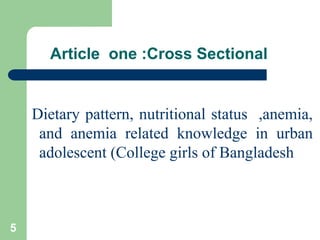
Article one :Cross Sectional
Dietary pattern, nutritional status ,anemia,
and anemia related knowledge in urban
adolescent (College girls of Bangladesh
5
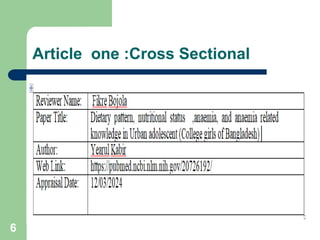
Article one :Cross Sectional
6
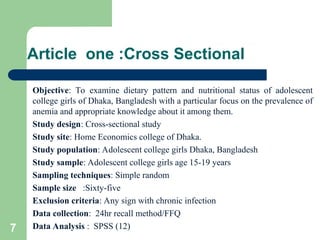
Article one :Cross Sectional
Objective: To examine dietary pattern and nutritional status of adolescent
college girls of Dhaka, Bangladesh with a particular focus on the prevalence of
anemia and appropriate knowledge about it among them.
Study design: Cross-sectional study
Study site: Home Economics college of Dhaka.
Study population: Adolescent college girls Dhaka, Bangladesh
Study sample: Adolescent college girls age 15-19 years
Sampling techniques: Simple random
Sample size :Sixty-five
Exclusion criteria: Any sign with chronic infection
Data collection: 24hr recall method/FFQ
Data Analysis : SPSS (12)
7
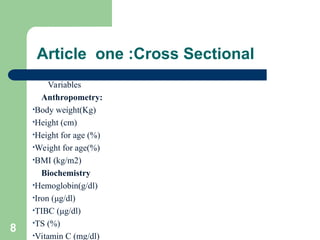
Article one :Cross Sectional
Variables
Anthropometry:
•Body weight(Kg)
•Height (cm)
•Height for age (%)
•Weight for age(%)
•BMI (kg/m2)
Biochemistry
•Hemoglobin(g/dl)
•Iron (μg/dl)
•TIBC (μg/dl)
•TS (%)
•Vitamin C (mg/dl)
8
Article one :Cross Sectional
Main Findings
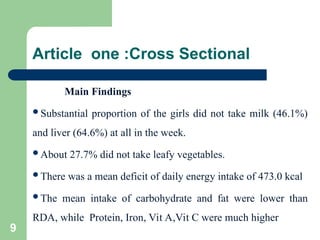
Substantial proportion of the girls did not take milk (46.1%)
and liver (64.6%) at all in the week.
About 27.7% did not take leafy vegetables.
There was a mean deficit of daily energy intake of 473.0 kcal
The mean intake of carbohydrate and fat were lower than
RDA, while Protein, Iron, Vit A,Vit C were much higher
9
Article one :Cross Sectional
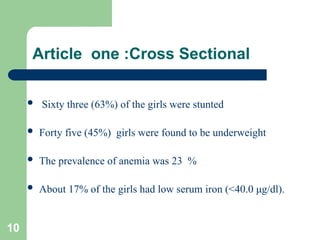
 Sixty three (63%) of the girls were stunted
 Forty five (45%) girls were found to be underweight
 The prevalence of anemia was 23 %
 About 17% of the girls had low serum iron (<40.0 μg/dl).
10
Article one :Cross Sectional
Conclusion
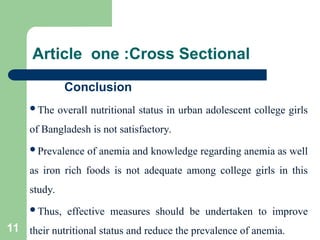
The overall nutritional status in urban adolescent college girls
of Bangladesh is not satisfactory.
Prevalence of anemia and knowledge regarding anemia as well
as iron rich foods is not adequate among college girls in this
study.
Thus, effective measures should be undertaken to improve
their nutritional status and reduce the prevalence of anemia.
11
Article one appraisal summary
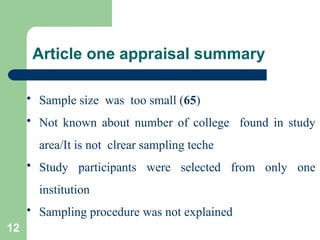
 Sample size was too small (65)
 Not known about number of college found in study
area/It is not clrear sampling teche
 Study participants were selected from only one
institution
 Sampling procedure was not explained
12
Article one appraisal summary
 Selected sample may not representative of every urban city in
Bangladesh
 Ethical approval and considerations was not addressed
 Instrument and measurement /data quality assurance
techniques was not included
 In exclusion criteria the 3F for 24 hr recall method was not
considered
 Not mentioned author contributions

13
Article two : case control
Risk factors associated with overweight and
obesity among urban school children and
adolescents in Bangladesh: a case-control study
14
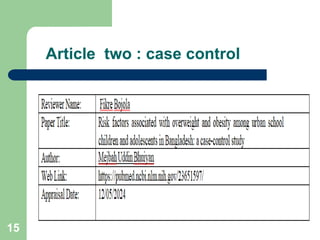
Article two : case control
15
Article two : case control
 Objective: To identify the risk factors associated with overweight and
obesity among school children and adolescents in Dhaka, Bangladesh.
 Study design: Case-control
 Study site: In seven schools located in Dhanmondi, Mohammadpur and
Siddeswari area in Dhaka,Bangladesh
 Study participant: Students of age 10-15 years corresponding to class 5 to
class 10 in the selected schools.
 Study sample: The case were overweight students, Control, healthy
/normal students
16
Article two : case control
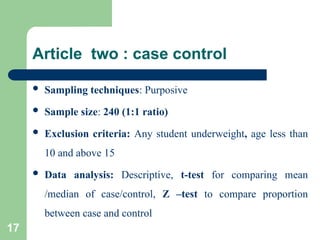
 Sampling techniques: Purposive
 Sample size: 240 (1:1 ratio)
 Exclusion criteria: Any student underweight, age less than
10 and above 15
 Data analysis: Descriptive, t-test for comparing mean
/median of case/control, Z –test to compare proportion
between case and control
17
Article two : case control
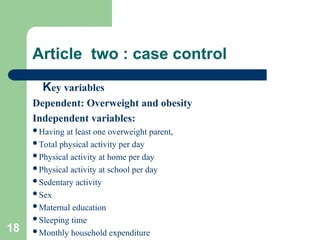
Key variables
Dependent: Overweight and obesity
Independent variables:
Having at least one overweight parent,
Total physical activity per day
Physical activity at home per day
Physical activity at school per day
Sedentary activity
Sex
Maternal education
Sleeping time
Monthly household expenditure
18
Article two : case control
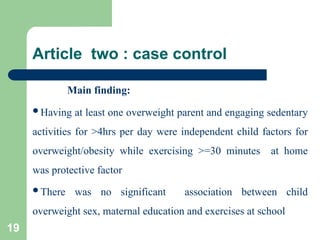
Main finding:
Having at least one overweight parent and engaging sedentary
activities for >4hrs per day were independent child factors for
overweight/obesity while exercising >=30 minutes at home
was protective factor
There was no significant association between child
overweight sex, maternal education and exercises at school
19
Article two : case control
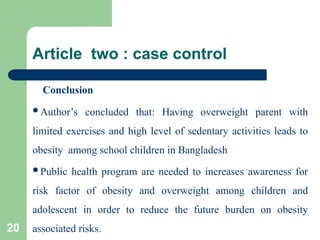
Conclusion
Author’s concluded that: Having overweight parent with
limited exercises and high level of sedentary activities leads to
obesity among school children in Bangladesh
Public health program are needed to increases awareness for
risk factor of obesity and overweight among children and
adolescent in order to reduce the future burden on obesity
associated risks.
20
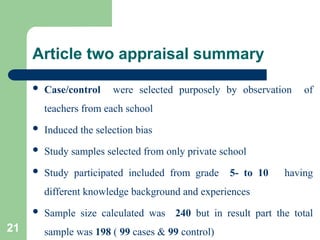
Article two appraisal summary
 Case/control were selected purposely by observation of
teachers from each school
 Induced the selection bias
 Study samples selected from only private school
 Study participated included from grade 5- to 10 having
different knowledge background and experiences
 Sample size calculated was 240 but in result part the total
sample was 198 ( 99 cases & 99 control)
21
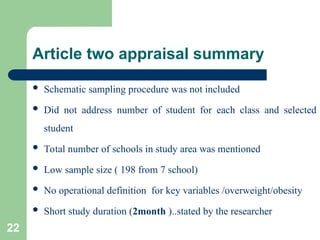
Article two appraisal summary
 Schematic sampling procedure was not included
 Did not address number of student for each class and selected
student
 Total number of schools in study area was mentioned
 Low sample size ( 198 from 7 school)
 No operational definition for key variables /overweight/obesity
 Short study duration (2month )..stated by the researcher
22
Article three : Cohort Study
Effect of under-nutrition during pregnancy on
low birth weight in Tigray regional state,
Ethiopia; a prospective cohort study
23
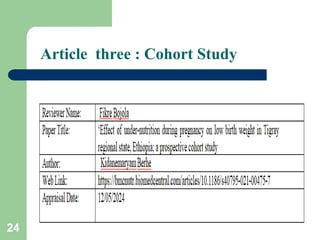
Article three : Cohort Study
24
Article three : Cohort Study
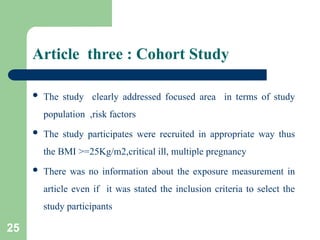
 The study clearly addressed focused area in terms of study
population ,risk factors
 The study participates were recruited in appropriate way thus
the BMI >=25Kg/m2,critical ill, multiple pregnancy
 There was no information about the exposure measurement in
article even if it was stated the inclusion criteria to select the
study participants
25
Article three : Cohort Study
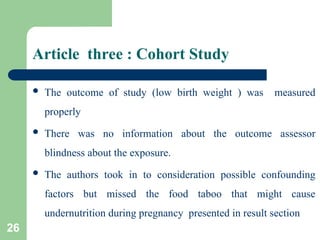
 The outcome of study (low birth weight ) was measured
properly
 There was no information about the outcome assessor
blindness about the exposure.
 The authors took in to consideration possible confounding
factors but missed the food taboo that might cause
undernutrition during pregnancy presented in result section
26
Article three : Cohort Study
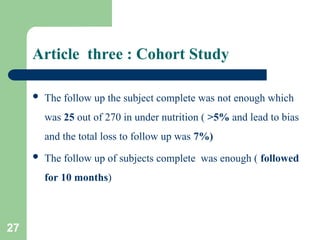
 The follow up the subject complete was not enough which
was 25 out of 270 in under nutrition ( >5% and lead to bias
and the total loss to follow up was 7%)
 The follow up of subjects complete was enough ( followed
for 10 months)
27
Article three : Cohort Study
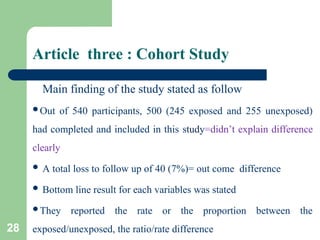
Main finding of the study stated as follow
Out of 540 participants, 500 (245 exposed and 255 unexposed)
had completed and included in this study=didn’t explain difference
clearly
 A total loss to follow up of 40 (7%)= out come difference
 Bottom line result for each variables was stated
They reported the rate or the proportion between the
exposed/unexposed, the ratio/rate difference
28
Article three : Cohort Study
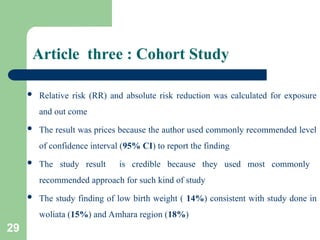
 Relative risk (RR) and absolute risk reduction was calculated for exposure
and out come
 The result was prices because the author used commonly recommended level
of confidence interval (95% CI) to report the finding
 The study result is credible because they used most commonly
recommended approach for such kind of study
 The study finding of low birth weight ( 14%) consistent with study done in
woliata (15%) and Amhara region (18%)
29
Article three : Cohort Study
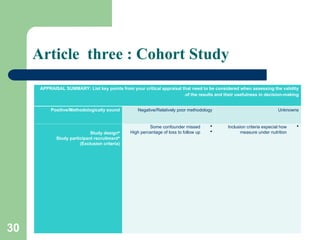
APPRAISAL SUMMARY: List key points from your critical appraisal that need to be considered when assessing the validity
of the results and their usefulness in decision-making
.
Positive/Methodologically sound Negative/Relatively poor methodology Unknowns

Study design

Study participant recruitment
(Exclusion criteria)

Some confounder missed

High percentage of loss to follow up

Inclusion criteria especial how
measure under nutrition
30
Article Four : RCT
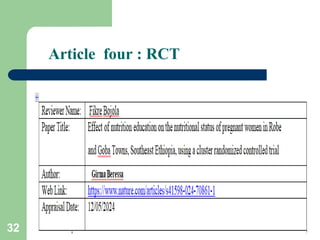
Effect of nutrition education on the nutritional
status of pregnant women in Robe and Goba
Towns, Southeast Ethiopia, using a cluster
randomized controlled trial
31
Article four : RCT
32
Article four : RCT
 The study addressed a clearly focused research question study
population ,intervention group, comparison group , outcome
measurement
 The assignment of participants to interventions was randomized
by tossing the coins Robe interventional/Goba control (1;1
ratio)
 Most participants who entered the study accounted for at its
conclusion but there was no information on loss to follow up of
33
Article four : RCT
 Total facility was not mentioned in study
 The intervention group were not blinded and they knew the
intervention the were taking
 The study groups similar at the start of the randomized
controlled trial and base line assessment measured for both
 There was a clearly defined study protocol for both group
 Follow-up intervals for each study group was not mentioned
34
Article four : RCT
 Total facility was not mentioned in study
 The intervention group were not blinded and they knew the
intervention the were taking
 The study groups similar at the start of the randomized
controlled trial and base line assessment measured for both
 There was a clearly defined study protocol for both group
 Follow-up intervals for each study group was not mentioned
35
Article four : RCT
 There was no missing or incomplete data.
 There was not clearly potential sources of bias identified
 Different statistical test was used and p value reported (SPSS
for Windows version 20 and STATA version 14)
 The precision of the estimate of the intervention or treatment
effect reported with confidence interval of 95%
36
Article four : RCT
 The benefits of the experimental intervention outweigh
the harms because it increases MUAC by 0.85 cm in
urban pregnant women
 There was no clear information about the unintended
effect reported in both group
 There was no clear information about as a cost-
effectiveness analysis undertaken
37
Article four : RCT
 This study can be applied in my urban local community but can’t
be applied for rural community.
 The difference in my community especial behavioral factors and
dietary habit may alter the outcome reported
 The outcome of this study that was nutritional education increases
MUAC by 0.85 cm in urban pregnant women is important for my
local community
 On food preferences and food taboo further information is needed
38
Article four : RCT
 The time interval for each group and the maximum nutritional
education given session was not clearly mentioned that might
affect the result
 The experimental intervention provides greater value to my people
in care than any of the existing interventions
 To implement this intervention it is important to consider the health
system inclusion of nutritional education focusing on behavioral
factors and counselling and training health professionals
39
Appraisal summary-RCT
 There was no information on loss to follow up of the
participants
 Total facility was not mentioned in study
 The intervention group were not blinded and they knew the
intervention they were taking
 Follow-up intervals for each study group was not mentioned
40
Appraisal summary-RCT
 Nutritional education interventions increased MUAC by 0.85
cm in urban pregnant women
 On food preferences and food taboo further information is
needed
 It is better to implement this finding in large scale
41
References
1.https://casp-uk.net/casp-tools-checklists/
2.https://pubmed.ncbi.nlm.nih.gov/20726192/
3.https://pubmed.ncbi.nlm.nih.gov/23651597/
4.https://bmcnutr.biomedcentral.com/articles/10.1186/s40795-021-00475-7
5.https://www.nature.com/articles/s41598-024-70861-1
42
43

Critical Appraisal power points on different study design .ppt

  • 1.
  • 2.
    Presentation Contents  Session objectives  Introduction  Criticalappraisal on cross sectional study  Critical appraisal on case control study Critical appraisal on cohort study  Critical appraisal on RCT study  Types of dietary assessments  Methods of dietary assessments  Summary  References 2
  • 3.
    Session Objectives After asuccessful completion of this presentation, students should able to: Describe basic concept of critical appraisal Discuss on common critiques on selected cross sectional article Discuss on common critiques on selected case control article Discuss on common critiques on selected cohort article  Discuss on common critiques on selected RCT article 3
  • 4.
    Introduction  Critical Appraisalis the process of carefully and systematically examining research to judge its trustworthiness, and its value and relevance in a particular context  Critical appraisal skills are important as they enable you to assess published papers  Where an article is published, or who wrote it should not be an indication of its trustworthiness and relevance.  Critical appraisals can be applied to different study and research formats including (cross-sectional, case-control, RCT, case-control, cohort,clinical) 4
  • 5.
    Article one :CrossSectional Dietary pattern, nutritional status ,anemia, and anemia related knowledge in urban adolescent (College girls of Bangladesh 5
  • 6.
    Article one :CrossSectional 6
  • 7.
    Article one :CrossSectional Objective: To examine dietary pattern and nutritional status of adolescent college girls of Dhaka, Bangladesh with a particular focus on the prevalence of anemia and appropriate knowledge about it among them. Study design: Cross-sectional study Study site: Home Economics college of Dhaka. Study population: Adolescent college girls Dhaka, Bangladesh Study sample: Adolescent college girls age 15-19 years Sampling techniques: Simple random Sample size :Sixty-five Exclusion criteria: Any sign with chronic infection Data collection: 24hr recall method/FFQ Data Analysis : SPSS (12) 7
  • 8.
    Article one :CrossSectional Variables Anthropometry: •Body weight(Kg) •Height (cm) •Height for age (%) •Weight for age(%) •BMI (kg/m2) Biochemistry •Hemoglobin(g/dl) •Iron (μg/dl) •TIBC (μg/dl) •TS (%) •Vitamin C (mg/dl) 8
  • 9.
    Article one :CrossSectional Main Findings Substantial proportion of the girls did not take milk (46.1%) and liver (64.6%) at all in the week. About 27.7% did not take leafy vegetables. There was a mean deficit of daily energy intake of 473.0 kcal The mean intake of carbohydrate and fat were lower than RDA, while Protein, Iron, Vit A,Vit C were much higher 9
  • 10.
    Article one :CrossSectional  Sixty three (63%) of the girls were stunted  Forty five (45%) girls were found to be underweight  The prevalence of anemia was 23 %  About 17% of the girls had low serum iron (<40.0 μg/dl). 10
  • 11.
    Article one :CrossSectional Conclusion The overall nutritional status in urban adolescent college girls of Bangladesh is not satisfactory. Prevalence of anemia and knowledge regarding anemia as well as iron rich foods is not adequate among college girls in this study. Thus, effective measures should be undertaken to improve their nutritional status and reduce the prevalence of anemia. 11
  • 12.
    Article one appraisalsummary  Sample size was too small (65)  Not known about number of college found in study area/It is not clrear sampling teche  Study participants were selected from only one institution  Sampling procedure was not explained 12
  • 13.
    Article one appraisalsummary  Selected sample may not representative of every urban city in Bangladesh  Ethical approval and considerations was not addressed  Instrument and measurement /data quality assurance techniques was not included  In exclusion criteria the 3F for 24 hr recall method was not considered  Not mentioned author contributions  13
  • 14.
    Article two :case control Risk factors associated with overweight and obesity among urban school children and adolescents in Bangladesh: a case-control study 14
  • 15.
    Article two :case control 15
  • 16.
    Article two :case control  Objective: To identify the risk factors associated with overweight and obesity among school children and adolescents in Dhaka, Bangladesh.  Study design: Case-control  Study site: In seven schools located in Dhanmondi, Mohammadpur and Siddeswari area in Dhaka,Bangladesh  Study participant: Students of age 10-15 years corresponding to class 5 to class 10 in the selected schools.  Study sample: The case were overweight students, Control, healthy /normal students 16
  • 17.
    Article two :case control  Sampling techniques: Purposive  Sample size: 240 (1:1 ratio)  Exclusion criteria: Any student underweight, age less than 10 and above 15  Data analysis: Descriptive, t-test for comparing mean /median of case/control, Z –test to compare proportion between case and control 17
  • 18.
    Article two :case control Key variables Dependent: Overweight and obesity Independent variables: Having at least one overweight parent, Total physical activity per day Physical activity at home per day Physical activity at school per day Sedentary activity Sex Maternal education Sleeping time Monthly household expenditure 18
  • 19.
    Article two :case control Main finding: Having at least one overweight parent and engaging sedentary activities for >4hrs per day were independent child factors for overweight/obesity while exercising >=30 minutes at home was protective factor There was no significant association between child overweight sex, maternal education and exercises at school 19
  • 20.
    Article two :case control Conclusion Author’s concluded that: Having overweight parent with limited exercises and high level of sedentary activities leads to obesity among school children in Bangladesh Public health program are needed to increases awareness for risk factor of obesity and overweight among children and adolescent in order to reduce the future burden on obesity associated risks. 20
  • 21.
    Article two appraisalsummary  Case/control were selected purposely by observation of teachers from each school  Induced the selection bias  Study samples selected from only private school  Study participated included from grade 5- to 10 having different knowledge background and experiences  Sample size calculated was 240 but in result part the total sample was 198 ( 99 cases & 99 control) 21
  • 22.
    Article two appraisalsummary  Schematic sampling procedure was not included  Did not address number of student for each class and selected student  Total number of schools in study area was mentioned  Low sample size ( 198 from 7 school)  No operational definition for key variables /overweight/obesity  Short study duration (2month )..stated by the researcher 22
  • 23.
    Article three :Cohort Study Effect of under-nutrition during pregnancy on low birth weight in Tigray regional state, Ethiopia; a prospective cohort study 23
  • 24.
    Article three :Cohort Study 24
  • 25.
    Article three :Cohort Study  The study clearly addressed focused area in terms of study population ,risk factors  The study participates were recruited in appropriate way thus the BMI >=25Kg/m2,critical ill, multiple pregnancy  There was no information about the exposure measurement in article even if it was stated the inclusion criteria to select the study participants 25
  • 26.
    Article three :Cohort Study  The outcome of study (low birth weight ) was measured properly  There was no information about the outcome assessor blindness about the exposure.  The authors took in to consideration possible confounding factors but missed the food taboo that might cause undernutrition during pregnancy presented in result section 26
  • 27.
    Article three :Cohort Study  The follow up the subject complete was not enough which was 25 out of 270 in under nutrition ( >5% and lead to bias and the total loss to follow up was 7%)  The follow up of subjects complete was enough ( followed for 10 months) 27
  • 28.
    Article three :Cohort Study Main finding of the study stated as follow Out of 540 participants, 500 (245 exposed and 255 unexposed) had completed and included in this study=didn’t explain difference clearly  A total loss to follow up of 40 (7%)= out come difference  Bottom line result for each variables was stated They reported the rate or the proportion between the exposed/unexposed, the ratio/rate difference 28
  • 29.
    Article three :Cohort Study  Relative risk (RR) and absolute risk reduction was calculated for exposure and out come  The result was prices because the author used commonly recommended level of confidence interval (95% CI) to report the finding  The study result is credible because they used most commonly recommended approach for such kind of study  The study finding of low birth weight ( 14%) consistent with study done in woliata (15%) and Amhara region (18%) 29
  • 30.
    Article three :Cohort Study APPRAISAL SUMMARY: List key points from your critical appraisal that need to be considered when assessing the validity of the results and their usefulness in decision-making . Positive/Methodologically sound Negative/Relatively poor methodology Unknowns  Study design  Study participant recruitment (Exclusion criteria)  Some confounder missed  High percentage of loss to follow up  Inclusion criteria especial how measure under nutrition 30
  • 31.
    Article Four :RCT Effect of nutrition education on the nutritional status of pregnant women in Robe and Goba Towns, Southeast Ethiopia, using a cluster randomized controlled trial 31
  • 32.
  • 33.
    Article four :RCT  The study addressed a clearly focused research question study population ,intervention group, comparison group , outcome measurement  The assignment of participants to interventions was randomized by tossing the coins Robe interventional/Goba control (1;1 ratio)  Most participants who entered the study accounted for at its conclusion but there was no information on loss to follow up of 33
  • 34.
    Article four :RCT  Total facility was not mentioned in study  The intervention group were not blinded and they knew the intervention the were taking  The study groups similar at the start of the randomized controlled trial and base line assessment measured for both  There was a clearly defined study protocol for both group  Follow-up intervals for each study group was not mentioned 34
  • 35.
    Article four :RCT  Total facility was not mentioned in study  The intervention group were not blinded and they knew the intervention the were taking  The study groups similar at the start of the randomized controlled trial and base line assessment measured for both  There was a clearly defined study protocol for both group  Follow-up intervals for each study group was not mentioned 35
  • 36.
    Article four :RCT  There was no missing or incomplete data.  There was not clearly potential sources of bias identified  Different statistical test was used and p value reported (SPSS for Windows version 20 and STATA version 14)  The precision of the estimate of the intervention or treatment effect reported with confidence interval of 95% 36
  • 37.
    Article four :RCT  The benefits of the experimental intervention outweigh the harms because it increases MUAC by 0.85 cm in urban pregnant women  There was no clear information about the unintended effect reported in both group  There was no clear information about as a cost- effectiveness analysis undertaken 37
  • 38.
    Article four :RCT  This study can be applied in my urban local community but can’t be applied for rural community.  The difference in my community especial behavioral factors and dietary habit may alter the outcome reported  The outcome of this study that was nutritional education increases MUAC by 0.85 cm in urban pregnant women is important for my local community  On food preferences and food taboo further information is needed 38
  • 39.
    Article four :RCT  The time interval for each group and the maximum nutritional education given session was not clearly mentioned that might affect the result  The experimental intervention provides greater value to my people in care than any of the existing interventions  To implement this intervention it is important to consider the health system inclusion of nutritional education focusing on behavioral factors and counselling and training health professionals 39
  • 40.
    Appraisal summary-RCT  Therewas no information on loss to follow up of the participants  Total facility was not mentioned in study  The intervention group were not blinded and they knew the intervention they were taking  Follow-up intervals for each study group was not mentioned 40
  • 41.
    Appraisal summary-RCT  Nutritionaleducation interventions increased MUAC by 0.85 cm in urban pregnant women  On food preferences and food taboo further information is needed  It is better to implement this finding in large scale 41
  • 42.
  • 43.