Aesthetic Pedagogy
                  Kurt Love, Ph.D.
Central Connecticut State University
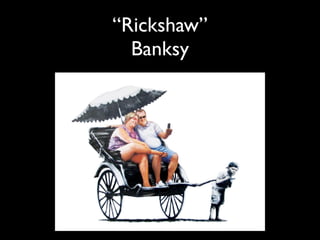
“Rickshaw”
  Banksy
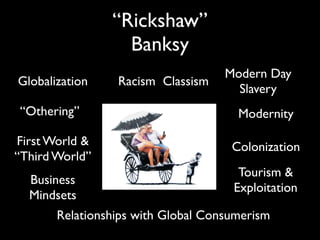
“Rickshaw”
                  Banksy
                                    Modern Day
Globalization    Racism Classism
                                      Slavery
“Othering”                            Modernity

First World &                        Colonization
“Third World”
                                      Tourism &
  Business
                                     Exploitation
  Mindsets
       Relationships with Global Consumerism
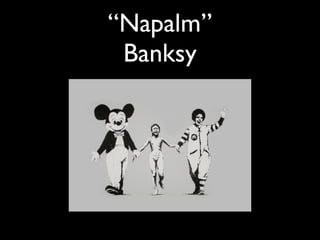
“Napalm”
 Banksy
Critical Aesthetic Pedagogy & Empowerment


   By exposing students to participatory encounters
   with artworks that possess certain qualities that
   encourage the sharing of experiences and the
   recognition of common sources of oppression,
   educators can create a sense of empowerment that
   will prepare students to enable social justice.
   (Medina, 2006)
   Students can explore oppressions, privilege,
   relationships & tensions that exist in community so
   that they can be empowered to create change.
Art as a “Portal”


The “Portal”
  Art serves as a medium for deeper
  analysis
  Art asks us to make deeper
  connections about ourselves
Art as a Portal

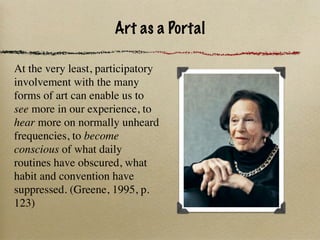
At the very least, participatory
involvement with the many
forms of art can enable us to
see more in our experience, to
hear more on normally unheard
frequencies, to become
conscious of what daily
routines have obscured, what
habit and convention have
suppressed. (Greene, 1995, p.
123)                                    1917 -
Art as a Portal Into Self, Soul & Society

   Many nature-based cultures have no word for art or
   artist because producing what we call art is simply part
   of being human.
   True art has nothing to do with impressing or
   entertaining others with pleasant or stunning creations;
   it’s about carrying what is hidden in the soul as a gift to
   others.
   However we embody our souls in the world, that is our
   art.
   Soul expression...(Plotkin, 2003, p. 191)
Using Art as a Teaching Method


 Steps:
   What do you see?
   What relationships exist among the
   elements of the artwork?
   What do you think it means?
Various Portals


Myths
Fine Arts
Performing Arts
Poetry
Art as Myth

Myths are oral art, as opposed to visual art
“A myth is, in a sense, the very truest of stories, a
story that reveals universal qualities of that human
condition, of the world, and the deeper meanings and
possibilities of our lives.” (Plotkin, 2003, p. 204)
Myths contain “layers upon layers of significance,
like bands of rock in a canyon wall, each stratum
holding and hiding untold treasures and mysteries.
We become aware of the different layers only as we
develop spiritually.” (Plotkin, 2003, p. 205)
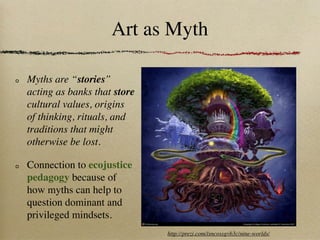
Art as Myth

Myths are “stories”
acting as banks that store
cultural values, origins
of thinking, rituals, and
traditions that might
otherwise be lost.

Connection to ecojustice
pedagogy because of
how myths can help to
question dominant and
privileged mindsets.
                             http://prezi.com/lsncossgvb3c/nine-worlds/
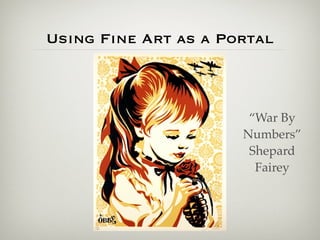
Using Fine Art as a Portal


                       “War By
                      Numbers”
                       Shepard
                        Fairey
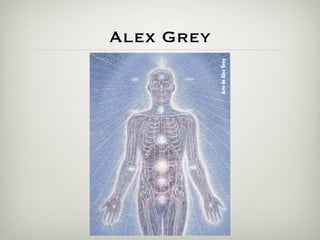
Alex Grey
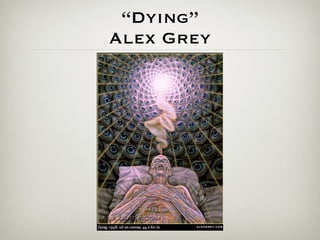
“Dying”
Alex Grey
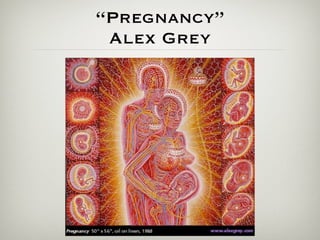
“Pregnancy”
 Alex Grey
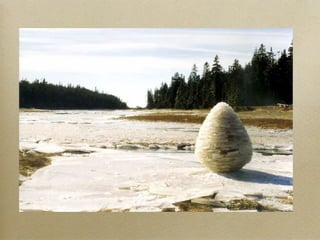
Andy Goldsworthy
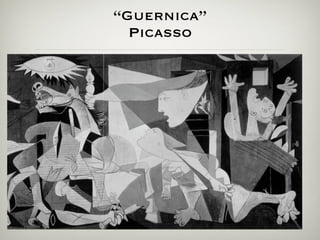
“Guernica”
  Picasso
“Guernica”
  Picasso
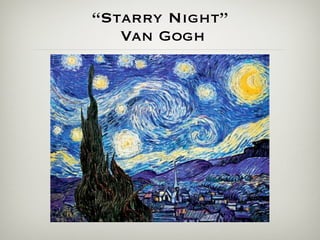
“Starry Night”
   Van Gogh
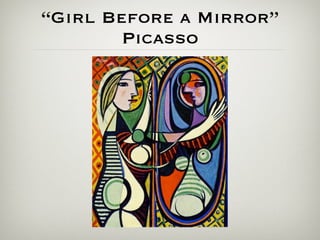
“Girl Before a Mirror”
        Picasso
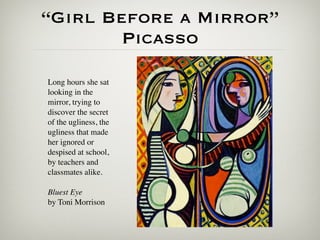
“Girl Before a Mirror”
        Picasso

Long hours she sat
looking in the
mirror, trying to
discover the secret
of the ugliness, the
ugliness that made
her ignored or
despised at school,
by teachers and
classmates alike.

Bluest Eye
by Toni Morrison
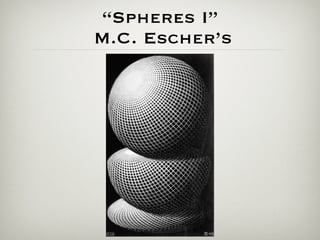
“Spheres I”
M.C. Escher’s
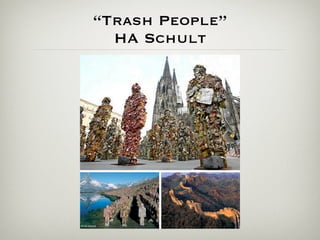
“Trash People”
  HA Schult
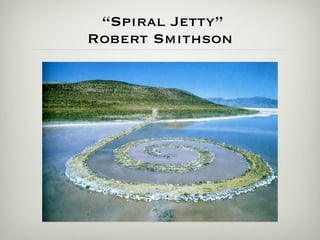
“Spiral Jetty”
Robert Smithson
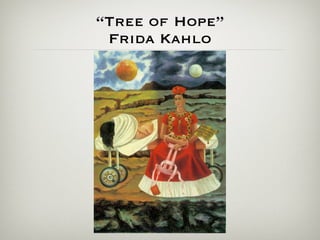
“Tree of Hope”
 Frida Kahlo
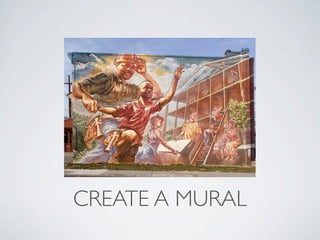
CREATE A MURAL
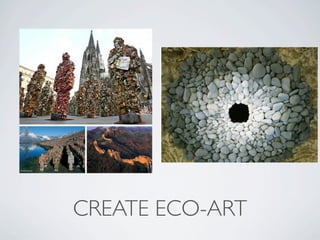
CREATE ECO-ART
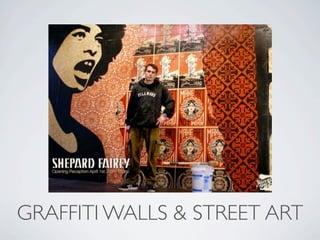
GRAFFITI WALLS & STREET ART
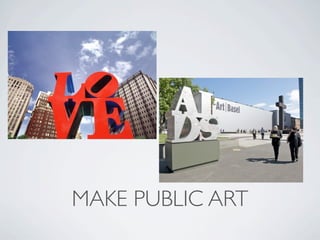
MAKE PUBLIC ART
BUST ADVERTISEMENTS
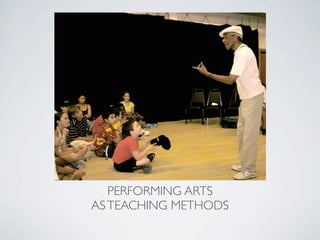
PERFORMING ARTS
AS TEACHING METHODS
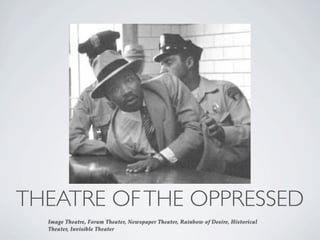
THEATRE OF THE OPPRESSED
  Image Theatre, Forum Theater, Newspaper Theater, Rainbow of Desire, Historical
  Theater, Invisible Theater
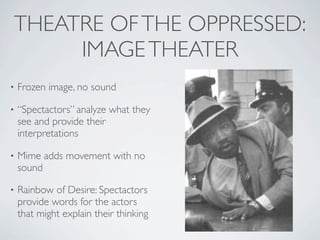
THEATRE OF THE OPPRESSED:
     IMAGE THEATER
•   Frozen image, no sound

•   “Spectactors” analyze what they
    see and provide their
    interpretations

•   Mime adds movement with no
    sound

•   Rainbow of Desire: Spectactors
    provide words for the actors
    that might explain their thinking
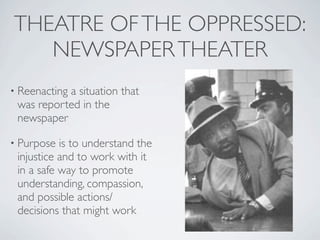
THEATRE OF THE OPPRESSED:
   NEWSPAPER THEATER
• Reenacting
           a situation that
 was reported in the
 newspaper

• Purpose  is to understand the
 injustice and to work with it
 in a safe way to promote
 understanding, compassion,
 and possible actions/
 decisions that might work
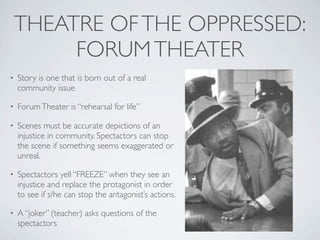
THEATRE OF THE OPPRESSED:
         FORUM THEATER
•   Story is one that is born out of a real
    community issue

•   Forum Theater is “rehearsal for life”

•   Scenes must be accurate depictions of an
    injustice in community. Spectactors can stop
    the scene if something seems exaggerated or
    unreal.

•   Spectactors yell “FREEZE” when they see an
    injustice and replace the protagonist in order
    to see if s/he can stop the antagonist’s actions.

•   A “joker” (teacher) asks questions of the
    spectactors
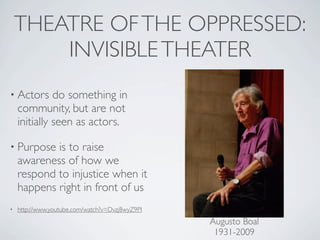
THEATRE OF THE OPPRESSED:
        INVISIBLE THEATER
• Actors      do something in
    community, but are not
    initially seen as actors.

• Purpose   is to raise
    awareness of how we
    respond to injustice when it
    happens right in front of us
•   http://www.youtube.com/watch?v=Dvzj8wyZ9PI
                                                 Augusto Boal
                                                  1931-2009
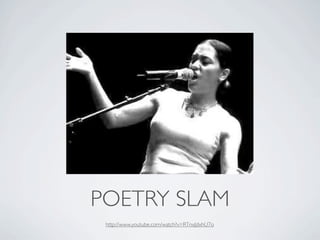
POETRY SLAM
 http://www.youtube.com/watch?v=RTnxJdxhU7o
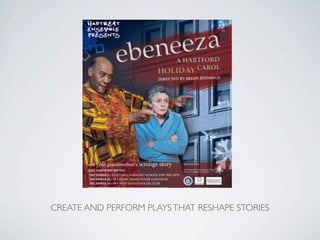
CREATE AND PERFORM PLAYS THAT RESHAPE STORIES
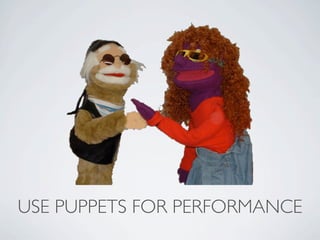
USE PUPPETS FOR PERFORMANCE
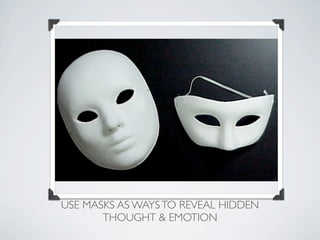
USE MASKS AS WAYS TO REVEAL HIDDEN
       THOUGHT & EMOTION
MAKE A DOCUMENTARY
MAKE A DOCUMENTARY
REFERENCES

Greene, M. (1995). Releasing the imagination. San Francisco: Jossey-Bass.
Medina, Y. (2006). Critical aesthetic pedagogy: Toward a theory of self and
   social understanding. Unpublished Dissertation, University of North
   Carolina at Greensboro, Greenboro, NC.
Plotkin, B. (2003). Soulcraft: Crossing into the mysteries of nature and
   psyche. Novato, CA: New World Library.

Critical Aesthetic Pedagogy2012

  • 1.
    Aesthetic Pedagogy Kurt Love, Ph.D. Central Connecticut State University
  • 2.
  • 3.
    “Rickshaw” Banksy Modern Day Globalization Racism Classism Slavery “Othering” Modernity First World & Colonization “Third World” Tourism & Business Exploitation Mindsets Relationships with Global Consumerism
  • 4.
  • 5.
    Critical Aesthetic Pedagogy& Empowerment By exposing students to participatory encounters with artworks that possess certain qualities that encourage the sharing of experiences and the recognition of common sources of oppression, educators can create a sense of empowerment that will prepare students to enable social justice. (Medina, 2006) Students can explore oppressions, privilege, relationships & tensions that exist in community so that they can be empowered to create change.
  • 6.
    Art as a“Portal” The “Portal” Art serves as a medium for deeper analysis Art asks us to make deeper connections about ourselves
  • 7.
    Art as aPortal At the very least, participatory involvement with the many forms of art can enable us to see more in our experience, to hear more on normally unheard frequencies, to become conscious of what daily routines have obscured, what habit and convention have suppressed. (Greene, 1995, p. 123) 1917 -
  • 8.
    Art as aPortal Into Self, Soul & Society Many nature-based cultures have no word for art or artist because producing what we call art is simply part of being human. True art has nothing to do with impressing or entertaining others with pleasant or stunning creations; it’s about carrying what is hidden in the soul as a gift to others. However we embody our souls in the world, that is our art. Soul expression...(Plotkin, 2003, p. 191)
  • 9.
    Using Art asa Teaching Method Steps: What do you see? What relationships exist among the elements of the artwork? What do you think it means?
  • 10.
  • 11.
    Art as Myth Mythsare oral art, as opposed to visual art “A myth is, in a sense, the very truest of stories, a story that reveals universal qualities of that human condition, of the world, and the deeper meanings and possibilities of our lives.” (Plotkin, 2003, p. 204) Myths contain “layers upon layers of significance, like bands of rock in a canyon wall, each stratum holding and hiding untold treasures and mysteries. We become aware of the different layers only as we develop spiritually.” (Plotkin, 2003, p. 205)
  • 12.
    Art as Myth Mythsare “stories” acting as banks that store cultural values, origins of thinking, rituals, and traditions that might otherwise be lost. Connection to ecojustice pedagogy because of how myths can help to question dominant and privileged mindsets. http://prezi.com/lsncossgvb3c/nine-worlds/
  • 13.
    Using Fine Artas a Portal “War By Numbers” Shepard Fairey
  • 14.
  • 15.
  • 16.
  • 17.
  • 19.
  • 20.
  • 21.
  • 22.
    “Girl Before aMirror” Picasso
  • 23.
    “Girl Before aMirror” Picasso Long hours she sat looking in the mirror, trying to discover the secret of the ugliness, the ugliness that made her ignored or despised at school, by teachers and classmates alike. Bluest Eye by Toni Morrison
  • 24.
  • 25.
  • 26.
  • 27.
  • 28.
  • 29.
  • 30.
    GRAFFITI WALLS &STREET ART
  • 31.
    GRAFFITI WALLS &STREET ART
  • 32.
  • 33.
  • 34.
  • 35.
    THEATRE OF THEOPPRESSED Image Theatre, Forum Theater, Newspaper Theater, Rainbow of Desire, Historical Theater, Invisible Theater
  • 36.
    THEATRE OF THEOPPRESSED: IMAGE THEATER • Frozen image, no sound • “Spectactors” analyze what they see and provide their interpretations • Mime adds movement with no sound • Rainbow of Desire: Spectactors provide words for the actors that might explain their thinking
  • 37.
    THEATRE OF THEOPPRESSED: NEWSPAPER THEATER • Reenacting a situation that was reported in the newspaper • Purpose is to understand the injustice and to work with it in a safe way to promote understanding, compassion, and possible actions/ decisions that might work
  • 38.
    THEATRE OF THEOPPRESSED: FORUM THEATER • Story is one that is born out of a real community issue • Forum Theater is “rehearsal for life” • Scenes must be accurate depictions of an injustice in community. Spectactors can stop the scene if something seems exaggerated or unreal. • Spectactors yell “FREEZE” when they see an injustice and replace the protagonist in order to see if s/he can stop the antagonist’s actions. • A “joker” (teacher) asks questions of the spectactors
  • 39.
    THEATRE OF THEOPPRESSED: INVISIBLE THEATER • Actors do something in community, but are not initially seen as actors. • Purpose is to raise awareness of how we respond to injustice when it happens right in front of us • http://www.youtube.com/watch?v=Dvzj8wyZ9PI Augusto Boal 1931-2009
  • 40.
  • 41.
    CREATE AND PERFORMPLAYS THAT RESHAPE STORIES
  • 42.
    USE PUPPETS FORPERFORMANCE
  • 43.
    USE MASKS ASWAYS TO REVEAL HIDDEN THOUGHT & EMOTION
  • 44.
  • 45.
  • 46.
    REFERENCES Greene, M. (1995).Releasing the imagination. San Francisco: Jossey-Bass. Medina, Y. (2006). Critical aesthetic pedagogy: Toward a theory of self and social understanding. Unpublished Dissertation, University of North Carolina at Greensboro, Greenboro, NC. Plotkin, B. (2003). Soulcraft: Crossing into the mysteries of nature and psyche. Novato, CA: New World Library.