Managerial
Communication
Presenting By :-
Bharath Somashekar
Crisis
Communication
When it’s not business as usual
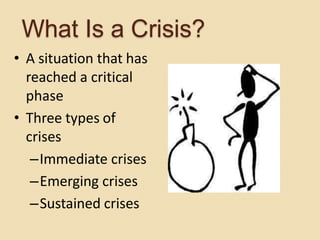
What Is a Crisis?
• A situation that has
reached a critical
phase
• Three types of
crises
–Immediate crises
–Emerging crises
–Sustained crises
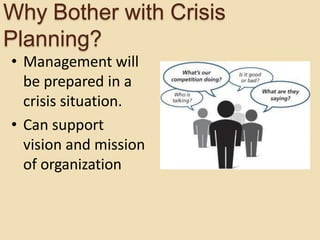
• Management will
be prepared in a
crisis situation.
• Can support
vision and mission
of organization
Why Bother with Crisis
Planning?
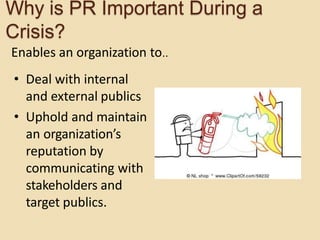
Why is PR Important During a
Crisis?
Enables an organization to..
• Deal with internal
and external publics
• Uphold and maintain
an organization’s
reputation by
communicating with
stakeholders and
target publics.
Maple Leaf
FoodsFirstReports
• Maple Leaf Foods issues news
release on August 17, 2008,
notifying public that products at
their Toronto facility may have been contaminated
with Listeriamonocytogenes.
• Recall begins immediately after positive confirmation
by public health agency.
• There are 19 deaths and more than 60 cases of
illness.
Information
&Media
MLF representatives made available to media:
• Linda Smith (Spokesperson)
• Michael H. McCain (CEO)
• Lynda Kuhn (InvestorInquiries Contact)
• Michael Vel (CFO/VP)
Seventeen official news releases and 45 stories
in the Toronto Star between August and
October.
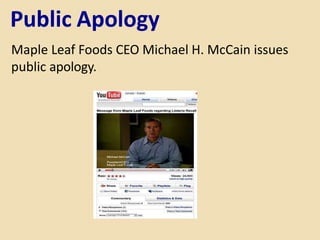
Public Apology
Maple Leaf Foods CEO Michael H. McCain issues
public apology.
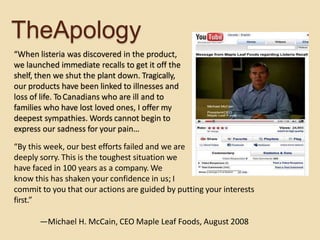
“By this week, our best efforts failed and we are
deeply sorry. This is the toughest situation we
have faced in 100 years as a company. We
know this has shaken your confidence in us; I
commit to you that our actions are guided by putting your interests
first.”
—Michael H. McCain, CEO Maple Leaf Foods, August 2008
TheApology
“When listeria was discovered in the product,
we launched immediate recalls to get it off the
shelf, then we shut the plant down. Tragically,
our products have been linked to illnesses and
loss of life. ToCanadians who are ill and to
families who have lost loved ones, I offer my
deepest sympathies. Words cannot begin to
express our sadness for your pain…
Public
Reaction
By August 26, the Toronto Star reports that Maple Leaf Foods
was “winning applause for its proactive and open public
relations approach.”
“It's a tragedy; people got very sick, people died, and that's
bad news no matter how you look at it. But a company in that
kind of a crisis can gain or lose a lot. They can lose everything
or they can gain some public trust if they're handling the
problem the best they can...I think Maple Leaf Foods did that.”
—interview with J. Fred Kuntz, Toronto Star editor-in-chief at
the time of the crisis, October 2011
• Accountability is deflected by Cadbury as
media stories fail to convey any sense of
sincerity.
Little
Accountability
• British media began to report by July that
Cadbury CEO Todd Stitzer and the company
were being criticized for the huge
embarrassment.
Public
Reaction
Planning for
CrisisBeing prepared is the first step to success.
• Mitigate impact with issues management
vigilance and open communication.
• Organizations better equipped to respond with
proactive solutions to reduce risk and policies to
react swiftly to crisis situations.
―Giventhat the potential for damage increases
exponentially if it takes time to react effectively,
Bernstein argues that it is better to prepare for a
crisis than to simply react.‖
• Immediate, transparent and proactive
communications proof that Maple Leaf Foods
had an emergency plan in place to deal with
the outbreak.
• Strategic plan executed across a variety of
media outlets, CEO made available to media,
and openly apologized for endangering public.
Strategies: Maple Leaf Foods
Effective PR Strategy Well
Executed
• Use of familiar spokespeople and the CEO as
key authorities reaffirm public’s perception of
organization’s honesty, integrity and
accountability.
Strategies: Maple Leaf Foods
Uses CEO’s Presence to
Successfully Add Credibility to PR
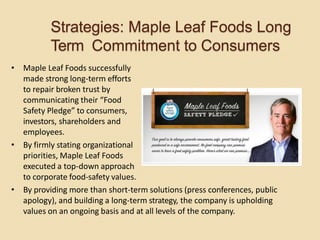
• Maple Leaf Foods successfully
made strong long-term efforts
to repair broken trust by
communicating their “Food
Safety Pledge” to consumers,
investors, shareholders and
employees.
• By firmly stating organizational
priorities, Maple Leaf Foods
executed a top-down approach
to corporate food-safety values.
• By providing more than short-term solutions (press conferences, public
apology), and building a long-term strategy, the company is upholding
values on an ongoing basis and at all levels of the company.
Strategies: Maple Leaf Foods Long
Term Commitment to Consumers
A crisis well managed, praised by industry analysts,
media and consumers alike
• Maple Leaf Foods handled their contamination
crisis with transparency, swift action and public
accountability, which resonated positively with
all stakeholders.
In CourtofPublicOpinion,
Maple LeafFoods Crisis
Communications Deemed a
Pass
Role ofthe PR
Practitioner
• The career of a PR practitioner can be a multi-faceted
journey.
• A well-respected public relations professional is a key
contributor to the executive management of any
organization.
• The PR professional must be able to deliver a
message that is timely, authentic and empathetic.
―There’stwo tenets that you seek to reinforce. One is timeliness, and the
other one is authenticity of message — and what people need to hear
emotionally, for the empathy side of the equation.‖
—interview with Linda Smith, Maple Leaf Foods spokesperson at the
time of the crisis, October 2011
LessonsLearn
edA PR practitioner can, with the support of all management, craft
and execute a plan that will help an organization weather any
storm.
An effective crisis communications plan, well-executed, will
ensure that the organization and its PR representatives are
• Well-informed
• Prepared to act
• True to the organization’s mission and values
• Trusted and valued within the organization
• Available to and trusted by the public and the media
It is in a crisis that the value of the communications plan and
the character of an organization will be most tested.
Crisis in Communication

Crisis in Communication

  • 1.
  • 2.
  • 3.
    What Is aCrisis? • A situation that has reached a critical phase • Three types of crises –Immediate crises –Emerging crises –Sustained crises
  • 4.
    • Management will beprepared in a crisis situation. • Can support vision and mission of organization Why Bother with Crisis Planning?
  • 5.
    Why is PRImportant During a Crisis? Enables an organization to.. • Deal with internal and external publics • Uphold and maintain an organization’s reputation by communicating with stakeholders and target publics.
  • 6.
    Maple Leaf FoodsFirstReports • MapleLeaf Foods issues news release on August 17, 2008, notifying public that products at their Toronto facility may have been contaminated with Listeriamonocytogenes. • Recall begins immediately after positive confirmation by public health agency. • There are 19 deaths and more than 60 cases of illness.
  • 7.
    Information &Media MLF representatives madeavailable to media: • Linda Smith (Spokesperson) • Michael H. McCain (CEO) • Lynda Kuhn (InvestorInquiries Contact) • Michael Vel (CFO/VP) Seventeen official news releases and 45 stories in the Toronto Star between August and October.
  • 8.
    Public Apology Maple LeafFoods CEO Michael H. McCain issues public apology.
  • 9.
    “By this week,our best efforts failed and we are deeply sorry. This is the toughest situation we have faced in 100 years as a company. We know this has shaken your confidence in us; I commit to you that our actions are guided by putting your interests first.” —Michael H. McCain, CEO Maple Leaf Foods, August 2008 TheApology “When listeria was discovered in the product, we launched immediate recalls to get it off the shelf, then we shut the plant down. Tragically, our products have been linked to illnesses and loss of life. ToCanadians who are ill and to families who have lost loved ones, I offer my deepest sympathies. Words cannot begin to express our sadness for your pain…
  • 10.
    Public Reaction By August 26,the Toronto Star reports that Maple Leaf Foods was “winning applause for its proactive and open public relations approach.” “It's a tragedy; people got very sick, people died, and that's bad news no matter how you look at it. But a company in that kind of a crisis can gain or lose a lot. They can lose everything or they can gain some public trust if they're handling the problem the best they can...I think Maple Leaf Foods did that.” —interview with J. Fred Kuntz, Toronto Star editor-in-chief at the time of the crisis, October 2011
  • 11.
    • Accountability isdeflected by Cadbury as media stories fail to convey any sense of sincerity. Little Accountability
  • 12.
    • British mediabegan to report by July that Cadbury CEO Todd Stitzer and the company were being criticized for the huge embarrassment. Public Reaction
  • 13.
    Planning for CrisisBeing preparedis the first step to success. • Mitigate impact with issues management vigilance and open communication. • Organizations better equipped to respond with proactive solutions to reduce risk and policies to react swiftly to crisis situations. ―Giventhat the potential for damage increases exponentially if it takes time to react effectively, Bernstein argues that it is better to prepare for a crisis than to simply react.‖
  • 14.
    • Immediate, transparentand proactive communications proof that Maple Leaf Foods had an emergency plan in place to deal with the outbreak. • Strategic plan executed across a variety of media outlets, CEO made available to media, and openly apologized for endangering public. Strategies: Maple Leaf Foods Effective PR Strategy Well Executed
  • 15.
    • Use offamiliar spokespeople and the CEO as key authorities reaffirm public’s perception of organization’s honesty, integrity and accountability. Strategies: Maple Leaf Foods Uses CEO’s Presence to Successfully Add Credibility to PR
  • 16.
    • Maple LeafFoods successfully made strong long-term efforts to repair broken trust by communicating their “Food Safety Pledge” to consumers, investors, shareholders and employees. • By firmly stating organizational priorities, Maple Leaf Foods executed a top-down approach to corporate food-safety values. • By providing more than short-term solutions (press conferences, public apology), and building a long-term strategy, the company is upholding values on an ongoing basis and at all levels of the company. Strategies: Maple Leaf Foods Long Term Commitment to Consumers
  • 17.
    A crisis wellmanaged, praised by industry analysts, media and consumers alike • Maple Leaf Foods handled their contamination crisis with transparency, swift action and public accountability, which resonated positively with all stakeholders. In CourtofPublicOpinion, Maple LeafFoods Crisis Communications Deemed a Pass
  • 18.
    Role ofthe PR Practitioner •The career of a PR practitioner can be a multi-faceted journey. • A well-respected public relations professional is a key contributor to the executive management of any organization. • The PR professional must be able to deliver a message that is timely, authentic and empathetic. ―There’stwo tenets that you seek to reinforce. One is timeliness, and the other one is authenticity of message — and what people need to hear emotionally, for the empathy side of the equation.‖ —interview with Linda Smith, Maple Leaf Foods spokesperson at the time of the crisis, October 2011
  • 19.
    LessonsLearn edA PR practitionercan, with the support of all management, craft and execute a plan that will help an organization weather any storm. An effective crisis communications plan, well-executed, will ensure that the organization and its PR representatives are • Well-informed • Prepared to act • True to the organization’s mission and values • Trusted and valued within the organization • Available to and trusted by the public and the media It is in a crisis that the value of the communications plan and the character of an organization will be most tested.