77
Identifying the Environmental Factors Contributing
to the Occurrence of Crime and Anomic Behavior
(Case Study: Urban Deteriorated Spaces of Borazjan City)
*1
Shideh Shakouri Asl, 2
Jahanshah Pakzad
1
Ph.D. Candidat, Department of Art and Architecture, Tehran Science and Research Branch, Islamic Azad
University, Tehran, Iran.
2
Professor, Shahid Beheshti University, Tehran, Iran.
Recieved 08.08.2013; Accepted 09.12.2013
ABSTRACT: Cities, as the focused centers for human residence and settlement, are faced with various issues
and problems. The high rate of crime and anomic behavior are characteristics of today’s major cities. Fear of crime and
anomic behavior is perceived as the most important reasons leading to a decline in the use of public spaces in cities
by its residents. According to the mutual relation between environment and behavior, clearly, different characteristics
of urban spaces can both significantly increase or decrease the rate of crime in a city. The purpose of this paper is to
identify the physical factors and parameters which underlie crime and anomic behavior in Borazjan urban deteriorated
spaces. The aim of this research is to identify, and therefore, help eliminate these effective environmental factors and
reach higher level of safety and regularity in public spaces of deteriorated areas of Borazjan city. According to the
results of this research, the most effective factors that give rise to crime in public spaces are physical disturbance,
functional disorders and confusion of meaning and identity.
Key words: Social deviance, Crime, Anomie, Violence, Borazjan city
*Corresponding Author Email: shdhshakouri@gmail.com
INTRODUCTION
The explosion of cities development has given rise to a
plethora of the problems for human beings and the most
important of which is the imbalance of the relation between
human and urban spaces. Expansion of the cities on one hand
and the lack of space on the other hand have led to the over
density of the population and activities within the modern
cities. The complexity and overpopulation have far-reaching
consequences including increased social irregularities. In this
process, the metropolitans and cities of Iran have also faced
an unprecedented hike in the various social deviance, crime,
violence and anomic behavior. It should be noted that the
extent and type of the crimes and social deviances vary in
different urban districts. Given their special physical structure,
type of activity and features of the residents, some areas are
more prone to the crimes. Meanwhile, urban deteriorated
spaces are among the areas more likely to nurture manifold
crimes and deviations due to their relatively high social,
International Journal of Architecture and Urban Development
Vol.4, No.1, Winter 2014
cultural, economic, physical and functional irregularities.
The urban deteriorated spaces of Borazjan face serious
challenges in providing safety for its residents.The appearance
of the crimes and irregularity in this area, in addition to
creating a sense of uncertainty and skepticism, has imposed
mental, physical and financial strain on the community, city
managers, government and justice in general. On one hand,
such problems have generated a sense of insecurity, anxiety,
terror, distress and reduced quality of life among the dwellers,
and on the other hand, they have compromised the functional
quality, hospitality of the space, and ultimately the health of
the city.
Due to the fact that all social irregularities and evils
categorized under the umbrella terms of "crime", no matter
how they being committed, take place into a particular
spatial context, the present study attempts to investigate the
environmental characteristics that prepare and affect the
appearance of various social crimes and deviations within
Borazjan urban deteriorated spaces.
78
InternationalJournalofArchitectureandUrbanDevelopment
Vol.4,No.1,Winter2014
Regarding these factors in urban policy making, planning
and design processes, the crimes can be prevented and
environmental opportunities for committing the crimesand
other deviances in the area may be restricted.
MATERIALS AND METHODS
People face a variety of threats in the urban environment:
crime, terrorism, fast-moving vehicles, air pollution, water
contamination, and so forth. In some places ,the threat of
natural disasters is an everyday fear to be faced in the design
of buildings and settlements. In most Western societies,
although many natural threats are now adequately managed,
other human threats- real or imagined- are seemingly on
increase. One of the most crucial threats to the sense of
security of people is the fear of being harassed by crime,
violence and non-civil behavior (Carmona, et al., 2003).
Based on the aforementioned statement, identifying criminal
and anomic behaviors reasons and restricting the opportunities
to commit such behavior in public spaces is particularly
important. In this paper, before examining the effect of
physical features of the urban areas on the appearance of
crime and other anomic behaviors and in an attempt to avoid
eclectic concepts, the basic definitions of the various types of
abnormal behaviors are briefly reviewed.
Aberration or Social Deviance
From a sociological perspective, aberration or social deviance
is attributed to any abnormal behavior. In the other words,
it includes any social aberration or any individual or social
act that is beyond the moral framework of target society and
general codes of ethic whichthe agents act in, either formally
or informally, sincethey face legal restrictions and moral
obscenity. In consequence, the deviators tend to conceal their
deviance from the eye of the legal observers, public morality
and social order (Abdollahi, 2002).
Crime
According to the cultural-legal definition, a crime is
defined as a positive or negative act which is against the
social discipline of people in the society, for which legal
consequences or punishments are determined. Thus ,crime
is either the commitment or avoiding of an act for which a
penalty is determined by the law (Nourbaha, 1999).
The sociological definition of crime refers to any type of
behavior that fails to confirm to the norms or rules of any
group or society (Durkheim, 1964).
Crime and fear of crime are two of the main aspects that can
influence, in a negative way, society and the life of urban
citizens (Saraiva & Pinho, 2011).
It should be noted that crime and deviance are two distinct
concepts, and despite some overlapping and proximity in
social theories, they do not share a unified definition. In
fact, crimes are those aberrations and deviances that incur
punishment legally, and their criminal nature is in the eye of
the law (Bounds, 2004).
Anomie and Anomic Behavior
Anomic theory is another theory which aims to define
crime occurrence and social deviance. Anomy is one of the
few uniquely sociological concepts (Parsons, 1968). Yet, it
continues to be shrouded in conceptual difficulty (Shoham &
Grahame, 1982).
The concept of anomy has been defined in sociological terms
as a condition of normlessness or the suspension of rules and
behavioral guidelines which creates a moral vacuum (Coser,
1964).
The concept of anomie, or anomia, has existed since 1600s;
however it has been more widely used since the work of
a French theorist, Emile Durkheim, resurrected the term
in the late 1800s. Durkheim used the concept to study the
social satisfaction problems in the French republic where
he had witnessed a marked increase in suicide. He theorized
that “an abrupt and unforeseen growth or diminution of an
individual’s power and wealth tended to produce anomie
(Ibid). Additionally, during periods of sudden depression,
sudden prosperity, or rapid technological change, the
regulatory functions of the collective order tend to break
down (Cloward, 1959).
Robert Merton (1983), another sociologist formulated his
theory using Durkheim in arguing that societies differed in
the relative emphasis they placed on cultural goals and the
legitimate means governing goal achievement. Cultural goals
are those that are deemed “worth striving for” when societies
place equal emphasis on goals and means, individuals achieve
satisfaction both from goal achievement and following
institutional means for achieving goals. When societies
have an imbalanced emphasis on goals and means, anomie
is resulted. Anomie is rampant when societies emphasize
certain common goals for success, such as monetary provide
equal access for everyone to achieve that goal. Anomie
increases the probability of committing crime, in particular
instrumental crimes (Bernard, 1987).
Violence
Violence is an extremely diffuse and complex phenomenon.
Defining it is not an exact science but a matter of judgment.
Notions of what is acceptable and unacceptable in terms of
behavior and what constitutes harm, are culturally influenced
and constantly under review as values and social norms evolves
(World Health Organization, 2002). Violence, as usually
defines, involves intentional injury of a serious nature by one
entity against another (Gottesman & Maxwell Brown, 1999).
The legal culture, defines violence as “the illegal, unsuitable
and harassing act of using power”. By this definition, one
example of violence is the illegal obligation against liberty, and
public rights. Violent crimes are those which by nature have an
extremely severe physical aspect, such as murder, rape, beating
(Motamedi Mehr, 2000).
79
InternationalJournalofArchitectureandUrbanDevelopment
The City as Context: Social Deviation, Crimes
and Anomic Behaviors
The concept of cities and crime has been studied together
and alongside each other, ever since sociology gained an
independent scientific identity. In their study, Park and Burgess
focused on the prevalence of social deviations and problems in
the urban life in Chicago, and put emphasis on the influence
of language, ethnicity, immigration, residential districts, and
population density in this realm. Park argues that urban spaces
suppresses the motivation and instinct of those residing in them
and causes social deviations. The physical structure of the city,
profoundly affects the cultural- social patterns in the urban life
(Ahmadi, 2005).
In addition, cities as places where the density of human
population is the highest on the Earth, is considered by itself a
complicated phenomenon. Correspondingly, the urban society
is a mass best characterized by diversity and opposing interests.
A non-thorough approach towards these opposing interests can
lead to anarchy and chaos. On the other hand, these interests
can’t be left unattended, because then everyone will start to
act the way it is most to his benefit, without taking the other’s
interest into consideration (Lioyd,1997) and this can lay the
foundation for anomic behavior.
New social disorder theories stress the role of the expanded
urban processes on the development of social disorder. In
these theories, the larger cities with greater population lack the
necessary capacity to exercise supervision and informal control
(Sampson & Groves, 1989). Accordingly, due to the weakened
local friendship ties, increased anomie and reduced local
participation, urbanization relies heavily on formal monitoring
and controlling systems. Several studies have shown that
growing urban population increases the crime rate, suggesting
a significant correlation between the urban population and
crime rate. As such, the social disorder theory maintains
that expanded urbanization will increase the social disorder,
something which ultimately leads to the increased crime and
deviances within the society
In fact, parallel to the population hike, the society gradually
loses its control over its members, thus no longer being able to
curb the conflicting tendencies. A comparison between small
and large cities would provide some insight into this matter.
In small and closed environments, the minimum deviation is
disclosed, eliciting disparage and suppression. In large cities
and where public supervision is somewhat loose, however,
individuals can do what they want without any restriction.
The extent of people’s liberty from public supervision depends
on the expansion and density of the population, and the more
widespread and dense the population; the less will be the public
supervision over the individual behaviors due to the dispersion
in a wider area.
Anotherfactoraffectingthedevelopmentofsocialabnormalities
is the changing social life. While in small or rural areas the
structure of social life is based on kinship and extended
families, in large cities this structure is torn apart and the social
life finds a more individual-based orientation, something that
would result in reduced public monitoring over the individuals.
Under such structure, there is no longer any close family,
tribal or kinship monitoring, and even if in existence, the
wide geographical area of the city helps individuals unchain
themselves from such inhibition. Thus, cities are able to change
the extent of control and supervision over the life of people
in a society and create a new structure of social life through
two main factors i.e. population and the modified structure of
the social life. This multiplies the potential for the prevalence
of deviances and social deviances in the society (Durkheim,
1964).
Based on the discussion, it can be assumed that there is direct
relationship between increased urbanization and expanded
social deviances, at least in some temporal and spatial periods.
That is, the development of the cities is a good predicator of
greater social crises in the future. The experience shows that
expanded urbanization generates a plethora of the crimes and
deviances, making urban crimes one of the main concerns of
the people in the cities (Stucky, 2005).
In addition, Security is a core feature of the sustainable
development (Raco, 2007) and lack of security decreases the
quality of life of citizens.
Characteristics of Urban Crimes and Violence
Urban crimes are also a part of social deviations that follow
urbanization and exacerbation of its problems, inflicting
serious damages on the society. Urban violence is a type of
violence that deals with the city as a physical and a conceptual
being, in a direct relation. Therefore, not all types of violence
that occur in the city can be called urban violence. Crime and
violence in the city can be characterized by the following traits:
Trait 1: Statistically speaking, the prevalence of the occurrence
of violence in urban spaces is much more than rural areas and
villages.
Trait 2: In comparison with rural areas, a higher percentage
of crime and violence in the cities happen against women and
children. The occurrence of crime and violence, in this case,
increases with alcohol and drug abuse in cities.
Trait 3: Basically, a phenomenon called “street violence” exists
in the streets (Fokouhi, 2011).
Effective Factors Contributing to Crime and
Anomic Behavior
According to legal culture, although it is not difficult to define
crime, the analysis of crime requires understanding certain
points without which comprehending the simple definition of
crime will not be easy. These issues are personal cognition,
society cognition and the law cognition (Nourbaha, 1999).
Generally, in the study of crime and anomic behavior, it is
of utmost importance to investigate the different personal
and psychological characteristics of both the convict and the
victim and the different aspects of the environment in which
the crime has been committed, including social, economic,
80
InternationalJournalofArchitectureandUrbanDevelopment
Vol.4,No.1,Winter2014
cultural, legal, environmental and other aspects. Furthermore,
in geographical investigations of crime and anomic behavior, it
is important to pay attention to certain key factors including the
law, the convict, the victim (person or object), the location and
time at which the crime is committed (Brown, 2000). In this
paper, from all the mentioned key factors, the role of “location”
will be investigated from the aspects of urban design, planning
and management.
The Relation between Physical Environment
and Crime Occurrence
Scholars have proposed two sets of factors, i.e. internal
or individual and external or environmental to explain the
origins of crimes and delinquencies. In this classification, the
environment has been used in the general sense of the word,
namely the natural and artificial spaces. Given the common
definition of the geography as the study of human, environment
and their interactions, the valuable position of the applied
research in the geography to identify the crime and examine the
relationship and the role of environmental and spatial factors in
the emergence of social abnormalities will be evident.
The Essence of the Relation between
Environment and Behavior
We as human beings, behave in many different ways during our
daily life. In fact, we are behaving in one certain way at every
moment in time. Our behavior is our communication pathway
and our reaction to the environment around us. In effect, it is
the practical outcome of what is flowing in our mind.
According to what was mentioned above, two factors
dramatically impact the type and ways of behavior: the
“environment” - information we get from it – and “the person”
– considering all his characteristics. In fact, the basis of our
behavior roots in the combination of both the person and the
surrounding environment; therefore our behavior is the result
of the interaction of our needs, motivations, environmental
capacities, concepts, mental image, and last but not least, the
way we define the environment around us. Consequently, it
is vivid that our activities can take different forms under the
influence of these main factors: environmental and personal
(Pakzad & Bozorg, 2013).
About the extent to which the environment influences human
behavior, three main outlooks can be defined as follows:
Environment as a determining factor: According to this
outlook, the environment plays a determining role in human’s
perception and sensation. Moreover, every stimulus provokes a
specific response, as if the awareness and personal will-power
of the person in giving that response are overshadowed by the
effect of the stimulus.
Environment as a Fostering factor: Based on this outlook, the
physical environment brings with itself a set of opportunities
and restrictions in the way people are to behave. Nevertheless,
the environment does not determine the behavior, and people
behave in certain ways under the influence of other factors.
In other words, environment is not considered as the sole
determinant of behavior, but it merely provides opportunities
for some behaviors to surface and restricts others.
Environment as a contributingfactor: According to this
outlook, as people can behave in different ways in a certain
environment, the design and physical characteristics of the
environment can contribute to the occurrence of certain
behaviors. Thus the environment increases the chances for
the occurrence of a certain behavior, yet it doesn’t play a
determining role (Rezazadeh, 2001).
In general, all social abnormalities and deviances opposed
to the values of a society, which are known as "crime" or
"offense", irrespective of how they are being committed, take
place in a temporal and spatial context.
On the whole, to describe the effect of the man-made
environment on the occurrence of anomic behavior, the
relation between human’s environment and their behavior can
be assumed as the relation between a container and its content.
(Eliei, 1971)
Offenders often operate in a rational fashion, they prefer to
commit crimes that require the least effort, provide the highest
benefits, and pose the lowest risks. Researchers have applied
this rational offender perspective to a range of crimes (Clarke,
1983; Clarke & Cornish, 1985). This view suggests that crimes
are most likely to occur when potential offenders come into
contact with a suitable crime target where the changes of
detection by others are thought to be low or the criminal,
if detected, will be able to exit without being identified or
apprehended. In short, the crime site lacks a natural guardian
(Taylor & Harrell, 1996).
The current study was carried out as an “analytical” study
based on surveys carried out on the residents, administrators as
managers in the city as well as anyone else who used the urban
spaces. The literature on this topic was reviewed using libraries
and observation and field study techniques were used to gather
more data about the subject of the study. The overall model and
process in this study is as follows:
Identifying the contributing factors on the prevalence of crime
in urban spaces by going through relevant literature and articles
on the subject;
Conducting in-depth interviews with the experts and
administrators in the district;
Conducting different focus groups with the residents of the
districts with deteriorated texture in the city of Borazjan as
participants;
Concluding the factors identified from the 3 methods mentioned
above and preparing a questionnaire;
Conducting a survey on this topic from the residents of the
district using the questionnaire withlikertscale;
Preparing a thorough list of indexes concluded from all the
above mentioned steps;
Grouping and finalizing the factors using “factor-analysis”
In the current study, first the relevant literature and texts have
been reviewed on the topic and a primary list of physical factors
81
InternationalJournalofArchitectureandUrbanDevelopment
contributing to the occurrence of crime and anomic behavior
has been developed. Then, an in-depth interview with the
experts and managers with the responsibility to administrate
the urban spaces was conducted, and using the Delphy method,
the factors which all the interviews agreed upon were identified.
In the next step, the residents of the district were encouraged
to freely express their opinion regarding the influential
factors on the prevalence of crime and anomic behavior in the
district, in openly conducted focus groups. Eventually, all the
identified factors from the previous stages were used to prepare
a questionnaire with Likert scale. Then the residents were
surveyed on the topic using the questionnaires. The extent of
the statistical population in this study (residents with the age
of 15 and above in the district) was 15365. The sample size
was determined 105, using the Cochran formula. In this study,
Cluster sampling was applied.
After the residents were surveyed on the topic, a list of all
the factors, including the factors gathered from the previous
steps, was arranged. Then, using factor analysis, a final list
of all the effective environmental factors contributing to the
prevalence of crime in public spaces of the deteriorated areas
of Borazjan city was developed. The “Factor Analysis” method
is a multivariate analysis in which factors are not addressed
as dependent and independent, but instead they are considered
correlated. In other words, all variables are dependent towards
one another and therefore it is tried to classify the variables in
several categories.
Introducing of Case Study
Borazjan is the center of the DashtestanCounty and it is the
second biggest city of the Boushehr province after Boushehr
city.
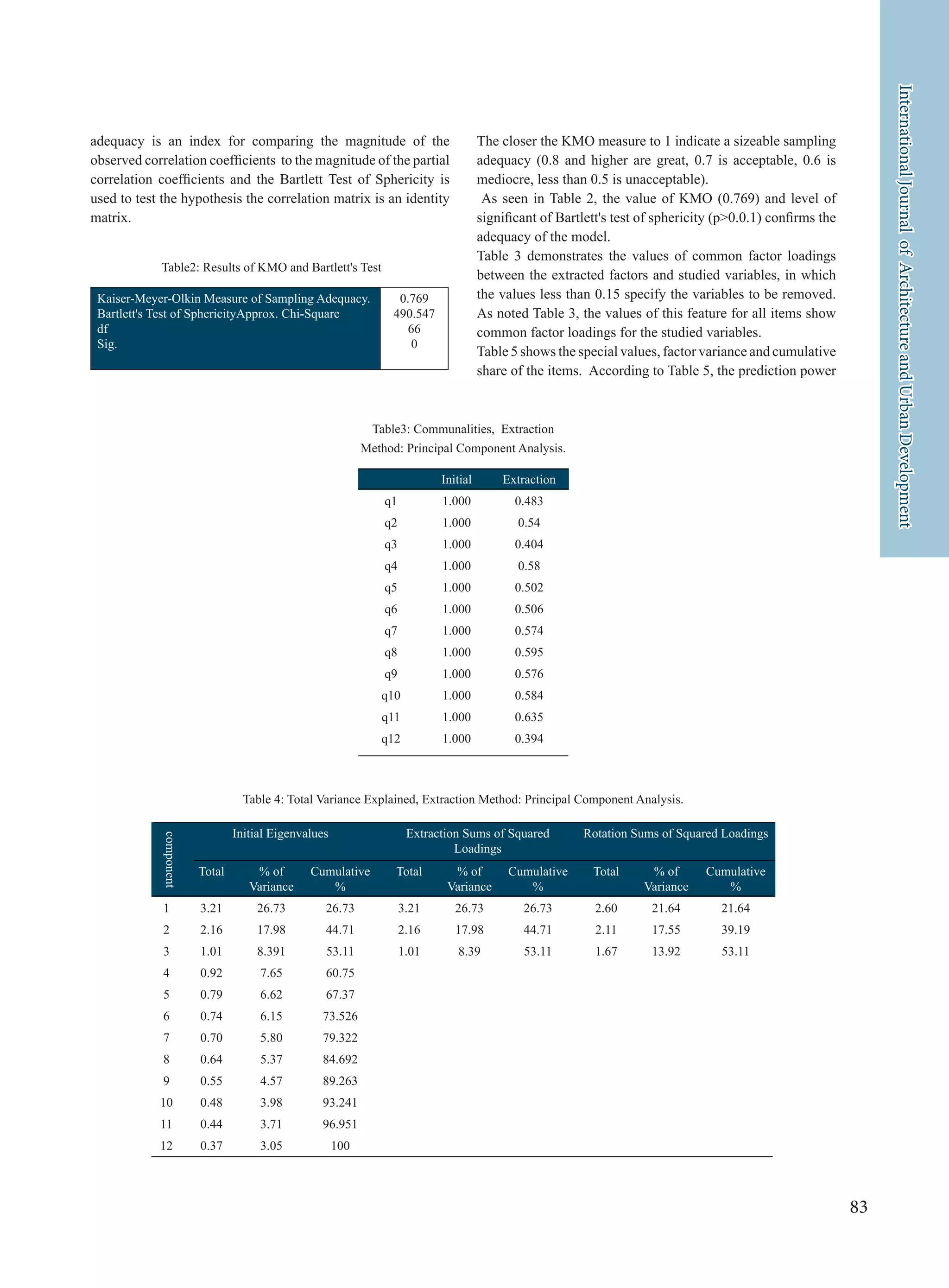
The district which will be investigated in this paperis urban
deteriorated area of Borazjan city. The area of this district is
201 hectares.
Based on the data provided by the Iran’s Census Bureau, the
population of deteriorated area was 20204 in 2006. Given
the physical erosion, the lack of adequate roadway access,
facilities, services and urban infrastructure, this area is quite
vulnerable, lacking the spatial, environmental and economic
values compared to other parts of the city. This district is
the main trading center of Borazjan city. Retailing makes
up most of the business activities in this district. A sizable
portion of this area constitutes ruins and unused lands. The
physical condition of the buildings in this district is rather not
appropriate and a great majority of the buildings are either ruined
or are non-retainable. The reason why this area was chosen to be
studied was the problems and flaws in this area that has made
it a district with a high prevalence of crime occurrence and
anomic behavior in the city.
RESULT AND DISCUSSION
As discussed earlier in this study, based on parameters derived
from the review of relevant literature, in-depth interviews
with experts and officials as well as focus groups formed with
the contribution of the local residents, the framework of the
researcher-built questionnaire was designed. The questionnaire
consisted of 12 sections on a 5-point Likert scale (strongly
agree , agree , disagree , strongly disagree , neutral ) , with the
respective scores ( 5 , 4 , 3 , 2 , and 1 ) assigned for each item.
For assessing the reliability of this questionnaire Cronbach's
alpha has been applied. Cronbach's alpha has been invented
by Cronbach and is one of the most Prevalent methods for
measuring the reliability of questionnaires. The meaning of
reliability is that if features are measured by the same tools
and under the same conditions at different times, results should
almost be similar.
Table 1 shows that according to the results of Cranach’s alpha
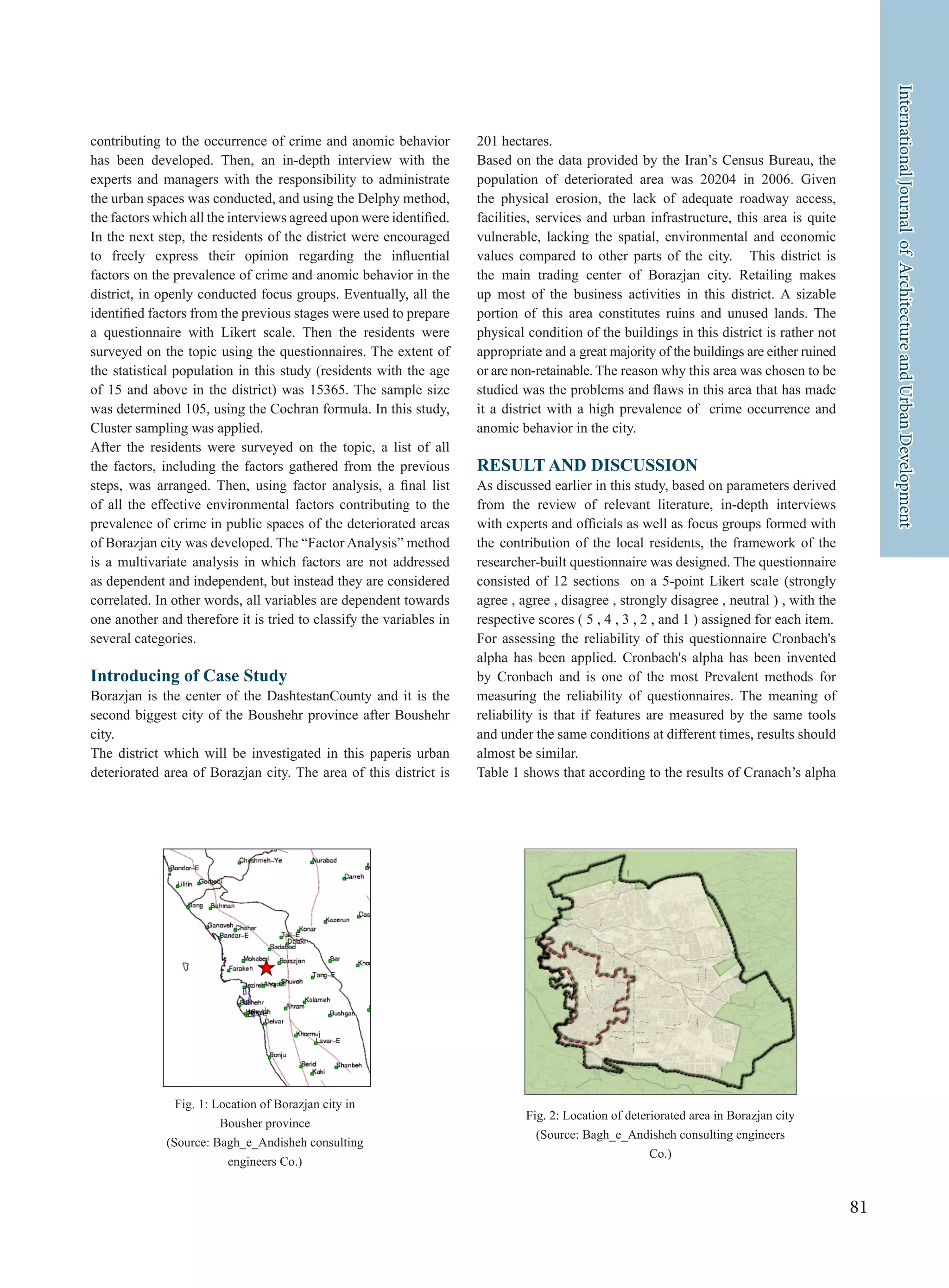
Fig. 1: Location of Borazjan city in
Bousher province
(Source: Bagh_e_Andisheh consulting
engineers Co.)
Fig. 2: Location of deteriorated area in Borazjan city
(Source: Bagh_e_Andisheh consulting engineers
Co.)
82
InternationalJournalofArchitectureandUrbanDevelopment
Vol.4,No.1,Winter2014
the coefficient of internal consistency of questions of this
research questionnaire is 0.740.
Cranach’s alphais a figure between 0 and 1, and the closer
Alpha is to 1, the more coherent our questionnaire is, with a
minimum of 0.7 considered as acceptable. Therefore the 0.74
figure claims that the questionnaire used in this study is reliable
and coherent.
The criterion for the validity and reliability of the questionnaire
items following the analysis of the data obtained from the case
study indicated the efficacy of this tool and its acceptability in
terms of the psychometric properties.
Factor analysis was used to summarize the results of the
questionnaire. This statistical method has vast application in
different branches of science. This technique is formed by
combining several statistical techniques and it aims to simplify
a complex group of data. This technique can reduce many
dependent variables to several factors which have spatial
autocorrelation.
In general, the steps for conducting the factor analysis are:
Indicator selection;
Designing a data matrix;
Factor extraction;
Factor rotation;
Interpretation and labeling the factors.
The final step in the factor analysis process is labeling the
factors, which is, in a way, the most important stage of the
process. The reason being there is no certain rule to it and
we can’t certainly say what different variables related to a
particular factor has in common.
The steps and results of factor analysis have been shown below.
First, to assess the adequacy of the model, Kaiser-Meyer-Olkin
(KMO) index and Bartlett Test of Sphericity were used. The
results of the tests are shown in Table 2.
The Kaiser-Meyer-Olkin (KMO) measure of sampling
Fig. 3 and 4: Physical erosion in deteriorated areas of Borazjan
Table 1: Item-Total Statistics
Cronbach's
Alpha if Item
Deleted
Corrected
Item-Total
Correlation
Scale
Variance
if Item
Deleted
Scale
Mean
if Item
Deleted
0.7210.39459.65234.95q1
0.7170.41857.89335.35q2
0.7290.32360.64834.92q3
0.7110.45755.44135.94q4
0.7150.44358.52335.27q5
0.7210.39357.79636.07q6
0.7430.22561.49436.17q7
0.7140.43756.43535.8q8
0.6960.56854.46935.46q9
0.7330.28762.11134.57q10
0.7320.29462.57234.34q11
0.7390.22762.94136.21q12
83
InternationalJournalofArchitectureandUrbanDevelopment
adequacy is an index for comparing the magnitude of the
observed correlation coefficients to the magnitude of the partial
correlation coefficients and the Bartlett Test of Sphericity is
used to test the hypothesis the correlation matrix is an identity
matrix.
0.769
490.547
66
0
Kaiser-Meyer-Olkin Measure of Sampling Adequacy.
Bartlett's Test of SphericityApprox. Chi-Square
df
Sig.
Table2: Results of KMO and Bartlett's Test
The closer the KMO measure to 1 indicate a sizeable sampling
adequacy (0.8 and higher are great, 0.7 is acceptable, 0.6 is
mediocre, less than 0.5 is unacceptable).
As seen in Table 2, the value of KMO (0.769) and level of
significant of Bartlett's test of sphericity (p>0.0.1) confirms the
adequacy of the model.
Table 3 demonstrates the values of common factor loadings
between the extracted factors and studied variables, in which
the values less than 0.15 specify the variables to be removed.
As noted Table 3, the values of this feature for all items show
common factor loadings for the studied variables.
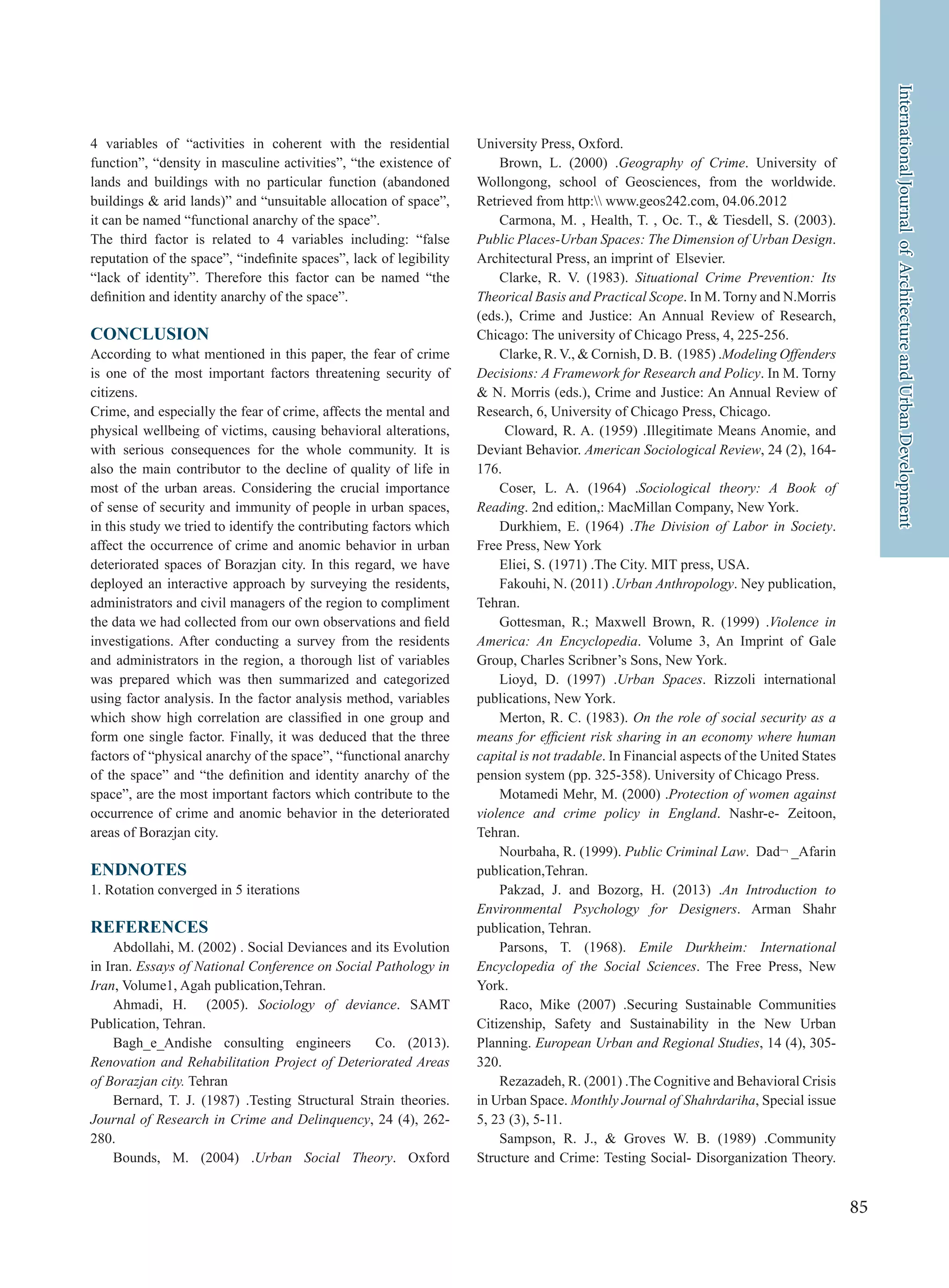
Table 5 shows the special values, factor variance and cumulative
share of the items. According to Table 5, the prediction power
Table 4: Total Variance Explained, Extraction Method: Principal Component Analysis.
Rotation Sums of Squared LoadingsExtraction Sums of Squared
Loadings
Initial Eigenvalues
component
Cumulative
%
% of
Variance
TotalCumulative
%
% of
Variance
TotalCumulative
%
% of
Variance
Total
21.6421.642.6026.7326.733.2126.7326.733.211
39.1917.552.1144.7117.982.1644.7117.982.162
53.1113.921.6753.118.391.0153.118.3911.013
60.757.650.924
67.376.620.795
73.5266.150.746
79.3225.800.707
84.6925.370.648
89.2634.570.559
93.2413.980.4810
96.9513.710.4411
1003.050.3712
ExtractionInitial
0.4831.000q1
0.541.000q2
0.4041.000q3
0.581.000q4
0.5021.000q5
0.5061.000q6
0.5741.000q7
0.5951.000q8
0.5761.000q9
0.5841.000q10
0.6351.000q11
0.3941.000q12
Table3: Communalities, Extraction
Method: Principal Component Analysis.
84
InternationalJournalofArchitectureandUrbanDevelopment
Vol.4,No.1,Winter2014
of this model based on the aggregate proportion of factor
variance is equal to 53.106%.
Fig. 5 shows the special values for different factors. According
to this diagram, i.e. the factors in the initial part and the steep
slope of the diagram, factor analysis suggests three factors to
be extracted.		
Looking closely at “Rotated Factor Matrix” (Table 5), the first
factor has a high and significant relation with the following 5
variables of area grading, Inaccessibility of area, lighting, street
network quality and physical quality of buildings. In theresult
this factor can be named, “physical anarchy of the space”.
Due tothe relation between second factors and the other
Fig. 5: Scree Plot
Table 5: Rotated Component Matrix1
, Extraction Method: Principal Component Analysis, Rotation
Method: Varimax with Kaiser Normalization.
Component
321
0.3610.593Grading of the areaq1
0.694Lack of legibilityq2
0.613Inaccessibility of areaq3
0.716Disrepute of spaceq4
0.644Quality of street networkq5
0.674Unsuitable allocation of spaceq6
0.72Activities incoherent with the residential
function
q7
0.755The existence of lands and buildings
with no particular function (Abandoned
buildings &arid lands)
q8
0.647Density in masculine activitiesq9
0.751Physical quality of buildingsq10
0.788Lightingq11
0.526Indefinite spaces (Lack of identity)q12
85
InternationalJournalofArchitectureandUrbanDevelopment
4 variables of “activities in coherent with the residential
function”, “density in masculine activities”, “the existence of
lands and buildings with no particular function (abandoned
buildings & arid lands)” and “unsuitable allocation of space”,
it can be named “functional anarchy of the space”.
The third factor is related to 4 variables including: “false
reputation of the space”, “indefinite spaces”, lack of legibility
“lack of identity”. Therefore this factor can be named “the
definition and identity anarchy of the space”.
CONCLUSION
According to what mentioned in this paper, the fear of crime
is one of the most important factors threatening security of
citizens.
Crime, and especially the fear of crime, affects the mental and
physical wellbeing of victims, causing behavioral alterations,
with serious consequences for the whole community. It is
also the main contributor to the decline of quality of life in
most of the urban areas. Considering the crucial importance
of sense of security and immunity of people in urban spaces,
in this study we tried to identify the contributing factors which
affect the occurrence of crime and anomic behavior in urban
deteriorated spaces of Borazjan city. In this regard, we have
deployed an interactive approach by surveying the residents,
administrators and civil managers of the region to compliment
the data we had collected from our own observations and field
investigations. After conducting a survey from the residents
and administrators in the region, a thorough list of variables
was prepared which was then summarized and categorized
using factor analysis. In the factor analysis method, variables
which show high correlation are classified in one group and
form one single factor. Finally, it was deduced that the three
factors of “physical anarchy of the space”, “functional anarchy
of the space” and “the definition and identity anarchy of the
space”, are the most important factors which contribute to the
occurrence of crime and anomic behavior in the deteriorated
areas of Borazjan city.
ENDNOTES
1. Rotation converged in 5 iterations
REFERENCES
Abdollahi, M. (2002) . Social Deviances and its Evolution
in Iran. Essays of National Conference on Social Pathology in
Iran, Volume1, Agah publication,Tehran.
Ahmadi, H. (2005). Sociology of deviance. SAMT
Publication, Tehran.
Bagh_e_Andishe consulting engineers Co. (2013).
Renovation and Rehabilitation Project of Deteriorated Areas
of Borazjan city. Tehran
Bernard, T. J. (1987) .Testing Structural Strain theories.
Journal of Research in Crime and Delinquency, 24 (4), 262-
280.
Bounds, M. (2004) .Urban Social Theory. Oxford
University Press, Oxford.
Brown, L. (2000) .Geography of Crime. University of
Wollongong, school of Geosciences, from the worldwide.
Retrieved from http: www.geos242.com, 04.06.2012
Carmona, M. , Health, T. , Oc. T., & Tiesdell, S. (2003).
Public Places-Urban Spaces: The Dimension of Urban Design.
Architectural Press, an imprint of Elsevier.
Clarke, R. V. (1983). Situational Crime Prevention: Its
Theorical Basis and Practical Scope. In M. Torny and N.Morris
(eds.), Crime and Justice: An Annual Review of Research,
Chicago: The university of Chicago Press, 4, 225-256.
Clarke, R. V., & Cornish, D. B. (1985) .Modeling Offenders
Decisions: A Framework for Research and Policy. In M. Torny
& N. Morris (eds.), Crime and Justice: An Annual Review of
Research, 6, University of Chicago Press, Chicago.
Cloward, R. A. (1959) .Illegitimate Means Anomie, and
Deviant Behavior. American Sociological Review, 24 (2), 164-
176.
Coser, L. A. (1964) .Sociological theory: A Book of
Reading. 2nd edition,: MacMillan Company, New York.
Durkhiem, E. (1964) .The Division of Labor in Society.
Free Press, New York
Eliei, S. (1971) .The City. MIT press, USA.
Fakouhi, N. (2011) .Urban Anthropology. Ney publication,
Tehran.
Gottesman, R.; Maxwell Brown, R. (1999) .Violence in
America: An Encyclopedia. Volume 3, An Imprint of Gale
Group, Charles Scribner’s Sons, New York.
Lioyd, D. (1997) .Urban Spaces. Rizzoli international
publications, New York.
Merton, R. C. (1983). On the role of social security as a
means for efficient risk sharing in an economy where human
capital is not tradable. In Financial aspects of the United States
pension system (pp. 325-358). University of Chicago Press.
Motamedi Mehr, M. (2000) .Protection of women against
violence and crime policy in England. Nashr-e- Zeitoon,
Tehran.
Nourbaha, R. (1999). Public Criminal Law. Dad¬ _Afarin
publication,Tehran.
Pakzad, J. and Bozorg, H. (2013) .An Introduction to
Environmental Psychology for Designers. Arman Shahr
publication, Tehran.
Parsons, T. (1968). Emile Durkheim: International
Encyclopedia of the Social Sciences. The Free Press, New
York.
Raco, Mike (2007) .Securing Sustainable Communities
Citizenship, Safety and Sustainability in the New Urban
Planning. European Urban and Regional Studies, 14 (4), 305-
320.
Rezazadeh, R. (2001) .The Cognitive and Behavioral Crisis
in Urban Space. Monthly Journal of Shahrdariha, Special issue
5, 23 (3), 5-11.
Sampson, R. J., & Groves W. B. (1989) .Community
Structure and Crime: Testing Social- Disorganization Theory.
86
InternationalJournalofArchitectureandUrbanDevelopment
Vol.4,No.1,Winter2014
American Journal of Sociology , 94 (4) ,802-774.
Saraiva, M., & Pinho, P. (2011). A comprehensive and
accessible approach to crime prevention in the planning and
design of public spaces. Urban Design International 16, 213–
226.
Shoham, S. G., & Grahame, A. (1982). Alienation and
Anomie Revisited. Sheridan House and Ramot Educational
Systems for the center of Sociological, Penal and Penitentiary
Research and Studies, Italy.
Stucky, Th. D. (2005) .Urban Politics, Crime Publishing
LLC Rates and Police Strengthen. LFB Scholarly.
Taylor, R. B.; Harrell, A. V. (1996) .Physical Environment
and Crime. a final summery report presented to the National
Institute of Justice. U. S. Department of Justice.
World Health Organization (2002) .World Report on
Violence and Health: Summery. Geneva.

Crime and Anomic Behavior

  • 1.
    77 Identifying the EnvironmentalFactors Contributing to the Occurrence of Crime and Anomic Behavior (Case Study: Urban Deteriorated Spaces of Borazjan City) *1 Shideh Shakouri Asl, 2 Jahanshah Pakzad 1 Ph.D. Candidat, Department of Art and Architecture, Tehran Science and Research Branch, Islamic Azad University, Tehran, Iran. 2 Professor, Shahid Beheshti University, Tehran, Iran. Recieved 08.08.2013; Accepted 09.12.2013 ABSTRACT: Cities, as the focused centers for human residence and settlement, are faced with various issues and problems. The high rate of crime and anomic behavior are characteristics of today’s major cities. Fear of crime and anomic behavior is perceived as the most important reasons leading to a decline in the use of public spaces in cities by its residents. According to the mutual relation between environment and behavior, clearly, different characteristics of urban spaces can both significantly increase or decrease the rate of crime in a city. The purpose of this paper is to identify the physical factors and parameters which underlie crime and anomic behavior in Borazjan urban deteriorated spaces. The aim of this research is to identify, and therefore, help eliminate these effective environmental factors and reach higher level of safety and regularity in public spaces of deteriorated areas of Borazjan city. According to the results of this research, the most effective factors that give rise to crime in public spaces are physical disturbance, functional disorders and confusion of meaning and identity. Key words: Social deviance, Crime, Anomie, Violence, Borazjan city *Corresponding Author Email: shdhshakouri@gmail.com INTRODUCTION The explosion of cities development has given rise to a plethora of the problems for human beings and the most important of which is the imbalance of the relation between human and urban spaces. Expansion of the cities on one hand and the lack of space on the other hand have led to the over density of the population and activities within the modern cities. The complexity and overpopulation have far-reaching consequences including increased social irregularities. In this process, the metropolitans and cities of Iran have also faced an unprecedented hike in the various social deviance, crime, violence and anomic behavior. It should be noted that the extent and type of the crimes and social deviances vary in different urban districts. Given their special physical structure, type of activity and features of the residents, some areas are more prone to the crimes. Meanwhile, urban deteriorated spaces are among the areas more likely to nurture manifold crimes and deviations due to their relatively high social, International Journal of Architecture and Urban Development Vol.4, No.1, Winter 2014 cultural, economic, physical and functional irregularities. The urban deteriorated spaces of Borazjan face serious challenges in providing safety for its residents.The appearance of the crimes and irregularity in this area, in addition to creating a sense of uncertainty and skepticism, has imposed mental, physical and financial strain on the community, city managers, government and justice in general. On one hand, such problems have generated a sense of insecurity, anxiety, terror, distress and reduced quality of life among the dwellers, and on the other hand, they have compromised the functional quality, hospitality of the space, and ultimately the health of the city. Due to the fact that all social irregularities and evils categorized under the umbrella terms of "crime", no matter how they being committed, take place into a particular spatial context, the present study attempts to investigate the environmental characteristics that prepare and affect the appearance of various social crimes and deviations within Borazjan urban deteriorated spaces.
  • 2.
    78 InternationalJournalofArchitectureandUrbanDevelopment Vol.4,No.1,Winter2014 Regarding these factorsin urban policy making, planning and design processes, the crimes can be prevented and environmental opportunities for committing the crimesand other deviances in the area may be restricted. MATERIALS AND METHODS People face a variety of threats in the urban environment: crime, terrorism, fast-moving vehicles, air pollution, water contamination, and so forth. In some places ,the threat of natural disasters is an everyday fear to be faced in the design of buildings and settlements. In most Western societies, although many natural threats are now adequately managed, other human threats- real or imagined- are seemingly on increase. One of the most crucial threats to the sense of security of people is the fear of being harassed by crime, violence and non-civil behavior (Carmona, et al., 2003). Based on the aforementioned statement, identifying criminal and anomic behaviors reasons and restricting the opportunities to commit such behavior in public spaces is particularly important. In this paper, before examining the effect of physical features of the urban areas on the appearance of crime and other anomic behaviors and in an attempt to avoid eclectic concepts, the basic definitions of the various types of abnormal behaviors are briefly reviewed. Aberration or Social Deviance From a sociological perspective, aberration or social deviance is attributed to any abnormal behavior. In the other words, it includes any social aberration or any individual or social act that is beyond the moral framework of target society and general codes of ethic whichthe agents act in, either formally or informally, sincethey face legal restrictions and moral obscenity. In consequence, the deviators tend to conceal their deviance from the eye of the legal observers, public morality and social order (Abdollahi, 2002). Crime According to the cultural-legal definition, a crime is defined as a positive or negative act which is against the social discipline of people in the society, for which legal consequences or punishments are determined. Thus ,crime is either the commitment or avoiding of an act for which a penalty is determined by the law (Nourbaha, 1999). The sociological definition of crime refers to any type of behavior that fails to confirm to the norms or rules of any group or society (Durkheim, 1964). Crime and fear of crime are two of the main aspects that can influence, in a negative way, society and the life of urban citizens (Saraiva & Pinho, 2011). It should be noted that crime and deviance are two distinct concepts, and despite some overlapping and proximity in social theories, they do not share a unified definition. In fact, crimes are those aberrations and deviances that incur punishment legally, and their criminal nature is in the eye of the law (Bounds, 2004). Anomie and Anomic Behavior Anomic theory is another theory which aims to define crime occurrence and social deviance. Anomy is one of the few uniquely sociological concepts (Parsons, 1968). Yet, it continues to be shrouded in conceptual difficulty (Shoham & Grahame, 1982). The concept of anomy has been defined in sociological terms as a condition of normlessness or the suspension of rules and behavioral guidelines which creates a moral vacuum (Coser, 1964). The concept of anomie, or anomia, has existed since 1600s; however it has been more widely used since the work of a French theorist, Emile Durkheim, resurrected the term in the late 1800s. Durkheim used the concept to study the social satisfaction problems in the French republic where he had witnessed a marked increase in suicide. He theorized that “an abrupt and unforeseen growth or diminution of an individual’s power and wealth tended to produce anomie (Ibid). Additionally, during periods of sudden depression, sudden prosperity, or rapid technological change, the regulatory functions of the collective order tend to break down (Cloward, 1959). Robert Merton (1983), another sociologist formulated his theory using Durkheim in arguing that societies differed in the relative emphasis they placed on cultural goals and the legitimate means governing goal achievement. Cultural goals are those that are deemed “worth striving for” when societies place equal emphasis on goals and means, individuals achieve satisfaction both from goal achievement and following institutional means for achieving goals. When societies have an imbalanced emphasis on goals and means, anomie is resulted. Anomie is rampant when societies emphasize certain common goals for success, such as monetary provide equal access for everyone to achieve that goal. Anomie increases the probability of committing crime, in particular instrumental crimes (Bernard, 1987). Violence Violence is an extremely diffuse and complex phenomenon. Defining it is not an exact science but a matter of judgment. Notions of what is acceptable and unacceptable in terms of behavior and what constitutes harm, are culturally influenced and constantly under review as values and social norms evolves (World Health Organization, 2002). Violence, as usually defines, involves intentional injury of a serious nature by one entity against another (Gottesman & Maxwell Brown, 1999). The legal culture, defines violence as “the illegal, unsuitable and harassing act of using power”. By this definition, one example of violence is the illegal obligation against liberty, and public rights. Violent crimes are those which by nature have an extremely severe physical aspect, such as murder, rape, beating (Motamedi Mehr, 2000).
  • 3.
    79 InternationalJournalofArchitectureandUrbanDevelopment The City asContext: Social Deviation, Crimes and Anomic Behaviors The concept of cities and crime has been studied together and alongside each other, ever since sociology gained an independent scientific identity. In their study, Park and Burgess focused on the prevalence of social deviations and problems in the urban life in Chicago, and put emphasis on the influence of language, ethnicity, immigration, residential districts, and population density in this realm. Park argues that urban spaces suppresses the motivation and instinct of those residing in them and causes social deviations. The physical structure of the city, profoundly affects the cultural- social patterns in the urban life (Ahmadi, 2005). In addition, cities as places where the density of human population is the highest on the Earth, is considered by itself a complicated phenomenon. Correspondingly, the urban society is a mass best characterized by diversity and opposing interests. A non-thorough approach towards these opposing interests can lead to anarchy and chaos. On the other hand, these interests can’t be left unattended, because then everyone will start to act the way it is most to his benefit, without taking the other’s interest into consideration (Lioyd,1997) and this can lay the foundation for anomic behavior. New social disorder theories stress the role of the expanded urban processes on the development of social disorder. In these theories, the larger cities with greater population lack the necessary capacity to exercise supervision and informal control (Sampson & Groves, 1989). Accordingly, due to the weakened local friendship ties, increased anomie and reduced local participation, urbanization relies heavily on formal monitoring and controlling systems. Several studies have shown that growing urban population increases the crime rate, suggesting a significant correlation between the urban population and crime rate. As such, the social disorder theory maintains that expanded urbanization will increase the social disorder, something which ultimately leads to the increased crime and deviances within the society In fact, parallel to the population hike, the society gradually loses its control over its members, thus no longer being able to curb the conflicting tendencies. A comparison between small and large cities would provide some insight into this matter. In small and closed environments, the minimum deviation is disclosed, eliciting disparage and suppression. In large cities and where public supervision is somewhat loose, however, individuals can do what they want without any restriction. The extent of people’s liberty from public supervision depends on the expansion and density of the population, and the more widespread and dense the population; the less will be the public supervision over the individual behaviors due to the dispersion in a wider area. Anotherfactoraffectingthedevelopmentofsocialabnormalities is the changing social life. While in small or rural areas the structure of social life is based on kinship and extended families, in large cities this structure is torn apart and the social life finds a more individual-based orientation, something that would result in reduced public monitoring over the individuals. Under such structure, there is no longer any close family, tribal or kinship monitoring, and even if in existence, the wide geographical area of the city helps individuals unchain themselves from such inhibition. Thus, cities are able to change the extent of control and supervision over the life of people in a society and create a new structure of social life through two main factors i.e. population and the modified structure of the social life. This multiplies the potential for the prevalence of deviances and social deviances in the society (Durkheim, 1964). Based on the discussion, it can be assumed that there is direct relationship between increased urbanization and expanded social deviances, at least in some temporal and spatial periods. That is, the development of the cities is a good predicator of greater social crises in the future. The experience shows that expanded urbanization generates a plethora of the crimes and deviances, making urban crimes one of the main concerns of the people in the cities (Stucky, 2005). In addition, Security is a core feature of the sustainable development (Raco, 2007) and lack of security decreases the quality of life of citizens. Characteristics of Urban Crimes and Violence Urban crimes are also a part of social deviations that follow urbanization and exacerbation of its problems, inflicting serious damages on the society. Urban violence is a type of violence that deals with the city as a physical and a conceptual being, in a direct relation. Therefore, not all types of violence that occur in the city can be called urban violence. Crime and violence in the city can be characterized by the following traits: Trait 1: Statistically speaking, the prevalence of the occurrence of violence in urban spaces is much more than rural areas and villages. Trait 2: In comparison with rural areas, a higher percentage of crime and violence in the cities happen against women and children. The occurrence of crime and violence, in this case, increases with alcohol and drug abuse in cities. Trait 3: Basically, a phenomenon called “street violence” exists in the streets (Fokouhi, 2011). Effective Factors Contributing to Crime and Anomic Behavior According to legal culture, although it is not difficult to define crime, the analysis of crime requires understanding certain points without which comprehending the simple definition of crime will not be easy. These issues are personal cognition, society cognition and the law cognition (Nourbaha, 1999). Generally, in the study of crime and anomic behavior, it is of utmost importance to investigate the different personal and psychological characteristics of both the convict and the victim and the different aspects of the environment in which the crime has been committed, including social, economic,
  • 4.
    80 InternationalJournalofArchitectureandUrbanDevelopment Vol.4,No.1,Winter2014 cultural, legal, environmentaland other aspects. Furthermore, in geographical investigations of crime and anomic behavior, it is important to pay attention to certain key factors including the law, the convict, the victim (person or object), the location and time at which the crime is committed (Brown, 2000). In this paper, from all the mentioned key factors, the role of “location” will be investigated from the aspects of urban design, planning and management. The Relation between Physical Environment and Crime Occurrence Scholars have proposed two sets of factors, i.e. internal or individual and external or environmental to explain the origins of crimes and delinquencies. In this classification, the environment has been used in the general sense of the word, namely the natural and artificial spaces. Given the common definition of the geography as the study of human, environment and their interactions, the valuable position of the applied research in the geography to identify the crime and examine the relationship and the role of environmental and spatial factors in the emergence of social abnormalities will be evident. The Essence of the Relation between Environment and Behavior We as human beings, behave in many different ways during our daily life. In fact, we are behaving in one certain way at every moment in time. Our behavior is our communication pathway and our reaction to the environment around us. In effect, it is the practical outcome of what is flowing in our mind. According to what was mentioned above, two factors dramatically impact the type and ways of behavior: the “environment” - information we get from it – and “the person” – considering all his characteristics. In fact, the basis of our behavior roots in the combination of both the person and the surrounding environment; therefore our behavior is the result of the interaction of our needs, motivations, environmental capacities, concepts, mental image, and last but not least, the way we define the environment around us. Consequently, it is vivid that our activities can take different forms under the influence of these main factors: environmental and personal (Pakzad & Bozorg, 2013). About the extent to which the environment influences human behavior, three main outlooks can be defined as follows: Environment as a determining factor: According to this outlook, the environment plays a determining role in human’s perception and sensation. Moreover, every stimulus provokes a specific response, as if the awareness and personal will-power of the person in giving that response are overshadowed by the effect of the stimulus. Environment as a Fostering factor: Based on this outlook, the physical environment brings with itself a set of opportunities and restrictions in the way people are to behave. Nevertheless, the environment does not determine the behavior, and people behave in certain ways under the influence of other factors. In other words, environment is not considered as the sole determinant of behavior, but it merely provides opportunities for some behaviors to surface and restricts others. Environment as a contributingfactor: According to this outlook, as people can behave in different ways in a certain environment, the design and physical characteristics of the environment can contribute to the occurrence of certain behaviors. Thus the environment increases the chances for the occurrence of a certain behavior, yet it doesn’t play a determining role (Rezazadeh, 2001). In general, all social abnormalities and deviances opposed to the values of a society, which are known as "crime" or "offense", irrespective of how they are being committed, take place in a temporal and spatial context. On the whole, to describe the effect of the man-made environment on the occurrence of anomic behavior, the relation between human’s environment and their behavior can be assumed as the relation between a container and its content. (Eliei, 1971) Offenders often operate in a rational fashion, they prefer to commit crimes that require the least effort, provide the highest benefits, and pose the lowest risks. Researchers have applied this rational offender perspective to a range of crimes (Clarke, 1983; Clarke & Cornish, 1985). This view suggests that crimes are most likely to occur when potential offenders come into contact with a suitable crime target where the changes of detection by others are thought to be low or the criminal, if detected, will be able to exit without being identified or apprehended. In short, the crime site lacks a natural guardian (Taylor & Harrell, 1996). The current study was carried out as an “analytical” study based on surveys carried out on the residents, administrators as managers in the city as well as anyone else who used the urban spaces. The literature on this topic was reviewed using libraries and observation and field study techniques were used to gather more data about the subject of the study. The overall model and process in this study is as follows: Identifying the contributing factors on the prevalence of crime in urban spaces by going through relevant literature and articles on the subject; Conducting in-depth interviews with the experts and administrators in the district; Conducting different focus groups with the residents of the districts with deteriorated texture in the city of Borazjan as participants; Concluding the factors identified from the 3 methods mentioned above and preparing a questionnaire; Conducting a survey on this topic from the residents of the district using the questionnaire withlikertscale; Preparing a thorough list of indexes concluded from all the above mentioned steps; Grouping and finalizing the factors using “factor-analysis” In the current study, first the relevant literature and texts have been reviewed on the topic and a primary list of physical factors
  • 5.
    81 InternationalJournalofArchitectureandUrbanDevelopment contributing to theoccurrence of crime and anomic behavior has been developed. Then, an in-depth interview with the experts and managers with the responsibility to administrate the urban spaces was conducted, and using the Delphy method, the factors which all the interviews agreed upon were identified. In the next step, the residents of the district were encouraged to freely express their opinion regarding the influential factors on the prevalence of crime and anomic behavior in the district, in openly conducted focus groups. Eventually, all the identified factors from the previous stages were used to prepare a questionnaire with Likert scale. Then the residents were surveyed on the topic using the questionnaires. The extent of the statistical population in this study (residents with the age of 15 and above in the district) was 15365. The sample size was determined 105, using the Cochran formula. In this study, Cluster sampling was applied. After the residents were surveyed on the topic, a list of all the factors, including the factors gathered from the previous steps, was arranged. Then, using factor analysis, a final list of all the effective environmental factors contributing to the prevalence of crime in public spaces of the deteriorated areas of Borazjan city was developed. The “Factor Analysis” method is a multivariate analysis in which factors are not addressed as dependent and independent, but instead they are considered correlated. In other words, all variables are dependent towards one another and therefore it is tried to classify the variables in several categories. Introducing of Case Study Borazjan is the center of the DashtestanCounty and it is the second biggest city of the Boushehr province after Boushehr city. The district which will be investigated in this paperis urban deteriorated area of Borazjan city. The area of this district is 201 hectares. Based on the data provided by the Iran’s Census Bureau, the population of deteriorated area was 20204 in 2006. Given the physical erosion, the lack of adequate roadway access, facilities, services and urban infrastructure, this area is quite vulnerable, lacking the spatial, environmental and economic values compared to other parts of the city. This district is the main trading center of Borazjan city. Retailing makes up most of the business activities in this district. A sizable portion of this area constitutes ruins and unused lands. The physical condition of the buildings in this district is rather not appropriate and a great majority of the buildings are either ruined or are non-retainable. The reason why this area was chosen to be studied was the problems and flaws in this area that has made it a district with a high prevalence of crime occurrence and anomic behavior in the city. RESULT AND DISCUSSION As discussed earlier in this study, based on parameters derived from the review of relevant literature, in-depth interviews with experts and officials as well as focus groups formed with the contribution of the local residents, the framework of the researcher-built questionnaire was designed. The questionnaire consisted of 12 sections on a 5-point Likert scale (strongly agree , agree , disagree , strongly disagree , neutral ) , with the respective scores ( 5 , 4 , 3 , 2 , and 1 ) assigned for each item. For assessing the reliability of this questionnaire Cronbach's alpha has been applied. Cronbach's alpha has been invented by Cronbach and is one of the most Prevalent methods for measuring the reliability of questionnaires. The meaning of reliability is that if features are measured by the same tools and under the same conditions at different times, results should almost be similar. Table 1 shows that according to the results of Cranach’s alpha Fig. 1: Location of Borazjan city in Bousher province (Source: Bagh_e_Andisheh consulting engineers Co.) Fig. 2: Location of deteriorated area in Borazjan city (Source: Bagh_e_Andisheh consulting engineers Co.)
  • 6.
    82 InternationalJournalofArchitectureandUrbanDevelopment Vol.4,No.1,Winter2014 the coefficient ofinternal consistency of questions of this research questionnaire is 0.740. Cranach’s alphais a figure between 0 and 1, and the closer Alpha is to 1, the more coherent our questionnaire is, with a minimum of 0.7 considered as acceptable. Therefore the 0.74 figure claims that the questionnaire used in this study is reliable and coherent. The criterion for the validity and reliability of the questionnaire items following the analysis of the data obtained from the case study indicated the efficacy of this tool and its acceptability in terms of the psychometric properties. Factor analysis was used to summarize the results of the questionnaire. This statistical method has vast application in different branches of science. This technique is formed by combining several statistical techniques and it aims to simplify a complex group of data. This technique can reduce many dependent variables to several factors which have spatial autocorrelation. In general, the steps for conducting the factor analysis are: Indicator selection; Designing a data matrix; Factor extraction; Factor rotation; Interpretation and labeling the factors. The final step in the factor analysis process is labeling the factors, which is, in a way, the most important stage of the process. The reason being there is no certain rule to it and we can’t certainly say what different variables related to a particular factor has in common. The steps and results of factor analysis have been shown below. First, to assess the adequacy of the model, Kaiser-Meyer-Olkin (KMO) index and Bartlett Test of Sphericity were used. The results of the tests are shown in Table 2. The Kaiser-Meyer-Olkin (KMO) measure of sampling Fig. 3 and 4: Physical erosion in deteriorated areas of Borazjan Table 1: Item-Total Statistics Cronbach's Alpha if Item Deleted Corrected Item-Total Correlation Scale Variance if Item Deleted Scale Mean if Item Deleted 0.7210.39459.65234.95q1 0.7170.41857.89335.35q2 0.7290.32360.64834.92q3 0.7110.45755.44135.94q4 0.7150.44358.52335.27q5 0.7210.39357.79636.07q6 0.7430.22561.49436.17q7 0.7140.43756.43535.8q8 0.6960.56854.46935.46q9 0.7330.28762.11134.57q10 0.7320.29462.57234.34q11 0.7390.22762.94136.21q12
  • 7.
    83 InternationalJournalofArchitectureandUrbanDevelopment adequacy is anindex for comparing the magnitude of the observed correlation coefficients to the magnitude of the partial correlation coefficients and the Bartlett Test of Sphericity is used to test the hypothesis the correlation matrix is an identity matrix. 0.769 490.547 66 0 Kaiser-Meyer-Olkin Measure of Sampling Adequacy. Bartlett's Test of SphericityApprox. Chi-Square df Sig. Table2: Results of KMO and Bartlett's Test The closer the KMO measure to 1 indicate a sizeable sampling adequacy (0.8 and higher are great, 0.7 is acceptable, 0.6 is mediocre, less than 0.5 is unacceptable). As seen in Table 2, the value of KMO (0.769) and level of significant of Bartlett's test of sphericity (p>0.0.1) confirms the adequacy of the model. Table 3 demonstrates the values of common factor loadings between the extracted factors and studied variables, in which the values less than 0.15 specify the variables to be removed. As noted Table 3, the values of this feature for all items show common factor loadings for the studied variables. Table 5 shows the special values, factor variance and cumulative share of the items. According to Table 5, the prediction power Table 4: Total Variance Explained, Extraction Method: Principal Component Analysis. Rotation Sums of Squared LoadingsExtraction Sums of Squared Loadings Initial Eigenvalues component Cumulative % % of Variance TotalCumulative % % of Variance TotalCumulative % % of Variance Total 21.6421.642.6026.7326.733.2126.7326.733.211 39.1917.552.1144.7117.982.1644.7117.982.162 53.1113.921.6753.118.391.0153.118.3911.013 60.757.650.924 67.376.620.795 73.5266.150.746 79.3225.800.707 84.6925.370.648 89.2634.570.559 93.2413.980.4810 96.9513.710.4411 1003.050.3712 ExtractionInitial 0.4831.000q1 0.541.000q2 0.4041.000q3 0.581.000q4 0.5021.000q5 0.5061.000q6 0.5741.000q7 0.5951.000q8 0.5761.000q9 0.5841.000q10 0.6351.000q11 0.3941.000q12 Table3: Communalities, Extraction Method: Principal Component Analysis.
  • 8.
    84 InternationalJournalofArchitectureandUrbanDevelopment Vol.4,No.1,Winter2014 of this modelbased on the aggregate proportion of factor variance is equal to 53.106%. Fig. 5 shows the special values for different factors. According to this diagram, i.e. the factors in the initial part and the steep slope of the diagram, factor analysis suggests three factors to be extracted. Looking closely at “Rotated Factor Matrix” (Table 5), the first factor has a high and significant relation with the following 5 variables of area grading, Inaccessibility of area, lighting, street network quality and physical quality of buildings. In theresult this factor can be named, “physical anarchy of the space”. Due tothe relation between second factors and the other Fig. 5: Scree Plot Table 5: Rotated Component Matrix1 , Extraction Method: Principal Component Analysis, Rotation Method: Varimax with Kaiser Normalization. Component 321 0.3610.593Grading of the areaq1 0.694Lack of legibilityq2 0.613Inaccessibility of areaq3 0.716Disrepute of spaceq4 0.644Quality of street networkq5 0.674Unsuitable allocation of spaceq6 0.72Activities incoherent with the residential function q7 0.755The existence of lands and buildings with no particular function (Abandoned buildings &arid lands) q8 0.647Density in masculine activitiesq9 0.751Physical quality of buildingsq10 0.788Lightingq11 0.526Indefinite spaces (Lack of identity)q12
  • 9.
    85 InternationalJournalofArchitectureandUrbanDevelopment 4 variables of“activities in coherent with the residential function”, “density in masculine activities”, “the existence of lands and buildings with no particular function (abandoned buildings & arid lands)” and “unsuitable allocation of space”, it can be named “functional anarchy of the space”. The third factor is related to 4 variables including: “false reputation of the space”, “indefinite spaces”, lack of legibility “lack of identity”. Therefore this factor can be named “the definition and identity anarchy of the space”. CONCLUSION According to what mentioned in this paper, the fear of crime is one of the most important factors threatening security of citizens. Crime, and especially the fear of crime, affects the mental and physical wellbeing of victims, causing behavioral alterations, with serious consequences for the whole community. It is also the main contributor to the decline of quality of life in most of the urban areas. Considering the crucial importance of sense of security and immunity of people in urban spaces, in this study we tried to identify the contributing factors which affect the occurrence of crime and anomic behavior in urban deteriorated spaces of Borazjan city. In this regard, we have deployed an interactive approach by surveying the residents, administrators and civil managers of the region to compliment the data we had collected from our own observations and field investigations. After conducting a survey from the residents and administrators in the region, a thorough list of variables was prepared which was then summarized and categorized using factor analysis. In the factor analysis method, variables which show high correlation are classified in one group and form one single factor. Finally, it was deduced that the three factors of “physical anarchy of the space”, “functional anarchy of the space” and “the definition and identity anarchy of the space”, are the most important factors which contribute to the occurrence of crime and anomic behavior in the deteriorated areas of Borazjan city. ENDNOTES 1. Rotation converged in 5 iterations REFERENCES Abdollahi, M. (2002) . Social Deviances and its Evolution in Iran. Essays of National Conference on Social Pathology in Iran, Volume1, Agah publication,Tehran. Ahmadi, H. (2005). Sociology of deviance. SAMT Publication, Tehran. Bagh_e_Andishe consulting engineers Co. (2013). Renovation and Rehabilitation Project of Deteriorated Areas of Borazjan city. Tehran Bernard, T. J. (1987) .Testing Structural Strain theories. Journal of Research in Crime and Delinquency, 24 (4), 262- 280. Bounds, M. (2004) .Urban Social Theory. Oxford University Press, Oxford. Brown, L. (2000) .Geography of Crime. University of Wollongong, school of Geosciences, from the worldwide. Retrieved from http: www.geos242.com, 04.06.2012 Carmona, M. , Health, T. , Oc. T., & Tiesdell, S. (2003). Public Places-Urban Spaces: The Dimension of Urban Design. Architectural Press, an imprint of Elsevier. Clarke, R. V. (1983). Situational Crime Prevention: Its Theorical Basis and Practical Scope. In M. Torny and N.Morris (eds.), Crime and Justice: An Annual Review of Research, Chicago: The university of Chicago Press, 4, 225-256. Clarke, R. V., & Cornish, D. B. (1985) .Modeling Offenders Decisions: A Framework for Research and Policy. In M. Torny & N. Morris (eds.), Crime and Justice: An Annual Review of Research, 6, University of Chicago Press, Chicago. Cloward, R. A. (1959) .Illegitimate Means Anomie, and Deviant Behavior. American Sociological Review, 24 (2), 164- 176. Coser, L. A. (1964) .Sociological theory: A Book of Reading. 2nd edition,: MacMillan Company, New York. Durkhiem, E. (1964) .The Division of Labor in Society. Free Press, New York Eliei, S. (1971) .The City. MIT press, USA. Fakouhi, N. (2011) .Urban Anthropology. Ney publication, Tehran. Gottesman, R.; Maxwell Brown, R. (1999) .Violence in America: An Encyclopedia. Volume 3, An Imprint of Gale Group, Charles Scribner’s Sons, New York. Lioyd, D. (1997) .Urban Spaces. Rizzoli international publications, New York. Merton, R. C. (1983). On the role of social security as a means for efficient risk sharing in an economy where human capital is not tradable. In Financial aspects of the United States pension system (pp. 325-358). University of Chicago Press. Motamedi Mehr, M. (2000) .Protection of women against violence and crime policy in England. Nashr-e- Zeitoon, Tehran. Nourbaha, R. (1999). Public Criminal Law. Dad¬ _Afarin publication,Tehran. Pakzad, J. and Bozorg, H. (2013) .An Introduction to Environmental Psychology for Designers. Arman Shahr publication, Tehran. Parsons, T. (1968). Emile Durkheim: International Encyclopedia of the Social Sciences. The Free Press, New York. Raco, Mike (2007) .Securing Sustainable Communities Citizenship, Safety and Sustainability in the New Urban Planning. European Urban and Regional Studies, 14 (4), 305- 320. Rezazadeh, R. (2001) .The Cognitive and Behavioral Crisis in Urban Space. Monthly Journal of Shahrdariha, Special issue 5, 23 (3), 5-11. Sampson, R. J., & Groves W. B. (1989) .Community Structure and Crime: Testing Social- Disorganization Theory.
  • 10.
    86 InternationalJournalofArchitectureandUrbanDevelopment Vol.4,No.1,Winter2014 American Journal ofSociology , 94 (4) ,802-774. Saraiva, M., & Pinho, P. (2011). A comprehensive and accessible approach to crime prevention in the planning and design of public spaces. Urban Design International 16, 213– 226. Shoham, S. G., & Grahame, A. (1982). Alienation and Anomie Revisited. Sheridan House and Ramot Educational Systems for the center of Sociological, Penal and Penitentiary Research and Studies, Italy. Stucky, Th. D. (2005) .Urban Politics, Crime Publishing LLC Rates and Police Strengthen. LFB Scholarly. Taylor, R. B.; Harrell, A. V. (1996) .Physical Environment and Crime. a final summery report presented to the National Institute of Justice. U. S. Department of Justice. World Health Organization (2002) .World Report on Violence and Health: Summery. Geneva.